
Reylight Pineapple Flashlight Review
Here’s an updated version of the Reylight Pineapple Flashlight. This is a nice brass light, with AA/14500 support and a Nichia 219c emitter!
Official Specs and Features
Here’s a link to the official product page. That’s an affiliate link! Click it so BangGood knows how much traffic these reviews get!! Even if you don’t buy, clicking is good!
Versions
There’s only one version of this light. Brass body, and available with Nichia 219c. There are some older versions, as I mentioned. At the very least, the original, and possibly one between that one and this one.
Price and Coupon
The current price is $49.93, and that is a “sale” price of 17% off. Buy it here at Banggood!
Short Review
This is a nice little light. It’s very similar to the original, but the clip is much better. I’d love it if it were still 219b, but I understand that emitter is much less available now. My biggest complaint is that the light is coated brass.
Long Review
The Big Table
Vapcell Flat top 14500:
| ReyLight Pineapple | |
|---|---|
| Emitter: | Nichia 219c |
| Price in USD at publication time: | $49.93 |
| Cell: | 14500 |
| Turbo Runtime | High Runtime |
| LVP? | Yes |
| Switch Type: | Mechanical |
| On-Board Charging? | No |
| Claimed Lumens (lm) | 470 |
| Measured Lumens (at 30s) | 479 (101.9% of claim)^ |
| Claimed Throw (m) | 95 |
| Candela (Calculated) in cd (at 30s) | 137lux @ 4.545m = 2830cd |
| Throw (Calculated) (m) | 106.4 (112% of claim)^ |
| All my ReyLight reviews! | |
IKEA LADDA NiMH AA:
| ReyLight Pineapple | |
|---|---|
| Emitter: | Nichia 219c |
| Price in USD at publication time: | $49.93 |
| Cell: | AA |
| Turbo Runtime | High Runtime |
| LVP? | No |
| Switch Type: | Mechanical |
| On-Board Charging? | No |
| Claimed Lumens (lm) | 130 |
| Measured Lumens (at 30s) | 187 (143.8% of claim)^ |
| Claimed Throw (m) | 95 |
| Candela (Calculated) in cd (at 30s) | 45lux @ 4.363m = 857cd |
| Throw (Calculated) (m) | 58.5 (61.6% of claim)^ |
| All my ReyLight reviews! | |
^ Measurement disclaimer: Testing flashlights is my hobby. I use hobbyist-level equipment for testing, including some I made myself. Try not to get buried in the details of manufacturer specifications versus measurements recorded here; A certain amount of difference (say, 10 or 15%) is perfectly reasonable.
What’s Included
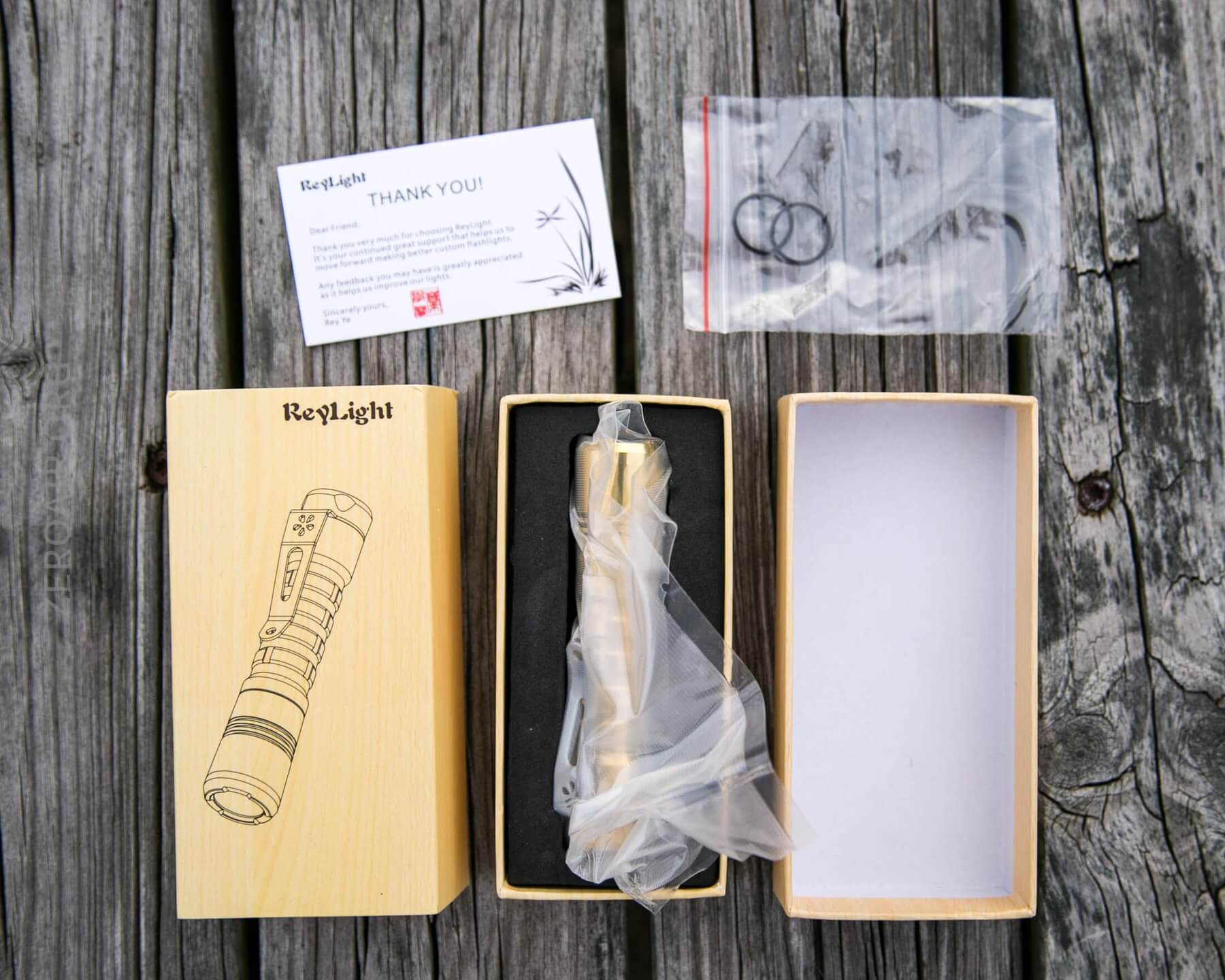
- ReyLight New Pineapple
- Spare o-rings (2)
The box serves as the manual.
Package and Manual
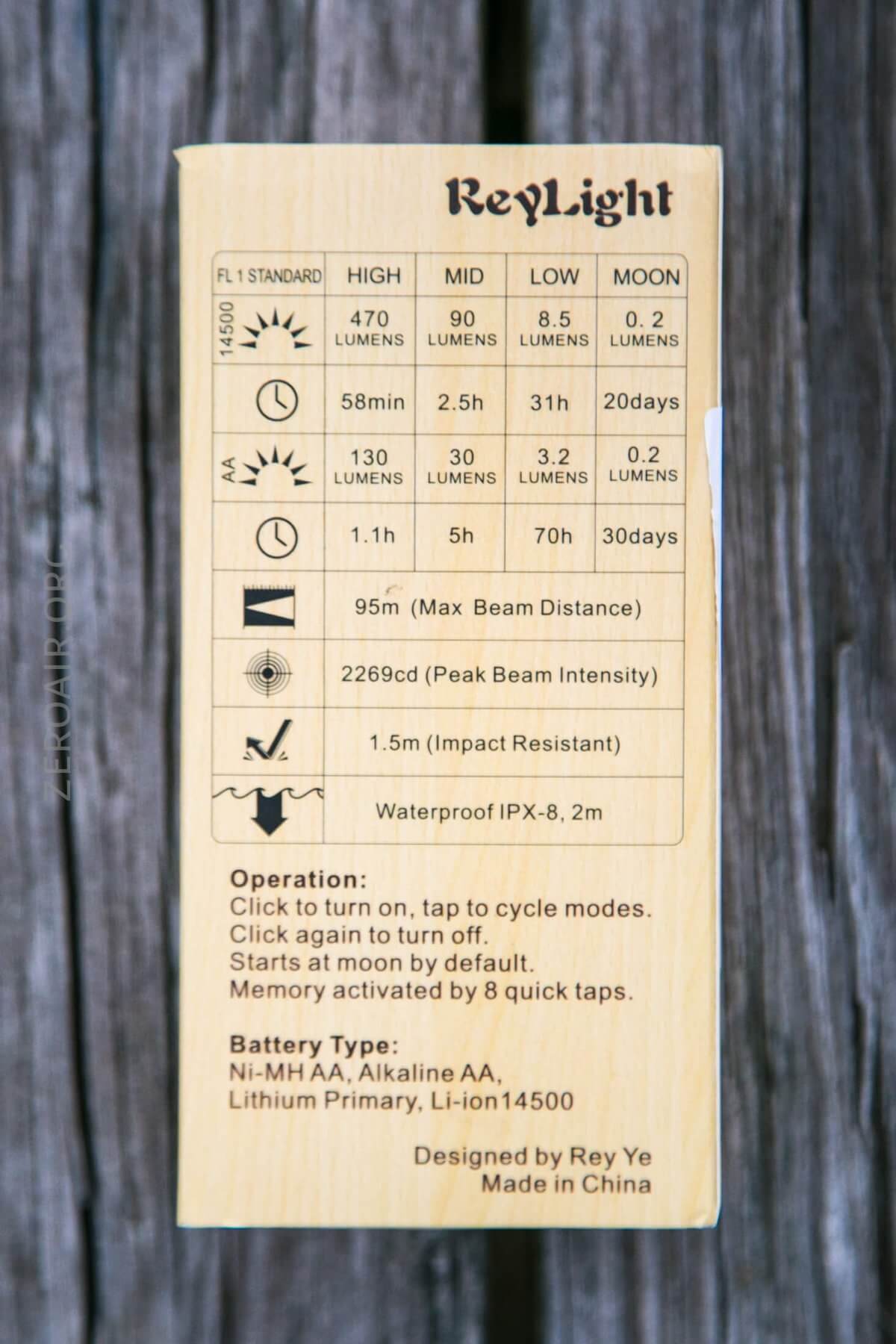
The box has a slipcover with the specs and, importantly, the operation guide.
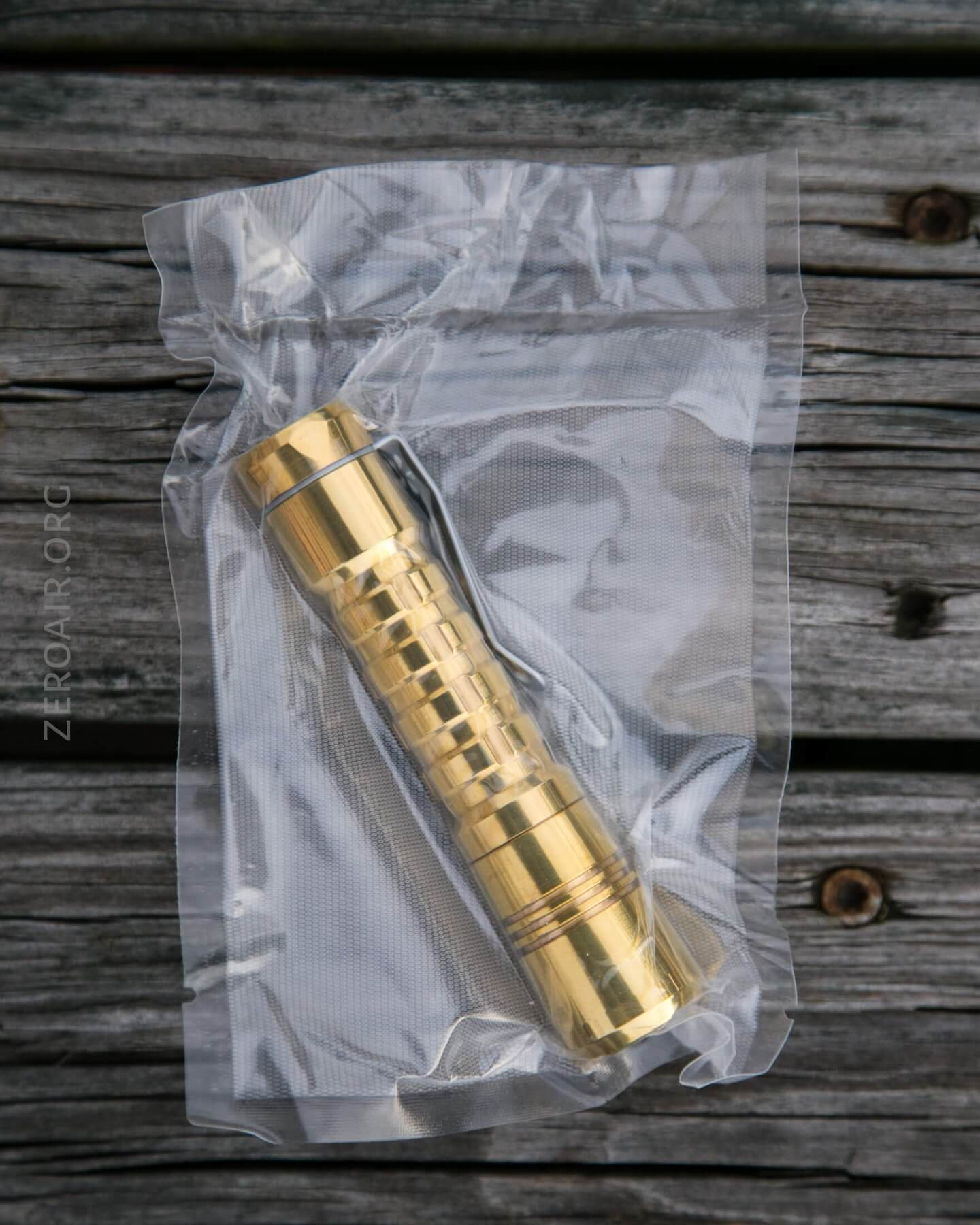
The light ships sealed in a little vacuum package. That’s a nice touch, but since the light is coated, I’m not sure how important that is.
There isn’t a manual included, because the user interface is on the back of the box. The box also includes the cell types supported, etc.
Build Quality and Disassembly
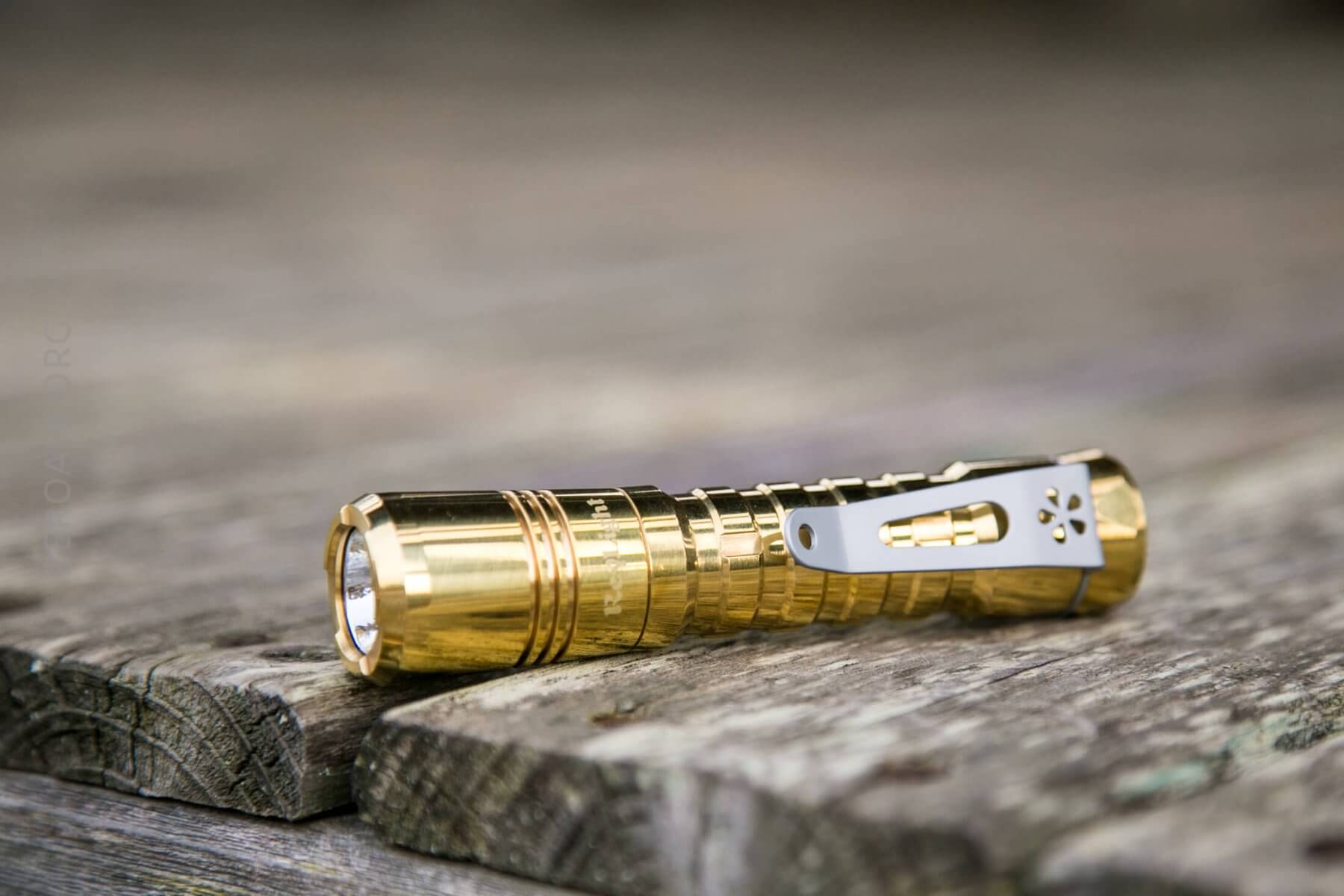
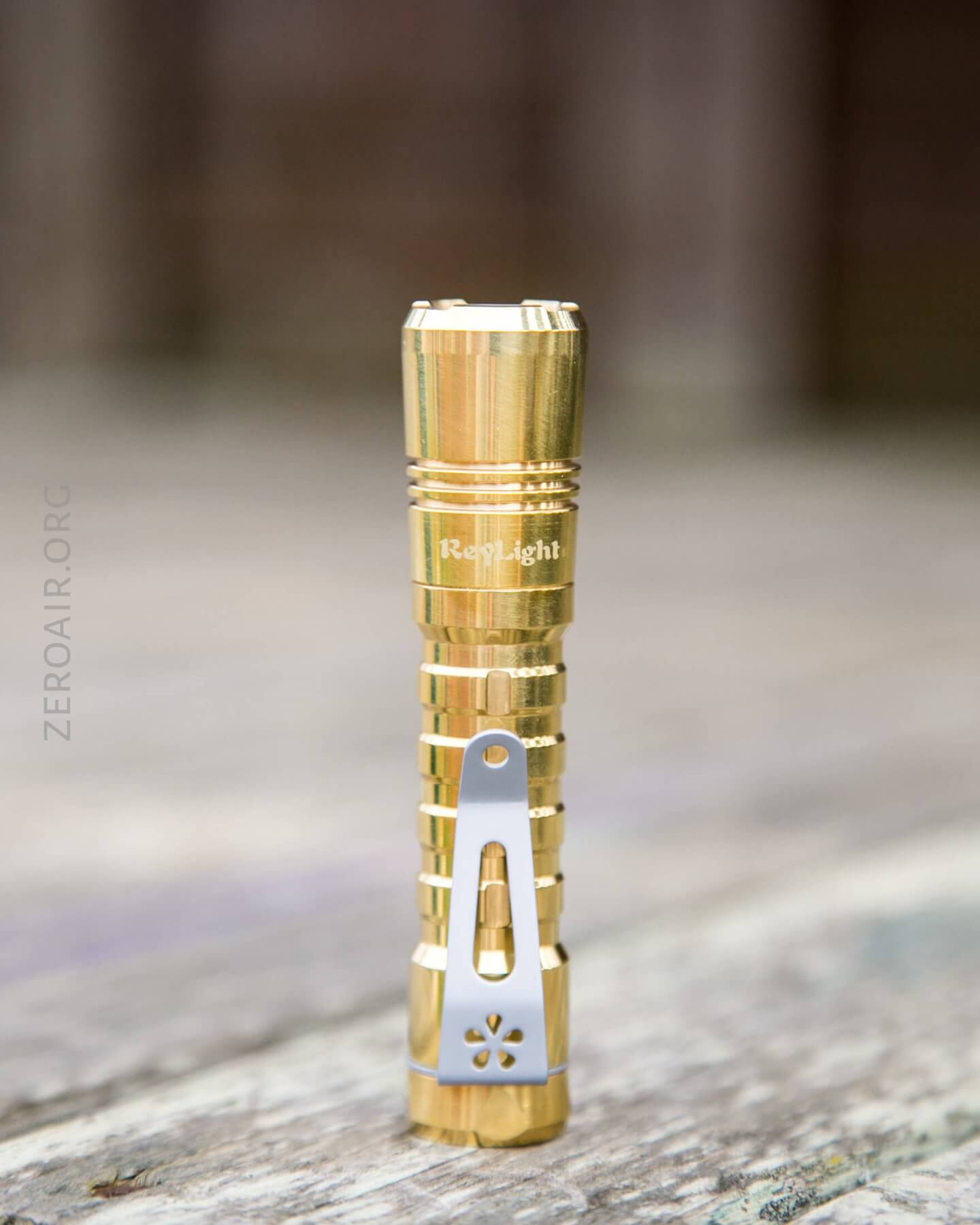
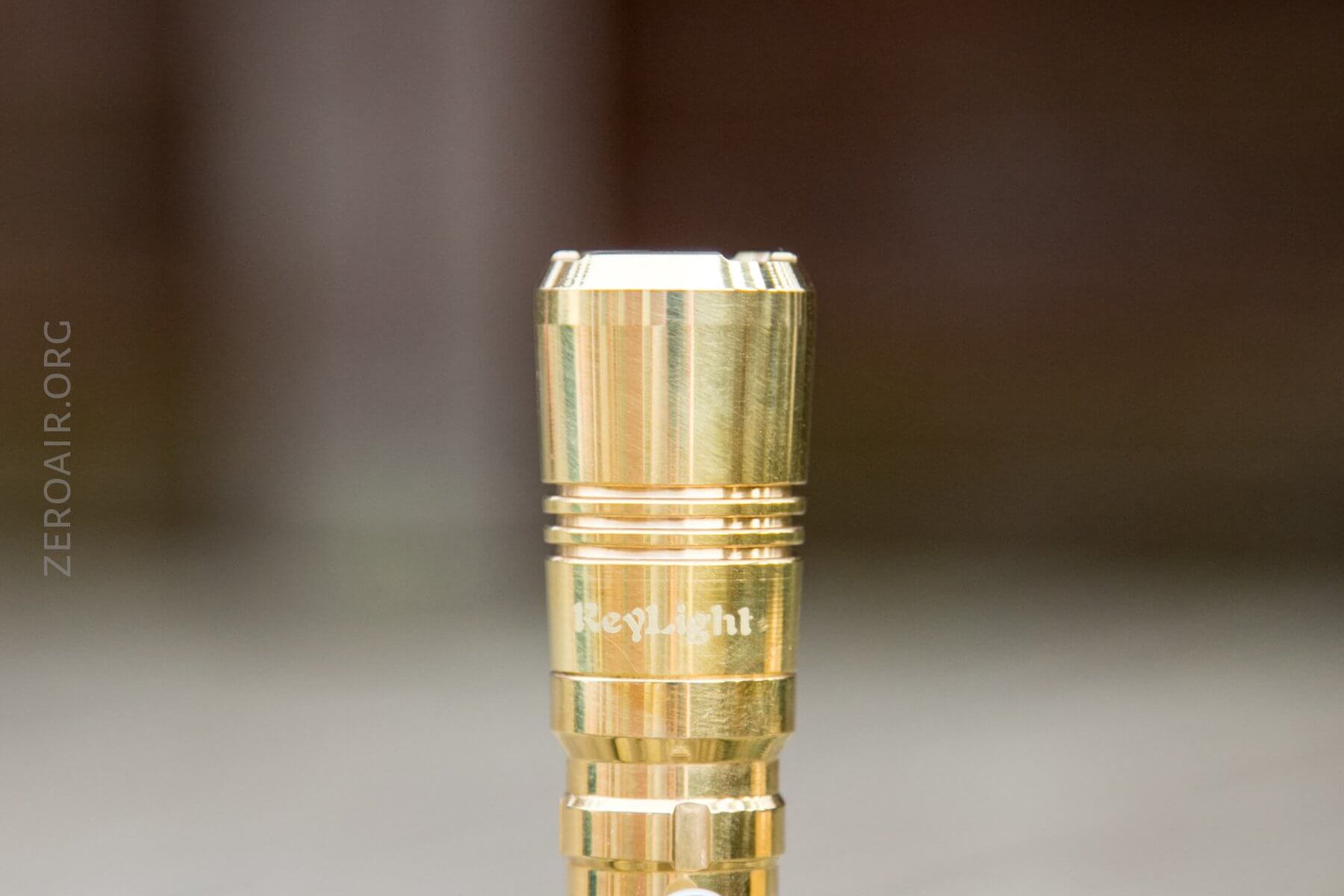
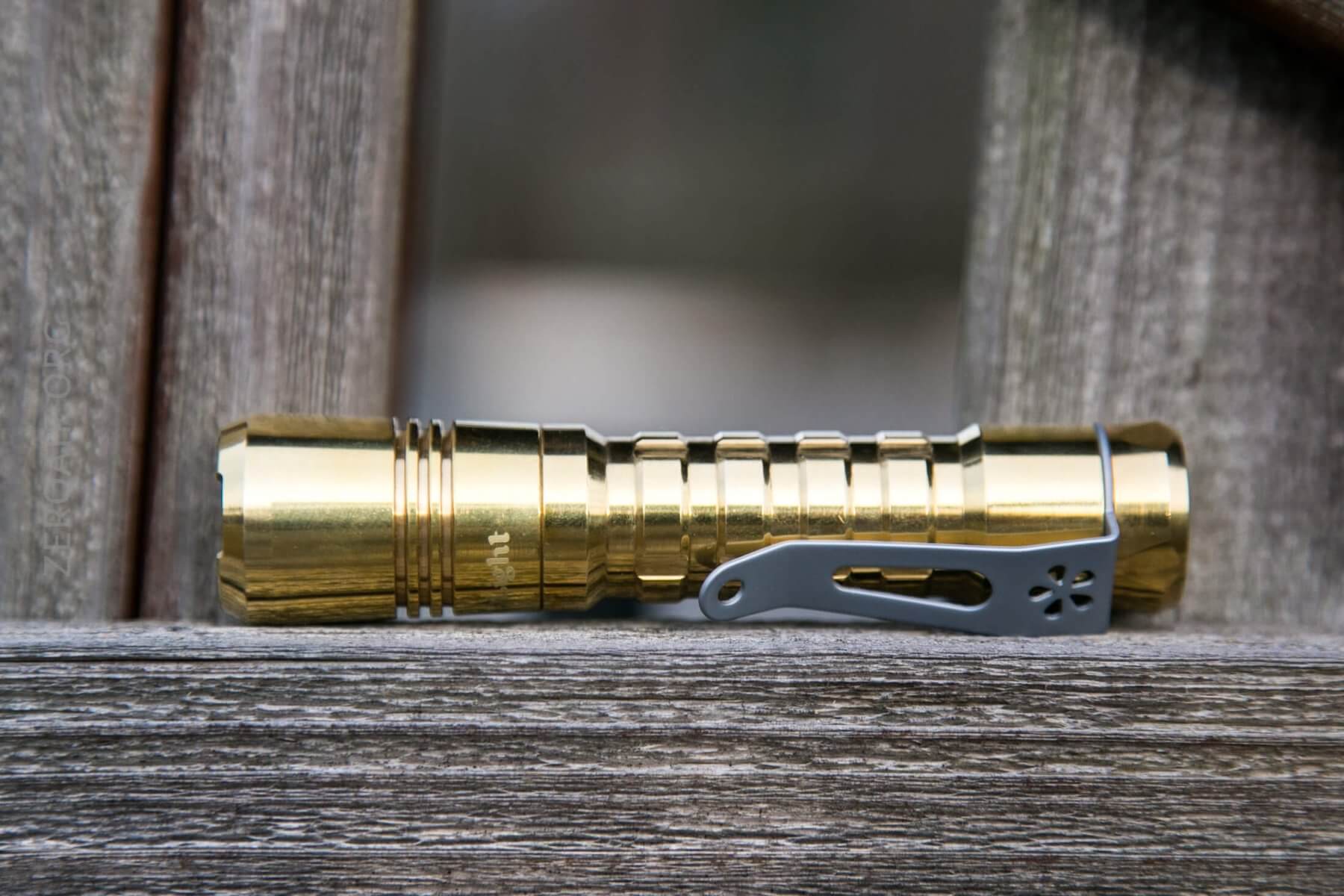
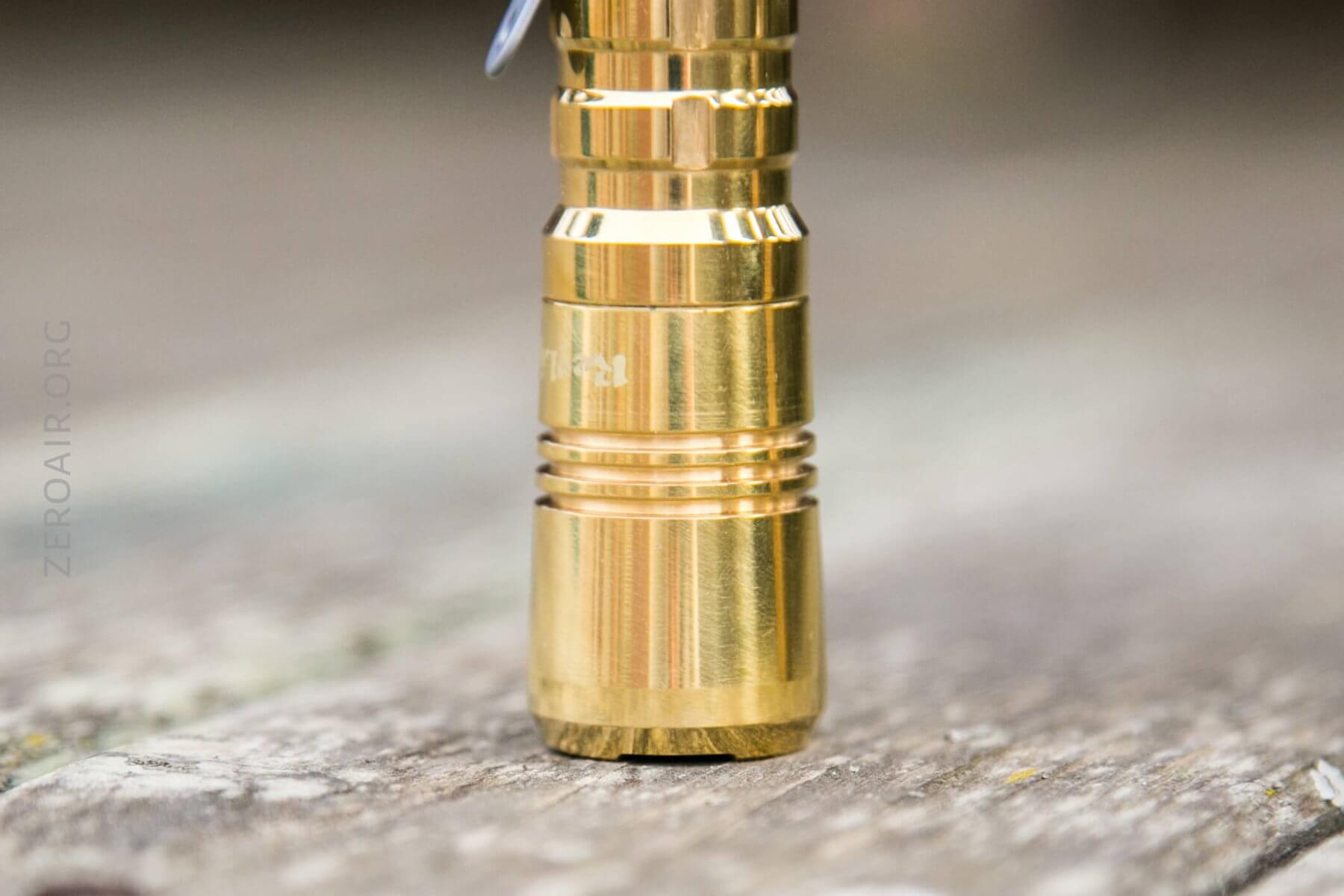
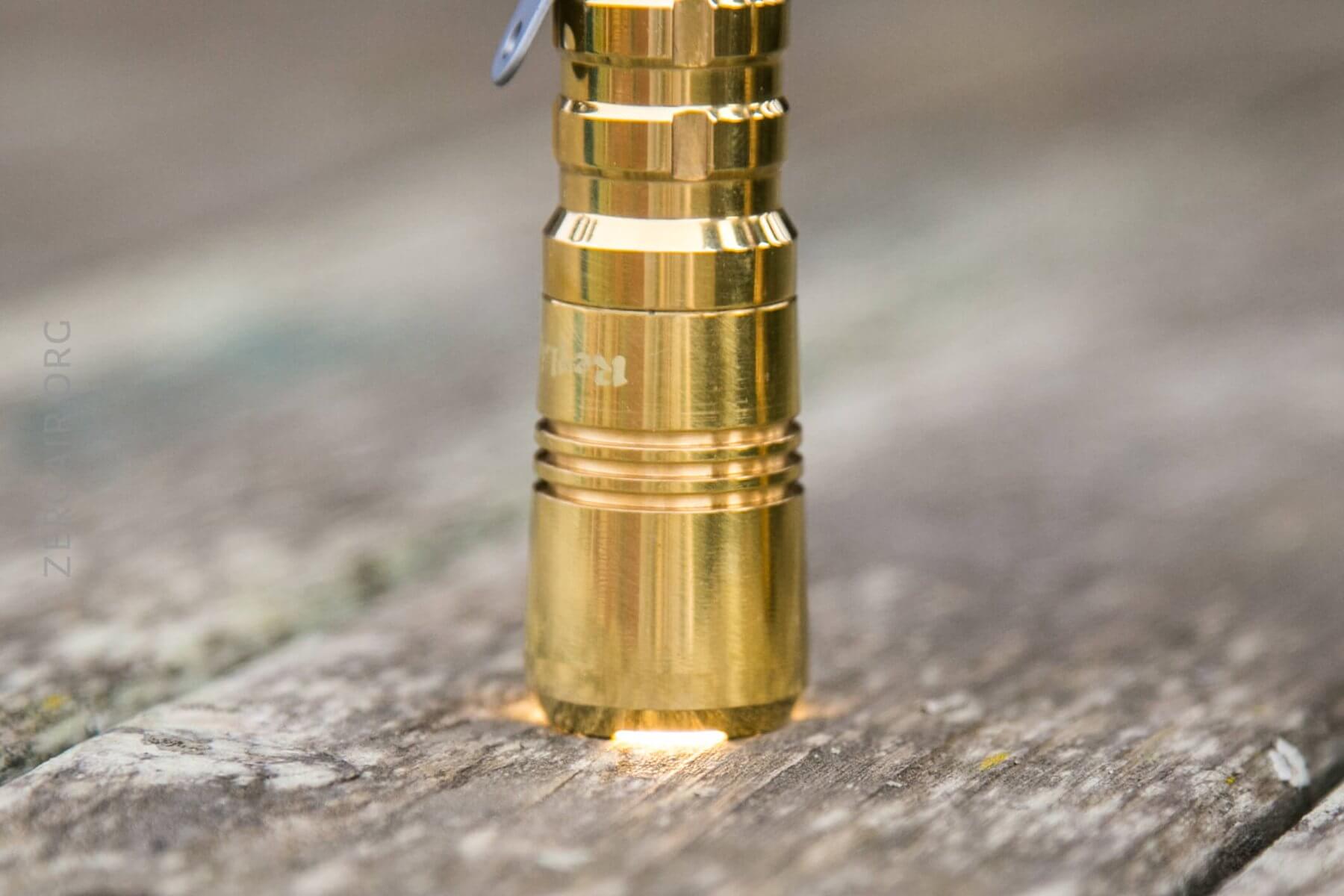
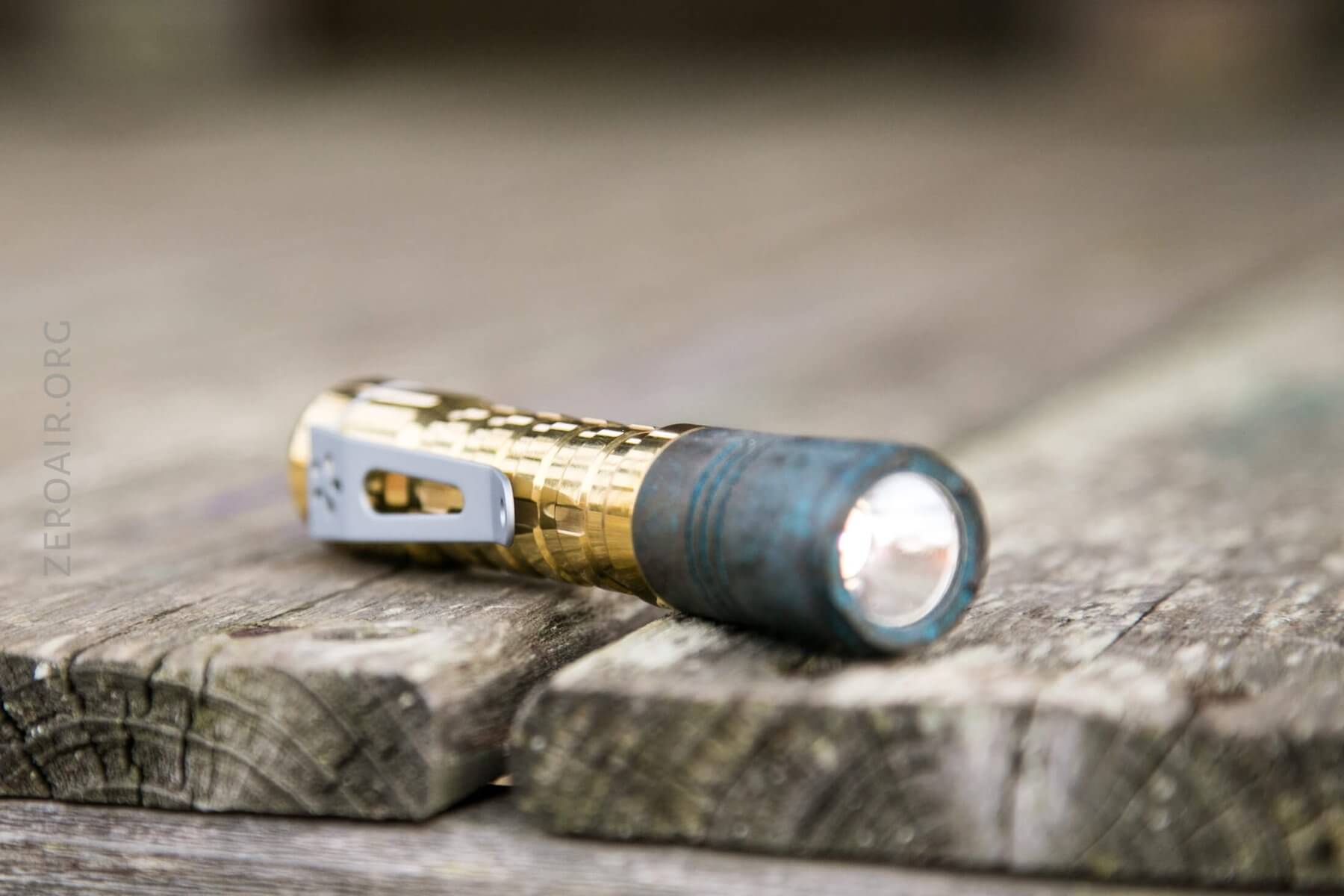
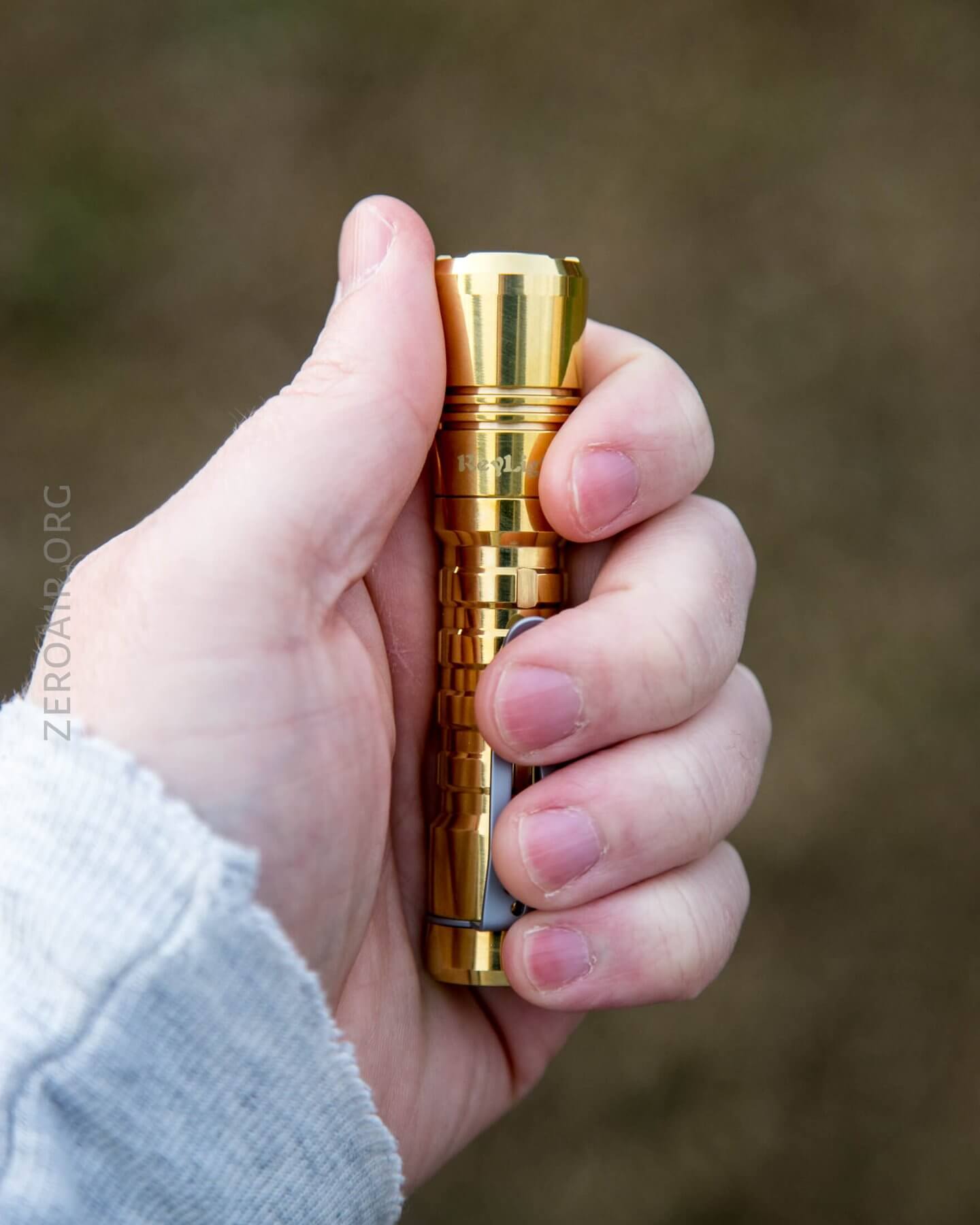
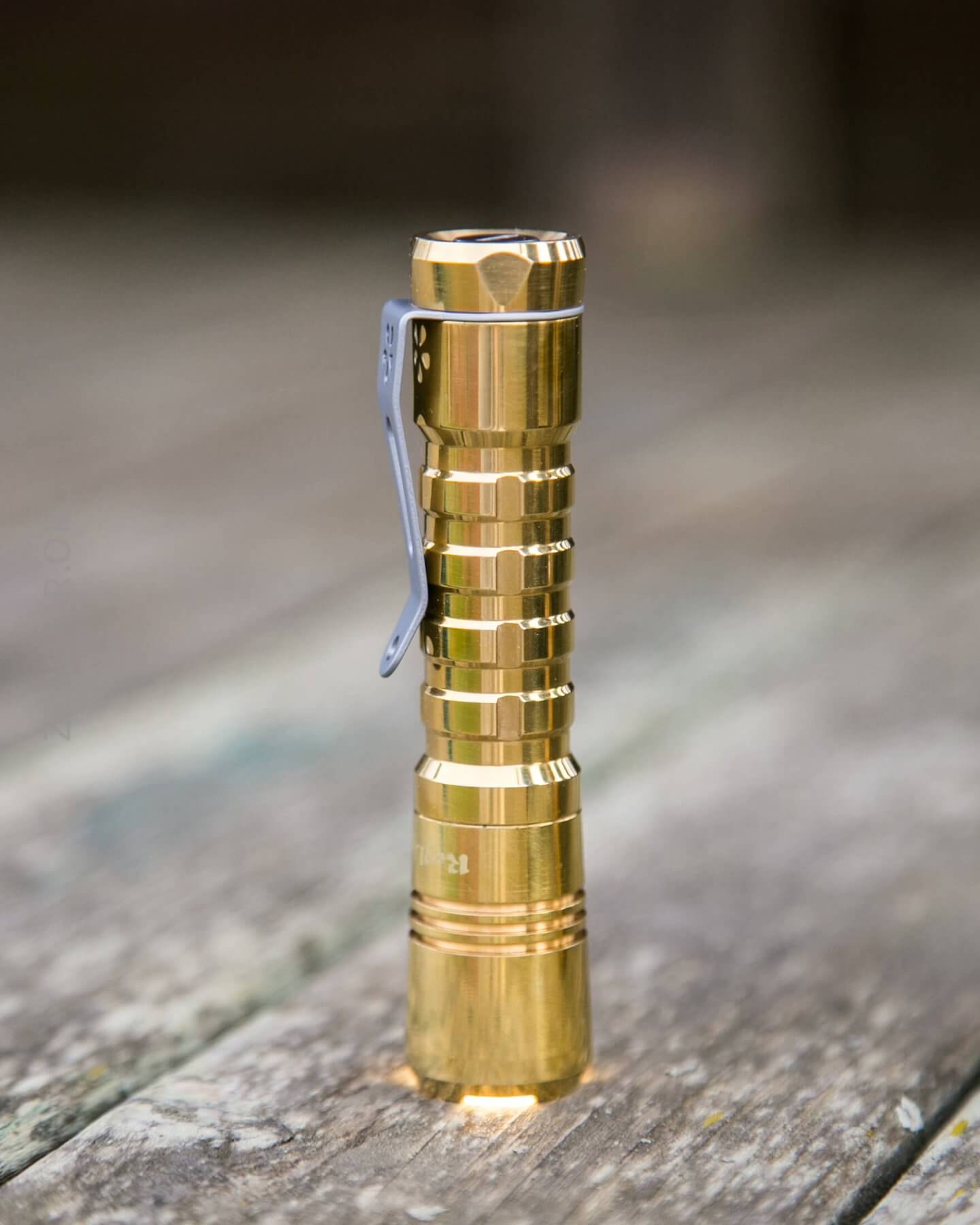
Even though coated brass isn’t my favorite thing, I have to say, it looks absolutely fantastic. Almost gold-colored, even! This makes it quite unusual.
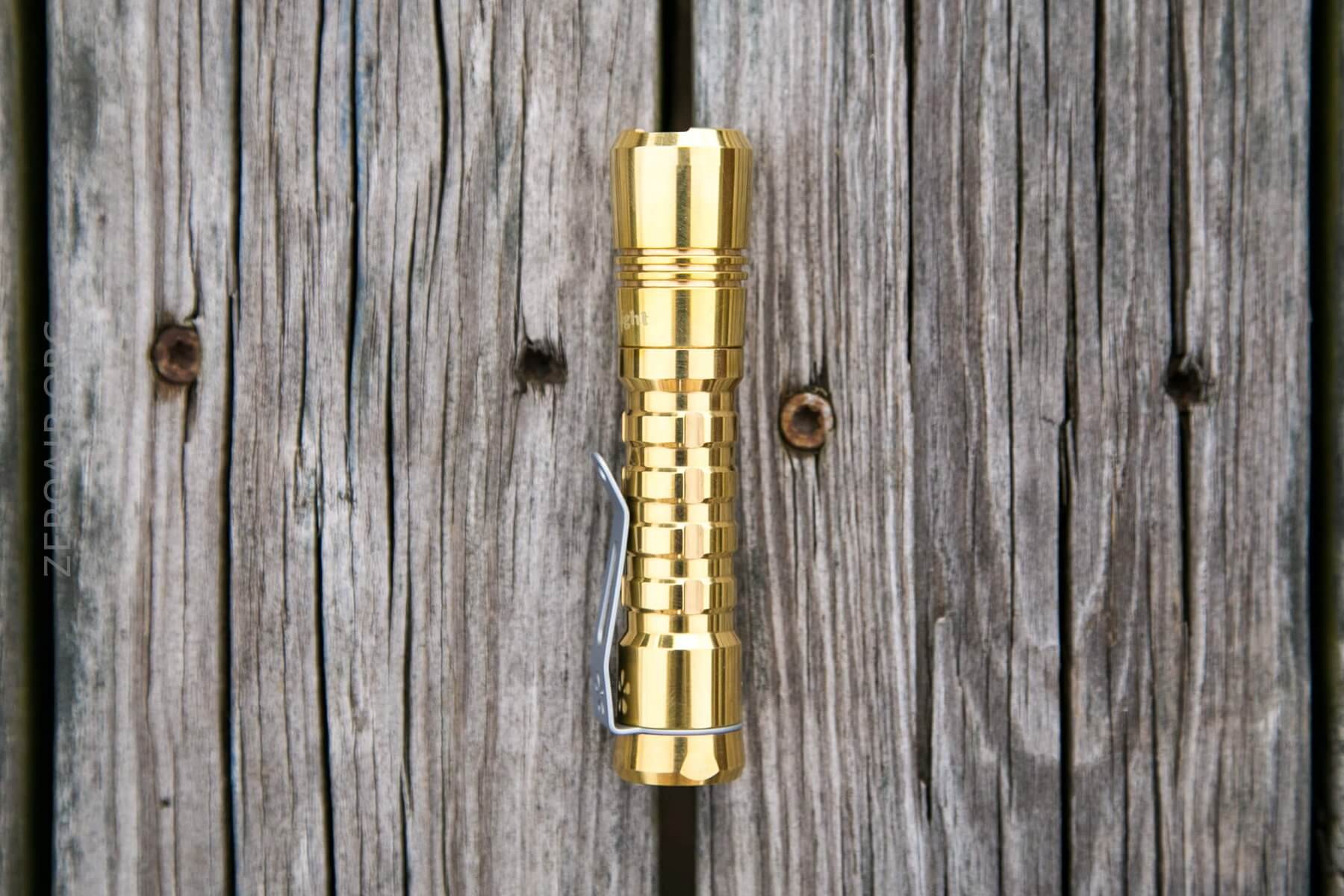
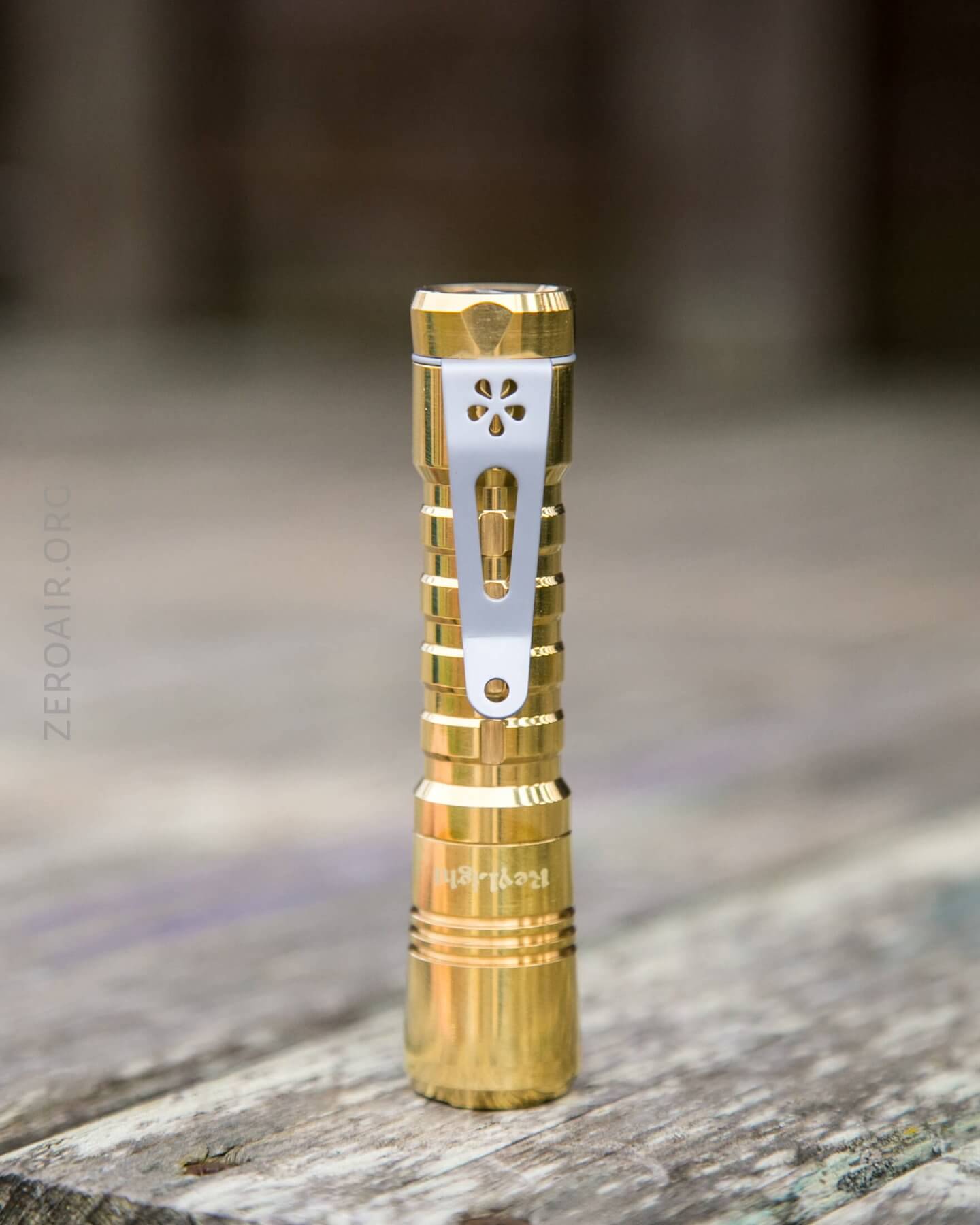
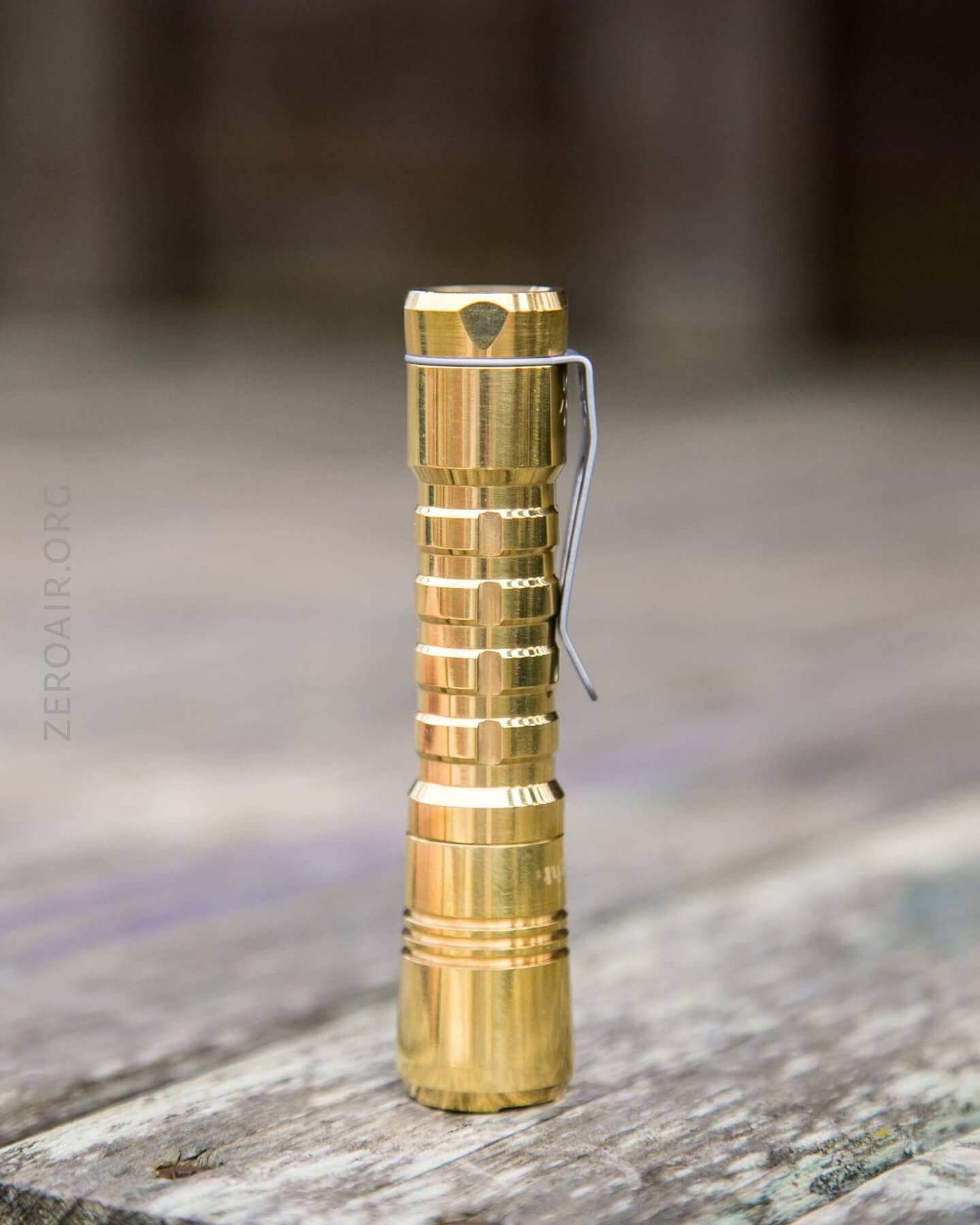
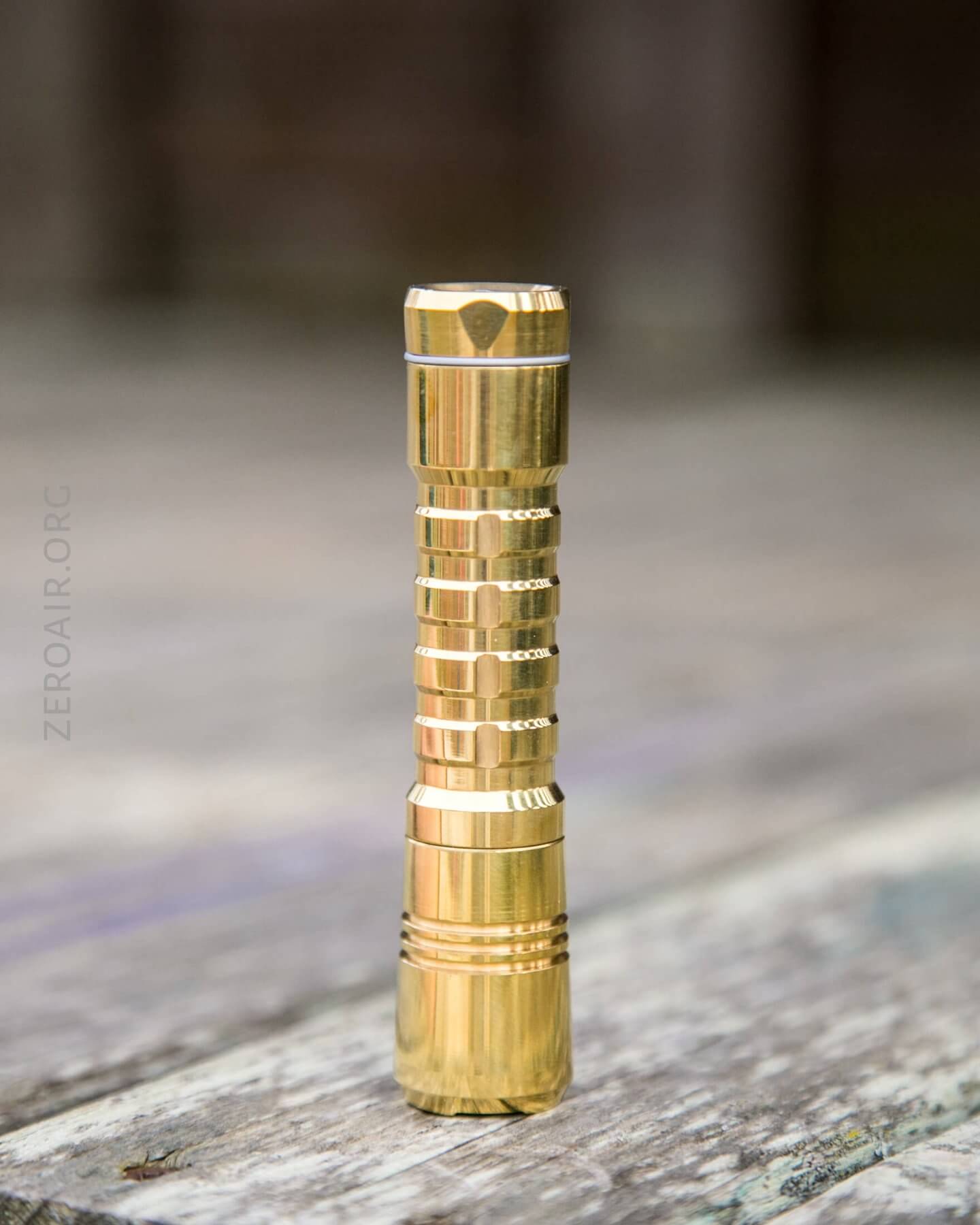
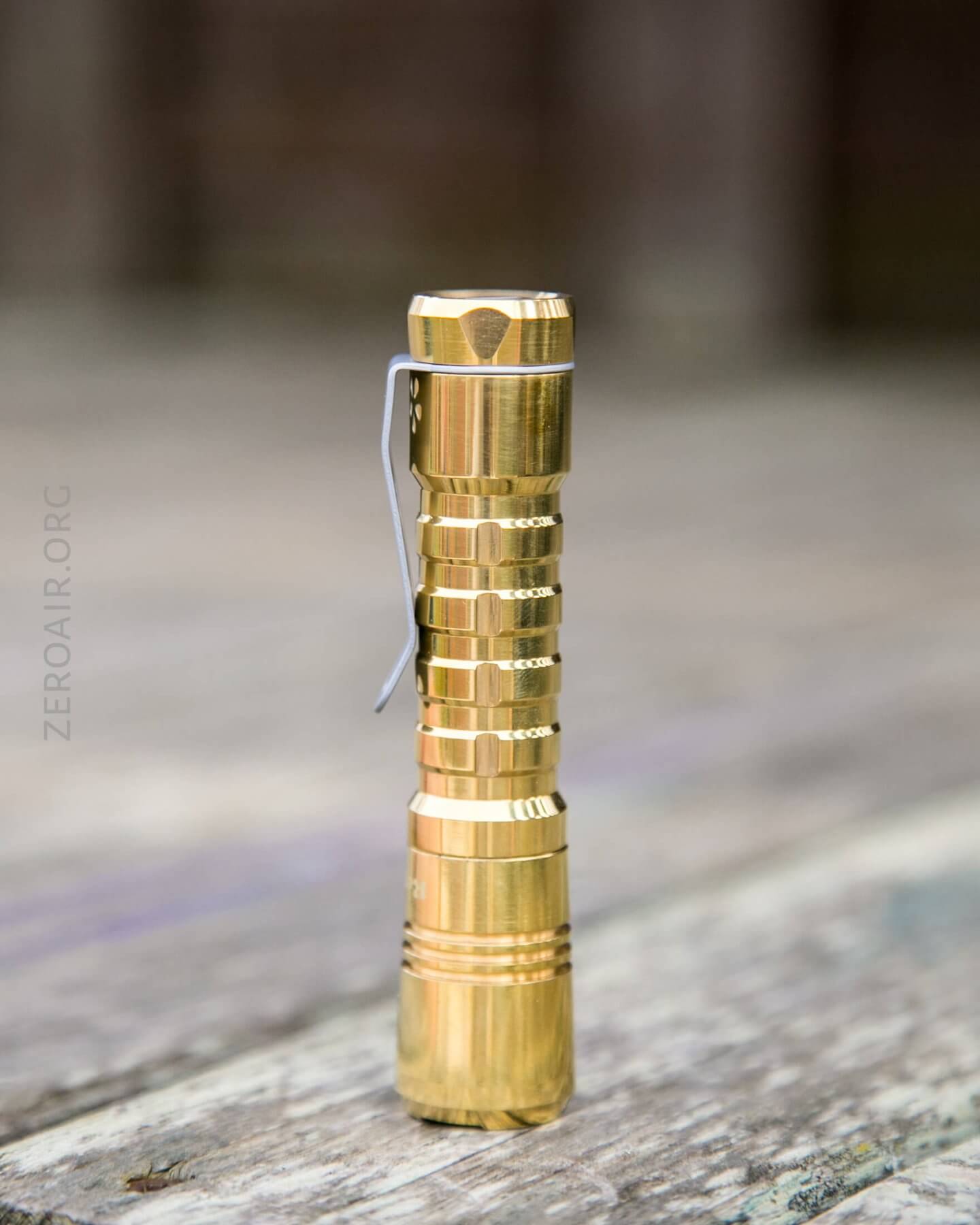
The build quality is quite good. That’s overall, including the aforementioned externals.
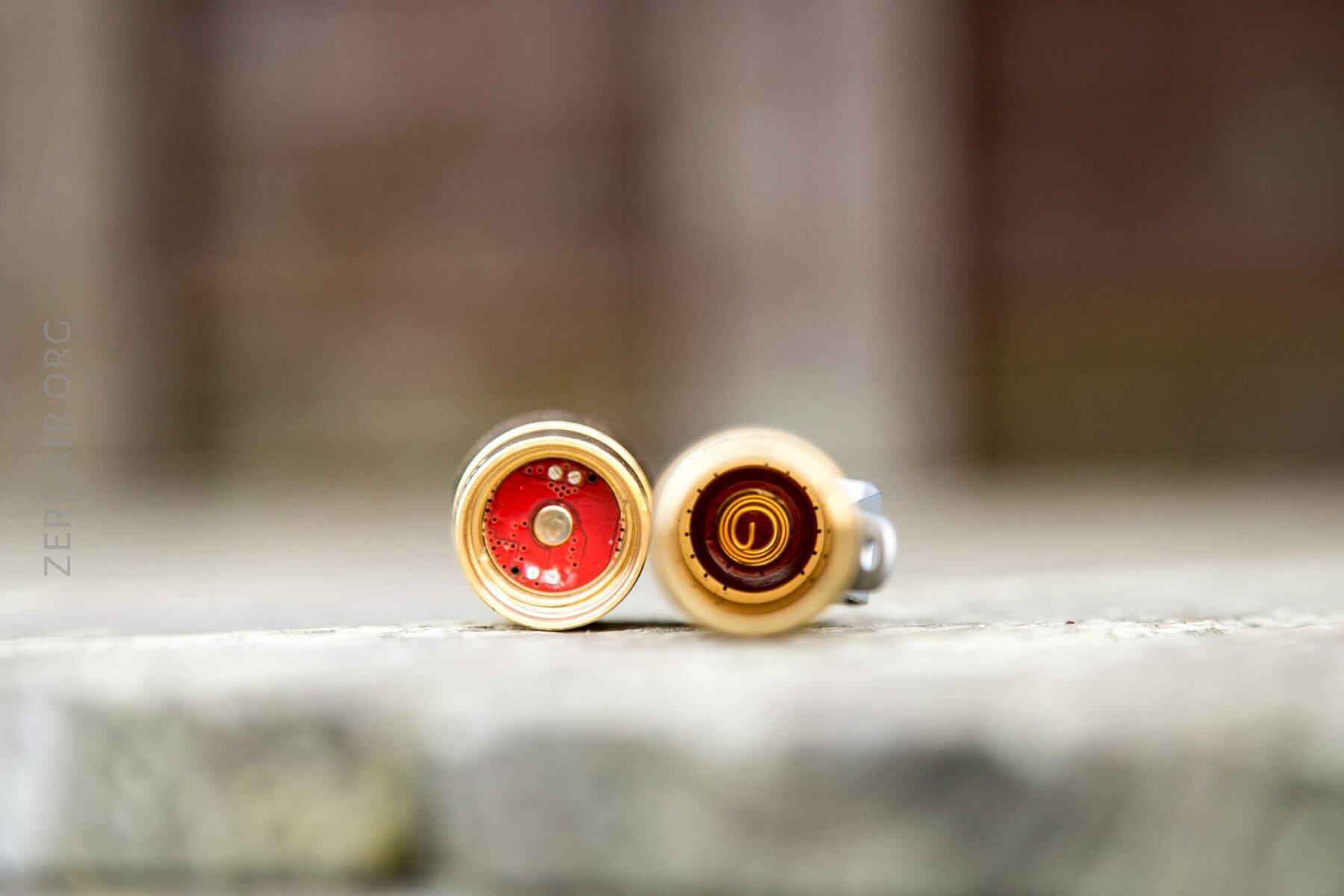
The head has a brass button, and the tail has a long, stiff spring.
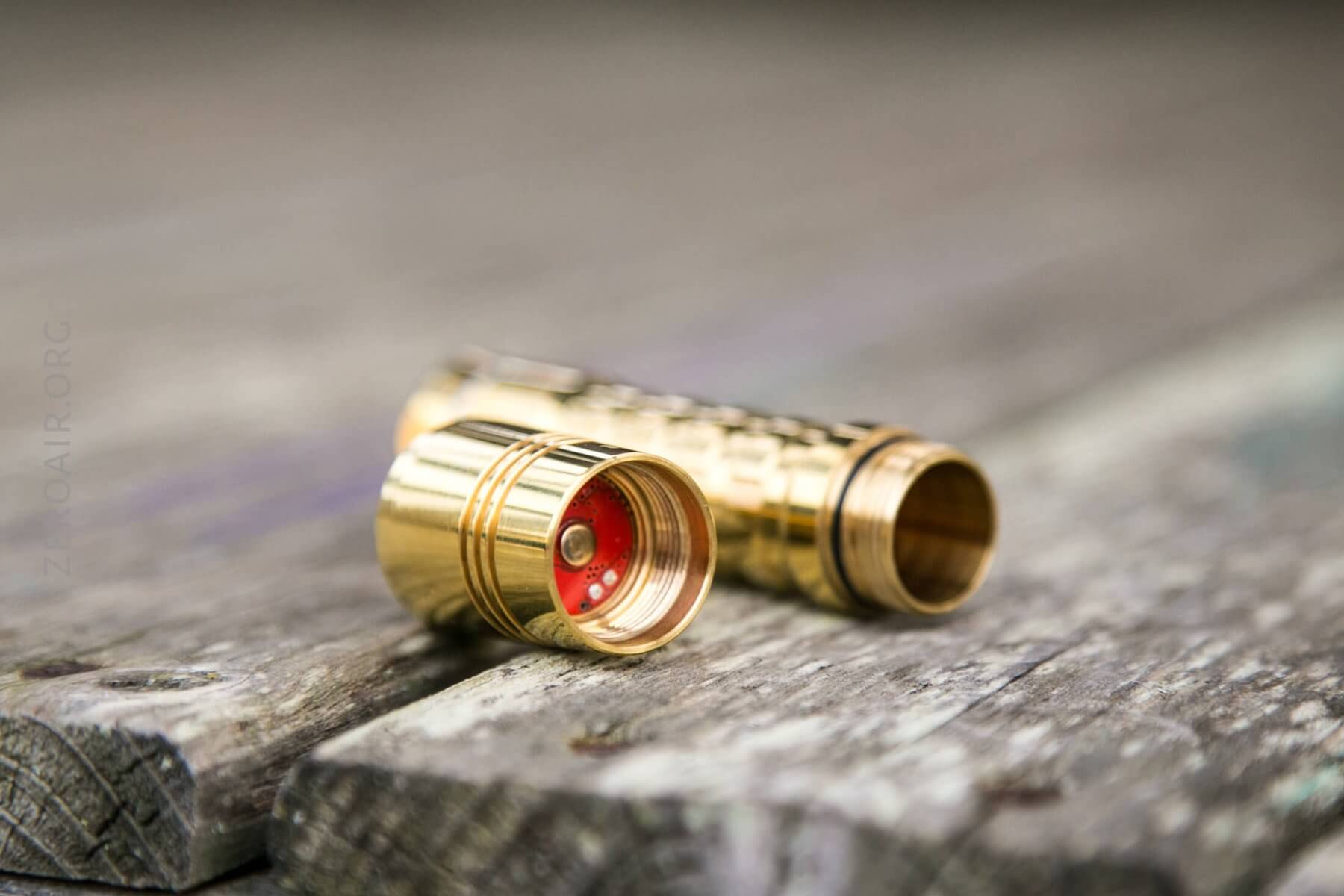
The threads are very smooth. They’re triangle cut and lightly lubed. Since they’re brass too (of course), it’s not really possible to mechanically lock out the light without entirely removing the head.
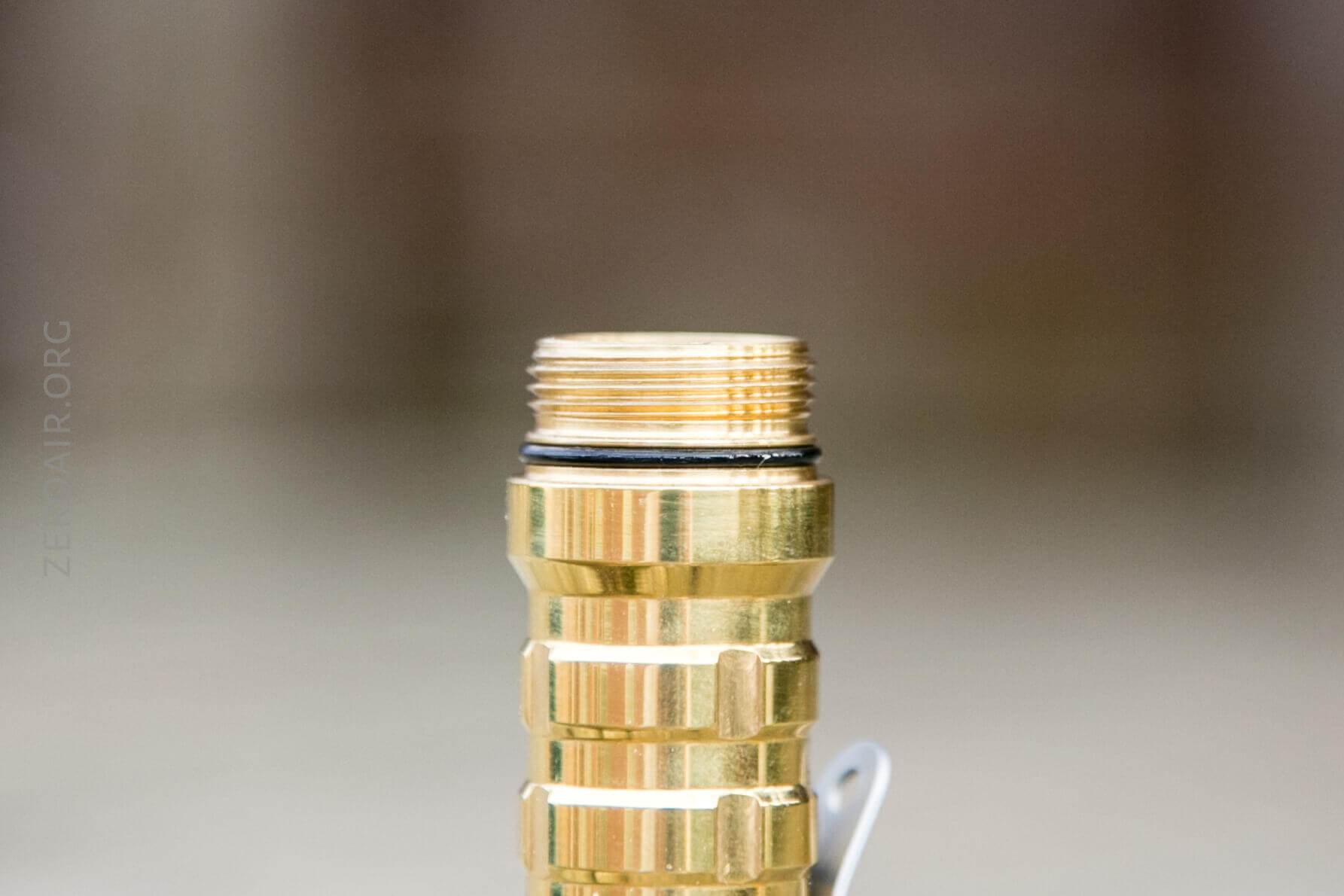
The head has some nice fins for cooling. Heat isn’t really an issue except on High with a 14500, and even then, these minimal fins handle it fine.
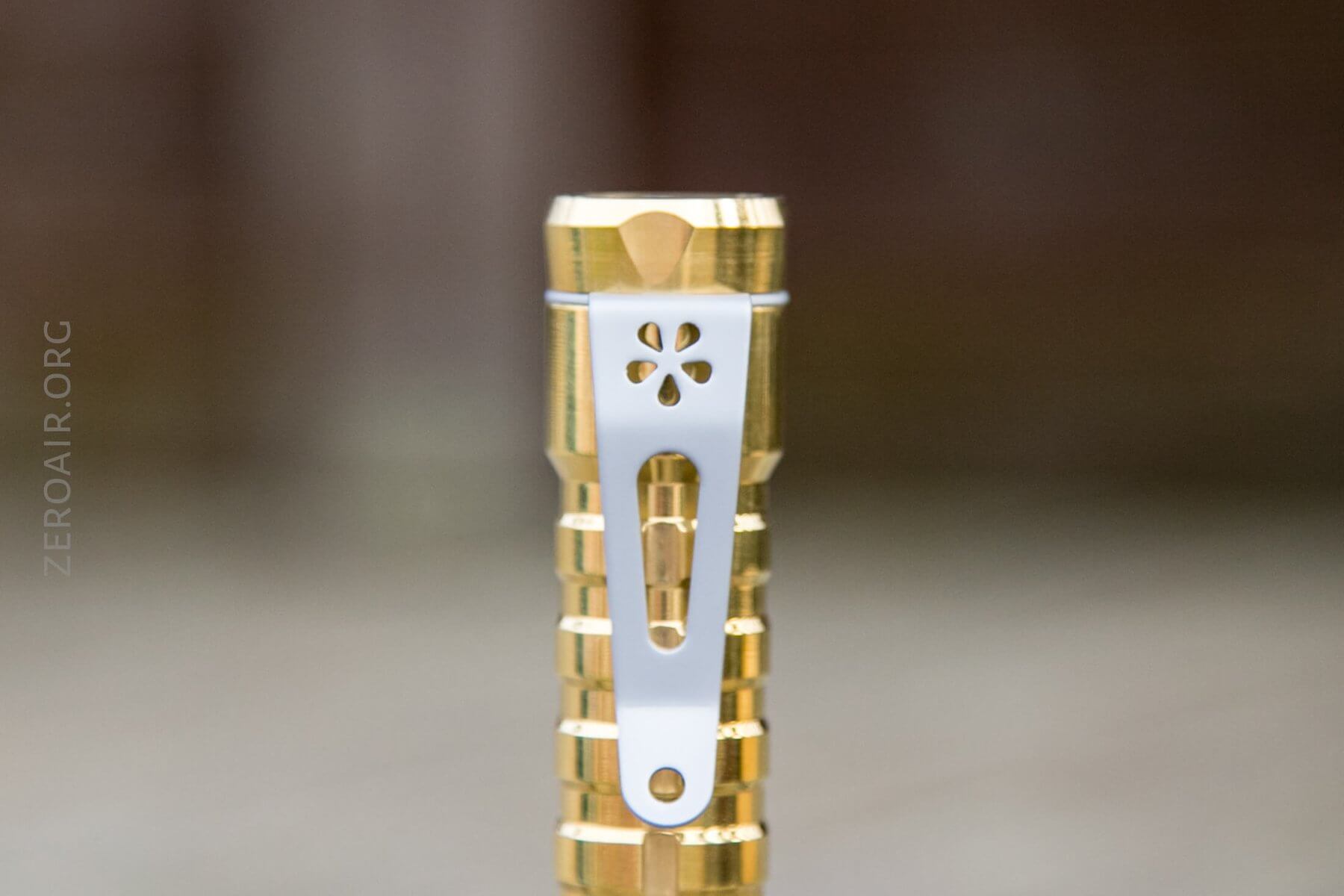
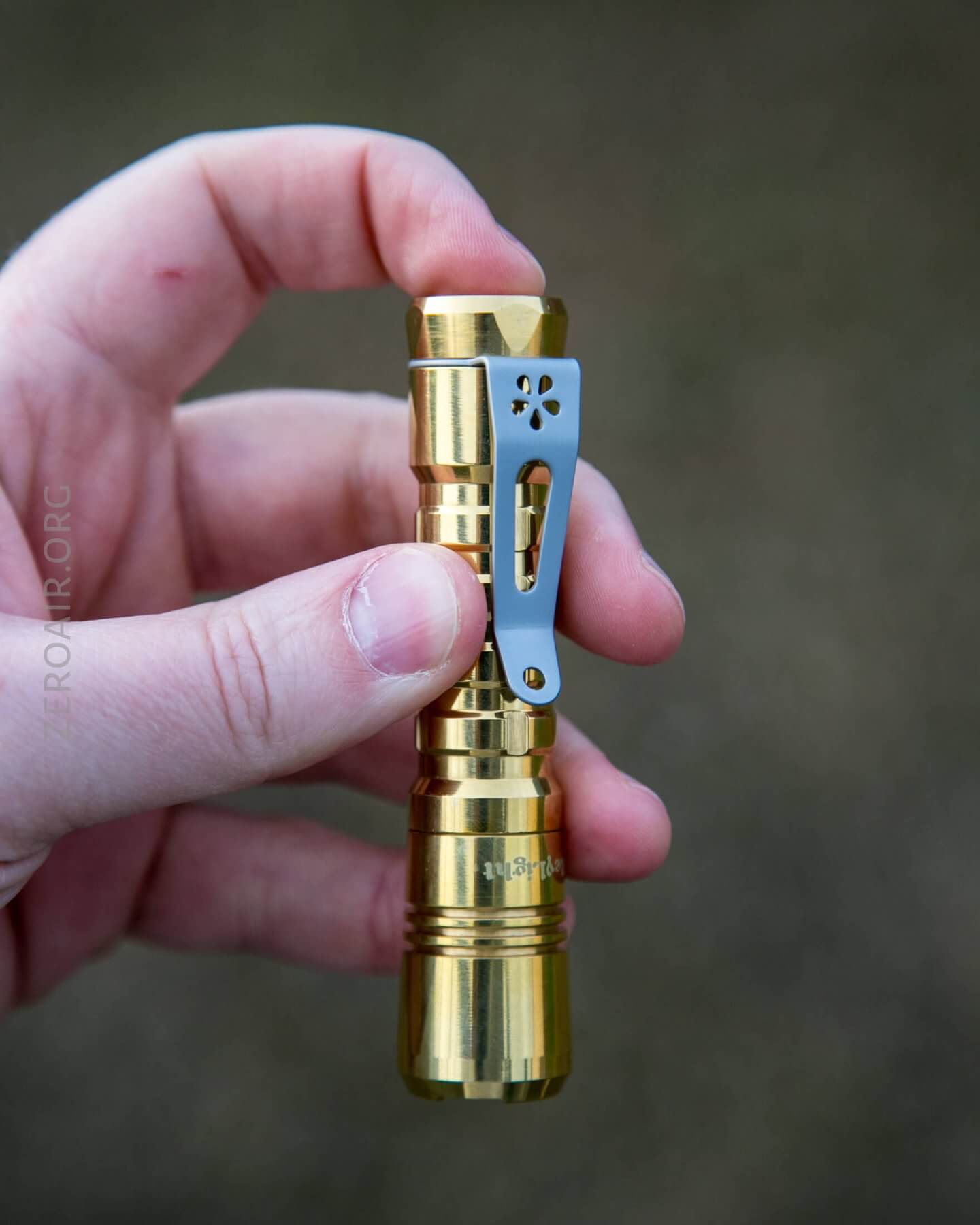
The pocket clip is much improved from the previous model. It’s a steel clip and amounts to “permanent” installation. That’s because the tailcap doesn’t come off (at least, easily). This is better than the original version since the clip on the original could scratch the body when the tailcap was removed.
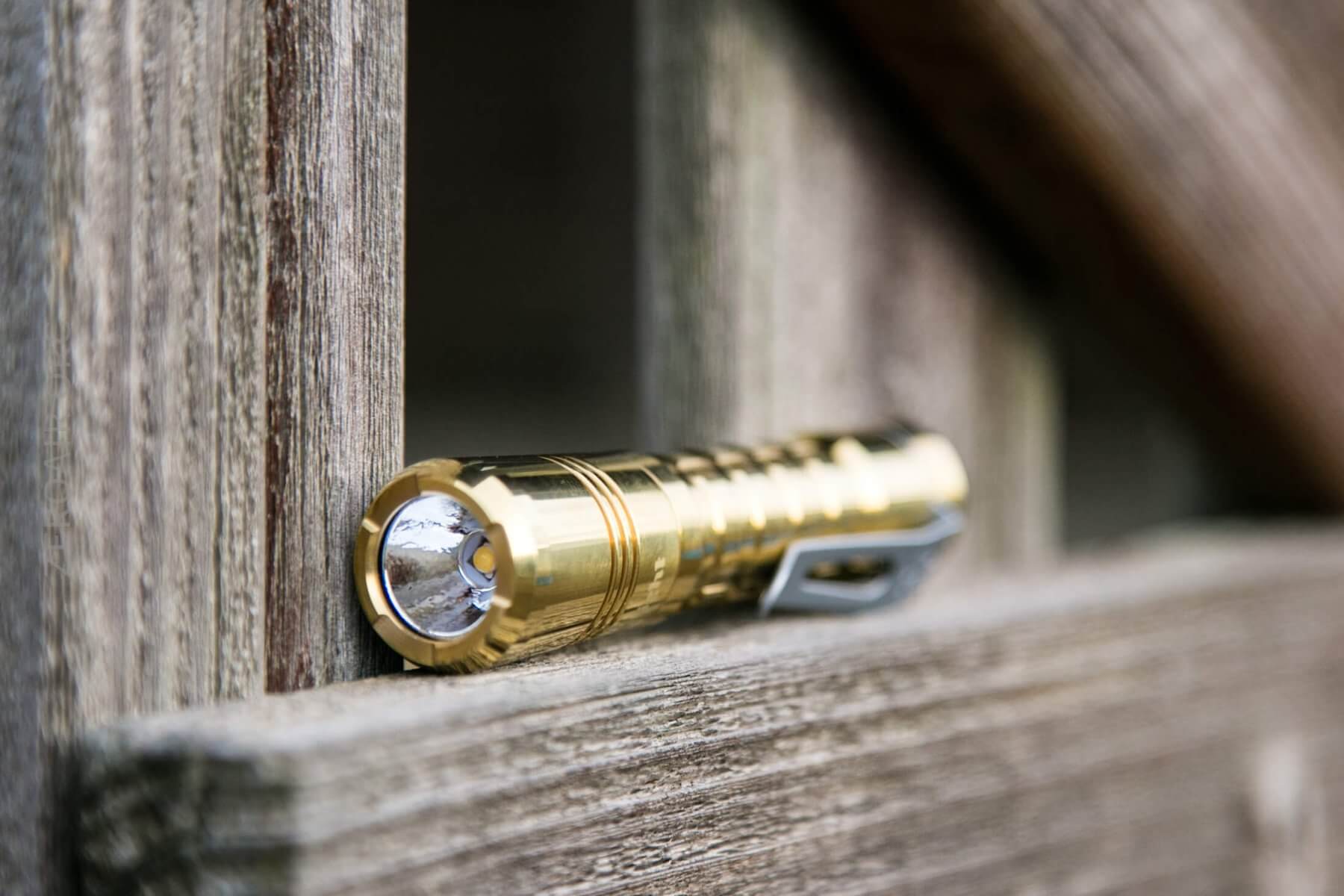
The bezel has not-really-pointed crenelations, which allow light to sneak out. I prefer this since it’s harder to put the light down in an “on” state and forget it.
Size and Comps
Official size:
Weight: 3.2 oz (91 g)
Size: 3.6 x 0.7 in (9.2 x 1.8 cm)
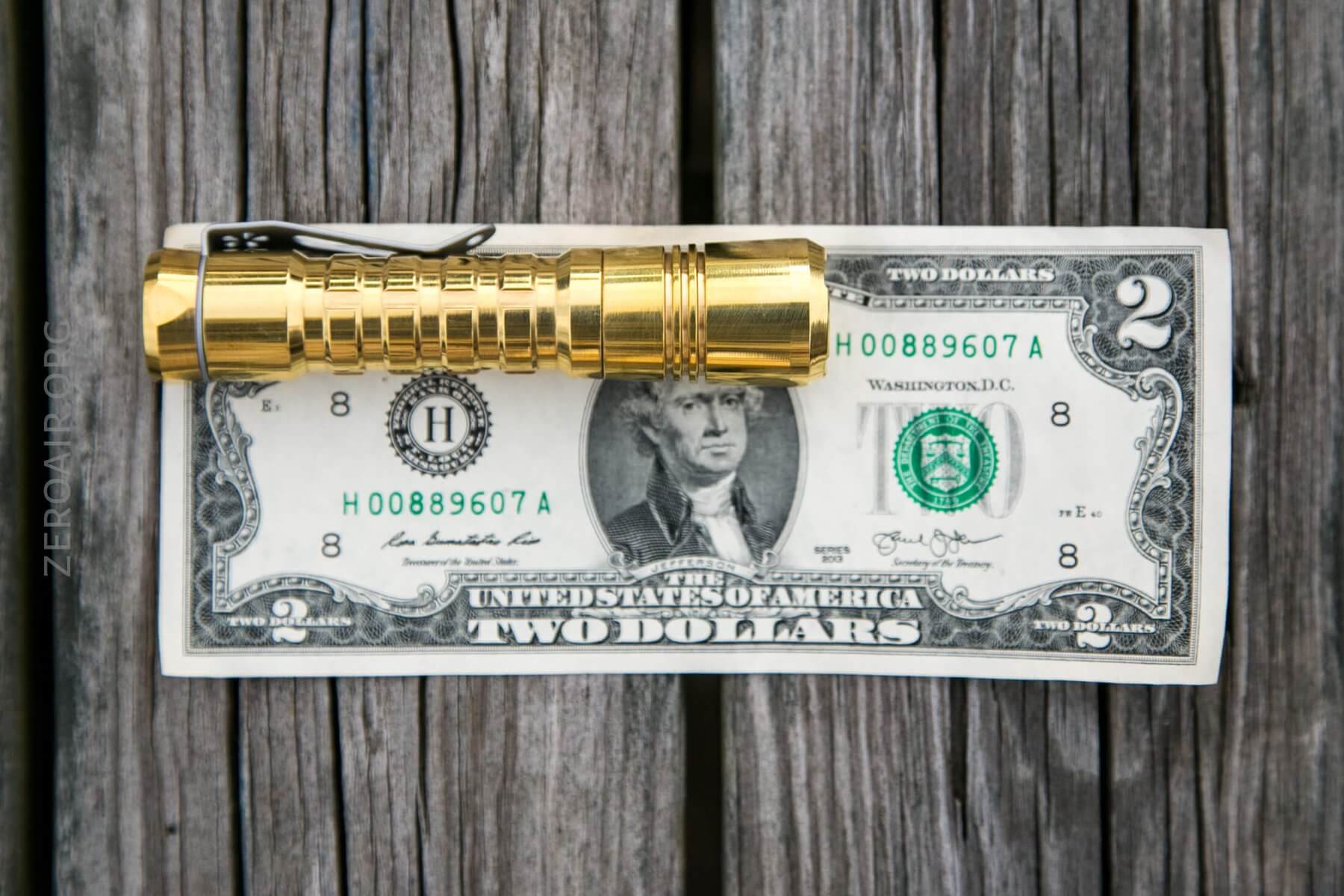
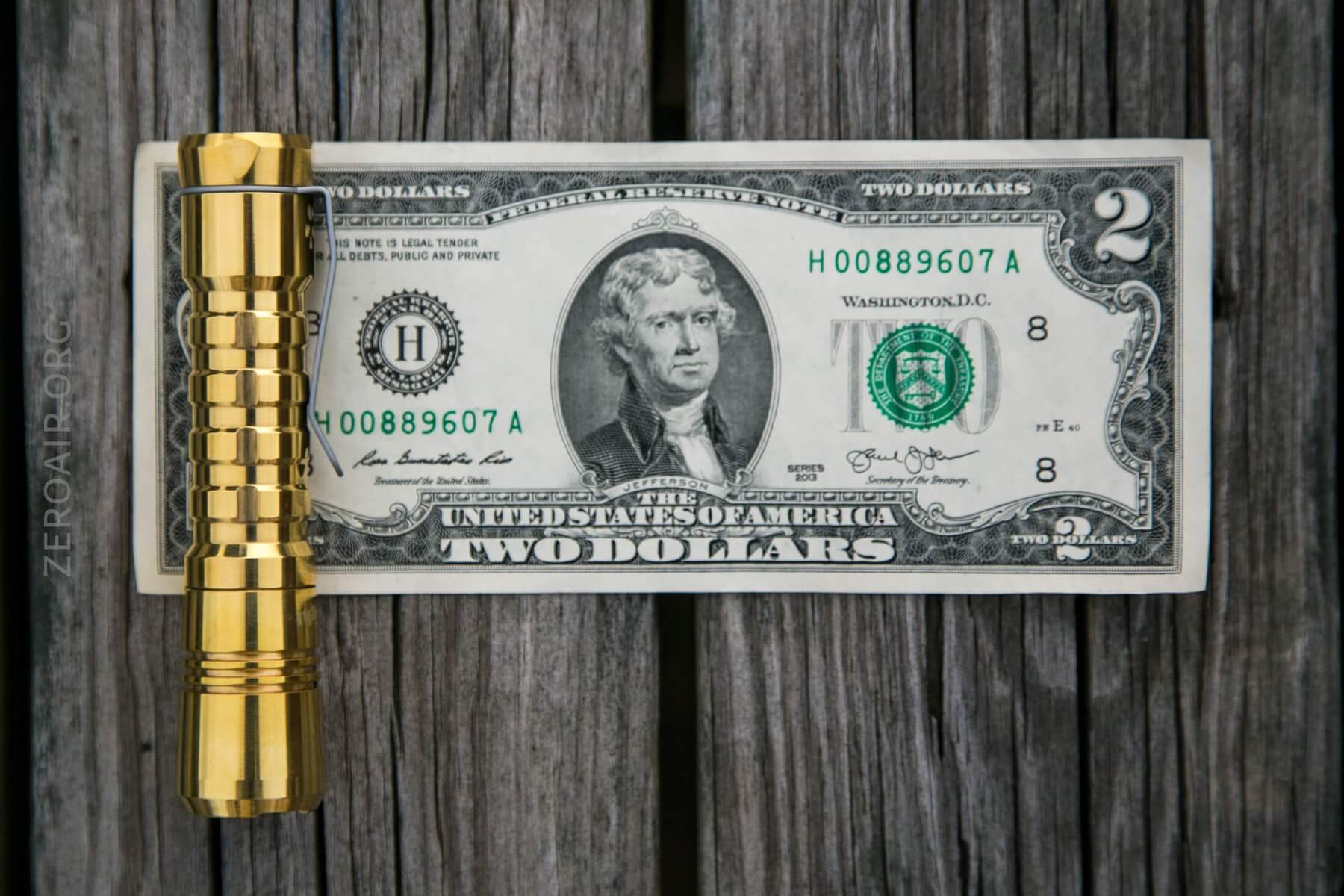
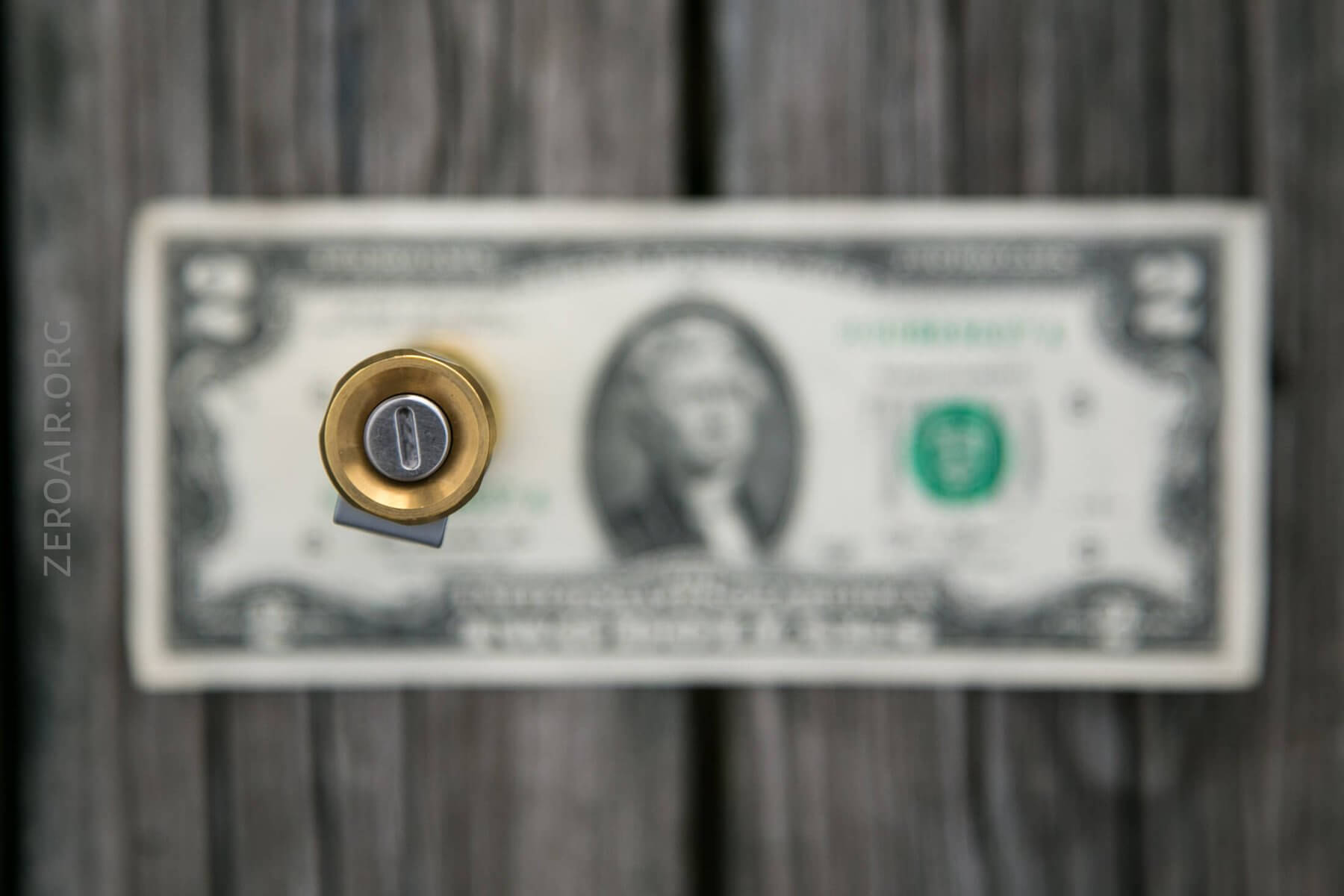
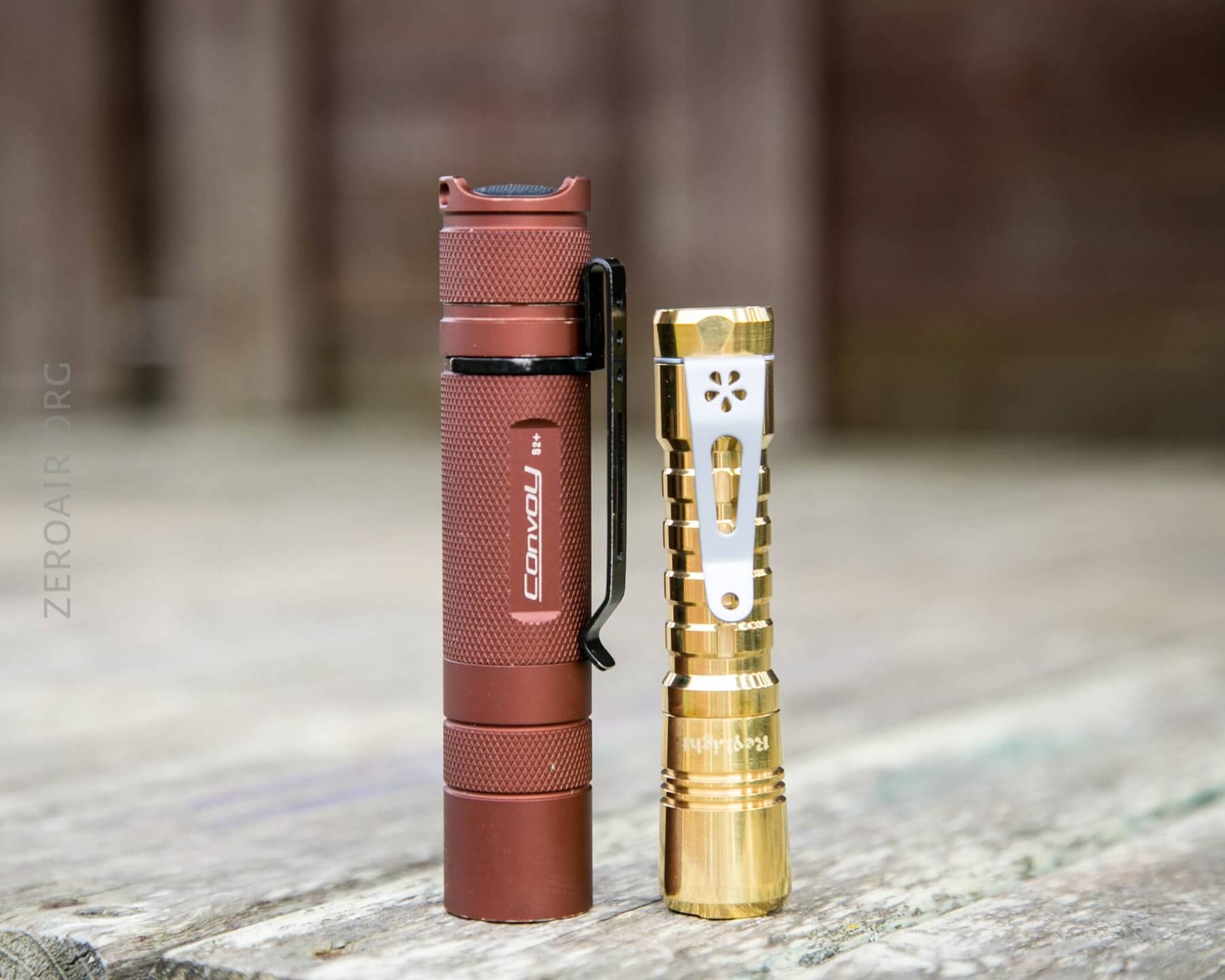
As many (most?) 14500 lights are, this one’s fairly long. Here’s the test light with the venerable Convoy S2+. Mine’s a custom “baked” edition Nichia 219b triple. A very nice 18650 light.
Here’s another 14500 light. This is the Adventure Sport Flashlight Brass EDC light – it’s a triple. It’s even longer than the Pineapple.
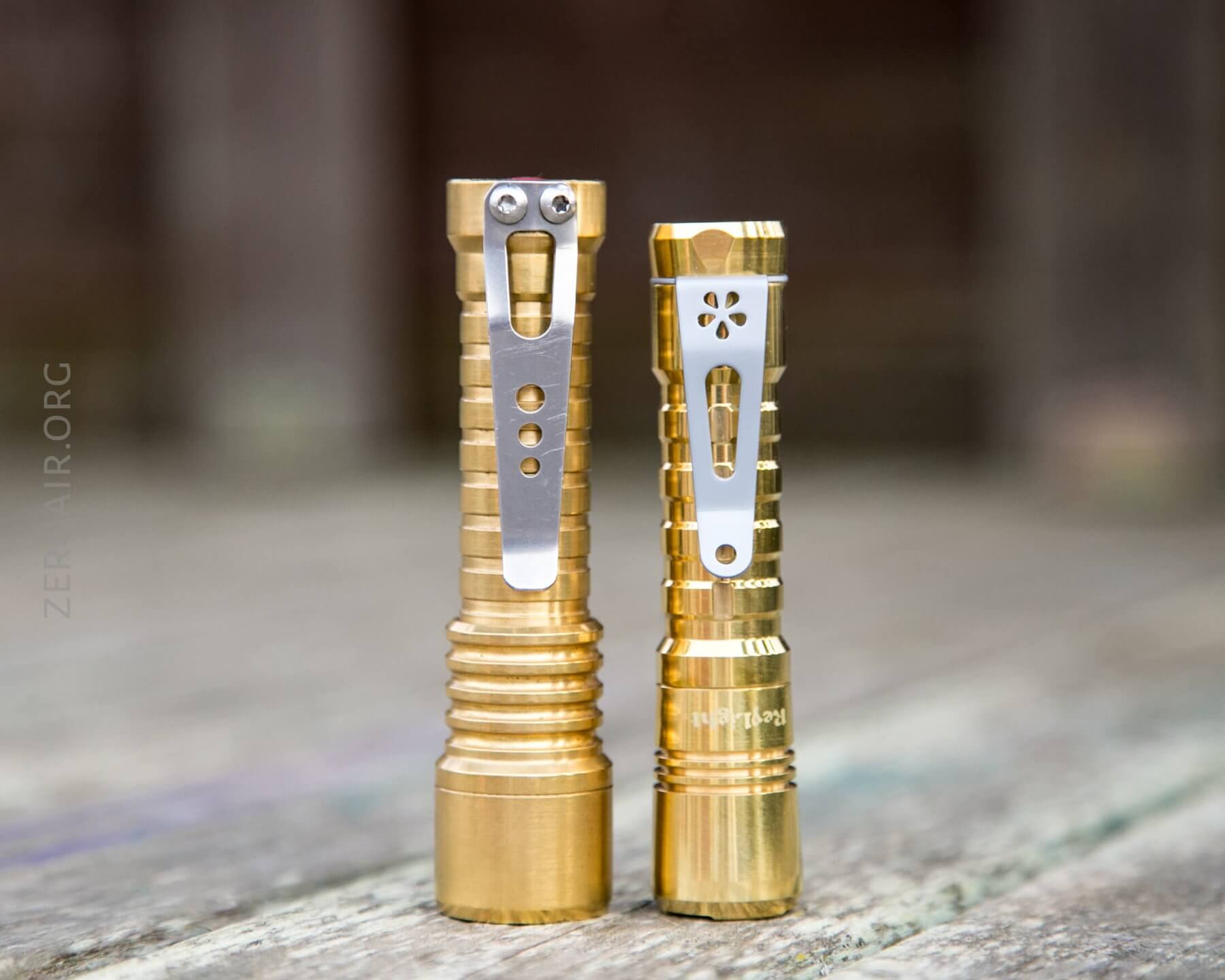
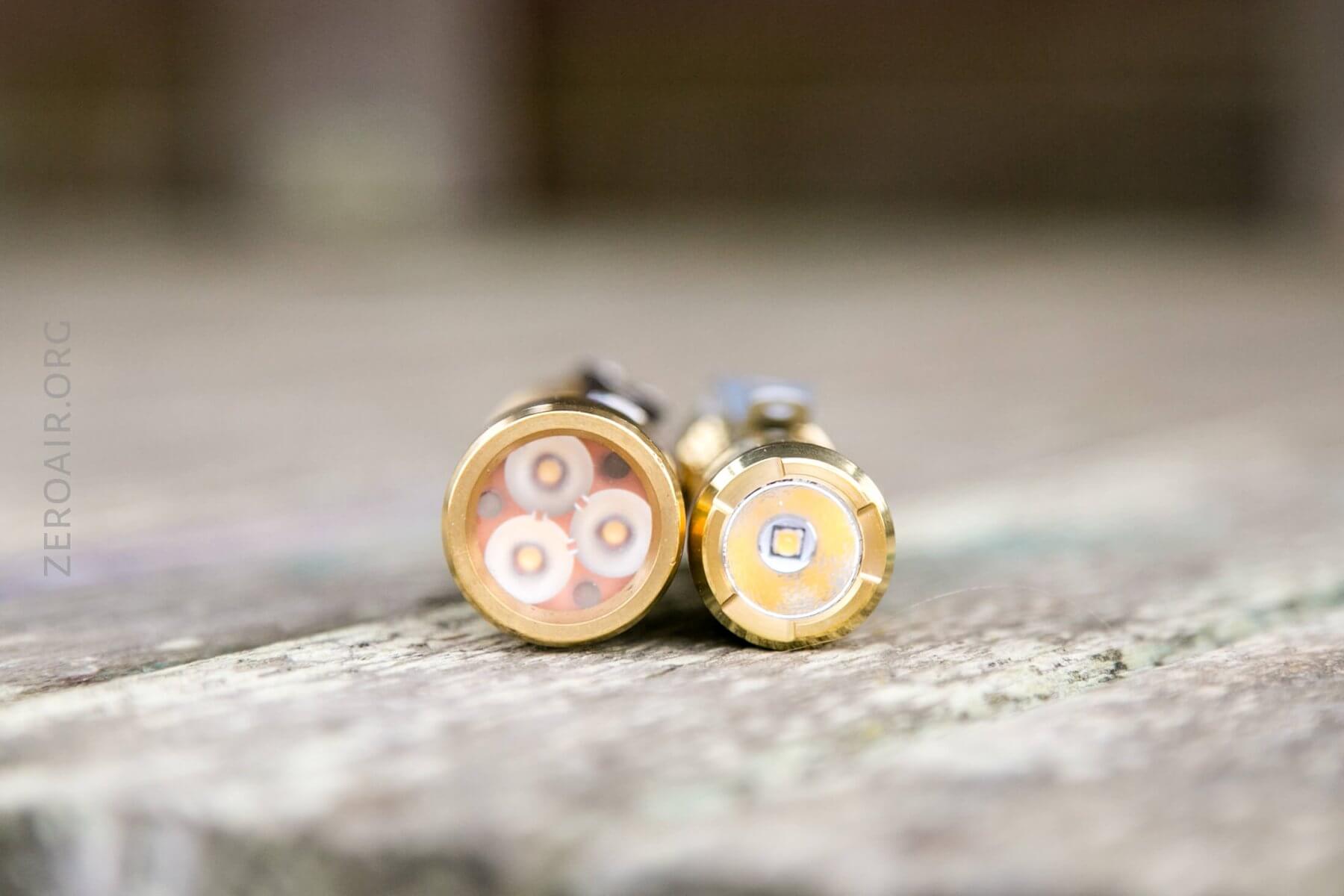
The New Pineapple is longer than the original, too. I believe this change was made to allow support for longer cells (such as protected/button top cells).
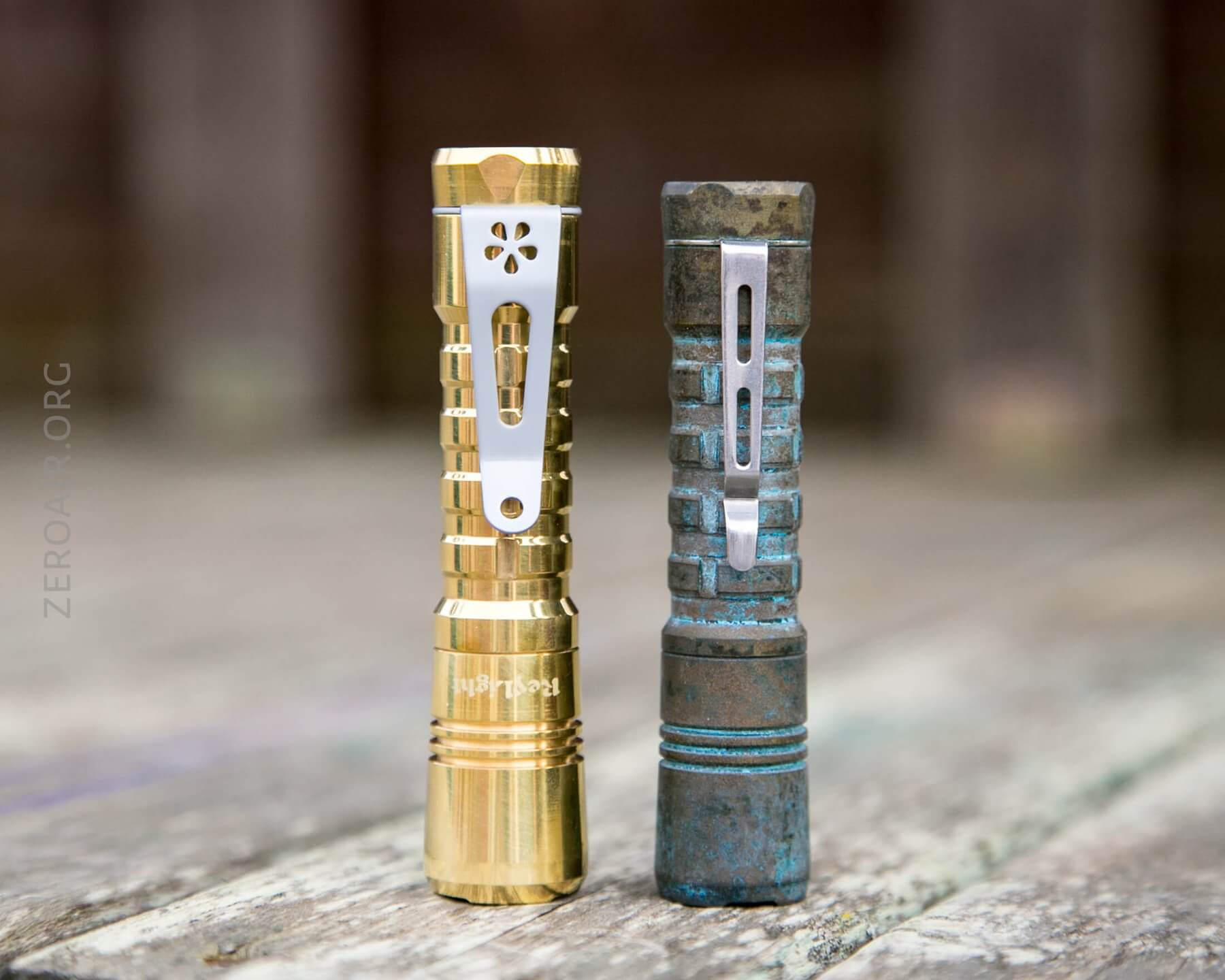
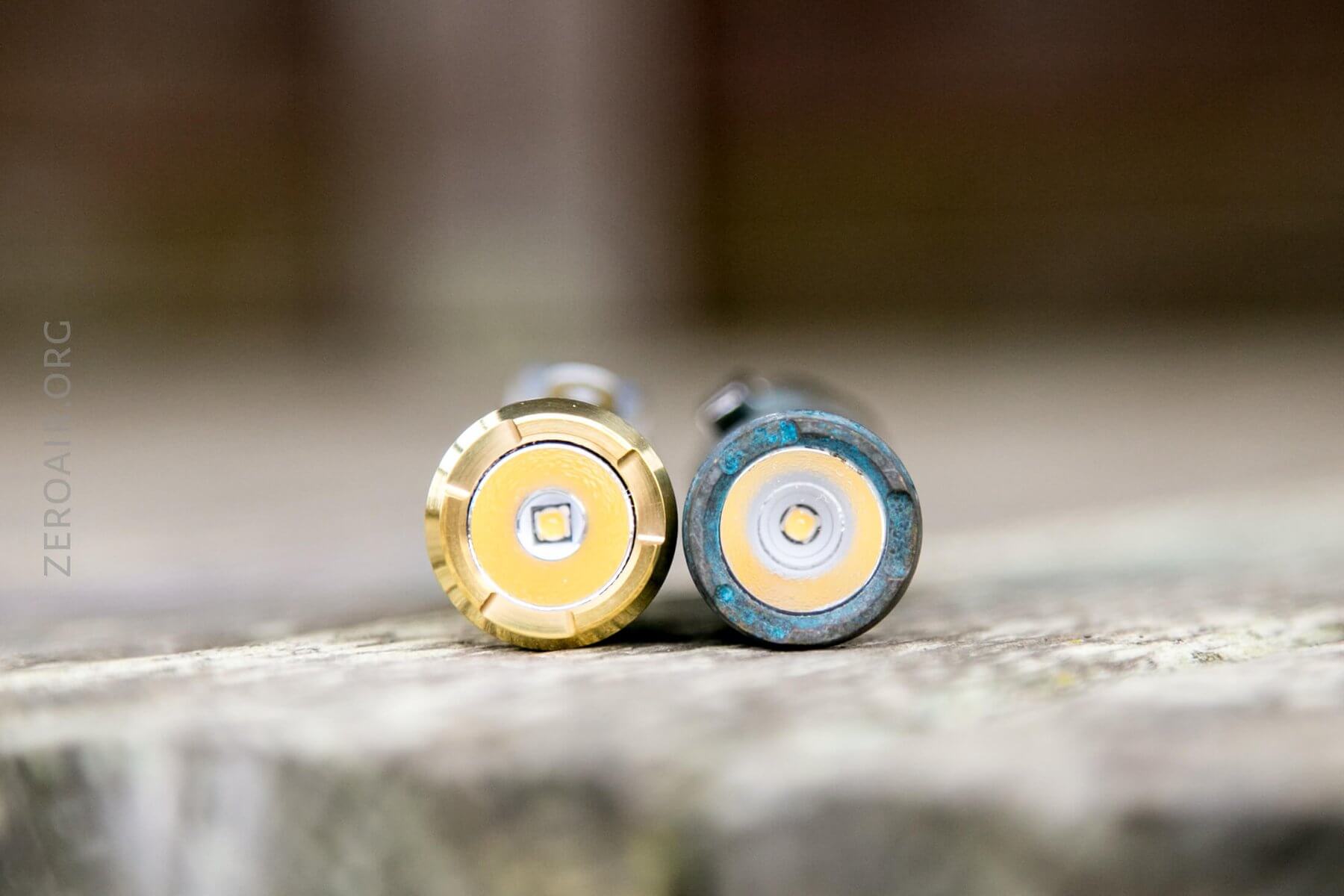
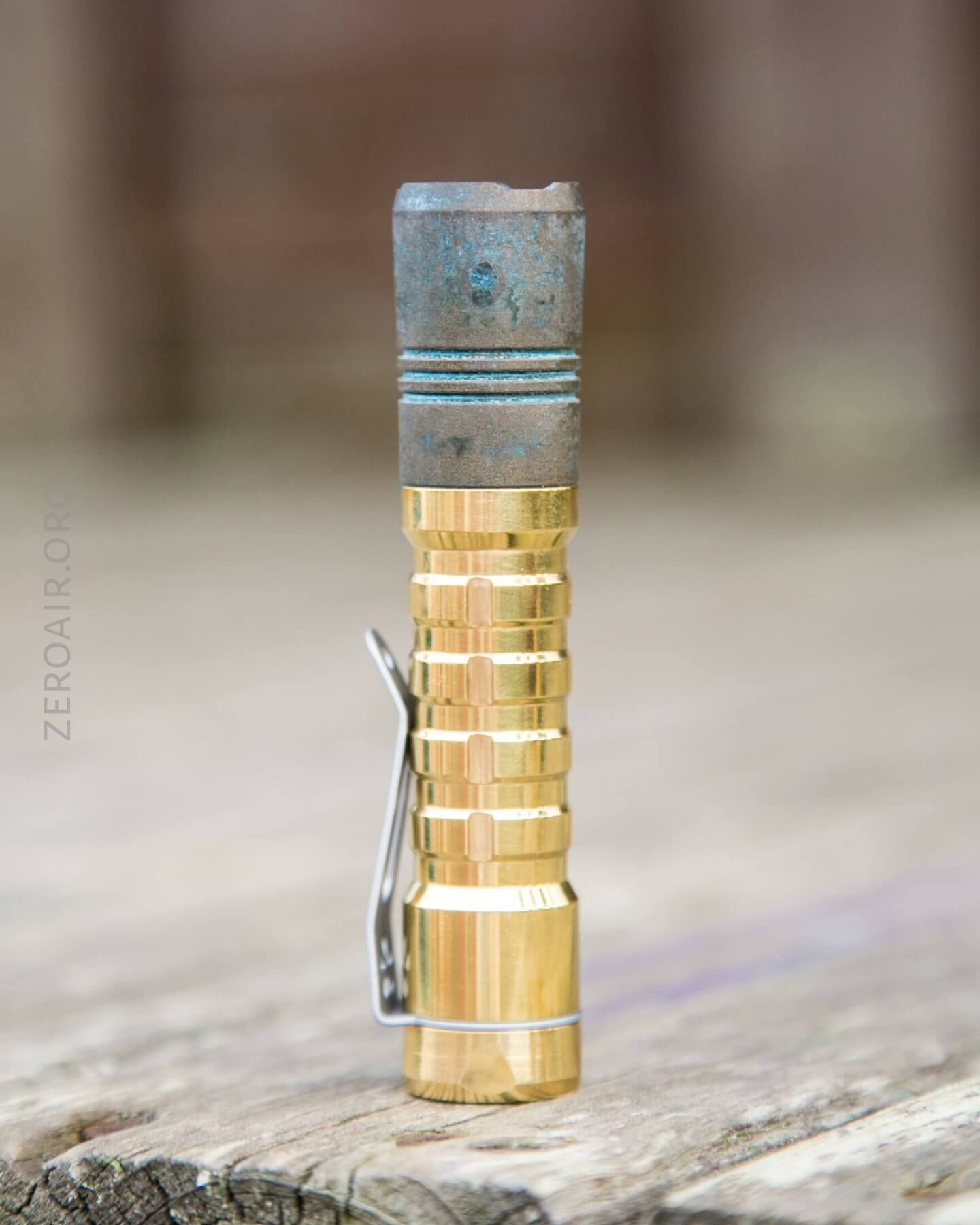
The parts from both models are interchangeable (and work in any configuration).
Retention and Carry
The only means for carrying the New Pineapple is the pocket clip. It’s a steel collar clip and is more or less permanently attached since the tailcap doesn’t come off.
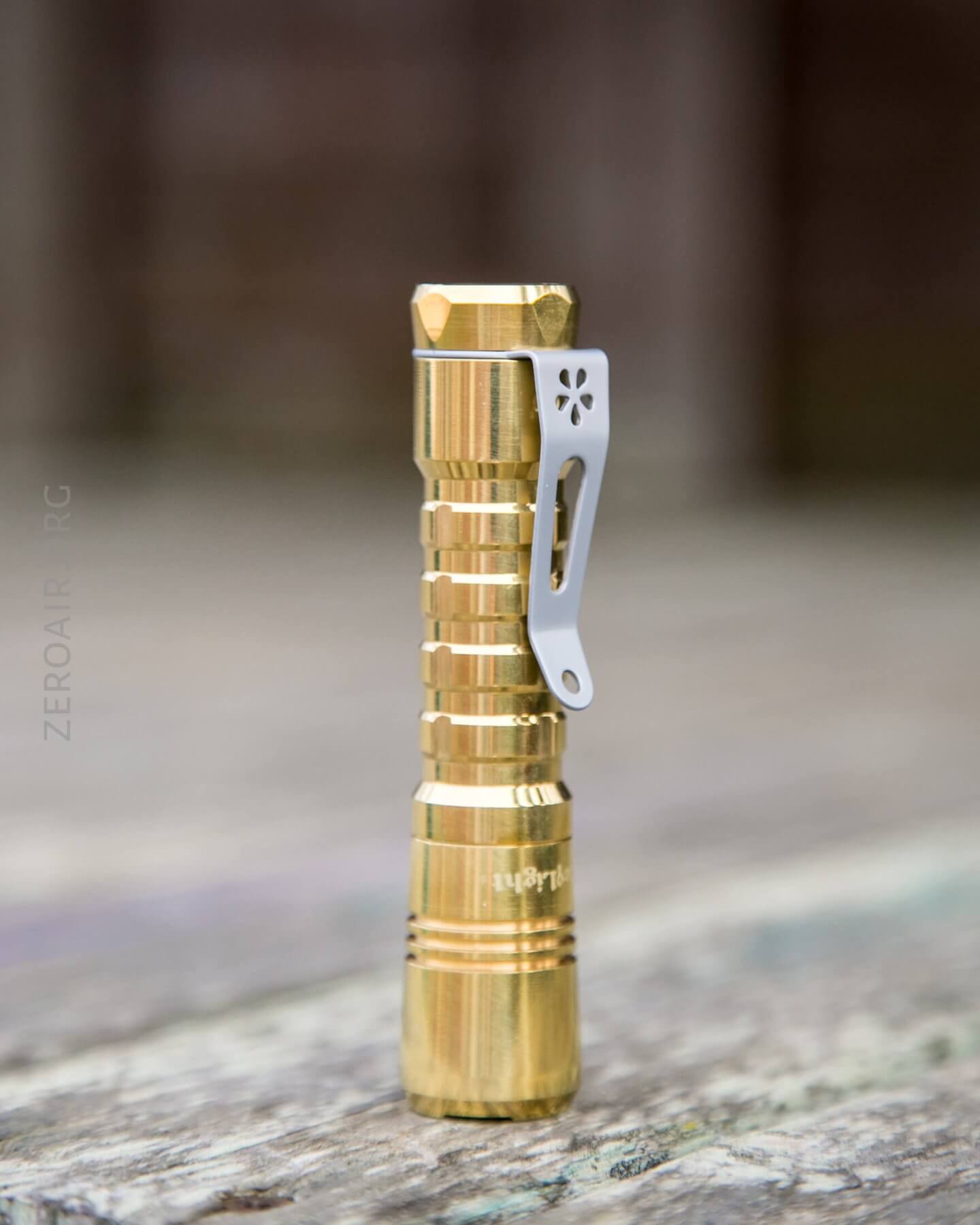
This clip is an absolutely massive improvement over the original. But a large part of that is a result of the clip never spinning around the body because the tailcap doesn’t come off. It’s a trade-off, I suppose.
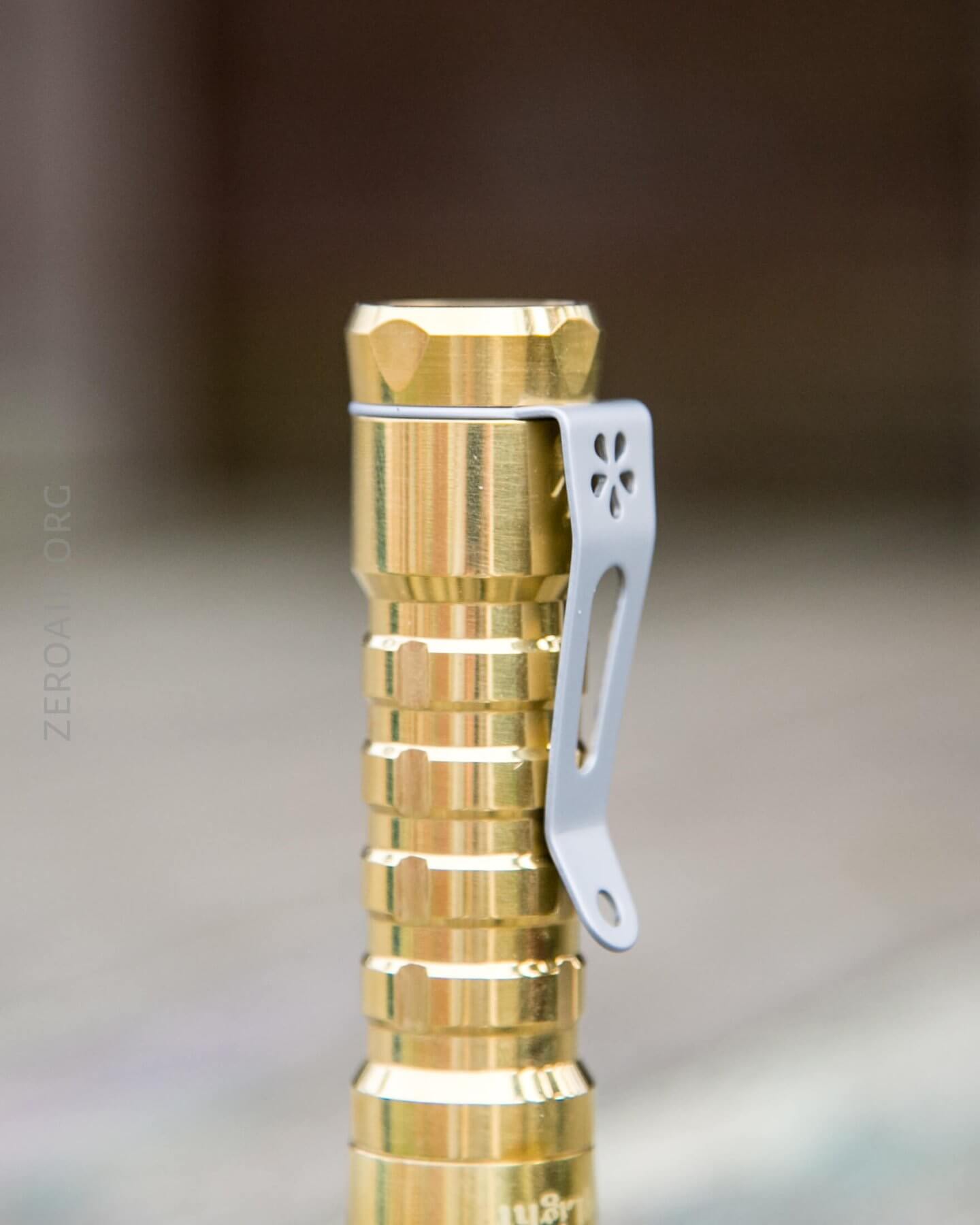
Even aside from that, this clip is better. The mouth is bigger, and so it’s easier to use. The clip also has holes, so if you had a lanyard, the clip would be a good place (and also the only place) to attach it. Since it’s a collar clip, it’d be very secure, too.
Power and Runtime
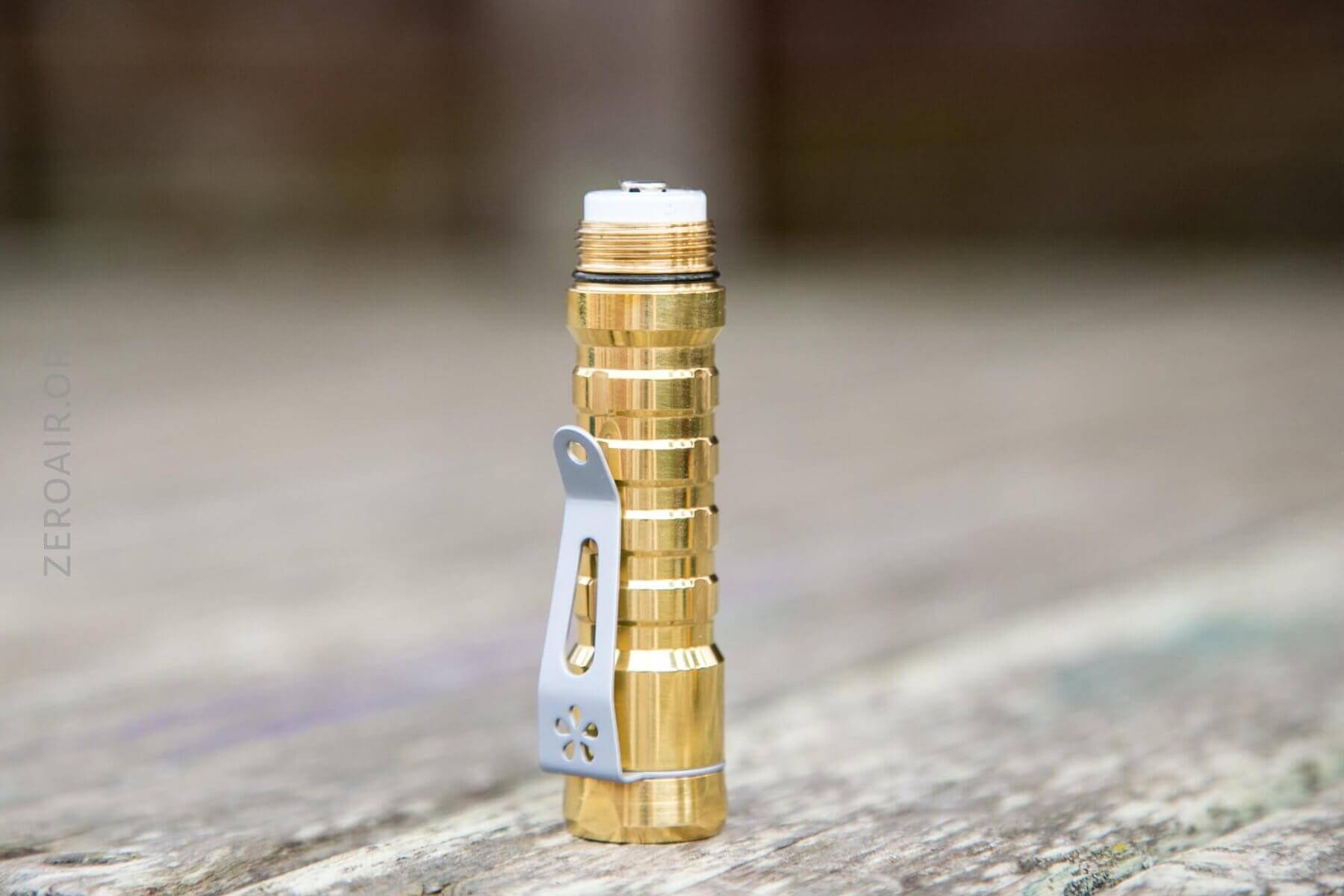
The Pineapple is a versatile device. It can be powered from any AA-sized cylindrical cell. I tested with both 14500 (flat and button) and AA NiMH cells. The cell goes with the positive end toward the head, as most do.
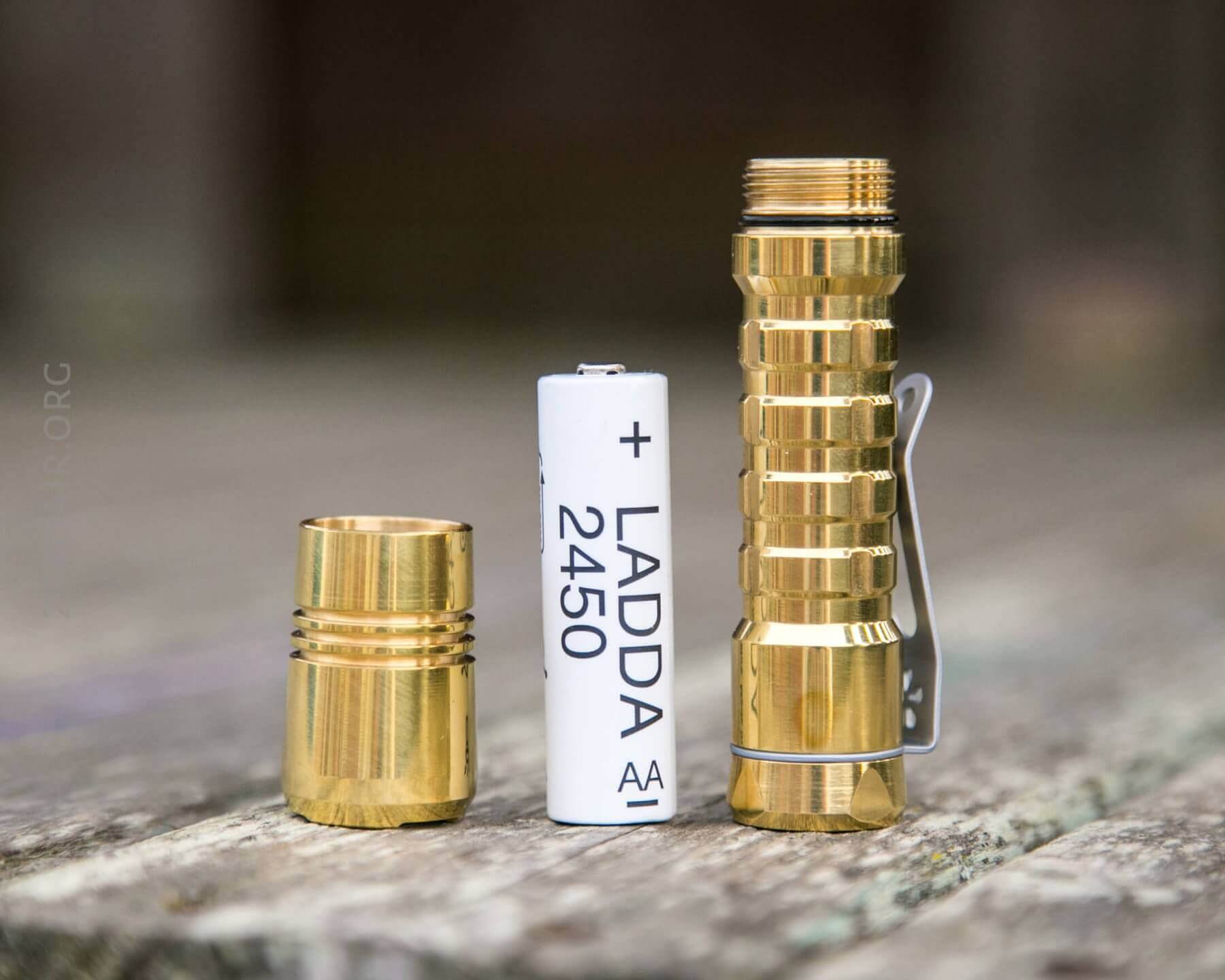
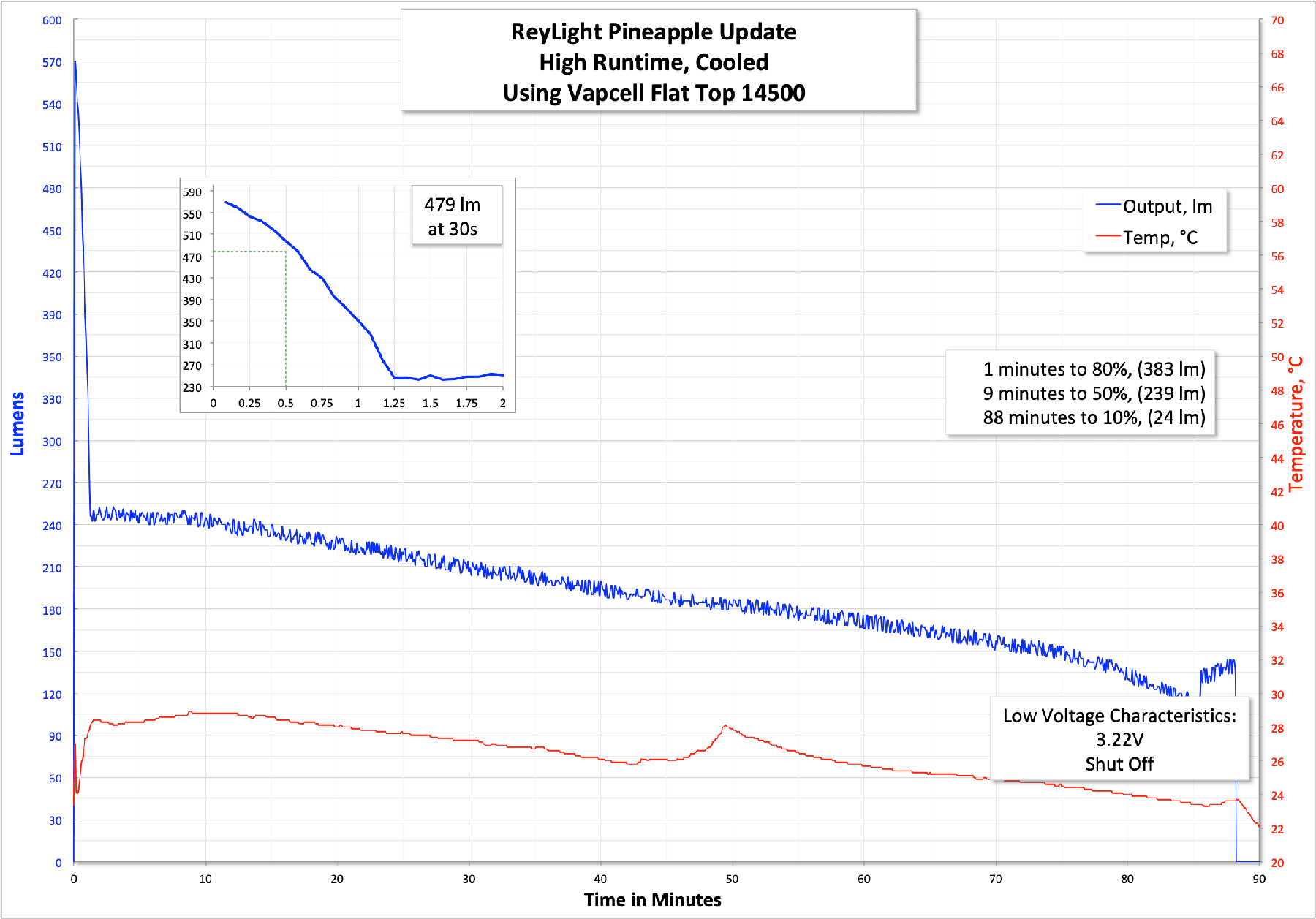
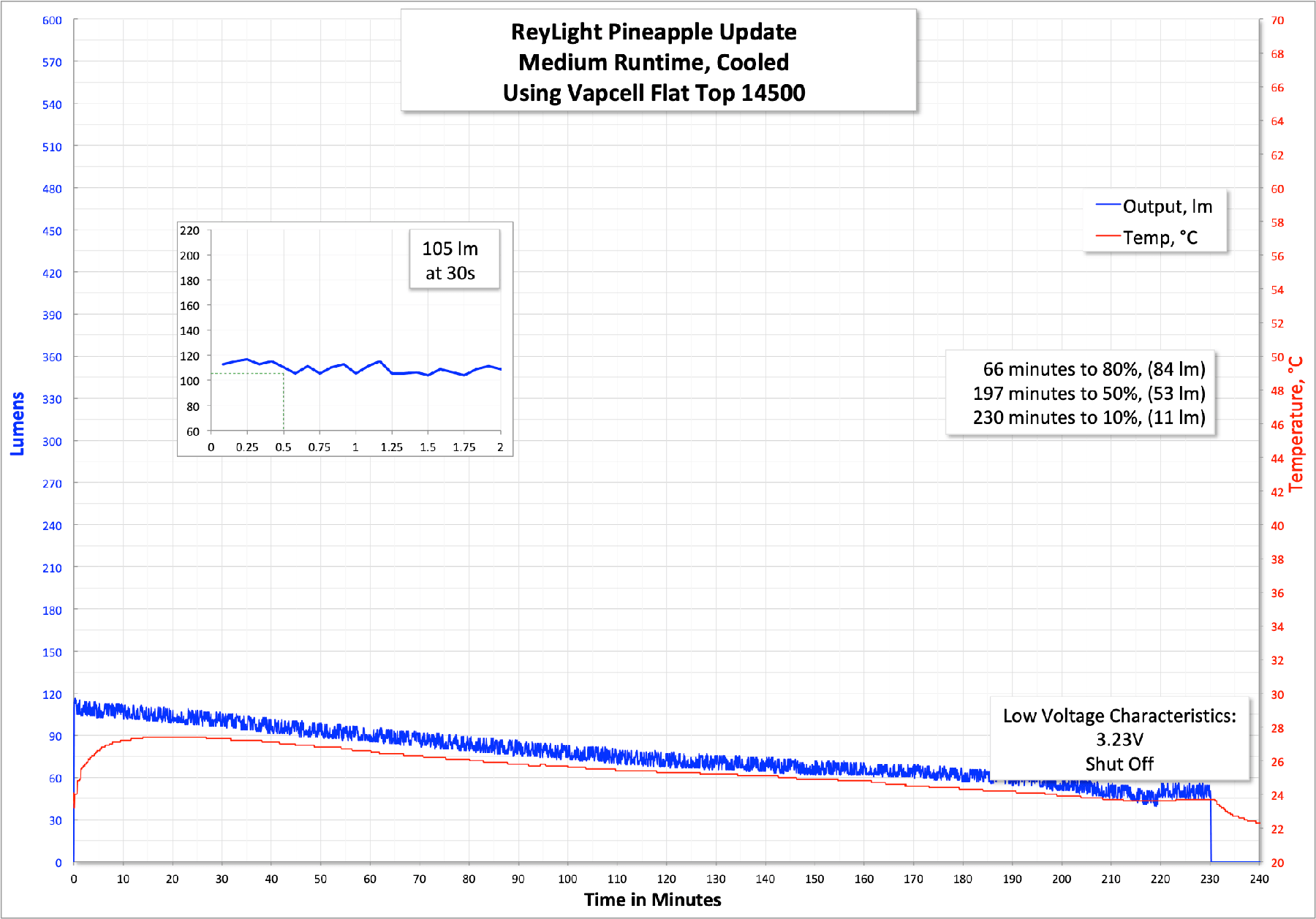
Max output should be 470 lumens, and I confirmed that with my runtime using a 14500. The output drops off very quickly, though, and at 30 seconds it’s heavily on its way down to the next step – around 240 lumens. With both Li-ion tests, the light did shut off (ie, LVP).
The second-highest mode with a Li-ion is around 115 lumens and trails off to about 70 by the end.
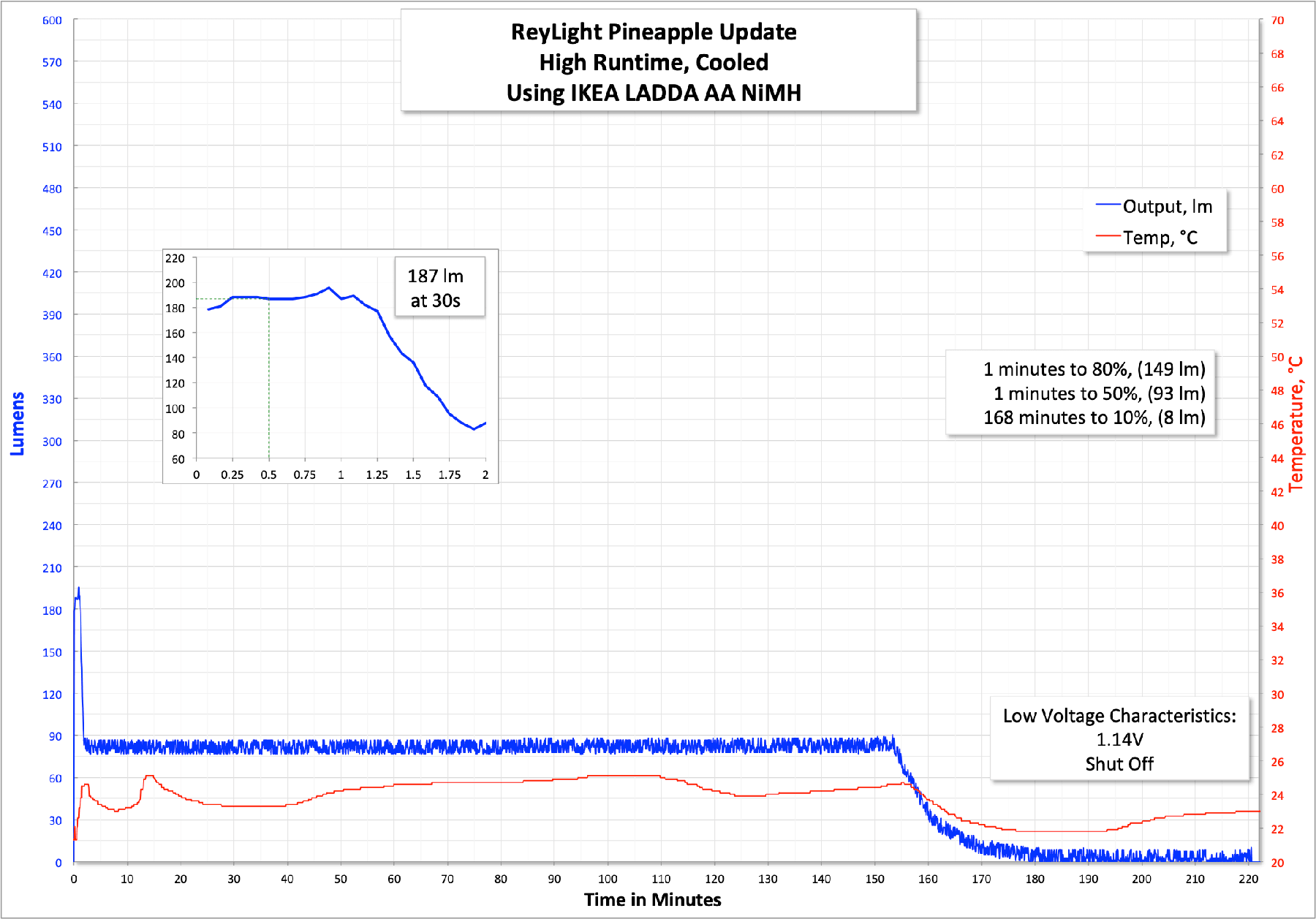
Runtimes with the NiMH cell are much different, of course. Interestingly, the output is much more regulated (perfectly flat, after the stepdown).
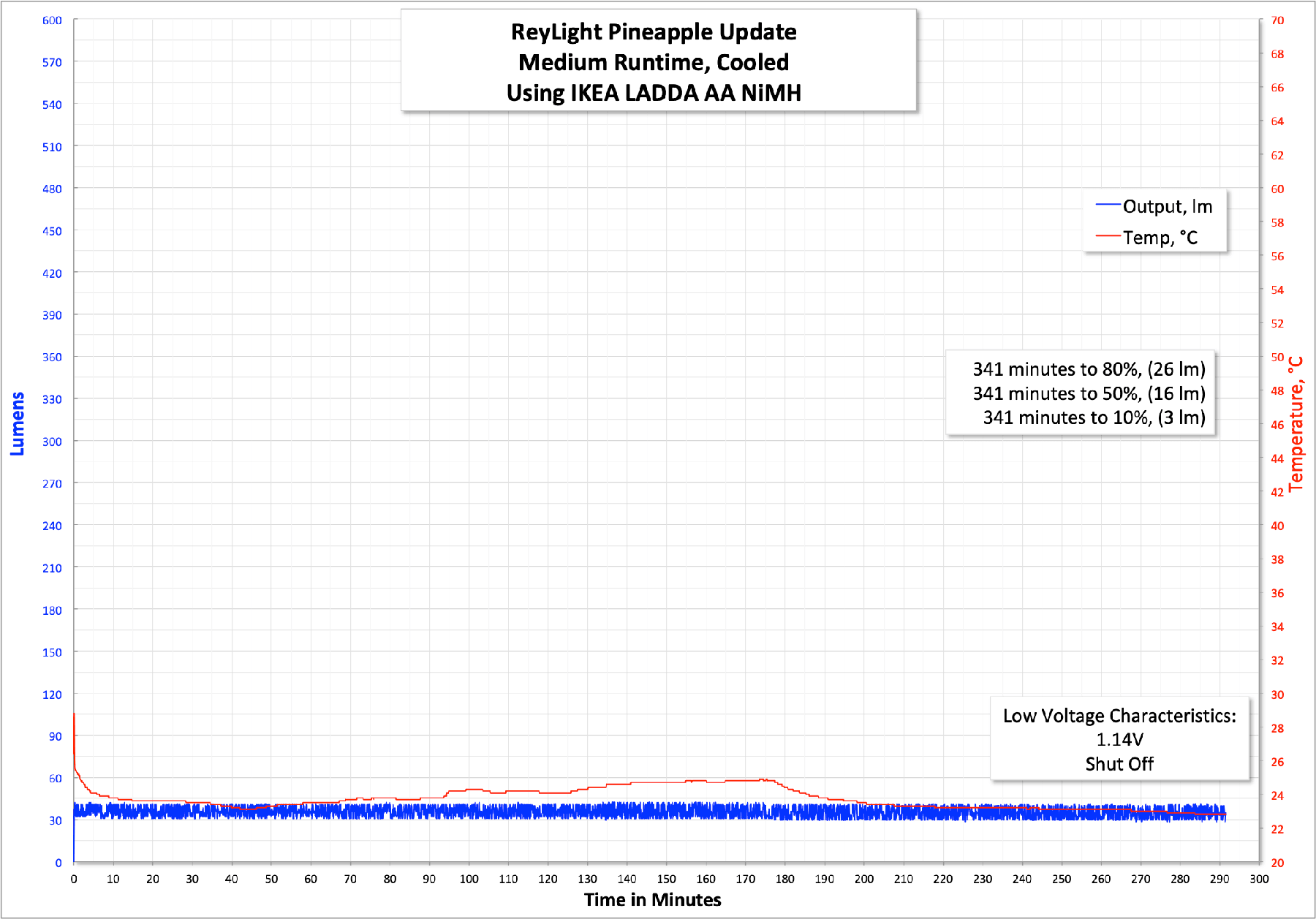
Medium with a NiMH cell was very flat, and never actually shut off – I stopped this test due to other circumstances… but at ~40 lumens and a projected 5h runtime, this is within spec easily.
When output starts with a 1.5V cell, the light does not exhibit LVP.
Pulse Width Modulation
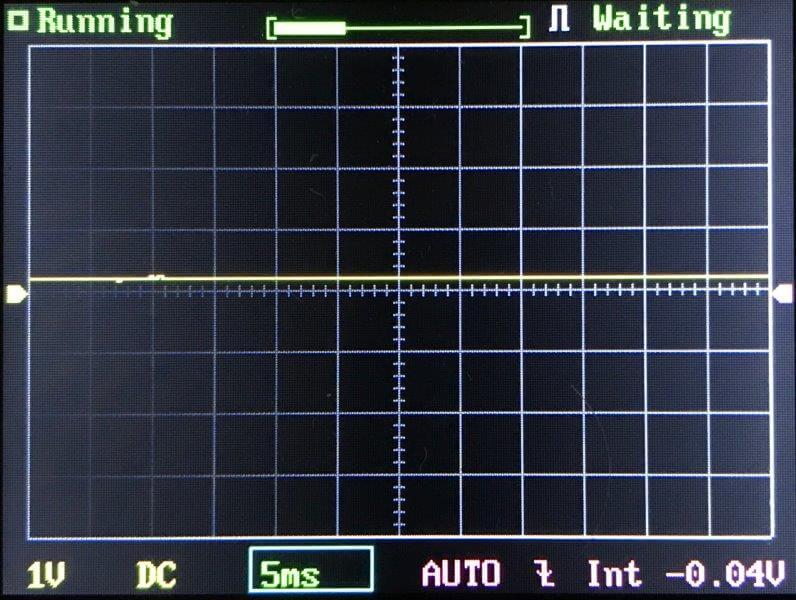
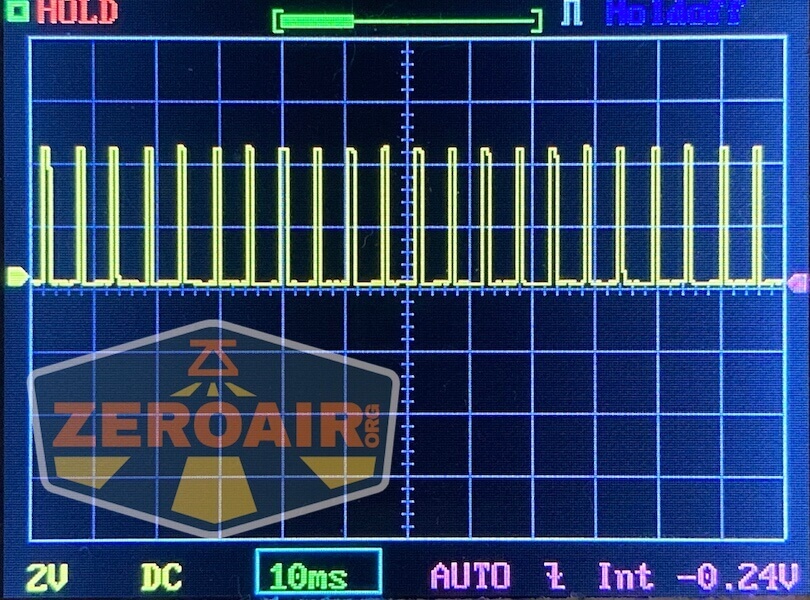
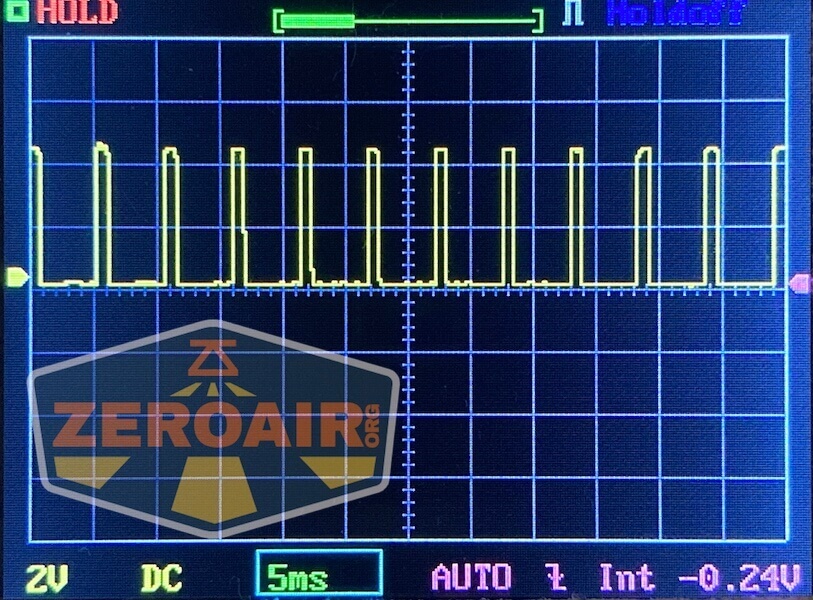
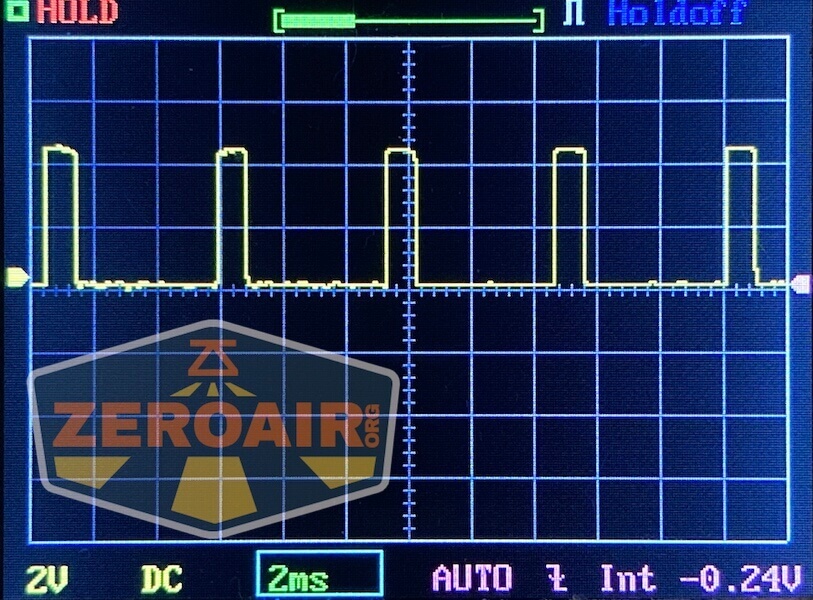
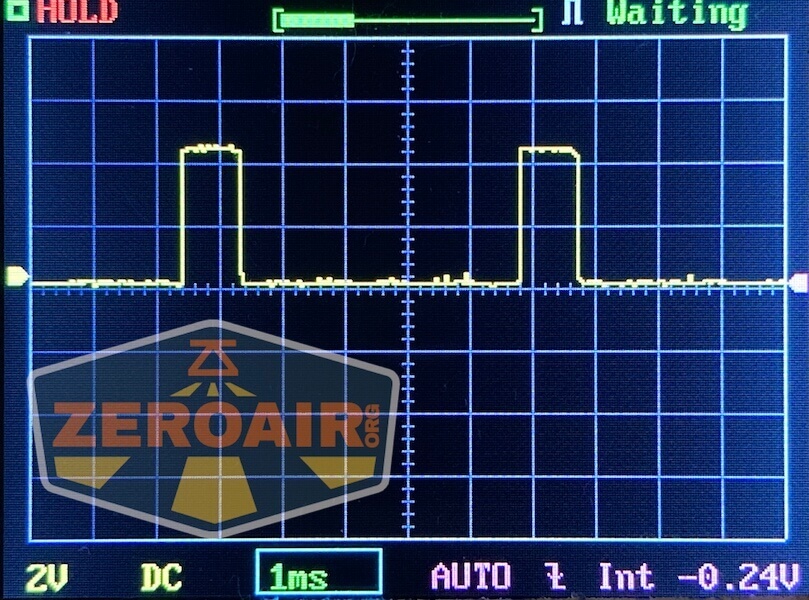
Here you can see a “baseline” – a chart with almost no light hitting the sensor.
Then there’s the Ultrafire WF-602C flashlight, which has some of the worst PWM I’ve seen. It’s so bad that I used a post about it to explain PWM! Here are multiple timescales (10ms, 5ms, 2ms, 1ms, 0.5ms, 0.2ms) to make comparing this “worst” PWM light to the test light easier. That post also explains why I didn’t test the WF-602C at the usual 50us scale.
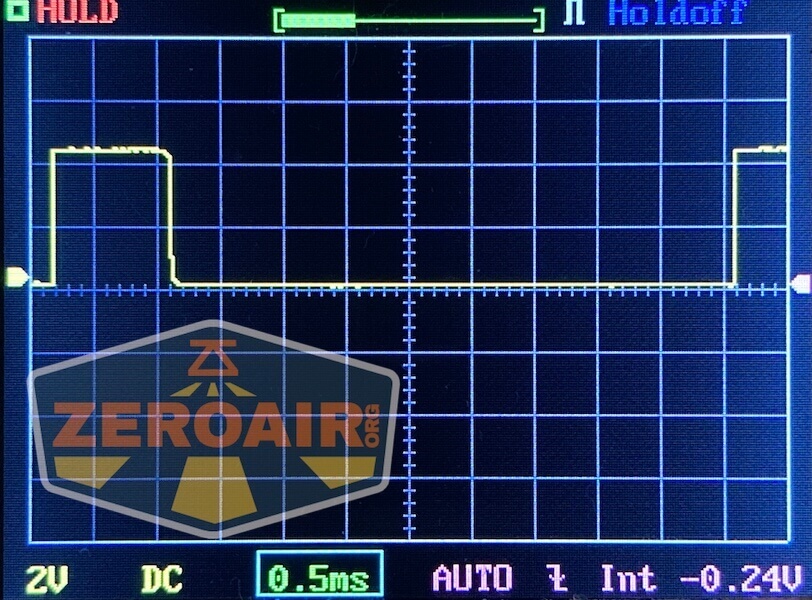
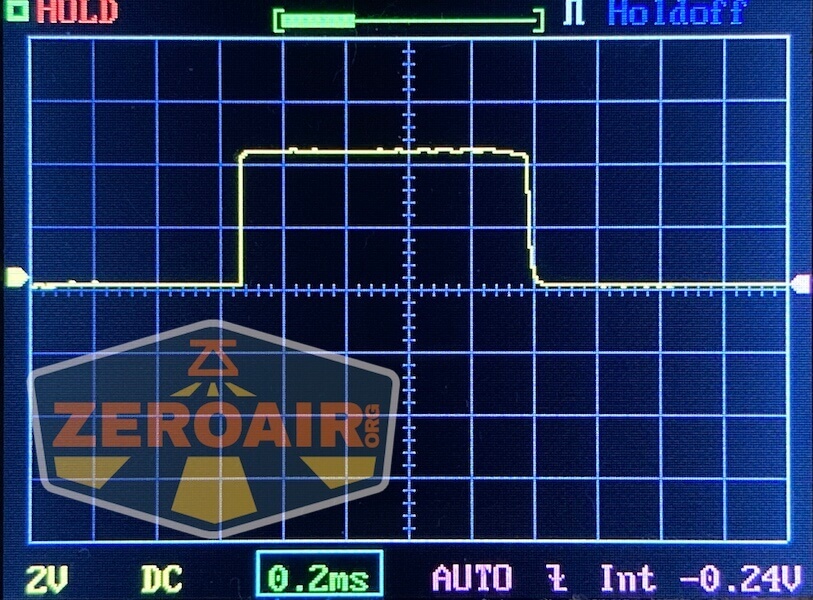
Vapcell Flat top 14500:

IKEA LADDA NiMH AA:

I wish I had a better way to quantify PWM. While it’s clearly present, it doesn’t bother me in the least in this light. In fact, using my normal tests to see PWM, I can’t even see it on low. So it’s no issue whatsoever.
User Interface and Operation
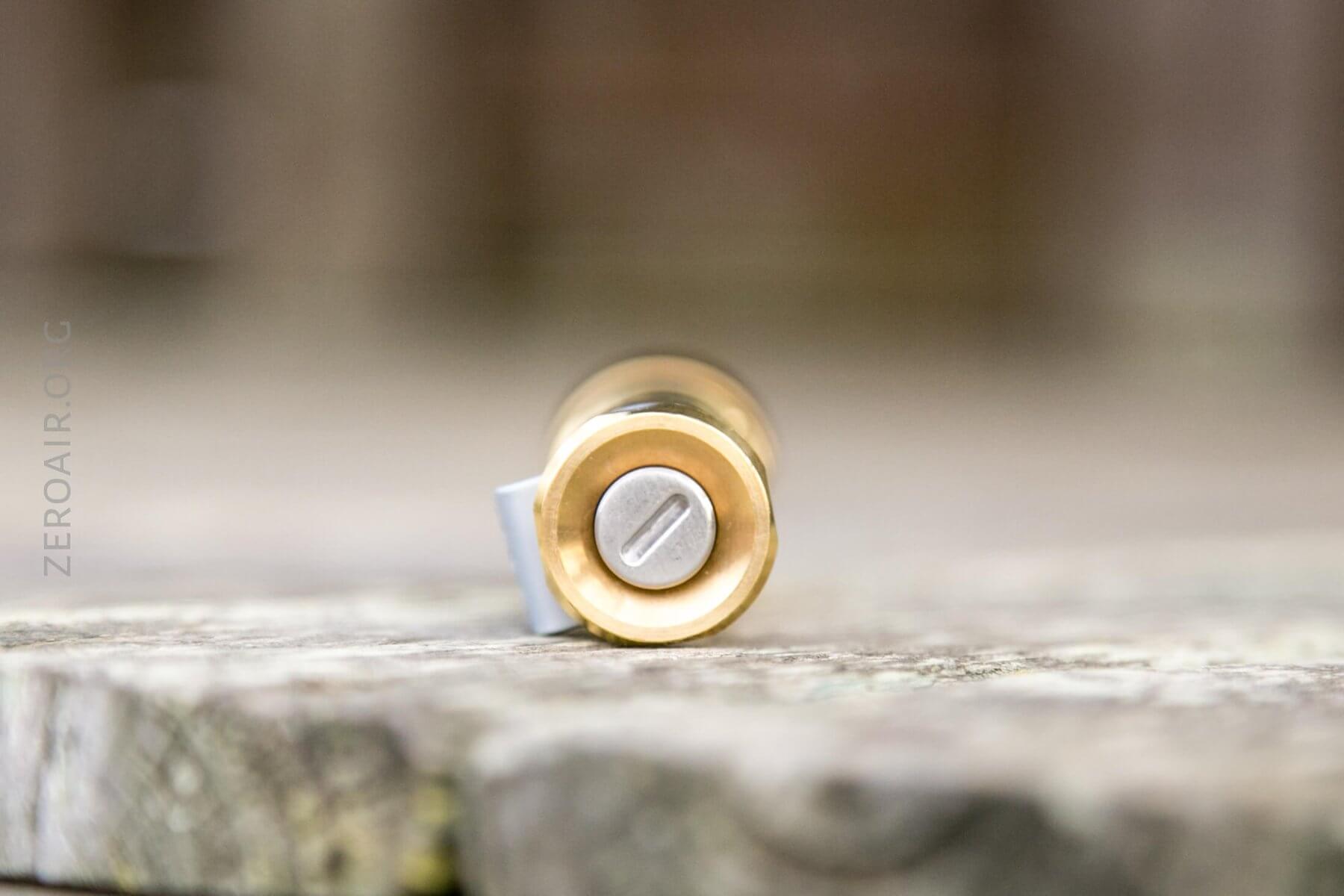
There’s a single switch on the New Pineapple. It’s a reverse clicky and has a metal switch cover. The switch cover is routed for a Tritium vial, too!
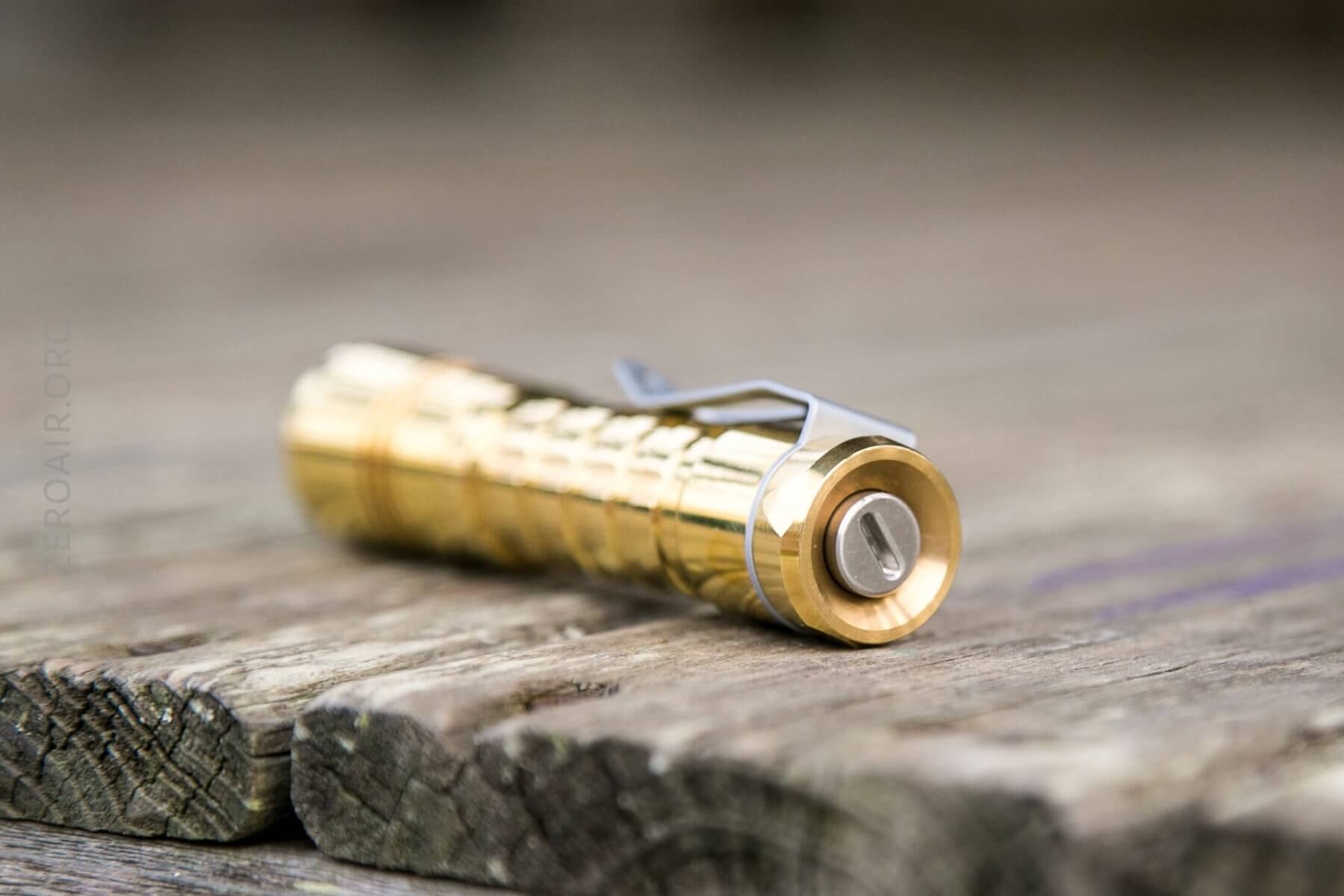
Here’s a user interface table! The user interface is unchanged from the first model.
| State | Action | Result |
|---|---|---|
| Off | Click | Moonlight^ |
| On | Click | Off |
| On | Half Press | Cycle modes (MoonLMH) |
^ If the light is turned back on soon after turning off (within a couple of seconds), the previous mode will be remembered. If more than 2 seconds, the light will turn on into Moonlight.
Modes and Currents
| Mode | Mode Claimed Output (lm) | Claimed Runtime | Measured Lumens | Tailcap Amps |
|---|---|---|---|---|
| High 14500 | 470 | 58m | 452 | 1.73 (@4.2V) |
| Mid 14500 | 90 | 2.5h | 114 | 0.29 (@4.2V) |
| Low 14500 | 8.5 | 31h | 12 | 0.02 (@4.2V) |
| Moonlight 14500 | 0.2 | 20d | 0 | ~ (@4.2V) |
| High AA | 130 | 1.1h | 187 | 2.38 (@1.5V) |
| Mid AA | 30 | 5h | 37 | 0.22 (@1.5V) |
| Low AA | 3.2 | 70h | 1 | 0.02 (@1.5V) |
| Moonlight AA | 0.2 | 30d | 0 | ~ (@1.5V) |
LED and Beam
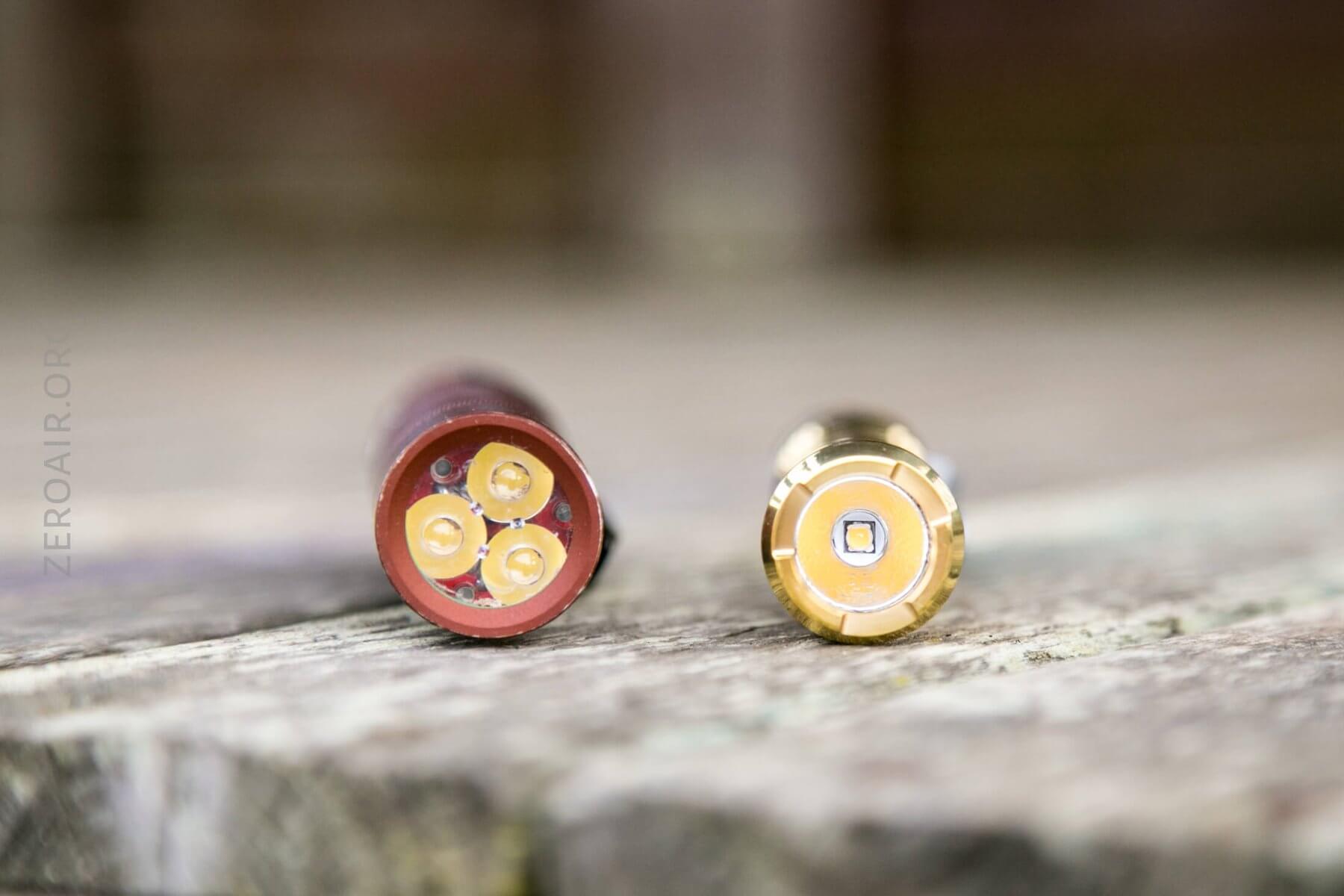
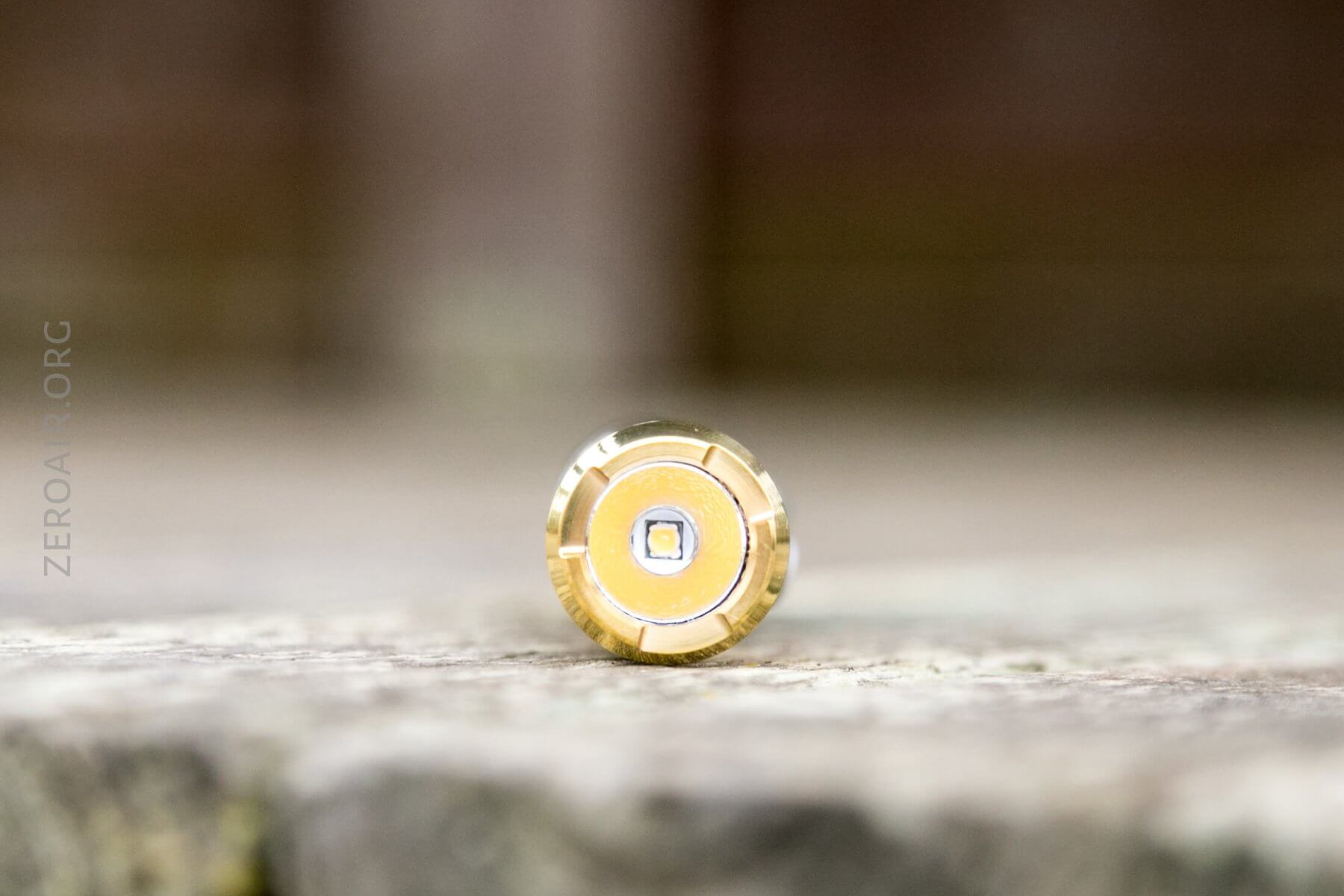
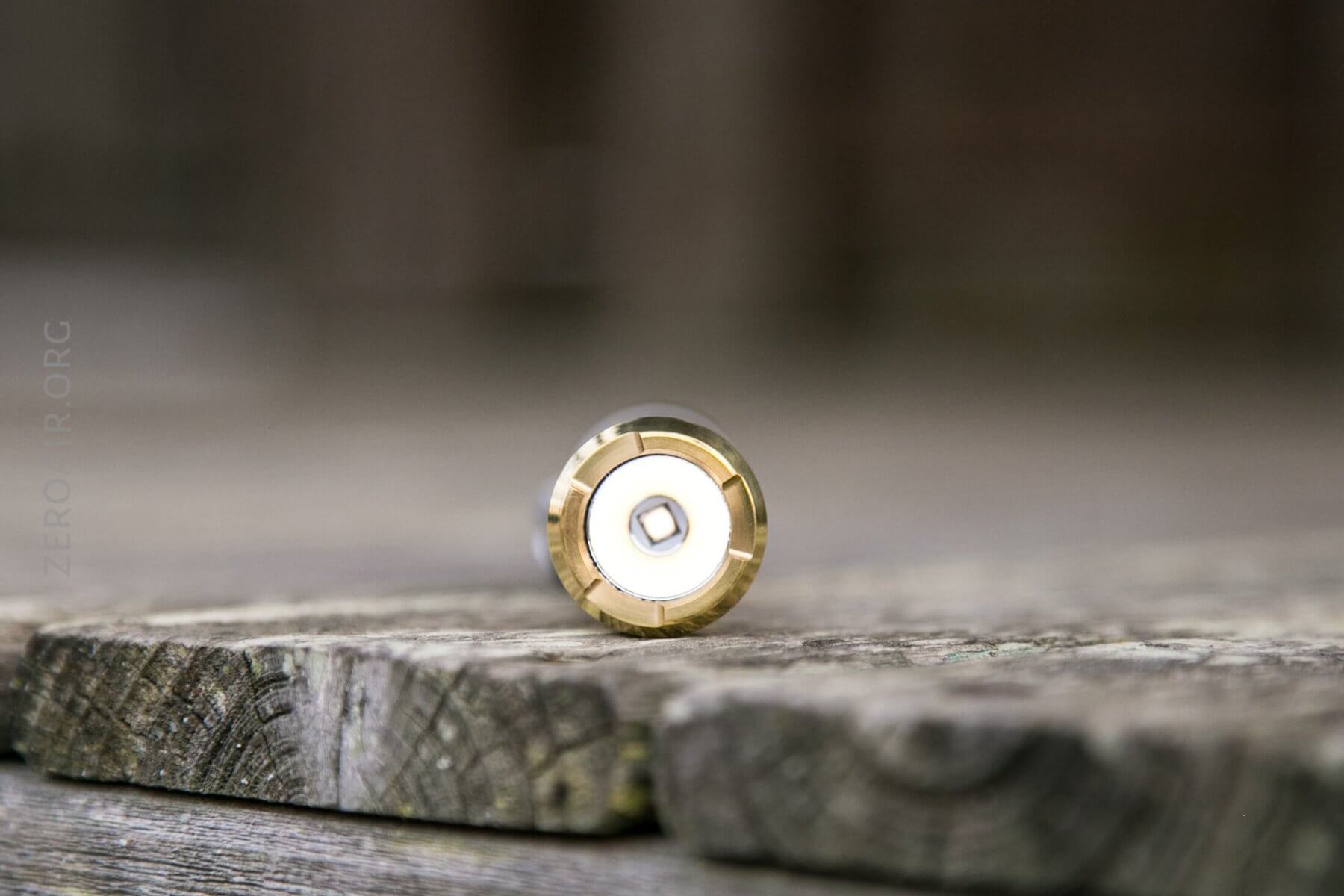
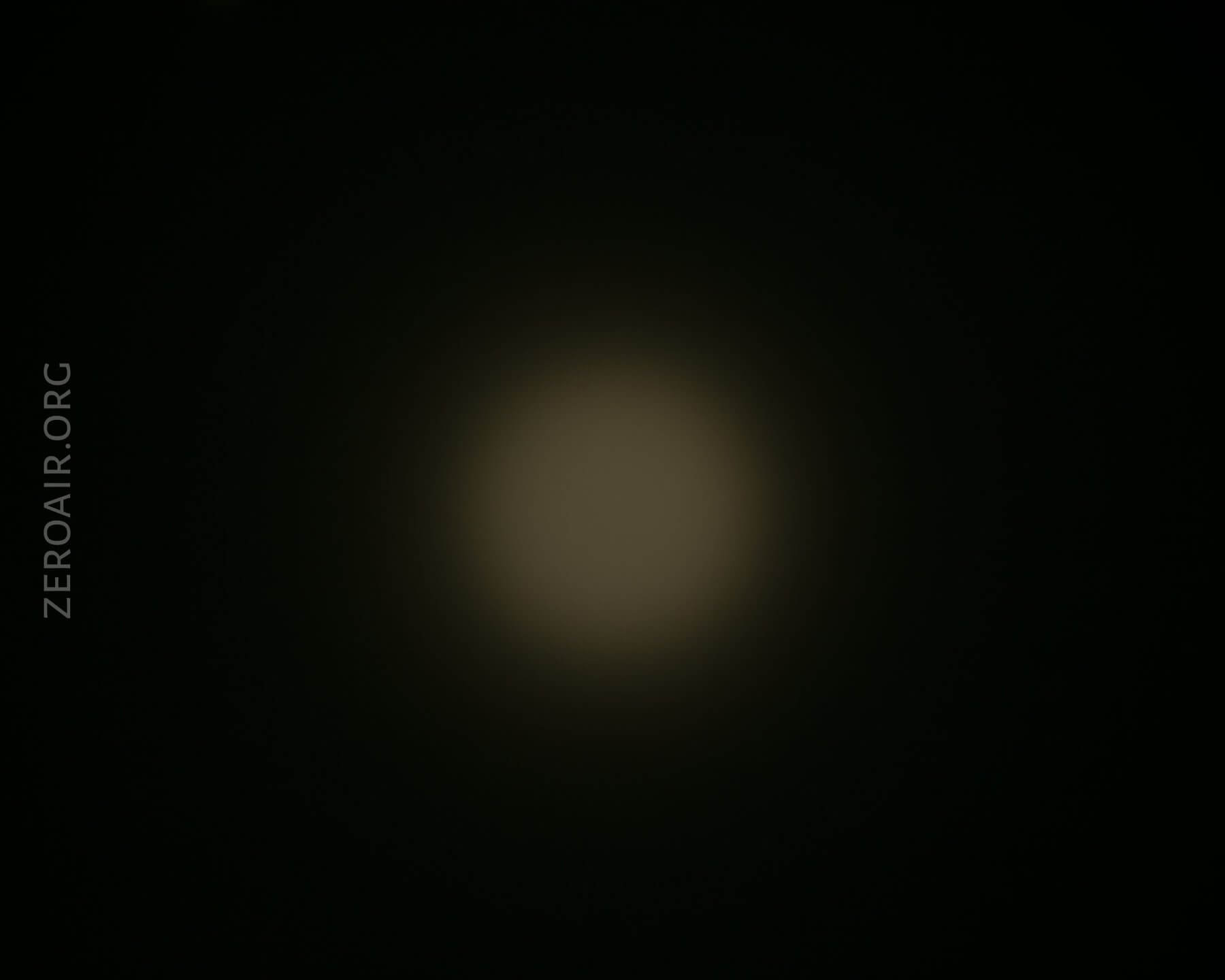
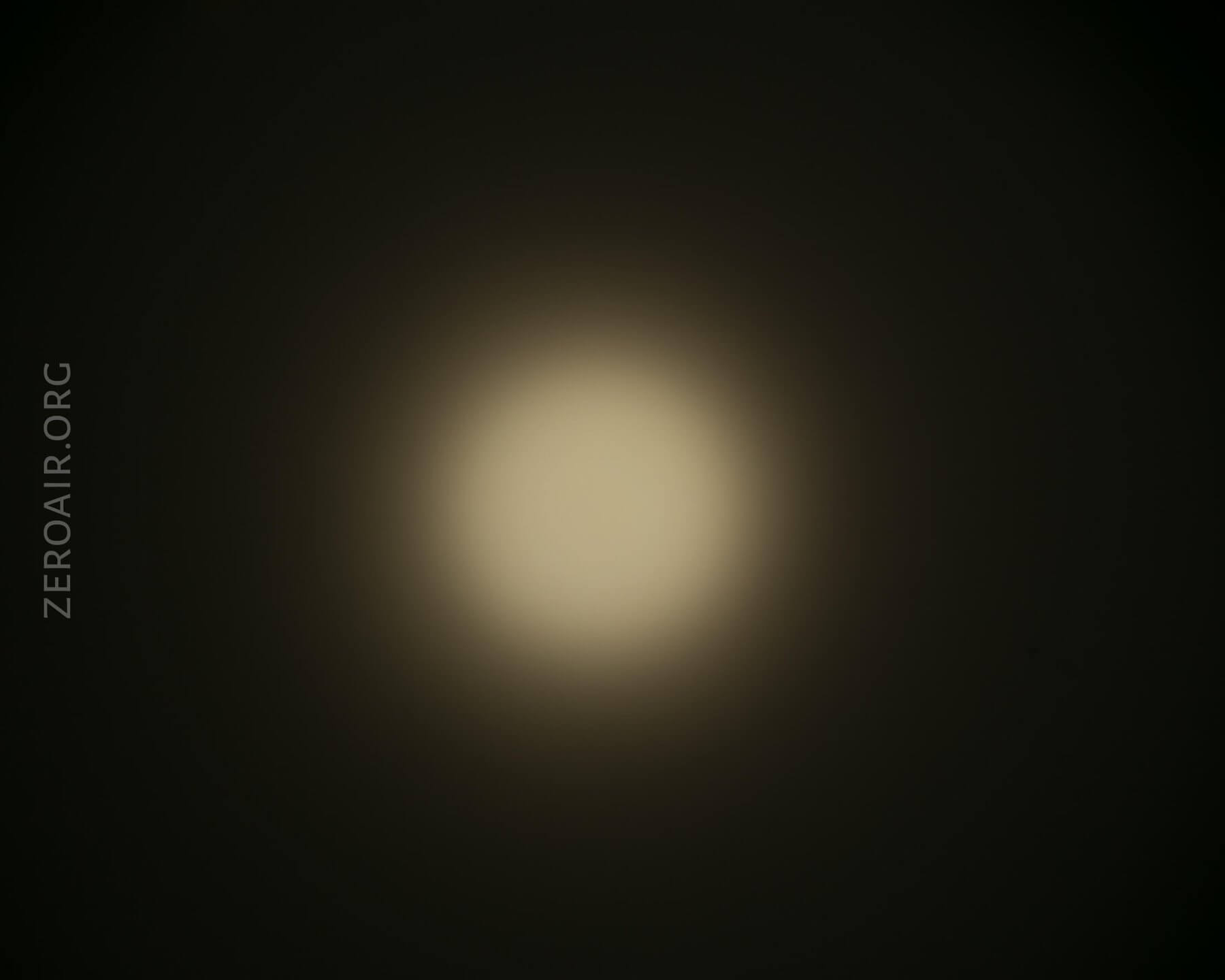
The emitter used here is a Nichia 219c, in 4000K. It’s a reflector light, and the reflector is orange peel. The spot is somewhat broad, and there’s little spill.
Beamshots
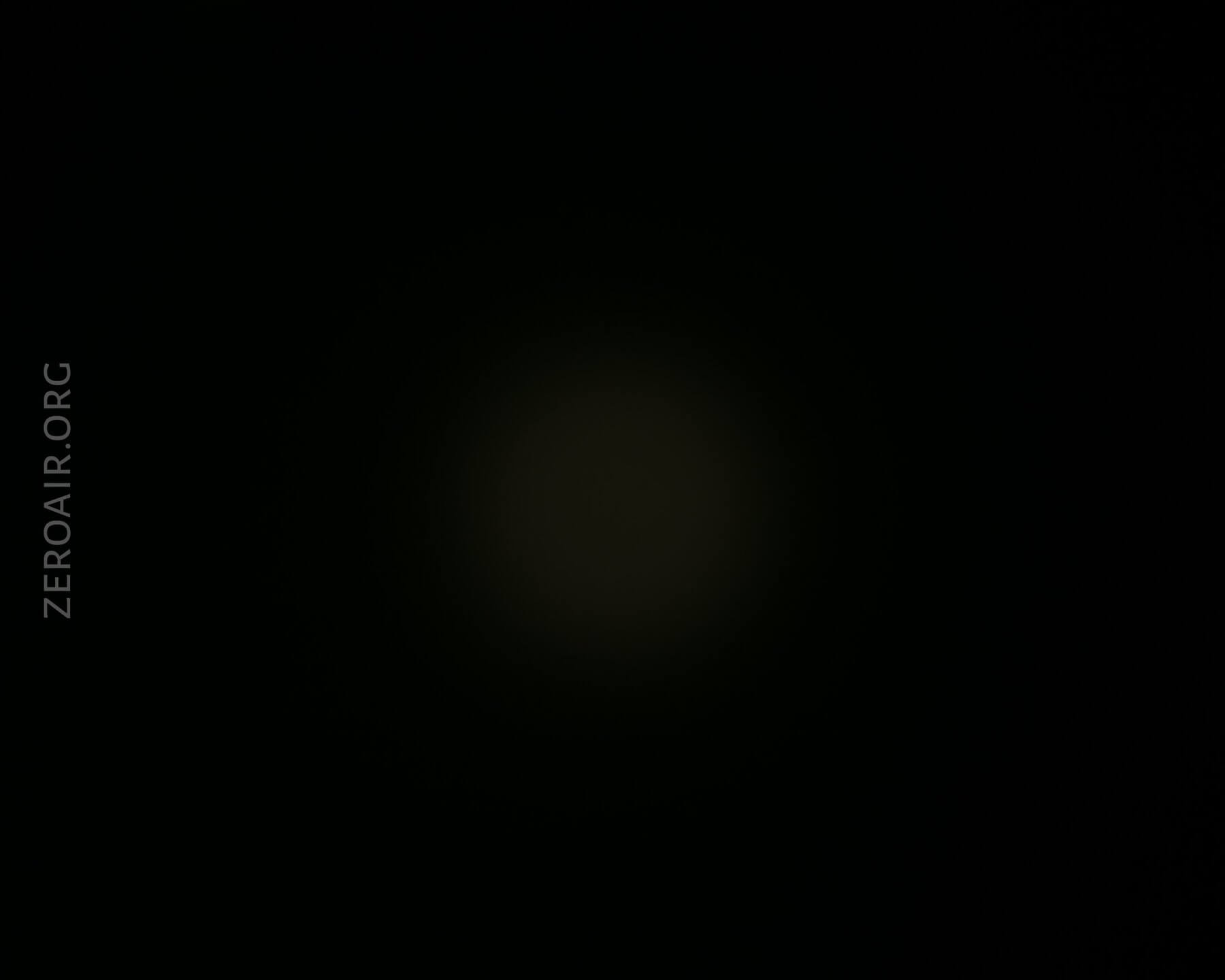
These beamshots always have the following settings: f8, ISO100, 0.3s shutter, and manual 5000K exposure. These photos are taken at floor level, and the beam hits the ceiling around 9 feet away.
Vapcell Flat top 14500:

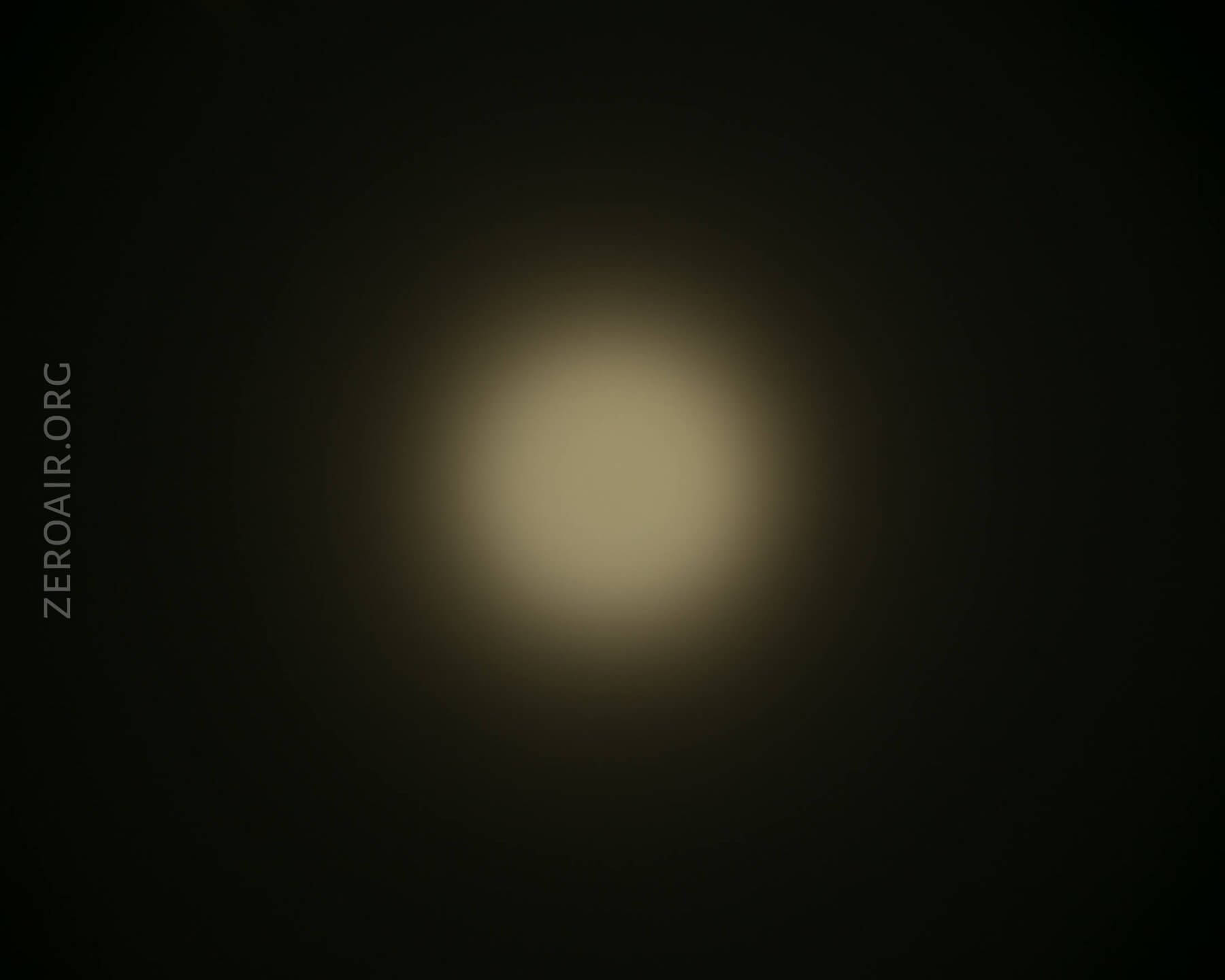
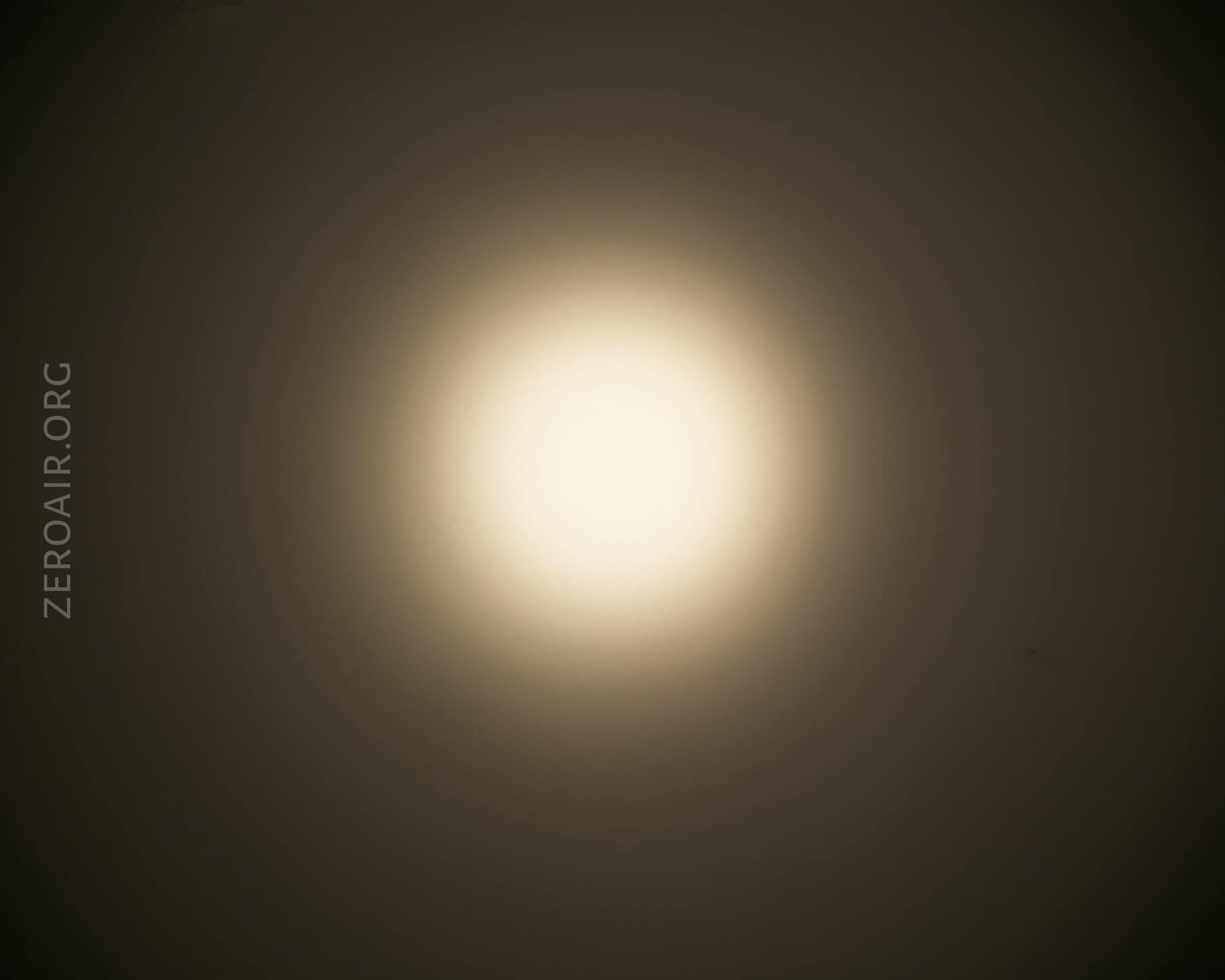
IKEA LADDA NiMH AA:


Tint vs BLF-348 (KillzoneFlashlights.com 219b version) (affiliate link)
Vapcell Flat top 14500:
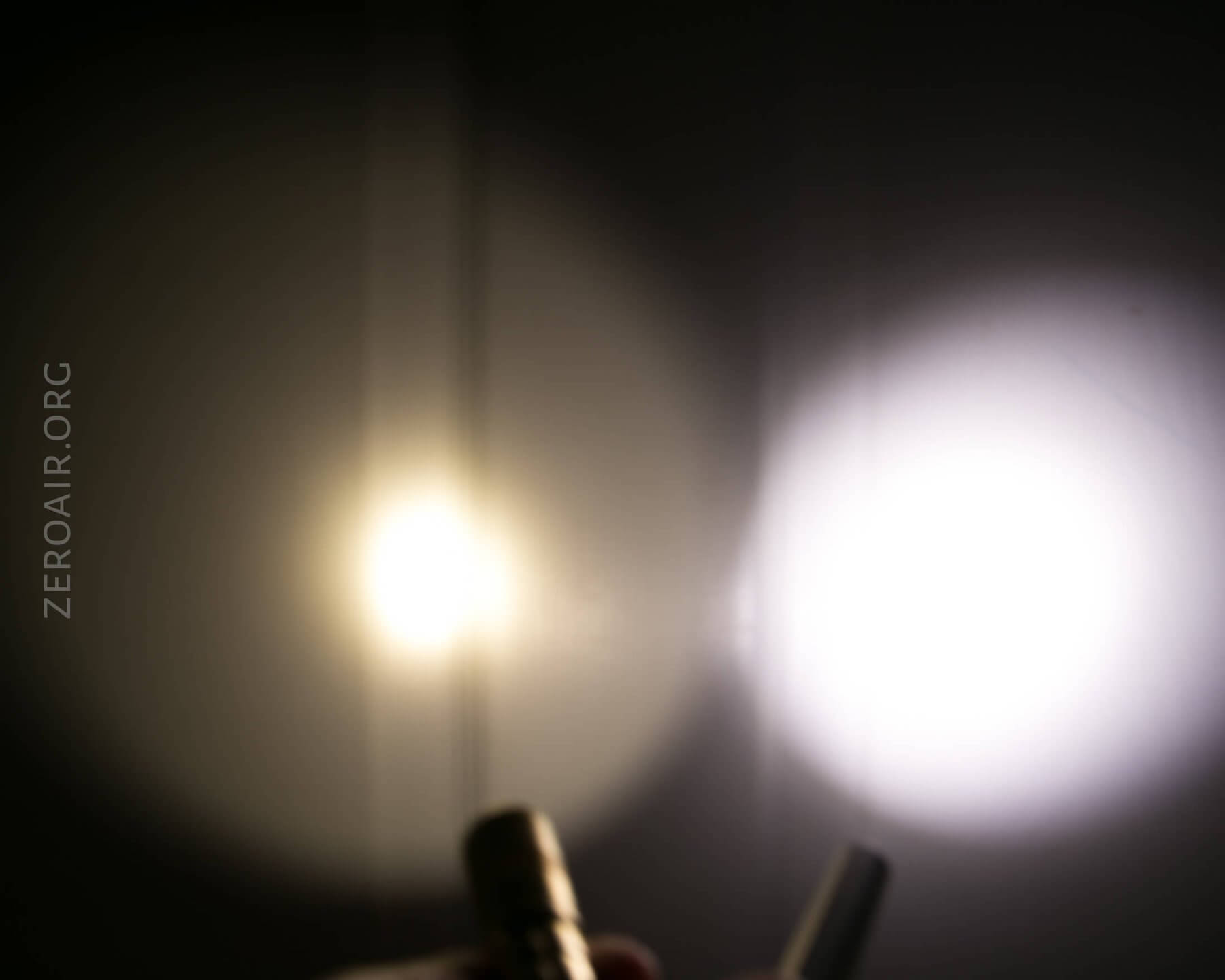
IKEA LADDA NiMH AA:
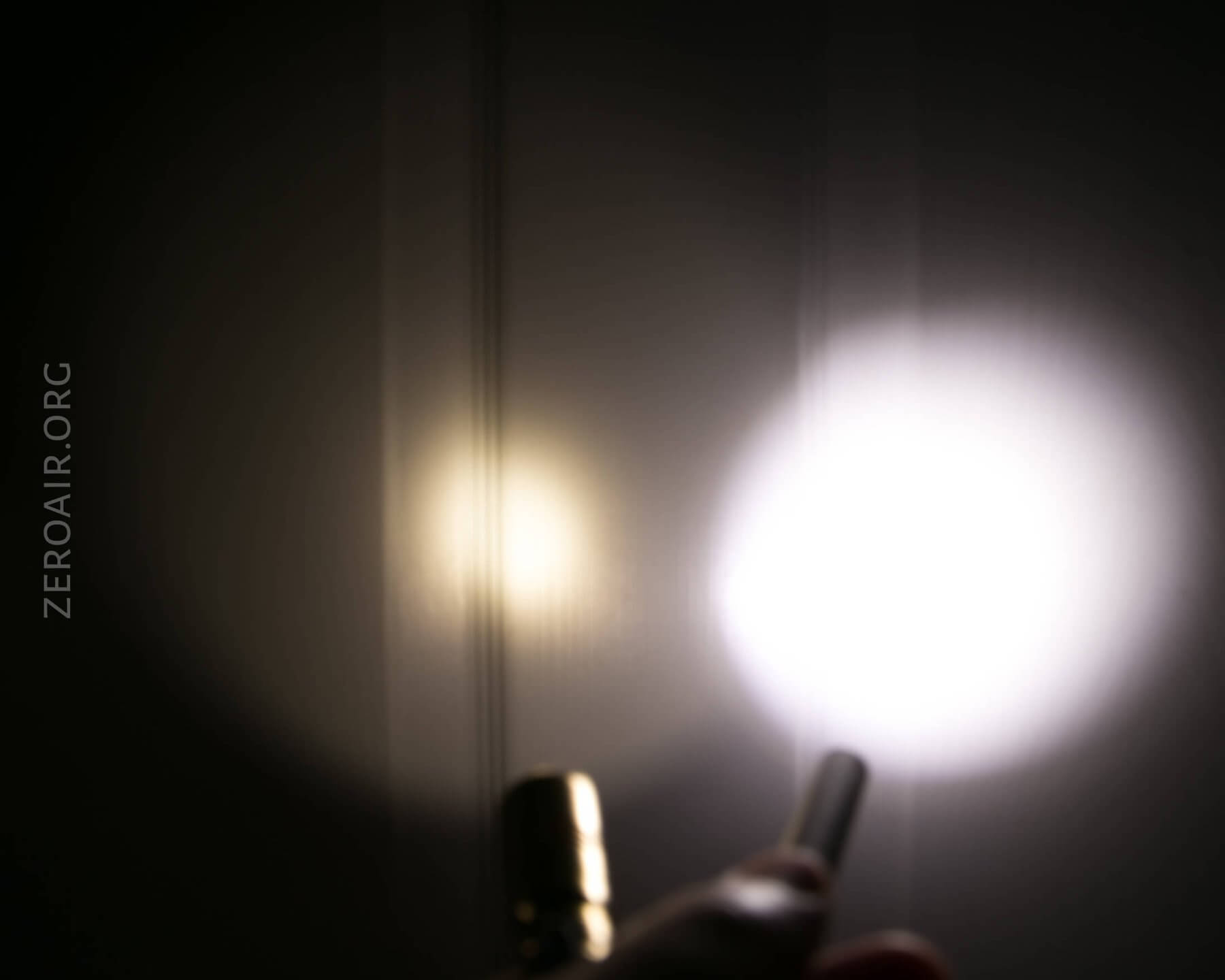
I compare everything to the Killzone 219b BLF-348 because it’s inexpensive and has the best tint!
Conclusion
What I like
- Brass light!
- AA/14500 use is a nice change from the common 18350/18650 lights on the market
- Moonlight is very low indeed
- The unusual shiny brass body looks very nice
- Vastly improved pocket clip
What I don’t like
- Brass is coated, so it won’t easily patina
- The button is a bit squeaky
- No option to ship with tritium
Notes
- This light was provided by BangGood for review. I was not paid to write this review.
- This content originally appeared at zeroair.org. Please visit there for the best experience!
- Use my amazon.com referral link if you’re willing to help support making more reviews like this one!
- Please support me on Patreon! I deeply appreciate your support!
Discover more from ZeroAir Reviews
Subscribe to get the latest posts sent to your email.
Great review, but I have to make one comment about your claim that the tailcap is not removable.
While the tailcap on this is quite tight, it came off for me using only my hands (I’m no bodybuilder). Once off it wasn’t too hard to separate the two pieces that comprise the tailcap/switch unit. Once this unit is broken free the part that holds the switch (to which the ring that secures the clip screws onto) can be tightened back to its original torque (so it won’t free easily). From here the ring that holds the clip can be put on finger tight, enough to keep the clip from easily spinning, but also able to be loosened easily by hand. This allows for easy clip removal/attachment.
It is worth noting that there is a small copper ring/washer that sits between the switch and flashlight body. This piece could be somewhat easy to bend or lose, if one is being careless. Remove this tailcap unit mindfully, this piece is by no means small, but could be missed. I assume this piece’s function is electrical contact, but I am not positive.
Since doing this, swapping between clip and no-clip has been a breeze, no tools and just a few seconds. And the clip is still held on strong enough that daily pocket carry does not spin it. This design has actually become one of my favorite aspects of the light, as removing the clip is now almost as easy as with a clip on style, but eliminates the unsightly scratches that clip-style leaves on the finish. I think it is a great middle ground between clip-on and screw-on clips.
It is raw brass with hand polishing, and then sealed in wrapping. Only copper LAN and copper Pineapple had a clear coating.
Hey Rey! Thank you for the official information!!
And welcome to zeroair.org. 🙂