

Olight i3T EOS Titanium AAA Flashlight Review
Olight has updated the i3T EOS light – now the AAA flashlight sports a body of titanium! I believe not much else has changed, but the titanium option is welcome! Read on for some testing.
Official Specs and Features
Here’s a link to the official product page.
Versions
There are a bunch! Not all of them are always, or still, available.

What I’m reviewing and testing here is the Olight i3T EOS Ti, but I’ve also reviewed the one beside it – the i3T EOS. As far as I can tell only the body has changed. As a result, much of that text will be seen here too. All new testing, of course!
Price
These are going for $36.95 right now at Olight.com/store (that’s a referral link).
Short Review
I like AAA lights, and this is a nice option. The titanium is very great – the threads are brass (or, at least the male side of the threads is brass) so they’re very smooth. The output meets the claims, and the light runs on standard AAA cells. I’m not a fan of the emitter (cool white), and I’m unclear how easy a swap would be. All in all for the price, for a titanium light, I think this isn’t a bad deal!
Long Review
The Big Table
| Olight i3t EOS Titanium | |
|---|---|
| Emitter: | Luxeon TX |
| Price in USD at publication time: | $36.95 |
| Cell: | 1xAAA |
| High Runtime | Low Runtime |
| LVP? | No |
| Switch Type: | Mechanical |
| On-Board Charging? | No |
| Claimed Lumens (lm) | 180 |
| Measured Lumens (at 30s) | 189 (105% of claim)^ |
| Candela per Lumen | 5.5 |
| Claimed Throw (m) | 60 |
| Candela (Calculated) in cd (at 30s) | 124lux @ 2.881m = 1029cd |
| Throw (Calculated) (m) | 64.2 (107% of claim)^ |
| All my Olight reviews! | |
^ Measurement disclaimer: Testing flashlights is my hobby. I use hobbyist-level equipment for testing, including some I made myself. Try not to get buried in the details of manufacturer specifications versus measurements recorded here; A certain amount of difference (say, 10 or 15%) is perfectly reasonable.
What’s Included

- Olight i3T EOS Titanium Flashlight
- Alkaline AAA cell
- Manual
Package and Manual


Build Quality and Disassembly

Like many Olights, this light has a nice feel in hand. The titanium is stonewashed (or some finish, anyway) and adds a nice subtle grippiness.


The tailcap – the only removable part – has reeding which really aids in tailcap removal.

The double helix is maintained from previous versions of the i3T EOS.


One update from previous iterations (or at least the one I reviewed) is a QR code. That QR code actually only brings up the serial number of this specific light.


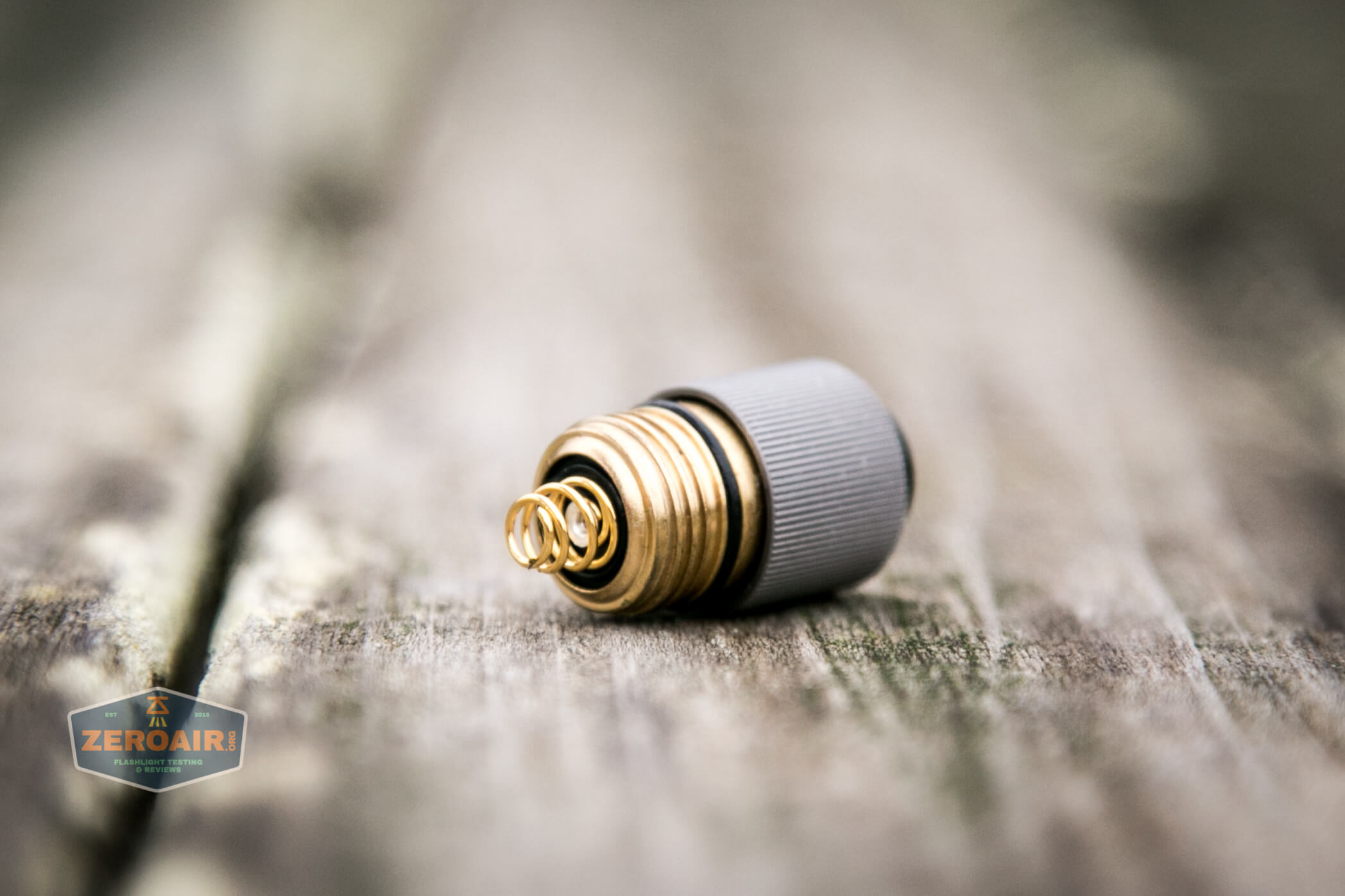
The tailcap is made of largely brass bits.

The threads are very smooth. Brass and titanium meet together very well, it seems! These threads are square-cut and fairly short.

The tailcap has a nice big spring.

The head end has only a brass button.


Size and Comps
Officially Weight 39g
Length 89mm
Head and body diameter 15mm.


If the flashlight will headstand, I’ll show it here (usually the third photo). If the flashlight will tailstand, I’ll show that here, too (usually the fourth photo).


Here’s the test light with the venerable Convoy S2+. Mine is a custom “baked” edition Nichia 219b triple. A very nice 18650 light!


And here’s the light beside my custom-engraved TorchLAB BOSS 35, an 18350 light. I reviewed the aluminum version of that light in both 35 and 70 formats.

Retention and Carry
The pocket clip, which is arrives installed, is a two-way clip. There’s a lanyard hole in the shoulder, too. At one point I didn’t like these clips, and while I still prefer the more traditional type, these have grown on me a little. Whatever you think about the clip part, it is held snugly on the body.


The clip hug, seen below.
No lanyard is included, though the pocket clip does have a hole that would allow easy connection of a lanyard.
Power and Runtime
Power is provided by a single AAA cell. Olight does include a primary cell, but all my testing was done with an Eneloop AAA NiMH.

As with most flashlights, the positive end of the cell goes toward the emitter.
Runtime is rated at 21 minutes for High. Output is in fact steady at around 189 for almost 10 minutes, then drops off steadily to around 60. Sixty lumens is much higher than the next mode down (Low), and this is stable for another ~50 minutes.

Low is projected at 16 hours. I am seeing about 15 hours here, but that could be just because I used a rechargeable.

Modes and Currents
| Mode | Mode Claimed Output (lm) | Claimed Runtime | Measured Lumens | Tailcap Amps |
|---|---|---|---|---|
| High | 180 | 21m | 189 | 1.34 |
| Low | 5 | 16h | 5 | 0.04 |
Pulse Width Modulation
Not really any PWM to be seen here, which is good.


Here you can see a “baseline” – a chart with almost no light hitting the sensor.

Then there’s the Ultrafire WF-602C flashlight, which has some of the worst PWM I’ve seen. It’s so bad that I used a post about it to explain PWM! Here are multiple timescales (10ms, 5ms, 2ms, 1ms, 0.5ms, 0.2ms) to make comparing this “worst” PWM light to the test light easier. That post also explains why I didn’t test the WF-602C at the usual 50us scale.


User Interface and Operation
The switch is a mechanical forward clicky. It’s very clicky and clicks on the downstroke and upstroke. The click is quite loud and extremely “positive.”
There’s a good bit of travel, too.


Here’s a user interface table!
| State | Action | Result |
|---|---|---|
| Off | Click | Low |
| Low | Click | High |
| Off | Half-press | Momentary (Low first, another half-press for high) |
The light will revert to low as the next mode once off for 2 seconds.
LED and Beam
The emitter used in this AAA light is the Philips LUXEON TX – or at least that’s what the original was. I don’t think this part has been updated, so that’s what I’m going with here too. The emitter utilizes a TIR reflector, for a nice even beam.


These beamshots always have the following settings: f8, ISO100, 0.3s shutter, and manual 5000K exposure. These photos are taken at floor level, and the beam hits the ceiling around 9 feet away.


Tint vs BLF-348 (KillzoneFlashlights.com 219b version) (affiliate link)
I keep the test flashlight on the left and the BLF-348 reference flashlight on the right.


I compare everything to the KillzoneFlashlights.com 219b BLF-348 because it’s inexpensive and has the best tint!
Conclusion
What I like
- Great use of titanium (with brass threads for smoothness)
- Simple UI
- AAA format (with alkaline/NiMH support)
- TIR optic beam profile
- No strobe!
- square-cut, high-quality threads
What I don’t like
- No Nichia option
Notes
- This light was provided by Olight for review. I was not paid to write this review.
- This content originally appeared at zeroair.org. Please visit there for the best experience!
- Please use my Amazon.com referral link to help support zeroair.org!