
Olight X7 Marauder Flashlight Review
The Olight X7 Marauder flashlight is a beast of a flashlight, using three Cree XHP70 emitters and four 18650 cells. Read on for some testing!
Olight X7 Marauder Official Specs and Features
Here’s a link to the Olight X7 Marauder Flashlight product page.
- Uses three top-class cool white CREE XHP 70 LED with a total of 12 light-emitting cores.
- A maximum output of 9000 lumens, which is great for strong illumination, and a minimum output of 3 lumens, which is suitable for long periods of use at night.
- The switch on the bezel side controls the flashlight, which has three common brightness levels: 3000 lumens, 1000 lumens, and 300 lumens; plus turbo modes: 5500 lumens and 9000 lumens; nightlight mode: 3 lumens; and a strobe at 10Hz.
- Double-press the side switch quickly to activate the Turbo (5500 lumens) mode, and double-press quickly again to access the Turbo S (9000 lumens) mode.
- Low-voltage indicator monitors the battery power level while the light is on, which will glow red when the battery power is running low.
- Active Thermal Management: MCU detects the flashlight temperature through the internal thermal sensor in real time, and prevents overheating by reducing the output.
This product has the following specifications (ANSI/NEMA FL1-2009 Standards):
| Item | Rating |
|---|---|
| Max Output (lumens) | 9000 |
| Low (lumens) | 3 |
| Max Run Time (hours) | 30 days |
| Beam Distance | 313 m |
| Peak Beam Intensity (candela units) | 24,500 cd |
| Water Resistance | IPX8 (waterproof up to 2 meters) |
| Impact Resistance | 1 m |
| Head Diameter | 2.68 in. / 68mm |
| Length | 5 in. / 127mm |
| Battery Type | 18650 |
| Weight (oz) | 16.6000 |
| pocketclip | No |
| User Manual | N/A |
Olight X7 Marauder Short Review
The Olight X7 Marauder is a very fun ‘little’ light that does what it claims – tons of glorious flood.

Long Review
What’s Included

- Olight X7 Marauder
- Holster
- Instruction Manual
Package and Manual
In typical ‘big light’ Olight fashion, this package is a well-appointed coated cardboard box, held closed by a magnet.
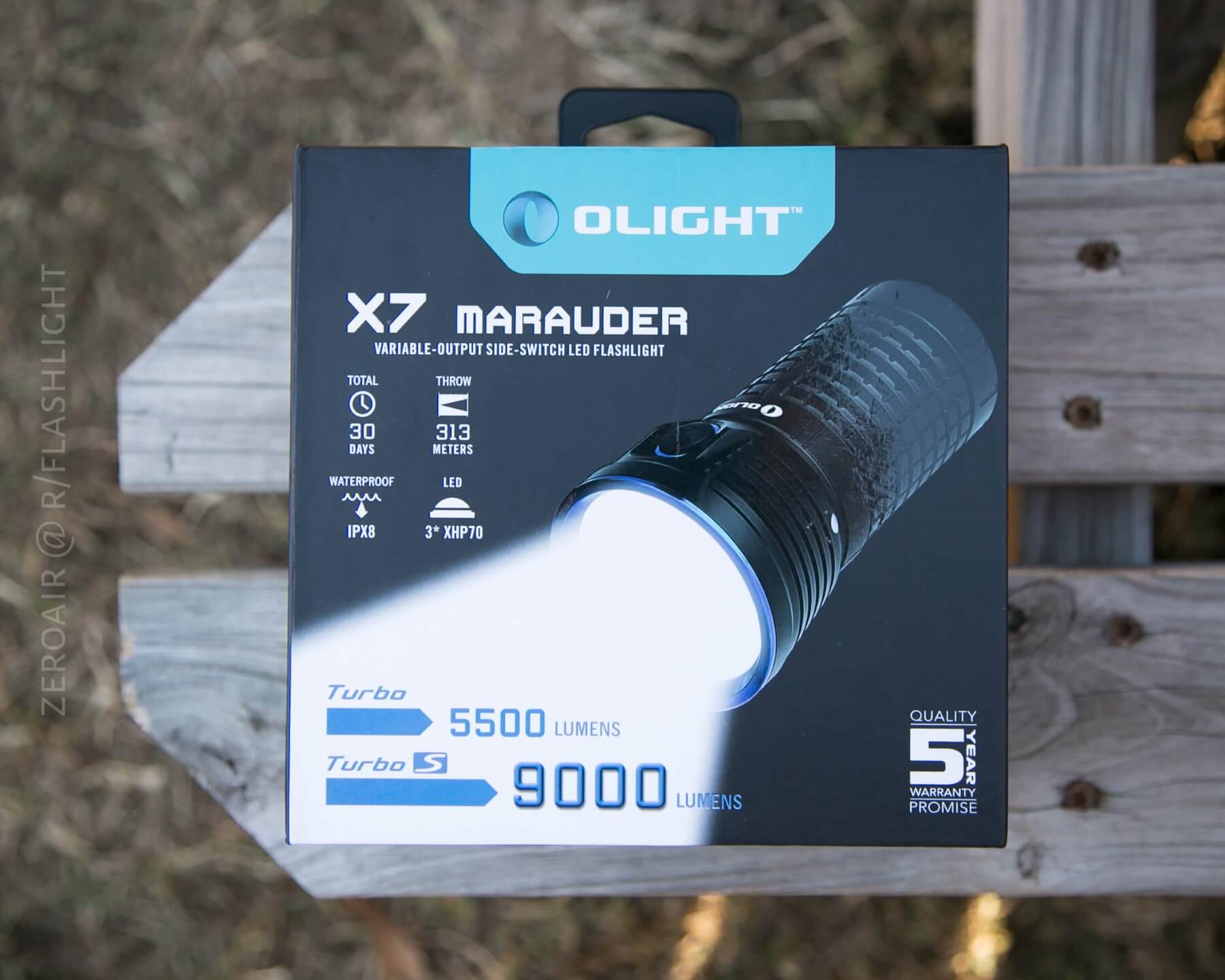
One side has a QR code.

The other, just some use images.

Inside, of course, the X7 Marauder is cradled in an exact cutout, retrievable by a little ribbon.

The other bits are in a box beside the light.

There’s a little hang tag perfect for store display, too. The back of the box has a bunch of useful spec/info.

The English manual isn’t long, but the manual as a whole contains many languages. And there’s a warranty page.


There’s also a card alerting the user to the need for 8A discharge cells.

Part of the ‘packaging’ is a film that protects the lens during shipping, on the X7. Remove this before use, of course.

Build Quality, Durability, and Disassembly
Build quality is superb. Just like on the R50 – possibly even better. Being a [can light, 18650×4, three emitters] light, of course, this light has some heft. It’s not unwieldy heft, however – it’s a “sturdy” heft. The light feels very solid and pleasant. The ‘knurling’ is great. Deep grooves and graspable but not grippy. I also like that the only thing that disturbs perfect cylindrical symmetry on the body is the switch. For some reason, I often have trouble finding switches if there are lots of bits on a light. That is not the case with the X7. The button is easy to find, and it’s also a large button, but responsive over the whole clicky part. The anodizing feels great – thick enough to feel very smooth. And the threads are very well lubed and square-cut. Extremely nice threads, really. Often, I’m afraid of cross-threading these things, but the X7 gives me no fear in that regard.
The head has nice, thick, and kind of deep cooling fins, which work quite well.

And of course, the appointments all over the light are the recognizable Olight blue.

It’s hard to make any claims about durability. I don’t really need a can light with x000 lumens of flood all that often, but from my use, there are absolutely no signs of use.
Disassembly…. The tailcap comes off, of course: that’s how you put the cells in. There have been reports that the bezel on the X7 unscrews. Using some of those grippy pads for opening jars in the kitchen, and with little effort, the bezel does in fact unscrew right off. It holds the glass, and the reflector just comes right out! So the MCPCB is easily accessible (held down by the leads and two Phillips screws). Emitter swaps should be easy if you’re into that kind of thing and want to move away from the stock tint.
Size
I hinted at it above, but this light is a great size and heft. Great in-hand and long enough that the head won’t be in your hand when the light gets hot…. 68mm x 127mm. For reference, a soda can is approximately 66x123mm. The X7 is about the size of a soda can.
Here are a few other lights for reference – maybe you can get a better idea of the size with comparisons. (Manker E14, Klarus XT11GT, BTU PK26, Olight X7, Convoy C8).

Retention
The only option is the provided pouch. There’s no belt clip, no magnet, no lanyard. You can store it in a bag or a pouch. Or your pocket, but that’s not for me. I got tired of all the “are you twice as happy to see me as usual?” jokes….
Power
The power-hungry Olight X7 marauder needs good cells. The kit, of course, comes with good cells. It will include four (4) Olight 3500mAh. Whatever cells you do choose to go with, make sure they’re married – same voltage, same capacity, and they need to be high-drain button cells – mine are IMRs. Flashlights like this, which have more than one cell, need to have cells that are balanced (V and Ah) because if the cells are mismatched, things might get boomy. Or maybe they won’t, and you’ll get lucky. But the logic behind using married cells isn’t a conspiracy by cell manufacturers.
The cells Olight sells for this light are protected, and that’s what they recommend. With the springs such as they are on the X7, I expect unprotected cells would work just fine, too. And the light does have low voltage protection, which kicks in around 3.05V. On my three runtime tests, the cutoff was:
- 3.10, 3.08, 3.08, 3.10
- 3.06, 3.07, 3.07, 3.08
- 2.96, 2.96, 2.97, 2.97
A fine cutoff for Li-ion cells. The protection of the cell would cut off at probably 2.5V, so there’s plenty of room before that.
Another note about the cells, for whatever you buy for this light: Olight says, “You will need to make sure it is at least 10A to make the light hit 9000 lumens.” Remember I said you’d need good cells….good high-discharge cells. (“10A” was in a comment on Olight’s site. Other places they say 8A.)
The battery compartment requires two cells up and two cells down. Both the tailcap and inside the body on the head side has +/- indicators, but it’s probably easier to just note that the negative terminals go on the spring end.

The battery compartment is also specific, in that there are two pins that must feed into the body of the light, before screwing down the tailcap fully.

This allows for proper alignment of the cells and tailcap. I found these to line right up at times, and be a little fiddly at other times.
And finally, regarding ‘power’ – if the cell voltage gets too low, the indicator (located on the head of the light) will blink red.
Here are my runtime results on 3500mAh cells.

User Interface (UI) and Operation
One single clicky button separates you from ultimate power. That’s right, one dime-sized silicone, responsive button, controls all these lumens.
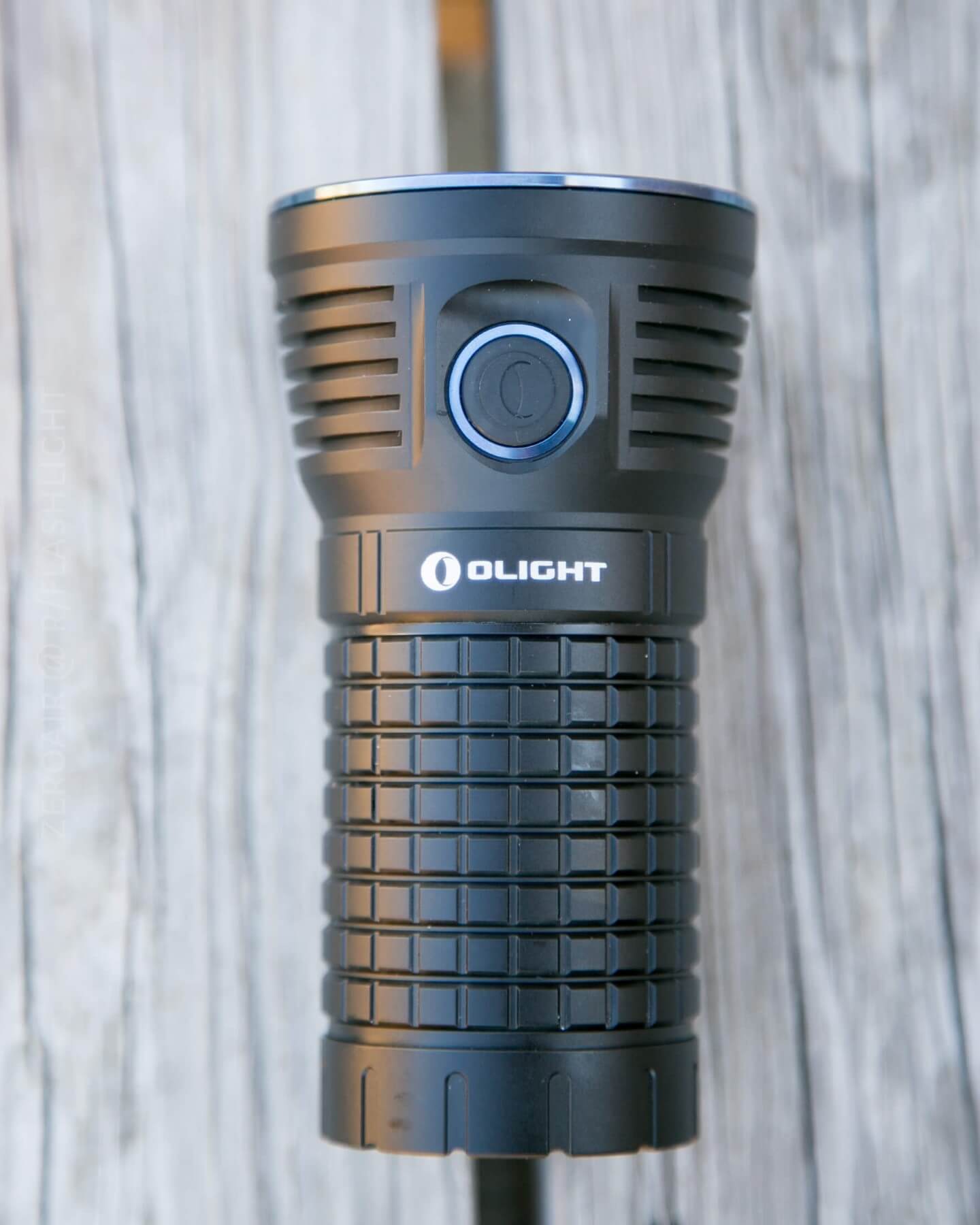
It’s easy to operate and, more importantly, easy to locatethe button. I like tables, so here’s the user interface in a table.
| State | Action | Result |
|---|---|---|
| Off | Click | On (last mode)^ |
| Off | Double Click | Turbo/Turbo S |
| Off | Triple Click | Strobe |
| Off | Hold | Nightlight |
| Off | Hold+Hold | Lockout |
| Lockout | Click | Momentary Nightlight |
| Lockout | Hold | Exit lockout |
| On | Hold | Cycle** (Nightlight>L>M>H***) |
^ Memory works with nightlight, low, and medium. High can be remembered for 10 minutes (then reverts to medium). Turbo S and Turbo are memorized as High.
** Release the switch on the desired mode
*** Turbo/Turbo S aren’t in the regular mode cycle
I haven’t seen anyone else mention the ‘momentary’ nightlight during lockout. I loved that, and think that’s an absolutely fantastic idea. Another light I’m working on right now has some other interesting features during lockout that have really impressed me, just like this momentary nightlight has. I’m very glad to see manufacturers thinking about how lights are used and trying to make them more usable in those cases. It’s fantastic.
The operation of this light is great. The clicky works great, and the user interface is easy to learn. I also like that even though it’s not all that common of a light, it’s simple. It doesn’t have added buttons or added charging…. it just makes a LOT of light from a small package.
LED and Beam
Three XHP70s are what you get in the Olight X7 Marauder.
Did you know ‘marauder’ means “a person who marauds; a raider”? Well, all those XHP70’s are gonna raid you of darkness. Seriously, this thing makes so much light it’s not even funny.
The emitters are each nestled in shallow orange peel reflectors.

Mine was pretty nicely centered, but with a beam that’s completely flood anyway, centering doesn’t matter much.

Beamshots
These beamshots always have the following settings: f8, ISO100, 0.3s shutter, and manual 5000K exposure. These photos are taken at floor level, and the beam hits the ceiling around 9 feet away.


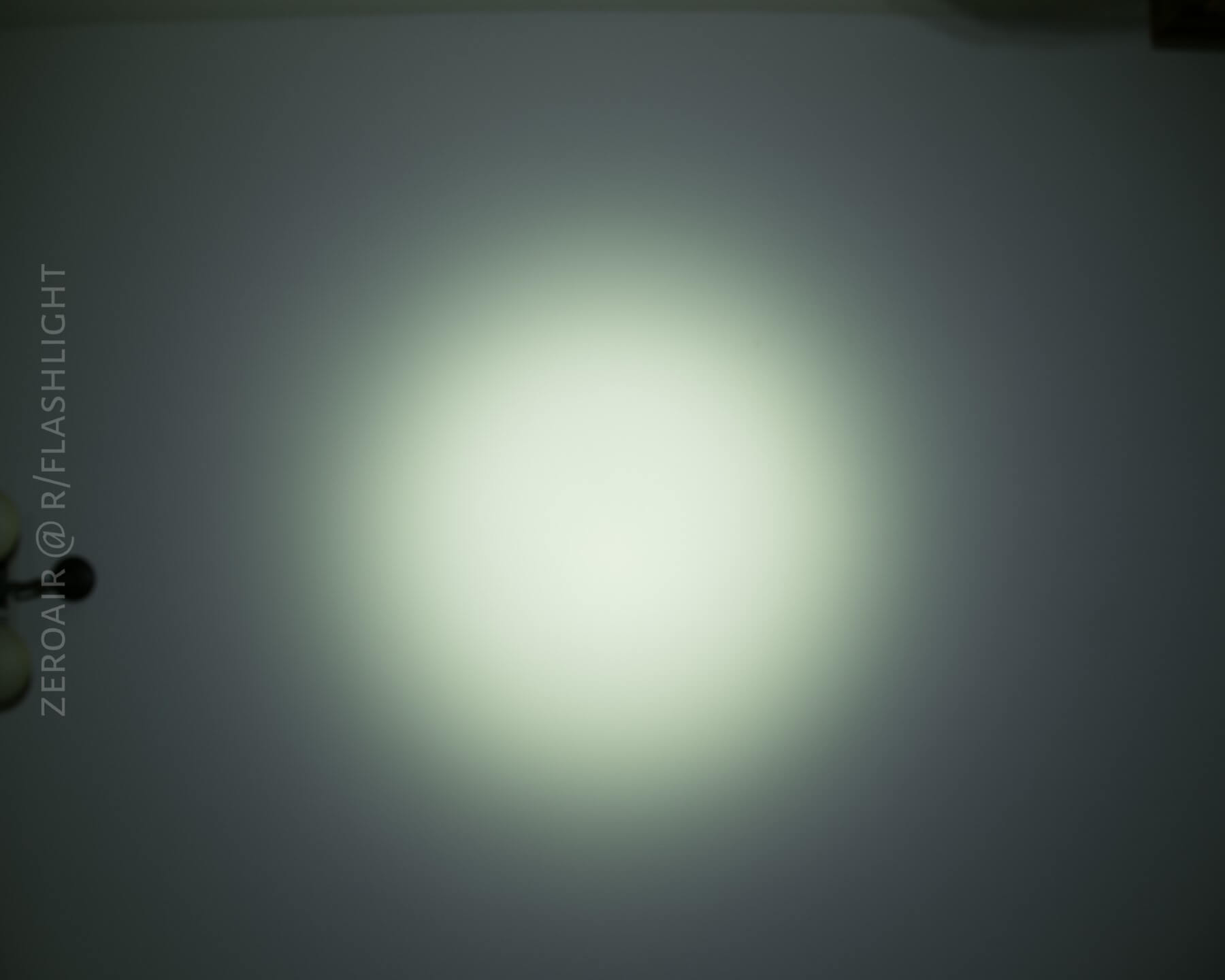

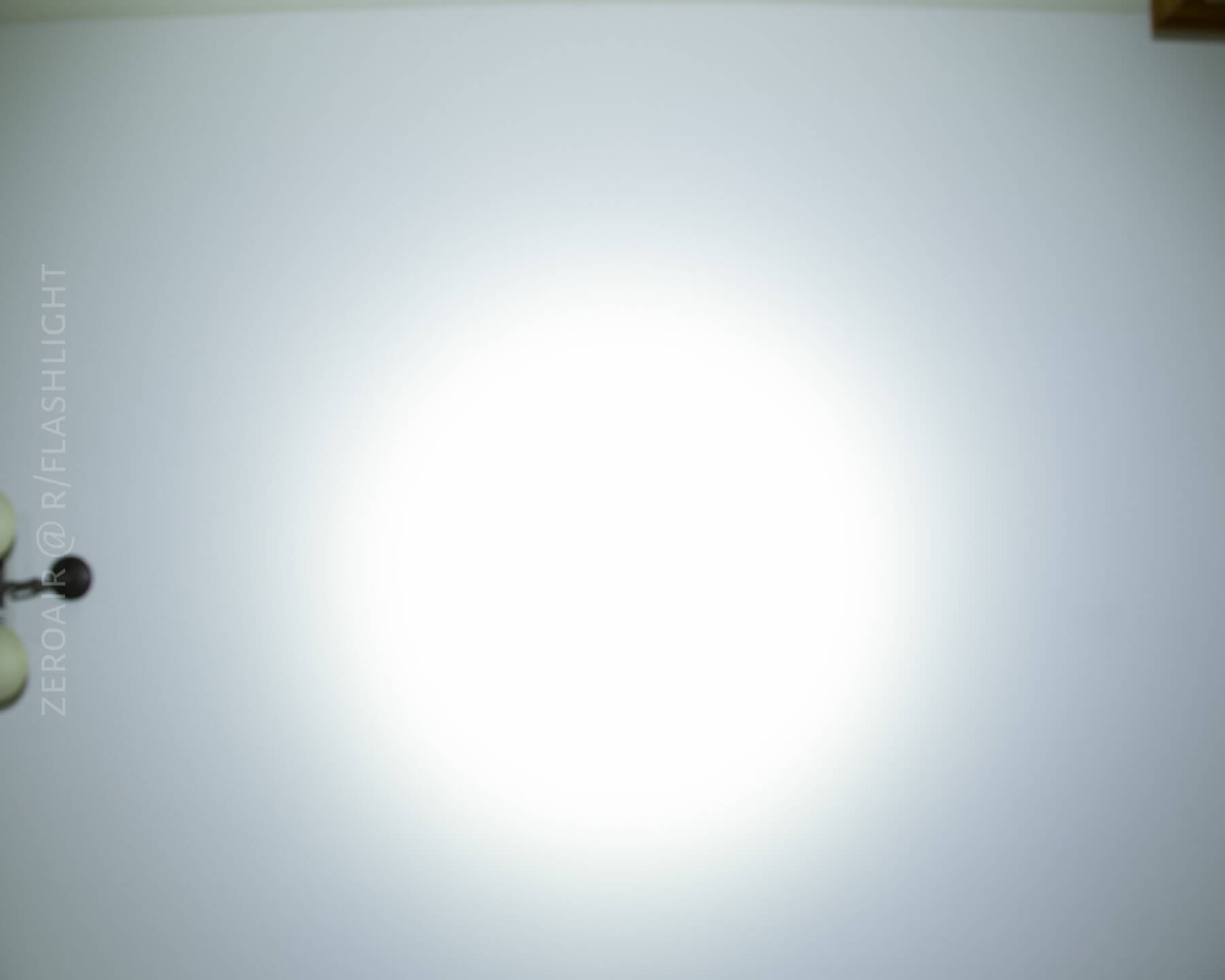

Tint vs BLF-348 (KillzoneFlashlights.com 219b version) (affiliate link)
I keep the test flashlight on the left and the BLF-348 reference flashlight on the right.
I did find the tint to be a little green. Not even cool (or “CW”, which the light is) but actually green. It wasn’t terribly annoyingly green, and not really noticeable on higher modes (which is why you have this light, right?). My go-to for comparison is my BLF-348, which is noticeably rosy. But on low, the X7 really looks quite green.

This becomes much less noticeable as the output goes up.
There was an interesting phenomenon with these huge emitters, and whatever capacitors run them…. upon turning the light off, the emitters glow for a short time. 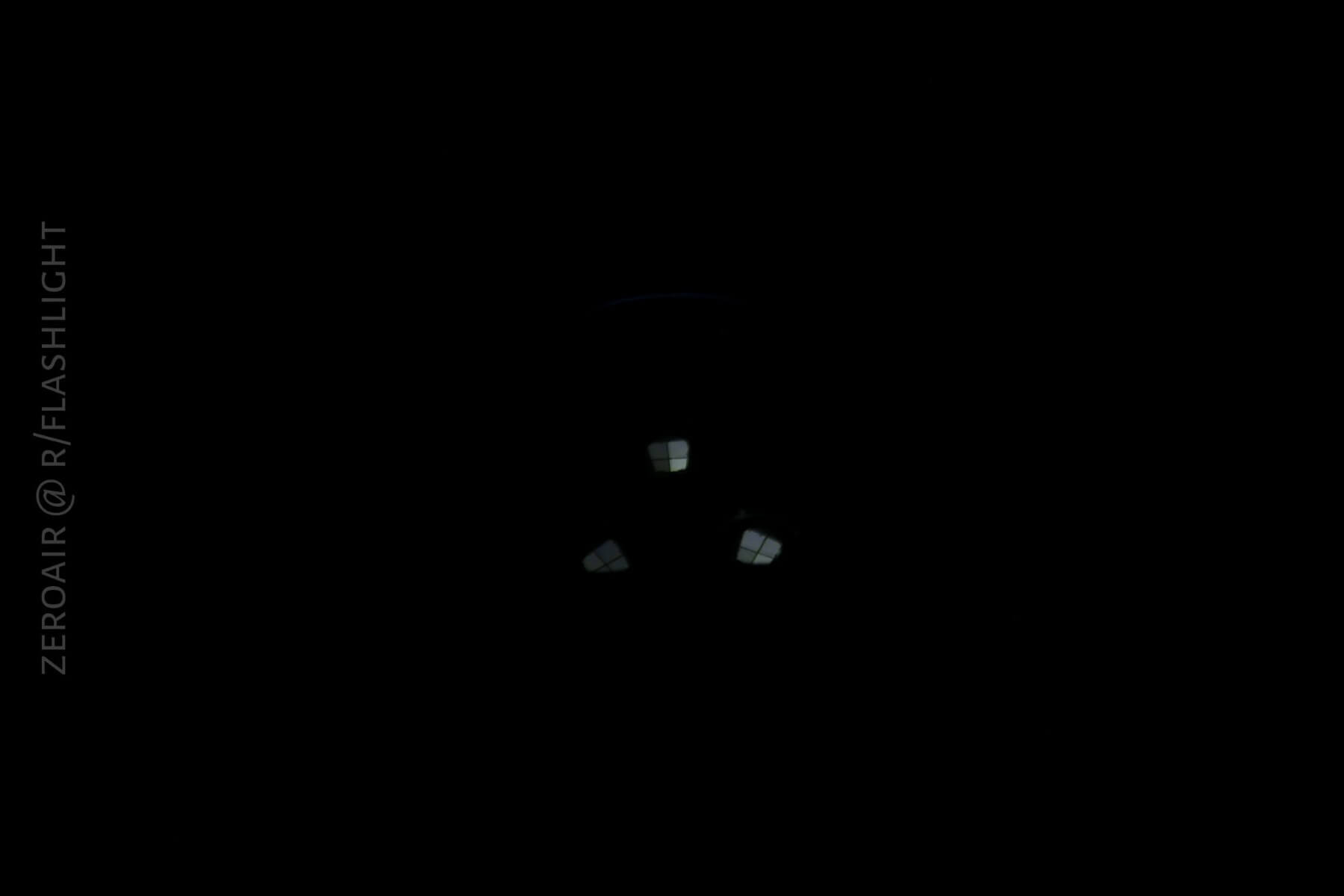
The capacitors are draining their remaining capacity. It’s just neat to see, and something that doesn’t happen with every light. It’s most noticeable after using the ‘nightlight mode’.

Beamshots, Runtime, and Lux Measurements
Here’s what Olight claims regarding runtimes:
| Mode | Lumens | Time (minutes) |
|---|---|---|
| Turbo S^ | 9000 lm | 2.5 |
| →Stepdown | 1800 | 200 |
| Turbo** | 5500 | 8 |
| →Stepdown | 1800 | 215 |
| High | 3000 | 32 |
| →Stepdown | 1800 | 200 |
| Medium | 1000 | 6.5 hr |
| Low | 300 | 40 hr |
| Nightlight | 3 | 30 days |
^ Requires >8A discharge current cells (which is what the kit has)
** Requires >5A discharge current cells
Random Comparisons and Competitive Options
Can lights are becoming more and more popular, and there are quite a few options. The Noctigon Meteor is a good option. The Niwalker MM25MB is even more similar, as it has XHP70x3 just like the X7. Then there’s the new Manker MK34 (which is more like the Meteor than it is like the X7). The point is that there are options. This X7 is so well built that it’d be nearly impossible for the others to be better built. The Meteor is a special category light, I think, with the 219b option, but the X7 should be visibly brighter. The MM25MB is also a great light, but the X7 edges it out on build quality.
The only light I have right now that really compares to the X7 is the Convoy L6.

Of course, the L6 will have more throw because it’s one emitter and a much deeper reflector, but it’s still interesting to see these lights side by side.

I took a bunch of beamshots of the L6 at the same time as I took the X7, but I forgot to upload those. I’ll do that asap.
Conclusion
What I like
- Form factor – can lights are just great fun lights
- The user interface is pretty good and very usable
- Output is ridiculous. Ridiculous good.
- Low is surprisingly good
- Glow-in-the-dark bezel paint!
- Voltage indicator on the head
- The kit has the cells I need, and that Olight recommends
What I don’t like
- Greenish tints in the lower two modes
- The user interface is a little simplistic, and the main purpose of this light (Turbo S) requires an unusual click pathway.
- Underutilized indicator onthe head
Final Thoughts
This is a great light, and I’m happy to have it. It really performs – the sheer amount of light produced is ridiculous.
Parting Shot
The sun, or the X7?

Notes
- This light was provided by GearBest for review. I was not paid to write this review.
- This content originally appeared at zeroair.org. Please visit there for the best experience!
- Use my Amazon.com referral link if you’re willing to help support making more reviews like this one!
- Please support me on Patreon! I deeply appreciate your support!
Pingback: Olight X7R Marauder Flashlight Review – ZeroAir Reviews
Pingback: Olight X7R Marauder Flashlight Review - ZeroAir Reviews