

Zanflare C4 Charger Review
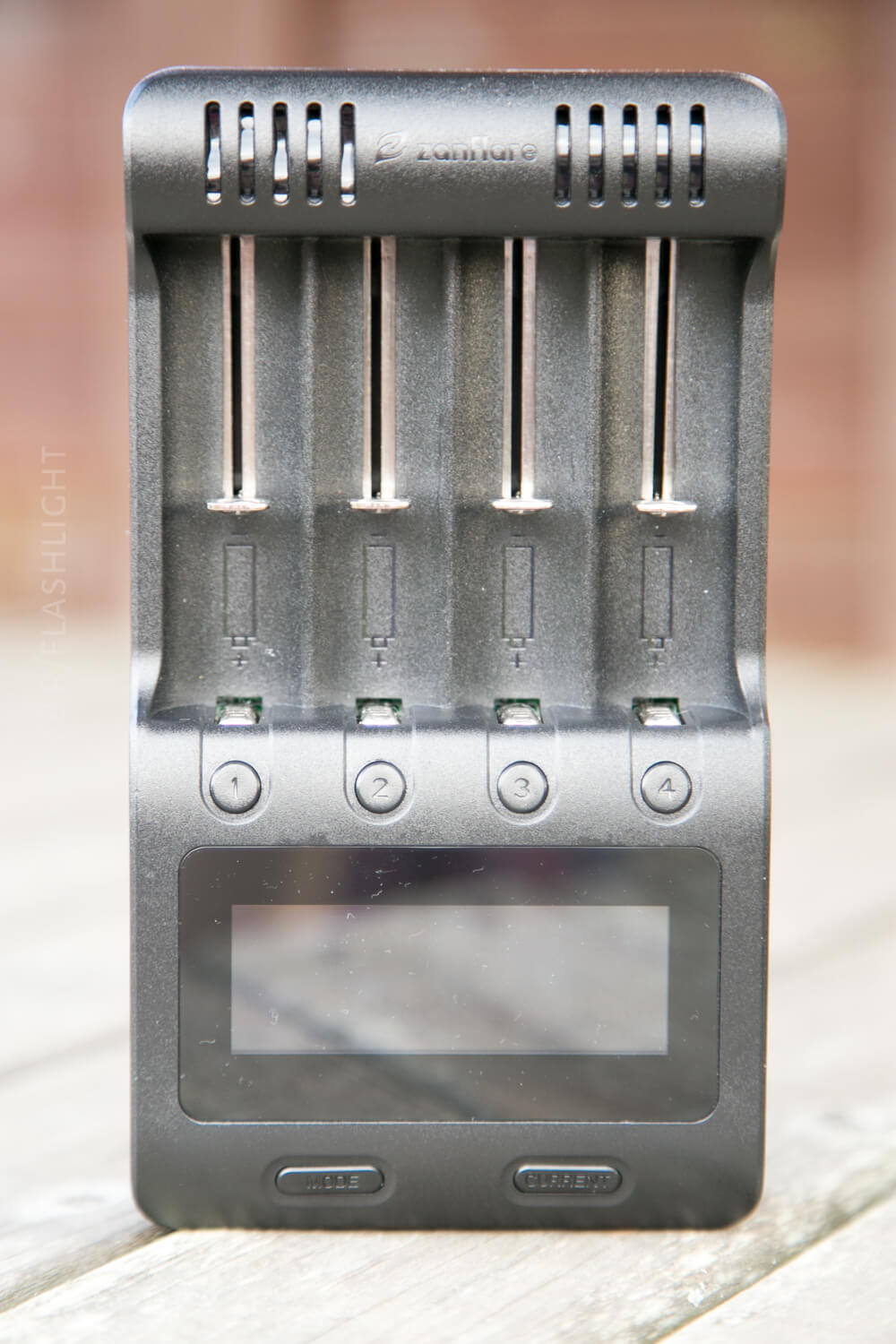
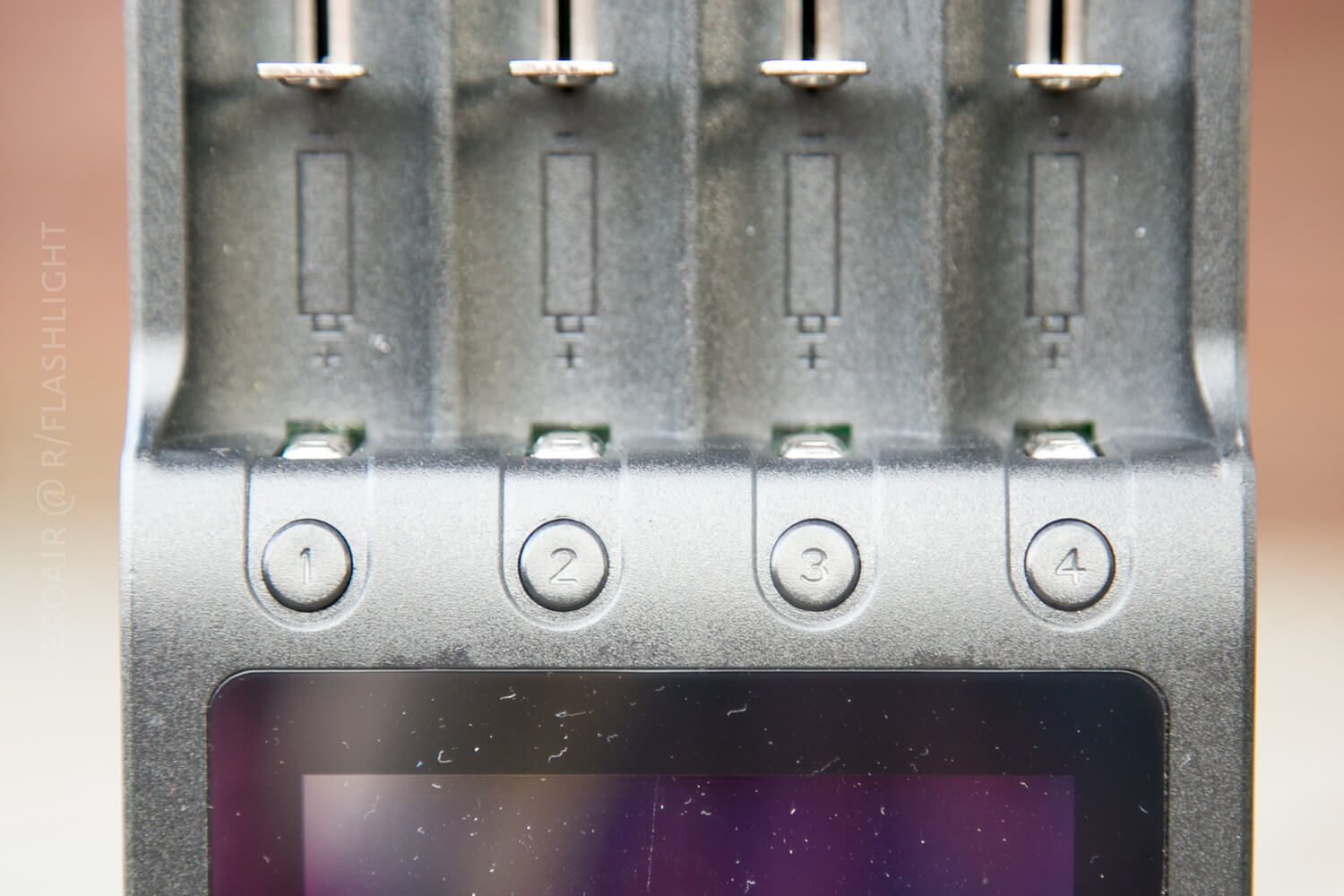
Here’s the Zanflare C4, a charger featuring four bays. Each bay has a button, and there’s a single large display for all the information.
Official Specs
Here’s a link to the Zanflare C4 Charger product page.
Short Review
This charger works just fine for my needs, which is occasional 18650 charging, and nearly constant Eneloop charging. Discharge test would be a nice addition.
Long Review
Key Features
- 4 different charge current options to choose from ( 300mA / 500mA / 700mA / 1000mA )
- It can charge simultaneously rechargeable batteries of different specifications ( 18650, 26650, 26500, 22650, 18490, 17670, 17500, 17355, 16340, 14500, 10440, A, AA, AAA, SC sizes )
- Provided with integrated LCD display to monitor battery parameters including voltage ( V ), current ( mA ), time ( h ), capacity ( mAh ), internal resistance ( mR )
- Overcharge, over-discharge, overheat, Short circuit, reverse polarity protection
- 0V voltage activation function
- Smart identification of damaged batteries
- The 4 slots work independently
- CHARGE, FAST TEST, and NORMAL TEST, three modes to select from
What’s Included

- Zanflare C4 4-bay charger
- Power adapter
- Car power adapter
- Manual
Manual and Packaging
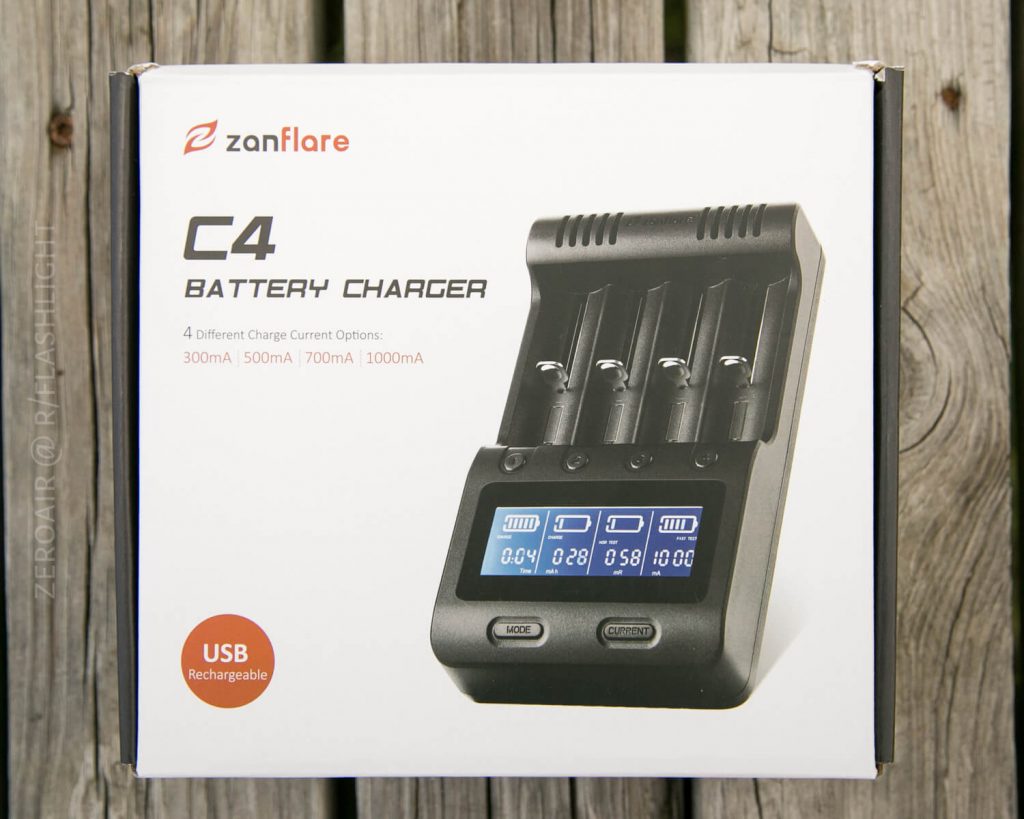
The package is fairly simple – not at all like the package from the Zanflare F1 (which is not bad at all). Everything is securely held in place.

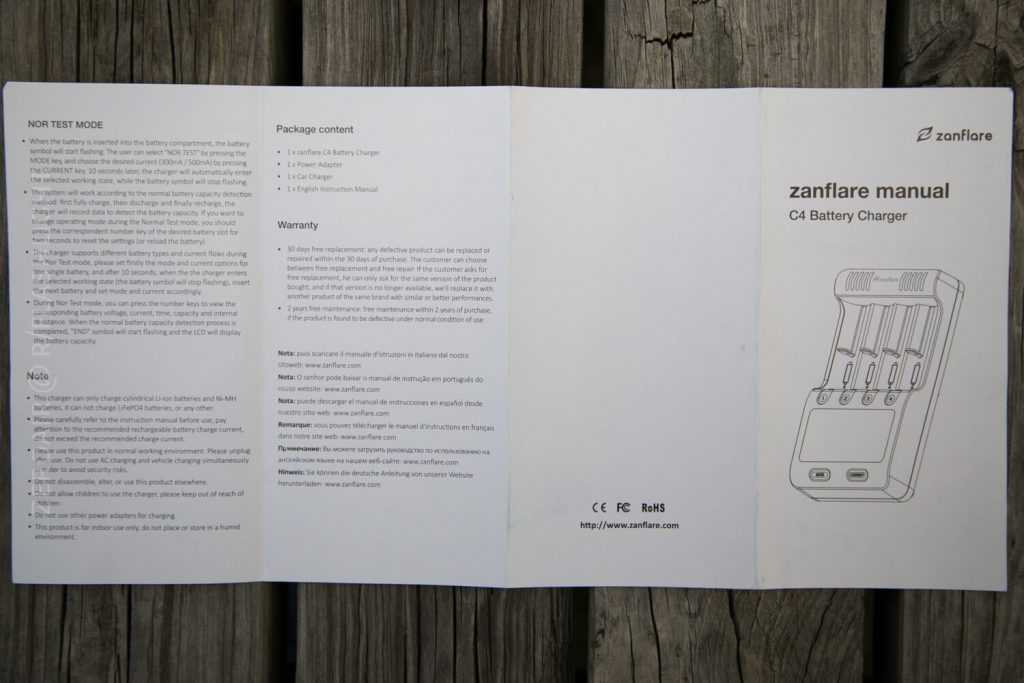
The manual is good, too. All in English; a two-sided paper. Each mode (3) is adequately described. Here are some detailed shots of the manual:


Build Quality and Durability
I’m extremely pleased with the build quality of this device. I haven’t torn it down to look at the internals. The plastic is good quality, and the buttons don’t have a hollow sound like some less expensive chargers.
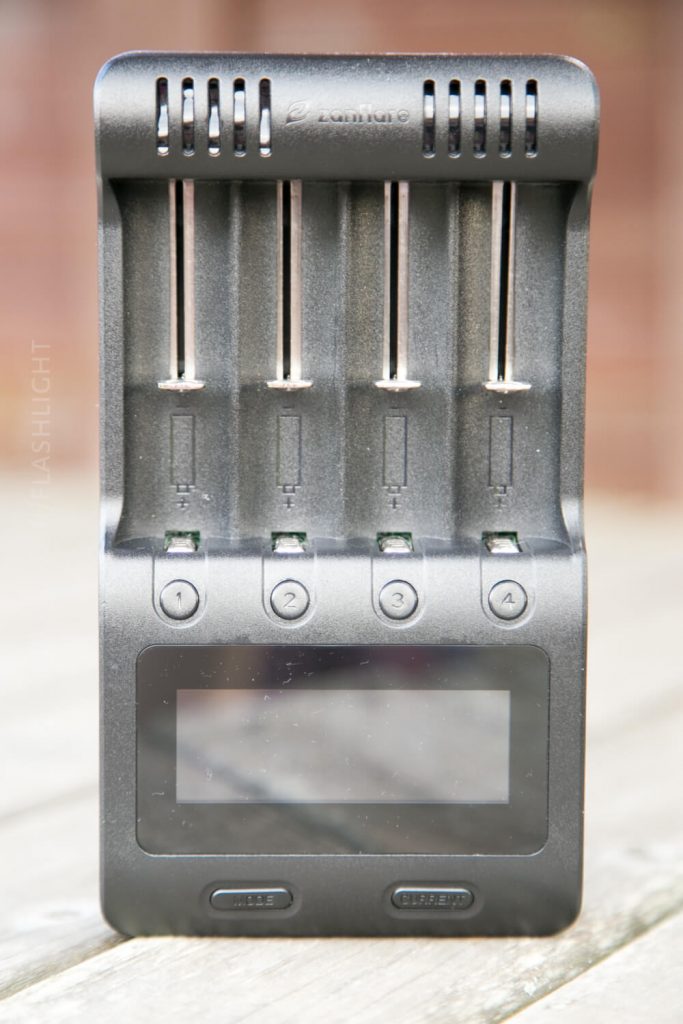

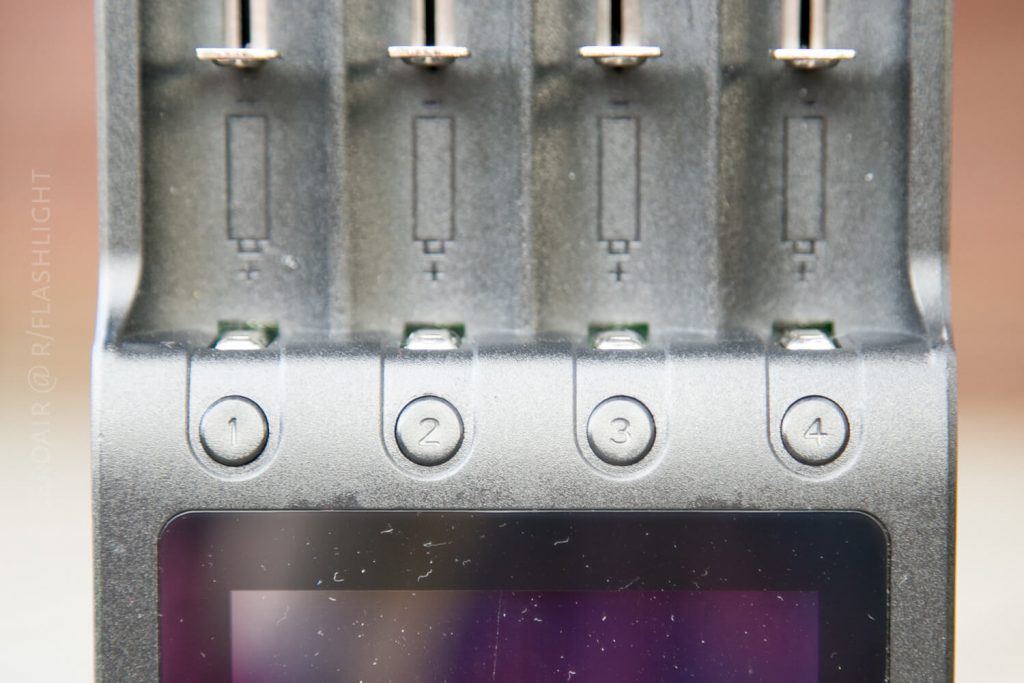
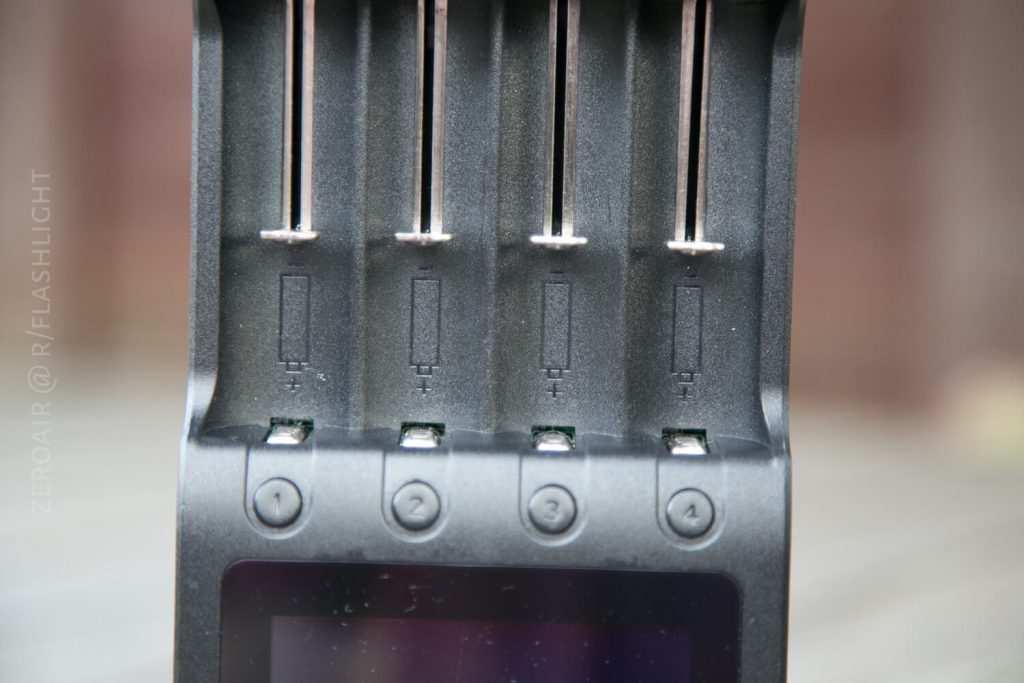
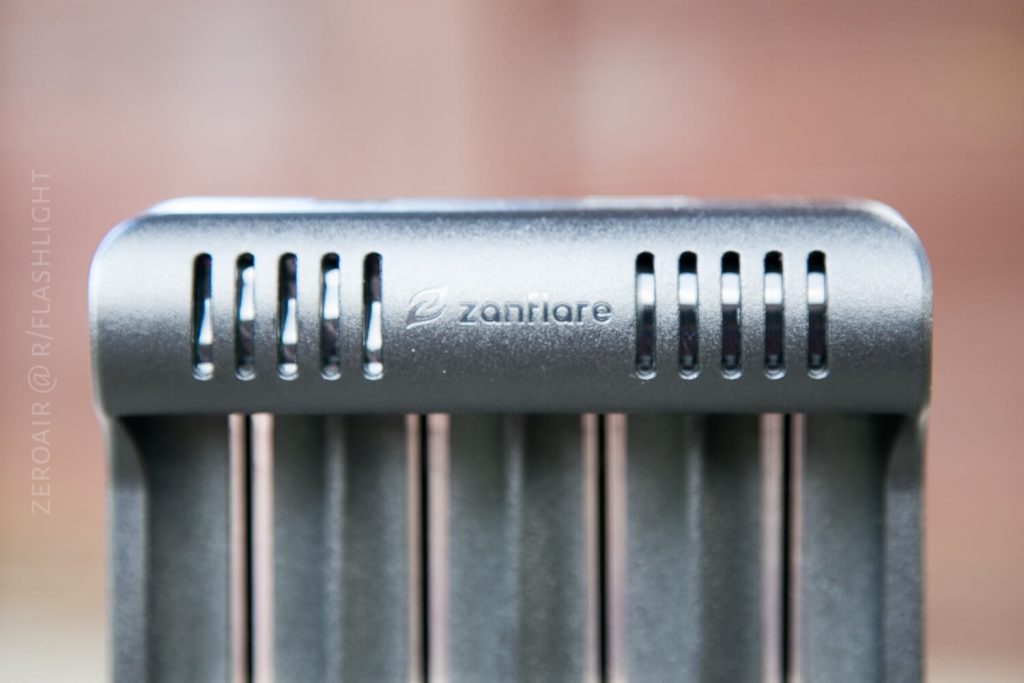

The metal tabs that connect to the cell terminals are nice and thick.


And the springs that run the slides are very smooth and not too tight at all.
Power
The most important point on a charger, huh!
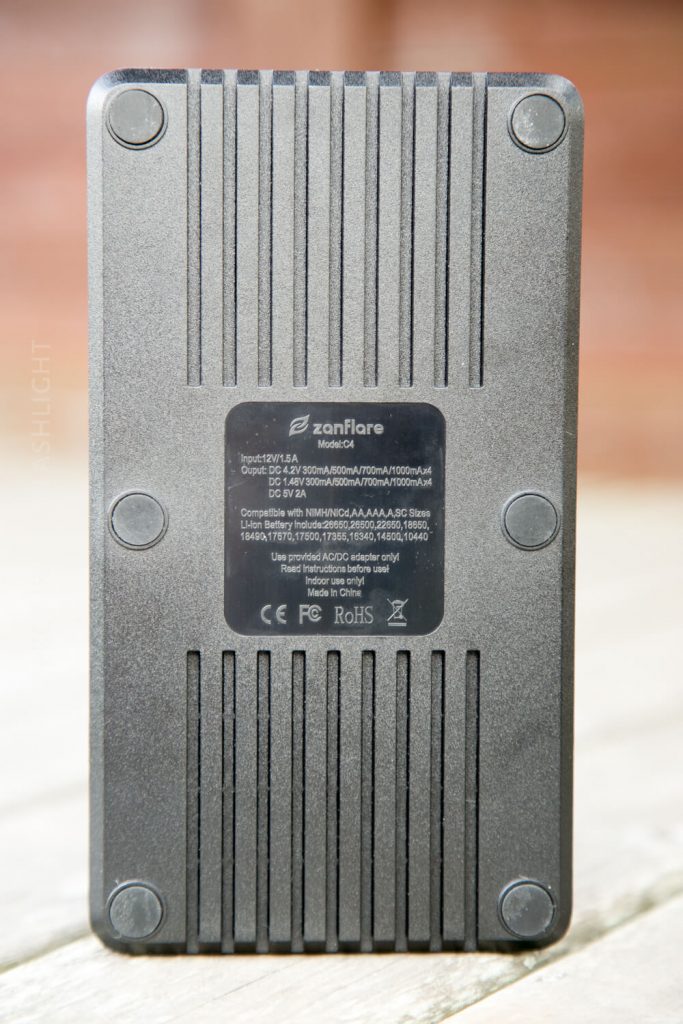
This 4 bay charger charges many common cylindrical cells. Notably (and actually, “only”) Li-ion and NiMH. Included capabilities are 18650, 26650, 26500, 22650, 18490, 17670, 17500, 17455, 16340, 14500, 10440, A, AA, AAA, and Sub C. The bays are long enough for protected 18650s, but not for anything longer. The C4 charges these cells at 300, 500, 700, and 1000mAh. The discharge current is 300 or 500mAh.
Each bay operates independently and can do any available action on any type of cell (as mentioned above), at any rate. It’s very convenient to be able to charge NiMH and Li-ion concurrently!
The device is powered by a 12V barrel plug. I’ll add here (since the barrel plug struck me as oddly small), that the C4 is not UL listed. Make of that what you will.

I ran a number of charging tests on various cells:
Charged 14500 to “4.19” on the readout, but was 4.16V on the meter.
Charged AA to “1.50” on the readout; was 1.479V on the meter.
Charged 18650 to “4.20” on the readout, was 4.15V on the meter.
So it seems the charger undercharges slightly.
I recorded cell voltage on a regular charge cycle of a 2000mAh 18650. I didn’t log current (no way to do that yet!), so what you see here is only cell voltage over time. Note that when the cell reaches 4.2V, charging terminates. There does not appear to be a trickle charge.

I measured each of the promised currents and they’re close to the claimed currents. (The higher the claim, the further off it is.) Ie 300 claimed = 300mA actual. But 1000 claimed is more like 970mA.
There is also a USB out on the top of the C4. Claimed is 1A out if there’s only one cell (which I confirmed: It’s nearly 1A and drops a little under 1A as the cell is more used). And the device claims 2A output if there is more than one cell present. I don’t have a way to test this. The unit has over-discharge protection, so one doesn’t have to worry about a cell becoming too low.
Here are a couple of shots with the device charging an iPhone with one cell at 1A and also with multiple cells at 1A. Note that in this case, the unit was not plugged into the wall, and the ldc can display nothing but “USB“. Can’t display cell voltage, for example. Also, if the unit is plugged in while USB charge is happening, USB charge will stop. (So this isn’t an uninterruptible power supply!). Also from what I can tell, the unit is not a passthrough- if the c4 is connected to wall power, USB out is not active.


I’ve recorded a couple of cycles on some cells, just for your reference.
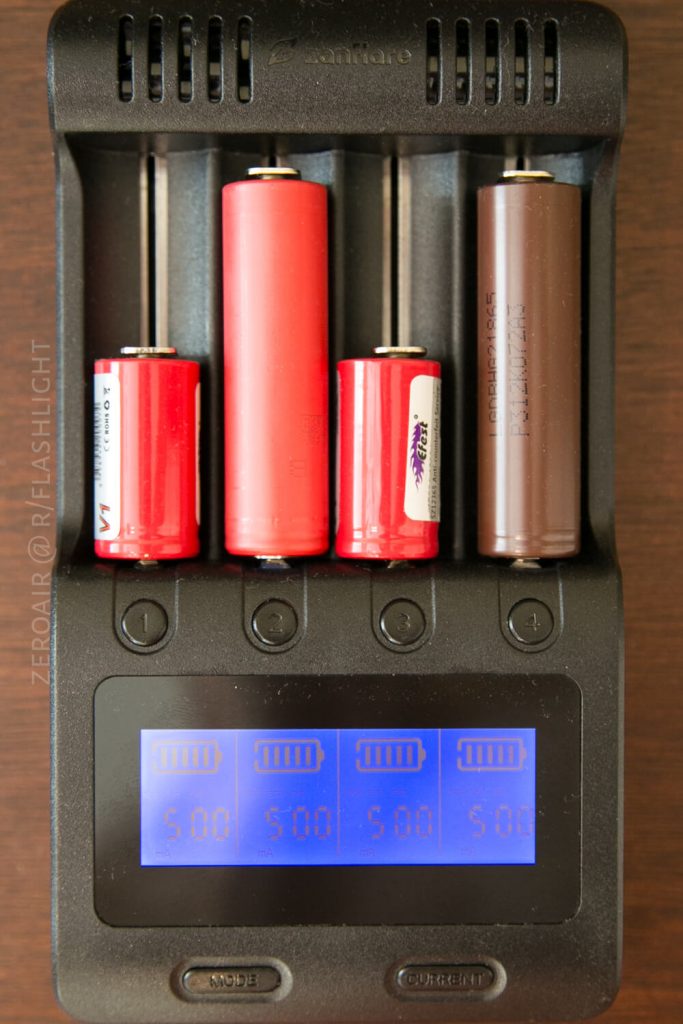
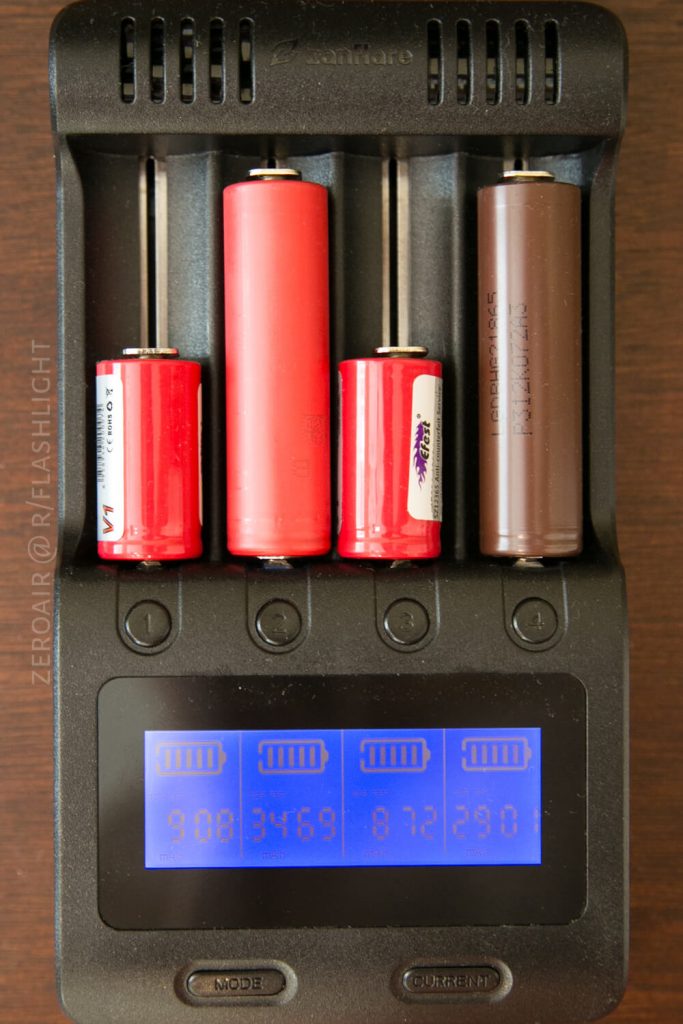
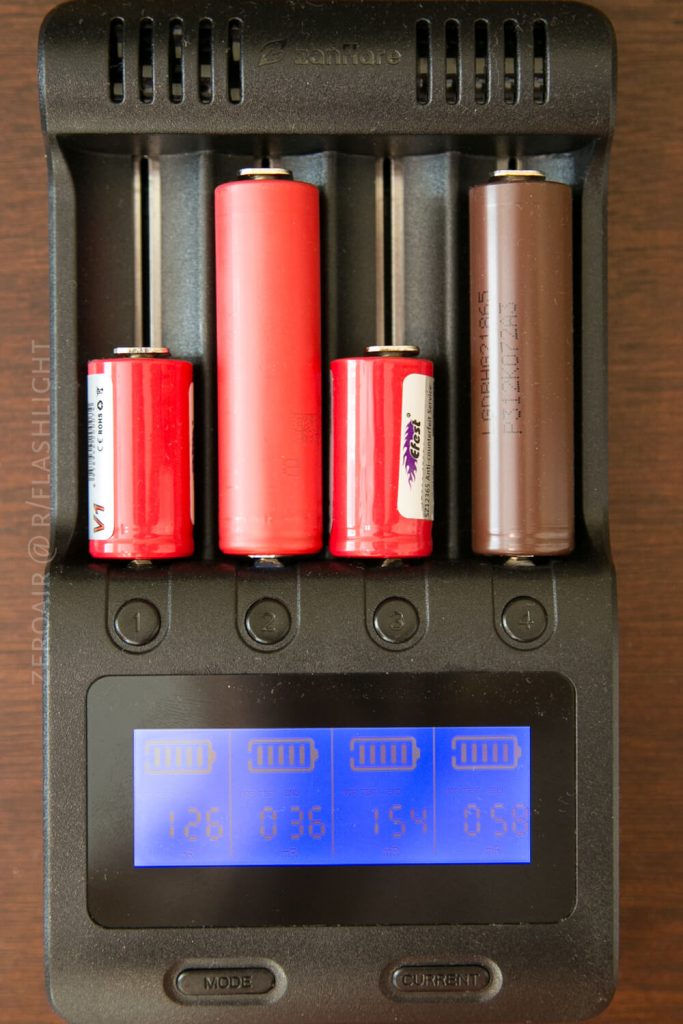
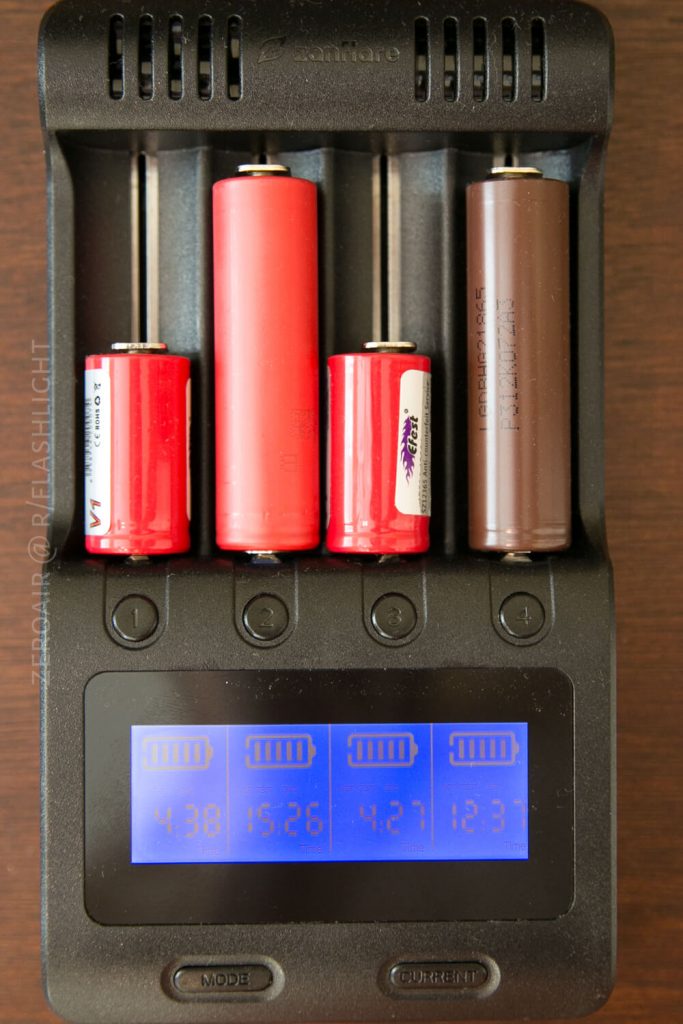
This is the Fast Test at 300mAh. You can see that it took around 4h for the 18350s and around 13-16h for the 18650s.
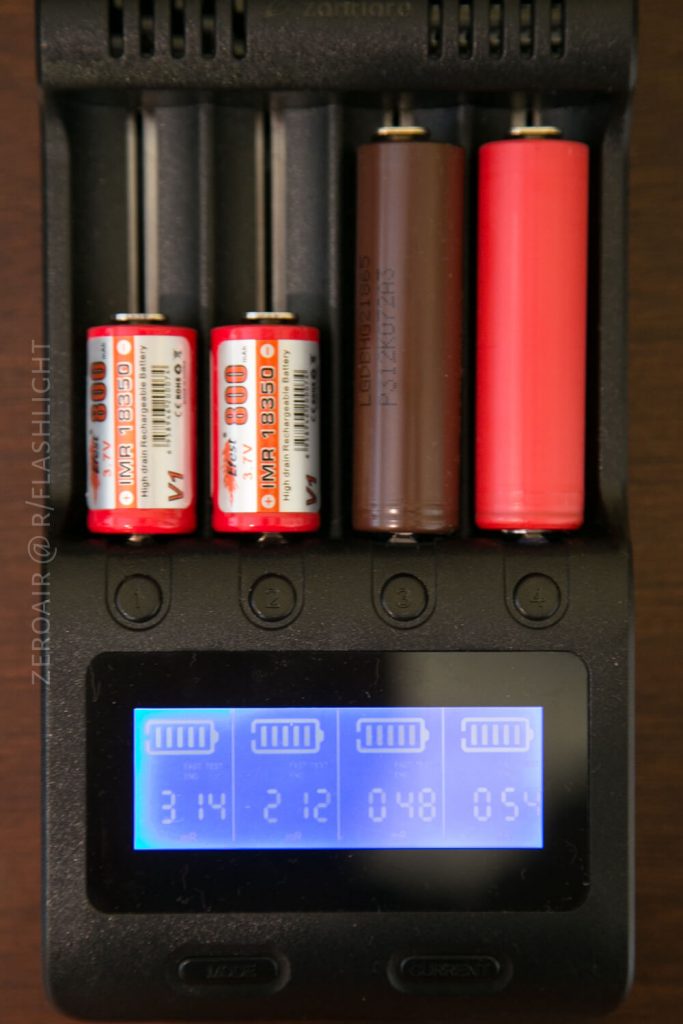
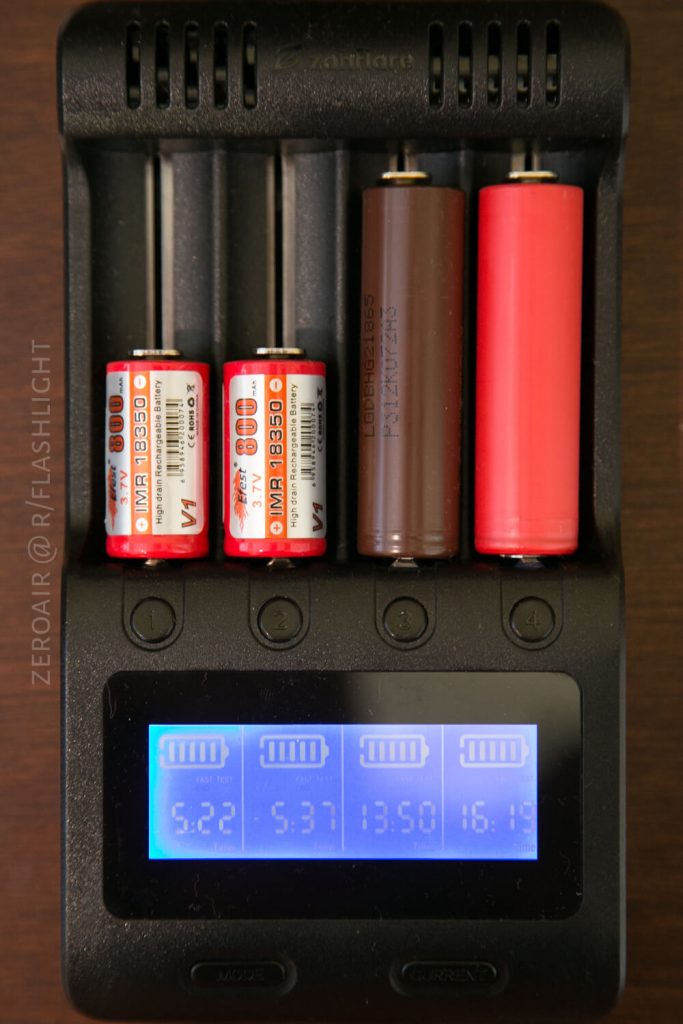
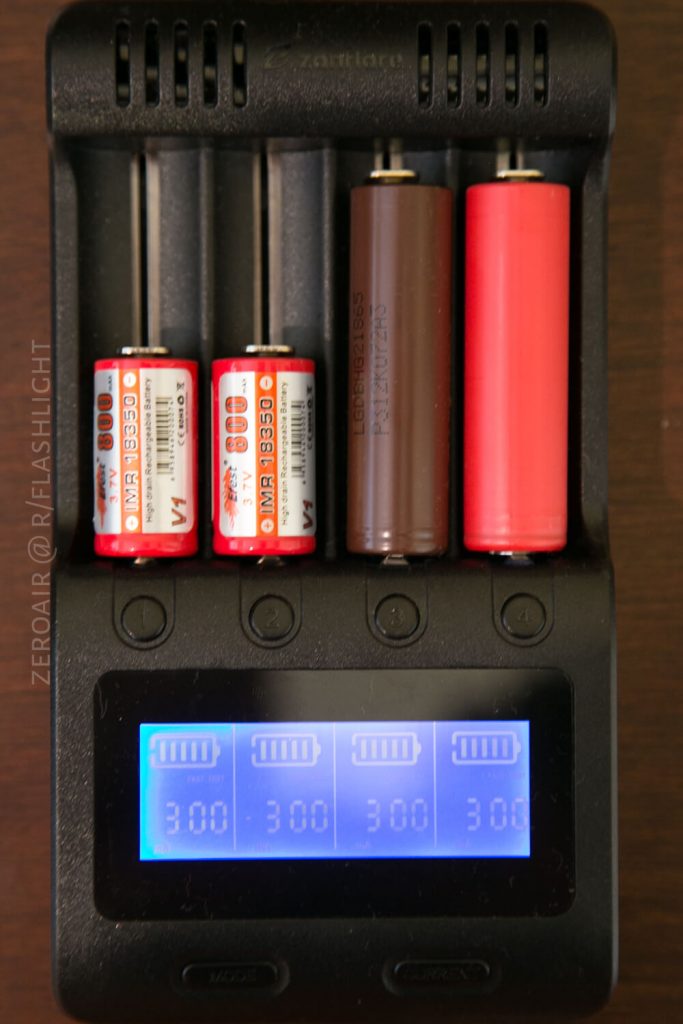

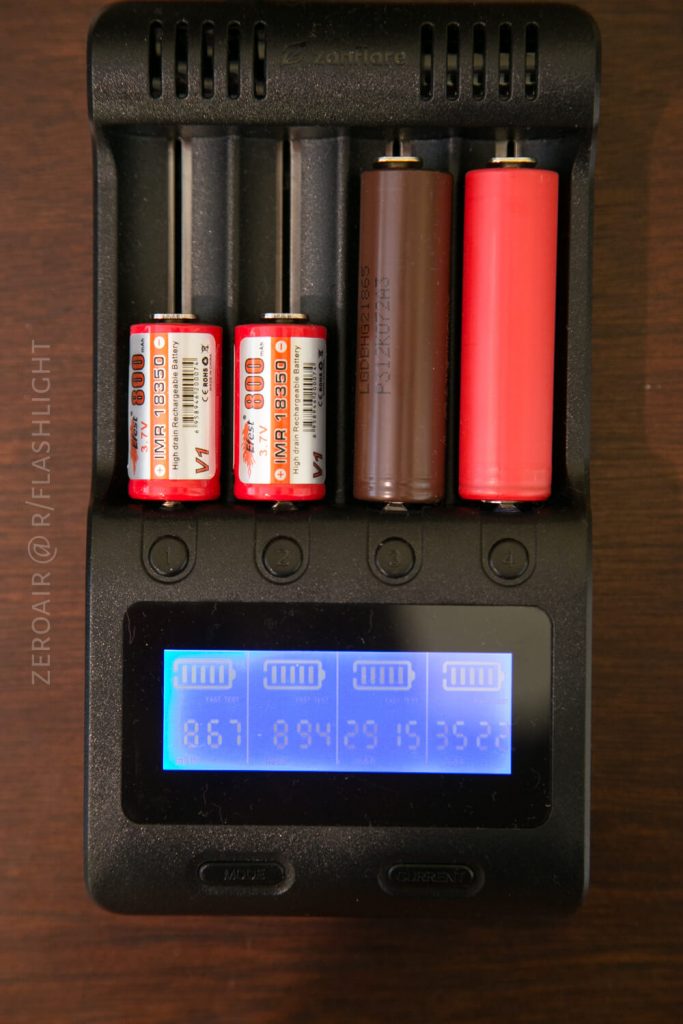
And here’s the Nor Test. Same cells in a different order – and it took not much longer than the Fast Test because I believe these cells were already nearly charged anyway.

User Interface and Operation
Each bay has one button which allows cycling the four data points (mAh, Voltage, internal resistance (mR), and time in mode.) And there are two buttons that control these four bays, as well – a “Current” button, and a “Mode” button. Current allows selection between the four current options (300, 500, 700, and 1000mAh, as applicable per mode), and the Mode button allows selection between the three modes (Charge, Nor Test, Fast test).

To use the C4 charger, put a cell in the device. If you did that wrong, the lcd will say “null.” Once the cell is inserted properly, one has 10 seconds to select the desired mode and current. If nothing’s pressed, then the device will operate at 500mAh. Note that the Mode button cycles all 4 bays. If you don’t get all 4 cells inserted by 10 seconds (from the first cell), you may end up cycling “badly”. Ie, the bays will be out of sync and you may have one in a mode you don’t intend. This is the bad side of independent bays…. However if you do end up in a mode you don’t want, you may hold the bay button for two seconds, and then select the appropriate mode. (Ie, it’s not a huge problem if the bays get out of the desired mode since modes can be changed easily on the fly.)
Briefly, the modes do as follows:
Charge: Charges the cell.
Fast Test: Discharge, then recharge, and record the recharged mAh.
Nor Test: Charge, discharge, recharge, and record the recharged mAh.
Size
Definitely not the smallest charger on the market, but the size is appropriate. I don’t believe you’d get four 26650s in here, but certainly 2×26650 and 2×18650 at one time should work.
Conclusion
What I like
- Build quality is good.
- All bays work independently.
- Ability to charge Li-ion and NiMH both.
- This is a fairly simple charger
- 1A USB out from as little as one cell. 2A out claimed with more than one cell!
What I don’t like
- As far as I can tell, there is no way to turn off the bright blue LCD. It does dim after a while but never turns off.
- No “Discharge” mode (it can discharge in other modes but those all end in a charge cycle.)
Notes
- This item was provided by GearBest.com for review. I was not paid to write this review.
- This content originally appeared at zeroair.org. Please visit there for the best experience!
- For flashlight-related patches, stickers, and gear, head over to PhotonPhreaks.com!
- Use my amazon.com referral link if you’re willing to help support making more reviews like this one!
- Please support me on Patreon! I deeply appreciate your support!
Thanks for the quality scan of the users manual!
Welcome friend!
In your review you mention “The device is powered by a 5V barrel plug” but then the picture immediately below that says 12V 1.5A. Was this a mistake, or do you know that it steps it down to 5V? My power supply got lost in a move and I am trying to find a replacement. Googling the model number has been less than helpful. And as you noted the plug is smaller than a standard 5.5X2.1(5). Did you happen to take note of what size it actually is?
Hey there! That’s almost certainly a typo. That wall wart lists the output at 12V, and so that’s what this charger takes from the barrel plug.
I am fairly certain I still have this charger but it’s not at this location. I’ll try to check soon.
You want the measurements of the barrel plug too?