
BLF Q8 Flashlight Review
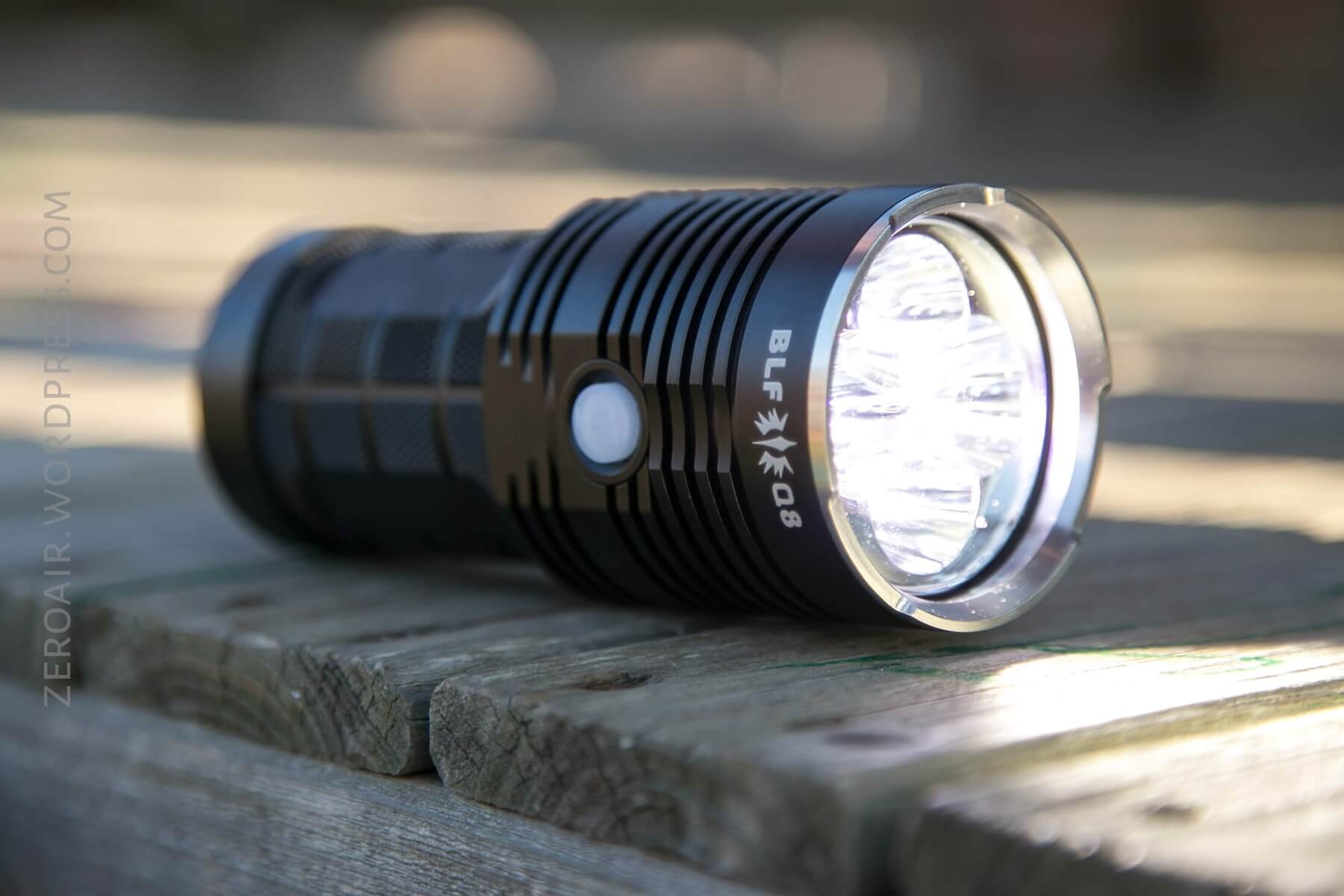
The BLF Q8 flashlight started off as a group buy, but this flashlight has moved into legend status! This version has four Cree XP-L HD emitters. Read on!
Official Specs and Features
Here’s a link to the BLF Q8 Flashlight product page.
Versions
There’s only one version of this light.
Price
The list price is $80. Originally, the buy-in was $40. If you look, you should be able to find a coupon to get the price somewhere between those two numbers. Even at the full MSRP of $80, this is a great deal.
Short Review
I really like this light quite a bit. Much more than I expected to, quite frankly. It’s impressive, fun, and bright!
Long Review
The Big Table
| BLF Q8 | |
|---|---|
| Emitter: | Cree XP-L HD (Four emitters, 4750K-5000K, NW) |
| Price in USD at publication time: | $80 |
| Cell: | 4×18650 |
| Turbo Runtime | |
| LVP? | Yes |
| Switch Type: | |
| On-Board Charging? | No |
| Claimed Lumens (lm) | 5000 |
| Claimed Throw (m) | 450 |
| Candela (Calculated) in cd (at 30s) | 2760lux @ 4.764m = 62640cd |
| Throw (Calculated) (m) | 500.6 (111.2% of claim)^ |
| All my BLF reviews! | |
^ Measurement disclaimer: Testing flashlights is my hobby. I use hobbyist-level equipment for testing, including some I made myself. Try not to get buried in the details of manufacturer specifications versus measurements recorded here; A certain amount of difference (say, 10 or 15%) is perfectly reasonable.
What’s Included

- BLF Q8
- Spare o-rings (3)
- Spare button cover
- Manual
Cells aren’t included with this package, and you’ll need four of them.
Package and Manual
There is no excess in the packaging for the Q8. At $40, one wouldn’t really expect there to be. The box is cardboard and has a sticker with the light info (but no specifications).

There’s a manual, which mainly covers the driver. That’s important because the driver is very versatile and has many, many options. Here’s a link to the manual. The driver is “NarsilM,” and I believe has been modified from Narsil for use specifically in the Q8.
Build Quality and Disassembly
It’s really amazing to me what $40 will buy. Even at $80, this light’s build quality is good. At $40, the quality-to-cost ratio is phenomenal. The knurling is very grippy. The fins on the head are thick and moderately deep.


More to the point of build quality, look at these internals. They’re great – the threads are big, thick, square-cut, and anodized. The contacts on the head are beefy – the positive being a large brass ring, making direct contact with the button tops. One mod users often do is to replace these screws throughout the light with brass screws. This can be done cheaply (maybe $3 total) and is said to increase the lumen output by around 300 lumens. I’m not sure if it’s because of heat management or because of better conductance that these brass screws help. But I have ordered mine. 🙂
The tail side of the light has beefy dual springs.


Size
Officially 132mm x 59mm x 50mm (length x head x body diameter). That’s roughly what I measure, depending on where on the body I measure, and how tightly I have (or should have) the body screwed together.

Of course, the Noctigon Meteor M43 is shorter – but then it doesn’t have reflectors at all.


Retention
The main means of retaining this light is with the tripod mount on the body/head, opposite the switch. There is no pouch, pocket clip, or lanyard. A lanyard could be attached via the tripod mount, of course.
Power
Button top cells are required for the BLF Q8. I didn’t have 4 married button tops, so I had to purchase some. I got those at Banggood too – here are the cells I purchased. For what it’s worth, I received these cells long before the light, and I tested every one of them. They all tested as they should, with capacities in the right range for the cell, and low internal resistance. They’re good cells. Also, the button top is an addition to the normally flat top cell: It’s put on well.
You also want high-drain cells, and as mentioned, you want to keep them married, as a set of 4. That’s better for the cells and safer for you.
I tested the runtime on stock firmware (with no configuration), on turbo. As a curiosity, I reset the light a number of times. There’s a marked step-down every time the light is in turbo, of about 3 minutes or so. This stepdown is from around 90% output to around 25% output (relative to whatever turbo was when it was activated). I stopped cooling the light on the last turbo activation, just to see how the Q8 would handle the heat. It did heat up, but I’d hardly call it “hot.”
It was hard for me to get a fix on the actual output so I didn’t let this one go forever (something something 4 unprotected 18650s), but the light does have Low Voltage Protection. Warnings should start around 3V, and the light should shut off completely at 2.8V. When I stopped the runtime here, the cell voltage was right at 3V.

User Interface and Operation
There’s a single indicating side e-switch on this Q8. It’s a responsive and clicky button. The indicating aspect is quite nice, and also configurable.
NarsilM makes this a ramping UI! The ramping on this light is probably the best implementation I’ve seen yet.

In the stock configuration, the switch emitters will be green when the light is off.

I am not going to try to cover all the options of this driver. I really encourage you to delve into the manual for that. There’s no good reason for me to restate the manual, so here’s the stock configuration UI:

The battery check option works like this. This displays the current voltage of the cells. The light blinks in the X number, and the pauses, then blinks in the .x number. So (as the manual states), 3.7V would be 3 blinks, a short pause, then 7 blinks, then a long pause, and repeats this until the battery check is turned off. Triple-clicking from off enters Battery check mode.
Four clicks from either state will lock or unlock the light.
There’s a lot more that this light will do. Really, dig into the manual!
LED and Beam
The BLF Q8 uses Cree XP-L HD V6 3D. These are Neutral White, at 4750K-5000K.
Each emitter sits at the base of a smooth, narrow reflector. This reflector gives a very nice spot, with a reasonable amount of spill.

One thing I really like about this light is that low is actually pretty low! Low enough that I can look directly into the light without ill effects.

Beamshots
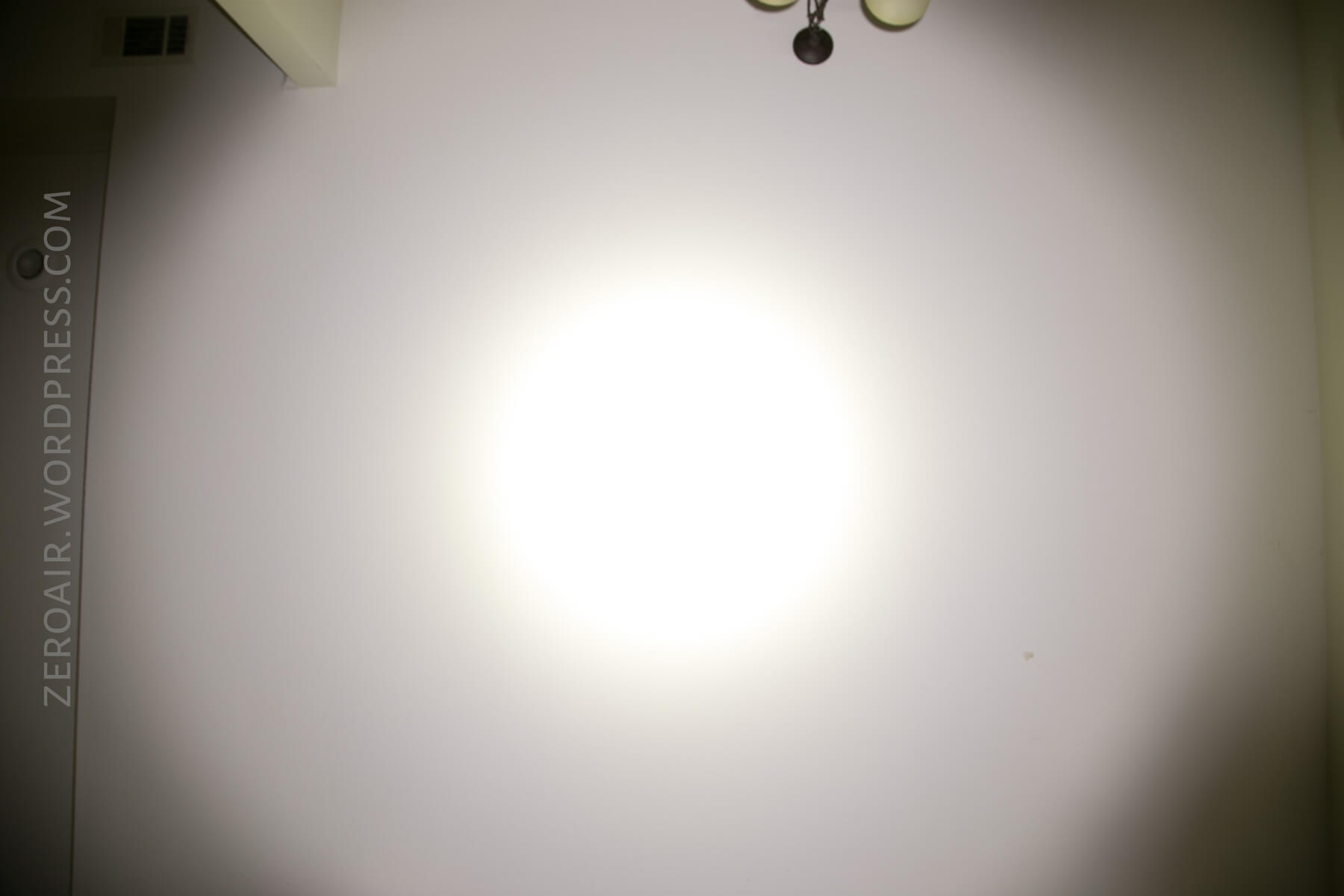
These beamshots always have the following settings: f8, ISO100, 0.3s shutter, and manual 5000K exposure. These photos are taken at floor level, and the beam hits the ceiling around 9 feet away.


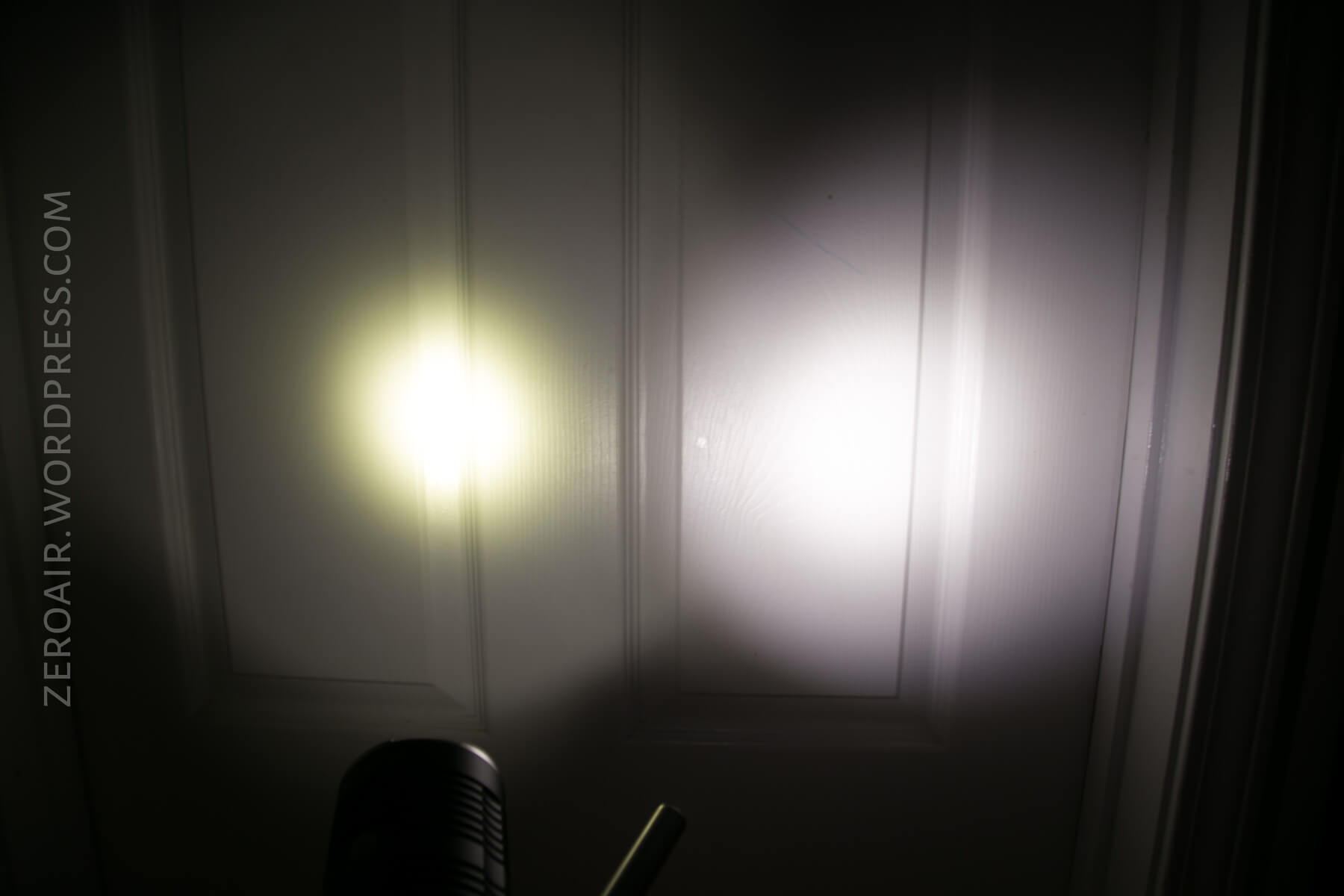
Tint vs BLF-348 (KillzoneFlashlights.com 219b version) (affiliate link)
I keep the test flashlight on the left and the BLF-348 reference flashlight on the right.
Random Comparisons and Competitive Options
There are a bunch of other can lights, but I’m not going to bother mentioning any of them. This light is well worth the price (even if you buy the others too), for the excellent user interface, and nice build quality.
Conclusion
What I like
- Output is great (it’s bright!)
- Indicating side switch
- Has a nice spot
- Community designed!
What I don’t like
- Configurability could be considered intimidating
- I’d take the tradeoff of Nichia’s lower output for a better tint.
Notes
- This light was provided by me for review. I was not paid to write this review.
- This content originally appeared at zeroair.org. Please visit there for the best experience!
- Use my amazon.com referral link if you’re willing to help support making more reviews like this one!
- Please support me on Patreon! I deeply appreciate your support!
Pingback: Sofirn Q8 Flashlight Review - ZeroAir Reviews