

Nitecore EC30 Flashlight Review
The Nitecore EC30 is an 18650 flashlight that uses a Cree XHP35 HD emitter. This should provide great output. Read on for testing!
Official Specs and Features
Here’s a link to the Nitecore EC30 Flashlight product page.
Versions
Just one version!
Price and Coupon
The EC30 clocks in at $59.95 right now at NitecoreStore.
Short Review
I like the build of this light, and it looks fairly “flashlighty” (which I do like!). But the user interface is practically a showstopper for me; I could not get used to it. Output is great, though.
Long Review
The Big Table
| Nitecore EC30 | |
|---|---|
| Emitter: | Cree XHP35 HD |
| Price in USD at publication time: | $59.95 |
| Cell: | 18650 |
| Turbo Runtime | High Runtime |
| LVP? | Yes |
| Switch Type: | E-Switch |
| Quiescent Current (A): | ? |
| On-Board Charging? | No |
| Claimed Lumens (lm) | 1800 |
| Measured Lumens (at 30s) | 1900 (105.6% of claim)^ |
| Claimed Throw (m) | 220 |
| Candela (Calculated) in cd (at 30s) | 603lux @ 4.7m = 13320cd |
| Throw (Calculated) (m) | 230.8 (104.9% of claim)^ |
| All my Nitecore reviews! | |

^ Measurement disclaimer: Testing flashlights is my hobby. I use hobbyist-level equipment for testing, including some I made myself. Try not to get buried in the details of manufacturer specifications versus measurements recorded here; A certain amount of difference (say, 10 or 15%) is perfectly reasonable.
What’s Included

I didn’t get a full retail package for the EC30, so what I have included is not the full package. But what I got:
- Nitecore EC30 Flashlight
- Spare o-rings (2)
- Lanyard
Package and Manual
I didn’t get a package, but I have no reason to think it won’t be typical Nitecore style packaging.
Fortunately, the manual is available as a pdf here. Go ahead and download that; you’ll likely need it for the user interface section.
Build Quality and Disassembly
The build quality of the EC30 is very nice. The light overall feel quite good in hand. I like the knurling – it’s a diamond pattern but not too grippy. “Flat grippy” basically.

The model name and some other things are silk-screened on the head in a very Armytek way.


The head has a brass button and a plastic surround which indicates this is the positive connection. This brass button has no give – during my testing, this button gave one of my favorite cells a bit of a dent in the positive terminal. Not sure why, though, as there’s plenty of room for an unprotected cell in there.

The tailcap has a beefy spring and a magnet.

Here’s a close-up of that silk screen printing on the head. There’s a lot there.

I’m very happy with the knurling on this light. Easily my favorite type and this version is done perfectly. Just grippy enough but doesn’t bother anything like grabbing skin or pockets.


The threads on the tailcap are fine but square-cut, making for a very pleasant threading experience.

The cell tube is not reversible, nor would you think it is – the head end is flared.


Size and Comps
Officially:
Length 111.5 mm / 4.38 in
Head Size 24.5 mm / 0.96 in
Weight 65.5 g / 2.31 oz


Shorter than the Convoy S2+, but the head is a little bigger.


Shorter than the BOSS, too!

Retention and Carry
I don’t know what else might come in the retail package (probably nothing!) but what I got was an already-installed pocket clip, seen below, a lanyard, and the magnet in the tailcap.

The pocket clip doesn’t allow me to carry the light as deep as I really want to and only allows for bezel-up carry. Even though the clip orients the button to the side, I still had one accidental activation and didn’t realize it till my favorite jacket had a nice big melty spot on it. 🙁


The magnet holds the light just fine horizontally.

Power and Runtime
The EC30 is powered by a single 18650 cell (and can also run on 2 × CR123). I tested the light with a GA cell. I’ll note that in one instance the EC30 dented my favorite cell! The cell is still fine, but be aware of this when tightening the cap. (That said, I don’t know how you’d really avoid this by leaving the cap unscrewed – I did drop the light, which is probably what caused the issue).
Here’s a runtime on Turbo. The output drifts down from Turbo (which is over the rated 1800 lumens at 30s), and steps to approximately the modes with each step. The light switches to low, but never actually shut off in my tests with a cell.

Here’s a runtime on high. Looks about like Turbo, and is fairly well flat for the duration of the High output.

Using bench power, there seems to be LVP at 2.8V. No switch warning, but light completely (and electrically) off.
User Interface and Operation
There’s a single switch, which is a side electronic switch, with an indicating LED right in the center. I like the switch just fine – it’s clicky, metal (ish?), and has an indicator.
The bad side of this side switch is coupled with the fact that this light has no electronic lockout. The switch is proud and very easy to activate. I resorted to doing the recommended action of 1/4 turn on the tailcap for a physical lockout (something I hate doing). I said the same thing about the Concept 1 – the switch is too easy to activate.

Here’s a user interface table!
| State | Action | Result |
|---|---|---|
| Off | Click | No action |
| Off | Short Hold | On (Mode Memory) |
| On | Click | Off |
| On | Hold | Momentary Turbo |
| Off | Long Hold | Mode cycle (L>H direction) |
| Off | Double Click | Moonlight |
| Off | Triple Click | Turbo |
Notes about the UI:
- Technically Nitecore calls what I’ve labeled as “off” “standby”.
- Direct access to Low and Turbo shouldn’t do unnoticed, though they do break tradition since in my experience double click should be Turbo, and triple click should be strobe.
- It is not possible to cycle the modes from an “on” state.
This user interface is the same as the Nitecore Concept 1. I … didn’t love it then and can still say this about it:
It is my opinion that this user interface is very purposeful. I’m not sure for whom it’s designed but I think the user interface would be great for someone who wants a one mode light. Because once the light is set to any particular mode, it’s as simple as long clicking to always get that mode. Yes, there are caveats (ie turbo is easy to hit), but it’s still a viable use for this UI.
I can say that it’s taken me a long time to get accustomed to the user interface on this light. I don’t dislike it strictly speaking, but it’s been a challenge.
I can actually say now that I don’t like this UI. I believe it was designed for someone who may not use flashlights all that much – ie a “beginner UI.” I handed this light to a beginner and they could absolutely not figure out how to use it.
There are actually two mode groups on this light; “General” and “Tactical.” The only difference is that in General, direct access from standby is to Turbo. In “Tactical” the direct access from standby is to Strobe. To switch between these groups, turn the light off, loosen the tailcap, hold the switch and tighten the cap back. Easy!
Modes and Currents
| Mode | Mode Claimed Output (lm) | Claimed Runtime | Measured Lumens | Tailcap Amps |
|---|---|---|---|---|
| Turbo | 1800 | 30m | 1900 | 4.60 |
| High | 810 | 1h45m | 912 | 1.36 |
| Mid | 300 | 5h30m | 286 | 0.32 |
| Low | 80 | 18h | 92 | 0.09 |
| Ultralow | 1 | 310h | – | – |
LED and Beam
Again, same emitter as the Concept 1.
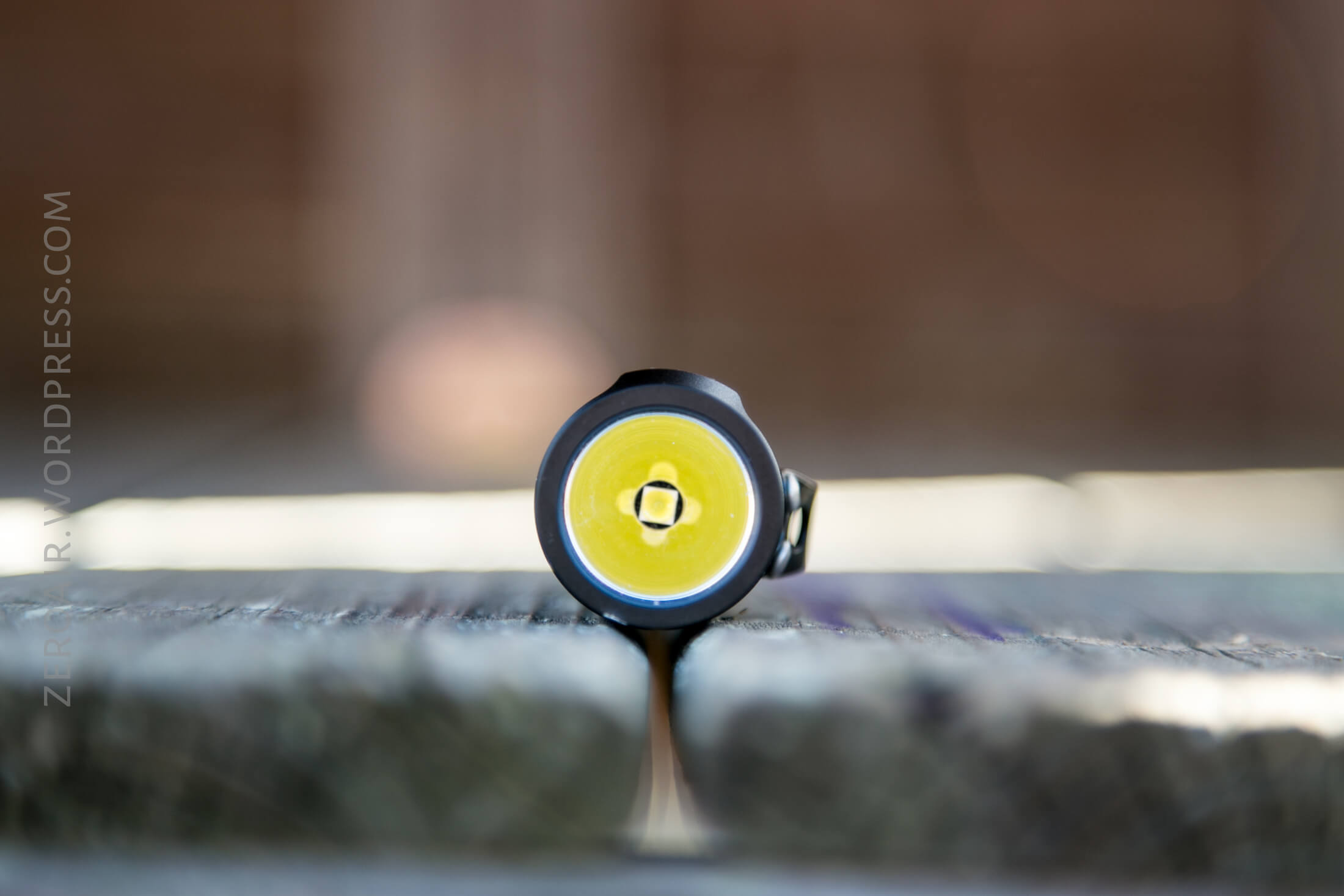
There’s a single Cree XHP35 HD in this light, behind a smooth average depth reflector. This makes a “throwy” beam (though I wouldn’t describe this light as a thrower). What I mean is that the light has a tight concentration, but is not a pencil-thin throwy beam. So there’s a distinct spot, with a secondary spot of maybe 1/3 intensity, then little spill.
I’ll add that there’s a very clear yellow spot in the very center of the beam, visible on all modes but low.
With the smooth reflector, size and shape of this light, and availability of the emitter, I’d probably rather see the HI version in this light. Or maybe just an option on the emitter; that’d be good.
I have no issue with the tint, though it’s not my preferred “rosy” and has, as mentioned, the yellow spot in the center.


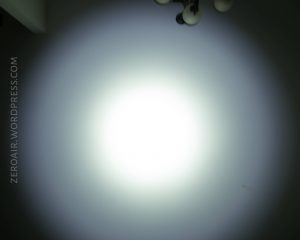
Tint vs BLF-348 (KillzoneFlashlights.com 219b version) (affiliate link)

Conclusion
What I like
- Nice form factor and build quality
- Love the knurling on the tail end of the light
- Output hits it’s specified numbers
What I don’t like
- The UI. I really can’t get behind this UI.
- The indicating switch is grossly underutilized.
Notes
- This light was provided by Nitecore for review. I was not paid to write this review.
- This content originally appeared at zeroair.org. Please visit there for the best experience!
- For flashlight-related patches, stickers, and gear, head over to PhotonPhreaks.com!
- Use my amazon.com referral link if you’re willing to help support making more reviews like this one!
- Please support me on Patreon! I deeply appreciate your support!