

Acebeam M20 Flashlight Review
Today I have a small Acebeam M20 Flashlight review. It’s a twisty with good knurling and easy operation. Read on for testing!
Official Specs and Features
The Acebeam M20 flashlight seems wiped from the internet now and I can’t find an official link!
Versions
There’s just one version, but there are two body colors: black (seen here), and tan.
Price
The Acebeam M20 flashlight seems wiped from the internet now and I can’t find an official link! I recommend that you shop at killzoneflashlights.com for the newest and updated version of this light!
Short Review
I like the knurling on this little guy, and the user interface is simple and intuitive enough. I don’t care for the 6500K and XP-G3 is fairly renowned as not a favorite emitter. But at $20, this isn’t a bad gift or keychain light.
Long Review
The Big Table
| Acebeam M20 | |
|---|---|
| Emitter: | Cree XP-G3 (6500K) |
| Price in USD at publication time: | $19.90 |
| Cell: | 1xAAA |
| Turbo Runtime | High Runtime |
| LVP? | No |
| Switch Type: | Twisty |
| On-Board Charging? | No |
| Claimed Lumens (lm) | 150 |
| Measured Lumens (at 30s) | 151 (100.7% of claim)^ |
| Claimed Throw (m) | 50 |
| Candela (Calculated) in cd (at 30s) | 37lux @ 3.895m = 561cd |
| Throw (Calculated) (m) | 47.4 (94.8% of claim)^ |
| All my Acebeam reviews! | |
^ Measurement disclaimer: Testing flashlights is my hobby. I use hobbyist-level equipment for testing, including some I made myself. Try not to get buried in the details of manufacturer specifications versus measurements recorded here; A certain amount of difference (say, 10 or 15%) is perfectly reasonable.
What’s Included
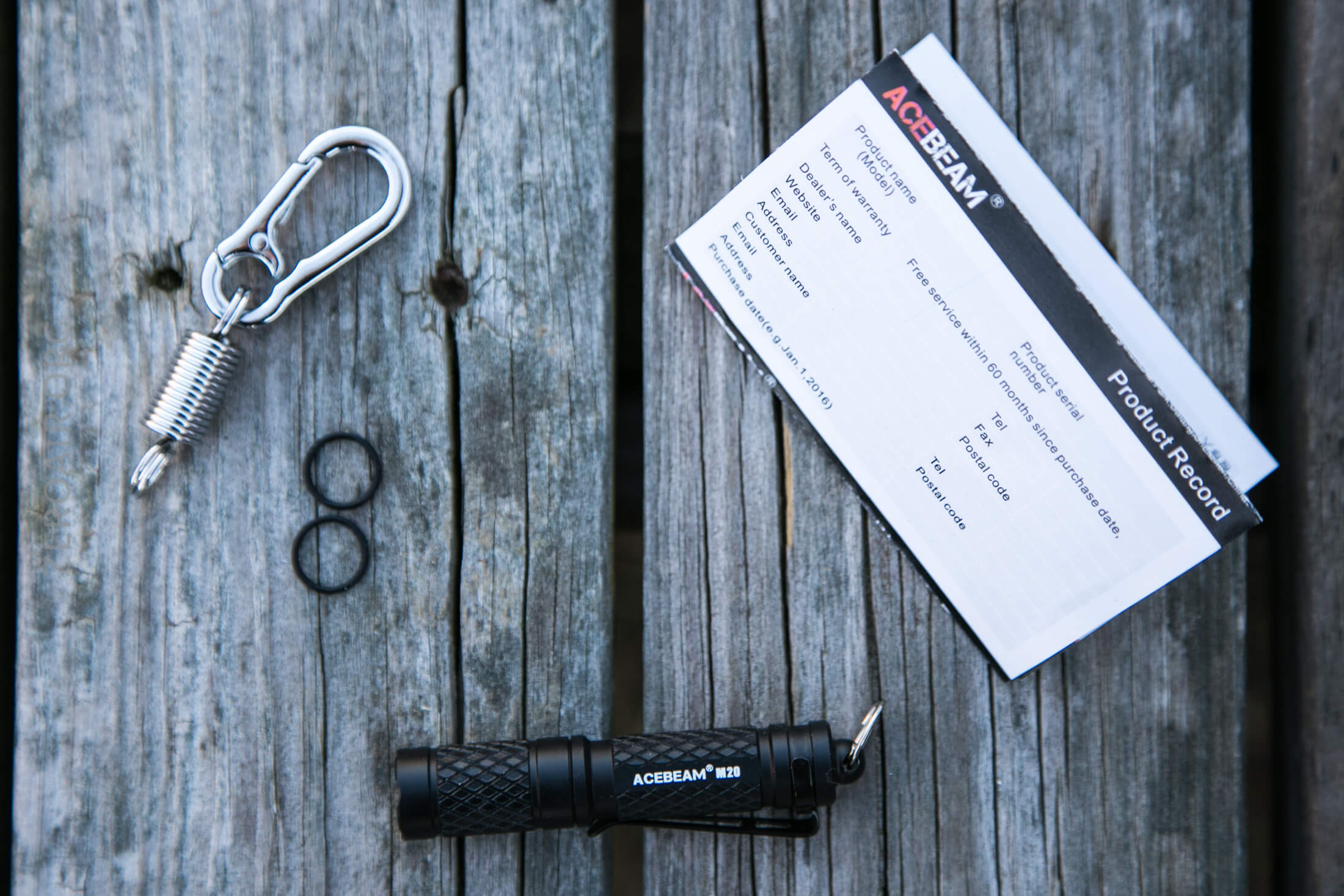
- Acebeam M20 Flashlight
- Spare o-rings (2)
- Springy keychain connector
- Split ring (attached to light)
- Manual
Package and Manual


Build Quality and Disassembly

There are a couple of things that stand out about this little AAA twisty right off the bat. First, the knurling. It’s diamond cut (my favorite) and is over enough of the body that there’s plenty of grip for twisting with one hand.


Next thing you’ll notice is that the bezel has crenelations, so when headstanding, the light will shine out. Not a big deal but something I like to see.
The two-part body has reasonably long threads, and they’re anodized and triangle cut. Of course, when the head is just a tiny bit off the body, the light is mechanically locked out, so no standby drain on the cells.

The tail end has a spring, and the head has a button. There are two holes in the driver so unscrewing the head should be straightforward for an emitter swap.


The included, attached split ring is nothing to write home about. Just a wire…. good candidate for replacement.

Size and Comps
Officially 68mm x 14mm (head) x 12mm (body), and 10g (without cell).


Here’s the test light with the venerable Convoy S2+. Mine’s a custom “baked” edition Nichia 219b triple. A very nice 18650 light.


And here’s the light beside my custom-engraved TorchLAB BOSS 35, an 18350 light. I reviewed the aluminum version of that light in both 35 and 70 formats.


Retention and Carry
The included, attached pocket clip is a fairly good one. The mouth makes for easy attachment to pockets, and it carries deeply enough that the light won’t fall out of a pocket. It’s a friction fit clip and has a couple of places to attach a lanyard if you’d like (though I’d attach a lanyard elsewhere).


Also included and also already attached from the factory is this split ring. It’s nothing special. It is attached through a hole in the tail end of the light, which adds a good bit of length to the light overall. I’d rather this be removed altogether (just like on the Surefire Titan Plus).


The pocket clip can be reversed. It’ll fit on the middle thinnest ring, just left of the Acebeam logo above. And in this configuration, the M20 may be used on the brim of a hat effectively.
Power and Runtime
Power is provided to the M20 by means of a single AAA-sized cell. Only primary 1.5V max cells are supported – no lithium-ion cells (10440). In my testing exclusively used NiMH cells.

Output goes about as you’d expect. It’s not very regulated and just tracks downward as the cell voltage drops. There is no LVP, but that’s not so bad with NiMH cells. Output is negligible when cell voltage gets low anyway. Plus, the emitter flashes in a strobe fashion when the voltage is low. In the graph below, sorry but my thermo probe broke off the light, and temperature wasn’t tracked past around 5.5 minutes. The light is notably hot, though, which is quite interesting. A temp of 47 degrees in a light this small is something you’d notice.

Output on Medium is remarkably flat and well-regulated. Still, no LVP but again the output drops off so fast and dramatically to nearly nothing that you’d notice it. Also, the emitter flashes to alert the user.

Modes and Currents
| Mode | Mode Claimed Output (lm) | Claimed Runtime | Measured Lumens | Tailcap Amps |
|---|---|---|---|---|
| High | 150 | 0.8h | 151 | 1.77 |
| Medium | 30 | 4h | 25 | 0.14 |
| Low | 2 | 25h | – | 0.01 |
Pulse Width Modulation
No PWM in any mode.


Here you can see a “baseline” – a chart with almost no light hitting the sensor.

Then there’s the Ultrafire WF-602C flashlight, which has some of the worst PWM I’ve seen. It’s so bad that I used a post about it to explain PWM! Here are multiple timescales (10ms, 5ms, 2ms, 1ms, 0.5ms, 0.2ms) to make comparing this “worst” PWM light to the test light easier. That post also explains why I didn’t test the WF-602C at the usual 50us scale.


User Interface and Operation

The M20 is twisty, so you’ll twist the head to switch modes. It’s not a progressive twisty – so twist it on, then off and on again to advance modes. But mode advance is not the normal direction. Medium is first, then low then High. The output resets to “Medium is next” after a few seconds. As a result, High can be completely avoided if desired.
LED and Beam
The emitter in the M20 is a Cree XP-G3 at 6500K temperature. The reflector is shallow (of course) and has a very light texture. Not enough to make any flood out of the beam, but just enough to break up any artifacts from the XP-G3.

These beamshots always have the following settings: f8, ISO100, 0.3s shutter, and manual 5000K exposure. These photos are taken at floor level, and the beam hits the ceiling around 9 feet away.


Tint vs BLF-348 (KillzoneFlashlights.com 219b version) (affiliate link)
Test light on the left.

I compare everything to the Killzone 219b BLF-348 because it’s inexpensive and has the best tint!
Random Comparisons and Competitive Options
Here’s a link to a relevantly filtered page on parametrek.com. I use that site a lot! There are indeed a few other XP-G3 AAA lights, but the list is surprisingly short. This Acebeam makes a good entry in the group.
Conclusion
What I like
- Knurling and smooth threads make for easy operation
- Small size
- Can be used as hatlight
- No strobes
- Highest output can be completely avoided
What I don’t like
- Cree XP-G3, especially 6500K
- Lack of LVP
Notes
- This light was provided by Going Gear for review. I was not paid to write this review.
- This content originally appeared at zeroair.org. Please visit there for the best experience!
- Use my amazon.com referral link if you’re willing to help support making more reviews like this one!
- Please support me on Patreon! I deeply appreciate your support!