

Cyansky M3 Flashlight Review
I have in my hands today the Cyansky M3 titanium 16340 flashlight. Cyansky reached out for me to review the M2 – which I will do later, but I convinced them to send this M3 titanium light as well. It looks pretty good on paper, so let’s see how the testing goes!
Official Specs and Features
Here’s a link to the official product page.
Versions
I believe this is the only version!
Price
No word on pricing!
Short Review
This is a nice little light. The e-switch has a nice metal (probably also titanium) cover but is very hard to find by feel. In fact it blends pretty well with the body, even when looking directly at it. All that said, it’s a good little pocket or keychain light as a backup, depending on the final price, of course.
Long Review
The Big Table
| Cyansky M3 Flashlight | |
|---|---|
| Emitter: | Cree XP-G3 (S4) |
| Price in USD at publication time: | $79.95 |
| Cell: | 1×16340 |
| Turbo Runtime | High Runtime |
| LVP? | Switched to low, but not off |
| Switch Type: | E-Switch |
| Quiescent Current (mA): | 0.01 |
| On-Board Charging? | Yes |
| Charge Port Type: | Micro-USB (on cell) |
| Chargetime | |
| Power off Charge Port | – |
| Claimed Lumens (lm) | 700 |
| Measured Lumens (at 30s) | 401 (57.3% of claim)^ |
| Candela per Lumen | 24.7 |
| Claimed Throw (m) | 73 |
| Candela (Calculated) in cd (at 30s) | 143lux @ 3.07m = 1348cd |
| Throw (Calculated) (m) | 73.4 (100.5% of claim)^ |
| All my Cyansky reviews! | |
^ Measurement disclaimer: Testing flashlights is my hobby. I use hobbyist-level equipment for testing, including some I made myself. Try not to get buried in the details of manufacturer specifications versus measurements recorded here; A certain amount of difference (say, 10 or 15%) is perfectly reasonable.
What’s Included

- Cyansky M3 Titanium 16340 Flashlight
- Cyansky 700mAh 16340 (with micro-USB charge port)
- Spare o-ring
- Charge cable (USB to micro-USB)
- Pocket clip
- Finger carry ring
- Manual and papers
Package and Manual


Build Quality and Disassembly

You might wonder from the start if a brand you’ve never heard of is really making a titanium flashlight. Well, I can assure you that the Cyansky M3 Titanium is in fact a titanium flashlight, and not one of those “titanium alloy” lights which just have the appearance of titanium.


There’s just a feeling of titanium on the light. It doesn’t feel aluminum. More proof of its titanium nature will be offered later of course, but for now, take the matte finish as evidence.
The reflector is very unusual. It doesn’t nearly fill the opening of the light and has a shiny reflective bit facing outward. More on that later.

The tailcap has a bit of laser etching with some relevant logos.


The head has some cooling fins, which are more likely for grip than dealing with heat.

The body has some shallow designs.


I’m unclear if the bezel is press-fit or screwed in. Mine will twist but doesn’t seem to actually be unscrewing. When the bezel twists, the reflector also twists.

I think the photo below snuck in. I’m not sure what’s the point. But maybe it’ll provide you with some key information. 😀


This is really a small light. I’m sure the reflector is “narrow” and “short” to allow the light to overall be very short.

Here’s more proof that the light is titanium. These threads are unmistakably titanium. They have the smooth grittiness of titanium. They’re square-cut, not too long, and smooth overall though.

When putting the light together, you’ll do best to hold the head between two fingers where you aren’t grabbing the switch, then screw in the body. It’ll only take a couple of times to get it sorted. I’m demonstrating it below.

The head has only a brass contact, but the tail has a nice thick spring. There is surprisingly no magnet here!


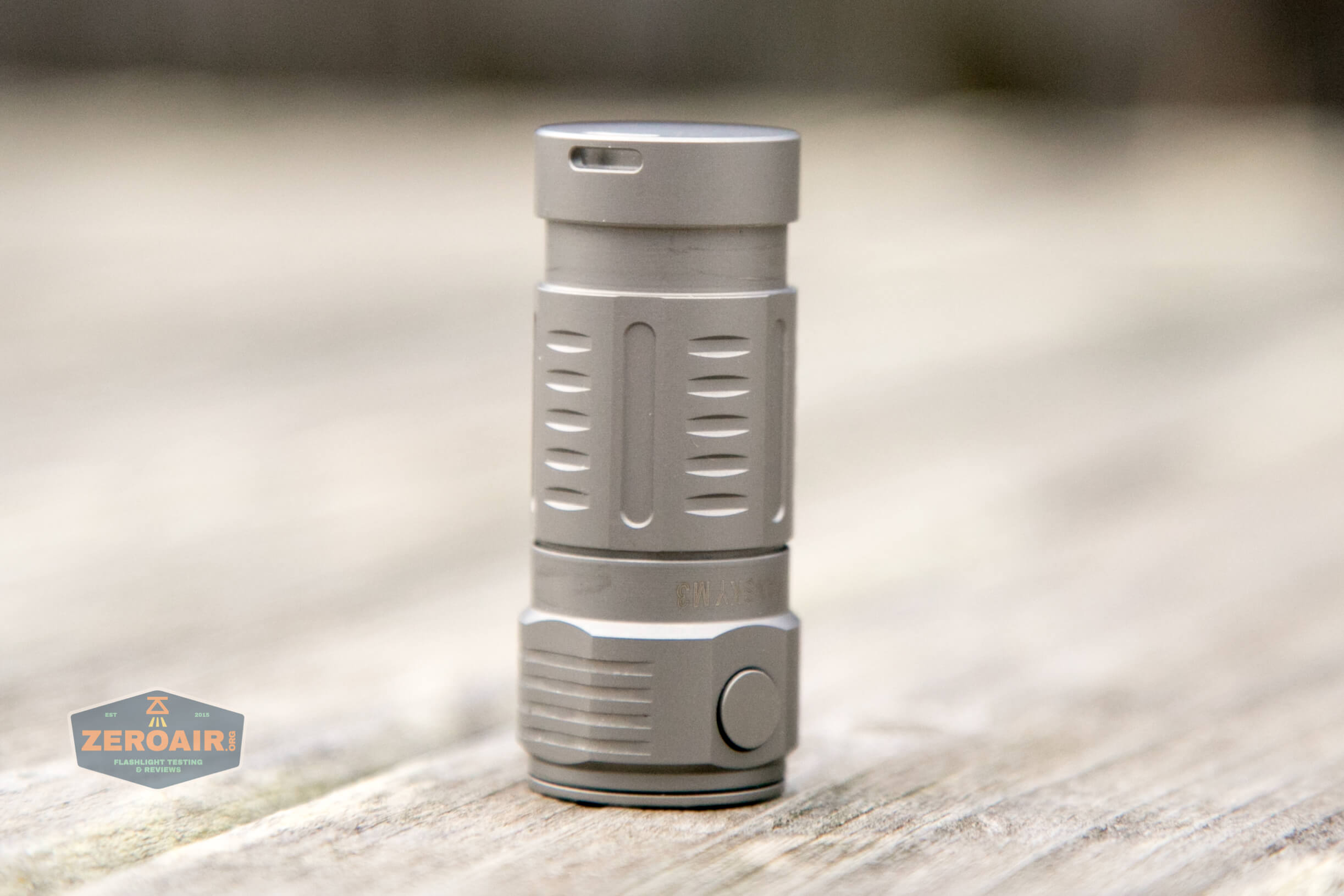


Size and Comps
Weight: 30 g/1 oz (excluding battery)
Tail Diameter: 21 mm/0.82 in
Head Diameter: 21 mm/0.82 in
Length: 51 mm/2 in


If the flashlight will headstand, I’ll show it here (usually the third photo). If the flashlight will tailstand, I’ll show that here, too (usually the fourth photo).


Here’s the test light with the venerable Convoy S2+. Mine’s a custom “baked” edition Nichia 219b triple. A very nice 18650 light.


And here’s the light beside my custom engraved TorchLAB BOSS 35, an 18350 light. I reviewed the aluminum version of that light in both 35 and 70 formats.

Here’s another light that I thought compared well. The Fenix E16 – a light I reviewed and liked quite a bit. Interestingly, these two lights are remarkably similar. In case you’re wondering about actual cross-compatibility – yes. The M3 head will work on the E16 body. But the E16 head will not work on the M3 body. The threads are exactly the same between the two, though.


Retention and Carry
I’d say the primary means for carry of the M3 is this included pocket clip. It’s a friction fit clip, and looks like titanium, but is magnetic (ergo, not titanium). No worries there, titanium clips need to be thicker than this one is, so titanium would have been a bad choice for this clip.
The friction fit pocket clip is designed to fit on the tail of the M3. The clip has two holes, so if you wish to attach the finger ring lanyard here, you can.


The clip can also technically ride on the head end, but it’s not a good fitment, and probably won’t stay on.
There’s also a ring, which is not unlike a lanyard but seems to be designed to wear as a ring. That attaches ideally in the tailcap hole seen below. This hole is still accessible when the clip is installed.
The finger ring has a screw-together barrel connector in the middle, which allows easy attaching to the light.
Power and Runtime
The Cyansky M3 is powered by a single lithium-ion cell. Included is the proper cell, a 700mAh 16340, with the model number BL1607U.

The cell is a standard button top 16340, with the addition of micro-USB charging.


The 16340 fits into the light in the usual way – positive terminal toward the head. It sticks out quite far before the head is installed.
Here are a couple of runtimes. Turbo steps down very quickly and doesn’t seem to even hit the 700-lumen claim at startup, much less at 30 seconds.

The second-highest output is very well regulated and steps down dramatically when the cell voltage drops.

I didn’t observe low voltage protection when testing with the bench power, but as I said, and like you can see in the charts above – the output is so low you’ll notice. Also, the manual states that the emitter will flash 3x every 5 minutes as a low voltage warning.
Included with the M3 is a 16340 with built-in charging. There’s a micro-USB port in the positive end.
An appropriate cable is included – USB to micro-USB.


Here are a couple of charge cycles. Charging is very consistent, and takes just over 2 and a half hours. The charge rate is around 0.5C, which is perfectly acceptable for this 700mAh cell.

The Cyansky M3 will also operate with CR123 cells.
Modes and Currents
| Mode | Mode Claimed Output (lm) | Claimed Runtime | Measured Lumens | Tailcap Amps |
|---|---|---|---|---|
| Turbo | 700 | 30m | 401 | 1.31 |
| High | 150 | 2h | 136 | 0.20 |
| Med | 30 | 11h | 18 | 0.04 |
| Low | 5 | 72h | 2 | 0.01 |
Pulse Width Modulation
I don’t think what we’re seeing below is actually pulse width modulation, but some sort of sawtooth. I don’t notice it in person, anyway.


Here you can see a “baseline” – a chart with almost no light hitting the sensor.

Then there’s the Ultrafire WF-602C flashlight, which has some of the worst PWM I’ve seen. It’s so bad that I used a post about it to explain PWM! Here are multiple timescales (10ms, 5ms, 2ms, 1ms, 0.5ms, 0.2ms) to make comparing this “worst” PWM light to the test light easier. That post also explains why I didn’t test the WF-602C at the usual 50us scale.


User Interface and Operation
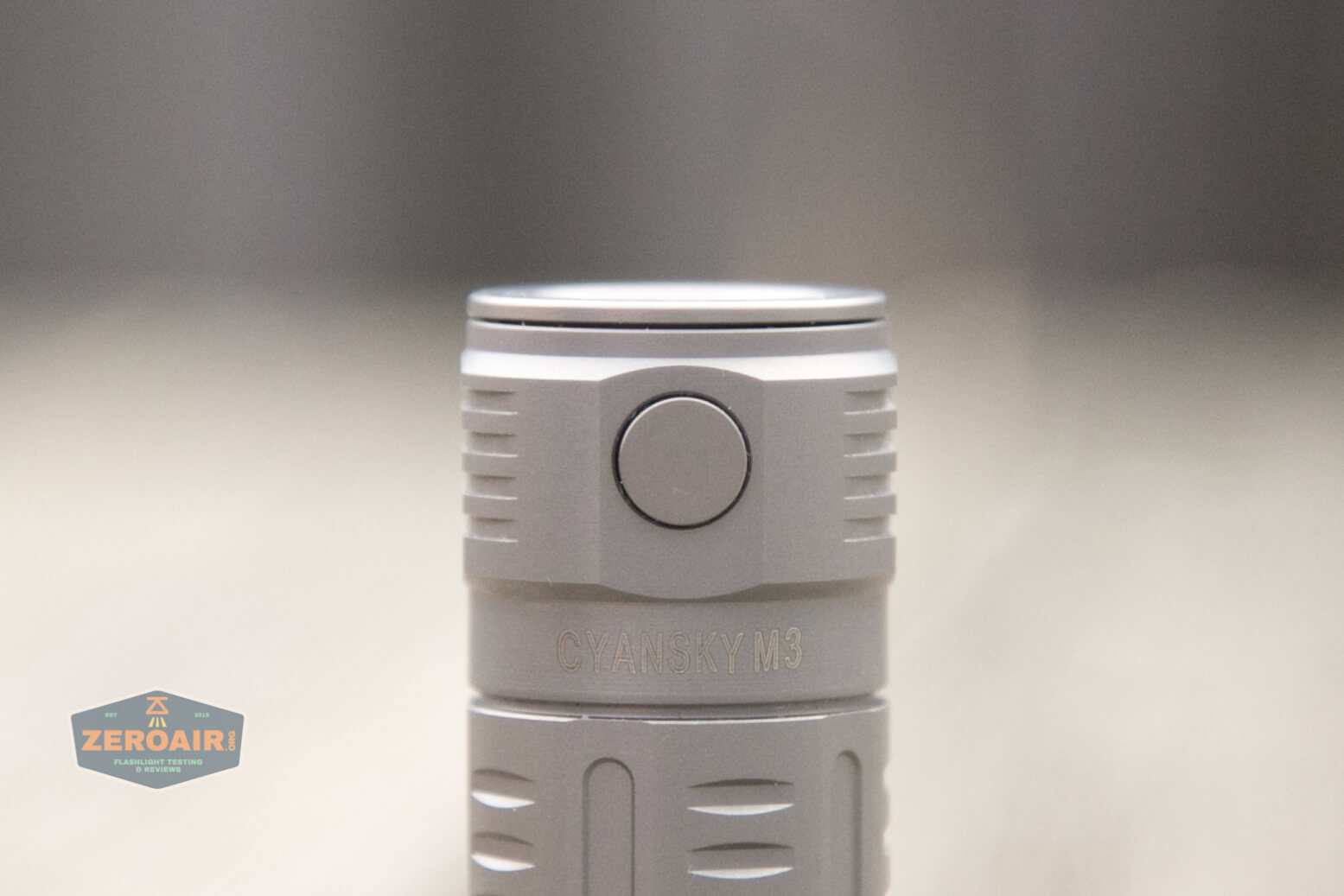
There’s a single switch on the Cyansky M3. It’s a metal button e-switch, on the side of the head. It’s a small switch.
It’s also not very proud (which is fine), but that leaves little to find by feel. There’s absolutely no texture at all on the switch.
All in all the switch is probably the biggest complaint about the M3. It’s hard to find. Even by looking at the light, it’s somewhat hard to find, because it blends so well with the body. To draw a comparison with the light mentioned above – the Fenix E16, has both a contrasting color switch, and the switch has a light concentric circle texture.
Here’s a user interface table!
| State | Action | Result |
|---|---|---|
| Off | Click | No action |
| Off | Hold ~0.5s | Low |
| On | Hold ~0.5s | Off |
| On | Click | Mode advance (LMHT) |
| Any | Hold >1s | Strobe |
| Strobe | Click | Low |
The user interface is overall very simple. But it’s hold for on and hold for off, which isn’t always ideal.
LED and Beam
The emitter Cyansky put in the M3 is a Cree XP-G3. The shallow, narrow reflector has a light orange peel texture, but is small enough that the beam is not very tight.
LED Color Report (CRI and CCT)


Beamshots
These beamshots always have the following settings: f8, ISO100, 0.3s shutter, and manual 5000K exposure. These photos are taken at floor level, and the beam hits the ceiling around 9 feet away.


Tint vs BLF-348 (KillzoneFlashlights.com 219b version) (affiliate link)
I keep the test flashlight on the left and the BLF-348 reference flashlight on the right.


I compare everything to the KillzoneFlashlights.com 219b BLF-348 because it’s inexpensive and has the best tint!
Conclusion
What I like
- Size
- Actually titanium
- Very simple UI
- Metal switch cover
- Cell charging works well
What I don’t like
- Switch is very hard to find
- Cree XP-G3
- Output falls well short of 700-lumen claim
Notes
- This light was provided by Cyansky for review. I was not paid to write this review.
- This content originally appeared at zeroair.org. Please visit there for the best experience!
- For flashlight-related patches, stickers, and gear, head over to PhotonPhreaks.com!
- Please use my Amazon.com referral link to help support zeroair.org!
Pingback: Flashlight News: Phreaky Briefing Issue 39 – PhotonPhreaks
Bezel twists with reflector – no waterproof, damaged LED? UI is horrible – slow on/off, not hidden turbo, no direct access to turbo.
Pingback: Cyansky M2 Keychain Flashlight Review - ZeroAir Reviews