

Cyansky M2 Keychain Flashlight Review
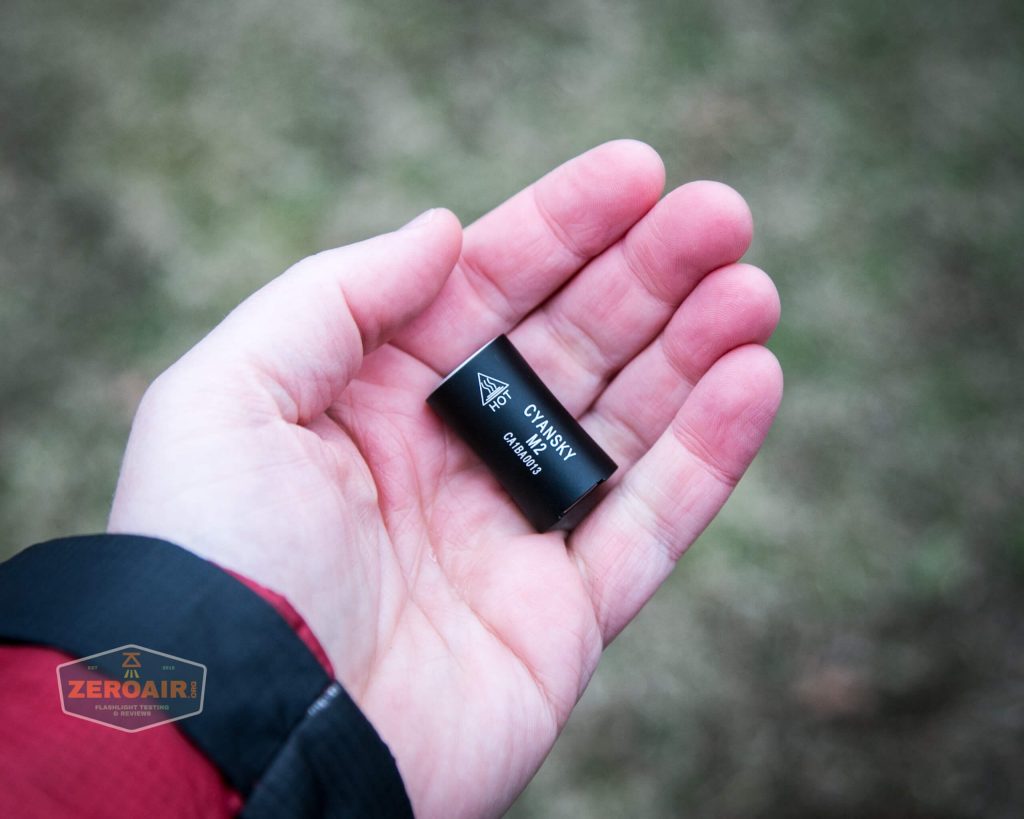
In my hands on this fine Christmas day is the Cyansky M2 keychain flashlight. It’s an interesting little light – very tiny, rechargeable, and unusual!
Cyansky M2 keychain Flashlight Official Specs and Features
Here’s a link to the official product page.
Versions
Only the version you see here is available.
Price
Like the M3, which I reviewed earlier this week, the M2 is… not easily available. So I can’t tell you where to buy it, nor can I tell you how much it costs. Cyansky was interested in a review of it though, so…. I agreed.
Short Review
I can honestly say I did not expect much out of this light. Lights with built-in batteries, Cree XP-G3 (*claimed) emitters, and the like – usually not my jam. However, there are things to like! The charging is good. Beam shape, also good. What bothers me most about the Cyansky M2 keychain flashlight is that the switch is hard to actuate.
Long Review of the Cyansky M2 keychain Flashlight
The Big Table
| Cyansky M2 | |
|---|---|
| Emitter: | Cree XP-G3 (S4) (claimed – looks like XP-E2 to me though) |
| Price in USD at publication time: | ? |
| Cell: | Internal 200mAh Lithium-ion |
| Turbo Runtime | High Runtime |
| LVP? | ? |
| Switch Type: | E-Switch |
| Quiescent Current (mA): | ? |
| On-Board Charging? | Yes |
| Charge Port Type: | micro-USB |
| Chargetime | |
| Power off Charge Port | Low only |
| Claimed Lumens (lm) | 200 |
| Measured Lumens (at 30s) | 186 (93% of claim)^ |
| Candela per Lumen | 12.7 |
| Claimed Throw (m) | 83 |
| Candela (Calculated) in cd (at 30s) | 185lux @ 3.259m = 1965cd |
| Throw (Calculated) (m) | 88.7 (106.9% of claim)^ |
| All my Cyansky reviews! | |
^ Measurement disclaimer: Testing flashlights is my hobby. I use hobbyist-level equipment for testing, including some I made myself. Try not to get buried in the details of manufacturer specifications versus measurements recorded here; A certain amount of difference (say, 10 or 15%) is perfectly reasonable.
What’s Included

- Cyansky M2 keychain flashlight
- Charge cable (USB to micro-USB)
- Keyring (not a split ring!)
- Manual
Package and Manual
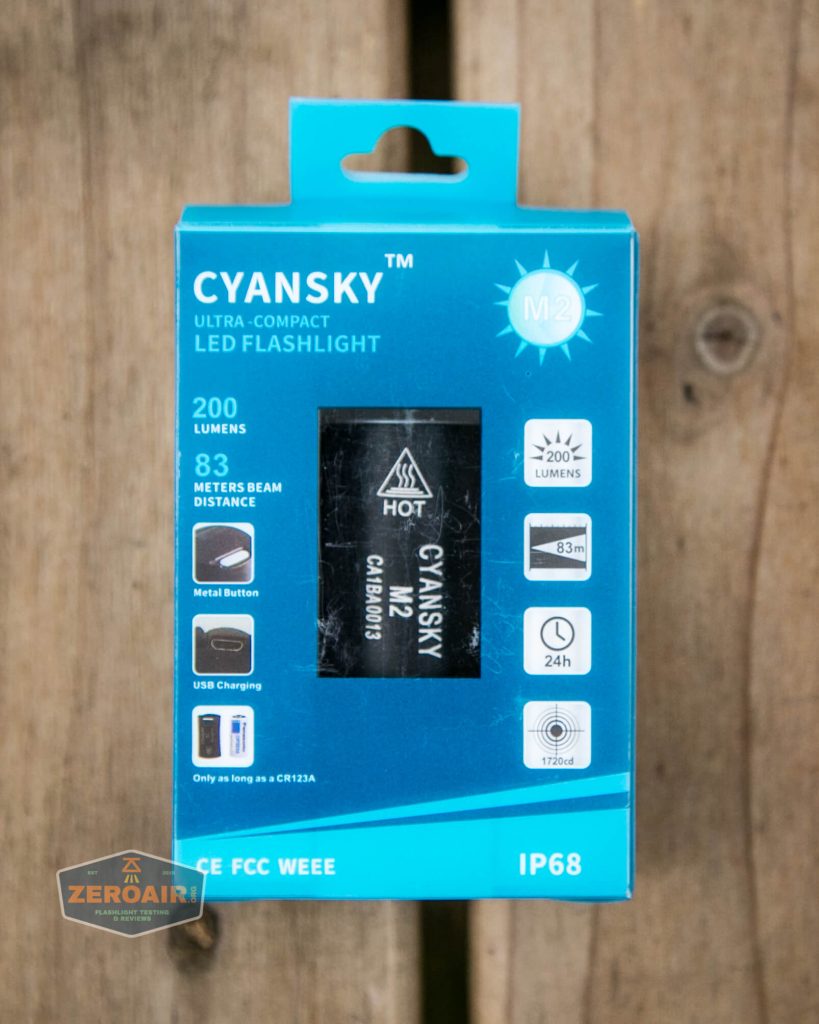
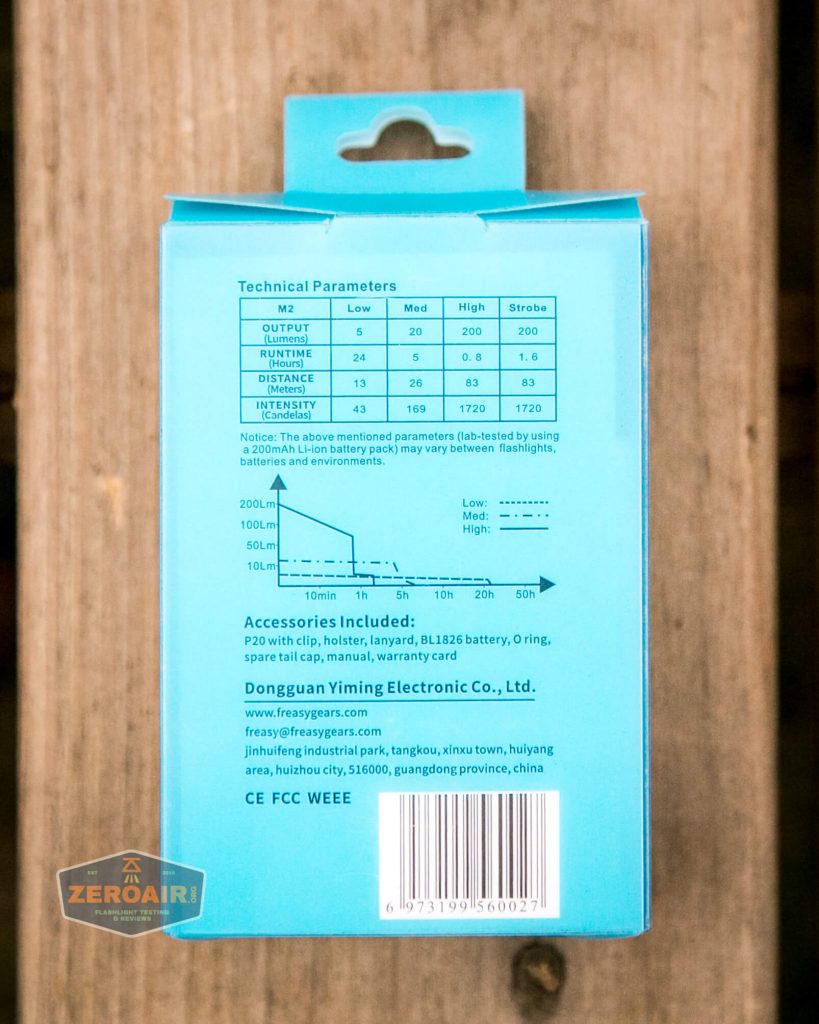

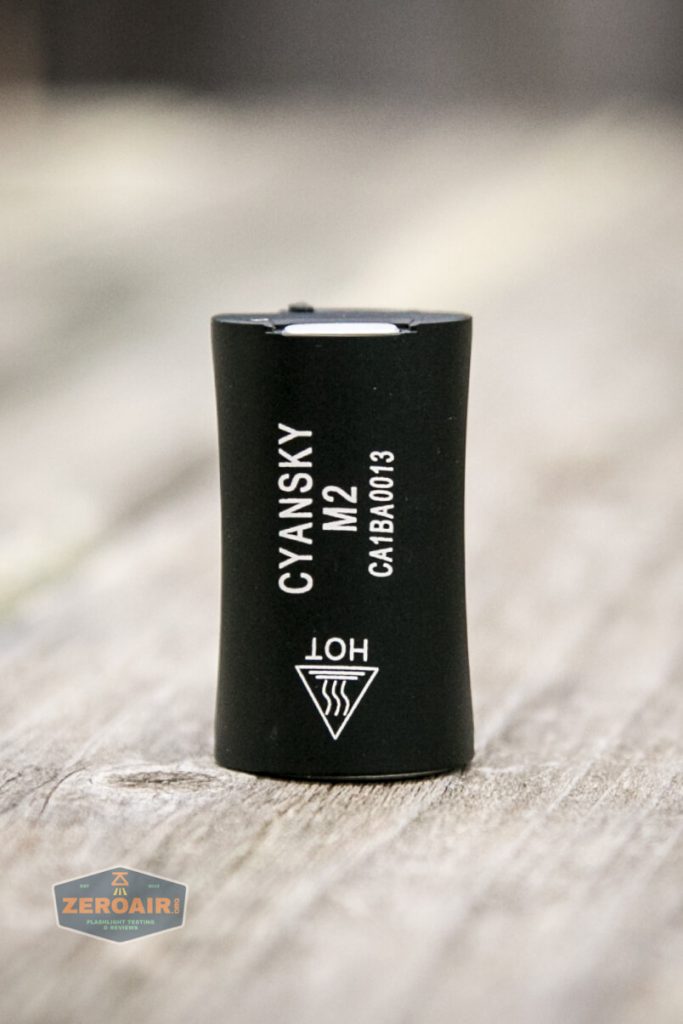
Build Quality and Disassembly

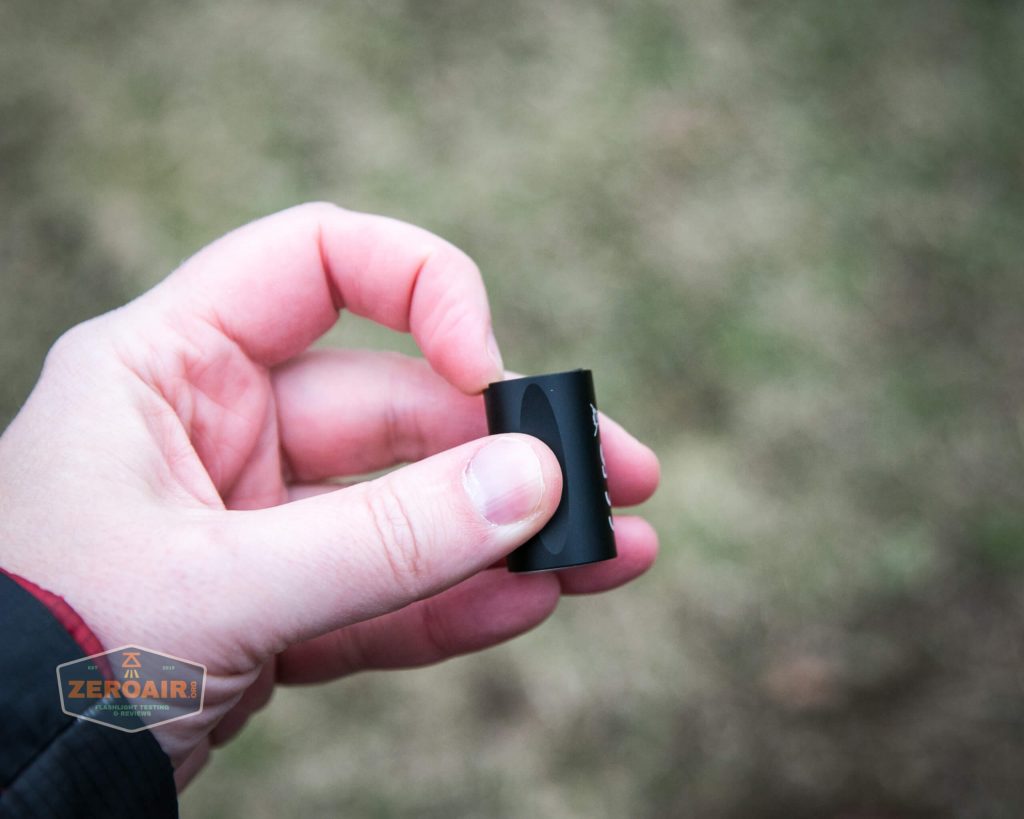
The Cyansky M2 keychain flashlight is really just a little blob of a light. There’s not much going on in the hand – it just feels like a tiny cylinder!
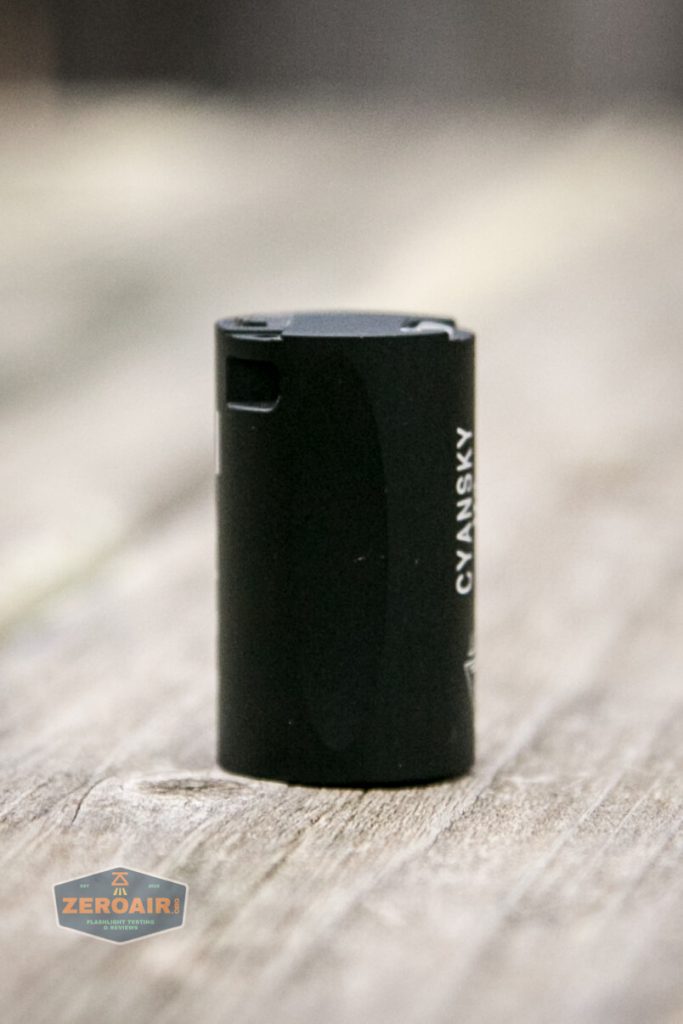
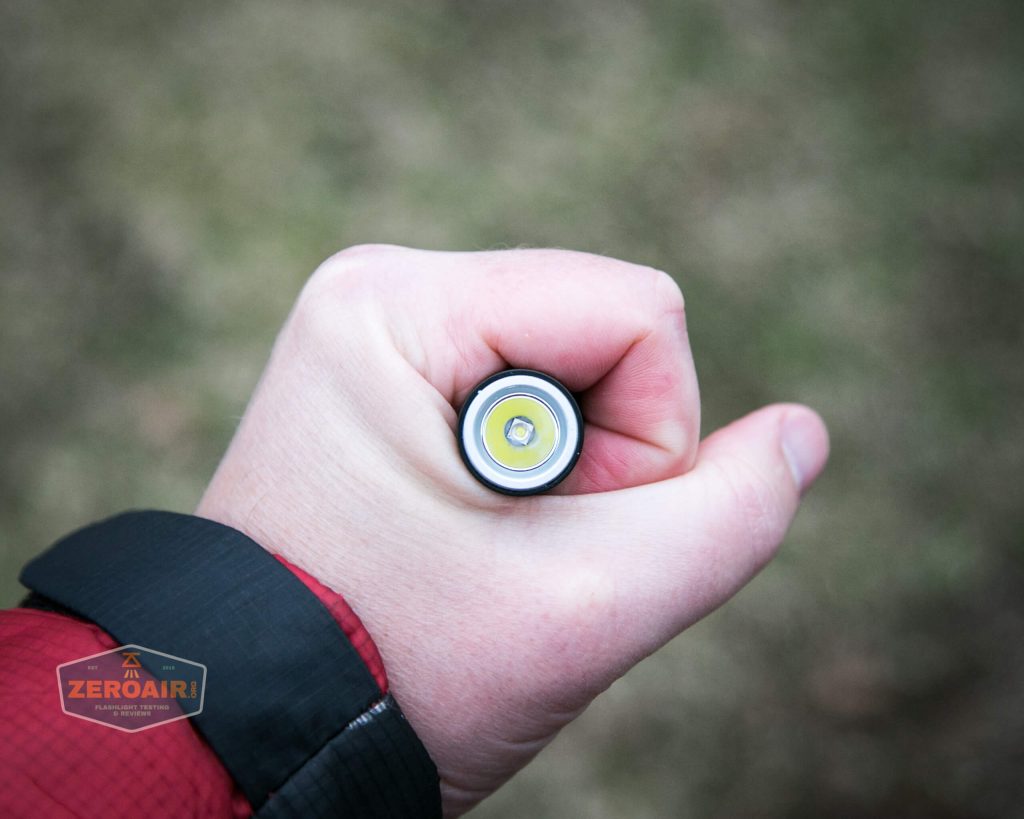
Have a look at the emitter here. More on this later!

Here’s your first look at the switch, too.

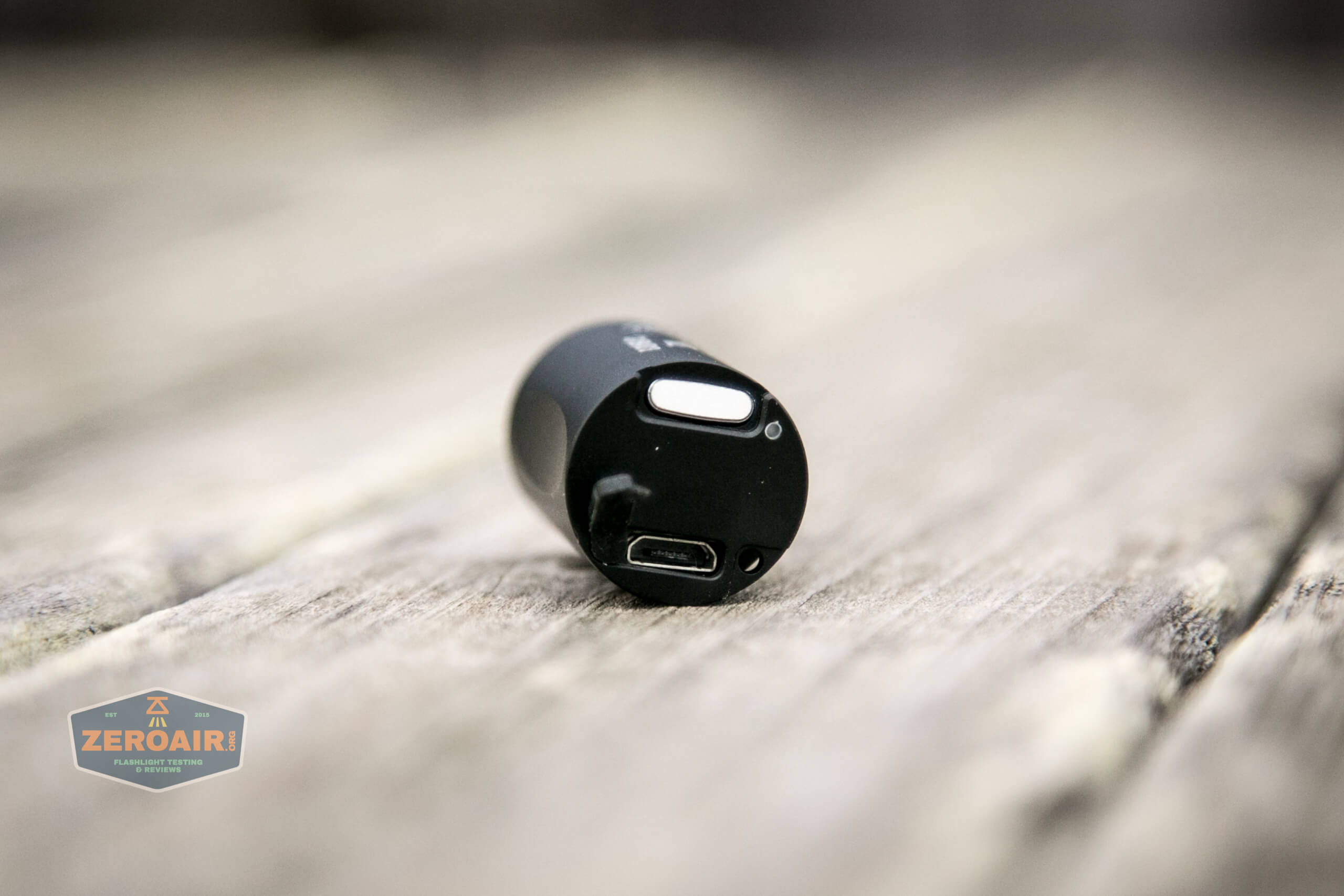
And the charge port!

Here’s the lanyard hole.

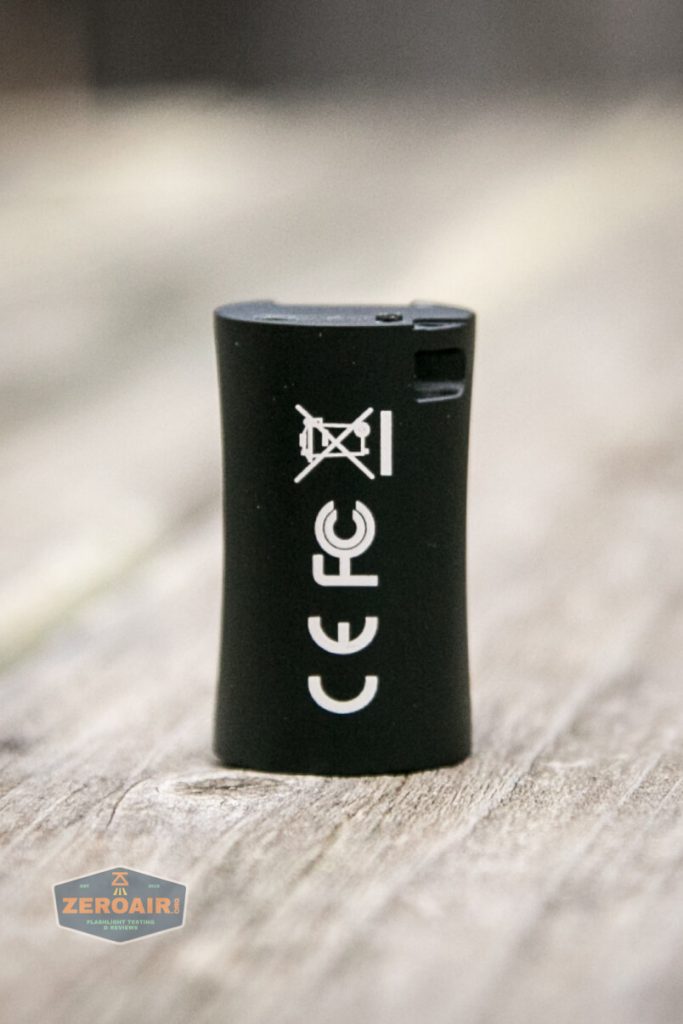
There’s a slight waist to the light; it’s not a completely straight-sided cylinder.

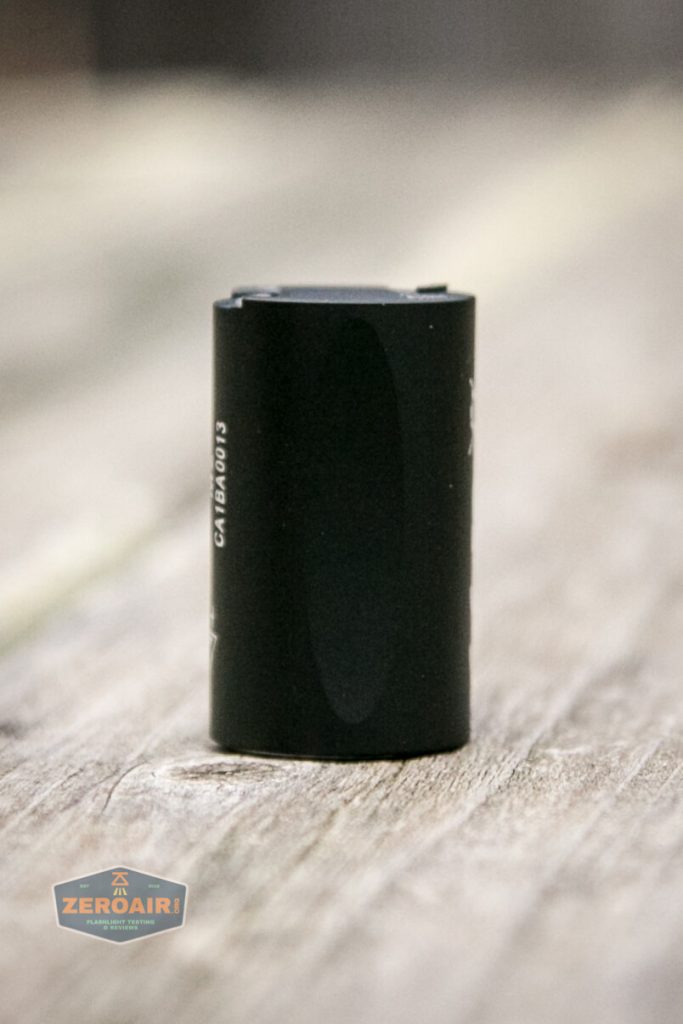
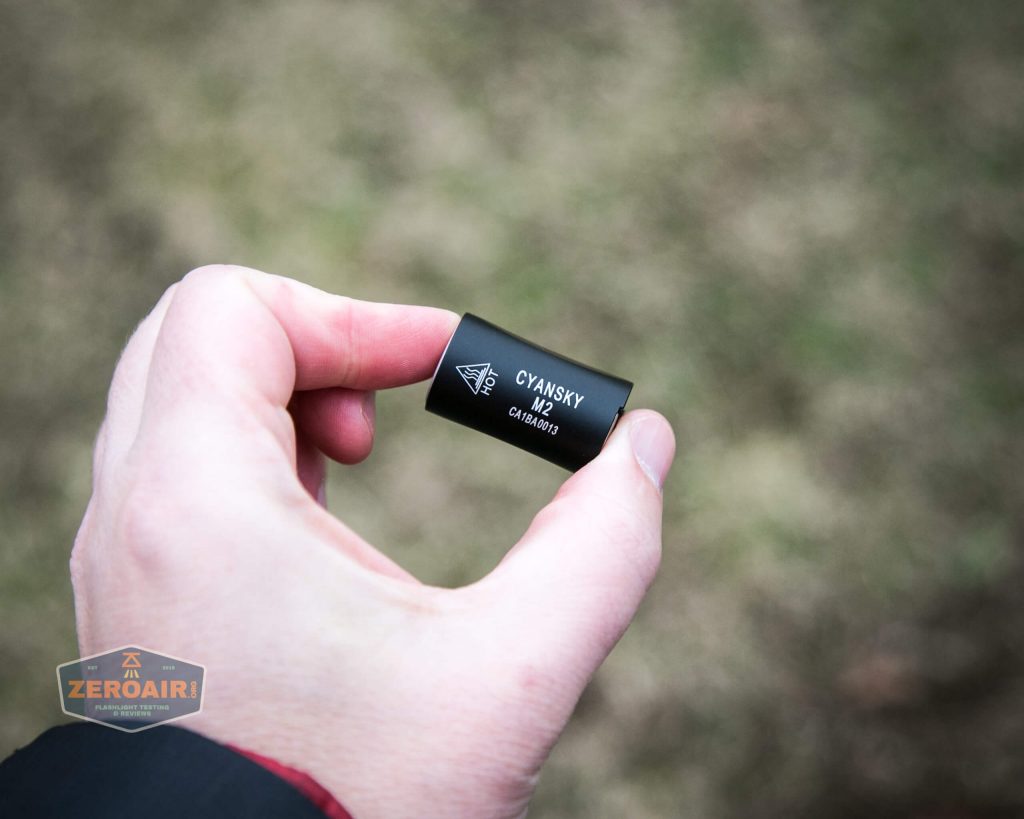
The M2 is serialized.


Size and Comps
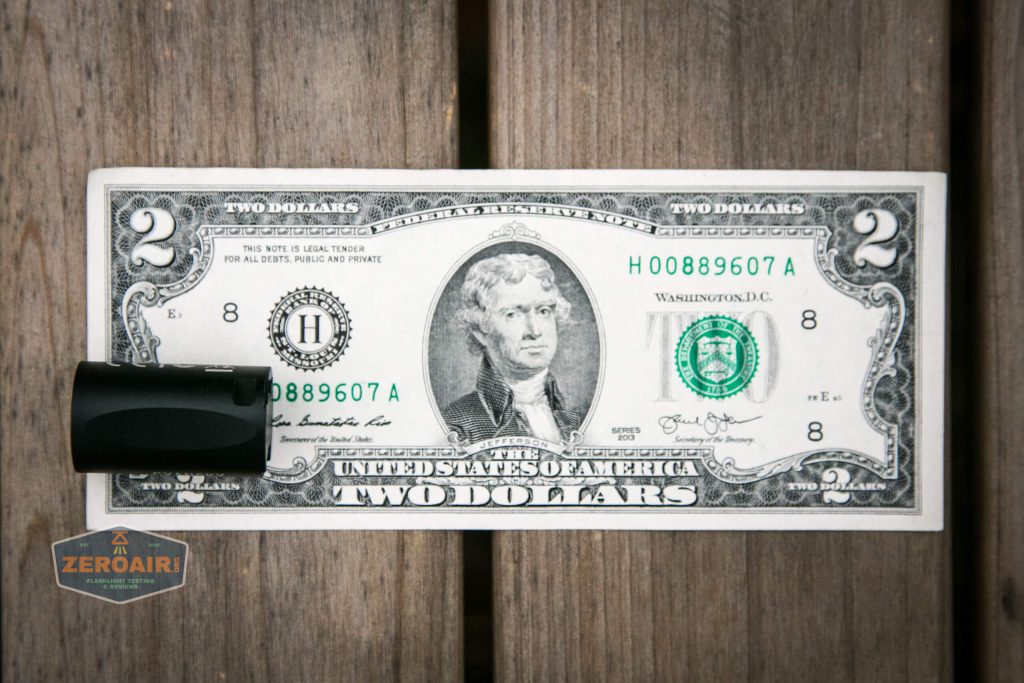
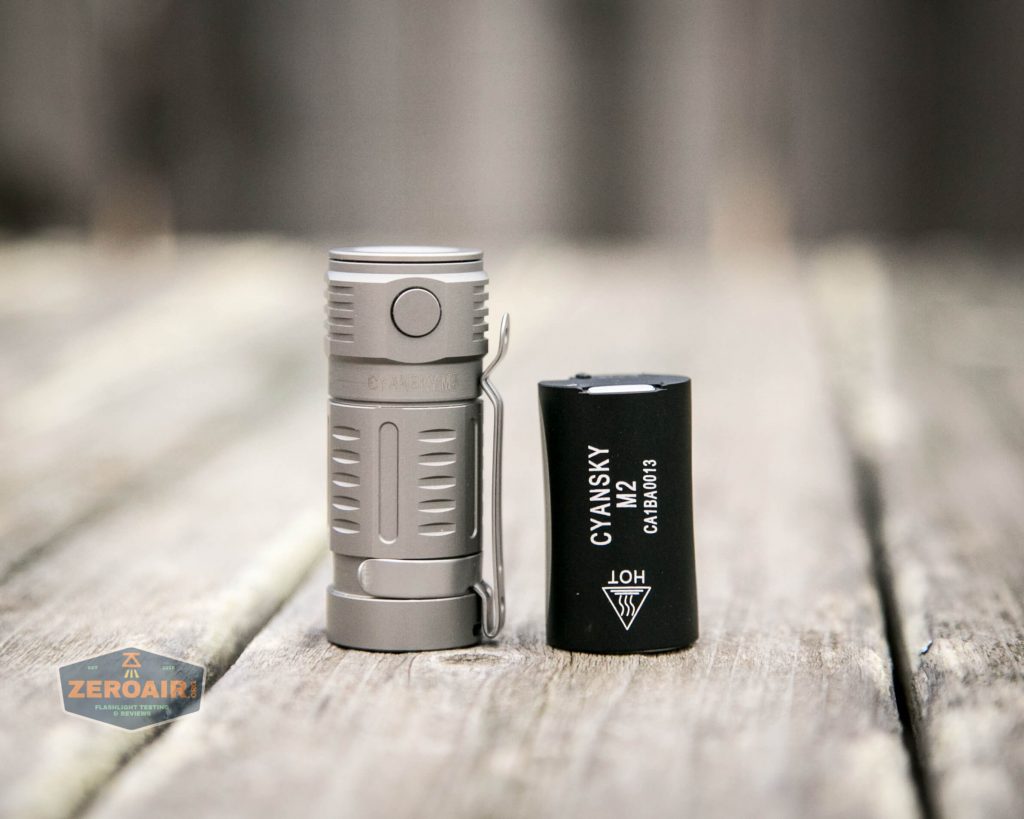
Officially 34mm x 20mm, and 18.5g.
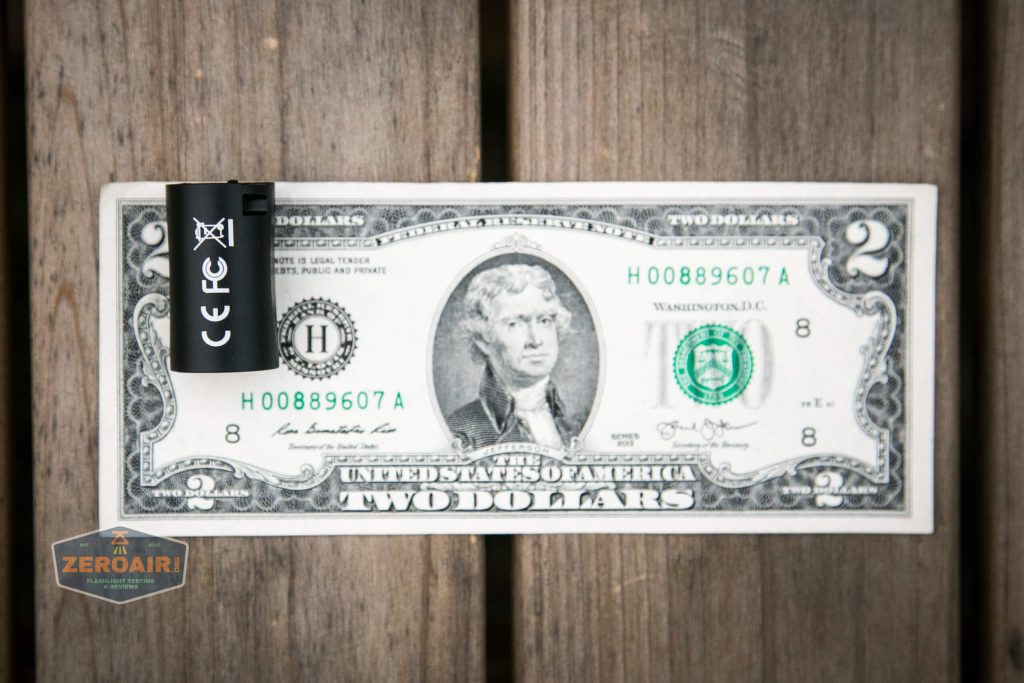
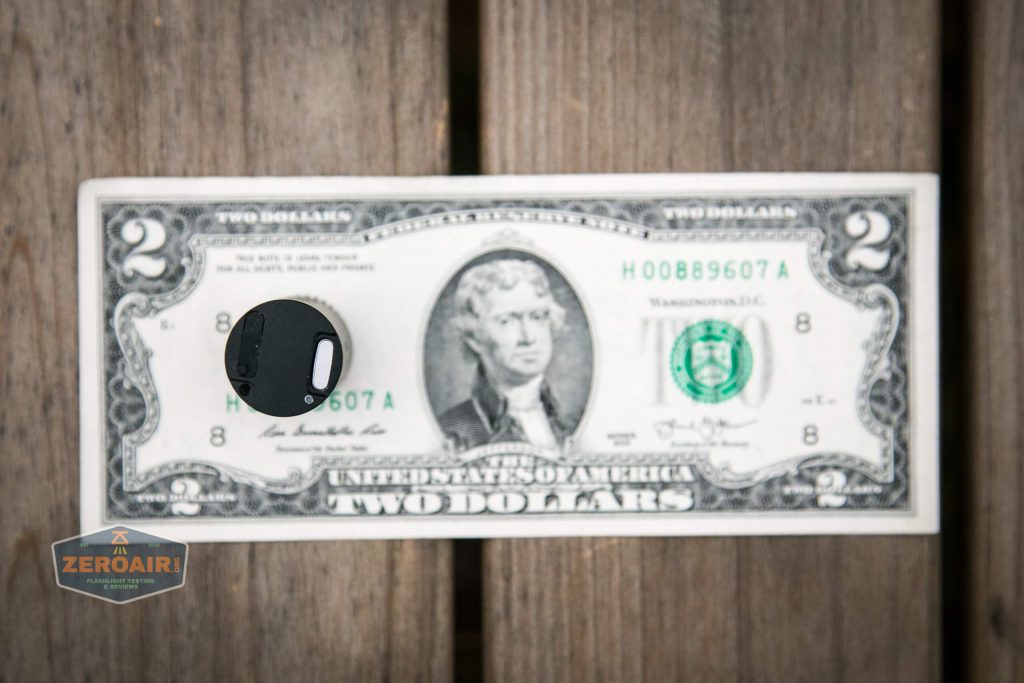
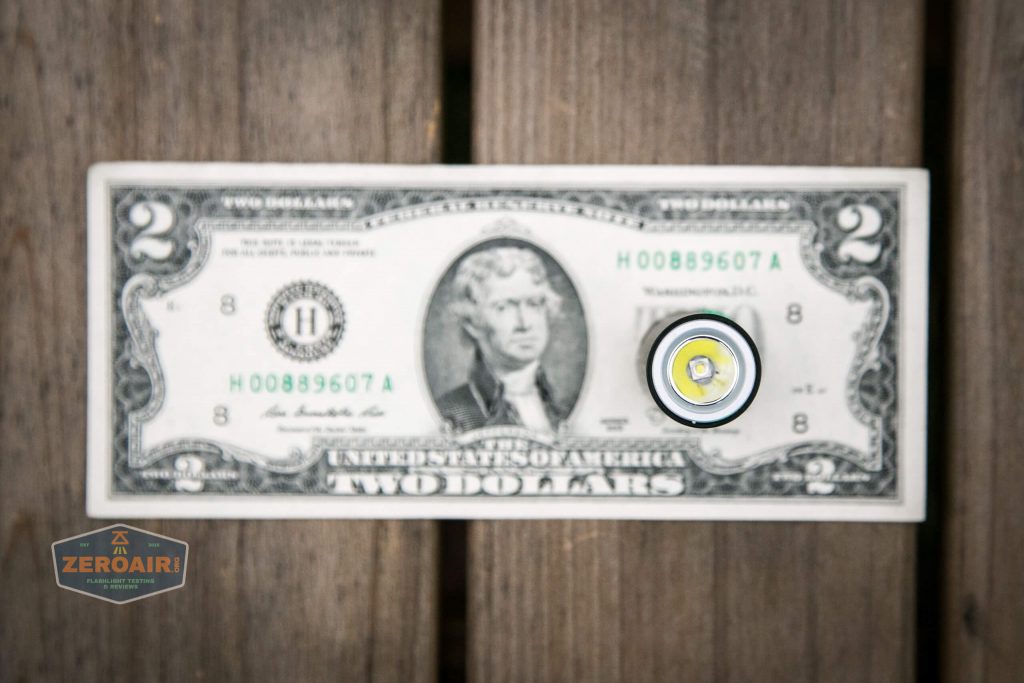
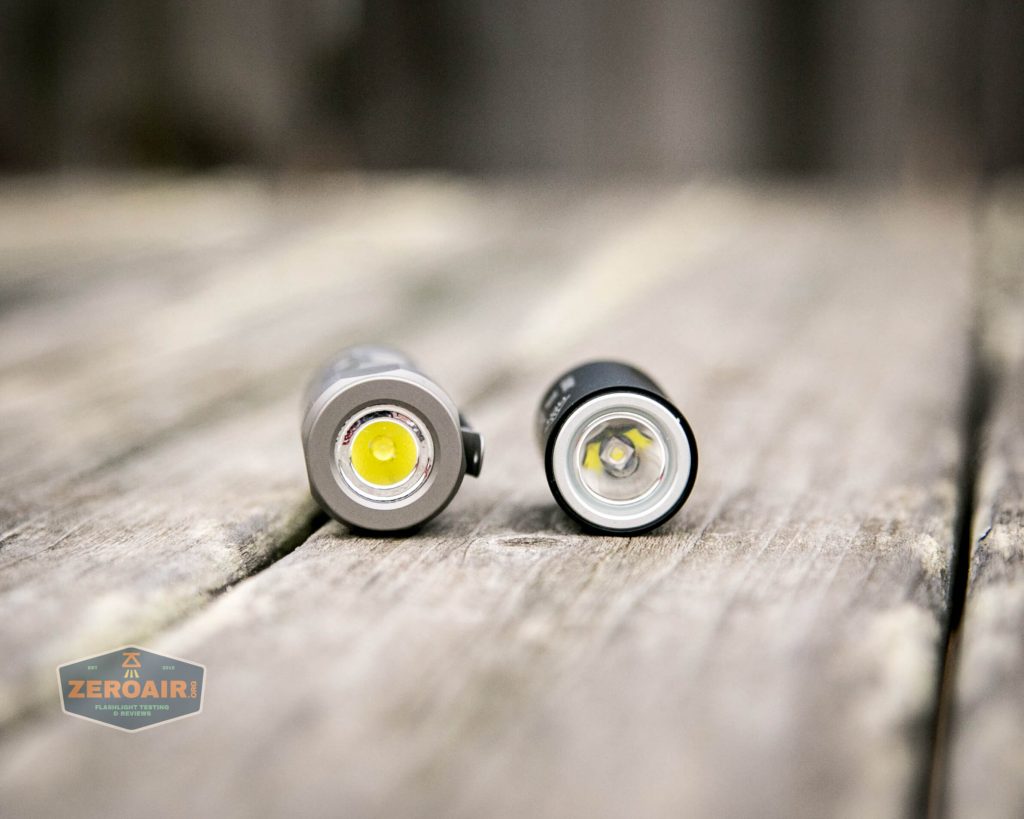
If the flashlight will headstand, I’ll show it here (usually the third photo). If the flashlight will tailstand, I’ll show that here, too (usually the fourth photo).
Here’s the test light with the venerable Convoy S2+. Mine’s a custom “baked” edition Nichia 219b triple. A very nice 18650 light.
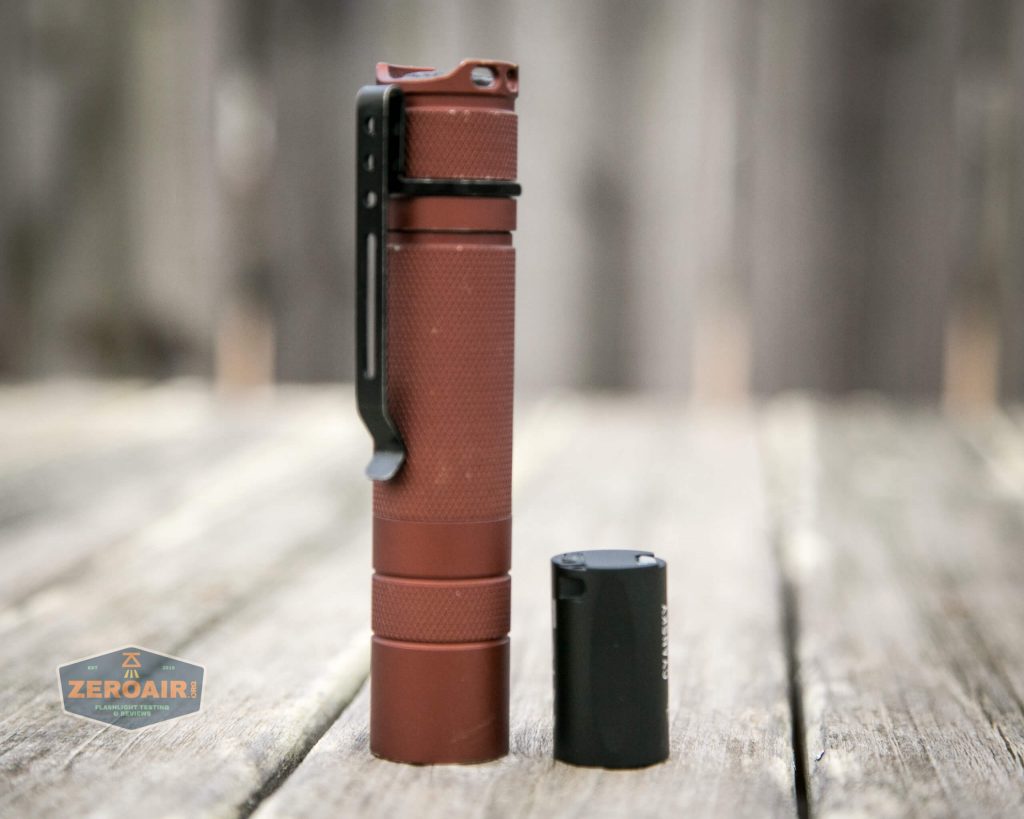
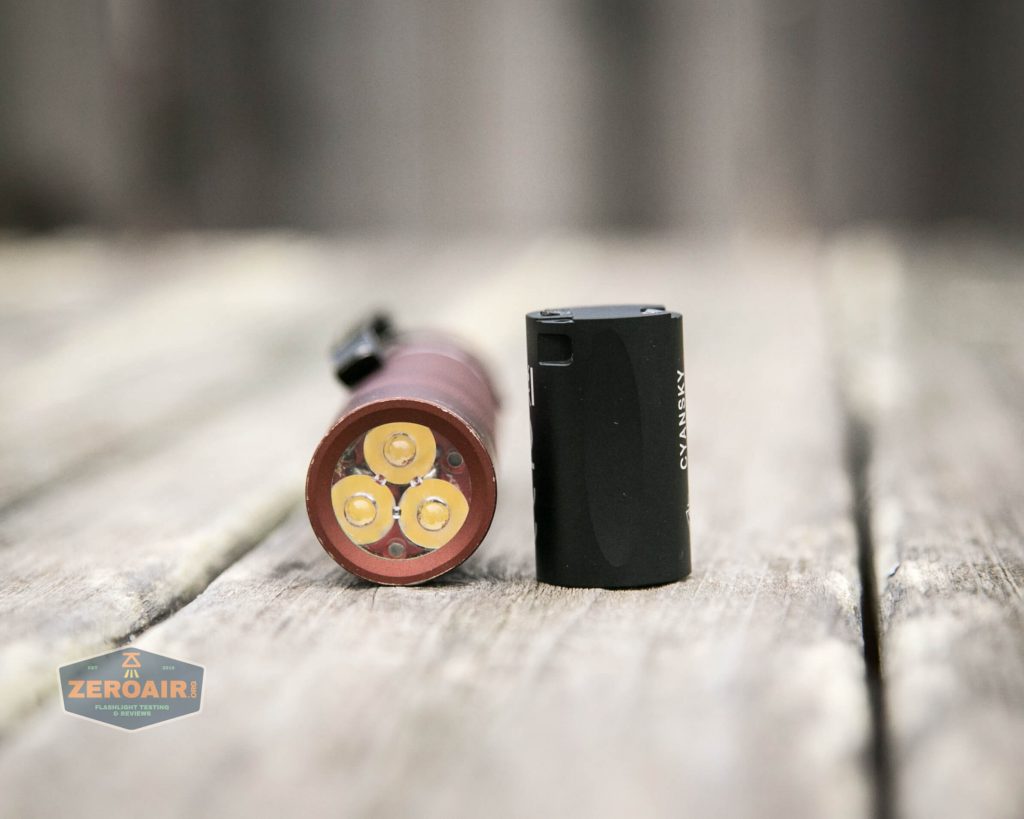
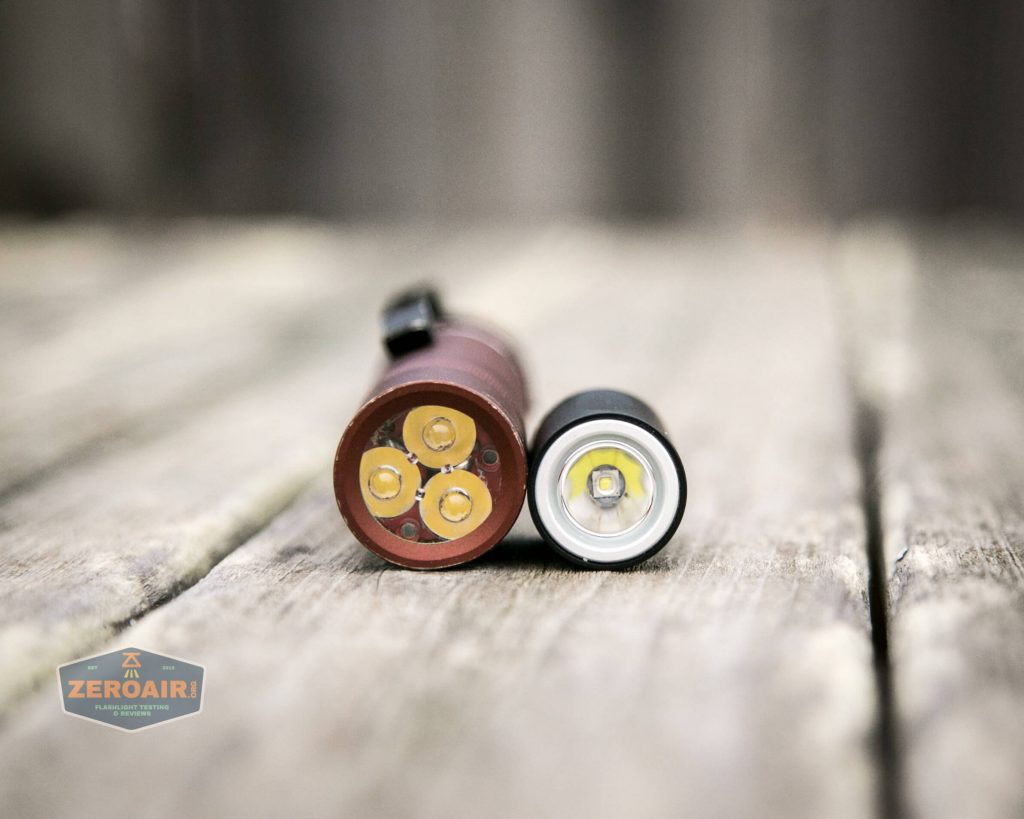
And here’s the light beside my custom engraved TorchLAB BOSS 35, an 18350 light. I reviewed the aluminum version of that light in both 35 and 70 formats.

Here’s the M2 (right) beside the other Cyansky light I have – the M3. I reviewed the M3 the other day, here. Surprisingly the reflector on the M2 is larger than the reflector on the M3 (a bigger light)!
Retention and Carry
Cyansky provides a ring, which is attached to a lanyard, for carrying the M2. My impression is that this is intended to be worn on a finger as seen below. The ring is not a split ring!

Fortunately that little stainless barrel is a screwed-together piece, which makes installing the lanyard on the light simple.

Then just screw the pieces back together.

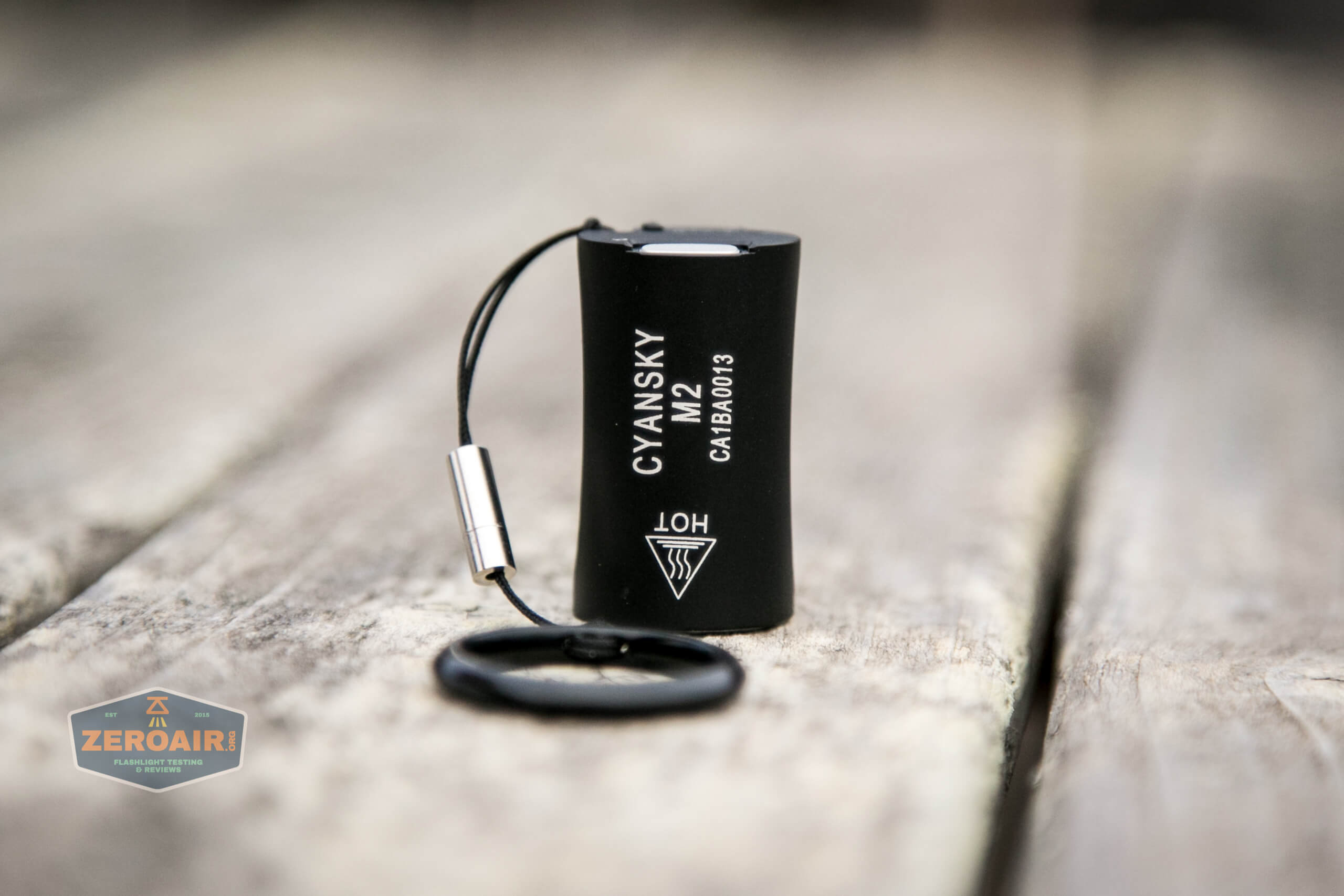
I don’t know if you’d want to use this…. I don’t. Rather, I’d just keep the light loose in a pocket. That’s how I carry it, in any case.


There is no pocket clip, no magnet, no pouch, and nothing else for carry.
Power and Runtime
The Cyansky M2 is powered by a built-in lithium-ion cell, of 200mAh capacity. This cell is not changeable as far as I can tell, but it is rechargeable.
Here are two runtimes. First the highest mode. It doesn’t quite hit the 200-lumen claim, and the output at 30s is still rapidly declining. But after the stepdown, the output is still fairly reasonable at around 80-100 lumens.

It’s unclear if there is low voltage protection because the light just kept on and on at around 2 lumens or so until I shut the test off. I wasn’t able to disassemble the light to test with bench power. The indicator beside the switch does indicate when power is low, by flashing red. This happens under 3V.
The output on Medium is fairly stable but does trend downward over the course of ~2 hours.

Charging
As mentioned, the M2 has built-in charging. The charge port has a very flexible press-in cover, which I found very hard to remove. I even used tweezers on occasion! (But with tweezers; very easy.)
The charge port is micro-USB.
An appropriate cable is included – USB to micro-USB.
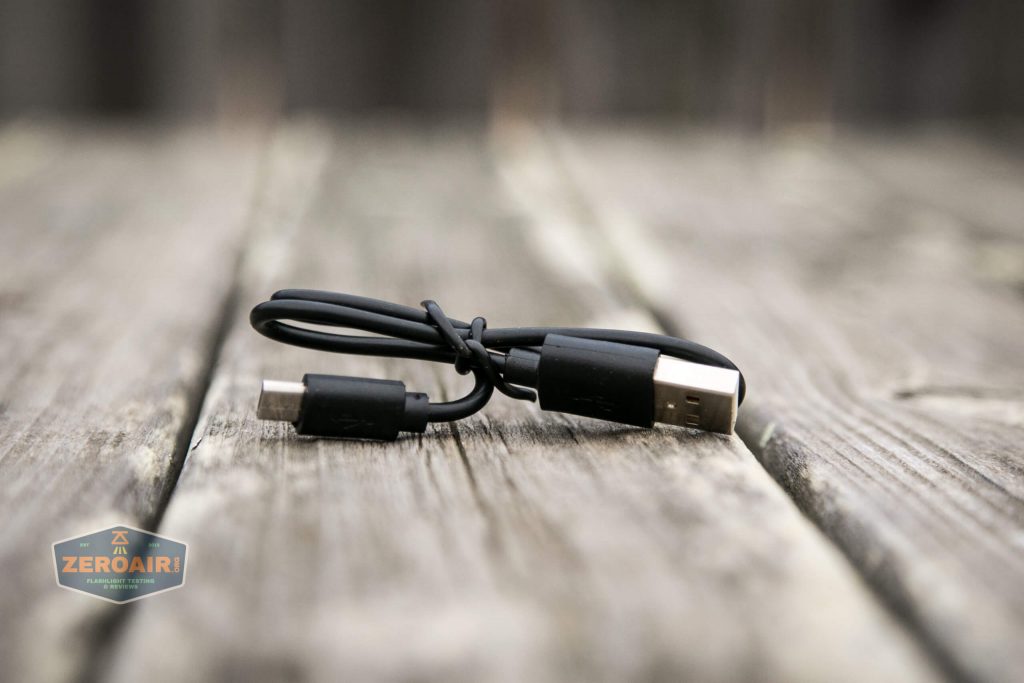

Charging looks very good, and is extremely consistent. A full charge takes around 1h40m.

While charging, an indicator beside the charge port is red. When the charge is complete, this indicator turns blue.
Modes and Currents
| Mode | Mode Claimed Output (lm) | Claimed Runtime | Measured Lumens | Tailcap Amps |
|---|---|---|---|---|
| High | 200 | 0.8h | 186 | – |
| Med | 20 | 5h | 50 | – |
| Low | 5 | 24h | 4 | – |
Pulse Width Modulation
The lower two modes do have PWM. It’s not specifically visible but if you saw the beam and thought “something could be better” it’s this.
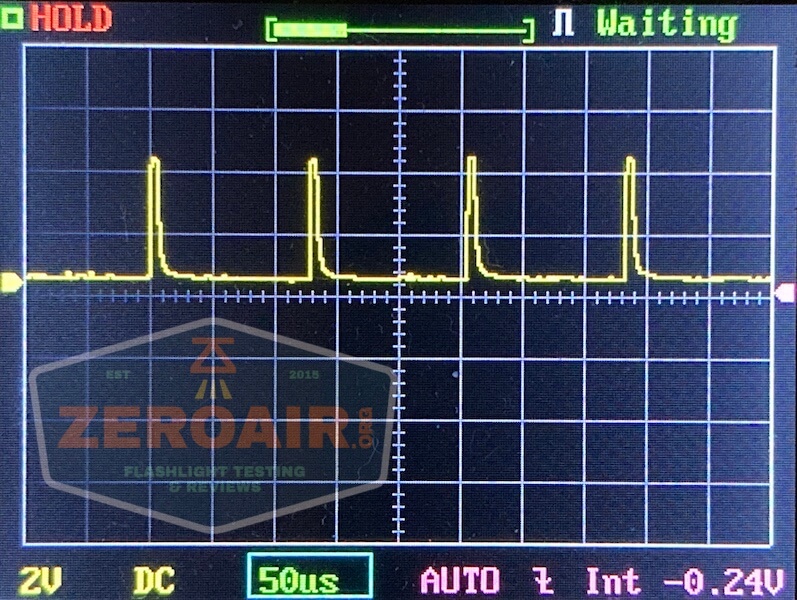
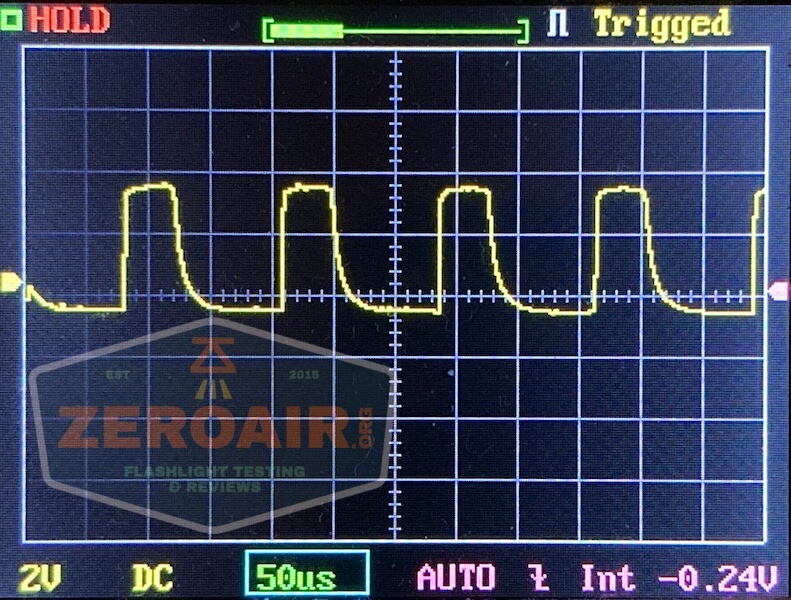
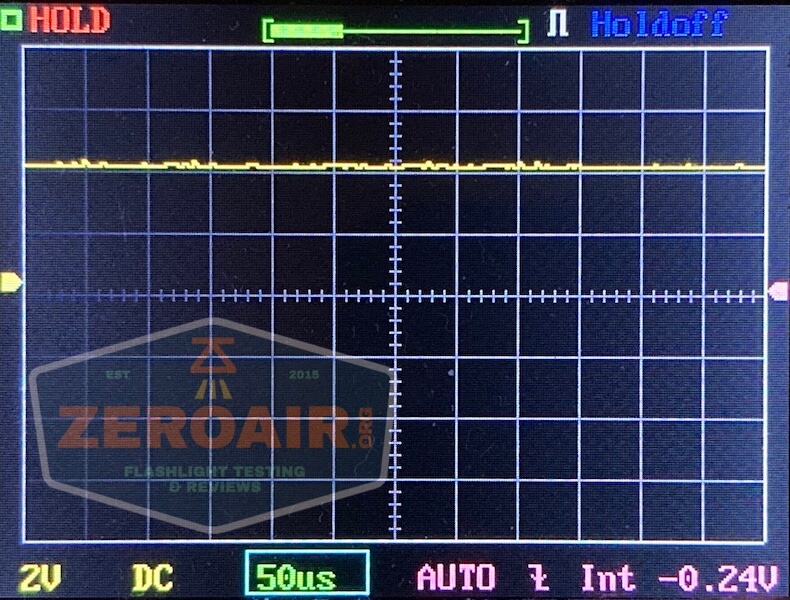
Here you can see a “baseline” – a chart with almost no light hitting the sensor.

Then there’s the Ultrafire WF-602C flashlight, which has some of the worst PWM I’ve seen. It’s so bad that I used a post about it to explain PWM! Here are multiple timescales (10ms, 5ms, 2ms, 1ms, 0.5ms, 0.2ms) to make comparing this “worst” PWM light to the test light easier. That post also explains why I didn’t test the WF-602C at the usual 50us scale.


User Interface and Operation
There’s a single switch on the Cyansky M2. It’s an e-switch, on the tail of the light. Basically, it’s what you might call a “fingernail switch” – it’s accessible by more than a fingernail, but only just.
The body has just the slightest indentation that will allow a “cover press,” where you can sort of just blindly press with a finger.
Here’s a user interface table!
| State | Action | Result |
|---|---|---|
| Off | Click | Battery check^ |
| Off | Hold (~0.5s) | Low |
| On | Hold (~0.5s) | Off |
| On | Click | Mode advance (LMH) |
| Any | Hold ~1s | Strobe (technically Low (if off) then strobe or Off (if on) then strobe) |
^ Battery indicator, per the manual:
Green steady (I think the light has been updated to “Blue” however!): 85% power
Green flash: 50%-85% power
Red steady: 25%-50% power
Red flash: >25% power
The user interface is very simple and intuitive. But the switch isn’t really all that excellent to interact with.
LED and Beam
Cyansky claims this to be a Cree XP-G3 emitter. I have to think that this is a carryover from the M3, which was accurately stated as having a Cree XP-G3, and the manual states such. What the M2 has is definitely not a Cree XP-G3. It looks to me most like a Cree XP-E2, but that and XP-G2 are very similar. Either way, it’s whatever you see below.
The emitter benefits from a small reflector. The beam is quite tight, with a candela per lumen of 12.7. This light is surprisingly throwy!
These beamshots always have the following settings: f8, ISO100, 0.3s shutter, and manual 5000K exposure. These photos are taken at floor level, and the beam hits the ceiling around 9 feet away.
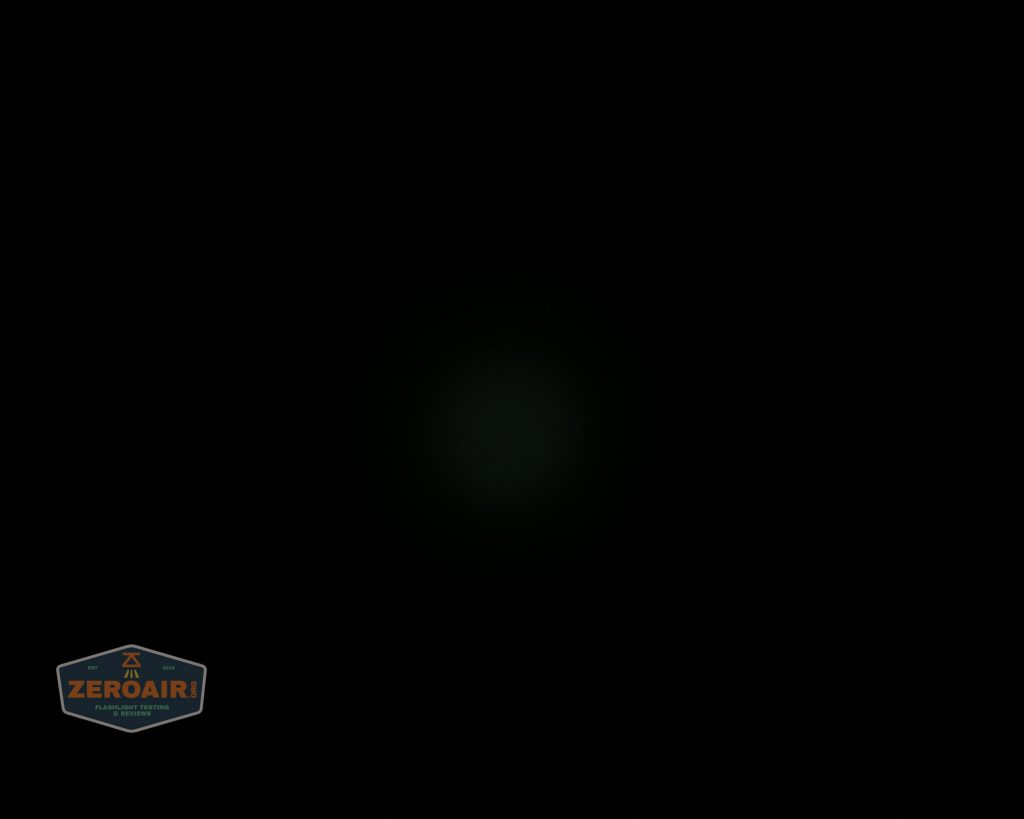
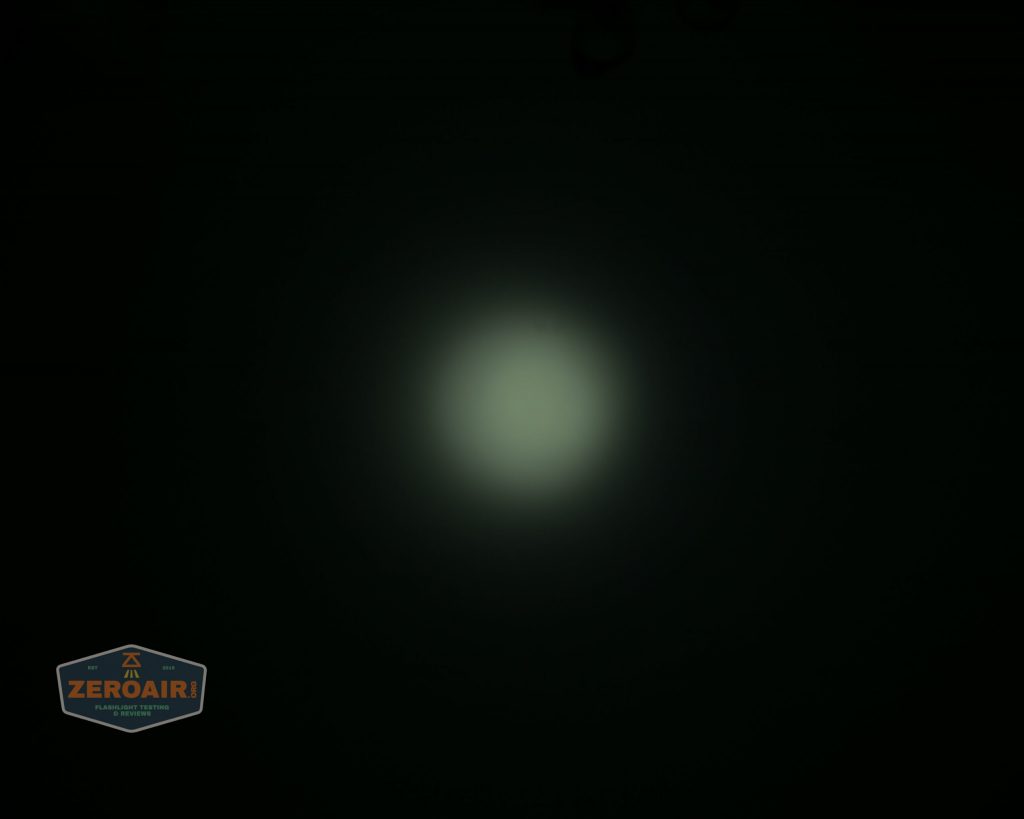

Tint vs BLF-348 (KillzoneFlashlights.com 219b version) (affiliate link)
I keep the test flashlight on the left and the BLF-348 reference flashlight on the right.
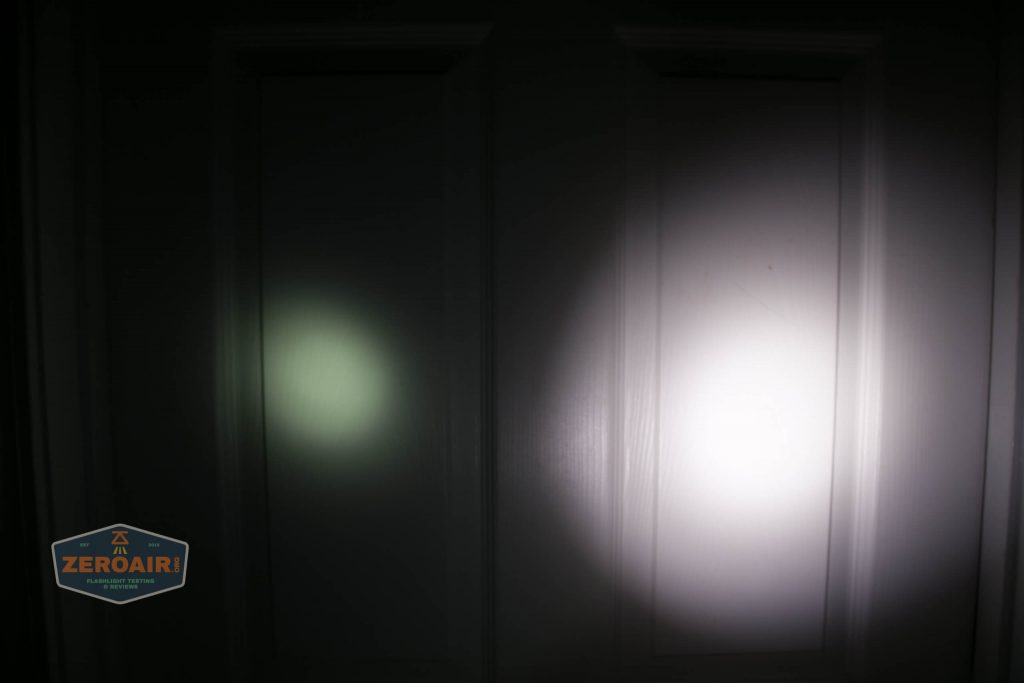
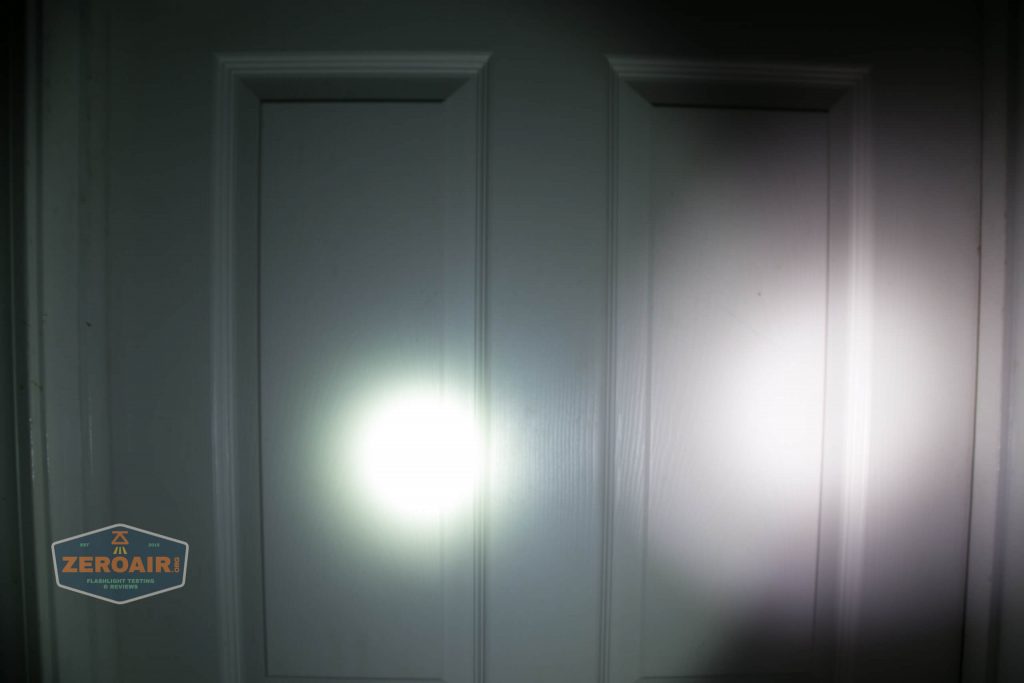
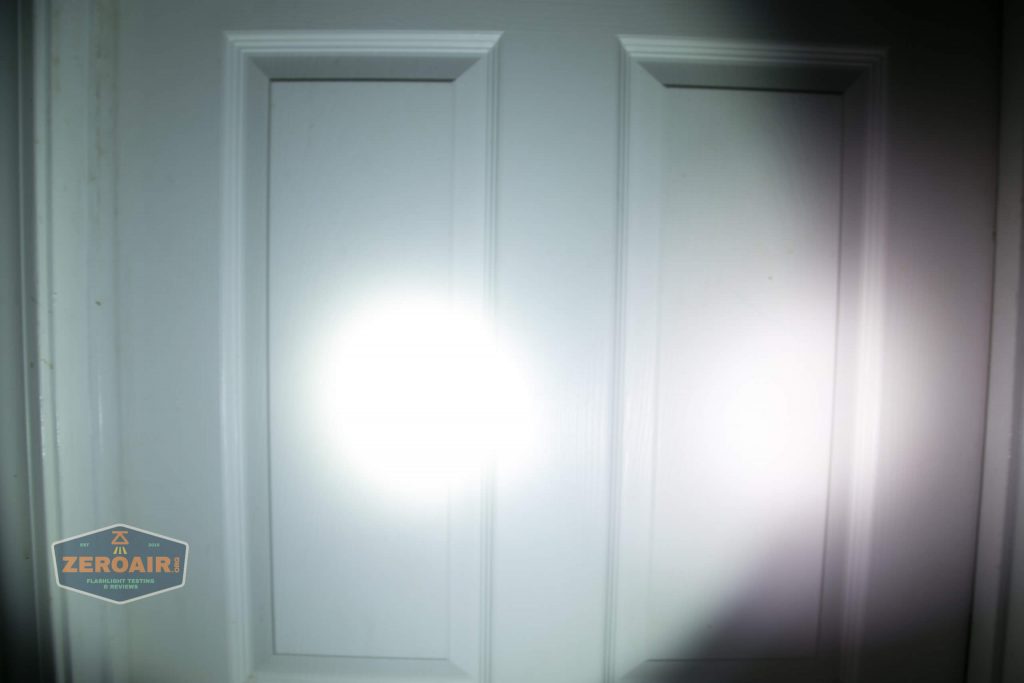
I compare everything to the KillzoneFlashlights.com 219b BLF-348 because it’s inexpensive and has the best tint!
Conclusion
What I like
- Charging is very consistent
- Good beam profile out of such a small light
- Nice pocket backup light
What I don’t like
- Mis-identified emitter
- Not able to be disassembled
- Cool white emitter
- Switch is difficult to manipulate
Notes
- This light was provided by Cyansky for review. I was not paid to write this review.
- This content originally appeared at zeroair.org. Please visit there for the best experience!
- For flashlight-related patches, stickers, and gear, head over to PhotonPhreaks.com!
- Please use my Amazon.com referral link to help support zeroair.org!