

Sofirn SD05 Diving Flashlight Review
The Sofirn SD05 diving flashlight is an interesting user interface light – just three modes and a rotary dial to access them. It runs on a 21700, and that’s included! Read on!
Official Specs and Features
Here’s a link to the Sofirn SD05 Diving flashlight product page.
Versions
I believe there is just one version.
Price
These go for $35.99 as seen in this review. There’s a “no-battery” package ($30.99), and a higher capacity battery ($36.99) option, too.
Short Review
First of all, I’m no diver, and I didn’t test this light in that way. I tested it simply a flashlight, and in that role it works quite well. The rotary interface is good, and leaves little in question for what you’re going to get when using the light.
Long Review
The Big Table
| Sofirn SD05 Diving Flashlight | |
|---|---|
| Emitter: | Luminus SST-70 |
| Price in USD at publication time: | $35.99 (as seen here) |
| Cell: | 1×21700 |
| High Runtime Graph | Medium Runtime Graph |
| LVP? | Off at 2.4V |
| Switch Type: | Dial |
| On-Board Charging? | Yes |
| Charge Port Type: | External Charger |
| Charge Graph | |
| Power off Charge Port | – |
| Claimed Lumens (lm) | 3000 |
| Measured Lumens (at 30s) | 2474 (82.5% of claim)^ |
| Candela per Lumen | 13.1 |
| Claimed Throw (m) | 270 |
| Candela (Calculated) in cd (at 30s) | 1201lux @ 5.492m = 36225cd |
| Throw (Calculated) (m) | 380.7 (141% of claim)^ |
| All my Sofirn reviews! | |
^ Measurement disclaimer: Testing flashlights is my hobby. I use hobbyist-level equipment for testing, including some I made myself. Try not to get buried in the details of manufacturer specifications versus measurements recorded here; A certain amount of difference (say, 10 or 15%) is perfectly reasonable.
What’s Included
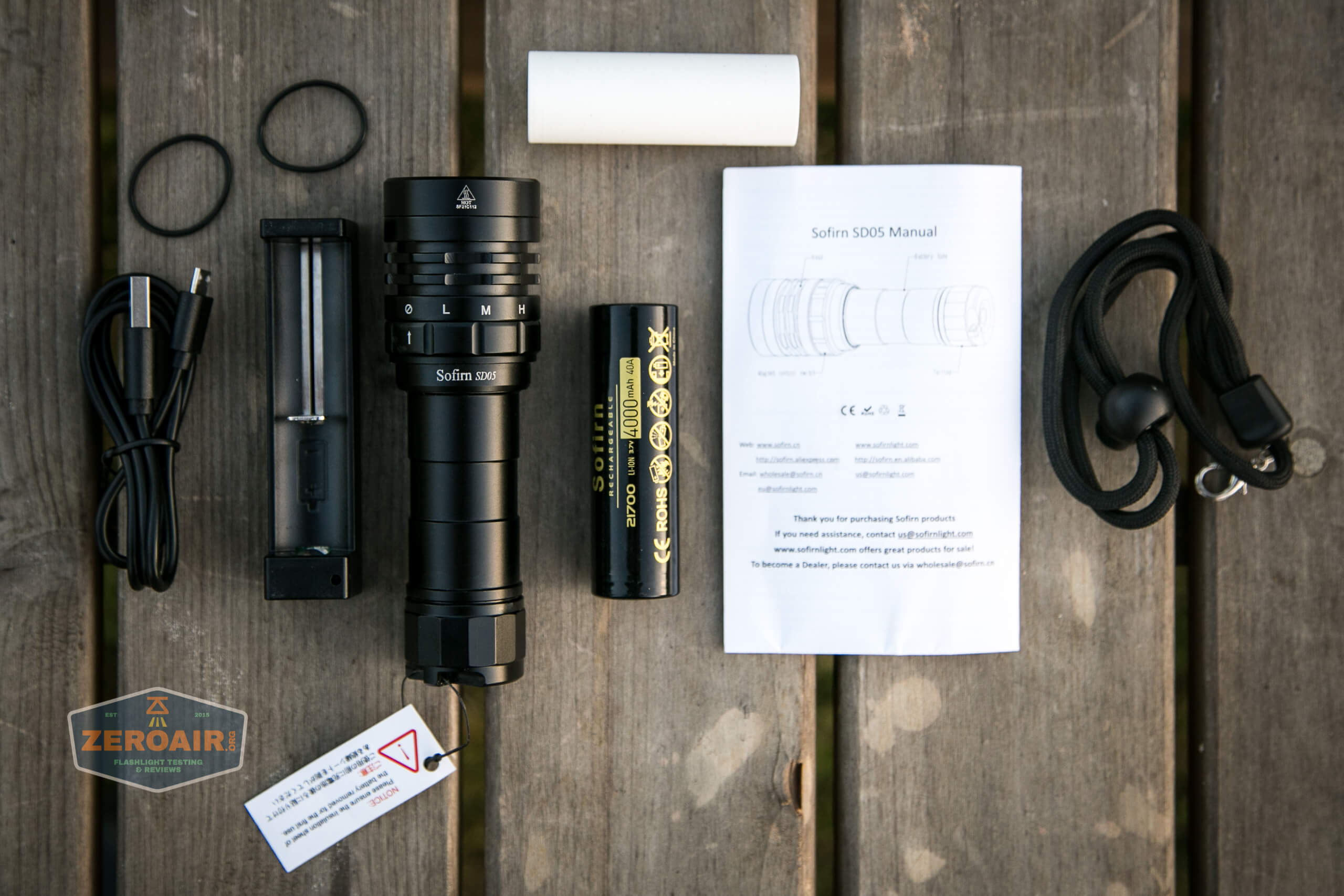
- Sofirn SD05 Diving Flashlight
- Sofirn 4000mAh 21700
- Lanyard/wrist strap
- Single-bay 21700 charger
- Charge cable (USB to micro-USB)
- 21700 to 18650 adapter
- Manual
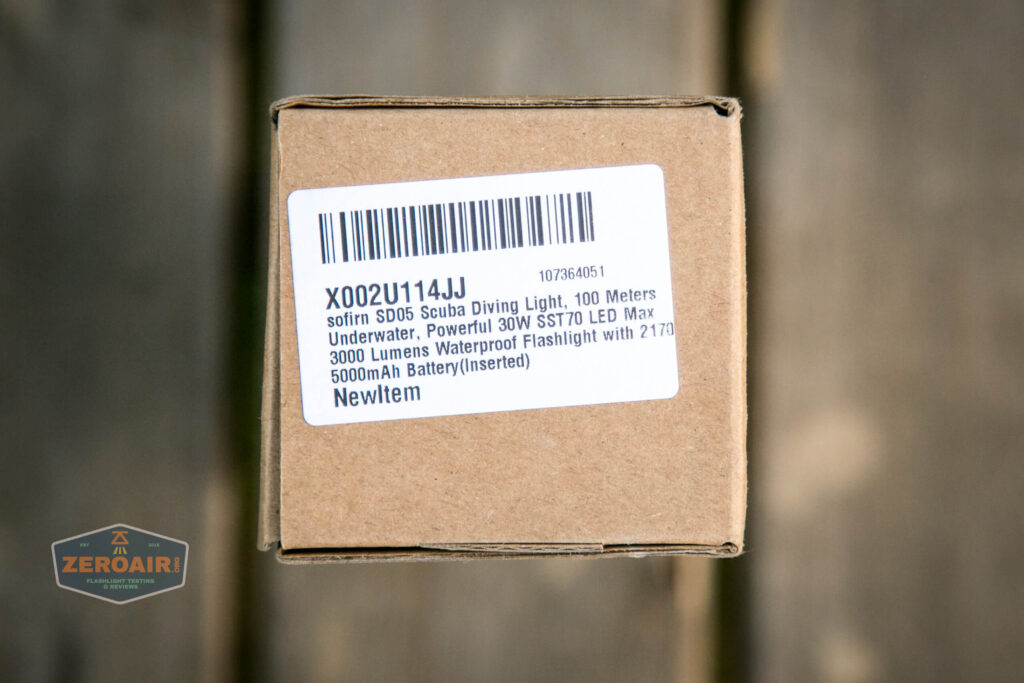
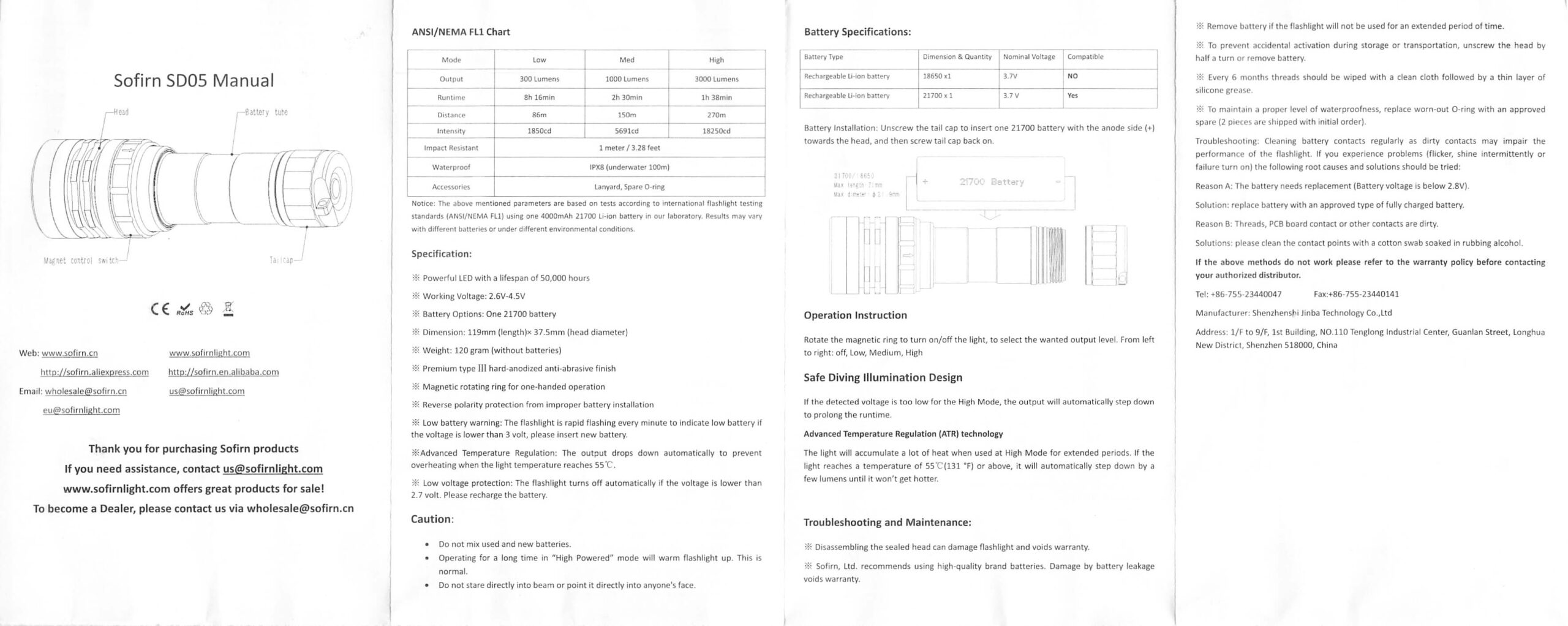
Package and Manual

Build Quality and Disassembly

As I said, I don’t dive, but the lack of any grip at all on this light seems to generally be a theme. Divers will almost certainly use the included wrist strap – more on that later.
The build quality is good. In particular, I like the anodization. It’s very smooth, with a sheen that many lights don’t get.
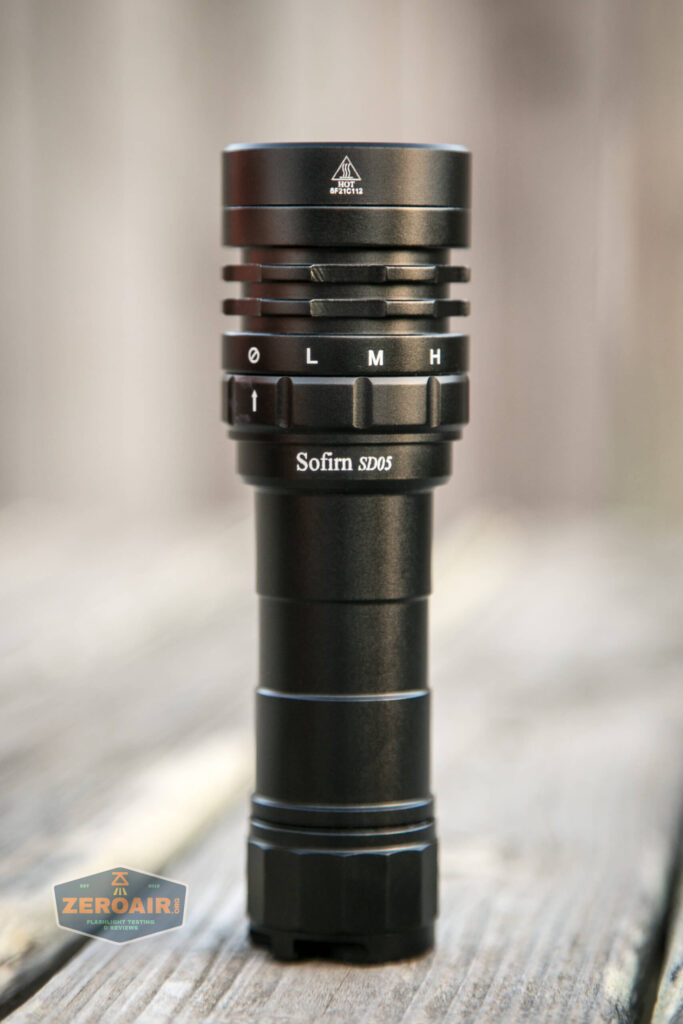
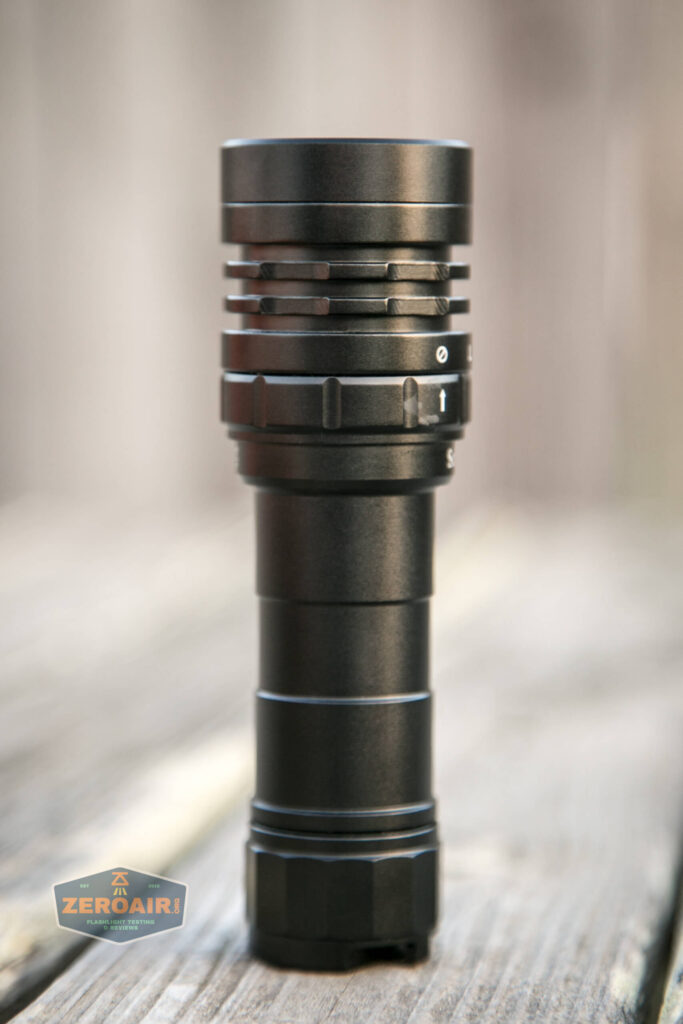


Here’s a top-down view!


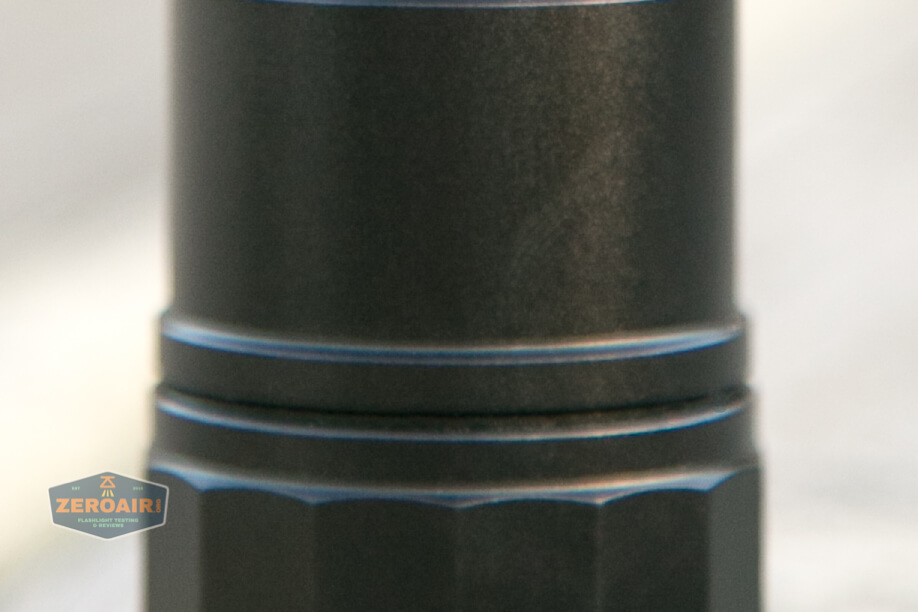
The cell tube is nearly featureless!

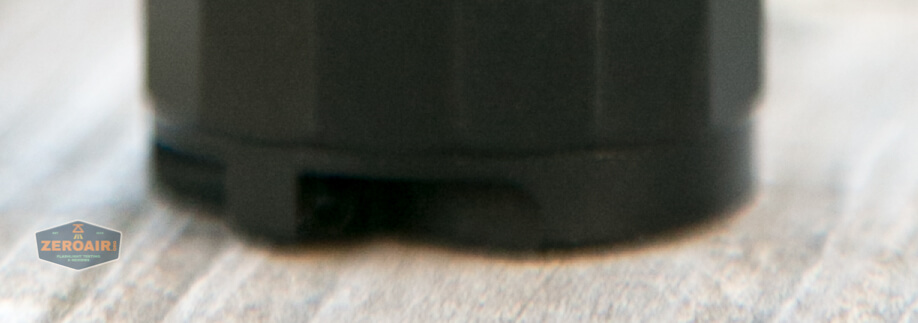
And the tailcap, which is what you’ll remove for cell swaps, doesn’t have any extra knurling or anything. It is faceted though, so if you ended up needing a tool to remove it, you could use one easily.

Nothing going on at the end:

Both head and tail come off the light easily. But check out the thread difference. While both ends are anodized and plenty smooth, the tail end has big thick square-cut threads, which will probably be more reliable to use when swapping the cell.

The head and tail both have nice big springs.


Size and Comps
Dimension: 119mm(length) × 37.5mm(head)
Net weight: 120g (Excluding battery)


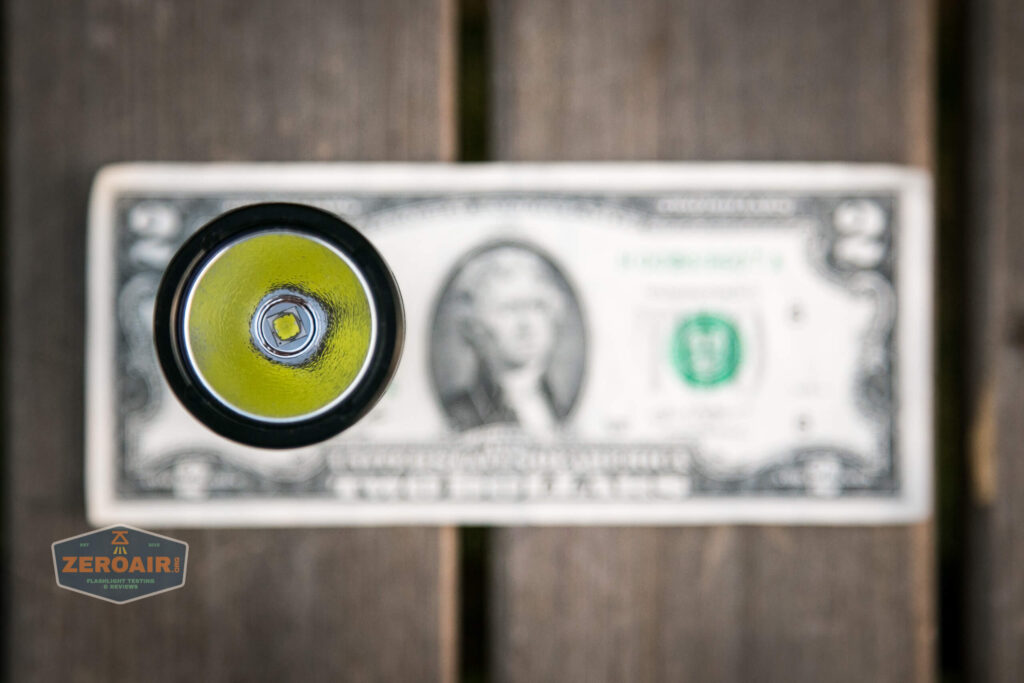
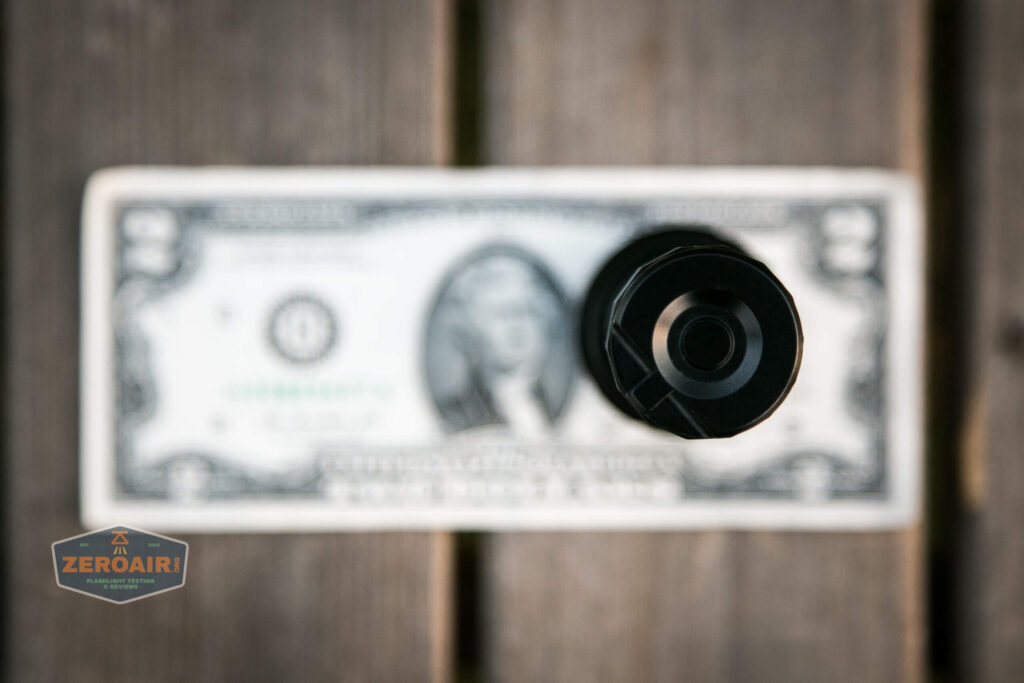
If the flashlight will headstand, I’ll show it here (usually the third photo). If the flashlight will tailstand, I’ll show that here, too (usually the fourth photo).
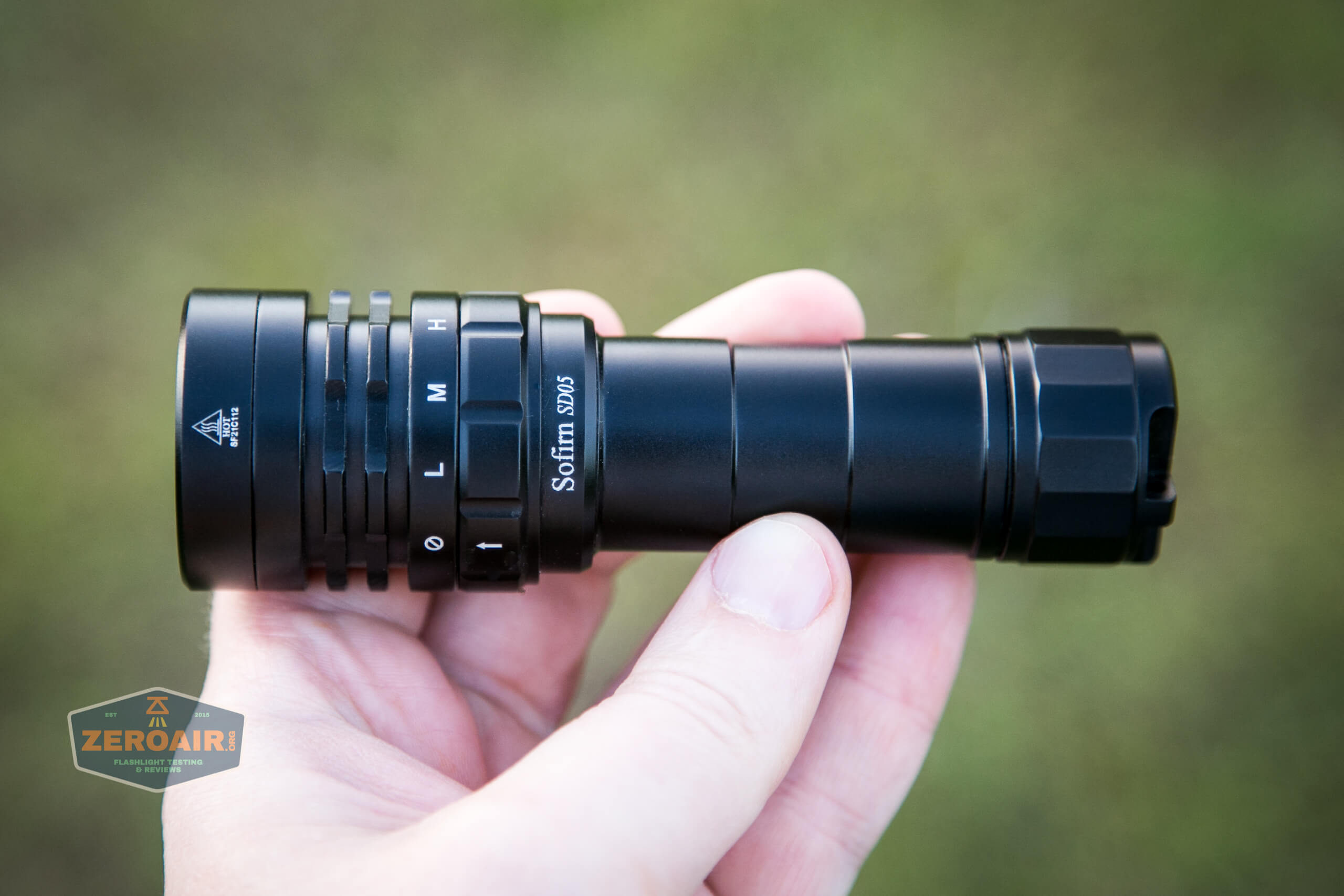


Here’s the test light with the venerable Convoy S2+. Mine’s a custom “baked” edition Nichia 219b triple. A very nice 18650 light.


And here’s the light beside my custom-engraved TorchLAB BOSS 35, an 18350 light. I reviewed the aluminum version of that light in both 35 and 70 formats.

Just a joke photo below! The cell tube is completely removed here. Just for fun. 😀

Retention and Carry
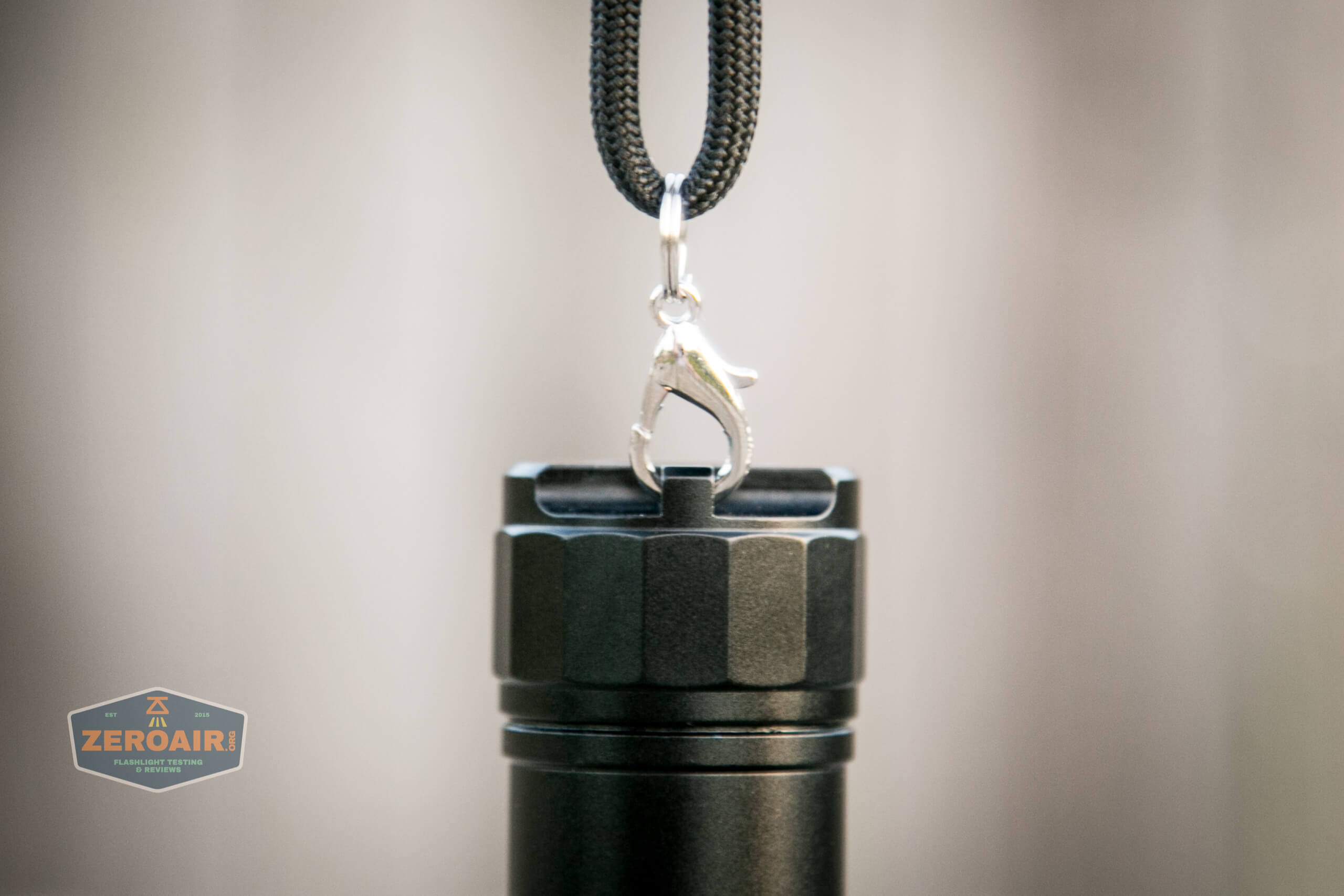
There’s a lanyard included, which attaches through this hole in the tailcap.
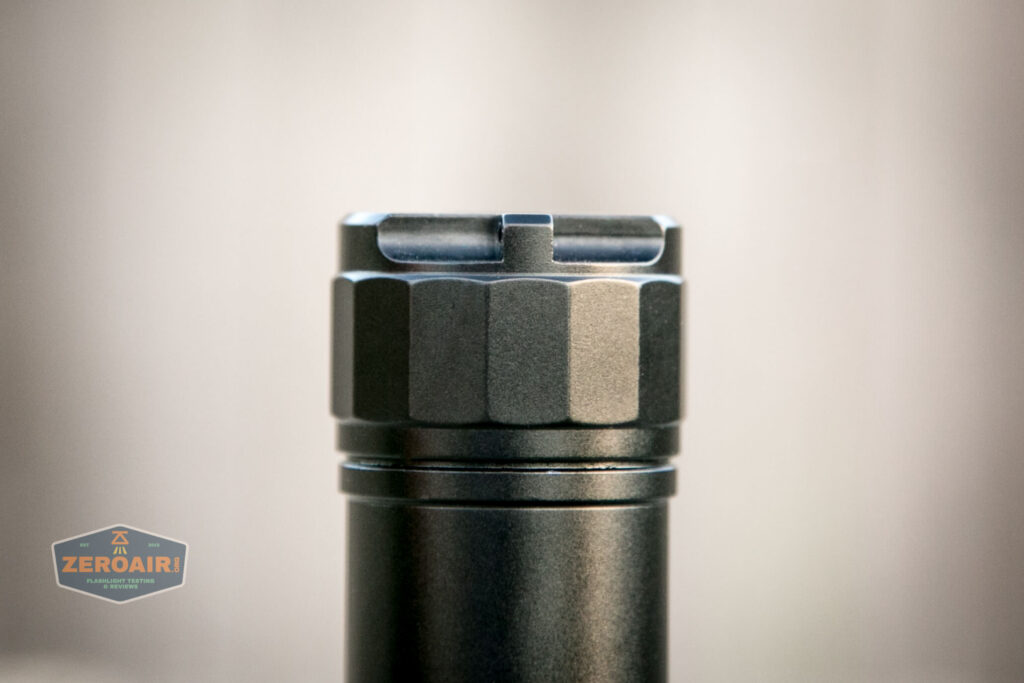
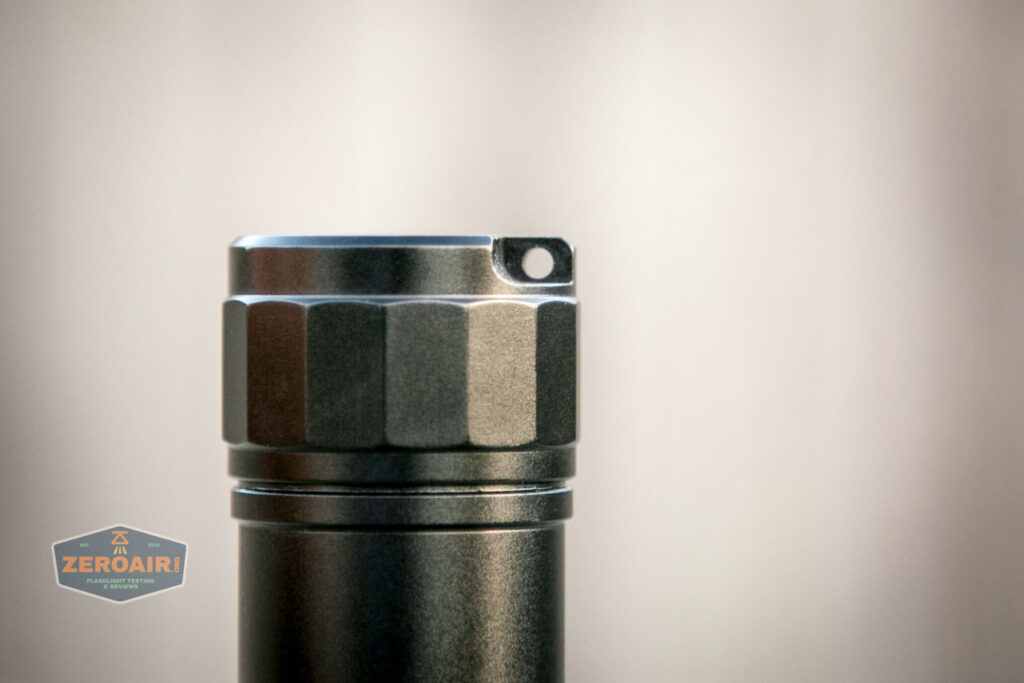
The hole is plenty big and actually doesn’t connect directly to the lanyard, but to this metal hook. This is certainly more convenient for attaching the lanyard, but I’m not sure if it’s better for diving scenarios.

That’s it, too. There’s no pouch or magnet or pocket clip.
Power and Runtime
The Sofirn SD05 Diving flashlight is powered by a single lithium-ion cell. The cell tube is sized for a 21700, and my package included the 4000mAh cell. A 5000mAh is available (or you can buy the light without a cell).


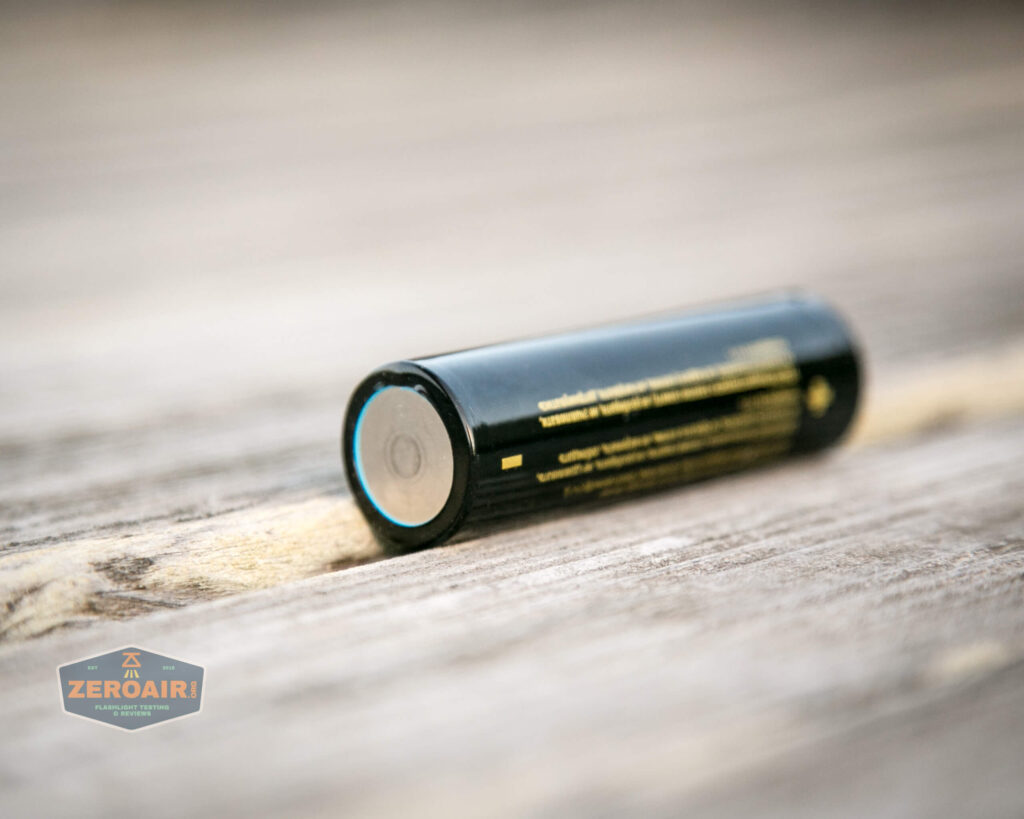
The included cell is standard, so you could bring your own if you wish. Also with springs on both head and tail, most likely any 21700 will work just fine.

Sofirn includes this 21700 to 18650 adapter, which is just a simple plastic sleeve.
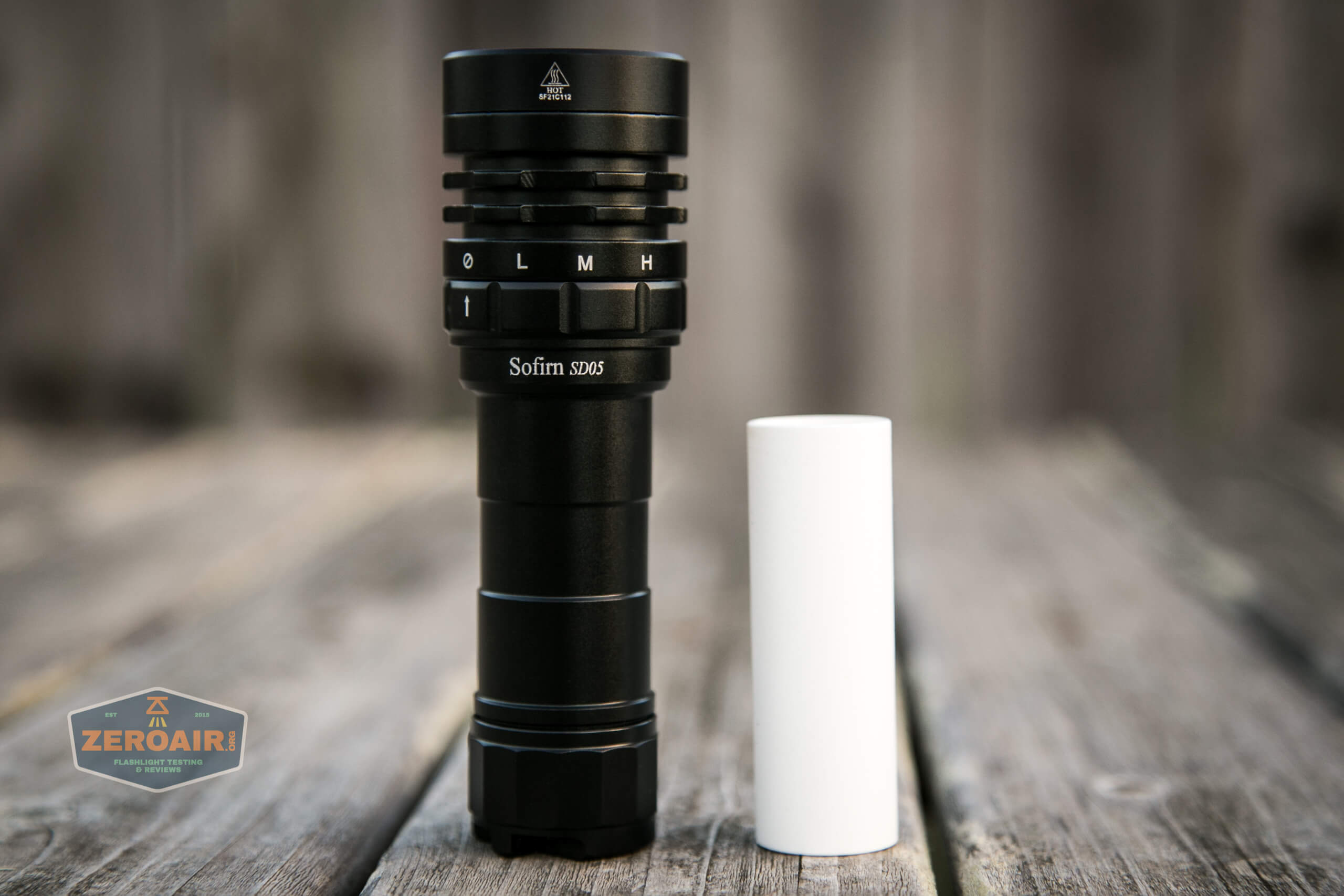
The cell is installed in the normal orientation – positive end toward the head.

Here are a few runtimes. Usually, I’d probably guess that my fan cooling is “maybe a little more” than “average use” but in this case, since this is a dive light and would likely be used underwater, my little fan cooling is “probably a little less” than average use/cooling. But it’s what we’re working with.
The output looks quite good, really – it’s not hitting 3000 lumens (even at startup) but 2548 is fairly close to my 10% metric. The stepdown is dramatic, but once the light steps down, it holds ~1500 lumens for almost an hour. This is higher than the “medium” output, too.

Medium is nice and stable from the start.
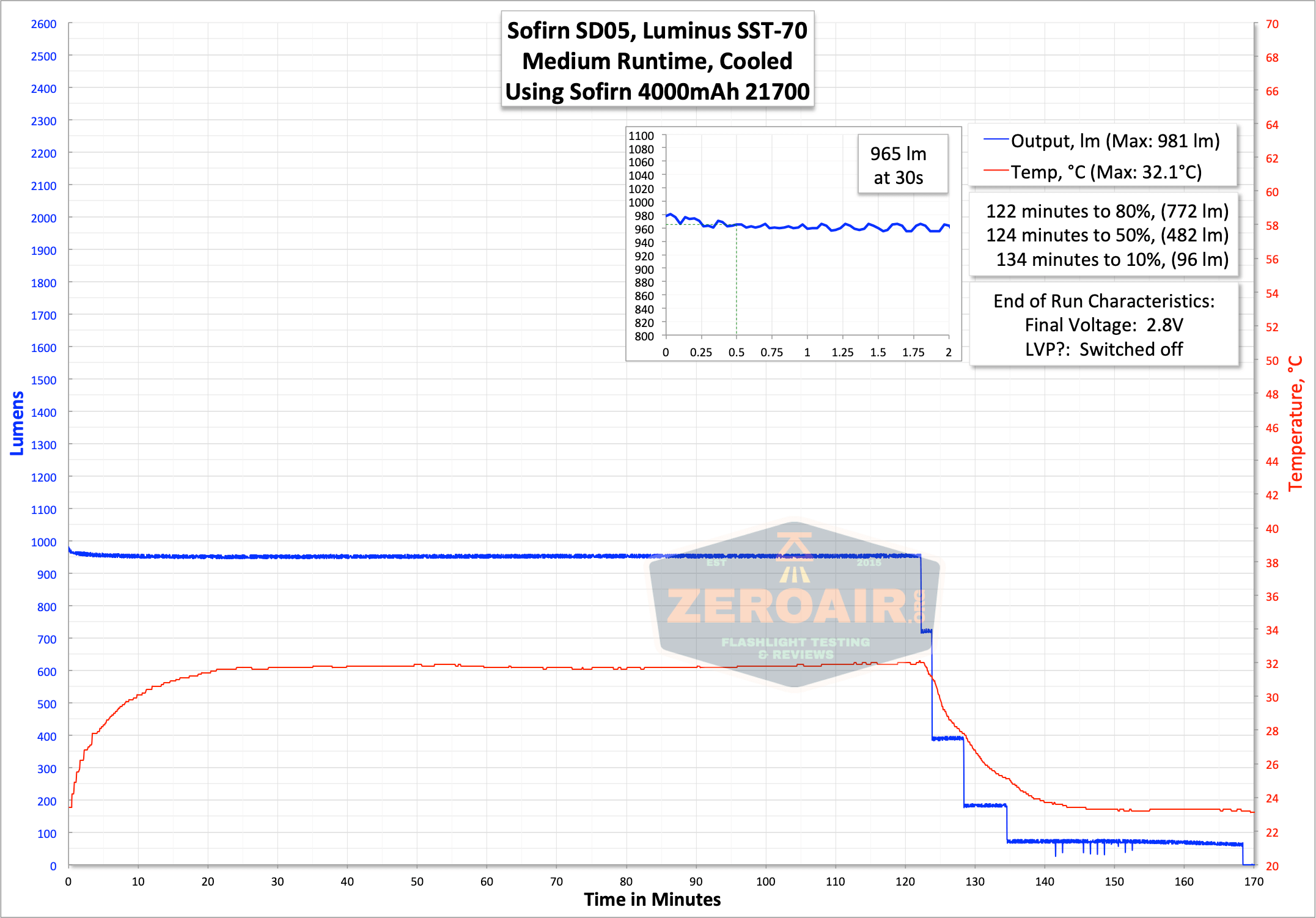
Low is also extremely stable.

When testing on bench power, it seems that the light shuts off at 2.4V. But in runtime tests (ie with a cell), the light shuts off at an appropriate voltage, and that’s after a number of stepdowns.
You’ll want to evaluate that behavior for diving use – you might wish that the light would kill the cell instead of going out during a dive. Or you might like the low voltage setup. I do for flashlight use.
Charging
The Sofirn SD05 diving flashlight doesn’t have built-in charging, but the package does include a single bay charger.
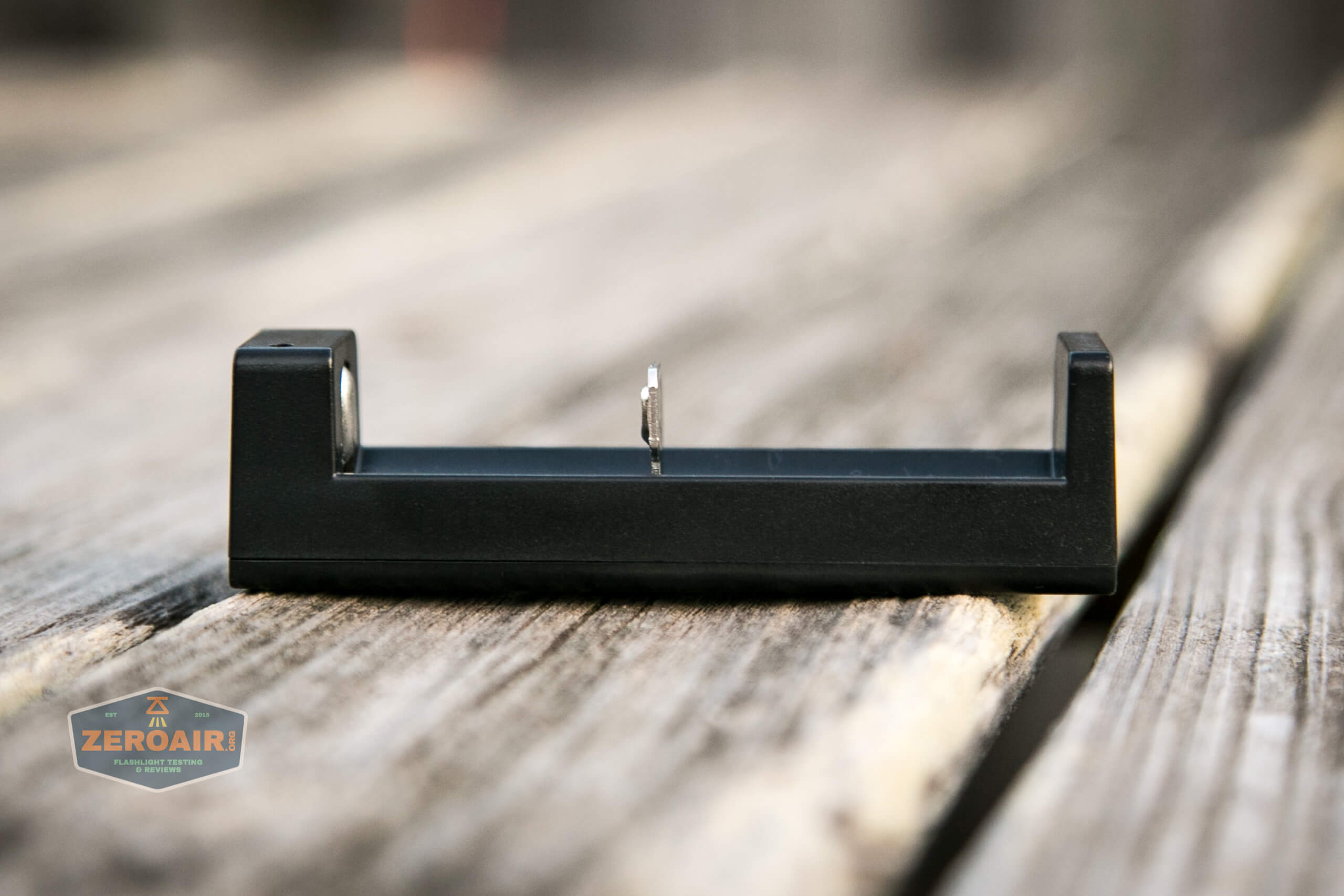

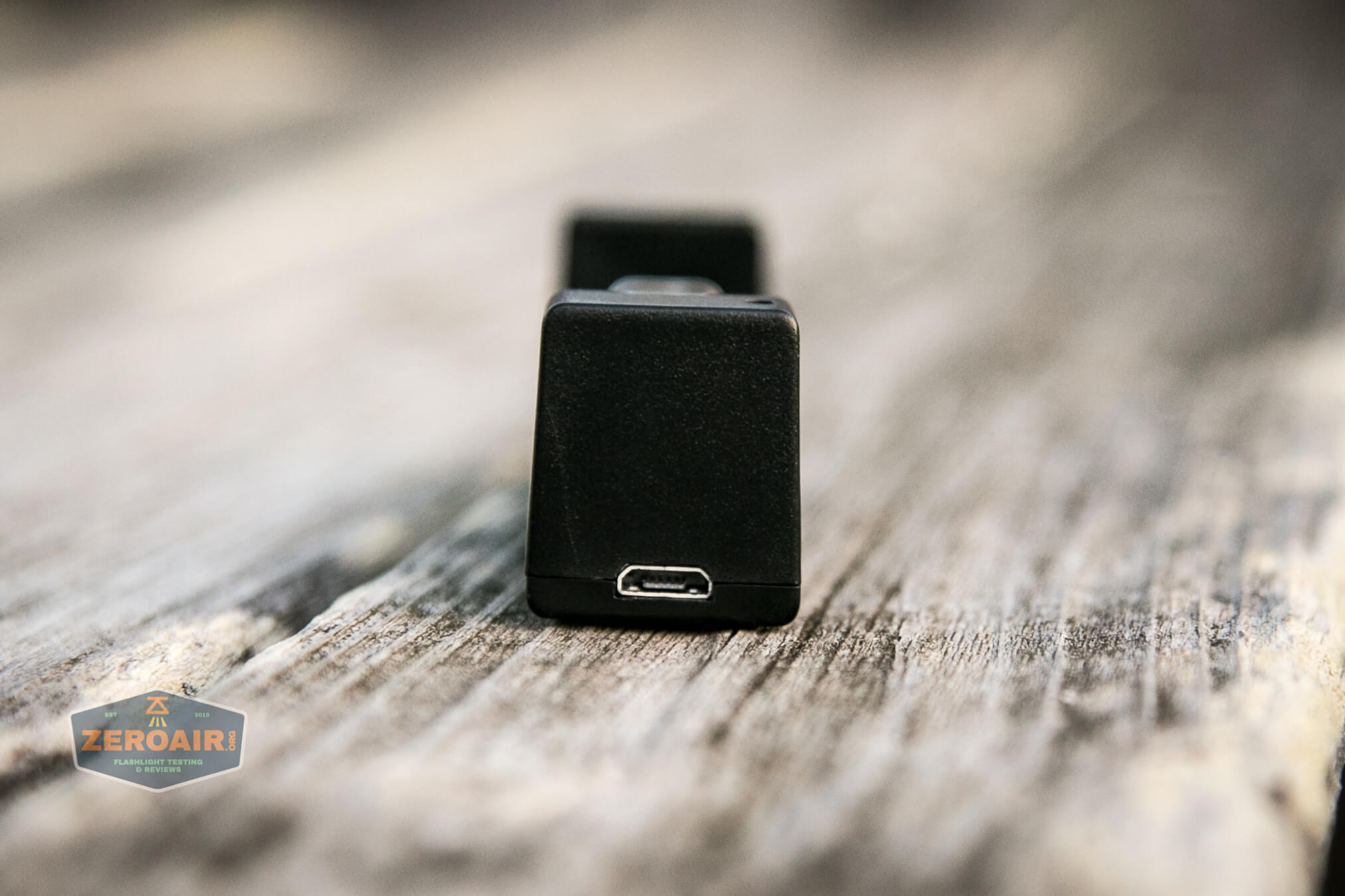
This charger is for lithium-ion only, and fits the included 21700 just fine. It’s powered by micro-USB.
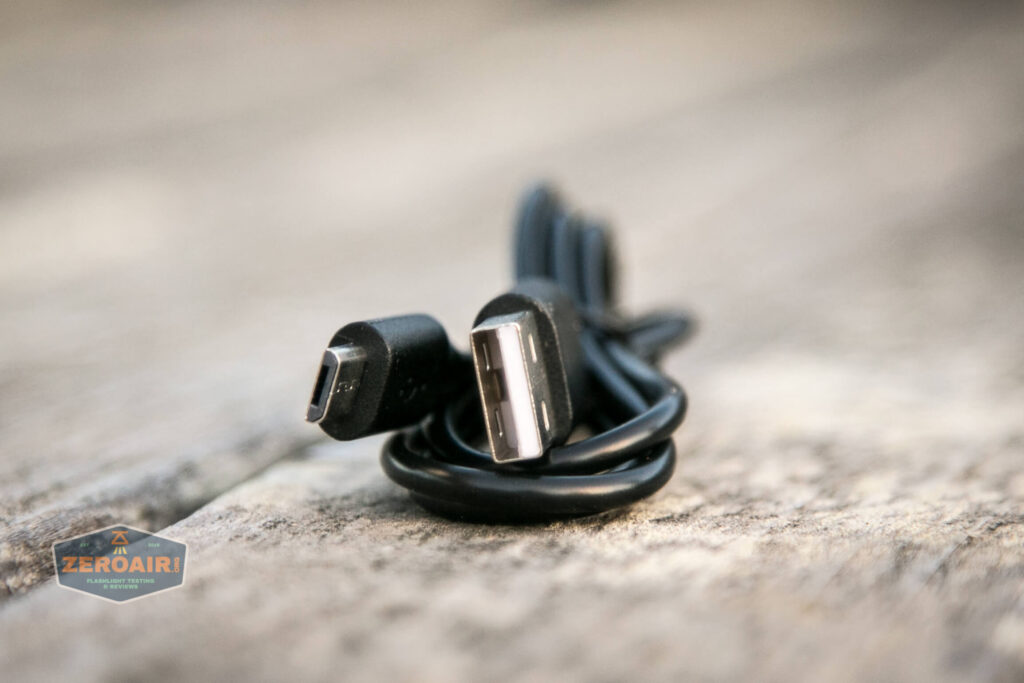
A USB to micro-USB cable is included.

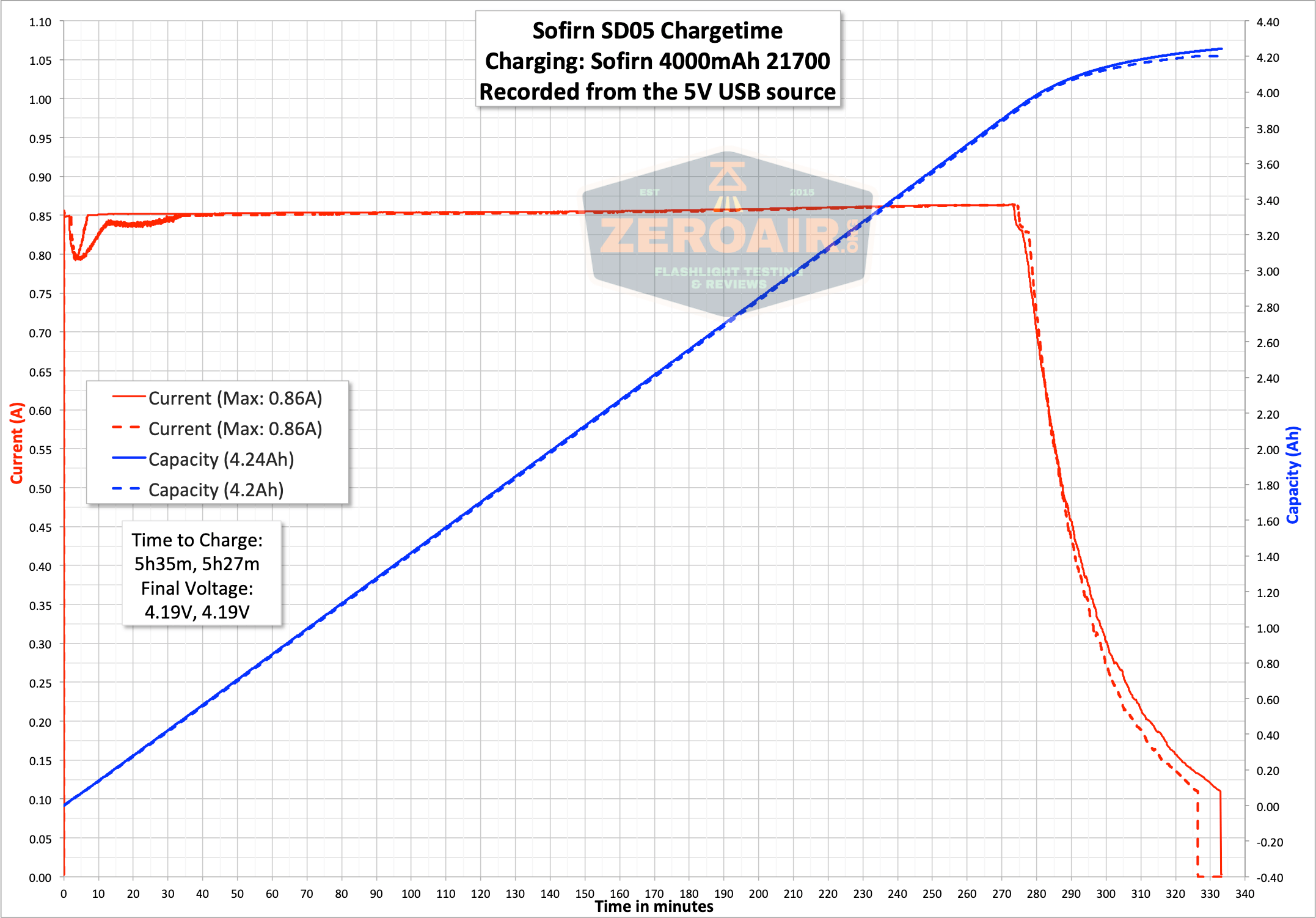
Charging looks pretty good if a little slow. It’s certainly consistent. You’d likely want to just have a backup 21700, so that you can swap the cell after one is depleted.
Modes and Currents
| Mode | Mode Claimed Output (lm) | Claimed Runtime | Measured Lumens | Tailcap Amps |
|---|---|---|---|---|
| High | 3000 | 1h38m | 2474 | 7.97 |
| Medium | 1000 | 2h30m | 965 | 1.67 |
| Low | 300 | 8h16m | 335 | 0.49 |
Pulse Width Modulation
There isn’t any PWM on any mode.
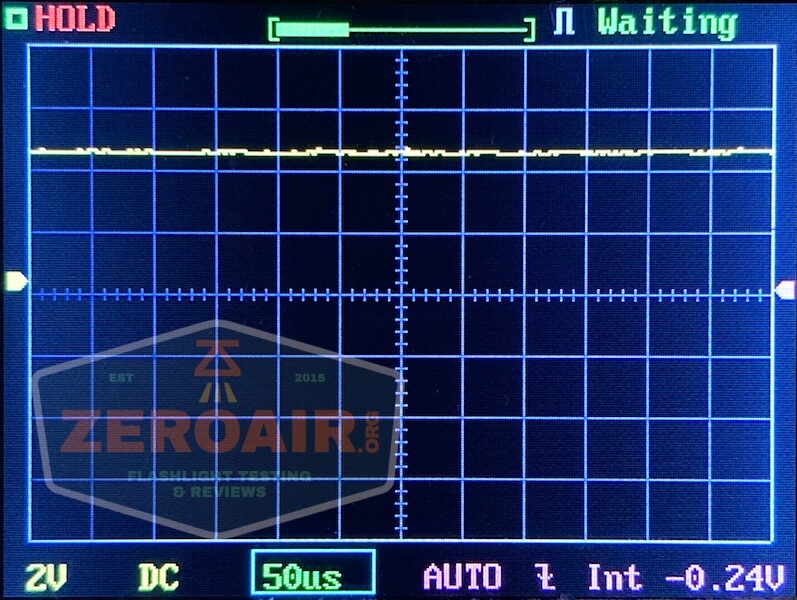
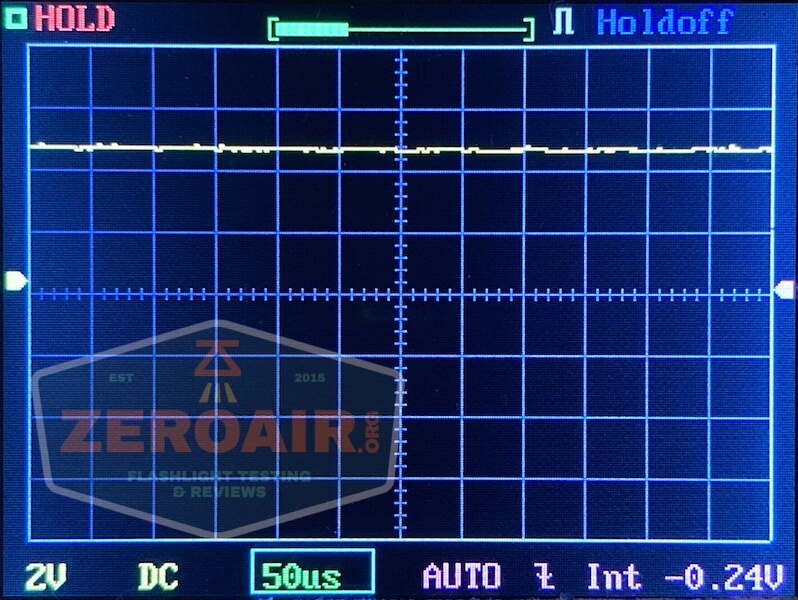
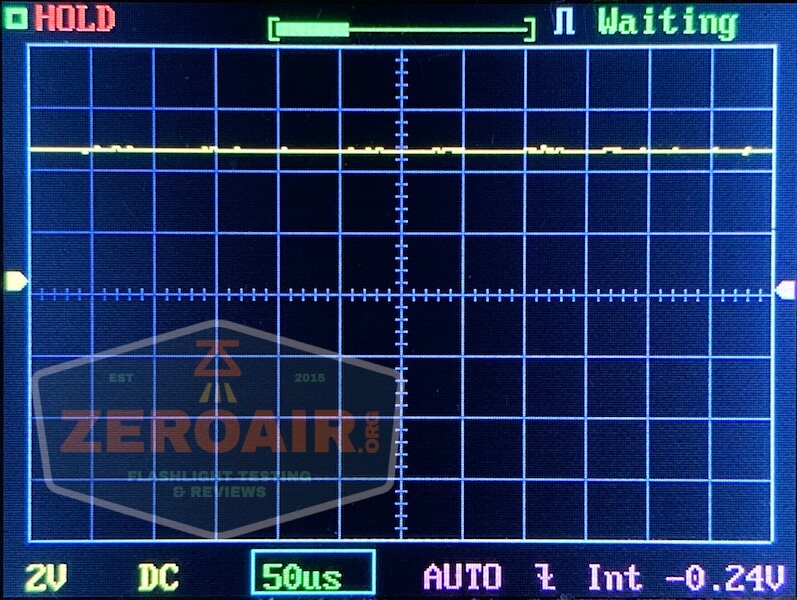
Here you can see a “baseline” – a chart with almost no light hitting the sensor.

Then there’s the Ultrafire WF-602C flashlight, which has some of the worst PWM I’ve seen. It’s so bad that I used a post about it to explain PWM! Here are multiple timescales (10ms, 5ms, 2ms, 1ms, 0.5ms, 0.2ms) to make comparing this “worst” PWM light to the test light easier. That post also explains why I didn’t test the WF-602C at the usual 50us scale.


User Interface and Operation
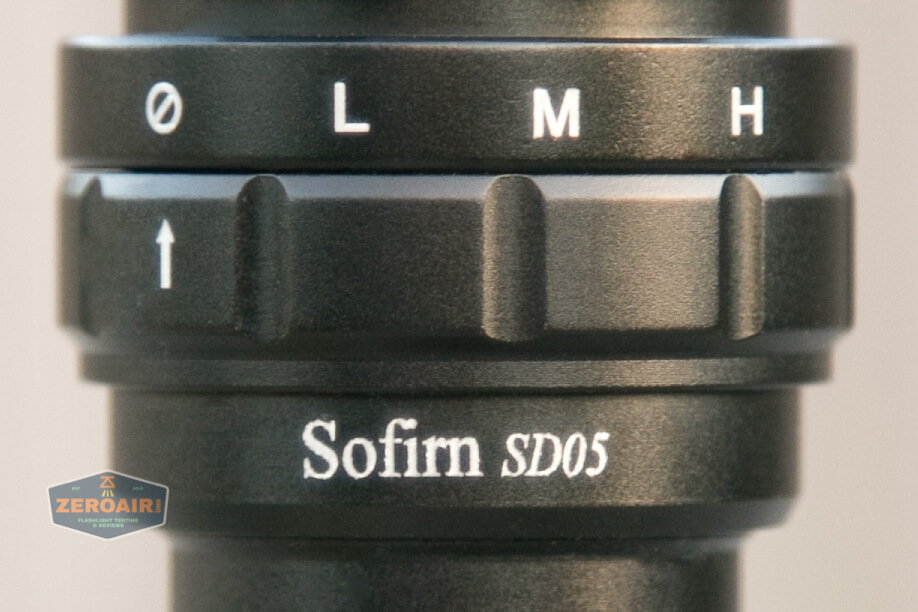
While there are a limited number of modes on the Sofirn SD05 diving flashlight, they’re easily accessible with this rotary dial on the head.
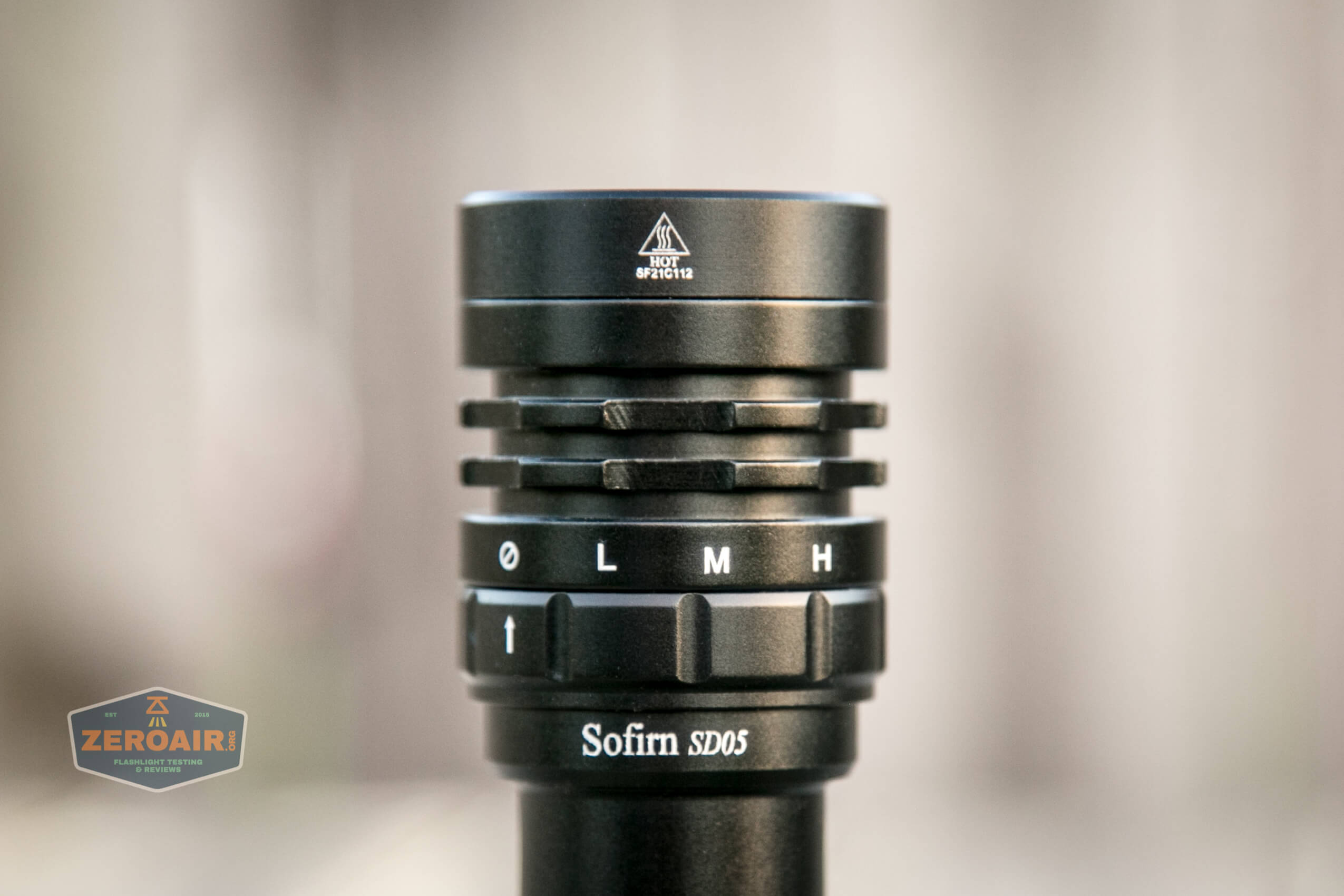
One-handed action is easy, and the dial has specific detents for resting in each mode. It’s even possible to rotate the dial with one finger if you hold the light securely enough with the rest of your hand.
Below you can see the dial-in all modes. The arrow on the dial itself serves as a visual indicator of the selected mode.
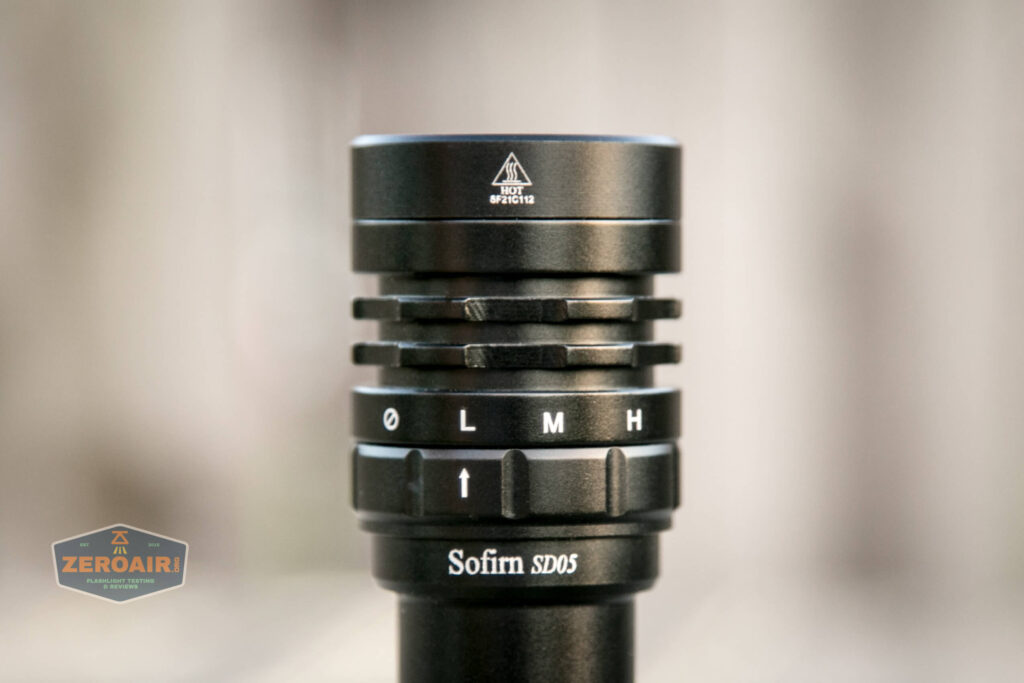
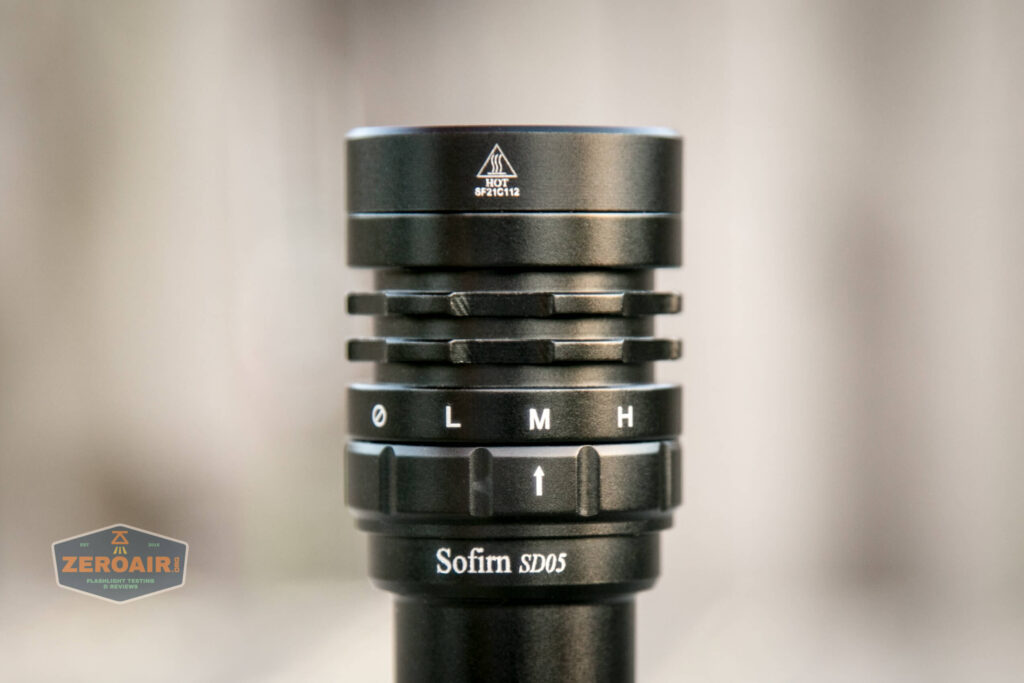

Here’s a user interface table!
| State | Action | Result |
|---|---|---|
| Off | Twist dial clockwise | Low |
| Low | Twist dial clockwise | Medium |
| Medium | Twist dial clockwise | High |
| High | Twist dial counterclockwise | Medium |
| Medium | Twist dial counterclockwise | Low |
| Low | Twist dial counterclockwise | Off |
That’s it, and quite frankly that table makes it more complicated than it is in real life.
LED and Beam
In the Sofirn SD05 diving flashlight is a Luminus SST-70 emitter. The emitter is stated as “6500K.”

This emitter is paired with a deep and wide orange peel reflector.

These beamshots always have the following settings: f8, ISO100, 0.3s shutter, and manual 5000K exposure. These photos are taken at floor level, and the beam hits the ceiling around 9 feet away.


Tint vs BLF-348 (KillzoneFlashlights.com 219b version) (affiliate link)
I keep the test flashlight on the left and the BLF-348 reference flashlight on the right.
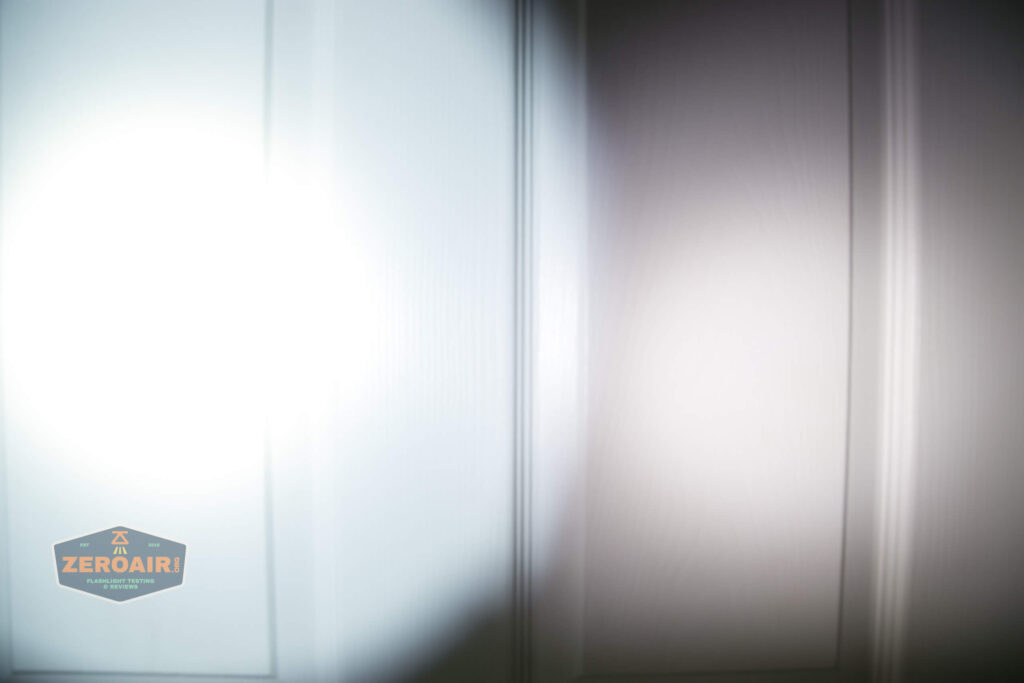

I compare everything to the KillzoneFlashlights.com 219b BLF-348 because it’s inexpensive and has the best tint!
Conclusion
What I like
- Good build quality
- Great rotary interface
- Low voltage protection
- Very flat output even on Turbo (after the stepdown)
- Included 21700
- No PWM
What I don’t like
- No knurling on tailcap
- Cool white – 6500K
Notesd
- This light was provided by Sofirn for review. I was not paid to write this review.
- This content originally appeared at zeroair.org. Please visit there for the best experience!
- For flashlight-related patches, stickers, and gear, head over to PhotonPhreaks.com!
- Please use my Amazon.com referral link to help support zeroair.org!
- Please support me on Patreon! I deeply appreciate your support!
Surprised you didn’t pick up on the fact this is using their old boost driver for the SST70 LED. This driver uses a timed step down which is why your fan did nothing on High.
They are no longer using SST70 for newer SD05 now. They start using 3v xhp50.2 again
I have the xhp50.2 version i bought maybe in 2019 !.
I noticed also they sell a version without the “3 minutes auto stepdown”.
So maybe you need to update the versions section in your article with these. !
They also make a 5000k version now.