

XTAR B20 1200 Flashlight Review
The XTAR B20 1200 flashlight has been released and features an included 21700 cell with a nice amount of throw. Read on for testing!
Official Specs and Features
There’s not actually an official page for this light yet!
Versions
I believe there’s just this one version.
Price
As there’s no official page, I can’t quote an official price either.
XTAR B20 1200 Flashlight Short Review
The short review of this light really depends on where the price lands, I think. It’s a fine enough light but needs to come in at a low to lowish cost to be reasonable. As a whole though, the package is acceptable. The charger features a somewhat dated micro-USB connection, but the included 21700 is nice. We’ll see!
Long Review
The Big Table
| XTAR B20 1200 Flashlight | |
|---|---|
| Emitter: | Cree XP-L2 |
| Price in USD at publication time: | ? |
| Cell: | 1×21700 (included) |
| Turbo Runtime Graph | High Runtime Graph |
| LVP? | No |
| Switch Type: | Mechanical |
| On-Board Charging? | Yes |
| Charge Port Type: | Included Charger |
| Charge Graph | |
| Power off Charge Port | – |
| Claimed Lumens (lm) | 1200 |
| Measured Lumens (at 30s) | 1009 (84.1% of claim)^ |
| Candela per Lumen | 15.9 |
| Claimed Throw (m) | 240 |
| Candela (Calculated) in cd (at 30s) | 714lux @ 4.898m = 17129cd |
| Throw (Calculated) (m) | 261.8 (109.1% of claim)^ |
| All my XTAR reviews! | |
^ Measurement disclaimer: Testing flashlights is my hobby. I use hobbyist-level equipment for testing, including some I made myself. Try not to get buried in the details of manufacturer specifications versus measurements recorded here; A certain amount of difference (say, 10 or 15%) is perfectly reasonable.
What’s Included

- XTAR B20 1200 Flashlight
- XTAR 4900mAh 21700 cell
- XTAR SC1 1-bay charger
- Charger cable (USB to micro-USB)
- Lanyard
- Spare o-rings (2)
- Nylon holster
- Manuals (2)
Package and Manual


Build Quality and Disassembly


There are nice deep cooling fins here on the head. My testing indicates this is pulling only around 2A on the highest mode, so these fins should handle that just fine.


This knurling is nice and soft. The softness means it provides grip, but not tons of grip.

These threads are long, triangle cut, anodized, and lubed. Mechanical lockout (aside from what the mechanical switch provides) is possible by loosening the tailcap a bit.

Both head and tail have springs.

Size and Comps
According to the manual, the dimensions are as follows:
34.5mm head diameter
26.8mm body diameter
146.3mm in length
122g weight (without cell)


If the flashlight will headstand, I’ll show it here (usually the third photo). If the flashlight will tailstand, I’ll show that here, too (usually the fourth photo).


Here’s the test light with the venerable Convoy S2+. Mine is a custom “baked” edition Nichia 219b triple. A very nice 18650 light!


And here’s the light beside my custom-engraved TorchLAB BOSS 35, an 18350 light. I reviewed the aluminum version of that light in both 35 and 70 formats.

Retention and Carry
A few means of carry for the XTAR B20 1200 flashlight are included. First is the friction fit pocket clip.


Next is the lanyard, which attaches through one of these two holes in the tailcap.


This is a very simple but acceptable lanyard.

Finally, you can see this nylon holster, which allows bezel up carry of the XTAR B20 1200 flashlight.


Power and Runtime
XTAR includes a 21700 cell with the XTAR B20 1200 flashlight. It’s a 4900mAh button top.

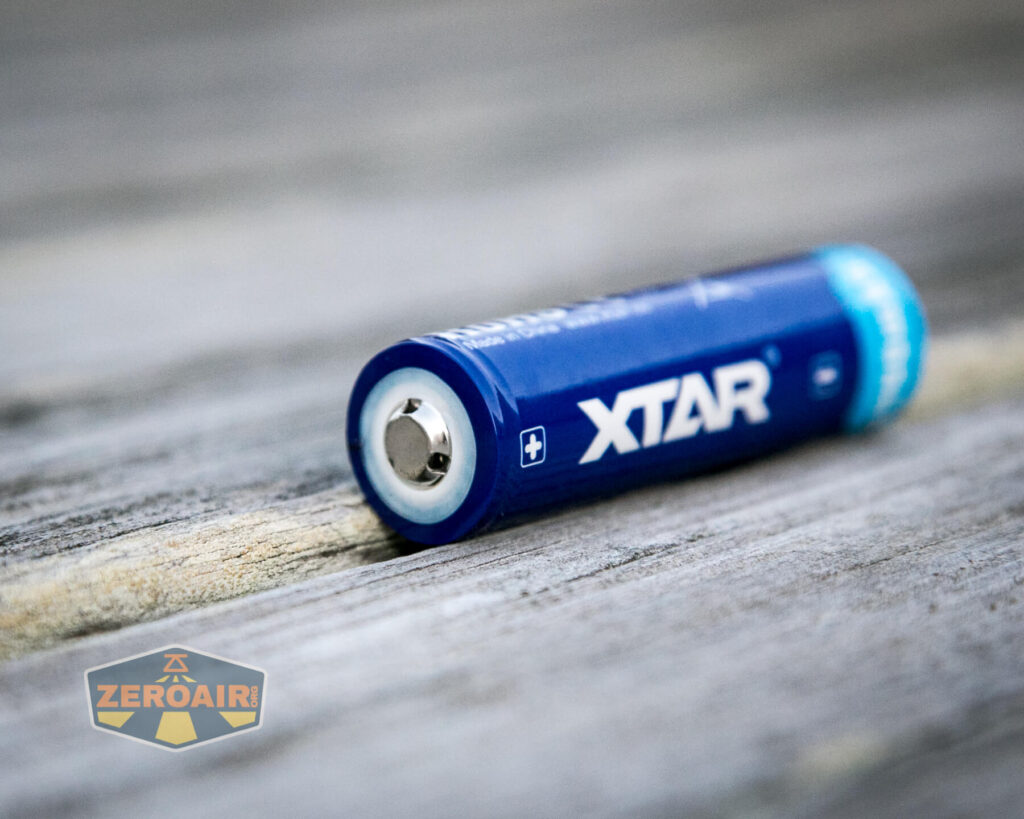

This is a standard cell, but you’ll need to use a button top in the light – otherwise the cell will be too short.


The cell is installed into the flashlight in the usual way: positive end toward the head.

Below you can find a few runtime tests. I’m not really sure why the output is jagged in this way – it certainly doesn’t seem to be a modulation due to temperature…. It’s very unlikely that you’ll notice this in use though.
I will note that while the XTAR B20 1200 flashlight does not have low voltage protection, in the first test below at around 140 minutes – that drop out is actual. This is a low voltage warning, and that’s all you get. The main emitter flashes a few times.


According to bench power, this blink warning happens at 3.0V. Otherwise, there is no LVP.
Charging
While the XTAR B20 1200 flashlight does not have built-in charging, the package does include a charger. I’m not testing this XTAR SC1 charger in the “charger testing” way, but offering a couple of charge graphs below.
This is a one-bay charger which of course has room for a (probably longish) 21700 cell.

The SC1 is powered by micro-USB.


The SC1 also will only charge lithium-ion cells; no NiMH here!


XTAR includes a micro-USB cable for connecting the charger.


Charging looks… inconsistent. I’m not sure why these two graphs are so different, but either way the micro-USB charger is still progressing at almost 2A, which is good (?) and surprising (?).

Modes and Currents
| Mode | Mode Claimed Output (lm) | Claimed Runtime | Measured Lumens | Tailcap Amps |
|---|---|---|---|---|
| Turbo | 1200 | 3.5h | 1009 | 2.11 |
| High | 600 | 5.6h | 481 | 0.97 |
| Mid | 270 | 13.6h | 249 | 0.45 |
| Low | 30 | 80h | 30 | 0.05 |
Pulse Width Modulation
There isn’t PWM on any modes, but each mode does have a sawtooth. This isn’t perceptible.


Here you can see a “baseline” – a chart with almost no light hitting the sensor.

Then there’s the Ultrafire WF-602C flashlight, which has some of the worst PWM I’ve seen. It’s so bad that I used a post about it to explain PWM! Here are multiple timescales (10ms, 5ms, 2ms, 1ms, 0.5ms, 0.2ms) to make comparing this “worst” PWM light to the test light easier. That post also explains why I didn’t test the WF-602C at the usual 50us scale.


User Interface and Operation
XTAR has included a mechanical switch on the B20 1200 flashlight. This is a forward clicky, which means you get momentary activation, but you can’t change modes while the light is on.

The switch is very accessible, but tailstanding is still possible.


Here’s a user interface table!
| State | Action | Result |
|---|---|---|
| Off | Click | Mode memory |
| On | Click | Off |
| Off | Tap | Momentary (mode memory) |
| Off | Repeated taps | Mode advance (High > Turbo > Mid > Low) |
| Off | Triple tap | Strobe (Technically “momentary strobe” but click on the third actuation for steady strobe) |
Yes, “(High > Turbo > Mid > Low)” is accurate. 😲
LED and Beam
The manual doesn’t say, and there’s no product page yet, but I asked XTAR and was told this is a Cree XP-L2 emitter. The reflector is very smooth, moderately wide and deep, and gives a nice tight hotspot.

Due to the crenelations on the bezel, light can escape when headstanding.


These beamshots always have the following settings: f8, ISO100, 0.3s shutter, and manual 5000K exposure. These photos are taken at floor level, and the beam hits the ceiling around 9 feet away. The beamshot order below represents the mode order as I experienced it (which is “mode memory” then the weird mode order).


Tint vs BLF-348 (KillzoneFlashlights.com 219b version) (affiliate link)
I keep the test flashlight on the left and the BLF-348 reference flashlight on the right.


I compare everything to the KillzoneFlashlights.com 219b BLF-348 because it’s inexpensive and has the best tint!
Conclusion
What I like
- Complete package
- Not overly complicated
- Standard button top 21700 cell
What I don’t like
- Very unusual mode order
- Cool white emitter
- micro-USB charger (XTAR, you make chargers, why isn’t this a USB-C charger!?)
Notes
- This light was provided by XTAR for review. I was not paid to write this review.
- This content originally appeared at zeroair.org. Please visit there for the best experience!
- Please use my Amazon.com referral link to help support zeroair.org!
- Please support me on Patreon! I deeply appreciate your support!