

KillzoneFlashlights.com BLF-348 (Updated) Flashlight Review
The KillzoneFlashlights.com BLF-348 has been updated to house a single Nichia 519a at 4500K. Read on for testing! Spoiler: it’s great!
Official Specs and Features
Here’s a referral link to the KillzoneFlashlights.com BLF-348 flashlight product page.
Versions
Available right now is just one version, and that’s the one this whole post is about. There is an old version (which I use as a reference light; you can see those images below) – it has Nichia 219b. Then there are the “non-special” (aka “non-BLF-348”) versions – there are many! There’s even a very similar host that has a laser!
Price
Short Review
I love this light. I loved the original version (and still do), and I happen to love Nichia 519a emitters. The CCT selected here is great – 4500K, and, overall this is just a fantastic way to experience Nichia 519a. I do think you should buy (more than) one of these!
Long Review
The Big Table
| KillzoneFlashlights.com BLF-348 BLF-348 | |
|---|---|
| Emitter: | Nichia 519a |
| Price in USD at publication time: | $14.99 |
| Cell: | 1xAAA |
| Runtime Graphs | |
| LVP? | Yes |
| Switch Type: | Mechanical |
| On-Board Charging? | No |
| Claimed Lumens (lm) | 50 |
| Measured Lumens (at 30s) | 51 (102% of claim)^ |
| Candela per Lumen | 4.1 |
| Claimed Throw (m) | – |
| Candela (Calculated) in cd (at 30s) | 14lux @ 3.742m = 196cd |
| Throw (Calculated) (m) | 28.0 |
| Claimed CCT | 4500 |
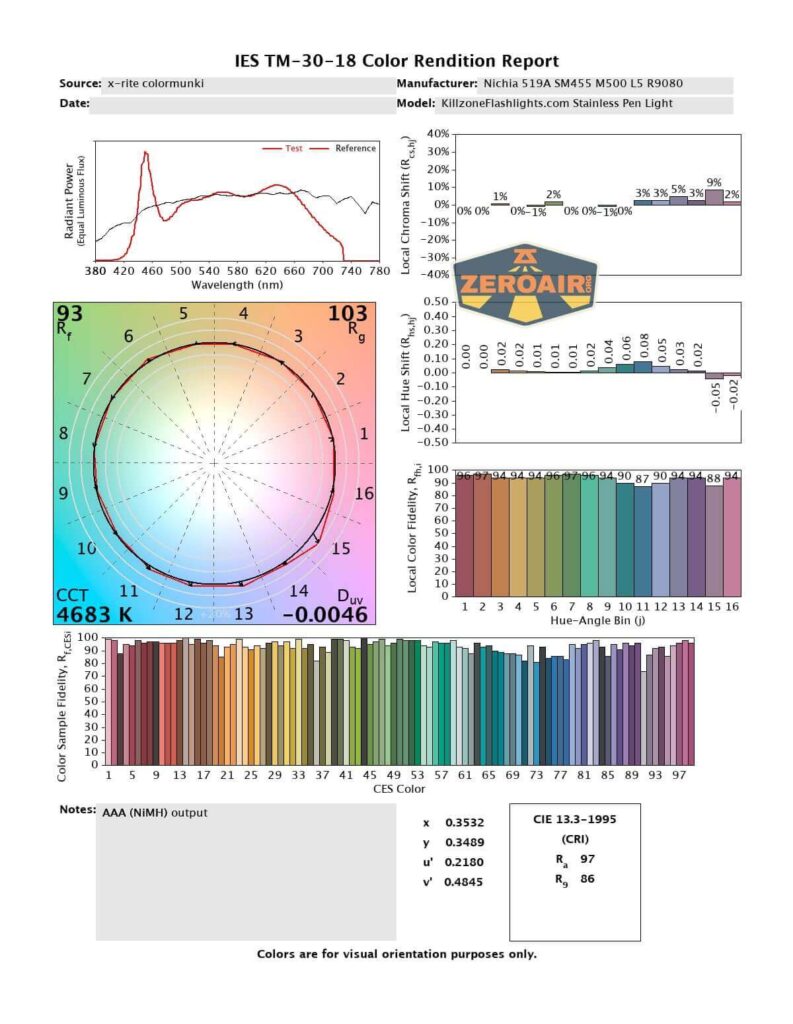
| Measured CCT Range (K) | 4683 |
| Item provided for review by: | KillzoneFlashlights.com |
| All my KillzoneFlashlights.com BLF-348 reviews! | |
| KillzoneFlashlights.com BLF-348 BLF-348 | |
|---|---|
| Emitter: | Nichia 519a |
| Price in USD at publication time: | $14.99 |
| Cell: | 1×10440 |
| Runtime Graphs | |
| LVP? | No |
| Switch Type: | Mechanical |
| On-Board Charging? | No |
| Claimed Lumens (lm) | 150 |
| Measured Lumens (at 30s) | 172 (114.7% of claim)^ |
| Candela per Lumen | 4 |
| Claimed Throw (m) | – |
| Candela (Calculated) in cd (at 30s) | 39lux @ 4.581m = 818cd |
| Throw (Calculated) (m) | 57.2 |
| Claimed CCT | 4500 |
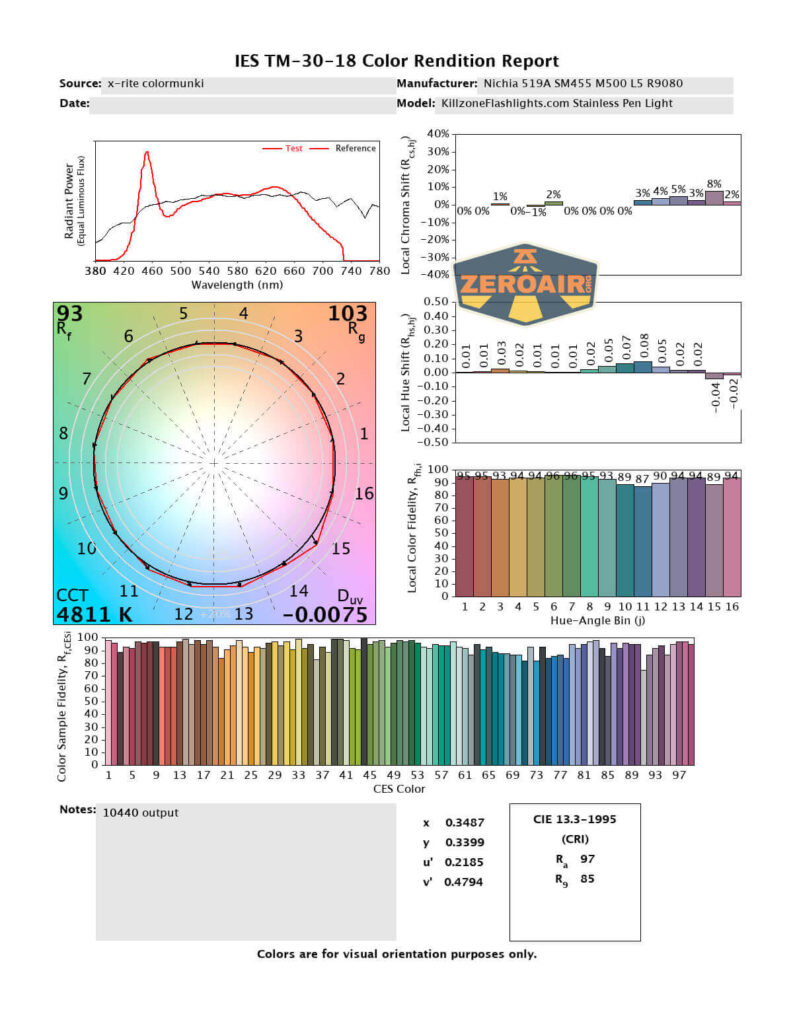
| Measured CCT Range (K) | 4811 |
| Item provided for review by: | KillzoneFlashlights.com |
| All my KillzoneFlashlights.com BLF-348 reviews! | |
^ Measurement disclaimer: Testing flashlights is my hobby. I use hobbyist-level equipment for testing, including some I made myself. Try not to get buried in the details of manufacturer specifications versus measurements recorded here; A certain amount of difference (say, 10 or 15%) is perfectly reasonable.
What’s Included
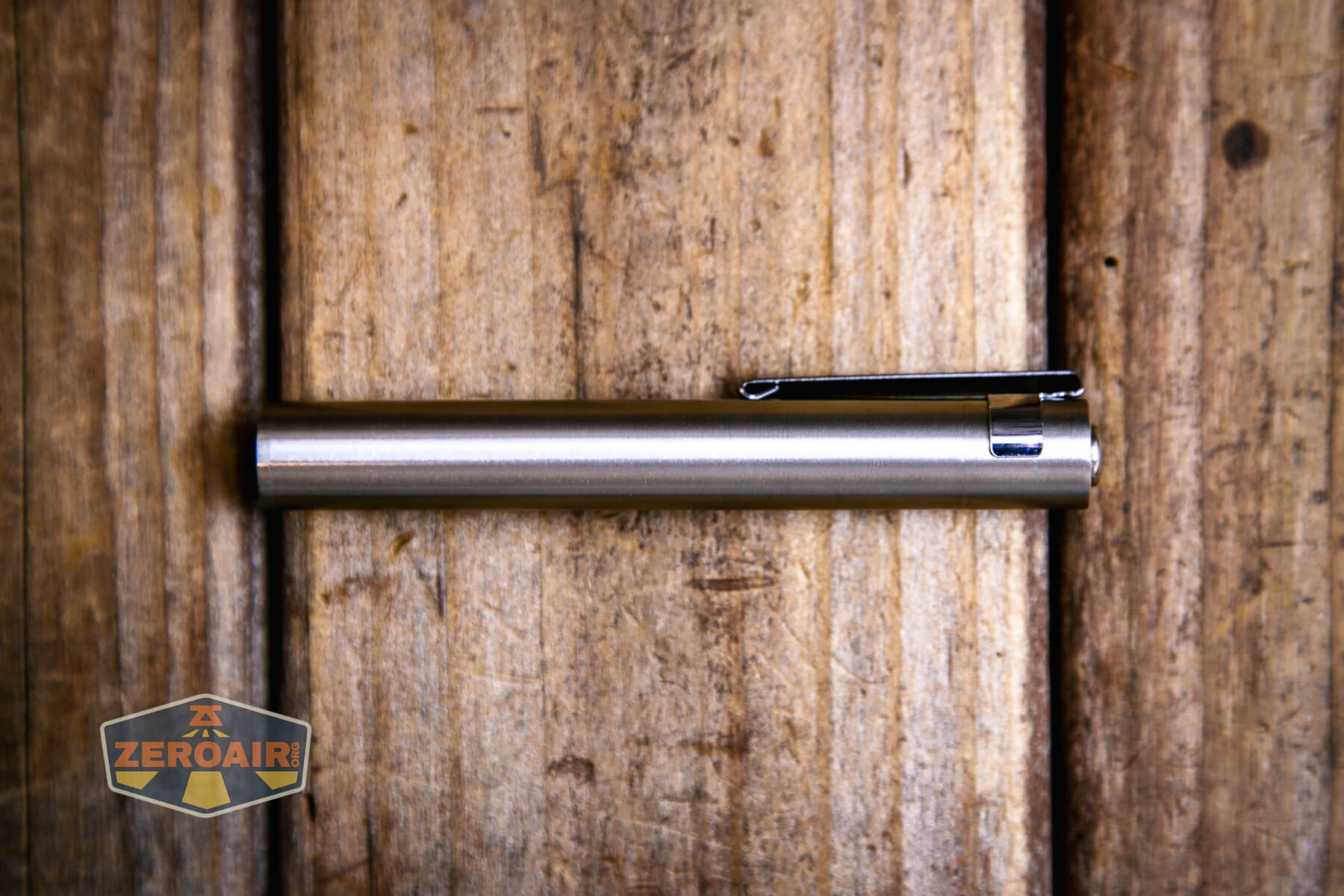
- Killzone Flashlights Stainless Steel Pen light (BLF-348)
Package and Manual
The light ships in a thin cardboard box with no labeling at all. The light itself is inside the box in a bubble baggie.
There is no manual. Aside from knowing if the light will accept 10440 cells (it will) as well as the preferred lower voltage chemistries, there’s not much to know about the light.
Build Quality and Disassembly
The build quality of this light is on par with all the other versions out there. Probably (possibly) a little better than the SingFire version, and certainly “good enough.”
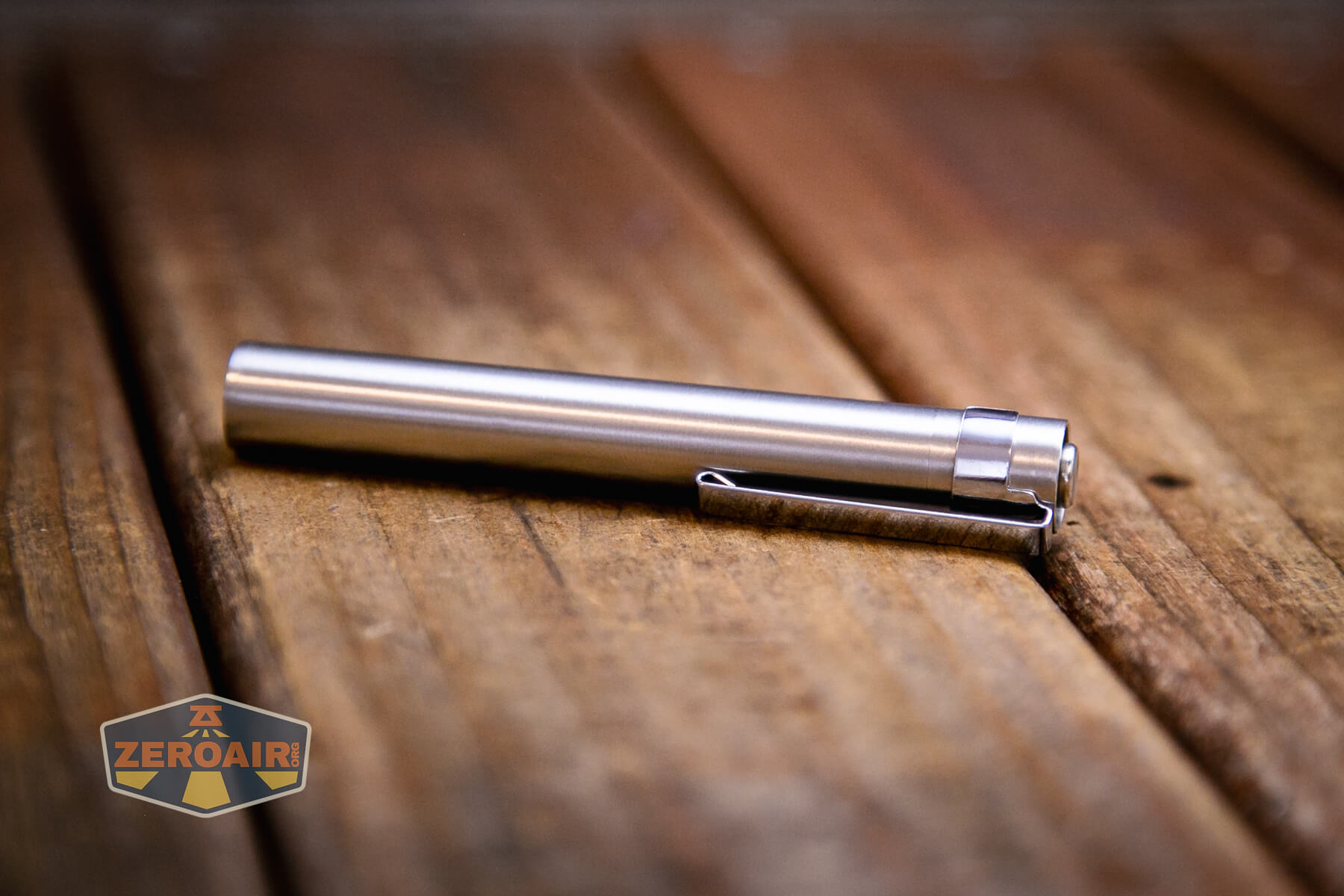
This version does not have any logo or printing! It’s completely bare!
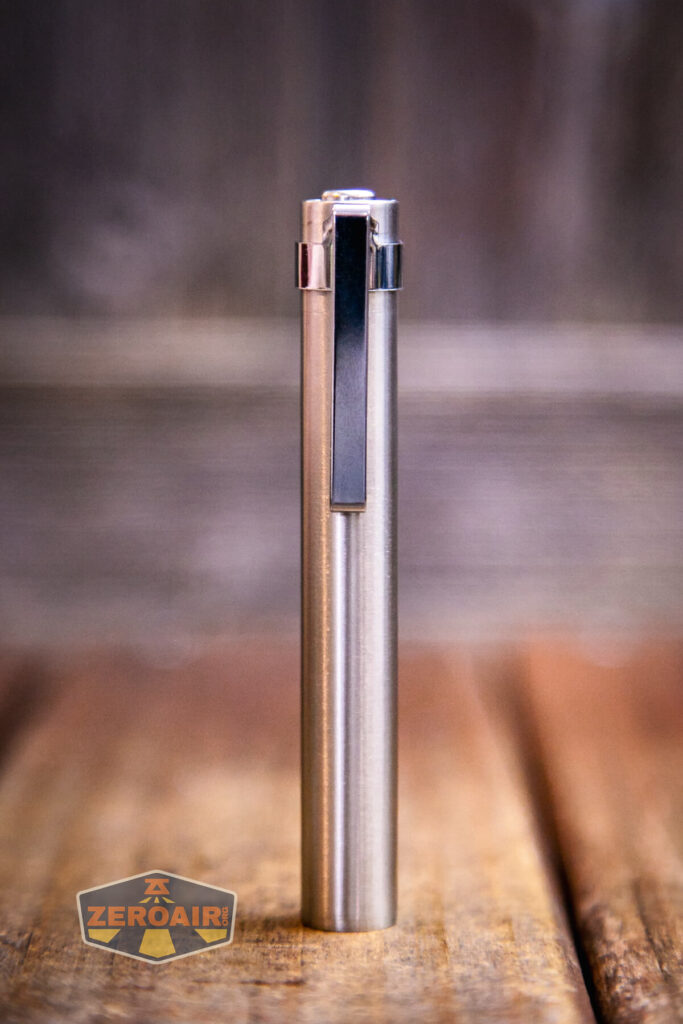
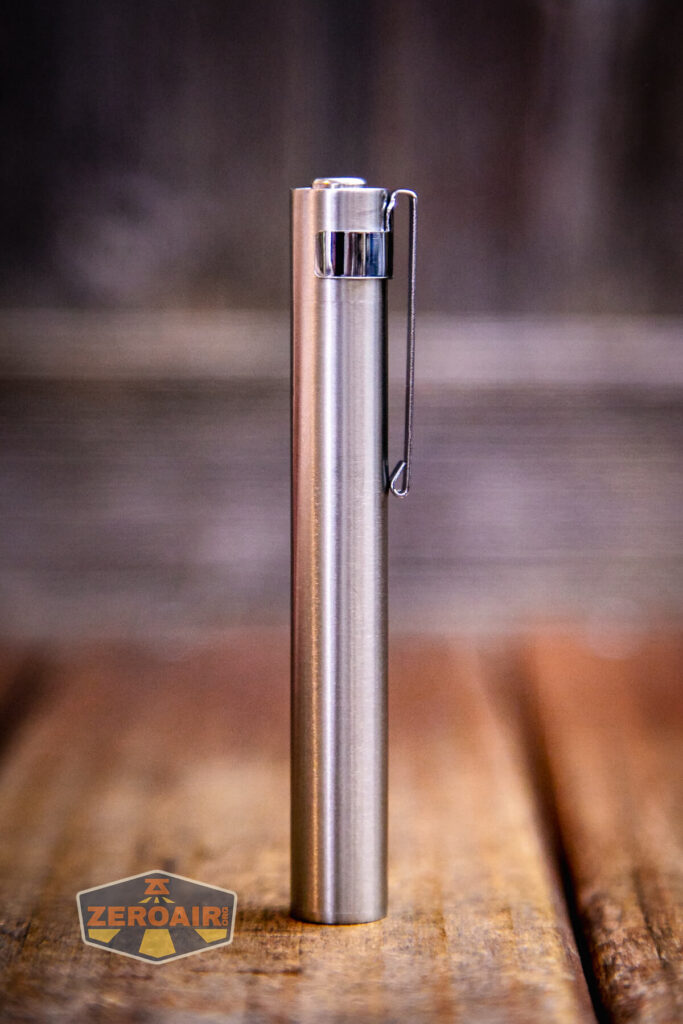
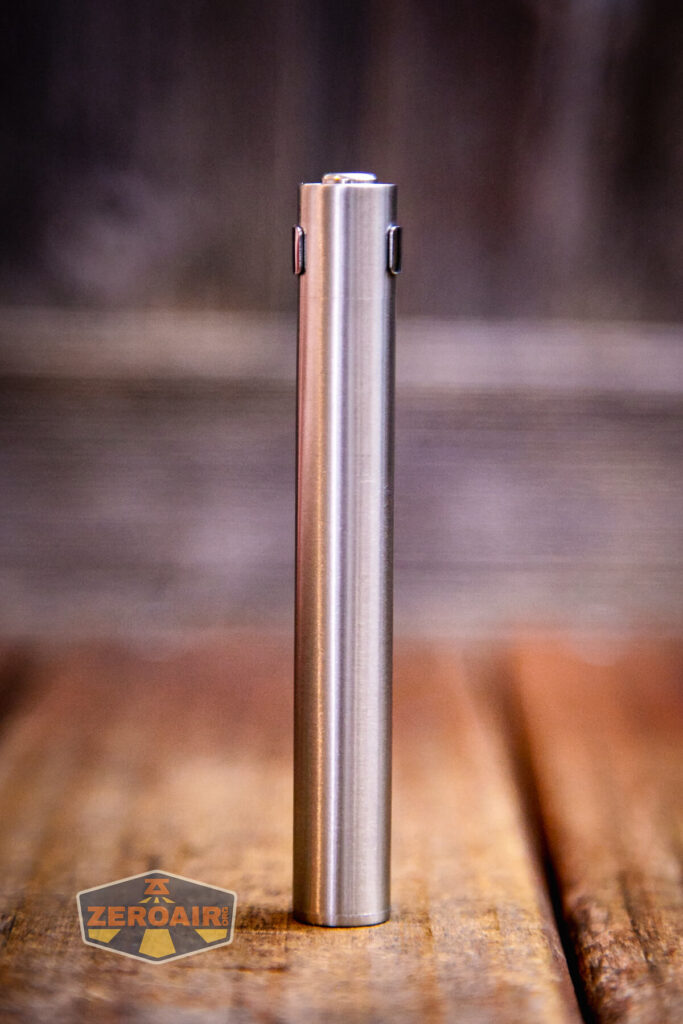
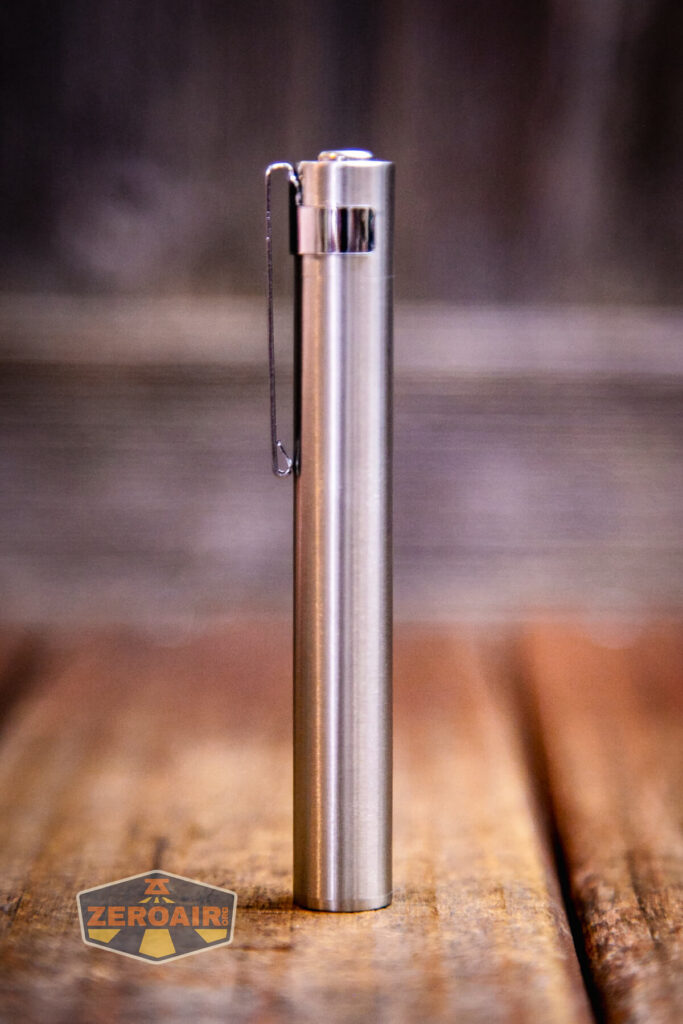
It’s basically just a stainless steel tube!
One thing that always struck me about this light, and the way I actually became accustomed to the term, is how the bezel, body, and tailcap are “match machined.” That means that after the parts are put together, they’re machined as one (which could be nothing more than a sanding pass) so that all the seams just disappear. Below, you can see the connection loosened just a bit to reveal the seam. Practically invisible when the parts are snug.
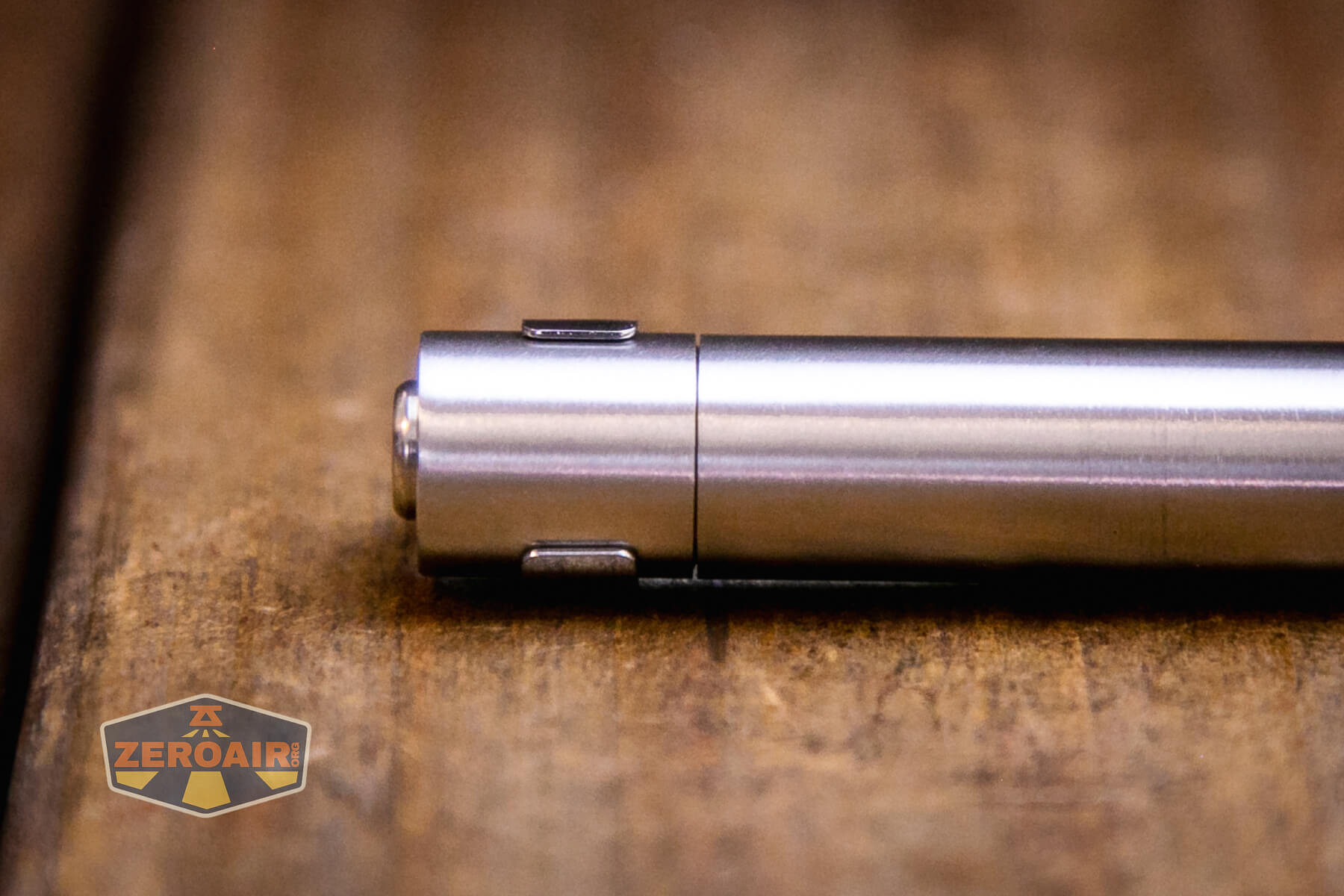
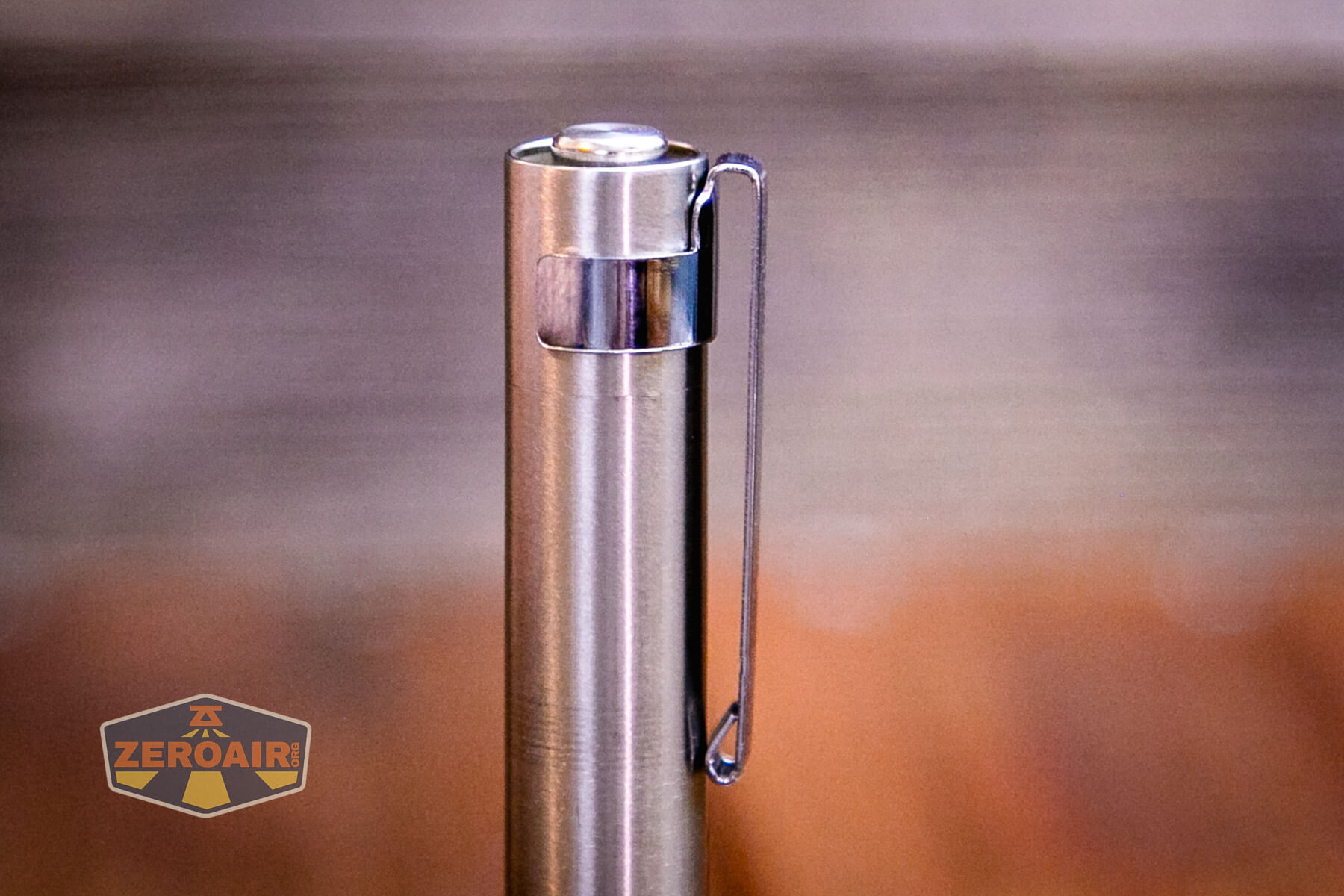
More on this below, but right here you can see where the pocket clip is installed upon arrival. I think that’s the wrong spot.
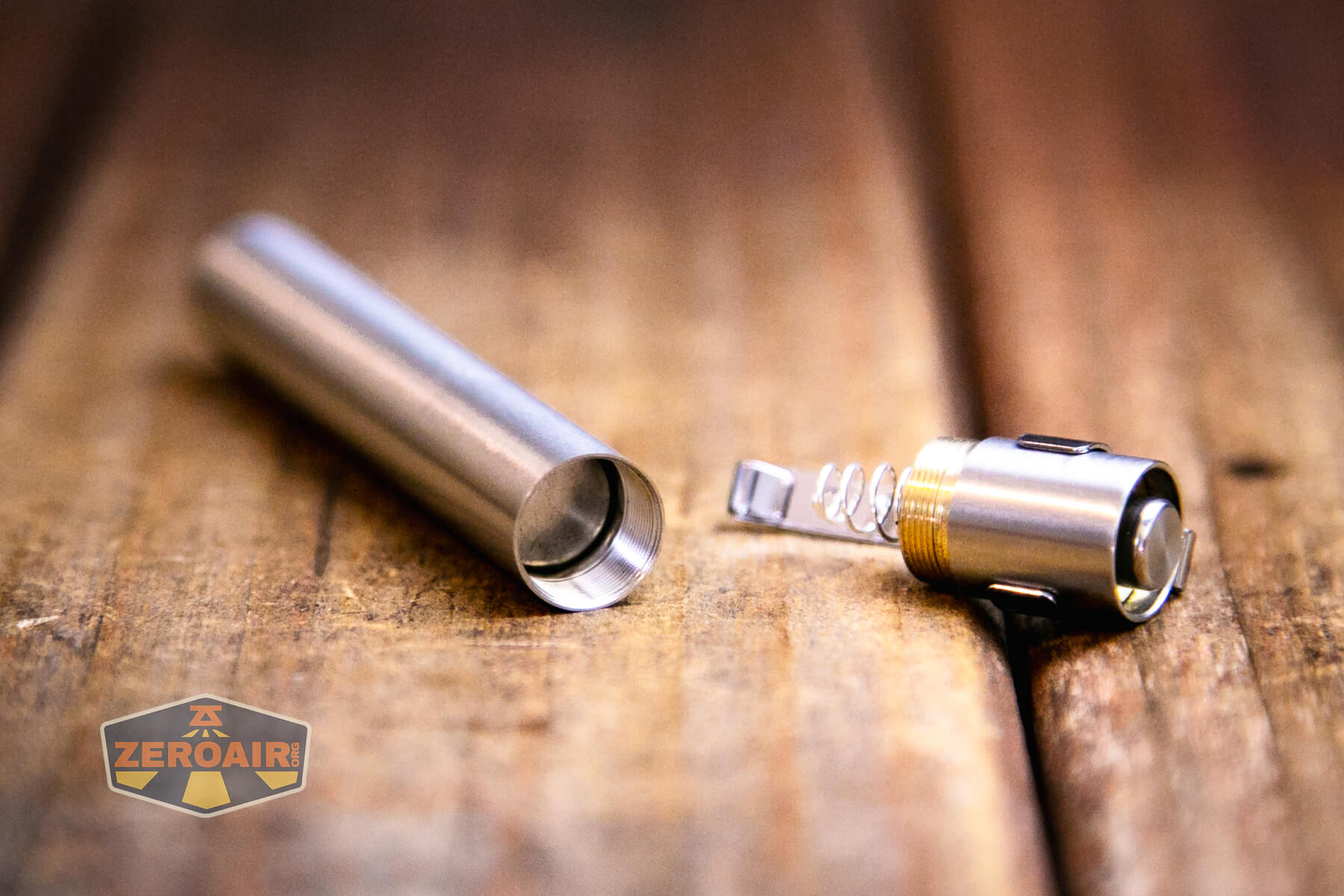
Anyway, you can see the spring on the tailcap end. It’s a thin spring, but sufficient. Those threads in the tail end are very fine. One good way to ensure that you won’t cross-thread the parts is to lay both parts on a flat surface and start from there. That removes one axis of contention for getting started (and this trick works for way more lights than just the KillzoneFlashlights BLF-348 updated flashlight.)
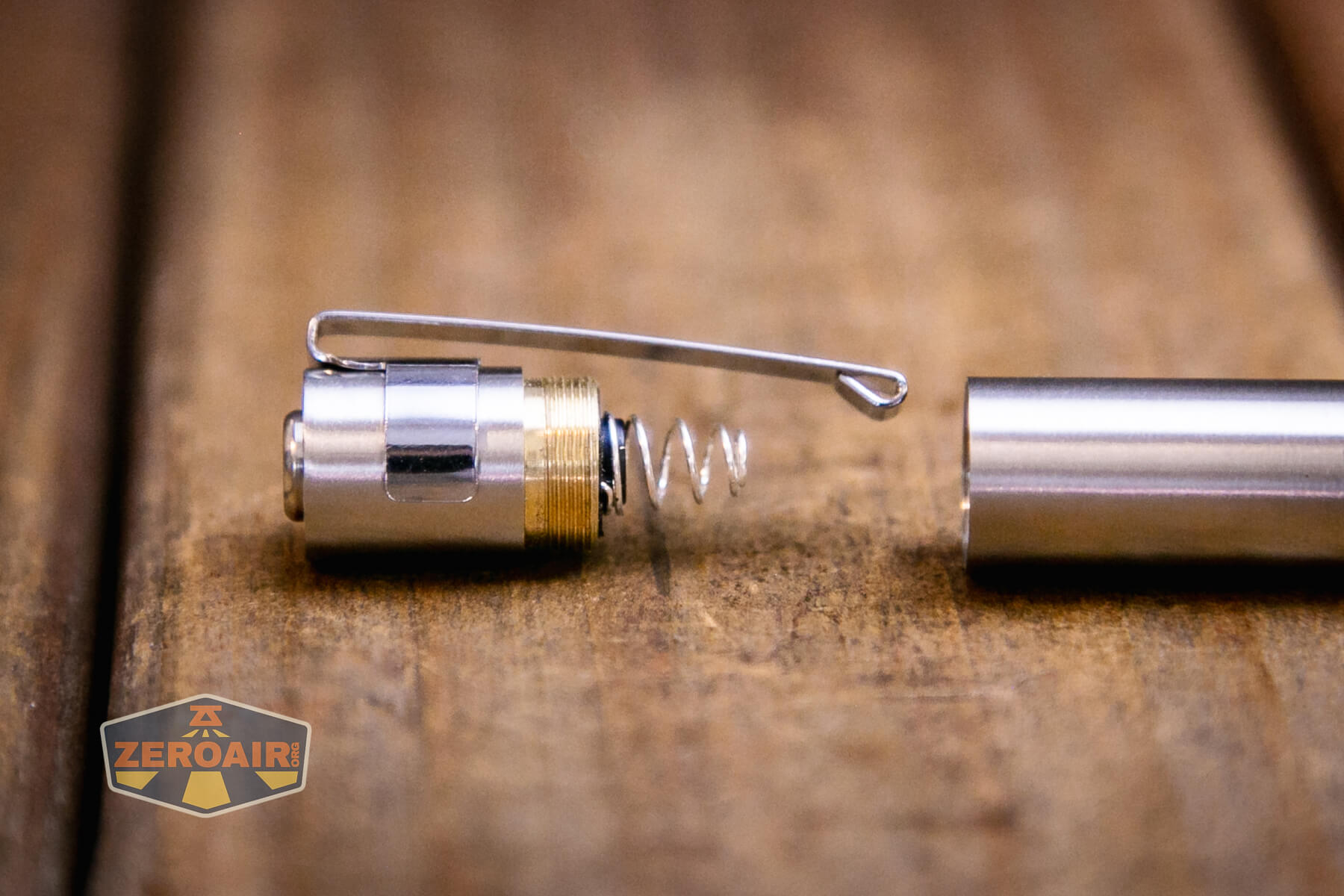
The head end has a little spring, too.
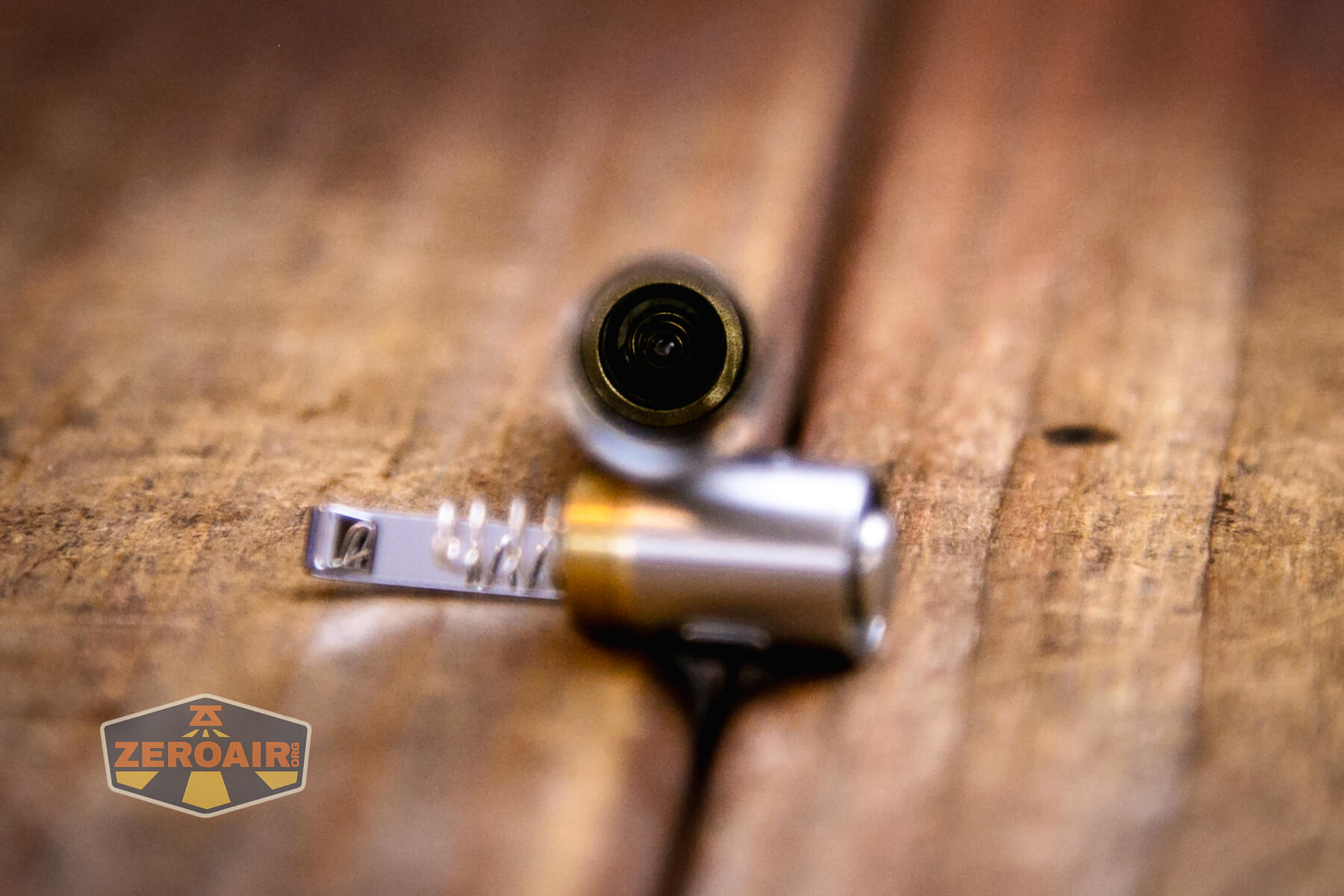
If you want to see the order of parts for when you inevitably take the whole light apart, check out my review of the 219b version of this BLF-348 by KillzoneFlashlights.com.
Size and Comps
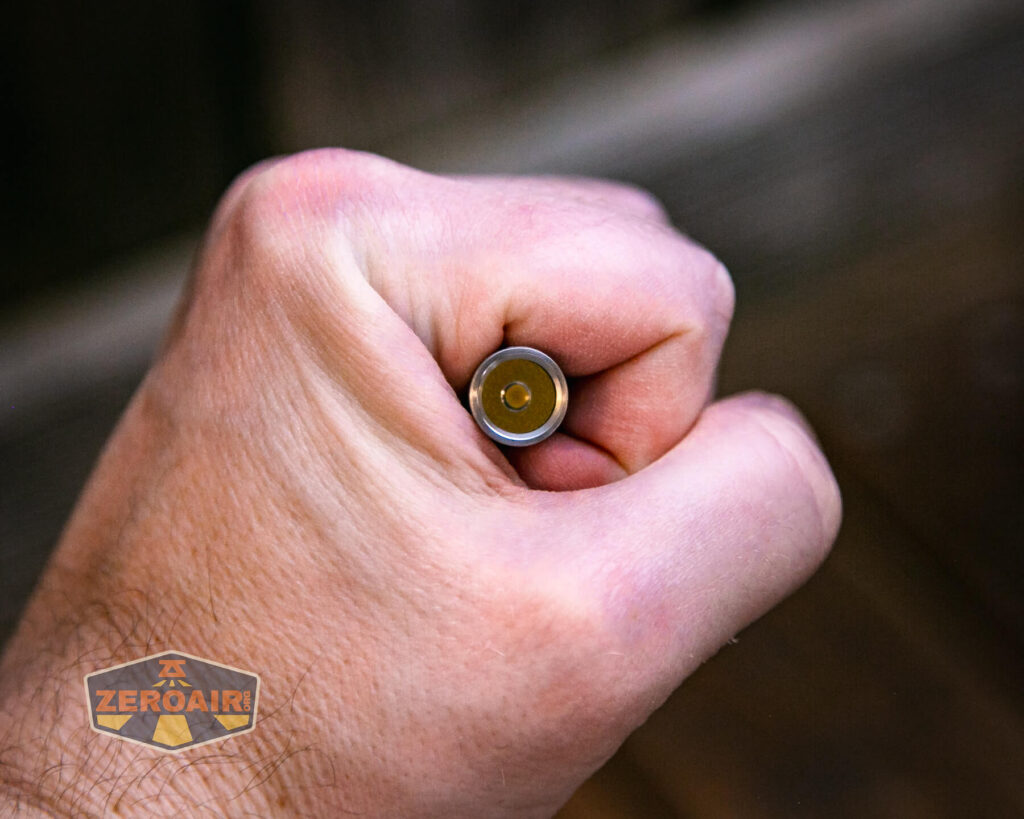
These lights are 9cm long and 1.2cm in diameter. Fairly small lights.
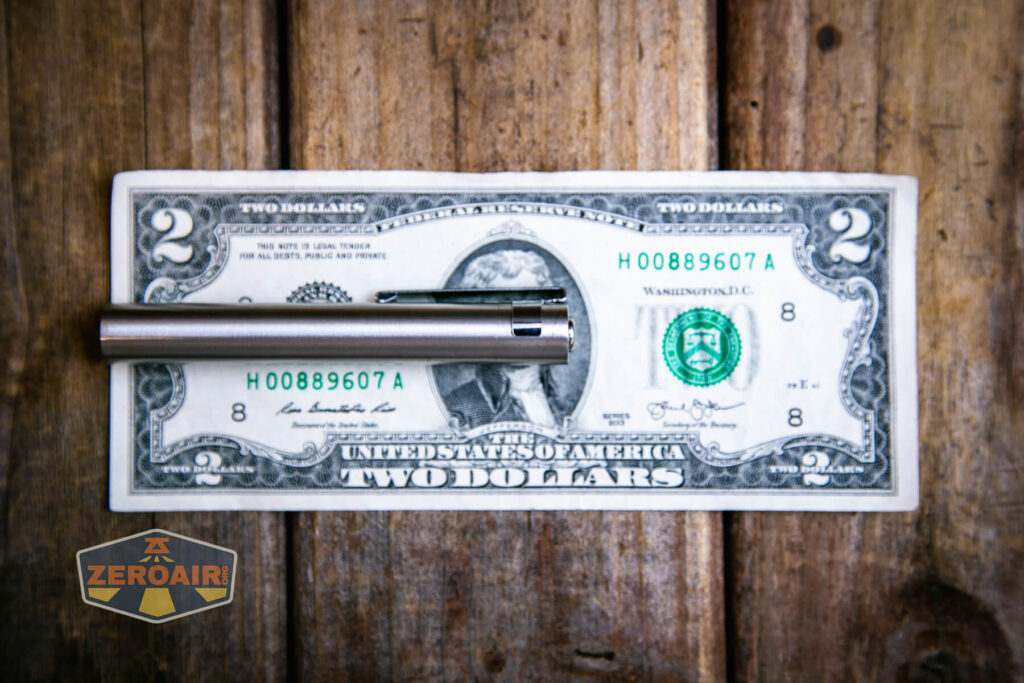
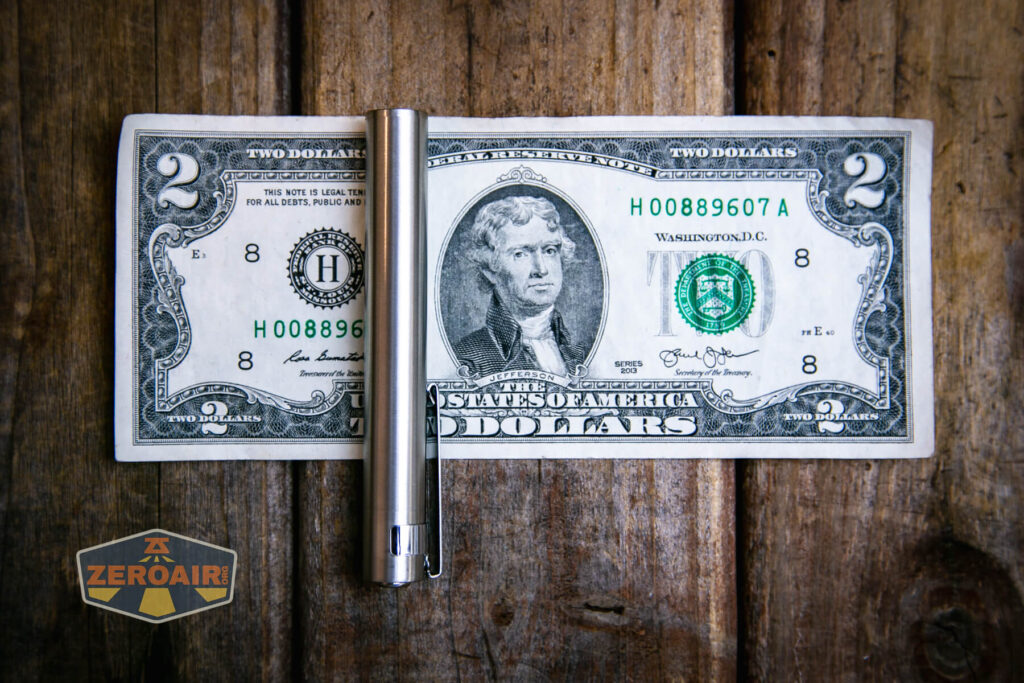
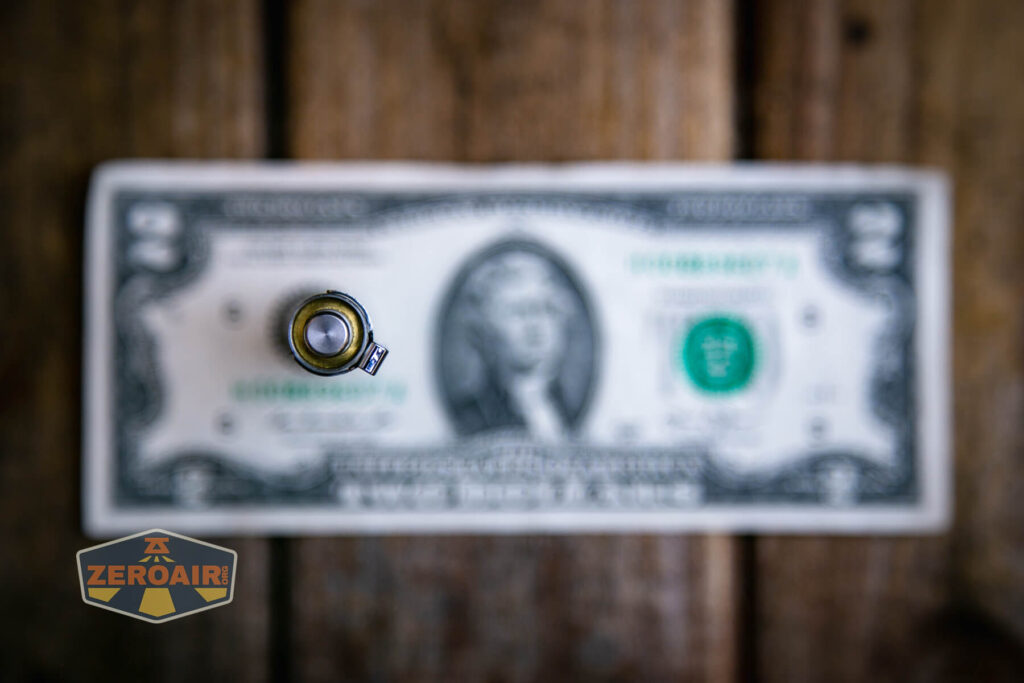
If the flashlight will headstand, I’ll show it here (usually the third photo). If the flashlight will tailstand, I’ll also show that (usually in the fourth photo).
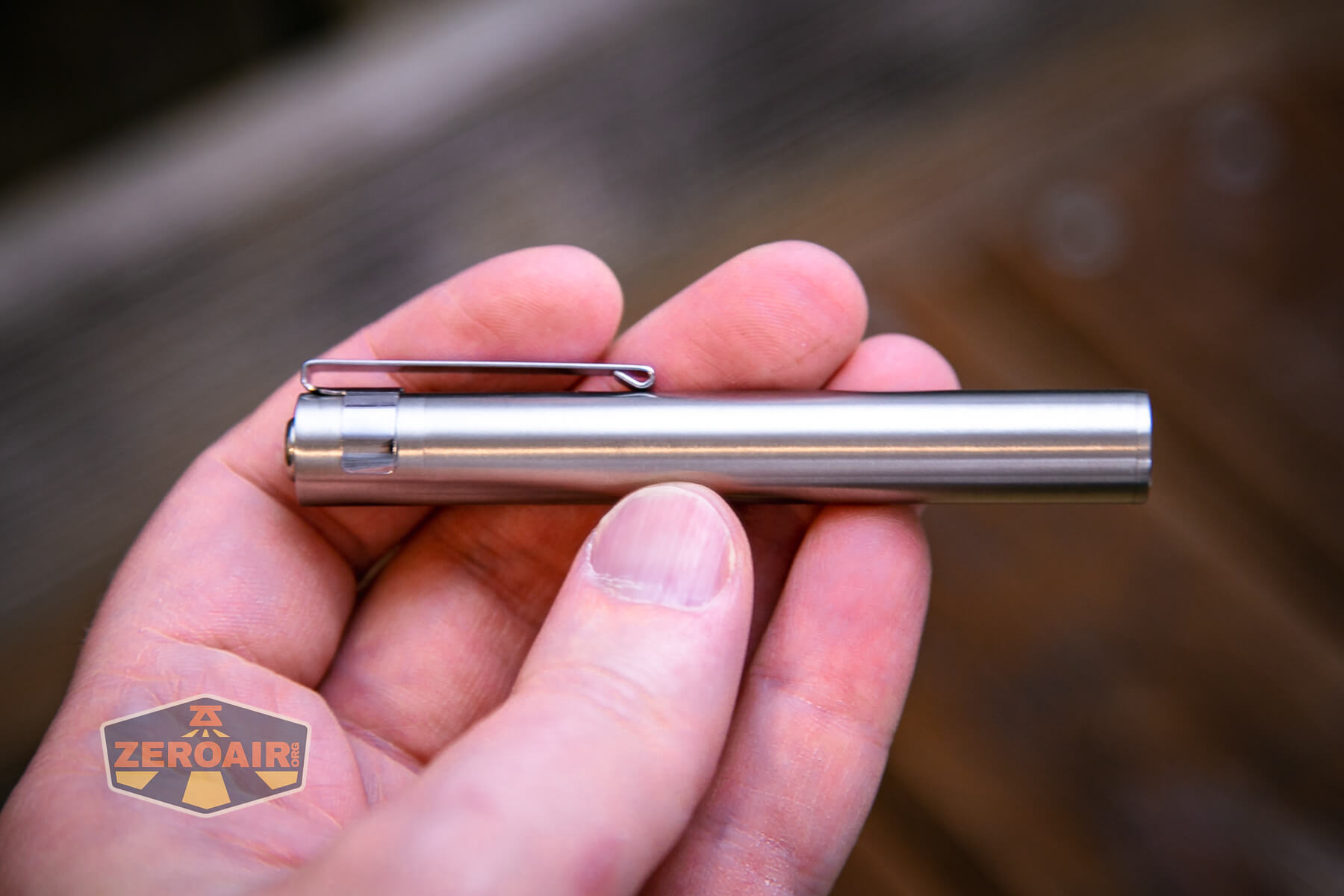
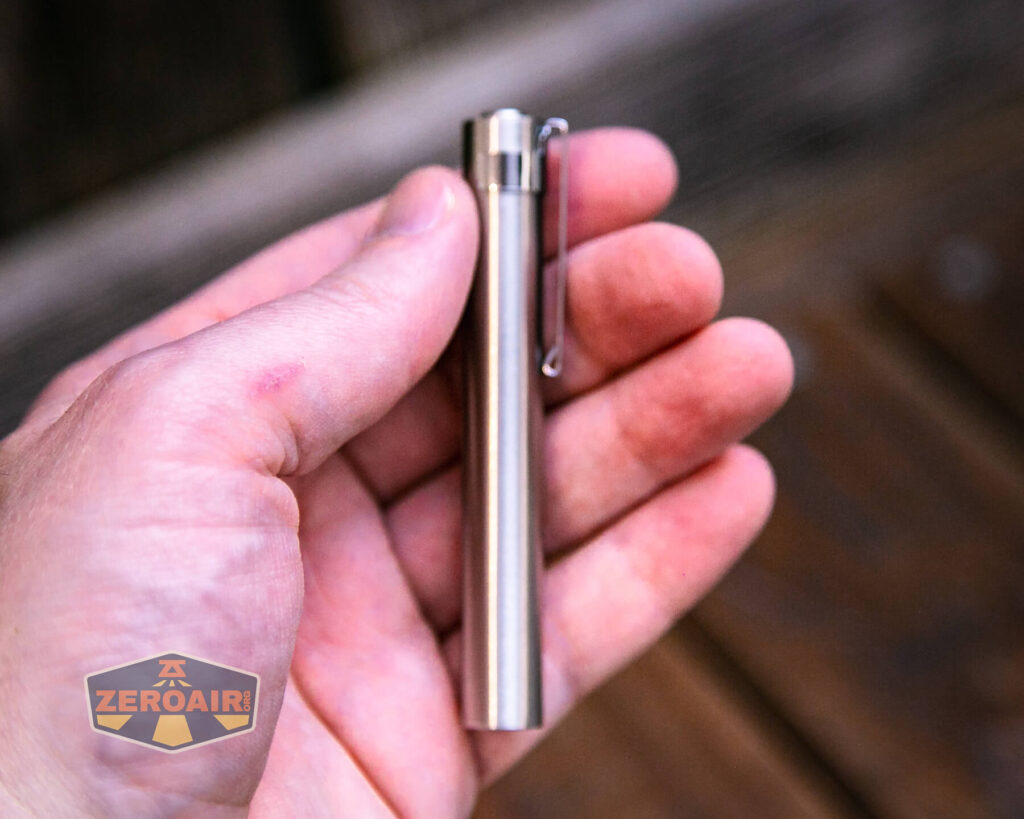
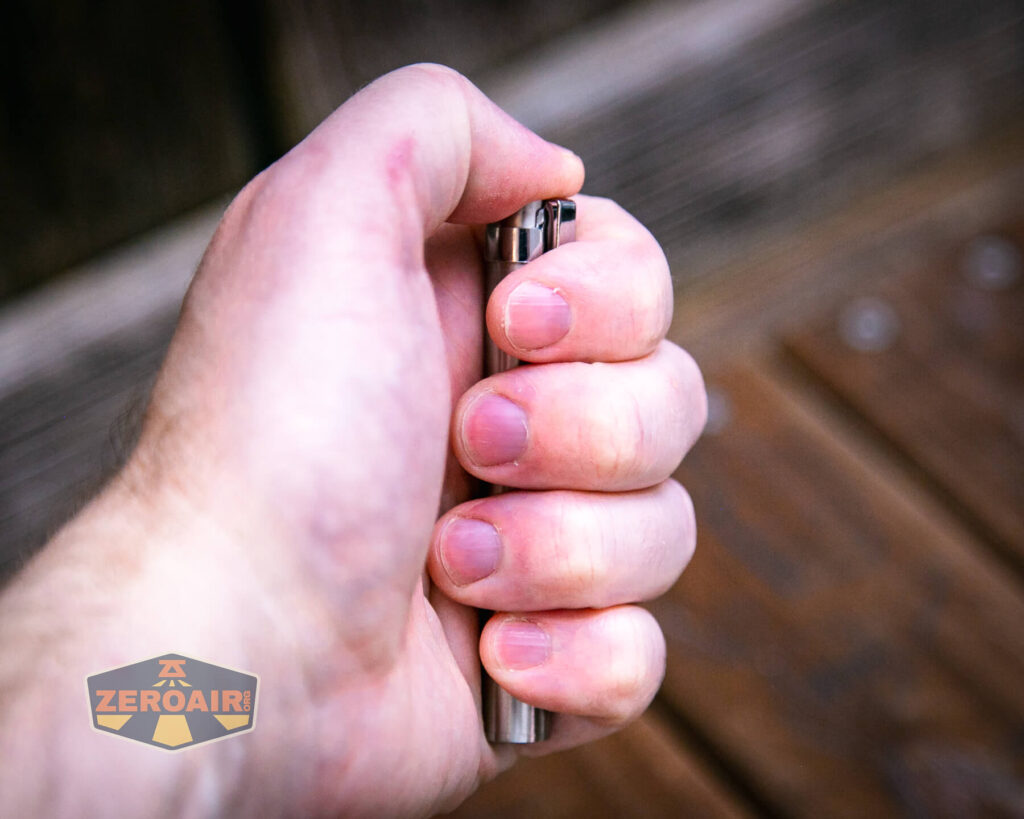
Here’s the test light with the venerable Convoy S2+. Mine’s a custom “baked” edition Nichia 219b triple. A very nice 18650 light.
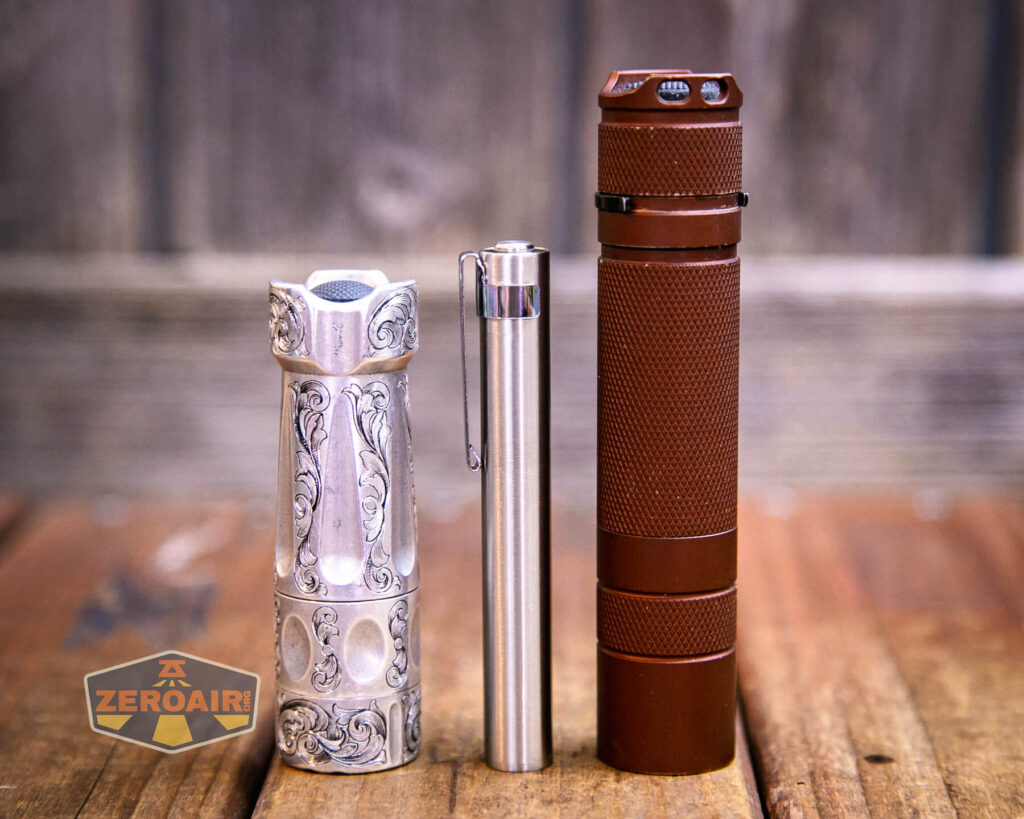
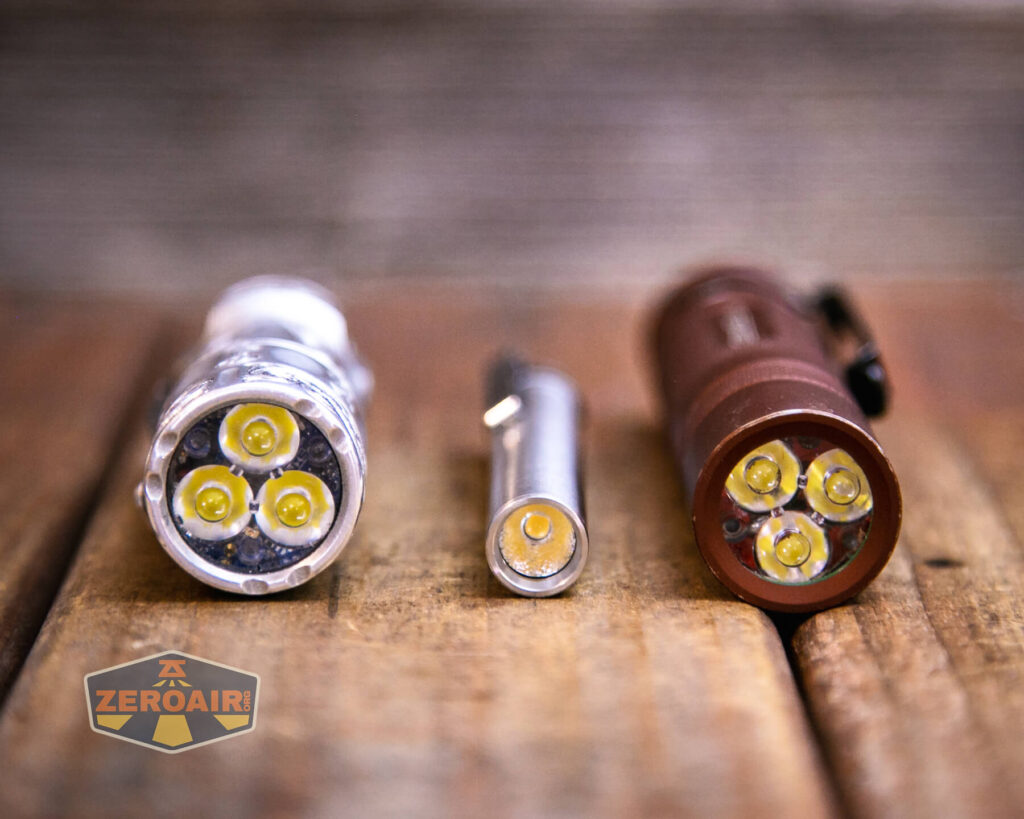
Also above is the light beside my custom-engraved TorchLAB BOSS 35, an 18350 light. I reviewed the aluminum version of that light in both 35 and 70 formats.
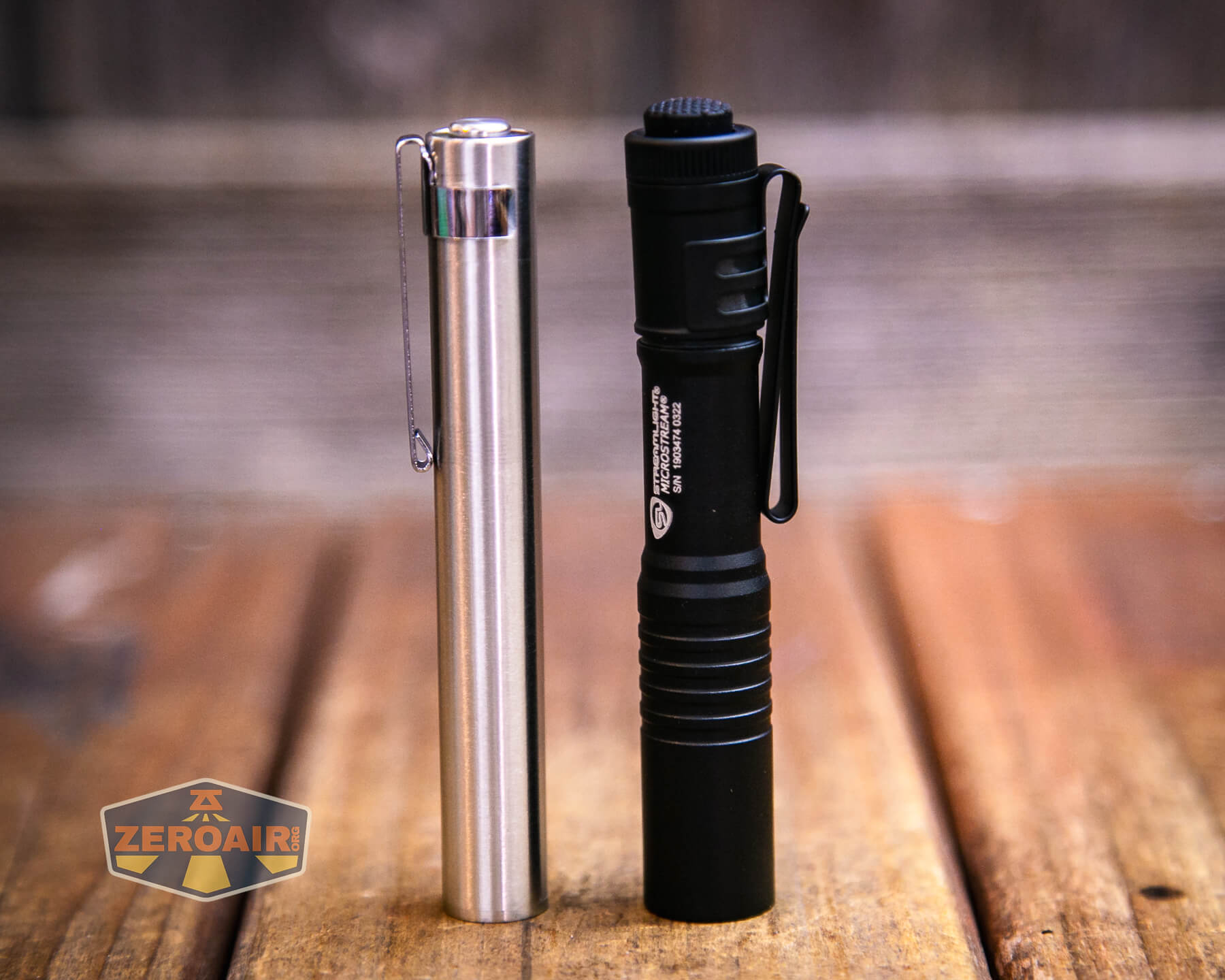
Below is the KillzoneFlashlights BLF-348 updated flashlight beside another random light I happened to have out. The Streamlight Microstream. Turns out there are a bunch of versions of this light, I think!
Retention and Carry
A pocket clip is already installed on this light, but very simple to remove. It’s a friction fit but slides over the end of the light.

By default, the clip is above the seam. If you look very closely below, you can see that the bottom part of the clip marks a spiral all the way around the light. Of course, you could separate those parts in such a way to prevent that, but you could also just move the clip down about 8mm. This makes for a shallower carry, but the light still carries just fine, and this way there are no extra marks on your light!
Nothing else is included for carrying this light.
Power and Runtime
The KillzoneFlashlights BLF-348 updated flashlight is powered by an AAA-sized cell. It’ll accept any variety, too. That means it’ll run NiMH AAA, primary AAA, and even 10440 lithium-ion cells!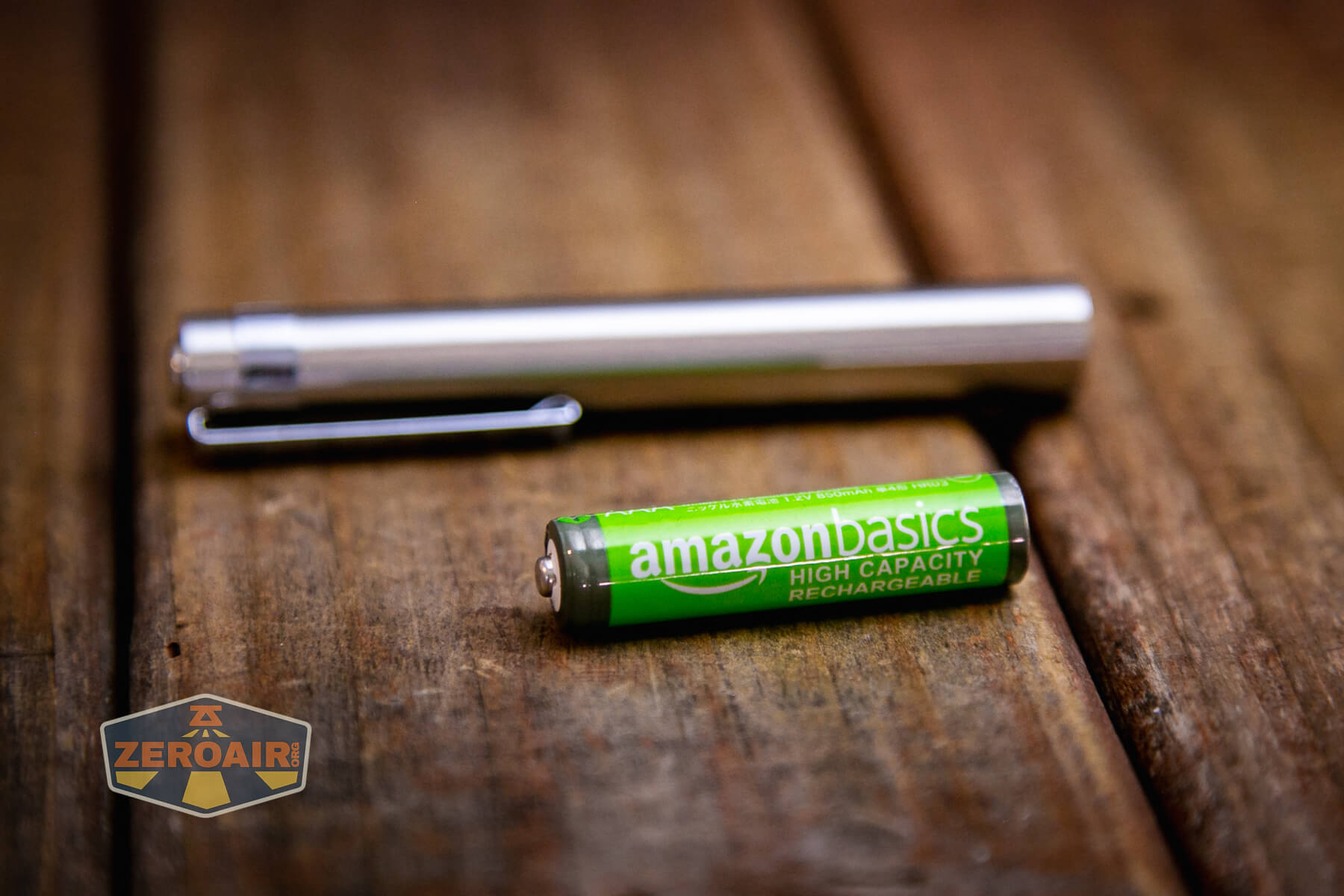
Here are a couple of runtime tests.

Note that in the test of 10440, the thermal sensor I use fell off the light. So you can see the temperature shoot up by around 2 minutes and then drop suddenly – the temperature obviously stayed high (or even got higher) – that’s quite hot!! My real advice is to just consider this a “1.5V cell” light and either use 10440 cells sparingly or never. Or always, but in brief durations (under a minute or two).
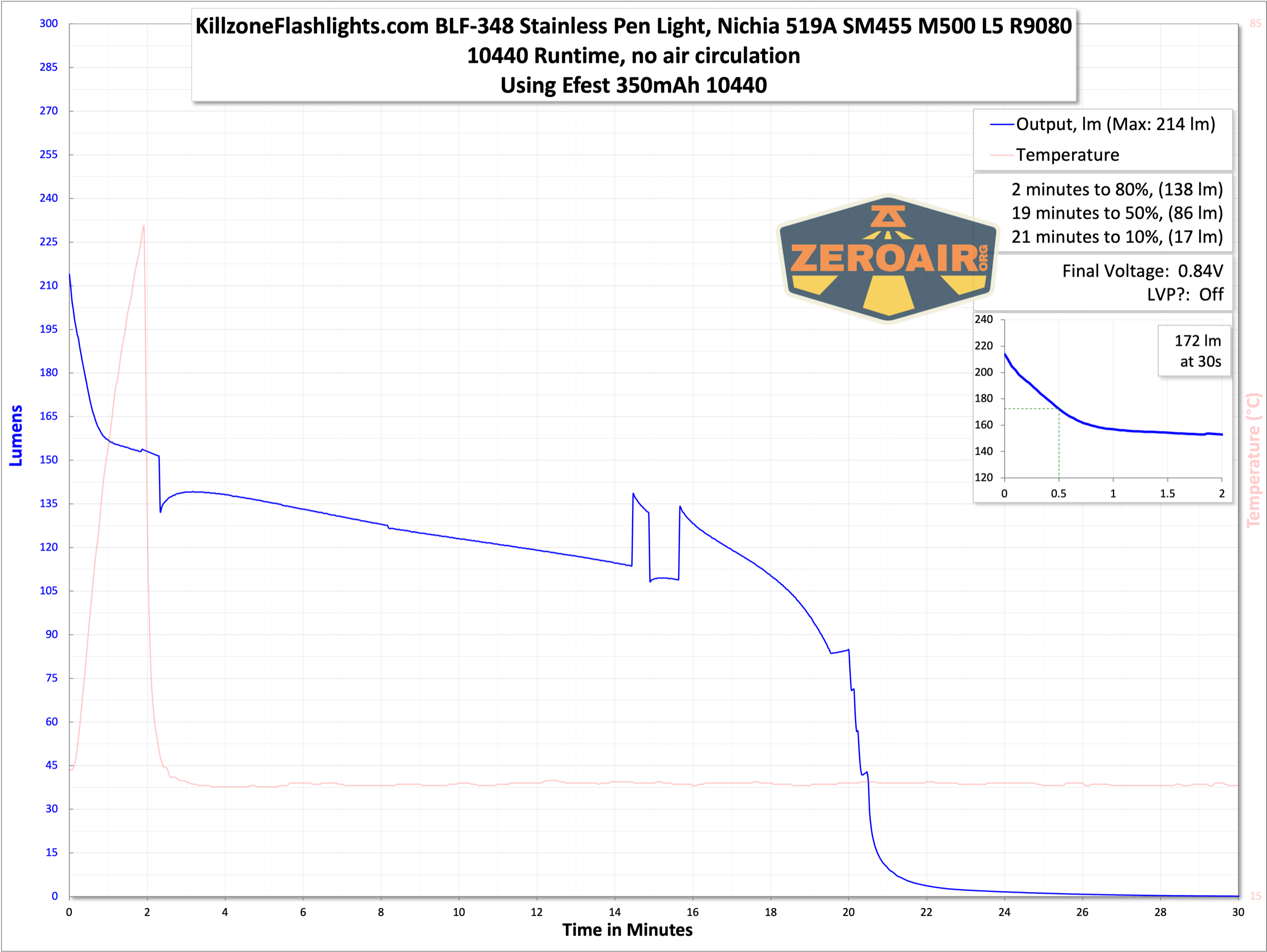
Also, there’s no low voltage protection with lithium-ion cells, so be aware of that, too! I love the support for both, but just use 1.5V cells. Specifically, use NiMH cells like these Amazon Basics.

Modes and Currents
| Mode | Mode Claimed Output (lm) | Claimed Runtime | Measured Lumens | Tailcap Amps |
|---|---|---|---|---|
| On (10440) | 175 | – | 172 | 1.90 |
| On (NiMH) | 50 | – | 51 | 0.85 |
You may be picking up what I’m putting down in that chart – there’s just one mode with this light. That mode is “on”. No moonlight, no turbo, no nothing else. On, and off. This is great for some users, not great for others – I like it in this particular light!
Pulse Width Modulation
The KillzoneFlashlights BLF-348 updated flashlight does not use PWM.
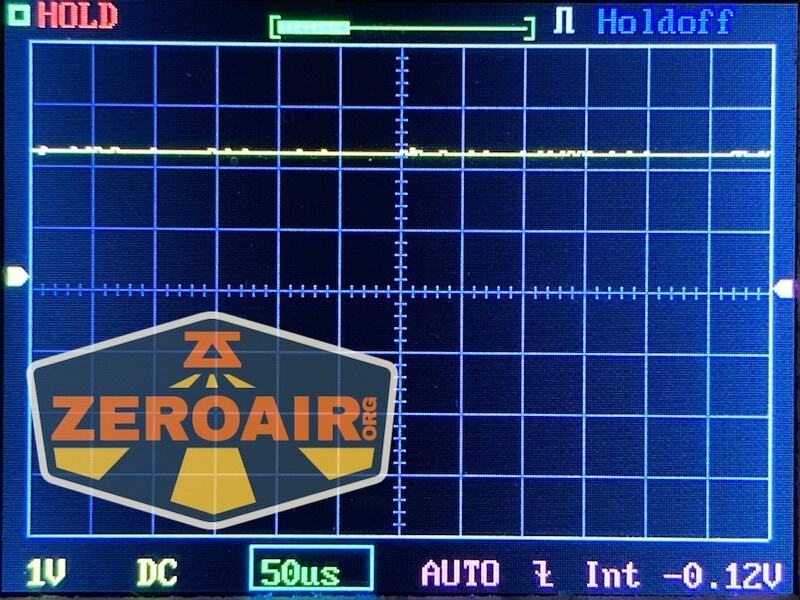
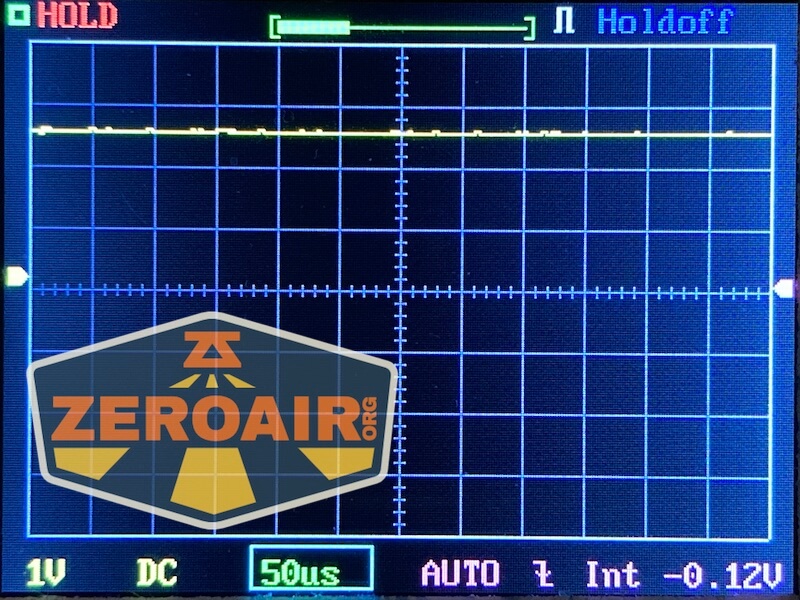
Here you can see a “baseline” – a chart with almost no light hitting the sensor. Then there’s the Ultrafire WF-602C flashlight, which has some of the worst PWM I’ve seen. It’s so bad that I used a post about it to explain PWM! Here are multiple timescales (10ms, 5ms, 2ms, 1ms, 0.5ms, 0.2ms) to make comparing this “worst” PWM light to the test light easier. That post also explains why I didn’t test the WF-602C at the usual 50us scale.


User Interface and Operation
The switch on this AAA light is a reverse clicky mechanical switch. The button itself is metal, which is great. There’s a little bit of play in the switch, but not in such a way that the switch gets bound on the way down or up. Travel is quite long – maybe 1.5-2mm or so.
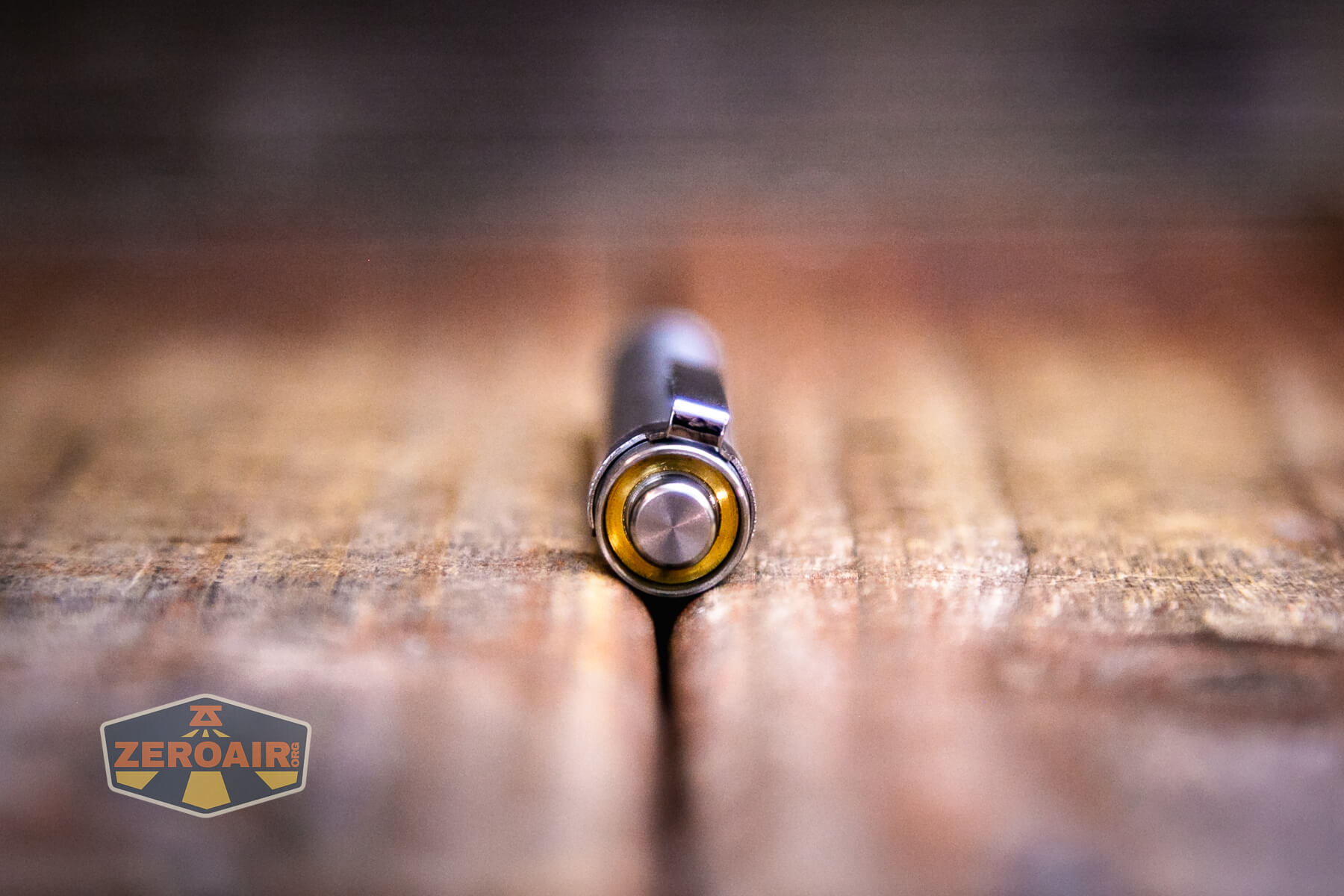
The button is a little proud, as well. That actually prevents tailstanding, too. I would say one difference between the new version and the old one is that the button is a little more rounded – or a bigger bevel, specifically. So while you could convince the old version to tailstand, it’s much harder (though probably technically possible) with this version.
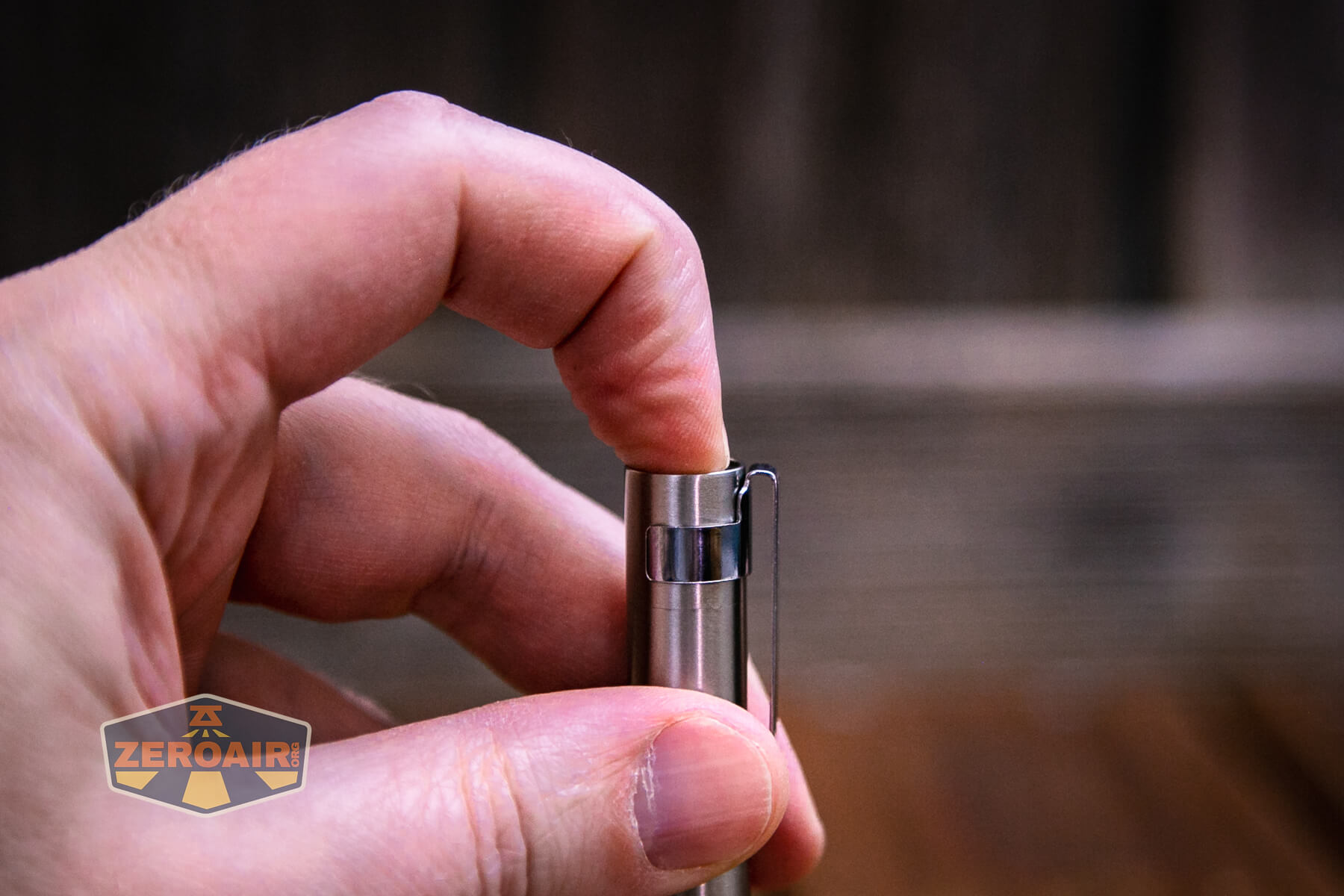
Here’s a user interface table!
| State | Action | Result |
|---|---|---|
| Off | Click | On |
| On | Click | Off |
LED and Beam
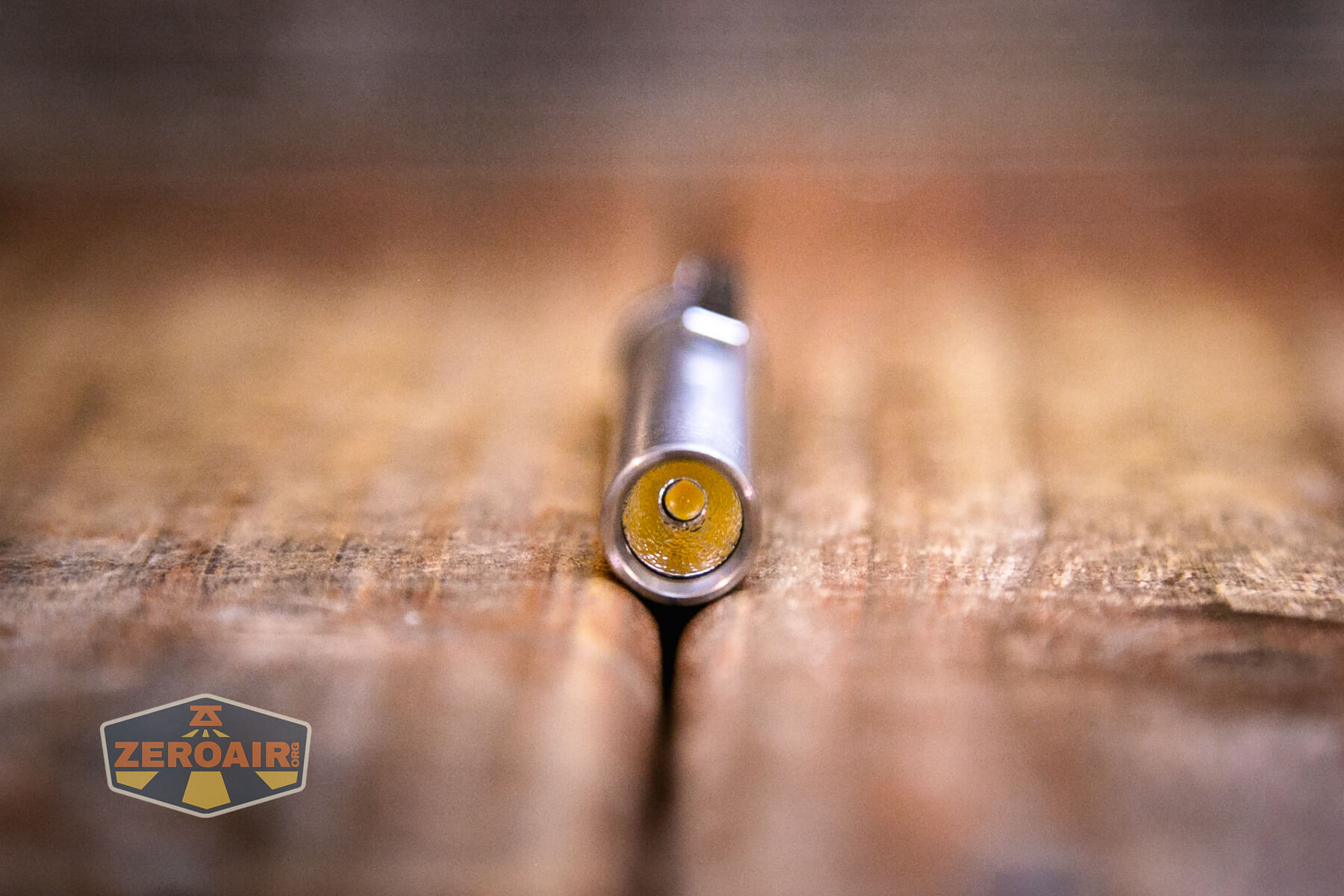
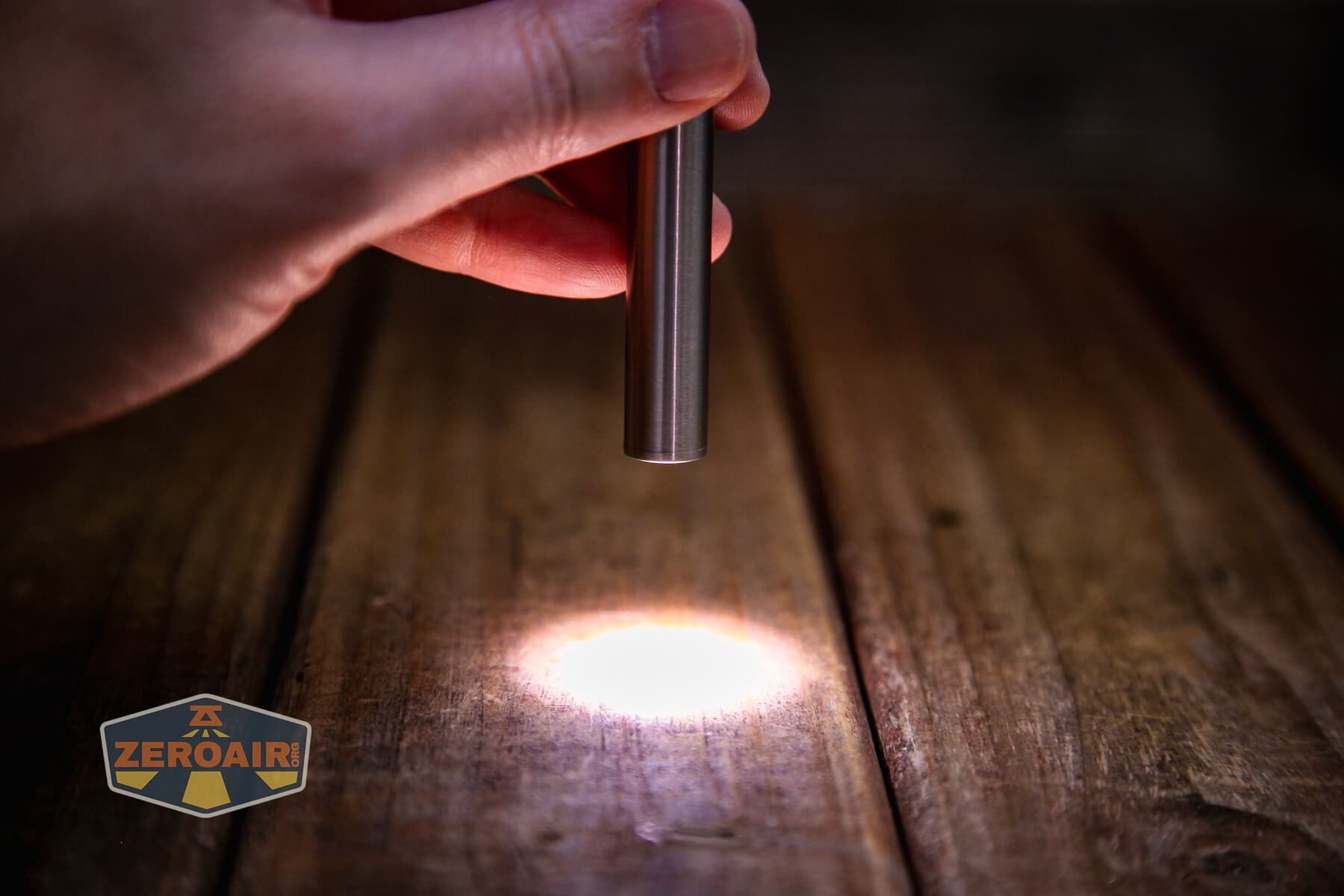
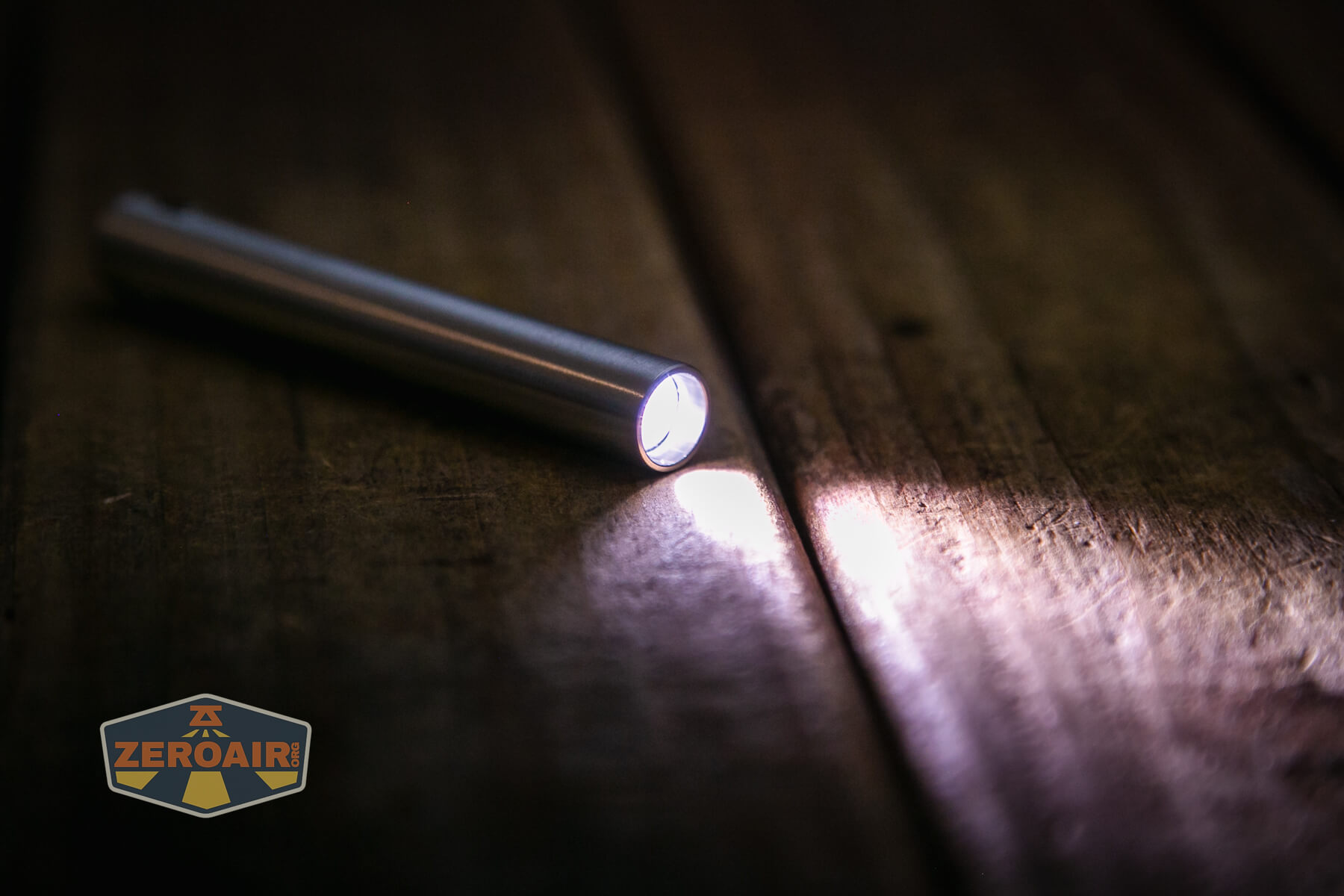
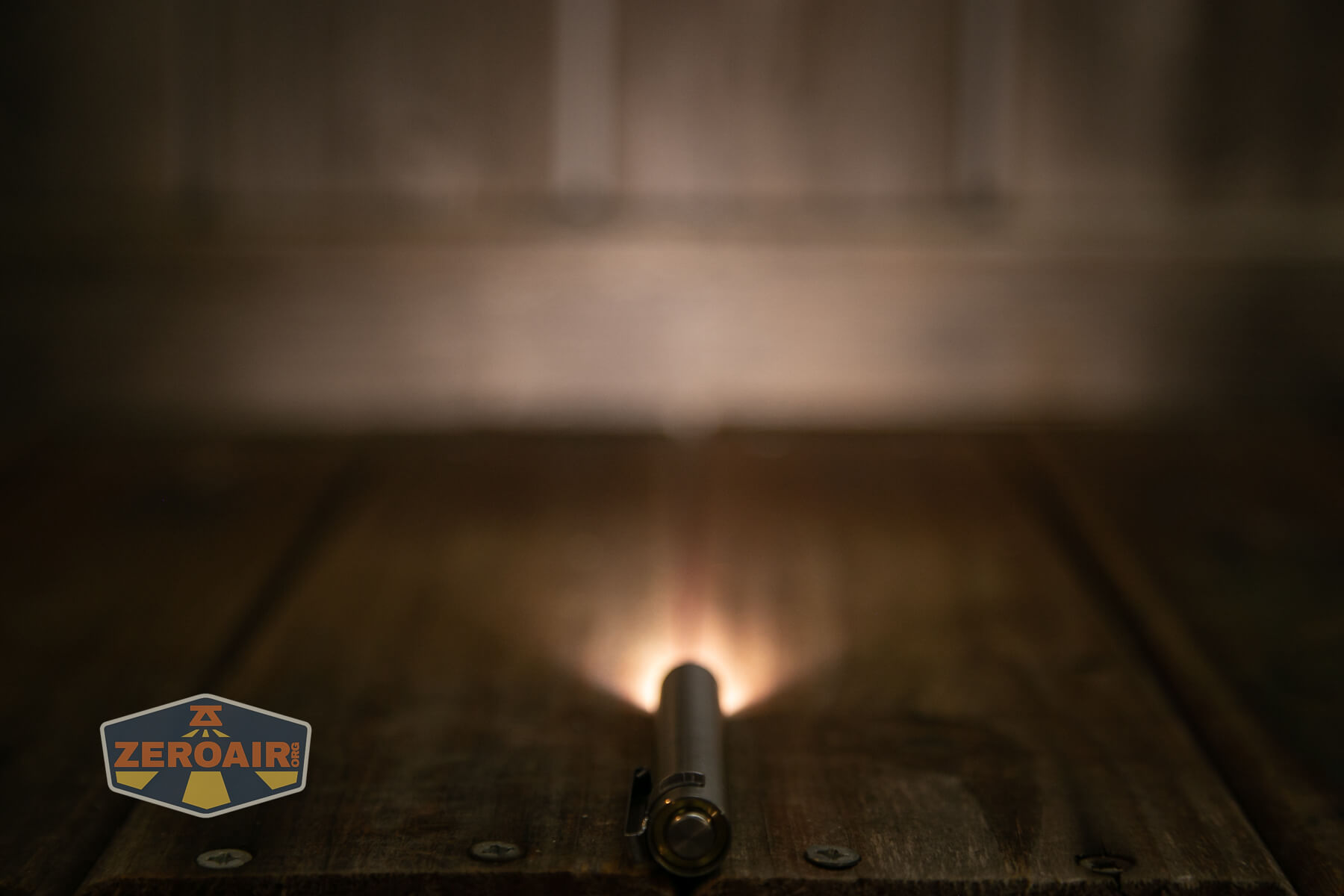
Now the most important part of this light (and exactly why you should go buy one). This emitter is a Nichia 519a. Yes, that’s the same thing I said about the Nichia 219b version, but also “yes” I do think that the Nichia 519a emitter is that good.
LED Color Report (CRI and CCT)
Just about everything on the Nichia 519a emitter is better than the Nichia 219b emitter I love so dearly. This verison has higher CRI. It has “better” Duv (it will appear “pinker”, probably). Efficiency (not represented in the chart below) is better on these, too! NiMH is on the left, with 10440 output on the right.
Beamshots
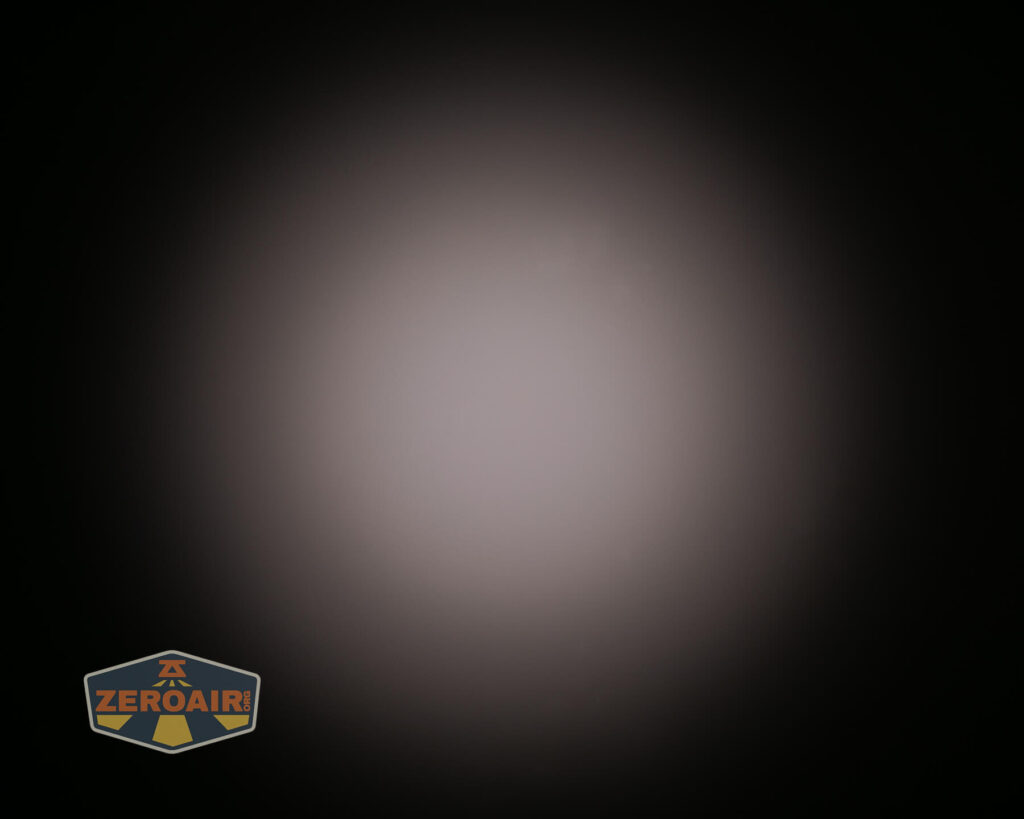
These beamshots always have the following settings: f8, ISO100, 0.3s shutter, and manual 5000K exposure. These photos are taken at floor level, and the beam hits the ceiling around 9 feet away. NiMH is on the left, with 10440 output on the right.

Tint vs BLF-348 (KillzoneFlashlights.com 219b version) (affiliate link)
I keep the test flashlight on the left and the BLF-348 reference flashlight on the right. NiMH is on the left, with 10440 output on the right.
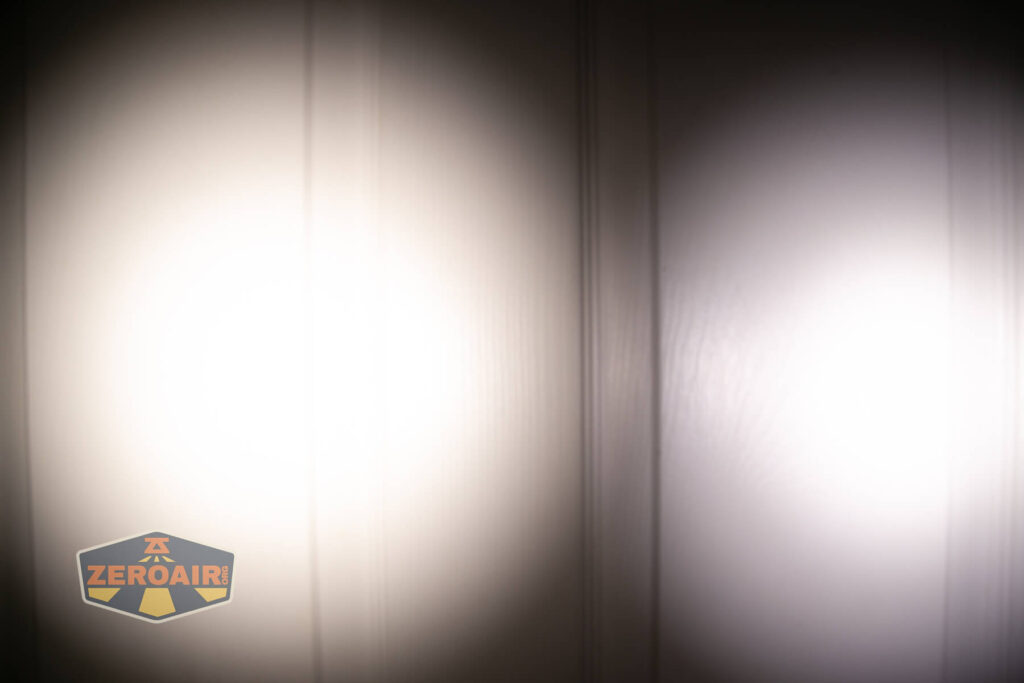
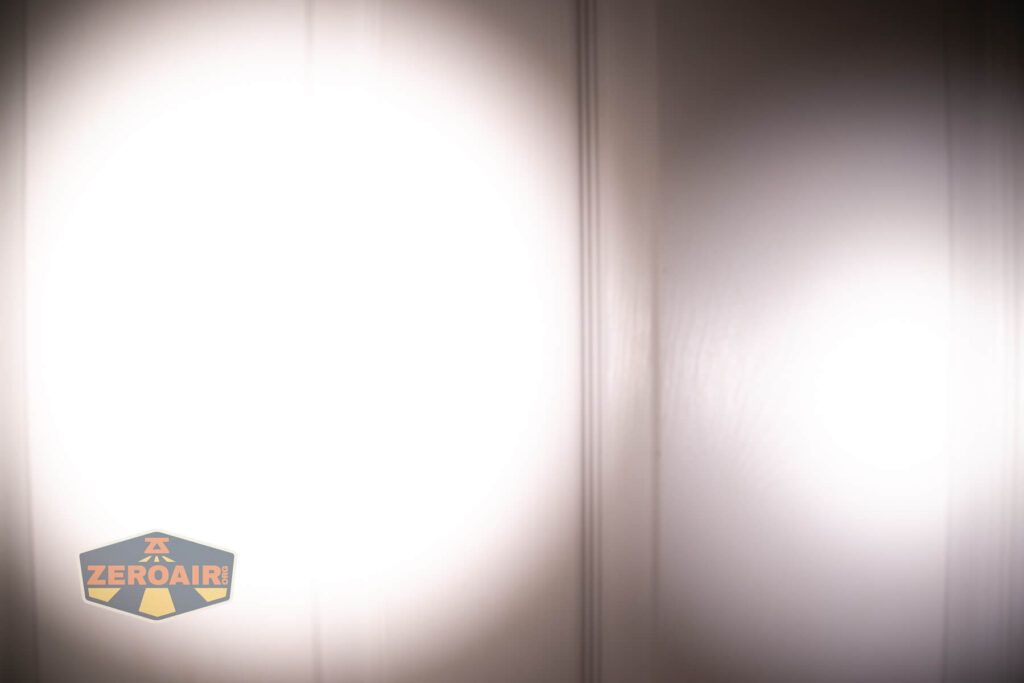
I compare everything to the KillzoneFlashlights.com 219b BLF-348 because it’s inexpensive and has the best tint!
Conclusion
I do think you should buy one of the KillzoneFlashlights BLF-348 updated flashlights!! In fact buy a bunch of these. KillzoneFlashlights.com said they have many in stock, and can definitely fulfil your order (of as many as you want to buy!). Also, KillzoneFlashlights is great! But this light at this price is practically a no-brainer.
What I like
- Nichia 519a emitter, with excellent tint
- High CRI (actually “very high” CRI)
- Multi-chemistry support
- Just one mode
What I don’t like
- Unregulated driver – gets very hot with 10440 cell.
- No LVP
- Just one mode
Notes
- This content originally appeared at zeroair.org. Please visit there for the best experience!
- For flashlight-related patches, stickers, and gear, head over to PhotonPhreaks.com!
- Please use my Amazon.com referral link to help support zeroair.org!
- Please support me on Patreon! I deeply appreciate your support!