

Emisar D3AA 5700K Flashlight Review
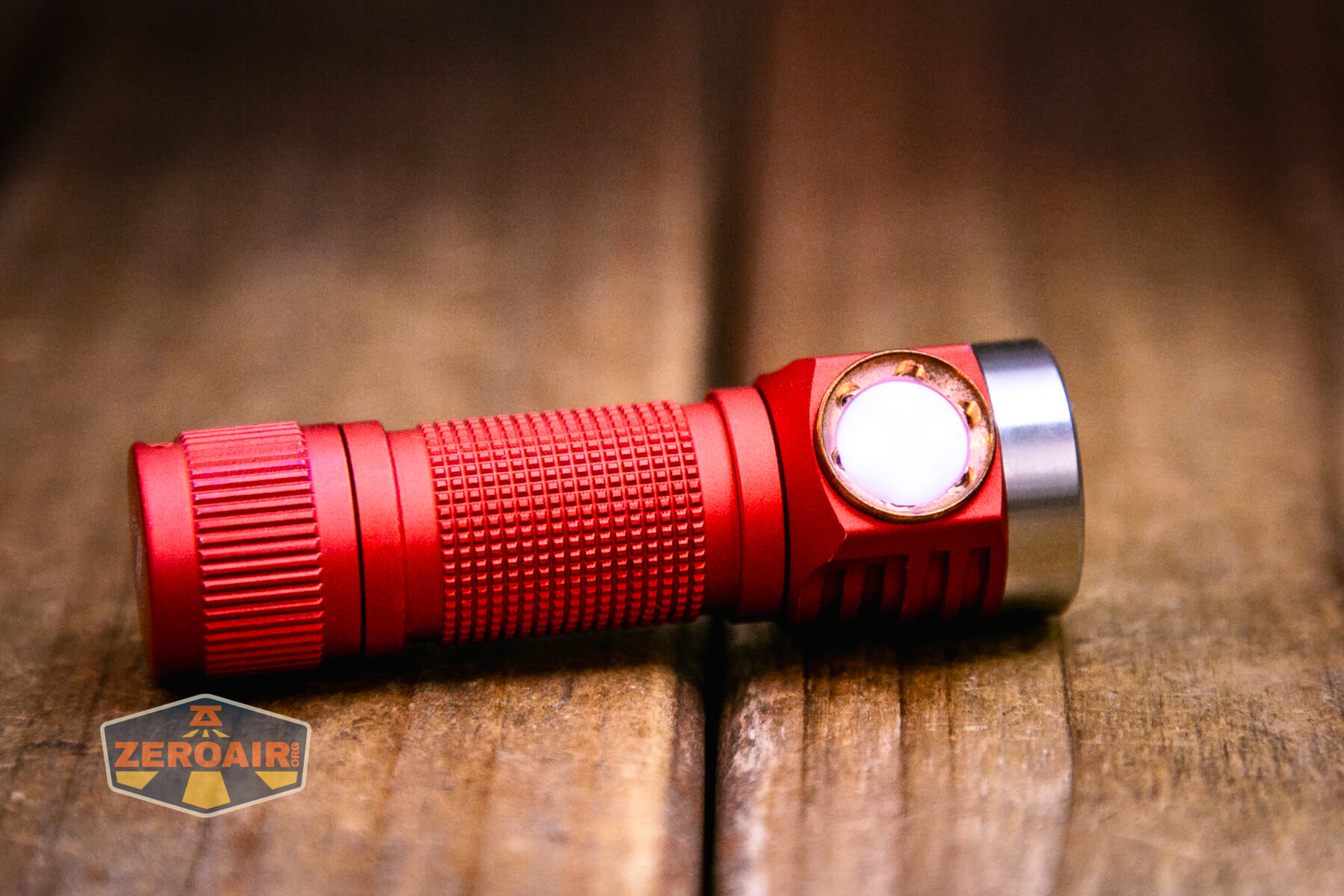
The Emisar D3AA 5700K flashlight can run 14500 and 1.5V cells and uses the popular Andúril user interface. There are many options such as the stainless bezel.
Official Specs and Features
Here’s a link to the Emisar D3AA 5700K flashlight product page.
Versions
There are a bunch of options!
First is aluminum, which comes in red (seen here), black, dark gray, and cyan. Also available is titanium, which has a copper engine section. Finally, there’s even a special finished version of titanium: Raw Ore, Clouds, Crinkle, Cyclone, and Oil Slick.
You can get a flat or raised switch bezel. You can get many different switch backlight colors (including RGB, seen here.)
There are also many emitter options (I count 22 – but Hank of Emisar might even do something custom if you ask!) This is an off-the-shelf option, of Nichia dedomed 519a 5700K.
Price
As pictured in this post, the Emisar D3AA 5700K flashlight costs around $46. Nichia 519a adds $7.50 (worth it!) to the base price of $35.81. A magnet tailcap adds $4.99. The stainless bezel adds $2.99. There are many other things you can add, too! This light also has the copper retaining ring on the switch, which adds a bit of cost (but I don’t see those are available anymore.)
What’s Included

- Emisar D3AA 5700K flashlight
- Lanyard
- Spare o-rings (2)
Note: the battery is not included.
Package and Manual
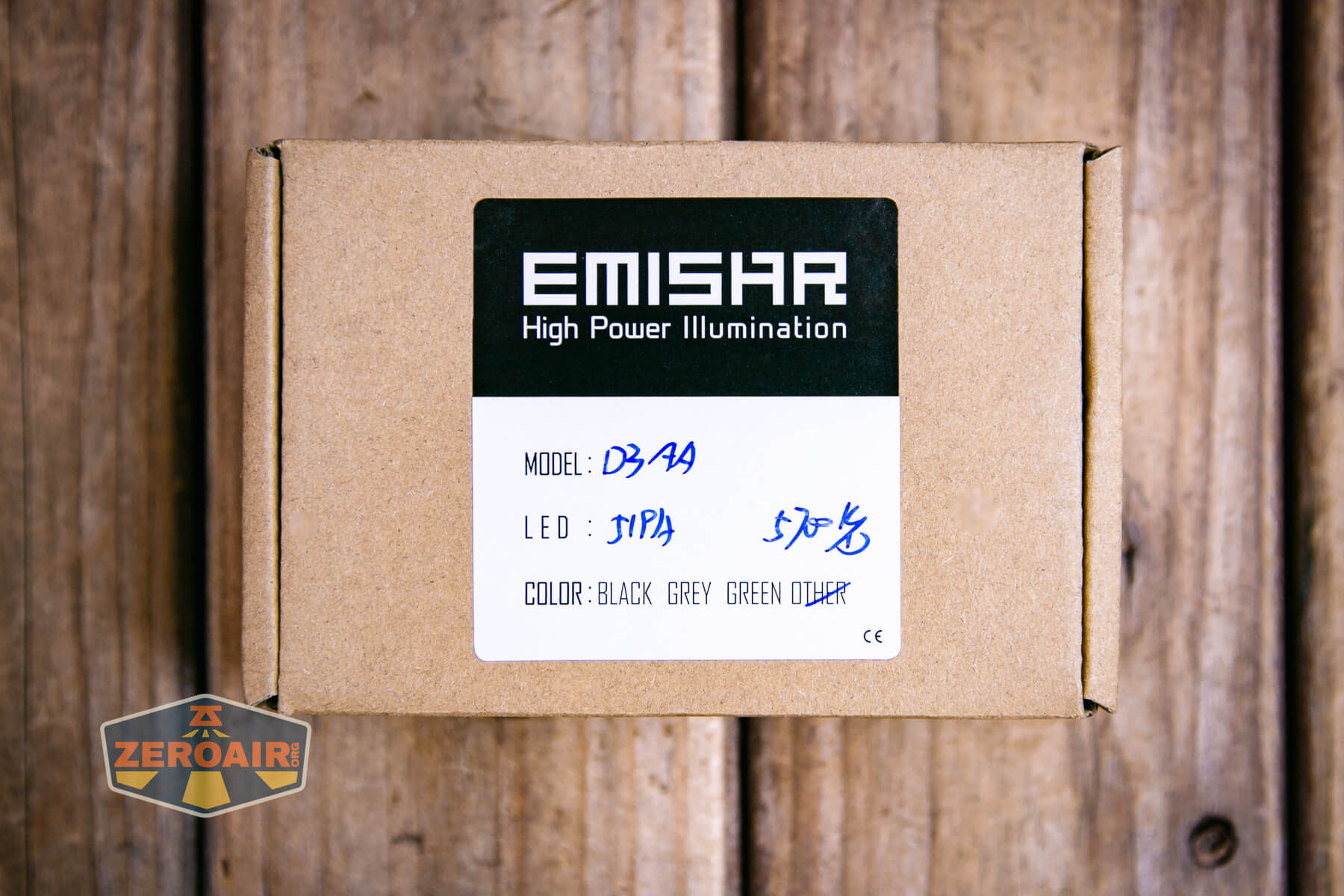
There is no manual.
Build Quality and Disassembly

The Emisar D3AA 5700K flashlight very much feels like a small version of the venerable Emisar D4V2. I think proportionally it’s slightly different, but still – the look is there. Build quality is great and the Emisar D3AA 4500K flashlight feels like more than just a $35 light.
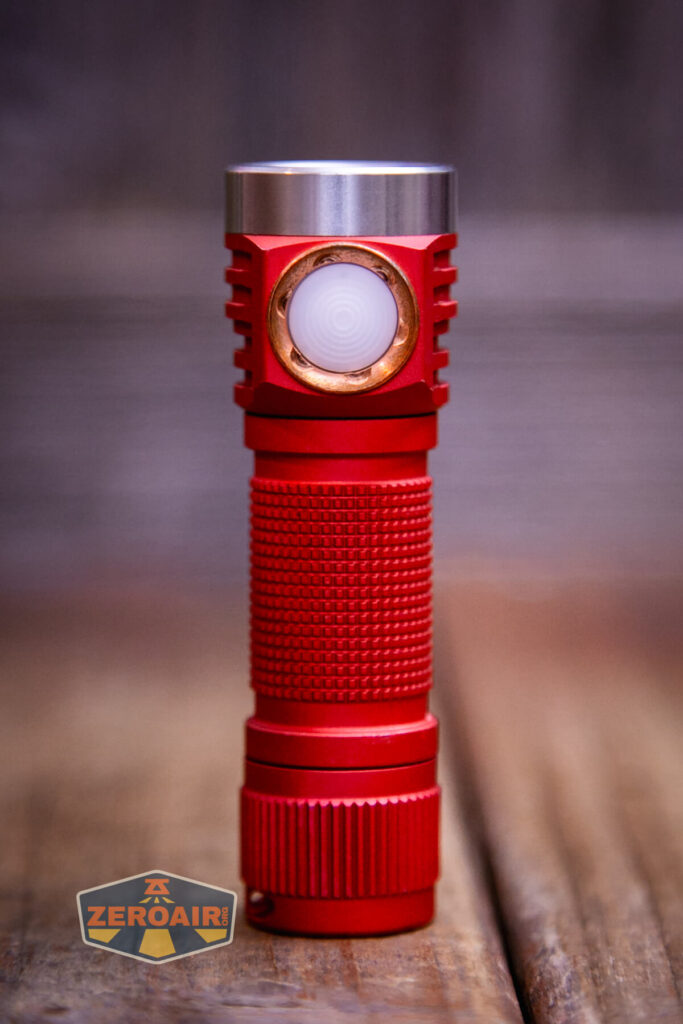

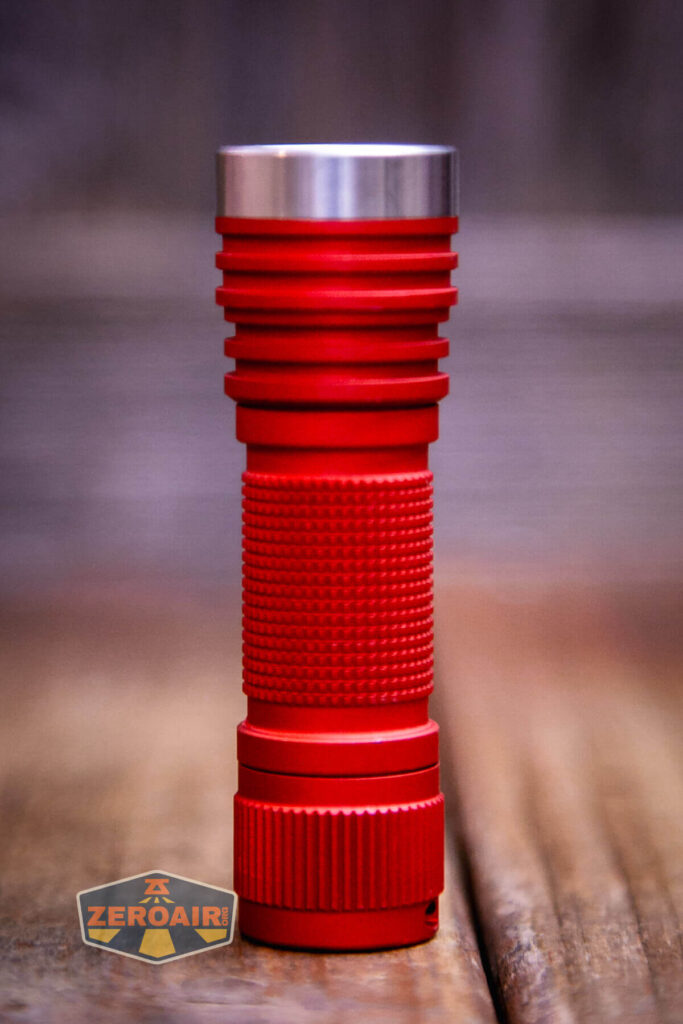

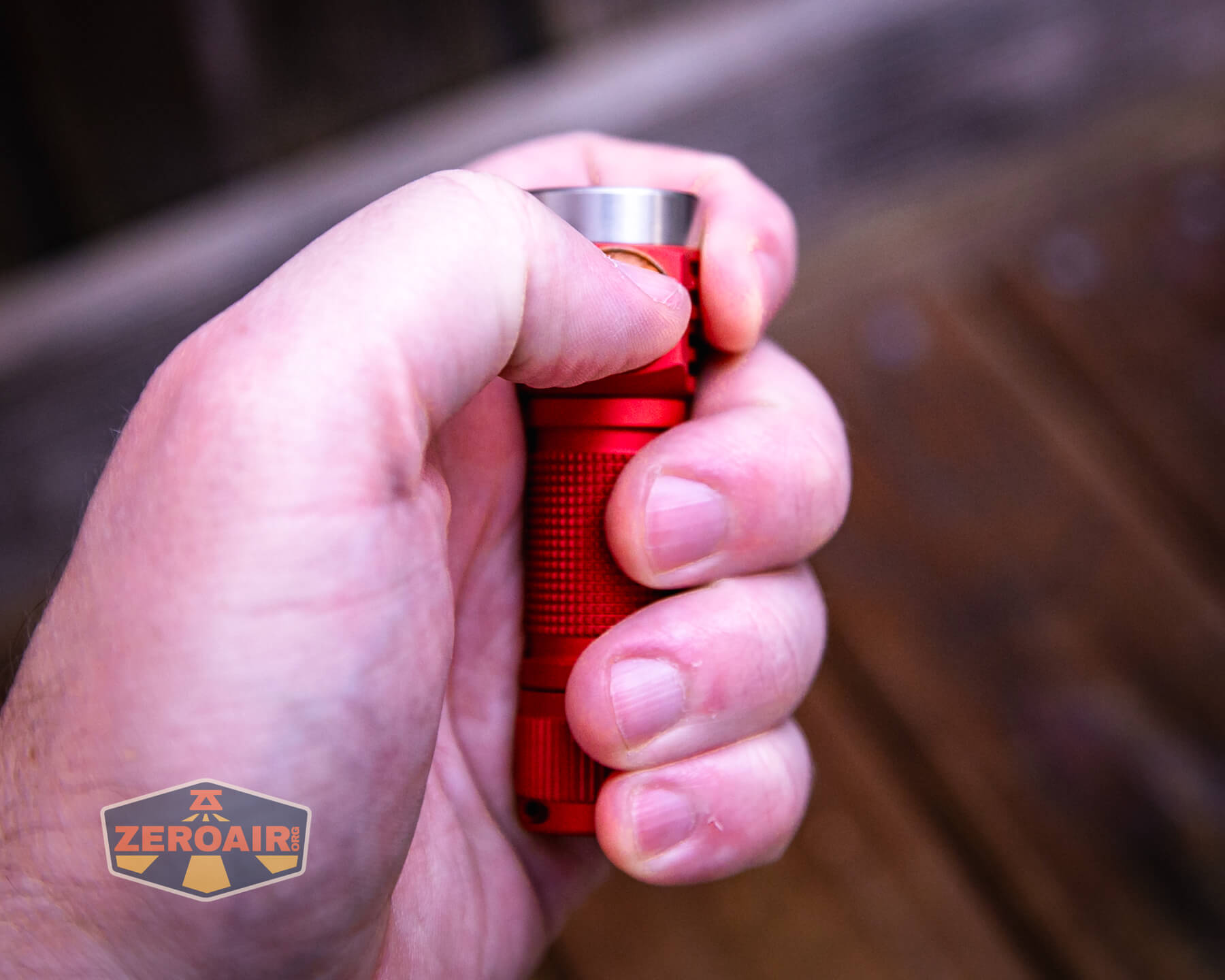
The body is plenty grippy. The anodizing isn’t “chalky” but leans that way – the anno itself provides a bit of grip, and the knurling finishes that out.
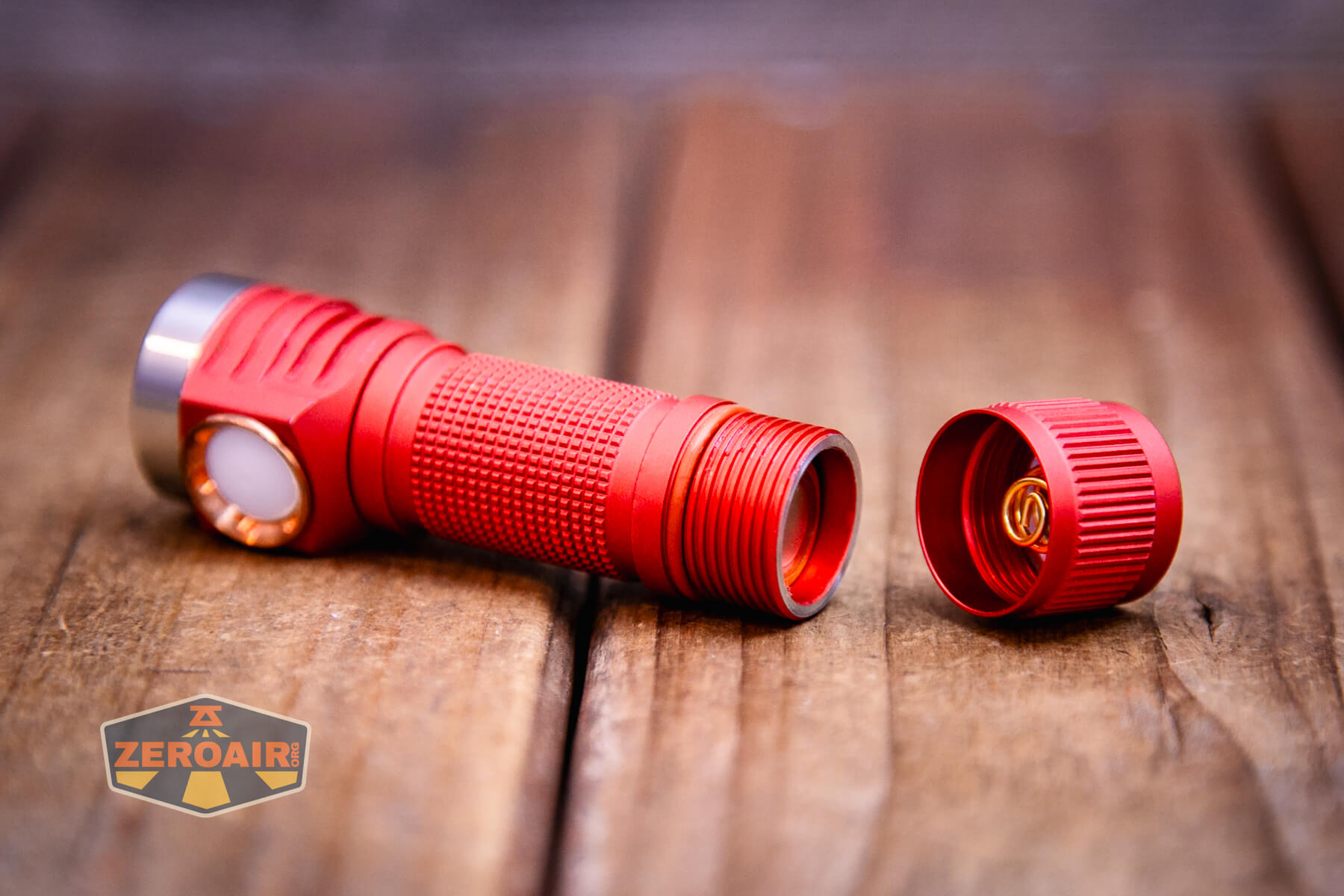
Both the head and tail can come off the cell tube. The cell tube isn’t reversible, though, and there are no other cell tube options for the Emisar D3AA 5700K flashlight.
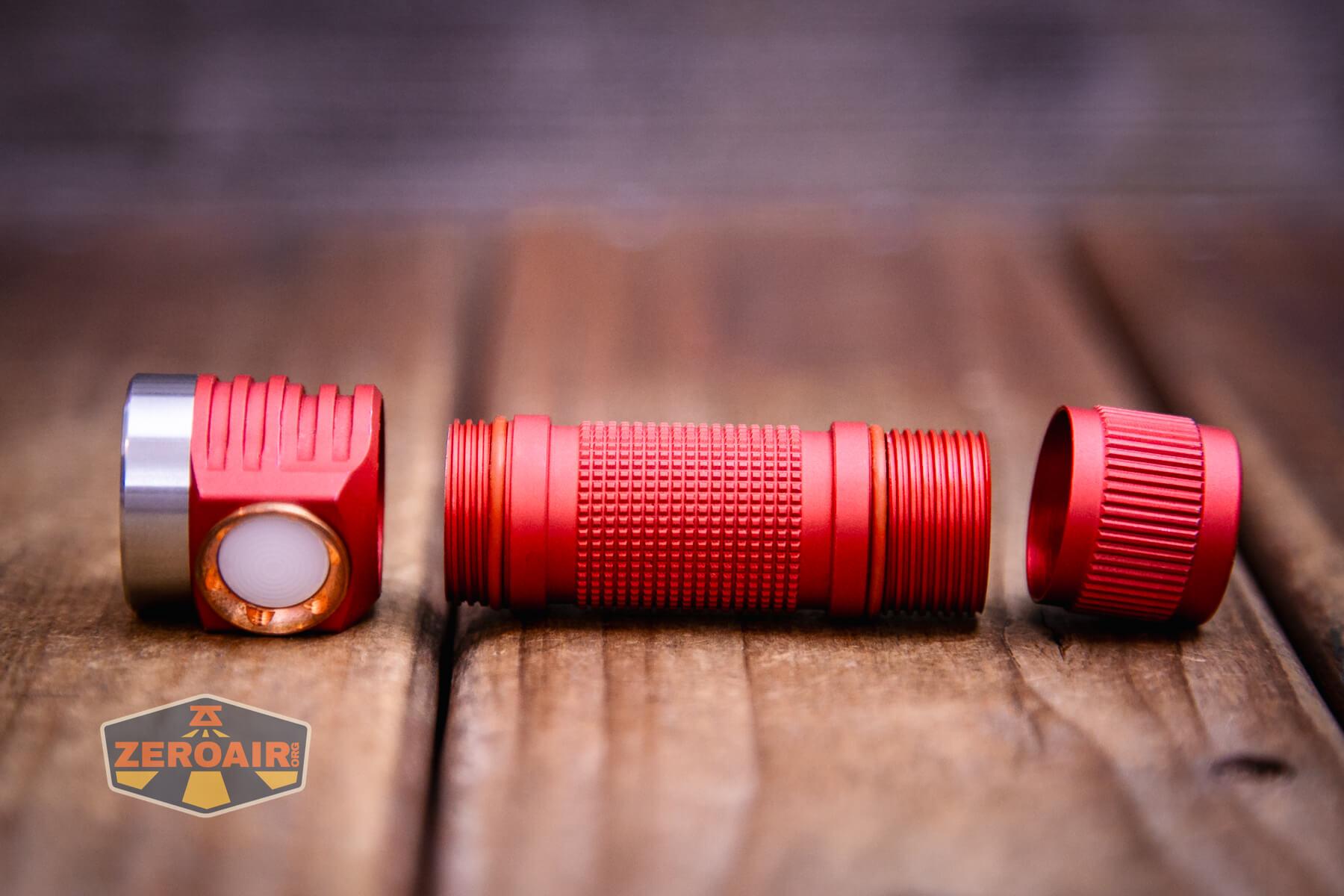
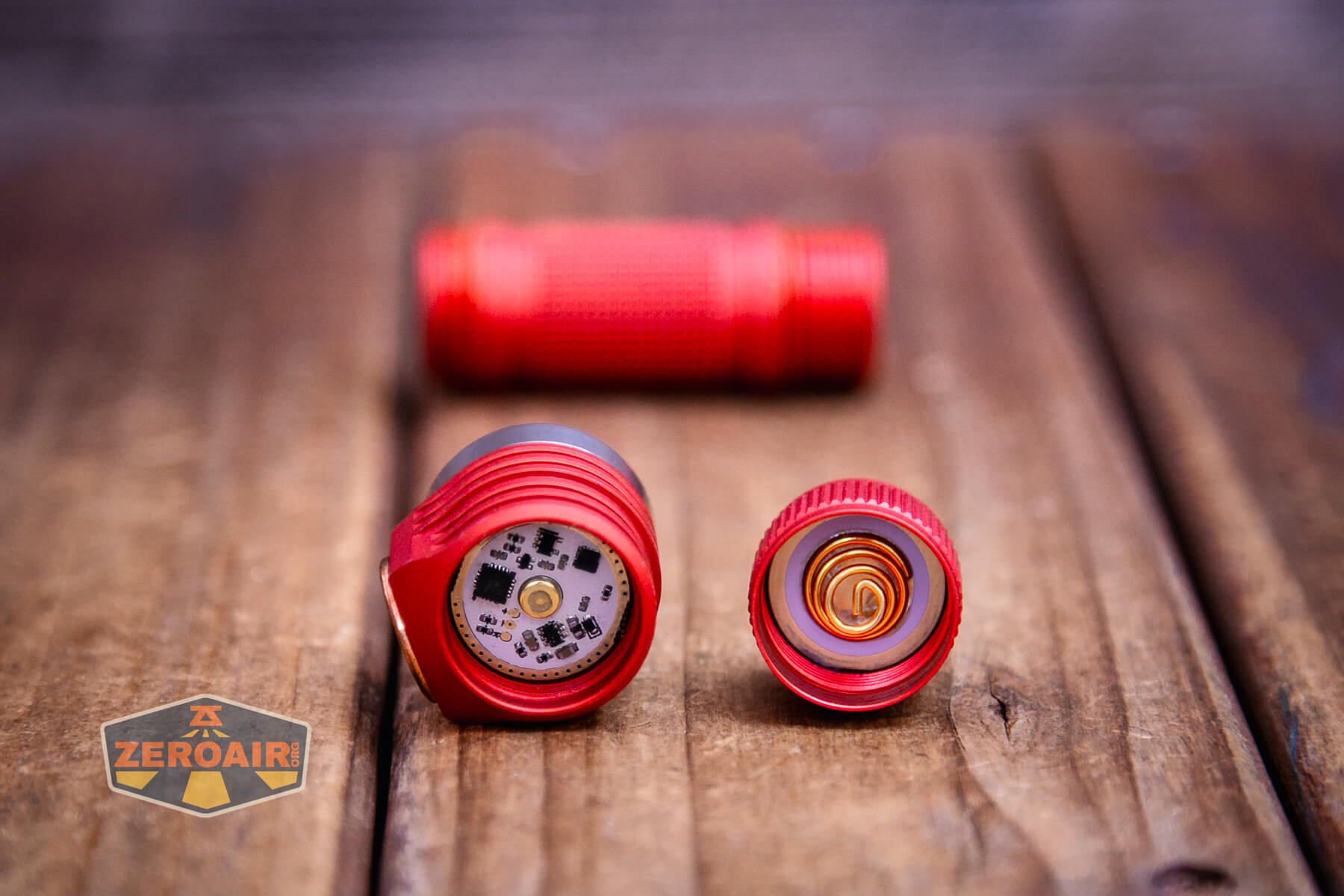
Below you can see the tailcap – this is the magnetic tailcap option and the magnet is not (easily) removable. It does not appear to be held in by the spring, as is so often the case. On the left, you can see the driver, which Emisar describes as a “high-efficiency boost driver.”
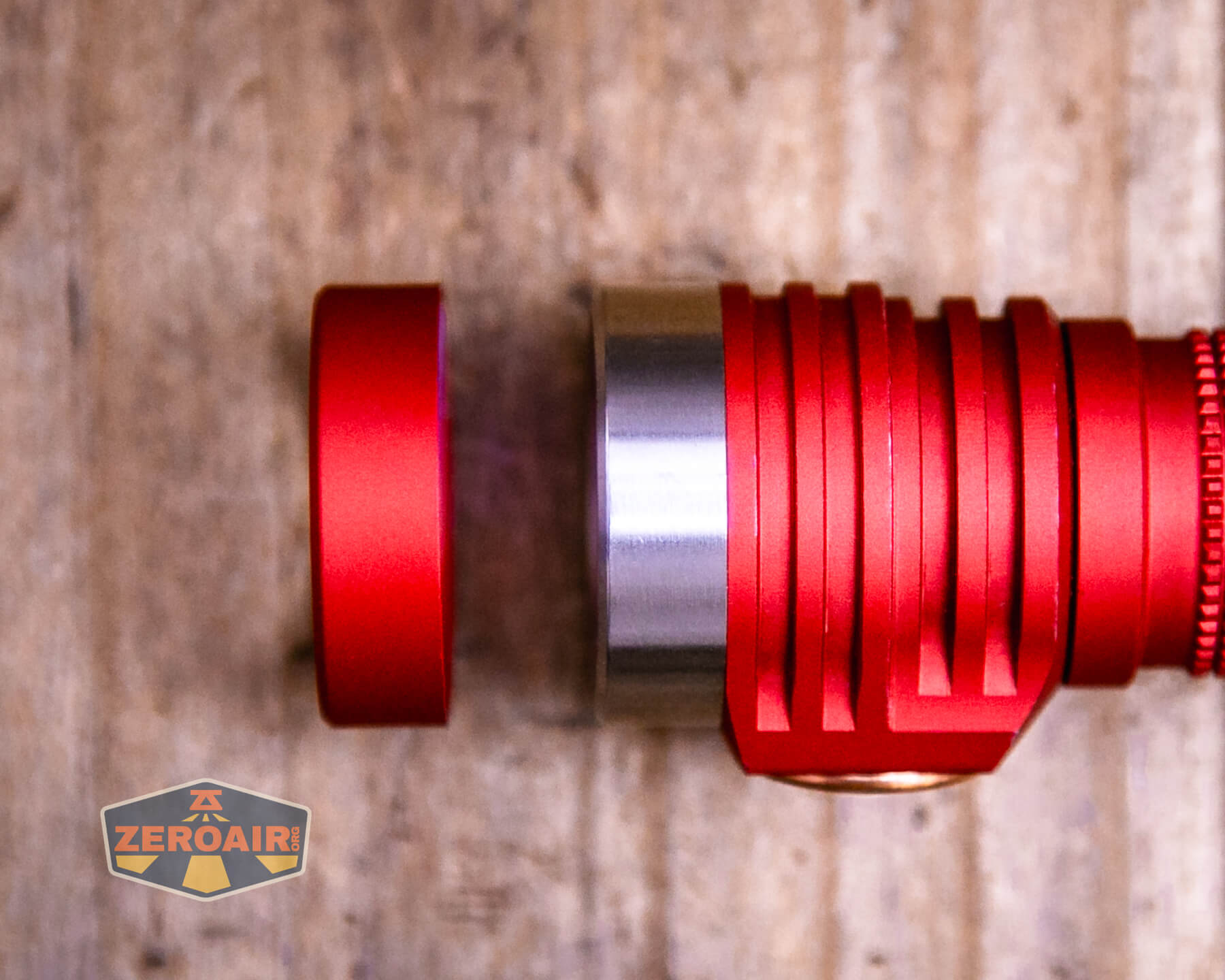
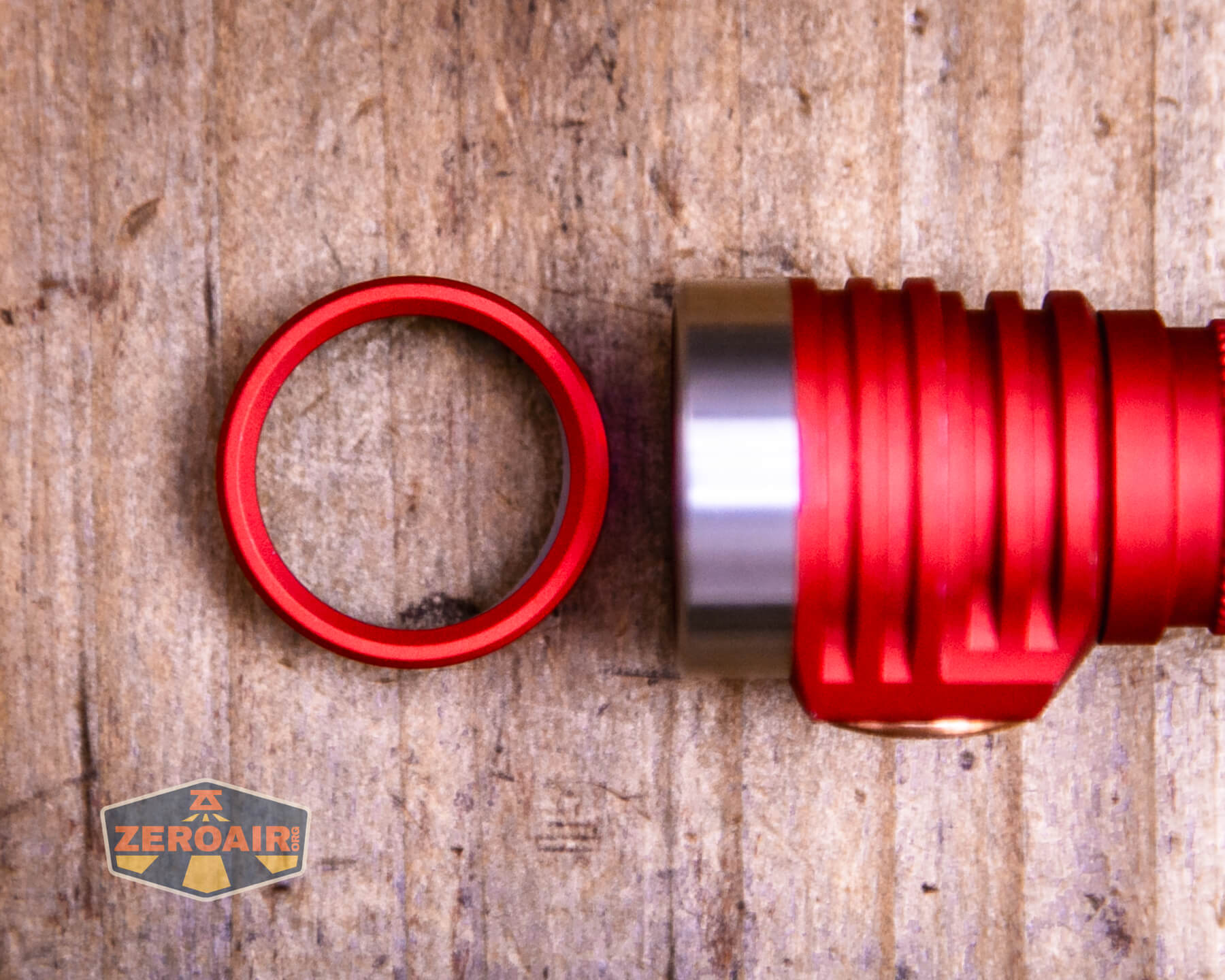
Below you can see the original bezel (not installed) with the optional stainless bezel installed. The stainless steel bezel is a nice upgrade!
Size and Comps
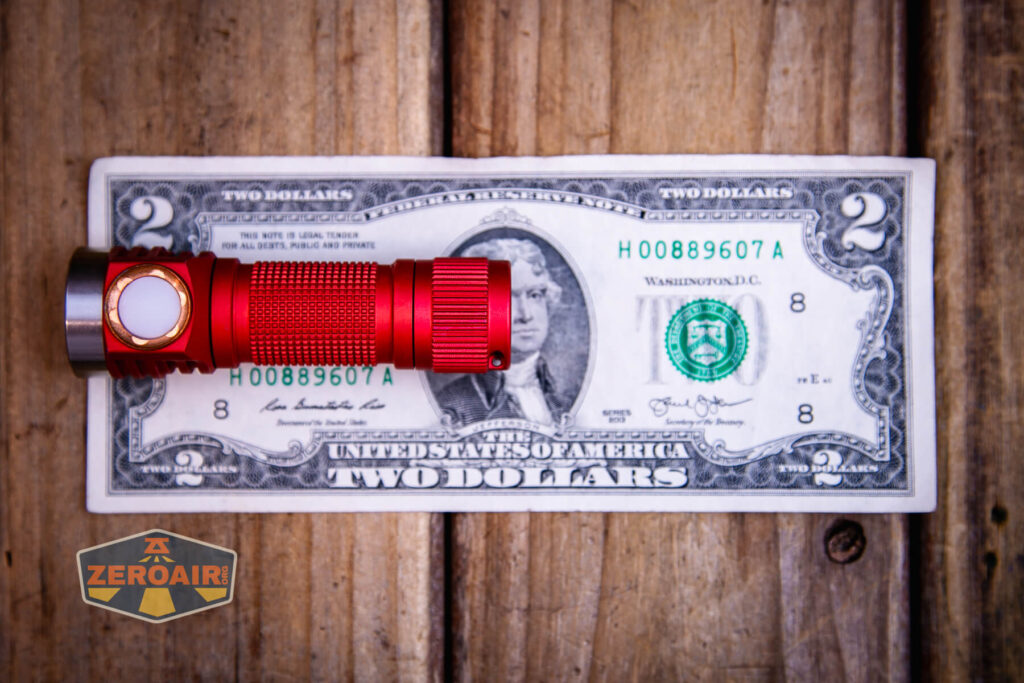
Dimensions: 78.3mm (length) x 24mm (head) x 19mm (body)
Weight: 38.5g (without magnet)
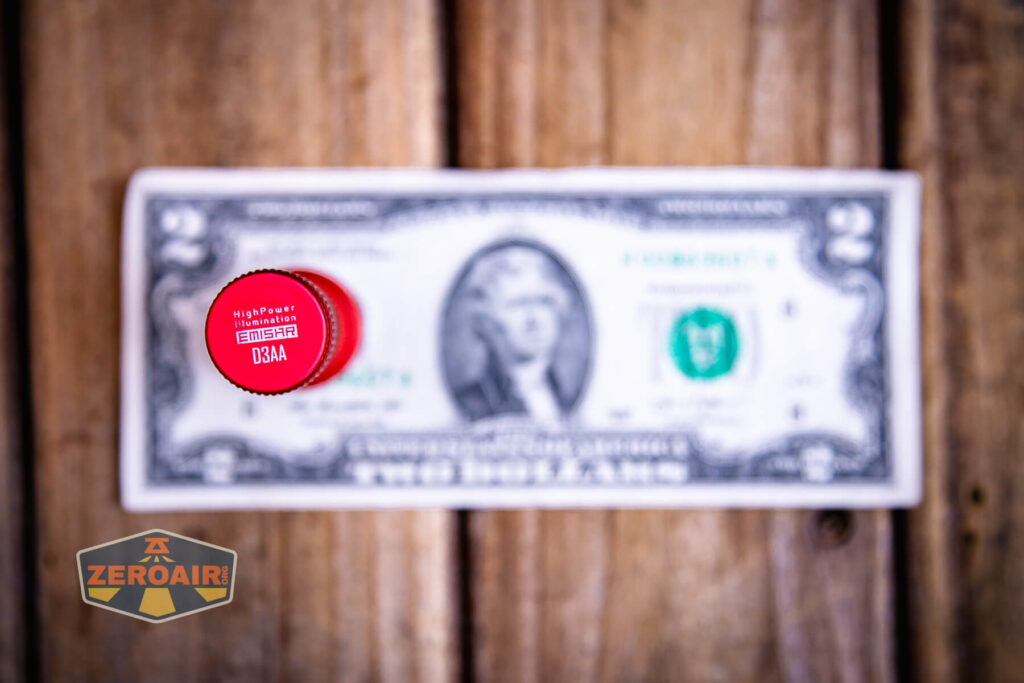
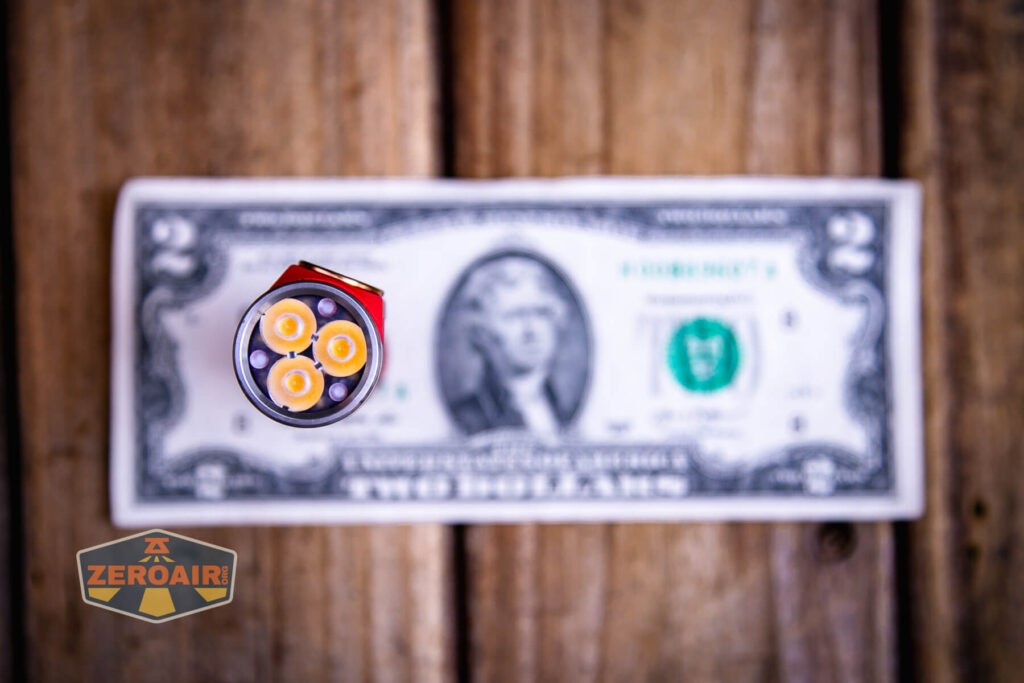
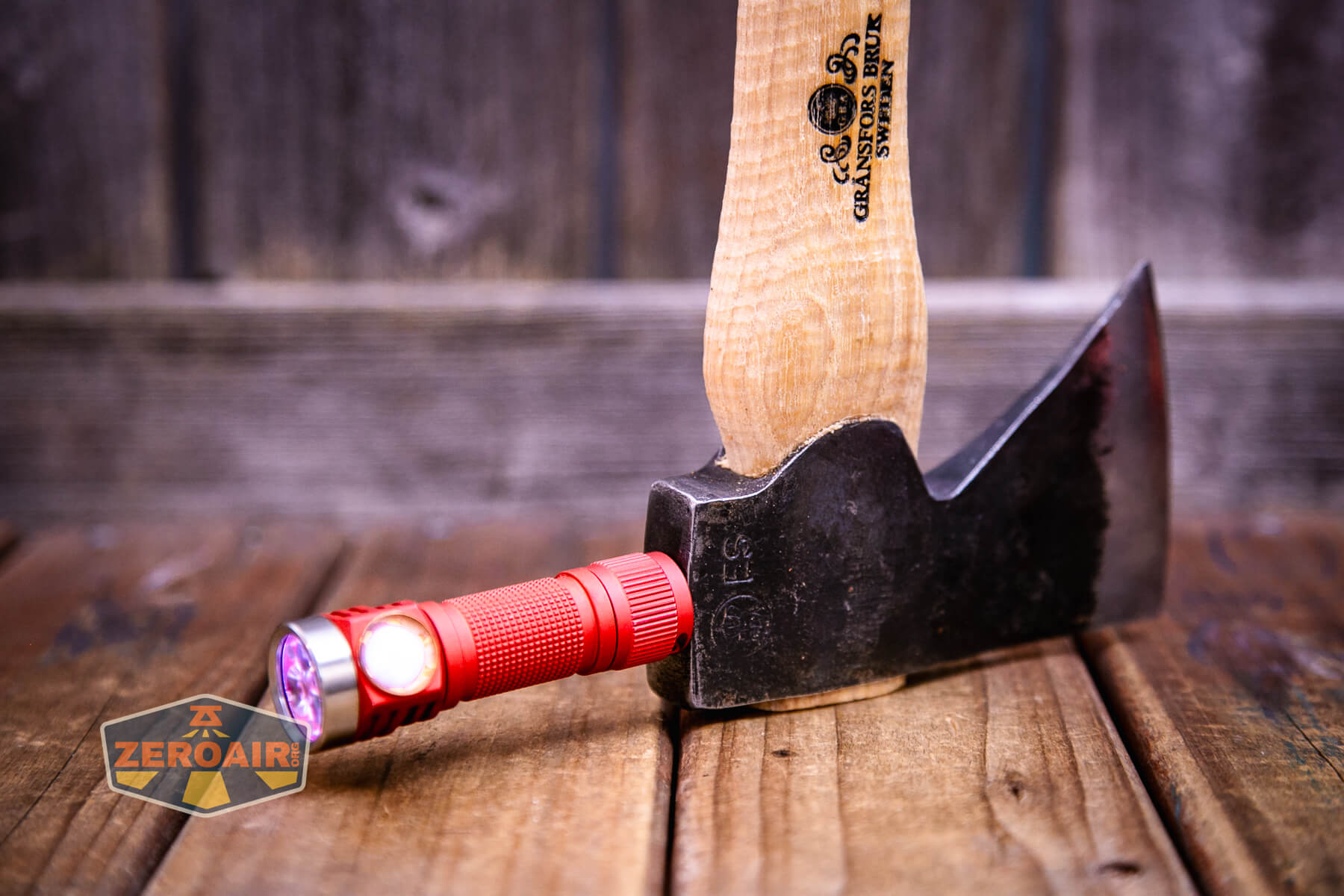
If the flashlight will headstand, I’ll show it here. If the flashlight will tailstand, I’ll also show that here too!


Here’s the test light with the venerable Convoy S2+. The version below is a custom laser-engraved Convoy S2+ host by GadgetConnections.com. I did a full post on an engraved orange host right here! Or go straight to GadgetConnections.com to buy your Convoy S2+ now!
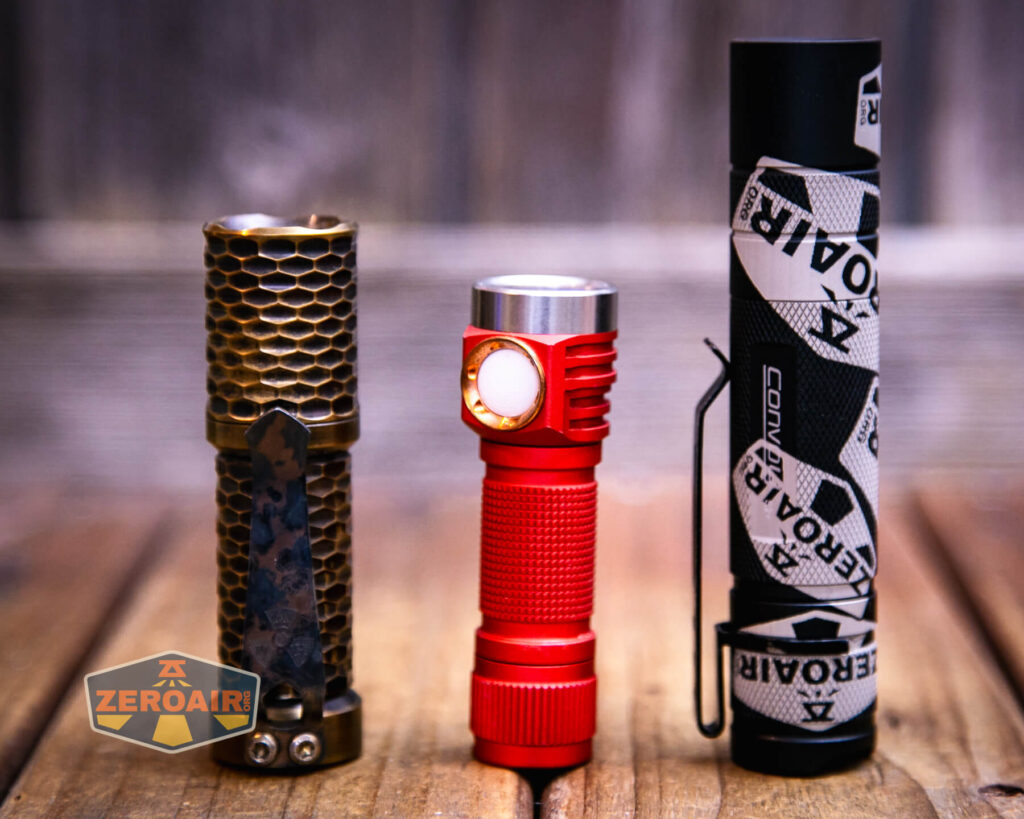
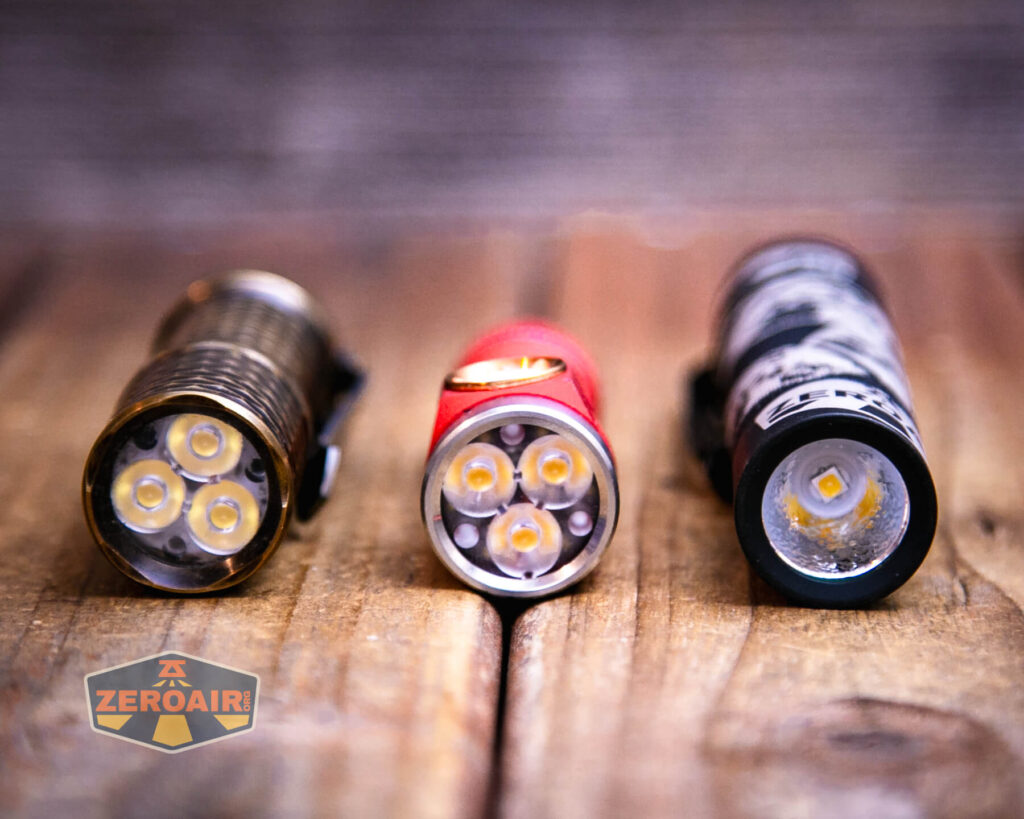
In the photo above, you may note that the SRM (standard reference material) flashlight for comparison has changed! I used a TorchLAB BOSS 35 for ages. Now what you can see as the 18350 SRM is the Hanko Machine Works Trident. While I have not reviewed or tested the Gunner Grip version seen here, I have tested a Hanko Machine Works Trident Total Tesseract in brass. I love the Trident, and it’s a striking contrast next to the inexpensive Convoy S2+, which also makes a great standard reference material.
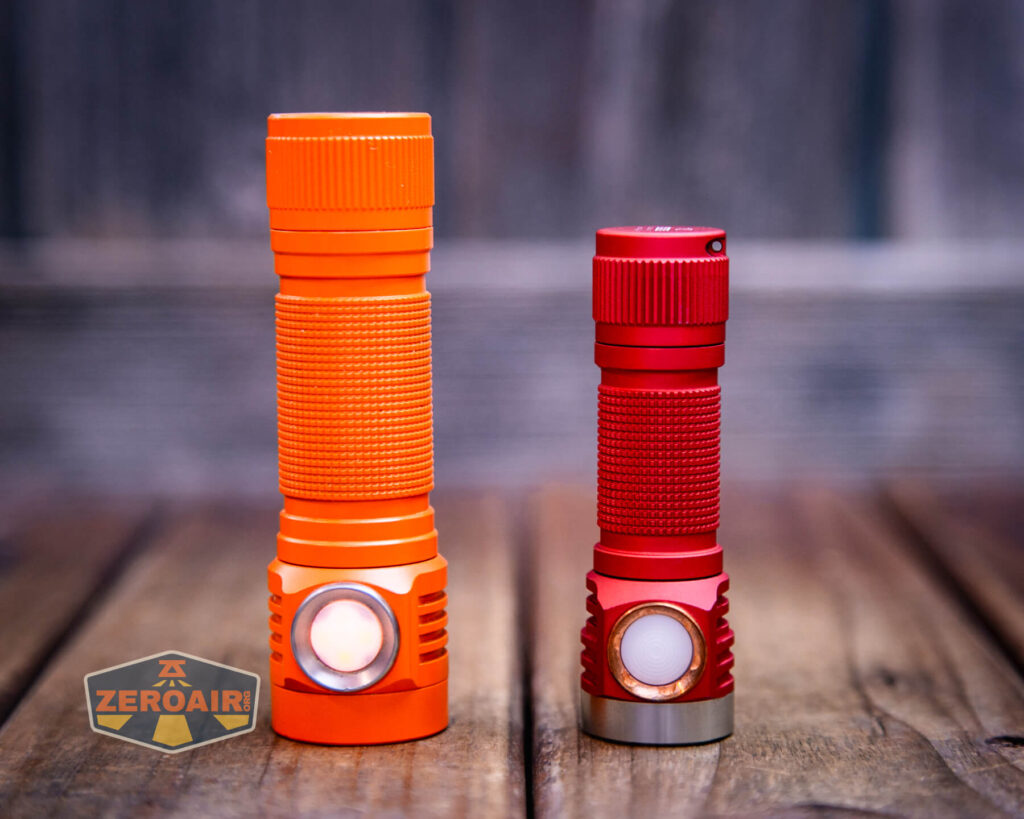
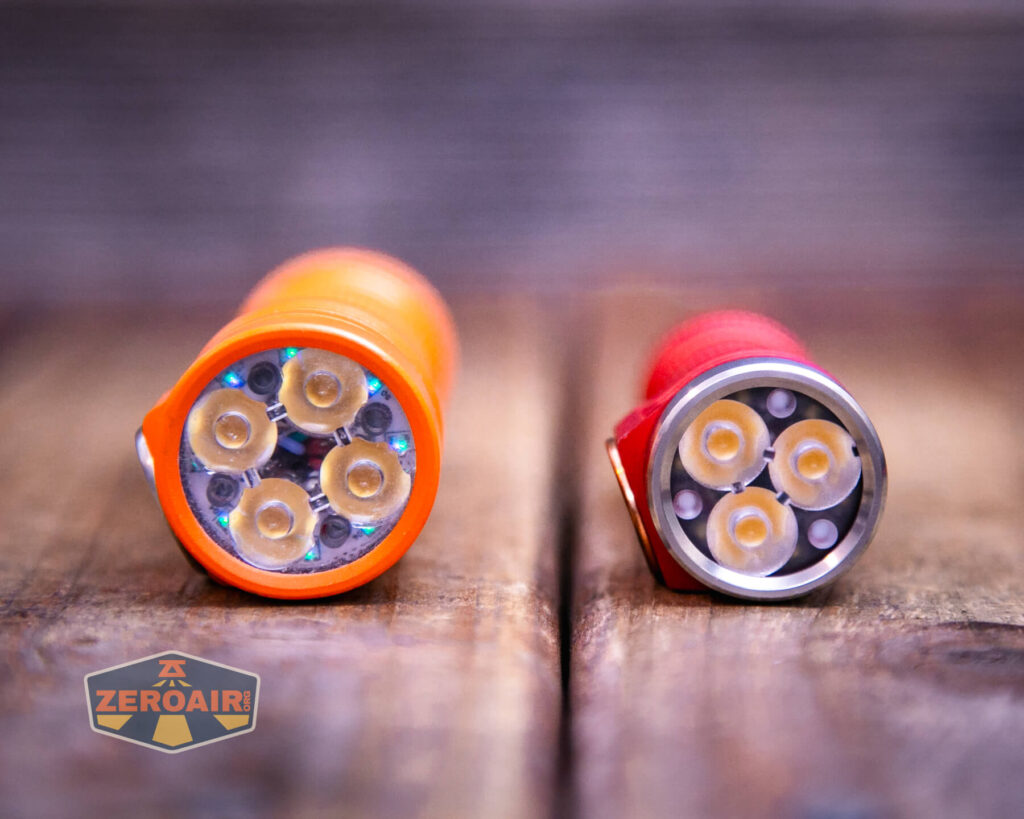
Below you can see the Emisar D3AA 5700K flashlight beside an aluminum Emisar D4V2. This one is very special! It’s cerakoted orange and has other specifications that are very much to my taste! But in size, it’s a standard 18650 D4V2, good for comparison against this tiny D3AA.
Retention and Carry
A pocket clip is available, but I have not purchased that yet. I do have a tailcap magnet, though, which is plenty strong for holding this small light.
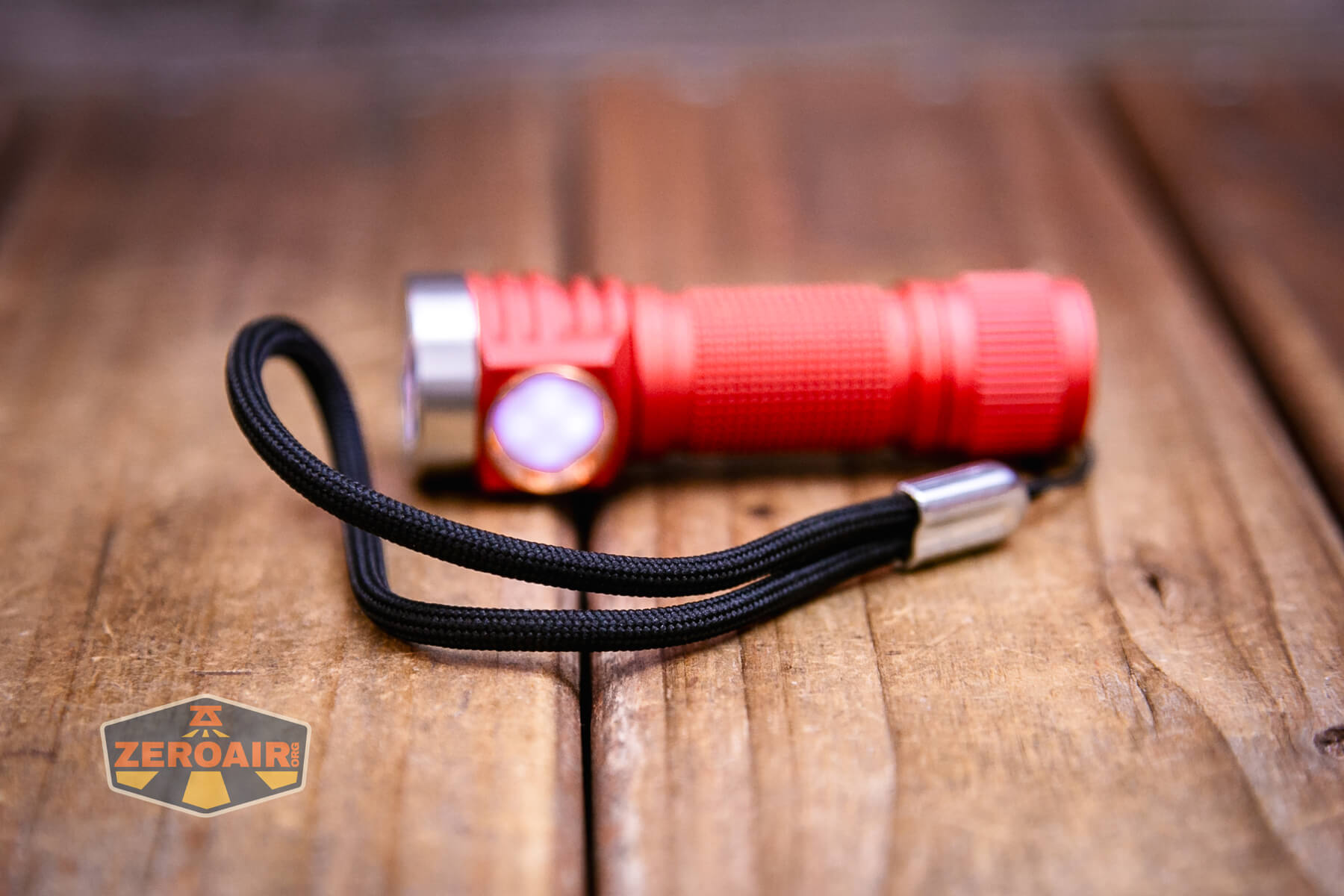
There’s also a lanyard included, which connects through a hole in the tailcap.
Power and Runtime
The Emisar D3AA 5700K flashlight on lithium-ion cells. Emisar says it’ll work with button or flat top cells, but not protected button top cells, probably due to the added protection circuit length.
The cell goes into the Emisar D3AA 5700K flashlight in the usual way – positive end toward the head.
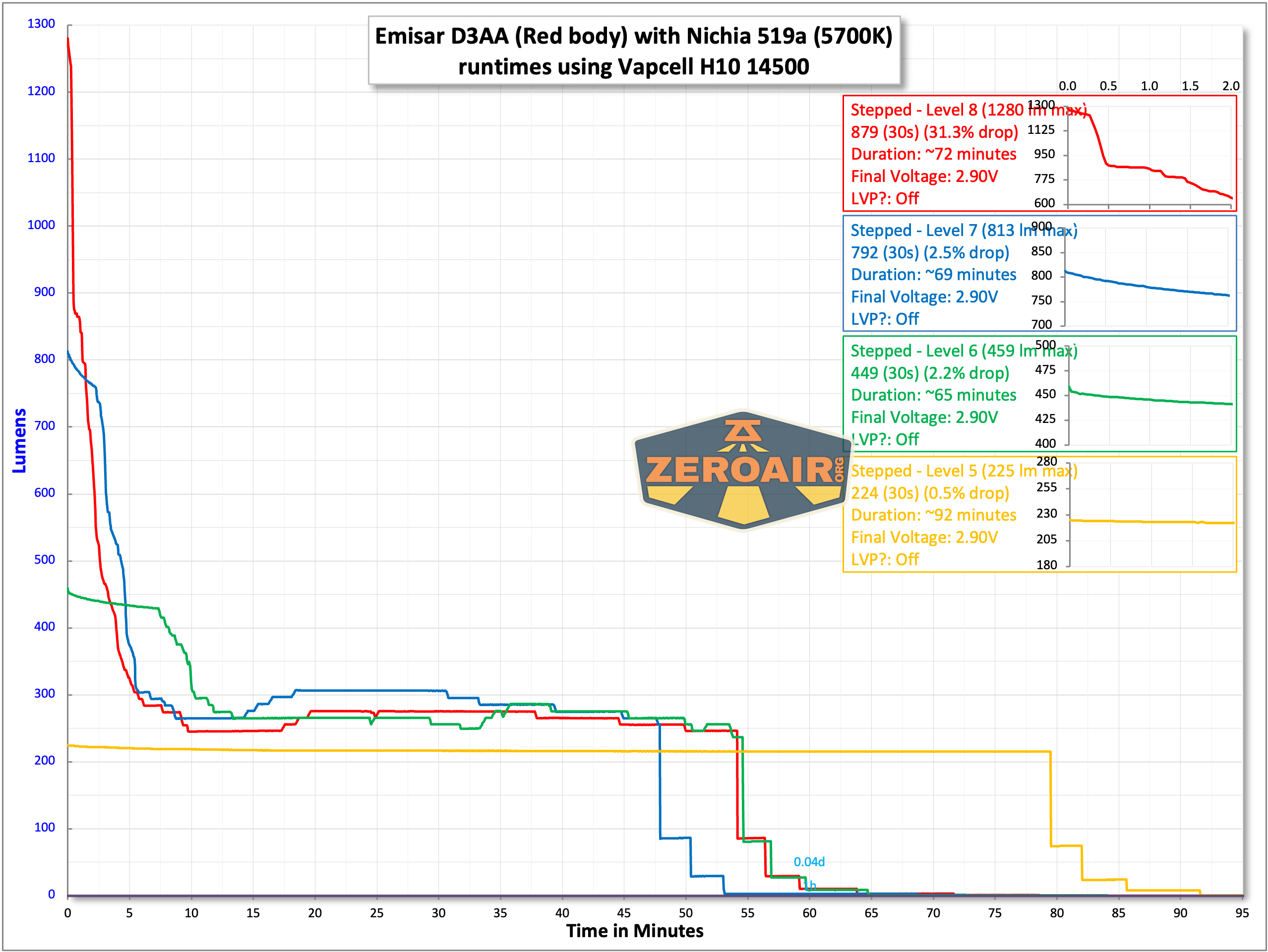
Here are runtimes on the highest four modes with a 14500 cell. I tested with a Vapcell H10. It’s a flat top, but that doesn’t change performance. Initial output is fairly great and very good once the light is around only 300 lumens. I only ever use stepped output, so I know I can reliably get the 400-lumen level – level 6!
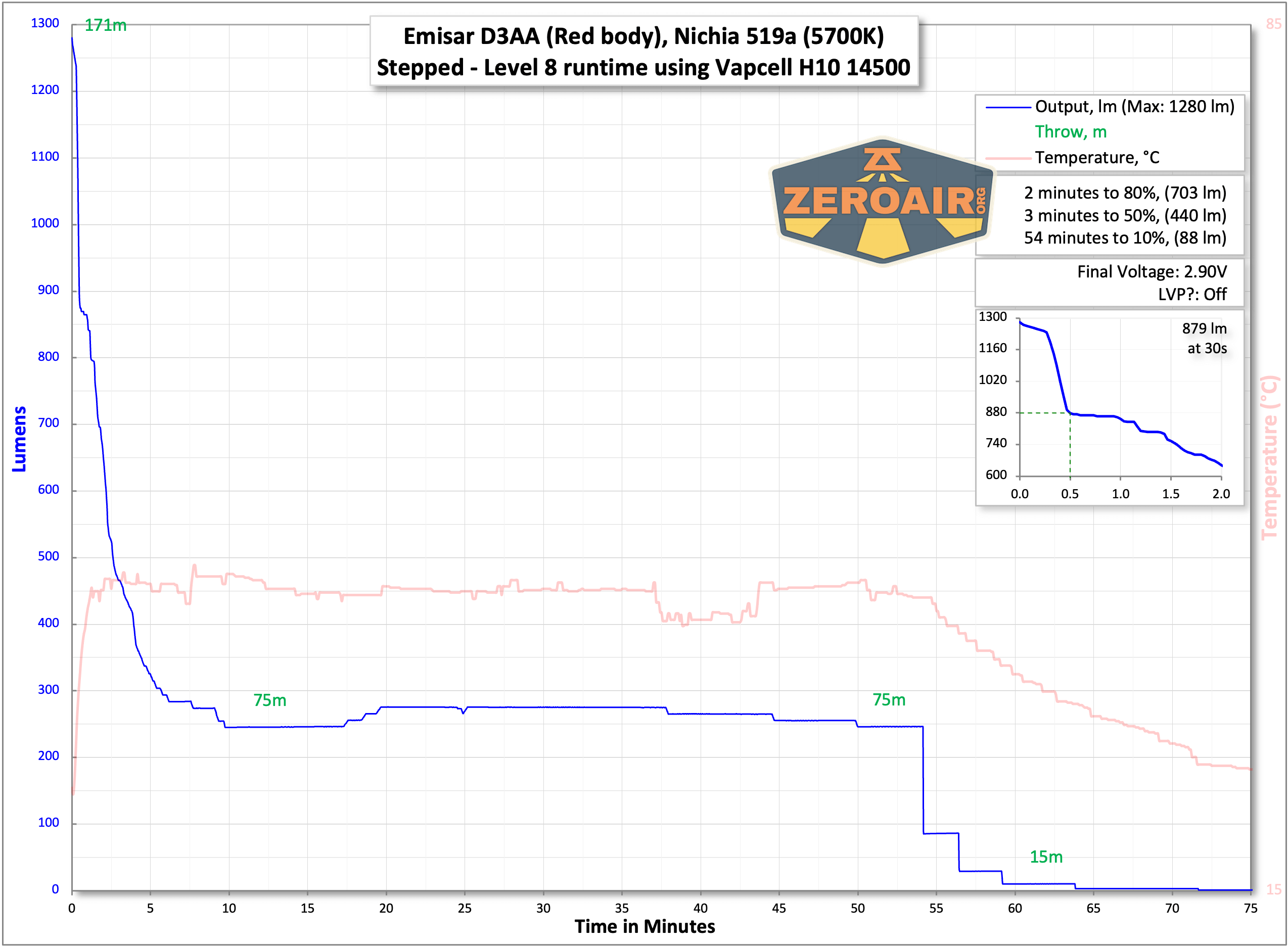

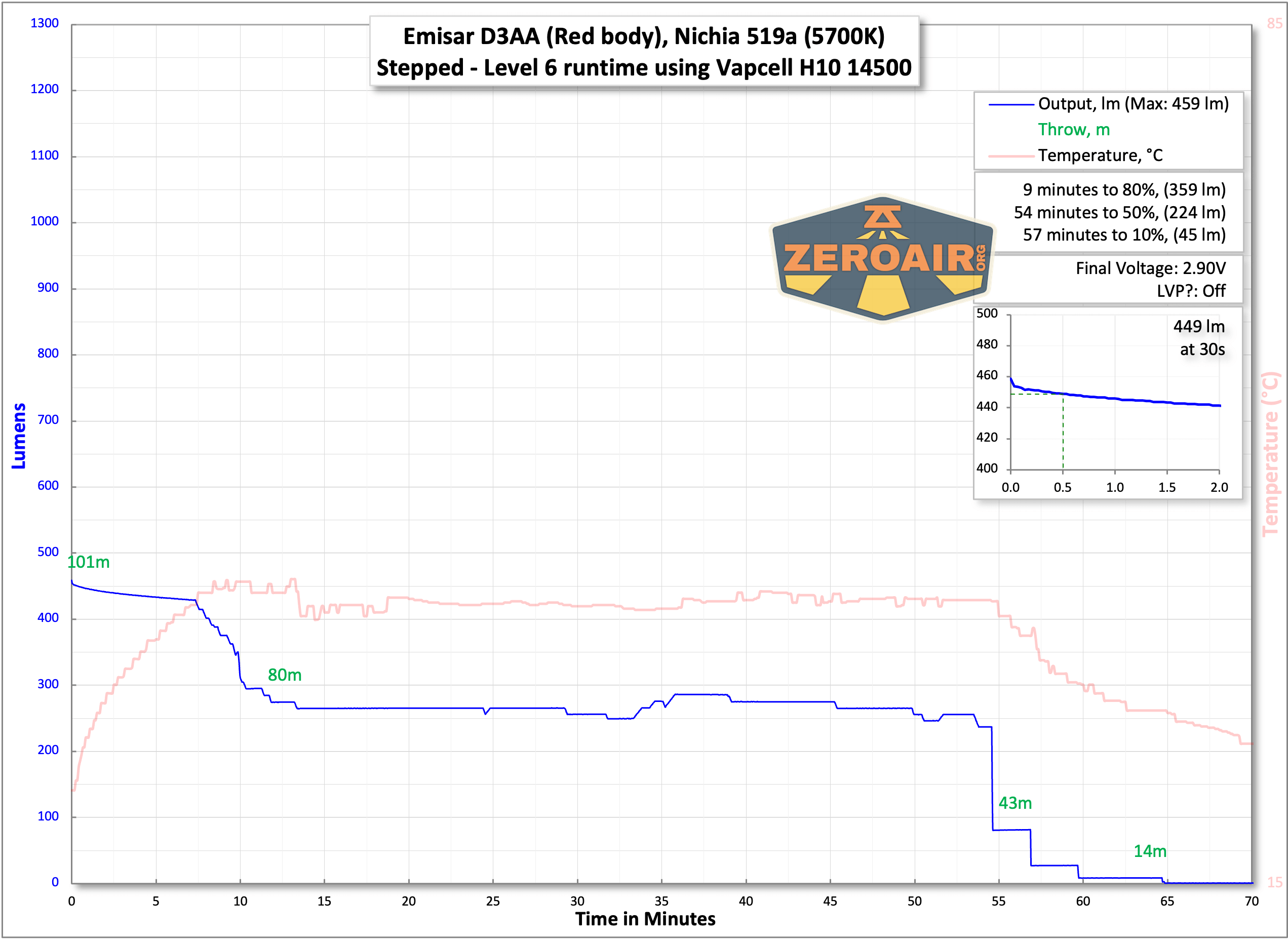

The Emisar D3AA 5700K flashlight does shut off when cell voltage gets around 3V, but it switches to the secondary RGB emitters. I’m not sure how long those will stay on, but users do report that there’s low voltage protection with the secondary emitters, too.
A great feature of the Emisar D3AA 5700K flashlight is that it’ll also run 1.5V cells – primary or rechargeable! I’ve tested a bit with this Ikea LADDA NiMH.
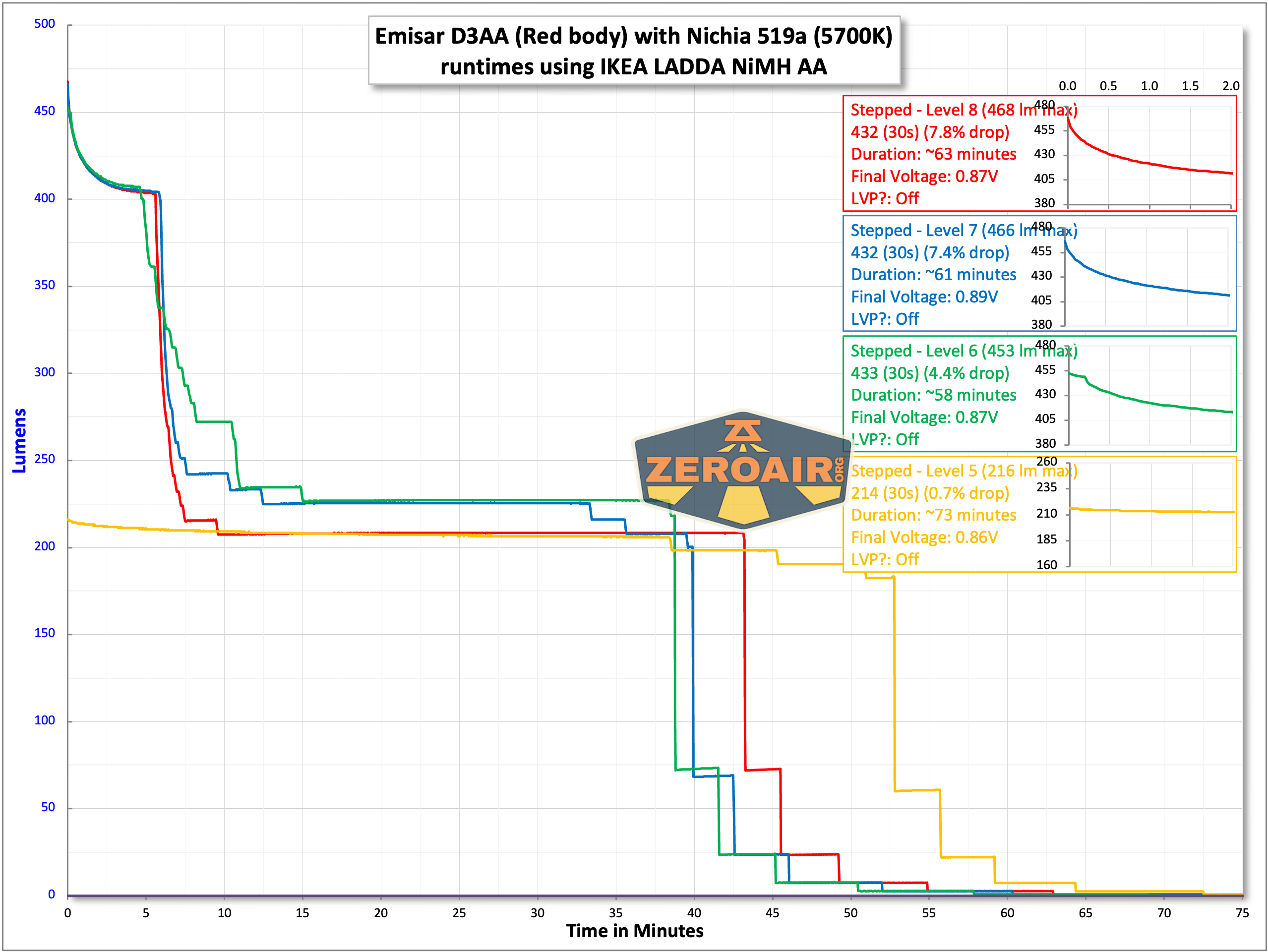
Interestingly, levels 6, 7, and 8 seem to all have (around) the same output (confirmed visually and with the lumen tube). That could be due to NiMH limitations (though this cell has no more than 3 charge cycles – it’s new), or just how the light works. Either is fine with me, because, again, 350 lumens or so is very useful!

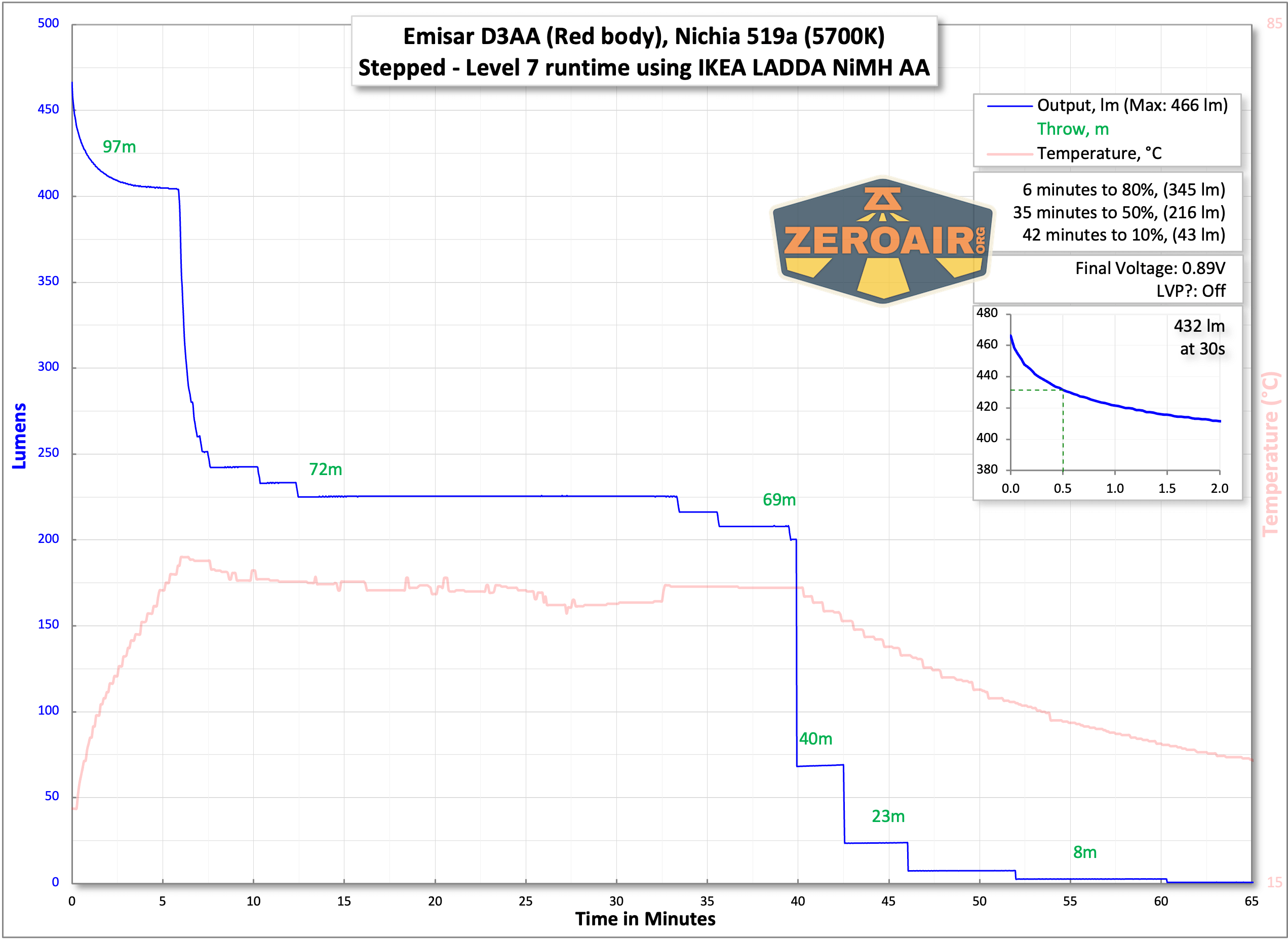


The Emisar D3AA 5700K flashlight seems to also shut off with low voltage protection when using a NiMH cell too, at around 1V.
Modes and Currents
| Mode | Mode Claimed Output (lm) | Claimed Runtime | Measured Lumens | Tailcap Amps |
|---|---|---|---|---|
| 14500 Level 8 – Stepped | 1540 (for domed option – this test is dedomed option!) | – | 1280 (0s) 879 (30s) |
5.11 |
| 14500 Level 7 – Stepped | – | – | 813 (0s) 792 (30s) |
2.69 |
| 14500 Level 6 – Stepped | – | – | 459 (os) 449 (30s) |
1.34 |
| 14500 Level 5 – Stepped | – | – | 225 | 0.59 |
| 14500 Level 4 – Stepped | – | – | 89 | 0.22 |
| 14500 Level 3 – Stepped | – | – | 27 | 0.065 |
| 14500 Level 2 – Stepped | – | – | 4.1 | [low] |
| 14500 Level 1 – Stepped | – | – | 0.07 | [low] |
| NiMH AA Level 8 – Stepped | 510 (for domed option – this test is dedomed option!) | – | 468 (0s) 432 (30s) |
5.45 |
| NiMH AA Level 7 – Stepped | – | – | 466 (0s) 432 (30s) |
5.45 |
| NiMH AA Level 6 – Stepped | – | – | 453 (0s) 433 (30s) |
4.96 |
| NiMH AA Level 5 – Stepped | – | – | 216 | 1.87 |
| NiMH AA Level 4 – Stepped | – | – | 91 | 0.69 |
| NiMH AA Level 3 – Stepped | – | – | 27 | 0.22 |
| NiMH AA Level 2 – Stepped | – | – | 4.1 | 0.02 |
| NiMH AA Level 1 – Stepped | – | – | 0.6 | [low] |
Pulse Width Modulation
This “high-efficiency boost driver” does not use PWM on any mode with either type of cell. That’s excellent!!
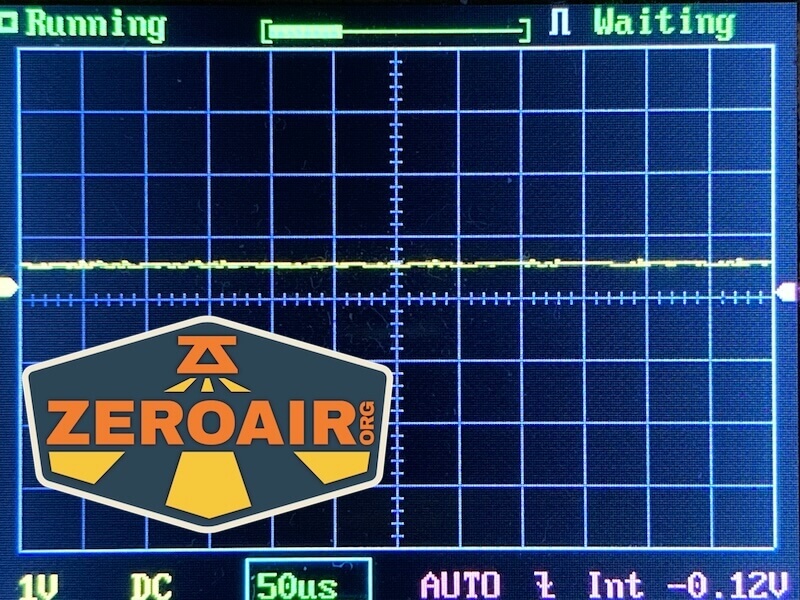
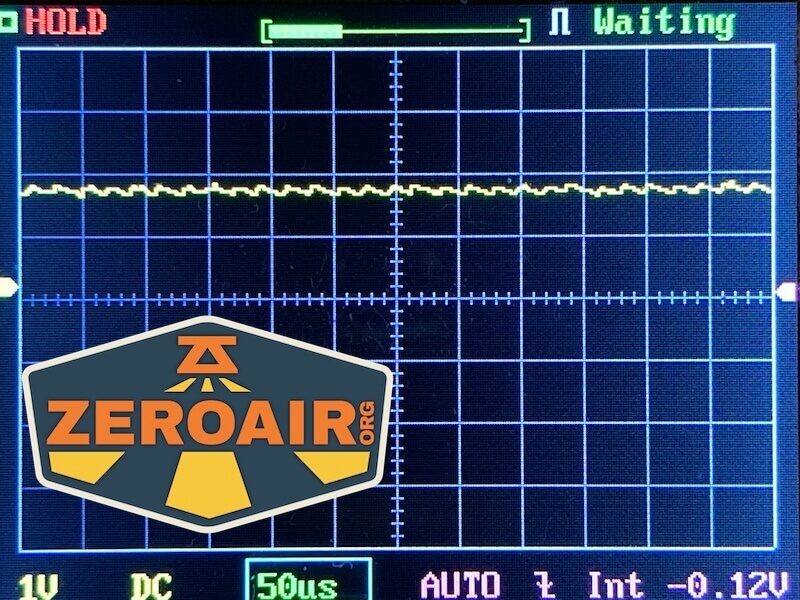
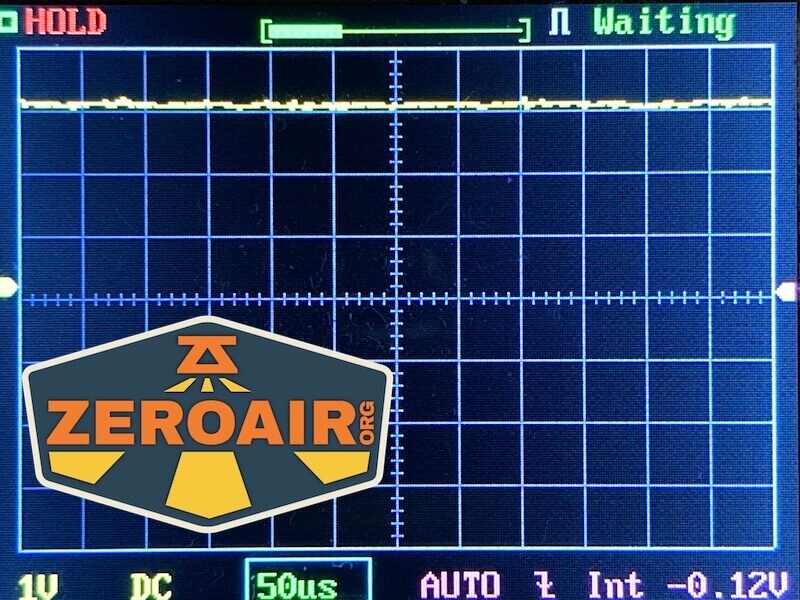
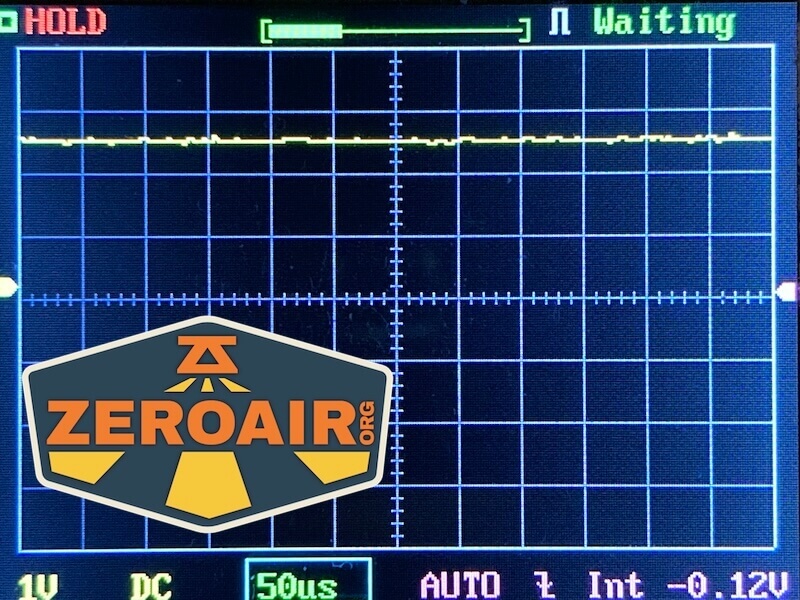
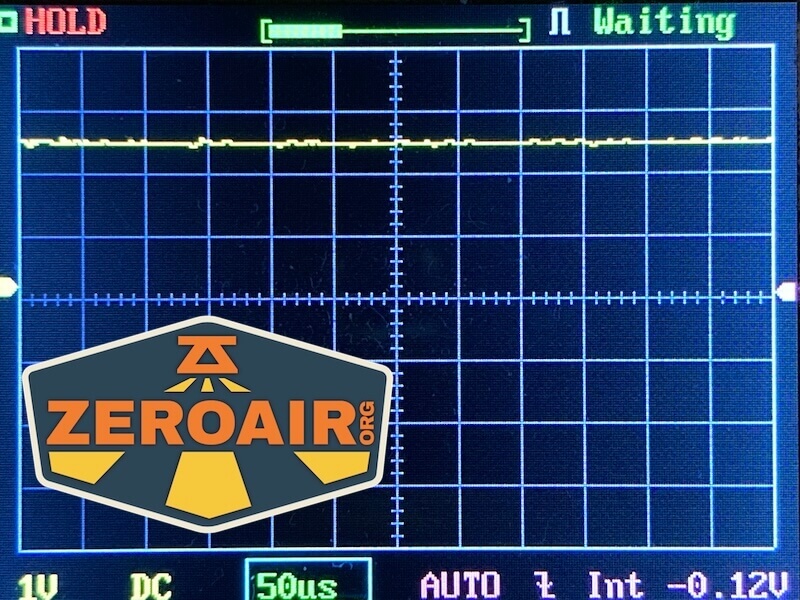
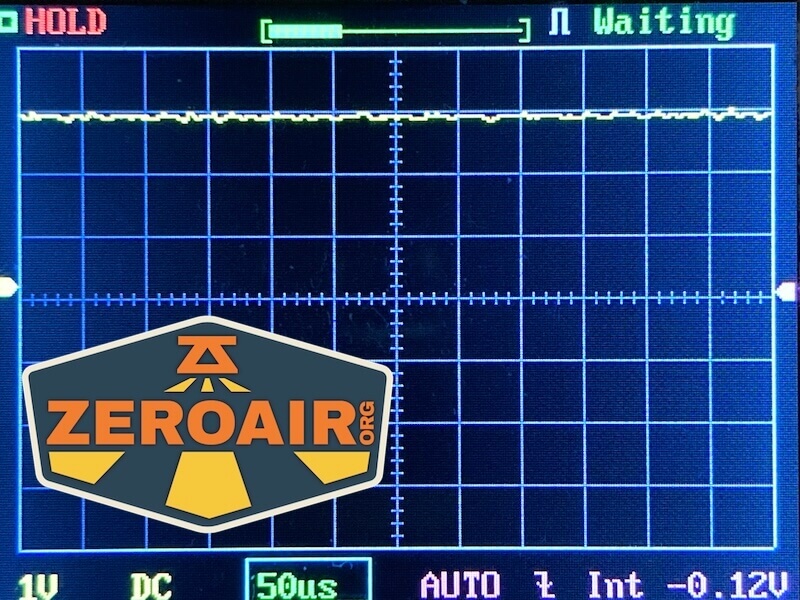
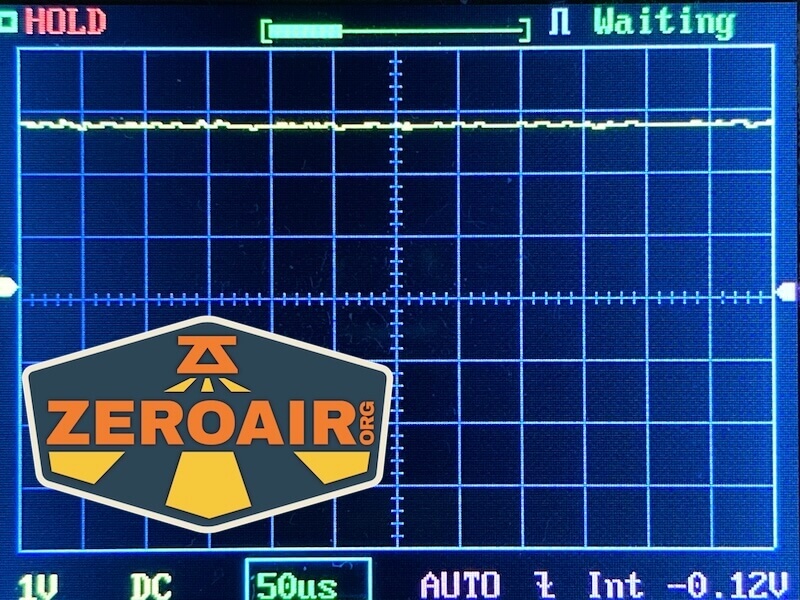
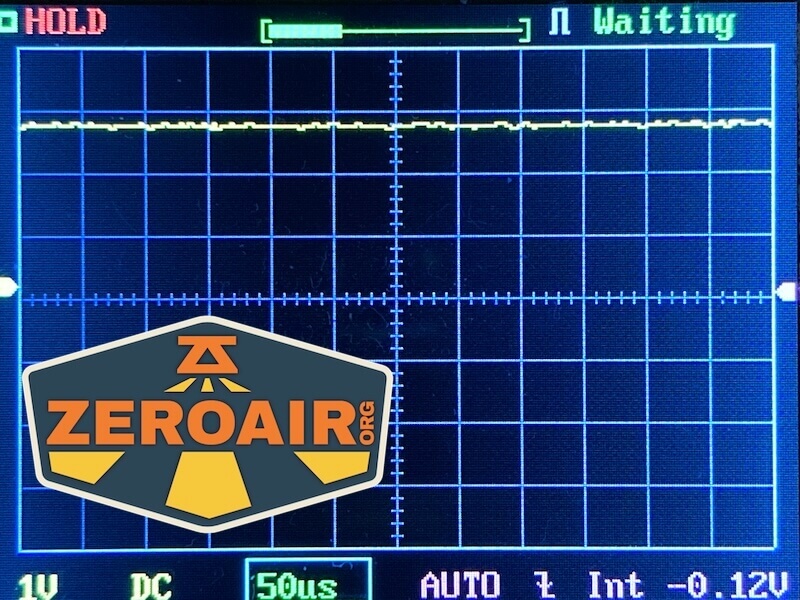
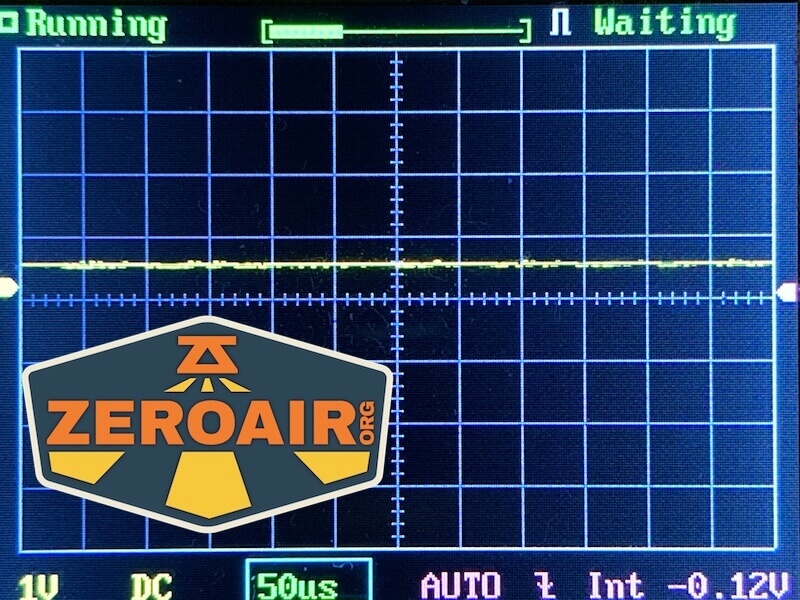
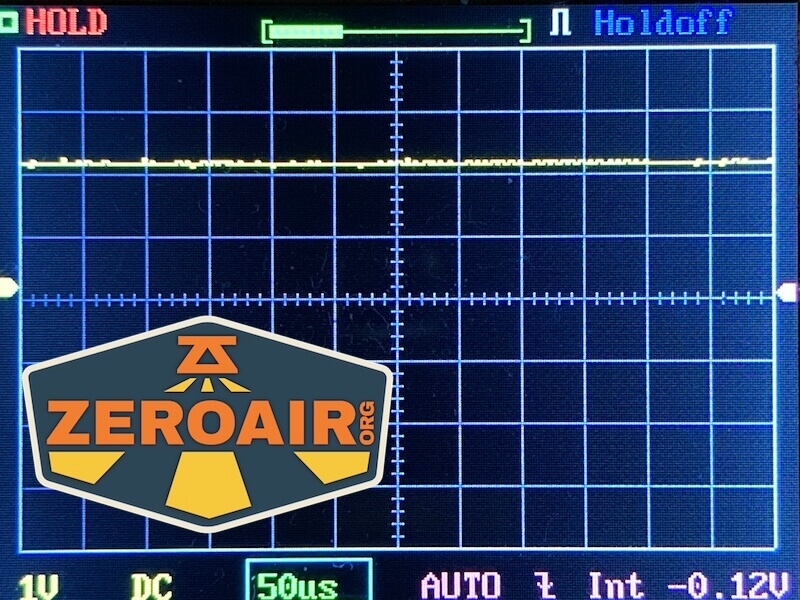
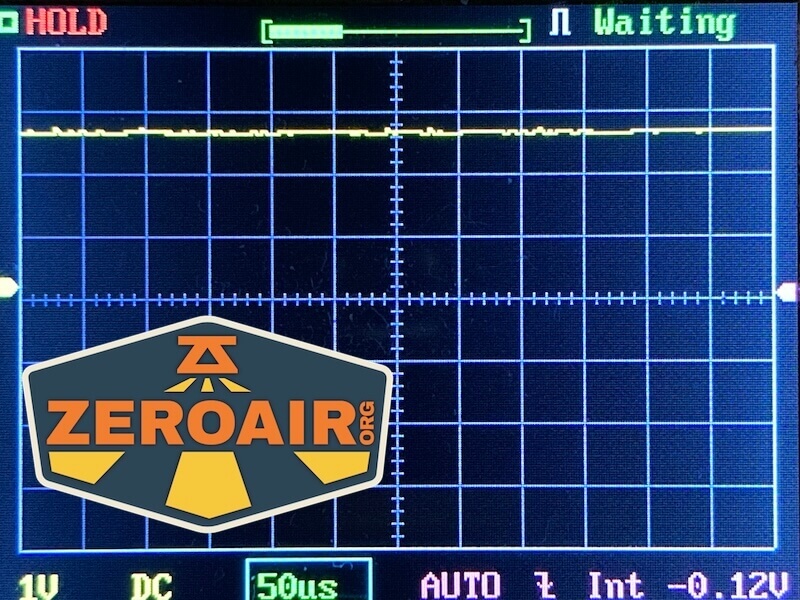
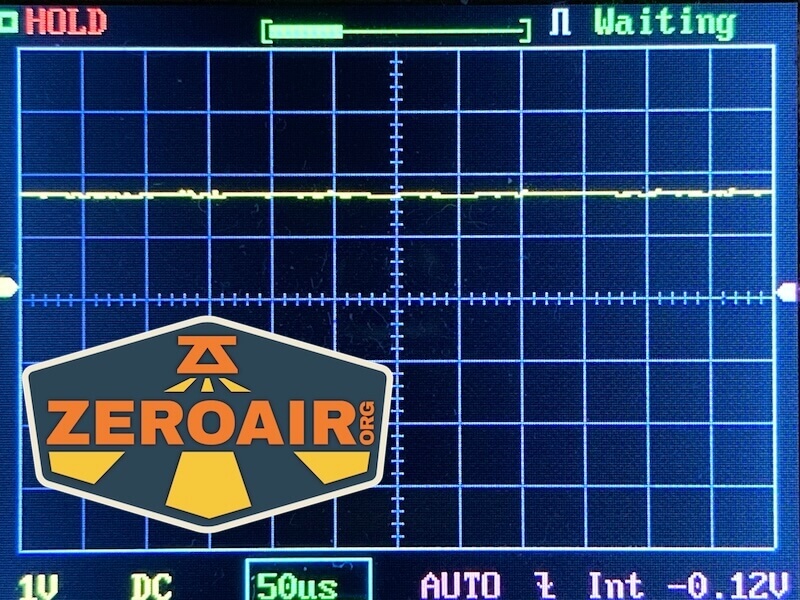
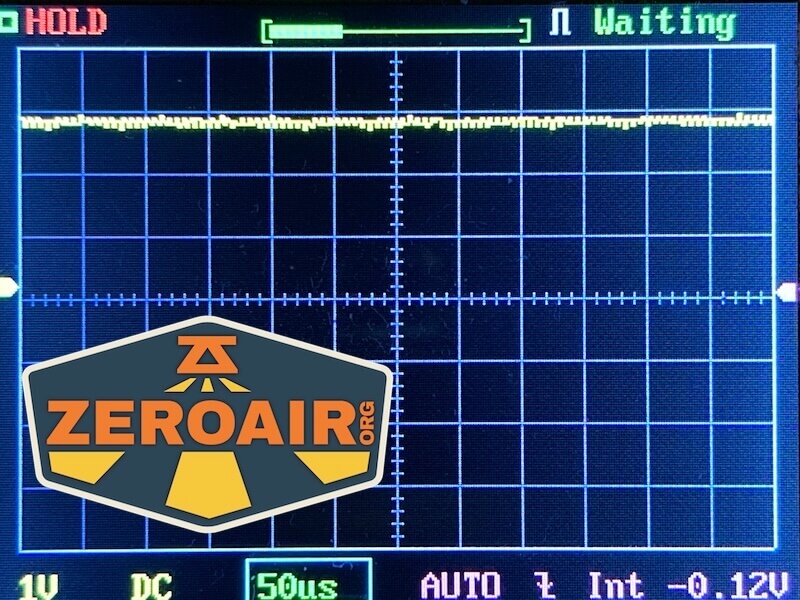
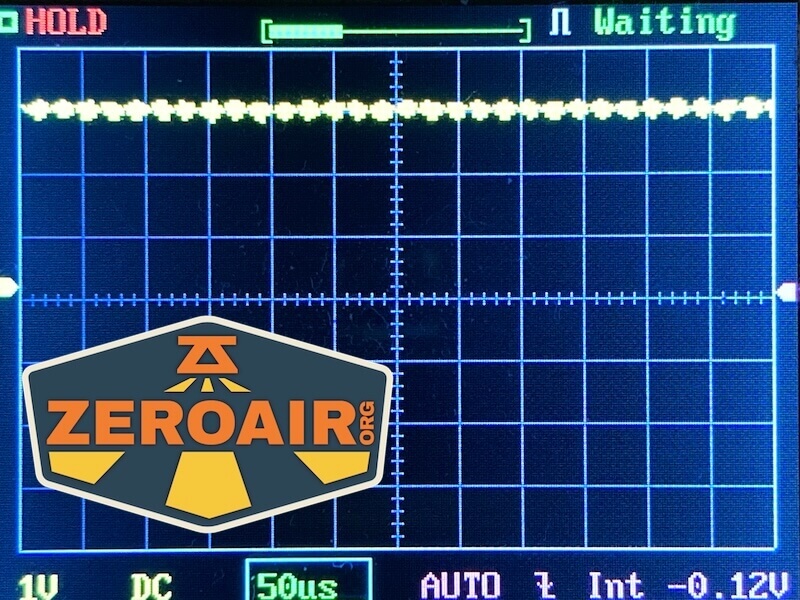
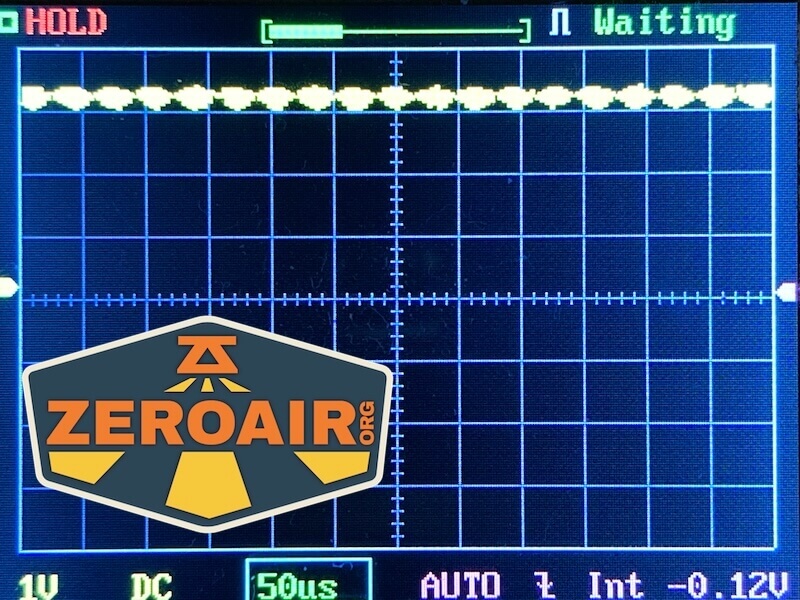
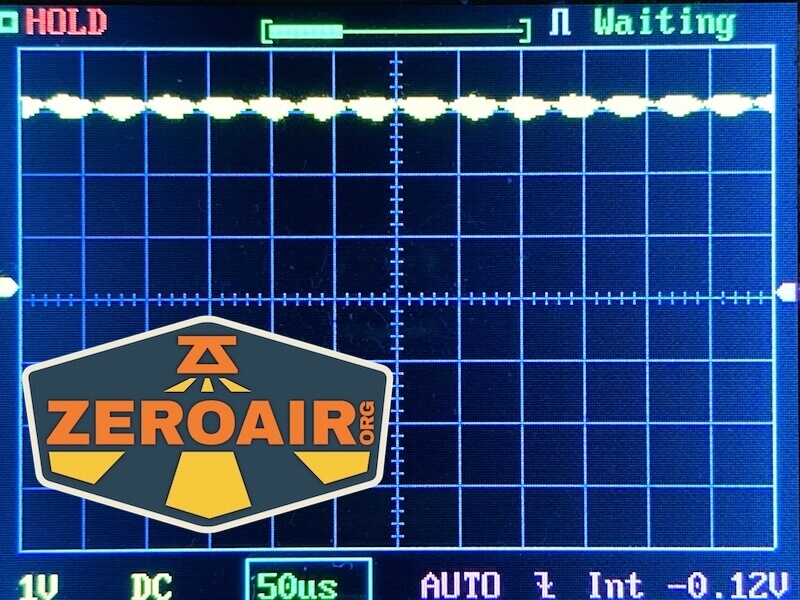
Here you can see a “baseline” – a chart with almost no light hitting the sensor.

Then there’s the Ultrafire WF-602C flashlight, which has some of the worst PWM I’ve seen. It’s so bad that I used a post about it to explain PWM! Here are multiple timescales (10ms, 5ms, 2ms, 1ms, 0.5ms, 0.2ms) to make comparing this “worst” PWM light to the test light easier. That post also explains why I didn’t test the WF-602C at the usual 50us scale.


User Interface and Operation
There’s one switch on the D3AA. It’s a side e-switch, with four white indicating LEDs. It’s quiet but very clicky, and the rubber cover is nice and grippy. Many backlight colors are available!
This light ships with Andúril 2 by ToyKeeper. Andúril is an extremely versatile user interface!

Andúril2 is great, and I think it’s an improvement over the first iteration(s). There are some things some users might not love about it, but I think overall it’s much more approachable. I will note though that the nomenclature might be a bit confusing – the light (all lights with Andúril2) ships in Simple UI. This is not Muggle Mode. You may think “Well duh” and by now you’ve already seen the blistering runtime on turbo of Simple, so you get it. But just be aware, don’t hand this light to the uninitiated thinking they won’t set their hand on fire while using Simple UI. Here is where I’d tell you how to switch to muggle mode. There is no muggle mode.
Here’s a user interface table!
A newer and up-to-date version can be seen here:
https://github.com/ToyKeeper/anduril/blob/trunk/docs/anduril-manual.md
Since the manual (linked above) has changed, I need to go through it all again to confirm that this table is the “most right.” Lights ship with revisions all the time anyway, so you might even get an updated version from what I have.
The table below is direct and in full from ToyKeeper. All actions may not apply to all lights, including the one in this review. The table is the version from 20241229. It’s a little different from my usual user interface table layout, but I’m preserving all the info from GitHub here.
This is a table of all button mappings in Anduril, in one place:
| Mode | UI | Button | Action |
|---|---|---|---|
| Off | Any | 1C |
On (ramp mode, memorized level) |
| Off | Any | 1H |
On (ramp mode, floor level) |
| Off | Any | 2C |
On (ramp mode, ceiling level) |
| Off | Simple | 2H |
On (momentary ceiling level) |
| Off | Full | 2H |
On (momentary turbo) |
| Off | Any | 3C |
Battcheck mode |
| Off | Full | 3H |
Strobe mode (whichever was used last) |
| Off | Any | 4C |
Lockout mode |
| Off | Full | 5C |
Momentary mode |
| Off | Full | 6C |
Tactical mode |
| Off | Full | 7C |
Aux LEDs: Next pattern |
| Off | Full | 7H |
Aux LEDs: Next color |
| Off | Full | 9H |
Misc Config menu (varies per light): ?1: tint ramp style ?2: jump-start level |
| Off | Full | 10C |
Enable Simple UI |
| Off | Simple | 10H |
Disable Simple UI |
| Off | Full | 10H |
Simple user interface ramp config menu: 1: floor 2: ceiling 3: steps 4: turbo style |
| Off | Any | 13H |
Factory reset (on some lights) |
| Off | Any | 15+C |
Version check |
| Ramp | Any | 1C |
Off |
| Ramp | Any | 1H |
Ramp (up, with reversing) |
| Ramp | Any | 2H |
Ramp (down) |
| Ramp | Any | 2C |
Go to/from ceiling or turbo (configurable) |
| Ramp | Full | 3C |
Change ramp style (smooth / stepped) |
| Ramp | Full | 6C |
(same as above, but on multi-channel lights) |
| Ramp | Full | 3H |
Momentary turbo (when no tint ramping) |
| Ramp | Full | 4H |
Momentary turbo (on multi channel lights) |
| Ramp | Any | 4C |
Lockout mode |
| Ramp | Full | 5C |
Momentary mode |
| Ramp | Full | 5H |
Sunset timer on, and add 5 minutes |
| Ramp | Full | 7H |
Ramp config menu: (for current ramp) 1: floor 2: ceiling 3: speed / steps |
| Ramp | Full | 10C |
Turn on manual memory and save current brightness |
| Ramp | Full | 10H |
Ramp Extras config menu: 1: switch to automatic mem, not manual mem 2: set manual mem timeout 3: ramp after moon or not 4: advanced user interface turbo style 5: smooth steps |
Multi-channel Lights
| Mode | UI | Button | Multi-channel lights only! |
|---|---|---|---|
| Any | Any | 3C |
Next channel mode (i.e. next color mode) |
| Any | Any | 3H |
Tint ramp (if this mode can) |
| Any | Full | 9H |
Channel mode enable/disable menu: N: click (or not) to enable (disable) mode N |
Lockout Mode
| Mode | UI | Button | Action |
|---|---|---|---|
| Lockout | Any | 1C/1H |
Momentary moon (lowest floor) |
| Lockout | Any | 2C/2H |
Momentary moon (highest floor, or manual mem level) |
| Lockout | Any | 3C |
Unlock (go to “Off” mode) |
| Lockout | Any | 3H |
Next channel mode (if more than one enabled) |
| Lockout | Any | 4C |
On (ramp mode, memorized level) |
| Lockout | Any | 4H |
On (ramp mode, floor level) |
| Lockout | Any | 5C |
On (ramp mode, ceiling level) |
| Lockout | Full | 7C |
Aux LEDs: Next pattern |
| Lockout | Full | 7H |
Aux LEDs: Next color |
| Lockout | Full | 10H |
Auto-lock config menu: 1: set timeout in minutes (0 = no auto-lock) |
Strobe Group Modes
| Mode | UI | Button | Action |
|---|---|---|---|
| Strobe (any) | Full | 1C |
Off |
| Strobe (any) | Full | 2C |
Next strobe mode |
| Strobe (any) | Full | 3C |
Next channel mode (saved per strobe mode) |
| Strobe (any) | Full | 4C |
Prev strobe mode |
| Strobe (any) | Full | 5C |
Momentary mode (using current strobe) |
| Party strobe | Full | 1H/2H |
Faster / slower |
| Tactical strobe | Full | 1H/2H |
Faster / slower |
| Police strobe | – | – | None (brightness is Ramp Mode’s last-used level) |
| Lightning | Full | 1H |
Interrupt current flash or start new one |
| Candle | Full | 1H/2H |
Brighter / dimmer |
| Candle | Full | 5H |
Sunset timer on, add 5 minutes |
| Biking | Full | 1H/2H |
Brighter / dimmer |
Blinky Modes
| Mode | UI | Button | Action |
|---|---|---|---|
| Batt check | Any | 1C |
Off |
| Batt check | Full | 2C |
Next blinky mode (Temp check, Beacon, SOS) |
| Batt check | Full | 3C |
Next channel mode (for number blinks only) |
| Batt check | Full | 7H |
Voltage config menu 1: voltage correction factor … 5: -0.10V 6: -0.05V 7: no correction 8: +0.05V 9: +0.10V … 2: post-off voltage display seconds |
| Temp check | Full | 1C |
Off |
| Temp check | Full | 2C |
Next blinky mode (Beacon, SOS, Batt check) |
| Temp check | Full | 7H |
Thermal config menu 1: set current temperature 2: set temperature limit |
| Beacon | Full | 1C |
Off |
| Beacon | Full | 1H |
Configure beacon timing |
| Beacon | Full | 2C |
Next blinky mode (SOS, Batt check, Temp check) |
| SOS | Full | 1C |
Off |
| SOS | Full | 2C |
Next blinky mode (Batt check, Temp check, Beacon) |
Momentary Mode
| Mode | UI | Button | Action |
|---|---|---|---|
| Momentary | Full | Any | On (until button is released) |
| Momentary | Full | Disconnect power | Exit Momentary mode |
Tactical Mode
| Mode | UI | Button | Action |
|---|---|---|---|
| Tactical | Full | 1H |
High (tactical slot 1) |
| Tactical | Full | 2H |
Low (tactical slot 2) |
| Tactical | Full | 3H |
Strobe (tactical slot 3) |
| Tactical | Full | 6C |
Exit (go back to Off Mode) |
| Tactical | Full | 7H |
Tactical Mode config menu: 1: tactical slot 1 2: tactical slot 2 3: tactical slot 3 |
Config Menus
| Mode | UI | Button | Action |
|---|---|---|---|
| Config menus | Full | Hold | Skip current item with no changes |
| Config menus | Full | Release | Configure current item (goes to Number Entry menu) |
| Number entry | Full | Click | Add 1 to value for current item |
| Number entry | Full | Hold | Add 10 to value for current item |
LED and Beam
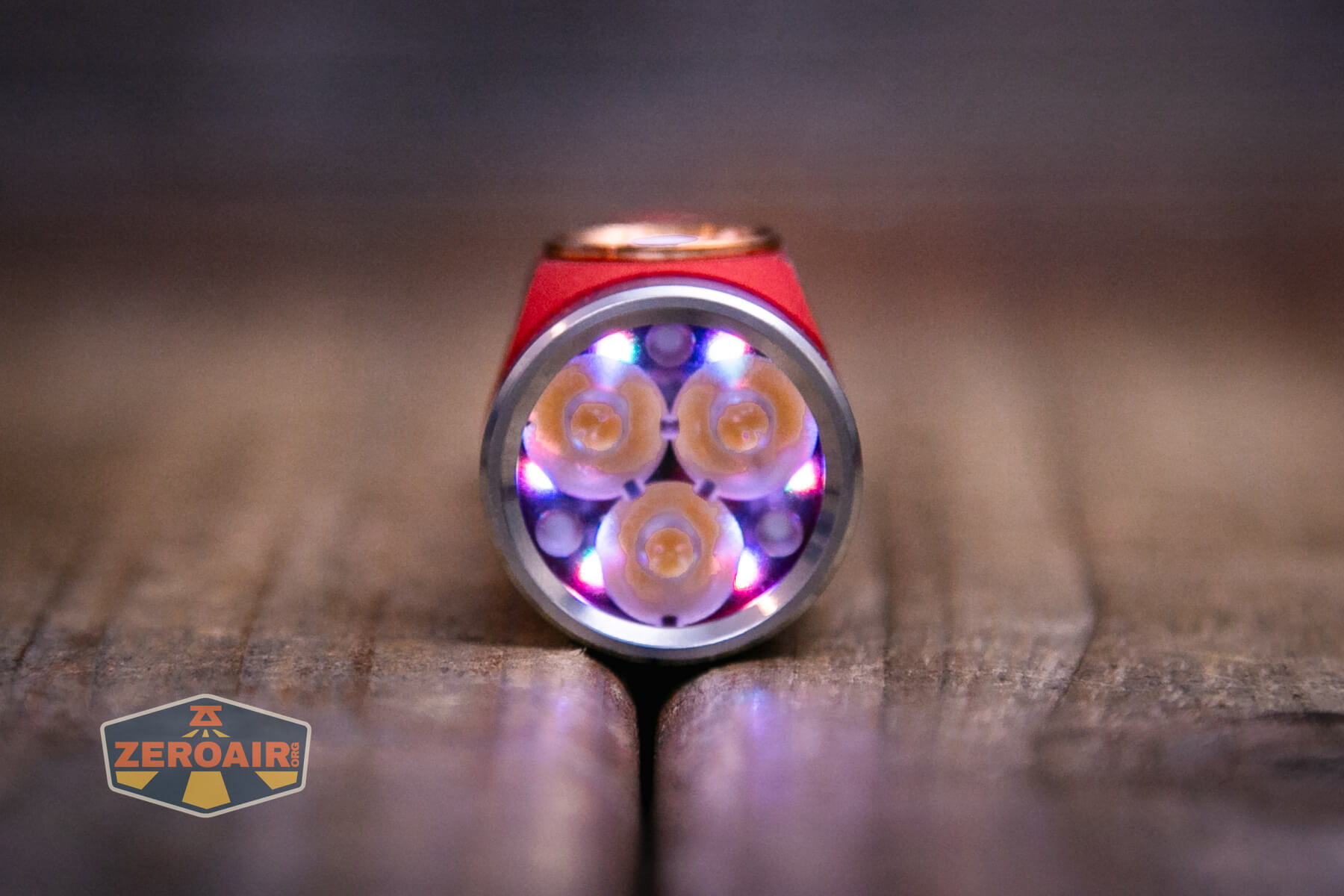
There are three emitters in the Emisar D3AA 5700K flashlight – it’s a triple! These are Nichia 519a 5700K emitters (fantastic) but they’re also dedomed (fantastic) which makes them warmer than the claimed 5700K (fantastic.) I love all the things about this difference!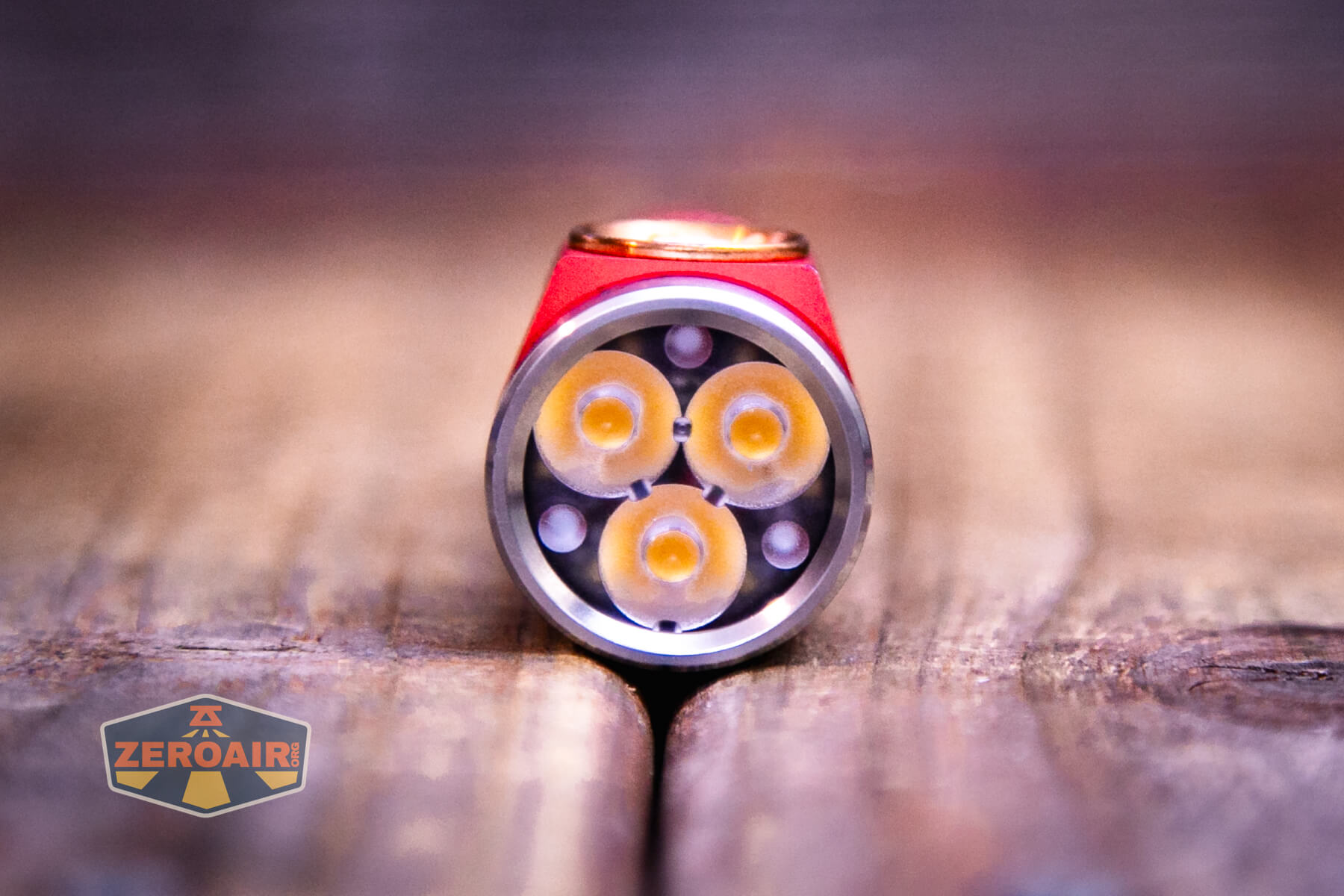
There are also secondary emitters in there.

LED Color Report (CRI and CCT)
Output (in CCT) ranges from around 4000K to 4300K with the 14500 and stays right at 4000K to 4200K with a 1.5V cell. This really tracks for these being dedomed emitters – dedoming typically (always?) lowers the CCT. CRI is very high, at over 95 across the board. No complaints here, and a lot to love.
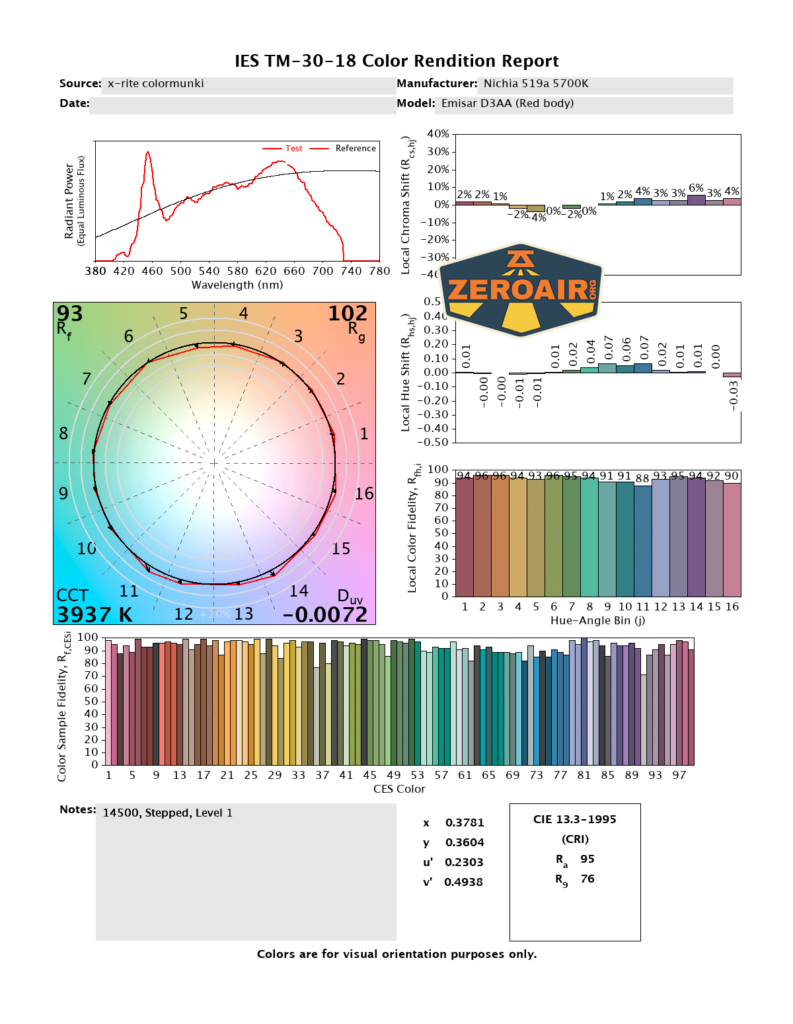
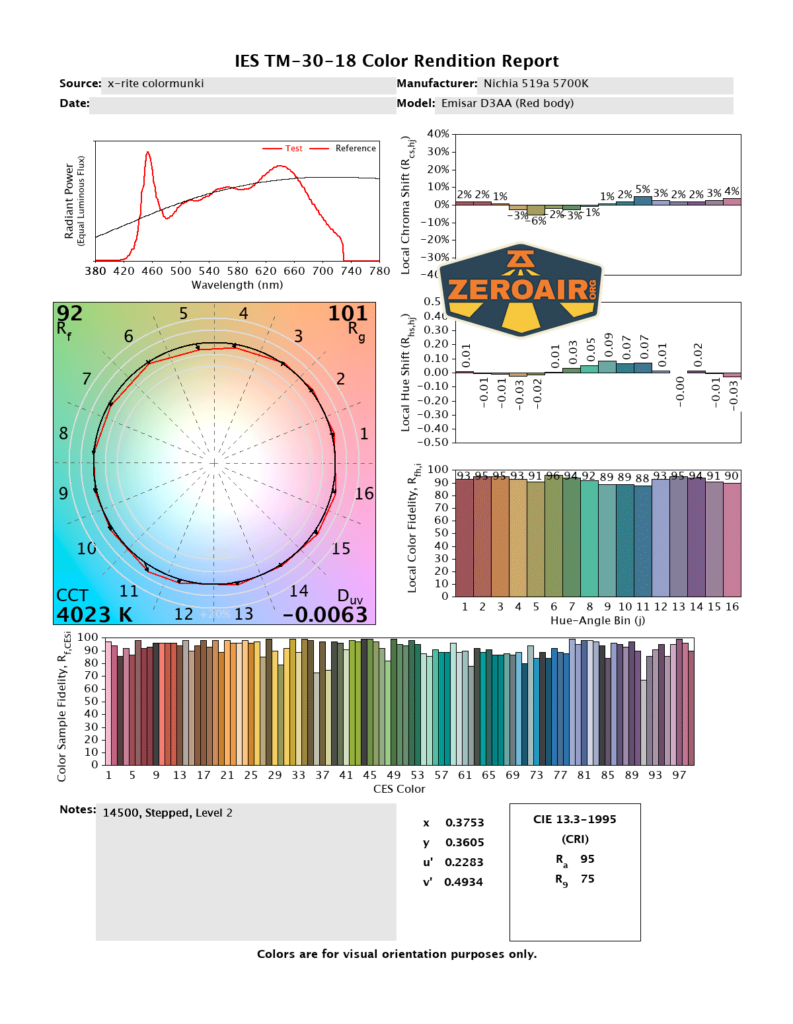
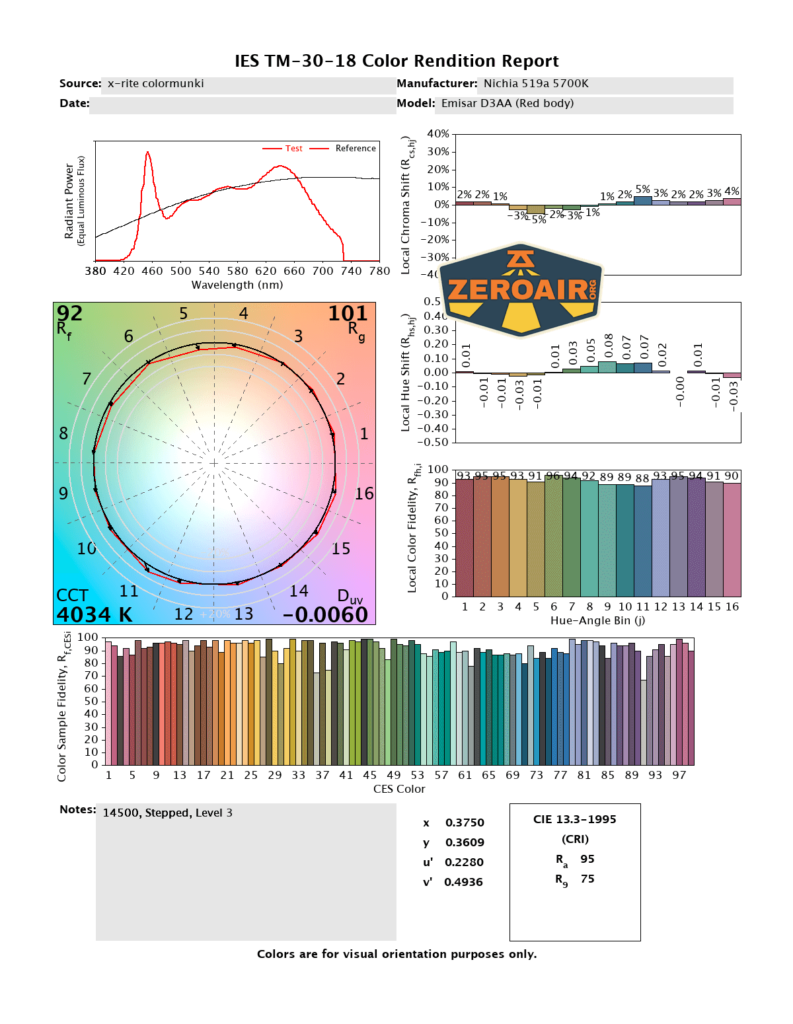
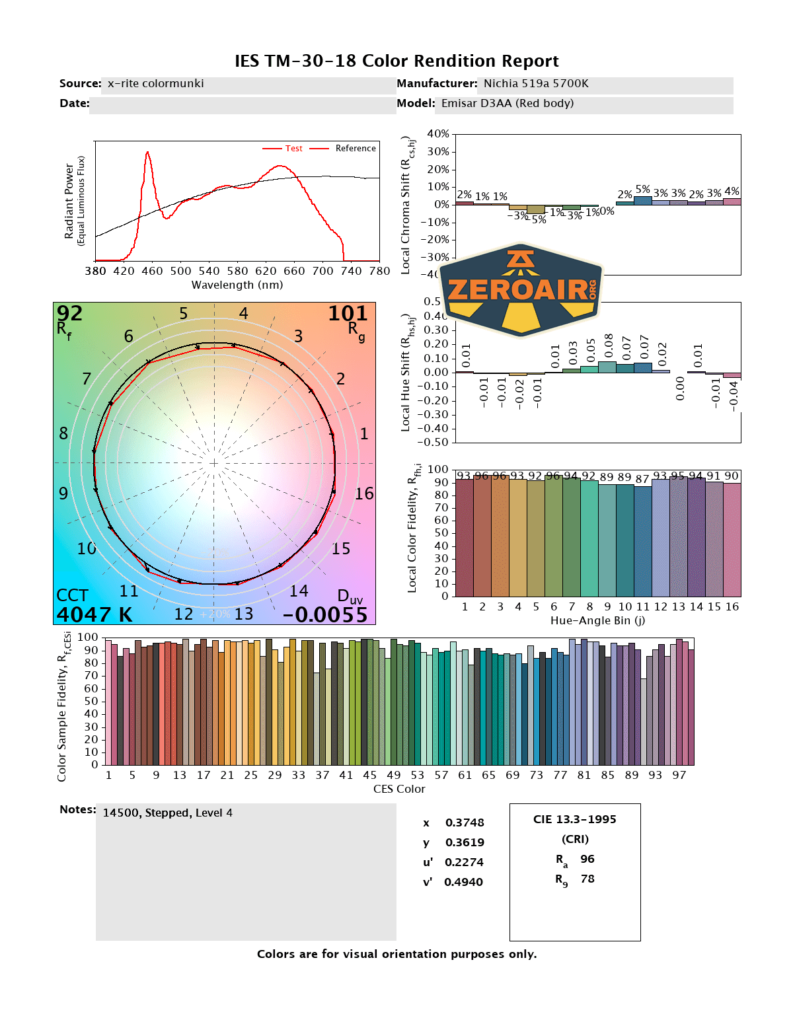

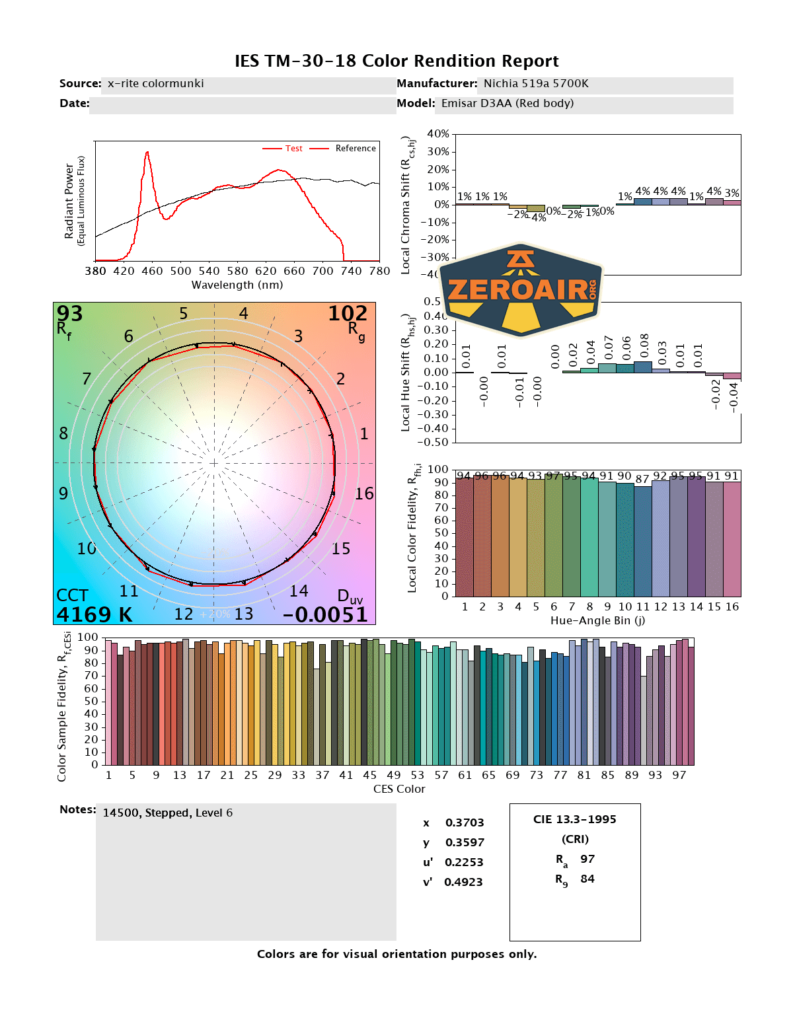
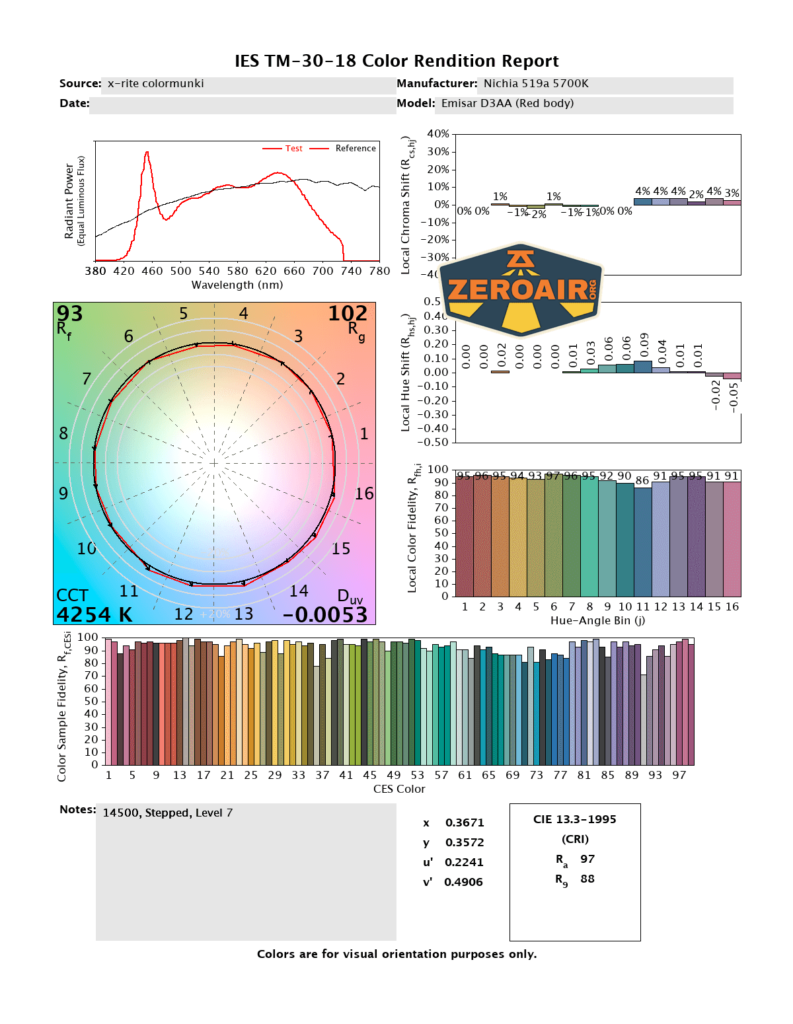
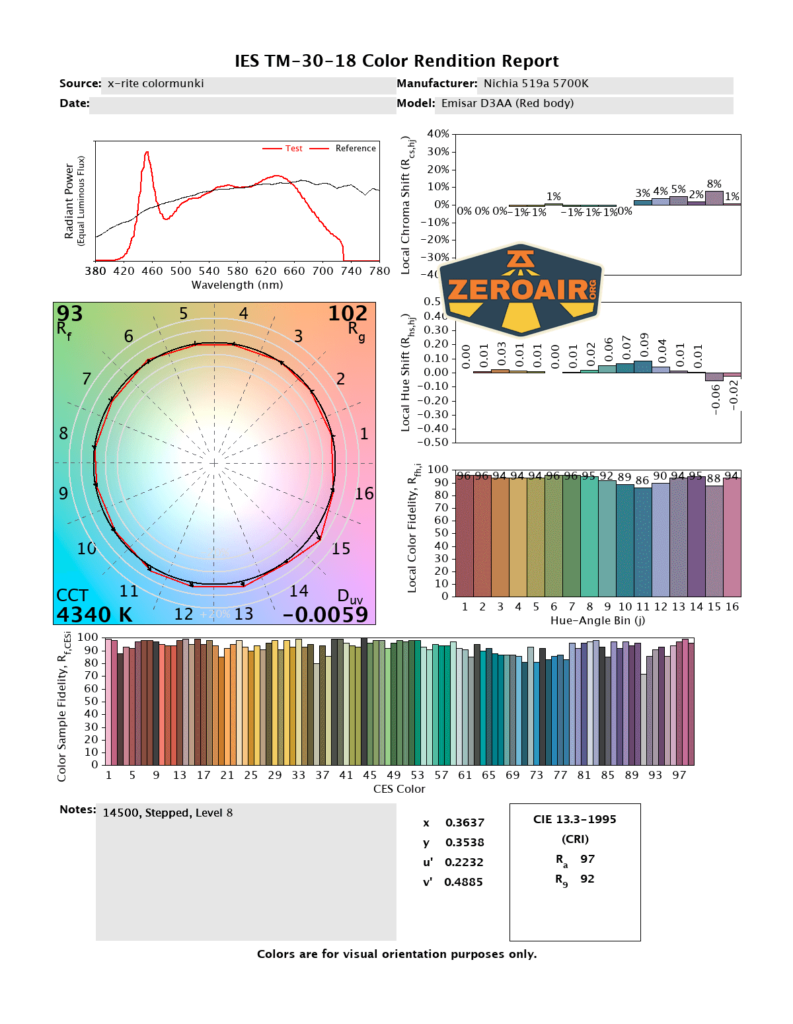

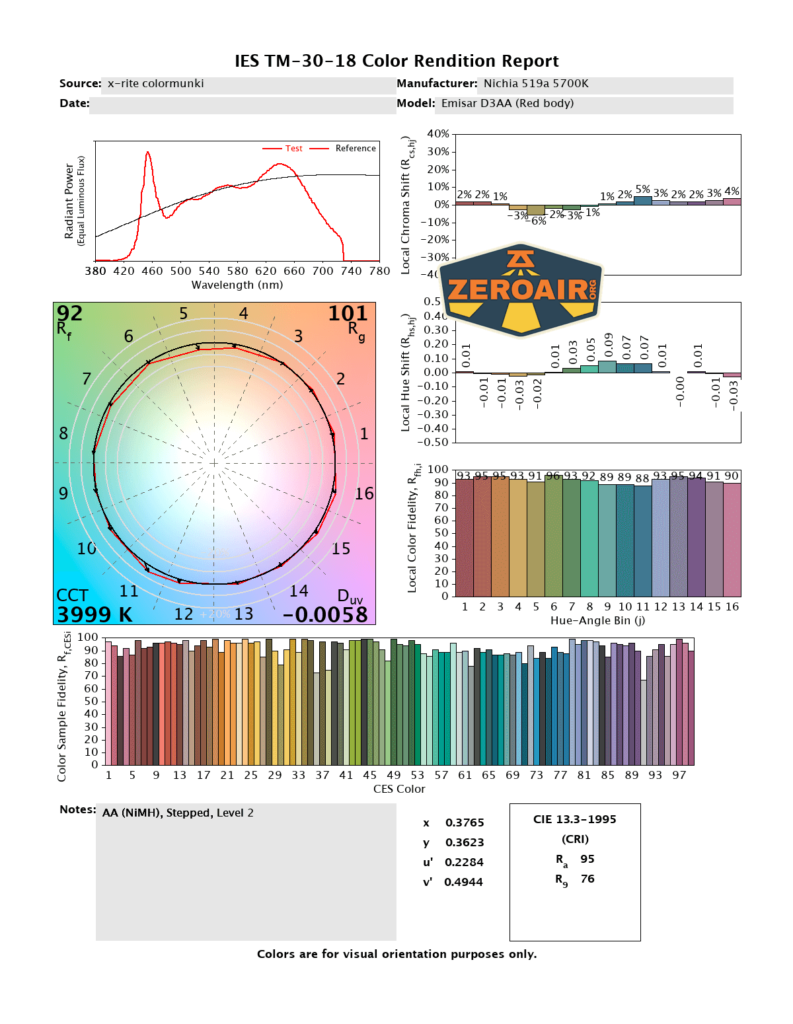
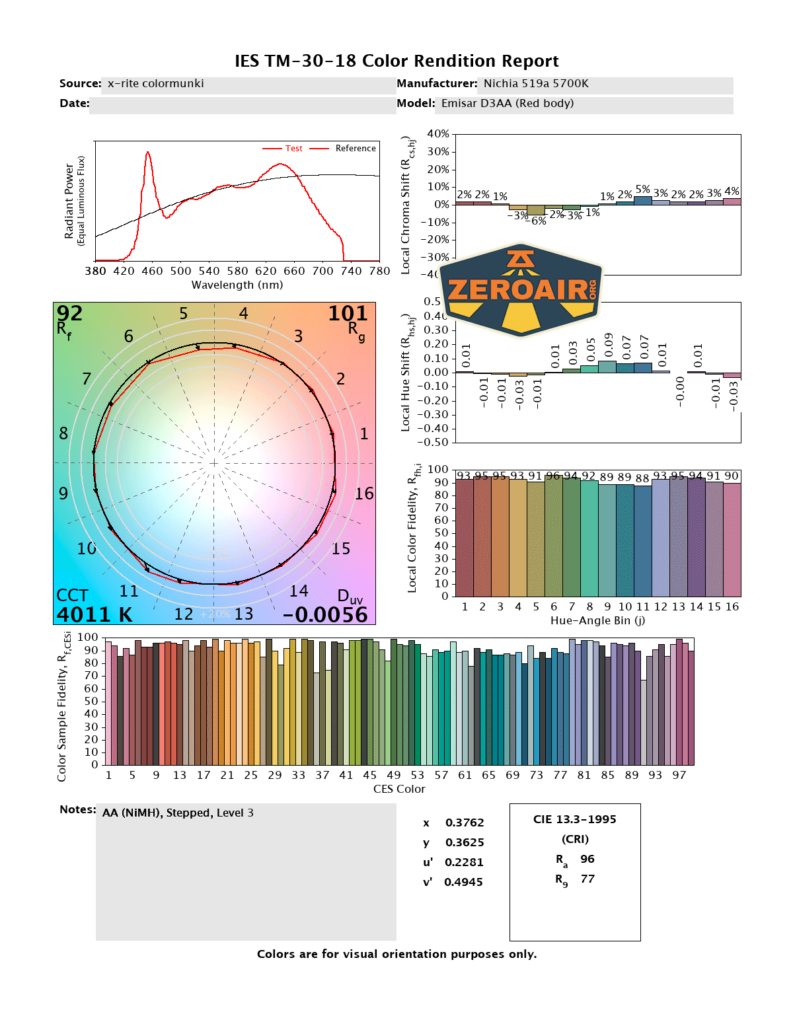


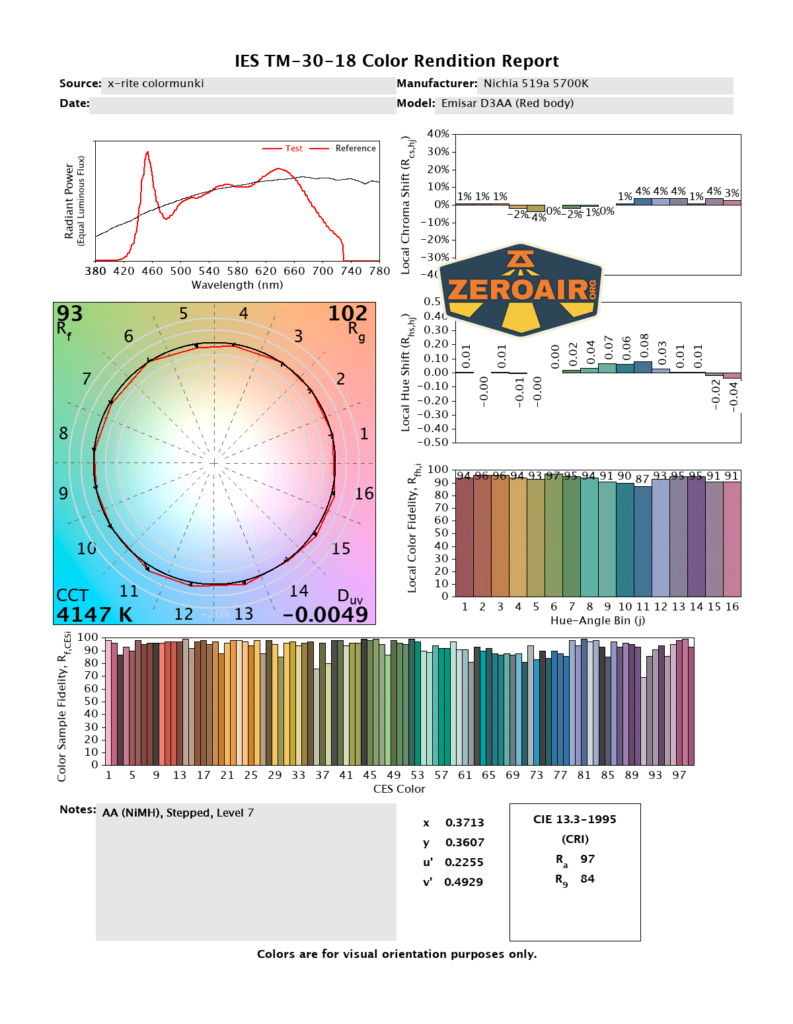
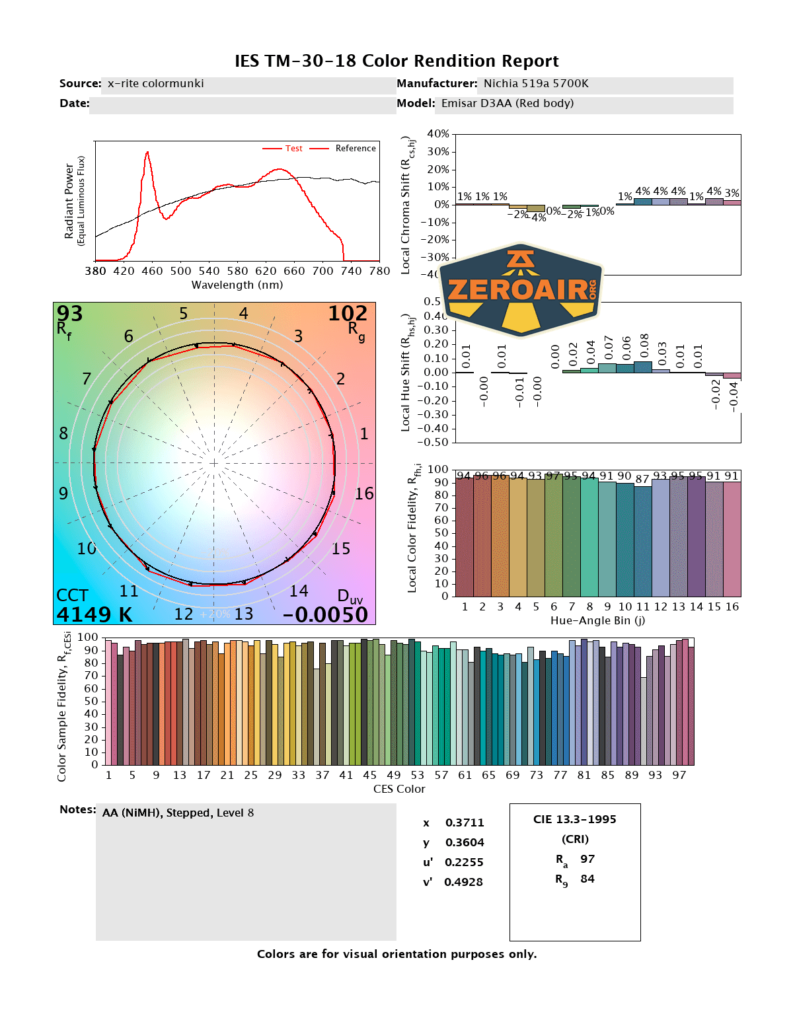
CCT (Correlated Color Temperature) refers to the measurement of the color appearance of light, expressed in Kelvins (K), which indicates whether the light is warm (yellowish) or cool (bluish). A lower CCT (below 3000K) is considered warm light, while a higher CCT (above 5000K) gives cooler, bluish light.
CRI (Color Rendering Index) is a measure of how accurately a light source renders colors in comparison to natural sunlight. Scored on a scale from 0 to 100, higher CRI values indicate that colors appear more true to life and vibrant, similar to how they would look under the sun.
Beamshots
These beamshots always have the following settings: f8, ISO100, 0.3s shutter, and manual 5000K exposure. These photos are taken at floor level, and the beam hits the ceiling around 9 feet away.


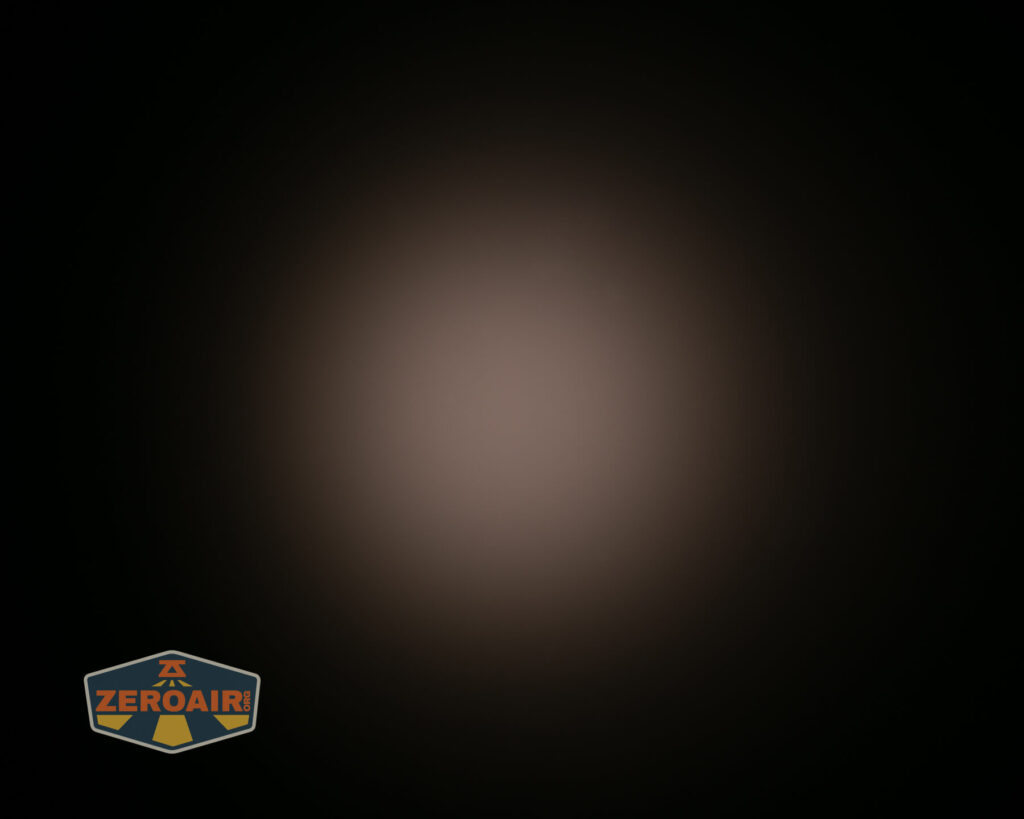

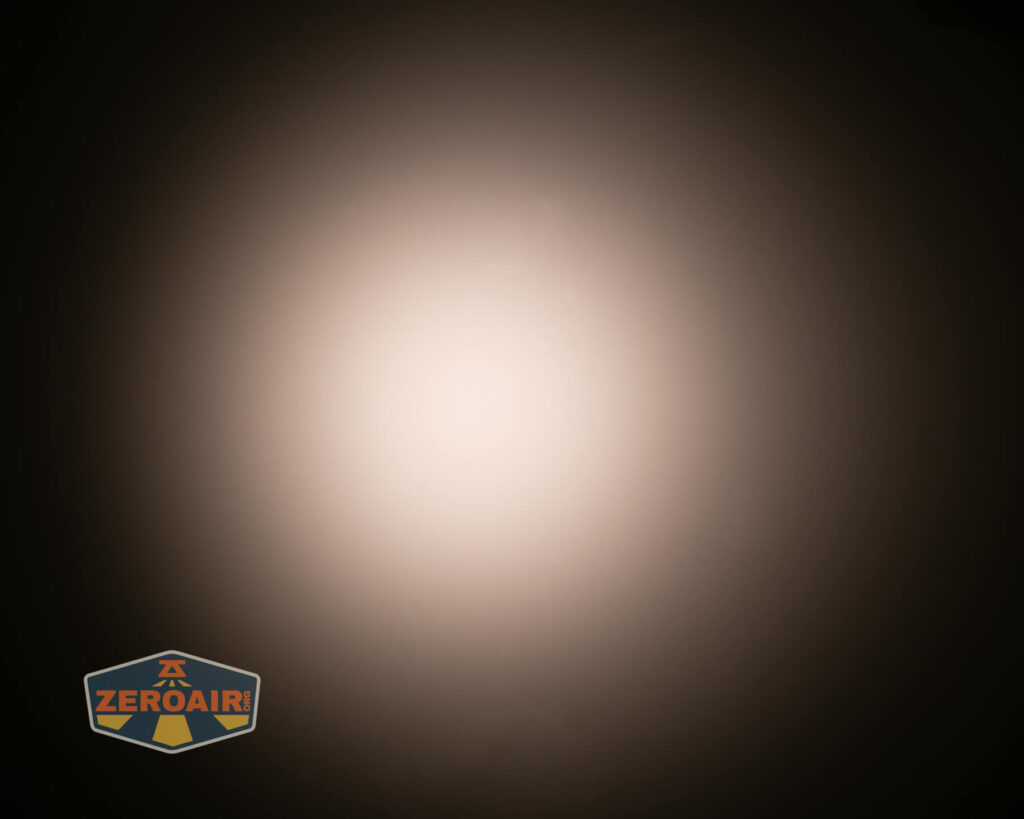
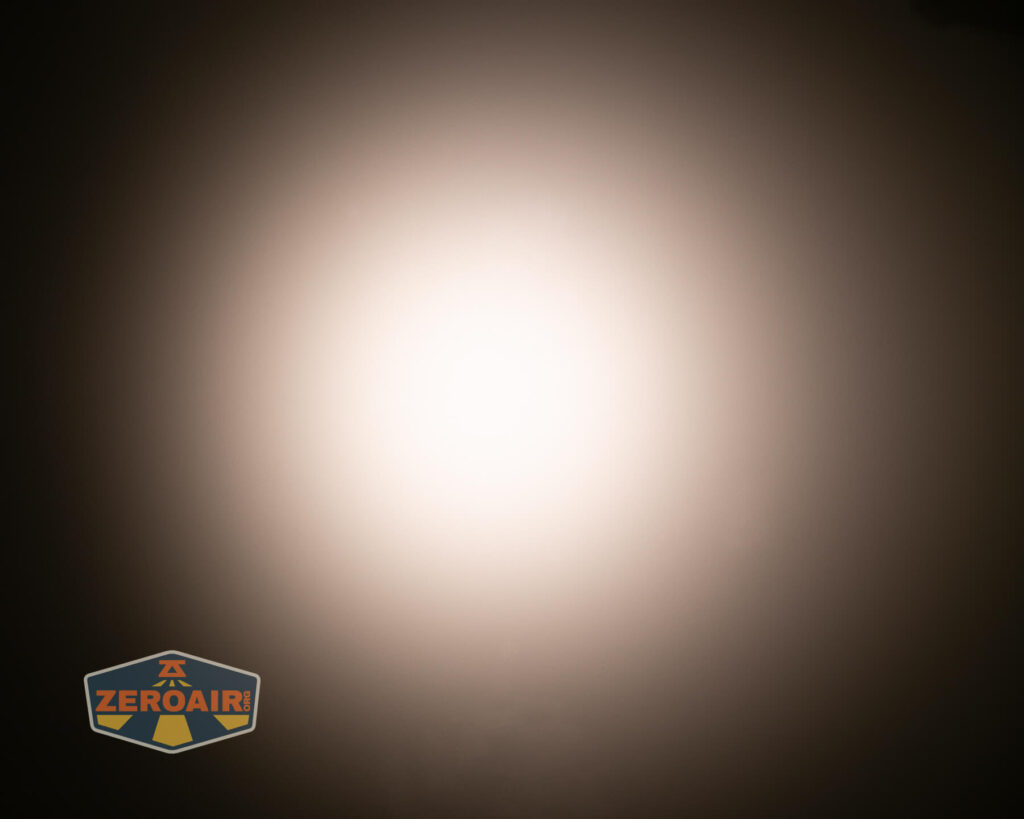



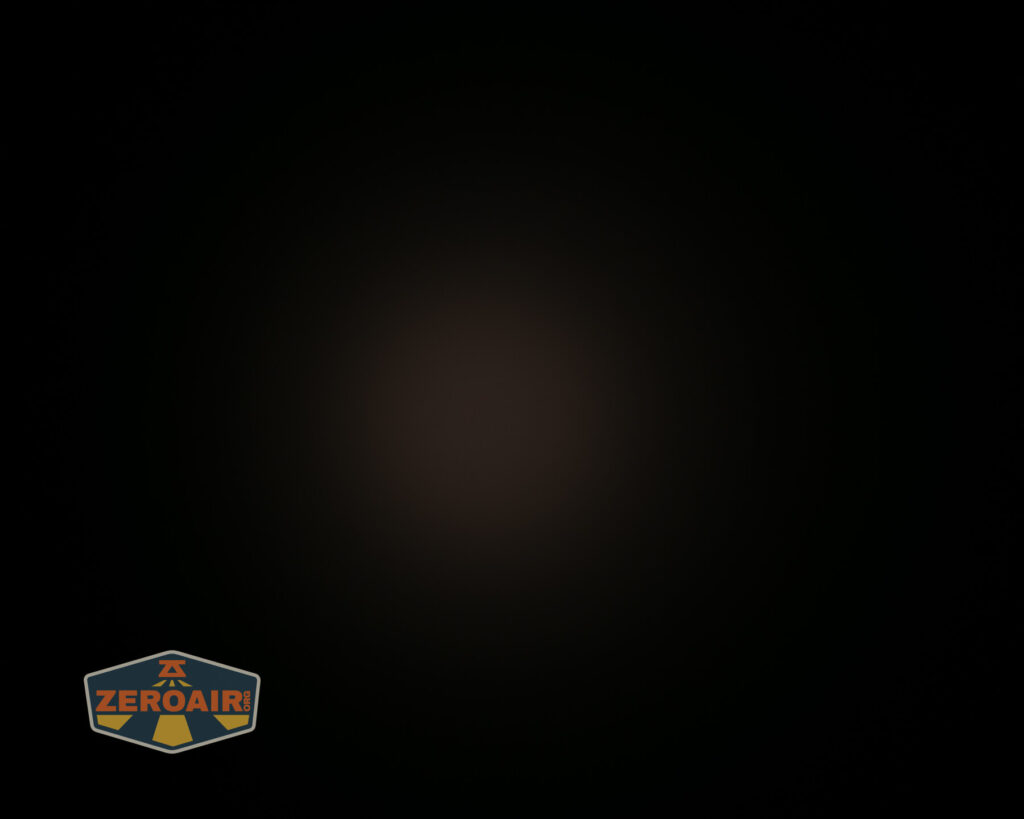

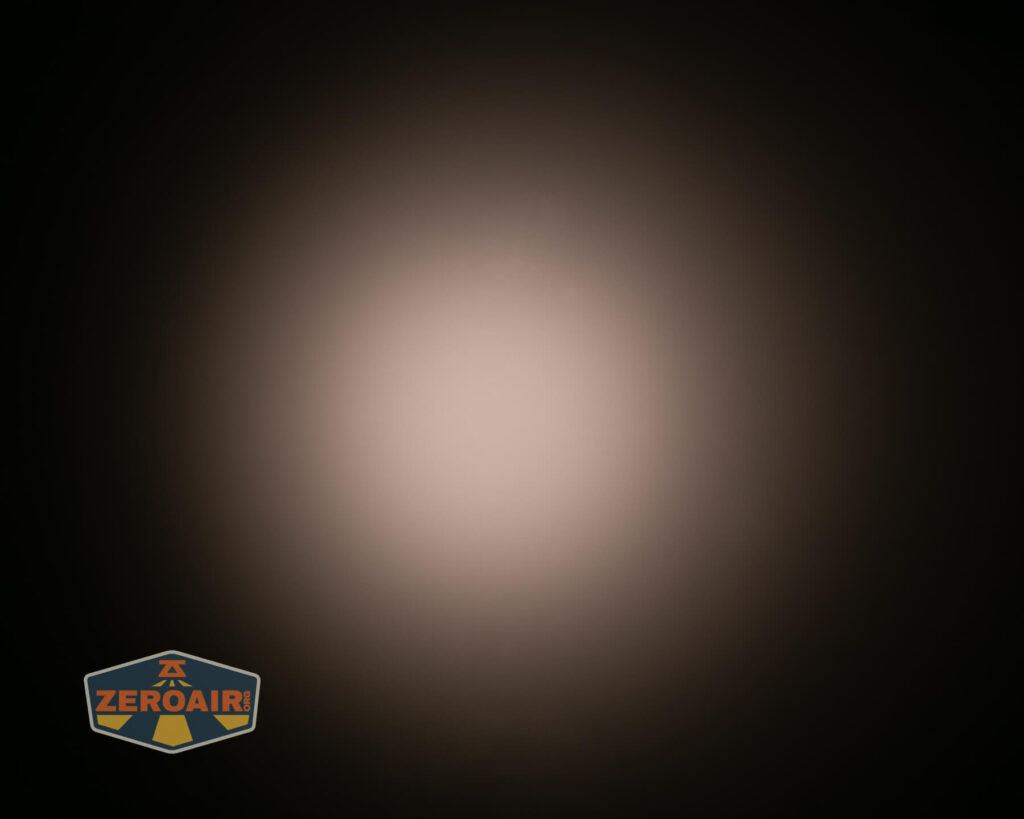
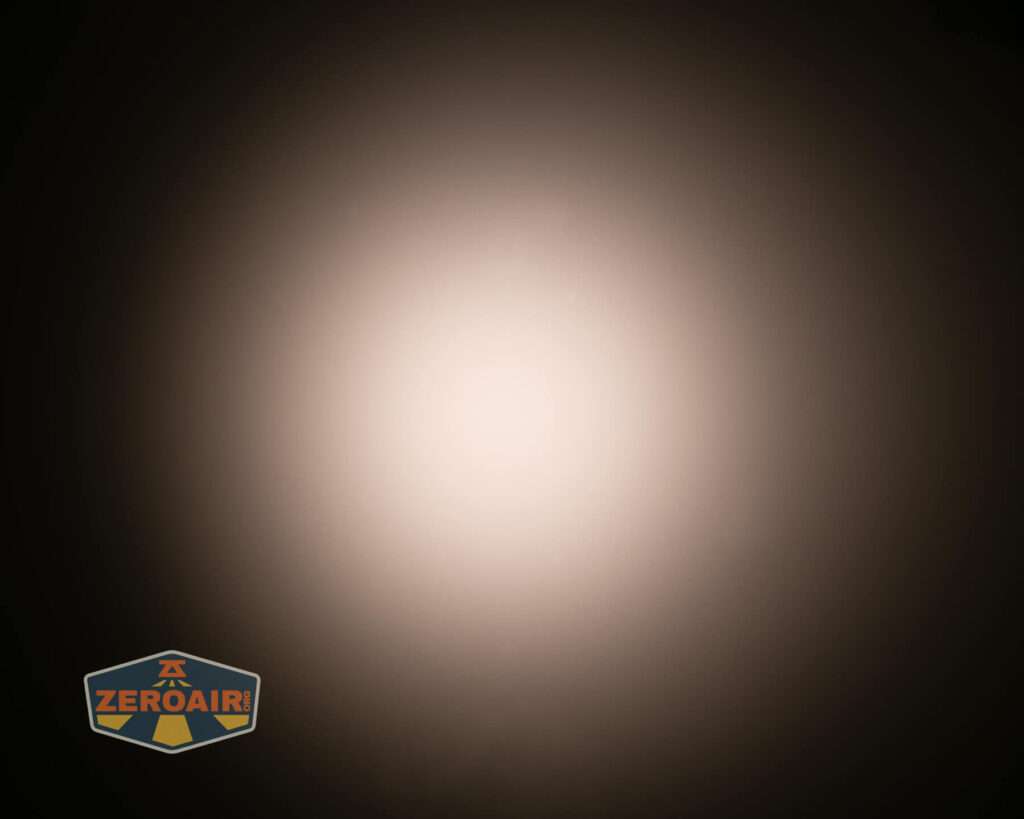
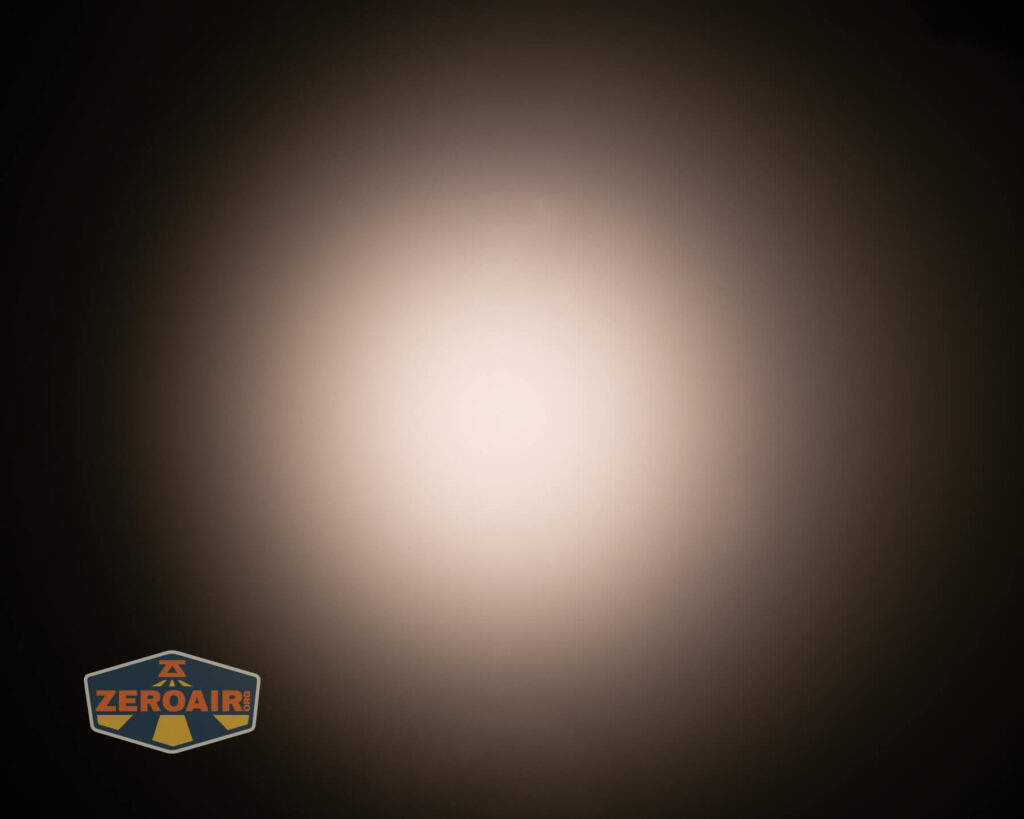

Tint vs BLF-348 (KillzoneFlashlights.com 219b version) (affiliate link)
I keep the test flashlight on the left and the BLF-348 reference flashlight on the right. These photos are taken around 18 inches from the door.
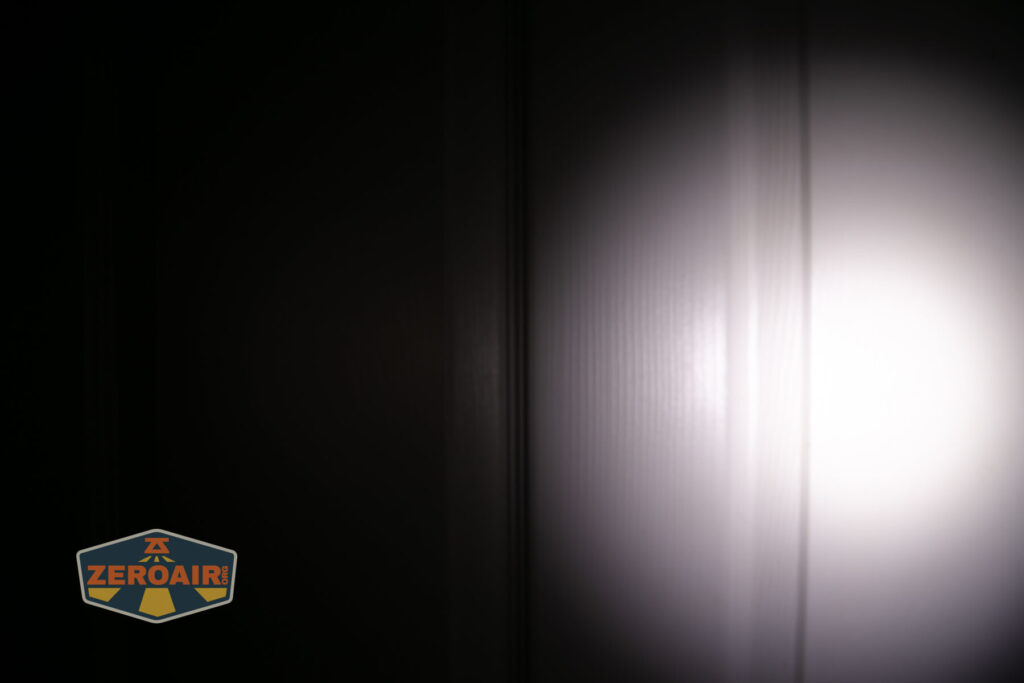

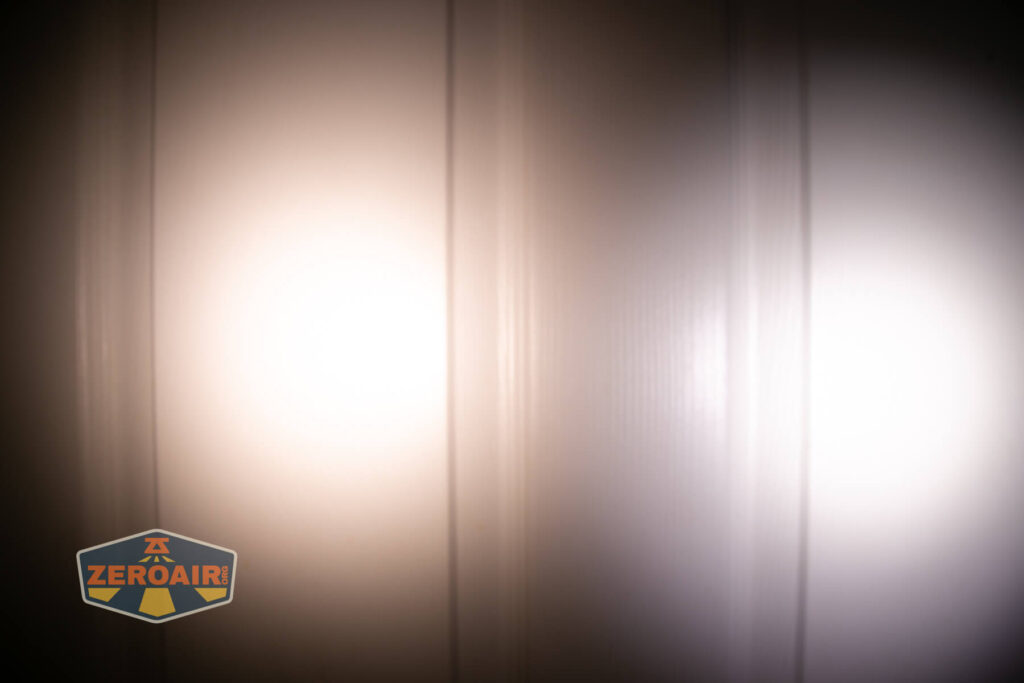

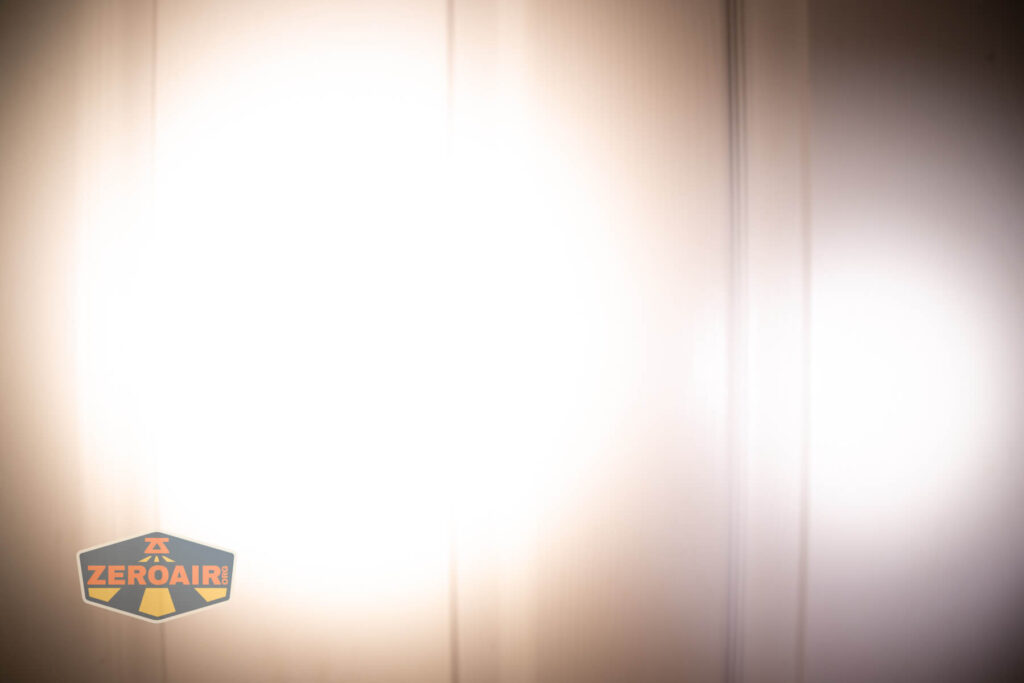

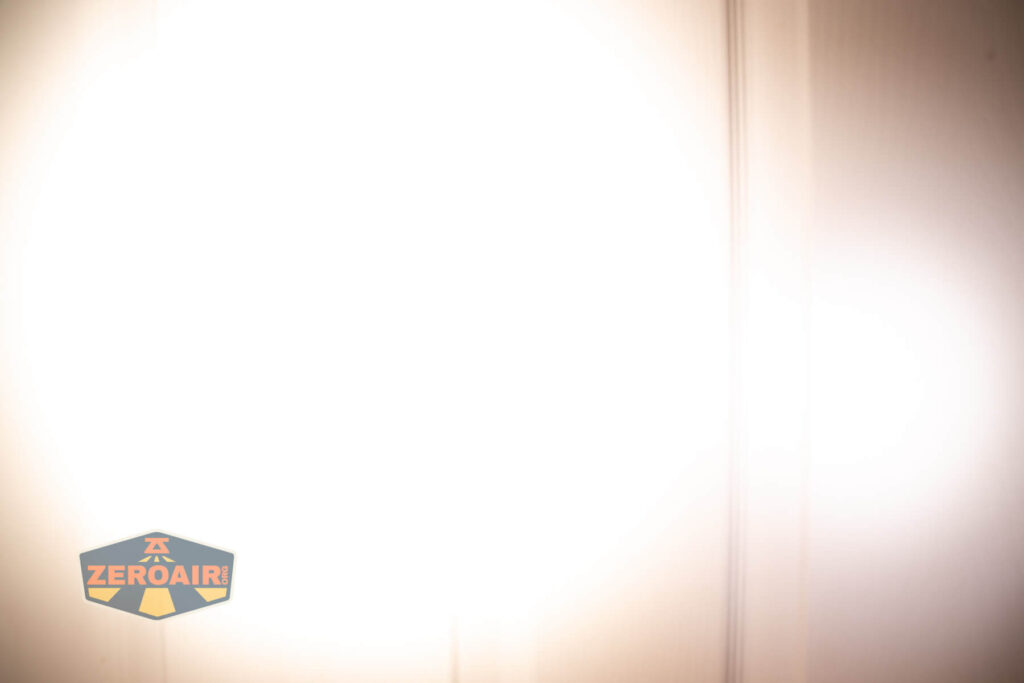
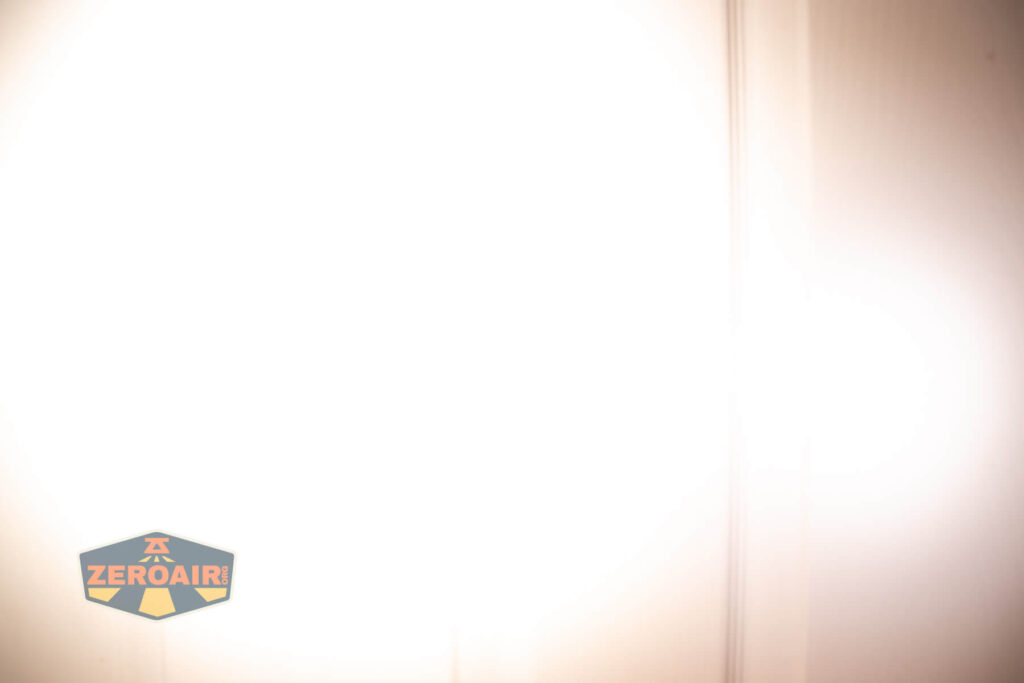
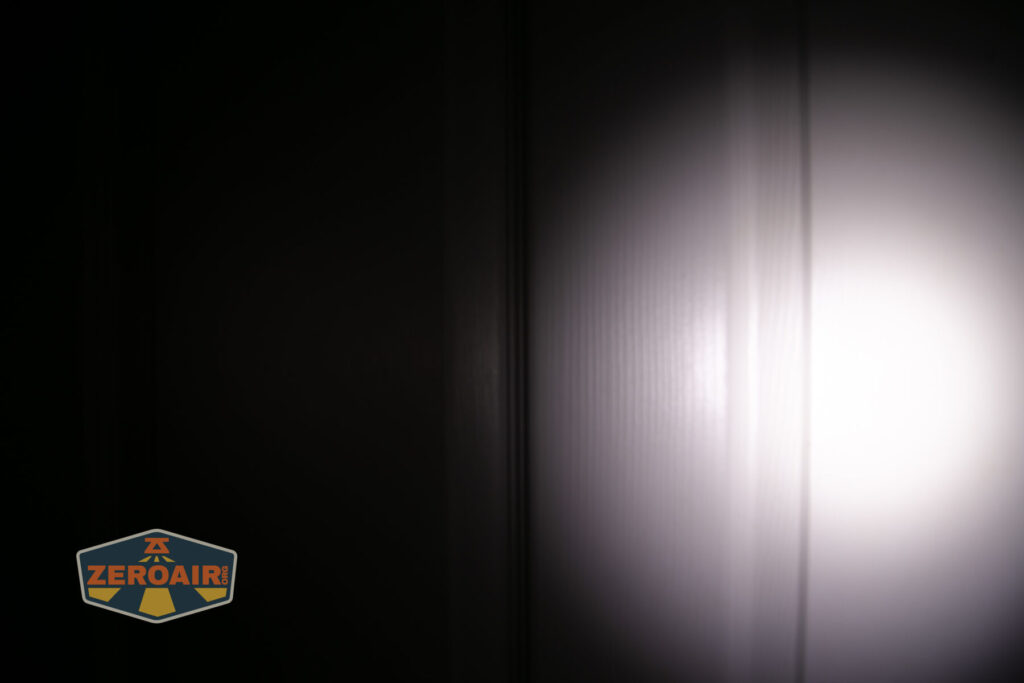


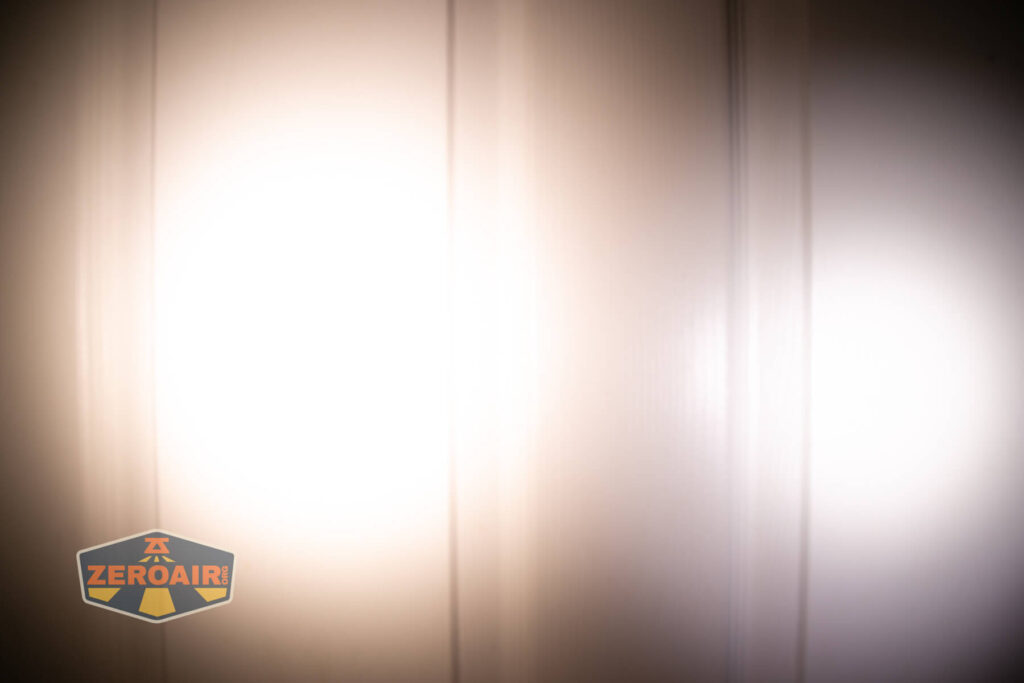

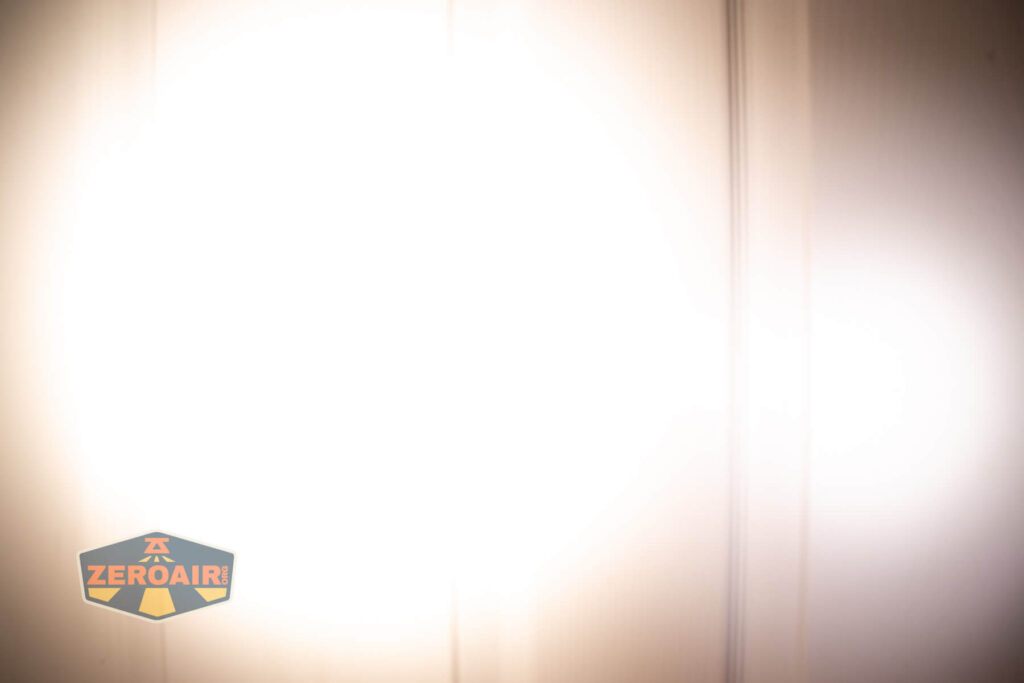
I compare everything to the KillzoneFlashlights.com 219b BLF-348 because it’s inexpensive and has the best tint!
Summary and Conclusion
I love the Emisar D3AA 5700K flashlight – much more than I thought I would. I use a D4V2 daily and love it, so it should come as no surprise that the D3AA would be great too. But I still resisted for the longest time. There are so many options though, that it can be confusing to pick. At $35 or so, at least the burden of “picking wrong” is not TOO painful. This Emisar D3AA 5700K flashlight is a very good option. For daytime use, I consider this “5700K” (really much warmer than 5700K due to the dedome option) to be fantastic. That the light will run 1.5V cells too is a great bonus.
The Big Table
| Emisar D3AA 5700K flashlight | |
|---|---|
| Emitter: | Nichia 519a (triple) (5700K, dedomed) |
| Price in USD at publication time: | |
| Cell: | 1×14500 |
| Runtime Graphs | |
| LVP? | Yes |
| Switch Type: | E-Switch |
| Quiescent Current (mA): | ? |
| On-Board Charging? | No |
| Claimed Lumens (lm) | 1540 |
| Measured Lumens (at 30s) | 879 (57.1% of claim)^ |
| Candela per Lumen | 5.76 |
| Claimed Throw (m) | – |
| Candela (Calculated) in cd (at 30s) | 247lux @ 4.959m = 6074cd |
| Throw (Calculated) (m) | 155.9 |
| Claimed CCT | 5700 |
| Measured CCT Range (K) | 4000-4300 Kelvin |
| Item provided for review by: | Me |
| All my Emisar reviews! | |
| Emisar D3AA 5700K flashlight | |
|---|---|
| Emitter: | Nichia 519a (triple) (5700K, dedomed) |
| Price in USD at publication time: | |
| Cell: | 1xAA |
| Runtime Graphs | |
| LVP? | Yes |
| Switch Type: | E-Switch |
| Quiescent Current (mA): | ? |
| On-Board Charging? | No |
| Claimed Lumens (lm) | 510 |
| Measured Lumens (at 30s) | 432 (84.7% of claim)^ |
| Candela per Lumen | 5.76 |
| Claimed Throw (m) | – |
| Candela (Calculated) in cd (at 30s) | 120lux @ 4.758m = 2717cd |
| Throw (Calculated) (m) | 104.2 |
| Claimed CCT | 5700 |
| Measured CCT Range (K) | 4000-4100 Kelvin |
| Item provided for review by: | Me |
| All my Emisar reviews! | |
^ Measurement disclaimer: Testing flashlights is my hobby. I use hobbyist-level equipment for testing, including some I made myself. Try not to get buried in the details of manufacturer specifications versus measurements recorded here; A certain amount of difference (say, 10 or 15%) is perfectly reasonable.
What I like
- Small size
- Many emitter options
- Dedome option
- Can run 1.5V and 4.2V cells both
- No PWM
- Familiar user interface
What I don’t like
- Nothing
Notes
- This content originally appeared at zeroair.org. Please visit there for the best experience!
- For flashlight-related patches, stickers, and gear, head over to PhotonPhreaks.com!
- Please use my Amazon.com referral link to help support zeroair.org!
- Please support me on Patreon! I deeply appreciate your support!
I only have 7 Noctigon/Emisar and the quality check seems to be very random. Of course they sent you a good exemplar for review…
I understand that sentiment and try to be mindful of that possibility. But based on some of the issues I’ve encountered, I don’t believe any brand has ever hand-picked a light for me to review.
And that’s especially true for Emisar, as they did not send this light for review. They didn’t even know I was going to review this light, nor did I buy it from them with an account associated with reviewing.
They also have not sent (or even provided) any of the eight Emisar lights I have reviewed.
In short, this review represents any random sample from Emisar. Thank you for reading!