
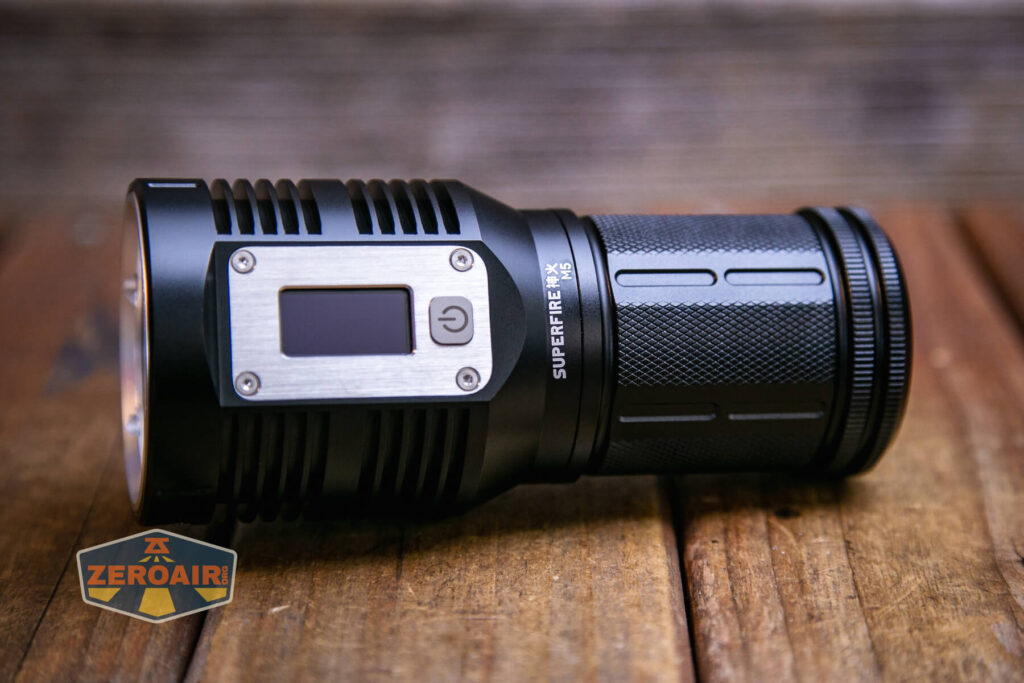
Superfire M5 Rechargeable Flashlight Review
Superfire has released the Superfire M5 Rechargeable flashlight that features a LED display and USB-C charging. Read on for testing of the M5!
Testing for this light was sponsored by the manufacturer.
Official Specs and Features
Here’s a link to the Superfire M5 rechargeable flashlight product page.
Versions
There is only one version of the Superfire M5 rechargeable flashlight.
Price
The Superfire M5 rechargeable flashlight is available right now for $58.99, and that includes the battery (that’s built-in) and charging cable.
Short Review
There’s a good bit to like about the Superfire M5 rechargeable flashlight! First, the output is fairly high (and comes closer to hitting the specification of 3000 lumens than you probably guessed.) I love the LED display used here – it’s exceptionally crisp and provides a great level of (seemingly actually accurate) detail! The e-switch is also quite fantastic. The emitter is very cool white, so steel yourself for that. Also, the user interface (despite having a great switch) leaves a bit to be desired (and the generic manual doesn’t help in this regard). One more thing that I don’t love is that the battery is built in (despite being four 18650 cells). On the other hand, both charging and powerbank features work great!
Long Review
The Big Table
| Superfire M5 Rechargeable Flashlight | |
|---|---|
| Emitter: | Supfire SH-S11 |
| Price in USD at publication time: | $58.99 |
| Cell: | Internal |
| Runtime Graphs | |
| LVP? | ? |
| Switch Type: | E-Switch |
| Quiescent Current (mA): | ? |
| On-Board Charging? | Yes |
| Charge Port Type: | USB-C |
| Charge Graph | |
| Power off Charge Port | No |
| Claimed Lumens (lm) | 3000 |
| Measured Lumens (at 30s) | 2371 (79% of claim)^ |
| Candela per Lumen | 8.9 |
| Claimed Throw (m) | 310 |
| Candela (Calculated) in cd (at 30s) | 570lux @ 6.376m = 23172cd |
| Throw (Calculated) (m) | 304.4 (98.2% of claim)^ |
| Claimed CCT | – |
| Measured CCT Range (K) | 8500-9300 Kelvin |
| Item provided for review by: | Superfire |
| All my Superfire reviews! | |
^ Measurement disclaimer: Testing flashlights is my hobby. I use hobbyist-level equipment for testing, including some I made myself. Try not to get buried in the details of manufacturer specifications versus measurements recorded here; A certain amount of difference (say, 10 or 15%) is perfectly reasonable.
What’s Included

- Superfire M5 rechargeable flashlight
- Charging cable (USB to USB-C)
- Manual (really “manual” since it’s generic and not specific to the M5.)
Package and Manual


Build Quality and Disassembly

I have to say, I did not expect too much from the Superfire M5. Any flashlight item with “fire” in the name usually draws the side-eye from users. (Surefire seems to get a pass on this one, and as far as names go, it seems the most… incendiary… see what I did there?) Either way, we’ve come to not expect much of the ‘fire’ lights. This Superfire M5 is actually pretty well made, though.


All the parts you’d think would feel cheap don’t. For example, the LED display (which I guess is really OLED, but they say LED, so ok, we’ll do that.). This display is great and also very well attached. It doesn’t feel cheap. In fact, it feels like the one Nitecore used!


One part of the Superfire M5 that I like much less is the battery. Now, I don’t necessarily mind a built-in battery. But this battery is wrapped (again, fine) and inside the light (again, fine-ish). But the battery only makes contact with the cell tube on the widest parts of the battery. So the flattest parts don’t make any contact with the body. This means two things. First, less heat management capability. Second, there’s a lot of mass that you’re expecting to be in the handle (from the cell tube cradling the cells with shaped aluminum) that simply is not present. So the Superfire M5 rechargeable flashlight feels lighter than you’ll expect it to feel.

The light is not at all designed to be taken apart. Here’s the driver. You can see below that the battery connects with a JST connector. That’s actually good – the battery isn’t actually hardwired!

Other than those things, the build is good. The anodizing feels good, and just overall, honestly, the M5 has a great presence in hand.
Size and Comps
Product Size: 143 x64 x 51mm
Weight: about 556g


If the flashlight will headstand, I’ll show it here (usually the third photo). If the flashlight will tailstand, I’ll also show that (usually in the fourth photo).


Here’s the test light with the venerable Convoy S2+. Mine is a custom “baked” edition Nichia 219b triple. A very nice 18650 light!


Also above on the left is a new feature light!! Laulima Metal Craft sent this Todai in tumbled aluminum for some size comparison photos like the ones above. Laulima has a bunch of incredible items. I’ve tested one (the Laulima Metal Craft Hoku) (the official site for Hoku is here) that was a Friend Fund Friday review. I was impressed enough by that Hoku that I bought a Laulima Metal Craft Diamond Slim (also in tumbled aluminum) (review is upcoming!) These lights by Laulima have impeccable build quality and not only that, they’re quite configurable. There are some (great, actually) default configurations, but Joshua Dawson (of Laulima Metal Craft) is open to ideas and emitter options and the like. I haven’t reviewed this Todai, but I have to say, it feels absolutely fantastic and I love it thus far. (Notably, I love how warm and eggy those emitters look through the TIR.)
Retention and Carry
Nothing is included for carry of the Superfire M5 rechargeable flashlight. There’s no belt clip, no pouch, no tripod mount, no holster. Just hold the light in your hand! It does tailstand very nicely, though.
Power and Runtime
As stated above, the M5 runs on an internal battery. This internal battery is made up of four 18650 cells, and Superfire does describe them: 2600mAh. This probably means they’re fairly high current cells, which is good. The body also has the text below, stating that the light has a max of 36W output and runs at 7.4V. Thus, the four 18650 cells are in a 2s2p configuration.

The battery connects via a JST connector, so is probably replaceable, but I’d say not really intended for replacement.
Below are a couple of runtime tests. Output max was observed at around 2500 lumens, which is pretty great!


Since I couldn’t check the cell, I was unable to test the ending voltage. The LED display does show the battery percentage left as well as the time estimated to be remaining in the runtime. As you can see in both tests above, the light switches to the lowest mode (300 lumens) automatically.
Charging
The internal battery utilizes USB-C charging. There’s a press-in cover for the USB-C port as well as the USB powerbank port.


Superfire includes a USB to USB-C cable.

Charging proceeds at a brisk ~2A and with either A or C USB charging, requires about 5.5 hours. This is respectable charging!


Powerbank
That USB-A port we saw above serves as a powerbank port. The USB-C port is for charging only and does not serve as a USB-C output port.

While the powerbank feature doesn’t have a high current output, it does have a great duration – around 3 hours at 1A.


Modes and Currents
| Mode | Mode Claimed Output (lm) | Claimed Runtime | Measured Lumens |
|---|---|---|---|
| 3000 | 3000 | – | 2371 |
| 1000 | 1000 | – | 850 |
| 300 | 300 | 11.5h | 299 |
Pulse Width Modulation
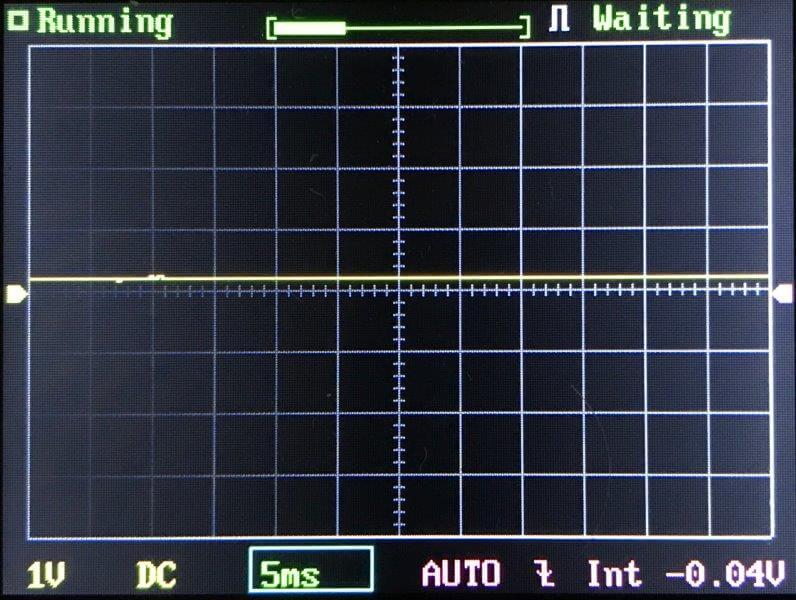
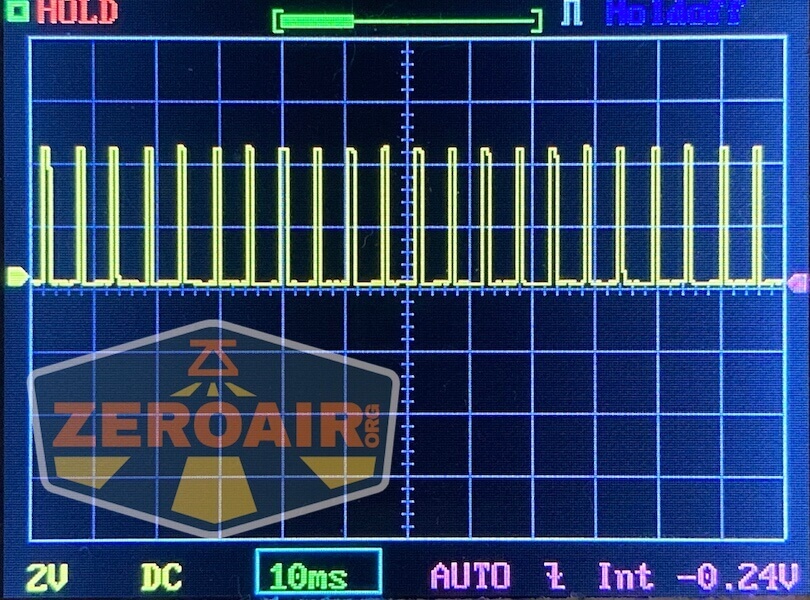
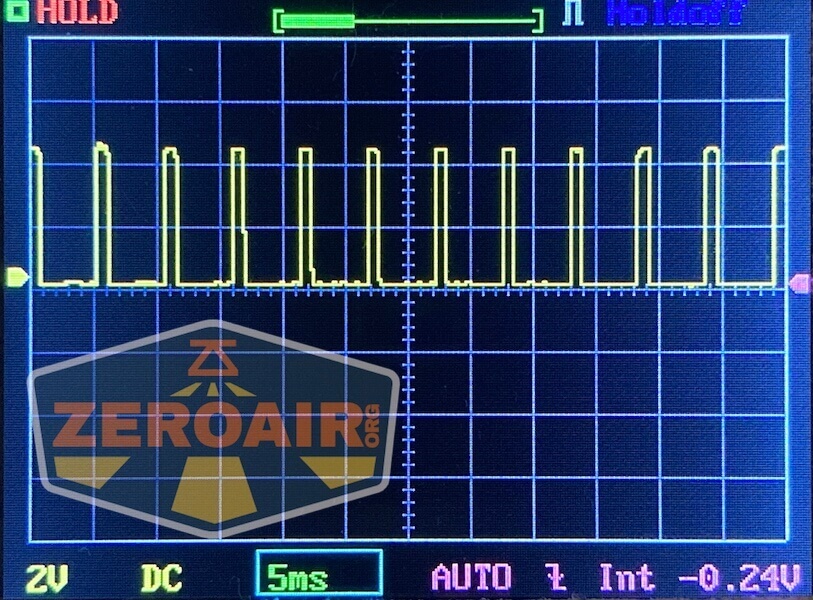
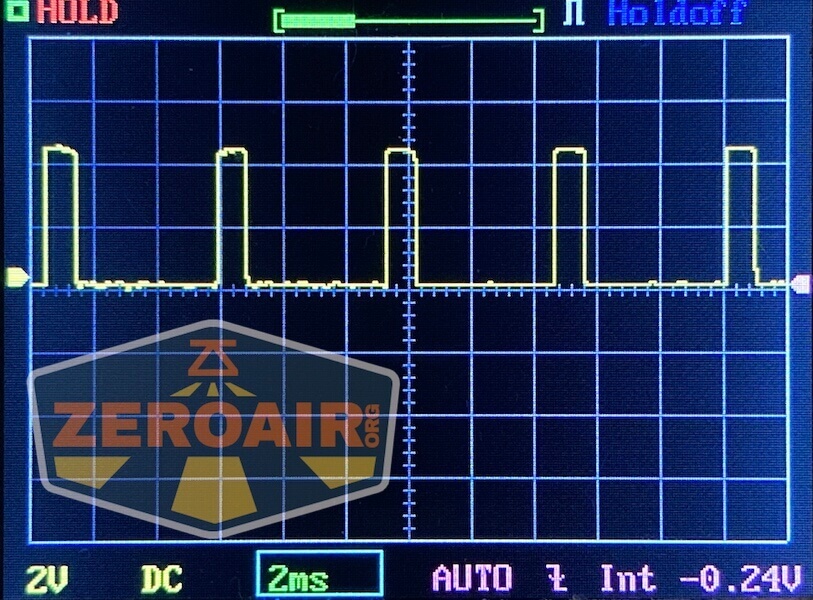
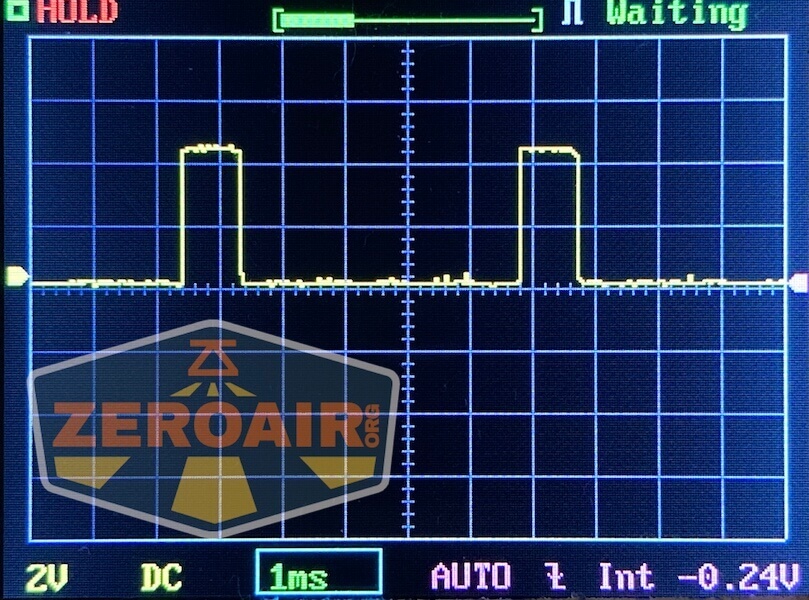
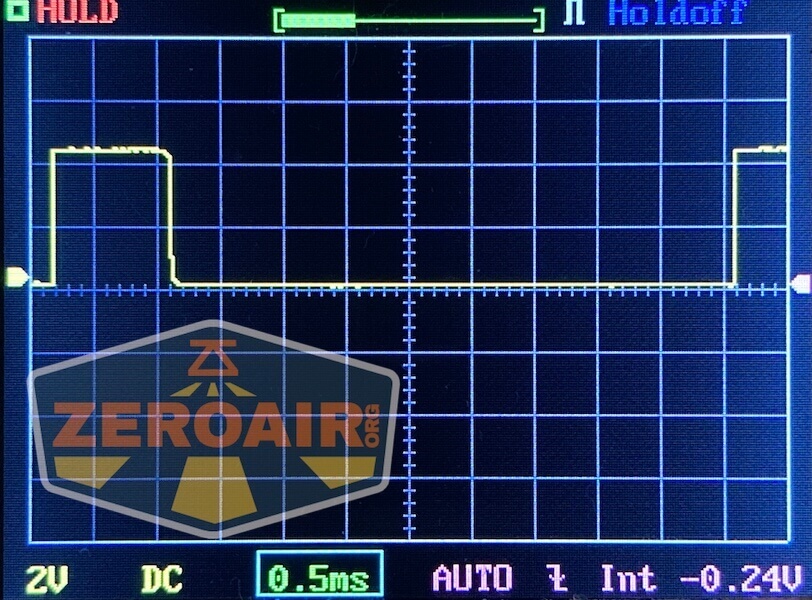
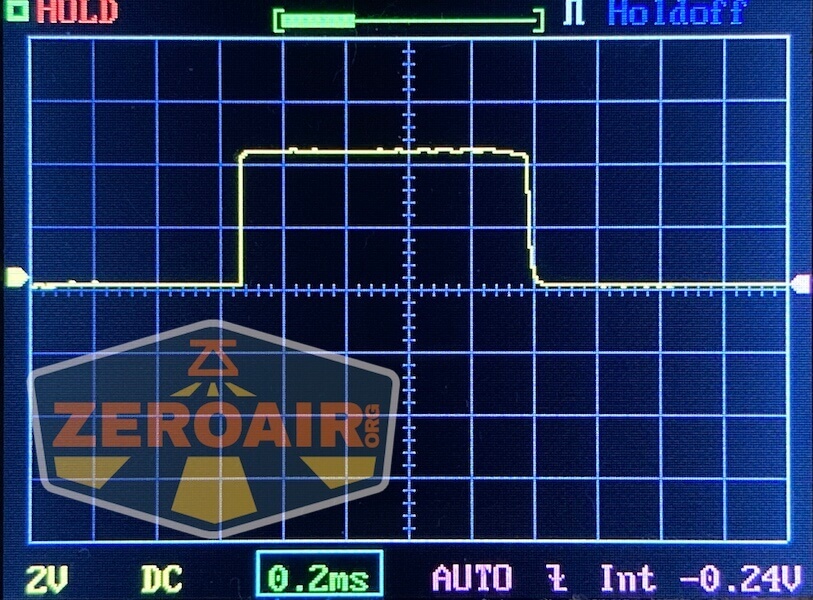
I wouldn’t say you can really observe PWM in the light, despite the sawtooth shown below. If you’re flicker-sensitive, you’ll notice the LED display having flicker, though.


Here you can see a “baseline” – a chart with almost no light hitting the sensor.
Then there’s the Ultrafire WF-602C flashlight, which has some of the worst PWM I’ve seen. It’s so bad that I used a post about it to explain PWM! Here are multiple timescales (10ms, 5ms, 2ms, 1ms, 0.5ms, 0.2ms) to make comparing this “worst” PWM light to the test light easier. That post also explains why I didn’t test the WF-602C at the usual 50us scale.
User Interface and Operation
A single e-switch controls all operation of the Superfire M5 rechargeable flashlight. It’s a nice switch, too – a flat button on the side of the M5 near the LED display.
The shape of the light, specifically that part of the bezel at right (below) keeps the switch from getting pressed accidentally.

Action of this e-switch is low and quick, but there’s a notable delay between when the switch is pressed and when the light responds.

Again, the display is brilliant!

Below you can see a few things. First, the output level. Then percent battery remaining (and an icon indicating that) and finally (bottom) is the time remaining at that level. At the far right, you can see that the camera captured the rolling flicker of the display.


Here’s a user interface table!
| State | Action | Result |
|---|---|---|
| Off | Click | 300 lumens |
| 300 lumens | Click | 1000 lumens |
| 1000 lumens | Click | 3000 lumens |
| 3000 lumens | Click | Off |
| On | Hold | Off |
| Any | Double Click | Blink (it’s not really fast enough to be called “Strobe”) |
| Off | Hold | Lockout |
| Lockout | Hold | Unlock (stays off) |
LED and Beam
Multiple times in the testing I’ve called this emitter “unstated” but Superfire does actually call this something specific: Supfire SH-S11. I have no idea what that is and nothing turned up, so I’m leaving it as “unstated.”

I was certain that somewhere I’d seen it called some version of a Cree emitter but I’m fairly certain it’s not that.
The reflector for this single-emitter flashlight is wide and shallow and has a bit of texture.


I love the beam profile provided by this setup. It’s surprisingly spotted – note the cd/lumens is around 9, which is fairly throwy.
LED Color Report (CRI and CCT)
CCT is where this emitter really falls off. It’s very cool white – nearly angry blue really, at 8500K to 9300K. CRI is low but not uncommonly low, at around 70.


Beamshots
These beamshots always have the following settings: f8, ISO100, 0.3s shutter, and manual 5000K exposure. These photos are taken at floor level, and the beam hits the ceiling around 9 feet away.


Tint vs BLF-348 (KillzoneFlashlights.com 219b version) (affiliate link)
I keep the test flashlight on the left and the BLF-348 reference flashlight on the right.


I compare everything to the KillzoneFlashlights.com 219b BLF-348 because it’s inexpensive and has the best tint!
Conclusion
What I like
- Great beam profile
- Nice e-switch
- LED display is crisp and informative
- Battery is not soldered in
- Powerbank works well
- USB-C charging works well
What I don’t like
- Battery doesn’t get the benefit of great heatsinking from the handle
- Very cool white emitter
- Battery is 2s2p and not user-serviceable
Notes
- This content originally appeared at zeroair.org. Please visit there for the best experience!
- Please use my Amazon.com referral link to help support zeroair.org!
- Please support me on Patreon! I deeply appreciate your support!
Discover more from ZeroAir Reviews
Subscribe to get the latest posts sent to your email.