

Eagle Eye X1 Flashlight Review
The Eagle Eye X1 is a tube-style flashlight that runs on a single 18650 lithium-ion cell. The emitter of choice is a Cree XP-G2. Read on!
Official Specs and Features
Best I can tell, Eagle Eye doesn’t have an official website. Here’s a link to the Eagle Eye X1 Flashlight product page.
Versions
There are a couple of emitter options: CW 6000K-6500K, and NW 5000K-5500K. And there are two body colors: black and army green (seen here).
Price
Around $10 on GearBest right now, and I doubt it’ll get much lower.
Short Review
This is a fun little light, but not quite as exciting as I’d hoped. The user interface is…. interesting and the switch is a bit hard to press. AA/14500 cell options is nice.
Long Review
The Big Table
| Eagle Eye X1 | |
|---|---|
| Emitter: | Cree XP-G2 (5000K) |
| Price in USD at publication time: | $10 |
| Cell: | 1×14500 |
| Turbo Runtime | |
| LVP? | No |
| Switch Type: | |
| On-Board Charging? | No |
| Claimed Lumens (lm) | 420 |
| Claimed Throw (m) | – |
| Candela (Calculated) in cd (at 30s) | 79lux @ 2.721m = 585cd |
| Throw (Calculated) (m) | 48.4^ |
| All my Eagle Eye reviews! | |
| Cell: | 1xAA |
| LVP? | No |
| Claimed Lumens (lm) | 140 |
| Claimed Throw (m) | – |
| Candela (Calculated) in cd (at 30s) | 14lux @ 3.302m = 153cd |
| Throw (Calculated) (m) | 24.7^ |
| All my Eagle Eye reviews! | |
^ Measurement disclaimer: Testing flashlights is my hobby. I use hobbyist-level equipment for testing, including some I made myself. Try not to get buried in the details of manufacturer specifications versus measurements recorded here; A certain amount of difference (say, 10 or 15%) is perfectly reasonable.
What’s Included

- Eagle Eye X1
- Split ring
Package and Manual
The package is typical of this genre of lights; just a simple cardboard box with a sticker label, and a GearBest inventory sticker. The light ships in bubble wrap inside the box.

There actually is no manual whatsoever.
Build Quality and Disassembly
As far as $10 lights go, this isn’t built too badly. It’s not top tier, but neither is the price. The anodizing seems good, and the trapezoidal threads are anodized too. They’re quite smooth. The diamond knurling is grippy and even, but not flat across the top.
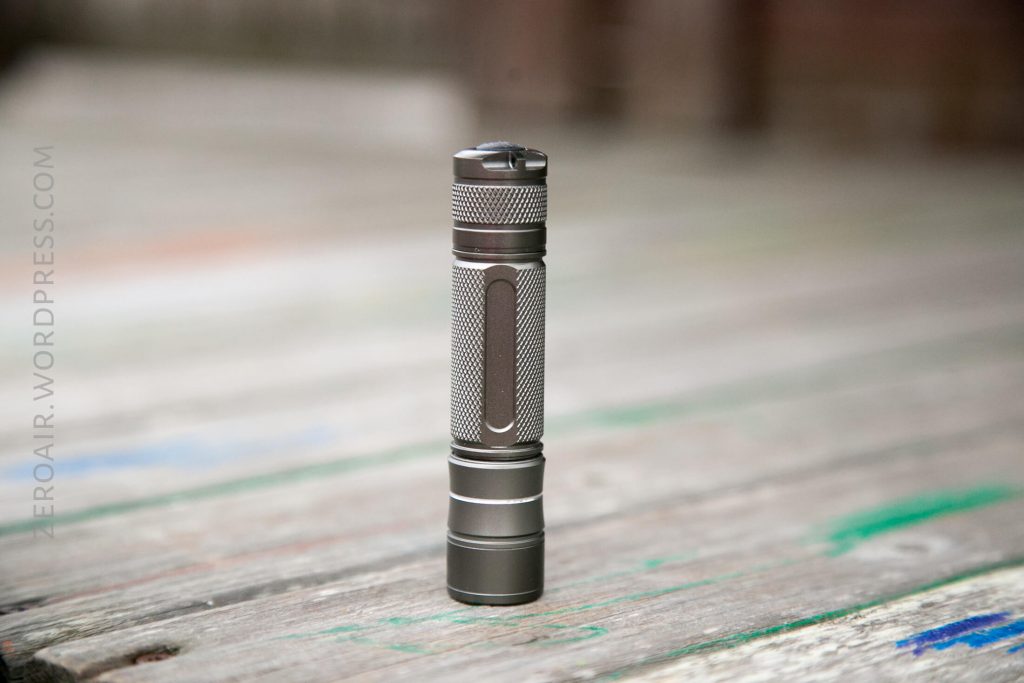

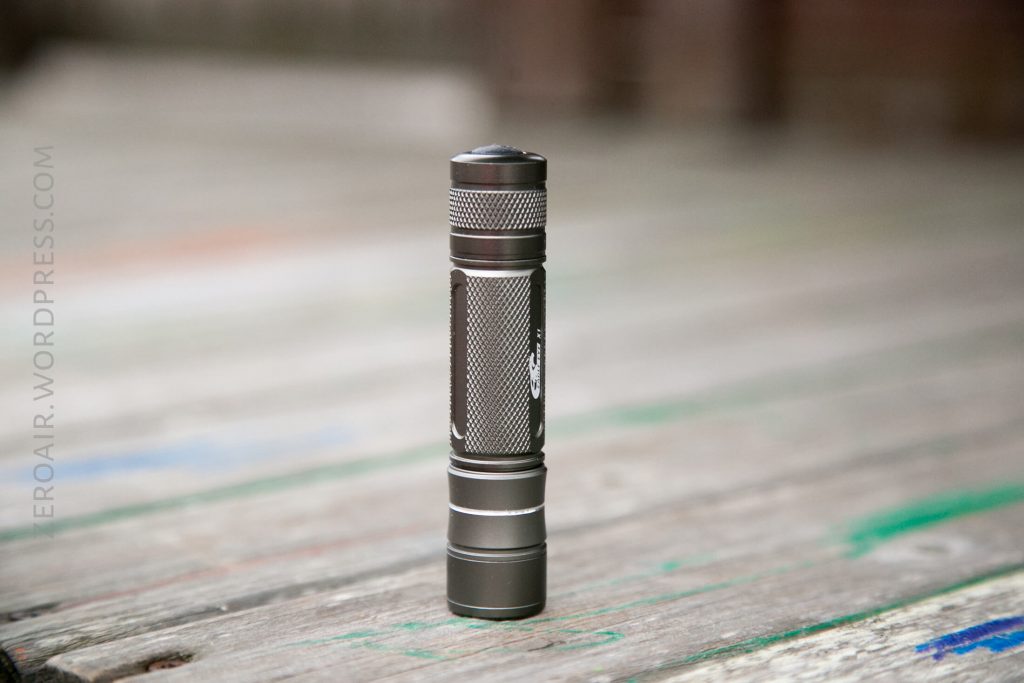

As for disassembly, this one like the light I reviewed before it, is a bit tough to tear down. The tailcap seems very tight – even thread locked. The head unscrews of course, for swapping the cell.
The driver is held in by a circlip. With the right tool, that should come out very easily, allowing access to the driver.
Size
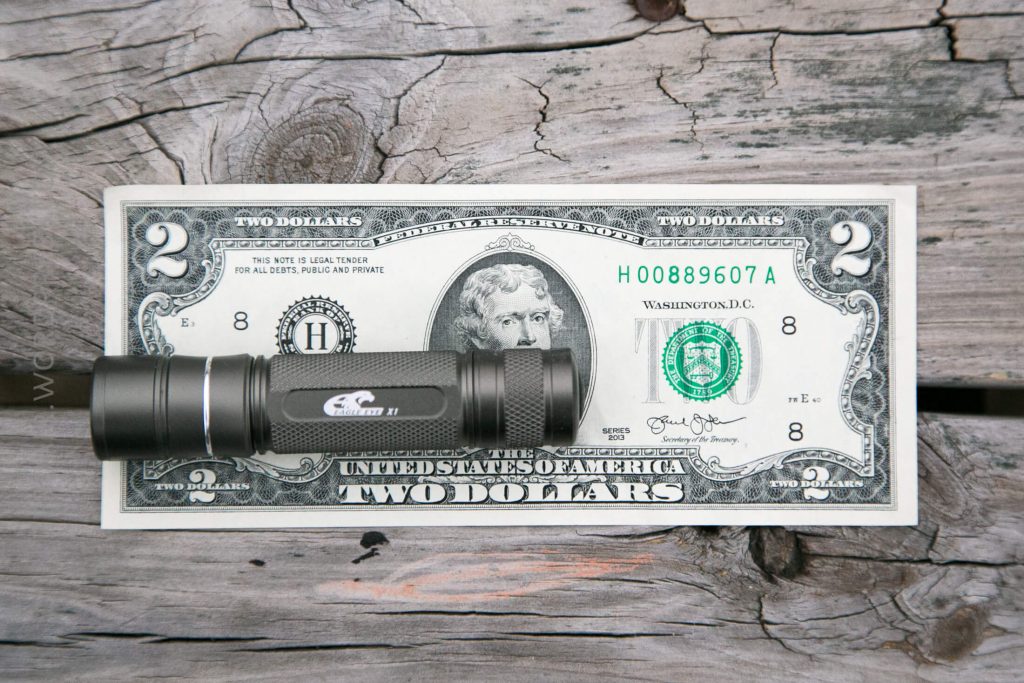
Officially 9.30 x 2.00 x 2.00 cm. It’s not the smallest AA light I’ve seen, nor is it the largest.

Retention
This is a pocket light plain and simple. There’s no pocket clip, and really not even a good connection point for one. There’s no lanyard, though there is a loop on the tailcap where a lanyard could go. The included split ring would indicate that this is a good keychain light, but it seems a little big for that.
Power
The X1 runs on AA-sized cells. It’ll work with AA (primary), NiMH, or 14500 (Li-Ion) cells. I’ve tested with an Eneloop and an unprotected Efest 14500. Note that there is no LVP on this light – in both tests output stopped when the cells were around 0.9V. That’s fine for NiMH, but that’s not good at all for Li-Ion. As such I wouldn’t really recommend carelessly running 14500’s in this light. It should, however, work with longer cells, including protected 14500’s.

Between 80 and 90 minutes, I stopped the test to check the cell voltage.
User Interface and Operation
There’s a single button on the light; a reverse clicky tail switch. The metal tailcap is a bit rounded, and the button itself is proud. This light will in no way shape or form tailstand. Also the button is nearly flush with the tailcap, and really a bit hard to press. It’s plenty big, but it’s an unusual setup for mechanical switches (in that it’s so protected).
The user interface doesn’t really lend itself to my normal table style.
Here’s the UI: Click for on.
Now that doesn’t cover the modes, does it…. well there are only two: high and low. To switch between them: loosen the head for low, tighten for high. I found the low to be hard to hit (it’s a small zone) with an AA but strangely seems to work much better with 14500.
I want the user interface to work much better than it does, but it’s just not great. The twisting to low is very much too specific and hard to hit, and when it’s near the right zone it flickers on and off.
LED and Beam
The emitter of choice in this Eagle Eye X1 is a Cree XP-G2, at 5000K. The lens is a stippled TIR, which softens the edges of the beam quite a bit. This is very much like the TIR on the Nitecore TINI which I just reviewed. I like TIRs a lot, and this one is fine. One thing I typically like about TIR is the hard edge with little spill, on a generally broad spot. The stipples ruin that for me. Still a good beam, though.
Beamshots
These beamshots always have the following settings: f8, ISO100, 0.3s shutter, and manual 5000K exposure. These photos are taken at floor level, and the beam hits the ceiling around 9 feet away.
14500:


AA:


Tint vs BLF-348 (KillzoneFlashlights.com 219b version) (affiliate link)
I keep the test flashlight on the left and the BLF-348 reference flashlight on the right.
14500 in the left photo, AA (NiMH) in the right.


Random Comparisons and Competitive Options
Here’s a relevantly filtered page on parametrek.com. There’s some good competition in this category, but nothing as inexpensive. For example the Fenix LD11 also has a tailswitch but the modes may be cycled by the switch.
Conclusion
What I like
- Multi-chemistry support
- Steady output with NiMH
- No strobes
- Fairly small
What I don’t like
- Twisty user interface isn’t good
- Tailcap switch is too hard to press
- Only two modes
- No pocket clip option and no lanyard included.
Notes
- This light was provided by GearBest for review. I was not paid to write this review.
- This content originally appeared at zeroair.org. Please visit there for the best experience!
- For flashlight-related patches, stickers, and gear, head over to PhotonPhreaks.com!
- Use my amazon.com referral link if you’re willing to help support making more reviews like this one!
- Please support me on Patreon! I deeply appreciate your support!
I like how you layout your review and the wood background for your photos. On top of that nice detailed review thanks
Thanks, @thegearguysblog!!
Nice and detailed review, thank you very much. I agree with your findings beside your UI description: The clicky can be used for mode switching, there is no twisting necessary – however it works if someone likes to switch this way…Beside that the light has no memory (always starts on low after > 1 sec off), the driver is whining loud on low.