
Imalent RT35 Flashlight Review
The Imalent RT35 flashlight runs up to four 18650 cells. The deep smooth reflector gives great throw with the Cree XHP35 HI emitter. Read on!
Official Specs and Features
Here’s a link to the Imalent RT35 Flashlight product page.
Versions
Just the one!
Price
The light is MSRP of $125ish, but is priced at just over $100 at FastTech right now. There’s also a kit that includes cells for $150. If you don’t already have cells, this could be a good option. The cells I used in this review were sponsored by LiIonWholesale and are protected MJ1 cells. (Buying from LiIonWholesale would end up being a little cheaper than the kit, to be sure.)
Short Review
I now have a few handheld (4×18650, that is) throwers. I think this one’s my favorite. It’s not perfect, but I like it a whole lot.
Long Review
The Big Table
| Imalent RT35 | |
|---|---|
| Emitter: | Cree XHP35 HI (-) |
| Price in USD at publication time: | $100 |
| Cell: | 4×18650 |
| Turbo Runtime | High Runtime |
| LVP? | Yes (~3.0) |
| Switch Type: | E-Switch |
| Quiescent Current (A): | ? |
| On-Board Charging? | Yes |
| Chargetime | |
| Power off Charge Port with no Cell? | ? |
| Claimed Lumens (lm) | 2350 |
| Measured Lumens (at 30s) | 1988 (84.6% of claim)^ |
| Claimed Throw (m) | 1338 |
| Candela (Calculated) in cd (at 30s) | 11120lux @ 6.058m = 408097cd |
| Throw (Calculated) (m) | 1277.6 (95.5% of claim)^ |
| All my Imalent reviews! | |
^ Measurement disclaimer: Testing flashlights is my hobby. I use hobbyist-level equipment for testing, including some I made myself. Try not to get buried in the details of manufacturer specifications versus measurements recorded here; A certain amount of difference (say, 10 or 15%) is perfectly reasonable.
What’s Included

- Imalent RT35
- Nylon pouch
- Charge cable (proprietary)
- Lanyard
- Spare o-rings (2)
- Paperwork
Package and Manual
This light is in a cardboard box, just like some other big Imalents I’ve had. There’s a plastic handle. The box has a sticker label with lots of printing, including a photo of the light and specs, etc.
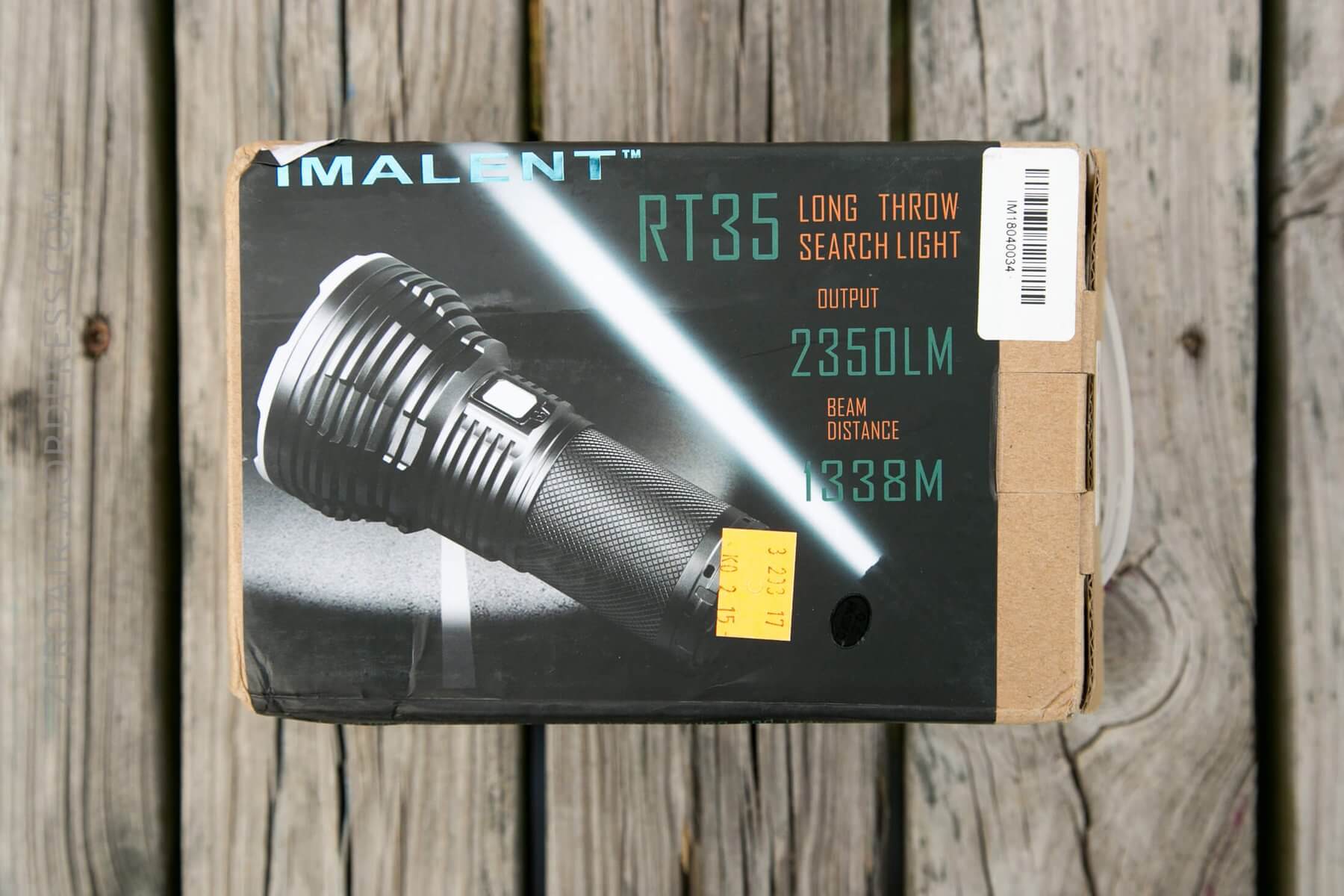
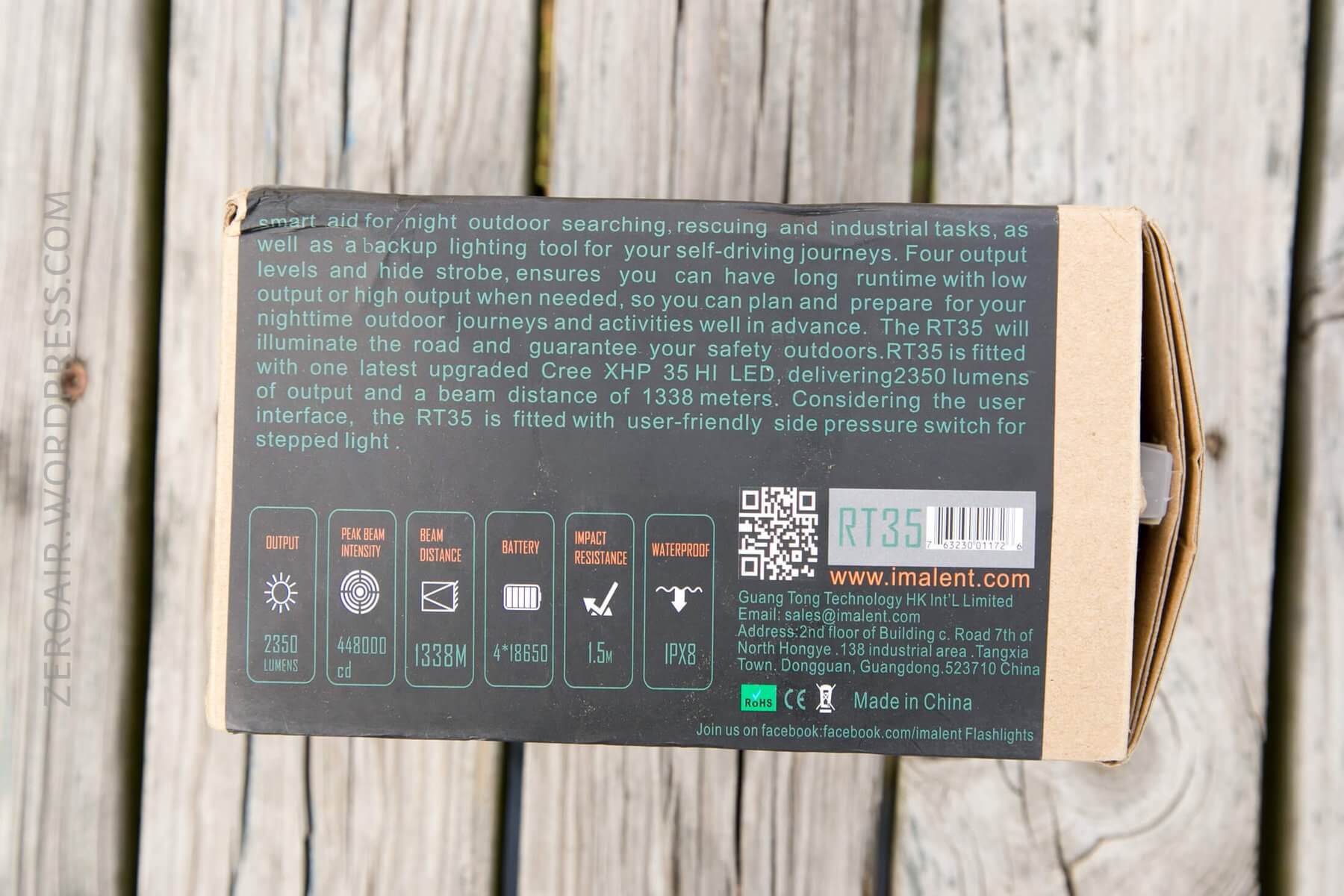

The manual has similar information to the box, and is a good manual. Printing is not great, but the information is fine.

Don’t forget to remove this film from the lens! It peels off cleanly.

Build Quality and Disassembly
I’m satisfied with the build quality of this light. Normally, I say I don’t like 4-up lights with cell holders, but I see why they’re preferred. Lights like this one (with no cell holder) are harder to get tightened down properly. That’s the case with this light, though I still managed just fine.
Otherwise, the build quality is great. I like all the fins on the head and body. I like the way they look, and they’re functional too.


The RT35 has a metal switch on one side and the charge port on the other. For what it’s worth, I never had any issue confusing these two things. They’re different enough in feel to be distinguishable. I’ll talk more about the switch later, but suffice to say that [while it’s not perfect] I love it.
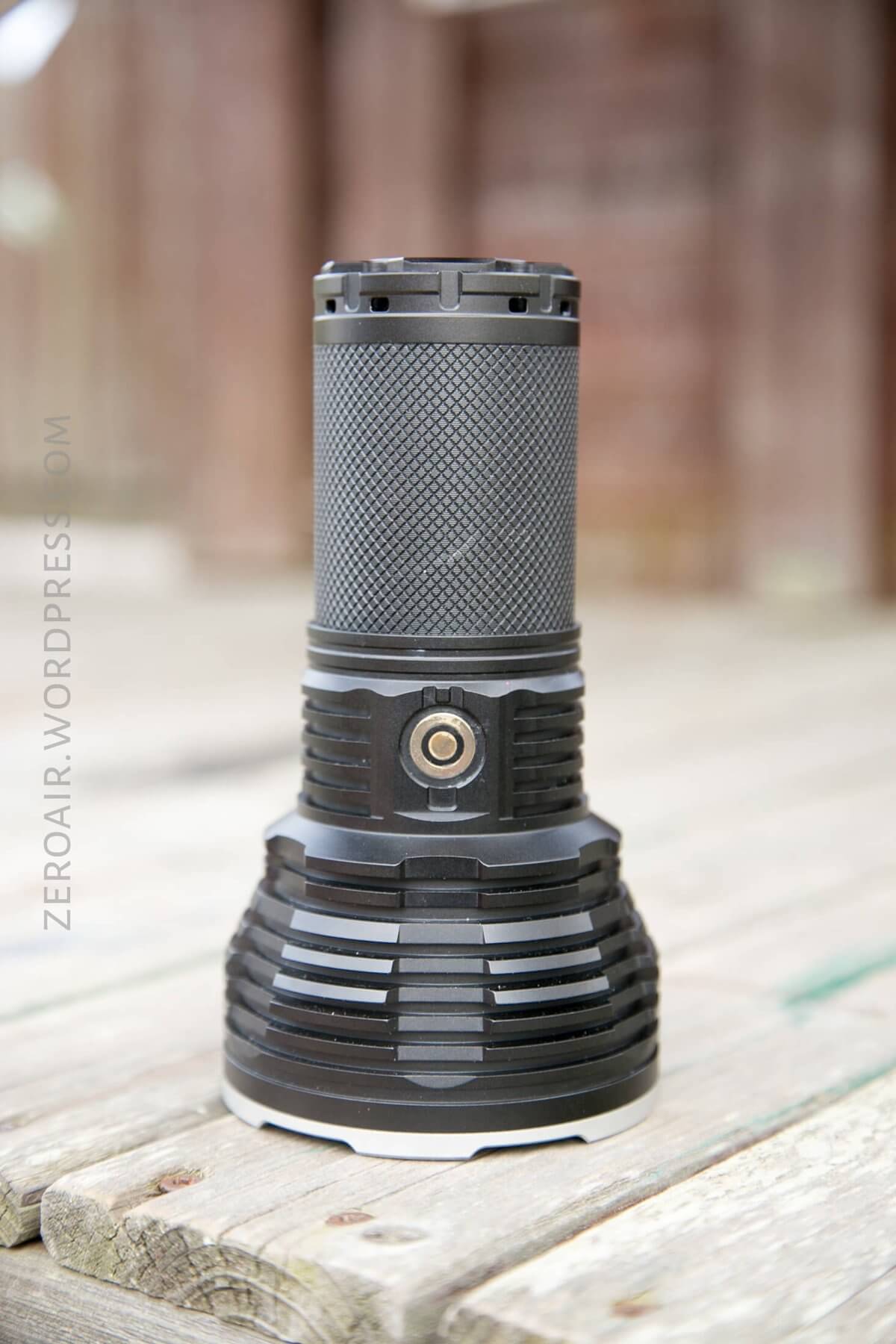
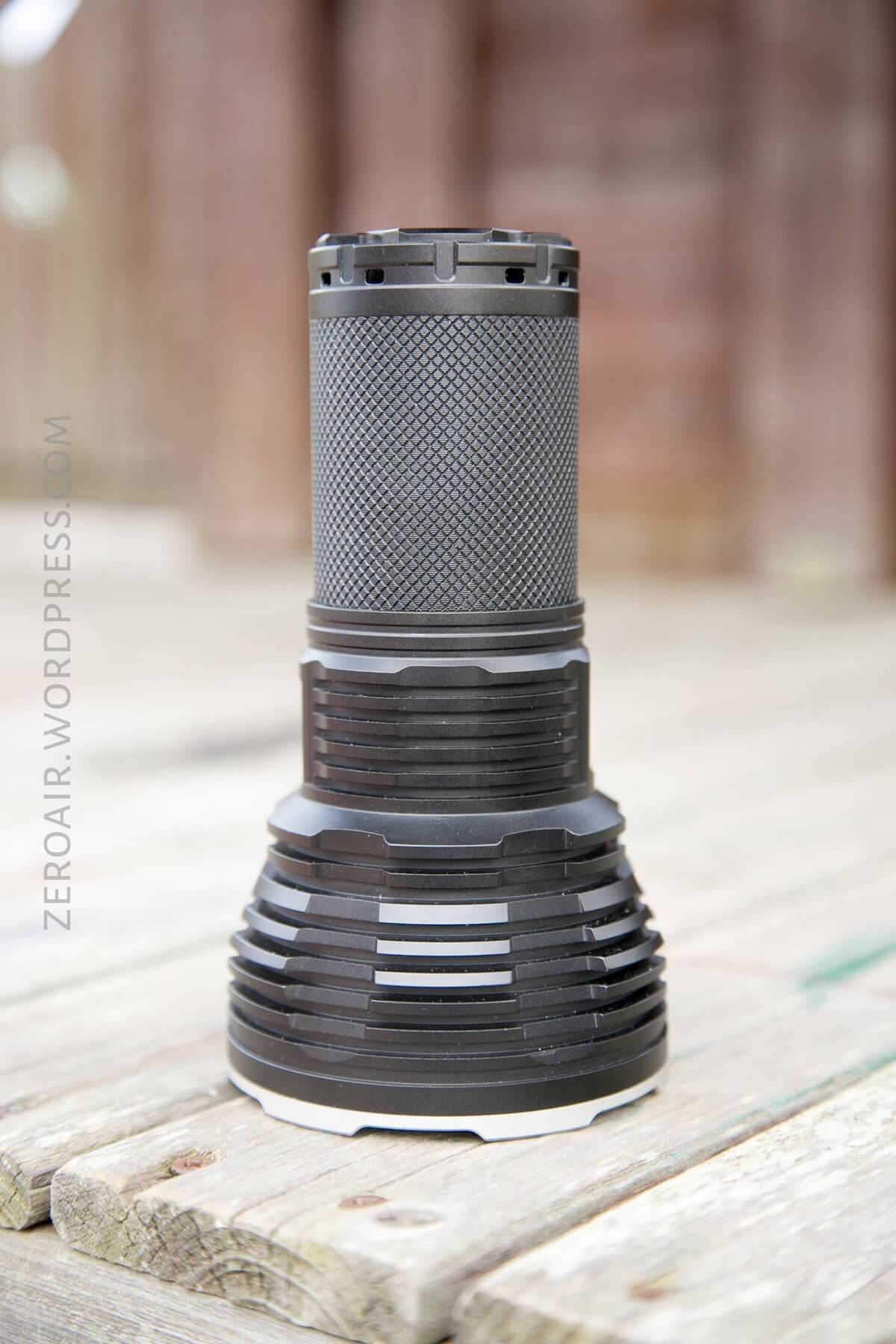
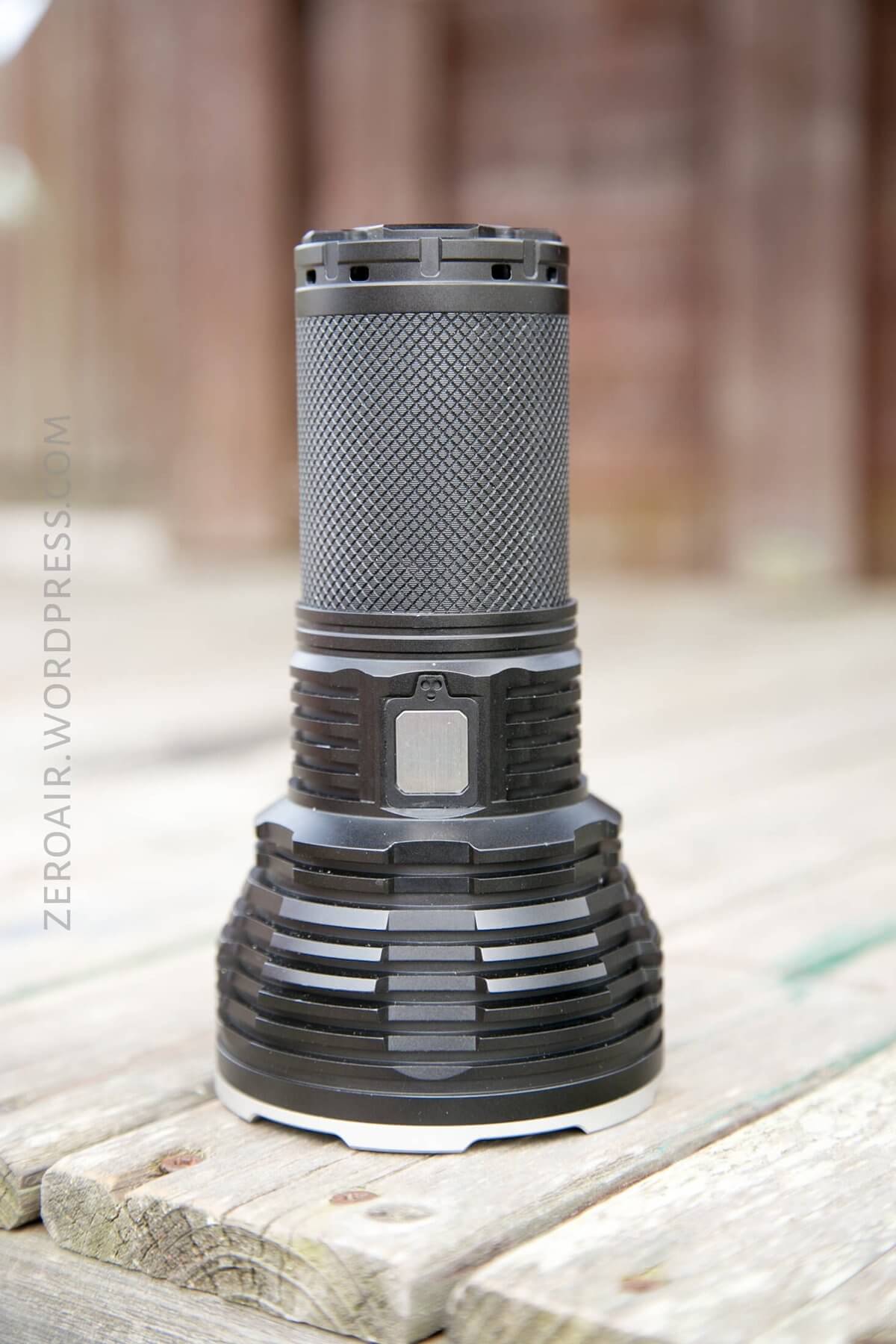

I didn’t disassemble the light further than this.


The knurling isn’t aggressive at all. Couple that with what I mentioned about tightening the parts together (and that this doesn’t have a cell holder), and it can take some effort to get the parts tightened down properly. In this case, I wouldn’t ask for knurlier knurling, but maybe that the tailcap unscrewed instead of the head/body.

Size
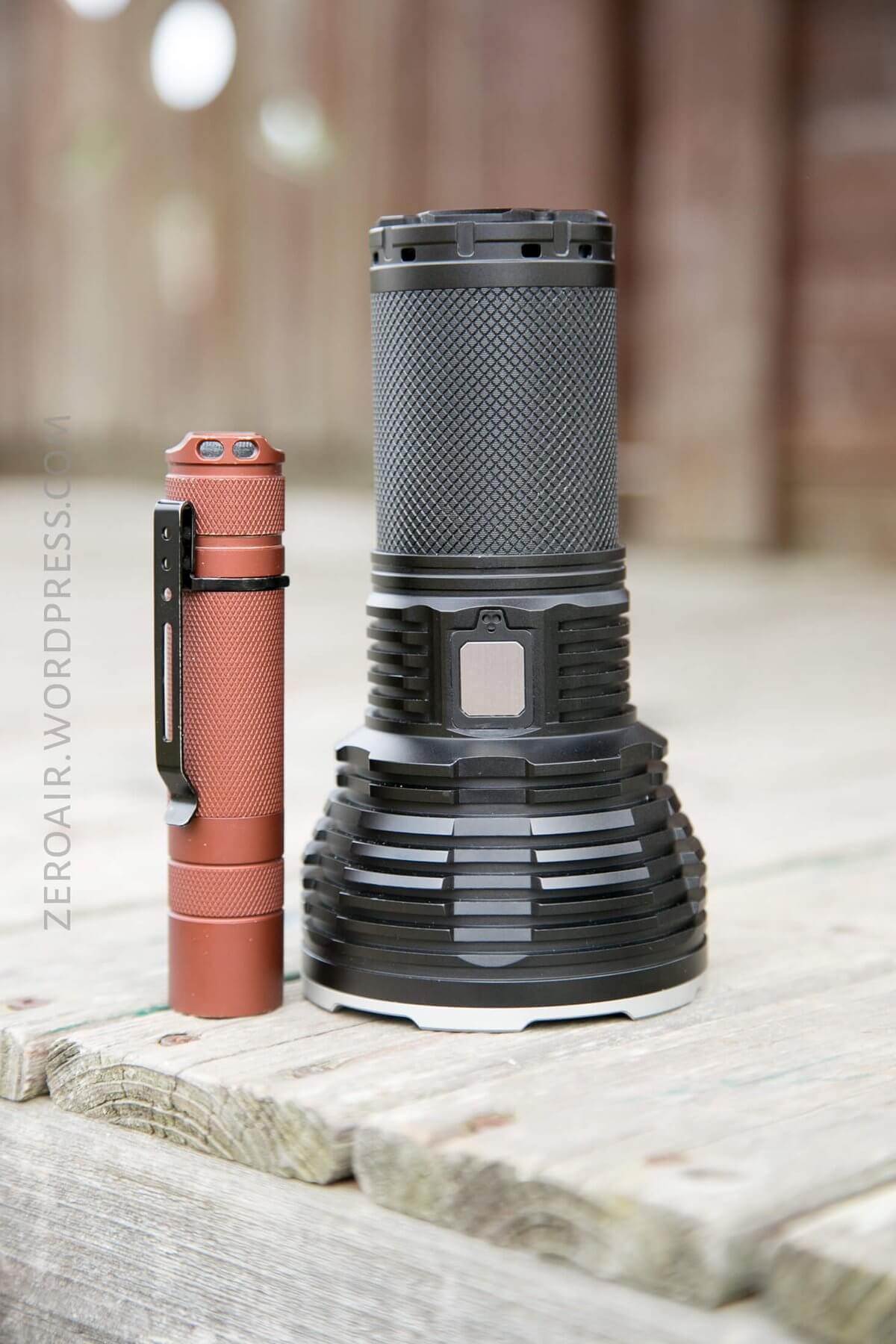
Officially: 161mm (length) * 86 mm (head diameter) * 51 mm (body diameter). As far as can light throwers, this light is pretty small!
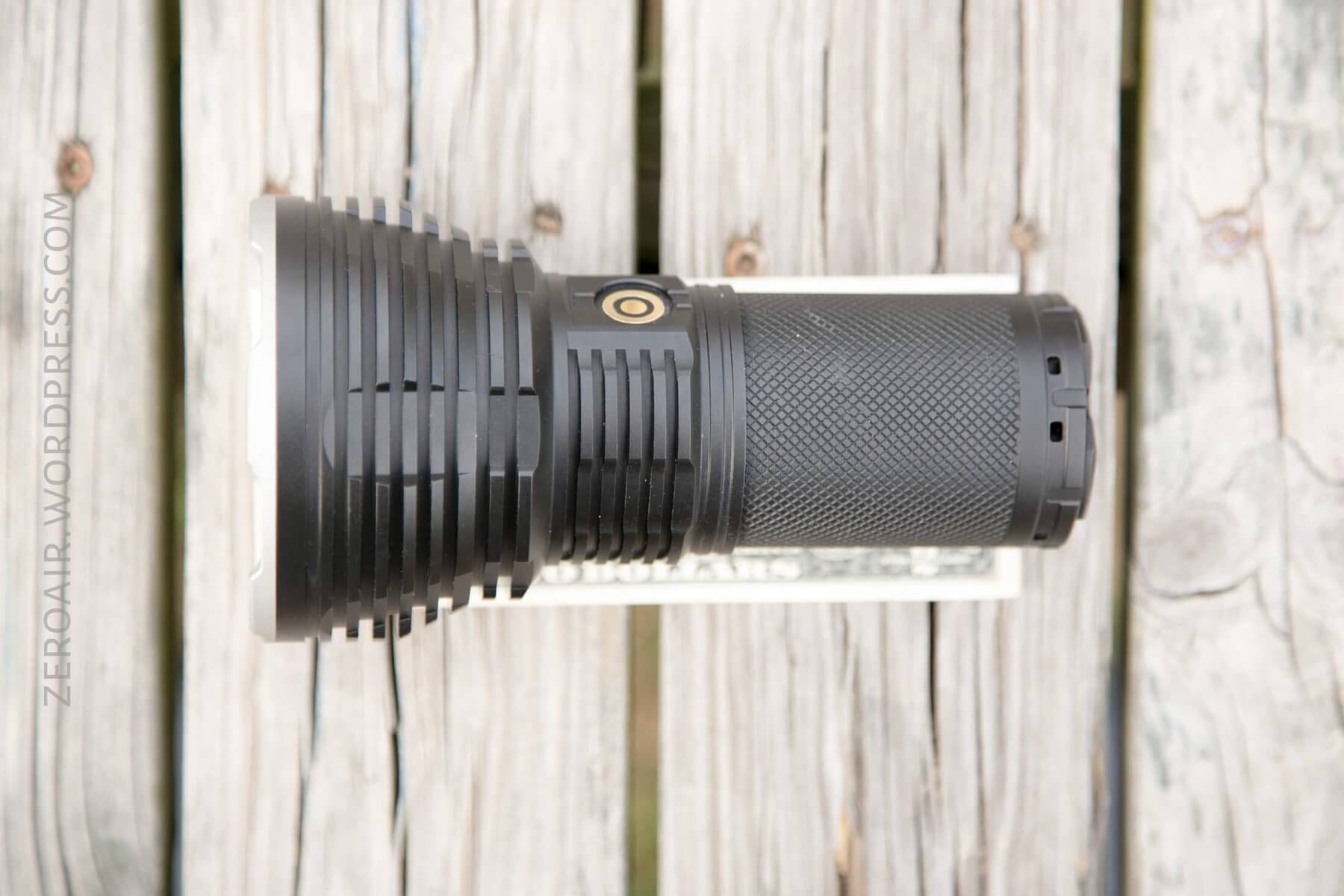


Here’s the RT35 beside the DX80.
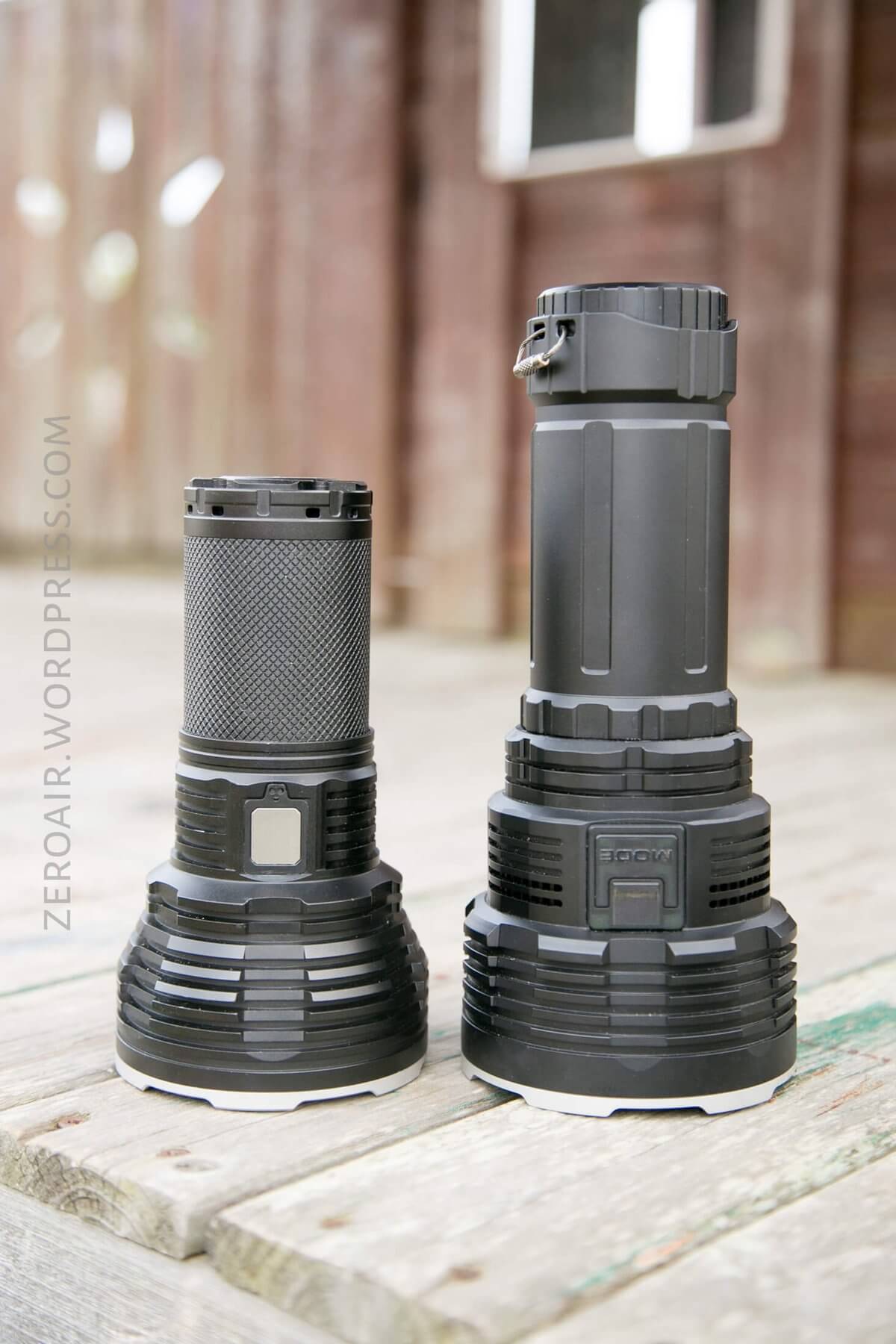
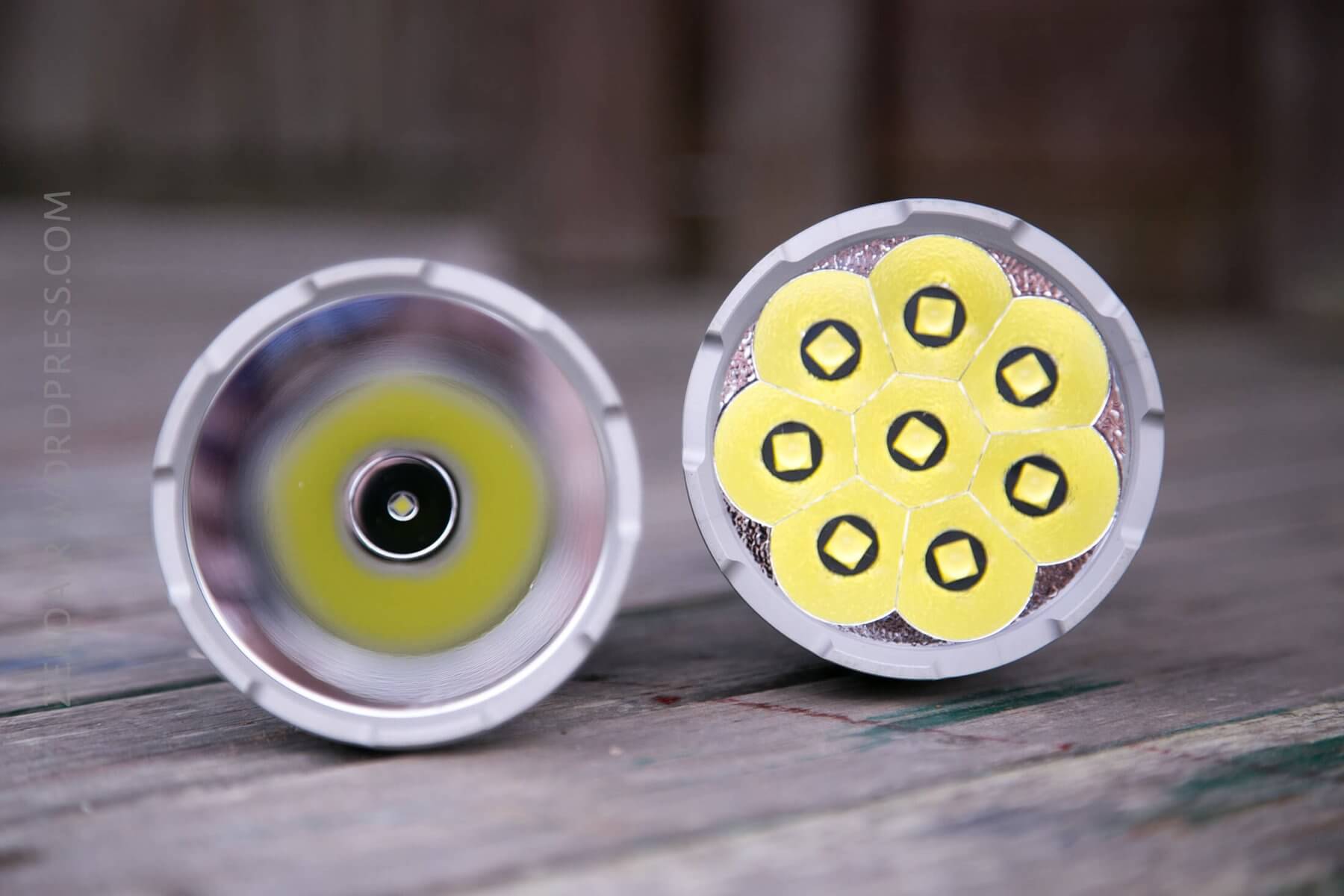
And beside the Convoy S2+.

Retention
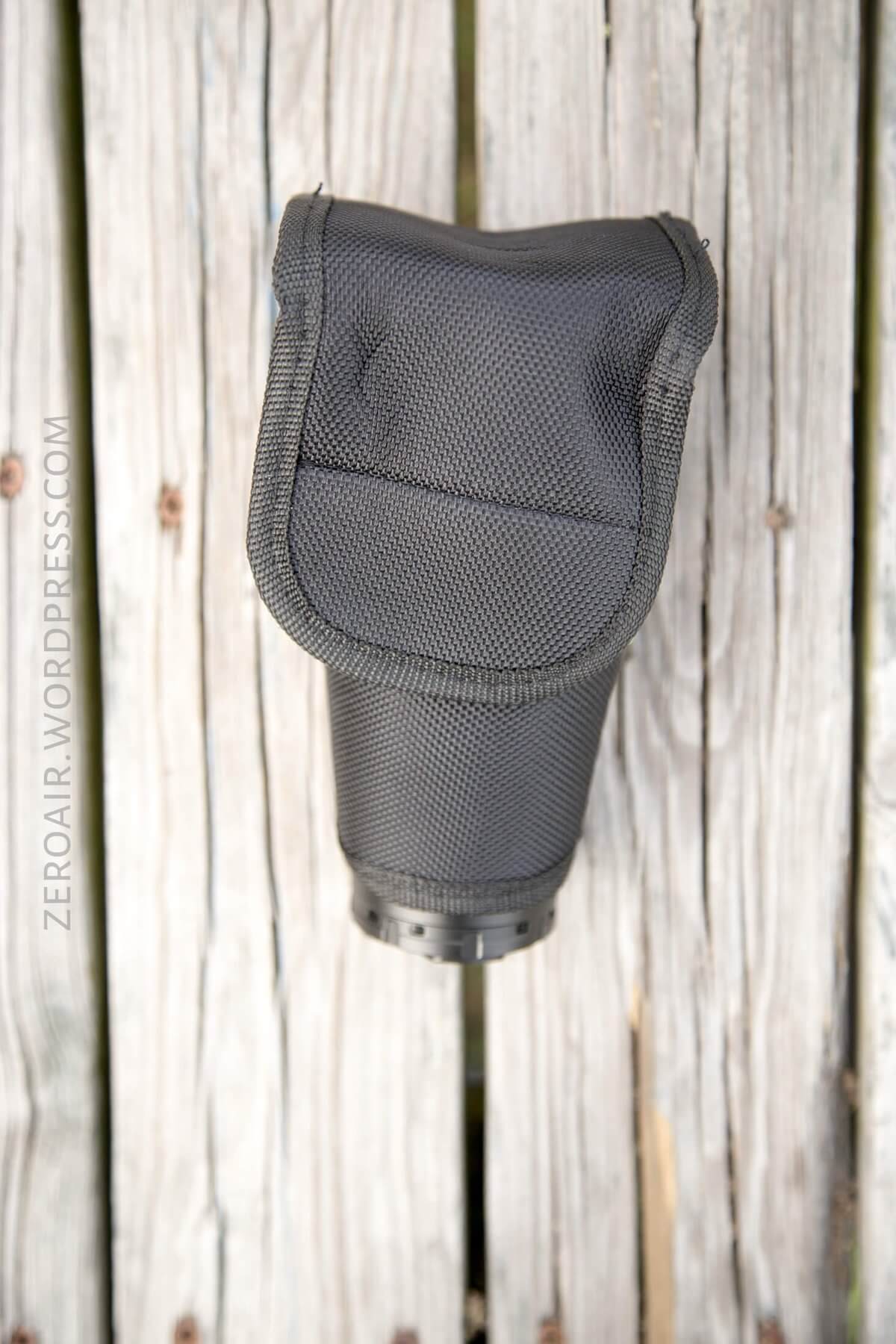
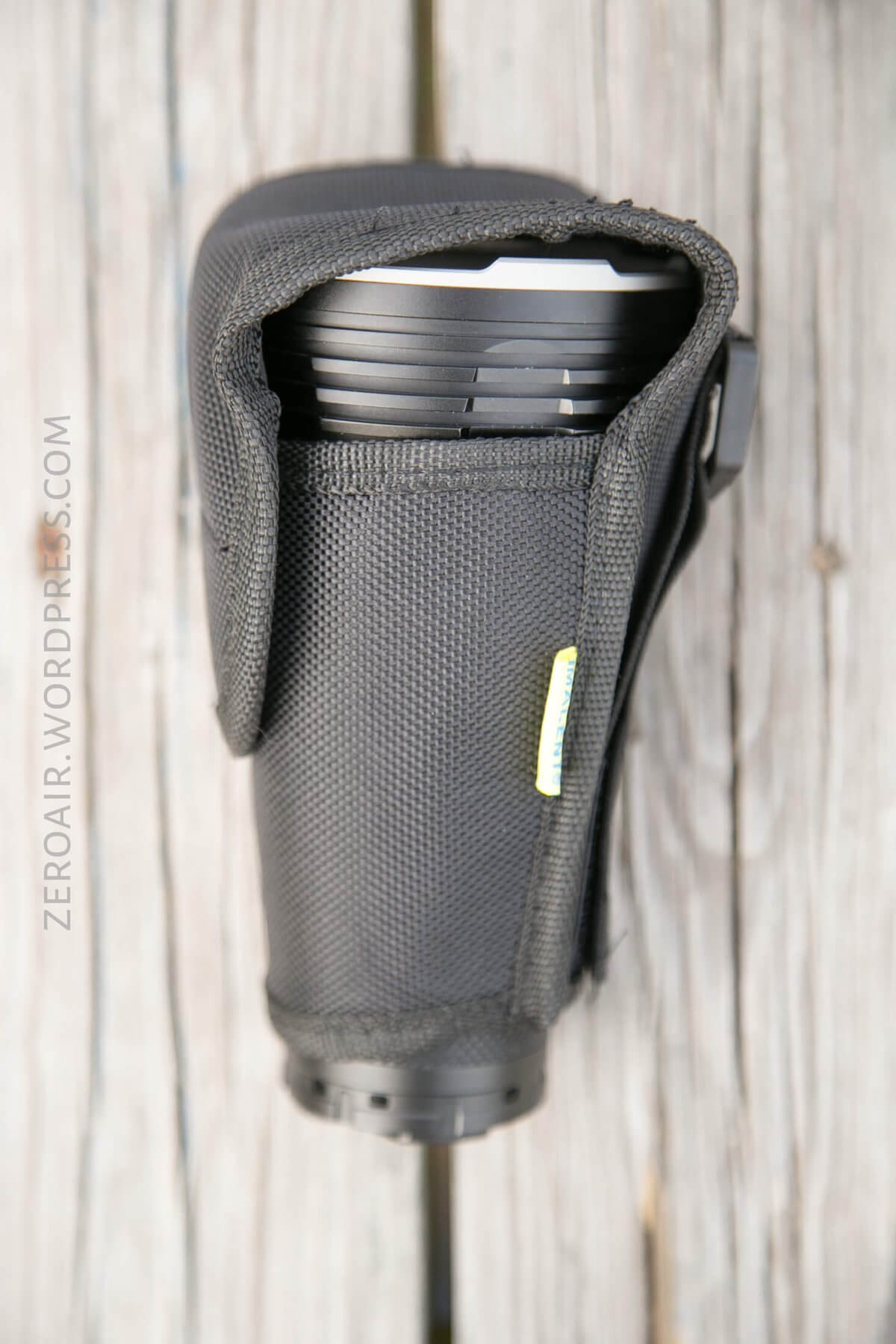
Imalent includes a directional nylon pouch. The bottom is open, and the light hangs out a little. The straps are double, with one being velcro and detaching at the bottom.


There’s a lanyard included, which connects in these holes in the tailcap.

The lanyard is interesting and unusual. It’s quite a long piece of cord, and it seems as though it’s meant to wrap around the head temporarily during carry, and can almost function as a handhold. It’s an interesting design, and to be sure, I like it. At least as much as the “normal” lanyards, in any case.
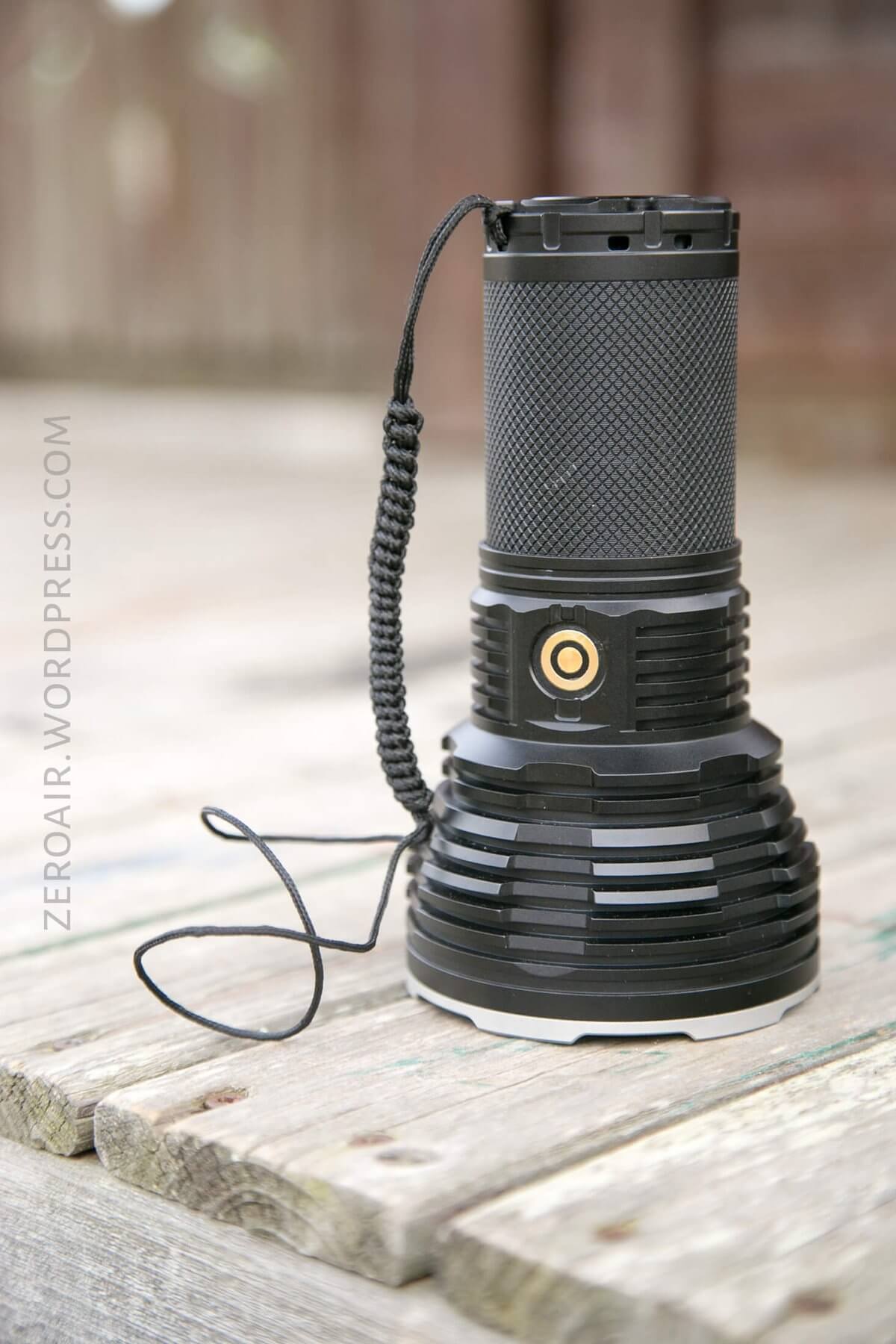
Here’s an example of what I mean: this lanyard can be used as a handle.

Power
The RT35 is powered by four 18650 cells. These cells need to be quite long, but capable of fairly high current. The light pulls 15A on Turbo. Fifteen Amps. That’s not trivial, so you’ll need good cells. The cells I’m using here are specials from LiIonWholesale, sent just for this review. Here’s that cell. It’s a protected MJ1 cell, and it seems to work well in this light.
Be aware that the light actually needs a quite long cell. I had a set of 3 Efest cells that were long enough. But button top 30q cells were not long enough. And the design of the light isn’t conducive to using magnets (ask me sometime how I know that).
So either buy the expensive cells from Imalent in the kit, or buy these less expensive ~10A continuous protected MJ1’s for it.
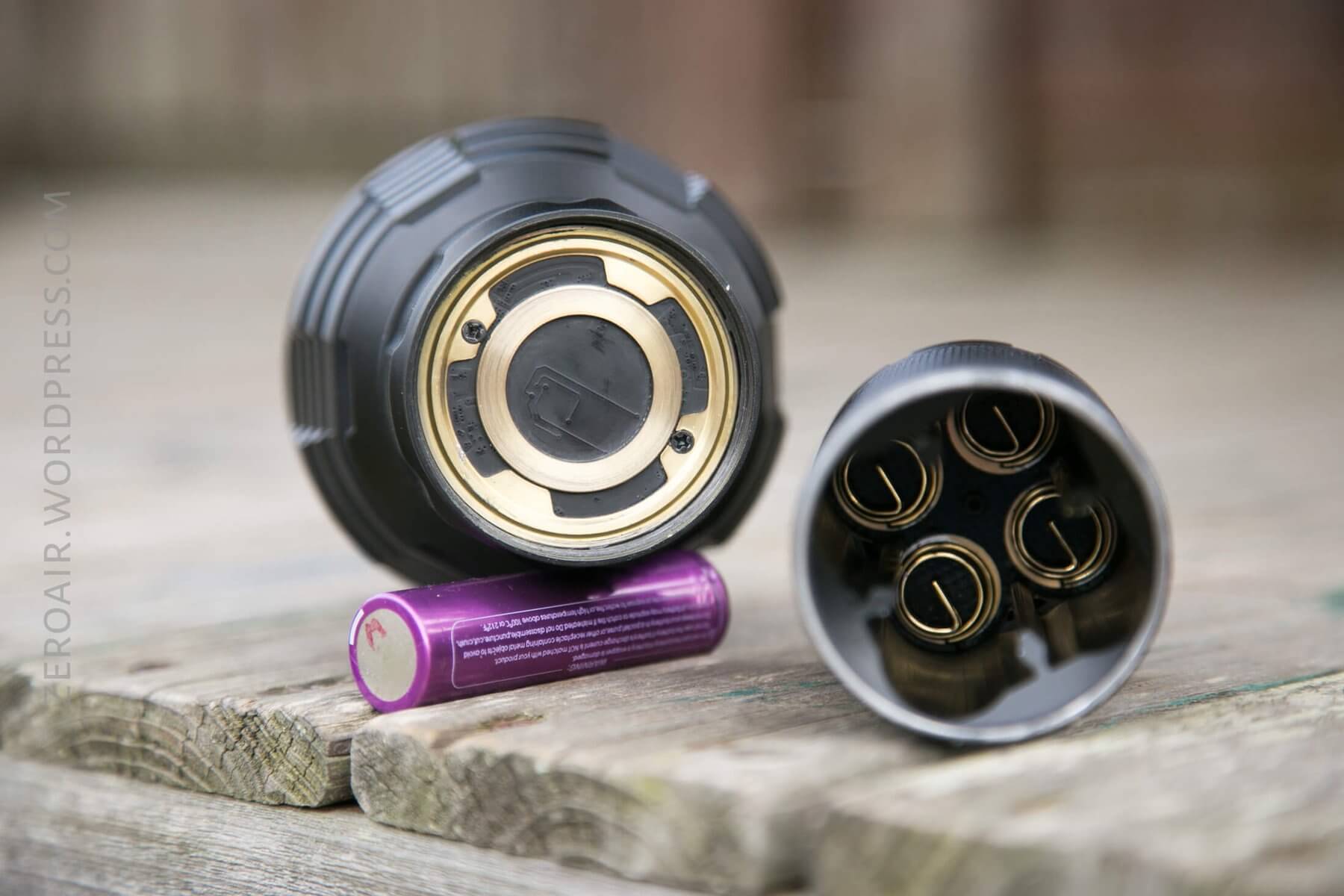
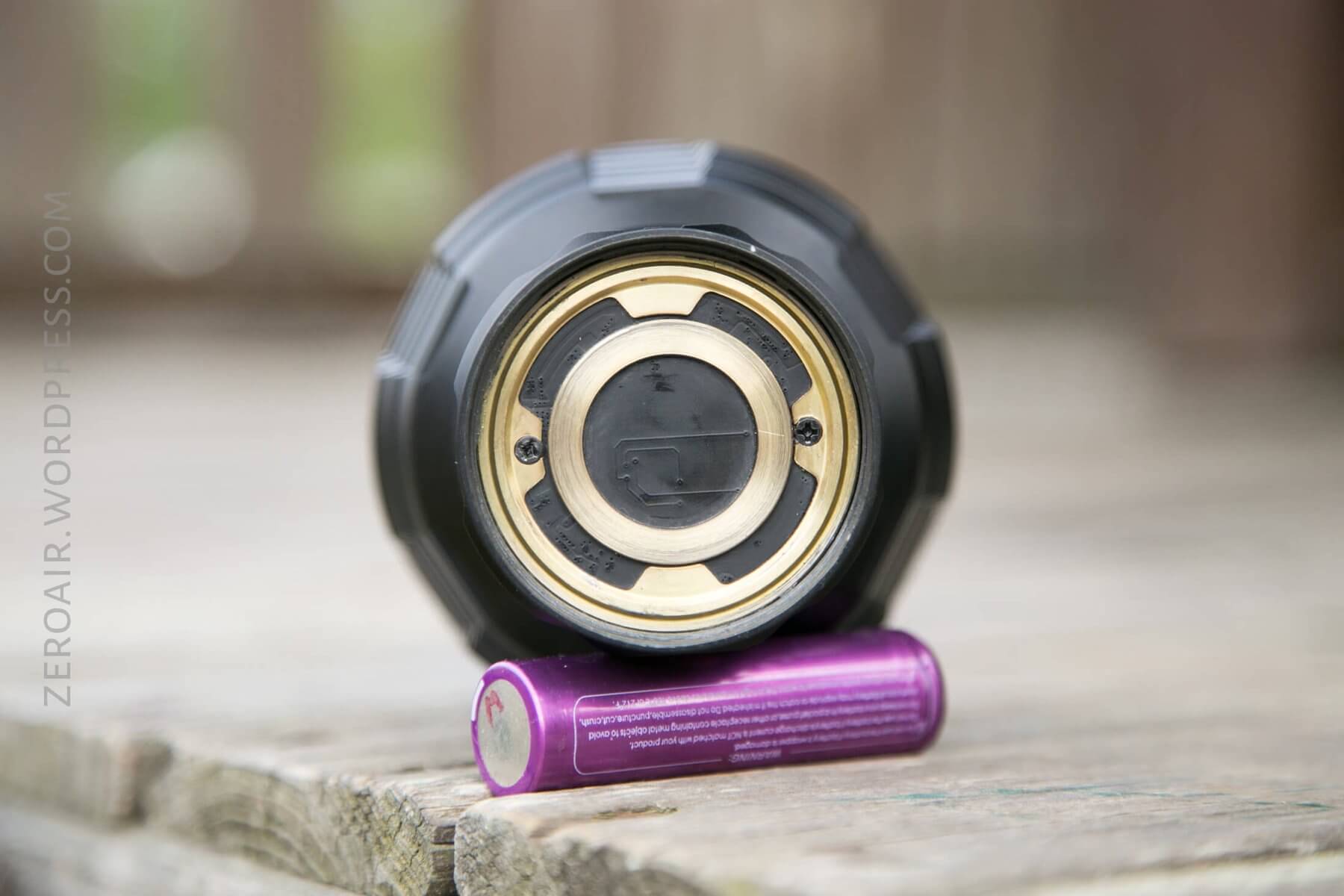
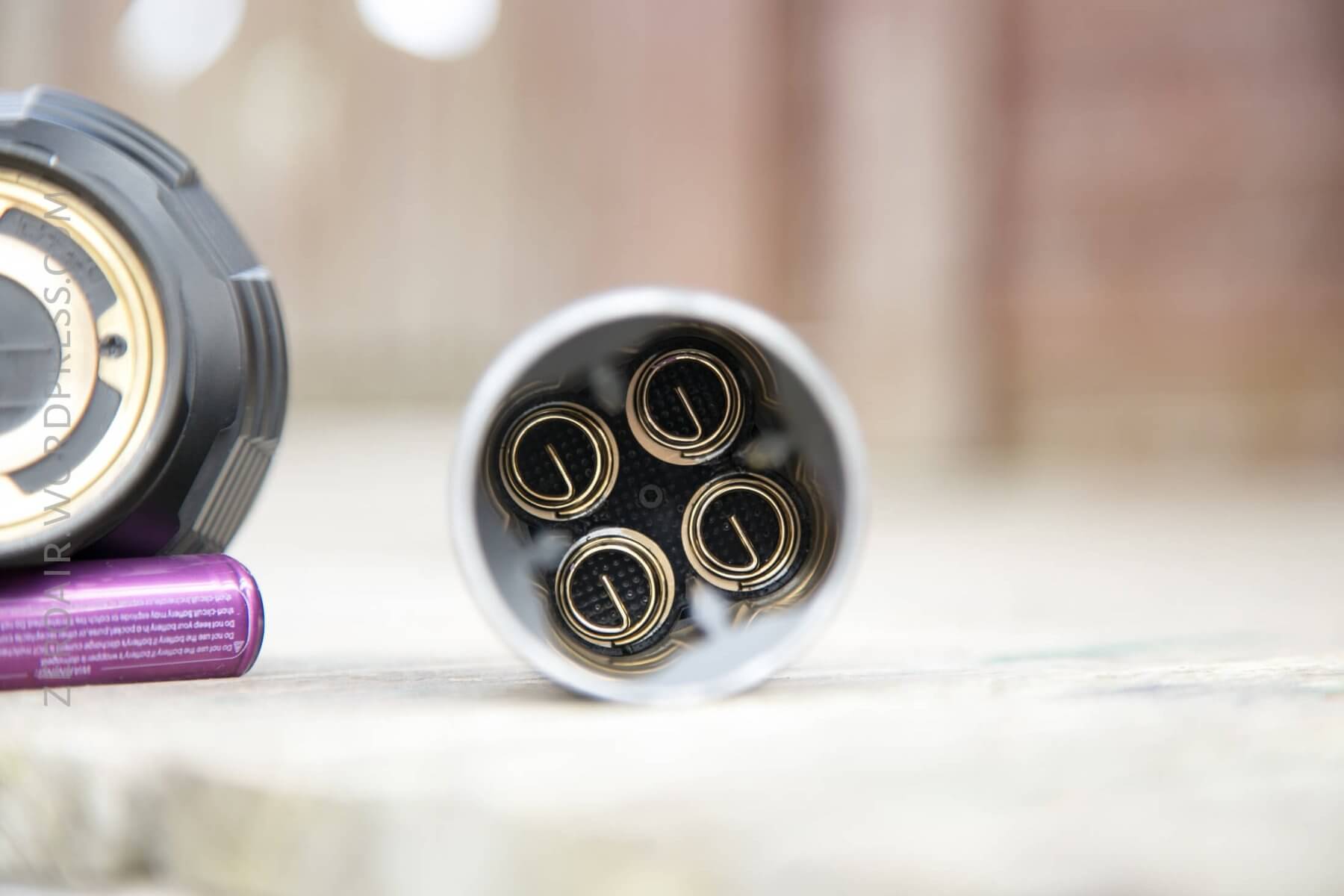
Since these cells are in parallel, the light will actually operate on any number of cells. However, Turbo isn’t accessible with a single cell, but starting with 2 cells, Turbo is available. This could be cell-quality dependent, as 15A is a lot to pull from a single cell.
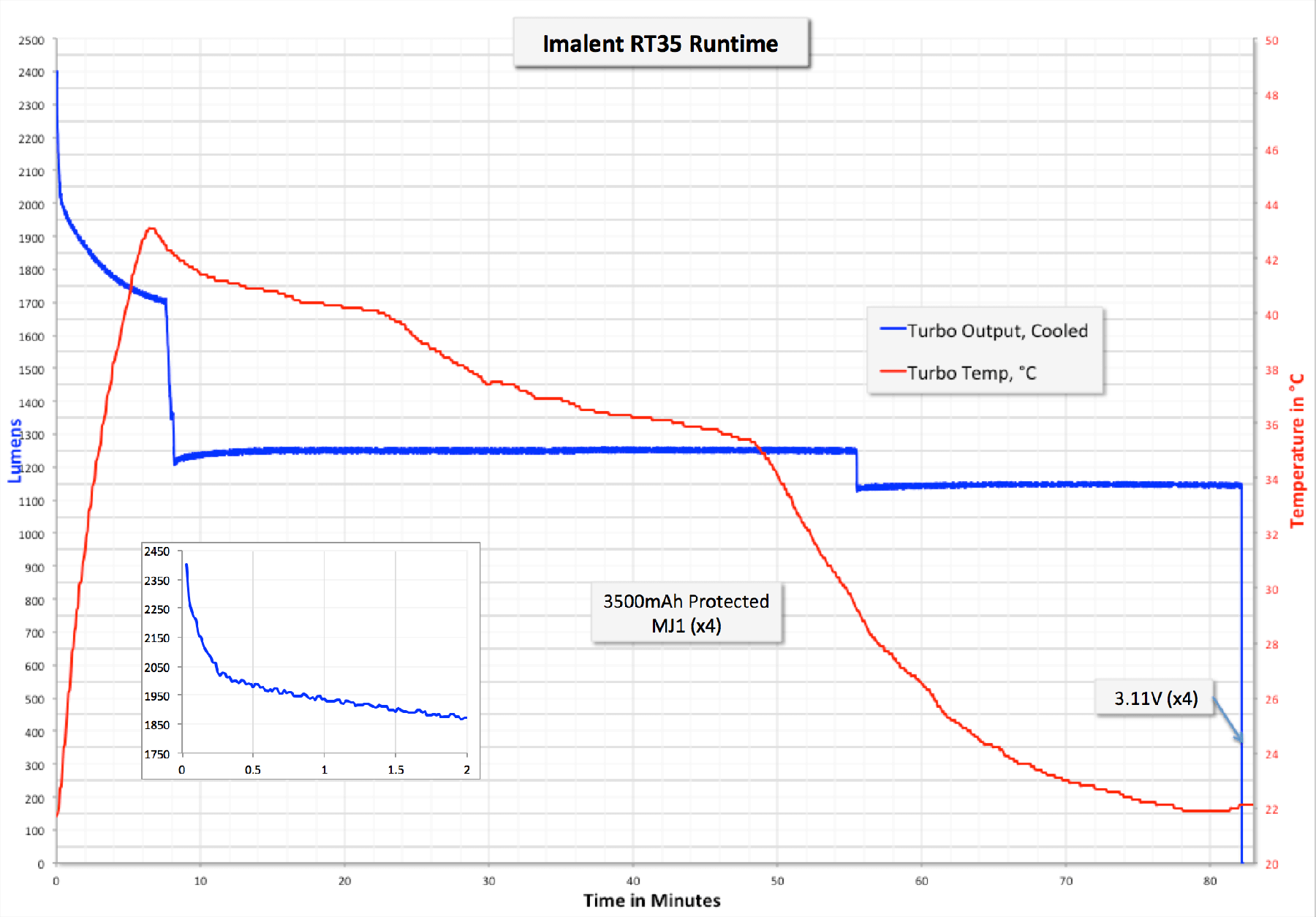
Here’s a runtime on Turbo. I measured the 30-second output at around 2000, which is exactly what the spec claims. And that’s after quite a tumble from the initial output. Imalent says the light is temperature-controlled, and when the light hits 55 degrees Celsius, the output steps down.
At the end of the runtime, the light just shuts off cleanly with no fade out. The switch has an indicating feature that will turn red, then turn blinking red when the cells are at 3.2V. At around 3V (per cell) the light shuts off.
Here’s a runtime on High, which also has a very quick stepdown, but is stable after about 15 seconds. This is approximately 1250 lumens for around an hour. Then stepdown to 550 lumens for another hour +.

Charging
The charger is unfortunately proprietary, but the cable is included. The connector is USB. USB 3.0 would have been fantastic to harness faster charging. But this light already charges at almost 2A, even with just USB 2.0.


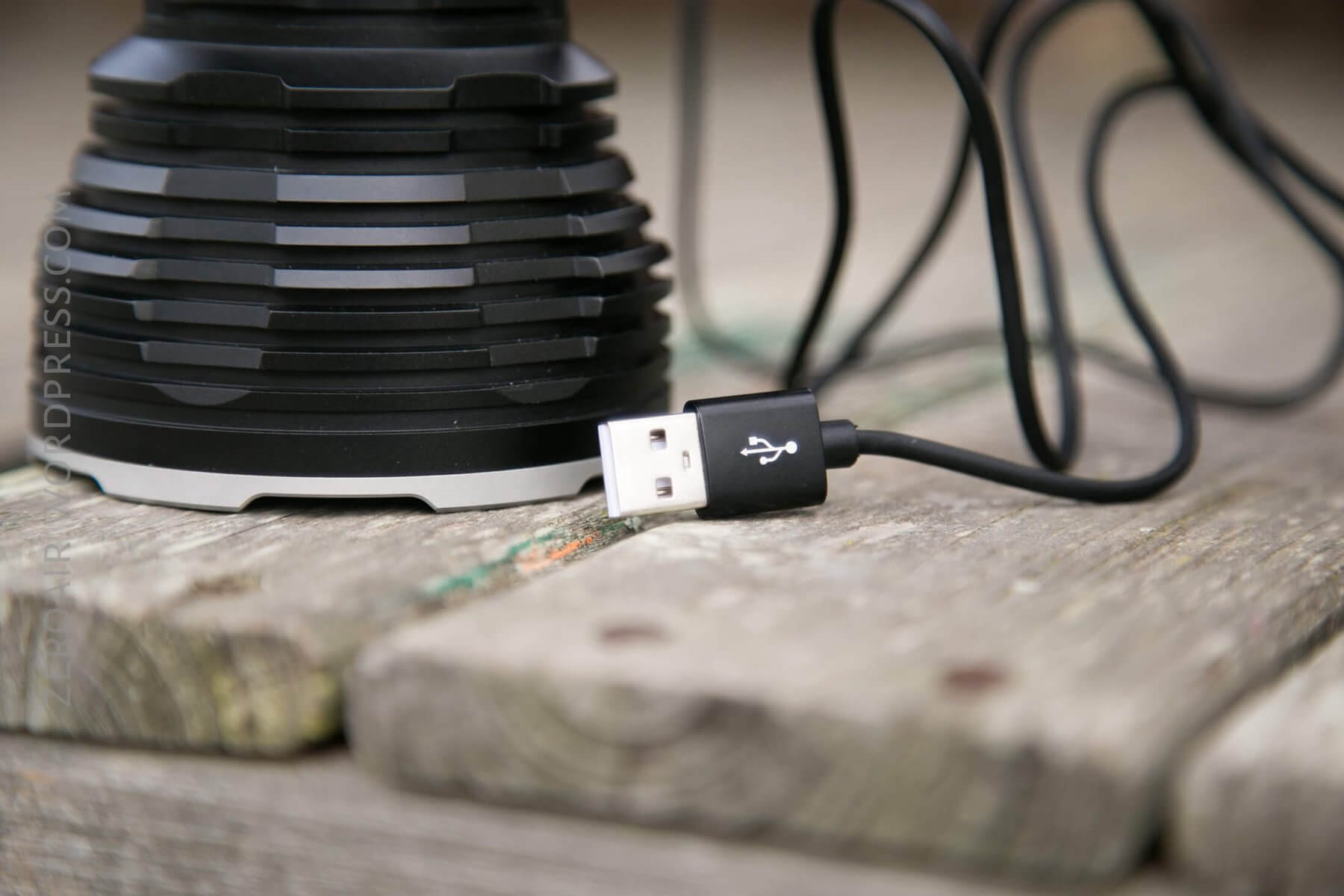
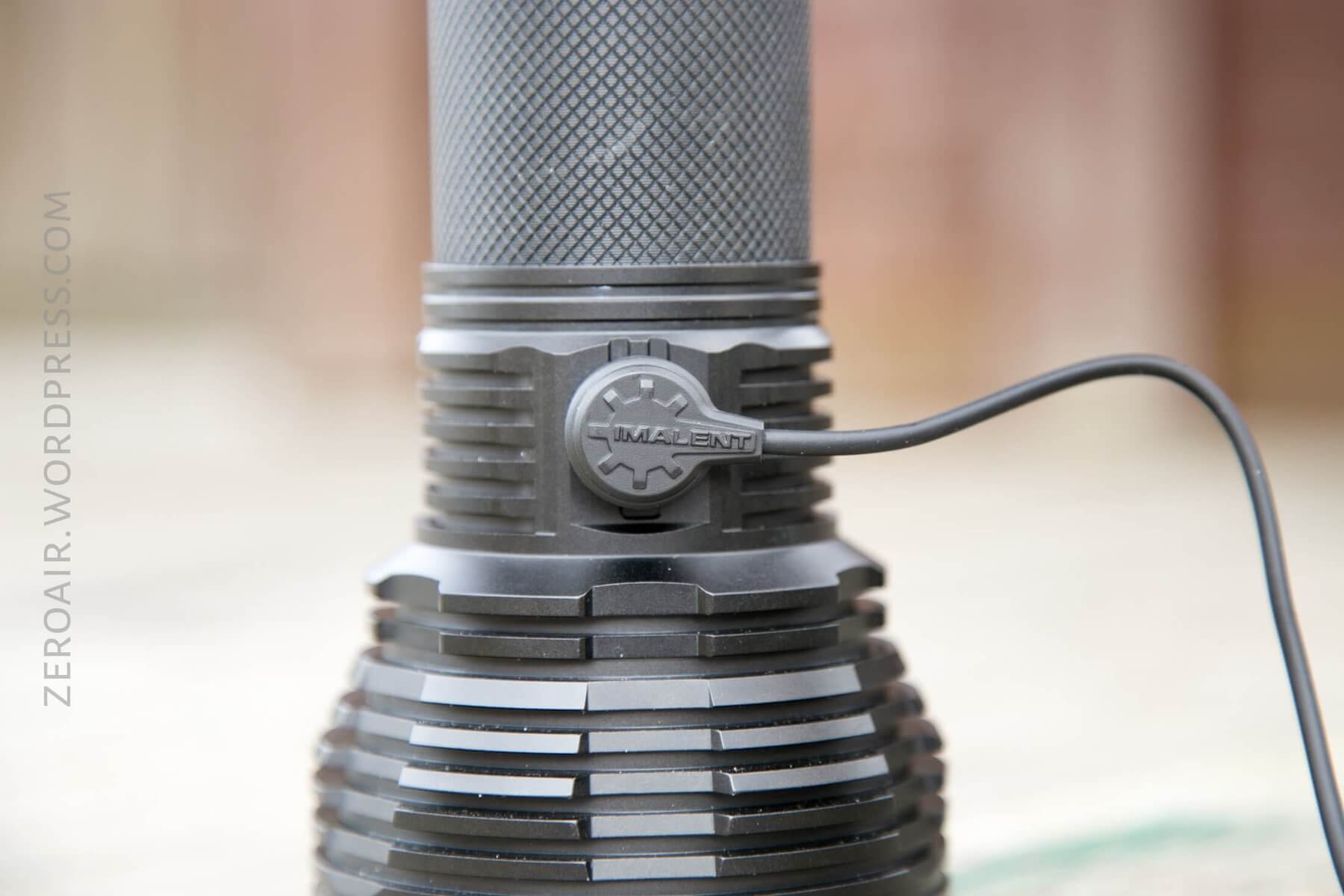
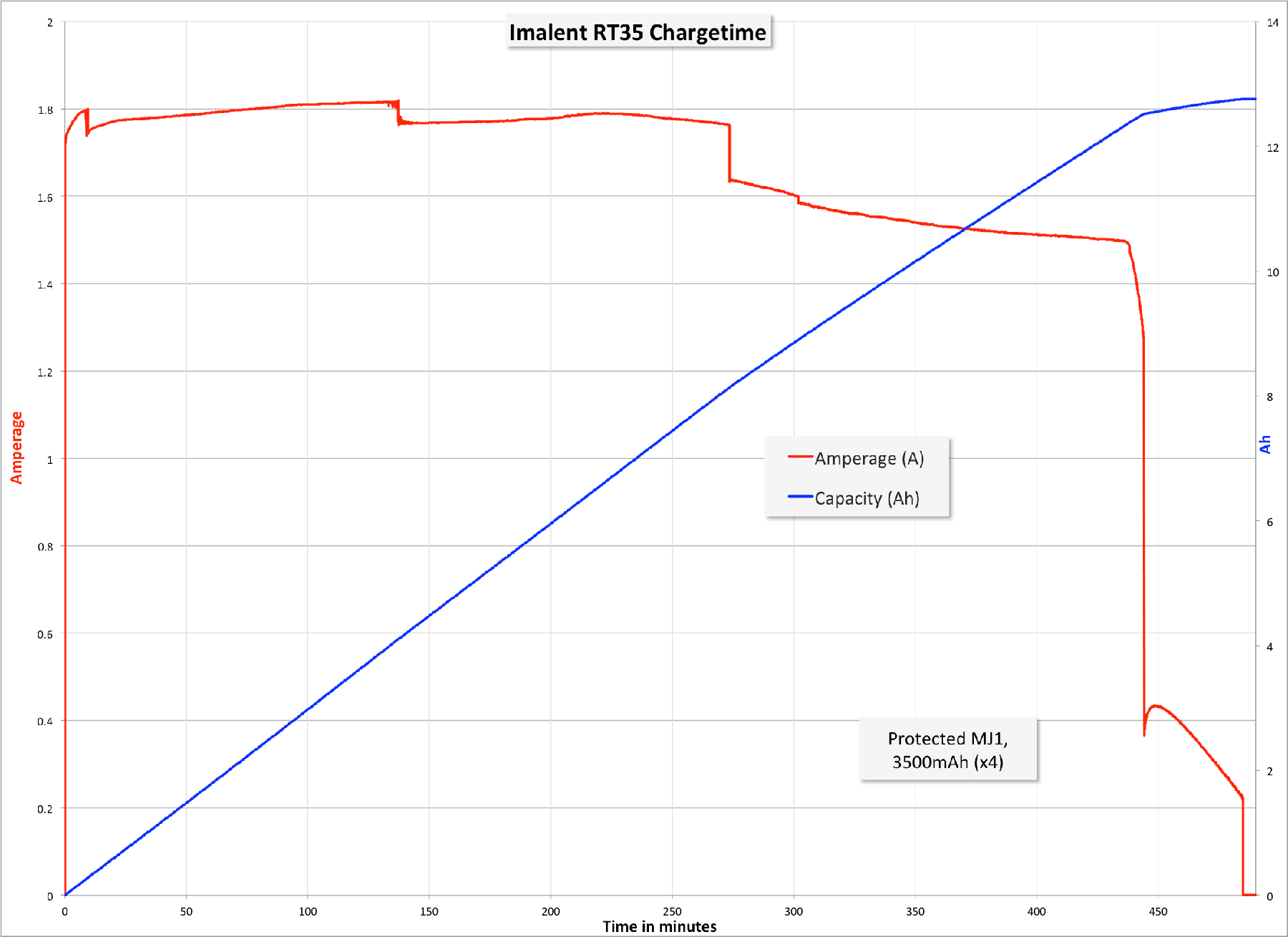
Charging isn’t steady at 2A, but does stay over 1.7A for over 4 hours. Total charge time is around 7 hours to completion, and the cells were around 4.14-4.15V when charging stopped. There is no trickle to the cells once charging stops.
Charging works on any type of cell. It’s the charge connector itself that’s proprietary, not the cell requirement.
User Interface and Operation
The user input comes from a single switch. It’s solid metal, rectangular, and very unusual. Very clicky. The indicator (red and green) is above (below? beside? perspective….) the switch, and stays on when the light is on. Green means the cells have a good charge, but red means the cells are <3.2V.

Here’s the green indication.

Here’s a user interface table!
| State | Action | Result |
|---|---|---|
| Off | Click | On (Mode Memory) |
| Any | Double Click | Turbo |
| On | Click | Off |
| On | Hold | Mode Cycle (LMMH) |
| Off | Hold (>3s) | Lockout |
| Lockout | Hold (>1s) | Unlock (and on, to Low) |
| Turbo | Double Click | Strobe |
Modes
| Mode | Mode Claimed Output (lm) | Claimed Runtime | Measured Lumens | Tailcap Amps |
|---|---|---|---|---|
| Turbo | 2350 | 8+162m | 1988 | 14.90 |
| High | 1500 | 3h45m | 1350 | 10.00 |
| Middle | 750 | 6h10m | 848 | 4.00 |
| Middle Low | 350 | 12h45m | 381 | 1.65 |
| Low | 50 | 60h16m | 109 | 0.40 |
LED and Beam
The emitter of choice is a Cree XHP35 HI. This is a 12V emitter, which means the driver has a boost circuit, and also explains why it pulls 15A on Turbo – gotta get that voltage up to 12!

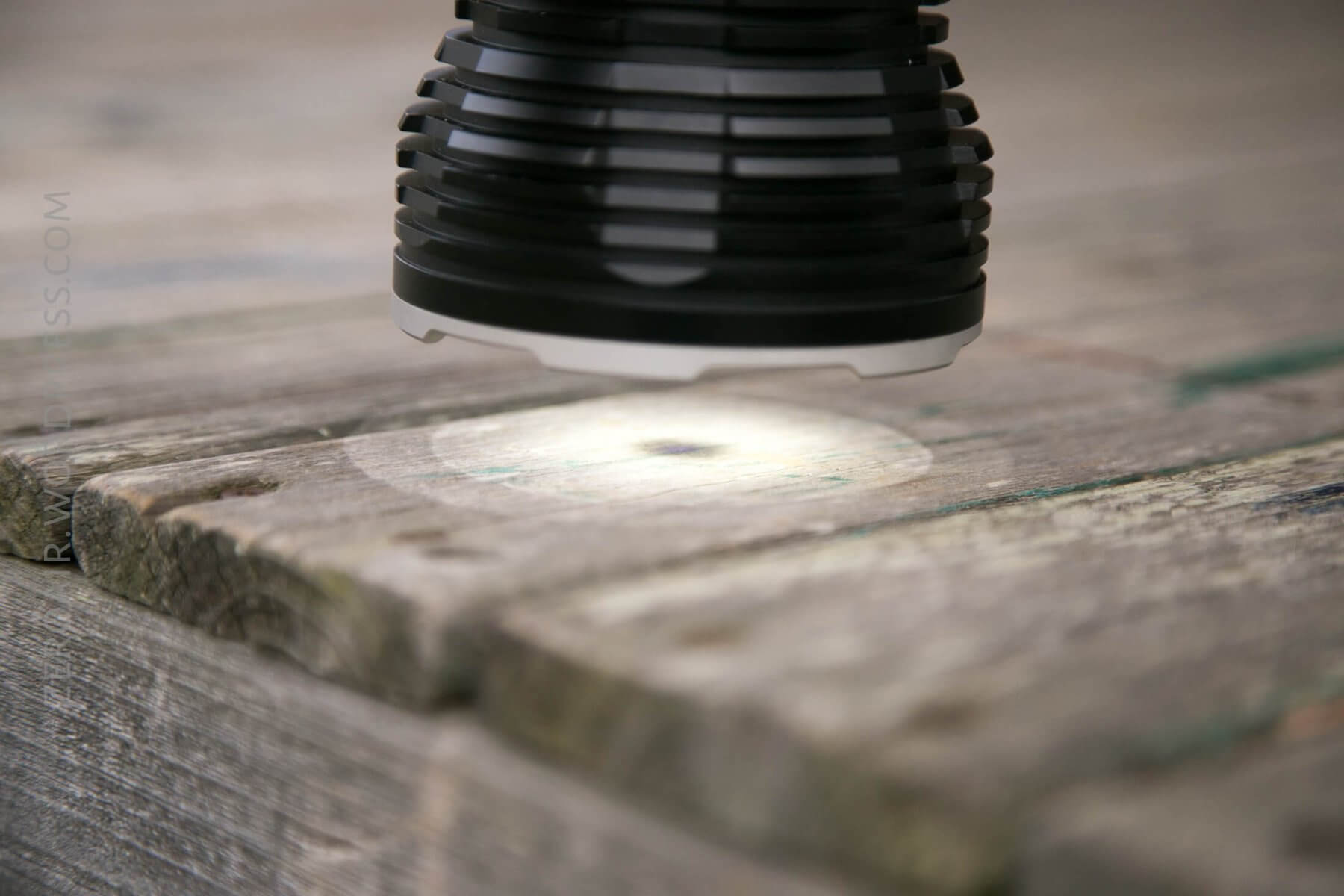
The reflector is smooth. Very smooth. One of the smoothest reflectors I can remember!
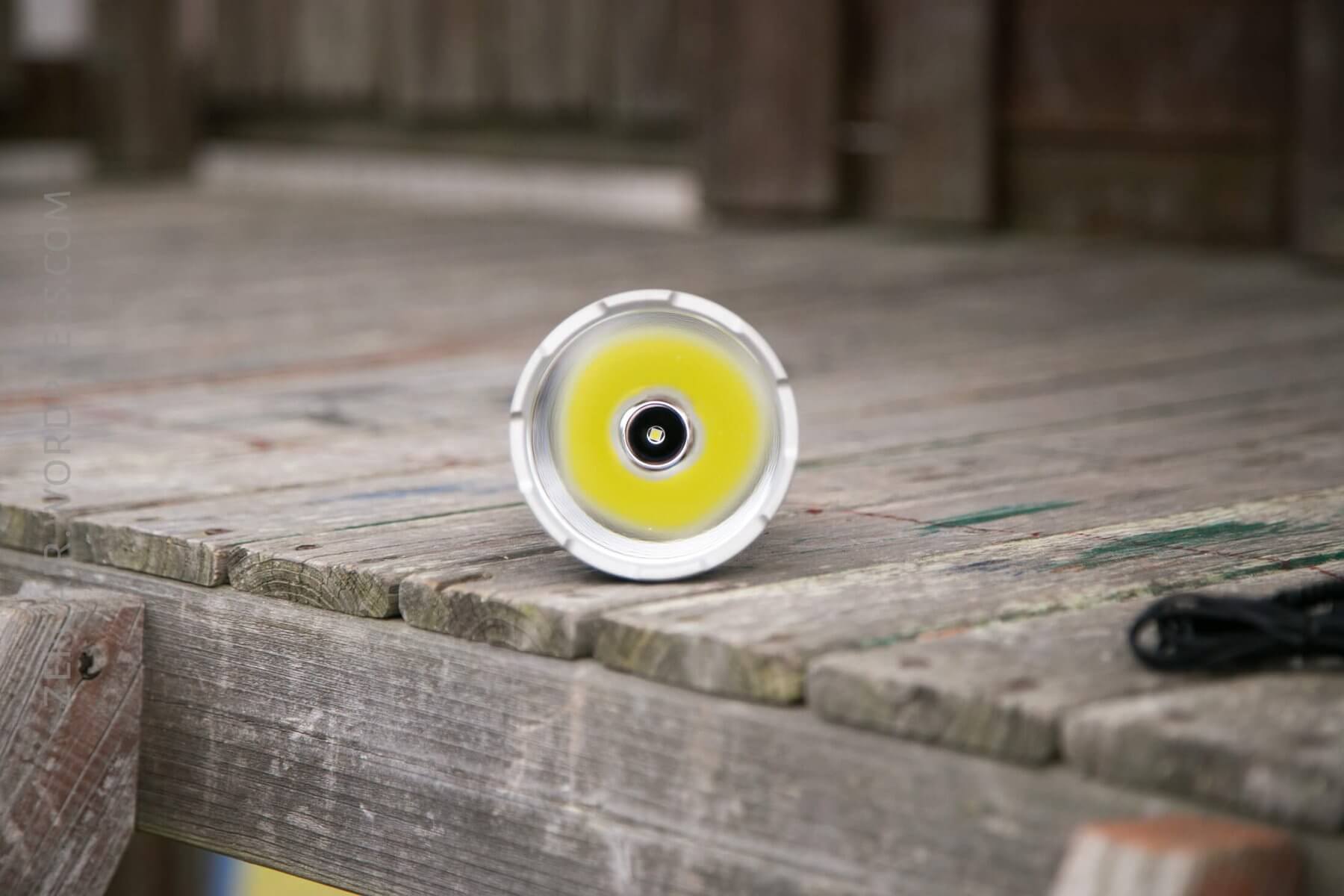

Of course, up close, you can see the donut from perfect collimation, very visible at near distances. This shouldn’t bother you in a light like this, as it’s a thrower.

Beamshots
These beamshots always have the following settings: f8, ISO100, 0.3s shutter, and manual 5000K exposure. These photos are taken at floor level, and the beam hits the ceiling around 9 feet away.

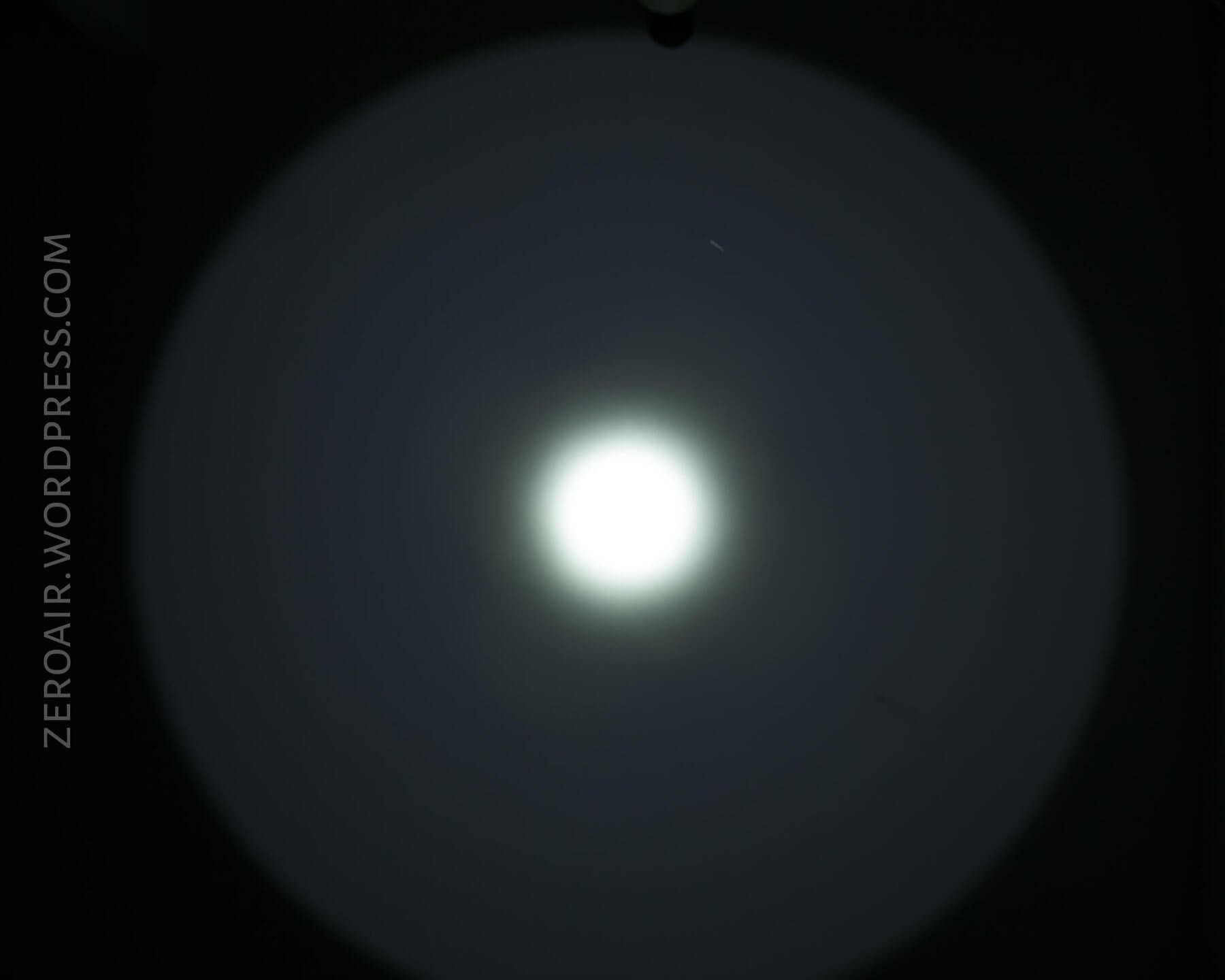
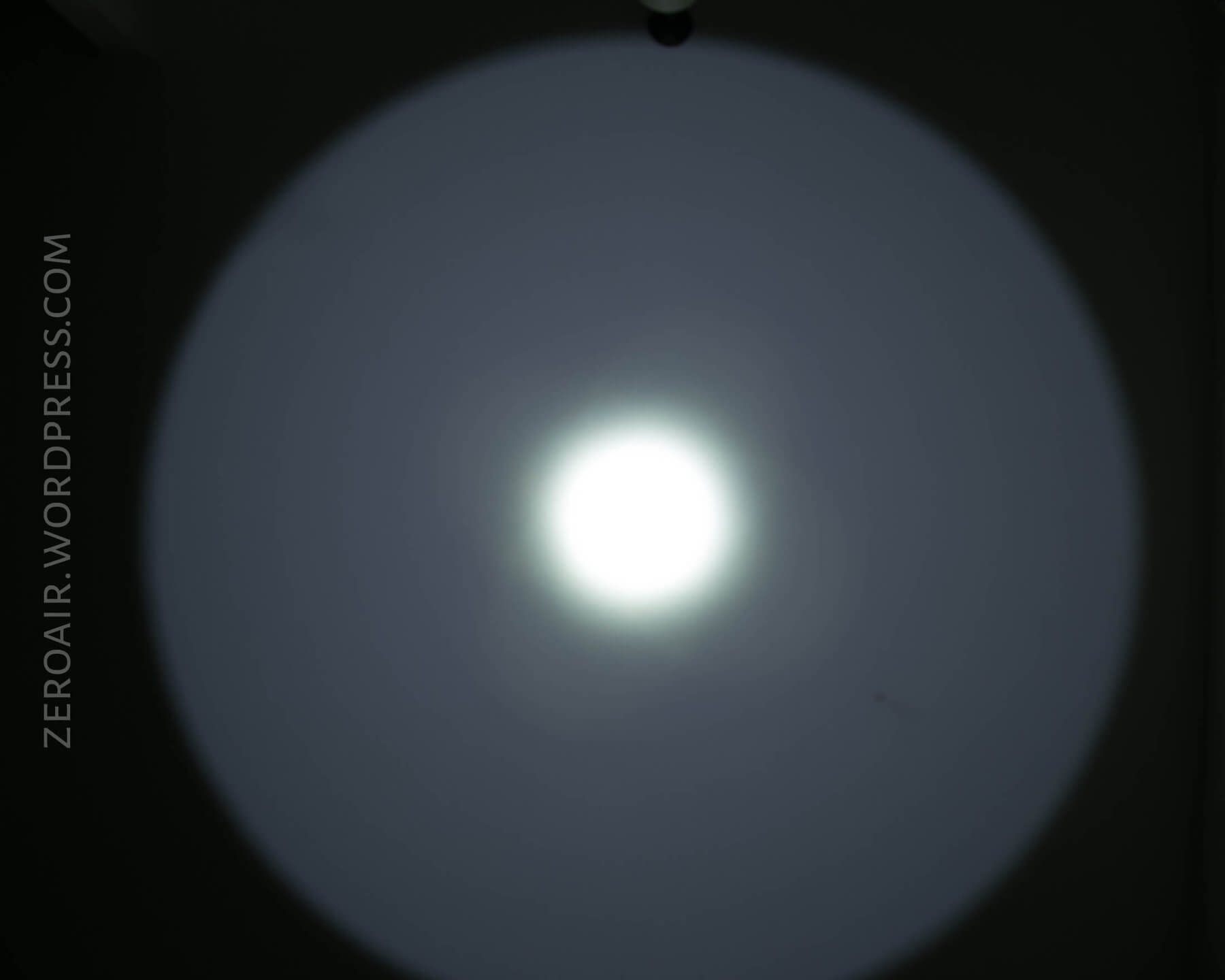
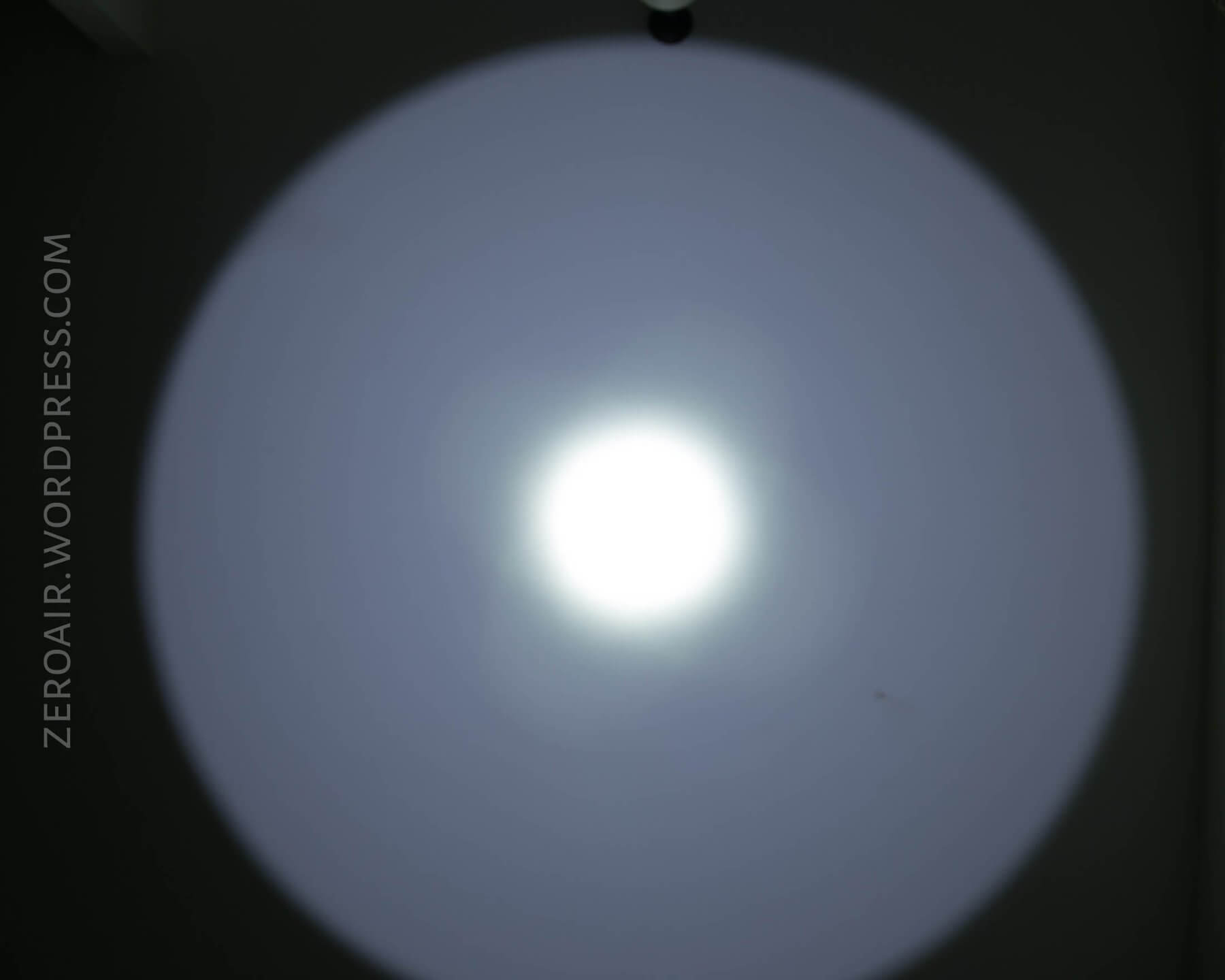
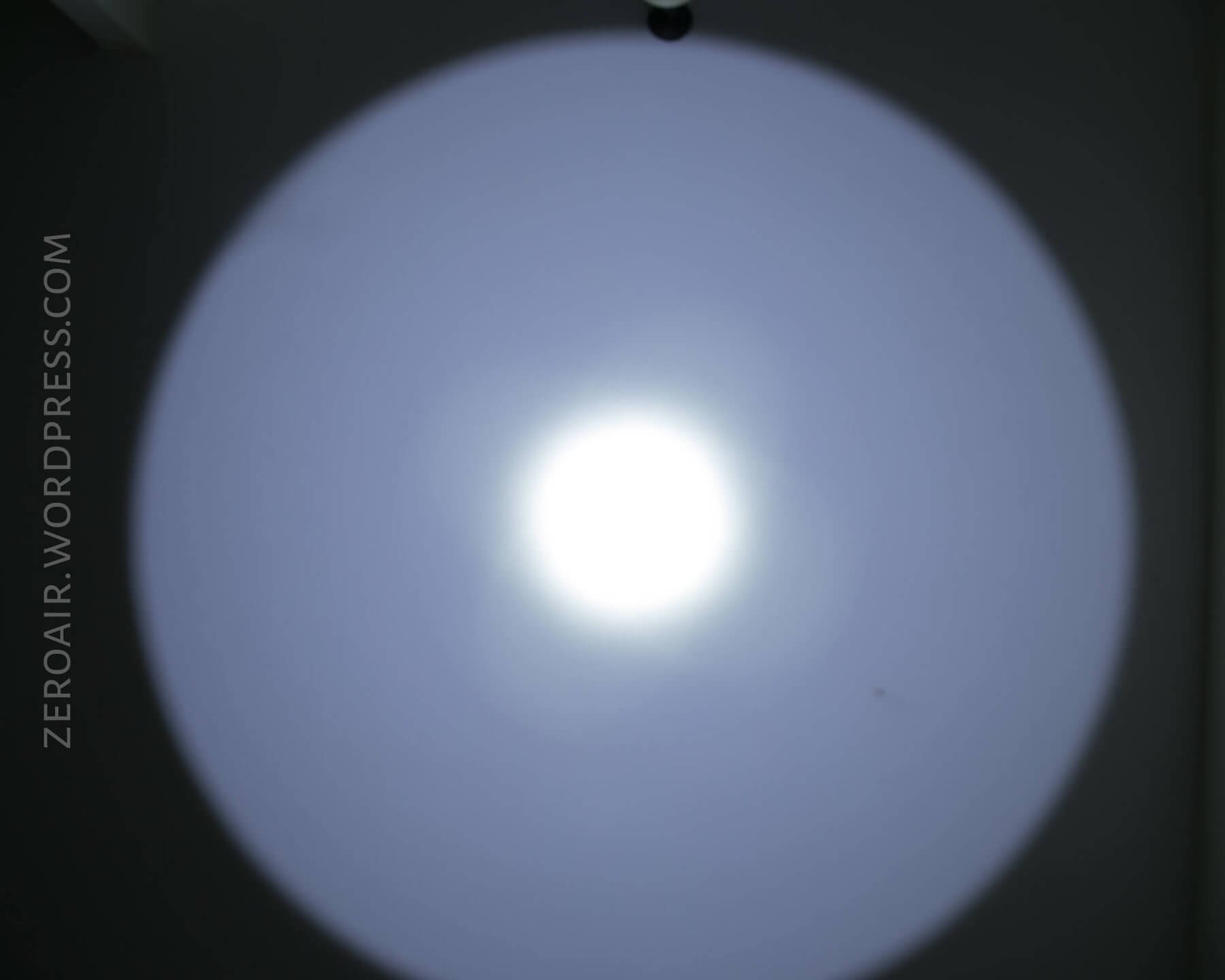
Tint vs BLF-348 (KillzoneFlashlights.com 219b version) (affiliate link)
I keep the test flashlight on the left and the BLF-348 reference flashlight on the right.

Random Comparisons and Competitive Options
Here’s a relevantly filtered page on parametrek.com. This isn’t a category of lights lacking competition. There are at least 7 lights with the same emitter and similar throw, but not a single one of those has onboard charging. Even if you disregard the charging because it’s proprietary (in connection), this light is still not a bad deal because of its fairly small size.
Conclusion
What I like
- Size
- Output is great (though technically not up to spec)
- I love the big metal switch!
What I don’t like
- Fairly specific cell needs
- Can be hard to tighten the head
Notes
- This light was provided by FastTech for review. I was not paid to write this review.
- This content originally appeared at zeroair.org. Please visit there for the best experience!
- Use my amazon.com referral link if you’re willing to help support making more reviews like this one!
- Please support me on Patreon! I deeply appreciate your support!
Pingback: Imalent RT70 Flashlight Review – ZeroAir Reviews
Pingback: Imalent RT70 Flashlight ReReview – ZeroAir Reviews
Pingback: LiionWholesale Protected MJ1 Li-Ion Cell Review – ZeroAir Reviews