
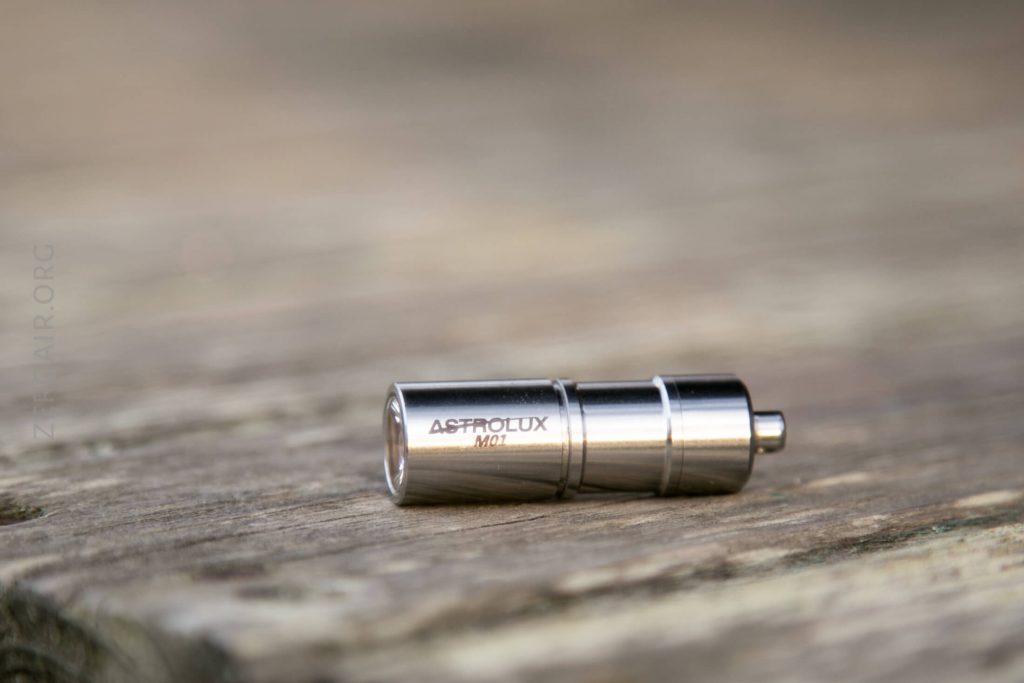
Astrolux M01 Keychain Flashlight Review
The Astrolux M01 is a 10180 keychain flashlight, which offers onboard charging and a nice polished body. Read on for more info!
Official Specs and Features
Here’s a link to the Astrolux M01 Keychain Flashlight product page.
Versions
The M01 is available with the listed 219c and a Cree XP-G3 too. The M01 is specific to a stainless steel body, but also available is the M03 (copper, XP-G3 only). Other common metals aren’t mentioned (aluminum, titanium). (There was a heat-treated stainless version a while back, but it doesn’t seem to be available – the M02.)
Price
The price is $15.52 for this version and $17.95 for the M03 copper version. Buy it at BangGood!
Short Review
I love this light except for one thing. It’s hard to twist. Coupled with that, the twist over the o-ring seems to damage the o-ring. Other than that, I really like this as a keychain light. But expect to replace the o-rings. A nice surprise was that mine is Nichia 219b, not 219c as listed!
Long Review
The Big Table
| Astrolux M01 | |
|---|---|
| Emitter: | Nichia 219b ((Really 219b)) |
| Price in USD at publication time: | $15.52 |
| Cell: | 1×10180 |
| High Runtime | Low Runtime |
| LVP? | No |
| Switch Type: | Twisty |
| On-Board Charging? | Yes |
| Chargetime | |
| Power off Charge Port with no Cell? | – |
| Claimed Lumens (lm) | 100 |
| Measured Lumens (at 30s) | 126 (121% of claim)^ |
| Claimed Throw (m) | 42 |
| Candela (Calculated) in cd (at 30s) | 91lux @ 2.346m = 501cd |
| Throw (Calculated) (m) | 44.8 (106.7% of claim)^ |
| All my Astrolux reviews! | |
^ Measurement disclaimer: Testing flashlights is my hobby. I use hobbyist-level equipment for testing, including some I made myself. Try not to get buried in the details of manufacturer specifications versus measurements recorded here; A certain amount of difference (say, 10 or 15%) is perfectly reasonable.
What’s Included
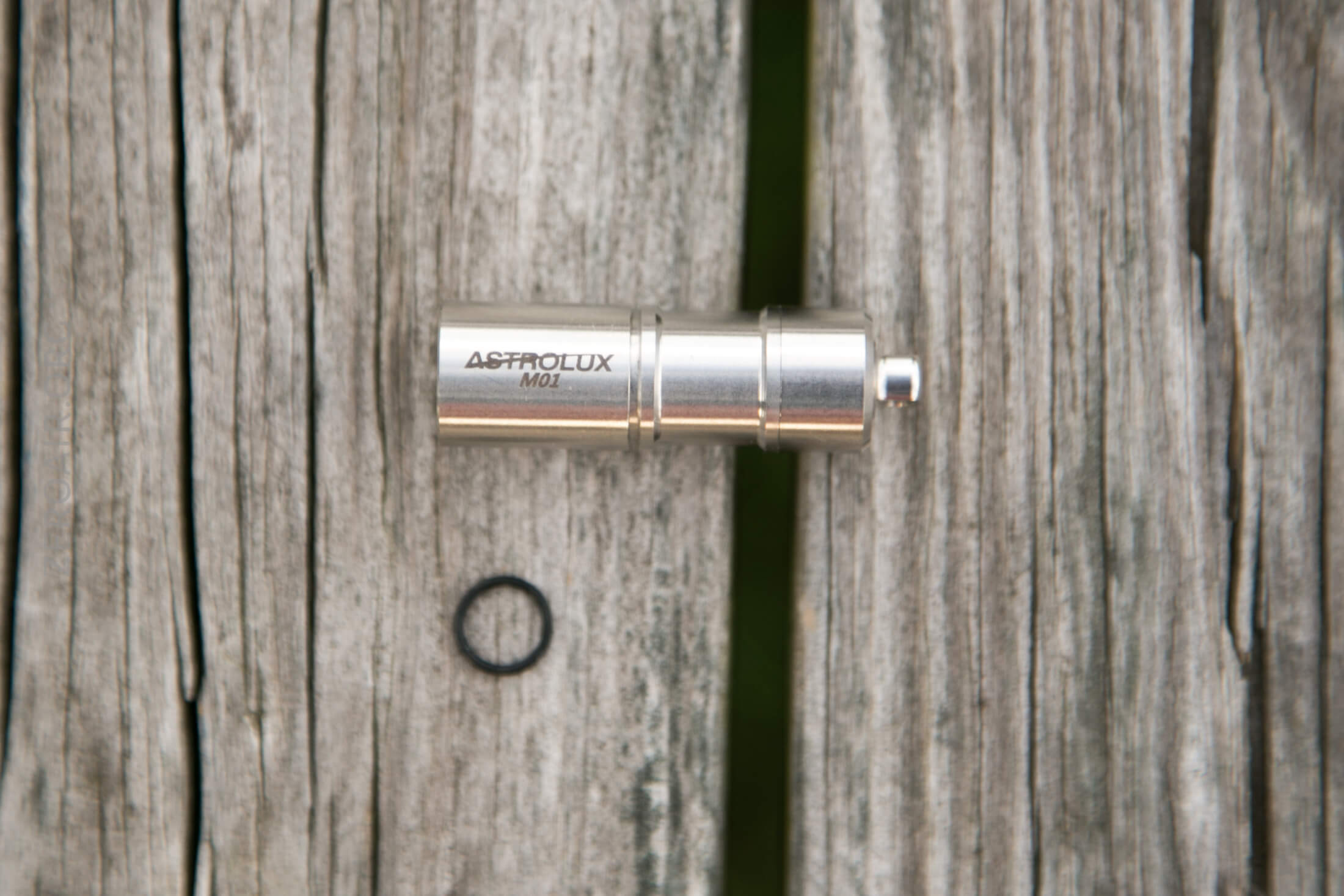
- Astrolux M01
- Spare o-rings (2)
Package and Manual


The light ships in this little windowed tin. I didn’t get a manual.
Build Quality and Disassembly

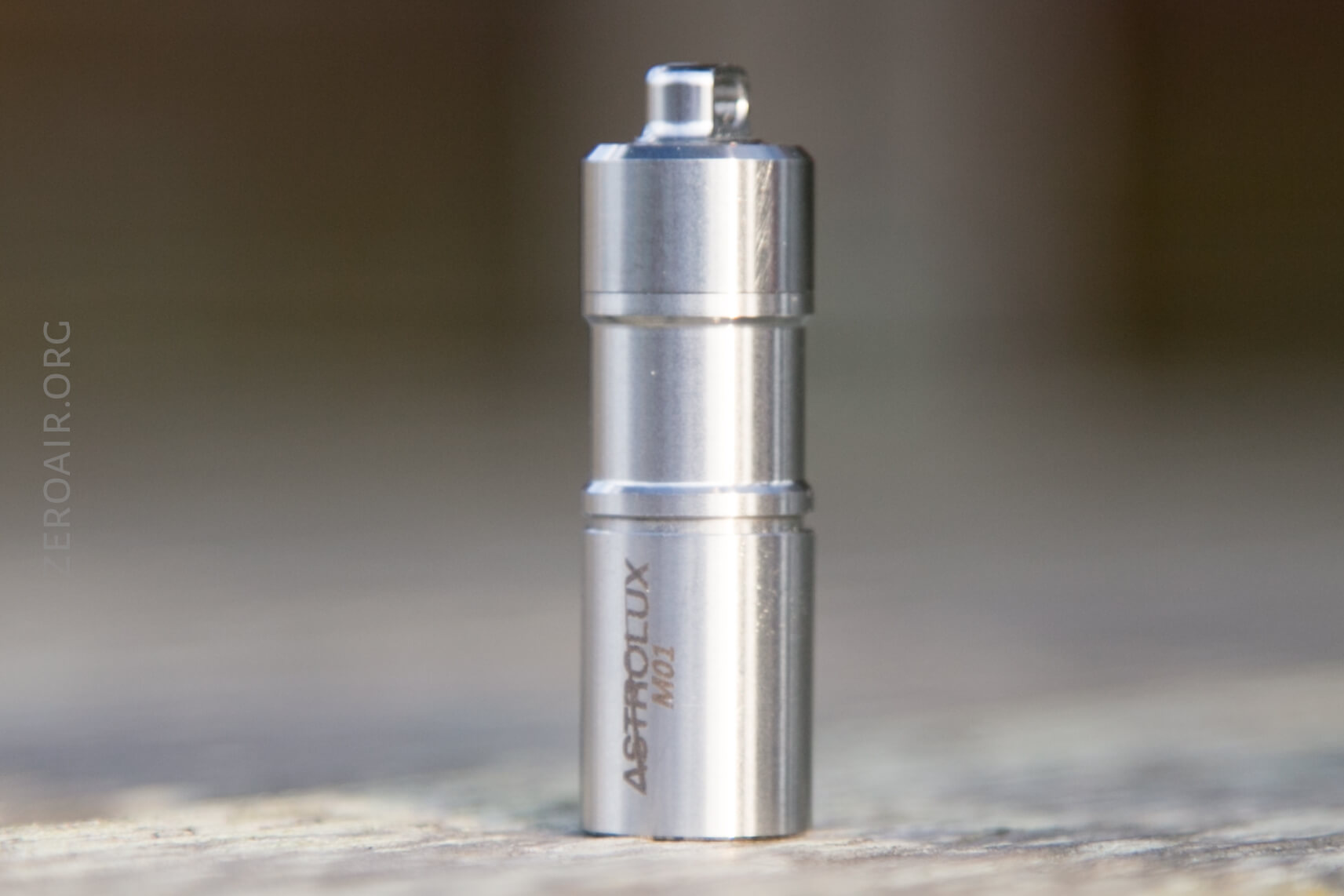
This is a superbly built little light. It’s got a surprising heft to it, being stainless steel.


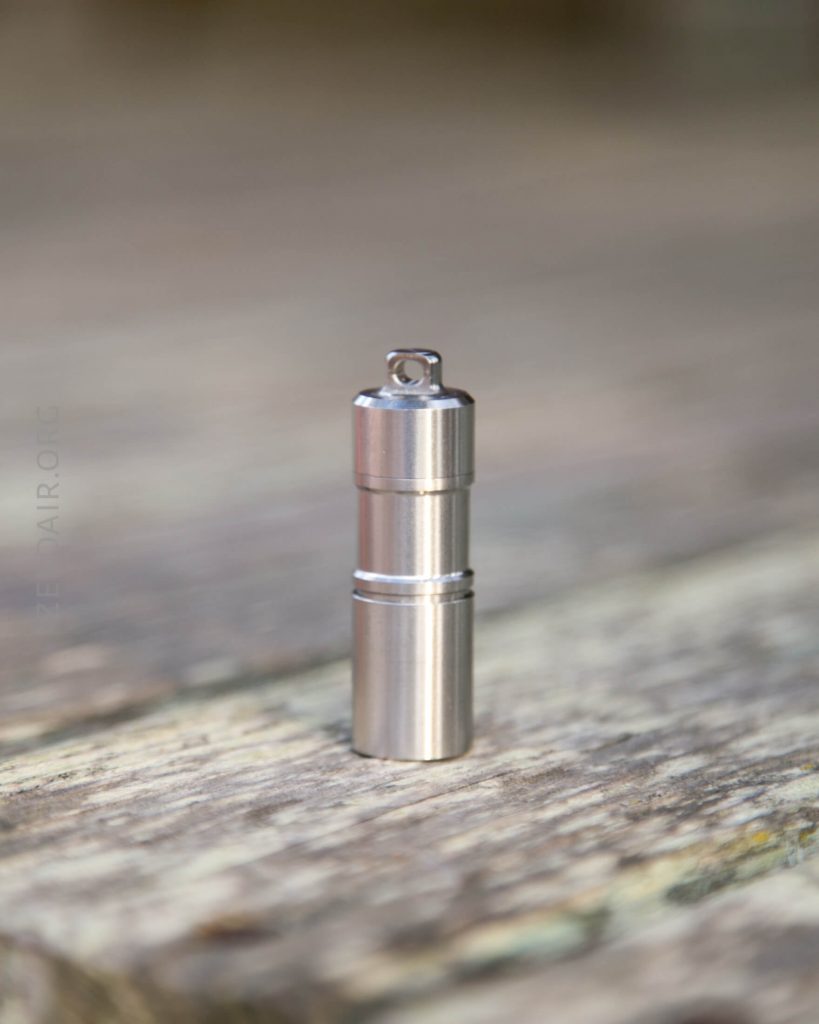

Note that the body is completely smooth…. there’s no knurling or grip of any sort for helping to twist the light on or off.
Here’s the body with the head off.

The silver spot on the head (right, below) is a button that switches modes. When pressed in (light tightened fully) the mode selected is “high.”


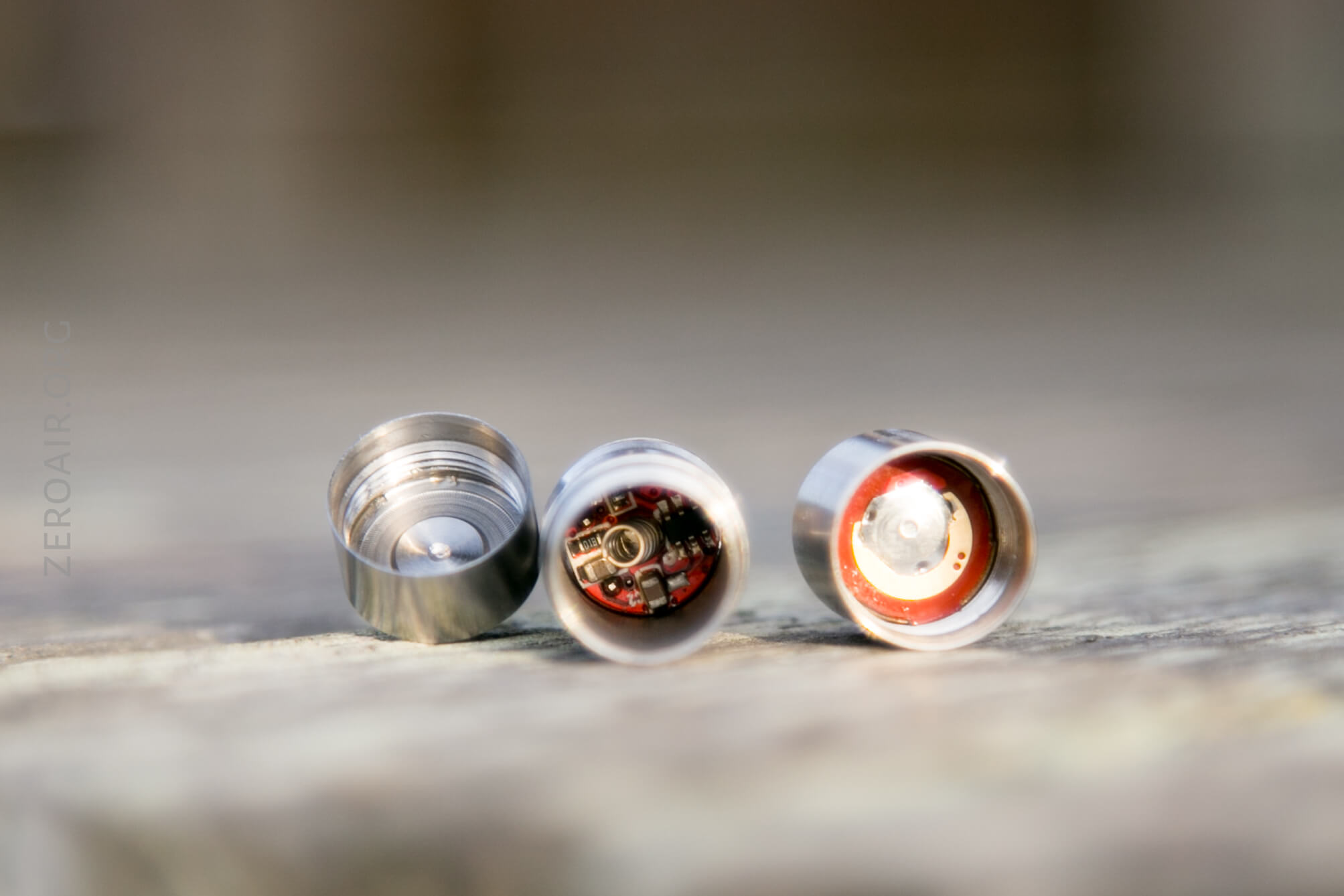
Here’s all the parts – note that the tailcap unscrews, allowing the cell to be removed. This is a bonus, allowing the cell to be swapped when it gets old and worn out. It also allows you to use the M01 as a charger for your other 10180 cells.


Inside the cell tube (center, below) is the charging circuit, and a thin spring. The tailcap is “dumb.”
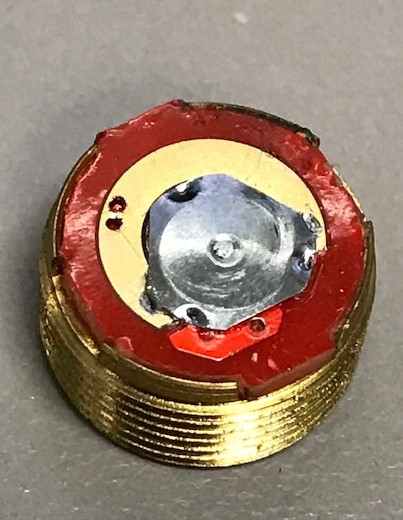
I broke out the big device for photographing the pill, once I got it apart. It screws out easily, with the help of a thumbtack or the like. See that emitter? That’s a Nichia 219b!!
So this is a bit of an issue…. I’m super excited to have another 219b light in my stable, and even glad that it’s this keychain light. But the product listing does in fact (mostly) state that it’s 219c (or XP-G3). That means that the product listing can’t be trusted all that much. Basically buy this light hoping for a 219b, and keep it even if it’s 219c because you got a good little light for inexpensive, and 219c is still good.


The pill appears to be brass. The MCPCB is a two-sided thing, so an emitter swap will be difficult – unless you are using hot air, which should work easily.


The optic removes easily too and does not have a lens.



Size and Comps
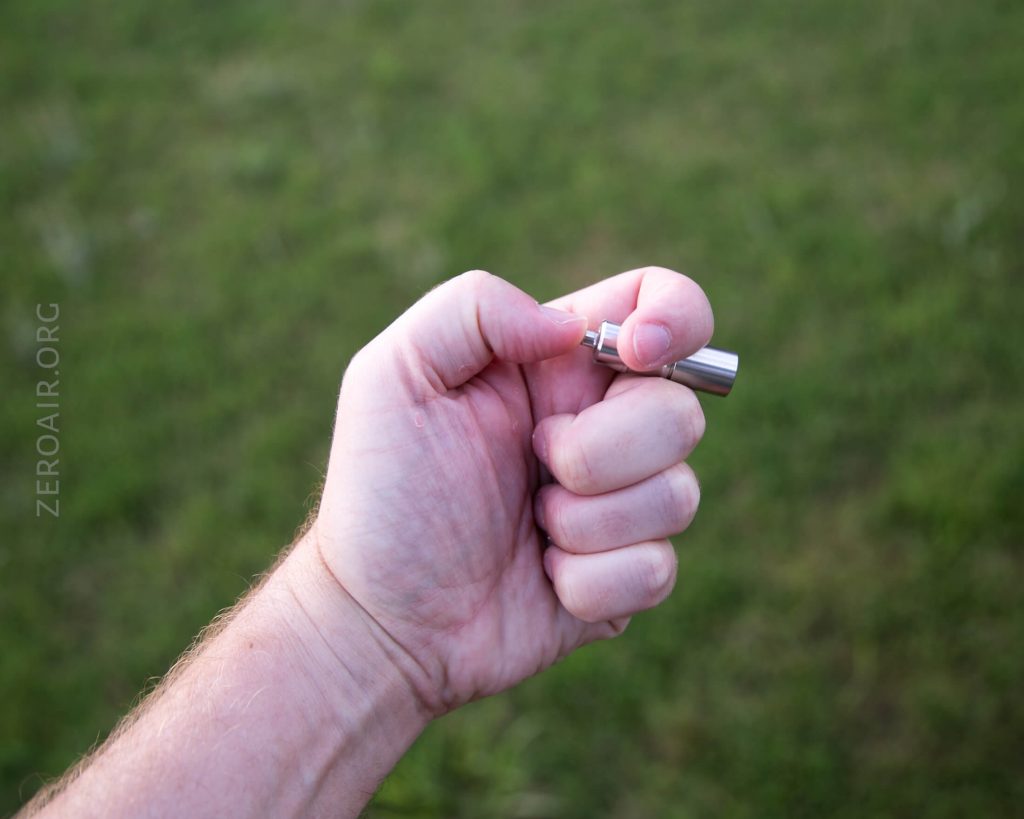
Officially: 41.75mm x 13mm (length x body diameter).
I measure 13.08mm (head/thickest) diameter, and 42.78mm (length, all-inclusive, in the Off position.)


Thumbs up for awesome.


Here’s the M01 beside the EDC Pico, which I just reviewed.


And here’s the light beside my custom engraved TorchLAB BOSS 35, an 18350 light. I reviewed the aluminum version of that light in both 35 and 70 formats.

Retention and Carry
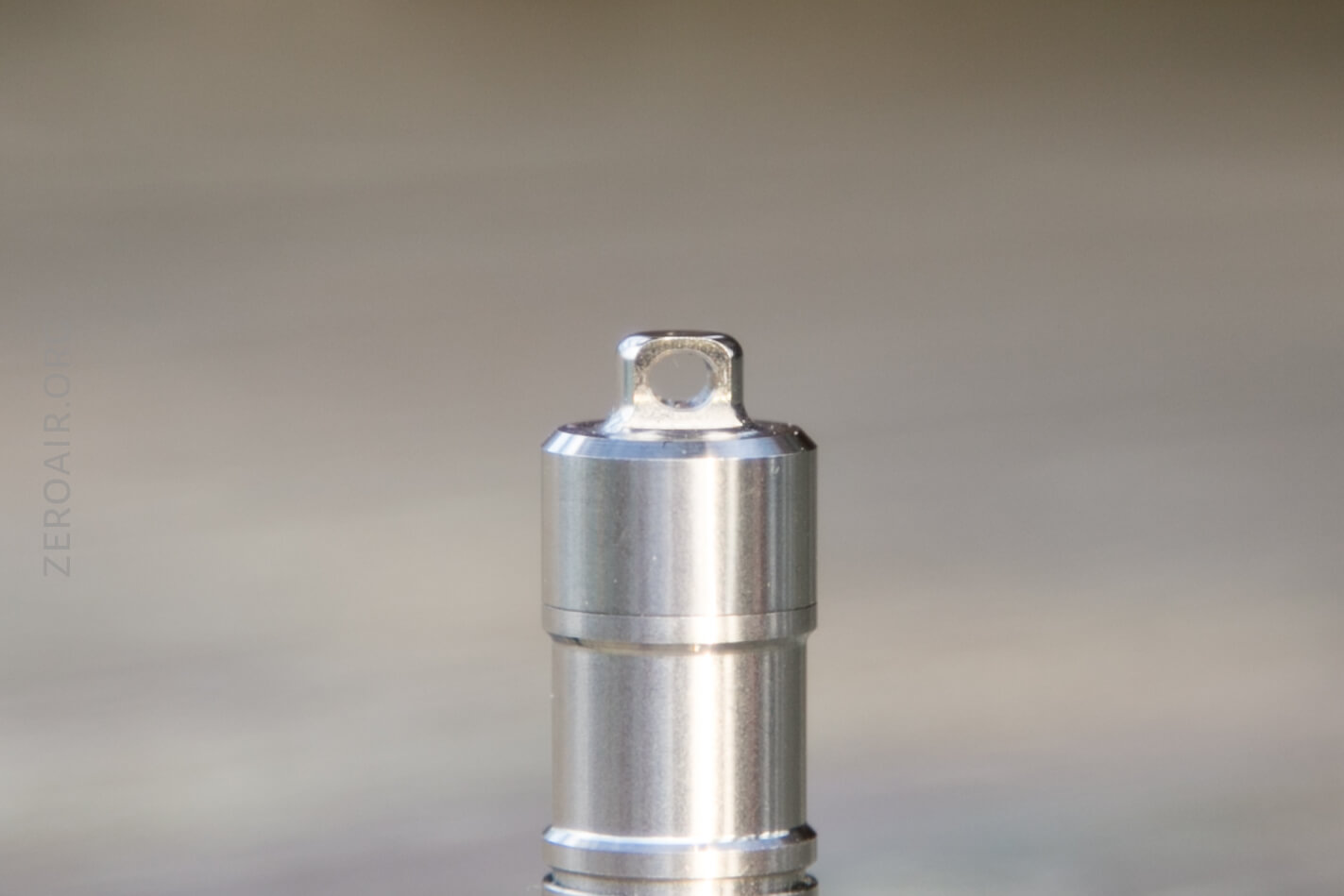
This is decidedly a pocket light, but if you want to throw it on a necklace or lanyard or whatever, that’s possible. The attachment point is on the tailcap and is not removable. I’d really rather this not be here, and/or be removable so that the light will tailstand.
Power and Runtime
The M01 is powered by a single Li-ion cell. It’s an 10180 and is included with the purchase.
Below is a runtime on both modes. Don’t worry about the wiggles in the output line, that’s just my luxmeter not enjoying the low outputs.


Here’s the included cell. It’s a little flat top 10180; isn’t that thing cute! Looks like some of these have a label, but mine does not.


Charging
Also built-in is onboard charging, by means of a micro-USB connection. When the light is connected and charging, the positive terminal is red, and when charge completes it turns green. The red is very bright, but the green is a very low output emitter.

Charging looks a little weird on my sample…. Both are fine, but it doesn’t seem consistent. The CV phase in one test just dragged out for hours, while the other test terminated quickly as expected. Either way, neither charging would hurt the cell.

Modes and Currents
| Mode | Mode Claimed Output (lm) | Claimed Runtime | Measured Lumens | Tailcap Amps |
|---|---|---|---|---|
| High | 100 | 30m | 121 | 0.50 |
| Low | 8 | 6.5h | 5 | 0.01 |
Pulse Width Modulation
No PWM is seen.


Here you can see a “baseline” – a chart with almost no light hitting the sensor.

Then there’s the Ultrafire WF-602C flashlight, which has some of the worst PWM I’ve seen. It’s so bad that I used a post about it to explain PWM! Here are multiple timescales (10ms, 5ms, 2ms, 1ms, 0.5ms, 0.2ms) to make comparing this “worst” PWM light to the test light easier. That post also explains why I didn’t test the WF-602C at the usual 50us scale.


User Interface and Operation
The M01 is a twisty. Twist the head tighter to turn the light to low, and twist the head even tighter for High. Loosen the head to turn the light off.
LED and Beam
The emitter on my review copy is in fact a Nichia 219b, and a good temperature too. I don’t think this is the 5700K version (which I don’t like nearly as much), so… this is really the holy grail of emitters.
The optic is clear, and provides a beam with a hotspot and a bunch of spill, too.


These beamshots always have the following settings: f8, ISO100, 0.3s shutter, and manual 5000K exposure. These photos are taken at floor level, and the beam hits the ceiling around 9 feet away.


Tint vs BLF-348 (KillzoneFlashlights.com 219b version) (affiliate link)

I compare everything to the Killzone 219b BLF-348 because it’s inexpensive and has the best tint!
Random Comparisons and Competitive Options
Here’s a link to a relevantly filtered page on parametrek.com. I use that site a lot! There’s not a bunch in the 219b/219c category, so this is a special light.
Conclusion
What I like
- Nichia 219b in my sample
- Good build quality
- Built in charging
- Cell can be removed (not built-in like so many in this category)
What I don’t like
- Hard to twist
- Twisting tends to damage o-ring in head
- Ordering 219c will be blind luck to get 219c or 219b
Notes
- This light was provided by BangGood for review. I was not paid to write this review.
- This content originally appeared at zeroair.org. Please visit there for the best experience!
- For flashlight-related patches, stickers, and gear, head over to PhotonPhreaks.com!
- Use my amazon.com referral link if you’re willing to help support making more reviews like this one!
- Please support me on Patreon! I deeply appreciate your support!
Thanks for the review.
After untwisting to a safe “OFF” position, how many complete turns until the head falls off?
Four and a half revolutions.