


Acebeam E10 Osram (White) Flashlight Review
The Acebeam E10 Osram flashlight packs quite a throwy punch! It’s a 26350 cell dedicated thrower, and quite a thrower it is. Read on!
Official Specs and Features
Here’s a referral link to the Acebeam E10 Osram (White) Flashlight product page.
Versions
There is only one body type available, but three emitters are offered. Osram white (seen here), Osram Green, and Osram Red.
Price
This lists for $57.30. Buy yours at KillzoneFlashlights when they’re available! (referral link)
Short Review
For the price of $57, there is a lot of fun to be had with this light. So I have to say, you should definitely buy this light. I don’t often suggest so wholeheartedly, but …. wow is this fun.
Long Review
The Big Table
| Acebeam E10 Osram (White) Flashlight | |
|---|---|
| Emitter: | Osram (White) |
| Price in USD at publication time: | $57.30. Buy yours at KillzoneFlashlights when they’re available! |
| Cell: | 1×26350 |
| Turbo Runtime | High Runtime |
| LVP? | Yes |
| Switch Type: | E-Switch |
| Quiescent Current (A): | ? |
| On-Board Charging? | Yes |
| Charge Port Type: | Micro-USB (on cell) |
| Chargetime | |
| Power off Charge Port with no Cell? | ? |
| Claimed Lumens (lm) | 760 |
| Measured Lumens (at 30s) | 543 (71.4% of claim)^ |
| Candela per Lumen | 201.6 |
| Claimed Throw (m) | 562 |
| Candela (Calculated) in cd (at 30s) | 2310lux @ 7.3m = 123100cd |
| Throw (Calculated) (m) | 701.7 (124.9% of claim)^ |
| All my Acebeam reviews! | |

^ Measurement disclaimer: Testing flashlights is my hobby. I use hobbyist-level equipment for testing, including some I made myself. Try not to get buried in the details of manufacturer specifications versus measurements recorded here; A certain amount of difference (say, 10 or 15%) is perfectly reasonable.
What’s Included

- Acebeam E10 Flashlight
- Acebeam 2000mAh 26350 cell
- Spare o-rings (2)
- Charge cable (USB to micro-USB)
- Manual and papers
Package and Manual


Build Quality and Disassembly

The E10 is a nice sturdy little light.


The knurling is good – This is the type of knurling Acebeam uses almost always, so … it’s good stuff.


The body is a one-piece – the tail cap doesn’t come off. The threads are square-cut, anodized, nice and thick, and well lubed. The threads are great. They’re kind of long though, so a good bit of twisting is required here.

Both the head and tail have springs, and the tail spring has a good bit of travel. You’ll have to sort of squeeze the body and head together when you’re screwing the light together, or the cell will stick out too far for the threads to grab. No big deal, and it’s not difficult.


The button is just proud and not hard to find.

There’s no traditional reflector. This is an optic of some sort – the kind most often seen with flat whites.

Now if you’re anything like me, you saw these three dots in the product photos and put together that this light has three options: white, green, and red, and thought that this light has them all. It doesn’t; those dots are something else. Each light has only one emitter (red or white or green). I was disappointed when I realized that (only after I had the light in my hand) but for the price I still consider the light a massive win!

Low is very low as far as output goes but even low still has some distance to it.


Size and Comps
Officially the light is 91mm long, 40mm (head) and 31mm (tail) diameter. Weight is 137.4g with cell.


Throwing in this Malkoff flashlight because it has the same emitter and has a similar reflector.


Retention and Carry
Not one single thing is included for carry of the E10. No pocket clip (though there appears to be a place to attach one on the tail end). No pouch, no lanyard (and no lanyard holes). No magnet (and the light is small enough that a magnet would probably work).
Surprisingly the light is more or less pocket friendly. Maybe cargo pockets…
Power and Runtime
The E10 is powered by a single lithium-ion cell. In this case, it’s a 26350, a generally “rare” cell, which is included with the light. I’d love to see an 26650 body offered for the head down the road.
The included cell is a 2000mAh “flat-top” (flat with just a little bit of bump). It also sports micro-USB charging.


There’s a little red/green indicator dot on the positive end of the cell (seen below left, at around 2 o’clock.)


The cell goes into the light in the usual way – positive terminal toward the head.
Here are a couple of runtimes – Turbo and High. The light exhibits LVP, at around 2.8V. Based on bench power testing, the light also seems to flash a warning when the cell gets depleted.
Output is low, yes. 543 measured lumens is just not very much but this is a dedicated thrower. See above in The Big Table, the relatively new “Candela per Lumen” part? On this light it’s 201.6. That’s absolutely massive. Ridiculously massive! So to be clear, you aren’t buying this light for big lumens, you’re buying it for throw!

Turbo isn’t regulated at all. High is very well regulated!

Charging
There’s a charge cable included – USB to micro-USB.


This cable is for use with the included cell – a 26350.

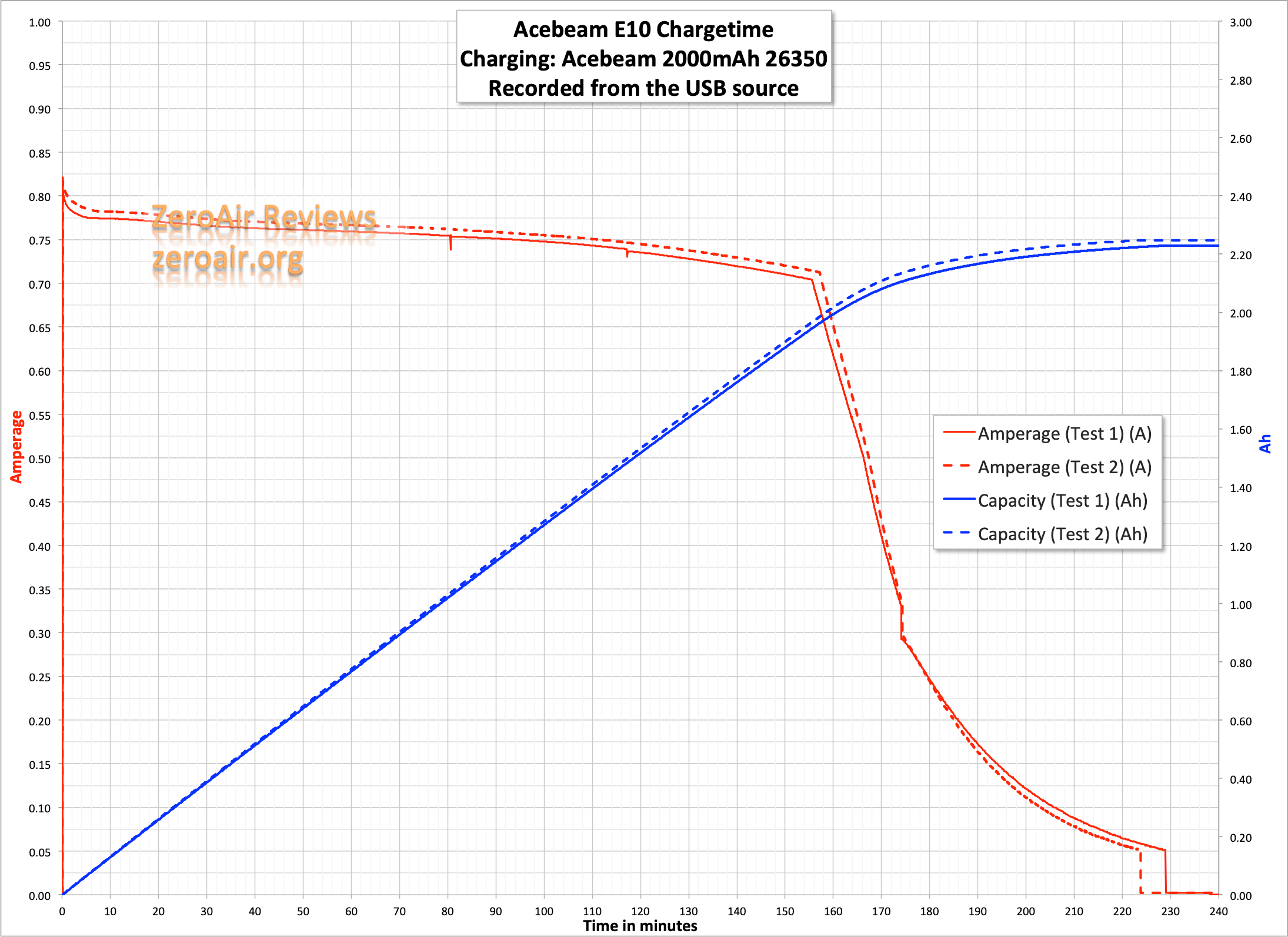
There’s an indicating LED on the positive end of the cell – red means charging, green means charging is complete. Charging is fairly slow, at around 0.5C – or 0.8A. That’s fine though; in my opinion slower is better.
Modes and Currents
| Mode | Mode Claimed Output (lm) | Claimed Runtime | Measured Lumens | Tailcap Amps |
|---|---|---|---|---|
| Turbo | 760 | 1h30m | 542 | 2.92 |
| High | 310 | 2h45m | 226 | 0.73 |
| Mid | 150 | 6h45m | 105 | 0.29 |
| Low | 20 | 46h | 12 | 0.04 |
| Moonlight | 1 | 1850h | 0 | ~ |
Pulse Width Modulation
There’s a bit of sawtooth on the lowest mode (possibly Low too), but I don’t notice it in real life.


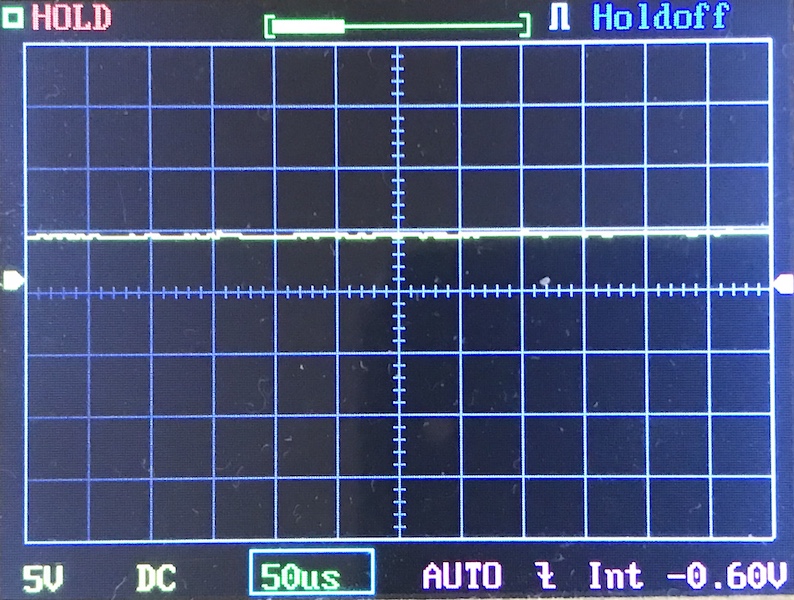


Here’s a blow-up on those two modes – a longer timeframe for a bigger picture.


Here you can see a “baseline” – a chart with almost no light hitting the sensor.

Then there’s the Ultrafire WF-602C flashlight, which has some of the worst PWM I’ve seen. It’s so bad that I used a post about it to explain PWM! Here are multiple timescales (10ms, 5ms, 2ms, 1ms, 0.5ms, 0.2ms) to make comparing this “worst” PWM light to the test light easier. That post also explains why I didn’t test the WF-602C at the usual 50us scale.


User Interface and Operation
There’s just one switch on the E10. It’s a rubber-covered e-switch, and the pad is plenty big.
Here’s a user interface table!
| State | Action | Result |
|---|---|---|
| Off | Click | On (Mode Memory) |
| Off | Hold | Moonlight |
| Any | Double Click | Turbo |
| On | Hold | Mode Advance (LMH) |
| On | Click | Off |
| Turbo | Double Click | Previous mode |
| Off | Long Hold | Lockout (Technically Moonlight then lockout) (flashes 3x to confirm lockout) |
| Lockout | Long Hold | Unlock (2x flash to confirm) |
LED and Beam
The emitter in my copy is the white version of this Osram emitter. Also available are red and green Osram options.
There’s an optic in here, which seems to be most often used with the Osram Flat emitters (but maybe not exclusively). It’s unusual – despite how it looks there’s also a lens over this optic, so it’s smooth across the top.


LED Color Report (CRI and CCT)


Beamshots
These beamshots always have the following settings: f8, ISO100, 0.3s shutter, and manual 5000K exposure. These photos are taken at floor level, and the beam hits the ceiling around 9 feet away.


Tint vs BLF-348 (KillzoneFlashlights.com 219b version) (affiliate link)
I keep the test flashlight on the left and the BLF-348 reference flashlight on the right. And this time I did all the modes vs the one mode of the BLF-348. Let me know if that’s something worthwhile.


I compare everything to the KillzoneFlashlights.com 219b BLF-348 because it’s inexpensive and has the best tint!
Conclusion
What I like
- Massive throw
- Full package
- It’s tiny!
- Did I mention the crazy throw?
- Three total emitter options are available.
- Easy to grasp UI.
What I don’t like
- I’d like a 26650 option
- The switch is just a bit mashy
Notes
- This light was provided by Acebeam for review. I was not paid to write this review.
- This content originally appeared at zeroair.org. Please visit there for the best experience!
- Use my amazon.com referral link if you’re willing to help support making more reviews like this one!
- Please support me on Patreon! I deeply appreciate your support!
Hi,
In your best estimate how much spill is there? 10%.20%,30% of the total lumens[output]?. I know it is a mini thrower but would like to know if there is enough spill to walk on the hiking trail.
On turbo it just gradually loses output and there is no step down?
Never liked or had any use for USB charging. Can the battery be charged in a regular charger? I would think so.
Thanks for the review.
I would not pick the E10 as a hiking light. Regardless of spill percentage….
That’s right, unregulated output that just wanders down along with cell voltage..
Yes just about any charger capable of charing 18350 cells should charge this cell just fine. (I’m with you on in-light charging.)
You wouldn’t use it as a hiking light you said ..so using it for camping, hiking, night walks etc wouldnt be advised ❓What else would it be used for then ❓that’s what most of us buy this kind of light for isn’t it ❓
You should review the Manker MC13 and compare it to this Acebeam E10. Pretty sure they use the same optic and emitter so it would be interesting to see how they stacked up. I went with the MC13 due to the option of both 18650 and 18350 tubes being available.
I would love to. I can never get anyone from Manker to reply to my messages. And I can’t buy all the lights…. 🙁
Pingback: Acebeam L17 - Really the Longest Throwing Tactical 18650 Flashlight? - A Review.
Was Playing around with my Lights and Discovered that The Battery Tube of the Sofirn SP33 Fits perfectly with the E10 so can use with a 26650 as well.
I always worry about some of these non Common Battery Forms. You gave me the idea reading you review on the Gt Nano, and found an obscure aaa light with A Tube that Fits.
Very nice!
Your runtime plot on turbo looks completely different from the one that 1lumen got in his review of the Acebeam E10. His runtime plot showed a regulated output, with max output for 3 minutes followed by a hard drop to 60% output and remaining flat for about 90 minutes, and then another drop to low remaining flat for another 70 minutes. Did Acebeam send you an early, preproduction version of the E10?
Sorry, I don’t know if they sent an early or preproduction E10.