

Swiss Tech Klassisch Premium Flashlight Review
The Swiss Tech Klassisch 8″ Premium Flashlight is all the rage on Reddit lately, because it was found to be on sale at $7. I grabbed one, and here’s my testing of it!
Official Specs and Features
Here’s a link to the Swiss Tech Klassisch 8″ Premium Flashlight page at WalMart.com.
Versions
There is just one version of the Swiss Tech Klassisch 8″ Premium Flashlight.
Price
The price is the joy! These were on sale for around $7 recently, and you might still find them in your local store for that price. The regular price is around $40 or so, though. Read on to see if either of those prices is worth it!
Short Review of the Swiss Tech Klassisch Premium Flashlight
You know what, this light is neater than you’d probably think. For $7, yes, you should buy one? Many? Definitely 1. Honestly even at $40, it’s probably not the worst deal you can find. The output is really great on High.
Long Review
The Big Table
| Swiss Tech Klassisch | |
|---|---|
| Emitter: | |
| Price in USD at publication time: | $7.00 |
| Cell: | Internal (single 18650) |
| High Runtime Graph | Low Runtime Graph |
| LVP? | Yes |
| Switch Type: | E-Switch |
| Quiescent Current (mA): | ? |
| On-Board Charging? | Yes |
| Charge Port Type: | USB-C |
| Charge Graph | |
| Power off Charge Port | Yes, all modes. |
| Claimed Lumens (lm) | 1200 |
| Measured Lumens (at 30s) | 1685 (140.4% of claim)^ |
| Candela per Lumen | 1.2 |
| Claimed Throw (m) | 50 |
| Candela (Calculated) in cd (at 30s) | 185lux @ 3.28m = 1990cd |
| Throw (Calculated) (m) | 89.2 (178.4% of claim)^ |
| All my Swiss Tech reviews! | |
^ Measurement disclaimer: Testing flashlights is my hobby. I use hobbyist-level equipment for testing, including some I made myself. Try not to get buried in the details of manufacturer specifications versus measurements recorded here; A certain amount of difference (say, 10 or 15%) is perfectly reasonable.
What’s Included
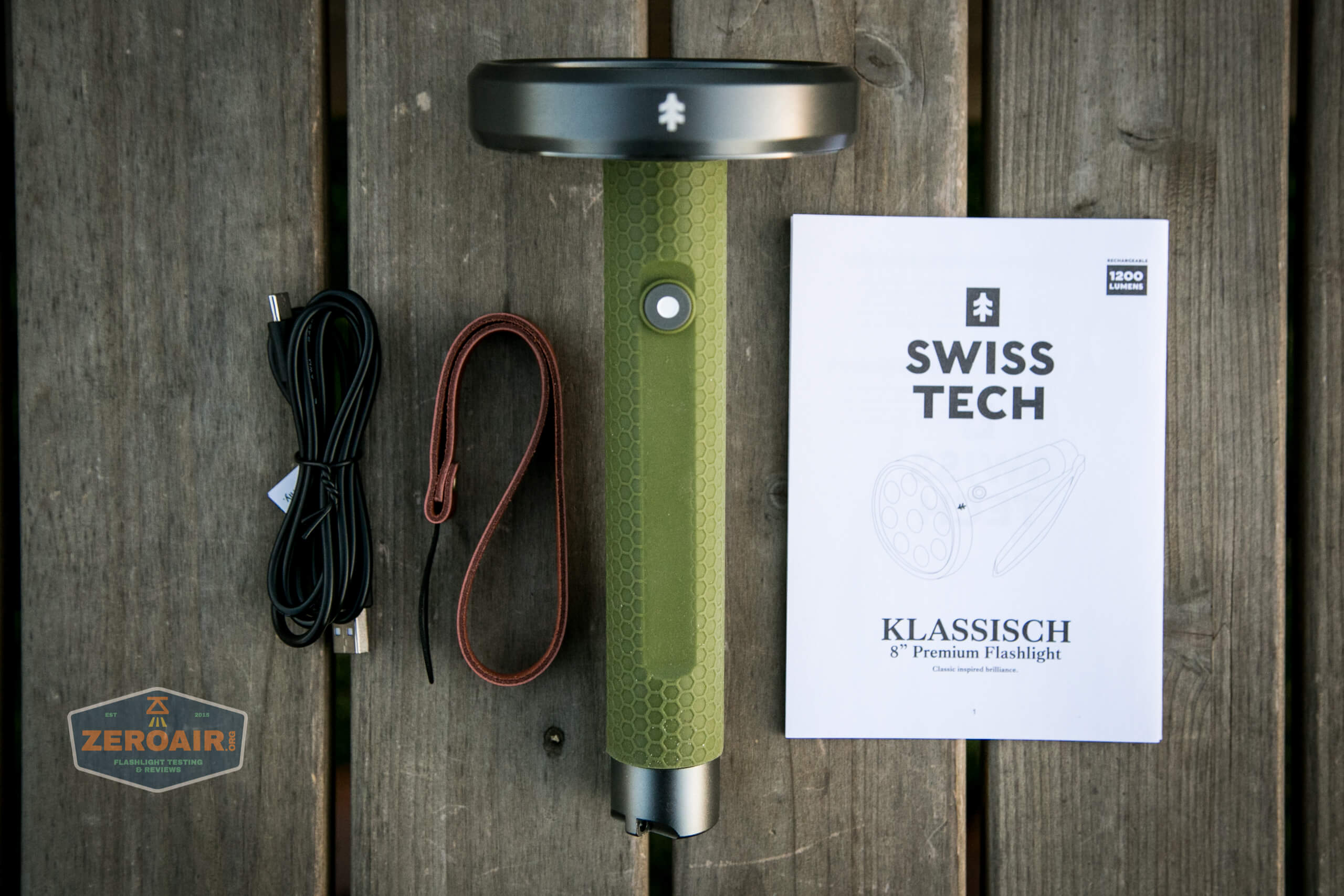
- Swiss Tech Klassisch Premium Flashlight
- Charge cable (USB to USB-C)
- Lanyard
- Manual
Package and Manual
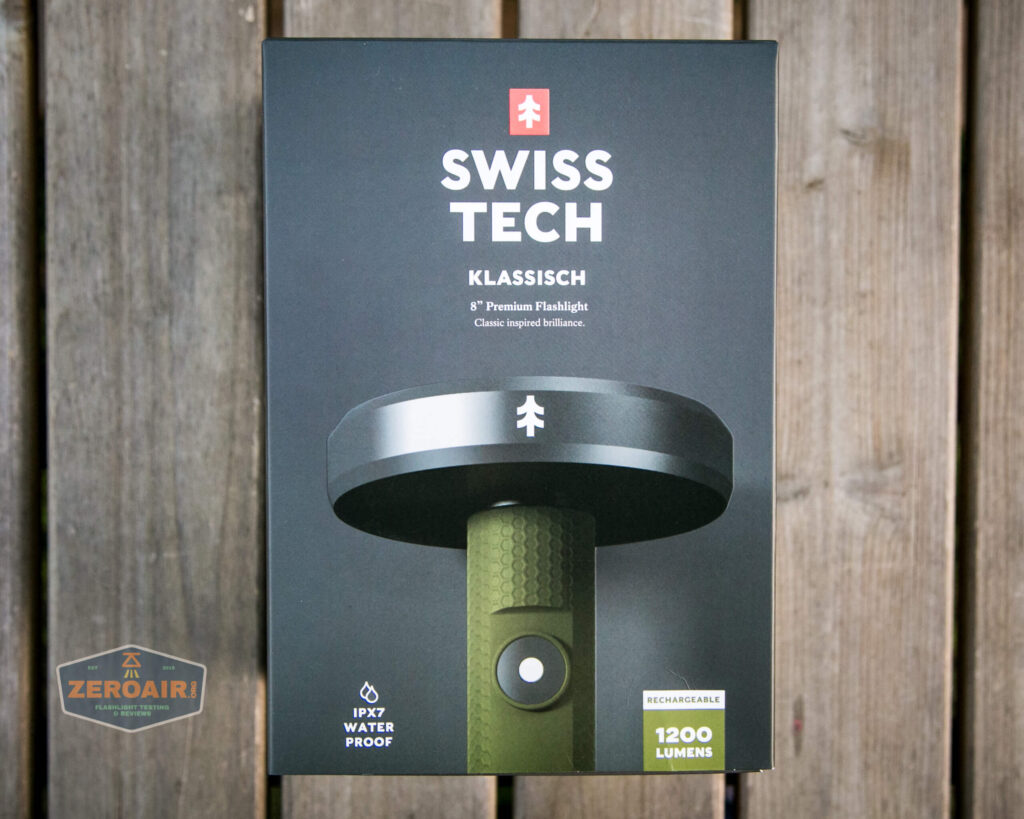

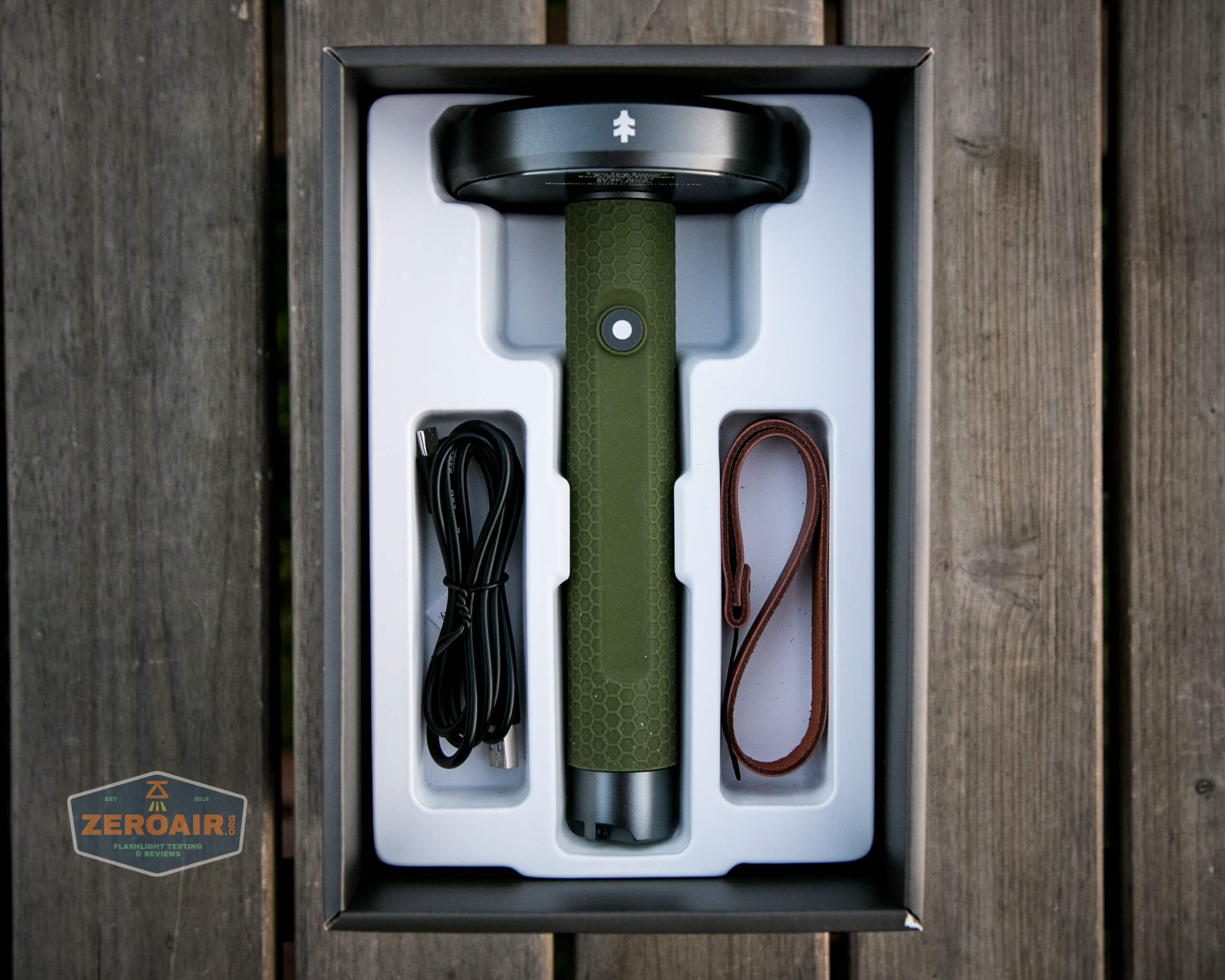

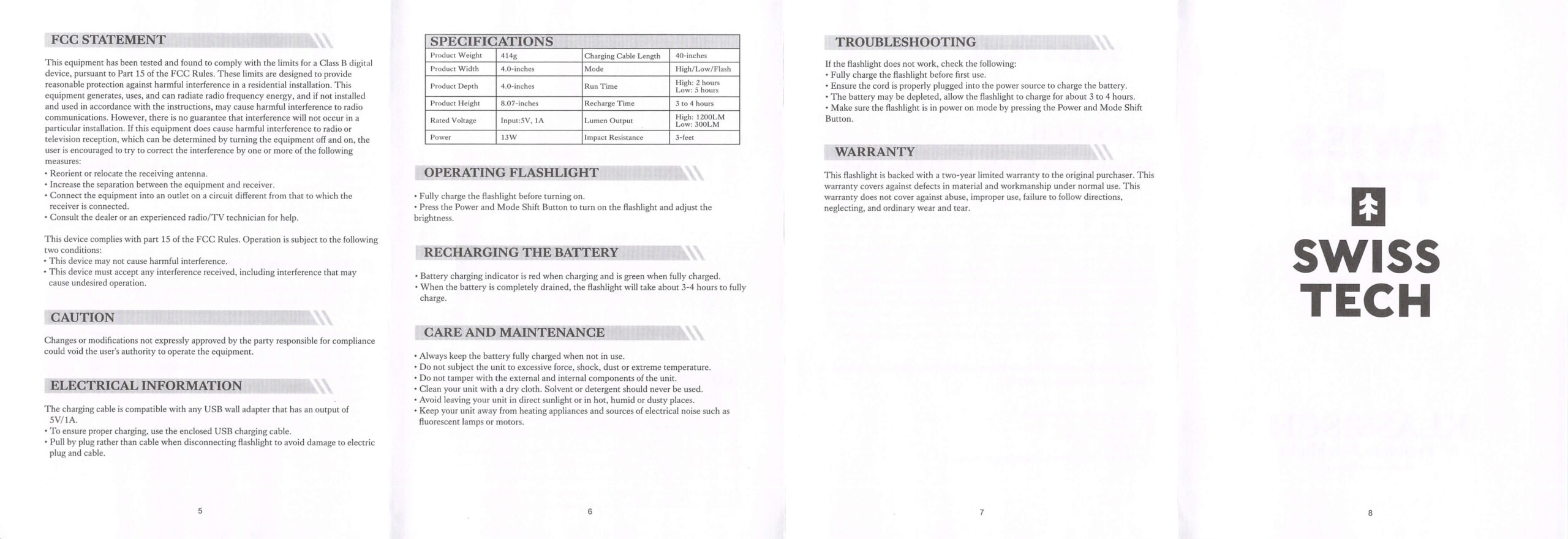
Yes that sticker comes off.

Build Quality and Disassembly

What an interesting design this light has. There’s nothing else like this, at least in the “flashlight world” of enthusiasts.


Here begins the top-down views.


This head “mushroom” is metal… or at least feels convincingly metal. With a claimed output of 1200 lumens, you’d really want metal here for better heat management.

You can see below that the tailcap has some indication of “lock/unlock” – but it’s not locked or unlocked. It’s demonstrating removing the tailcap. Also note that this image can be confusing – you might assume that the image means you can unscrew this tailcap and pop out the cell (which is pictured here at left). But that’s not so; removing this only provides access to the charge port.

One more note on disassembly…. I didn’t disassemble anything in this light. Others have done it (a Reddit post, which I can not find now), and discovered some interesting bits.

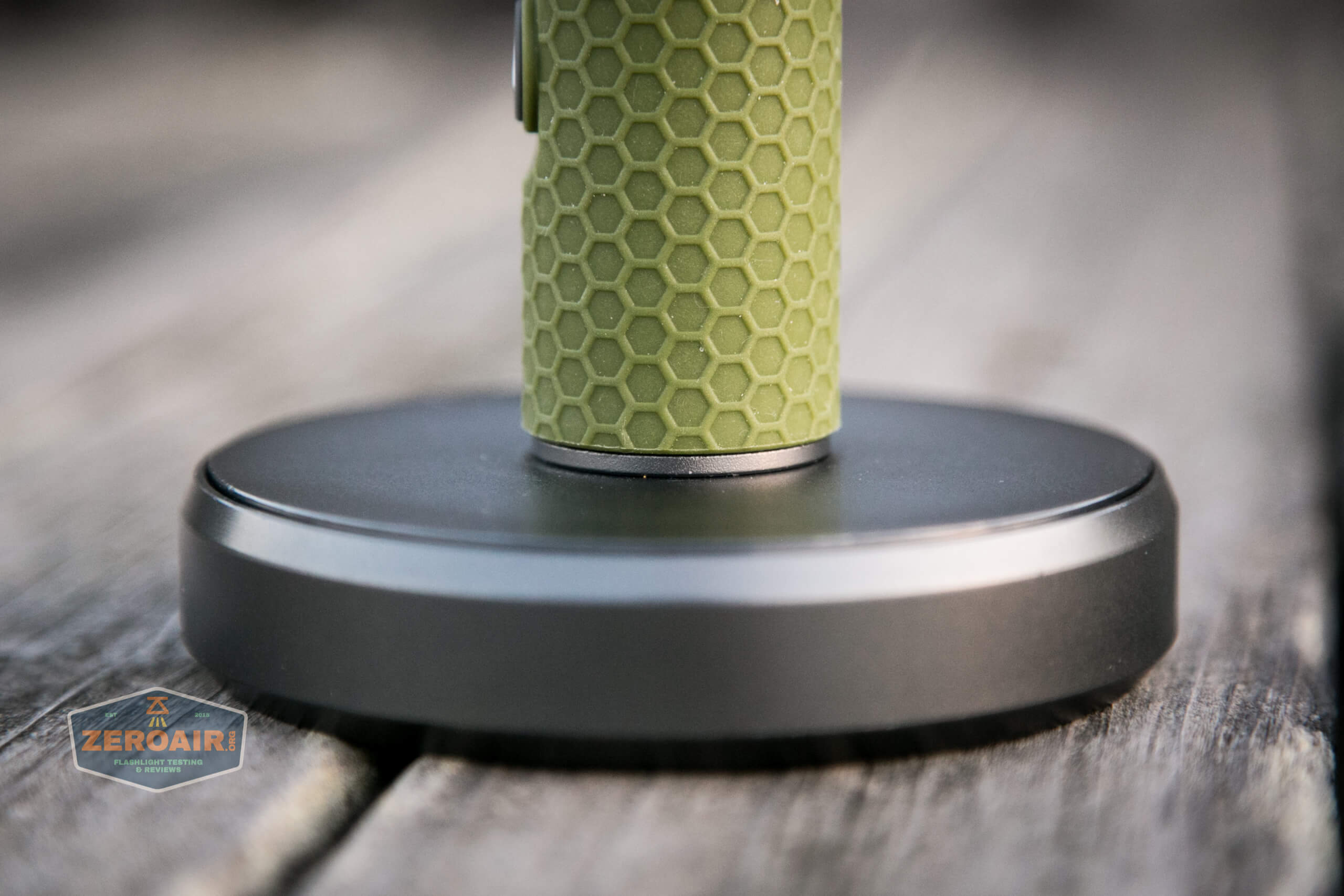
Here’s the tailcap removed. This is one massive gripe about this light and one that makes me think that the designers either never used lights, or that this light would be used once and thrown in the garbage can.
The threads here are not particularly smooth. And the tailcap is completely bereft of any grip whatsoever. So you’re left with just gripping the cap as tightly as you can, and unscrewing. It’s not that big of a deal, really. You’ll get used to it, good at it even. But some reeding or knurling or practically anything here would have gone a long way.

Once removed, the charge port is exposed.

Very nice that it’s USB-C!!

You may think that removing the switch cover would provide some access. You’d be wrong! It’s just a cover on the handle.

Speaking of that green handle: It’s not bad. It’s grippy, but it’s also a grippy sleeve over a metal tube. It’s not all that firmly connected, and when unscrewing the tailcap, it has a tendency to slip around. Also it’s silicone, so there’s no good reason at all that this isn’t orange instead of green. Just saying.
All in all the build quality is ok, but nothing to write home about. I don’t think there’s all that much room for modification, and despite the very long handle, there’s just a single 18650 inside. There’s room for a 21700, and probably even two if a proper driver is used.
Size and Comps
Officially:
Width: 4 inches
Depth: 4 inches
Height 8.07 inches
Weight: 414g


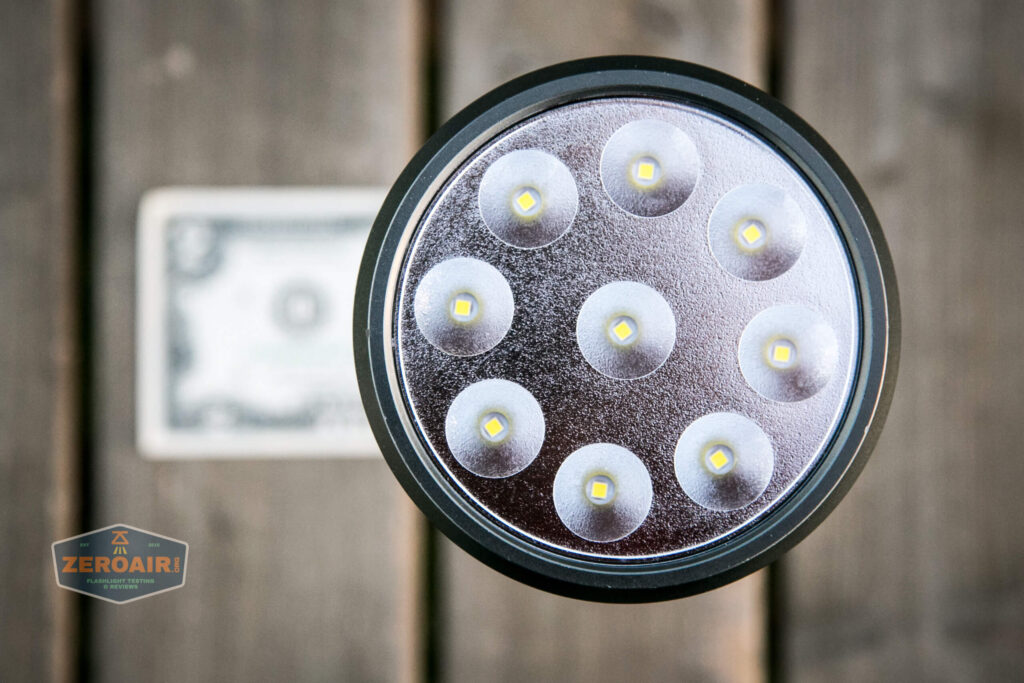
If the flashlight will headstand, I’ll show it here (usually the third photo). If the flashlight will tailstand, I’ll show that here, too (usually the fourth photo).


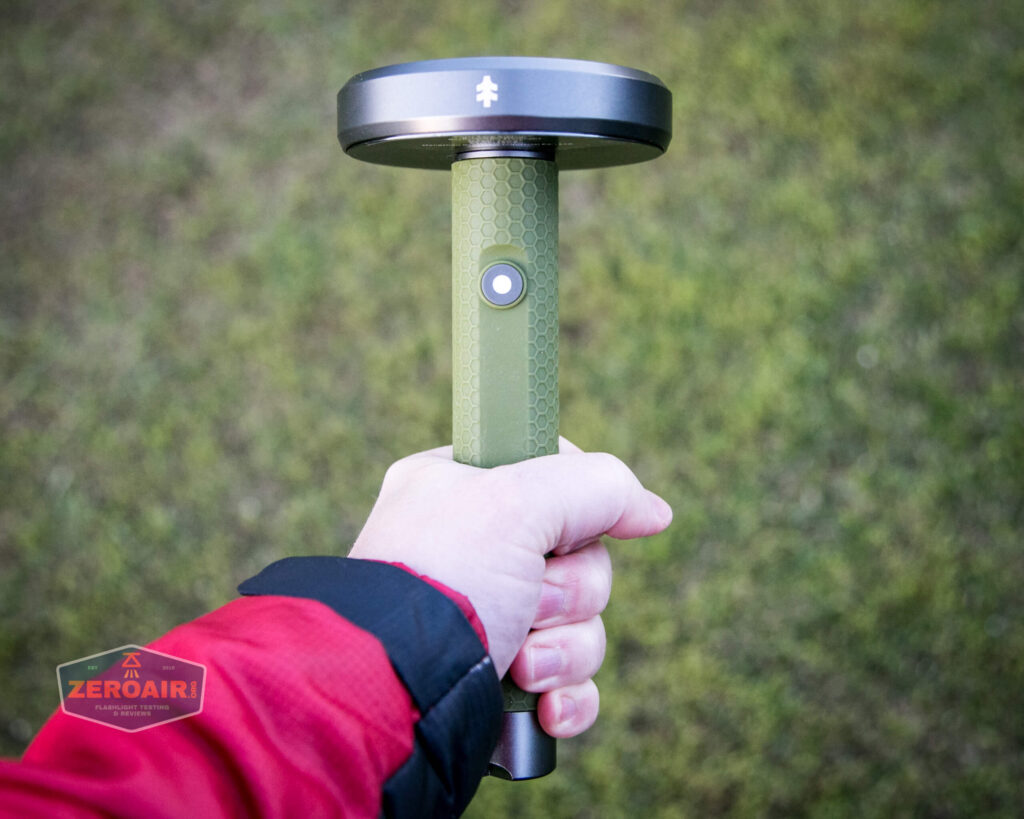

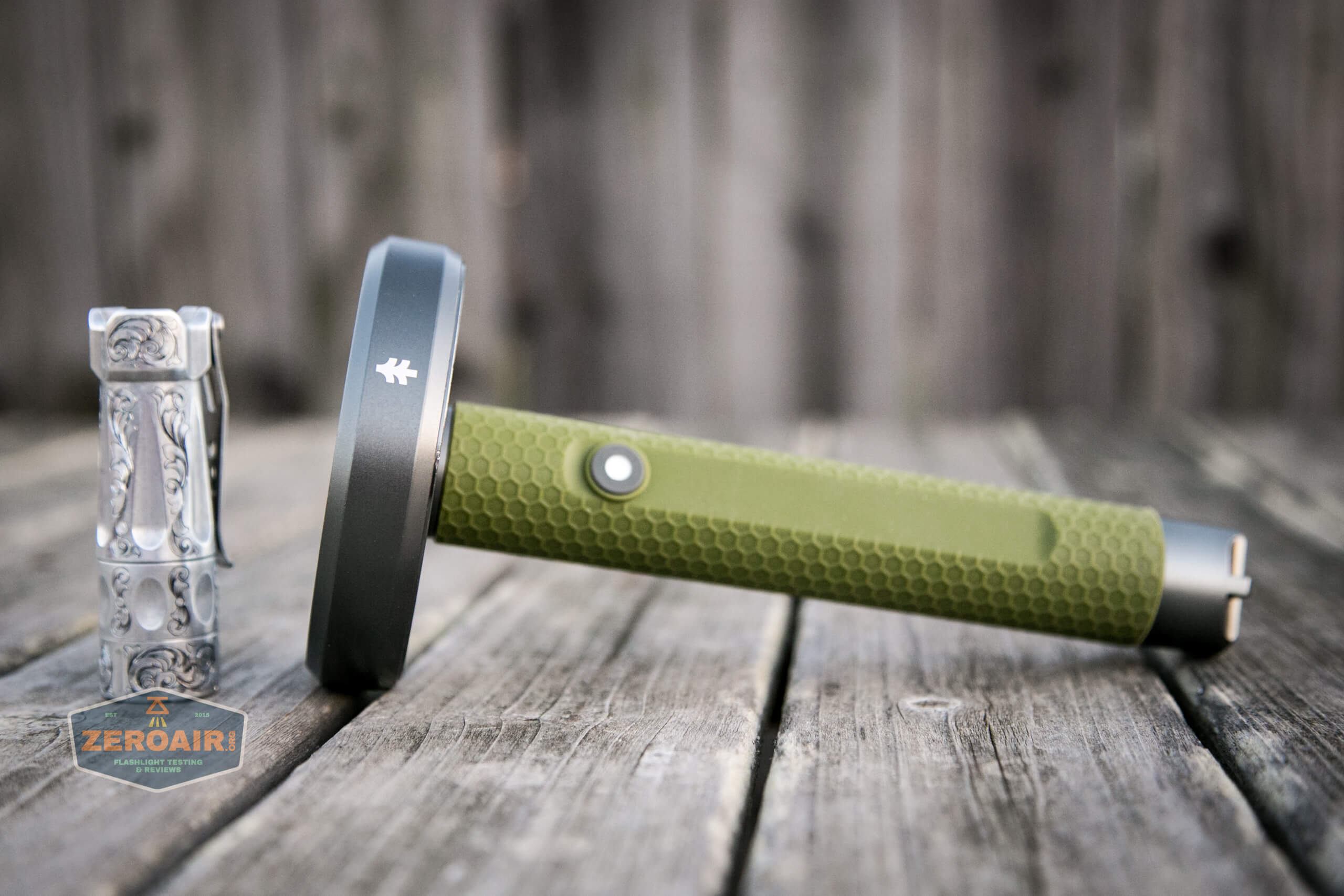
Here’s the test light with the venerable Convoy S2+. Mine is a custom “baked” edition Nichia 219b triple. A very nice 18650 light!

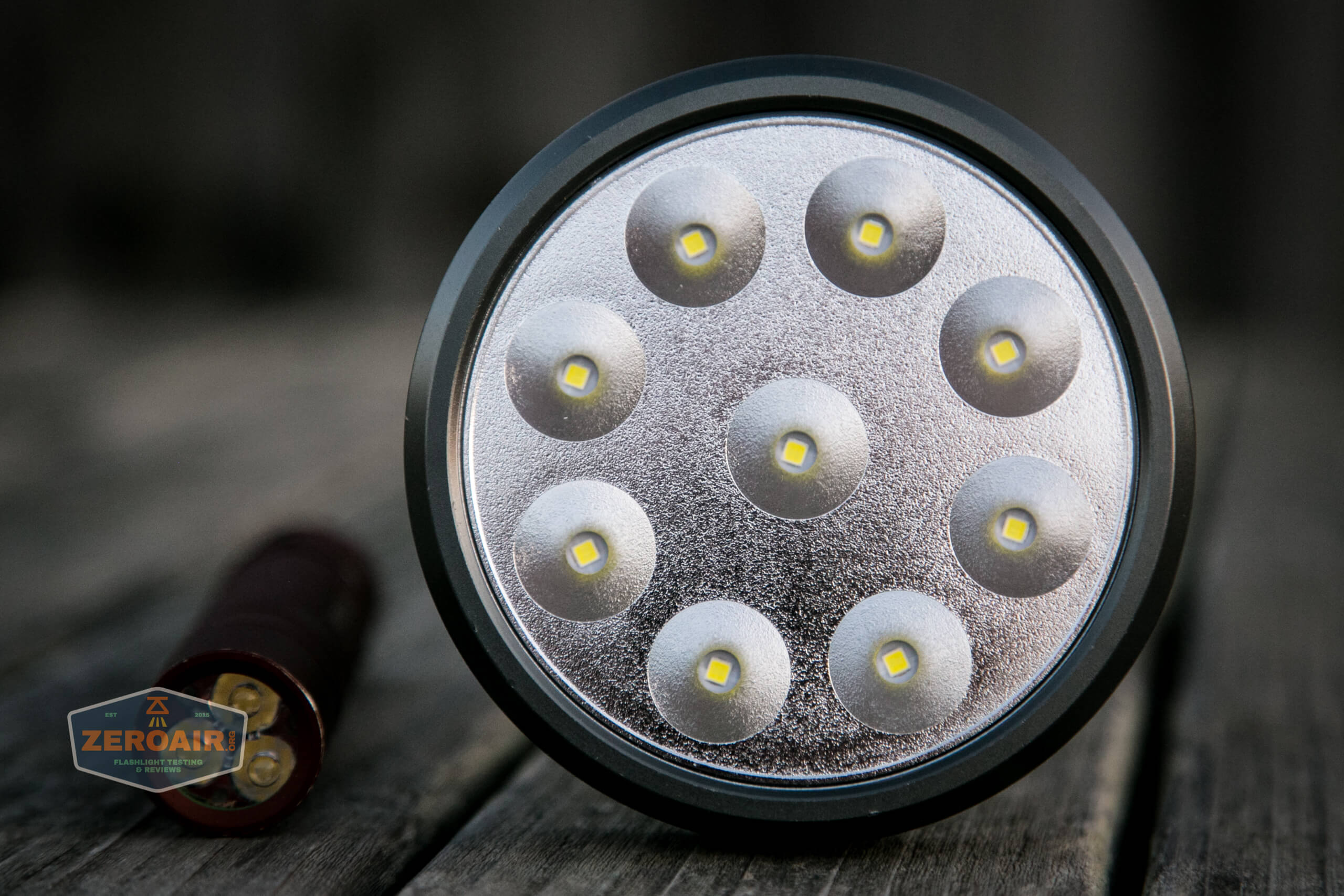
And here’s the light beside my custom-engraved TorchLAB BOSS 35, an 18350 light. I reviewed the aluminum version of that light in both 35 and 70 formats.

Retention and Carry
The Swiss Tech Klassisch 8″ Premium Flashlight ships with a lanyard, which attaches through the tailcap.
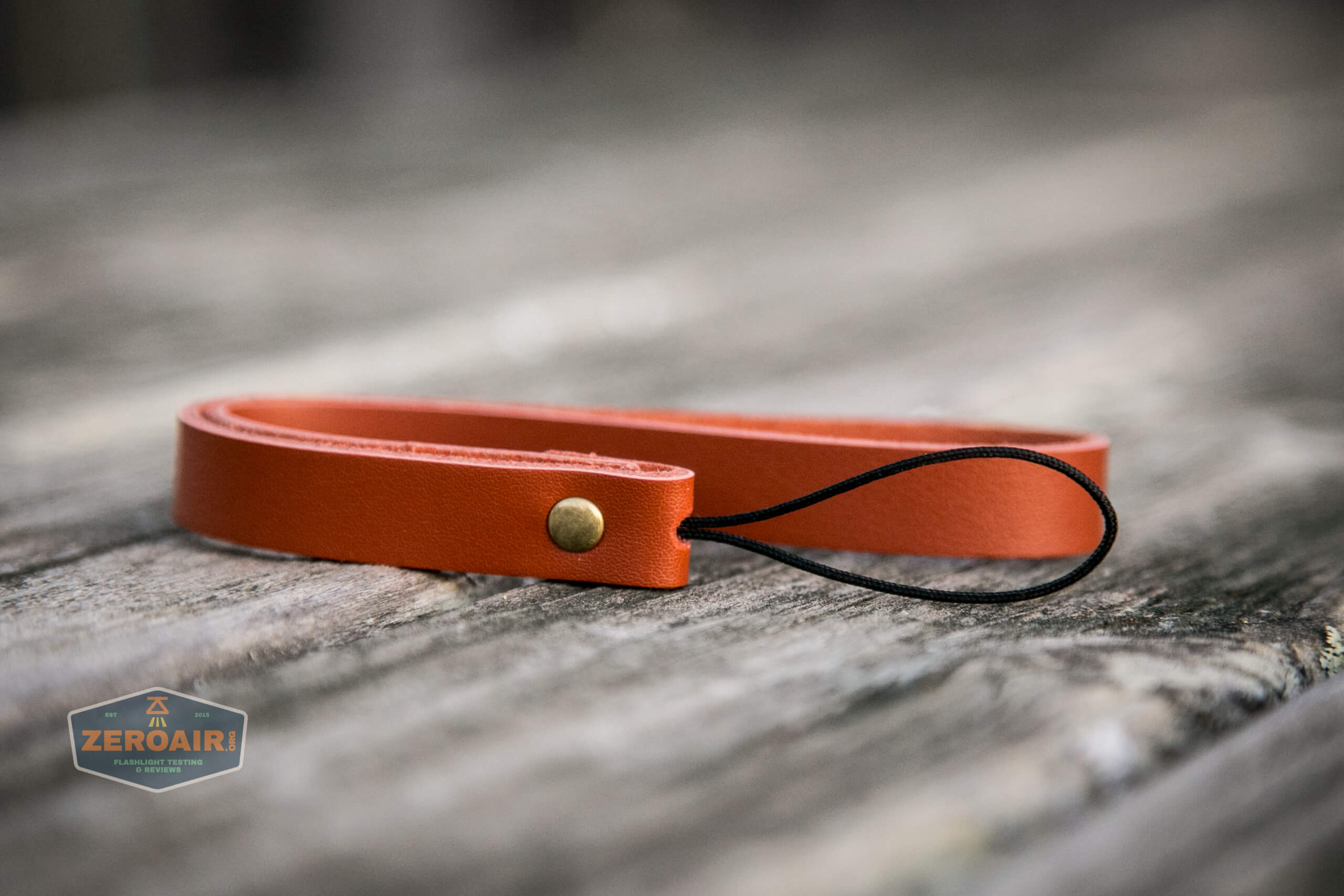
This lanyard has the appearance of leather, but I have my doubts. Also, it’s very stiff, and the edges are quite unforgiving.

The lanyard is the only means of retaining this flashlight.
Power and Runtime
As stated above, this Swiss Tech flashlight is powered by a single 18650 cell. If you’re like me, then you figured this was a 2×18650 light, or maybe even if we were lucky, a 2×21700 light. I think the cell tube would support it.
But it’s not either of those things. It’s a single 18650 cell light, which in some ways might even be a good thing. With just one cell, you’ll never have to worry about imbalanced series cells, for example. Just one cell keeps the weight down.
Of course, just one cell also means that the runtimes will be shorter than the very long cell tube implies. Here are runtimes for both High and Low.
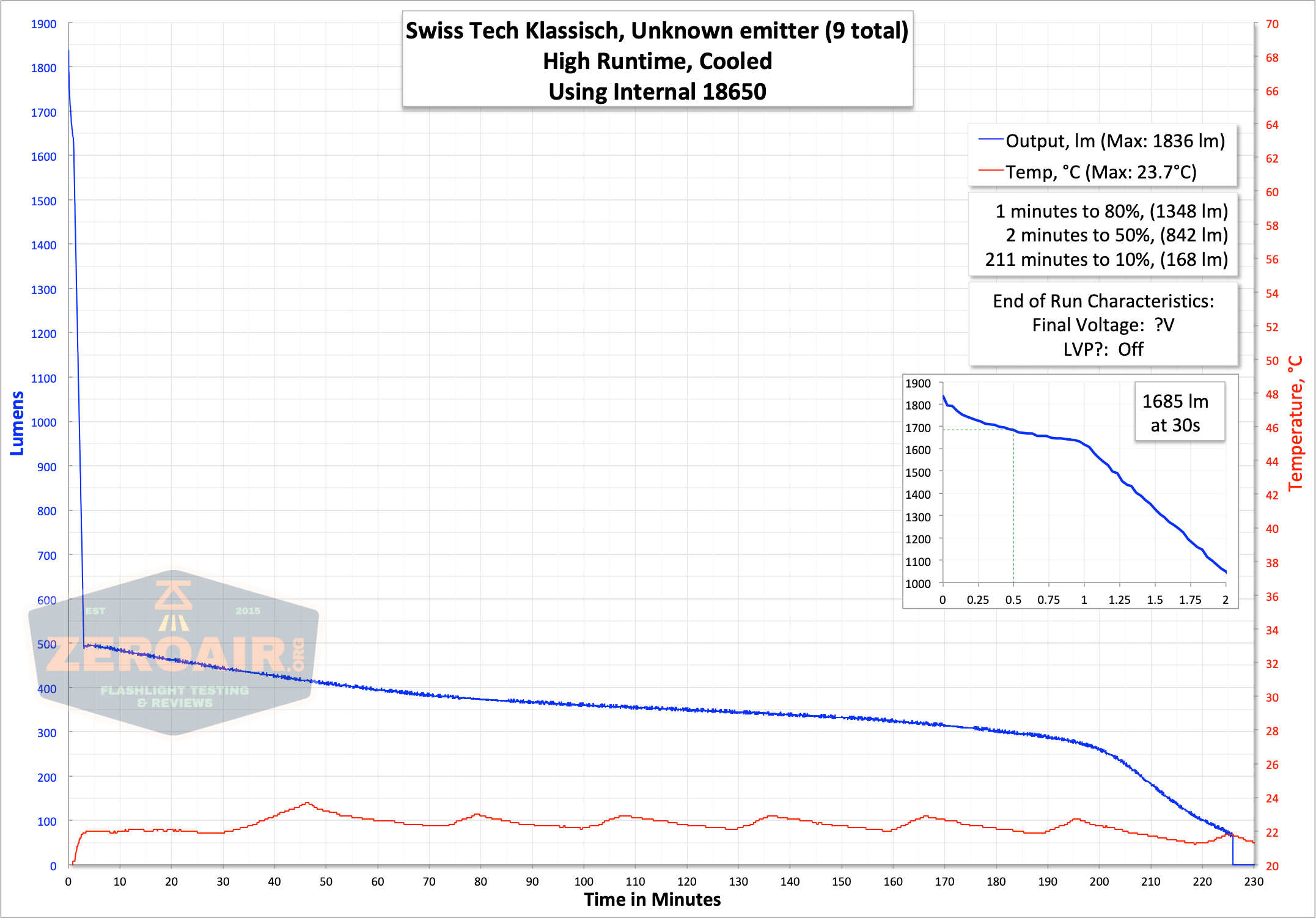

The runtimes are … respectable. We aren’t really seeing anything different here from what you’d see on many enthusiast-level flashlights, so it’s unfair to fault Swiss Tech for stepping down. Also, note the output. They’re claiming 1200 lumens, but at least initially (and even at 30 seconds) I’m seeing way higher than 1200 lumens.
In both tests, the light does either shut off or switch to very low. Even after the shutoff, the light can still be turned back on (though on High, it won’t reach the very high-level output).
Charging
With the built-in battery, you’d expect the light has built-in charging. It does, in the form of a USB-C port in the tailcap area.
Like I said above, accessing this port is hard because the tailcap is slippy with no grip. There’s also a charge indicator there beside the charge port, which is red during charge and green when charging is complete.


I tested only with the supplied format: USB to USB-C. Here’s a single charge graph. Charging is respectable, at over 1A.

The USB-C port does not have output capability. Also, the USB-C does not work at all with USB-C to USB-C.
Modes and Currents
| Mode | Mode Claimed Output (lm) | Claimed Runtime | Measured Lumens | Tailcap Amps |
|---|---|---|---|---|
| High | 1200 | 2h | 1685 | ? |
| Low | 300 | 5h | 523 | ? |
Pulse Width Modulation
One other issue that I have with this light (aside from the tailcap) is the aggressively bad PWM on every mode. Yes, every mode. Even “Flash.” How can strobe have PWM you ask. Well, it’s like a special level of atrociousness here – First off, the strobe is… well that’s its own kind of PWM, right? Just very very slow (and obviously acceptable). But in the on-times of strobe, that mode displays PWM as well. <shudder>
Here are all 3 modes, in order. High, Low, Flash.


Since that’s completely useless because the PWM is so slow (slow is bad), here’s a different timescale:


Strobe is last there, and it’s an even longer timescale – I wanted to be able to capture both on and off time in one graph. As you can see, the “on” is displaying PWM.
Here you can see a “baseline” – a chart with almost no light hitting the sensor.

Then there’s the Ultrafire WF-602C flashlight, which has some of the worst PWM I’ve seen. It’s so bad that I used a post about it to explain PWM! Here are multiple timescales (10ms, 5ms, 2ms, 1ms, 0.5ms, 0.2ms) to make comparing this “worst” PWM light to the test light easier. That post also explains why I didn’t test the WF-602C at the usual 50us scale.


User Interface and Operation
There’s a single e-switch for operating the Swiss Tech flashlight. It’s nice and clicky, easy to find, and has a silicone cover.

Here’s a user interface table!
| State | Action | Result |
|---|---|---|
| Off | Click | High |
| High | Click | Low |
| Low | Click | Flash |
| Flash | Click | Off |
That’s right, you have to cycle through all the modes (including Flash) to turn the light off.
LED and Beam
There are 9 emitters in the Swiss Tech Klassisch flashlight. I’m really not sure what they are exactly….
This almost looks like a dedomed (or domeless, or “HI”) Cree XP-G3, but it lacks the orientation mark in one of the corners. The center tint-shift in the beam would support this, too. But it’s probably just some generic emitter, which can be had for very cheap.

They operate in unison, and there are no modes that allow individual operation.
Two things here: Each emitter has its own reflector. And the whole unit there is covered by a lens, which is plastic. And not hard plastic, but soft, hollow-sounding plastic. I also question the sealed nature of this, too, because just in minimal use, there was debris under this lens.

The illumination is extremely even. And very very floody.

These beamshots always have the following settings: f8, ISO100, 0.3s shutter, and manual 5000K exposure. These photos are taken at floor level, and the beam hits the ceiling around 9 feet away.


Tint vs BLF-348 (KillzoneFlashlights.com 219b version) (affiliate link)
I keep the test flashlight on the left and the BLF-348 reference flashlight on the right.

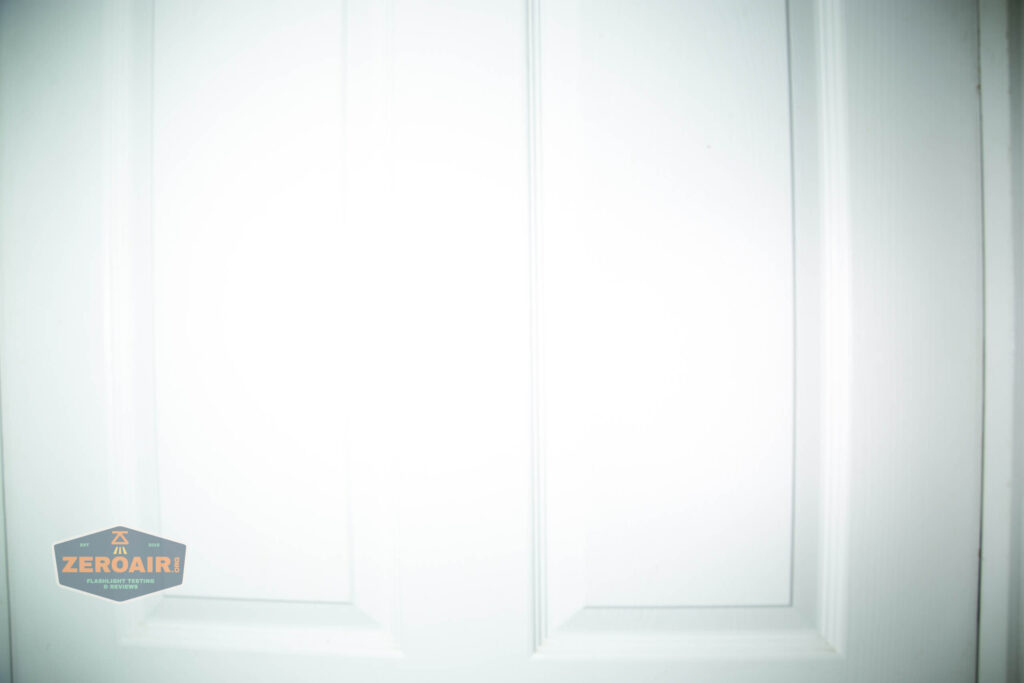
I compare everything to the KillzoneFlashlights.com 219b BLF-348 because it’s inexpensive and has the best tint!
Conclusion
What I like
- Neat and unusual design
- Hits the claim for output
- Hits the claim for throw
- USB-C Charging
What I don’t like
- Very bad PWM
- Tailcap hard to remove
- Very dumb user interface – mode cycle through all modes to turn off, for example.
- Doesn’t work at all with USB-C to USB-C.
Notes
- This light was provided by me for review. I was not paid to write this review.
- This content originally appeared at zeroair.org. Please visit there for the best experience!
- Please use my Amazon.com referral link to help support zeroair.org!
Pingback: Swiss Tech Flashlight Your Essential Guide to Brightness