

Nitecore UT27 Headlamp Review
Nitecore has released the UT27 headlamp. This innovative headlamp uses two Cree XP-G3 emitters in different CCT for different purposes!
Official Specs and Features
Here’s a link to the Nitecore UT27 headlamp product page.
Versions
Only one version of the Nitecore UT27 headlamp is available at this time.
Price
The going price for this new Nitecore UT27 headlamp is $54.95. They’re available for purchase now at NitecoreStore.com.
Short Review
I love seeing this warm emitter in a headlamp! Using the warmer emitter as a spotlight is a bit unusual (and great). I’d love for the flood to be warmer too – beside the 3000K spot, a 5700K flood looks very cool. Even something at 4000K for example, would be great here. The battery setup here is great too. A package including the HLB1300 lithium-ion is smart, but the UT27 will run on 3 AAA cells as well – a great backup plan.
Long Review
The Big Table
I don’t know the best way to present the tables exactly, so I’ll just do a bunch of them. This includes data for both battery setups (lithium-ion and AAAx3) as well as data for both emitters and the combo emitter. It’s a bunch of data!
| Nitecore UT27 | |
|---|---|
| Emitter: | Cree XP-G3 (Both) |
| Price in USD at publication time: | $54.95 |
| Cell: | 1xHLB1300 |
| Turbo Runtime Graph | |
| LVP? | Yes |
| Switch Type: | E-Switch |
| Quiescent Current (mA): | ? |
| On-Board Charging? | Yes |
| Charge Port Type: | USB-C |
| Power off Charge Port | Yes |
| Claimed Lumens (lm) | 520 |
| Measured Lumens (at 30s) | 379 (72.9% of claim)^ |
| Candela per Lumen | 5.3 |
| Claimed Throw (m) | 103 |
| Candela (Calculated) in cd (at 30s) | 269lux @ 3.089m = 2567cd |
| Throw (Calculated) (m) | 101.3 (98.3% of claim)^ |
| Claimed CCT | 5700K |
| Measured CCT Range (K) | 6900-7100 Kelvin |
| Item provided for review by: | NitecoreStore.com |
| All my Nitecore reviews! | |
| Nitecore UT27 | |
|---|---|
| Emitter: | Cree XP-G3 (Spot, 3000K) |
| Cell: | 1xHLB1300 |
| High Runtime Graph | |
| LVP? | Yes |
| On-Board Charging? | Yes |
| Charge Port Type: | USB-C |
| Charge Graph | |
| Power off Charge Port | Yes |
| Claimed Lumens (lm) | 400 |
| Measured Lumens (at 30s) | 421 (105.3% of claim)^ |
| Candela per Lumen | 8.4 |
| Claimed Throw (m) | 128 |
| Candela (Calculated) in cd (at 30s) | 302lux @ 3.335m = 3359cd |
| Throw (Calculated) (m) | 115.9 (90.5% of claim)^ |
| Claimed CCT | 3000K |
| Measured CCT Range (K) | 2900 Kelvin |
| Nitecore UT27 | |
|---|---|
| Emitter: | Cree XP-G3 (Flood, 5700K) |
| Cell: | 1xHLB1300 |
| High Runtime Graph | |
| LVP? | Yes |
| Quiescent Current (mA): | ? |
| On-Board Charging? | Yes |
| Charge Port Type: | USB-C |
| Charge Graph | |
| Power off Charge Port | Yes |
| Claimed Lumens (lm) | 200 |
| Measured Lumens (at 30s) | 196 (98% of claim)^ |
| Candela per Lumen | 1.2 |
| Claimed Throw (m) | 31 |
| Candela (Calculated) in cd (at 30s) | 37lux @ 2.869m = 305cd |
| Throw (Calculated) (m) | 34.9 (112.6% of claim)^ |
| Claimed CCT | 5700K |
| Measured CCT Range (K) | 3185 Kelvin |
| Nitecore UT27 | |
|---|---|
| Emitter: | Cree XP-G3 (Both) |
| Cell: | 3xAAA |
| Turbo Runtime Graph | |
| LVP? | Maybe |
| Quiescent Current (mA): | ? |
| On-Board Charging? | No |
| Claimed Lumens (lm) | 520 |
| Measured Lumens (at 30s) | 405 (77.9% of claim)^ |
| Candela per Lumen | 5.2 |
| Claimed Throw (m) | 103 |
| Candela (Calculated) in cd (at 30s) | 386lux @ 2.57m = 2549cd |
| Throw (Calculated) (m) | 101.0 (98.1% of claim)^ |
| Claimed CCT | 5700K |
| Measured CCT Range (K) | 6600-6700 Kelvin |
| Nitecore UT27 | |
|---|---|
| Emitter: | Cree XP-G3 (Spot, 3000K) |
| Cell: | 3xAAA |
| High Runtime Graph | |
| LVP? | Maybe |
| Quiescent Current (mA): | ? |
| On-Board Charging? | No |
| Claimed Lumens (lm) | 400 |
| Measured Lumens (at 30s) | 394 (98.5% of claim)^ |
| Candela per Lumen | 9.4 |
| Claimed Throw (m) | 128 |
| Candela (Calculated) in cd (at 30s) | 337lux @ 3.15m = 3344cd |
| Throw (Calculated) (m) | 115.7 (90.4% of claim)^ |
| Claimed CCT | 3000K |
| Measured CCT Range (K) | 2900 Kelvin |
| Nitecore UT27 | |
|---|---|
| Emitter: | Cree XP-G3 (Flood, 5700K) |
| Cell: | 3xAAA |
| LVP? | Maybe |
| Quiescent Current (mA): | ? |
| On-Board Charging? | No |
| Claimed Lumens (lm) | 200 |
| Measured Lumens (at 30s) | 187 (93.5% of claim)^ |
| Candela per Lumen | 1.4 |
| Claimed Throw (m) | 31 |
| Candela (Calculated) in cd (at 30s) | 47lux @ 2.603m = 318cd |
| Throw (Calculated) (m) | 35.7 (115.2% of claim)^ |
| Claimed CCT | 5700K |
| Measured CCT Range (K) | 3200 Kelvin |
^ Measurement disclaimer: Testing flashlights is my hobby. I use hobbyist-level equipment for testing, including some I made myself. Try not to get buried in the details of manufacturer specifications versus measurements recorded here; A certain amount of difference (say, 10 or 15%) is perfectly reasonable.
What’s Included

- Nitecore UT27 headlamp
- Nitecore HLB1300 lithium-ion battery (not pictured)
- Charging cable (USB to USB-C)
- Carry bag
- Manuals etc
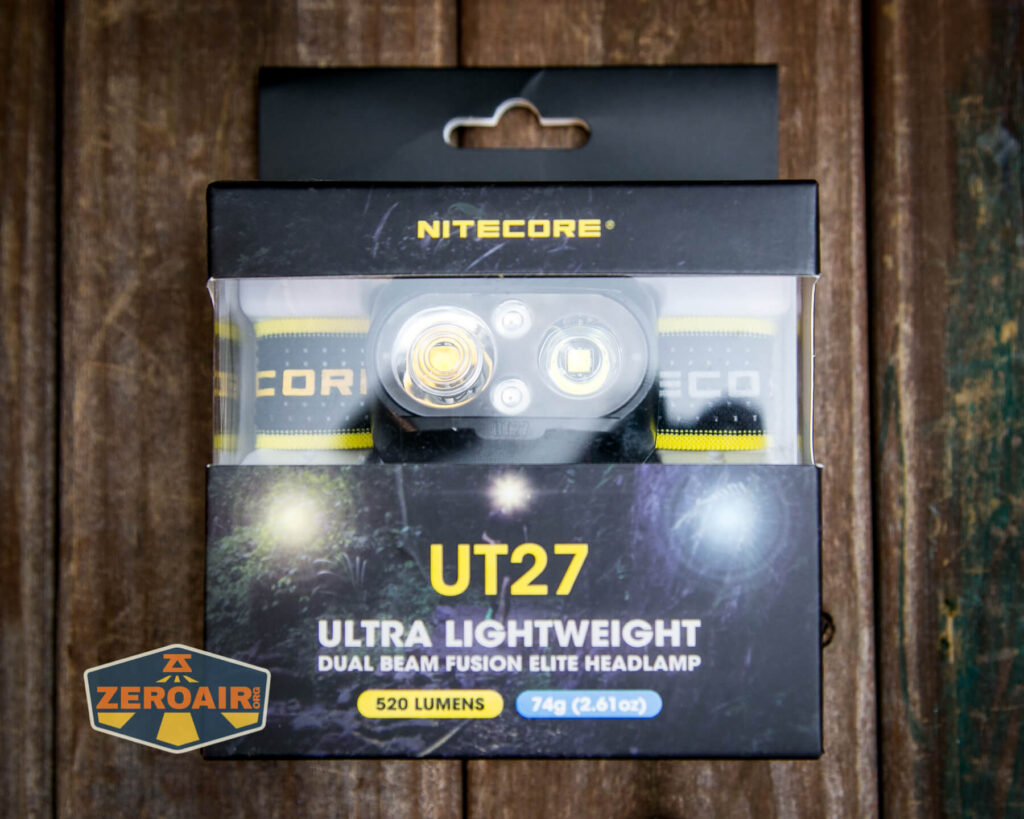
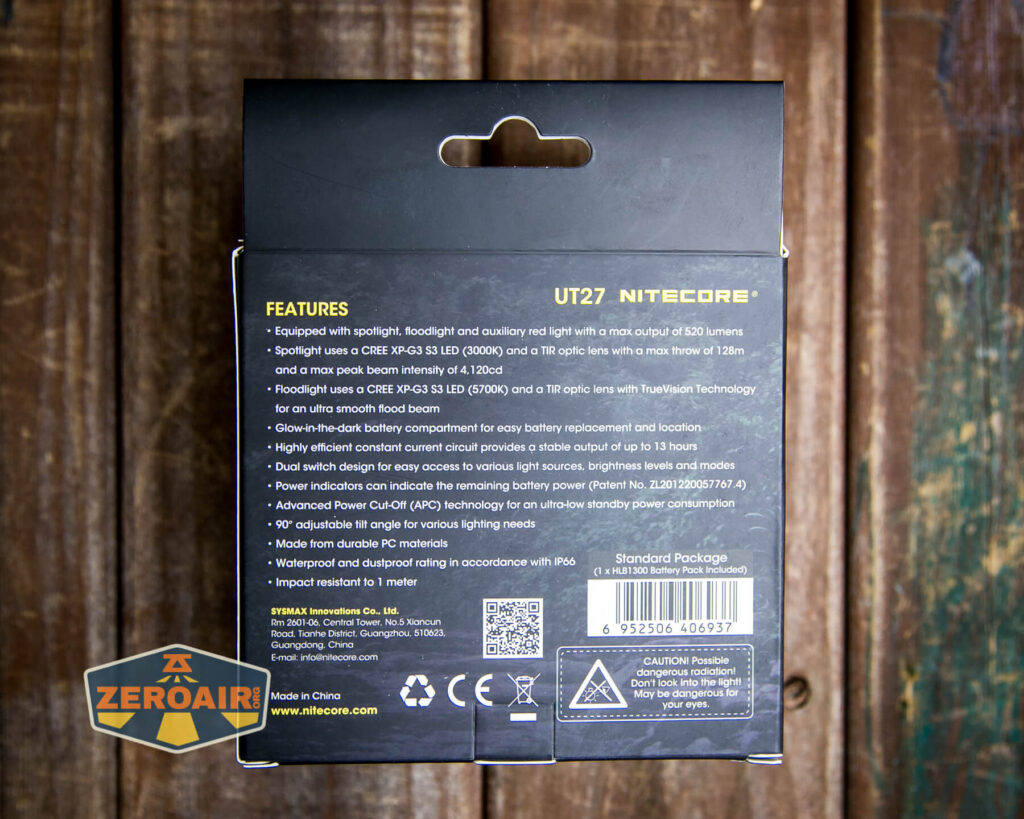
Package and Manual


Build Quality and Disassembly

This is a plastic headlamp. That might lump the Nitecore UT27 into the “hiker” category of headlamps for you – it’s understandable. Many brands like Petzl and Black Diamond use mostly plastic, and those have proven popular with some groups.

One downside of plastic parts on this headlamp is this hinge right here. I had fine luck with this headlamp thus far, but another Nitecore I own and still use (the Nitecure NU17) has nearly the same hinge (actually a worse version of it, I think) and that headlamp has broken off the hinge. I think the hinge here is a bit more robust, but it’s still plastic. If something breaks, then this is no longer a headlamp, it’s a handheld rectangular light. I would much rather see this be a metal connection of some sort.

To reveal the battery, just flip the back down.


You can see the o-ring there on the case. Inside the case are diagrams to demonstrate which way cells go.

Size and Comps
Dimensions:
55.4mm x 42.5mm x 32mm (bracket included)
Weight:
30.5g (bracket included, headband and battery excluded)
74g (bracket, headband, and battery included)


If the flashlight will headstand, I’ll show it here (usually the third photo). If the flashlight will tailstand, I’ll show that here, too (usually the fourth photo).


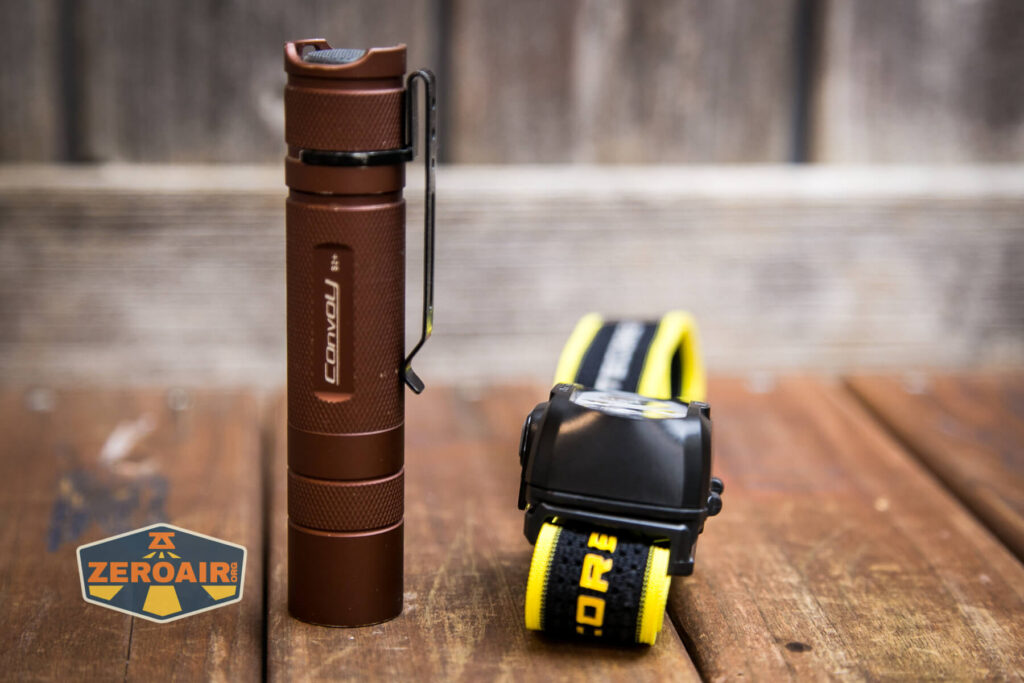
Here’s the test light with the venerable Convoy S2+. Mine’s a custom “baked” edition Nichia 219b triple. A very nice 18650 light.


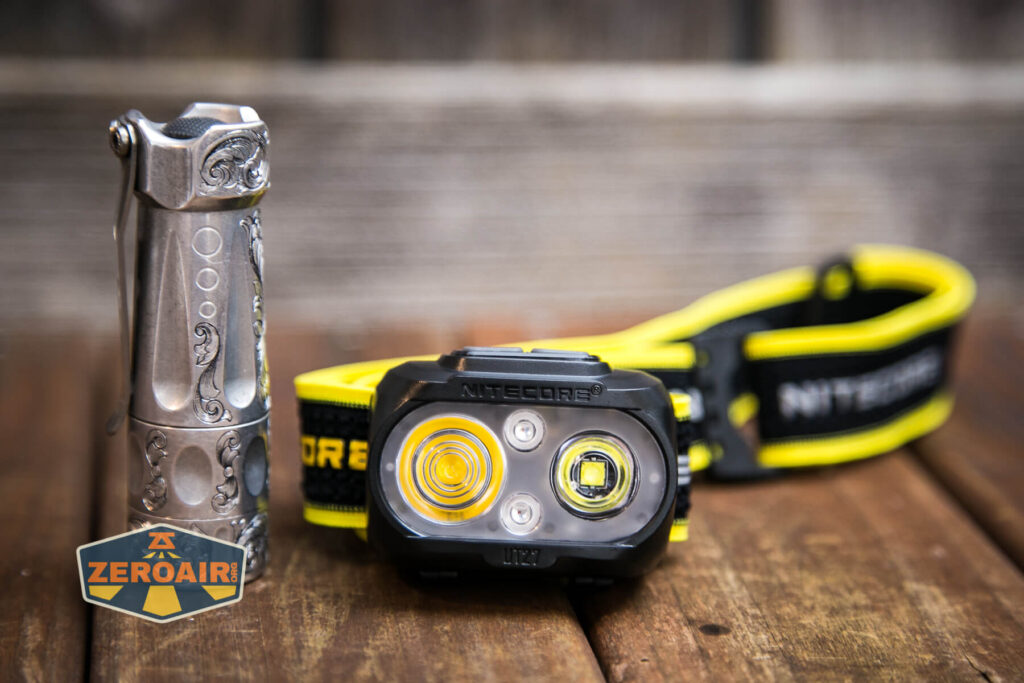
And here’s the light beside my custom-engraved TorchLAB BOSS 35, an 18350 light. I reviewed the aluminum version of that light in both 35 and 70 formats.

Retention and Carry
The Nitecore UT27 headlamp is a headlamp and really only a headlamp. It ships attached to this stretchy headband. The band is grippy and comfortable.

The UT27 doesn’t really come off of the headband very easily – really I can’t say why you’d want to do that but it’d be nice, anyway.

There’s a good bit of adjustability on the headband, but probably not enough to use this light as a waist light. Maybe an upper thigh light? Did you skip leg day though?

The photo below is intended to demonstrate that the light is not removable from the band.

But after all my testing and work with the light, I realized I could push the plastic out of the hinge part and it comes out pretty easily. The part attached to the headband remains attached to the headband. In the photo below, the hinges are the outermost connection points. Those two inner connections are the ratchets that help hold the light at different angles. They work well.
Another option for carry when the light is not in use is this white nylon bag.

I actually love little bags like this and this one is particularly good. It’s right-sized, thin and light, and has a drawstring.


It’s an absolute magnet for dirt though!

Power and Runtime
Nitecore includes the lithium-ion battery suitable for running the UT27. That’s the HLB1300, a custom battery by Nitecore which seems to be special for the UT27.
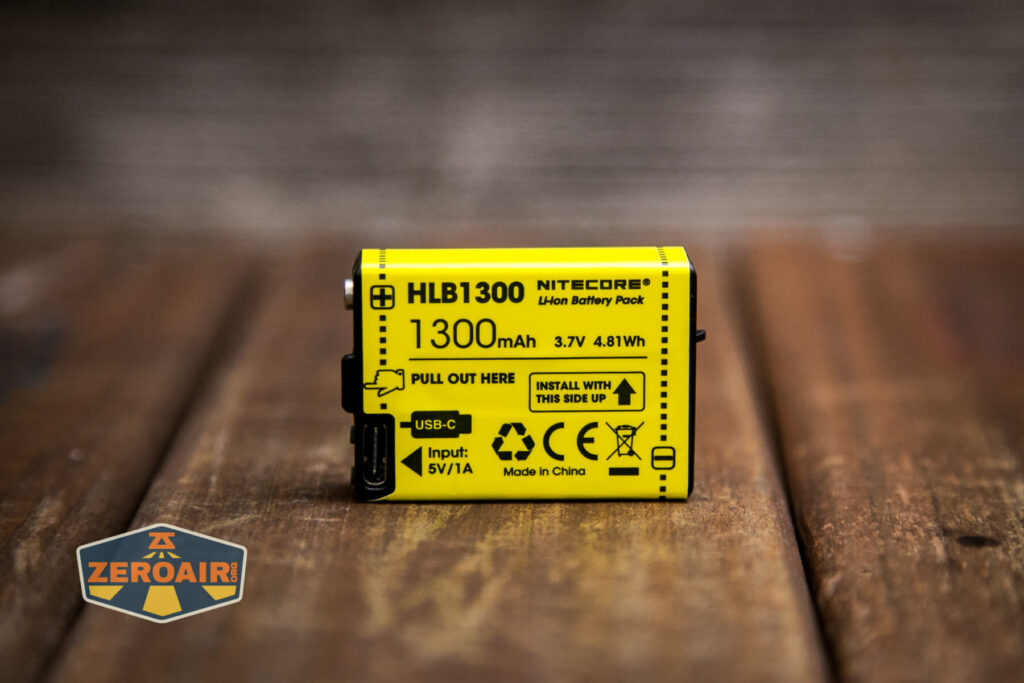


To access the battery, raise the tab shown below and twist the back case downward.
The HLB1300 will fit into the case in only one direction. There’s really no way to do it incorrectly – it’s physically prevented.
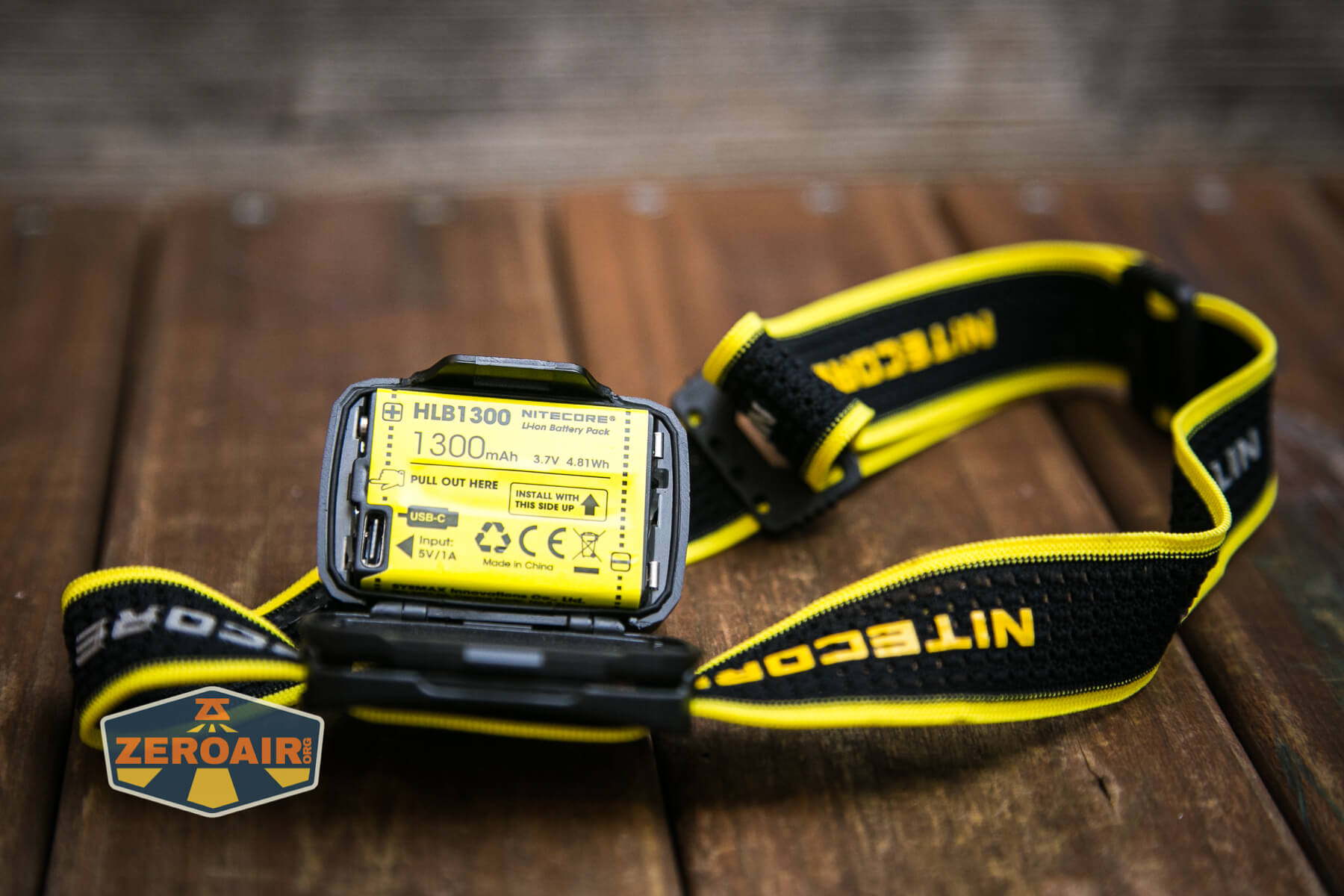


Here’s the main physical prevention. Below you can see that little plastic tab that will allow only one orientation of the battery.


Since all the contact points are inside the light (and not the back case), the HT27 will work with the back case open. As you can see that does leave the USB-C port exposed. And yes, in fact, you can use the UT27 with the battery plugged into a USB-C source. It’d be cumbersome, but that could get some extended runtimes for certain.

I didn’t get any photos with the AAA cells. The cells are in series and have a specific orientation. Output is essentially the same with AAA cells, but the runtimes are shorter.
Speaking of runtimes, here are some graphs.


Charging
The Nitecore UT27 headlamp itself does not have charging built-in, but the included battery does. This HLB1300 has a USB-C port on the back (“back” or “side” or whatever you want to call it.)

Nitecore includes a USB to USB-C cable.


Here are a couple of charging graphs. Both USB and USB-C sources work fine! While charging, there’s a red indicator on the battery (right near the charging port). When charging is complete, this indicator turns to green.


Modes and Currents
HLB1300:
| Mode | Mode Claimed Output (lm) | Claimed Runtime | Measured Lumens | Tailcap Amps |
|---|---|---|---|---|
| Turbo | 520 | – | Initial: 521 30s: 379 |
1.18 |
| High – Spot | 400 | 6h | 421 | 1.04 |
| Low – Spot | 100 | 10h | 100 | 0.17 |
| High – Flood | 200 | 8h | 196 | 0.43 |
| Low – Flood | 55 | 13h | 47 | 0.08 |
| Red | 16 | 6h | – | ? |
AAAx3:
| Mode | Mode Claimed Output (lm) | Claimed Runtime | Measured Lumens | Tailcap Amps |
|---|---|---|---|---|
| Turbo | 520 | – | Initial: 522 30s: 405 |
– |
| High – Spot | 400 | 4h | 394 | – |
| Low – Spot | 100 | 6h30m | 100 | – |
| High – Flood | 200 | 5h | 187 | – |
| Low – Flood | 55 | 8h | 46 | – |
| Red | 16 | 4h30m | – | – |
Pulse Width Modulation
There’s really no PWM at all on the Nitecore UT27 headlamp!
Lithium-ion:


AAAx3:


Here you can see a “baseline” – a chart with almost no light hitting the sensor.

Then there’s the Ultrafire WF-602C flashlight, which has some of the worst PWM I’ve seen. It’s so bad that I used a post about it to explain PWM! Here are multiple timescales (10ms, 5ms, 2ms, 1ms, 0.5ms, 0.2ms) to make comparing this “worst” PWM light to the test light easier. That post also explains why I didn’t test the WF-602C at the usual 50us scale.


User Interface and Operation
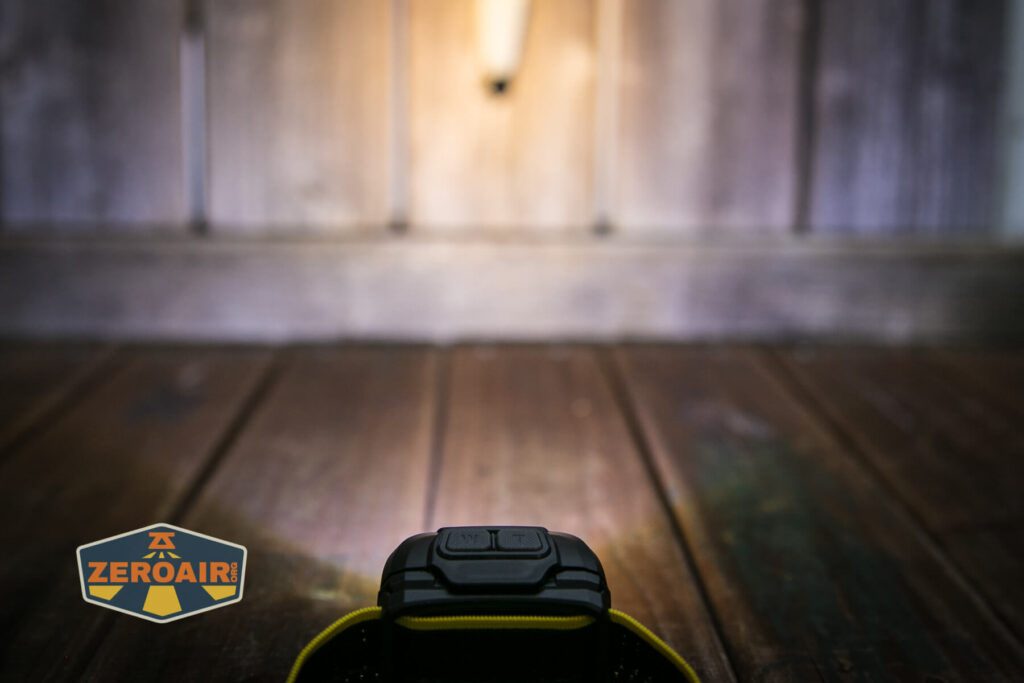
Two switches control all operations of the UT27. These are side-by-side on the top of the headlamp and are e-switches.
The action on the switches is very low, and because they resonate through the body a bit, they’re somewhat loud.
One more note about these switches – they do basically the same thing for their respective light. When worn properly, the spotlight (warm) is on the right side, and the floodlight (cool) is on the left. The right switch (“T”) controls the spot and the left switch (“W”) controls flood.
Here’s a user interface table!
| State | Action | Result |
|---|---|---|
| Off | Click Either | Battery indicator with red flashes^ |
| Off | Hold: T (Spot) W (Flood) |
Low |
| Off | Double Click Either | Red |
| On | Hold Either | |
| On | Click Switch of light that is on | Mode advance For White: low to high For Red: Steady to Warning flashing |
| On | Double Click Either | Turbo |
| On | Click Switch of light that is not on | Switch to Low for other emitter |
^ The battery indicator blinks as follows:
Three red blinks: >50% power
Two red blinks: <50% power
One red blink: <10% power
LED and Beam
Nitecore uses two of the same emitters of very different CCT in the UT27. They are Cree XP-G3 emitters. Not traditionally my favorite emitter, but I have to say that the 3000K is quite nice!
Each emitter has a different style of TIR. The warm (left, below) has a TIR making the output a tight beam. The cool output is very floody.



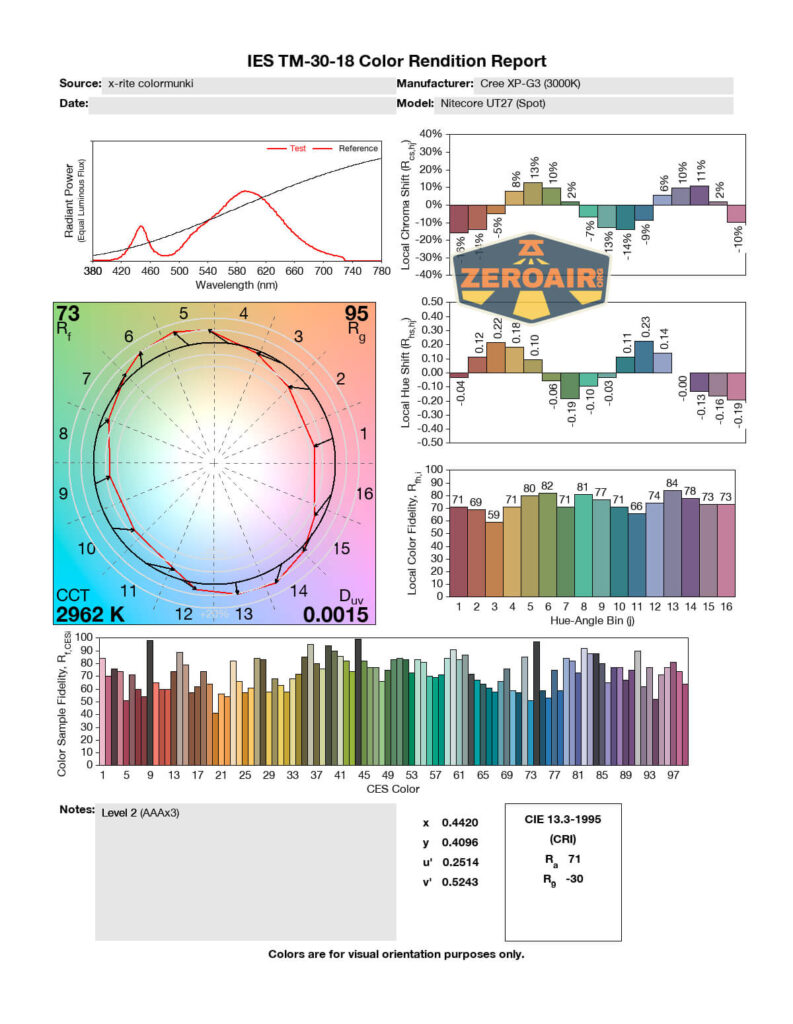
LED Color Report (CRI and CCT)
These should really look the same – the only difference the battery makes is the runtime. Still, I’m including the data.
Lithium-ion:


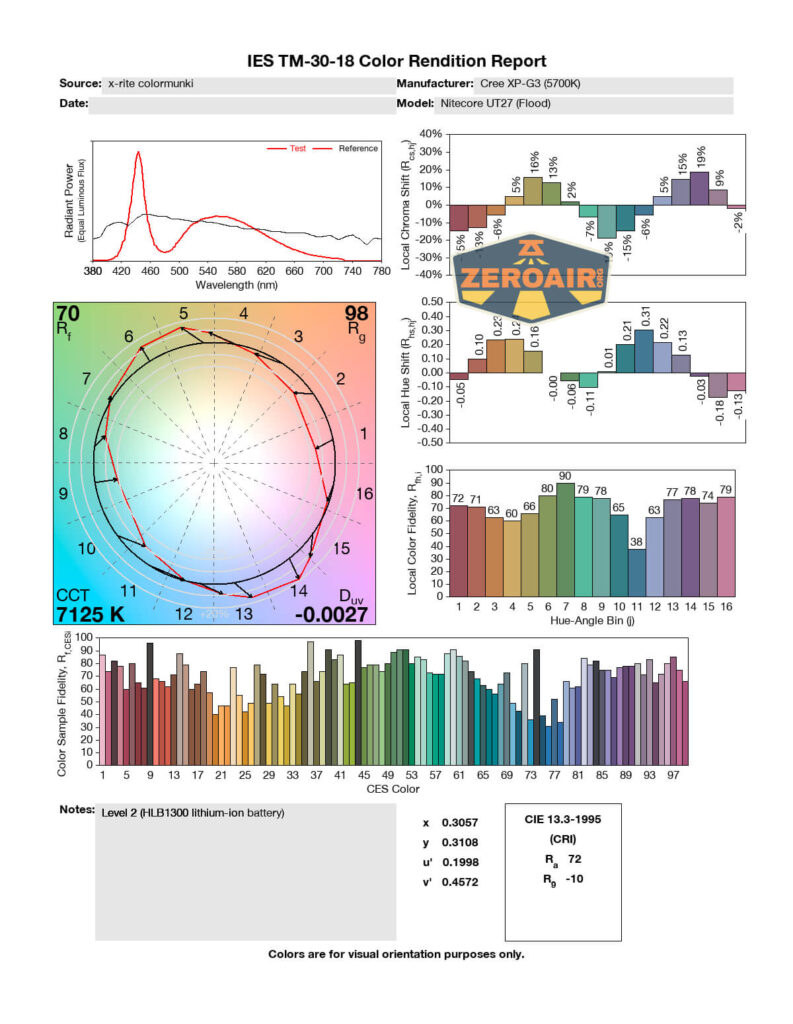


AAAx3:



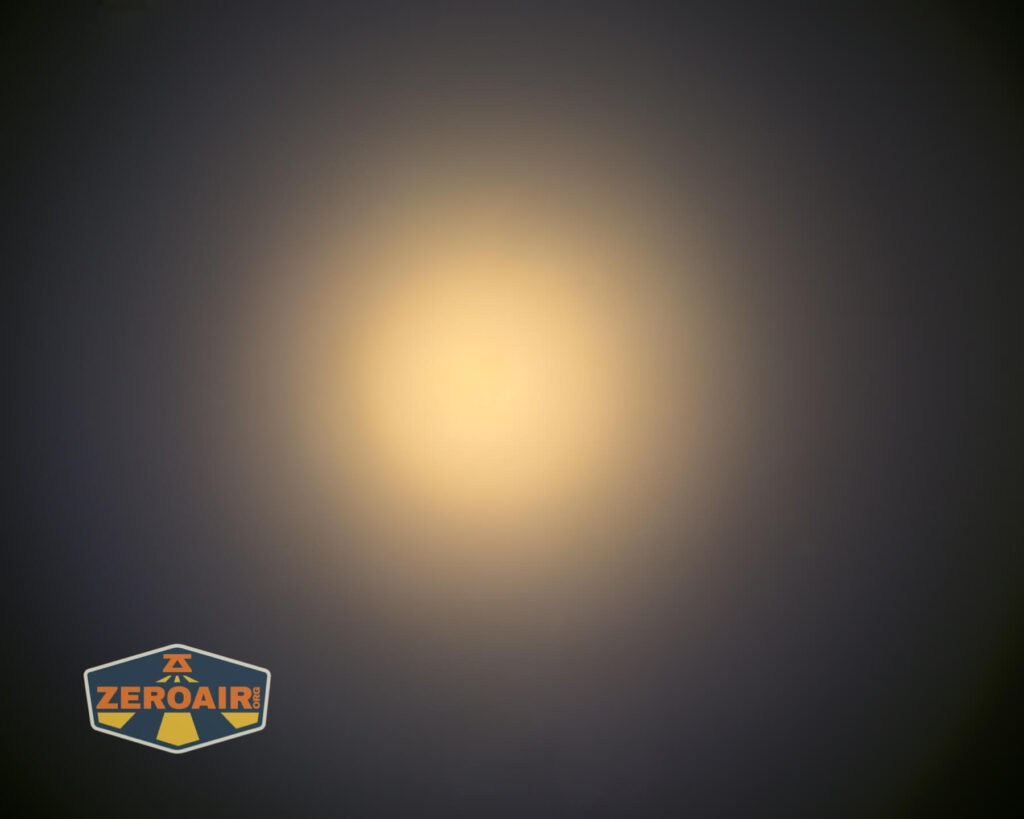
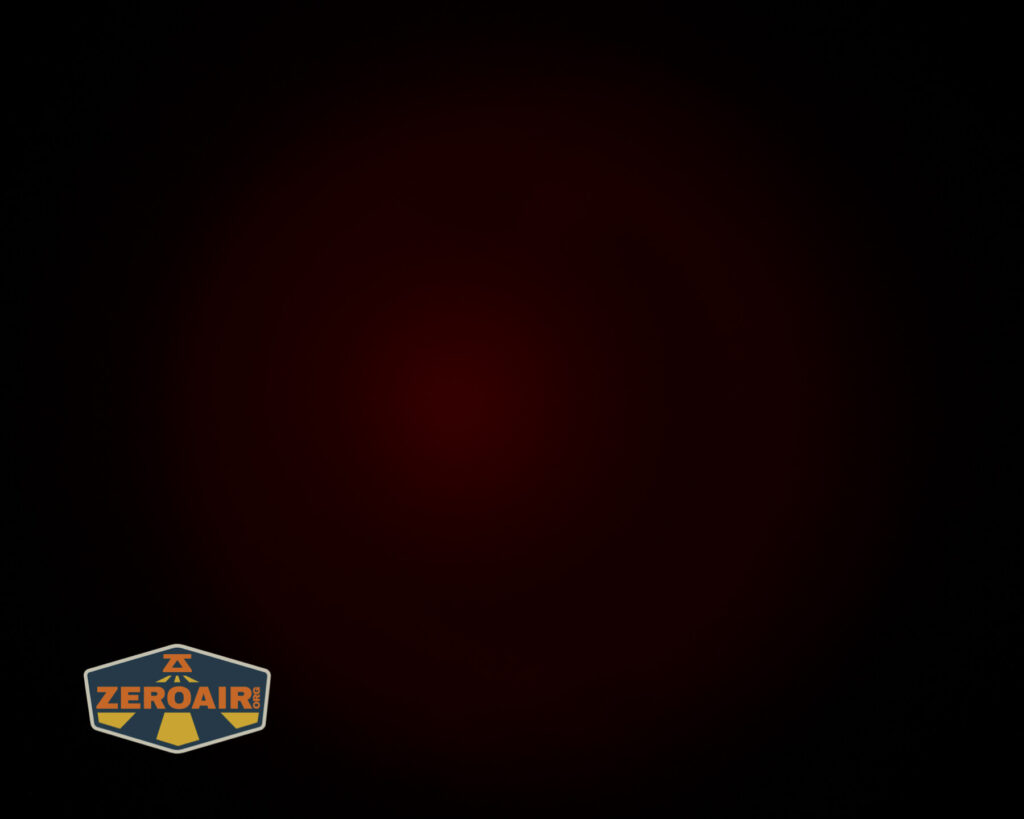
Beamshots
These beamshots always have the following settings: f8, ISO100, 0.3s shutter, and manual 5000K exposure. These photos are taken at floor level, and the beam hits the ceiling around 9 feet away.
Lithium-ion:


AAAx3:


Tint vs BLF-348 (KillzoneFlashlights.com 219b version) (affiliate link)
I keep the test flashlight on the left and the BLF-348 reference flashlight on the right.
Lithium-ion:


AAAx3:


I compare everything to the KillzoneFlashlights.com 219b BLF-348 because it’s inexpensive and has the best tint!
Conclusion
What I like
- Great use of TIR for different profiles from the same type of emitter.
- Good to see 3000K being used
- White outputs start on low
- Battery indicator
What I don’t like
- 5700K appears much too cold when the 3000K is used
- “5700K” is really more like 6900K (which is in fact extremely cool)
- Plastic hinge
Notes
- This content originally appeared at zeroair.org. Please visit there for the best experience!
- For flashlight-related patches, stickers, and gear, head over to PhotonPhreaks.com!
- Please use my Amazon.com referral link to help support zeroair.org!
- Please support me on Patreon! I deeply appreciate your support!
Does that bag make the headlamp a makeshift lantern?
I wouldn’t say “no” to that but my first (or second or third or fourth) impression of the bag was not that it could be used as a lantern. But yes probably, that’d work!