
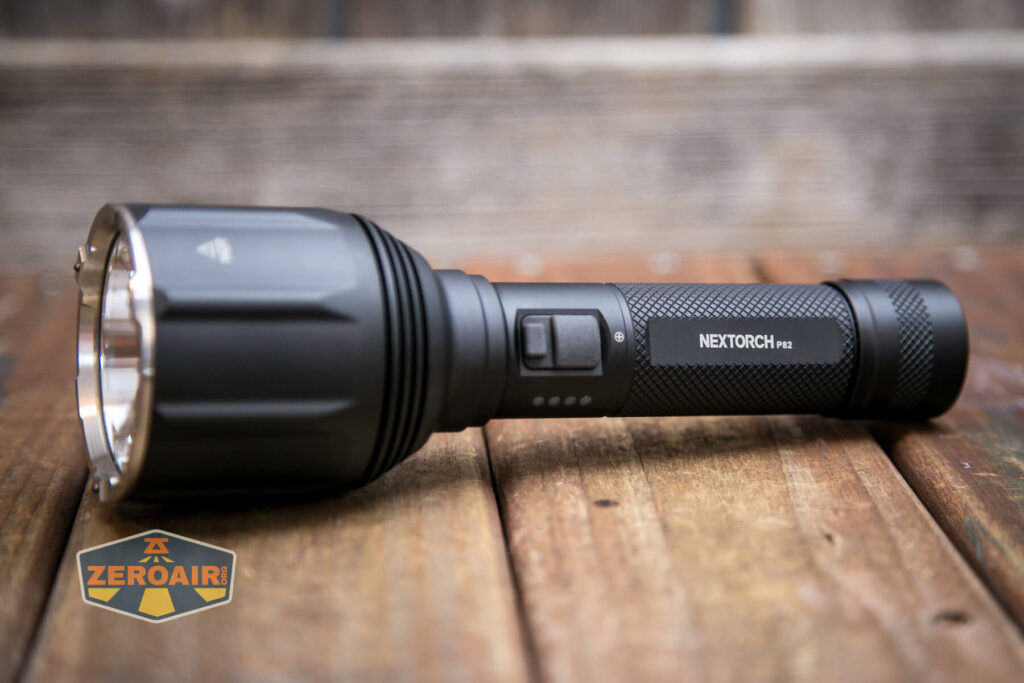
Nextorch P82 Long-Range Flashlight Review
The Nextorch P82 long-range flashlight uses a brand new emitter and offers very good output and throw. USB-C charging rounds out the package! Read on!
Official Specs and Features
Here’s a link to the Nextorch P82 long-range flashlight product page.
Versions
There’s just one version of the Nextorch P82 long-range flashlight.
Price
Nextorch has the P82 listed on their site right now for $99.
I also have a referral coupon for Nextorch.com that’ll give you 10% off! The code is “ZEROAIR“.
Short Review
I don’t know much about this new emitter that was (according to Nextorch) “jointly developed by the international teams and Nextorch R&D team.” Regardless of what it is exactly, it’s safe to say that it’s a performer, meeting throw and output claims made by Nextorch. I also love the beam profile it gives. I’d call it a sort of smaller, throwier version of an emitter you know and love – the Luminus SBT90.2. The whole light is a great size and shape (which you know I love). Charging is good too, with a hidden charging port. And I’d say the price is fairly reasonable, too!
Long Review
The Big Table
| Nextorch P82 Long-Range Flashlight | |
|---|---|
| Emitter: | “High Optical Density” (HOD) LED |
| Price in USD at publication time: | $99.00 |
| Cell: | 1×21700 |
| High Runtime Graph | Medium Runtime Graph |
| LVP? | Yes, with warning |
| Switch Type: | E-Switch |
| Quiescent Current (mA): | ? |
| On-Board Charging? | Yes |
| Charge Port Type: | USB-C |
| Charge Graph | |
| Power off Charge Port | No |
| Claimed Lumens (lm) | 1200 |
| Measured Lumens (at 30s) | 1322 (110.2% of claim)^ |
| Candela per Lumen | 268.4 |
| Claimed Throw (m) | 1100 |
| Candela (Calculated) in cd (at 30s) | 9190lux @ 6.069m = 338493cd |
| Throw (Calculated) (m) | 1163.6 (105.8% of claim)^ |
| Claimed CCT | – |
| Measured CCT Range (K) | 6200-6450 Kelvin |
| Item provided for review by: | Nextorch |
| All my Nextorch reviews! | |
^ Measurement disclaimer: Testing flashlights is my hobby. I use hobbyist-level equipment for testing, including some I made myself. Try not to get buried in the details of manufacturer specifications versus measurements recorded here; A certain amount of difference (say, 10 or 15%) is perfectly reasonable.
What’s Included

- Nextorch P82 long-range flashlight
- Nextorch 4800mAh 21700 cell
- Charging cable (USB to USB-C)
- Lanyard
- Spare o-rings (2)
- Manual
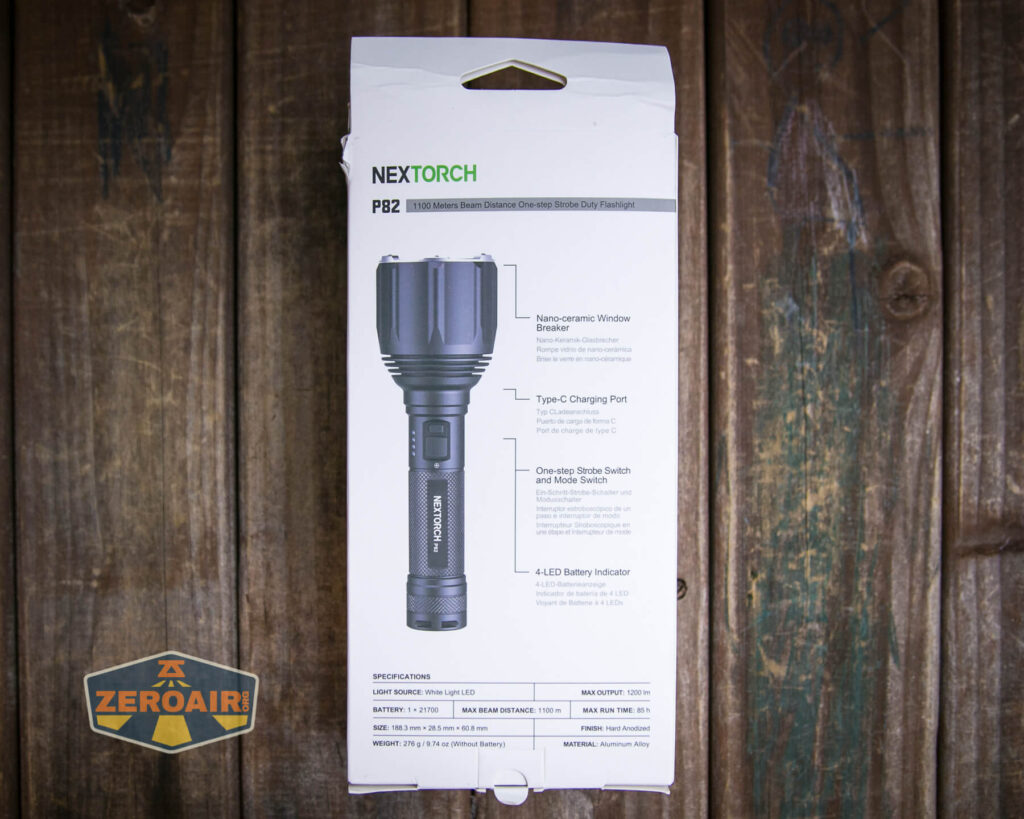
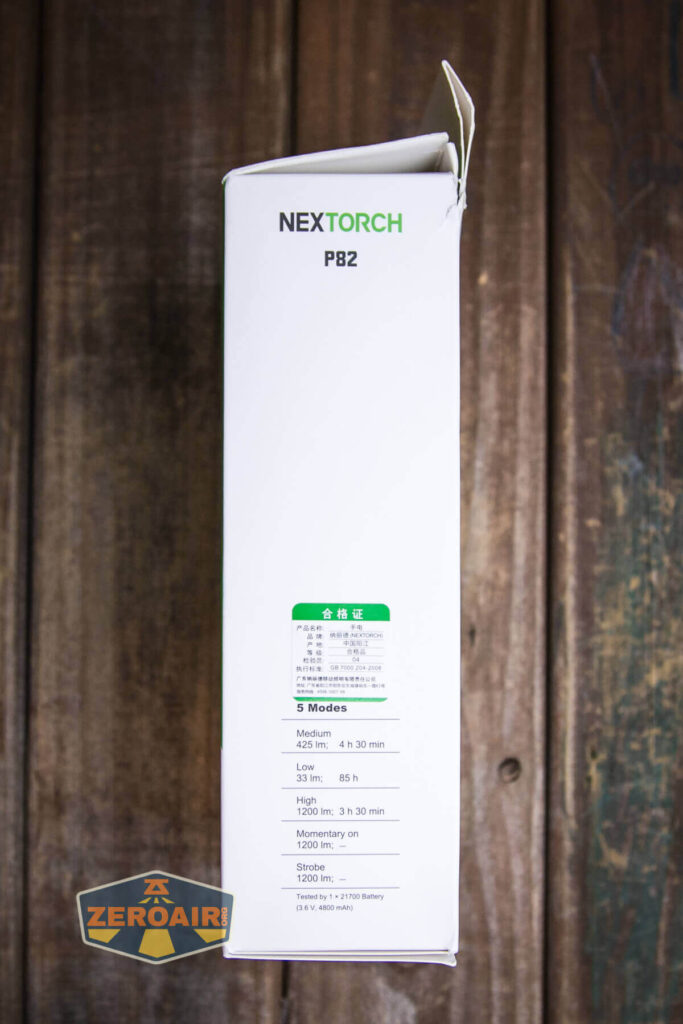
Package and Manual



Build Quality and Disassembly

Just like the Nextorch I’ve reviewed (the Nextorch TA30), the build quality of the Nextorch P82 long-range flashlight is fantastic. In fact, I’d say this P82 might be a “next generation” Nextorch, because it seems to stand out a bit in build quality.


These cooling fins are nice and deep, and also follow the contour of the light design very well.

The whole head is just a great look, too – these “ribs” (for lack of a better term) may serve some other specific purpose but if nothing else, they provide moderate anti-roll to the light.


Only the tailcap is fully removable, and it’s very smooth. These anodized threads are long, smooth, and appropriately lubed. You can see a beefy spring in the tailcap.

The head end had what looks to be a spring but it’s not actually a spring. Also around the “spring” is a (very hard to see) collar that will prevent using anything but button top cells.

The tailcap is nice and flat, for great tailstanding.

One more note on the build – have a look at this knurling. This is very nice knurling! It’s not the most grippy though and doesn’t go very far up the light.

Size and Comps
Dimensions: 188.3 × 28.5 × 60.8 mm
Weight: 276 g (Without Battery)


If the flashlight will headstand, I’ll show try to it here. If the flashlight will tailstand, I usually show that here, too.


Here’s the test light with the venerable Convoy S2+. Mine is a custom “baked” edition Nichia 219b triple. A very nice 18650 light!


And here’s the light beside my custom-engraved TorchLAB BOSS 35, an 18350 light. I reviewed the aluminum version of that light in both 35 and 70 formats.

Retention and Carry
The only means included for carrying the Nextorch P82 long-range flashlight is a lanyard. This lanyard attaches only through this hole in the tailcap.

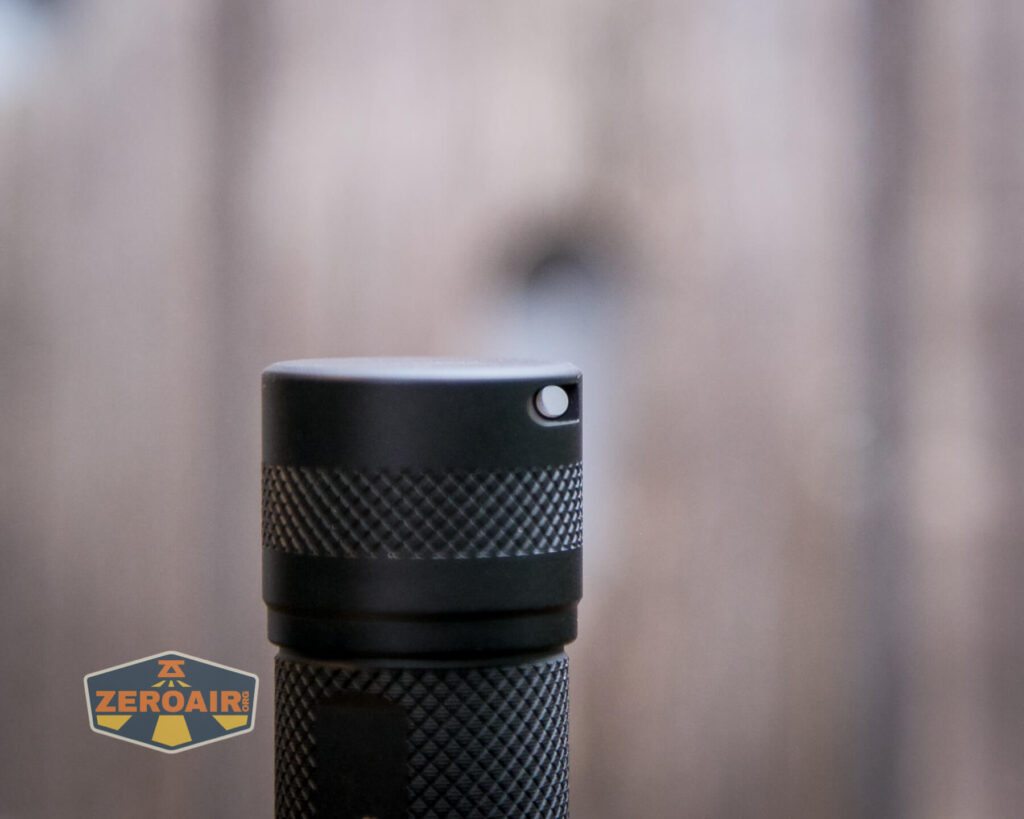
The ample-sized hole makes installing the lanyard very easy.

Power and Runtime
Nextorch includes the cell type that’s required for the P82. That’s a button top 21700, and in this case, has a capacity of 4800mAh.


The cell goes into the P82 with the button toward the head, as is the case with most flashlights. Only the tailcap comes off fully, so you’ll change the cell as seen below.

Below are a couple of runtime tests – the highest two modes. While initial output is good, the stepdown is fairly quick and dramatic – from around 1300 lumens to around 550 lumens (and falling).

Output on the second (middle) mode is about the same as on High, without the initial very high level.

There’s a LED array near the switch which does provide information about the charge level. This array lights briefly when you turn the light on, but stops indicating after a couple of seconds. When the cell is low (around 3V or so), this normally blue array blinks with one red LED.
Charging
Charging on the Nextorch P82 long-range flashlight is via USB-C. This charging port is in a nice but unusual spot – it’s hidden behind some threads in the head, so that it’s normally completely covered.

Just like when using the light, this LED array does indicate the charge level. While the manual doesn’t cover what the indications mean, it’s very straightforward – When the light is fully charged, all the emitters are blue. Anything less than that means the light is charging. For example, if three are solid blue and one is blinking, the cell is “nearly charged.”


Nextorch includes a short USB to USB-C charging cable.

Charging is a little strange, seeming to oscillate between two currents. I am not sure this is “bad” but it’s also probably not ideal – if nothing else, it causes charging to take longer than you’d really want it to. Still, the charge time is within the range Nextorch claims, of around 4 hours.

C to C charging does work too, and looks about like the charging provided through the included cable.

Modes and Currents
| Mode | Mode Claimed Output (lm) | Claimed Runtime | Measured Lumens | Tailcap Amps |
|---|---|---|---|---|
| High | 1200 | 3h30m | 1322 | 6.87 |
| Medium | 425 | 4h30m | 465 | 1.30 |
| Low | 33 | 85h | 26 | 0.11 |
Pulse Width Modulation
The mode order of the user interface is high > medium > low, so that’s how I’ve organized all the information in this review. The lower two modes do use PWM.
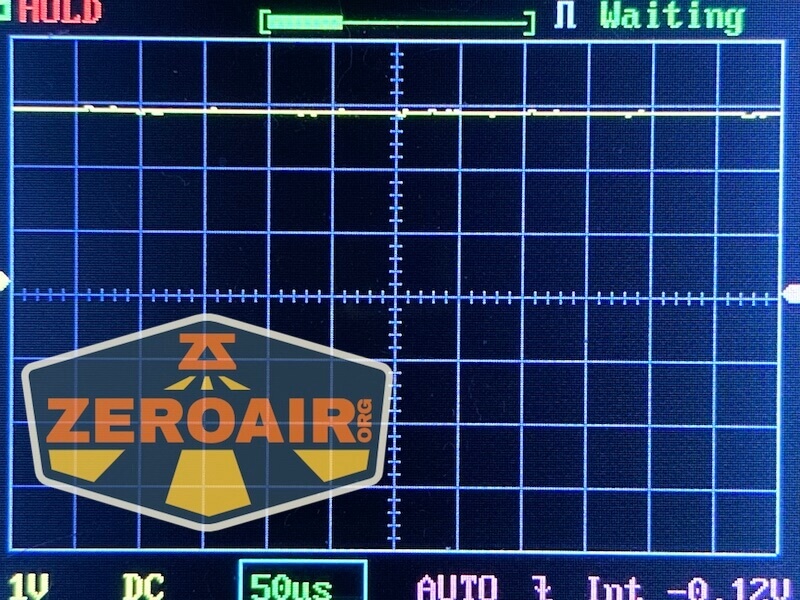
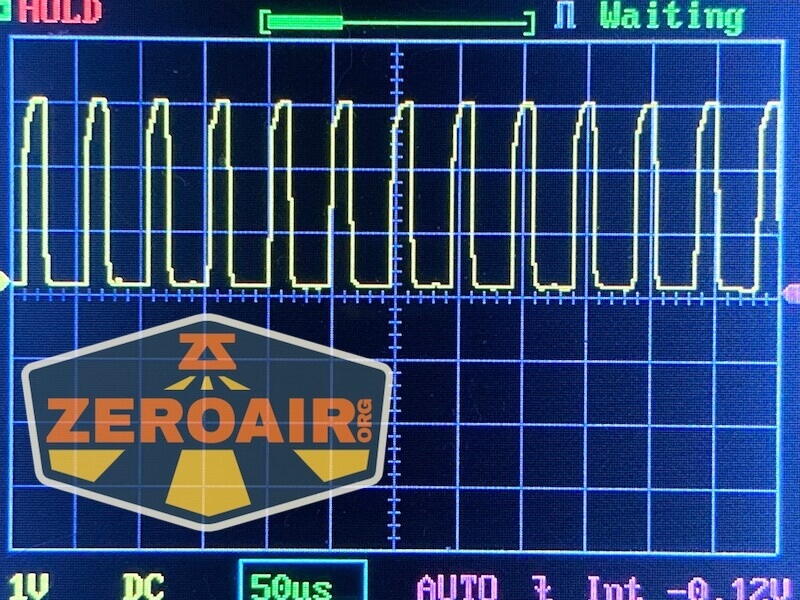

Here you can see a “baseline” – a chart with almost no light hitting the sensor.

Then there’s the Ultrafire WF-602C flashlight, which has some of the worst PWM I’ve seen. It’s so bad that I used a post about it to explain PWM! Here are multiple timescales (10ms, 5ms, 2ms, 1ms, 0.5ms, 0.2ms) to make comparing this “worst” PWM light to the test light easier. That post also explains why I didn’t test the WF-602C at the usual 50us scale.


User Interface and Operation
Nextorch uses an interesting switch setup here on the P82. There are two switches but they share a (“separated”) rubber cover. They’re both e-switches.
In the photo below, the left-most switch is a “strobe only” switch. That switch overrides anything else you do with the user interface. It’s also not a momentary switch – you tap this and strobe is on. Even if you’re in a steady mode and you tap the strobe, strobe is then on.
Here’s a user interface table!
| State | Action | Result |
|---|---|---|
| Off | Any action to strobe switch | Strobe (not momentary) |
| On (Steady) | Any action to strobe switch | Strobe (not momentary) |
| Strobe | Tap strobe switch | Off |
| Off | Tap mode switch | Momentary High |
| Off | Click mode switch | High (steady) |
| On (Steady) | Tap mode switch | Mode advance (High > Medium > Low) |
| On (Steady) | Click Mode switch | Off |
While the tactical switch is fairly great (at least it’s very suited to the purpose), I did find that the mode switch press was much too deep. It’s almost like there needs to be a nub on the inside of the switch cover to reach the actual e-switch, or the e-switch (inside) needs to be higher. This isn’t a problem except that upon rebounding from being fully clicked, the switch “almost always” (by that I mean “always” but I’m also not going to click it 10000x for a robust sample set) hits High on the downstroke but the upstroke of the switch is…. something…. enough that the light then immediately switches to Medium.
LED and Beam
Nextorch is using an emitter here that I’ve never seen before. I asked what this is and Nextorch said only that it’s a “High Optical Density” (Or “HOD”) LED. They added that it was developed by Nextorch and some other researchers. I do think there’s at least one other light with this emitter, but I don’t have that light to confirm.

The HOD is coupled with a deep and smooth (and big!) reflector.


The bezel, which like the TA30 has multiple glass-breaking balls, has a “tripod” feature to allow light to escape when headstanding.

This reflector and small emitter setup combine to make a very throwy beam!

LED Color Report (CRI and CCT)
This unknown and new emitter has a profile that you might expect from a new emitter. Fairly cool (which is typically the first version of any emitter that’s released, it seems) at around 6200-6450K and low CRI at around 65.


Beamshots
These beamshots always have the following settings: f8, ISO100, 0.3s shutter, and manual 5000K exposure. These photos are taken at floor level, and the beam hits the ceiling around 9 feet away.


Tint vs BLF-348 (KillzoneFlashlights.com 219b version) (affiliate link)
I keep the test flashlight on the left and the BLF-348 reference flashlight on the right.

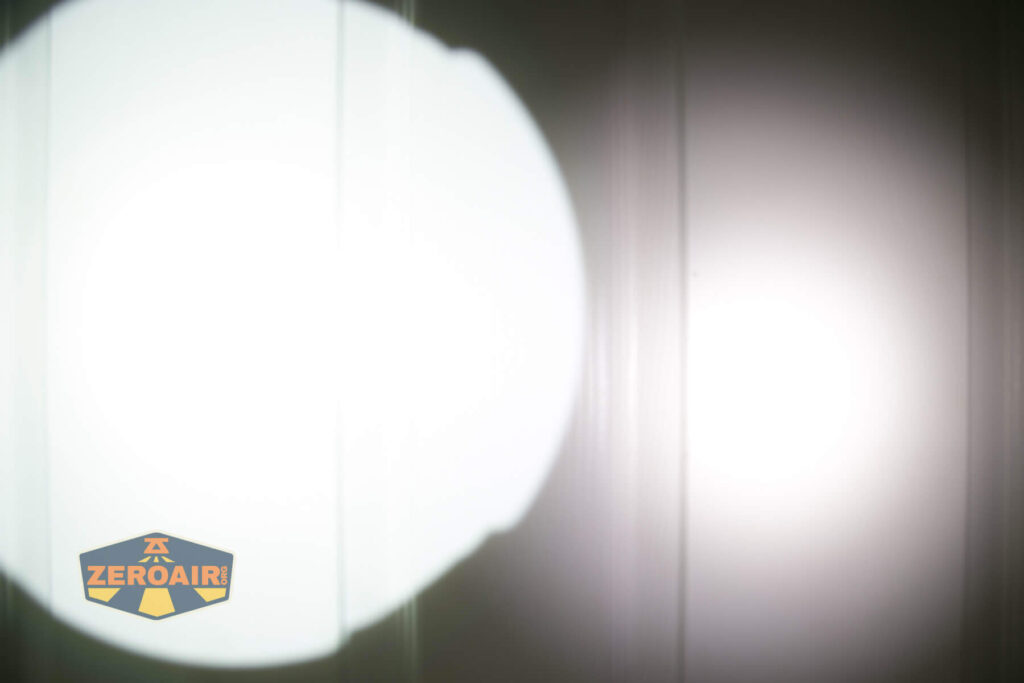
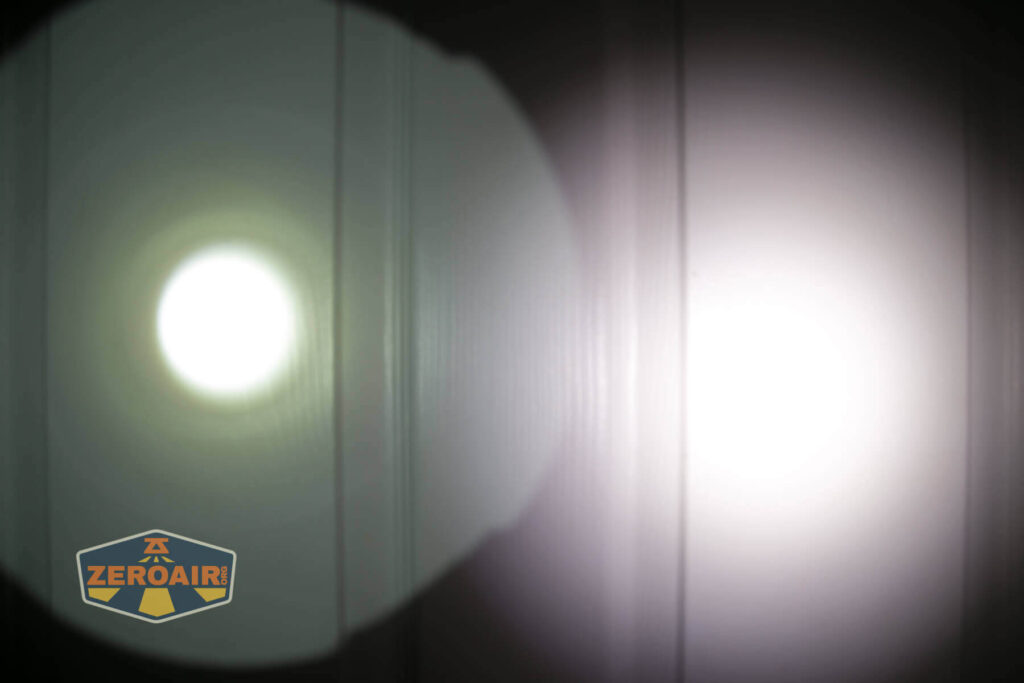
I compare everything to the KillzoneFlashlights.com 219b BLF-348 because it’s inexpensive and has the best tint!
Conclusion
What I like
- Great build quality
- USB-C charging port is well covered and protected
- Very good beam profile
- Exceptionally throwy beam (near-LEP-like performance!)
- Reasonable cost for a complete package light
What I don’t like
- Mode switch presses too deeply and causes a bit of mode skip
- Very low CRI
Notes
- This content originally appeared at zeroair.org. Please visit there for the best experience!
- Please use my Amazon.com referral link to help support zeroair.org!
- Please support me on Patreon! I deeply appreciate your support!
Yingding 5050 30w on Aliexpess 5k one