

RovyVon Angel Eyes E7 Keychain Flashlight Review
The RovyVon Angel Eyes E7 flashlight is a neat glow-in-the-dark keychain item. It has a built-in LiPO and will run a single AAA cell!
Official Specs and Features
Here’s a link to the RovyVon Angel Eyes E7 flashlight product page.
Versions
There are a bunch of versions and a bunch of bodies! There’s blue, orange, green, black, gunmetal, and Desert Tan (only E3 Pro model, though), and blue with the transparent glow-in-the-dark body (seen here).
There are also emitter options. Since there are side emitters, there’s the possibility of mixed options.
Front: Cool white x2 or Warm white High CRI x2
Side: Warm white + UV or Warm white + Red
Price
The RovyVon Angel Eyes E7 flashlight sells for $46.95.
The coupon code “REDDIT” will get 10% off at rovyvon.com!
Short Review
I thought this light would be “sort of neat” (and it is) but I actually really love it. It has all the characteristic RovyVon-ness that you’d want, but also is available in multiple emitter options including Warm white High CRI x2. The ability to run a single AAA cell is great, as well as running from the internal LiPO too. It’s just a very neat light! And you probably know I love GITD things!!
Long Review
The Big Table
| RovyVon Angel Eyes E7 flashlight | |
|---|---|
| Emitter: | Luminus SST-20 (6500K Cool White, Warm White + Red) |
| Price in USD at publication time: | $46.95 |
| Cell: | LiPO |
| Runtime Graphs | |
| LVP? | |
| Switch Type: | E-Switch |
| Quiescent Current (mA): | ? |
| On-Board Charging? | Yes |
| Charge Port Type: | USB-C |
| Charge Graph | |
| Power off Charge Port | Lowest two modes of any emitter |
| Claimed Lumens (lm) | 700 |
| Measured Lumens (at 30s) | 593 (84.7% of claim)^ |
| Candela per Lumen | |
| Claimed Throw (m) | 70 |
| Candela (Calculated) in cd (at 30s) | 114lux @ 4.764m = 2587cd |
| Throw (Calculated) (m) | 101.7 (145.3% of claim)^ |
| Claimed CCT | 6500 |
| Measured CCT Range (K) | 5400-6000 Kelvin |
| Item provided for review by: | RovyVon |
| All my RovyVon reviews! | |
| RovyVon Angel Eyes E7 flashlight | |
|---|---|
| Emitter: | Luminus SST-20 (6500K Cool White, Warm White + Red) |
| Price in USD at publication time: | $46.95 |
| Cell: | 1xAAA |
| Runtime Graphs | |
| LVP? | |
| Switch Type: | E-Switch |
| Quiescent Current (mA): | ? |
| On-Board Charging? | Yes |
| Charge Port Type: | USB-C |
| Charge Graph | |
| Power off Charge Port | Lowest two modes of any emitter |
| Claimed Lumens (lm) | 100 |
| Measured Lumens (at 30s) | 82 (82% of claim)^ |
| Candela per Lumen | |
| Claimed Throw (m) | – |
| Candela (Calculated) in cd (at 30s) | 14lux @ 4.528m = 287cd |
| Throw (Calculated) (m) | 33.9 |
| Claimed CCT | 6500 |
| Measured CCT Range (K) | 5400-5700 Kelvin |
| Item provided for review by: | RovyVon |
| All my RovyVon reviews! | |
^ Measurement disclaimer: Testing flashlights is my hobby. I use hobbyist-level equipment for testing, including some I made myself. Try not to get buried in the details of manufacturer specifications versus measurements recorded here; A certain amount of difference (say, 10 or 15%) is perfectly reasonable.
What’s Included

- RovyVon Angel Eyes E7 flashlight
- Pocket clip
- Split rings (2)
- EDC carry case
- Spare charge port cover
- Manual etc
Package and Manual
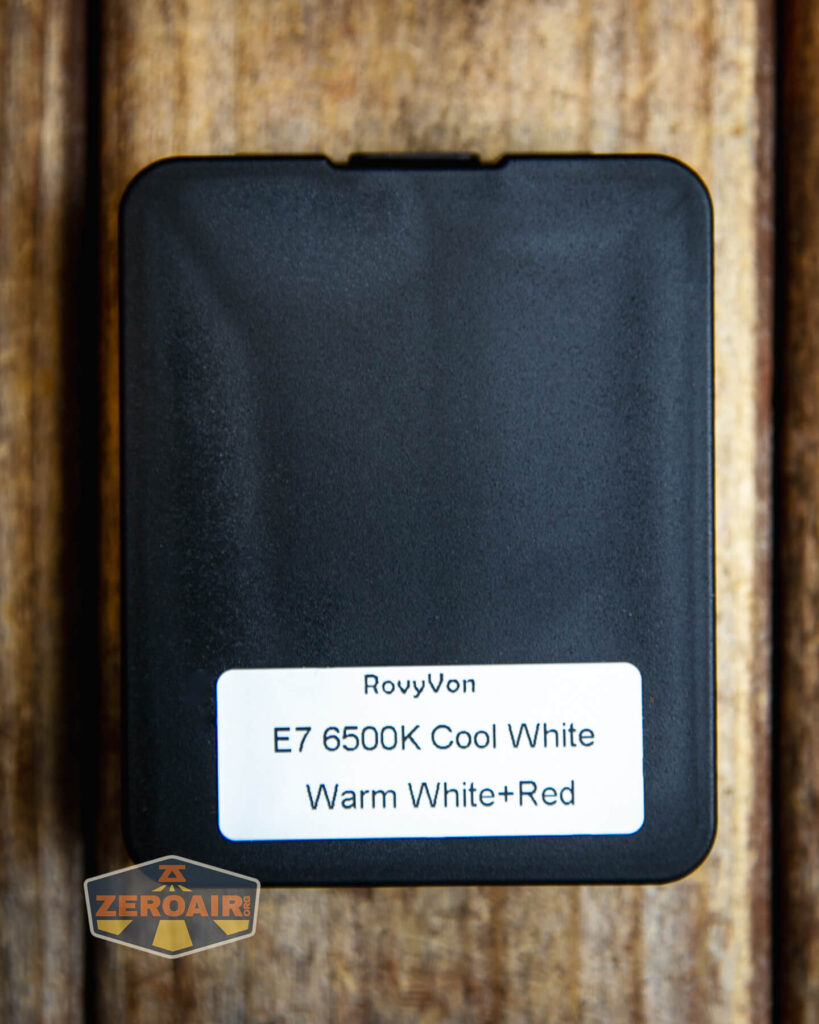

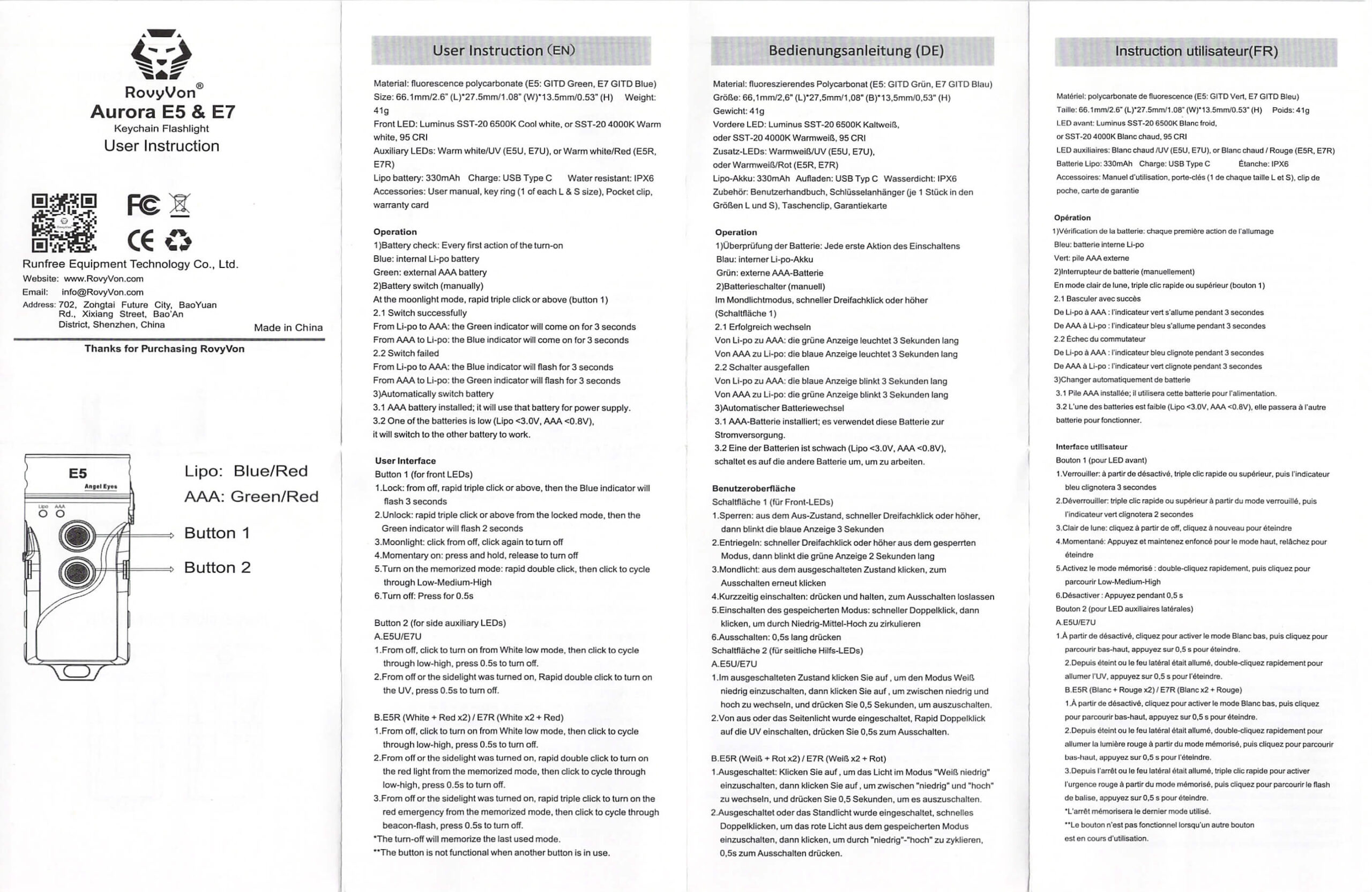
I’m pleased to report that this RovyVon has what I consider more of an “actual manual” or maybe a better way to say it is a “purposeful” manual. It’s not just a manual printed on A4 paper.

Build Quality and Disassembly

Here’s another installment of the RovyVon “Hybrid” series of flashlights. This little light features an internal lipo battery along with support for a single AAA cell. Interestingly they can sort of operate independently, but more on that later.
The build quality is great. This is very much like many of the RovyVon keychain lights (like the Aurora series) but I’d say it’s better build quality – it just feels sturdier in hand.
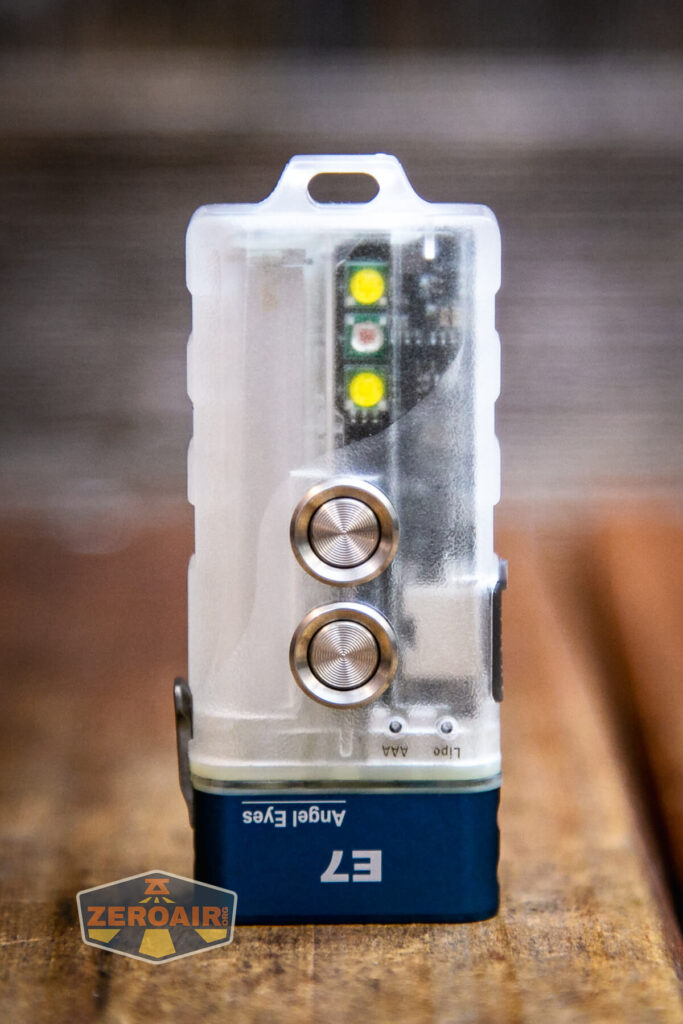
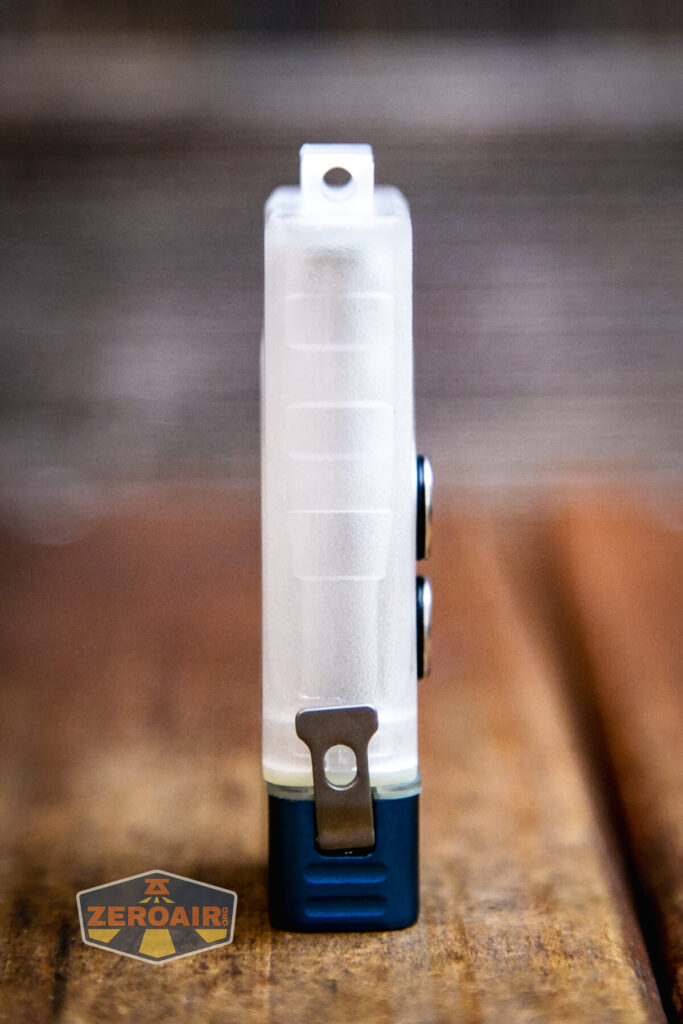

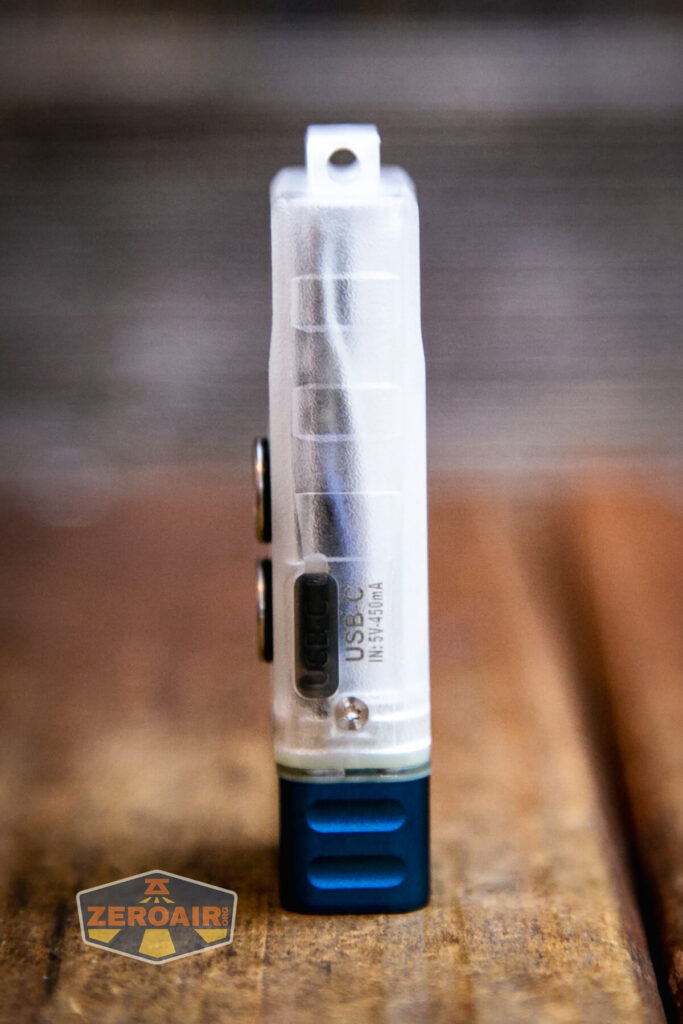
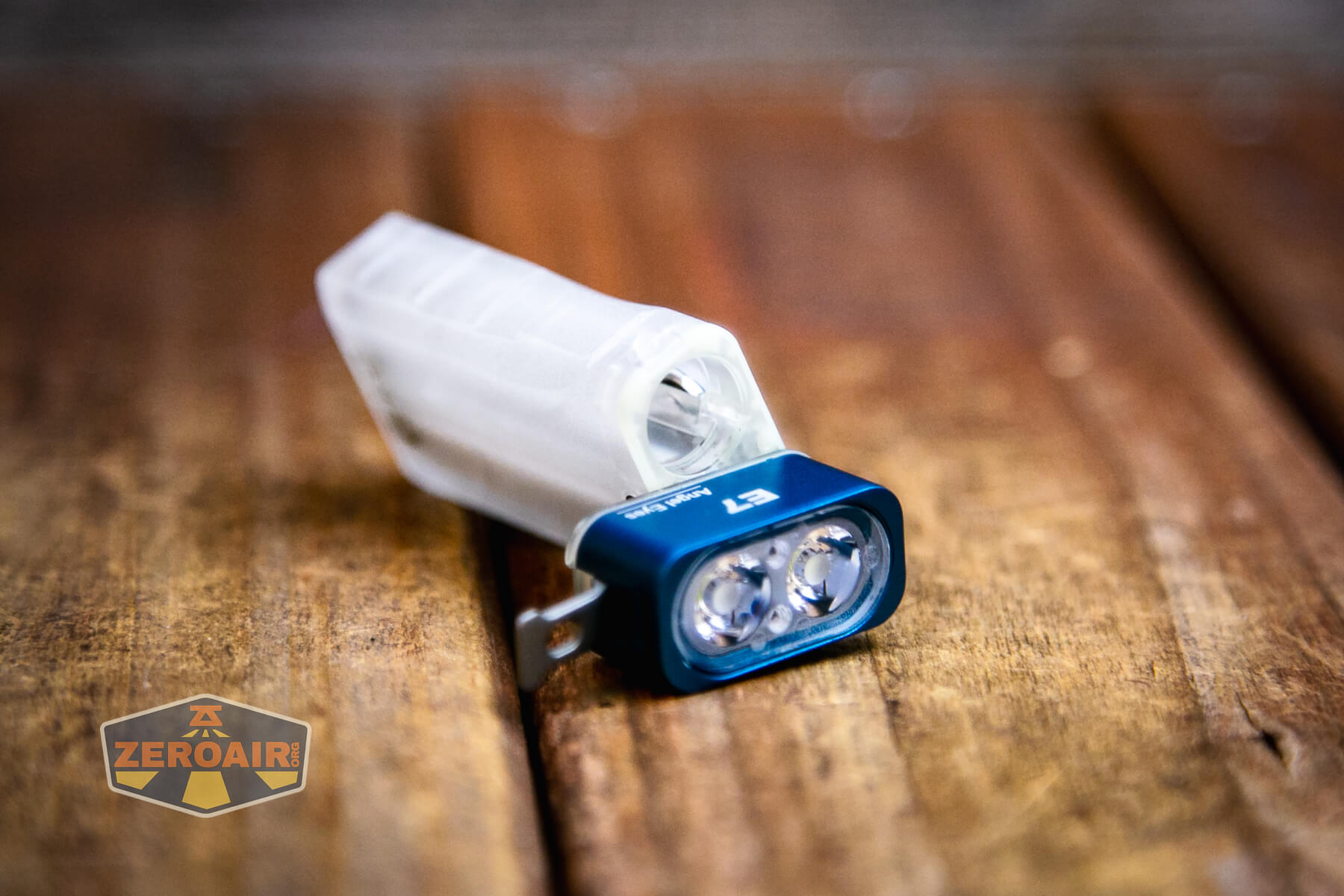
You can clearly see one big difference in this light and the other RovyVon lights. This one has a hinged front!

The hinge on this blue model isn’t quite as lined up as on others I’ve had, but it functions perfectly.

Size and Comps
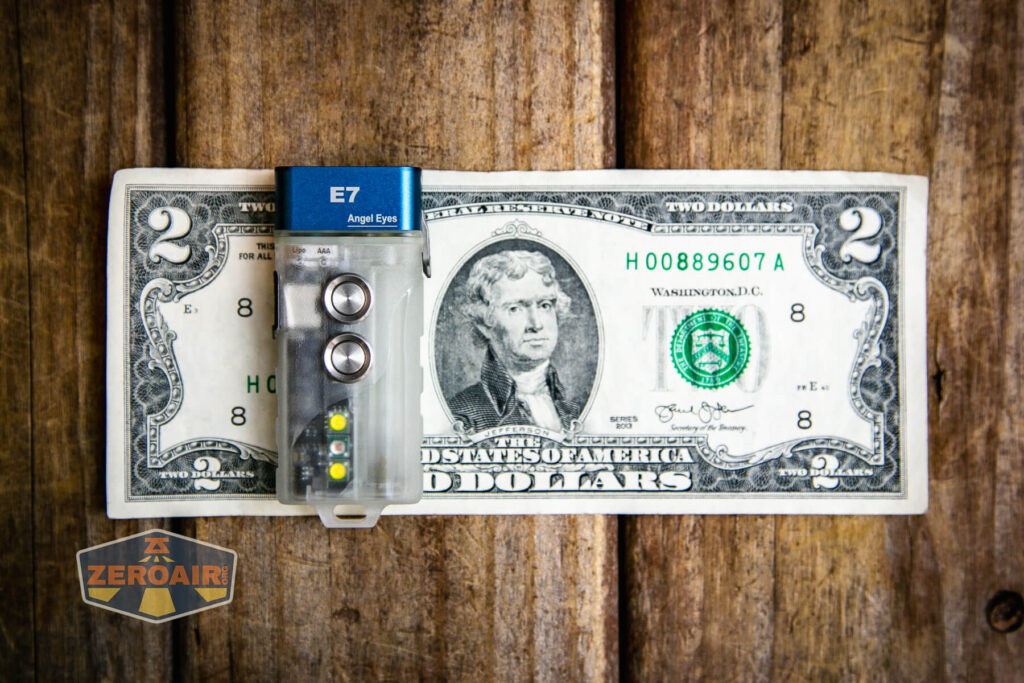
Size: 66.1mm (L) x 27.5mm (W) x 13.5mm (H)
Weight: 41g

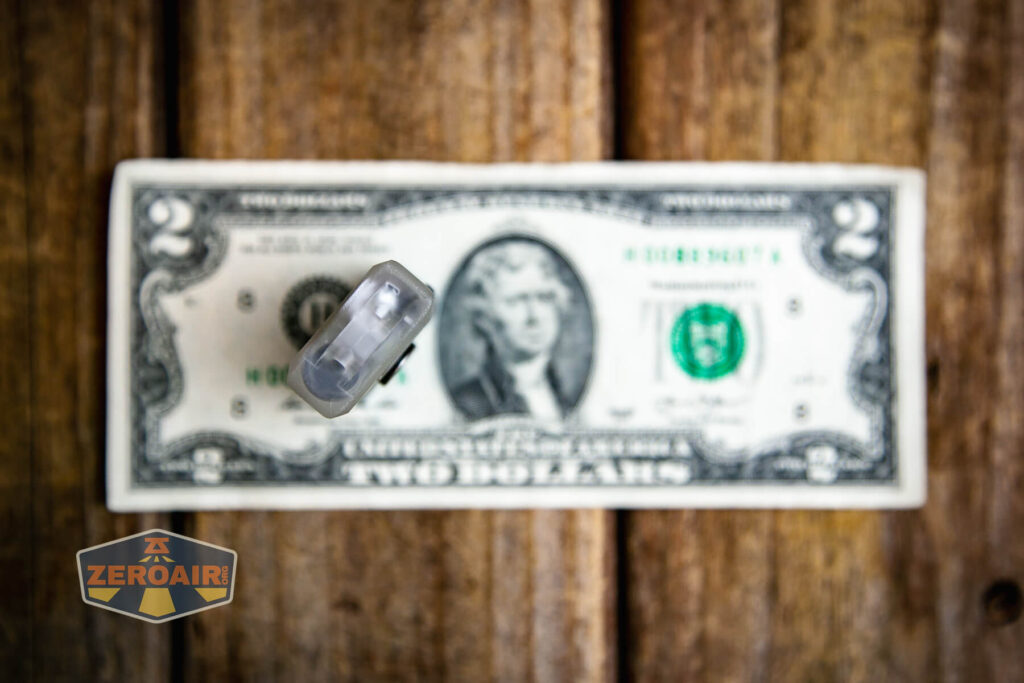
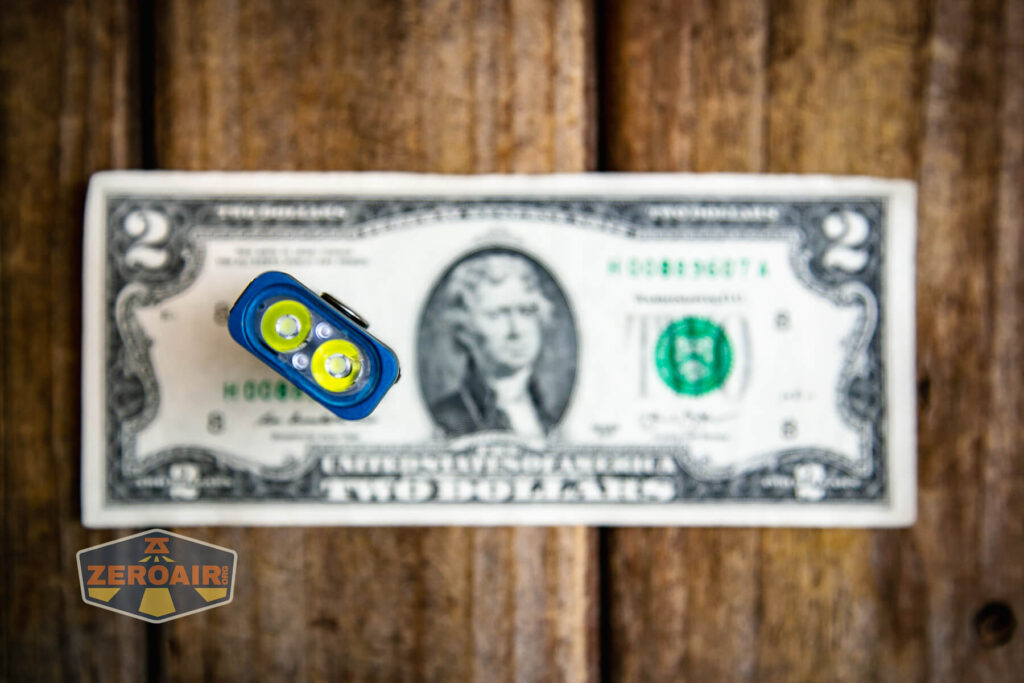
If the flashlight will headstand, I’ll show try to it here. If the flashlight will tailstand, I usually show that here, too.

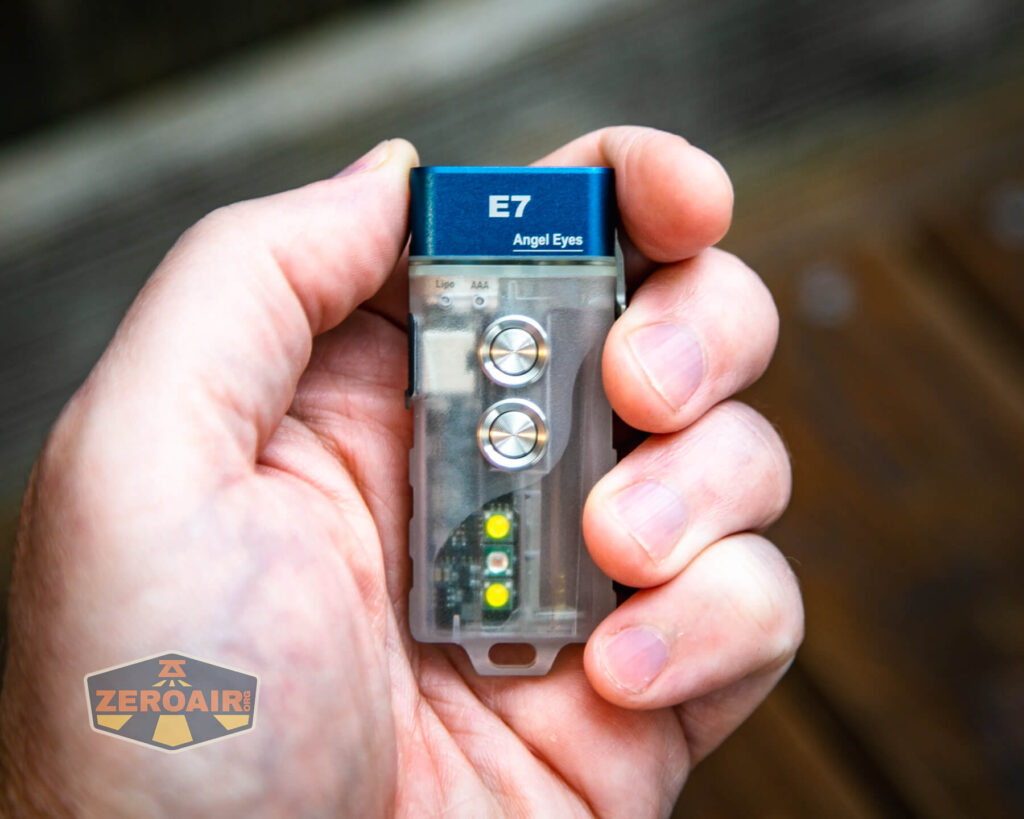
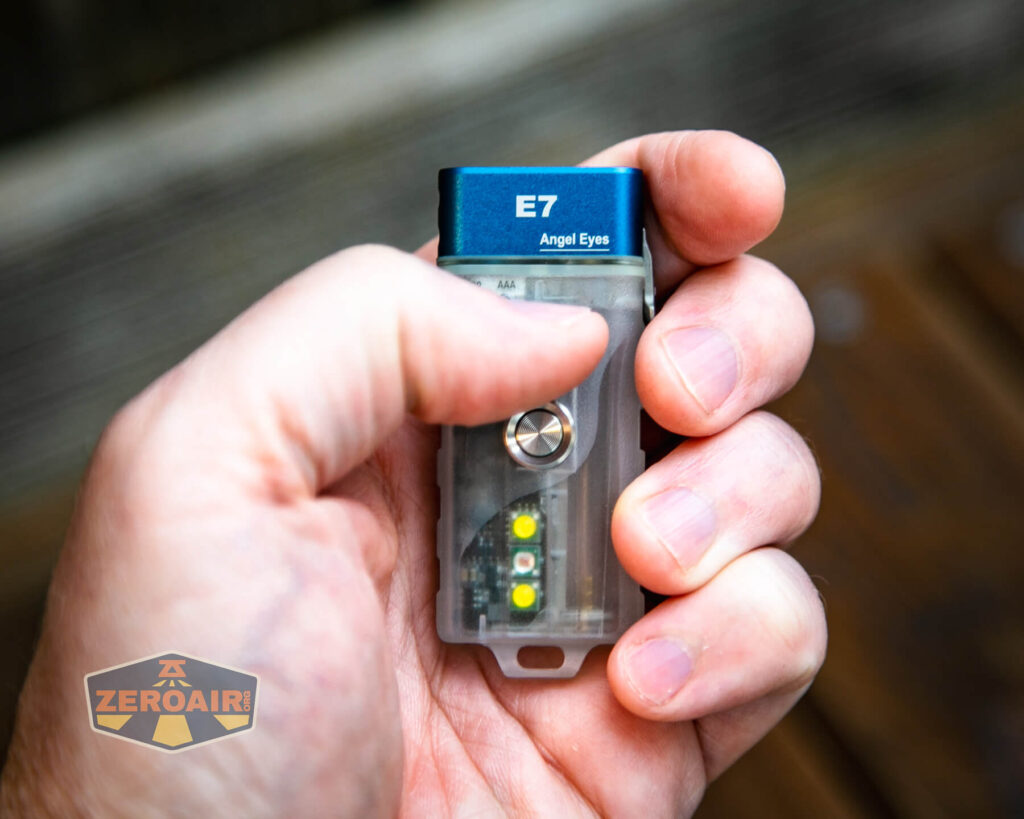
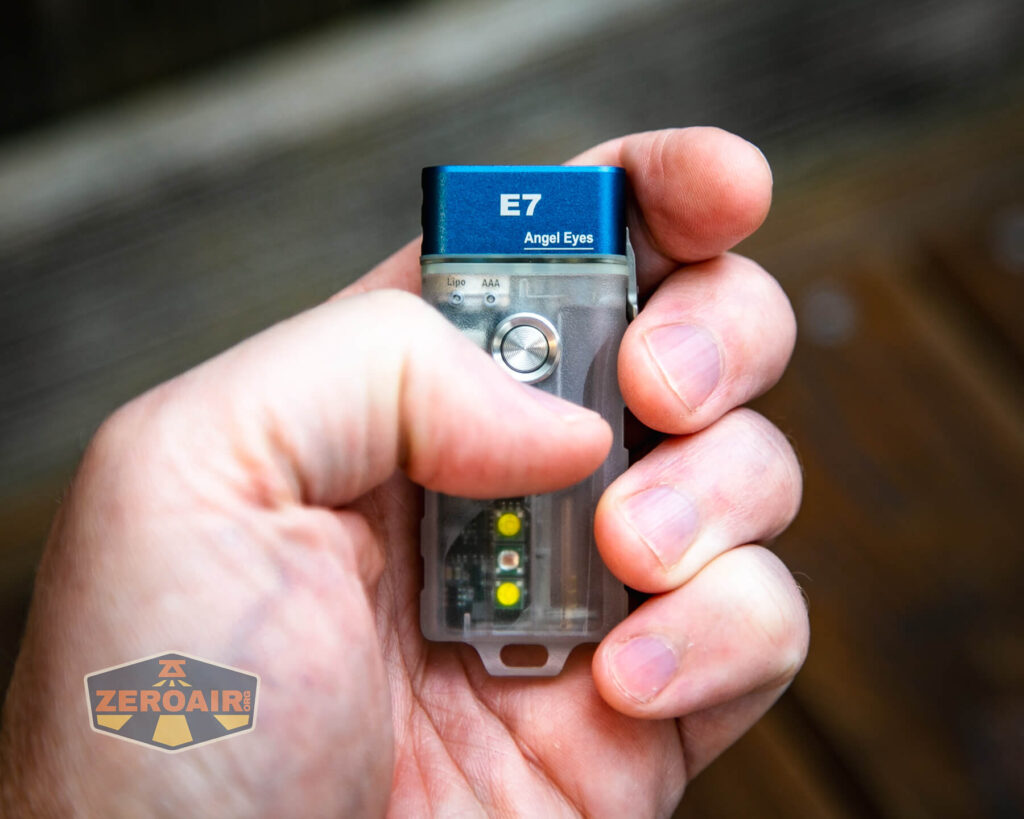
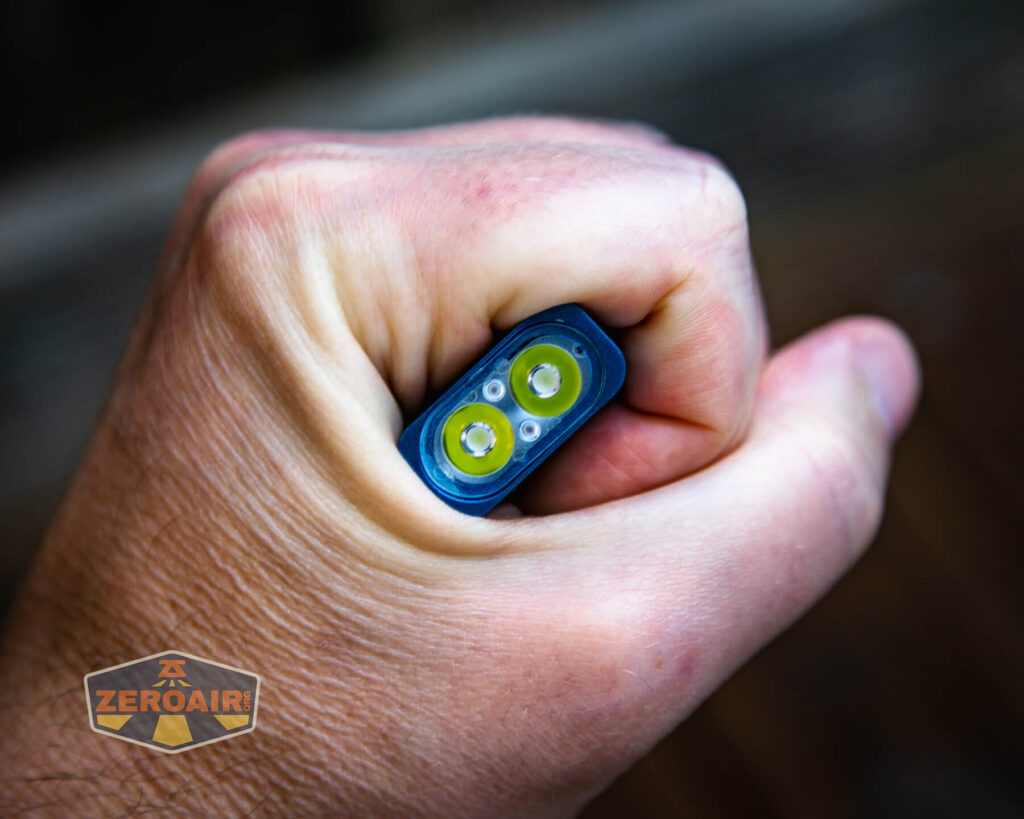
Here’s the test light with the venerable Convoy S2+. Mine is a custom “baked” edition Nichia 219b triple. A very nice 18650 light!
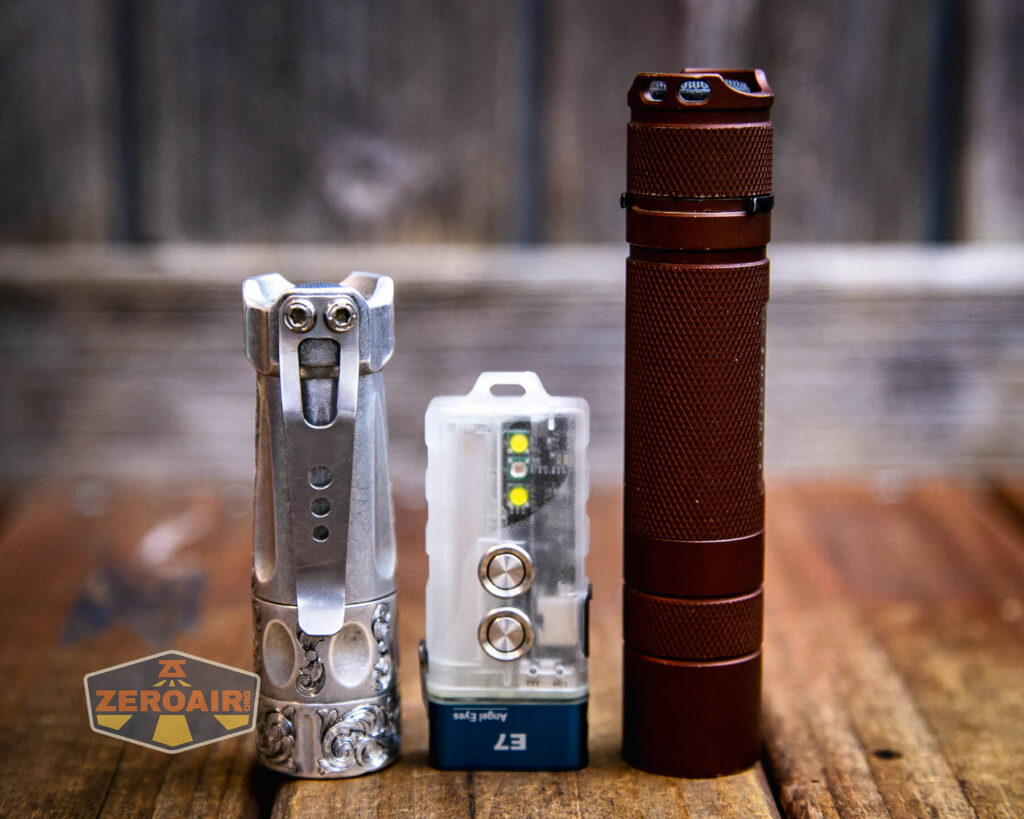
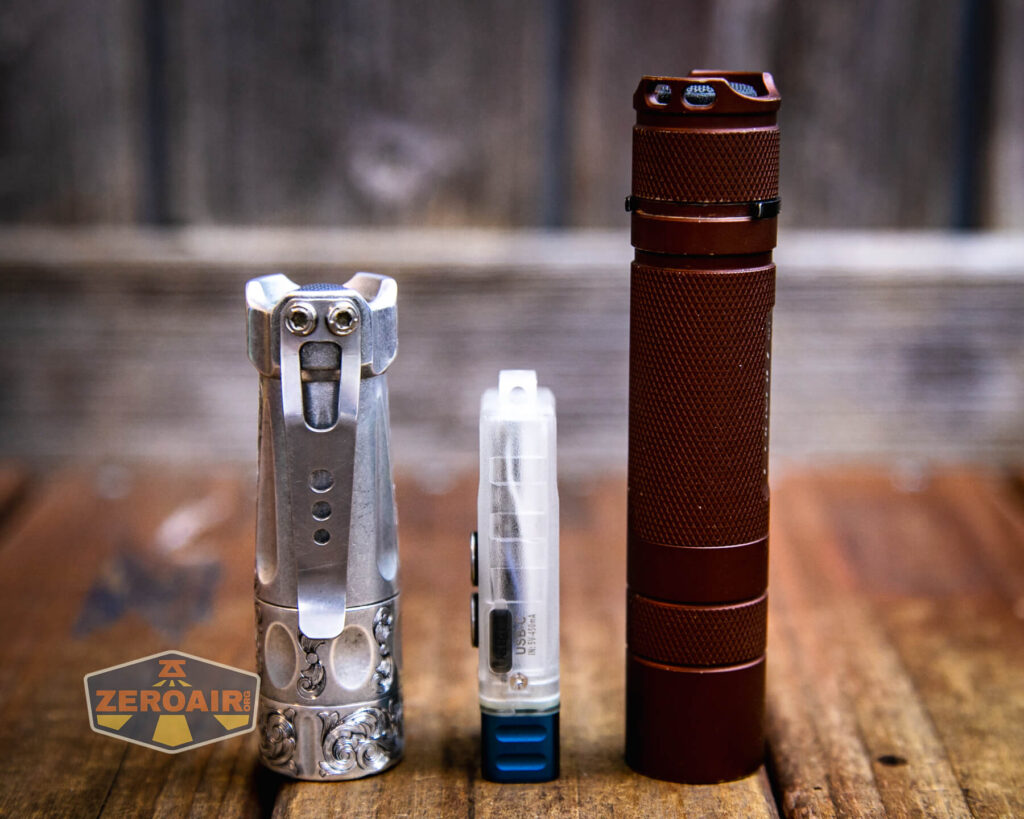
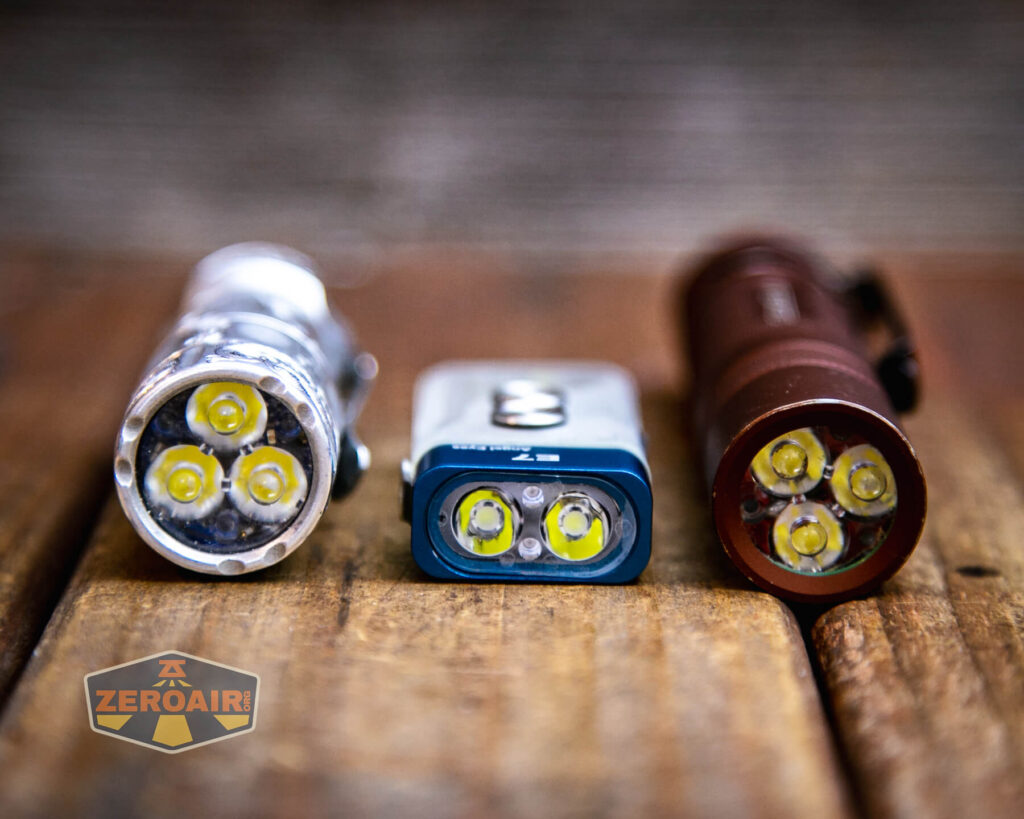
Also above is the light beside my custom-engraved TorchLAB BOSS 35, an 18350 light. I reviewed the aluminum version of that light in both 35 and 70 formats.
Retention and Carry
The RovyVon Angel Eyes E7 flashlight uses a typical RovyVon-style pocket clip. The clip hugs the body in a very tight manner. There are three grooves along the edge to allow different clip placements, but holding the light in hand, this (below) really seems like the only one that doesn’t block something else. Lower than this blocks the charge port. Higher than this blocks the head twist. Put it on the other side and it blocks the switch.
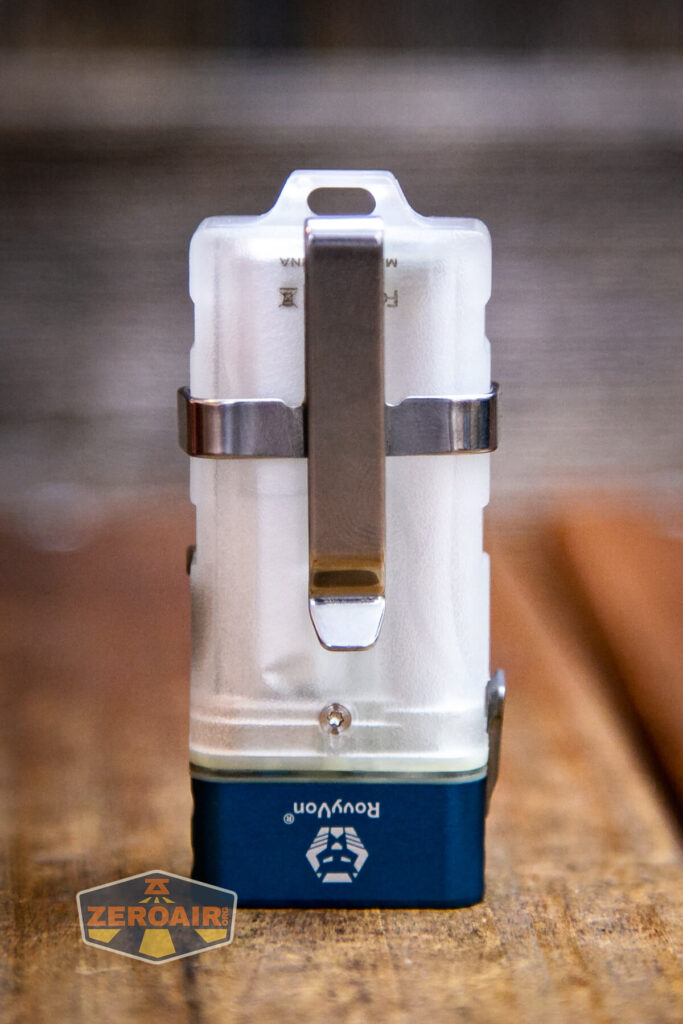
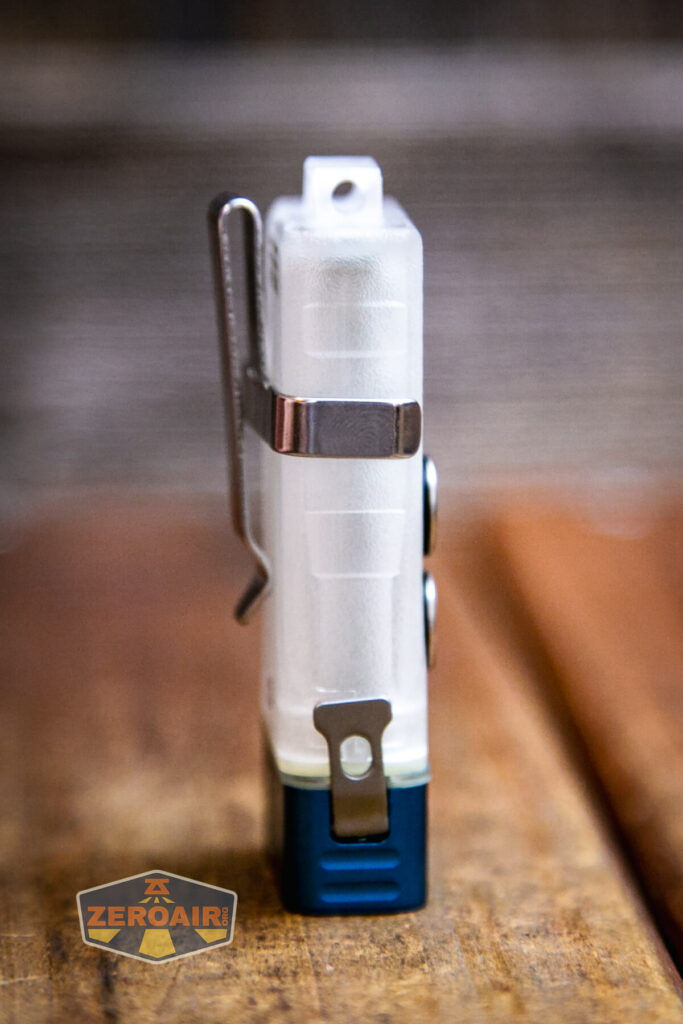
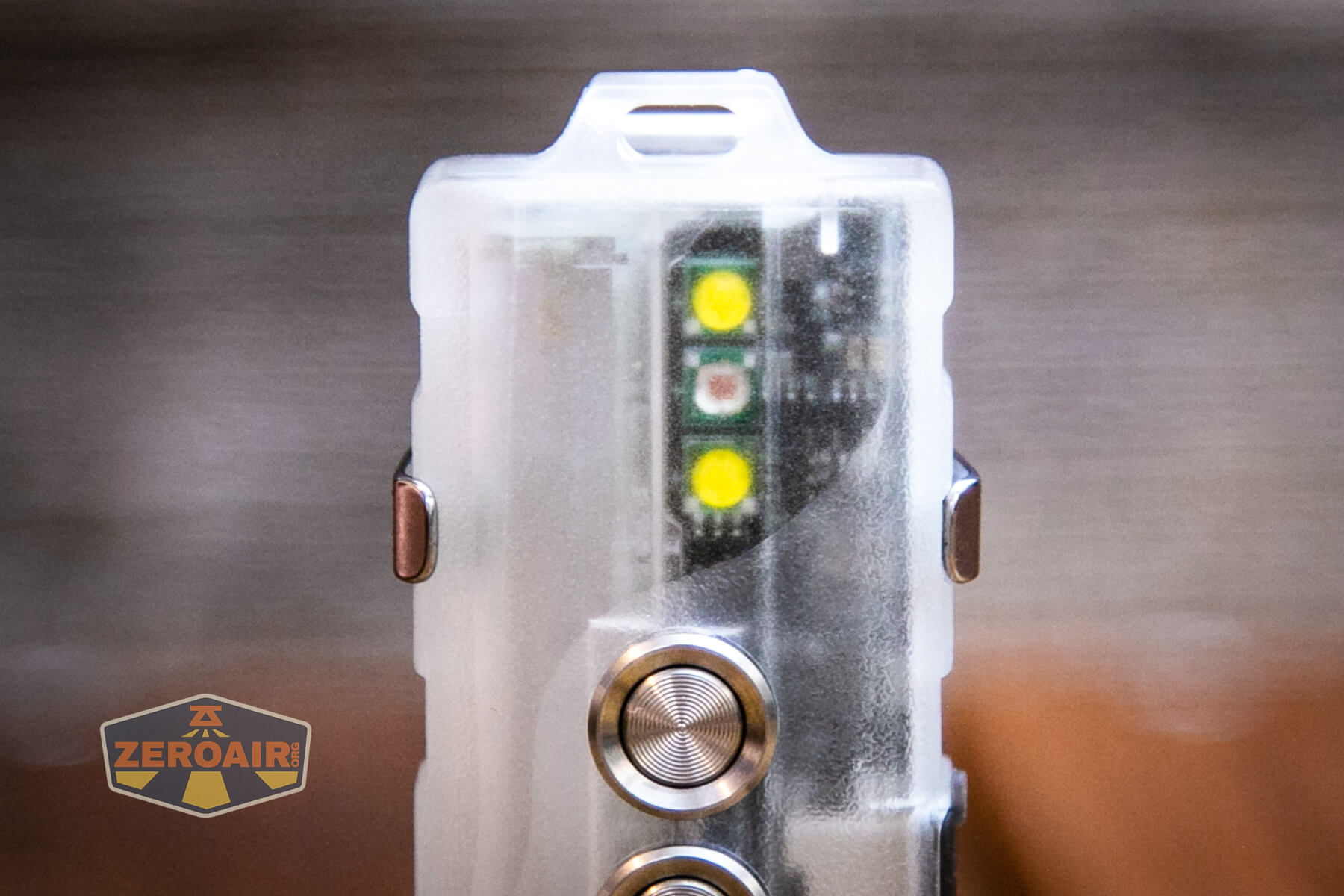
Of course, you might want the pocket clip to block the switch as a form of accidental activation prevention, but the clip doesn’t come on and off easily enough to allow access when you want it.

There are also a couple of split rings included. You could probably use either of those, and they’ll attach easily on this tailcap bumpout.

I don’t love the tailcap area’s lanyard or split ring holder, but technically the light can tailstand on it. I would probably rather just skip the little loop and have a squared end.
Power and Runtime
There are two power sources for the RovyVon Angel Eyes E7 flashlight. First is an internal LiPo battery. As with many RovyVon flashlights, this battery is not user-serviceable.
The other power source is a 1.5V AAA cell. I’ve used this Ikea Ladda NiMH cell for testing, but other types should work fine too (ie, primary alkaline, etc). A 10440 cell is officially supported, though! RovyVon said they don’t list it as supported because of some amazon regulations. Also, it’s silly-hard to find good 10440 cells! (But that’s not the fault of RovyVon.)

There are some interesting points to make about the power source. The different power sources have different output levels. If the E7 has only the LiPO, then the output for the highest 3 modes is higher. If there’s an AAA cell installed, you get the lower modes.
The body has two little indicating LEDs to show which power source is being used, too.
Now, one interesting thing about the E7 is that it can still operate when the head is open, like when you’re swapping the AAA cell. This brings up some interesting user scenarios, which I’ll cover below.
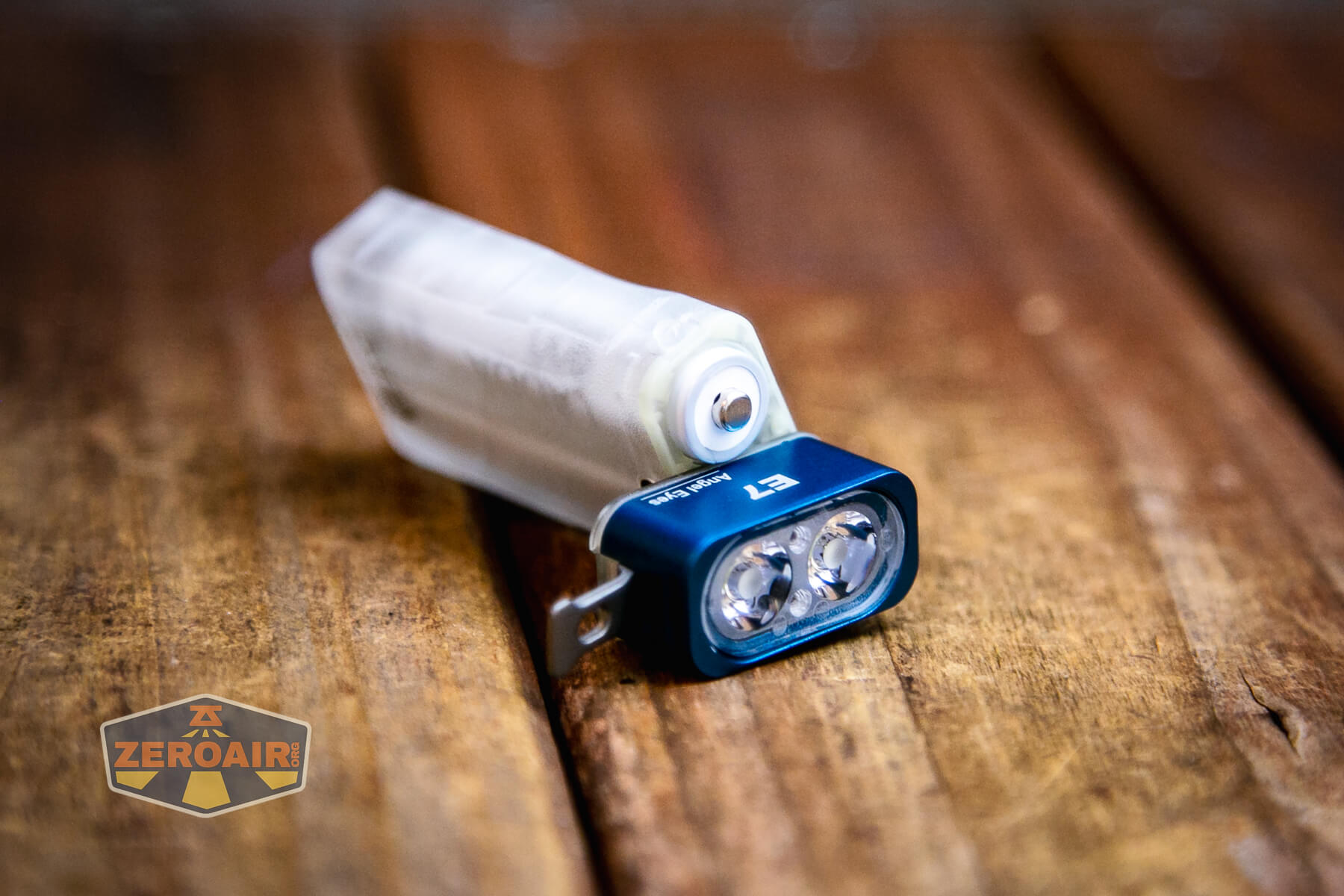
As stated above, the indicator lights on the body (beside the switch) will show which power source is being used. And if there’s an AAA installed, it’ll default to AAA! (This is selectable, though!)


When installing the AAA cell, you’ll put it into the E3 with the positive end (button) upward. When swinging the head back onto the body, you’ll need to press the cell down against a spring. This is easy, but you’ll want to pay attention so you don’t wear the seals when bumping them against the AAA button.


Charging
USB-C charging is available on the E7. This charging port is on the side of the light, and near the switches. This location is a departure from similar lights like the E3. The cover presses in and says in place fairly well.
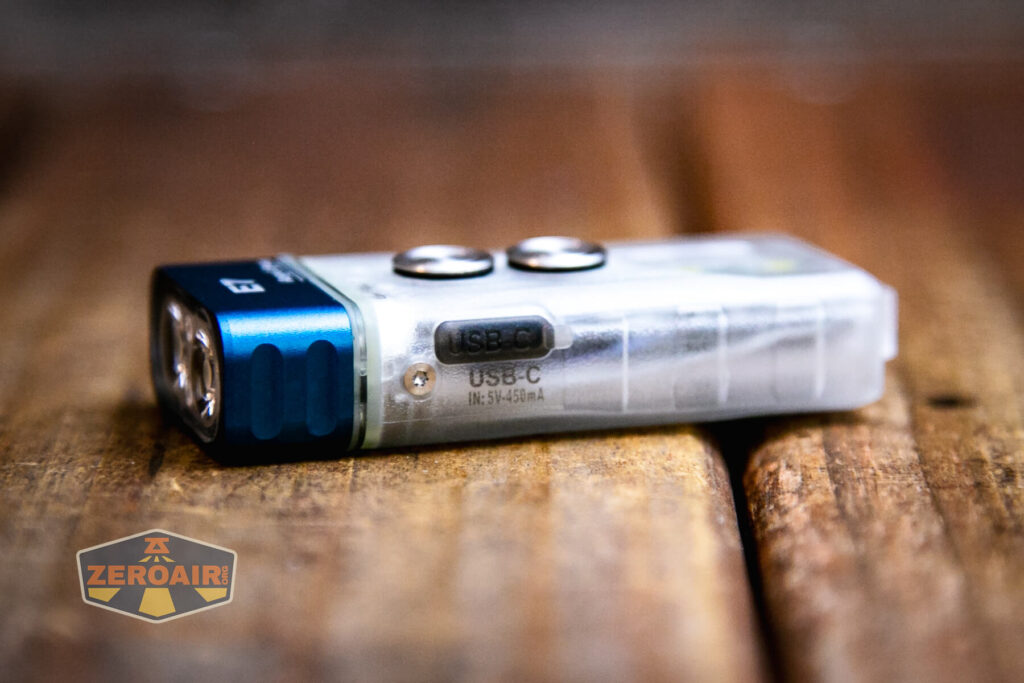

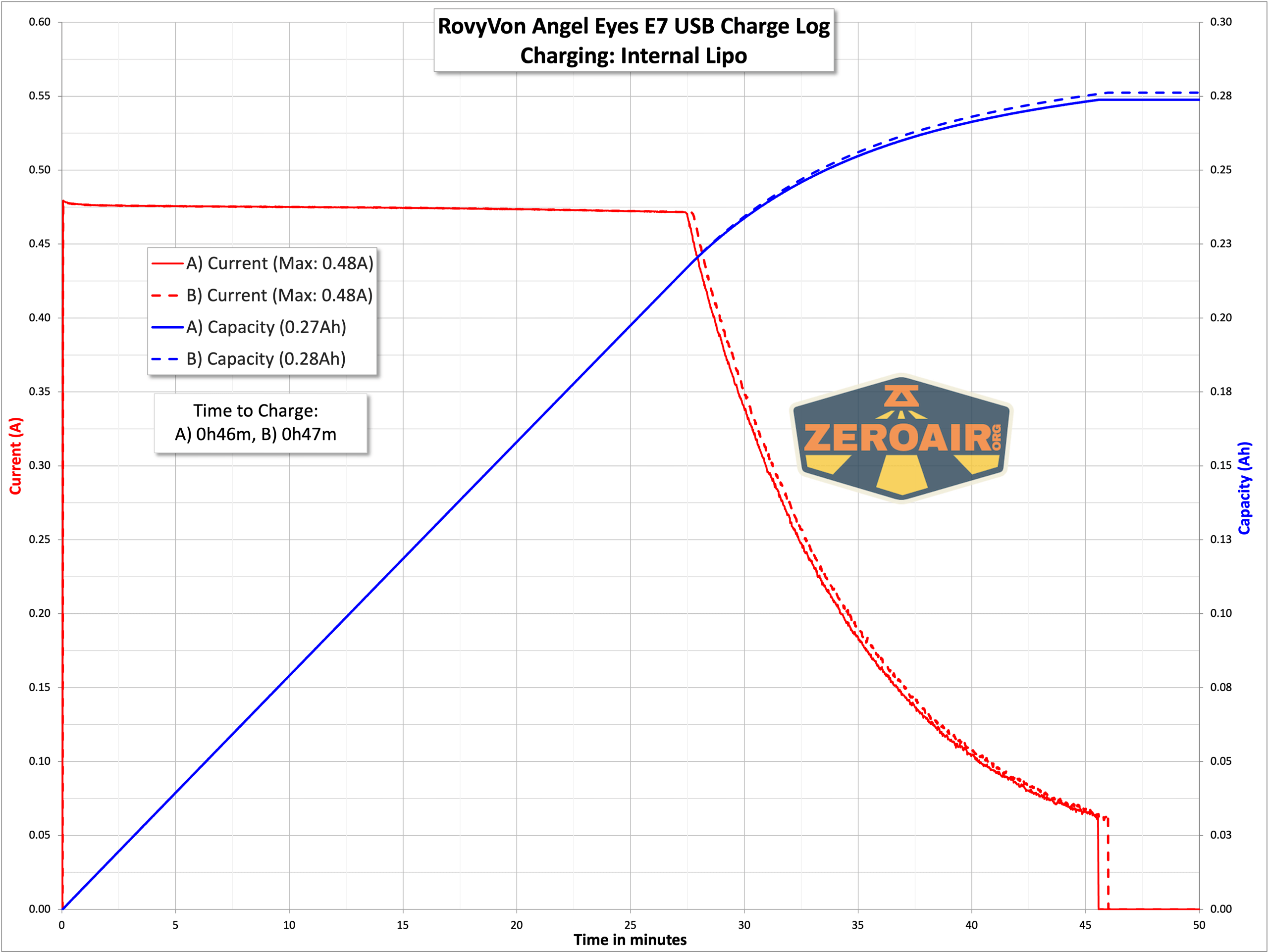

Unfortunately, the onboard charging is only for the internal LiPO battery. You won’t be able to charge an AAA cell with USB-C charging.
Modes and Currents
LiPO:
| Mode | Mode Claimed Output (lm) | Claimed Runtime | Measured Lumens |
|---|---|---|---|
| High | 700 | 3m+1h | 593 |
| Medium | 100 | 2h | 92 |
| Low | 10 | 14h | 12 |
| Moonlight | 0.5 | 62h | 0.34 |
AAA:
| Mode | Mode Claimed Output (lm) | Claimed Runtime | Measured Lumens |
|---|---|---|---|
| High | 100 | – | 82 |
| Medium | 20 | – | 16 |
| Low | 5 | – | 5 |
| Moonlight | 0.5 | – | 0.32 |
Pulse Width Modulation
The mode order here is four white front modes, lowest to highest. Then side white low and high then red. The top row is with the LiPO and the bottom is with an AAA. This mode order is used throughout, below.


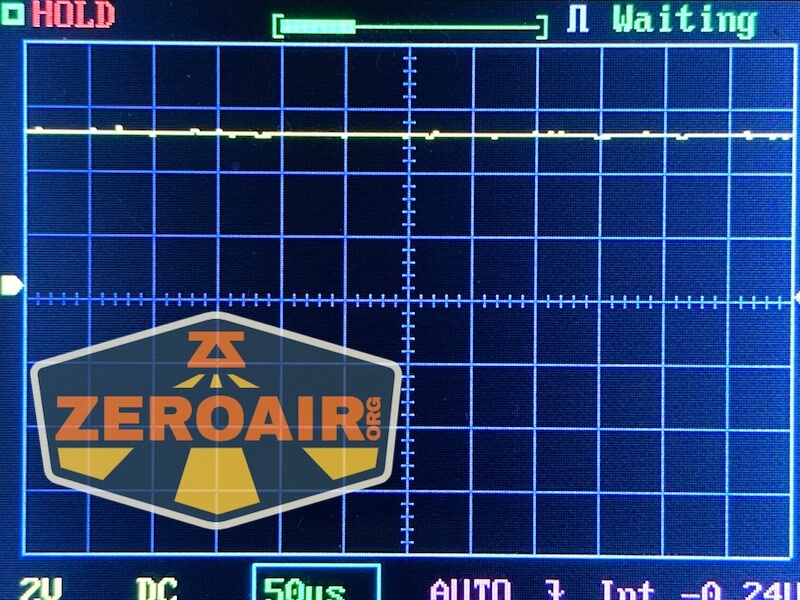
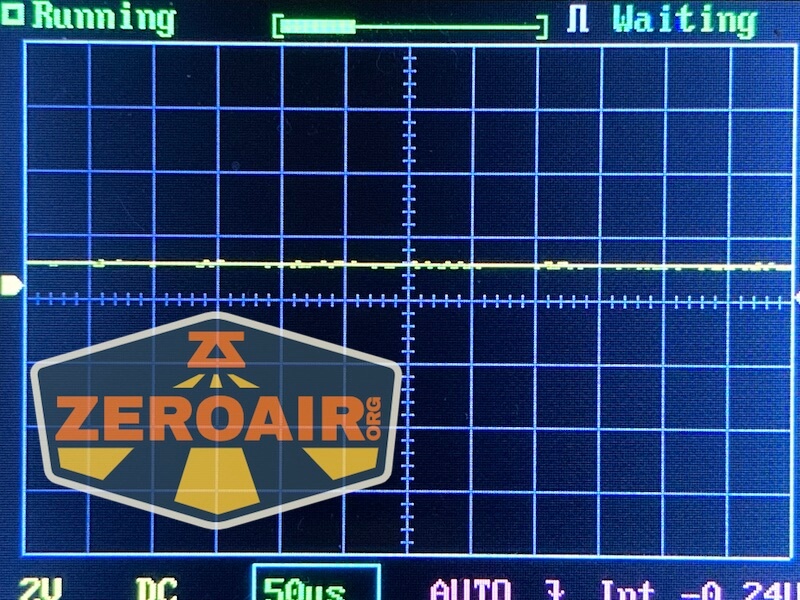
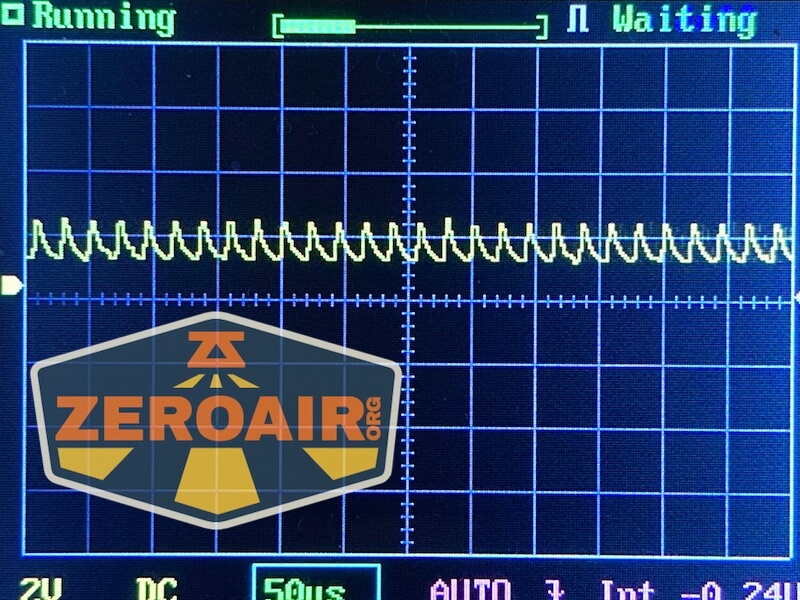
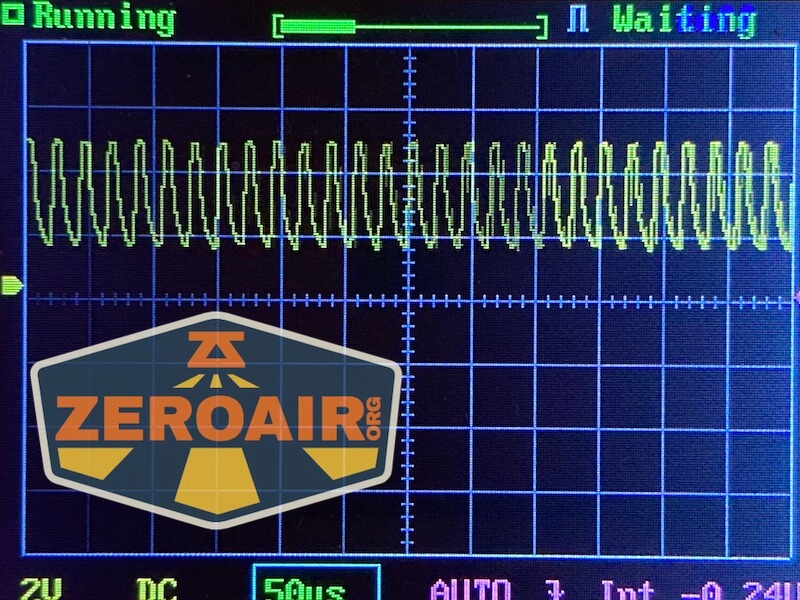
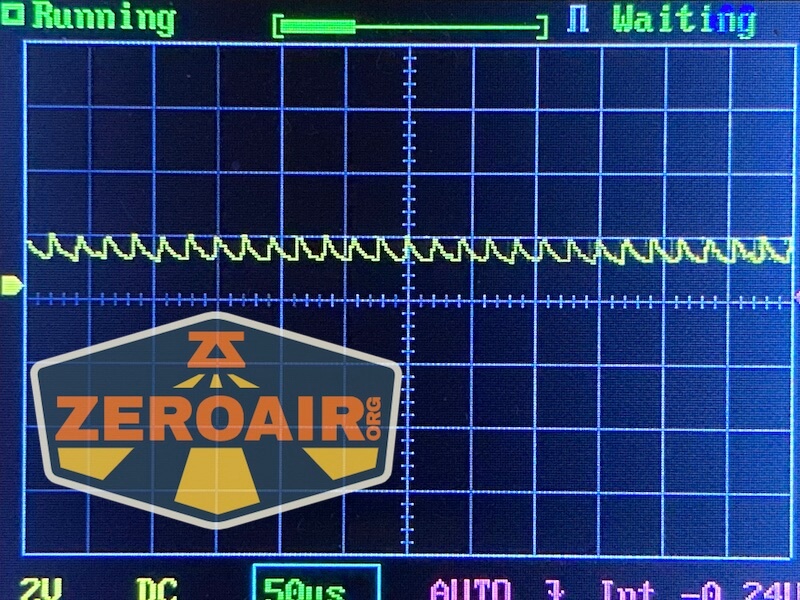
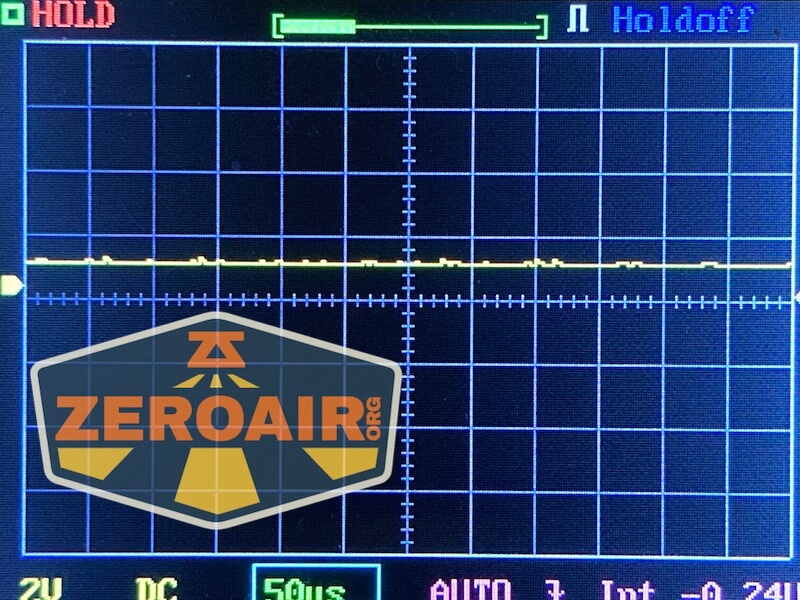
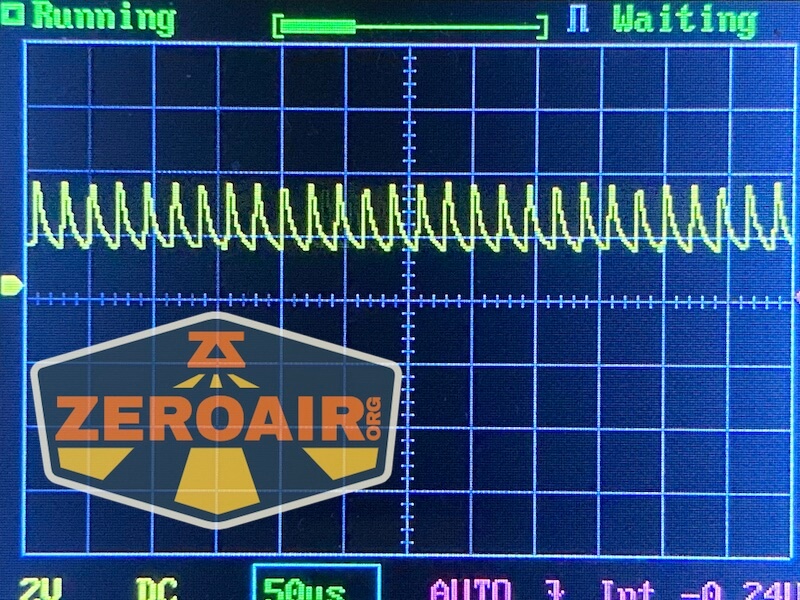
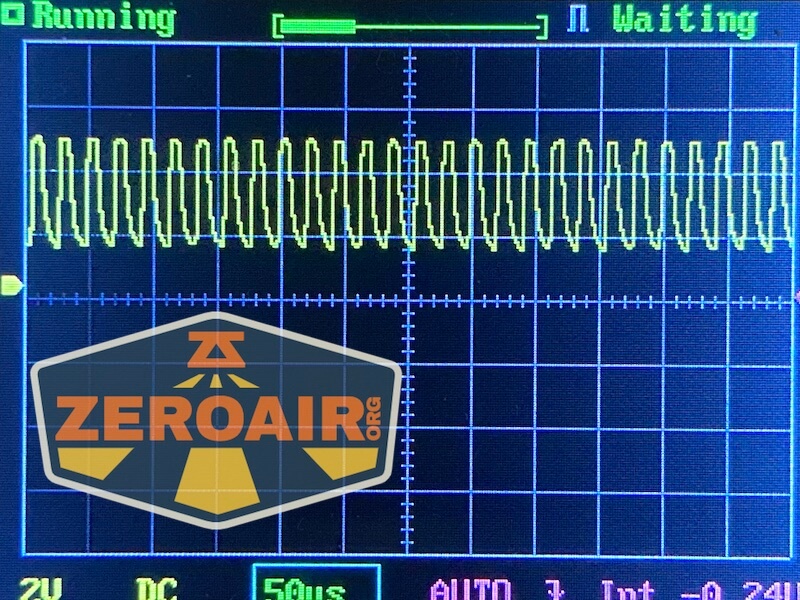
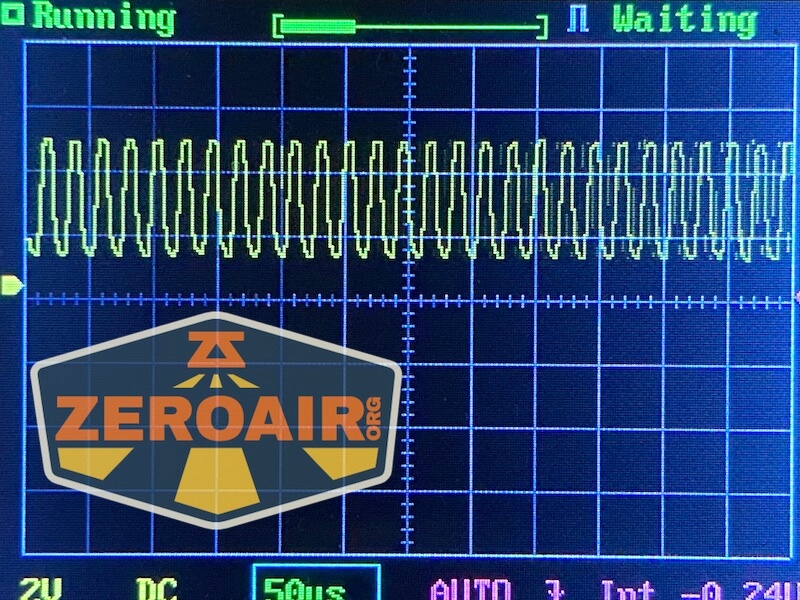
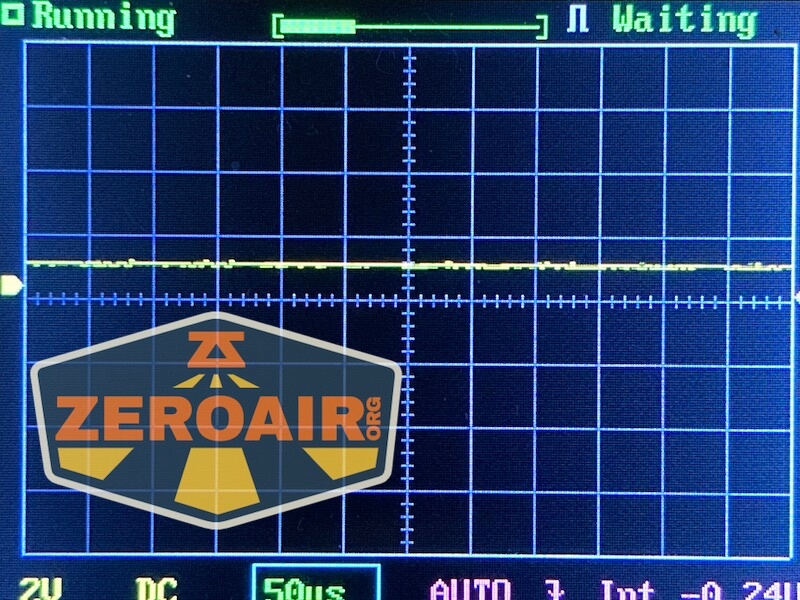
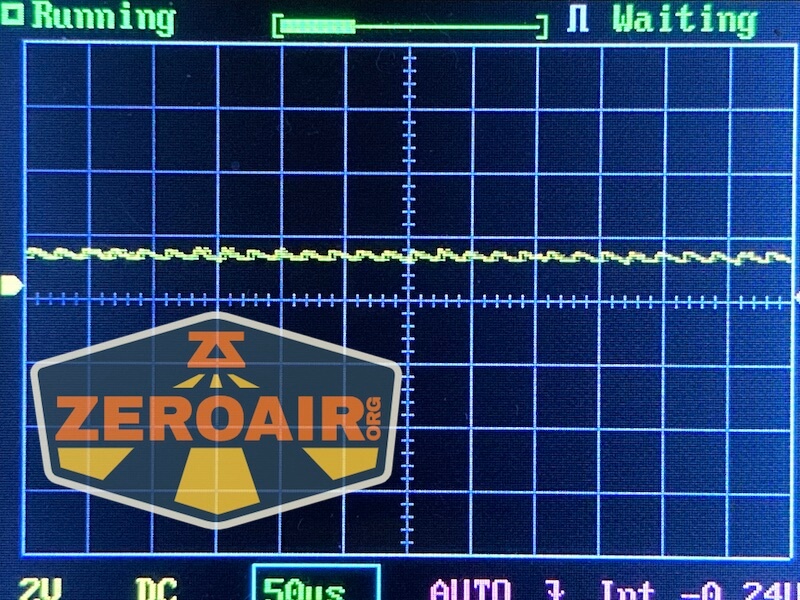
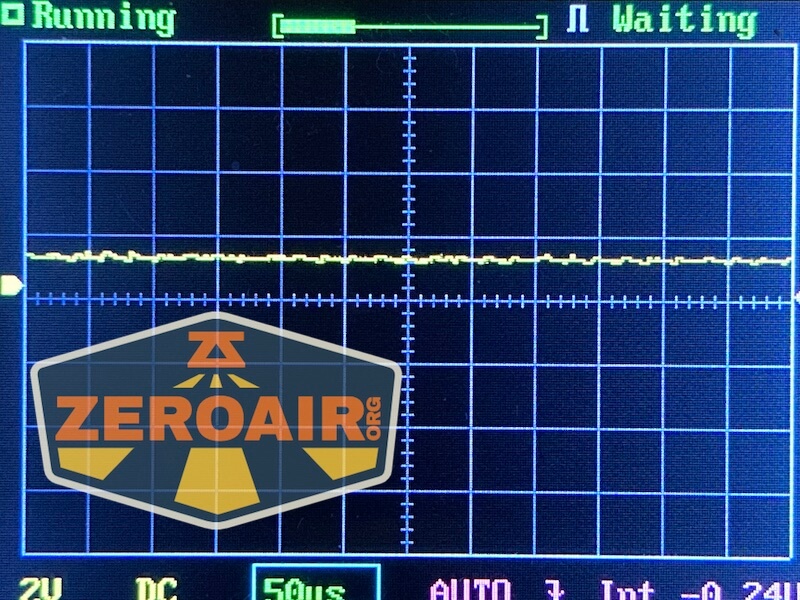
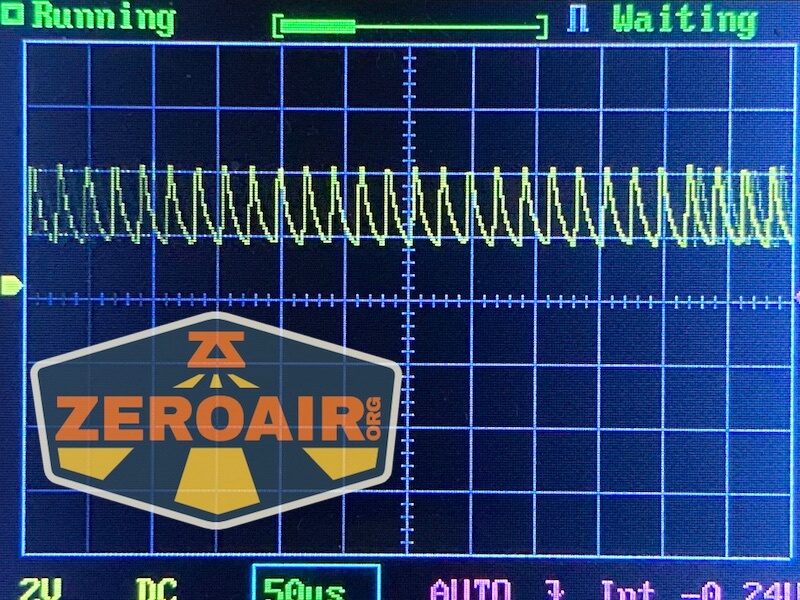
Here you can see a “baseline” – a chart with almost no light hitting the sensor.

Then there’s the Ultrafire WF-602C flashlight, which has some of the worst PWM I’ve seen. It’s so bad that I used a post about it to explain PWM! Here are multiple timescales (10ms, 5ms, 2ms, 1ms, 0.5ms, 0.2ms) to make comparing this “worst” PWM light to the test light easier. That post also explains why I didn’t test the WF-602C at the usual 50us scale.


User Interface and Operation
The switches on this RovyVon Angel Eyes E7 flashlight are metal cover e-switches. They are very much in design like the Aurora A24Ti (for example, but there are others.)

A bezel around the switch protects it reasonably well from accidental activation.

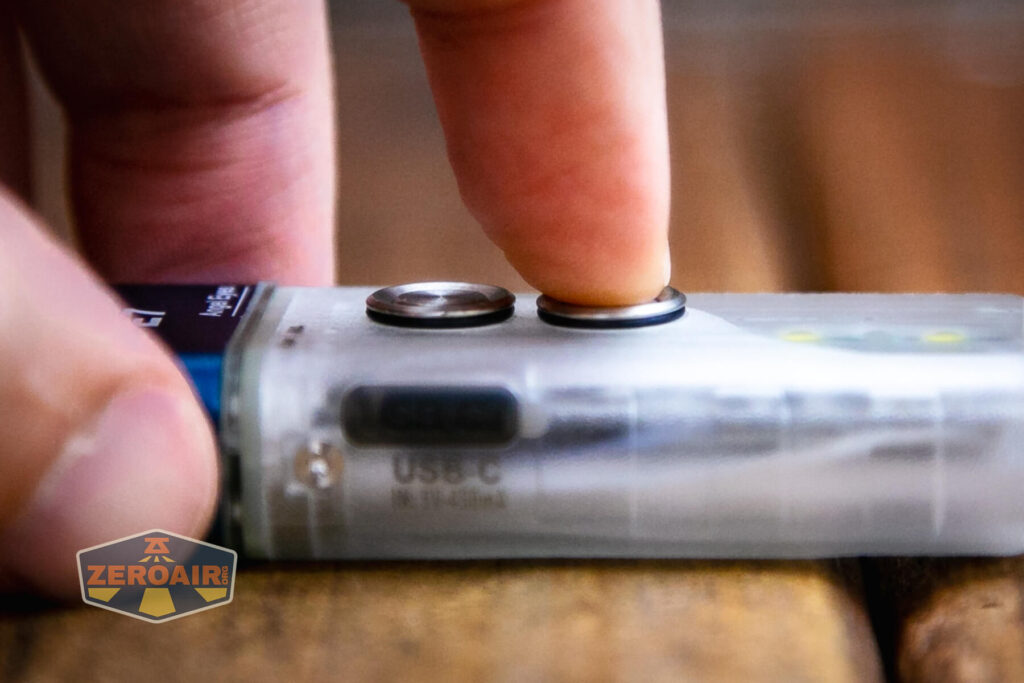
It’s a very quiet clicky button. Despite the similarity between other lights, the user interface has seen some changes. That’s understandable because this light has a different feature set! Note that the user interfaces for lights with mixed emitters is slightly different. On those lights, the emitters can be controlled independently. However, there are many user interface aspects that cover all the lights in this series, too.

Here’s a UI table! The user interface isn’t really too much different from what you’ve seen on the other Angel Eye lights, but this one has two switches. The switches don’t mix – the more “front” switch is for the front emitters only. The rear switch is for the side emitters only.
| State | Action | Result |
|---|---|---|
| Off | Click Front Switch | Moonlight (and brief battery check display on LiPO/AAA LED) |
| Off | Double Click Front Switch | Memorized mode (from Low, Medium, or High) (and brief battery check display on LiPO/AAA LED) |
| Off | Hold Front Switch | Momentary High (and brief battery check display on LiPO/AAA LED) |
| Moonlight | Click Front Switch | Off |
| Moonlight | Triple Click Front Switch | Iterate battery selection (pick between AAA or LiPO option) (or three blinks from LiPO LED to indicate “switch failed” (maybe AAA is not installed or depleted) |
| Off | Click 4x Front Switch | Lockout (LiPO LED blinks 3x rapidly to indicate lockout) |
| Lockout | Click Front Switch | LiPO LED blinks 3x rapidly to indicate lockout |
| Lockout | Click 4x Front Switch | Unlock (AAA LED blinks 2x rapidly to indicate unlock) |
| Front On (except Moonlight) | Click Front Switch | Mode advance (L, M, H) |
| Front On (except Moonlight) | Hold 0.5s Front Switch | Off |
| Off (or in L, M, H) | Click 3x Front Switch | Strobe in “High” of the selected battery |
| Off | Click Rear Switch | Side White Low |
| Side White Low On | Click Rear Switch | Side White High |
| Off (or any Side light On) | Double Click Rear Switch | Red |
| Side Lights On | Hold Rear Switch | Side lights off |
LED and Beam
RovyVon states that this cool white version uses two Luminus SST-20 emitters.

On the versions that have two of the same emitters (cool white x2 or warm white x2), the emitters can’t operate independently. However, on the versions that have mixed options (which is a different line of the Angel Eyes) (cool and warm white, or cool white and red), the emitters can be operated independently.


LED Color Report (CRI and CCT)
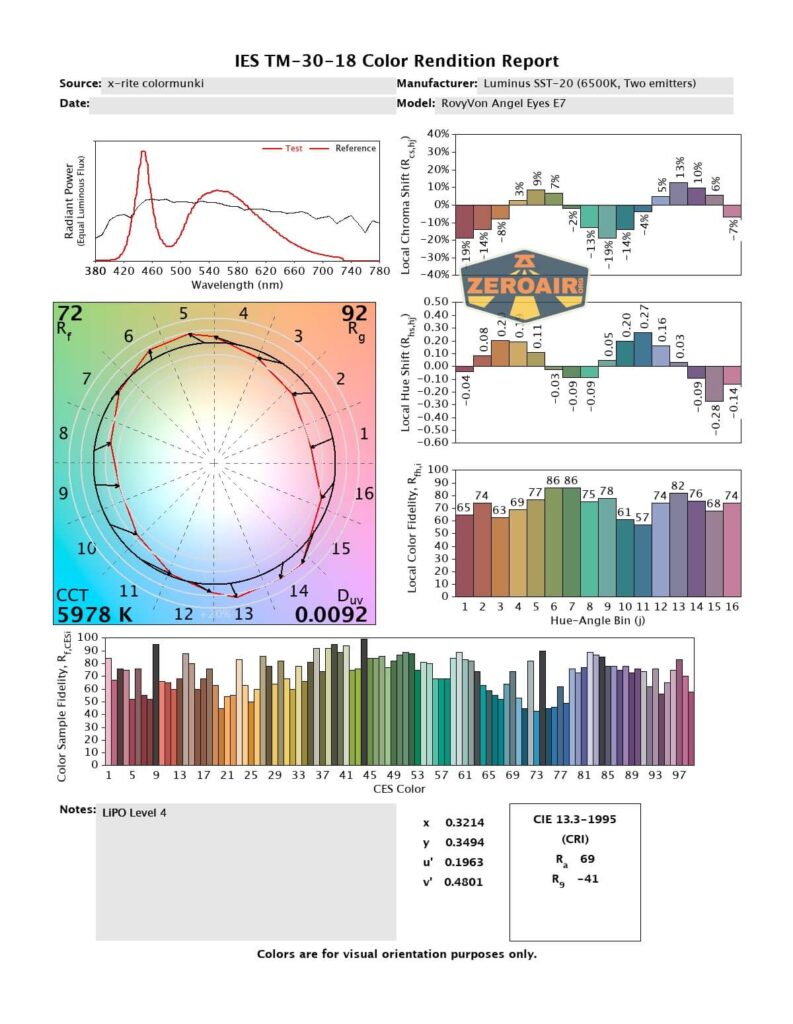
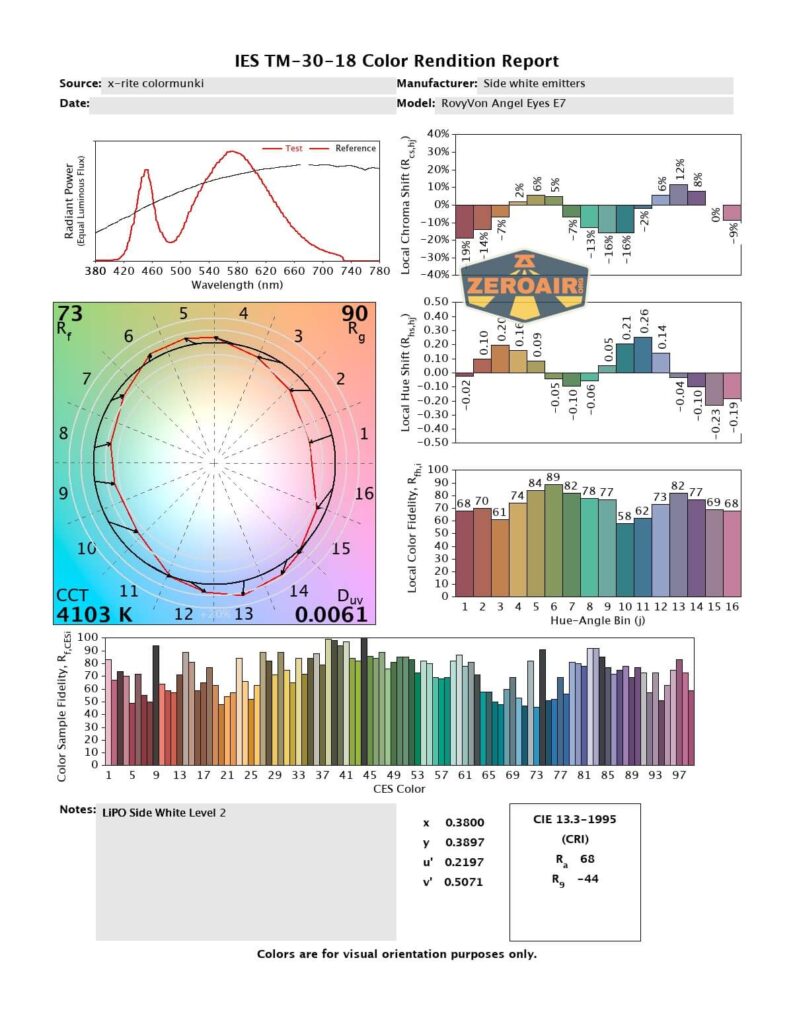
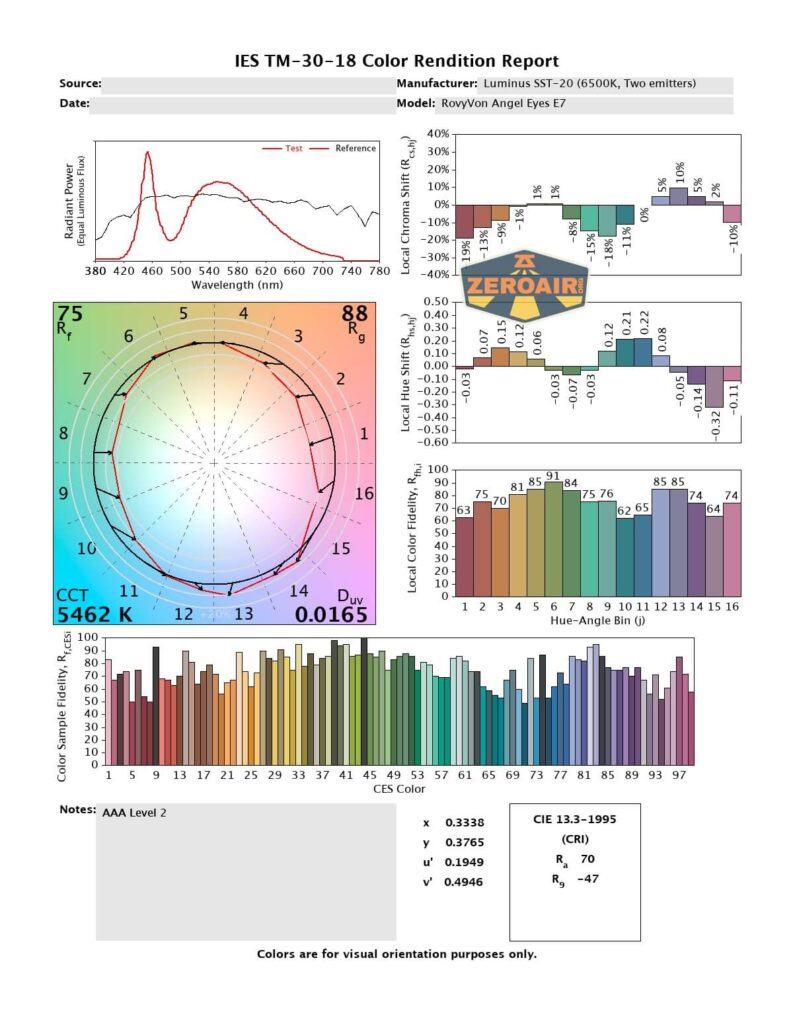
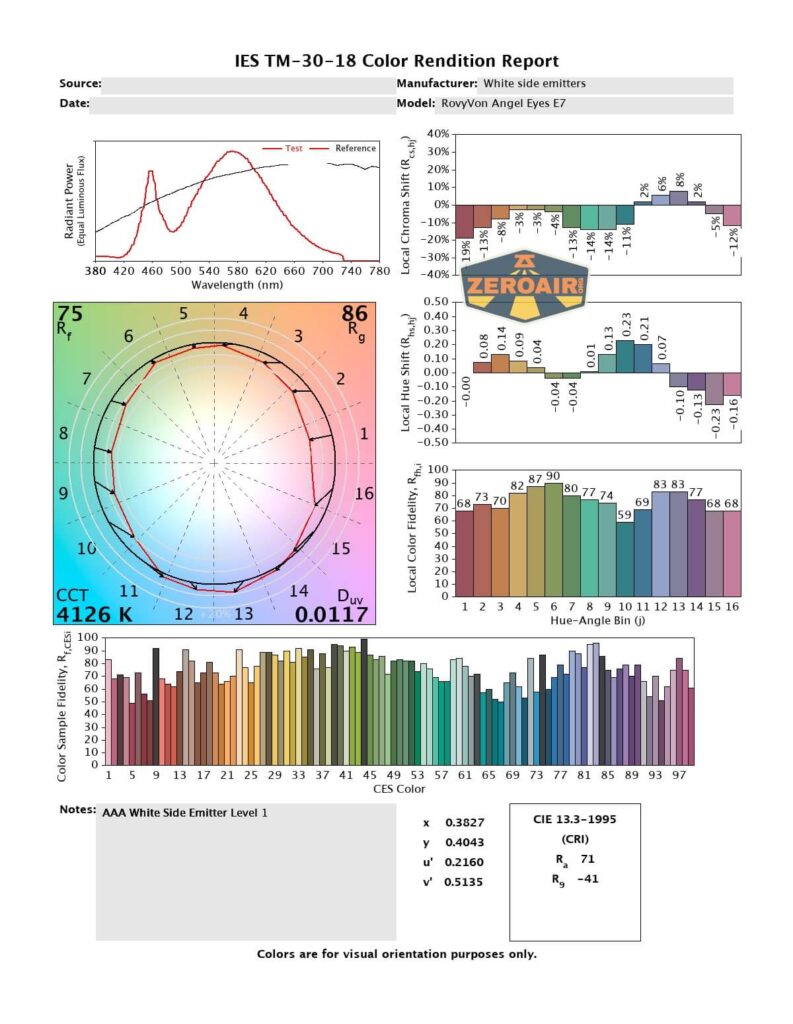
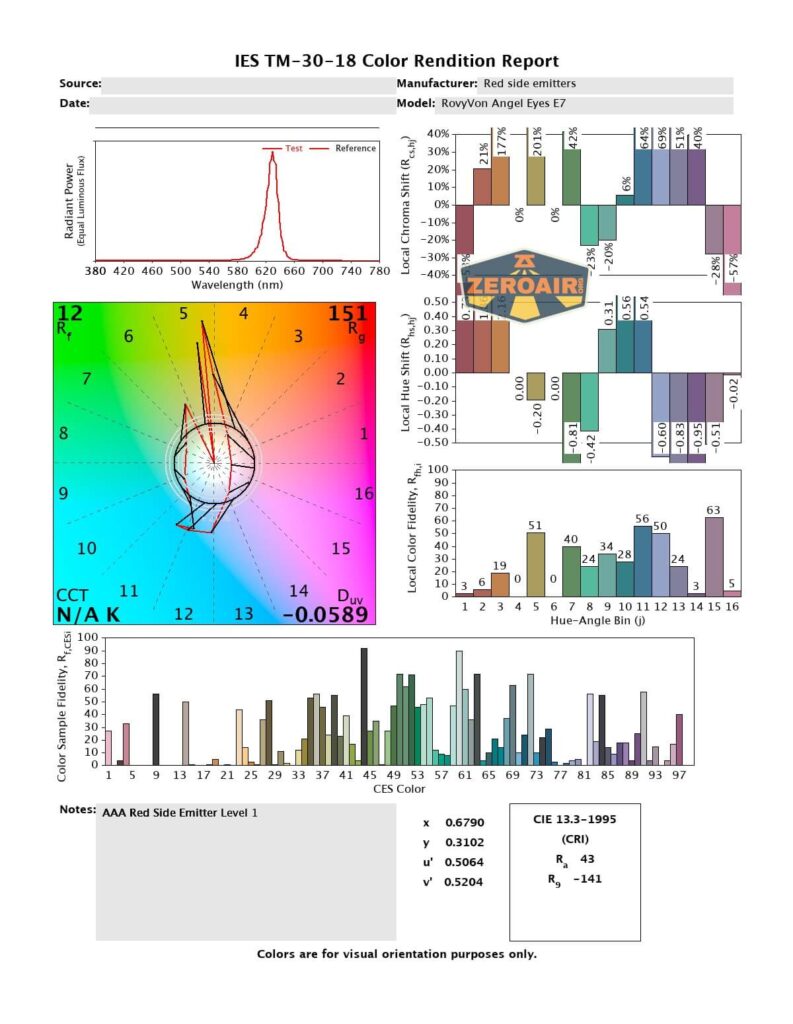
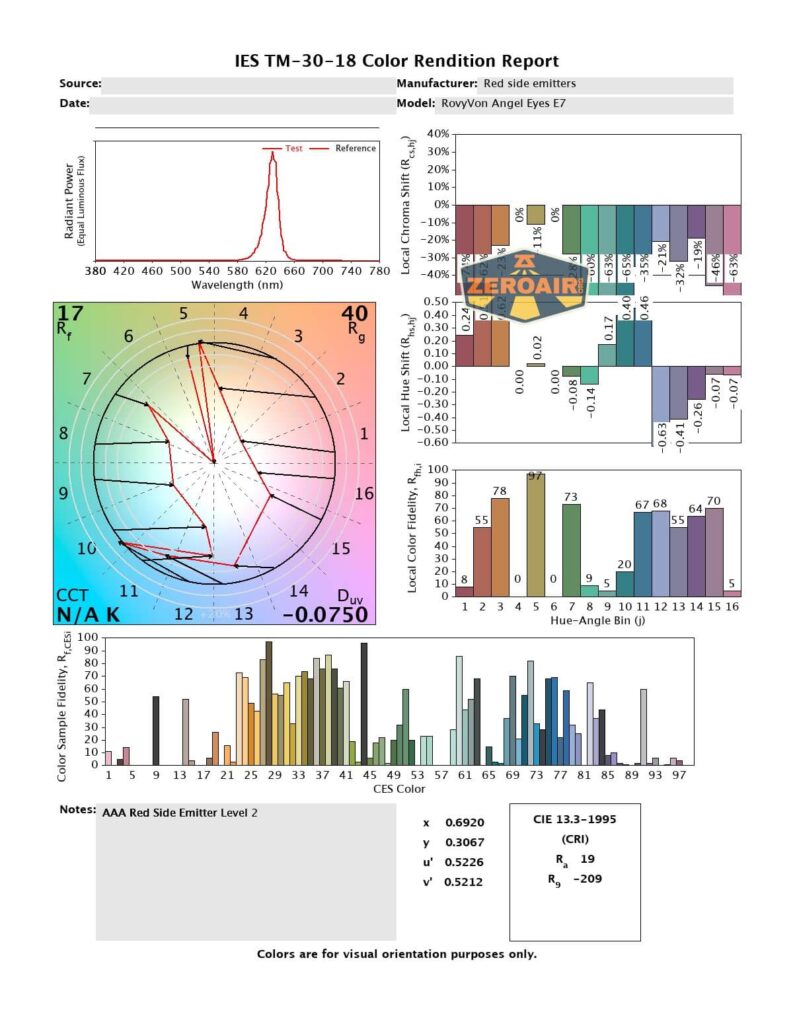
The main emitters are stated at 6500K. They’re Luminus SST-20 emitters, and test quite a bit warmer (thankfully) than 6500k. Even on the hardest-driven output (which is usually the coolest or highest CCT), the CCT is pleasantly under (warmer than) 6000K. Side white and red information is included, too.








Beamshots
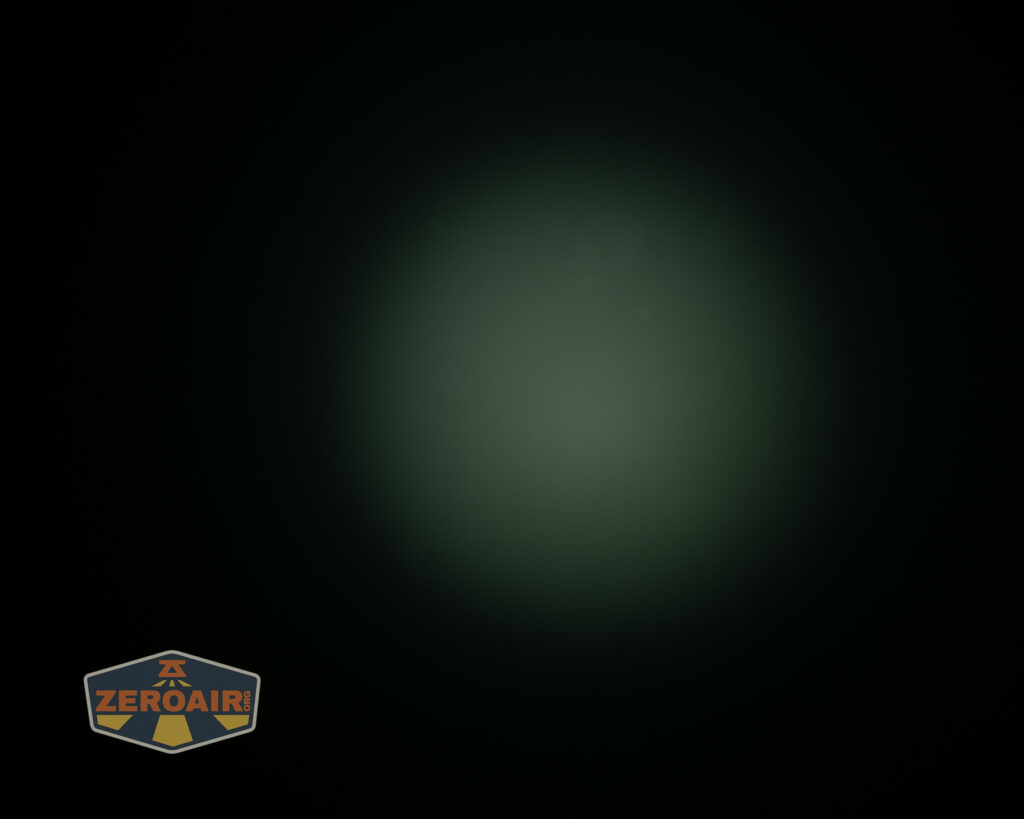
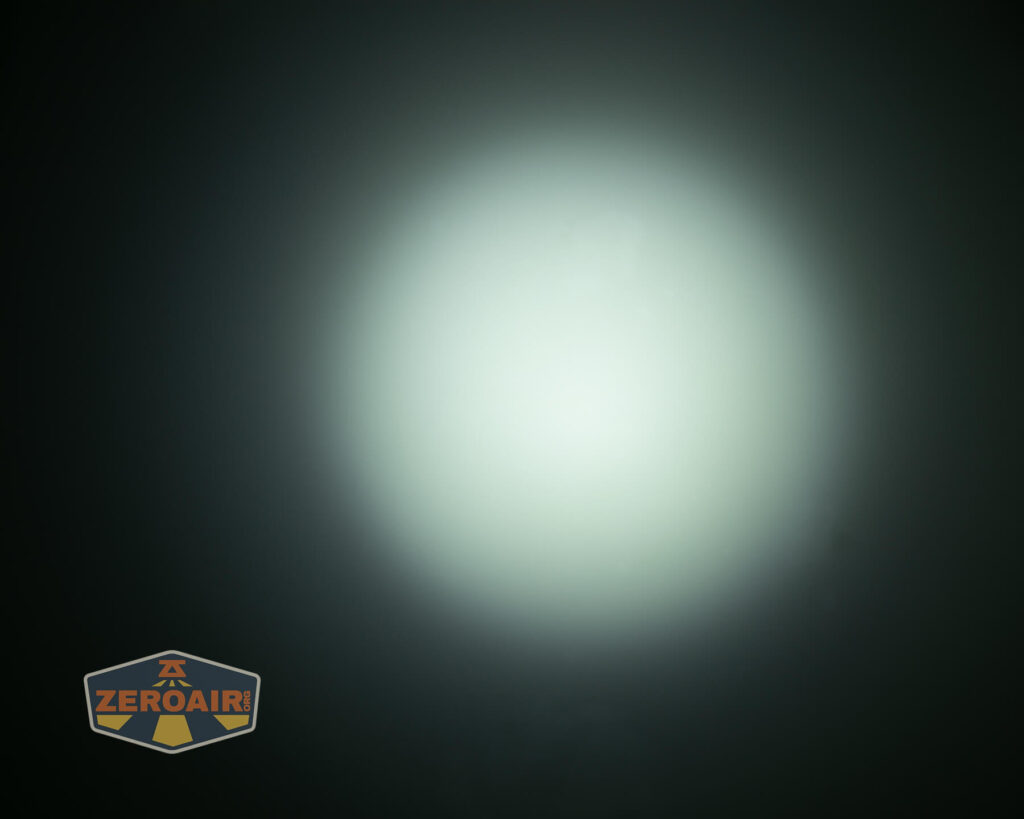
These beamshots are always with the following settings: f8, ISO100, 0.3s shutter, and manual 5000K exposure. These photos are taken at floor level and the beam hits the ceiling around 9 feet away.






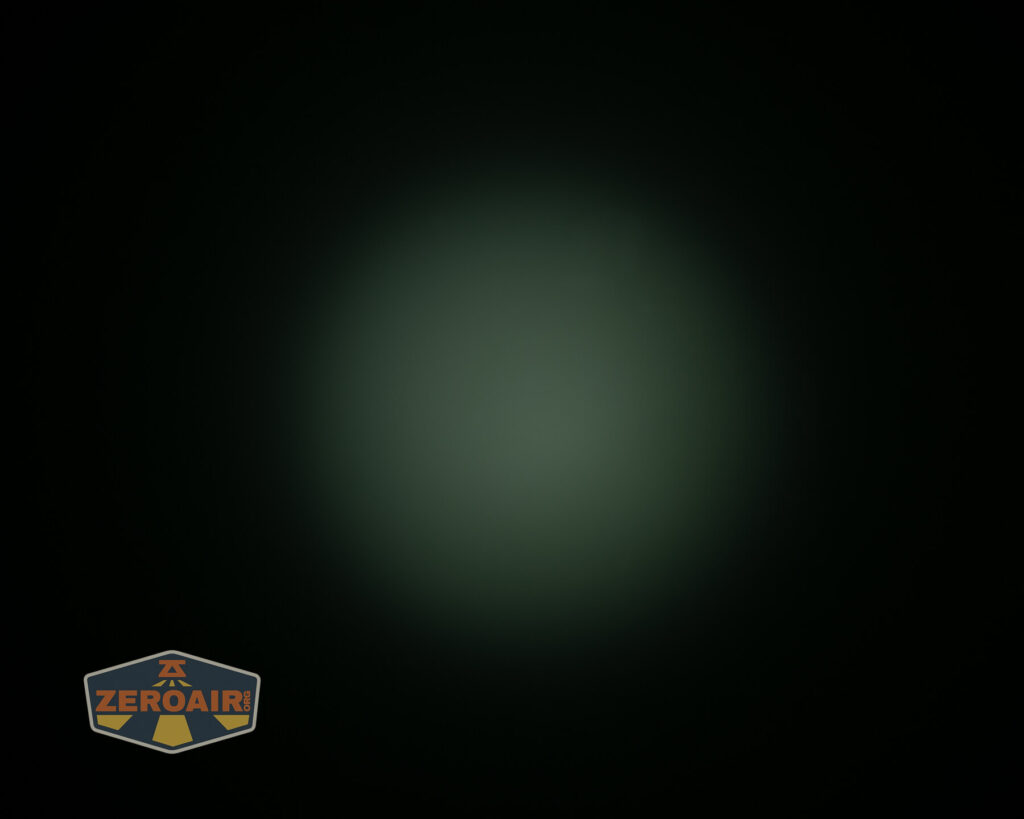




Tint vs BLF-348 (KillzoneFlashlights.com 219b version) (affiliate link)
I keep the test flashlight on the left, and the BLF-348 reference flashlight on the right.
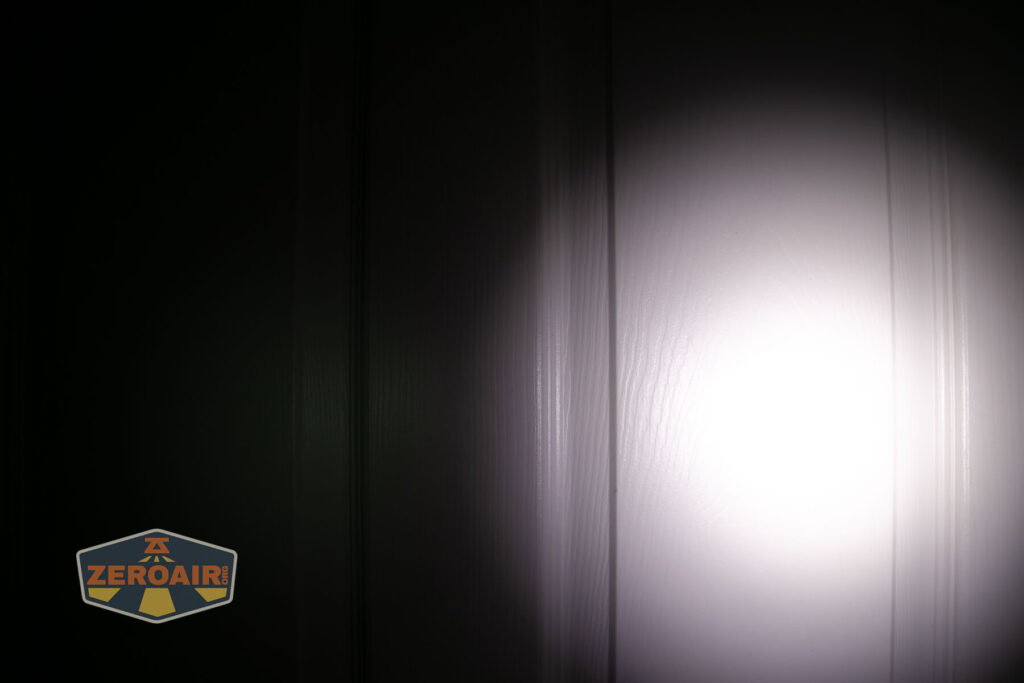
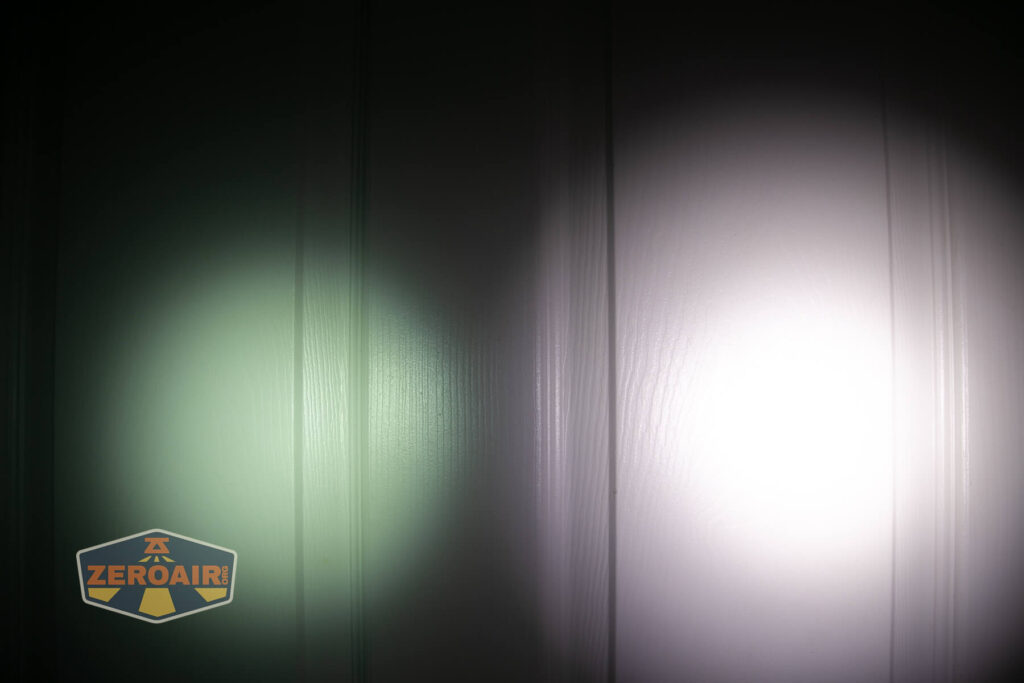
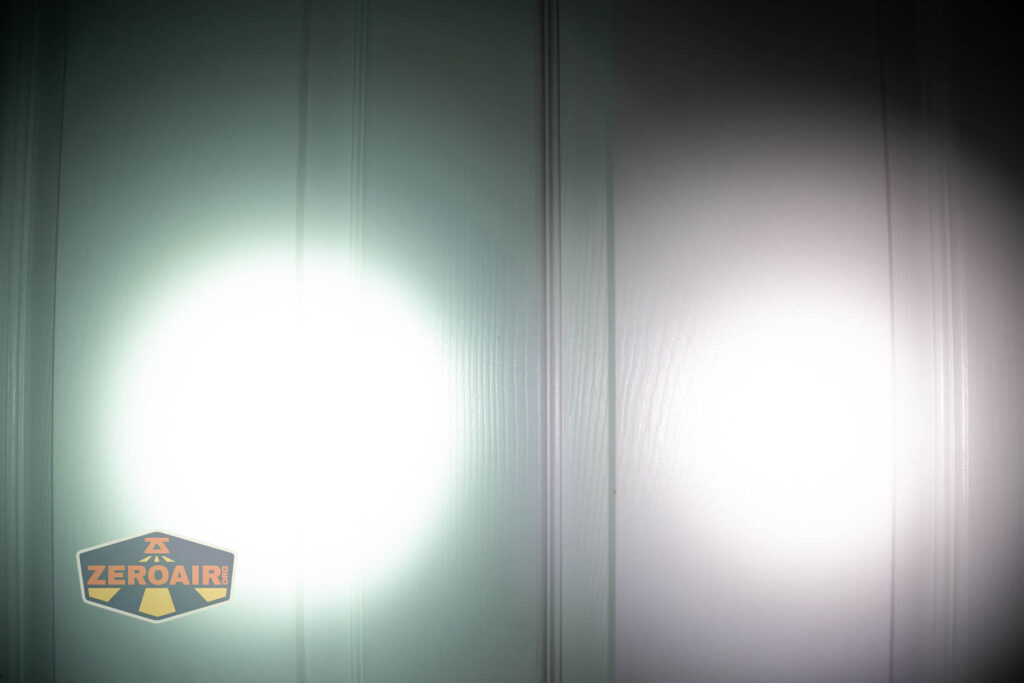

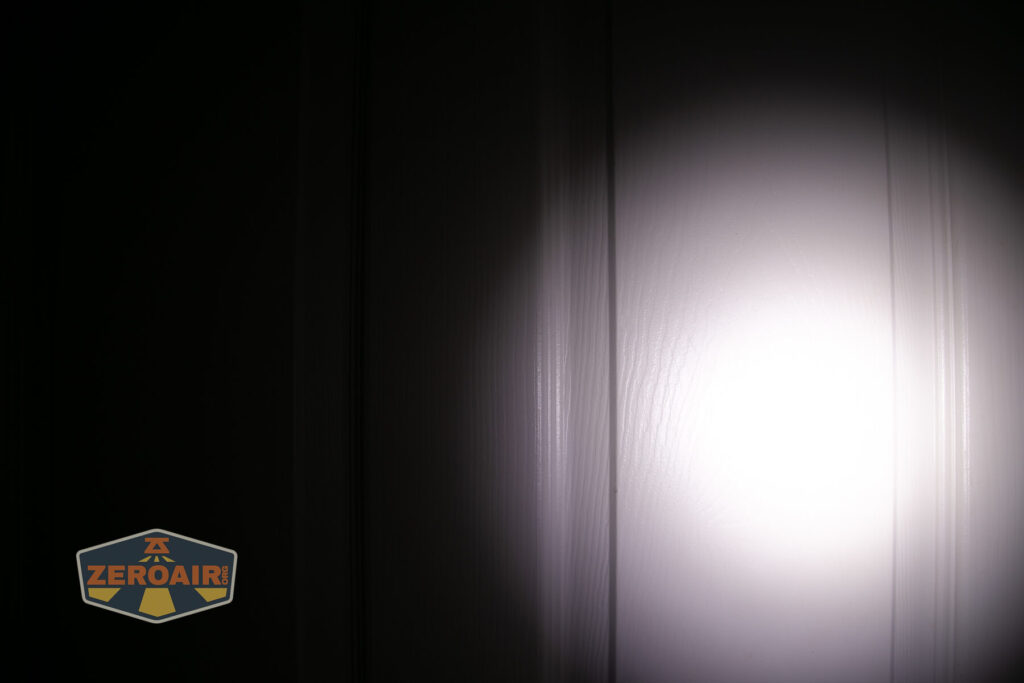

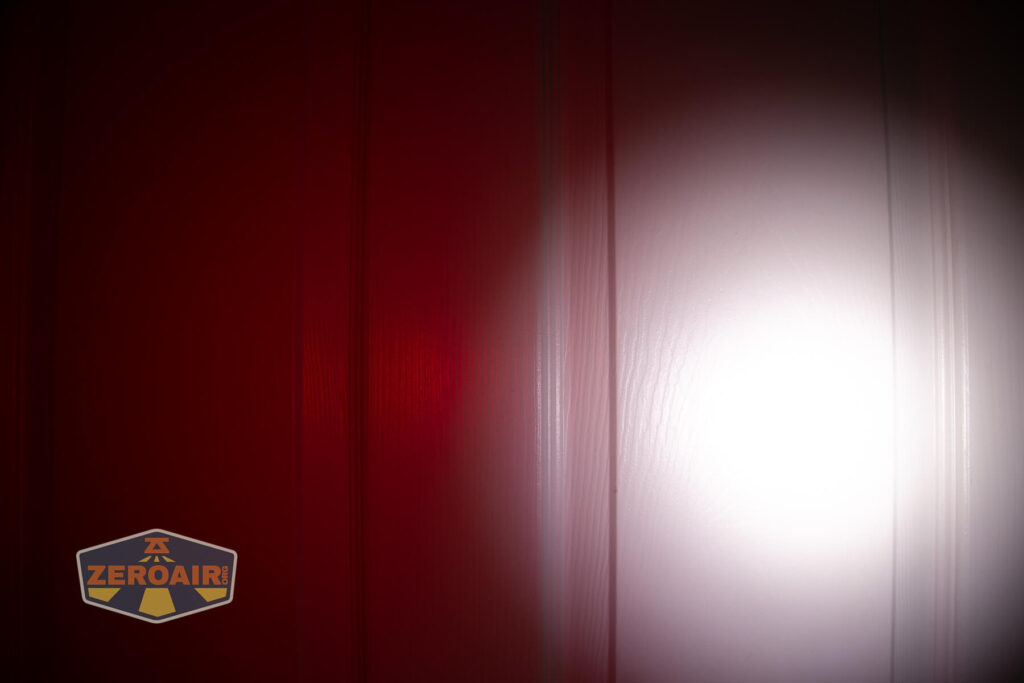
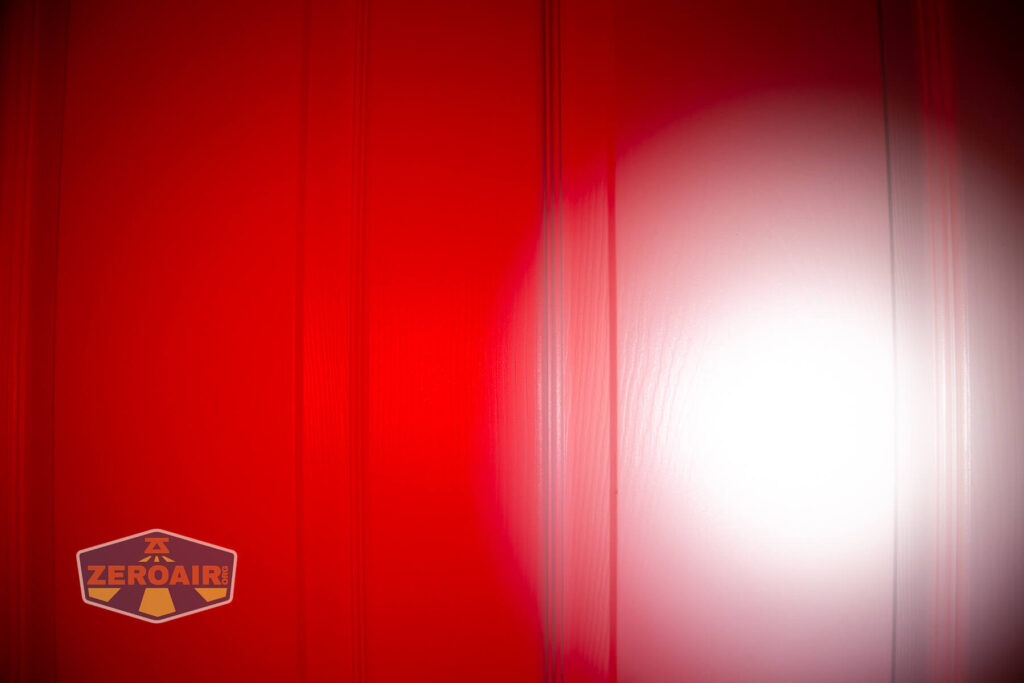
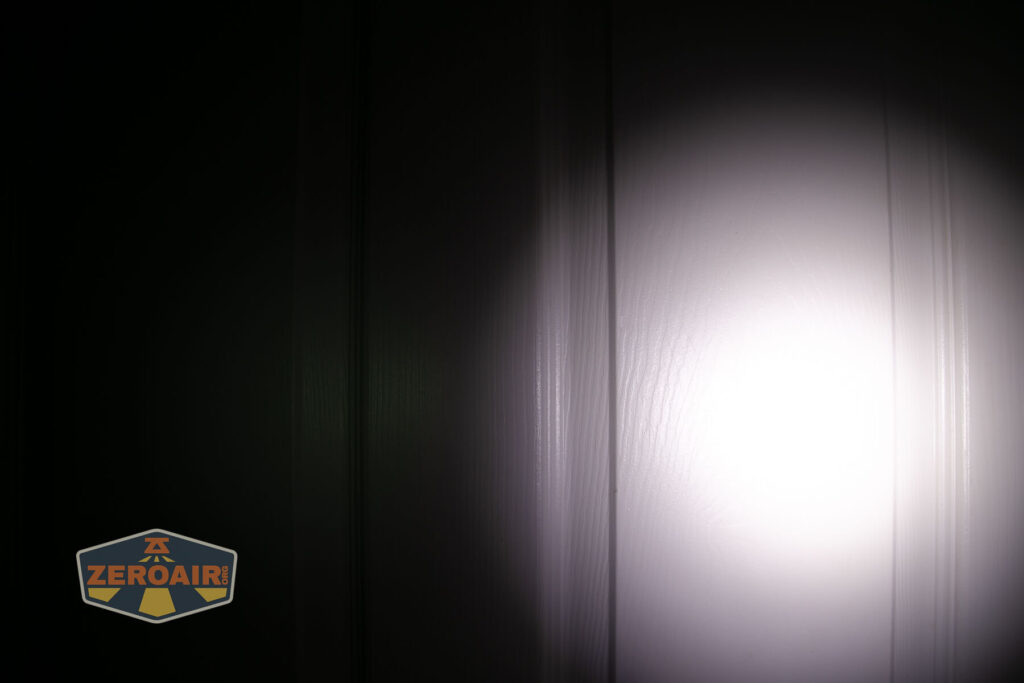
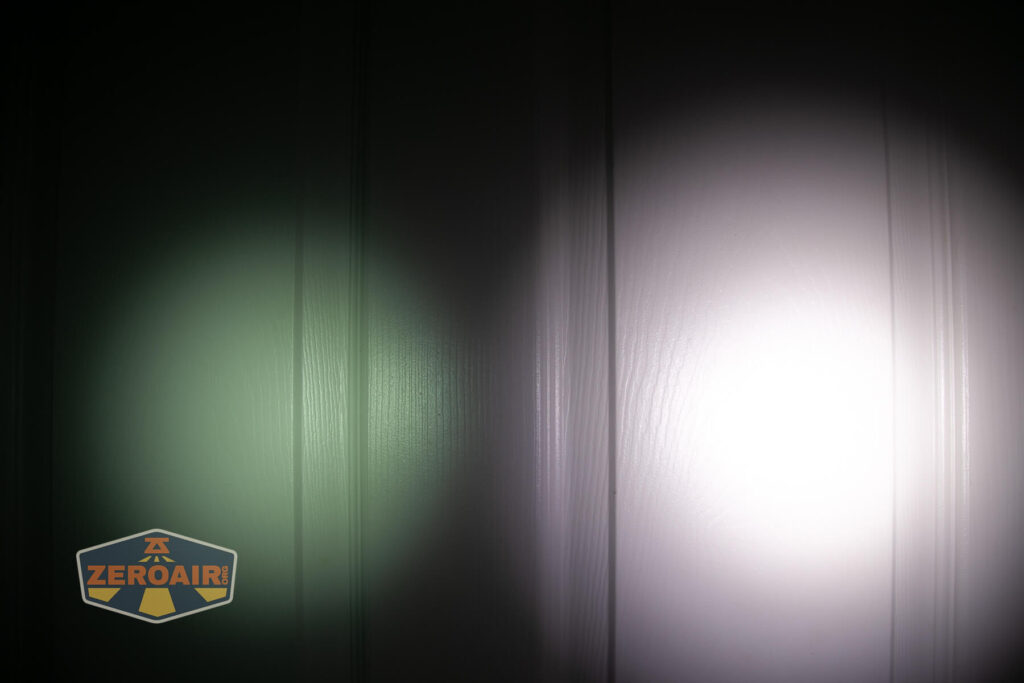
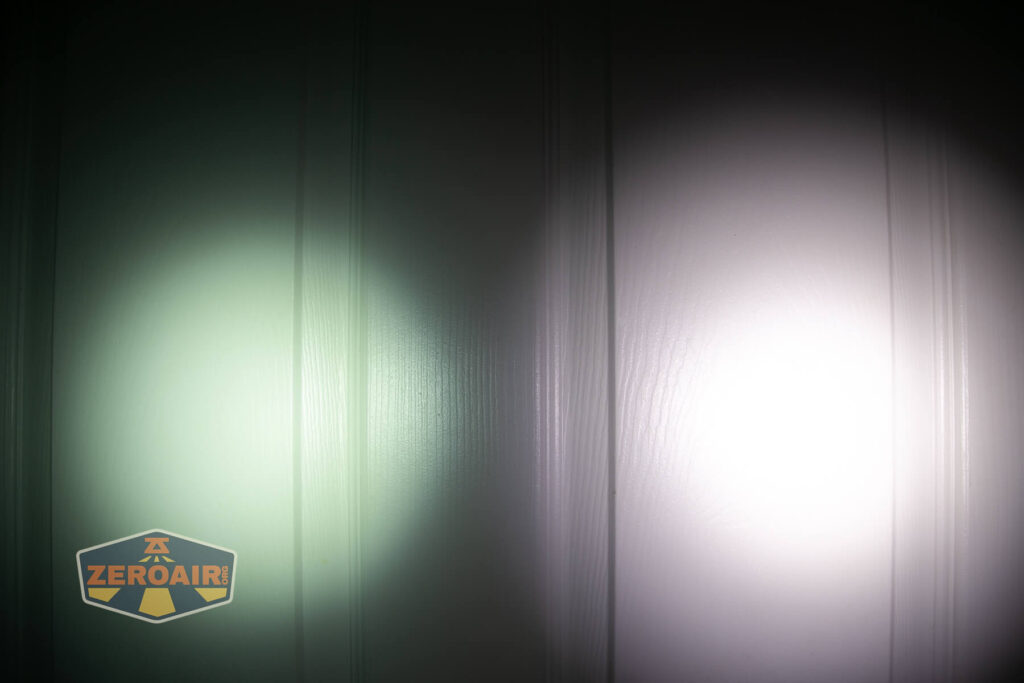
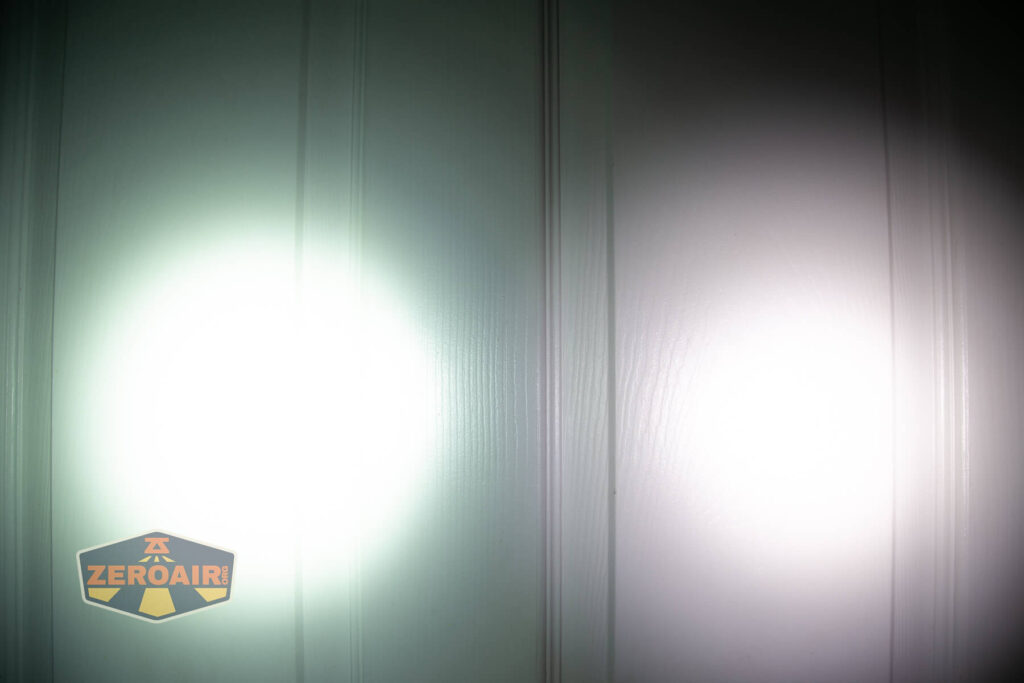

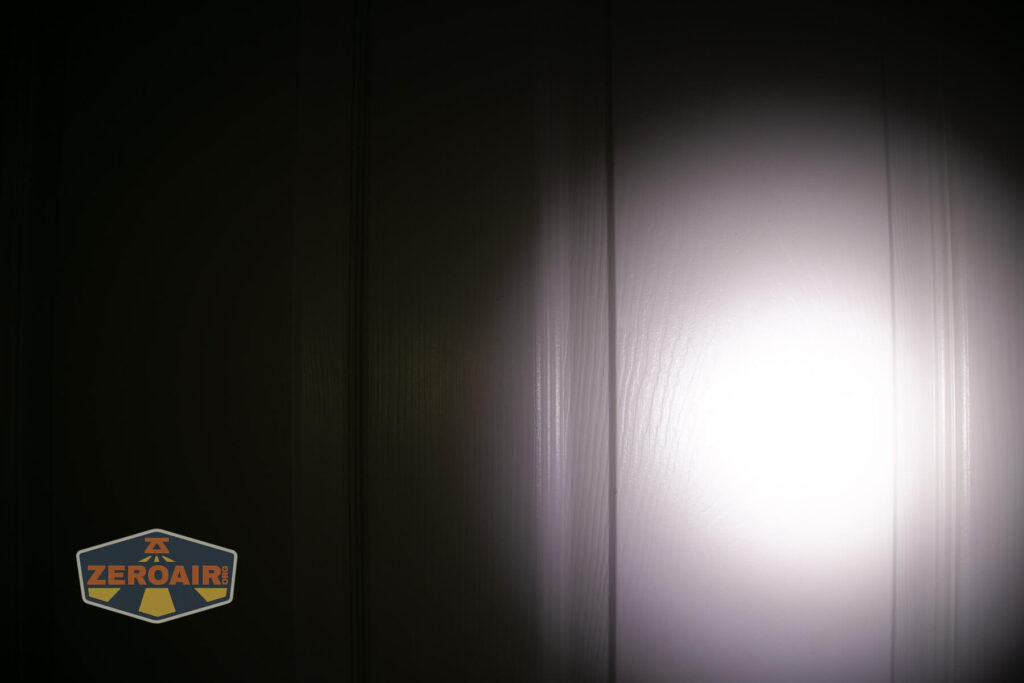
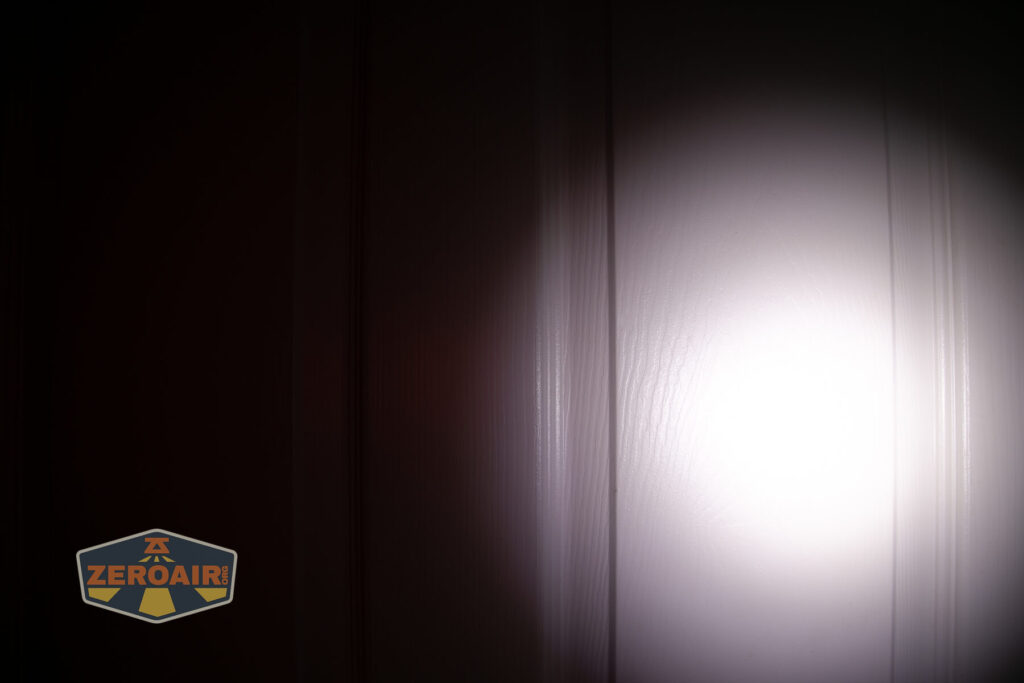
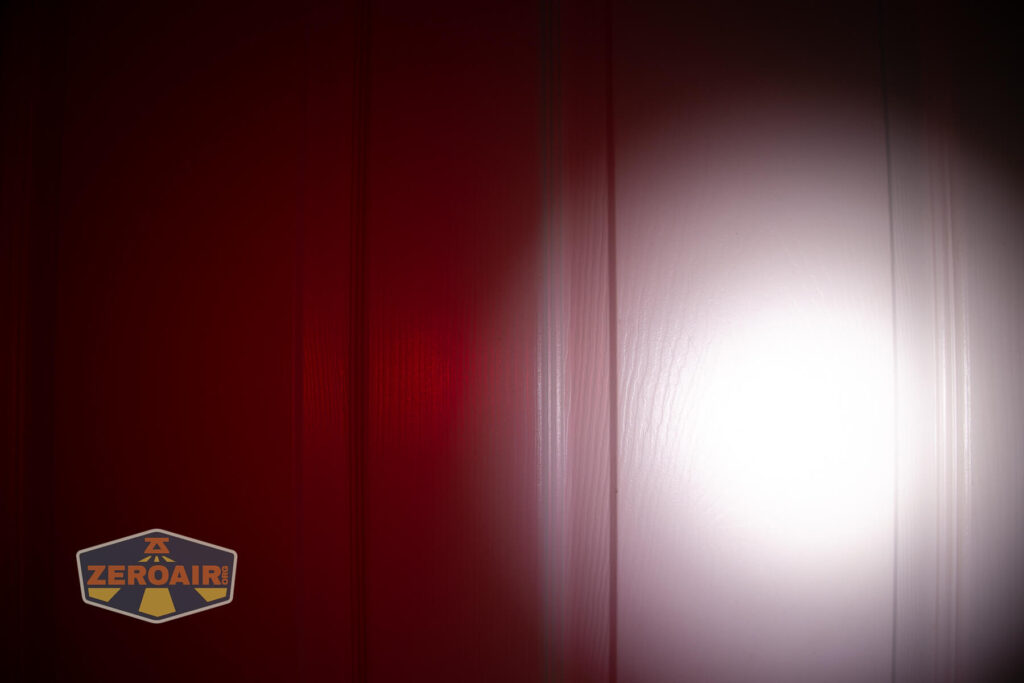
I compare everything to the KillzoneFlashlights.com 219b BLF-348 because it’s inexpensive and has the best tint!
Conclusion
What I like
- Unique LiPO/AAA mix
- LiPO can still power the light when AAA is being swapped – continuous usage!
- Possible to select between battery options (even with AAA installed) (this allows access to the 400 lumens high even if AAA is installed)
- Warm white emitter options
- Glow in the dark body!
- USB-C charging
- Luminus SST-20 is a great emitter choice!
- Indicator LEDs are quite useful
- C to C charging works!
- Glow gasket between head and body
What I don’t like
- LiPO is not replaceable
- Latch can be a bit hard to lift (but at least it seems secure)
- If the latch gets damaged, then the seal between head and body will be questionable (at best)
- USB-C charging doesn’t charge the AAA cell
Notes
- This content originally appeared at zeroair.org. Please visit there for the best experience!
- Please use my Amazon.com referral link to help support zeroair.org!
- Please support me on Patreon! I deeply appreciate your support!