

Olight i5R EOS HCRI Flashlight Review
Olight has introduced the Olight i5R EOS HCRI, a high CRI (HCRI) version of the great i5R EOS flashlight. Read on!
Official Specs and Features
Here’s a link to the Olight i5R EOS HCRI flashlight product page.
Versions
There are many versions, but since they’re so often limited, I’m not going to list them all here. At the very least, I’ve had the Olight i5R EOS Plum version on my review table before, and maybe others.
Price
When this was available (briefly?), the price was $35.99. I think the light sold out fairly quickly, and I hope Olight will take that as notice that we want high CRI options!
Since you’re here, and since this Olight i5R EOS HCRI flashlight isn’t even available now anyway, you should check out the Marauder Mini review I just published. That’s an available light that you should probably buy! The intro deals are even still available on it, too!
Short Review
The Olight i5R EOS HCRI flashlight is a great little size for EDC. I appreciate that it is dual-chemistry, and includes the cell required for lithium-ion output levels. I can’t quite see the reason to include this very specialized 2.4V lithium-ion cell, though, and not just go with a regular 14500 cell. The performance is great (and up to specification) and the output is truly High CRI.
Long Review
The Big Table
| Olight i5R EOS HCRI Flashlight | |
|---|---|
| Emitter: | (Probably Osram P9) (HCRI 5000K, 90CRI) |
| Price in USD at publication time: | $35.99 (ShareASale link) |
| Cell: | Included 2.4V “14500” cell |
| Runtime Graph | |
| LVP? | Yes |
| Switch Type: | Mechanical |
| On-Board Charging? | Yes |
| Charge Port Type: | USB-C (on cell) |
| Charge Graph | |
| Power off Charge Port | – |
| Claimed Lumens (lm) | 285 |
| Measured Lumens (at 30s) | 273 (95.8% of claim)^ |
| Candela per Lumen | 4 |
| Claimed Throw (m) | 58 |
| Candela (Calculated) in cd (at 30s) | 56lux @ 4.404m = 1086cd |
| Throw (Calculated) (m) | 65.9 (113.6% of claim)^ |
| Claimed CCT | 5000 |
| Measured CCT Range (K) | 4500-4600 Kelvin |
| Item provided for review by: | Olight |
| All my Olight reviews! | |
^ Measurement disclaimer: Testing flashlights is my hobby. I use hobbyist-level equipment for testing, including some I made myself. Try not to get buried in the details of manufacturer specifications versus measurements recorded here; A certain amount of difference (say, 10 or 15%) is perfectly reasonable.
What’s Included

- Olight i5R EOS HCRI flashlight
- “14500” cell that is a customized USB-C charging (only) 2.4V cell
- Charging cable
- Manual etc
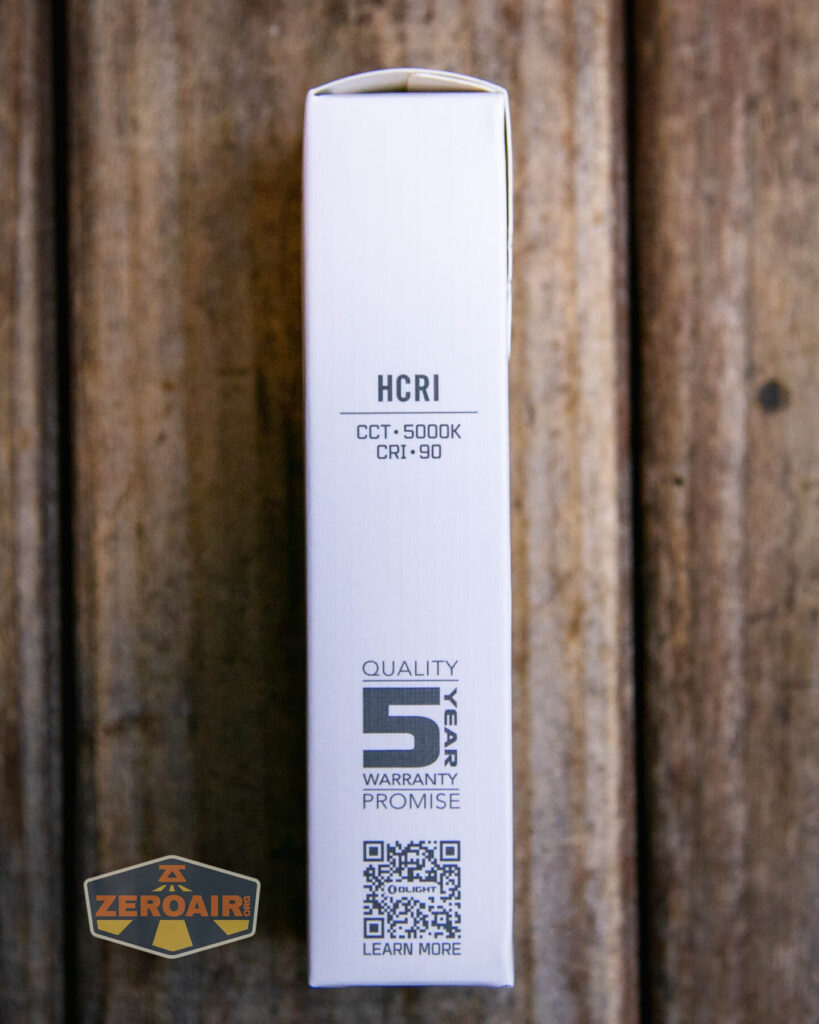
Package and Manual



Build Quality and Disassembly

I’ve tested the i5R EOS before (in Plum). It’s great! This version is not much (if any) different, except that this one offers a 5000K emitter with High CRI!
Ultimately, the build quality (and most other aspects) of these i5 lights by Olight (the i5R and i5T) aren’t really different. What is different is that the i5R includes a 2.4V lithium-ion cell.


Only the tailcap is removable on the Olight i5R EOS HCRI flashlight. The threads are bare copper. More on the body material below.

One thing that irks me just a little bit is this spring. It’s a great spring for cell contact, but the spring is cut cleanly off. That means when screwing the cap down, the spring edge can grind into the cell. This spring cut should be angled so that it doesn’t snag the cell on the in or out direction. I filed this down just a bit and it’s fine now.
I’ll add that the tailcap threads are very smooth and the reeding makes removal a breeze.
On the positive terminal is only a brass button – no spring.
Size and Comps
The Olight i5R EOS HCRI flashlight is 95.4mm long and 17.8mm in diameter. The weight is 60g.
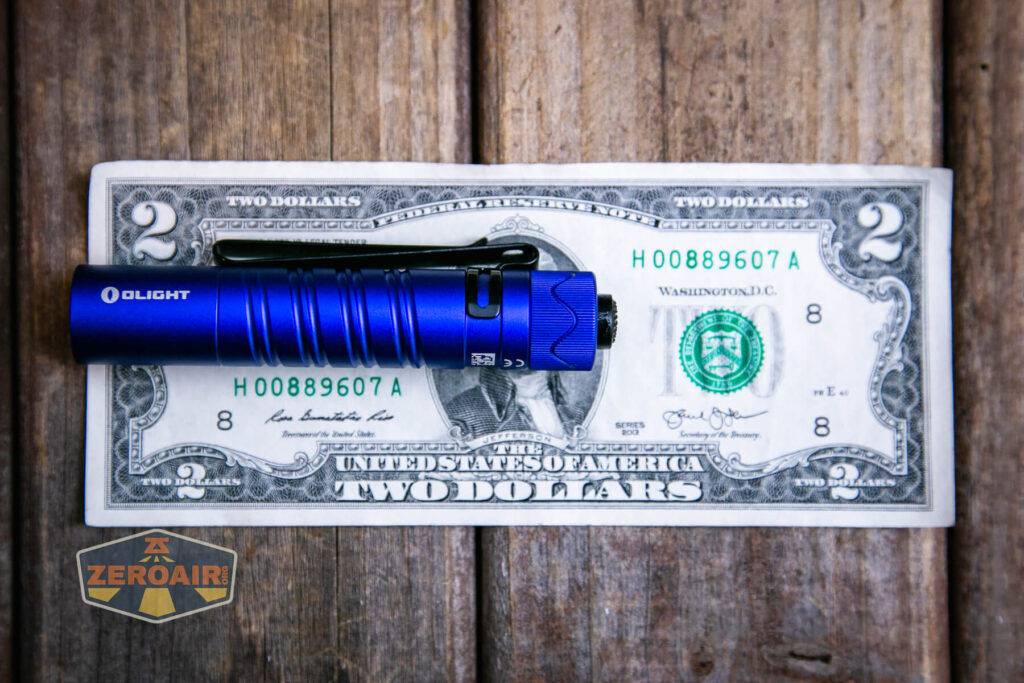


If the flashlight will headstand, I’ll show it here (usually the third photo). If the flashlight will tailstand, I’ll also show that (usually in the fourth photo).


Here’s the test light with the venerable Convoy S2+. Mine’s a custom “baked” edition Nichia 219b triple. A very nice 18650 light.


Also above is the light beside my custom engraved TorchLAB BOSS 35, an 18350 light. I reviewed the aluminum version of that light in both 35 and 70 formats.
Retention and Carry
The included way to carry this light is the two-way friction fit clip. This clip is black and matches the other appointments on the i5R EOS fairly well. I don’t typically love two-way clips, but this is by no means the worst iteration I’ve seen. It’s fairly slim (noteworthy because the bulk of these two-ways is one big complaint of mine).

There’s a lanyard hole on the shoulder. (No lanyard is included).
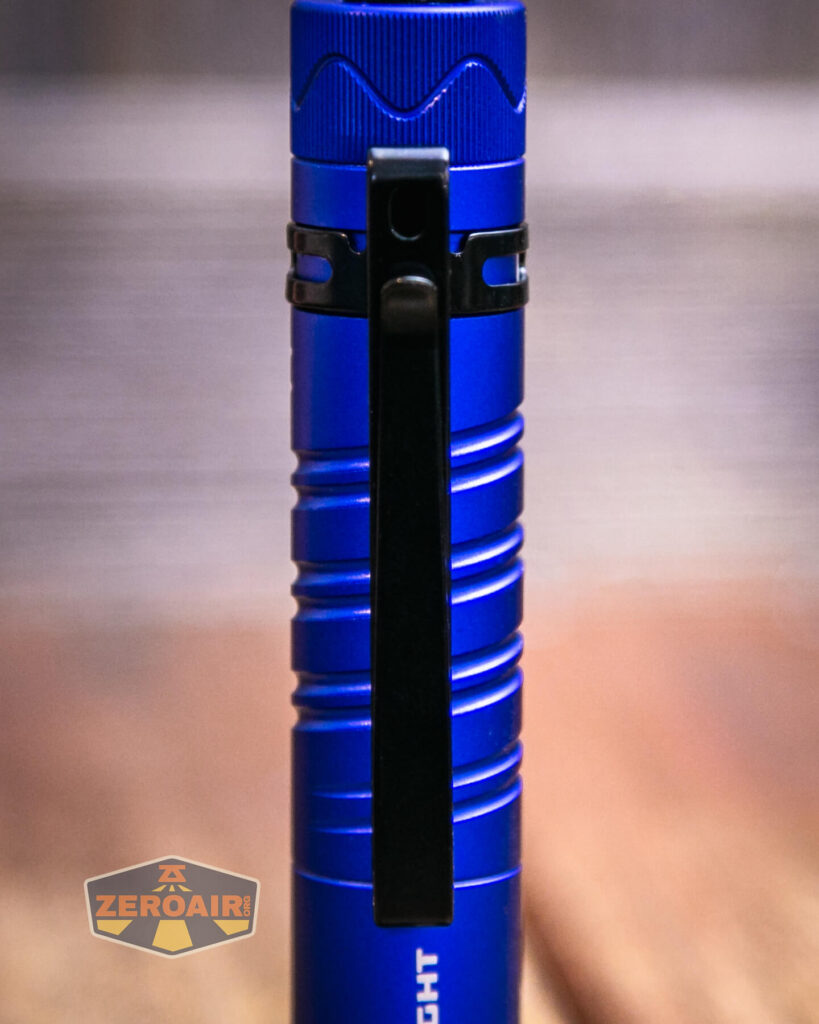
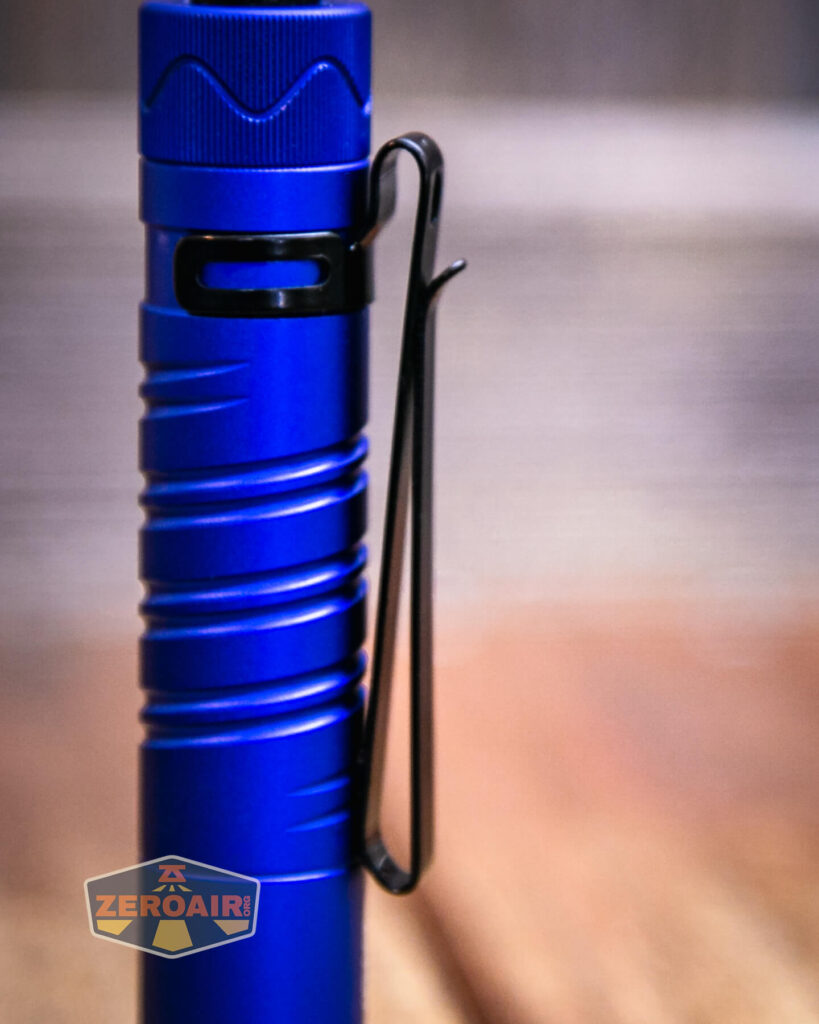

The clip is two-way but not reversible, but due to this, it’s usable as a hatlight. The weight might make it balance poorly there though.
Power and Runtime
The Olight i5R EOS HCRI flashlight runs on the included cell, which I’ve already talked about at length. This is a lithium-ion cell, but not a 14500. Or I’ll call it a 14500 as Olight does, but I’m going to put it in quotes – “14500.” It’s not really a 14500 cell, and saying it is implies that normal (4.2V) 14500 cells will work in the i5R. They might work but they aren’t recommended or supported (ie they might fry your electronics or they might be fine – do you want to risk it is the question.)

One benefit to having this specialized cell is that the capacity is much higher. The highest 14500 cell capacity I can see with a quick search is 1100mAh. This 1420mAh 2.4V cell is much greater capacity.
Here you can see the direction to install the cell – positive (button) goes into the light toward the head.

There’s one more thing to dislike about this cell, though. The 2.4V nature of it means it can not be charged in bay-style chargers. You’ll have to use USB-C to charge it. Now, just about any USB-C cable and power source should work, and yes, we probably all have some USB-C cables and power sources around, but locking us in this way is not ideal. This is a special kind of proprietary.
Fortunately, it’s a standard format cell, so there’s no proprietary connectivity happening here. That does mean that 1.5V cells work too – cells like the NiMH Eneloops and primary alkalines, too (though those are officially “not recommended.”)
Here’s a runtime for the higher output with the included cell.

Charging
While the Olight i5R EOS HCRI flashlight itself does not have charging, the included cell does. There’s a USB-C port on the positive terminal.

An appropriate cable is included – USB to USB-C. C to C charging does not work.

Here’s a charge graph for the cell.

Modes and Currents
| Mode | Mode Claimed Output (lm) | Claimed Runtime | Measured Lumens | Tailcap Amps (@2.4V) |
|---|---|---|---|---|
| High | 285 + 150 | 10m+170m | 273 | 1.13 |
| Low | 12 | 37h | 12 | 0.03 |
Pulse Width Modulation
There’s something on Low with the 14500, but not PWM. Just sawtooth, and I didn’t find it to be noticeable. It’s very fast.


Here you can see a “baseline” – a chart with almost no light hitting the sensor. Then there’s the Ultrafire WF-602C flashlight, which has some of the worst PWM I’ve seen. It’s so bad that I used a post about it to explain PWM! Here are multiple timescales (10ms, 5ms, 2ms, 1ms, 0.5ms, 0.2ms) to make comparing this “worst” PWM light to the test light easier. That post also explains why I didn’t test the WF-602C at the usual 50us scale.


User Interface and Operation
There’s a single switch on the Olight i5R EOS HCRI flashlight. It’s a proud rubber cover mechanical clicky on the tail. It has an extremely good feel.

It seems a bit unusual in that it seems to have hard sides with an internal soft stippled contact point. The hard sides make the action very smooth, and the stippled center bit makes it easy to grip. The action is very good. It’s smooth and direct and also very clicky.


Here’s a user interface table!
| State | Action | Result |
|---|---|---|
| Off | Click | Low |
| Off | Tap | Momentary Low |
| On (more than 2s) | Click | Off |
| Off | Double click | High |
| On (less than 2s) | Click | High |
LED and Beam
I can’t find it in the literature but based on searches on the web this is an Osram P9 emitter. The light uses a TIR and has a beam with mostly spot and a little spill. Notably, this is a High CRI option of the Osram P9 (or whatever emitter they used here.)


LED Color Report (CRI and CCT)
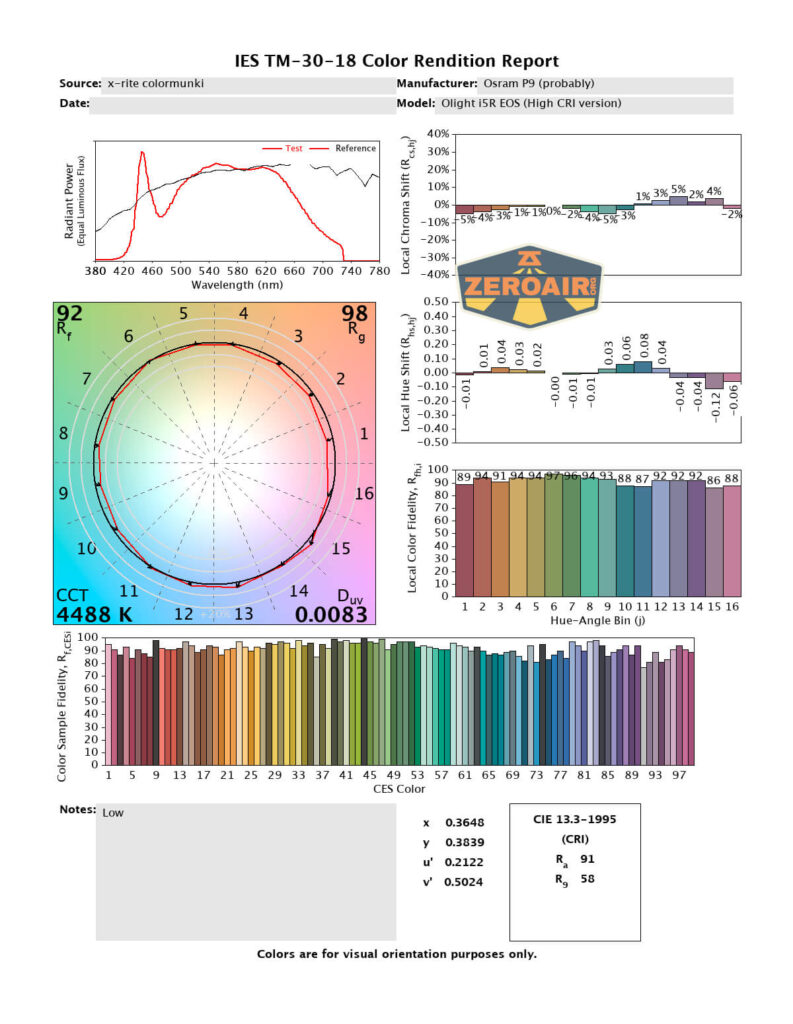
Olight states the CRI and CCT of this emitter as 5000K and 90 CRI. The CCT is around 4600K – that’s very good in Olight terms – practically warm white. The CRI is as claimed: high CRI at around 91.

Beamshots
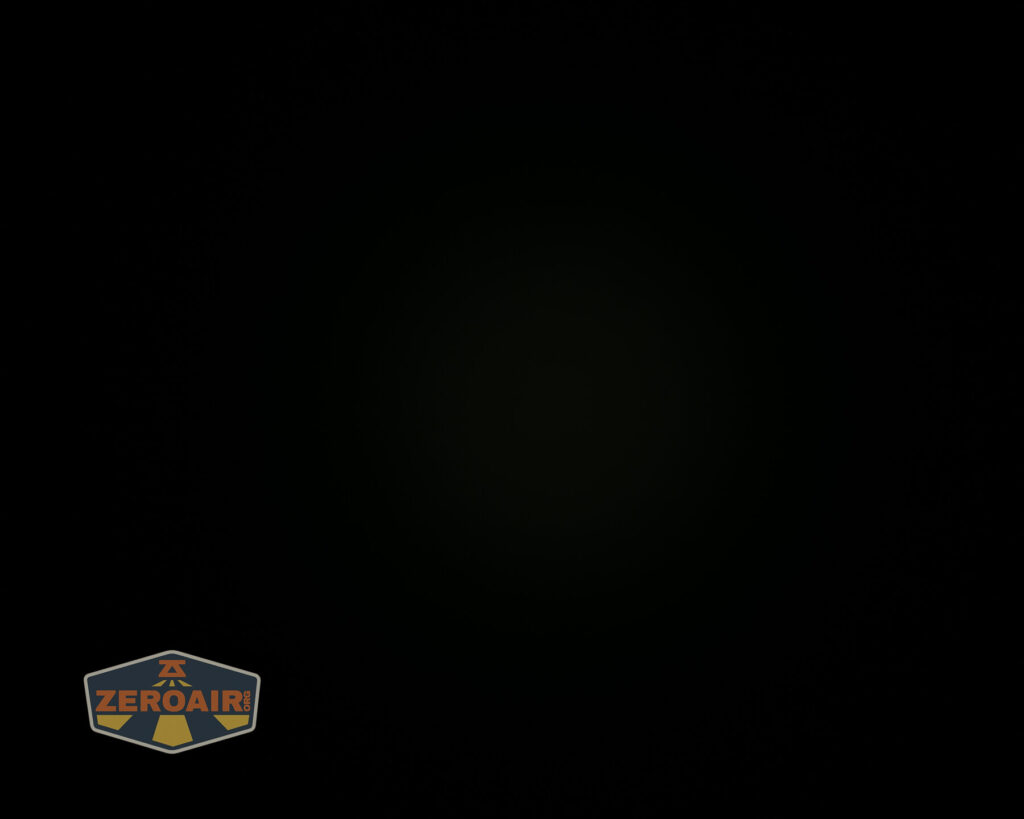
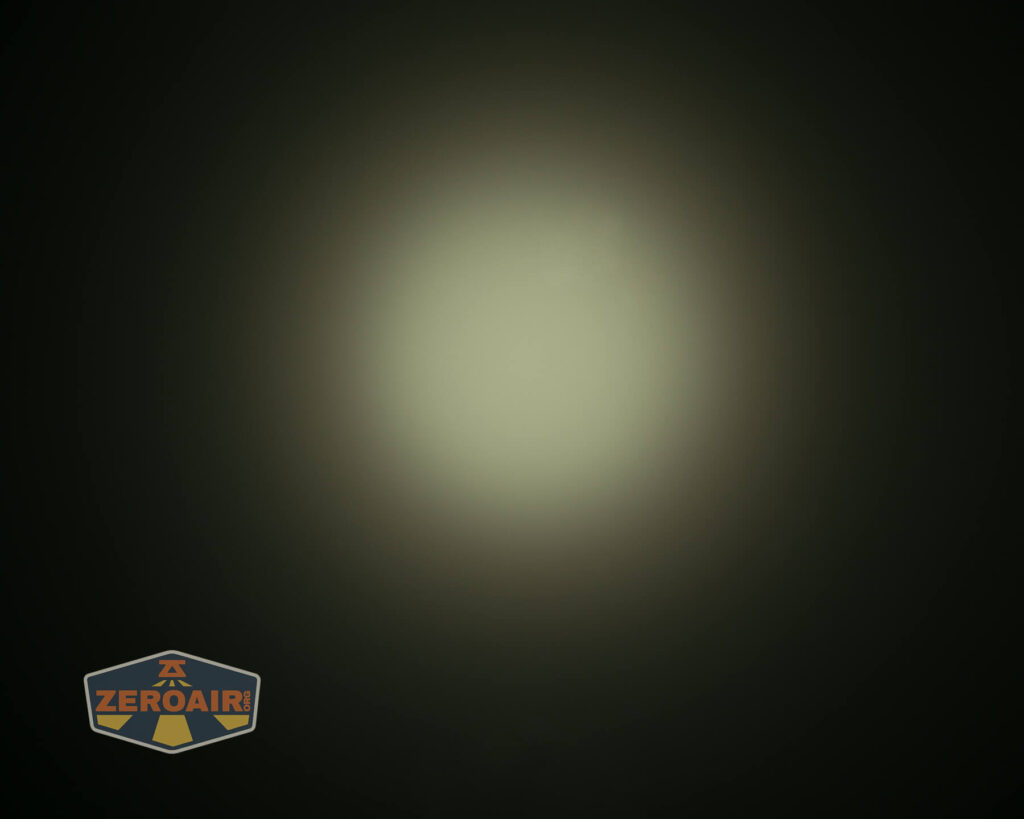
These beamshots always have the following settings: f8, ISO100, 0.3s shutter, and manual 5000K exposure. These photos are taken at floor level, and the beam hits the ceiling around 9 feet away.
Tint vs BLF-348 (KillzoneFlashlights.com 219b version) (affiliate link)
I keep the test flashlight on the left and the BLF-348 reference flashlight on the right.
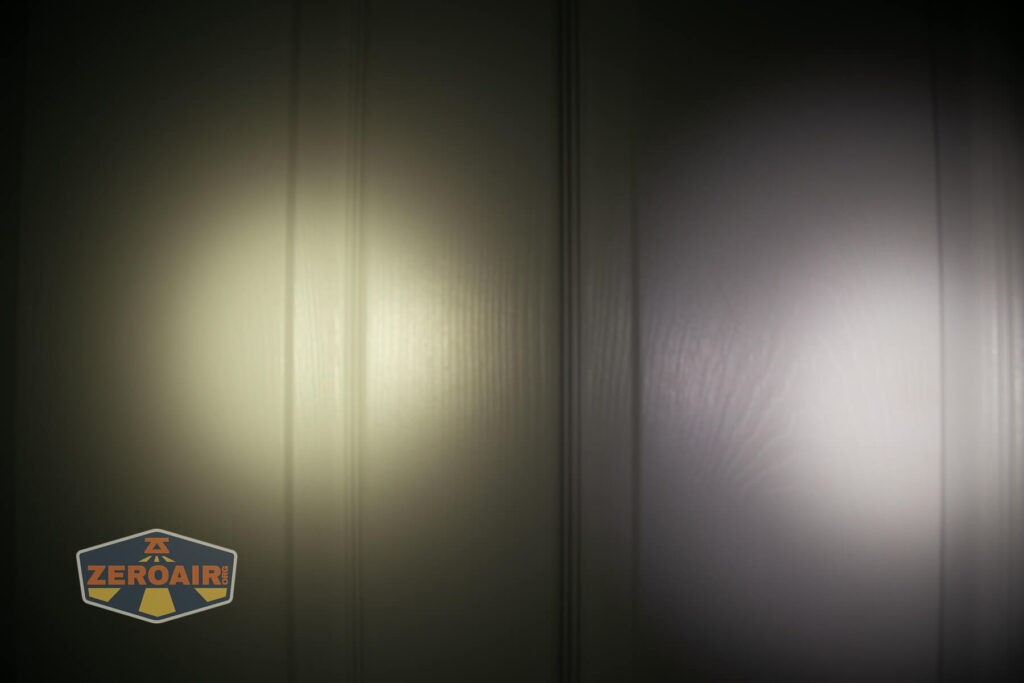
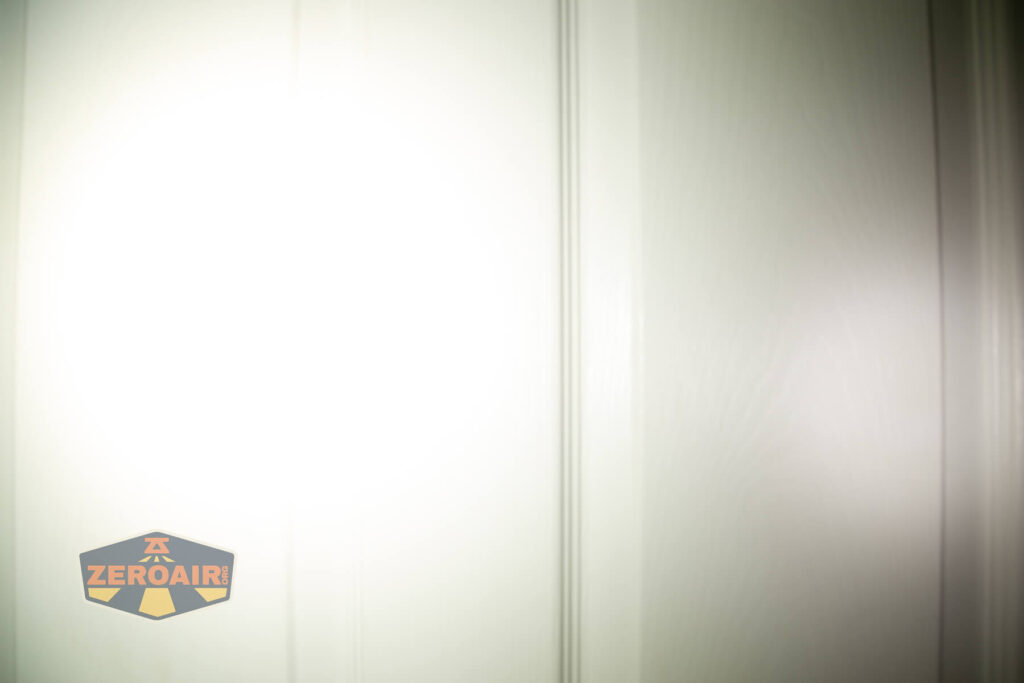
I compare everything to the KillzoneFlashlights.com 219b BLF-348 because it’s inexpensive and has the best tint!
Conclusion
What I like
- High CRI!
- Warmish white
- Nice build quality
- Very simple UI
- Switch cover is surprisingly great
- Reeding on the tailcap makes for easy grip
- Complete package with a cell included
- Cell has a USB-C charge port
What I don’t like
- Cell charges only by USB-C (bay-style chargers are not going to support this cell!)
- Proprietary cell format of a 14500 that’s unusual to the point of being cumbersome
- An extra mode wouldn’t hurt my feelings
Notes
- This content originally appeared at zeroair.org. Please visit there for the best experience!
- Please use my Amazon.com referral link to help support zeroair.org!
- Please support me on Patreon! I deeply appreciate your support!
You should look at watt hours when comparing capacity. Nominal voltage multiplied by amp hours.
Thanks for the review. I think these are good lights other than the emitters. High CRI means nothing to me if the tint is green.
I have a couple but I am decidedly not an Olight fan, but I think I might buy one of these. I’ve been interested in that 2.4V cell since I first heard about it and auditioning their new emitter might make it a winner. I see that Olight still doesn’t quite get laws and responsibilities in the NA market – that “exclusion clause” does not absolve them of anything and frankly if the cell really can reach 60C or any skin-burning temperature they need to reengineer it so that it is a safe product for the market. I guess the lawsuits weren’t enough to get their attention.