

Lumintop PK21-T Flashlight Review
The Lumintop PK21-T flashlight uses 2 21700 cells just like the PK21 does, and offers a Luminus SFT-40 emitter for an amazing throw. Read on!
Official Specs and Features
I can’t find an official listing for the Lumintop PK21-T flashlight at this time. The PK21 is available, though, as a very similar comparison.
Versions
There’s just this one version of the Lumintop PK21-T flashlight. The PK21, which has a different emitter, is available too.
Price
I don’t see a price for the PK21-T, but the PK21 is selling for $135.95 at lumintoplighting.com.
Short Review
Lumintop really killed it for making a thrower out of the PK21 line. This flashlight claims 1200 meters, and hits it! With these two (included) 21700 cells, the long body makes the light very nice to handle, too. I don’t love how simple the interface is – with the e-switch, I’d really hope for something more than just four modes.
Long Review
The Big Table
| Lumintop PK21-T Flashlight | |
|---|---|
| Emitter: | Luminus SFT40 |
| Price in USD at publication time: | ? |
| Cell: | 2×21700 |
| Runtime Graphs | |
| LVP? | Yes |
| Switch Type: | E-Switch |
| Quiescent Current (mA): | 0.27 (switch lit) 0.02 (switch unlit) |
| On-Board Charging? | No |
| Claimed Lumens (lm) | 1650 |
| Measured Lumens (at 30s) | 1651 (100.1% of claim)^ |
| Candela per Lumen | 213.8 |
| Claimed Throw (m) | 1200 |
| Candela (Calculated) in cd (at 30s) | 9400lux @ 6.019m = 340547cd |
| Throw (Calculated) (m) | 1167.1 (97.3% of claim)^ |
| Claimed CCT | – |
| Measured CCT Range (K) | 6300-6900 Kelvin |
| Item provided for review by: | Lumintop |
| All my Lumintop reviews! | |
^ Measurement disclaimer: Testing flashlights is my hobby. I use hobbyist-level equipment for testing, including some I made myself. Try not to get buried in the details of manufacturer specifications versus measurements recorded here; A certain amount of difference (say, 10 or 15%) is perfectly reasonable.
What’s Included

- Lumintop PK21-T flashlight
- 21700 (2) button top
This is not a production sample, so you’re likely to get the normal host of Lumintop things with your purchase.
Package and Manual


Build Quality and Disassembly


This is a long boy! The two 21700 cells being in series (and end to end) really make this a nice light to handle.

I might have done this myself, but I did notice that the centering ring for the emitter was dislodged (as you can see above.) This was easy to fix though, as the bezel unscrews easily. I’m nearly sure the light was not like this when I received it but at the point I noticed it I don’t believe I had loosened the bezel. So just check yours when you get it, and be sure the bezel is tight.

The tail has four ceramic glass-breaking balls.

Also down here is a tripod mounting hole.

Both the tail and head have nice, big springs. The threads on the tail end are anodized and very smooth, too.

On the head end, though, are unanodized threads. Cell swaps will be better through the tail end because of this.

As stated above, the bezel unscrews easily.

Whenever you put yours back together, note that the reflector is keyed! There’s a little divot in the flat part of the reflector there, and that needs to go directly over the screw on the shelf of the body.

Size and Comps
68mm x 29mm x 251mm and 374g (with cells)


If the flashlight will headstand, I’ll show it here (usually the third photo). If the flashlight will tailstand, I’ll also show that (usually in the fourth photo).


Here’s the test light with the venerable Convoy S2+. Mine’s a custom “baked” edition Nichia 219b triple. A very nice 18650 light.


Also above is the light beside my custom-engraved TorchLAB BOSS 35, an 18350 light. I reviewed the aluminum version of that light in both 35 and 70 formats.
Retention and Carry
The only way included for carrying the Lumintop PK21-T flashlight in my prototype package is this threaded tripod mount in the tailcap. This seems to be a very specific application of threaded mount, but if you have a good sturdy tripod it’ll probably work fine.
It could also work fine on those handles that have tripod holes.
Power and Runtime
The driver of the Lumintop PK21-T flashlight requires 8.4V (maximum, 7.4V nominal) to run. That requires two cells in series, and the proper size is 21700.

The package includes two 21700 cells, and they’re button top cells. Flat top cells should work fine because the light has springs on both ends IF the cells have enough reveal on the positive end to still make contact with each other (the “series” part) AND the overall length is enough. I measure these Samsung 50G (with added button) at around 72mm, so nearly standard 21700 length.
The cells go into the light in the usual way – positive end (button) toward the head.

Below are a few runtime test. Ouptut looks quite good, especially on the High mode, which maintains 900 lumens for well over 3 hours.


The light does shut off when the cell voltage is low, at an appropriate 2.7 or 2.8V.
Modes and Currents
| Mode | Mode Claimed Output (lm) | Claimed Runtime | Measured Lumens | Tailcap Amps (@8.4V) |
|---|---|---|---|---|
| Turbo | 1650 | 12m+3h30m | 1651 | 3.07 |
| High | 900 | 3h50m | 938 | 1.22 |
| Med | 350 | 12h | 348 | 0.36 |
| Low | 25 | 7d | 36 | 0.03 |
Pulse Width Modulation
Only the lowest mode (left, below) has any squiggles, and this isn’t even PWM. Nothing to worry about here.

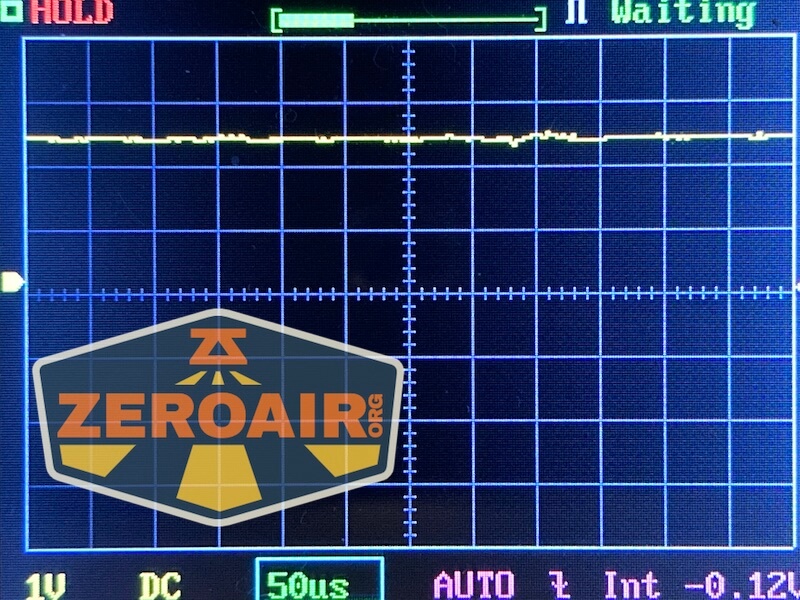


Here you can see a “baseline” – a chart with almost no light hitting the sensor. Then there’s the Ultrafire WF-602C flashlight, which has some of the worst PWM I’ve seen. It’s so bad that I used a post about it to explain PWM! Here are multiple timescales (10ms, 5ms, 2ms, 1ms, 0.5ms, 0.2ms) to make comparing this “worst” PWM light to the test light easier. That post also explains why I didn’t test the WF-602C at the usual 50us scale.


User Interface and Operation
Control of the PK21-T is by way of a single e-switch on the head end. It’s a nice big switch and has the Lumintop logo. The logo is translucent, and behind it is an (or two) indicating emitters.


Below you can see the switch lit in blue. I don’t think it lights any color other than blue, and it seems to mostly be for locator purposes and to indicate approximate battery charge. For a few seconds after the light is activated, the switch will blink.
Three blinks: <15% charge
Two blinks: 15%-75% charge
Steady for 2s then off: >75% charge

Here’s a user interface table!
| State | Action | Result |
|---|---|---|
| Off | Click | On (Mode Memory) |
| On | Hold | Off |
| On | Click | Mode advance (LMHT) |
| Any | Double click | Strobe |
| Strobe | Double Click | SOS |
| Strobe or SOS | Click | Previous mode |
| Off | Click 3x | Battery check^ |
| Off | Click 7x | Iterate switch backlight |
^ Battery check blinks out the actual voltage of one cell. I suppose the driver is reading the series voltage (which should be in the range of 5-8.4V) and splitting it to average the cell voltage value. So when the cells (each) are 3.4V, the light will blink 3x then pause and blink 4x. It doesn’t blink 6x then 8x.
LED and Beam
Lumintop has used a Luminus SFT-40 emitter in the PK21-T. The PK21 had a bigger domed emitter, so these two would make a good pair – high output (PK21) and great throw (PK21-T). This is a domeless emitter.

The reflector, as you can see, is large and smooth.

The bezel looks to be stainless steel and has some shape.


LED Color Report (CRI and CCT)
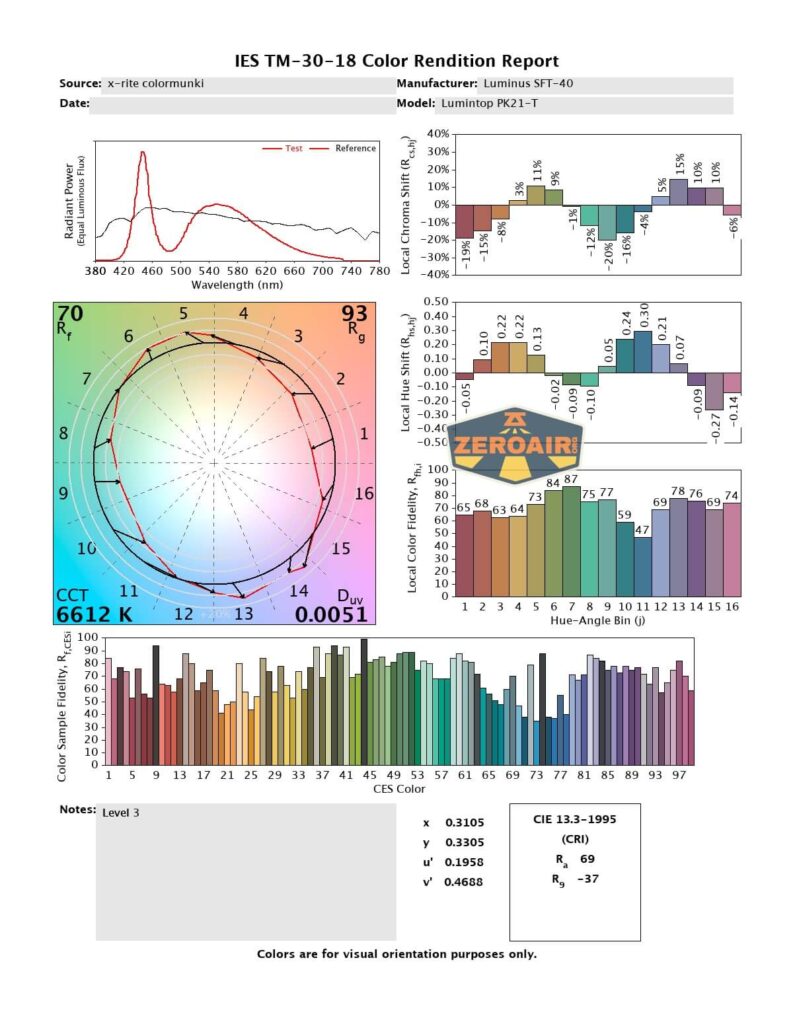
CRI and CCT are not a surprise for this very throwy light. CCT goes from around 6300 to 6900K and CRI stays around 70.



Beamshots
These beamshots always have the following settings: f8, ISO100, 0.3s shutter, and manual 5000K exposure. These photos are taken at floor level, and the beam hits the ceiling around 9 feet away.


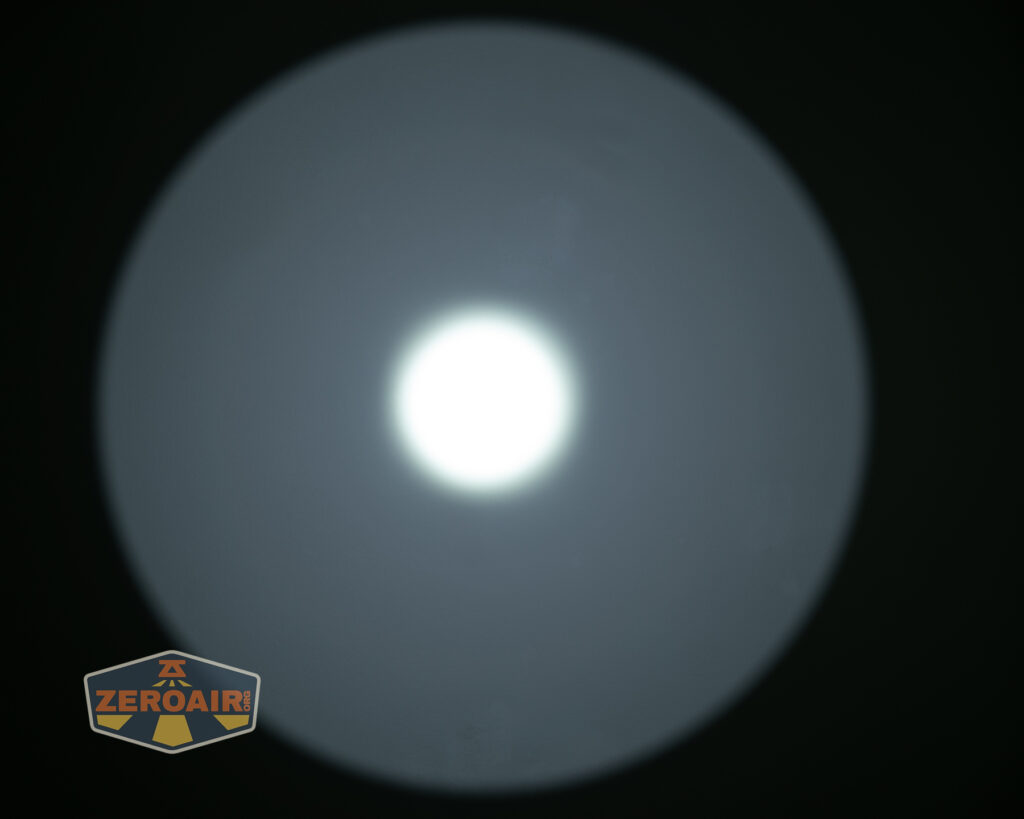

Tint vs BLF-348 (KillzoneFlashlights.com 219b version) (affiliate link)
I keep the test flashlight on the left and the BLF-348 reference flashlight on the right.


I compare everything to the KillzoneFlashlights.com 219b BLF-348 because it’s inexpensive and has the best tint!
Conclusion
What I like
- Fantastic throw
- Love the runtimes – that flat output is great!
- Very simple user interface
- Package includes cells
What I don’t like
- Light turns on when tailcap is screwed on
- Hold for off
Notes
- This content originally appeared at zeroair.org. Please visit there for the best experience!
- For flashlight-related patches, stickers, and gear, head over to PhotonPhreaks.com!
- Please use my Amazon.com referral link to help support zeroair.org!
- Please support me on Patreon! I deeply appreciate your support!
Hi, where can I buy the PK21-T with Luminus SFT40 LED? I don’t see it anywhere or even any mention of this other than the two reviews. Also I couldn’t find any date in the review, what is the date the review was done?
I didn’t find anywhere to buy it yet, actually. Typically they come up on aliexpress first.