

Acebeam E70 Mini Titanium Flashlight Review
Acebeam released the Acebeam E70 Mini Titanium flashlight! It’s a triple-emitter, high CRI 18650 flashlight, and it packs a punch!
Official Specs and Features
Here’s a referral link to the Acebeam E70 Mini Titanium flashlight product page.
Versions
There’s only one version of titanium, but of course, there’s an aluminum version too, which I’ve also reviewed.
Price
Killzoneflashlights.com has the titanium E70 Mini priced at $109.90 (referral link). The price for the Acebeam E70 Mini Titanium flashlight is $109.95 on Amazon (referral link).
Short Review
I really liked the aluminum version of the E70 Mini. I thought this titanium version might be a sort of a “nicer” (or “gentleman’s carry”) version of the E70 Mini. That’s approximately correct, too – this one feels very nice! Everything else I liked about the aluminum version is true for this one, and I do still wish this inner sleeve was orange. 🙂 Orange is Acebeam’s color, anyway!!
Long Review
The Big Table
| Acebeam E70 Mini Titanium Flashlight | |
|---|---|
| Emitter: | Nichia 519a (5000K, High CRI) |
| Price in USD at publication time: | $109.90 on KillzoneFlashlights.com $109.95 on Amazon.com |
| Cell: | 1×18650 |
| Runtime Graphs | |
| LVP? | Yes |
| Switch Type: | E-Switch |
| Quiescent Current (mA): | ? |
| On-Board Charging? | Yes |
| Charge Port Type: | USB-C (on cell) |
| Charge Graph | |
| Power off Charge Port | – |
| Claimed Lumens (lm) | 1500 |
| Measured Lumens (at 30s) | 1195 (79.7% of claim)^ |
| Candela per Lumen | 3.4 |
| Claimed Throw (m) | 140 |
| Candela (Calculated) in cd (at 30s) | 196lux @ 4.912m = 4729cd |
| Throw (Calculated) (m) | 137.5 (98.2% of claim)^ |
| Claimed CCT | 5000K |
| Measured CCT Range (K) | 4800-5000 Kelvin |
| Item provided for review by: | Acebeam |
| All my Acebeam reviews! | |
^ Measurement disclaimer: Testing flashlights is my hobby. I use hobbyist-level equipment for testing, including some I made myself. Try not to get buried in the details of manufacturer specifications versus measurements recorded here; A certain amount of difference (say, 10 or 15%) is perfectly reasonable.
What’s Included

- Acebeam E70 Mini Titanium flashlight
- Acebeam 3100mAh 18650
- Spare o-rings (2)
- Charging cable (USB to USB-C)
- Lanyard
- Manual and papers
Package and Manual

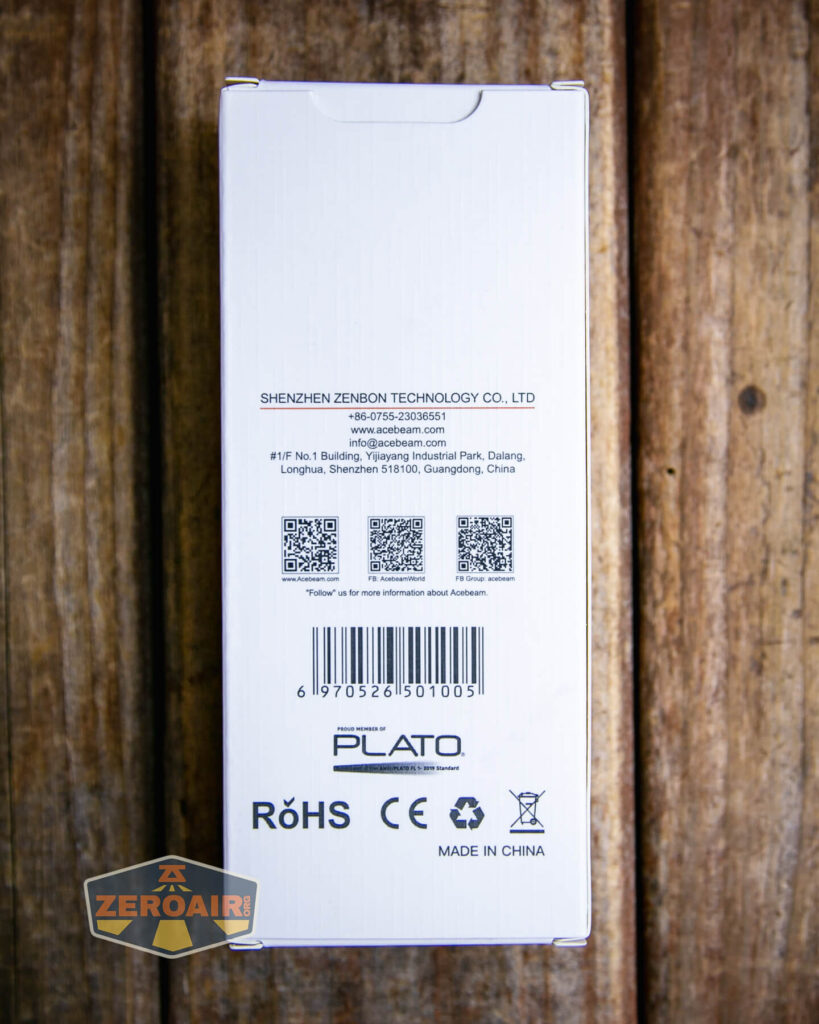


Build Quality and Disassembly

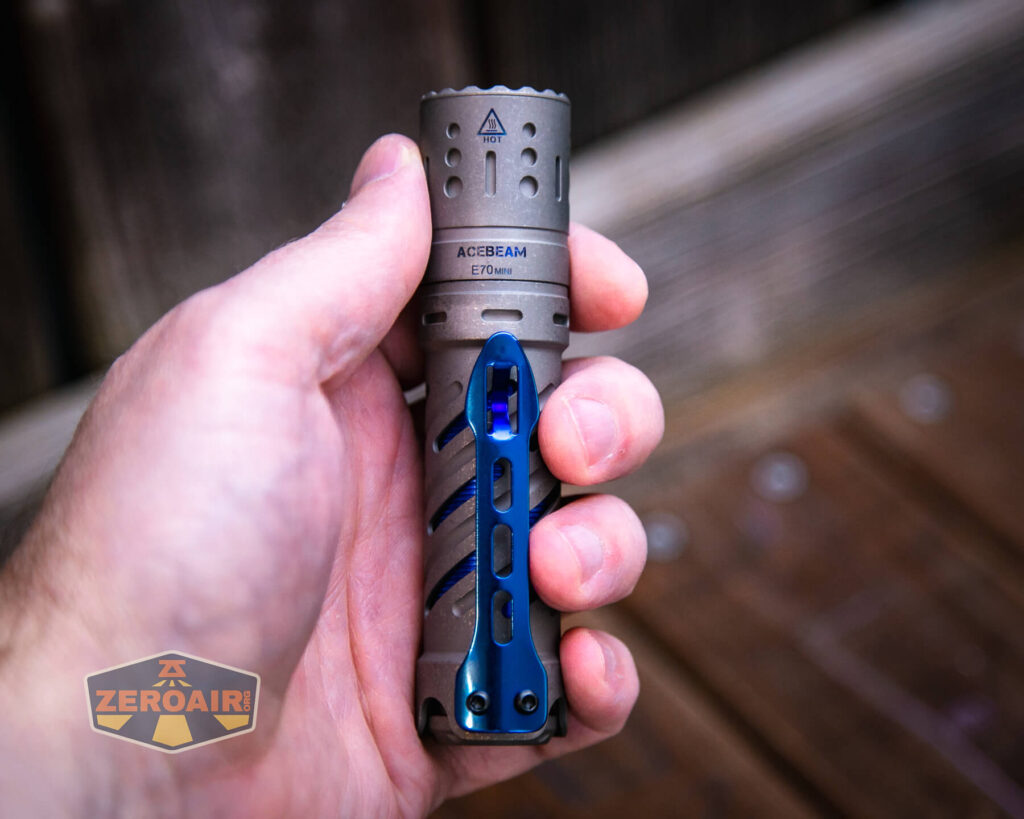
First of all, how much stuff is going on here with this light? There are body spirals. More than just spirals – there’s an inset body, with blue anodization. There are tritium slots in the shoulder. There are cooling…. circles… in the head. It’s a lot to take in! I’m happy with the size of this light. Generally, because I’d say I’m happy with the size of the 21700 cell lights. But this is an 18650 cell light…. What I mean by that is that it’s “probably big” for an 18650 light, but the size isn’t off-putting (You should be off pudding!), because the size is still acceptable. But look at the size comparisons below to make up your mind. (It’s shorter than a Convoy S2+, and everyone should have many of those!)


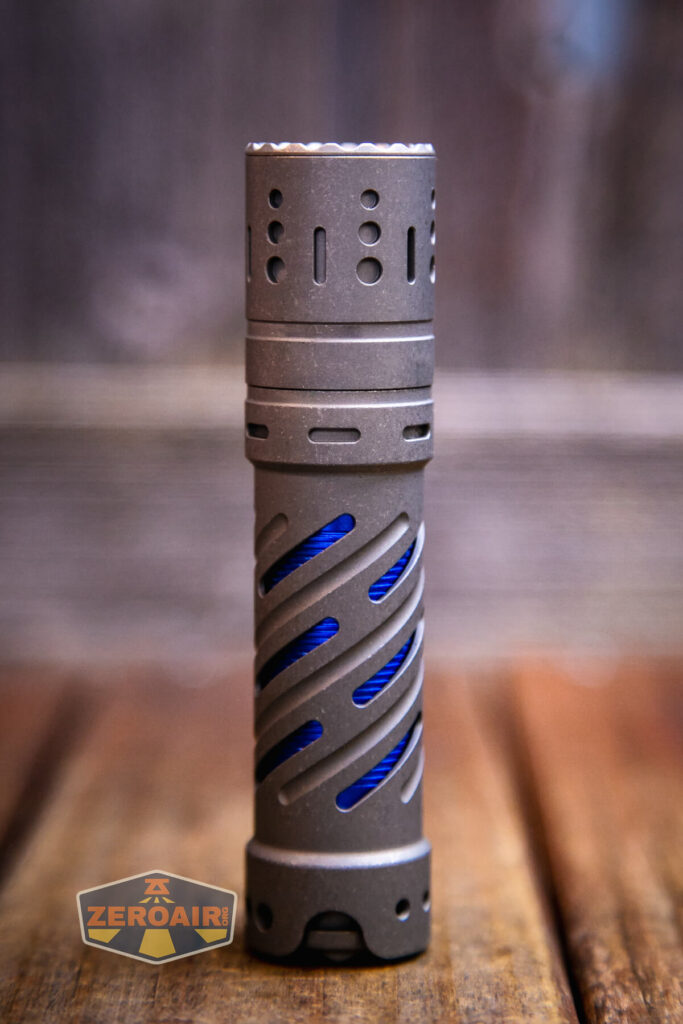

I’ll say again – there’s a lot going on in this body. Circles on the head. Tritium slots. Spirals in the body. Color in the body. If it was one or the other (circles or spirals) I might like it more but still, this is a good-looking light. I like the circles, aside from their obvious “Oveready-ness.” I am unsure how these circles aid in cooling. That long slot betwixt the circles does not seem to be a tritium slot – it’s not deep enough.

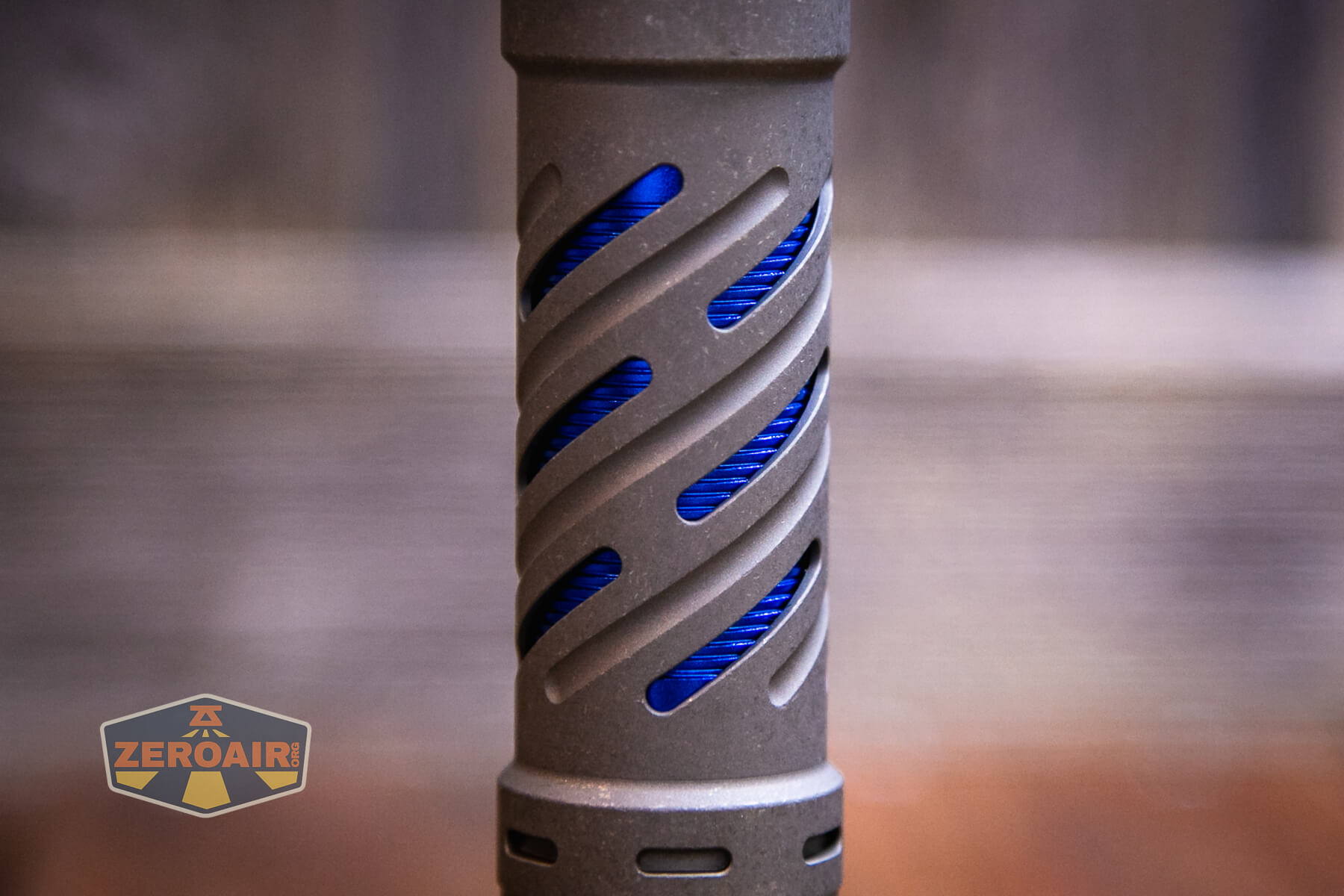
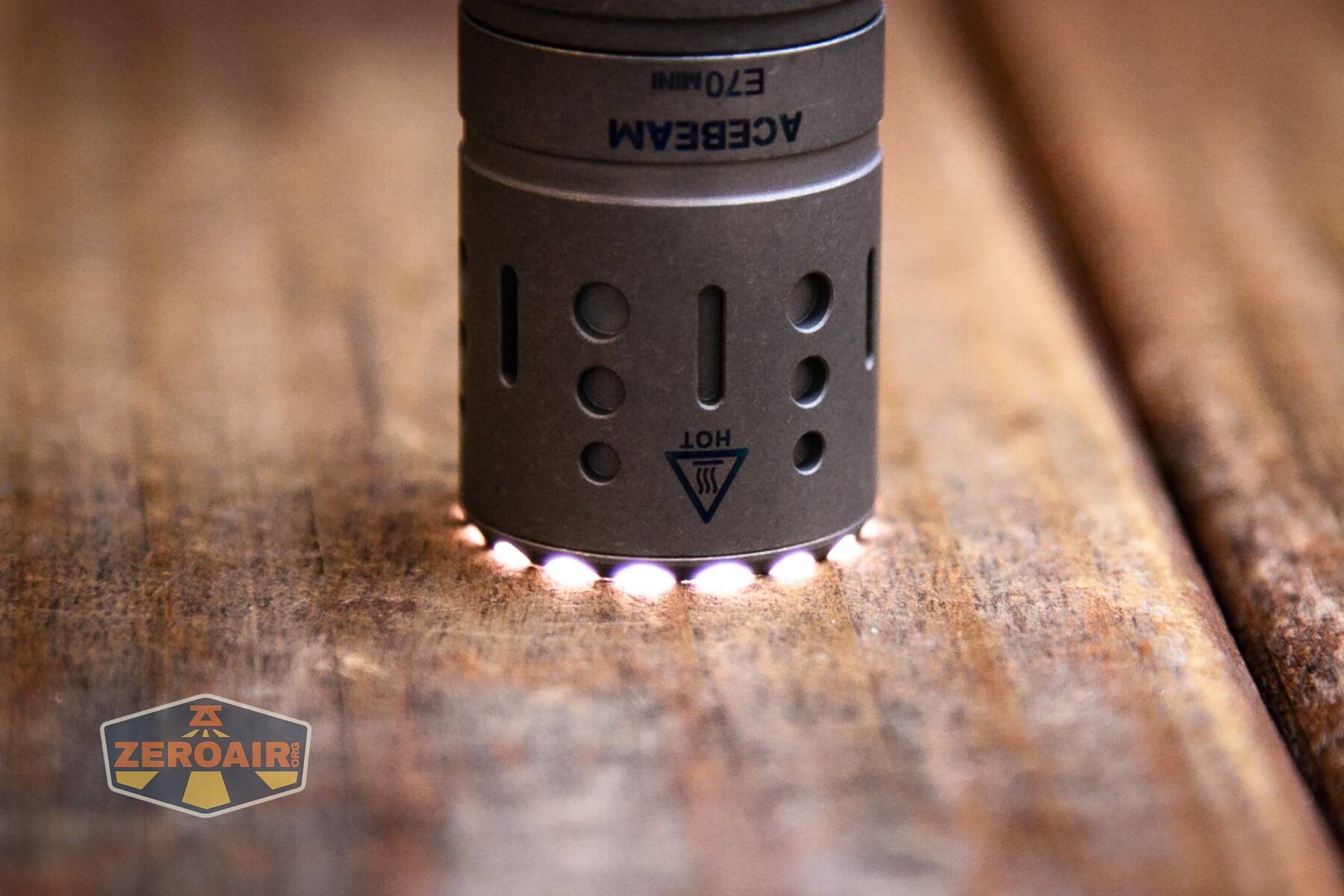
Here are the actual tritium slots – these seem to be 1.5mm x 6mm, and there are 6 slots total. Also, note the toothed bezel. Unlike the aluminum version (which appears to have a stainless bezel), this bezel matches the body very specifically – I guess the bezel is titanium too!

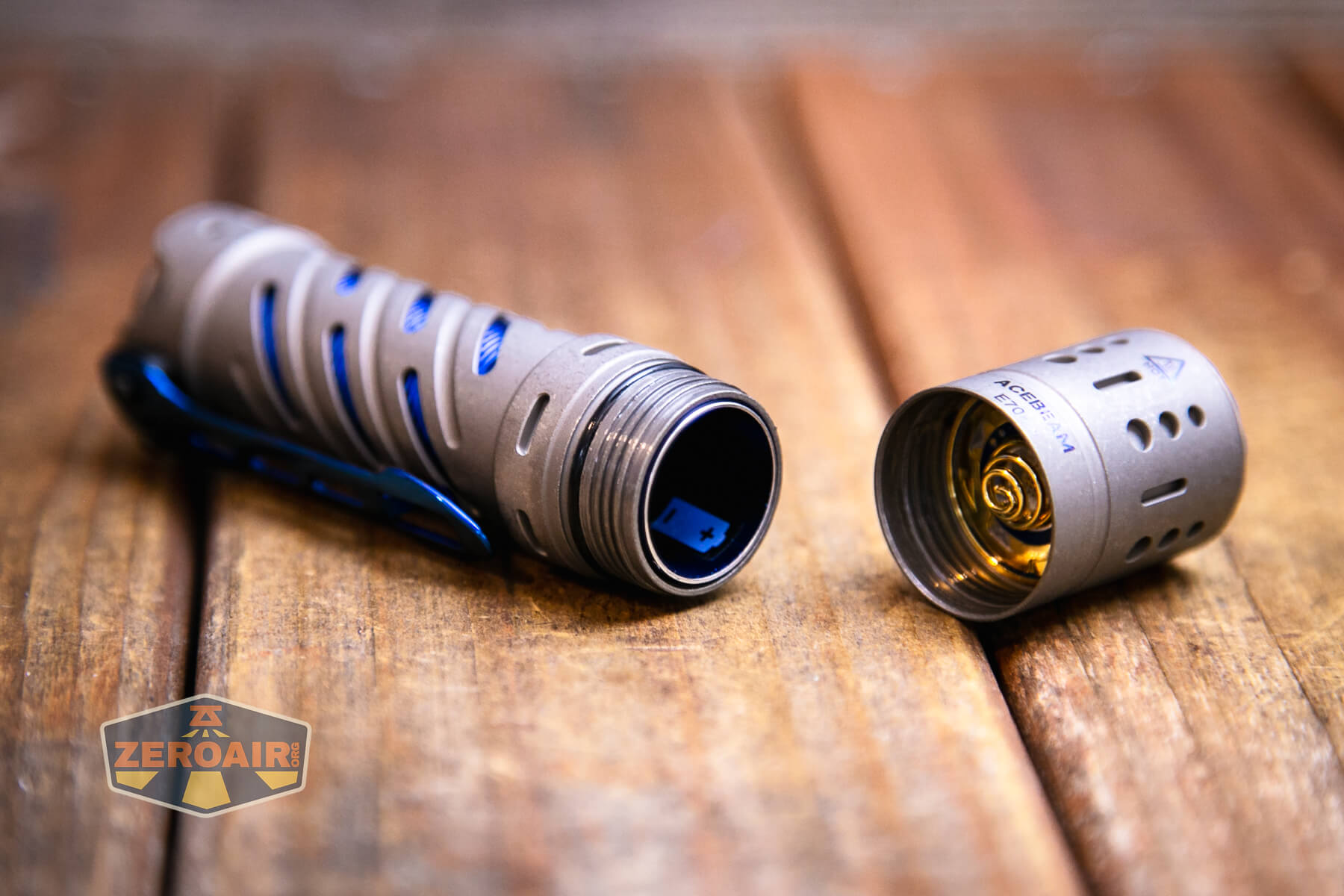
Only the head comes off the E70 Mini. I have a feeling with the right tool that the tailcap will come off too, but let me assure you that it won’t happen accidentally. You can see that the threads are square-cut, anodized, and appropriately lubed. They start easily too, and because of the anodization, a light loosening of the head will mechanically lock the light.

Inside, there are springs on the head and tail.

Size and Comps
Size: 4.37”/111mm (Length) x 1.02”/26mm (Head Dia.) x 0.92”/23.4mm (Body Dia.)
Weight: 144.6 with battery

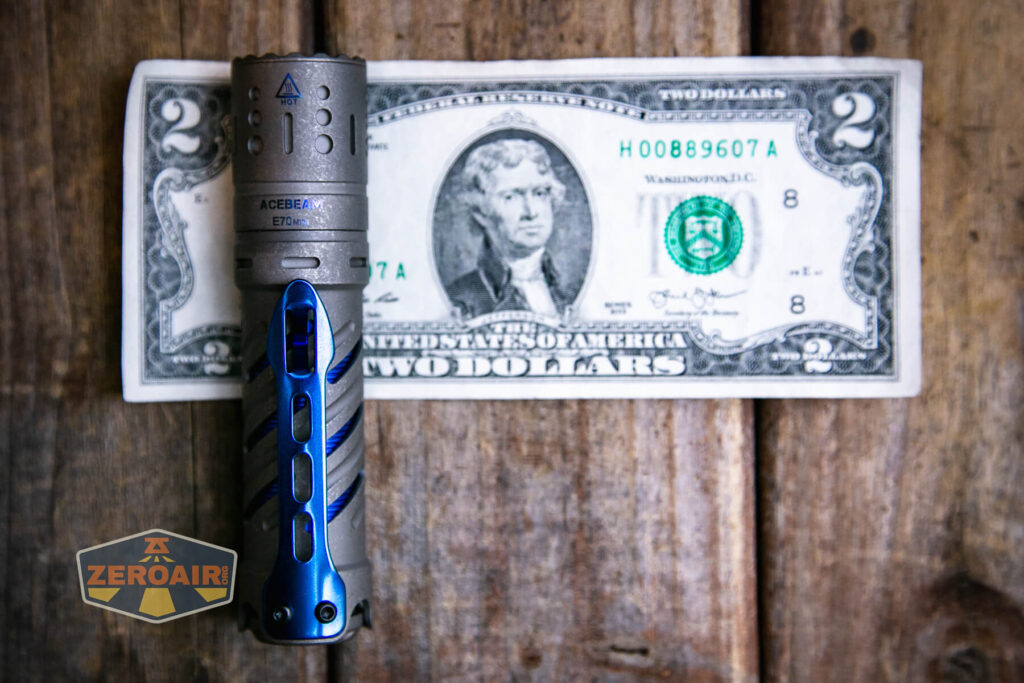
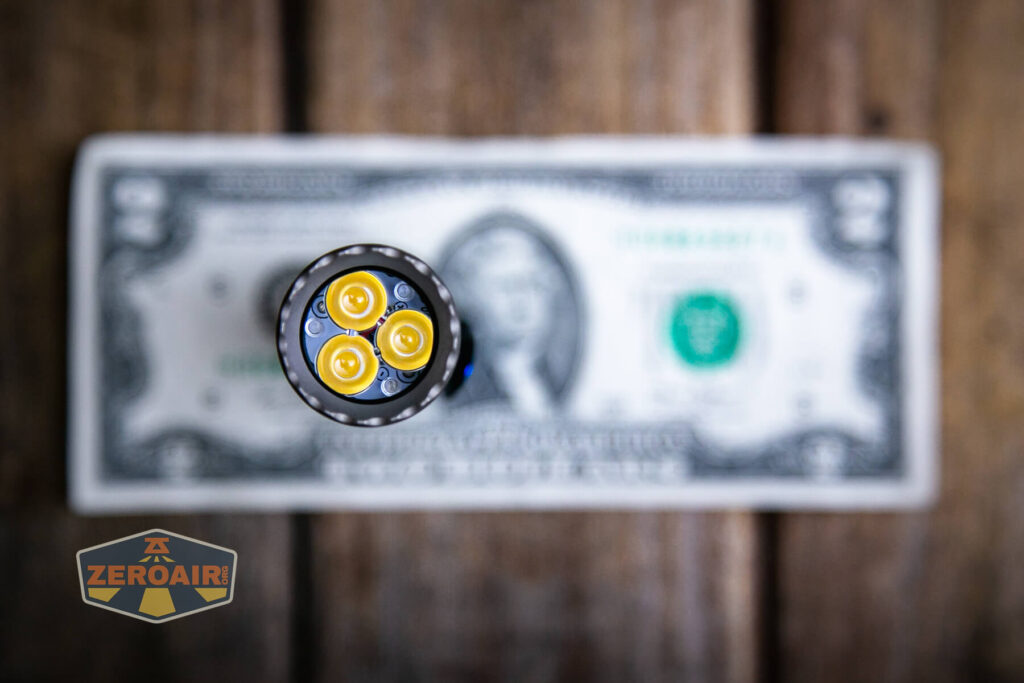
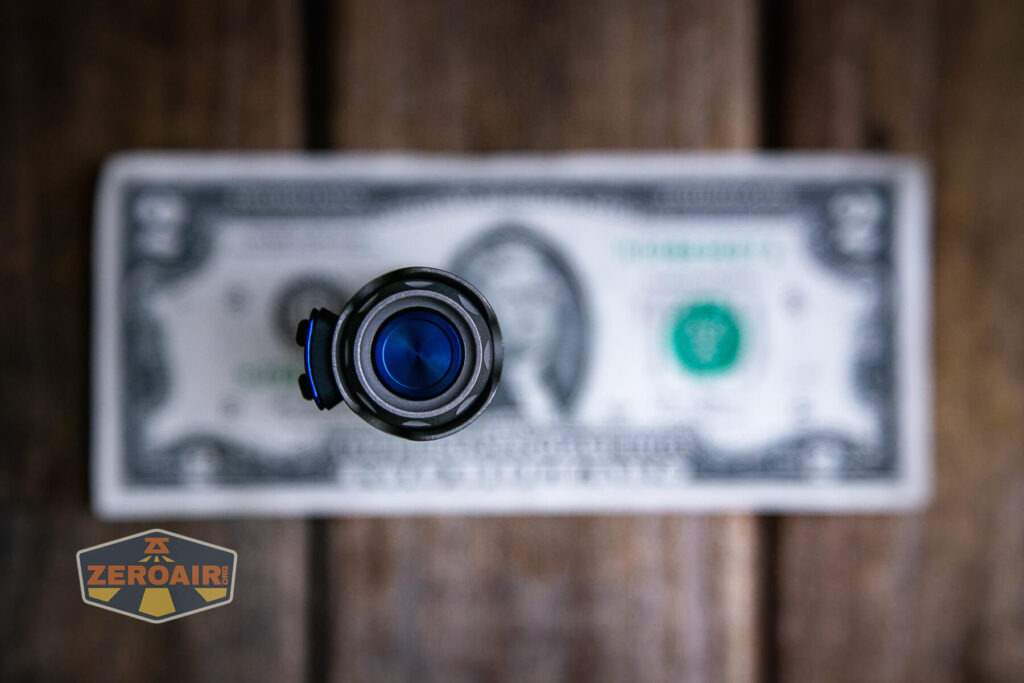
If the flashlight will headstand, I’ll show it here (usually the third photo). If the flashlight will tailstand, I’ll also show that (usually in the fourth photo).


Here’s the test light with the venerable Convoy S2+. Mine’s a custom “baked” edition Nichia 219b triple. A very nice 18650 light.

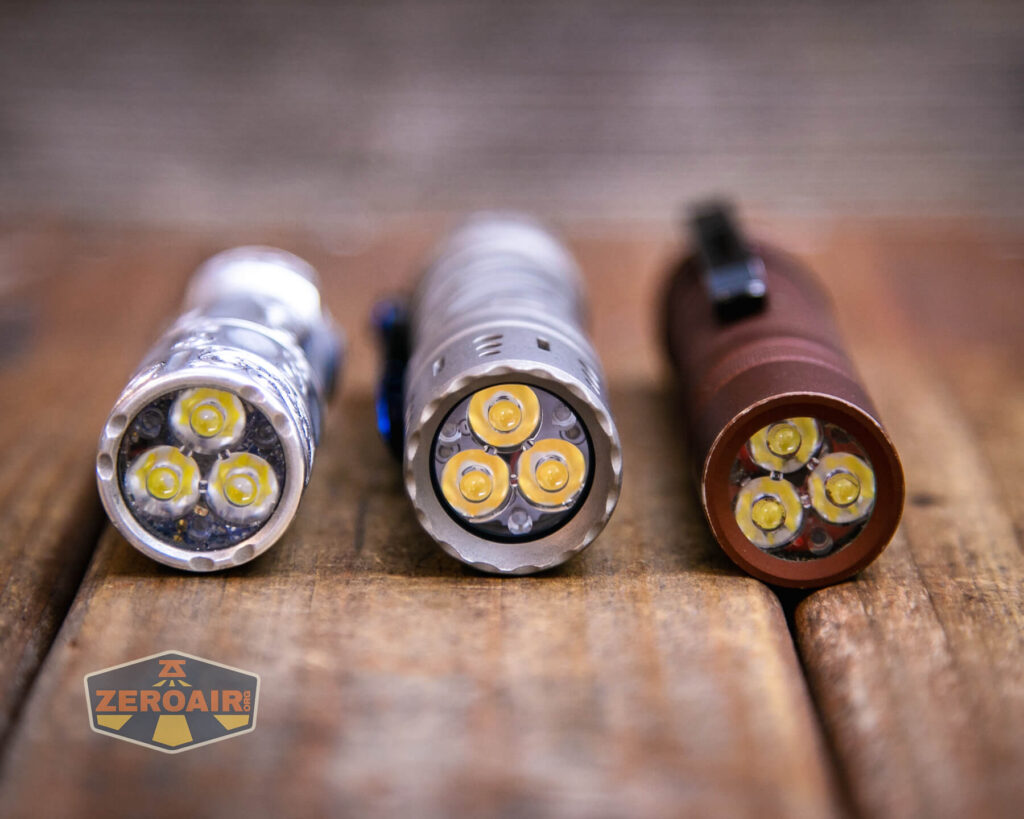
Also above is the light beside my custom-engraved TorchLAB BOSS 35, an 18350 light. I reviewed the aluminum version of that light in both 35 and 70 formats.
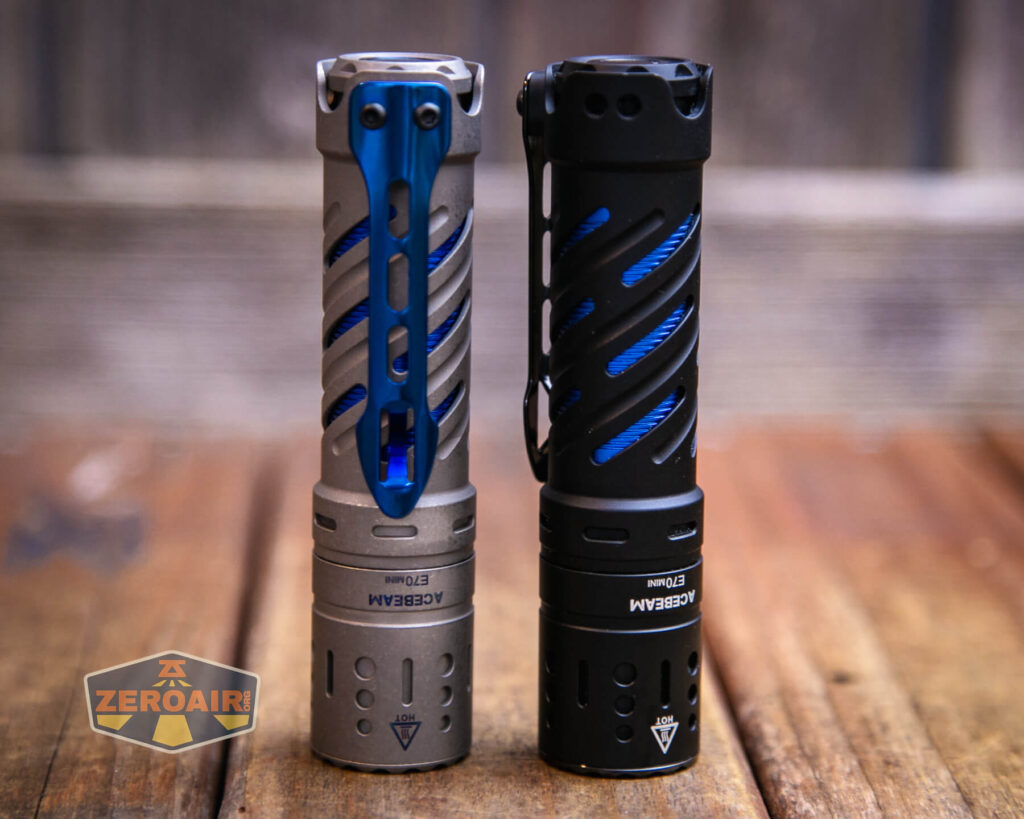
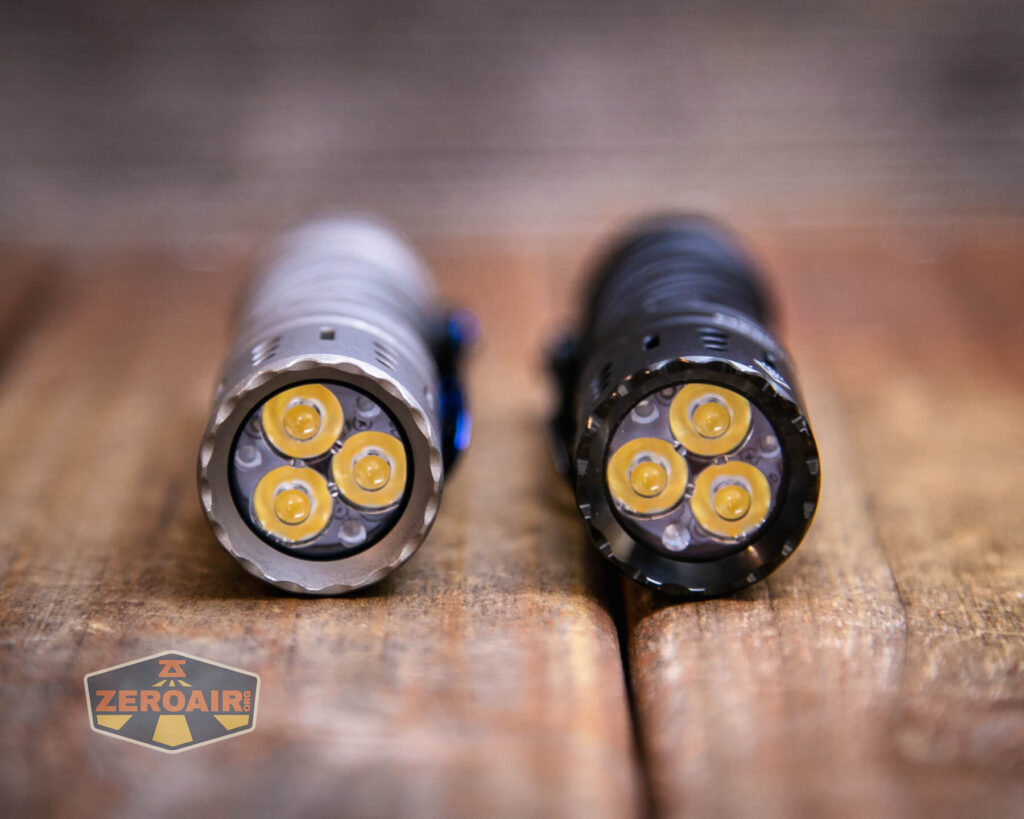
Below are the two E70 Mini’s compared. They’re the same!
Retention and Carry
There are two means of carry for the Acebeam E70 Mini Titanium flashlight included. First is this pocket clip, which is a fairly standard-looking steel clip.
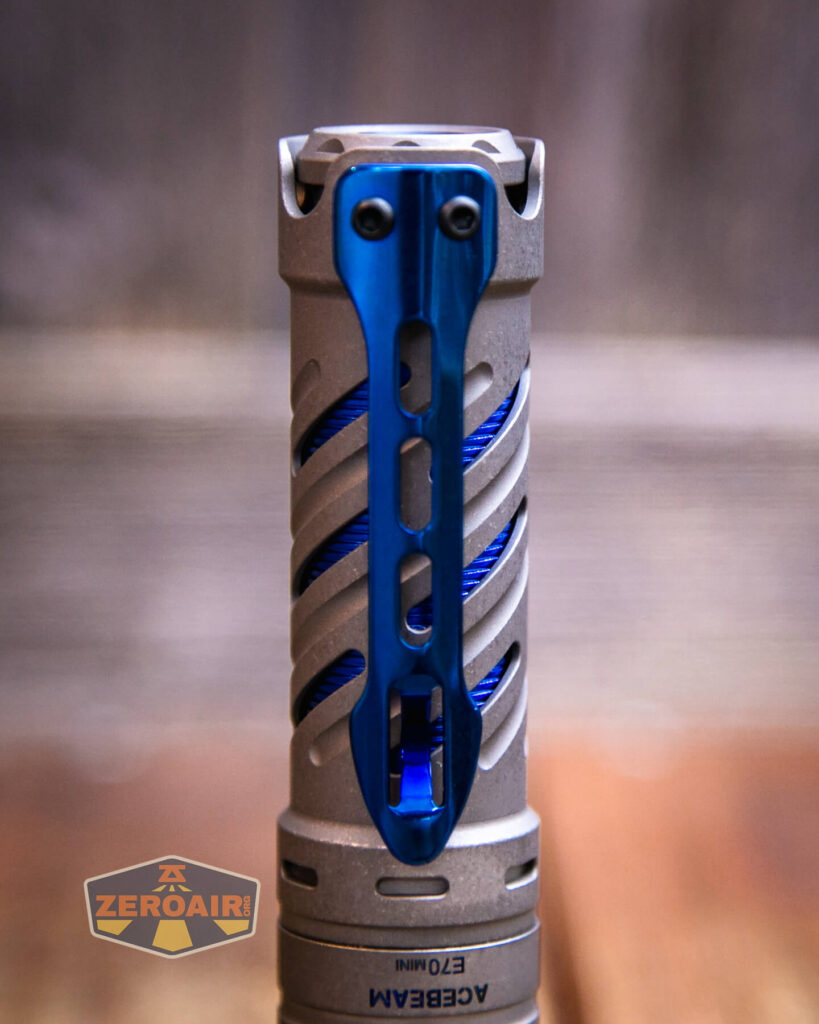
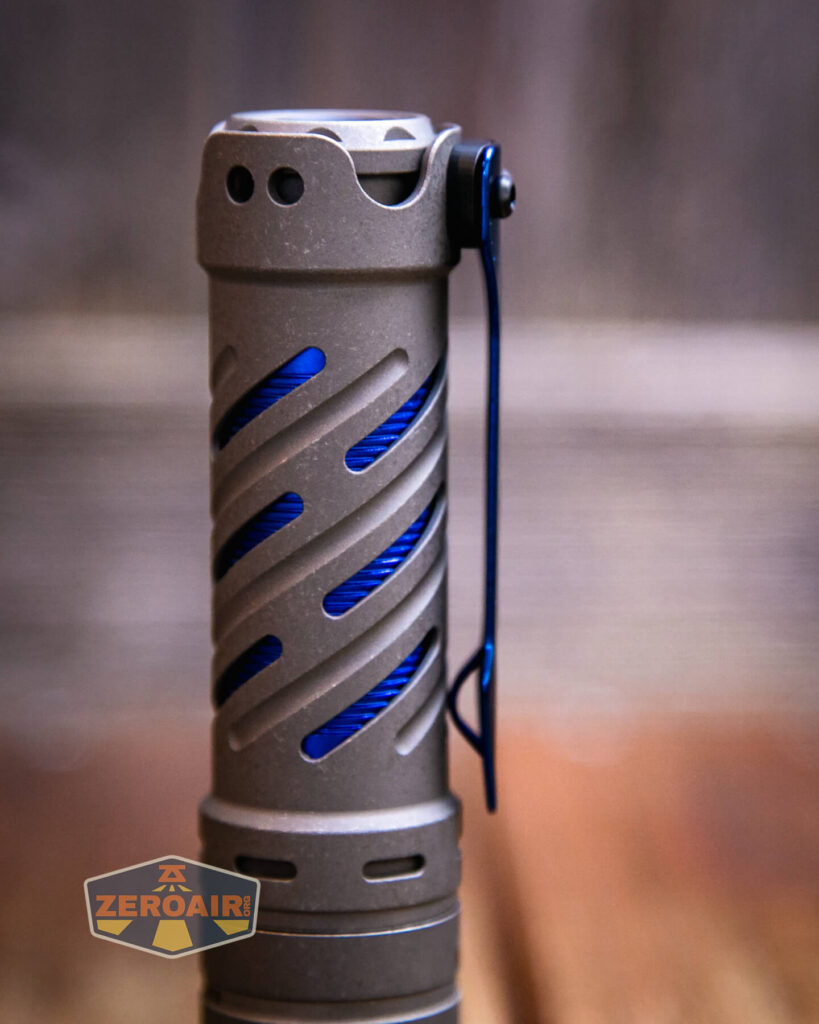
I say only “fairly standard” as it’s still sort of different. And it’s definitely different from the E70 clip, which is bent. This one is actually fairly straight and has a surprising amount of stiffness.

There are holes that appear to be an alternate mounting point for the pocket clip. It’s also possible that they offer different hole spacing for use of a different type of pocket clip (ie a Steel flame clip). There are also two other holes, (seen above) which are not only different, they’re not threaded and bigger, and are for the lanyard.

Here’s the included lanyard. I attached it to the pocket clip, which works fine. There are also holes in the tailcap (not seen below!)
Power and Runtime
The Acebeam E70 Mini Titanium flashlight is powered by a single lithium-ion cell. The cell tube is suitable for a single 18650 cell.
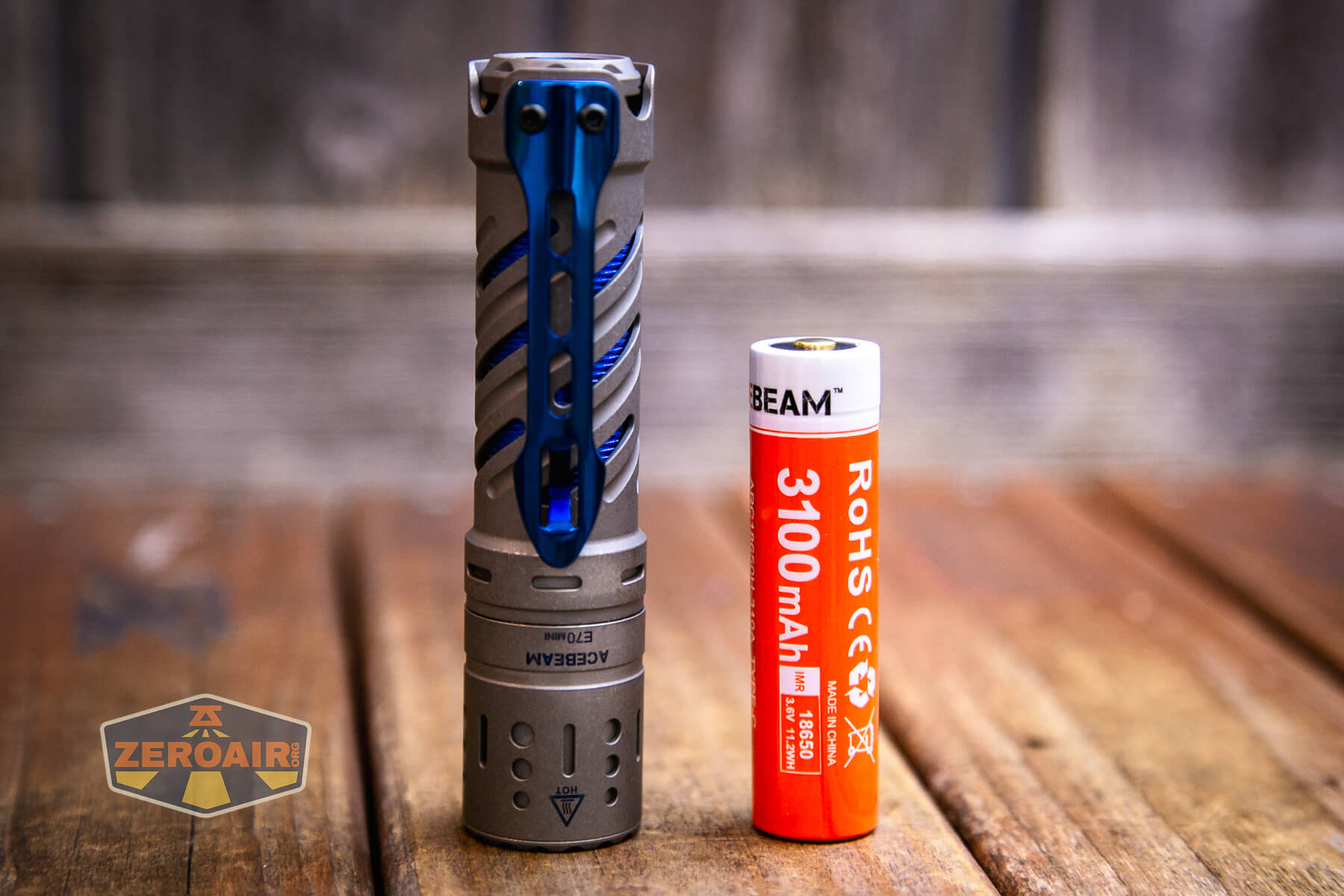
As far as I can tell, the purchase price of ~$110 includes this cell.
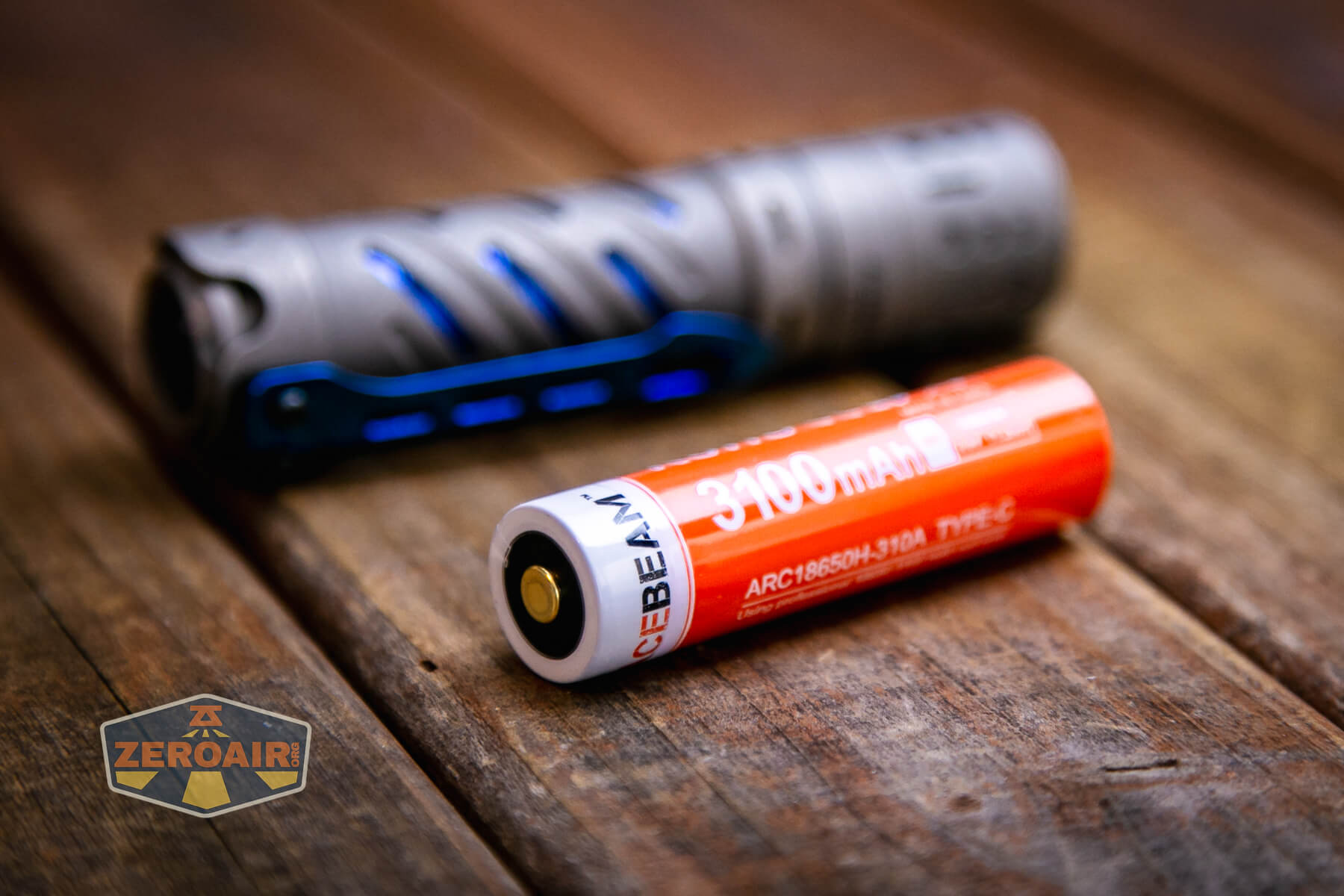
The cell goes into the light in the usual way: positive terminal toward the head.
In case you forget, you can reference this sticker just inside the cell tube:
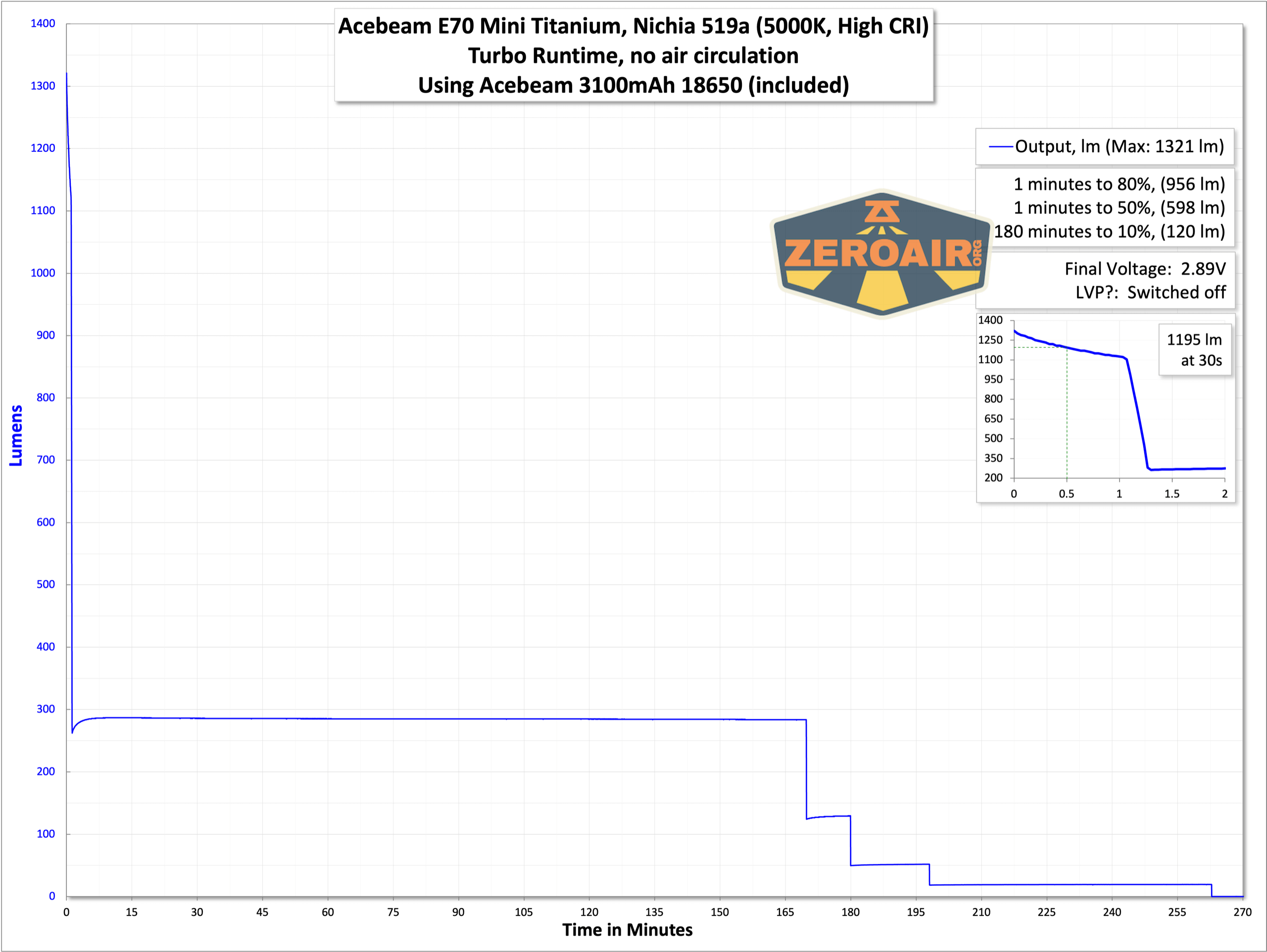
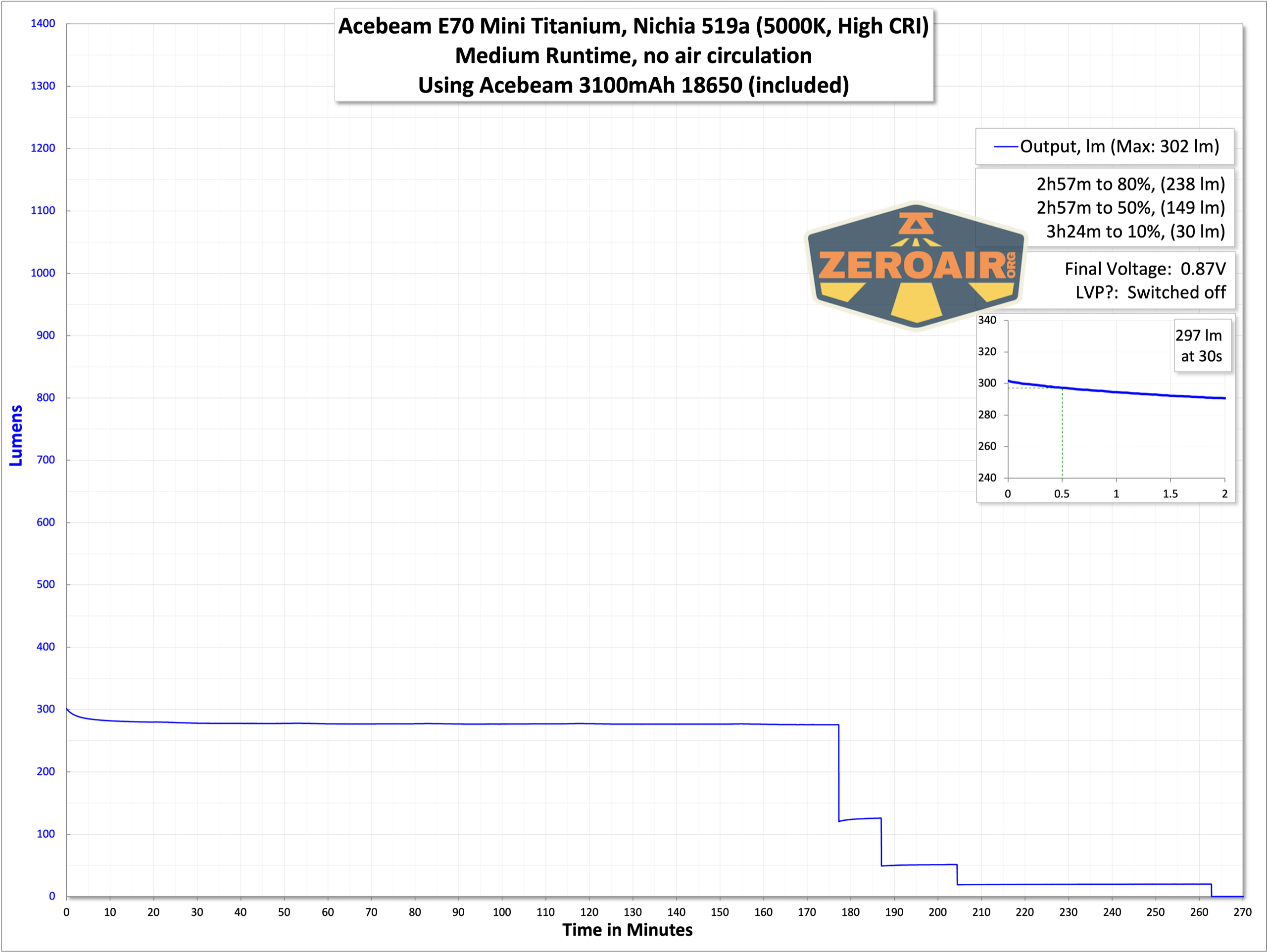
Below are three runtime graphs. The output looks pretty good but does step down quickly. After the stepdown, the Acebeam E70 Mini maintains >400 lumens for over an hour and a half.


Charging
The cell offers charging by way of a USB-C charging port in the positive terminal.

A USB to USB-C cable is included.
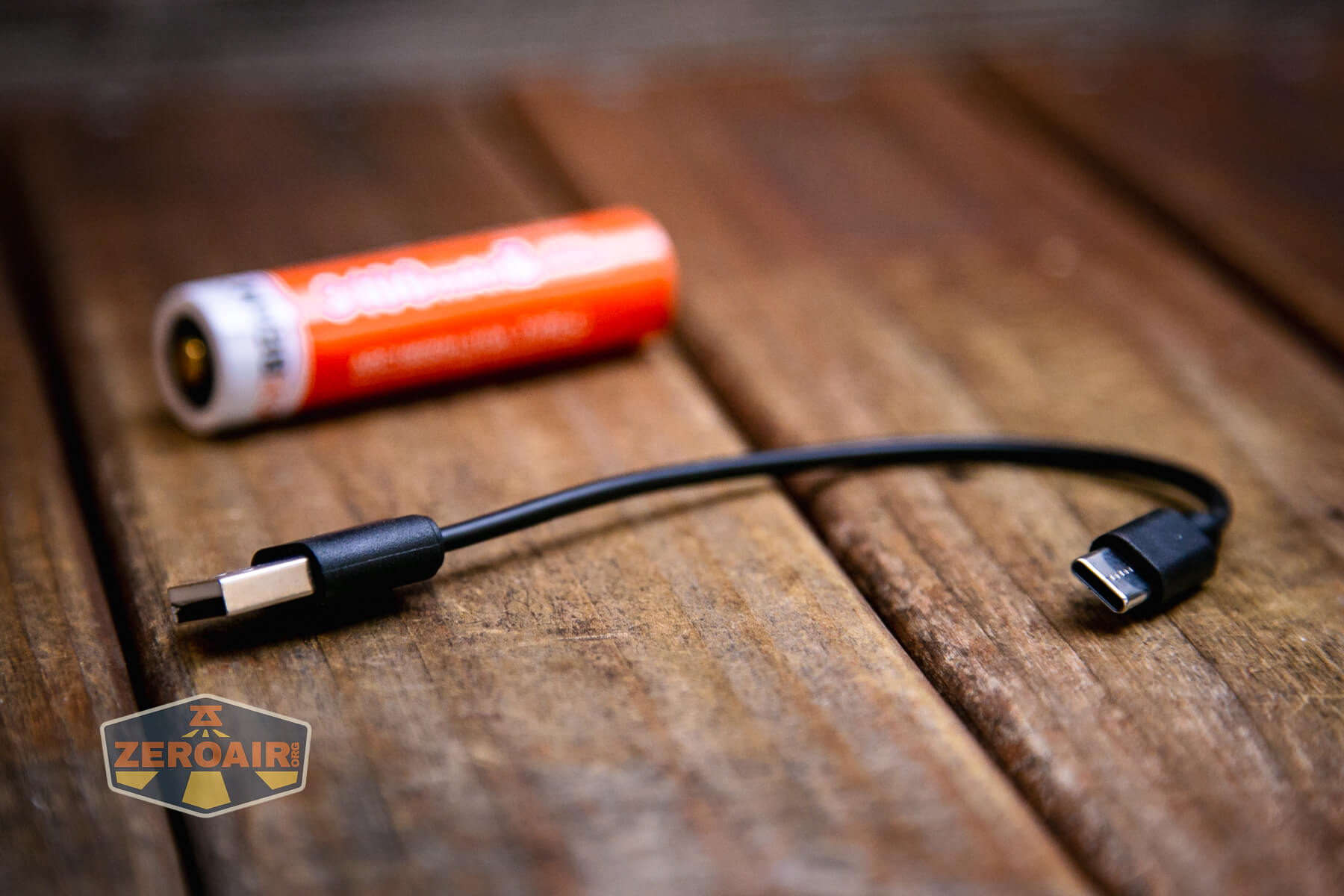
While charging, the top (positive end) of the cell is red. When charging is complete, the indicator turns green.
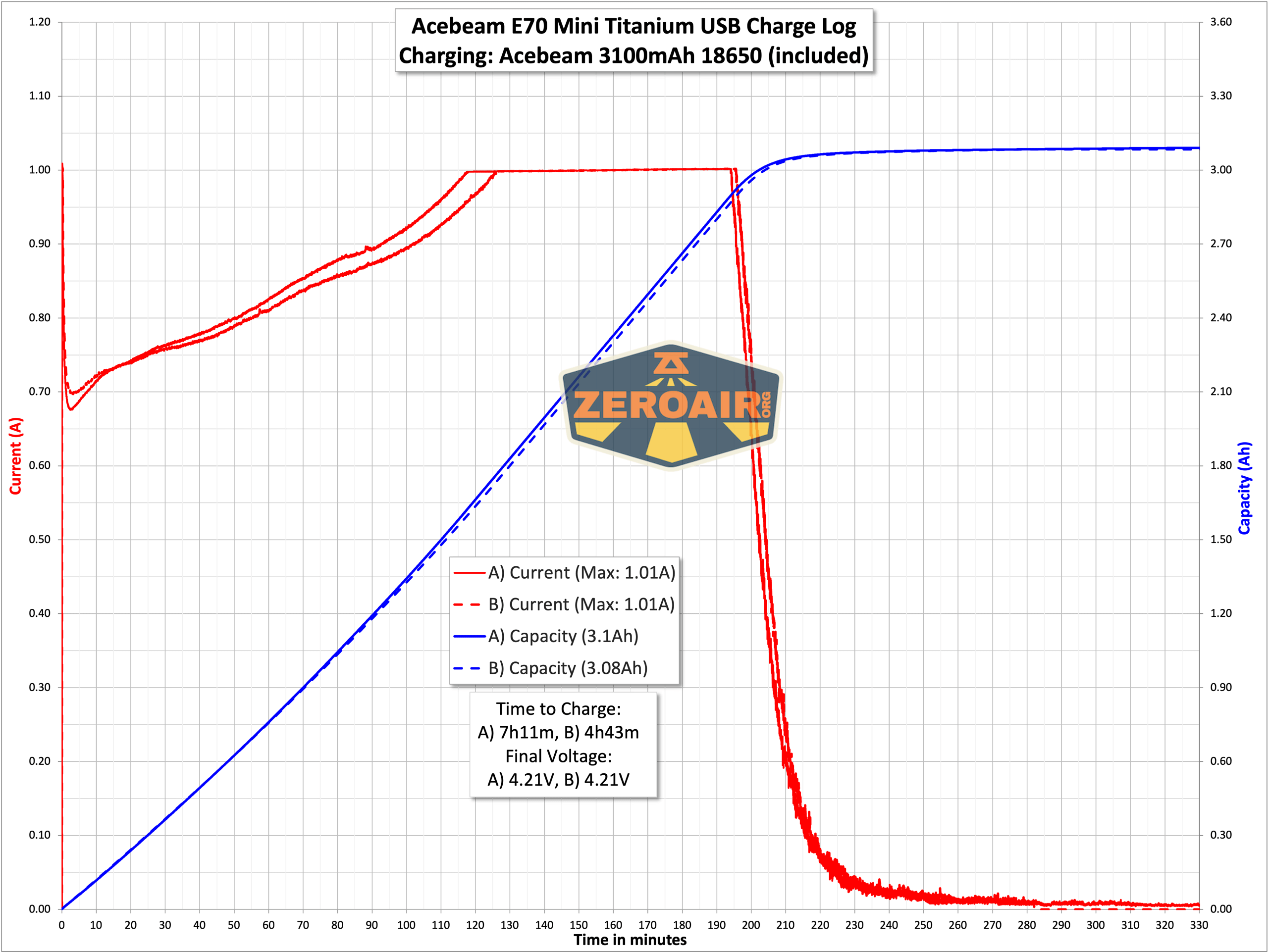
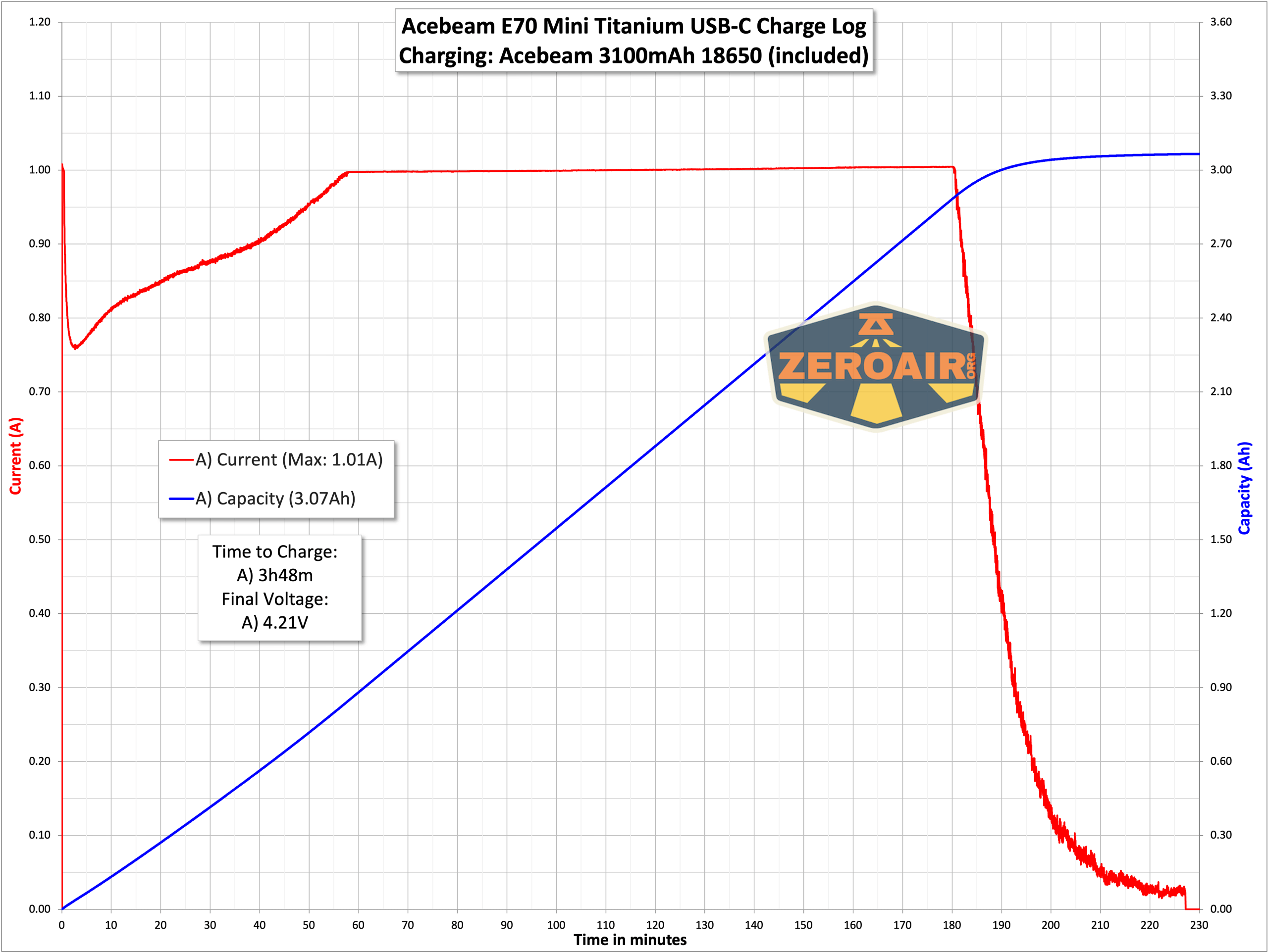
Both USB and USB-C power can charge the cell. The profile is about the same for either and requires around 3 hours to complete.
Modes and Currents
| Mode | Mode Claimed Output (lm) | Claimed Runtime | Measured Lumens |
|---|---|---|---|
| Turbo | 1500-380 | 44s+2h25m | 1321 (0s) 1195 (30s) |
| High | 800-380 | 110s+2h20m | 602 |
| Mid2 | 380 | 3h15m | 297 |
| Mid1 | 170 | 7h | 134 |
| Low | 60 | 19h | 51 |
| Ultra-Low | 12 | 100h | 7 |
Pulse Width Modulation
No PWM in any mode. No surprise with Acebeam lights, though.
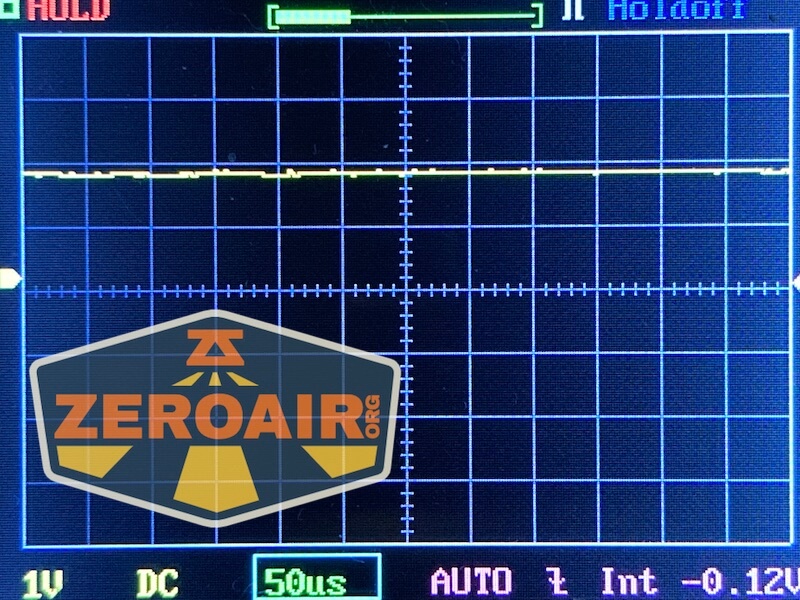
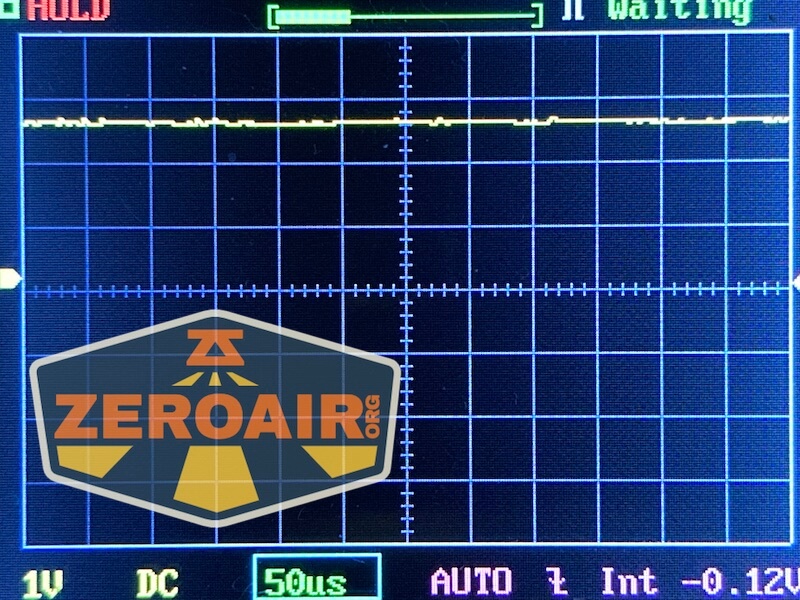


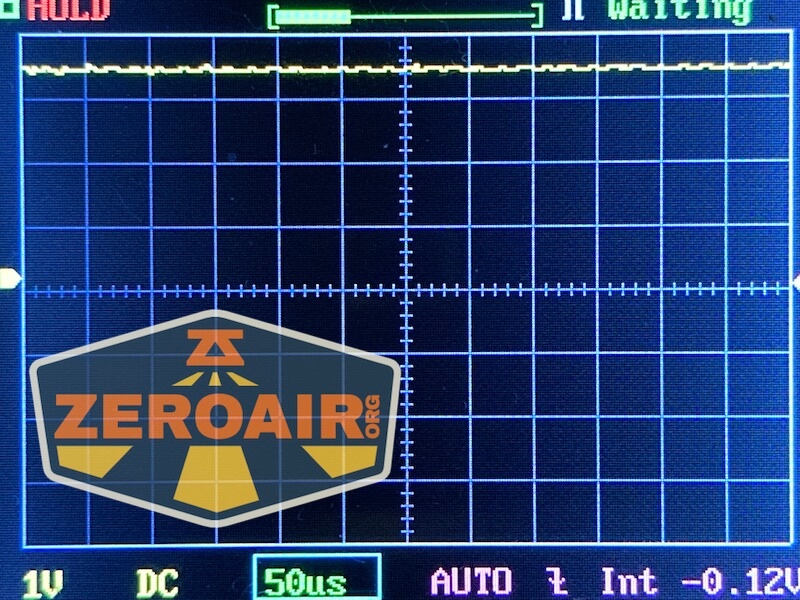
Here you can see a “baseline” – a chart with almost no light hitting the sensor.

Then there’s the Ultrafire WF-602C flashlight, which has some of the worst PWM I’ve seen. It’s so bad that I used a post about it to explain PWM! Here are multiple timescales (10ms, 5ms, 2ms, 1ms, 0.5ms, 0.2ms) to make comparing this “worst” PWM light to the test light easier. That post also explains why I didn’t test the WF-602C at the usual 50us scale.


User Interface and Operation
A single tail switch is used for controlling the Acebeam E70 Mini Titanium flashlight. This is an e-switch and has what seems to be a metal cover. The switch has very low action and can be actuated from any point (even the edge). I like the switch quite a bit.
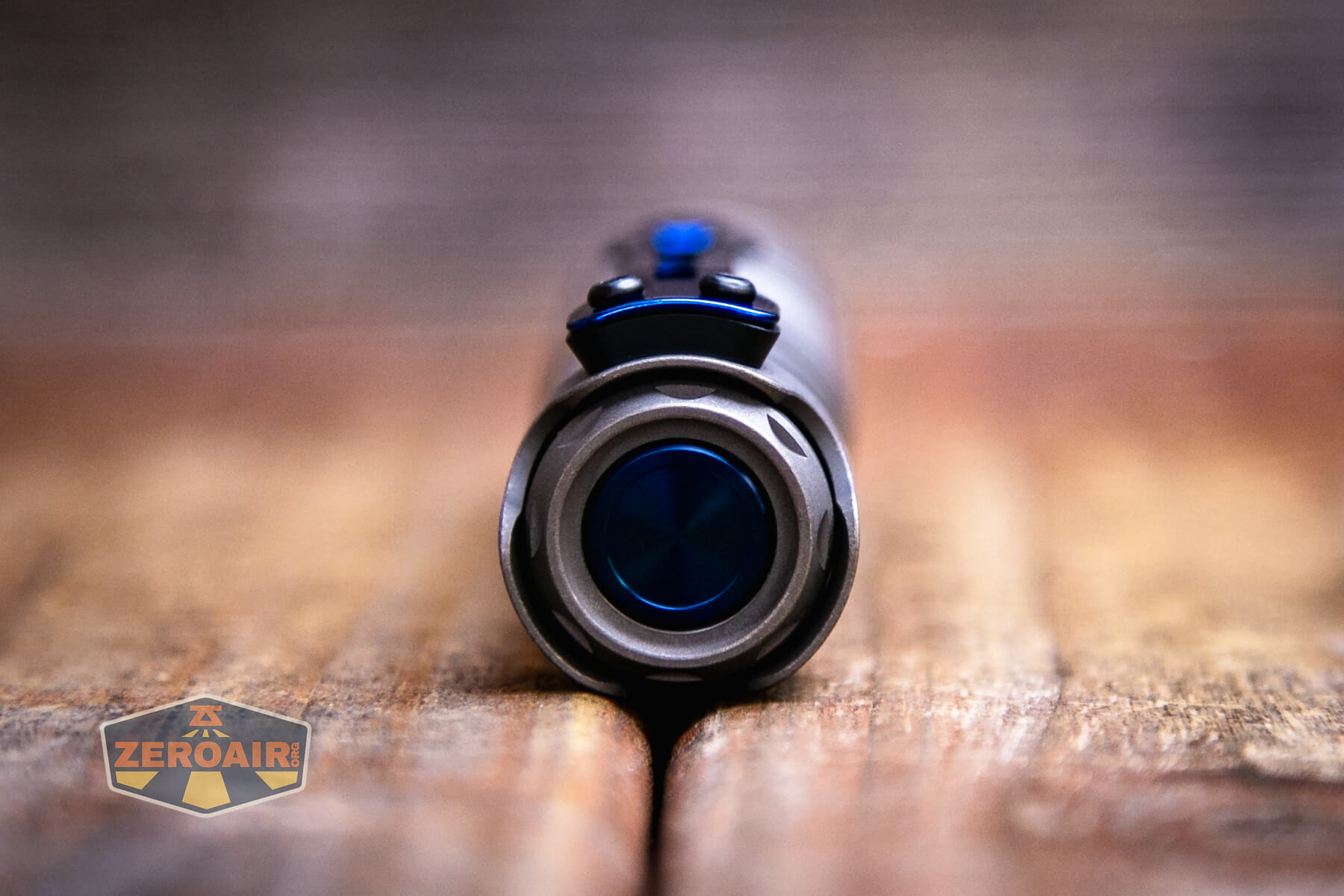
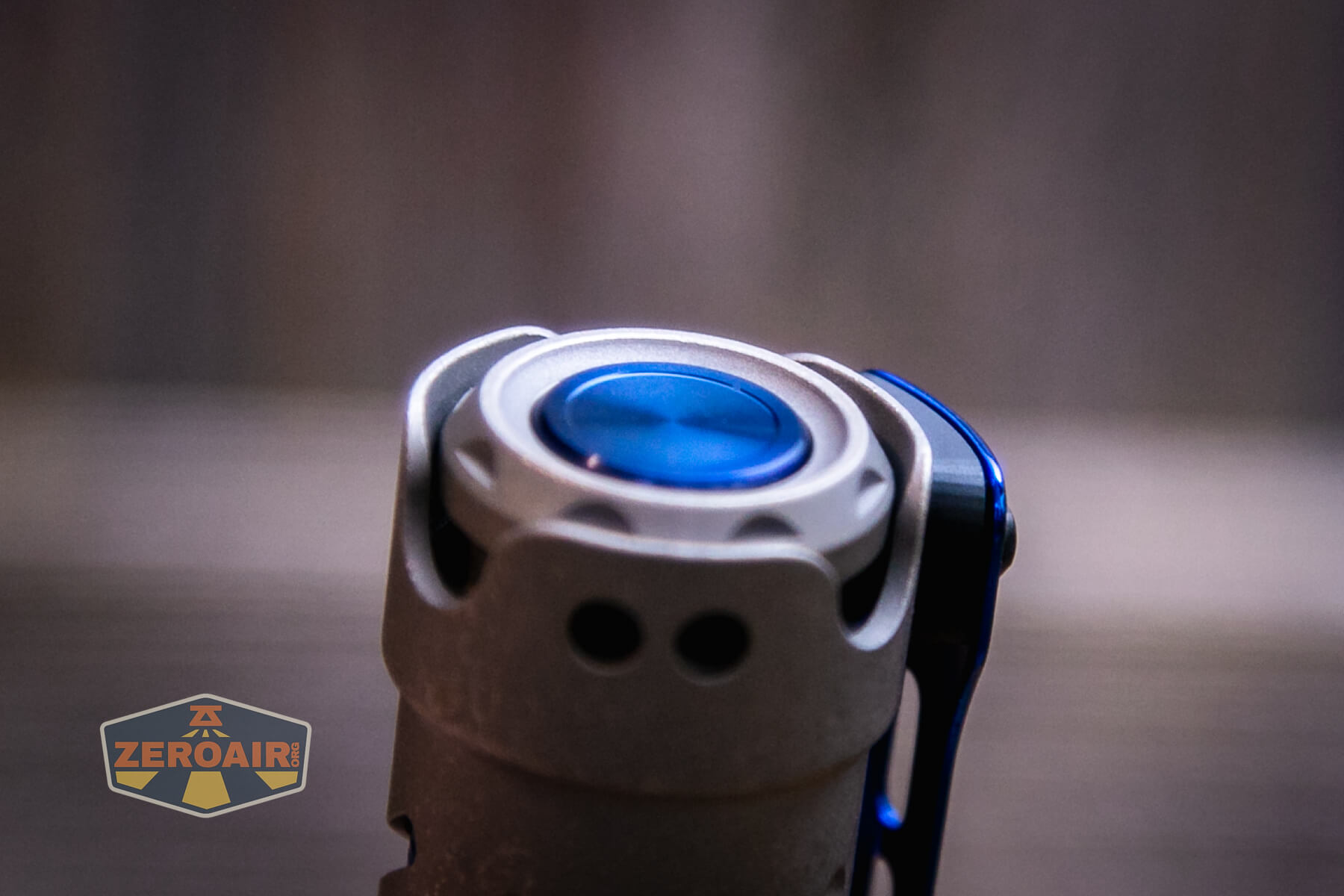
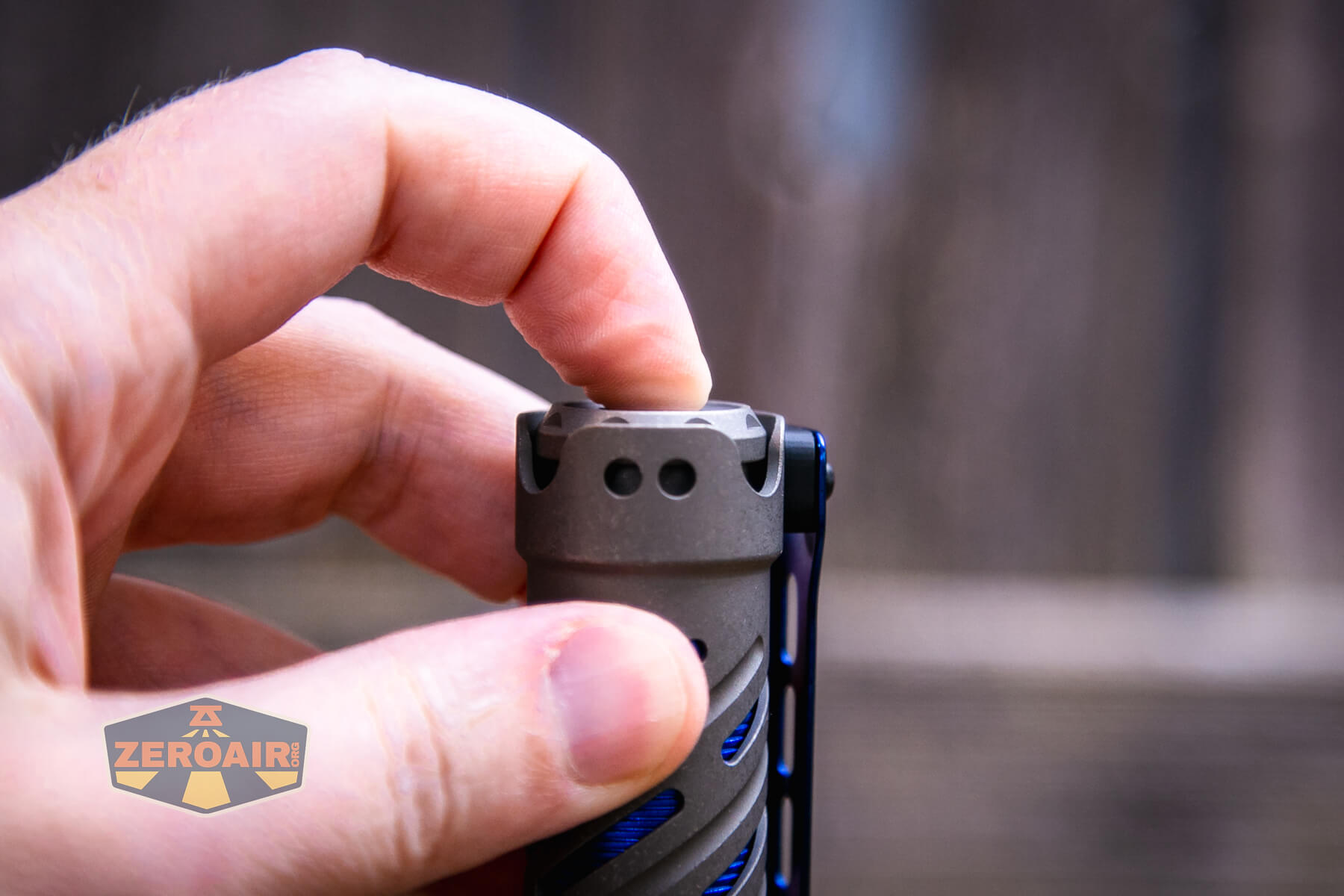
The user interface is a bit unusual in that it requires a double click from off to get into the regular modes. I believe the user interface to be exactly like the big E70 except that you can now cycle into the modes from Ultra-Low!
Here’s a user interface table!
| State | Action | Result |
|---|---|---|
| Off | Hold | Ultra-Low |
| Off | Double Click | On (Mode Memory, except Ultra-Low or Turbo) |
| On | Click | Off |
| On | Hold | Mode advance (Low>Mid1>Mid2>High) |
| On | Double Click | Turbo |
| Turbo | Click | Memorized mode (except Ultra-Low) |
| Any | Triple Click | Strobe |
| Off | Hold 5s | Lockout |
| Lockout | Hold 3s | Unlock to Ultra-Low |
LED and Beam
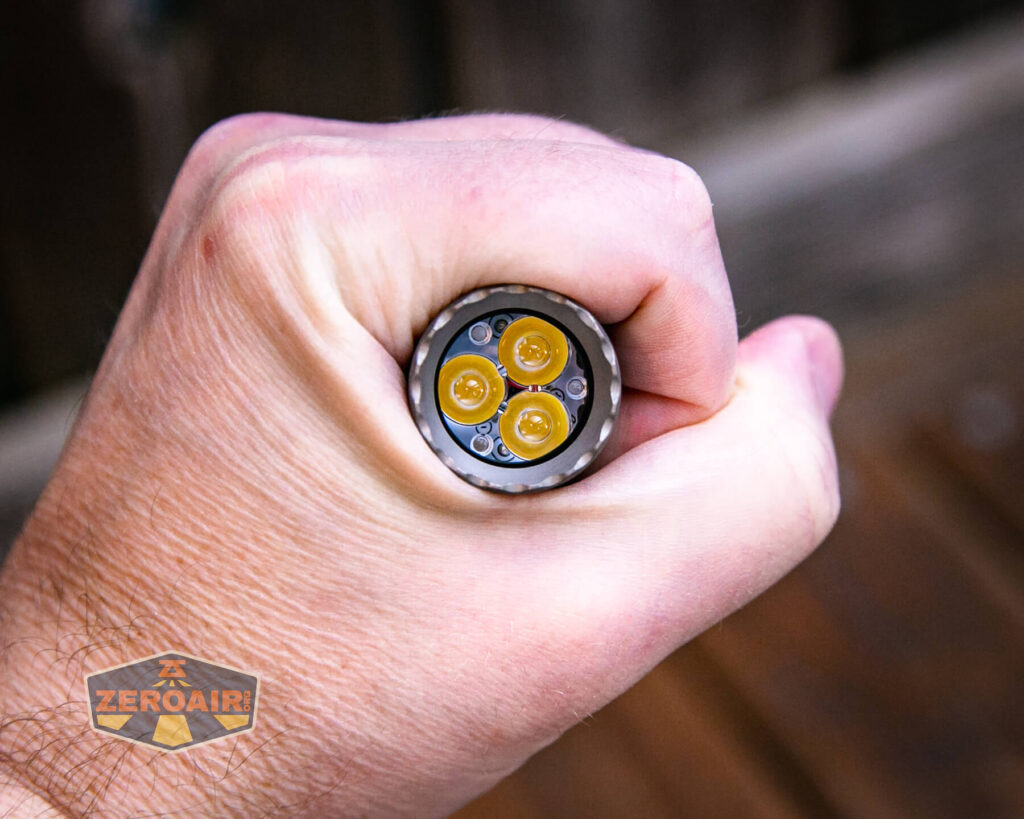
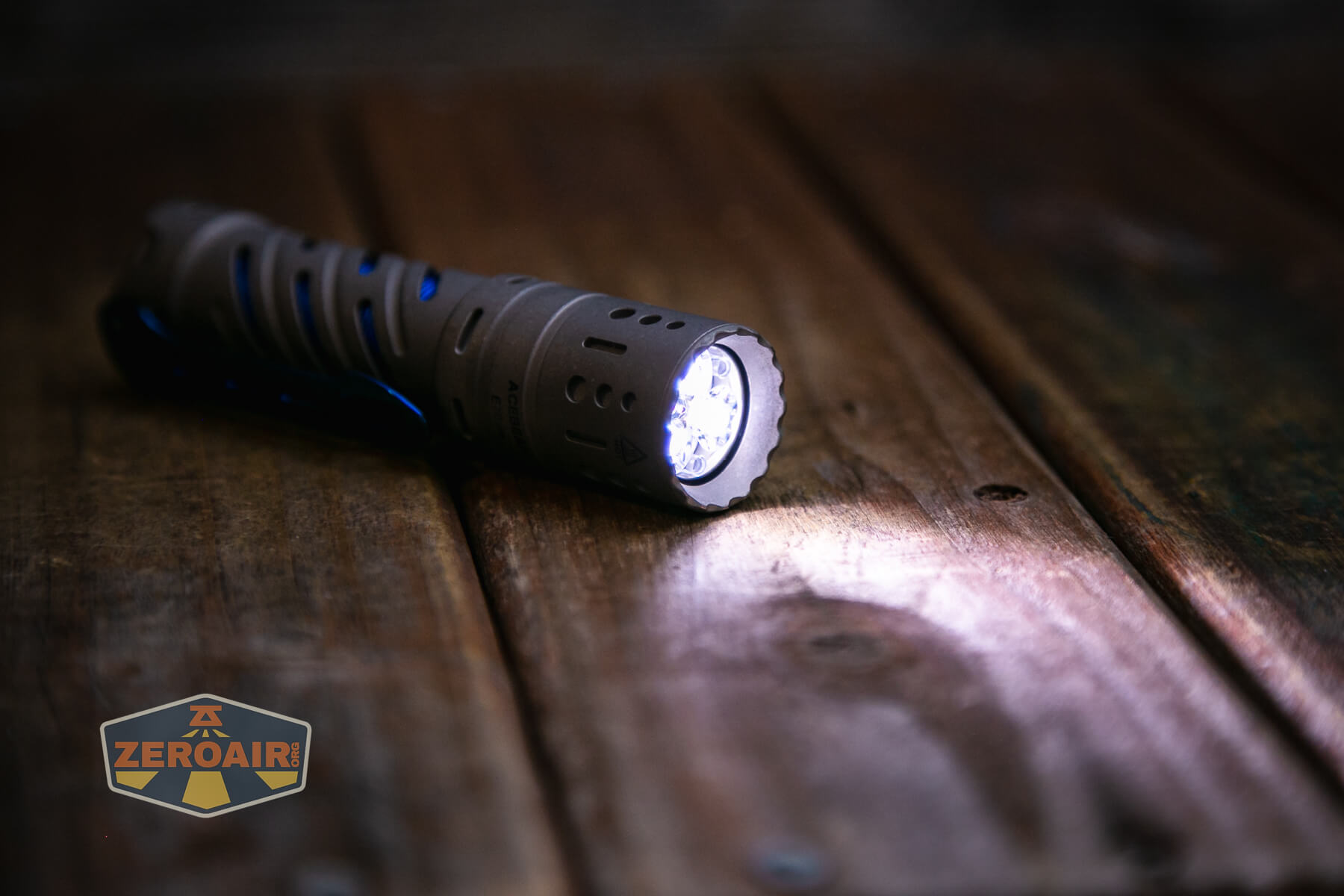
Acebeam smartly used a triple emitter array here, and also smartly used some of the newest and best emitters. These three are Nichia 519a emitters in 5000K and high CRI. They’re really fantastically great.
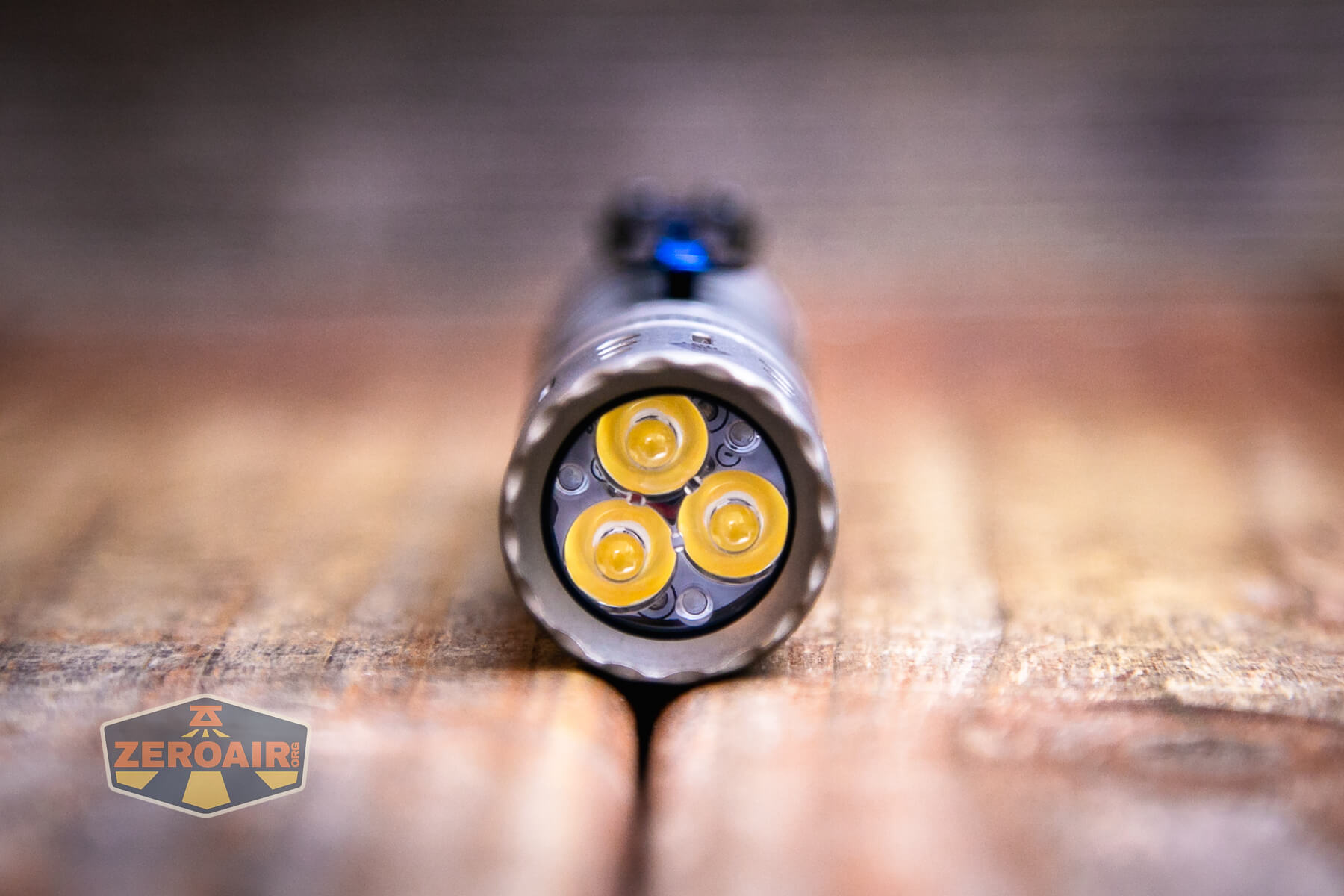
The toothy bezel (I’m not sure it’s really a strike bezel) allows light to escape.

LED Color Report (CRI and CCT)
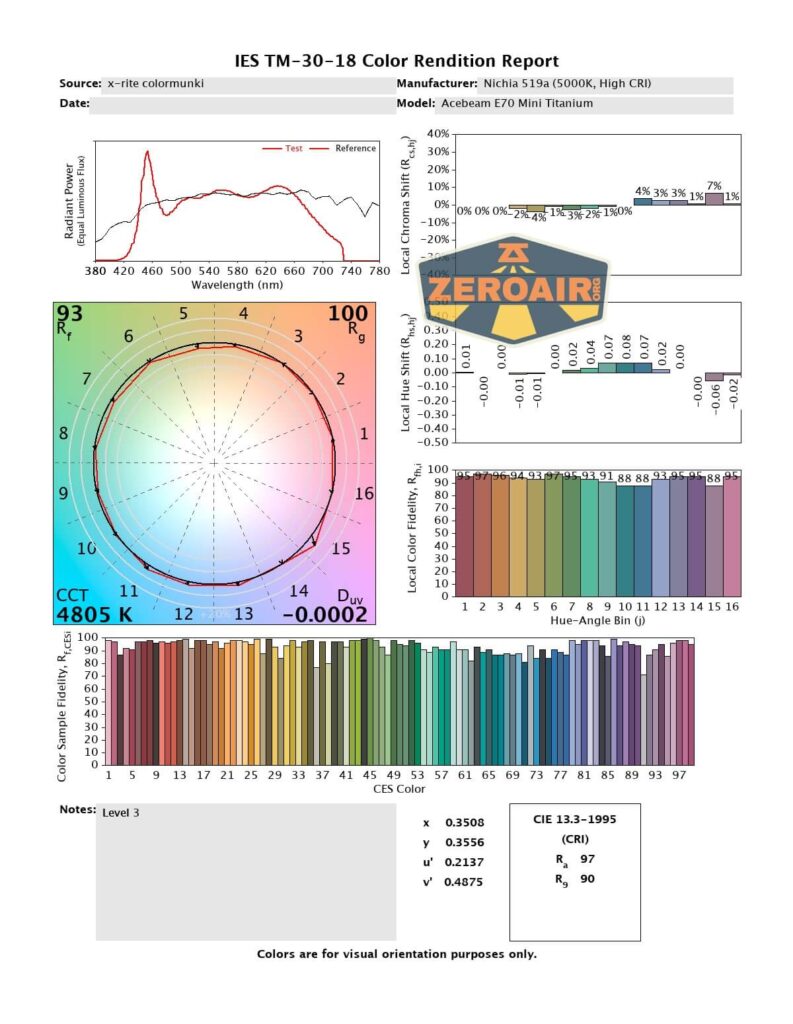
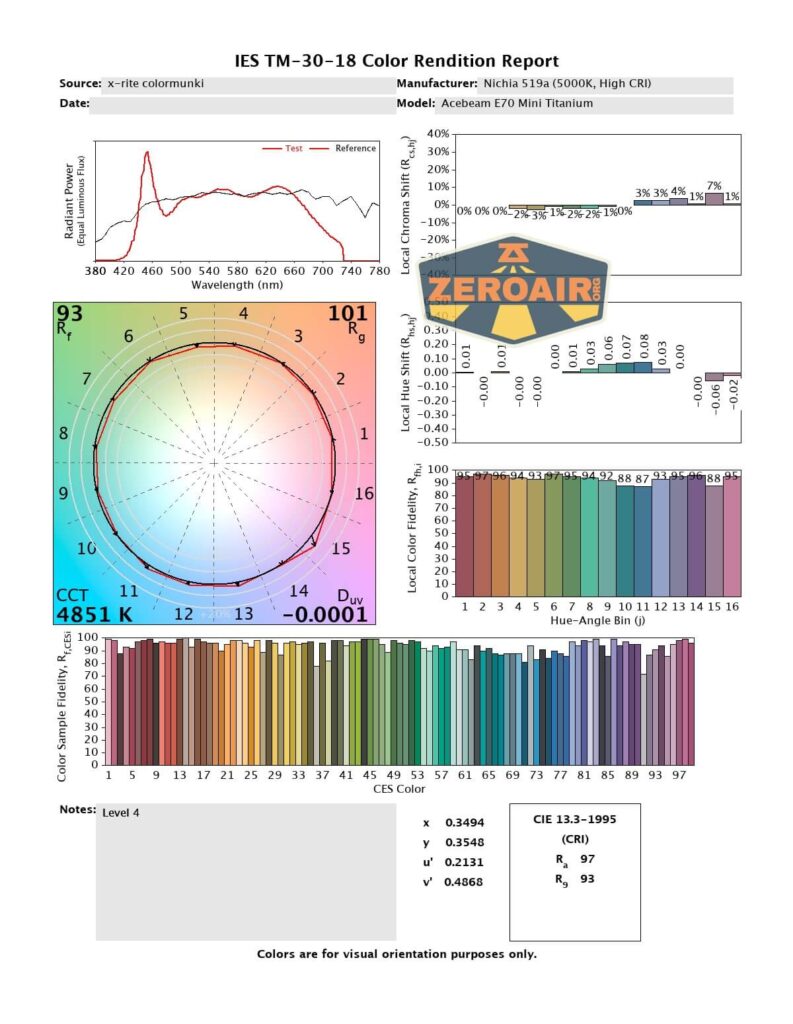
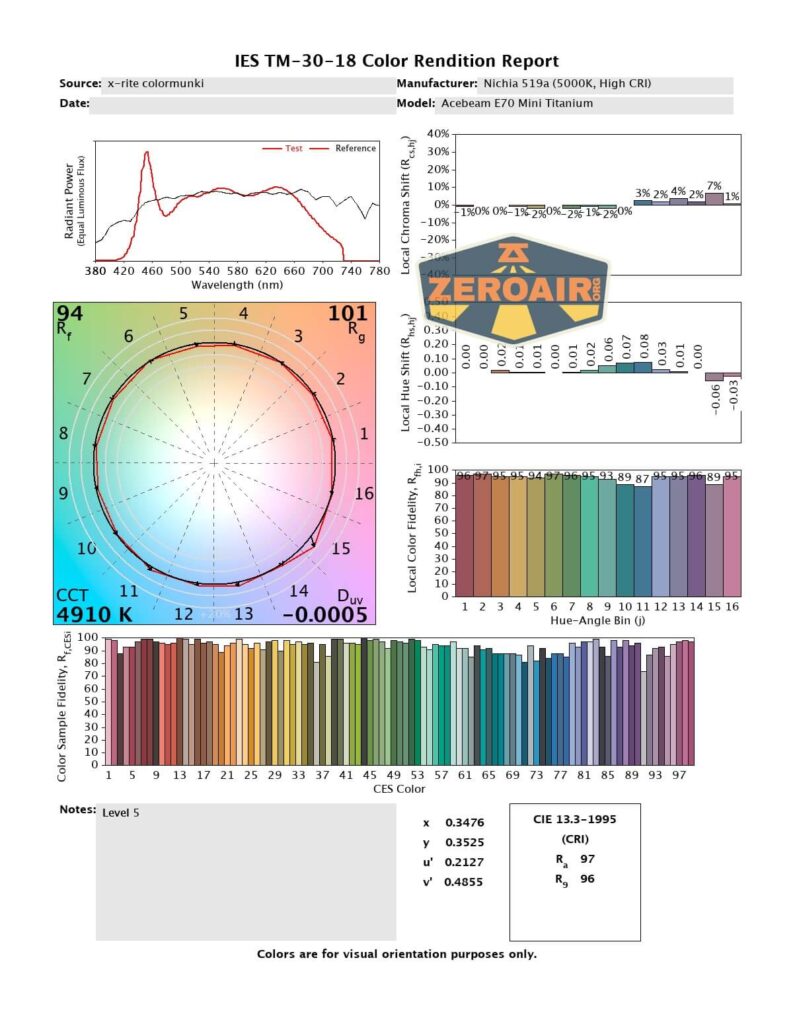
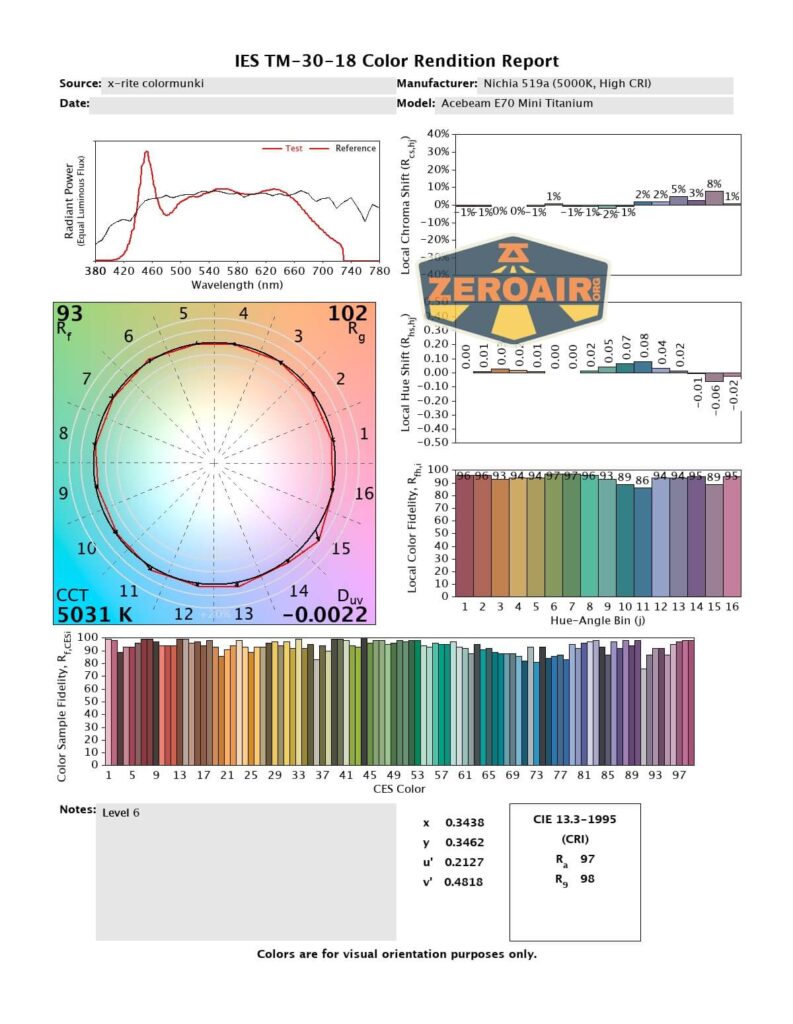
Just look at those circles! At a glance you can evaluate how closely the big red circle matches the big black circle – the closer these two are the more you’re going to like the output from any flashlight. These two are VERY CLOSE. Acebeam’s claim of “5000K” is supported by these tests, as is their claim of High CRI. This is a very very good report.


Beamshots
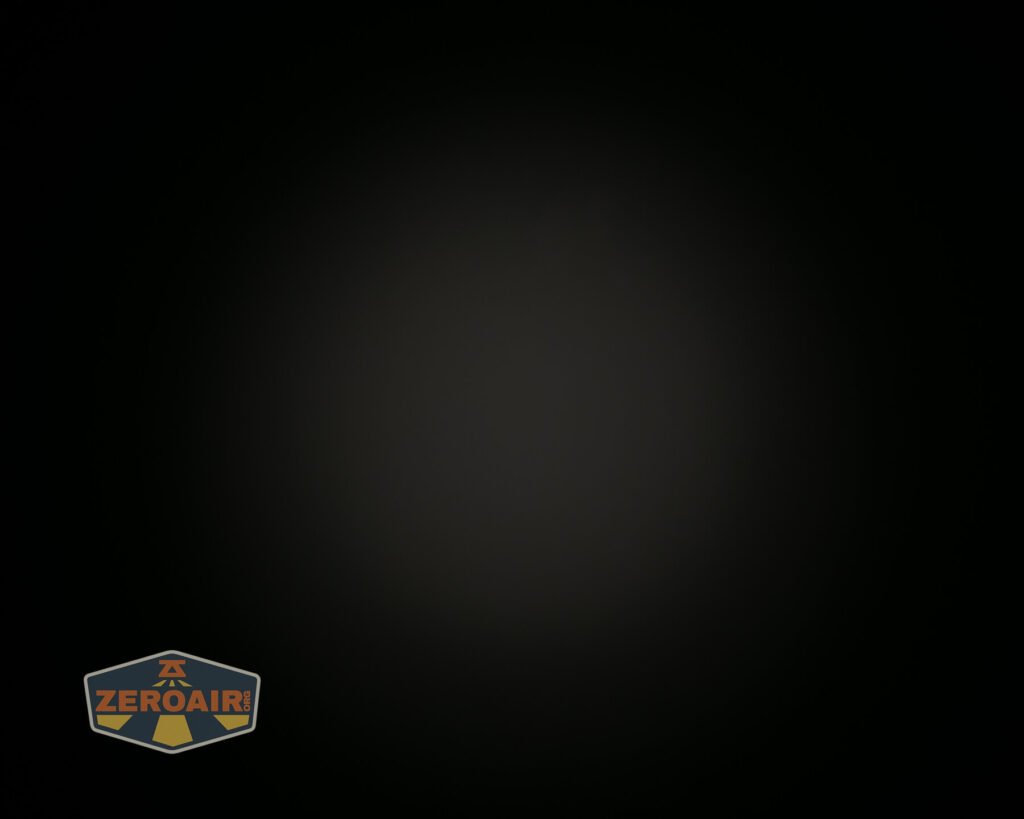
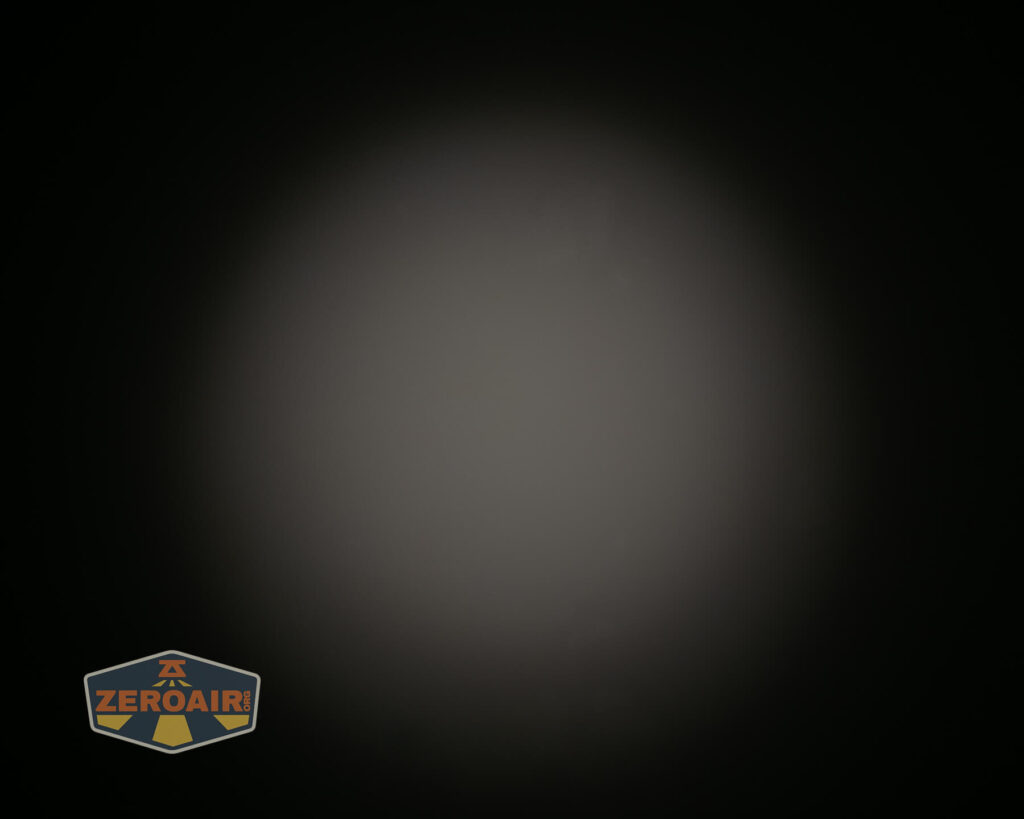
These beamshots always have the following settings: f8, ISO100, 0.3s shutter, and manual 5000K exposure. These photos are taken at floor level, and the beam hits the ceiling around 9 feet away.

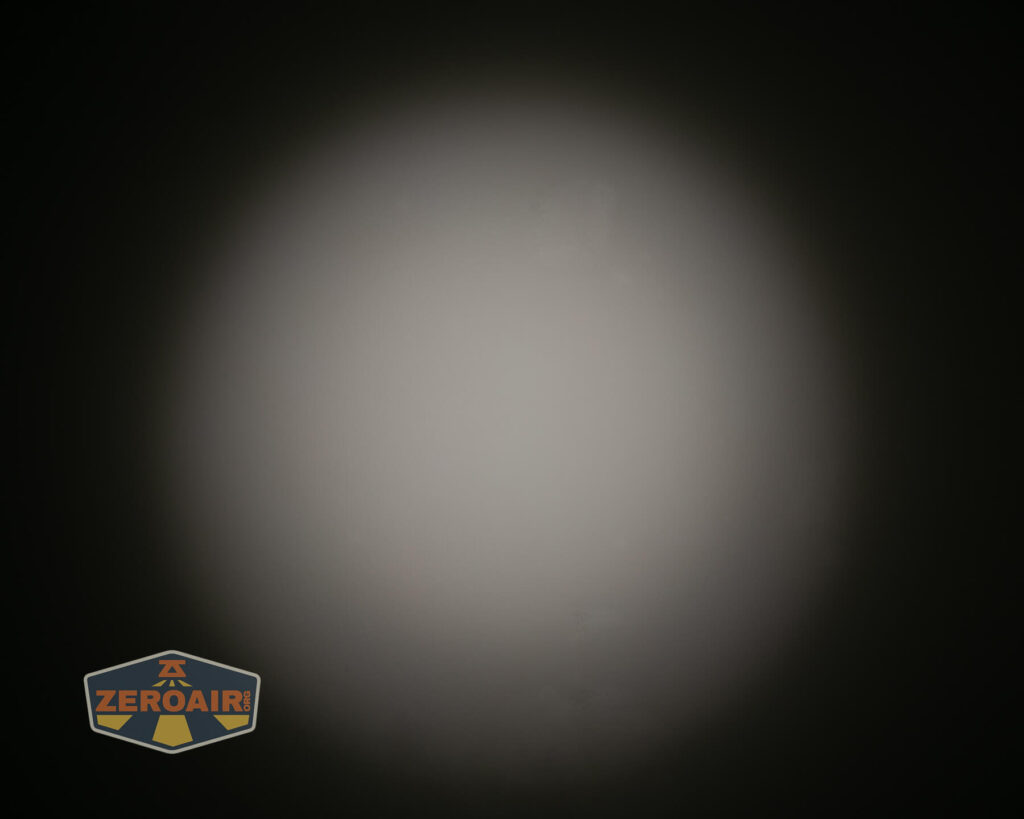
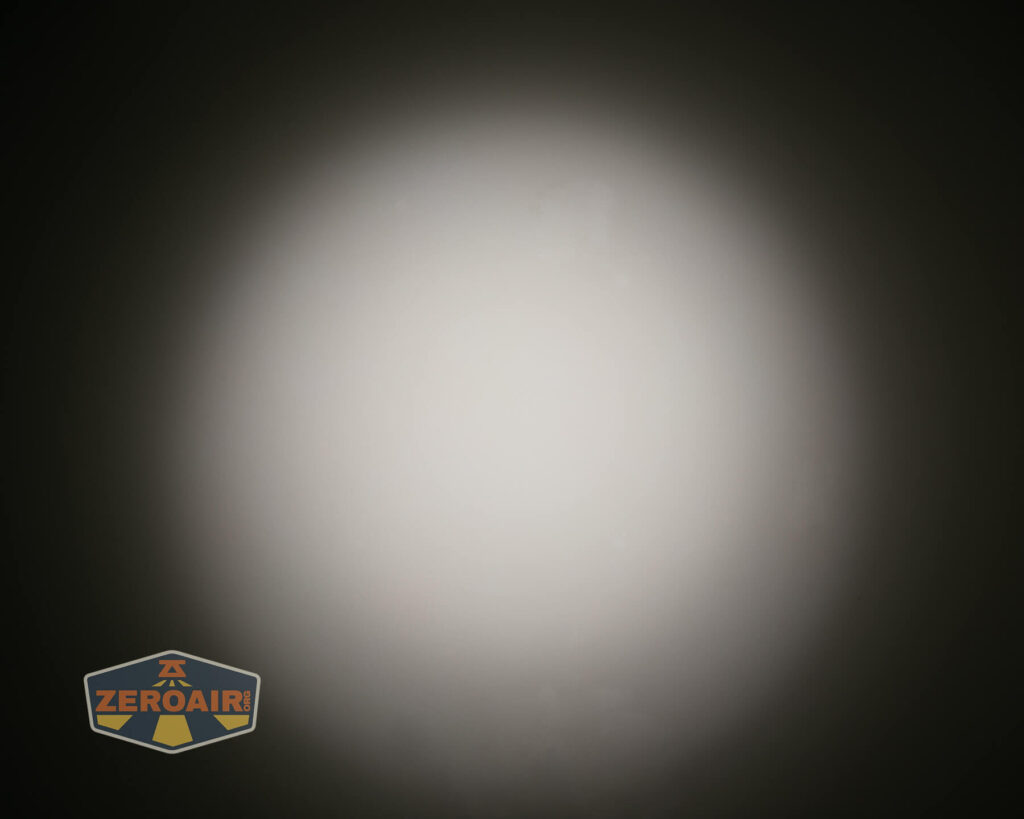

Tint vs BLF-348 (KillzoneFlashlights.com 219b version) (affiliate link)
I keep the test flashlight on the left and the BLF-348 reference flashlight on the right.

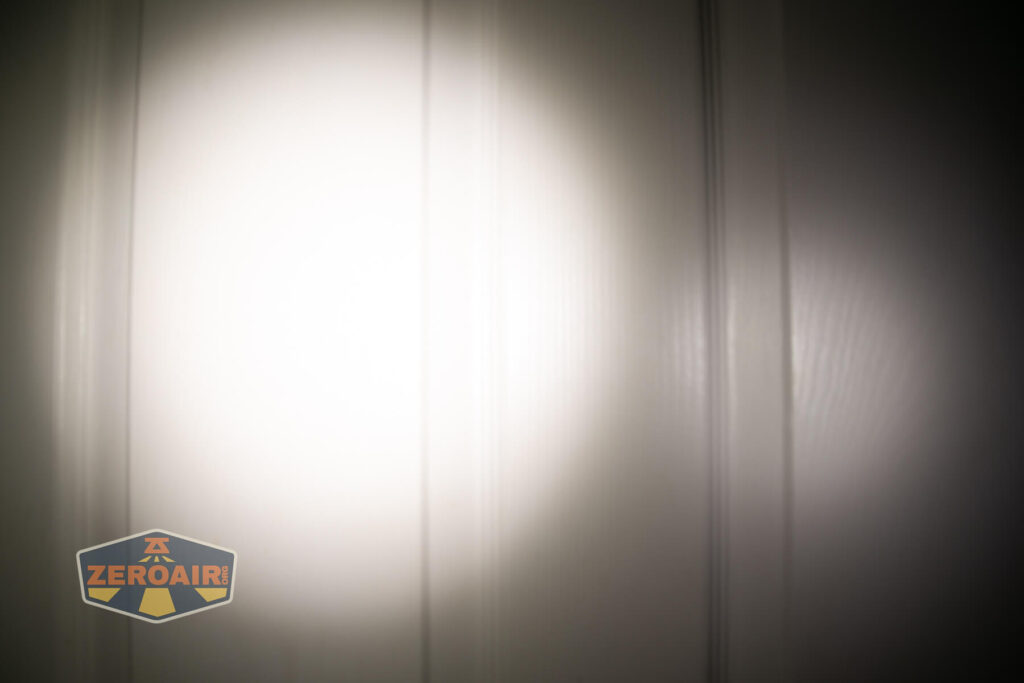
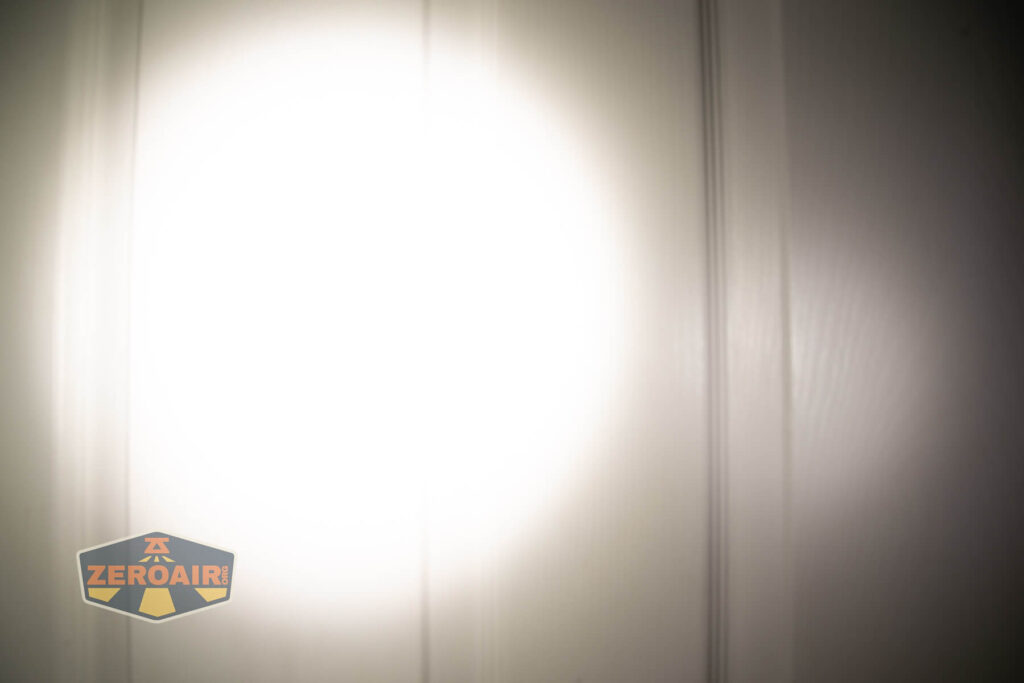


I compare everything to the KillzoneFlashlights.com 219b BLF-348 because it’s inexpensive and has the best tint!
Conclusion
What I like
- Interesting design and great little brother to the E70
- Titanium build!
- Tritium slots
- Excellent High CRI output
- Great beam profile (defined broad spot with even output)
- 5000K claim is met
- Hits throw specs
What I don’t like
- Double click from off? I don’t hate it but it’s unusual
- Overall size – it’s a big light
- Lanyard? Actually removing the lanyard is no problem, but getting it back on without removing the tailcap will be a burden. (And it ships off the light).
Notes
- This content originally appeared at zeroair.org. Please visit there for the best experience!
- Please use my Amazon.com referral link to help support zeroair.org!
- Please support me on Patreon! I deeply appreciate your support!
Another outstanding review! I have this as well as the aluminum version and agree wholeheartedly. It’s an improvement over the original full-size E70 — also a great light, but just too big (at least for pocket carry). Though unconventional, I actually have come to appreciate the double-click for on – almost no chance of accidental activation. And you are so right — probably the only way to improve this near-perfect light would be to offer an orange inner sleeve! I mean, the blue is great, but…
To install the lanyard, I found you can use a paperclip, needle, or sim card ejector. Slightly twist the lanyard tip so its a bit stiffer. Thread/shove it sideways through hole 1 until you can see it through 2nd hole. Then stab it and flick upwards with tool to pull it through.