
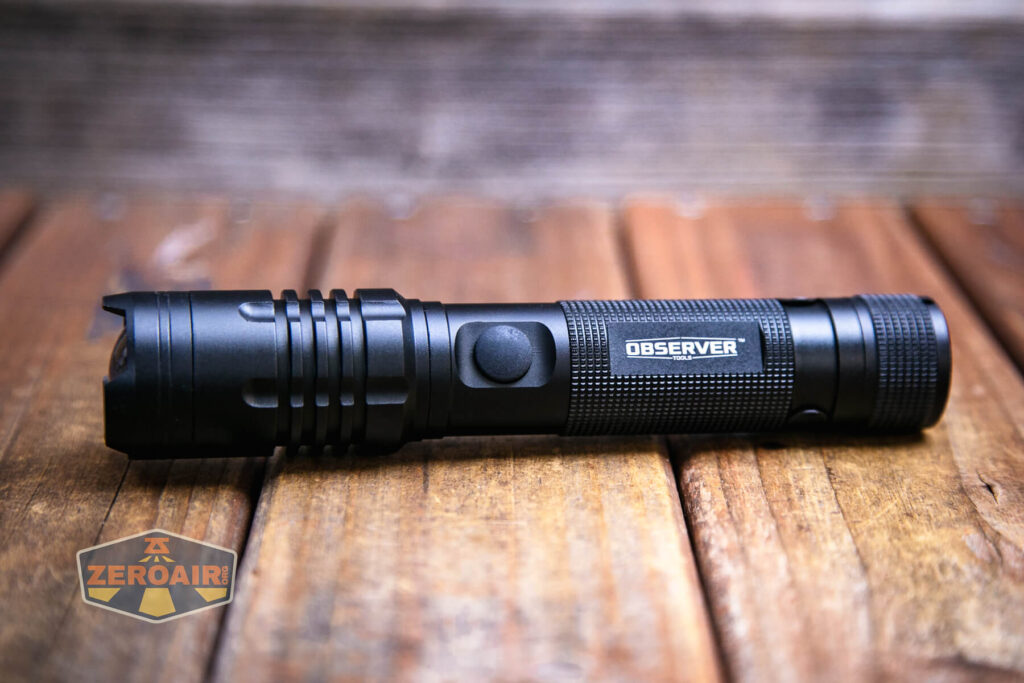
The Observer FL1000 Zoomie Flashlight Review
The Observer FL1000 zoomie flashlight includes an 18650, supports 3xAAA, has USB-C charging, and also has a powerbank feature! Read on!
This is a sponsored review.
Official Specs and Features
Here’s a link to the Observer FL1000 Zoomie flashlight product page.
Versions
There’s only one version of the Observer FL1000 Zoomie flashlight but it’s available (or listed, at least) in black (seen here), green, and orange body color.
Price
The MSRP for any body color is $59.99. The Observer FL1000 Zoomie flashlight is available at observertools.com.
Short Review
The Observer FL1000 Zoomie flashlight generally lives up to the claims made on the product page. It has a very floody flood. It has a very zoomy zoom. Both lumen output and throw are respectable (despite not reaching the target). I appreciate that the light includes an 18650 cell but it also has an AAA cell carrier for “in a pinch” use. There is definitely room for improvement, though. Read on for more!
Long Review
The Big Table
| Observer FL1000 | |
|---|---|
| Emitter: | “Cree XHP50” (Flood) |
| Price in USD at publication time: | $59.99 |
| Cell: | 1×18650 |
| Runtime Graphs | |
| LVP? | Yes |
| Switch Type: | E-Switch |
| Quiescent Current (mA): | 0.07 |
| On-Board Charging? | Yes |
| Charge Port Type: | USB-C |
| Charge Graph | |
| Power off Charge Port | with or without cell or tailcap: all modes |
| Claimed Lumens (lm) | 1200 |
| Measured Lumens (at 30s) | 973 (81.1% of claim)^ |
| Candela per Lumen | 1.3 |
| Claimed Throw (m) | – |
| Candela (Calculated) in cd (at 30s) | 96lux @ 3.224m = 998cd |
| Throw (Calculated) (m) | 63.2 |
| Claimed CCT | – |
| Measured CCT Range (K) | 10000 Kelvin |
| Item provided for review by: | The Observer |
| All my Observer reviews! | |
| Observer FL1000 | |
|---|---|
| Emitter: | “Cree XHP50” (Spot) |
| Price in USD at publication time: | $59.99 |
| Cell: | 1×18650 |
| Runtime Graphs | |
| LVP? | Yes |
| Switch Type: | E-Switch |
| Quiescent Current (mA): | 0.07 |
| On-Board Charging? | Yes |
| Charge Port Type: | USB-C |
| Power off Charge Port | with or without cell or tailcap: all modes |
| Claimed Lumens (lm) | 1200 |
| Measured Lumens (at 30s) | 973 (81.1% of claim)^ |
| Candela per Lumen | 55.9 |
| Claimed Throw (m) | 270 |
| Candela (Calculated) in cd (at 30s) | 341lux @ 5.603m = 10705cd |
| Throw (Calculated) (m) | 206.9 (76.6% of claim)^ |
| Claimed CCT | – |
| Measured CCT Range (K) | 10000-18000 Kelvin |
| Item provided for review by: | The Observer |
| All my Observer reviews! | |
| Observer FL1000 | |
|---|---|
| Emitter: | “Cree XHP50” (Flood) |
| Price in USD at publication time: | $59.99 |
| Cell: | 3xAAA |
| Runtime Graphs | |
| LVP? | Yes |
| Switch Type: | E-Switch |
| Quiescent Current (mA): | 0.07 |
| On-Board Charging? | Yes |
| Charge Port Type: | USB-C |
| Power off Charge Port | Do not attempt |
| Claimed Lumens (lm) | 900 |
| Measured Lumens (at 30s) | 446 (49.6% of claim)^ |
| Candela per Lumen | 1.3 |
| Claimed Throw (m) | – |
| Candela (Calculated) in cd (at 30s) | 39lux @ 3.576m = 499cd |
| Throw (Calculated) (m) | 44.7 |
| Claimed CCT | – |
| Measured CCT Range (K) | 12000 Kelvin |
| Item provided for review by: | The Observer |
| All my Observer reviews! | |
| Observer FL1000 | |
|---|---|
| Emitter: | “Cree XHP50” (Spot) |
| Price in USD at publication time: | $59.99 |
| Cell: | 3xAAA |
| Runtime Graphs | |
| LVP? | Yes |
| Switch Type: | E-Switch |
| Quiescent Current (mA): | 0.07 |
| On-Board Charging? | Yes |
| Charge Port Type: | USB-C |
| Power off Charge Port | Do not attempt |
| Claimed Lumens (lm) | 900 |
| Measured Lumens (at 30s) | 446 (49.6% of claim)^ |
| Candela per Lumen | 66.9 |
| Claimed Throw (m) | 180 |
| Candela (Calculated) in cd (at 30s) | 192lux @ 5.23m = 5252cd |
| Throw (Calculated) (m) | 144.9 (80.5% of claim)^ |
| Claimed CCT | – |
| Measured CCT Range (K) | 19000-23000 Kelvin |
| Item provided for review by: | The Observer |
| All my Observer reviews! | |
^ Measurement disclaimer: Testing flashlights is my hobby. I use hobbyist-level equipment for testing, including some I made myself. Try not to get buried in the details of manufacturer specifications versus measurements recorded here; A certain amount of difference (say, 10 or 15%) is perfectly reasonable.
What’s Included

- Observer FL1000 Zoomie flashlight
- Unbranded 18650
- 21700 to 18650 adapter (plastic sleeve)
- AAAx3 cartridge
- Charging cable (USB to multi-plug)
Package and Manual

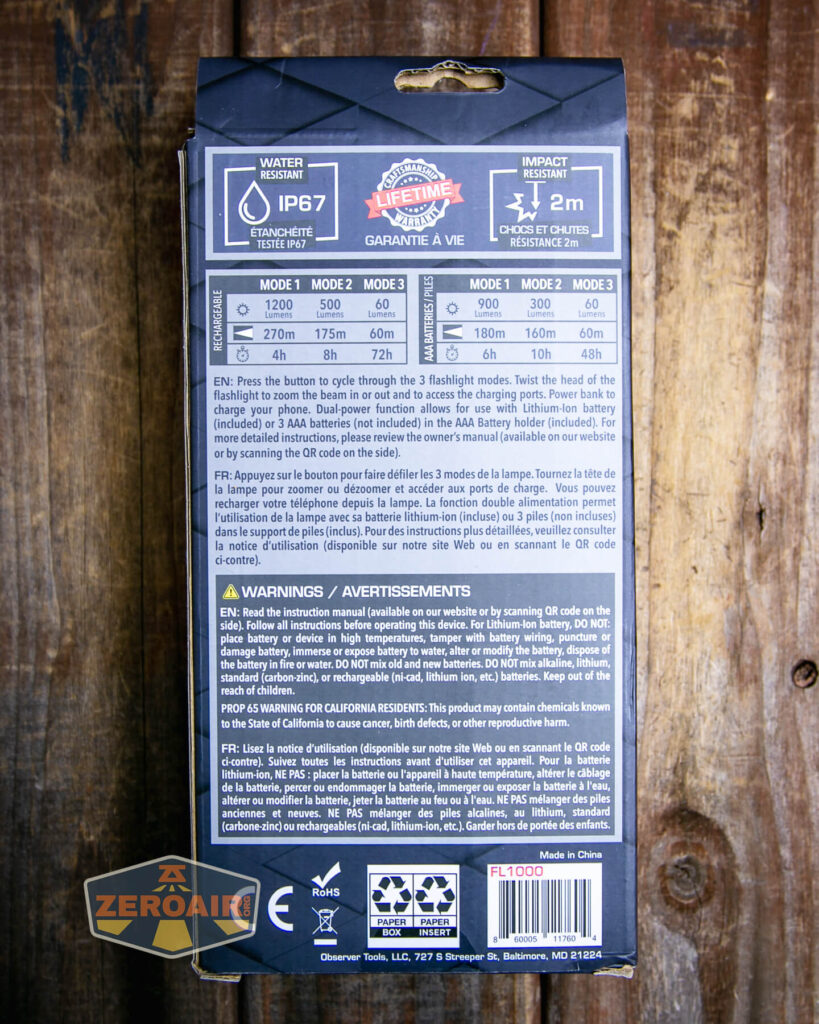
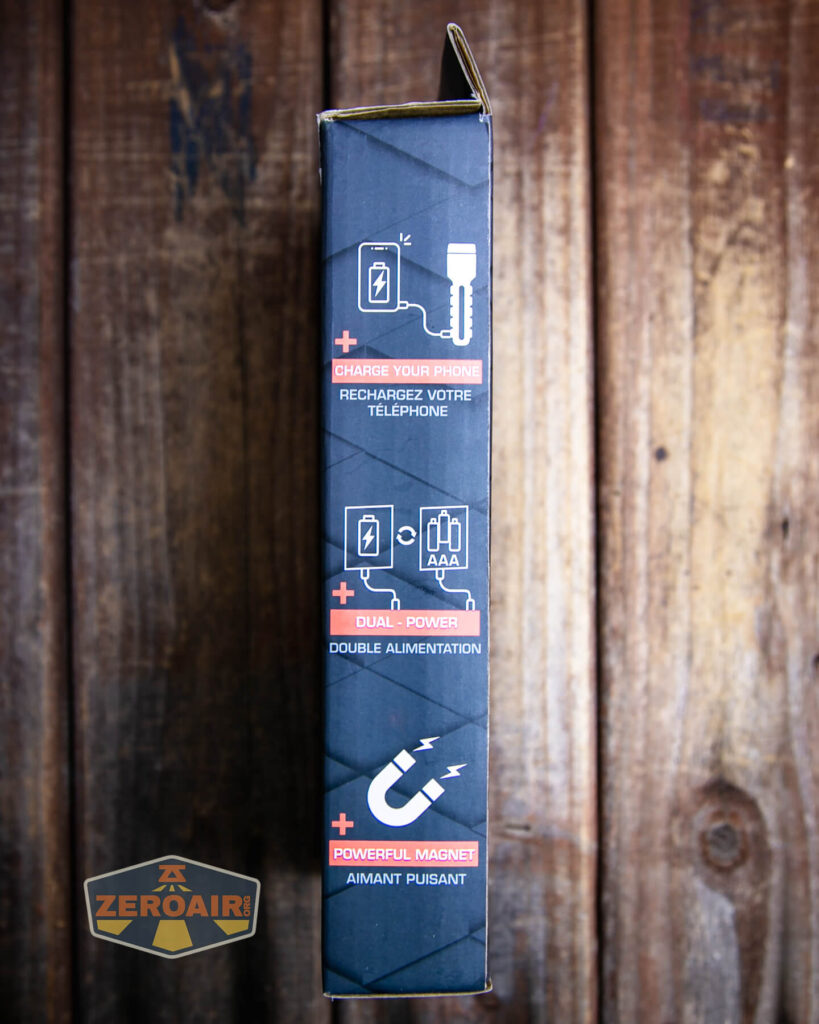
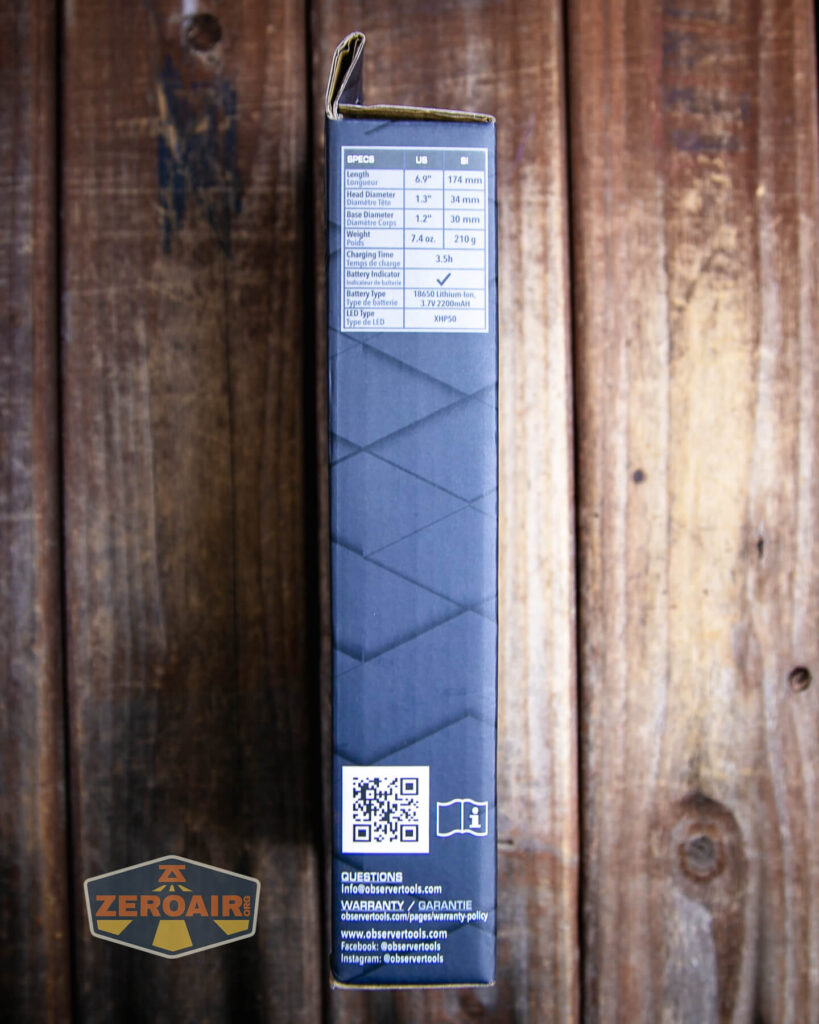
The box mentions a QR code that links to a manual. Here’s that link.
Build Quality and Disassembly

First off, you’ll notice that the Observer FL1000 Zoomie flashlight is a long flashlight. That’s not surprising, especially, since it has zoom features. Also even less surprising when you add in the USB-C charging and then the powerbank. All of that stuff takes up space!


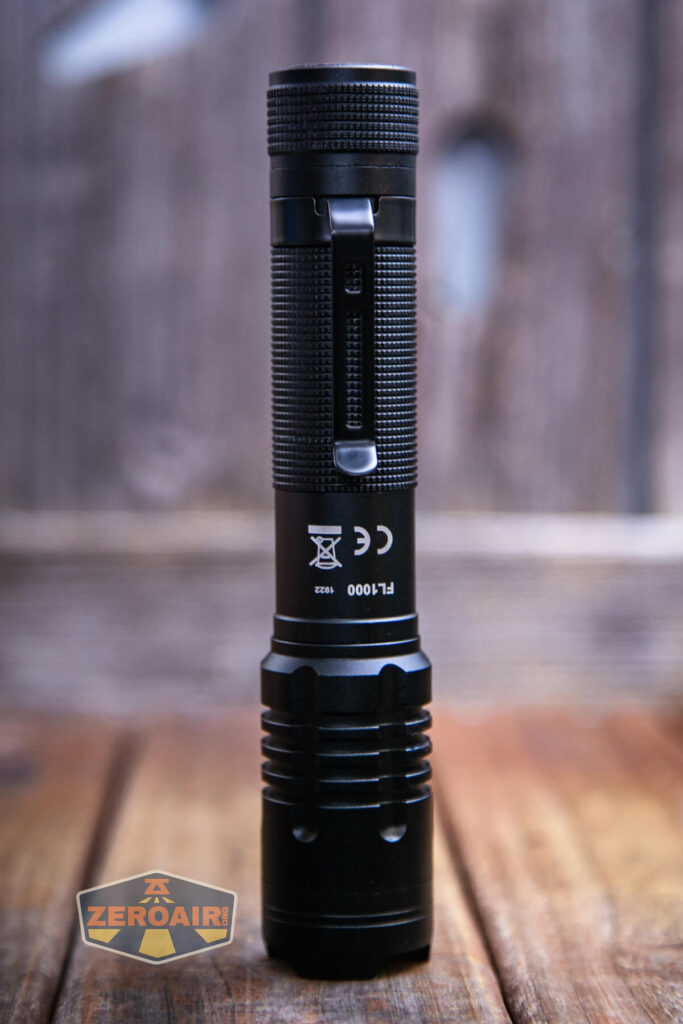
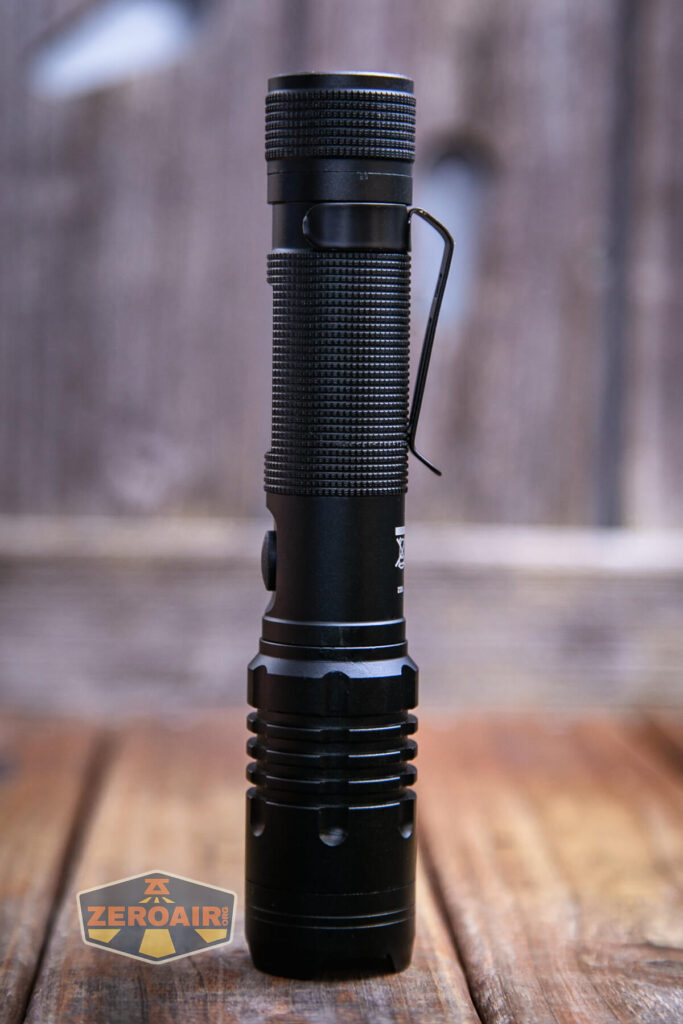
The build quality here is about what most flashlight enthusiasts would expect from a $60 zoomy flashlight. There are areas that could be improved.
The head has deep cooling fins. This is reasonable because the light draws nearly 5 amps on high!

The tailcap has a springy button. Those threads are fairly fine. Once started though, these threads (even though they’re unanodized) are quite smooth, without being overlubricated.

Inside the body is another button, but this one does not seem to be springy. No problem there, since this isn’t a tactical light.

Regarding disassembly, I can say that the bezel unscrews easily. I would suppose this gives way to easy emitter swaps, but I’m no expert in that! I will say that based on some characteristics we’ll see later, an emitter swap in this light might be a good decision.

The tailcap has a magnet. This magnet is surprisingly (?) strong enough to hold the Observer FL1000 Zoomie flashlight firmly. The light isn’t overly heavy but it is quite long.

I was unable to separate the body from the head – you’ll see why in the charging section. I’m sure there’s a way, but it’s probably thread locked. (That’s not a bad thing, I’d say.)
Size and Comps
Head: 1.34″
Base: 1.18″
Length: 6.85″
weight 7.4oz

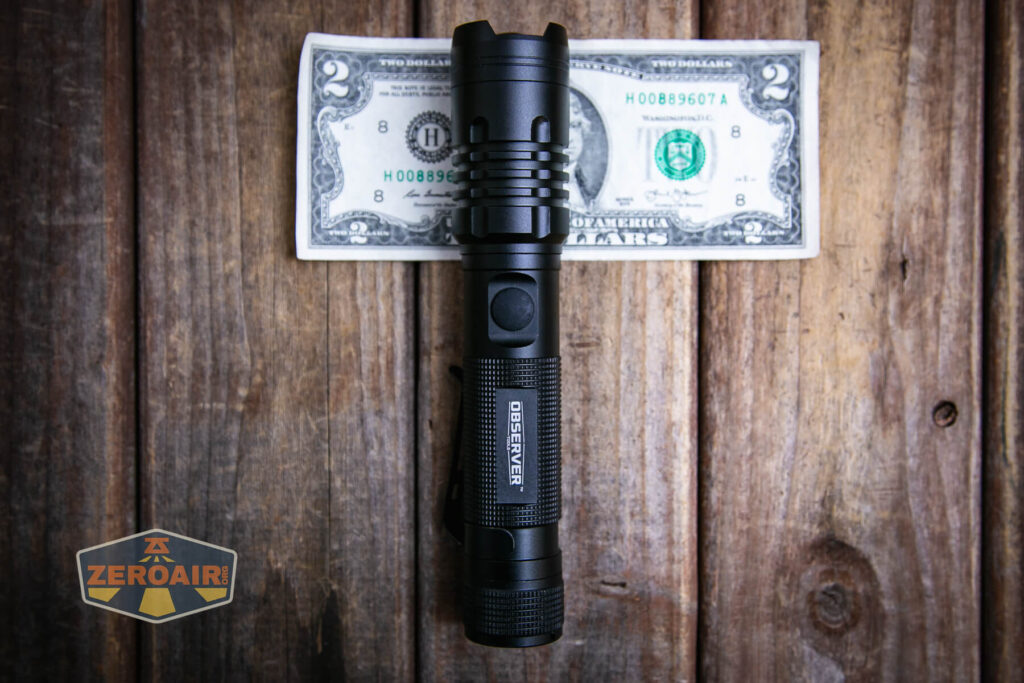

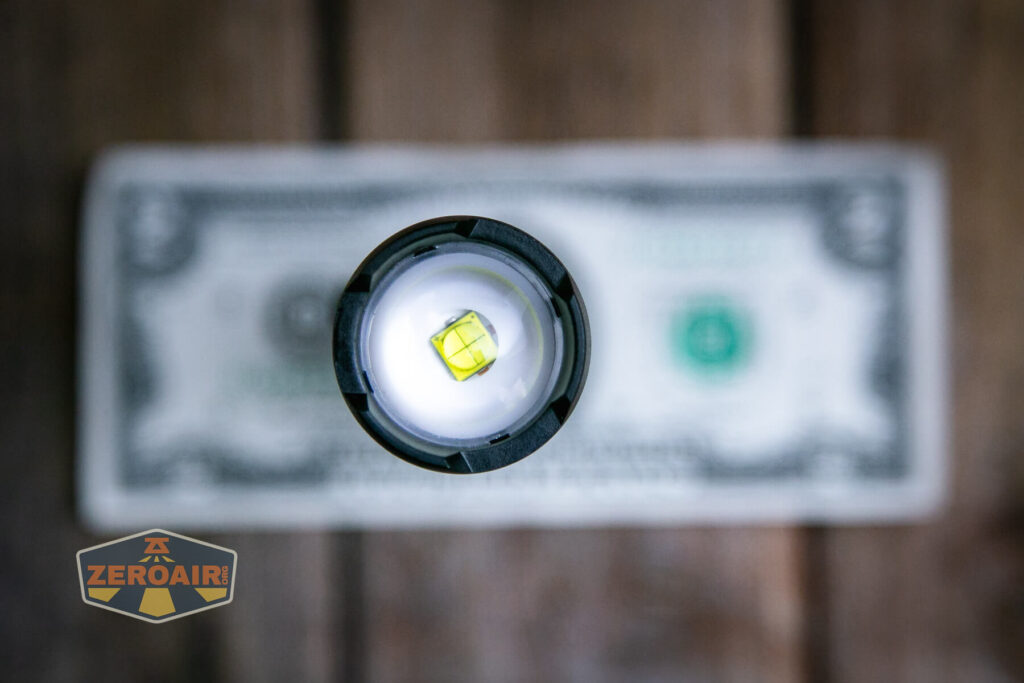

If the flashlight will headstand, I’ll show it here (usually the third photo). If the flashlight will tailstand, I’ll also show that (usually in the fourth photo).

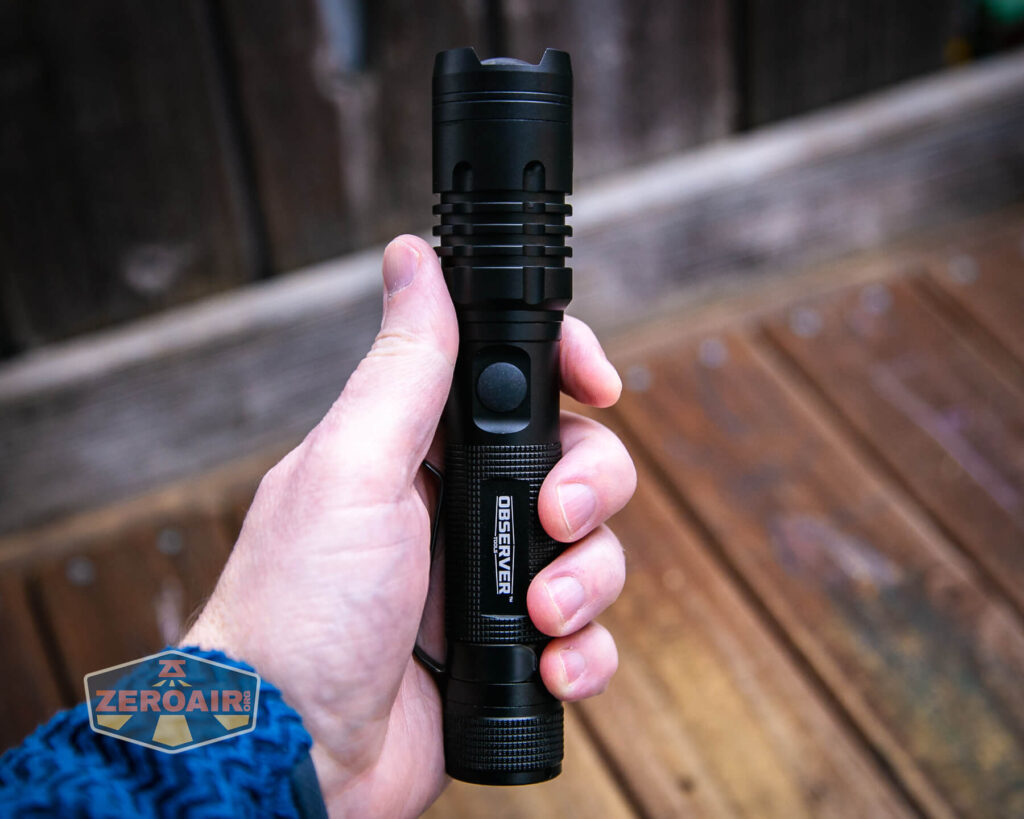
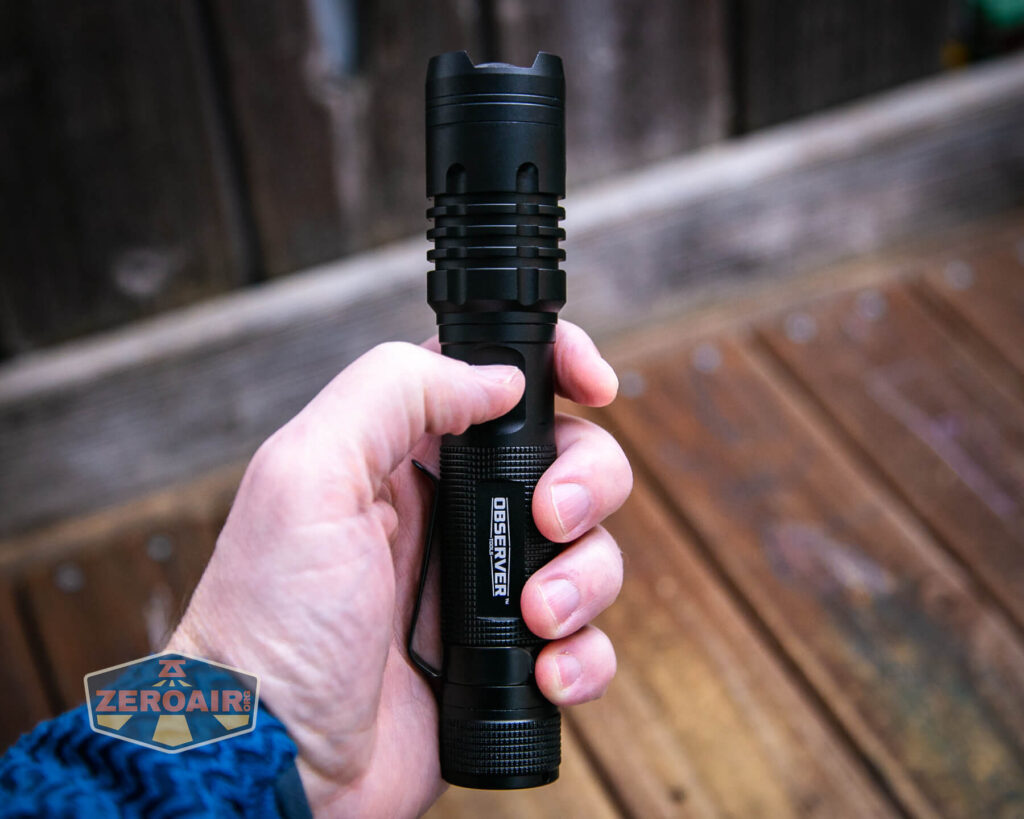
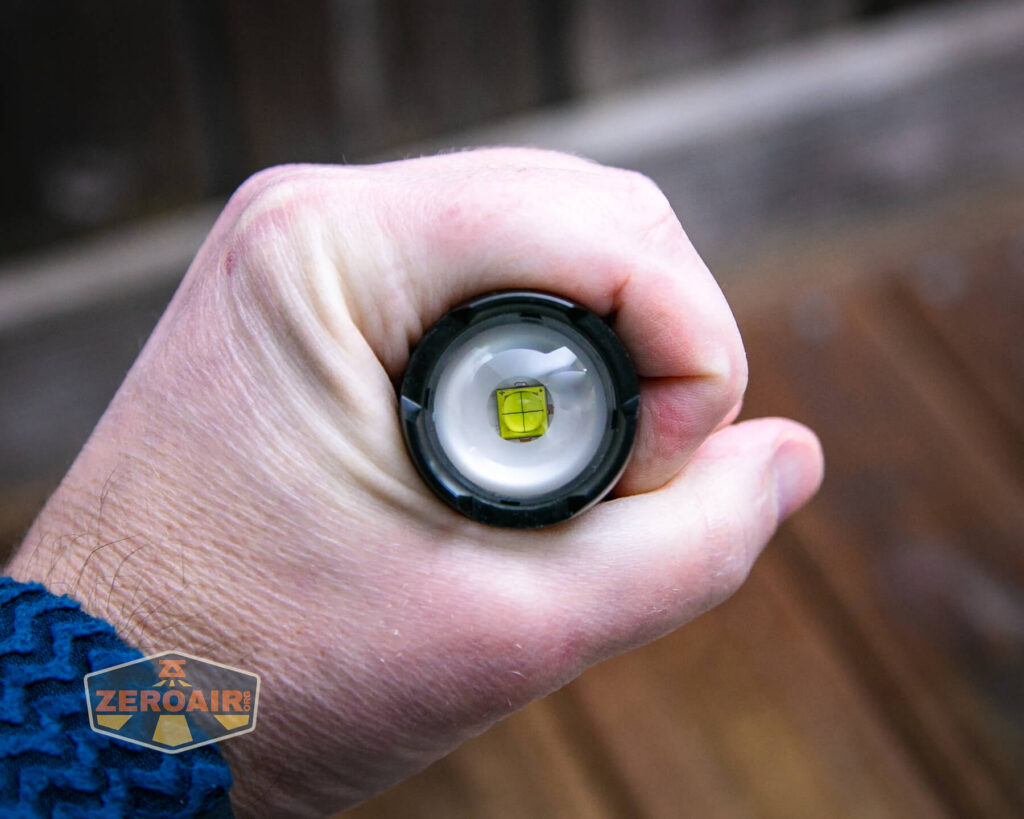
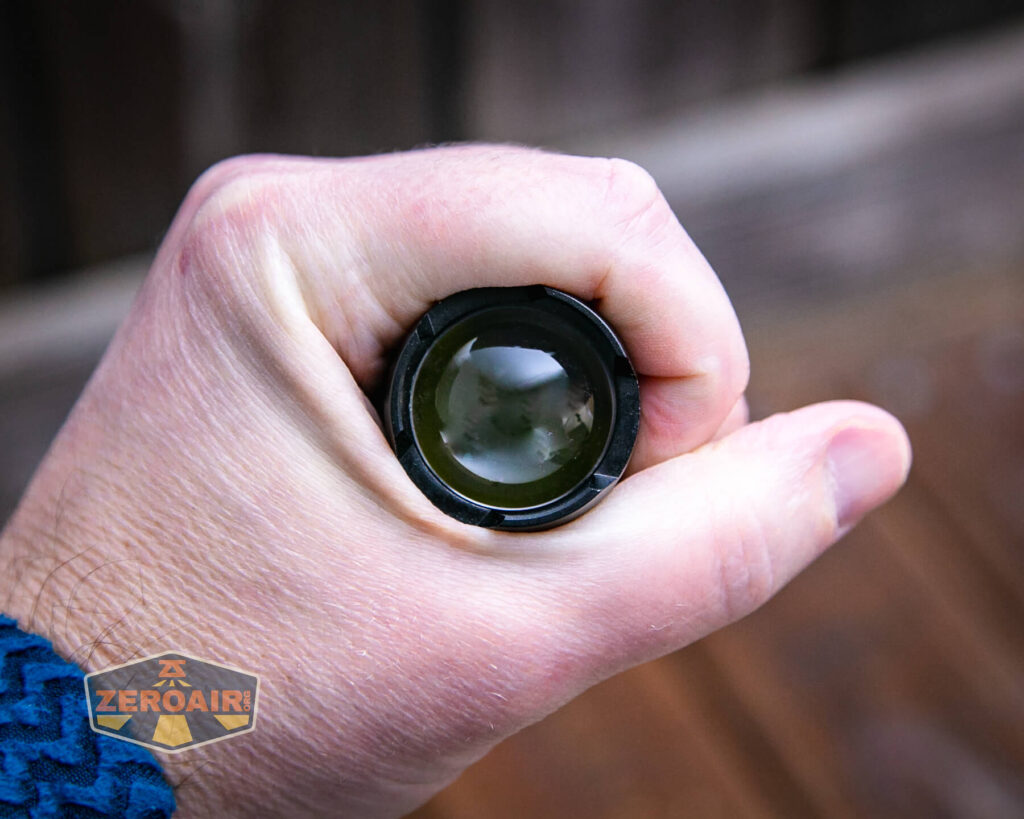
Here’s the test light with the venerable Convoy S2+. Mine’s a custom “baked” edition Nichia 219b triple. A very nice 18650 light.

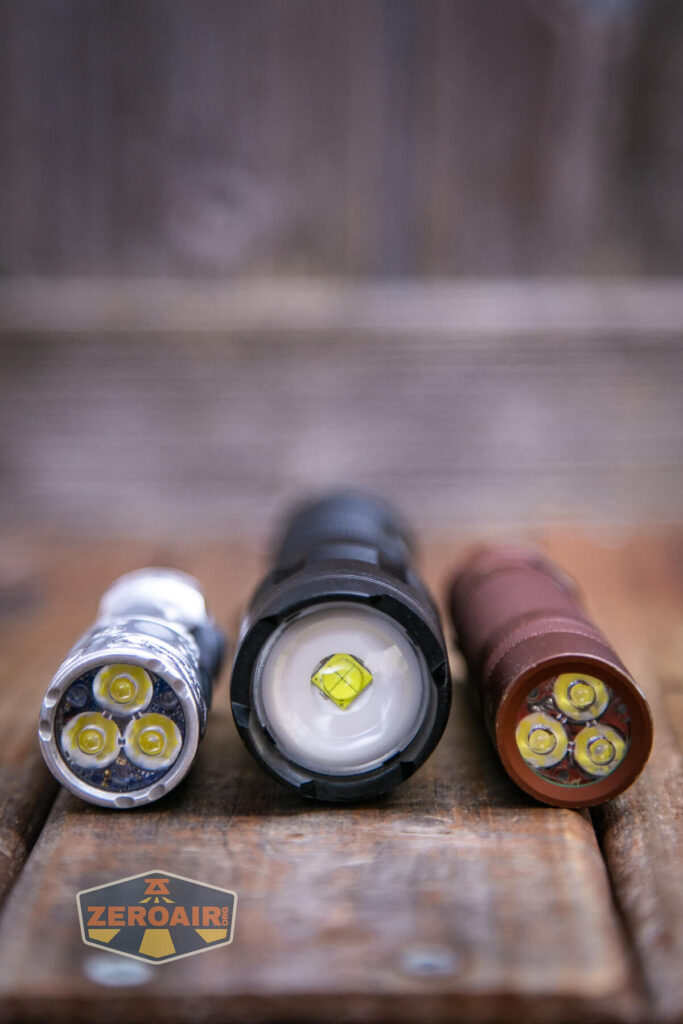
Also above is the light beside my custom engraved TorchLAB BOSS 35, an 18350 light. I reviewed the aluminum version of that light in both 35 and 70 formats.
Retention and Carry
The Observer FL1000 Zoomie flashlight ships with a friction-fit pocket clip installed.

This clip is a fairly common style and while easy enough to remove, it does provide adequate retention for carrying the Observer FL1000 Zoomie flashlight on a belt.

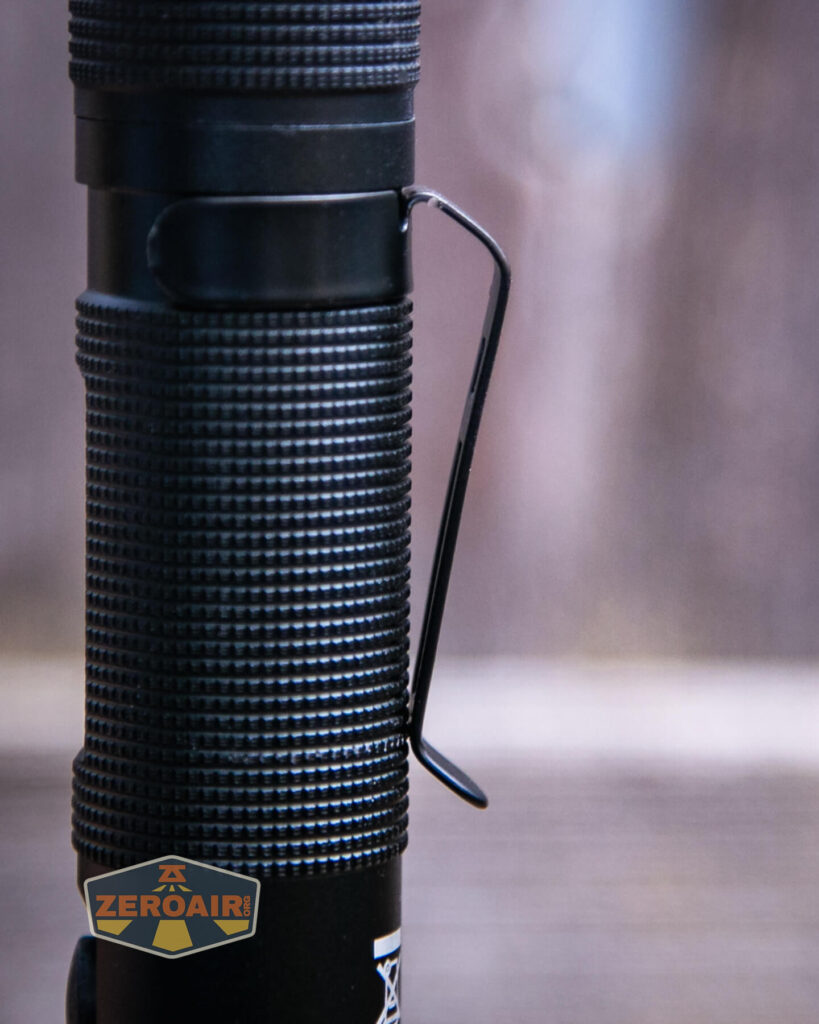
The clip can rotate around the body. This is good because it allows you to set the clip up however you want in relation to the e-switch.

While there is no lanyard included, there is a lanyard hole in the tailcap. This hole is partially obscured by the magnet sticker, but again, no lanyard is included so that’s not really a problem. If you have your own lanyard, no doubt you can figure out a way to get around the sticker, too. 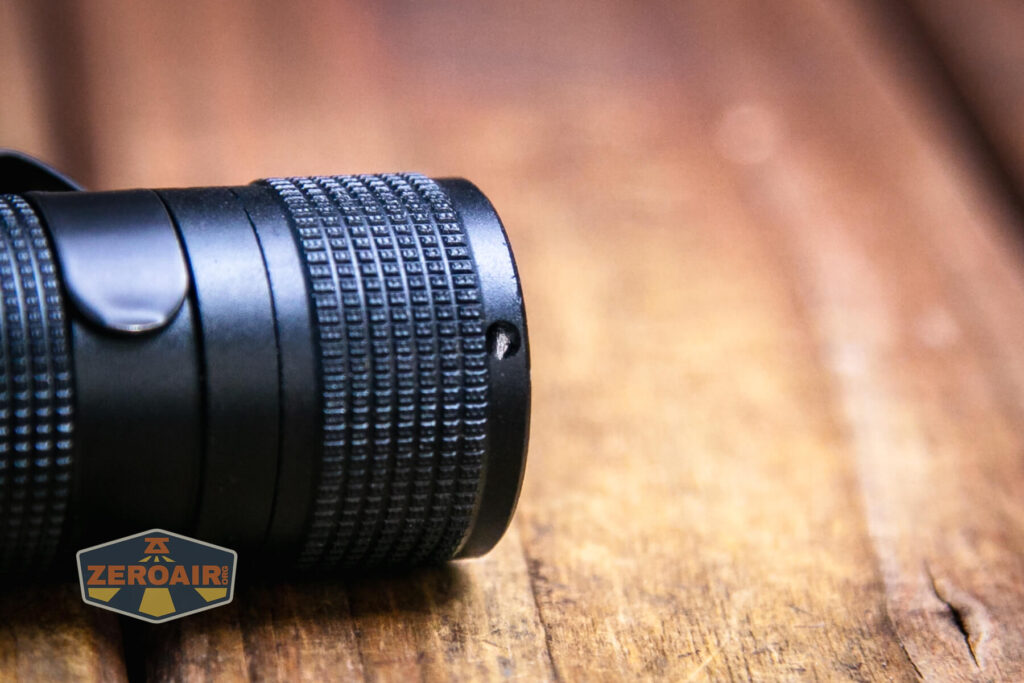

Next up is the magnet in the tailcap. This magnet is quite strong and seems to hold the FL1000 in any orientation. The magnet is not removable, as far as I can see.

No pouch or anything else is included.
Power and Runtime
Observer Tools includes probably the ideal fuel source for the FL1000. That’s this 2200mAh 18650.

The 18650 includes a plastic sleeve. I initially thought this sleeve was an accessory, and the Fl1000 was actually made for running a single 21700 cell. But that’s not the case. Inside the cell tube is a sort of a collar around the positive contact. While a 21700 cell fits inside the cell tube easily, this collar prevents the cell from dropping all the way in. I was unable to remove this little metal collar.

The cell goes into the light in the usual way – positive end toward the head.

Also included in the package is a little AAAx3 caddy. This is installed in “the normal” way too, which is to say that the button (left, below) should be considered the “positive end” and goes into the light. The arrow shown on the side there also supports this and serves as a reminder.

Here are a few runtime tests. I ran two tests for each power source.


Worth mentioning on these AAA runtimes is that the rated duration is almost certainly for primary cells, which are much higher in capacity than these rechargeables.


Charging
The Observer FL1000 Zoomie flashlight supports USB-C charging. The charging port is accessed when the light is in “fully zoomed” mode. That also means when the light is in zoom mode, that the USB-C charging port is exposed.

Observer Tools does not describe this as a waterproof USB-C charging port. I would add that there doesn’t seem to be any accessory waterproofing when the light is fully in flood mode but does carry an IP67 waterproof rating.
IP67 means the unit can be dropped into a body of water up to a meter deep for half an hour
Among the accessories that the FL1000 ships with is this neat and versatile charging cable. One end is USB and the other end has many cables – Lightning, micro-USB, and USB-C. This means that one cable can be used for charging as well as discharging the FL1000.


Here are a couple of charge cycles of charging the included 18650. Be advised that you should not utilize the charging feature when 3xAAA cells are installed. Charging is ONLY for the 18650 cell! (The manual covers this, too.)

Powerbank
One nice feature that the FL1000 offers is use as a powerbank. The powerbank is a single USB port and is also accessed by fully zooming the flashlight. The USB-C port and USB-A port are 90 degrees apart (not 180).

Bearing in mind that the included cell is just 2200mAh, it’s unreasonable to expect to use the light for multiple charge cycles on your phone or whatever. But for a single (maybe “emergency”) charge session, this should get you a bit of power. Stress testing the powerbank shows that it peaks at around 1A output.


Powerbank output shuts off when the cell is at around 3.6V.
Modes and Currents
| Mode | Mode Claimed Output (lm) | Claimed Runtime | Measured Lumens | Tailcap Amps |
|---|---|---|---|---|
| Mode 1 | 1200 (18650) 900 (AAAx3) |
4h (18650) 6h (AAAx3) |
973 (18650) 446 (AAAx3) |
4.59 (4.2V) 5.73 (4.5V) |
| Mode 2 | 500(18650) 300 (AAAx3) |
8h (18650) 10h (AAAx3) |
576(18650) 283 (AAAx3) |
2.64 (4.2V) 3.22 (4.5V) |
| Mode 3 | 60 (18650) 60 (AAAx3) |
72h (18650) 48h (AAAx3) |
19 (18650) 6 (AAAx3) |
0.05 (4.2V) 0.09 (4.5V) |
Pulse Width Modulation
Flood and throw output are not electrically different, so what you see below (in the top row) are three PWM readings for 18650 (in mode order) and then three PWM readings for the AAAx3 power. The default setting is deceiving, though… The second row tells the full story. PWM is very noticeable on the lower two modes with either power source. You might not notice PWM on medium, but you will absolutely notice that very slow PWM on both Low levels.


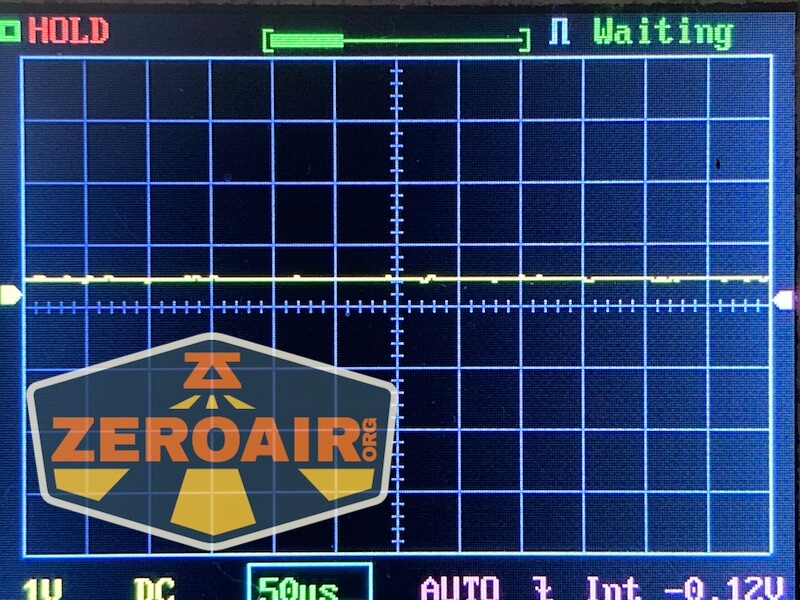

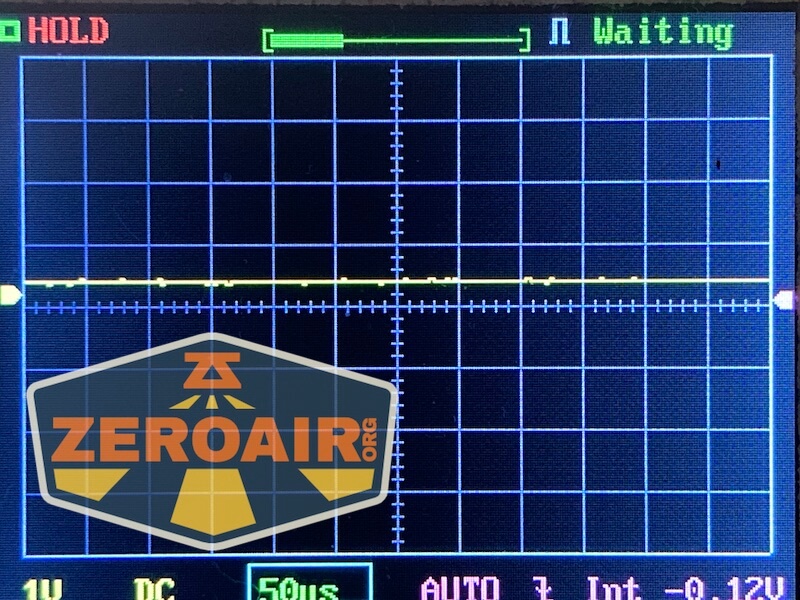


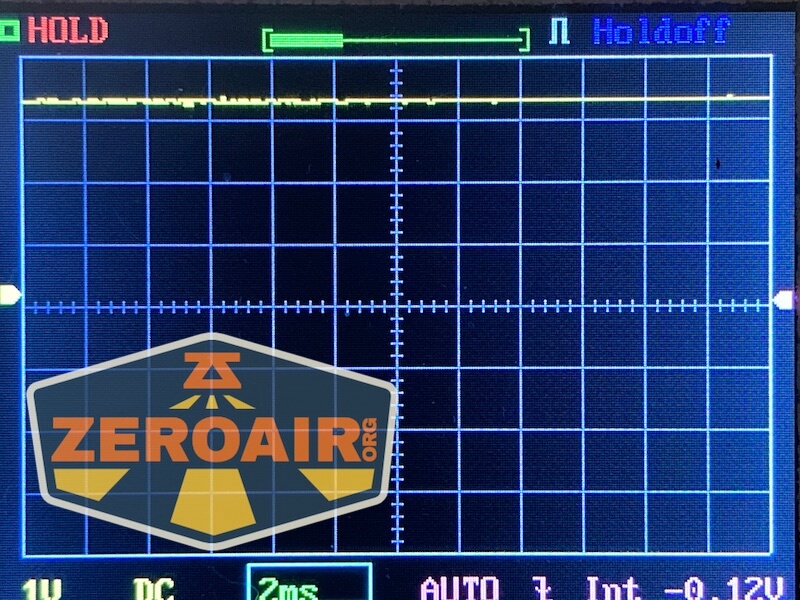

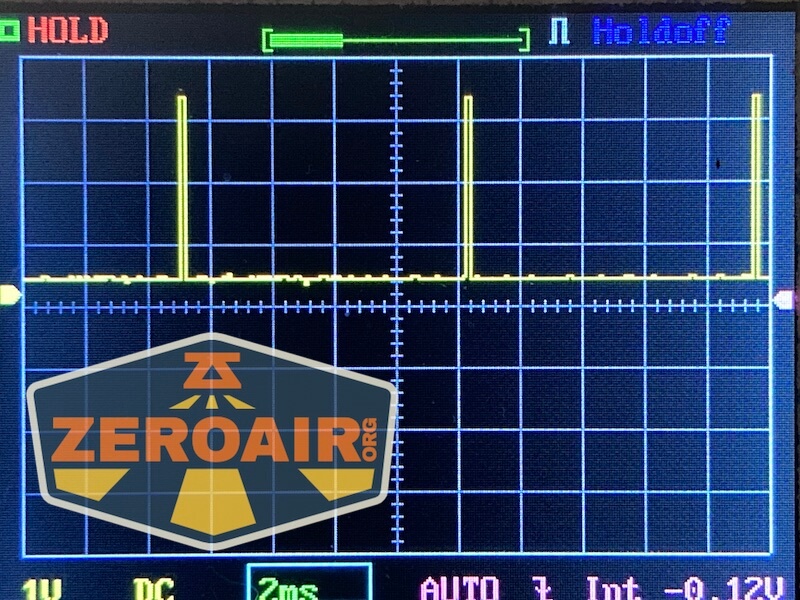
Here you can see a “baseline” – a chart with almost no light hitting the sensor. Then there’s the Ultrafire WF-602C flashlight, which has some of the worst PWM I’ve seen. It’s so bad that I used a post about it to explain PWM! Here are multiple timescales (10ms, 5ms, 2ms, 1ms, 0.5ms, 0.2ms) to make comparing this “worst” PWM light to the test light easier. That post also explains why I didn’t test the WF-602C at the usual 50us scale.


User Interface and Operation
Observer Tools went with a single e-switch for controlling the FL1000. This switch has a big domed cover and is easy to find and click.


The action is fairly deep.

Here’s a user interface table! The user interface is the same with either power source.
| State | Action | Result |
|---|---|---|
| Off | Click | High |
| High | Click | Medium |
| Medium | Click | Low |
| Low | Click | Off |
I do not see any mention of strobes, which is sort of nice.
Also a consideration for using the light is how to switch between zoom and flood. The manual states to “slide the head to the right or left to select the desired zoom.”
LED and Beam
Observer Tools states (on the box, specifically) that this is a Cree XHP50 emitter, but to the best of my knowledge (and checking) this is not like any other Cree XHP50 available.

In the configuration below, the FL1000 is in the flood output setting. There is no lens over the domed glass you see below.

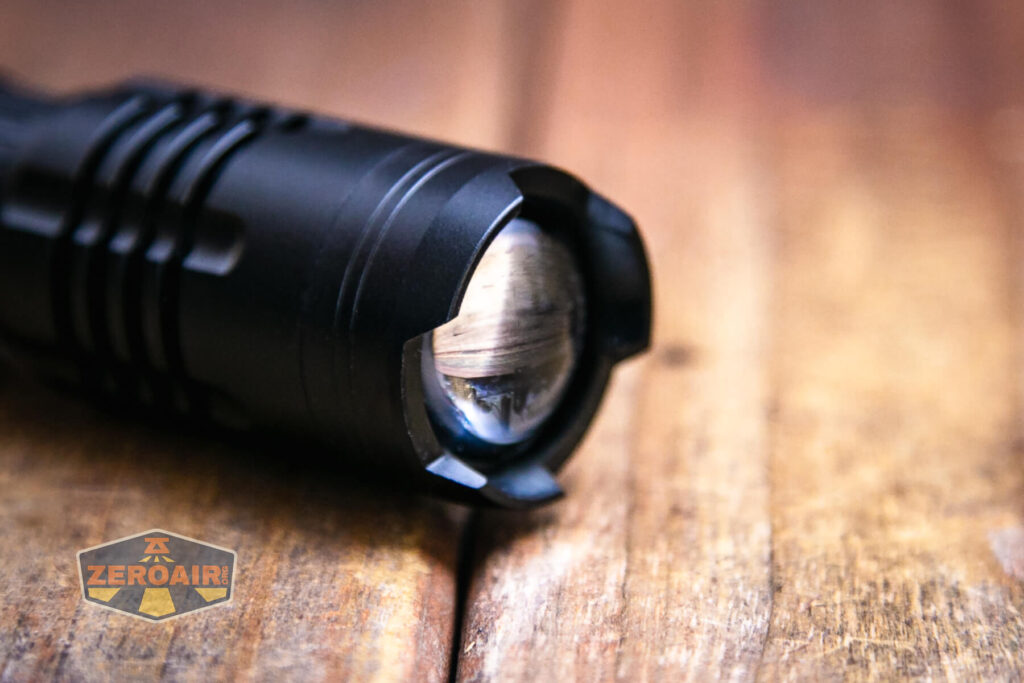
A strike bezel is built in to the front of the light. It actually has fairly sharp edges, so could really be used for striking.

Left below is the “most floody” output. And at right is the “most zoomed” output. That’s the range – there are no detents in the travel between flood and throw, so you can easily select any level you wish and the head will stay right there until you twist it again.


LED Color Report (CRI and CCT)
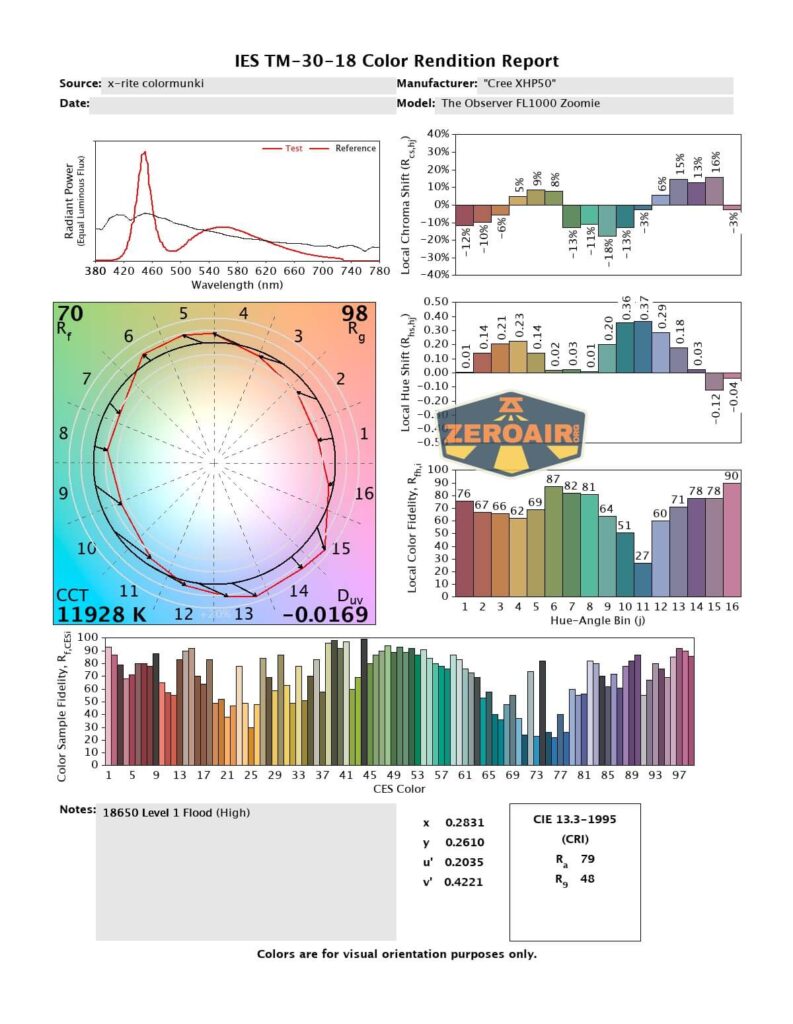
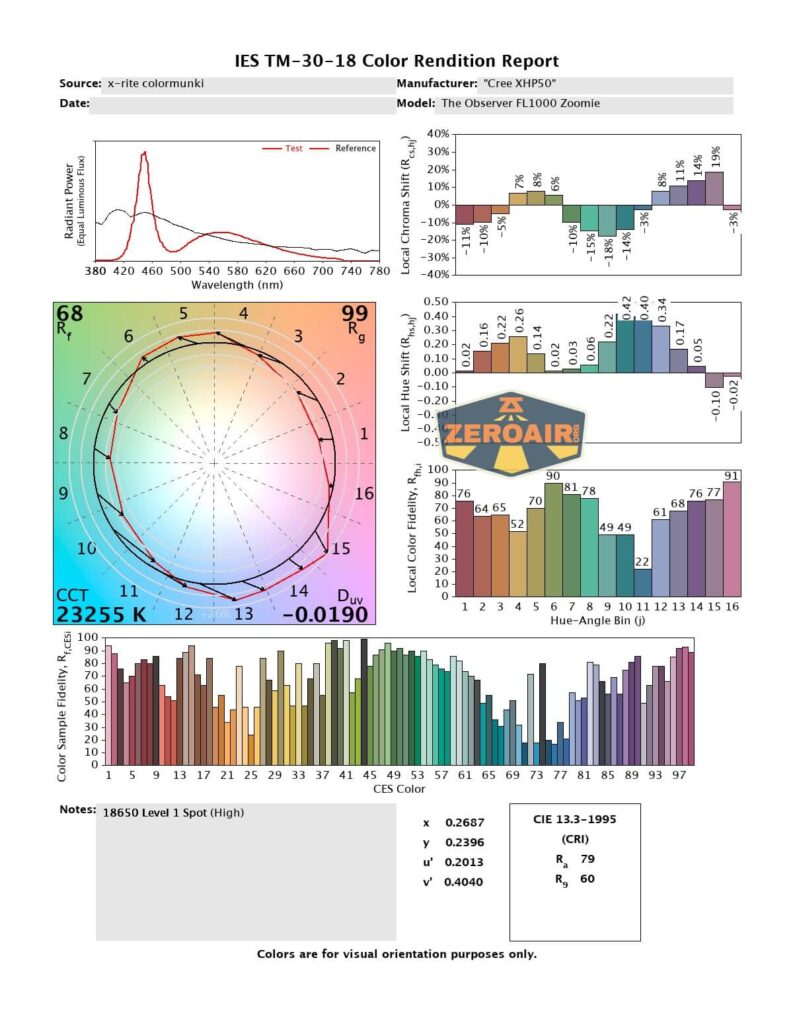
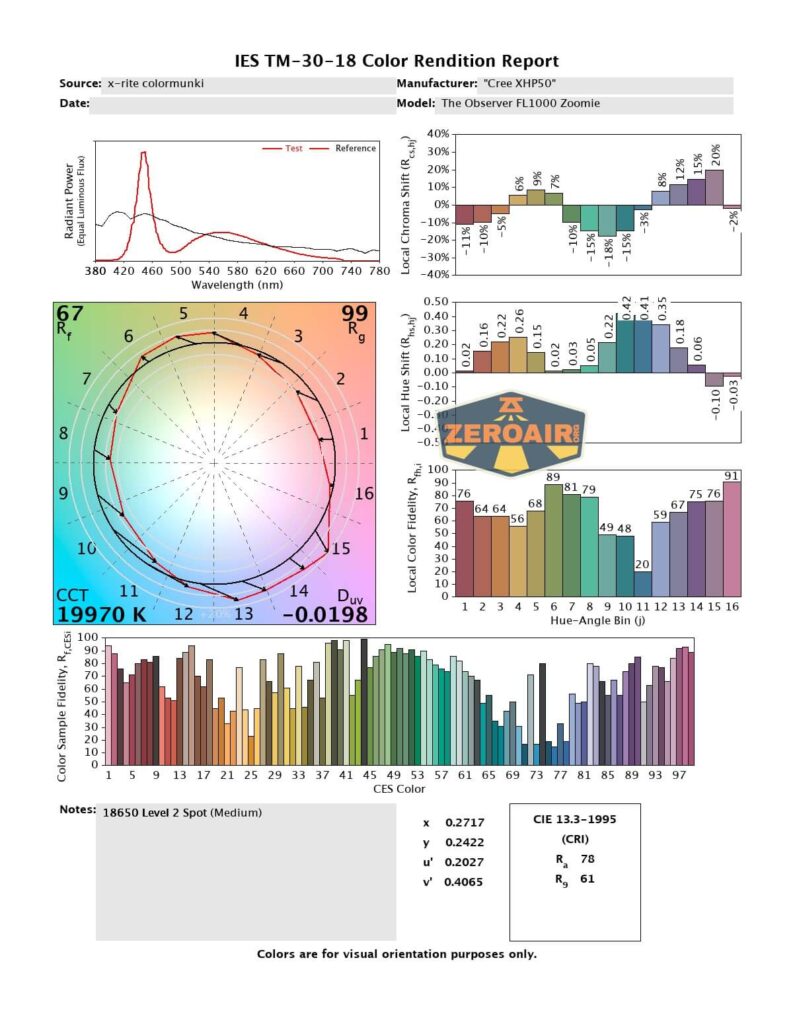
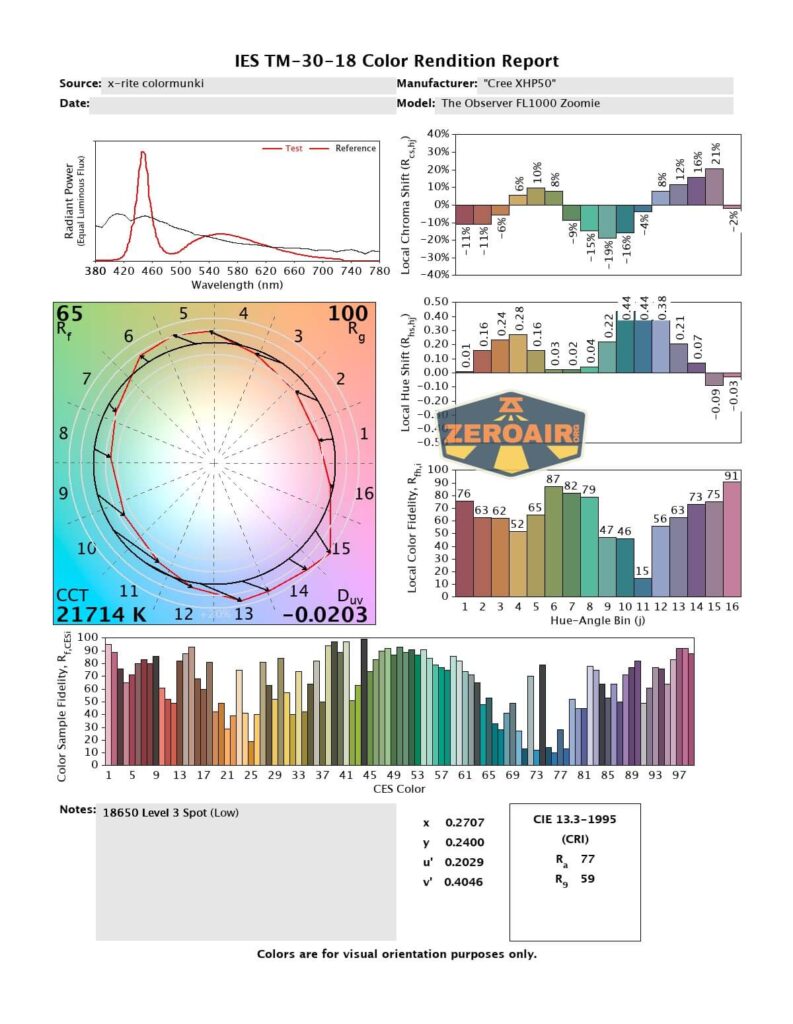
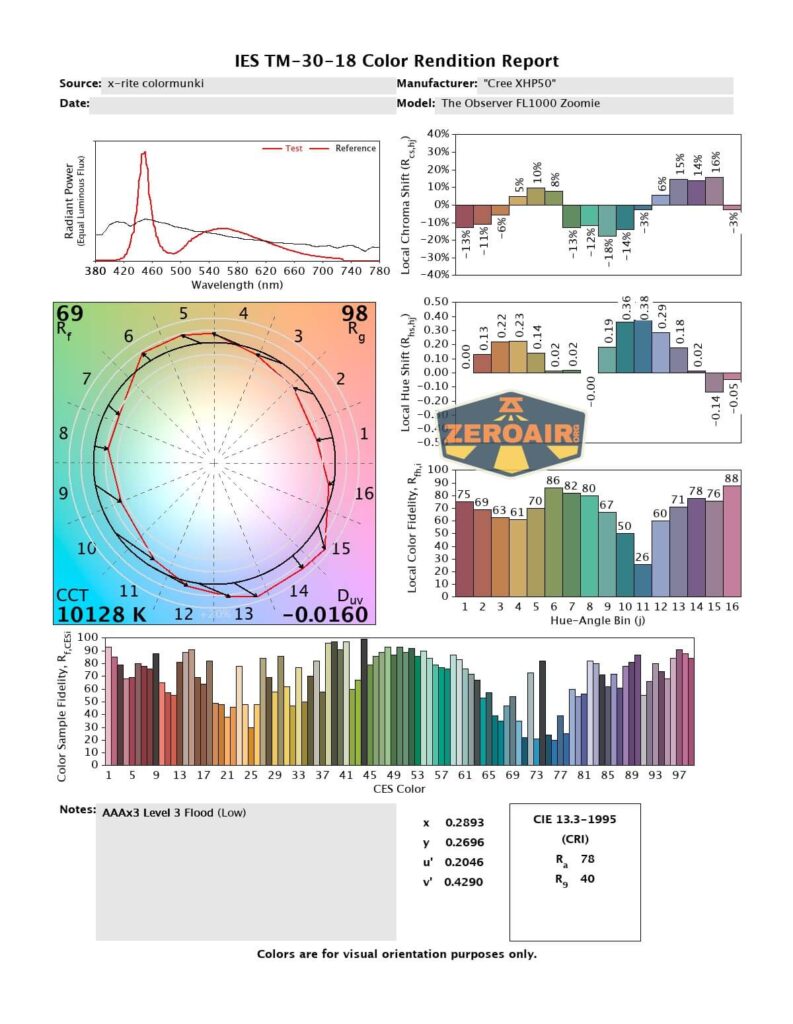
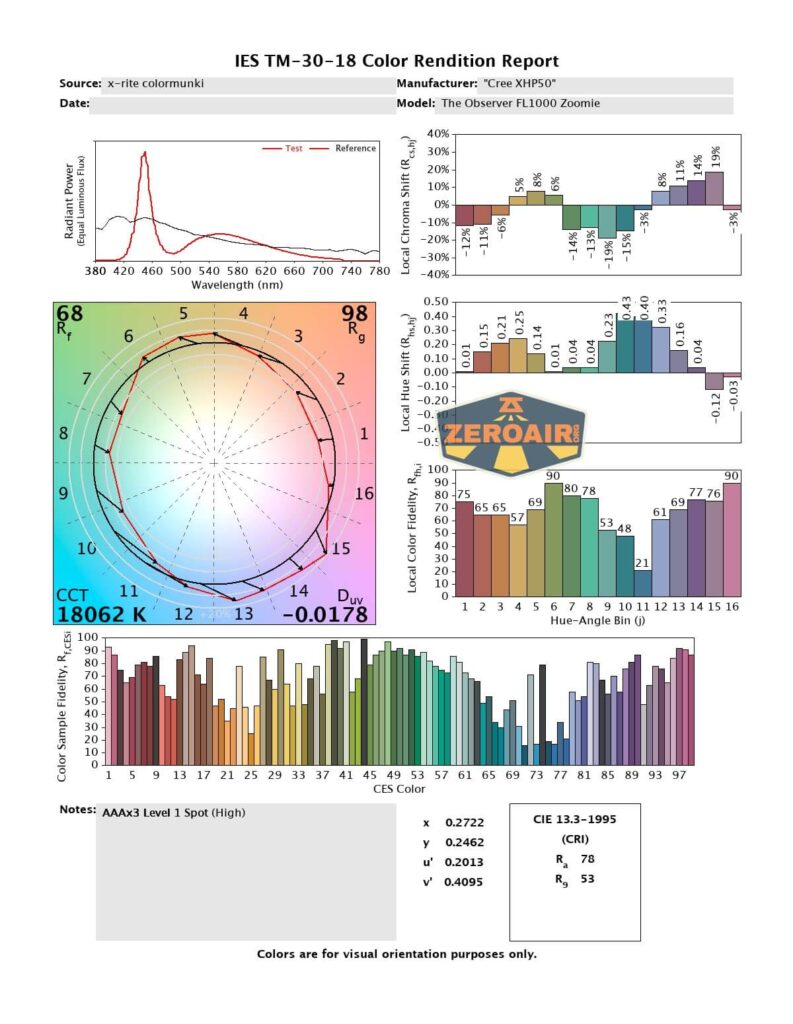
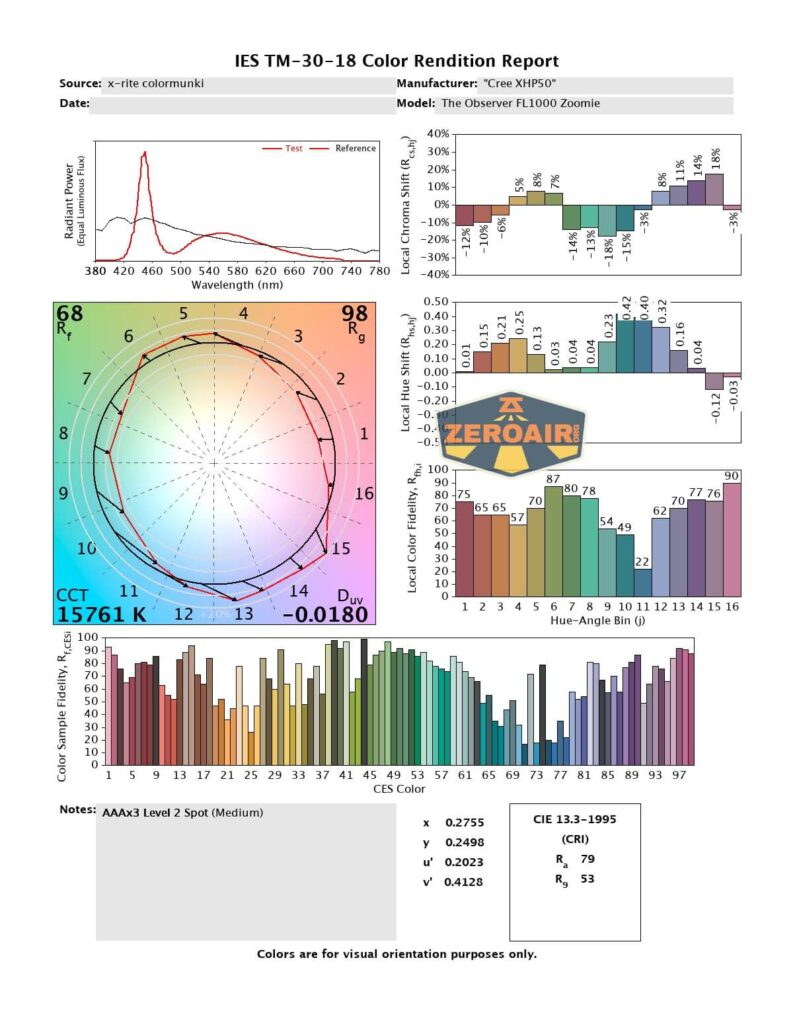
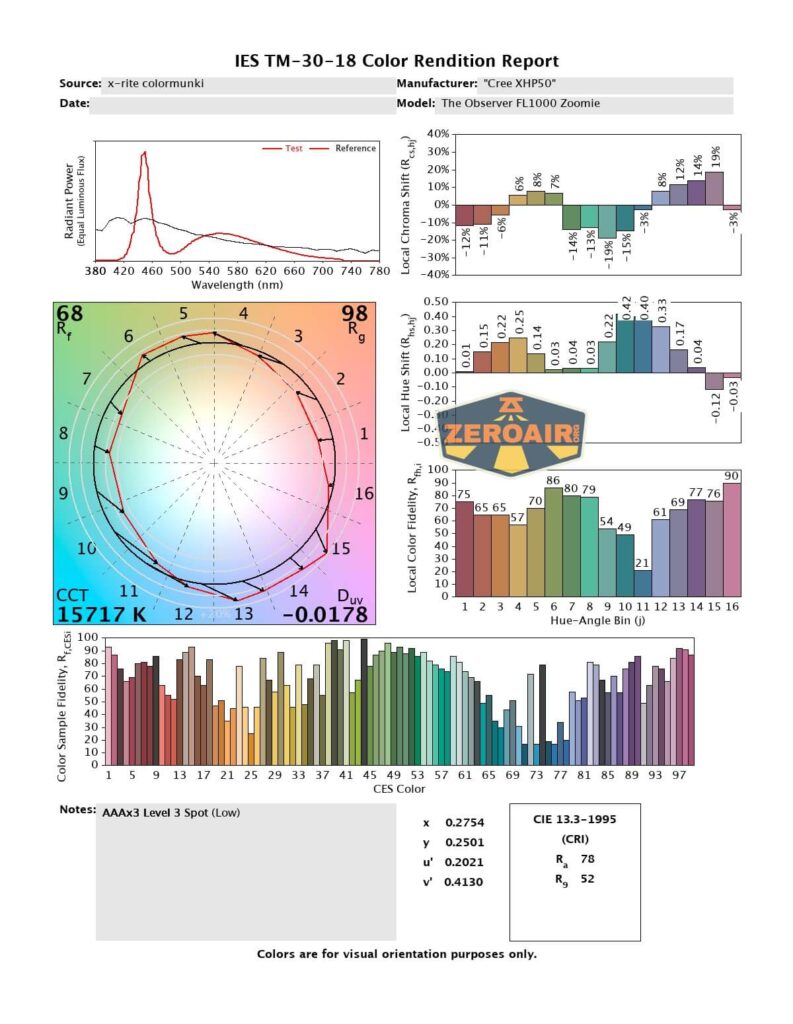
CRI and CCT tell a good bit of the story on the Observer FL1000 Zoomie flashlight. CCT ranges from around 10,000 all the way up to over 23,000. Even 10,000 is very cool white so 23,000 could easily be considered more of a blue color. The beamshots below in a controlled setting clearly demonstrate this, too. It’s for this reason (if no other) that you’d want to swap the emitter. This is simply too cold. CRI is mid to low, at around 79. CCT does seem to be affected by zoom level, and so I’ve included all outputs below. The top row is 18650 and the bottom row is AAA.




Beamshots
These beamshots always have the following settings: f8, ISO100, 0.3s shutter, and manual 5000K exposure. These photos are taken at floor level, and the beam hits the ceiling around 9 feet away. The top row is 18650 and the bottom row is AAA.

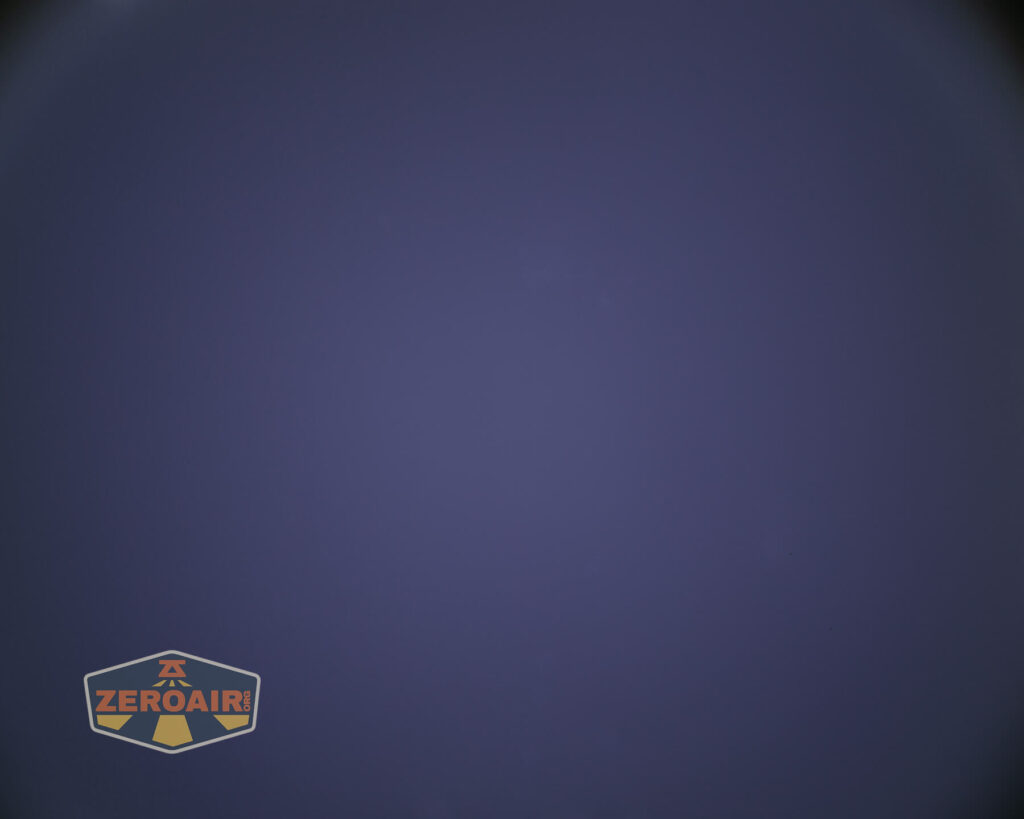

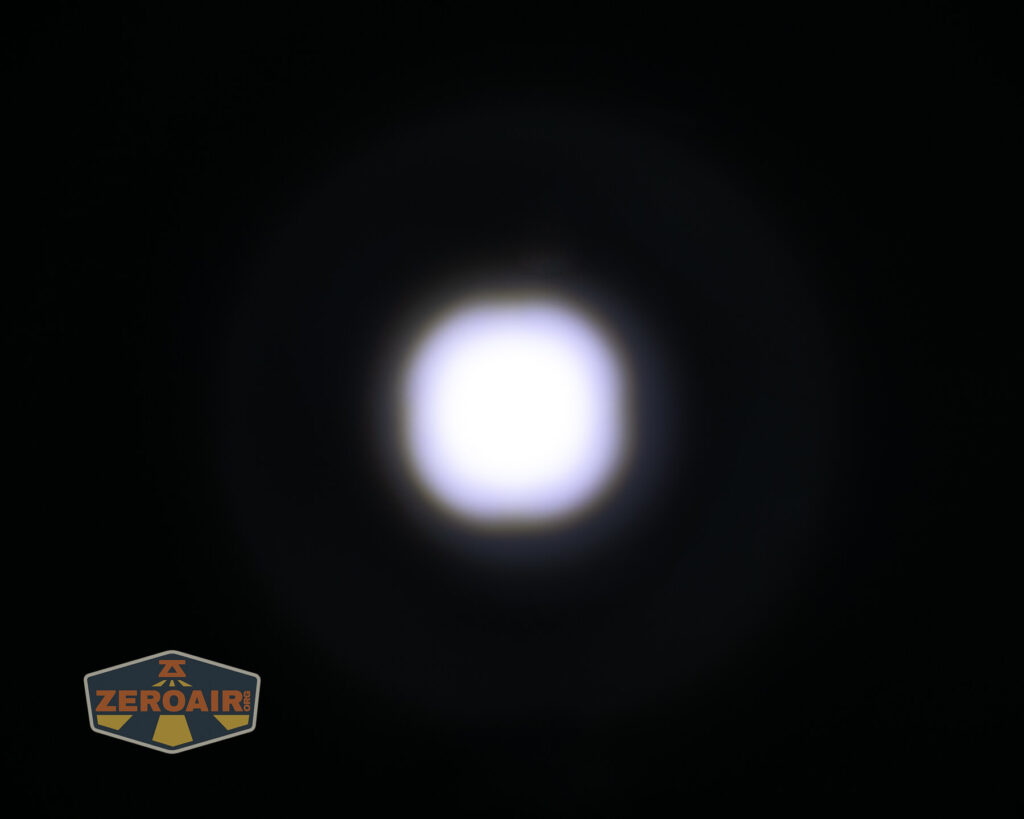

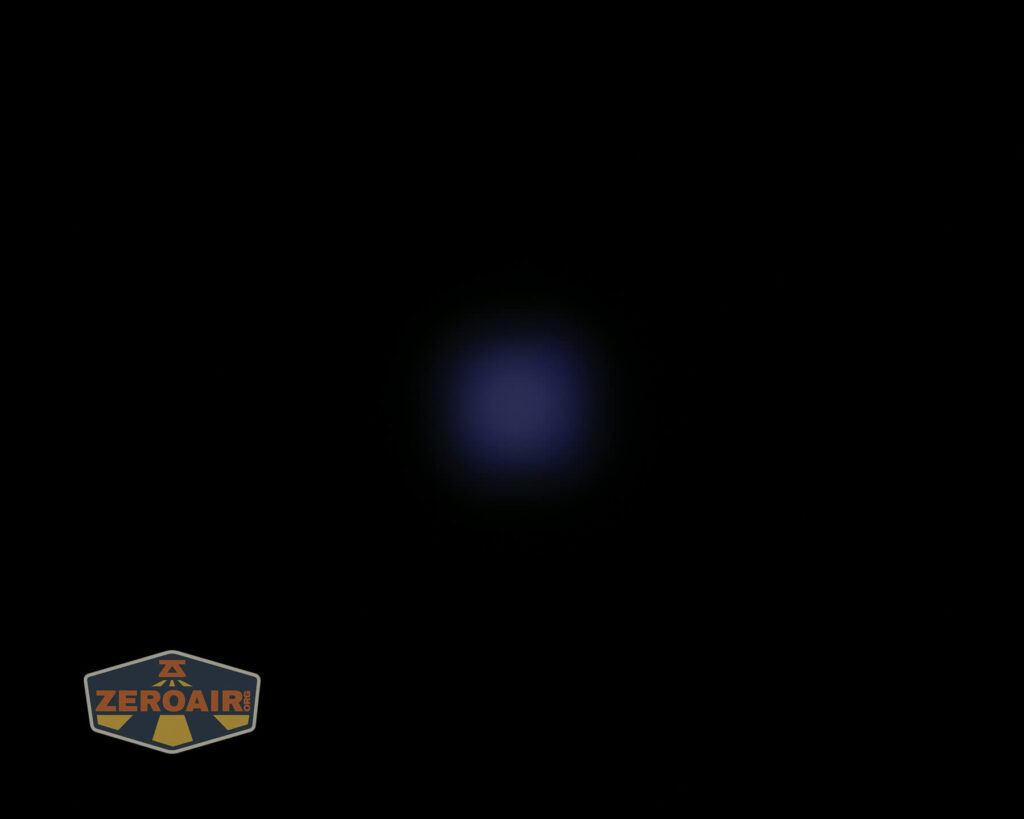




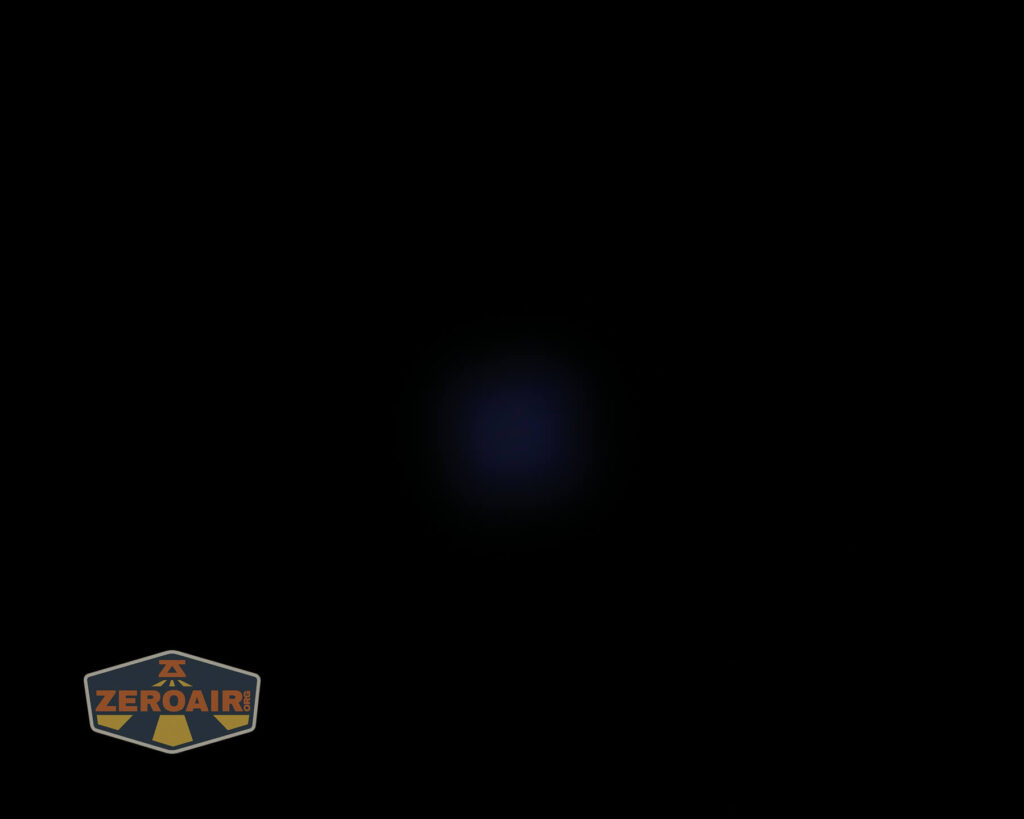
Tint vs BLF-348 (KillzoneFlashlights.com 219b version) (affiliate link)
I keep the test flashlight on the left and the BLF-348 reference flashlight on the right. The top row is 18650 and the bottom row is AAA.


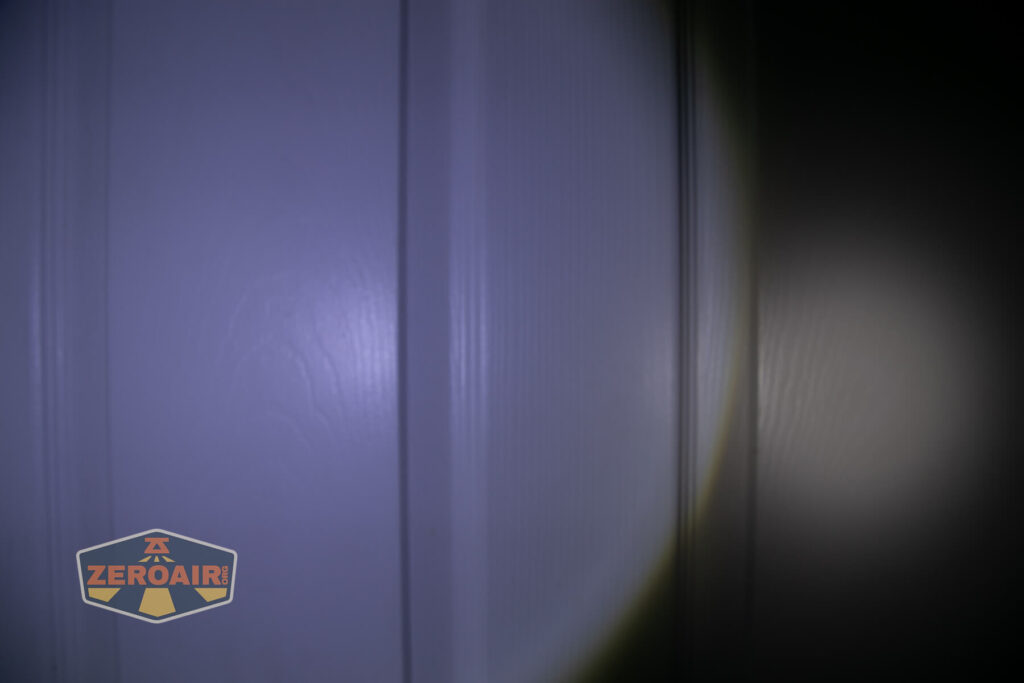





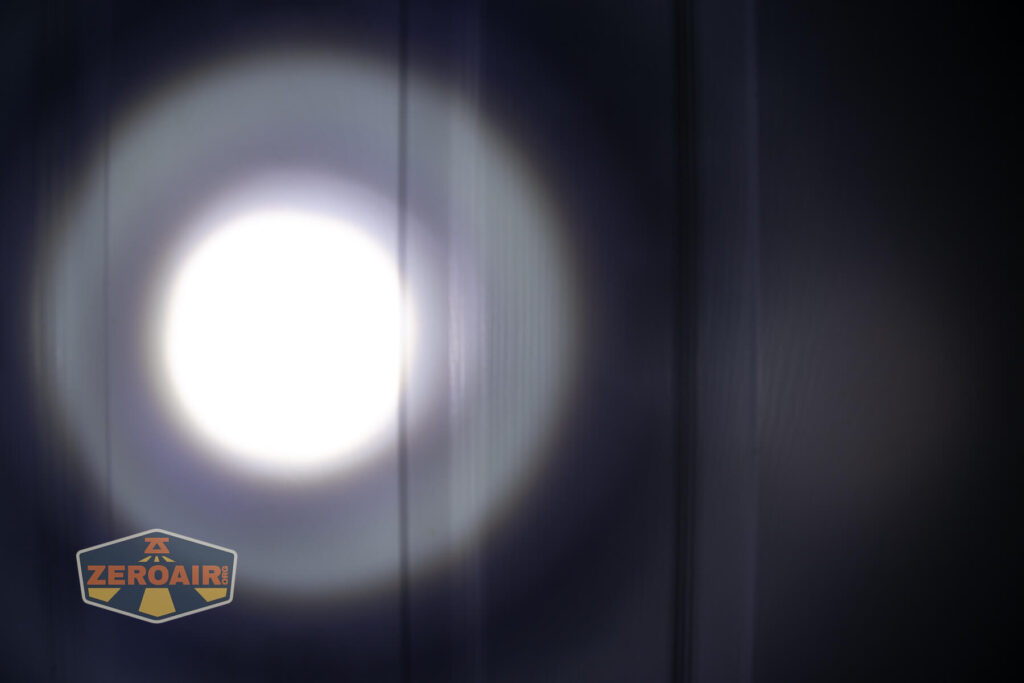
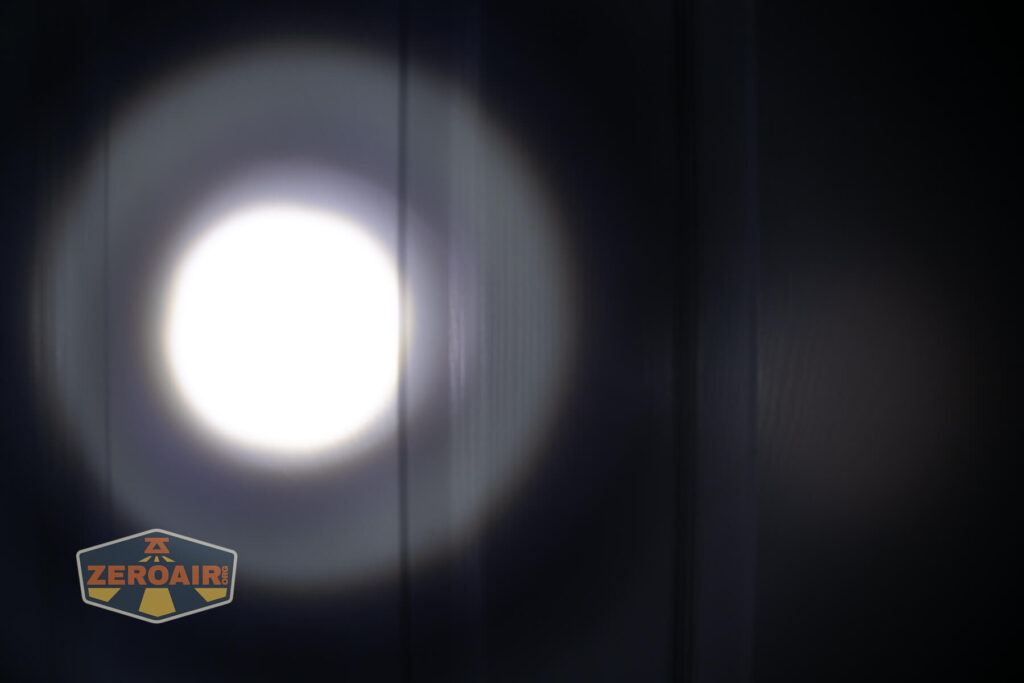
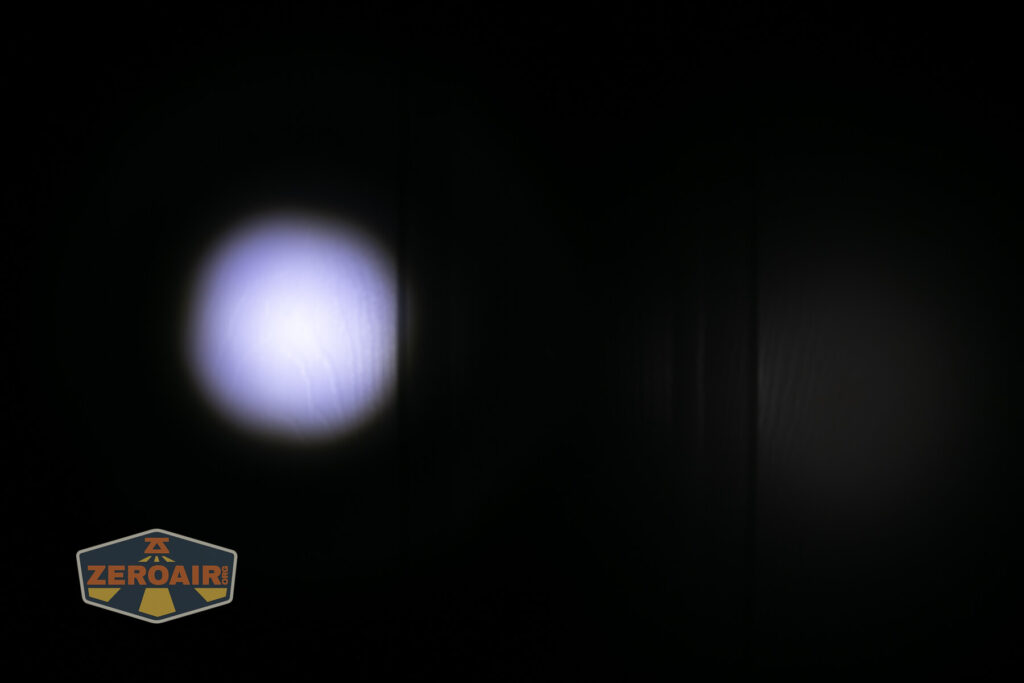
I compare everything to the KillzoneFlashlights.com 219b BLF-348 because it’s inexpensive and has the best tint!
Conclusion
What I like
- Feature-rich package
- Includes 18650 cell
- Charging / powerbank cable is neat!
- Magnet is strong enough to actually hold the light
- User interface is very simple
- No strobe modes
What I don’t like
- Extremely cool emitter CCT
- Very slow PWM on low mode
- Build quality has (too much) room for improvement
- Waterproofness is very questionable
- Must cycle through the modes to turn the light off
Notes
- This content originally appeared at zeroair.org. Please visit there for the best experience!
- For flashlight-related patches, stickers, and gear, head over to PhotonPhreaks.com!
- Please use my Amazon.com referral link to help support zeroair.org!
- Please support me on Patreon! I deeply appreciate your support!