

Olight Warrior Nano Flashlight Review
The Olight Warrior Nano flashlight is out, and it’s fantastic! It runs one 18350 (included) and has Olight’s great dual-stage tailswitch and an e-switch, too!
Official Specs and Features
Here’s a referral link to the Olight Warrior Nano flashlight product page.
Versions
As of right now, there are two versions. One’s black (this one!) and there’s a neat “Zombie Green” option too! The Zombie Green is limited to 6000 pieces.
Price
Olight is offering an introductory price on the Warrior Nano flashlight. It looks to be $56.24 and that includes the 18350 cell seen in this post. As much as I like the Warrior Nano (or “WN”) I think that’s a very good price.
Short Review
I have been asking for this light for ages. At least since Olight introduced the dual-stage tail switch 18650 lights. It’s just exactly as awesome as I thought it would be. I don’t have much more to say than that; I’m very excited about this light! There are even some user interface advancements that are worth talking about, too!
Long Review
The Big Table
| Olight Warrior Nano flashlight | |
|---|---|
| Emitter: | Unstated Cool White (probably Osram P9) |
| Price in USD at publication time: | $56.24 |
| Cell: | 1×18350 |
| Runtime Graphs | |
| LVP? | Yes |
| Switch Type: | E-Switch |
| Quiescent Current (mA): | ? |
| On-Board Charging? | Yes |
| Charge Port Type: | Proprietary Magnetic |
| Charge Graph | |
| Power off Charge Port | Lowest four levels |
| Claimed Lumens (lm) | 1200 |
| Measured Lumens (at 30s) | 1050 (87.5% of claim)^ |
| Candela per Lumen | 4.63 |
| Claimed Throw (m) | 135 |
| Candela (Calculated) in cd (at 30s) | 168lux @ 5.669m = 5399cd |
| Throw (Calculated) (m) | 147.0 (108.9% of claim)^ |
| Claimed CCT | 5700=6700 |
| Measured CCT Range (K) | 6400-7700 Kelvin |
| Item provided for review by: | Olight |
| All my Olight reviews! | |
^ Measurement disclaimer: Testing flashlights is my hobby. I use hobbyist-level equipment for testing, including some I made myself. Try not to get buried in the details of manufacturer specifications versus measurements recorded here; A certain amount of difference (say, 10 or 15%) is perfectly reasonable.
What’s Included

- Olight Warrior Nano flashlight
- Olight 1100mAh 18350 (customized, proprietary)
- Charging cable (USB to proprietary magnetic – Standard MCC)
- Wall mount L-bracket
- Manual etc
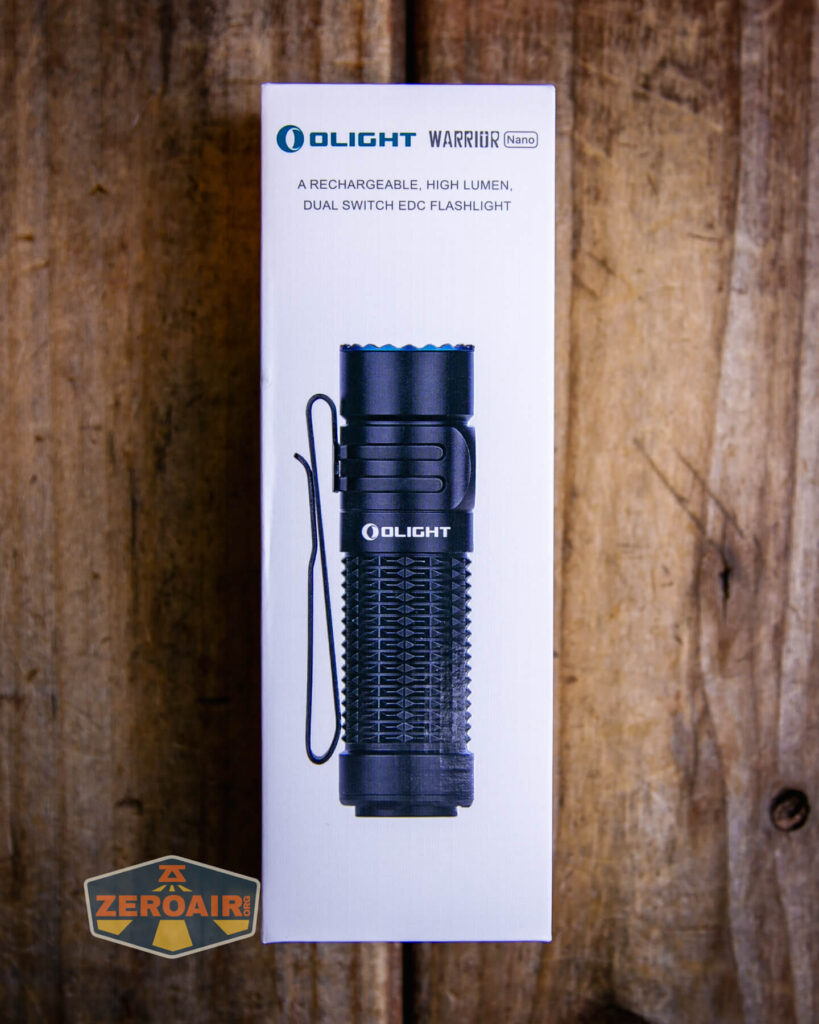
Package and Manual


Build Quality and Disassembly

If you’re like me, the first thing you think when you see this is that it might be “too long.” I thought that too! But think about this: it’s shorter than your ‘standard custom’ (hashtag custom) and it has a two-stage tail switch. So the size is really perfect, especially for EDC.
The second point from that is that of course the build quality is great. Olight always has great build quality!


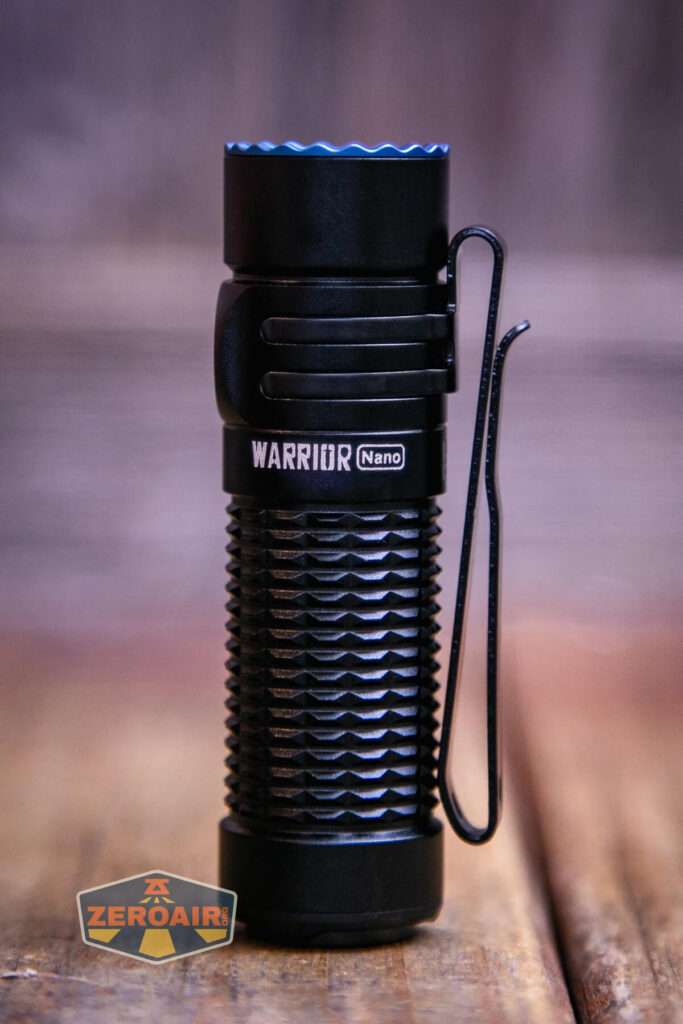
I didn’t pull this bezel off, but it does seem to be the same type of bezel that has allowed emitter swaps on other similar lights. That’s good news (you can see why later).
Much of the design here is brought over from other Olights. Generally, the Warrior line, but most specifically the Warrior Mini 3. I’ve reviewed that light before in green.

The contacts inside are much like the Warrior Mini 3, too. The head has both positive and negative, and the tail (below) has a spring with some (very Zebralight-like) contacts, too.

Size and Comps
81mm x 23mm and 85g (with battery)


If the flashlight will headstand, I’ll show it here (usually the third photo). If the flashlight will tailstand, I’ll also show that (usually in the fourth photo).


Here’s the test light with the venerable Convoy S2+. The version below is a custom laser-engraved Convoy S2+ host by GadgetConnections.com. I did a full post on an engraved orange host right here! Or go straight to GadgetConnections.com to buy your Convoy S2+ now!


Also above is the light beside a new standard 18350 light! It’s not one I’ve reviewed yet but this is the CWF Arcadian Peanut in aluminum. This one is stonewashed and has the new Quantum Dragon driver – a whole new product! Stay tuned for a full review of this tiny powerhouse!
Here’s the Olight Warrior Nano flashlight beside another Warrior Mini 3 (which I have not reviewed yet!). This is the Cracked Brass edition! These lights are essentially the same, but they notably do use (very?) different emitters. I think the footprint is the same though (5050 footprint).


The parts are interchangeable. Note that the Warrior Nano does have a proportional (shorter) pocket clip!


Retention and Carry
This light includes a pocket clip. The pocket clip has a specific place and orientation – just opposite the switch. This is a two-way clip, so technically could be carried bezel up or down, but the only reasonable way is really bezel up. Though the pocket clip is opposite the switch, I didn’t have any problems with accidental activation, and I didn’t tend to lock the light out.
Olight now sells a little adapter for the Warrior Mini 3 that will also work perfectly for this light. With that adapter, you can install the clip on the other end of the light.


The clip has a little hole, too, which is great for lanyard attachment. (Note: no lanyard is included.)
Of course, the base of the Olight Warrior Nano flashlight is magnetic because of the way this light charges. But that magnetic base also serves as a great connection point for the Nano, too. Olight even includes the little L-bracket for this purpose.
Power and Runtime
The Olight Warrior Nano flashlight includes a proprietary 18350. There are both positive and negative contacts on the positive end, (and only negative on the negative end). This facilitates onboard charging. These lights will not charge any type of cells except these specific Olight cells.

Just like the Baton 3 Pro and Warrior Mini 3, the cell on this Baton fits in the “normal” way – positive (button) toward the head. Despite that, regular button top 18350 cells will not work in this light.

Below you can see the runtime tests for the highest four levels. If you glanced back at the Baton 3 Pro or Warrior Mini 3 testing posts, you’d note that performance is remarkably similar. Internally, I’d guess the Warrior Mini 3 is very similar to the Baton line is very similar to the new Nano – it’s a great lineage, really.


You might wonder about this “Half-Turbo” mode. More about that later, but for now just sort of enjoy it. It’s a nice high level and I have a sneaking suspicion that you wouldn’t even notice the difference between Half-Turbo and (full) Turbo. Yes, the difference in output is great, and yes, Turbo output does hold for over 1.5 minutes… but practically speaking, in use the difference is minimal.
I guess the point here is that if you’re willing, you can use “Half-Turbo” as your main highest level and have a great experience.

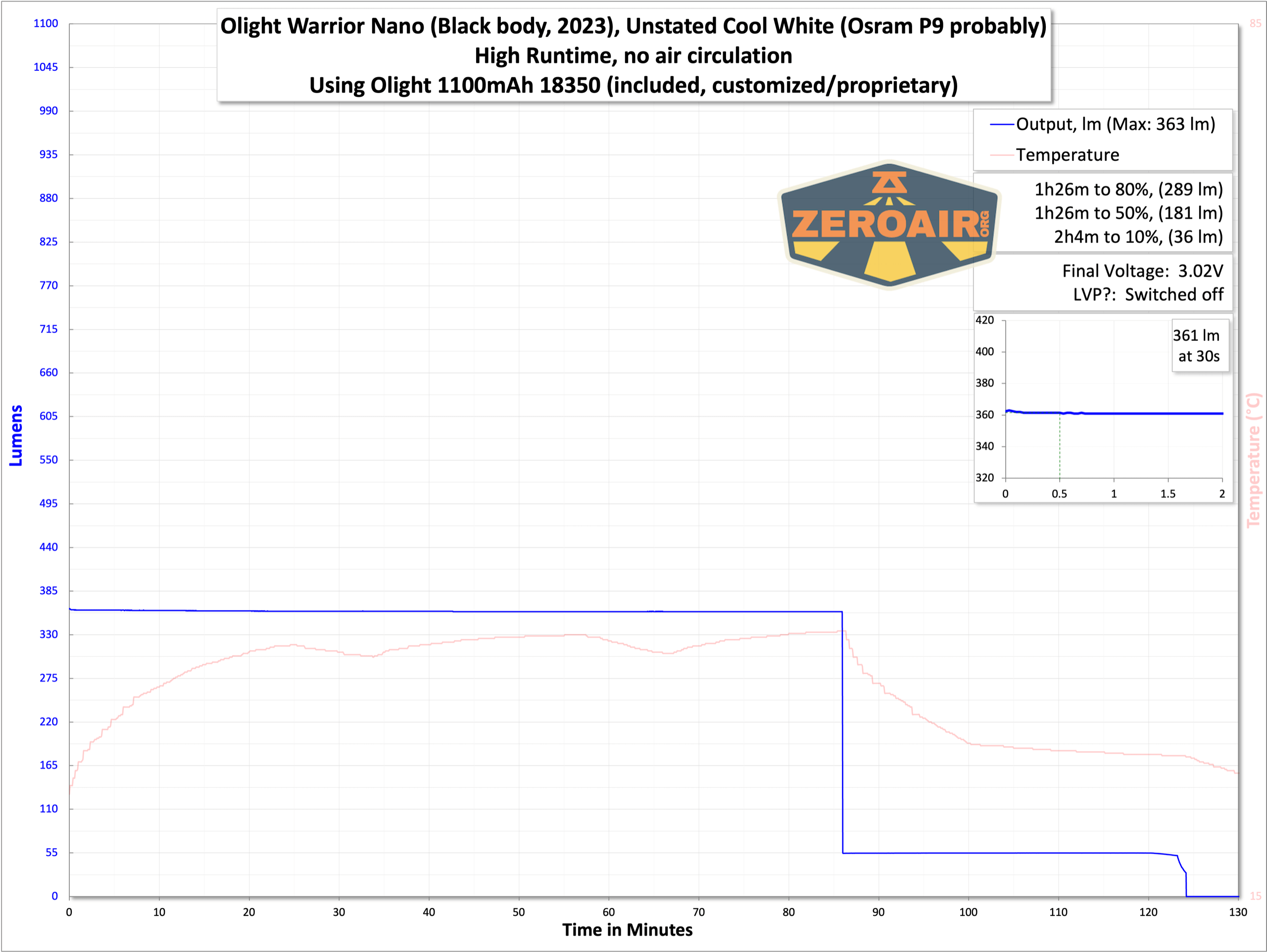

To be perfectly honest, I’m not sure you’ll even be able to tell the difference between Turbo and Half-Turbo after setting it… Sure it’s a difference of 2x but it’s not “twice as perceptible.”
Charging
Olight offers charging in the Olight Warrior Nano flashlight. It’s proprietary magnetic, but it’s the same as practically all the other Olights. This is the MCC 1A version.

Unlike on some other Olights, the charging base here is also a switch! It’s a very good switch and I do love it. The two rings you see below are all part of just one switch, and they actuate together (or really are just one piece). They’re separated for electrical reasons (that is: charging).

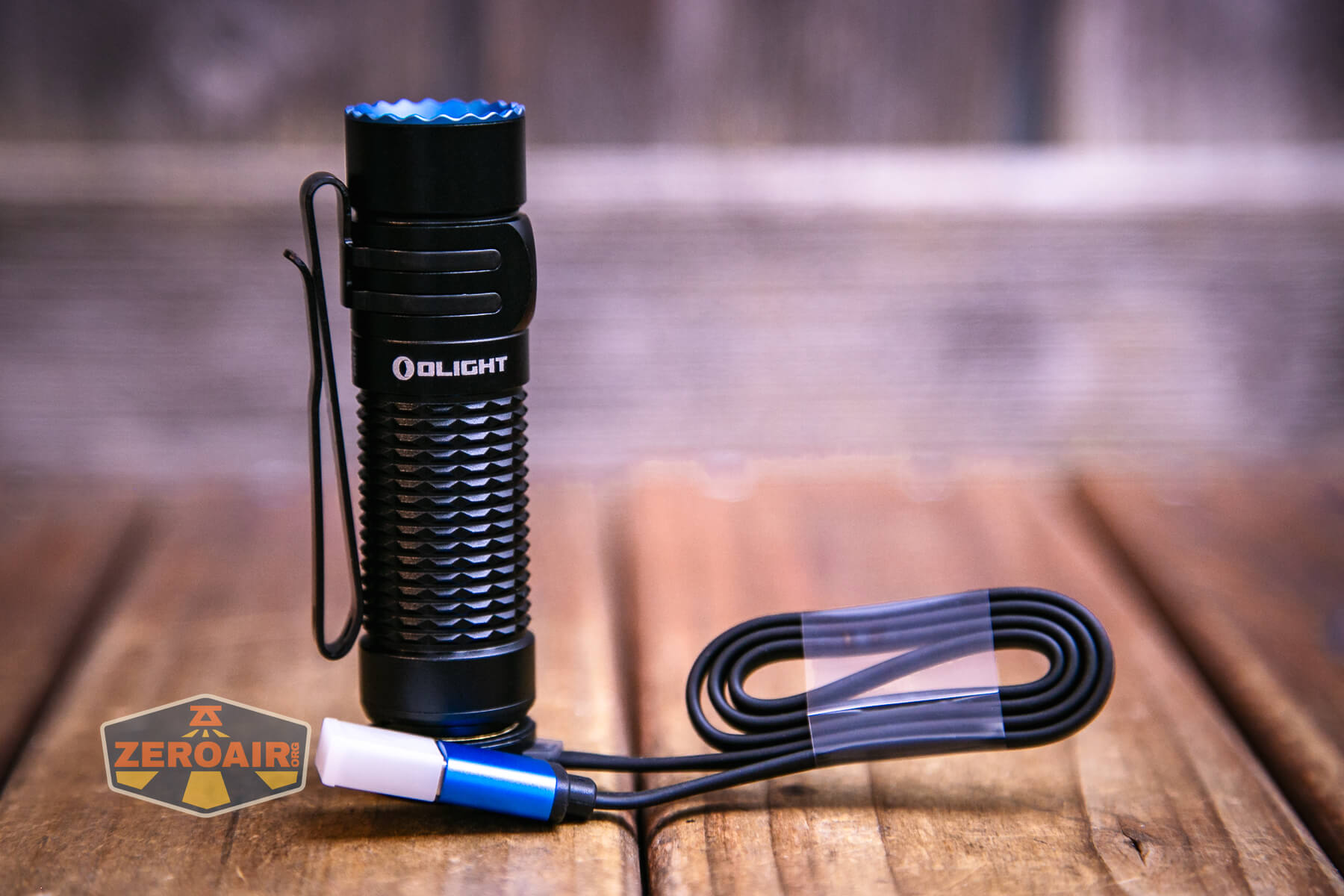
Charging proceeds at around 1A, and the 1100mAh cell is charged in around 1.5 hours. The charging base is red when charging, and green when not being used or the cell is “completely charged.” I noted in charge testing that the indicator on the charger would turn green before the trickle CV phase had stopped putting power into the cell. I will say that it seems that Olight has continually iterated this charging base, as this is probably the best (most consistent) charge cycle I’ve seen yet. This is a very nice charge cycle.

The indicating e-switch does not give any charging information, but the charging bases all have a red/green indicator. Red means charging and green means charging is complete.
Modes and Currents
| Mode | Mode Claimed Output (lm) | Claimed Runtime | Measured Lumens | Tailcap Amps |
|---|---|---|---|---|
| Turbo | 1200-400 | 3m+77m | 1098 (0s) 1050 (30s) |
3.02 |
| Half-Turbo | 600-400 | 10m+75m | 540 | (unable to test) |
| High | 400-60 | 85m+35m | 361 | 0.62 |
| Medium | 60 | 10h | 48 | 0.07 |
| Low | 15 | 36h | 14.3 | 0.02 |
| Moonlight | 0.5 | 40d | 0.25 | [low] |
Pulse Width Modulation
Nothing really to mention here. None of the modes seem to be using PWM. That wave graph on the second to lowest mode is fun, though.
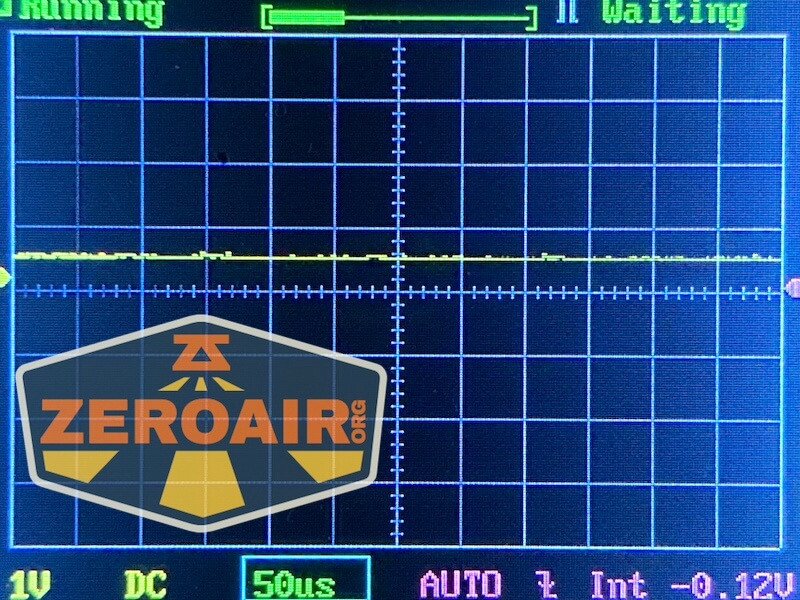

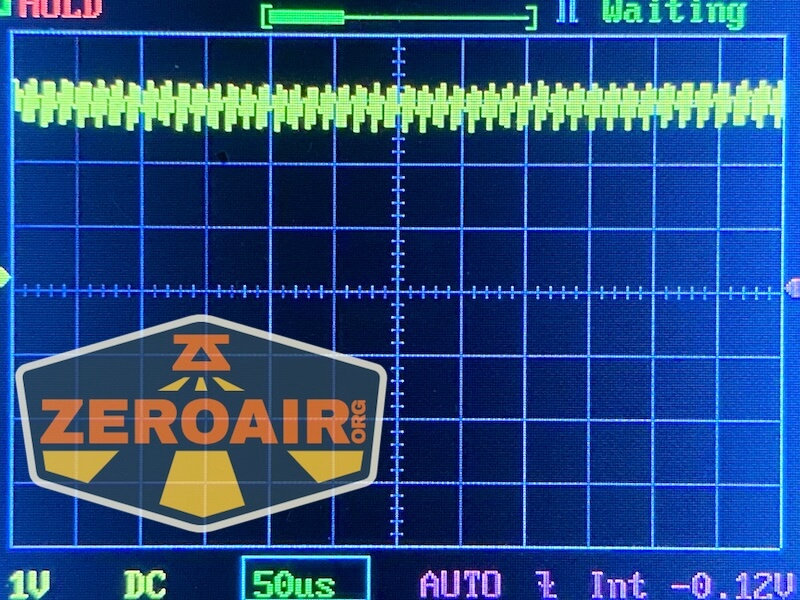


Here you can see a “baseline” – a chart with almost no light hitting the sensor. Then there’s the Ultrafire WF-602C flashlight, which has some of the worst PWM I’ve seen. It’s so bad that I used a post about it to explain PWM! Here are multiple timescales (10ms, 5ms, 2ms, 1ms, 0.5ms, 0.2ms) to make comparing this “worst” PWM light to the test light easier. That post also explains why I didn’t test the WF-602C at the usual 50us scale.


User Interface and Operation
There are two switches on the Olight Warrior Nano flashlight. First is the metal tail switch which also is used in charging.
To be honest, I loved the old switch. It had a sort of tripod built in around the switch so that the light would reliably tailstand. But this one has it too! The switch is just proud. It’ll still tailstand easily, but when the switch is pressed, the tripod tail is more revealed.


Next is the indicating side e-switch. Olight continues to subtly refine these switches, and this one is even better still. It has a very flat movement but seems to have added a reliable click. The movement is nice and deep but with no squish at all. This is a surprising level of advancement in e-switches by Olight.


Here’s a user interface table! This is practically the same user interface as is on the Warrior Mini 3, but with some fun new wrinkles.
| State | Action | Result |
|---|---|---|
| Off | Click Side Switch | On (Mode Memory) |
| Off | Hold Side Switch | Moon |
| Off | Double Click Side Switch | Turbo |
| Any | Triple Click Side Switch | Strobe |
| On | Click Side Switch | Off |
| On | Hold Side Switch | Mode Advance (L>M>H) (Moon and Turbo are excluded from the cycle) |
| Turbo | Double Click Side Switch | Return to previous mode (If previous was “High,” returns to Med. If previous state was “off”, returns to Moonlight) |
| Off | Long Hold Side Switch | Lockout (Technically “Moon then lockout”) |
| Lockout | Click Side Switch | Switch indicating lockout (red for 2s) |
| Lockout | Hold Side Switch | Unlock to Moonlight |
| Any | Shallow press (“half-press”) Tail Switch | Medium (in Config 1, default) Medium (in Config 2) |
| Any | Deep press Tail Switch | Turbo (in Config 1) Strobe (in Config 2) |
| Off | Deep press Tail Switch, Click Side Switch | Switch between Config 1 and 2 (confirmation exists by way of what fully depressing the tail switch does in each config (as above)) |
| Off while charging on charger | Hold side switch >2s | Lockout, then iterate Config 1 between Turbo (default) and “Half-Turbo” for a deep press on tail switch. I believe this also selects Config 1. |
I do sort of wish the soft tail switch press was configurable like the deep press is. I’d love to have a soft press go to Moonlight.
LED and Beam
One big difference between the Olight Warrior Nano flashlight and the Warrior Mini 3 is the emitter. This appears to be an Osram P9, but Olight does not say. They do say it’s a cool white emitter, and that’s proven with the data below. Like the Warrior Mini 3, though, this emitter is under a TIR, but there is no glass over the TIR. That’s a fairly big and unfortunate loss here.


LED Color Report (CRI and CCT)
Olight states this is a 5700K-6700K emitter. I think it’ll still catch some grief but it’s very notable that there’s almost no green at all in the output. The CCT does drift very high to the cool side of things. On the lower modes, Duv is negative, which is great.


Beamshots
These beamshots always have the following settings: f8, ISO100, 0.3s shutter, and manual 5000K exposure. These photos are taken at floor level, and the beam hits the ceiling around 9 feet away.


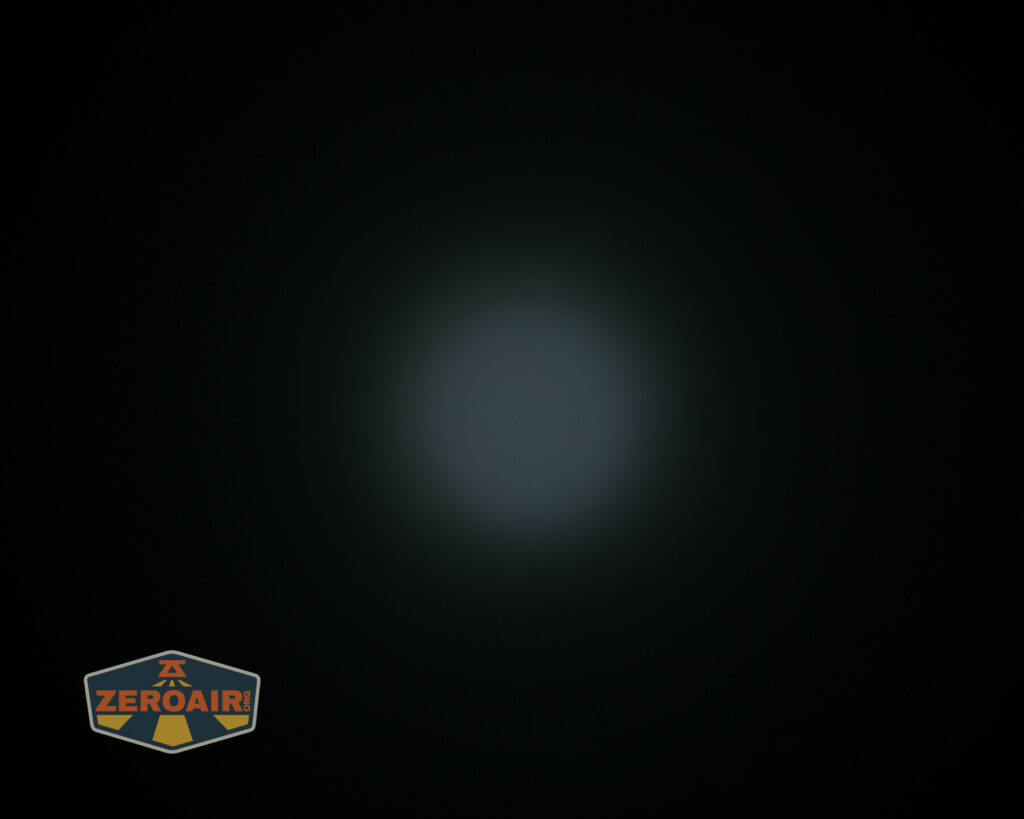

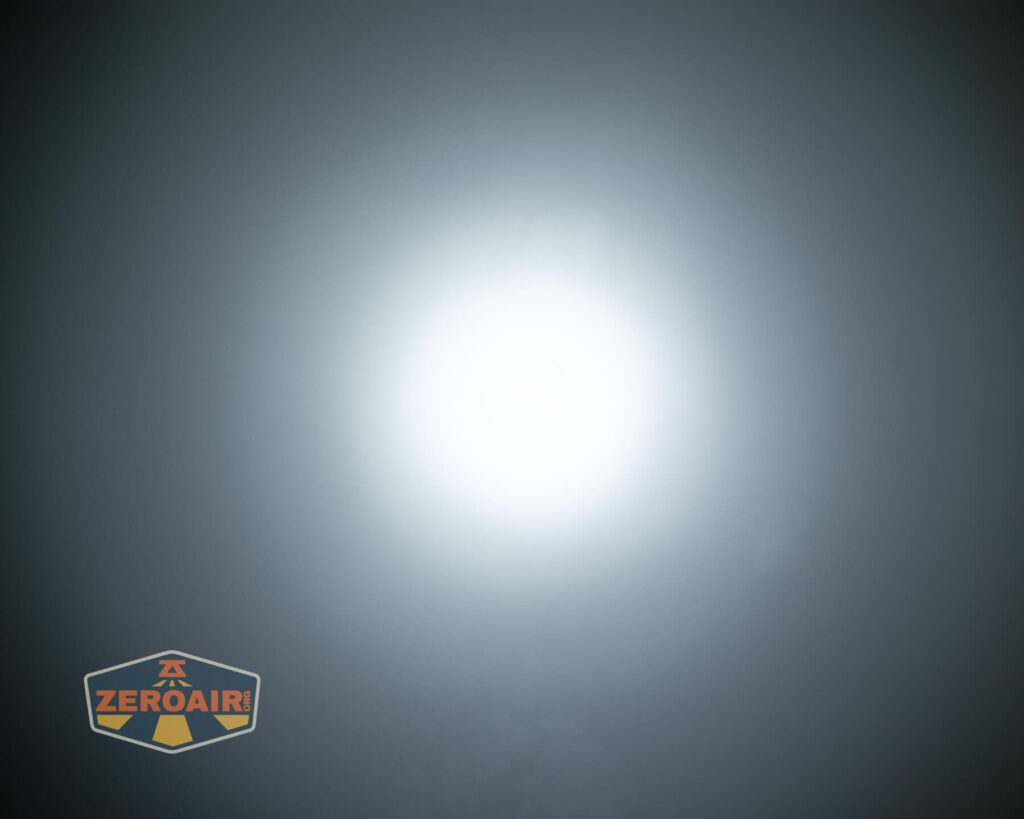

Tint vs BLF-348 (KillzoneFlashlights.com 219b version) (affiliate link)
I keep the test flashlight on the left and the BLF-348 reference flashlight on the right.


I compare everything to the KillzoneFlashlights.com 219b BLF-348 because it’s inexpensive and has the best tint!
Conclusion
What I like
- Complete package
- Good (and reliable) user interface.
- Nice user interface update, while maintaining great familiarity
- Very good beam profile (very tight beam!!)
- New and improved clip over version 1 (and not just a reused long Warrior Mini 3 clip, either)
- Half-Turbo. I do like that well enough to mention it specifically
- The size – this is a dual switch light that comes in at 83mm long… it’s really fantastic
- Emitter swapability (I think). The bezel is separated and doesn’t seem press-fit, so it should be possible.
- There’s no proximity sensor!
What I don’t like
- [Very] Cool white emitter
- Proprietary cell
- Proprietary charging
Notes
- This content originally appeared at zeroair.org. Please visit there for the best experience!
- Please use my Amazon.com referral link to help support zeroair.org!
- Please support me on Patreon! I deeply appreciate your support!
A great review and thanks for all your efforts. One question I have, is moonlight memorized? The instruction don’t make that clear. I miss that about the old batons, because you have direct access to 3 modes. It has kept me from ordering the newer ones.
Moonlight is definitely memorized.
Thanks!
Thanks for the reply. That makes it a pass for me.
Pingback: Revolutionary Olight Warrior Nano: Top 5 Features Reviewed