

Tactile Turn Apollo Flashlight Review
The Tactile Turn Apollo flashlight is for pen enthusiasts and is suited for a collector market. It has just three (High CRI) modes and excellent build quality!
Official Specs and Features
Here’s a link to the Tactile Turn Apollo flashlight product page.
Versions
At least four versions of the Tactile Turn Apollo flashlight have been available. That includes this titanium, but also X-Tone. X-Tone has a finish on the metal, but I don’t see that the metal is stated anywhere. (It’s also sold out.)
Price
The three available metals of Tactile Turn Apollo flashlight sell for $299. X-Tone is a bit more, at $349.
What’s Included

- Tactile Turn Apollo flashlight
- Nitecore 14500 (not the one seen above, that was my own cell)
Package and Manual


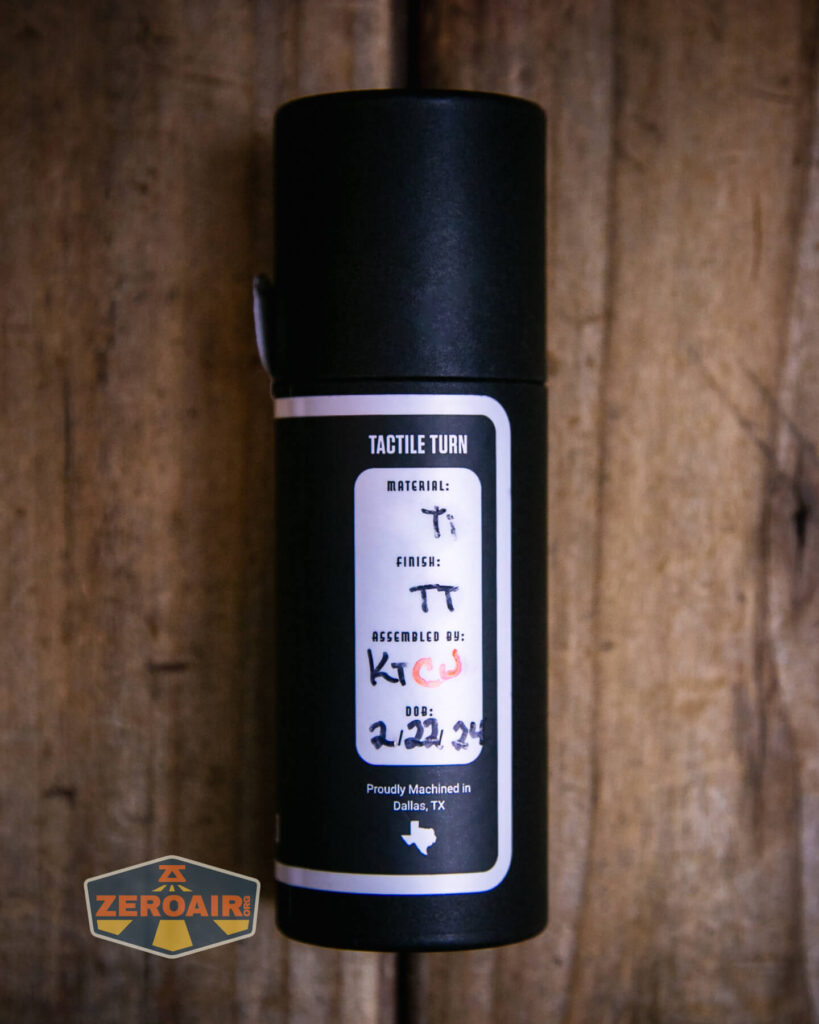
A manual is not included.
Build Quality and Disassembly

Based on the price, you might think the Tactile Turn Apollo flashlight is for flashlight enthusiasts. That’s fine, you can think that and not really be wrong. However, the Tactile Turn Apollo is in actuality a very nice flashlight made for pen enthusiasts. And that’s how I’ll evaluate it.


The build quality is excellent. That’s what I’d expect out of Tactile Turn. I know their pens well (and have even reviewed one!) So the build quality is great and expected to be great.
You might rightly observe that the Apollo is similar to the CWF Mini Arc. In fact, they share a driver sort of. The Apollo is finished (or “machined”) to look like some of Tactile Turn’s pen lineup. For example, the Side Click Pen has the same grip ridge around the circumference. If you’re a pen person and you have any of these ridged Tactile Turn pens, strongly consider grabbing an Apollo for the matchy-matchy!
And if you’re a pen person with no Tactile Turn pens, what are you doing?
Here’s where the relationship to CWF comes in – the driver is a CWF Quantum Chimera sort of. I say “sort of” because, by hardware, it’s the CWF Quantum Chimera. But this driver has been changed (I want to say “crippled” or “hamstrung” but I will refrain) to be not non-programmable. To be clear, this version of the CWF Quantum Chimera does not have any programming options. You get three modes and that’s it. No strobes, no … anything else.
To also be clear: this doesn’t bother me as long as you know it. If you go into the purchase knowing you get three modes – good deal. If you go into the purchase thinking you’re getting a full-featured CWF Quantum Chimera, you’re going to be surprised.
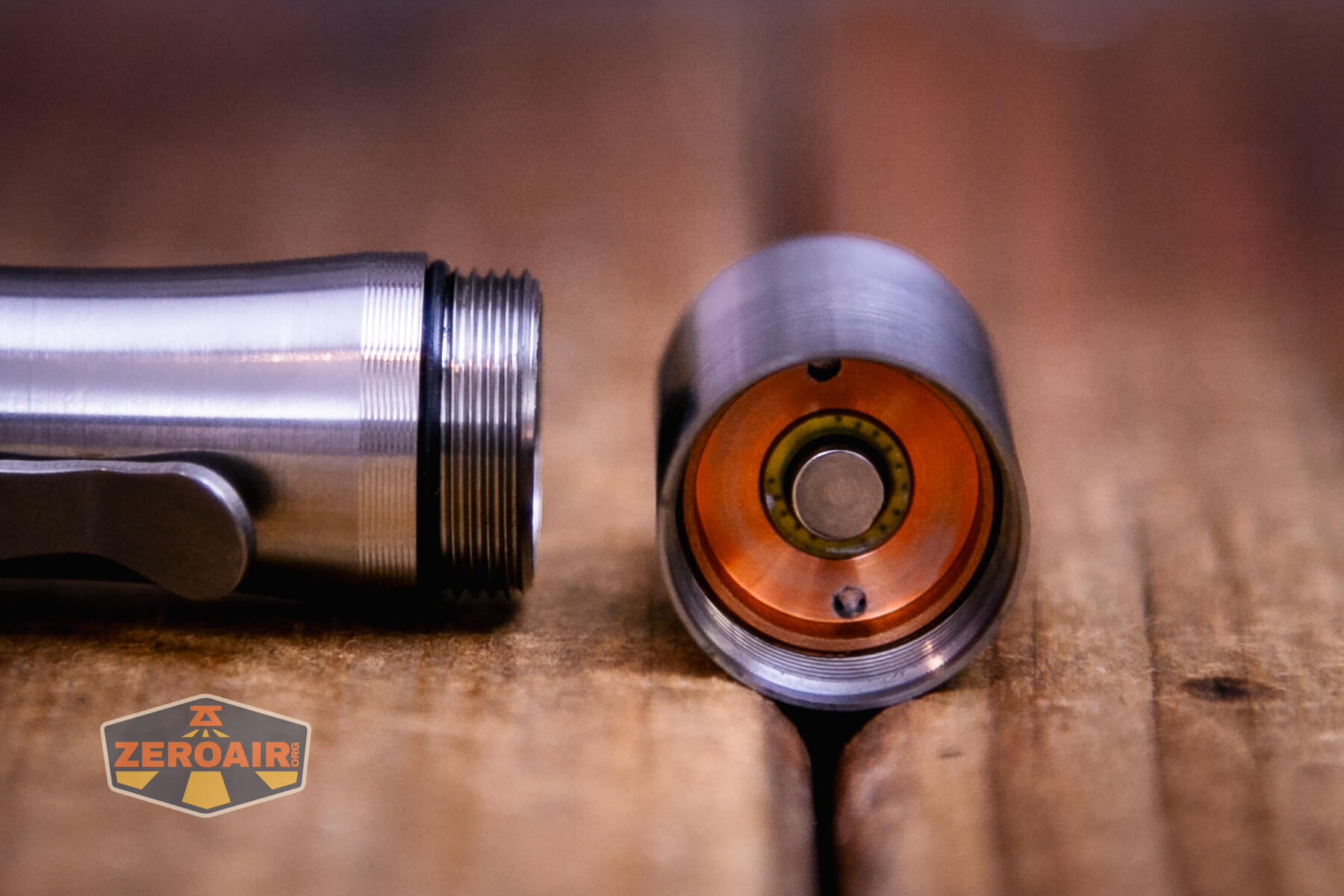
All that out of the way, above you can see the backside of the CWF Quantum Chimera. You can also note why this Tactile Turn Apollo flashlight uses the CWF Quantum Chimeara. It’s a one-sided driver that uses a button on the battery side. Most importantly, the emitter and driver components are on the same side. This means there are no wires to connect from the backside of the emitter board to the driver board. This makes the engine very short! And in turn, the light can be shorter than many 14500 lights, too.
So there’s the reason to use a CWF Quantum Chimera in such a nice and fancy light (even if this version has just three modes and isn’t programmable): size!
Both the head and tail screw onto the cell tube. I would recommend only ever removing the head though, as the pocket clip can (“will”) rub against the body.

The tail end has a nice and beefy spring.

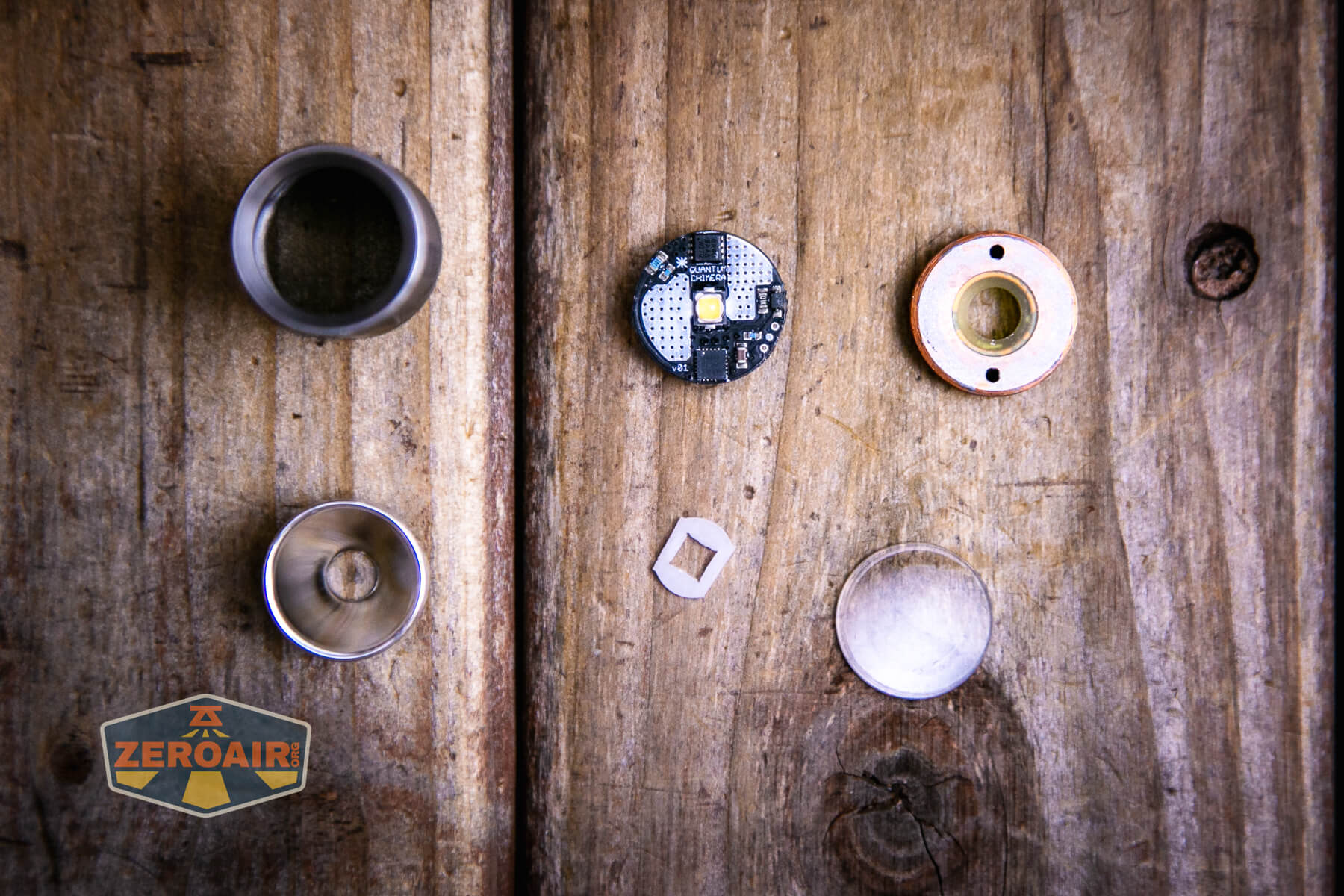
Here are the driver components. You can see how short the pill (the copper bit) is, and where the battery contact goes through the pill. Also, observe the emitter/driver components.

Here’s a better look at the battery contact on the driver.



All in all, this setup makes for a very reasonably sized 14500 flashlight.
Size and Comps
Diameter: 0.740″
Length: 3.6″
Weight: 1.45oz Titanium, 2.20oz Bronze, 2.50oz Copper


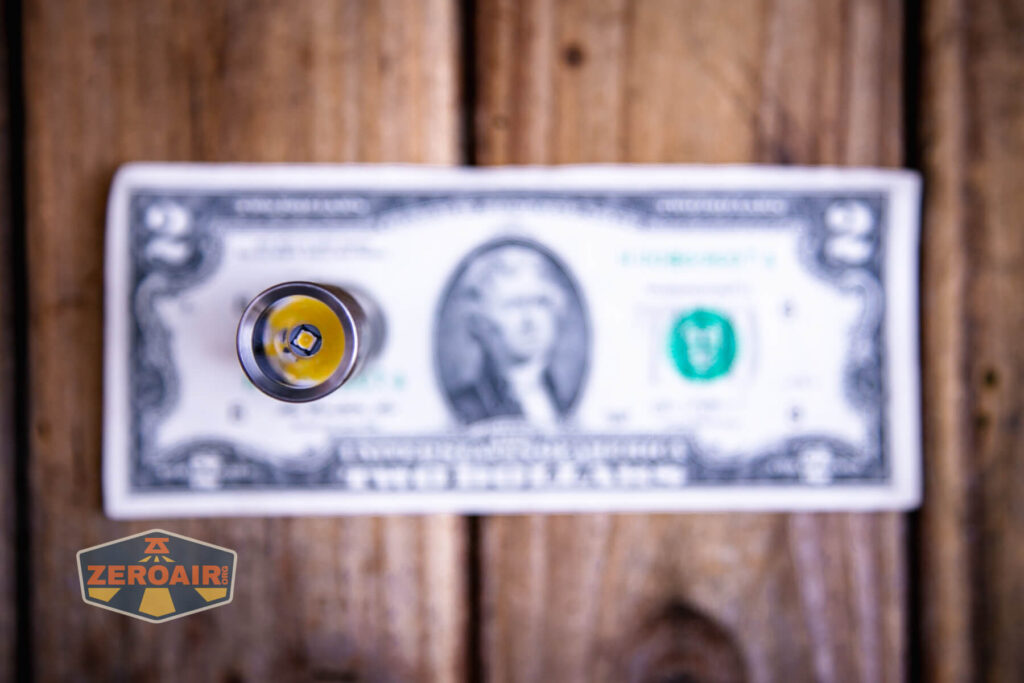
If the flashlight will headstand, I’ll show it here (usually the third photo). If the flashlight will tailstand, I’ll also show that (usually in the fourth photo).


Here’s the test light with the venerable Convoy S2+. The version below is a custom laser-engraved Convoy S2+ host by GadgetConnections.com. I did a full post on an engraved orange host right here! Or go straight to GadgetConnections.com to buy your Convoy S2+ now!
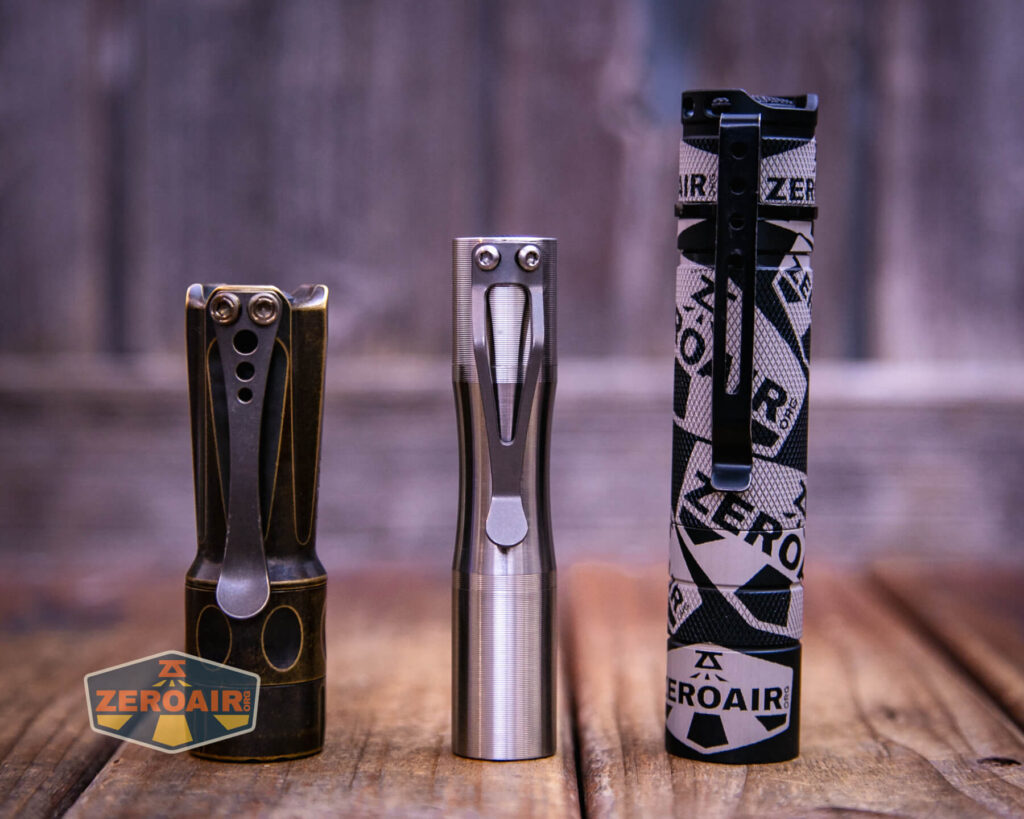

Also above is the light beside a TorchLAB BOSS 35, an 18350 light. I reviewed the aluminum version of that light in both 35 and 70 formats. I also reviewed that specific edition, the “Oveready BOSS FT Collector Vintage Brass” 35. I love it!
Retention and Carry
The Tactile Turn Apollo flashlight ships with a pocket clip installed. It’s a very secure two-screw clip. The clip is also titanium!

Tension on the clip is just right but as I said above, don’t unscrew the light from the tail end. Unscrew the head only, or you’ll get some lines around the cell tube. (In comparison, the Mini Arc tail seems to be glued!)
The pocket clip has a good opening to attach a lanyard but a lanyard is not included. There are no magnets or pouches or anything else included.
Power and Runtime
The Tactile Turn Apollo flashlight runs on one lithium-ion battery. It ships with a Nitecore NL1411R 1100mAh, which is a button top (a short button, but a button). The light will also work with a flat top.

Whatever cell you use, it goes into the light with the positive end toward the head.

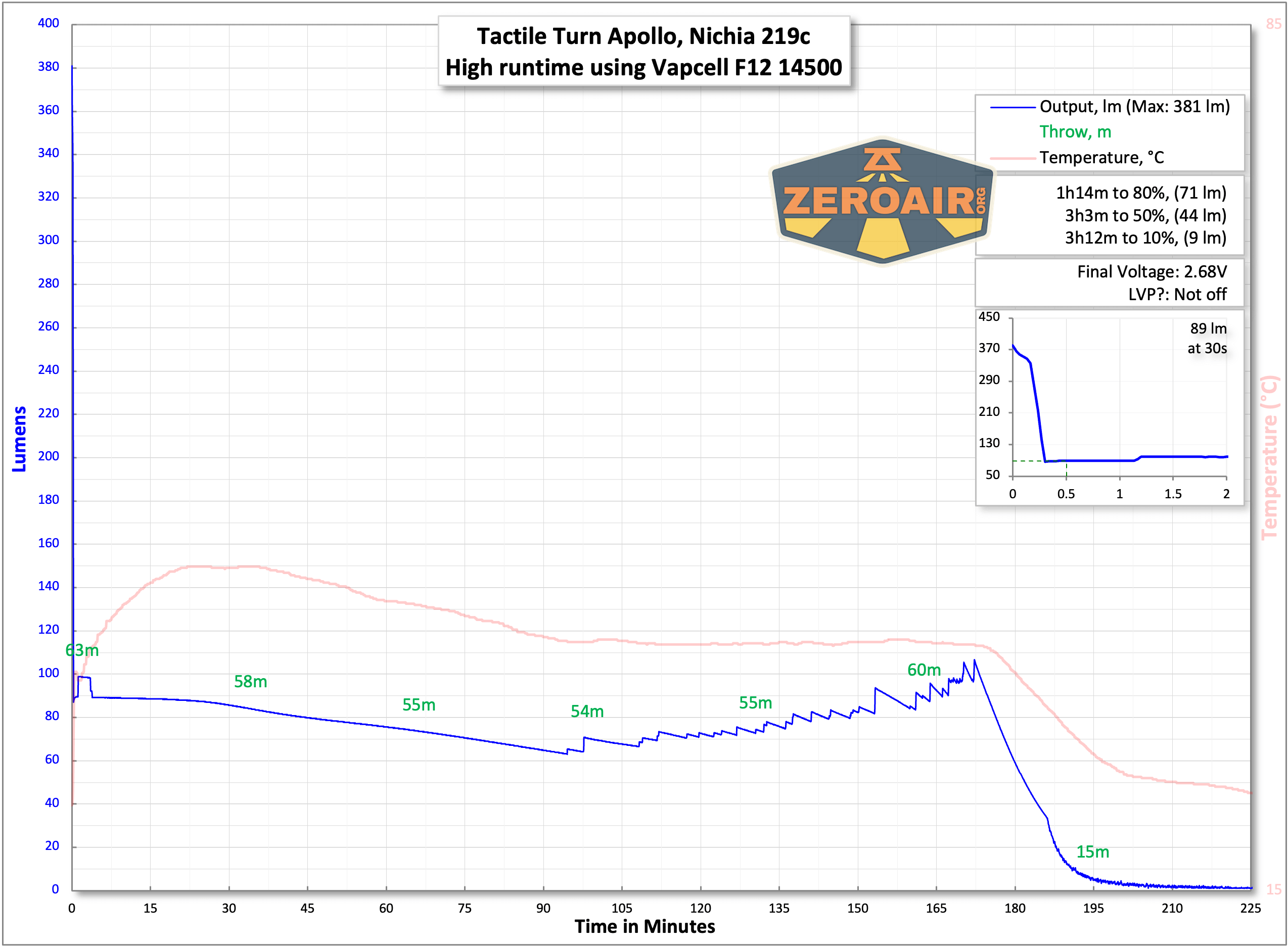
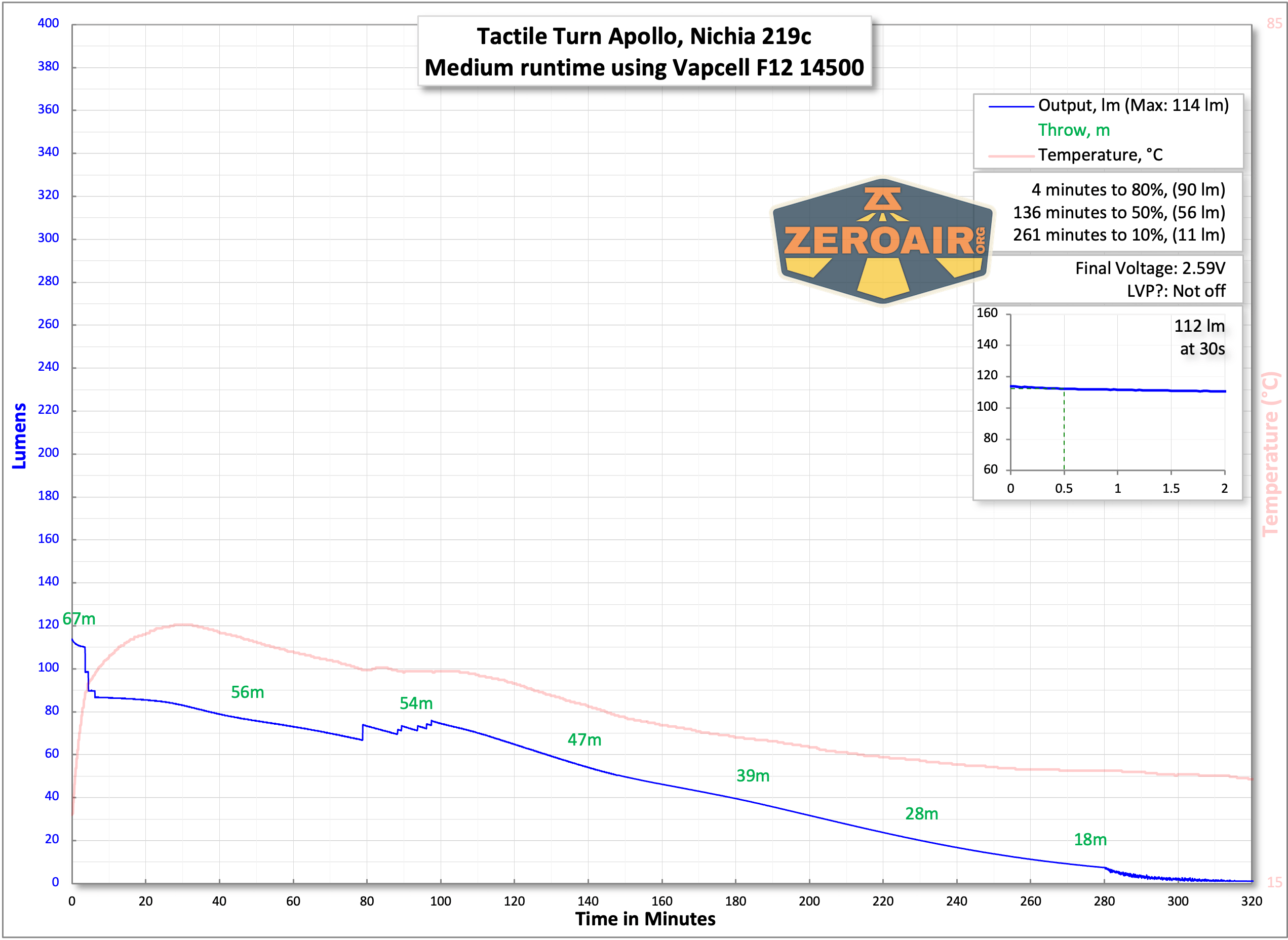
Below are runtime tests for all three modes. The Apollo claims 520 lumens. I didn’t observe 520 lumens and the stepdown from the initial output is fairly dramatic. So you’ll really observe around 80-100 lumens. It’s a small titanium light, so there’s not a lot of heat capacity, but I’d still like to see a better duration on High.


The Tactile Turn Apollo flashlight can not use any AA (1.5V) cells. No primary, no NiMH.
Modes and Currents
| Mode | Mode Claimed Output (lm) | Claimed Runtime | Measured Lumens | Tailcap Amps |
|---|---|---|---|---|
| High | 520 | – | 381 (0s) 89 (30s) |
3.11 |
| Medium | 160 | – | 114 (0s) 112 (30s) |
0.37 |
| Low | 16 | – | 14 | [low] |
Pulse Width Modulation
Every mode has PWM but it’s fast enough that you’re unlikely to have a problem with it. High is the right-most chart.

Here you can see a “baseline” – a chart with almost no light hitting the sensor. Then there’s the Ultrafire WF-602C flashlight, which has some of the worst PWM I’ve seen. It’s so bad that I used a post about it to explain PWM! Here are multiple timescales (10ms, 5ms, 2ms, 1ms, 0.5ms, 0.2ms) to make comparing this “worst” PWM light to the test light easier. That post also explains why I didn’t test the WF-602C at the usual 50us scale.


User Interface and Operation
In the Tactile Turn Apollo flashlight is a reverse mechanical clicky switch.
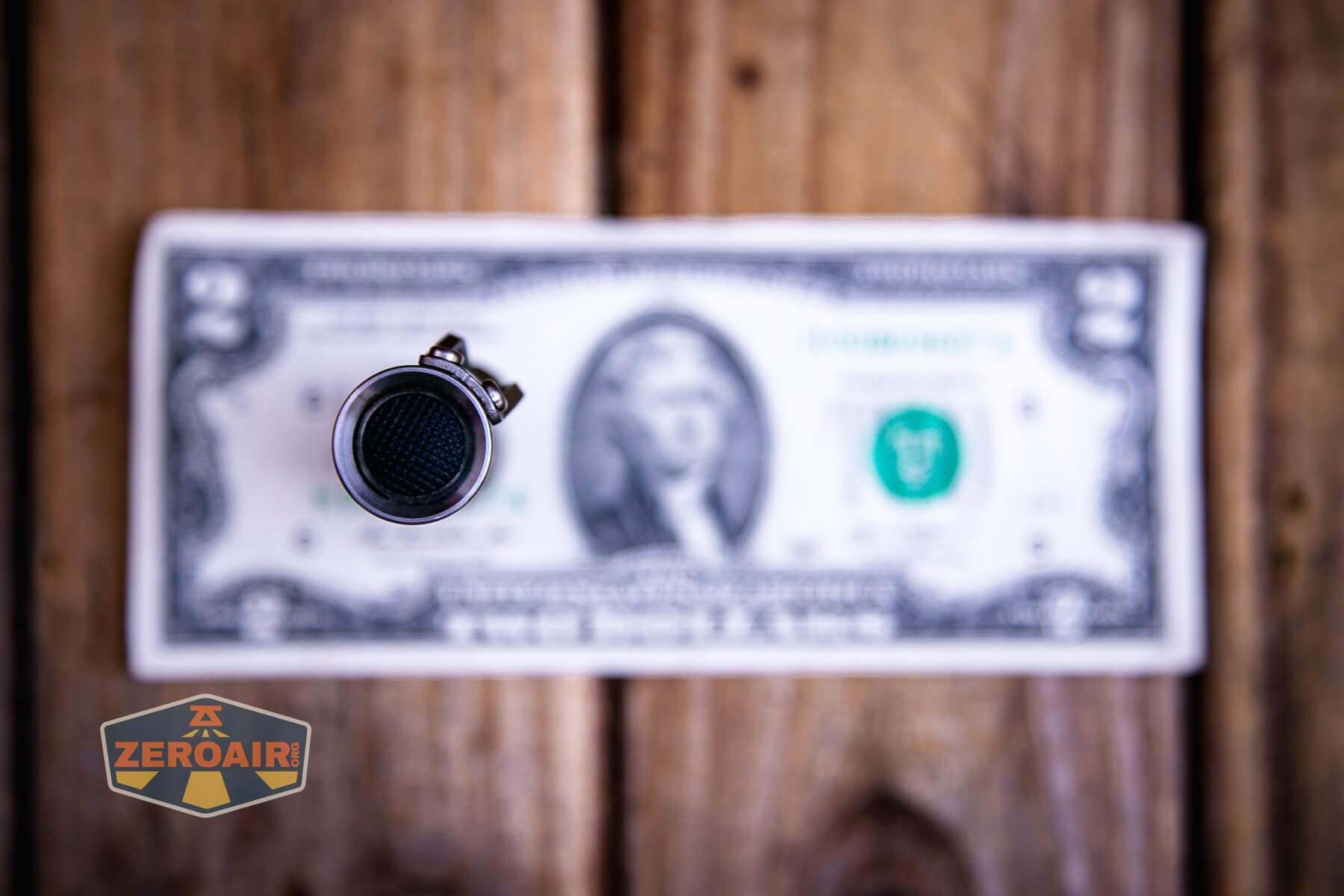
Being a reverse clicky means you can still change modes while the light is on, but you do not have any momentary output options (from off). For pen enthusiasts (and not operators), I’d say that’s fine and ideal.
The button does protrude from around the tailcap area just a bit, but the light will tailstand.

Here’s a user interface table!
| State | Action | Result |
|---|---|---|
| Off | Click | Low |
| On | Click | Off |
| On | Tap | Mode advance (LMH) |
You’ll note that’s a remarkably simple user interface. Again – no programming here!
One note about the website text. The Tactile Turn page for the Apollo says this:
Built with a top-of-the-line custom driver…
I am not saying that’s technically wrong. Believe me, I’ve gone circles with people smarter than I am about this. I still contend that the choice of wording there is not great. Some could even consider it deceiving. My position is that the CWF Quantum Chimera is already a “custom driver” (maybe depending on how you define “custom”) and the Tactile Turn Apollo flashlight uses a customized version of that driver. Almost like a double negative, this driver is no longer “custom” but “customized.” And the customizations dumb this smart driver down into only the most technically correct definition of “customized” imaginable – custom and/or customized in such a way that removes all programmability options from the user.
That’s fine (it’s fine, that’s fine) because the point of using CWF Quantum Chimera is the size. I would just like consistent verbiage on the Tactile Turn page to cover this. In one section, Tactile Turn does have this: Driver: CWF Quantum Chimera (non-programmable). Maybe that’s good enough.
LED and Beam
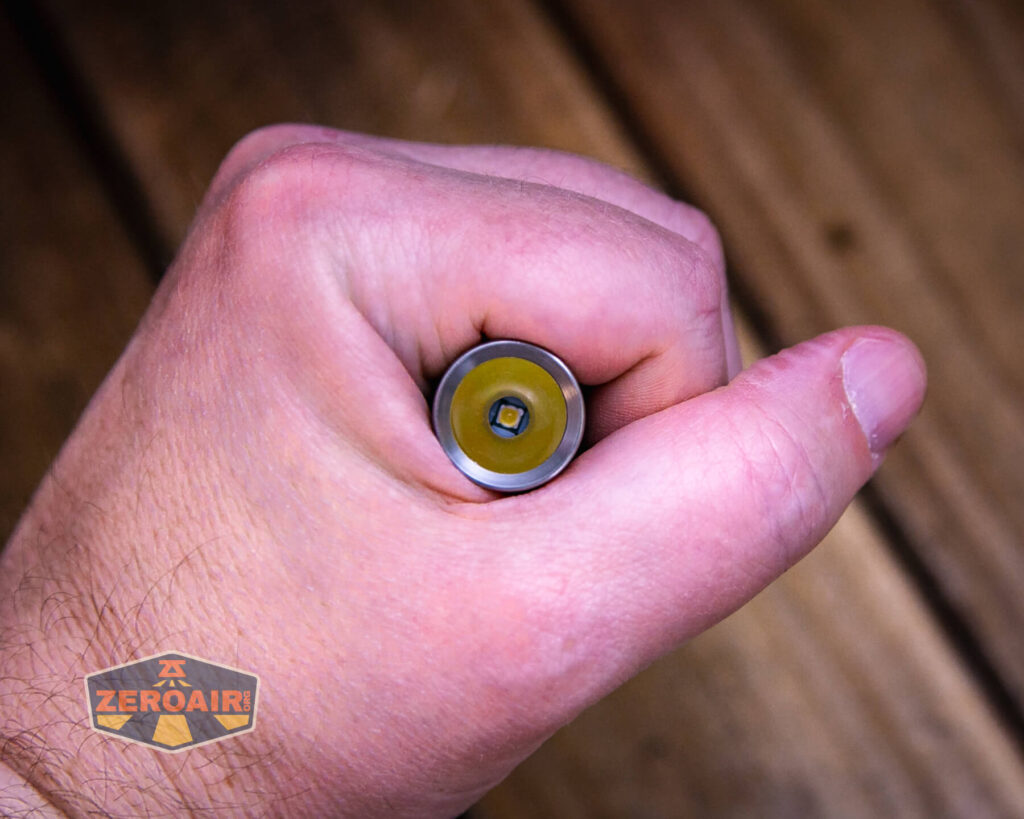
The Tactile Turn Apollo flashlight uses a Nichia 219c emitter. Mine is 4000K. There’s a nice smooth reflector to go with that emitter, too.


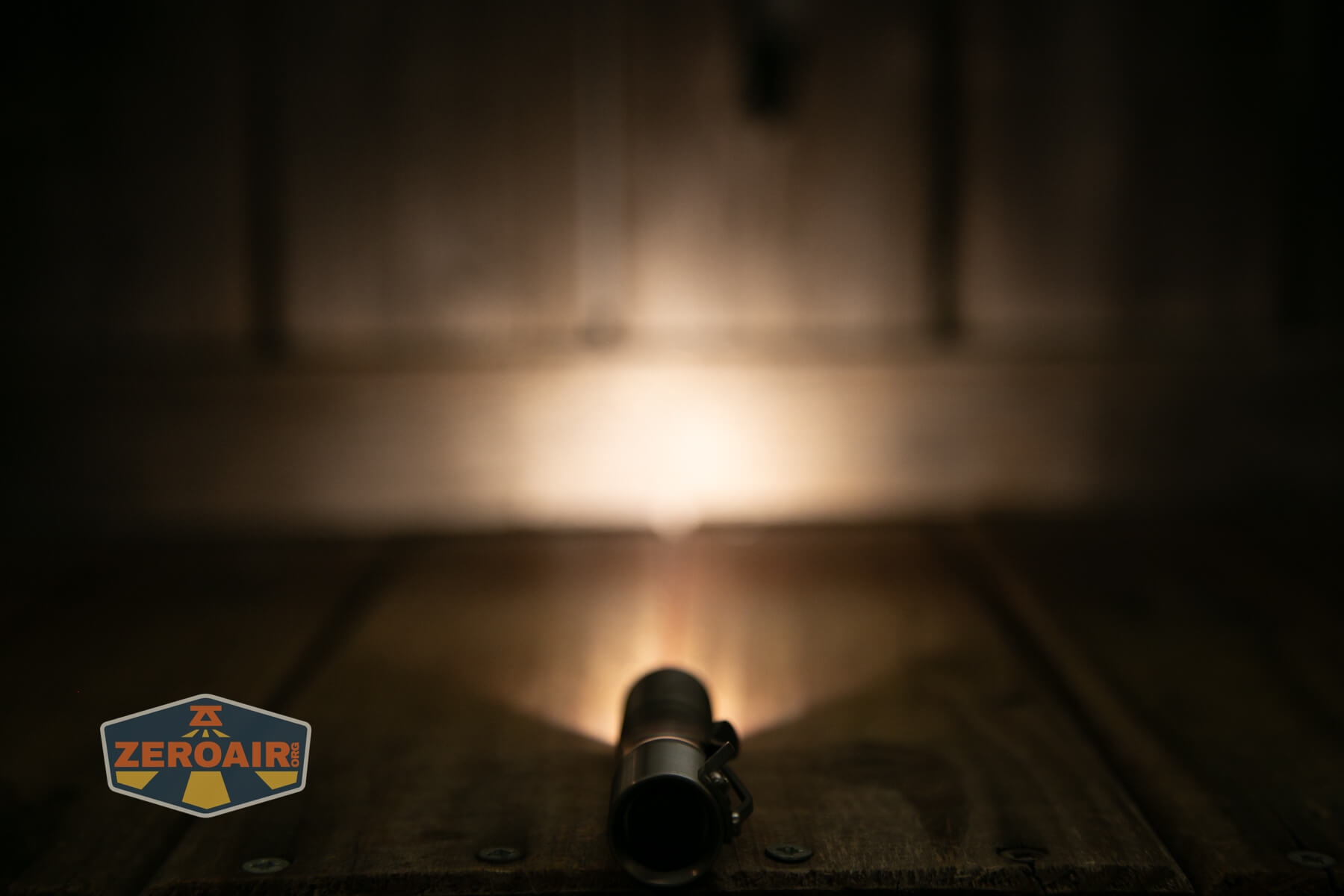
The beam profile is pleasant and useful.
LED Color Report (CRI and CCT)
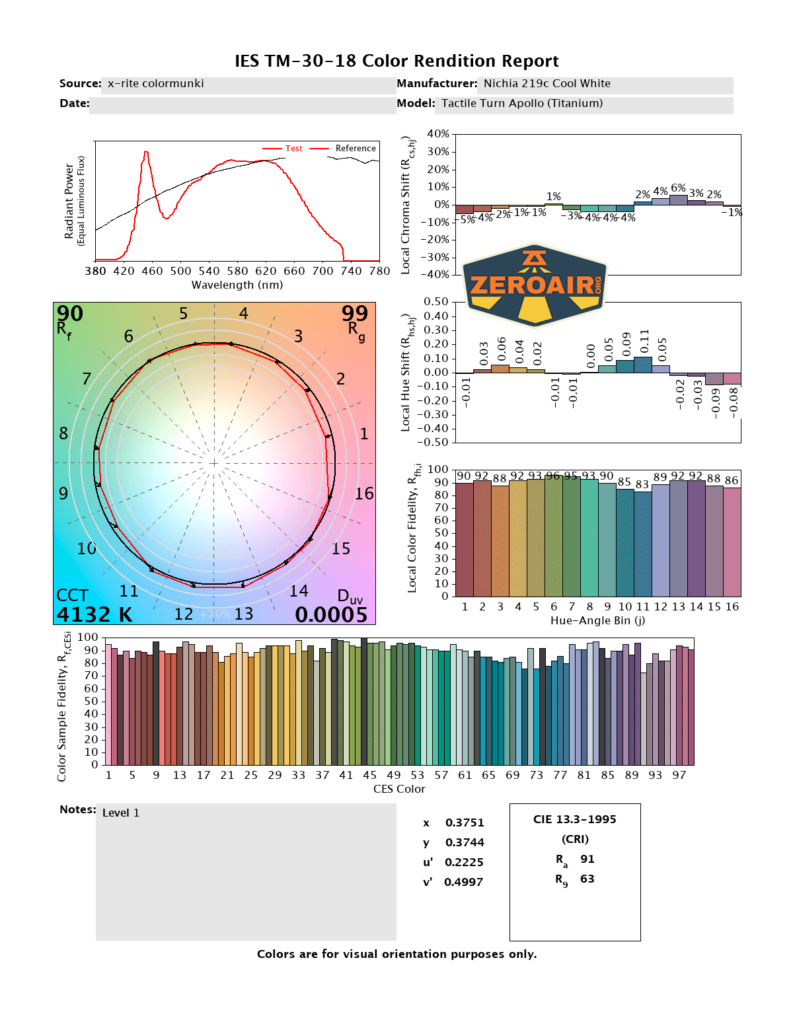
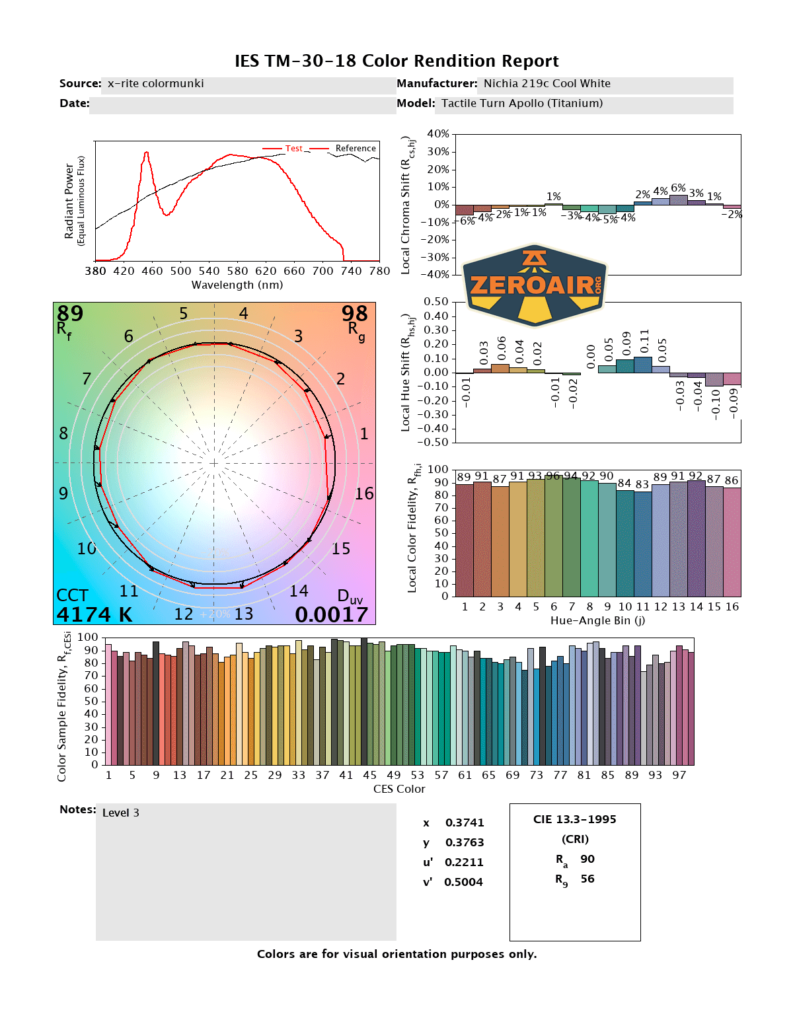
As stated, the Nichia 219c in this Apolo is stated to be 4000K (5000K also available) and that’s about what it measures, too. CRI is high (yay!) and the Duv stays right around the BBL (it won’t seem excessively green or pink.) This is a solid (maybe “safe”) emitter choice. Yes, 219c is a bit dated and I’d rather see Nichia 519a for example. Do note that emitter swaps on this light will be a fairly advanced technique since everything (emitter and driver components) are all on one side of the board!

Beamshots
These beamshots always have the following settings: f8, ISO100, 0.3s shutter, and manual 5000K exposure. These photos are taken at floor level, and the beam hits the ceiling around 9 feet away.
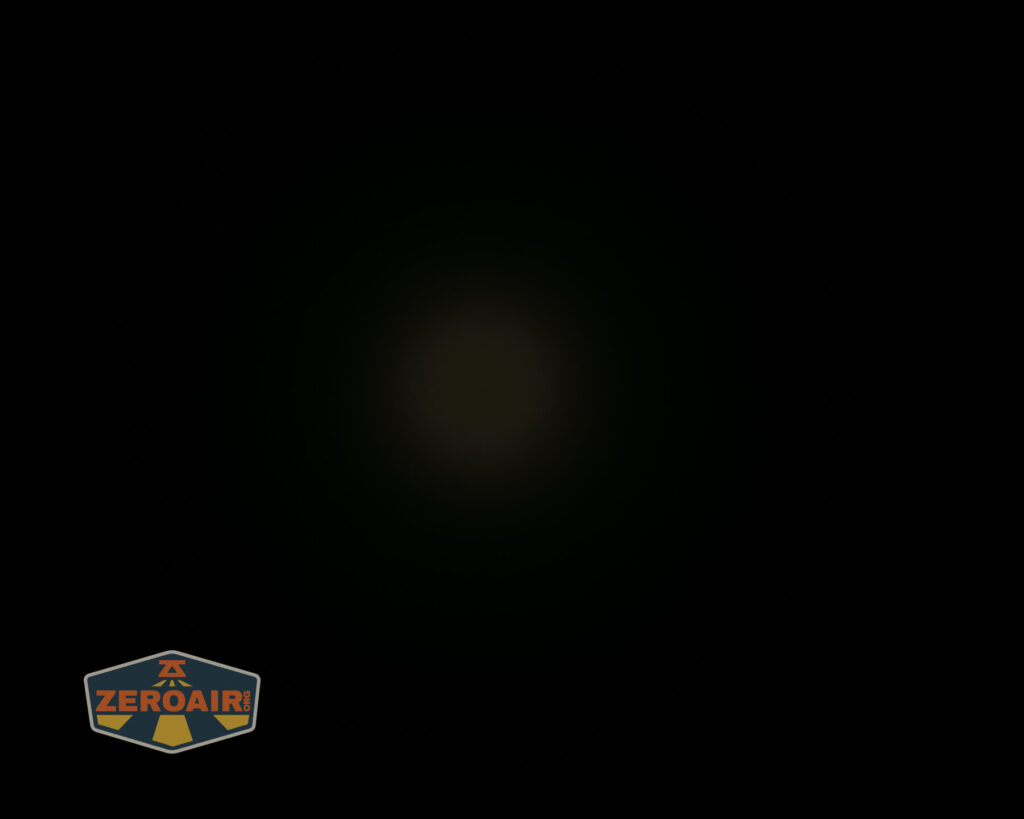

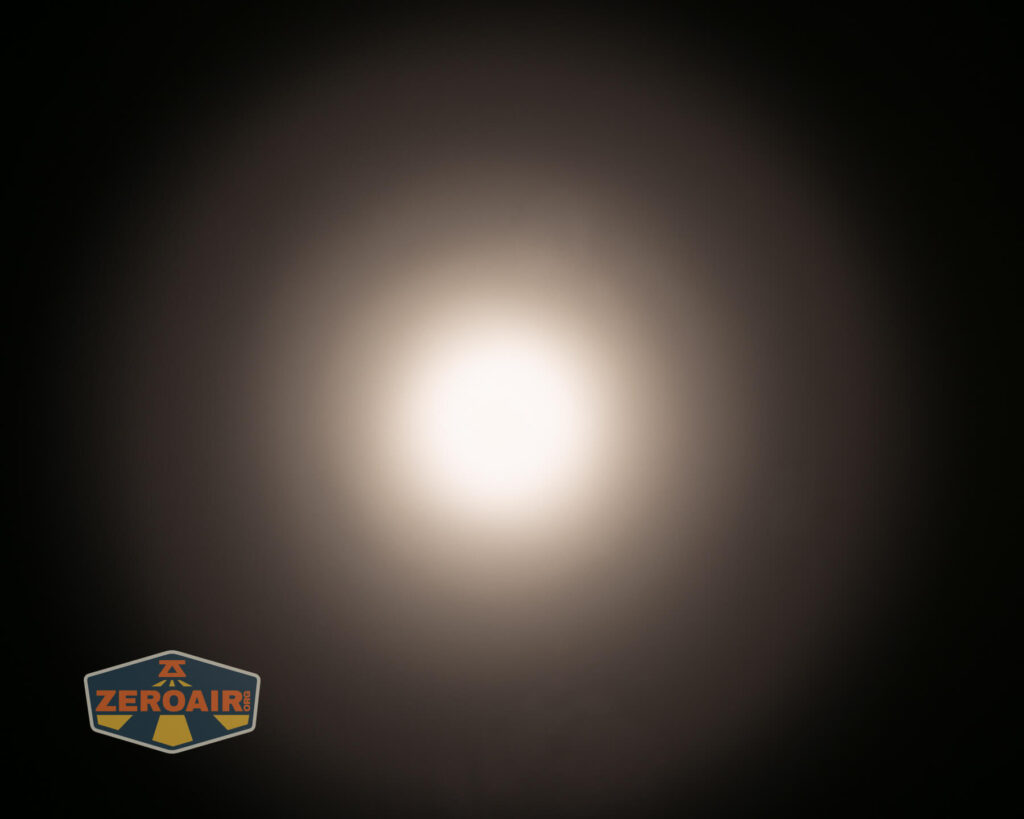
Tint vs BLF-348 (KillzoneFlashlights.com 219b version) (affiliate link)
I keep the test flashlight on the left and the BLF-348 reference flashlight on the right. These photos are taken around 18 inches from the door.
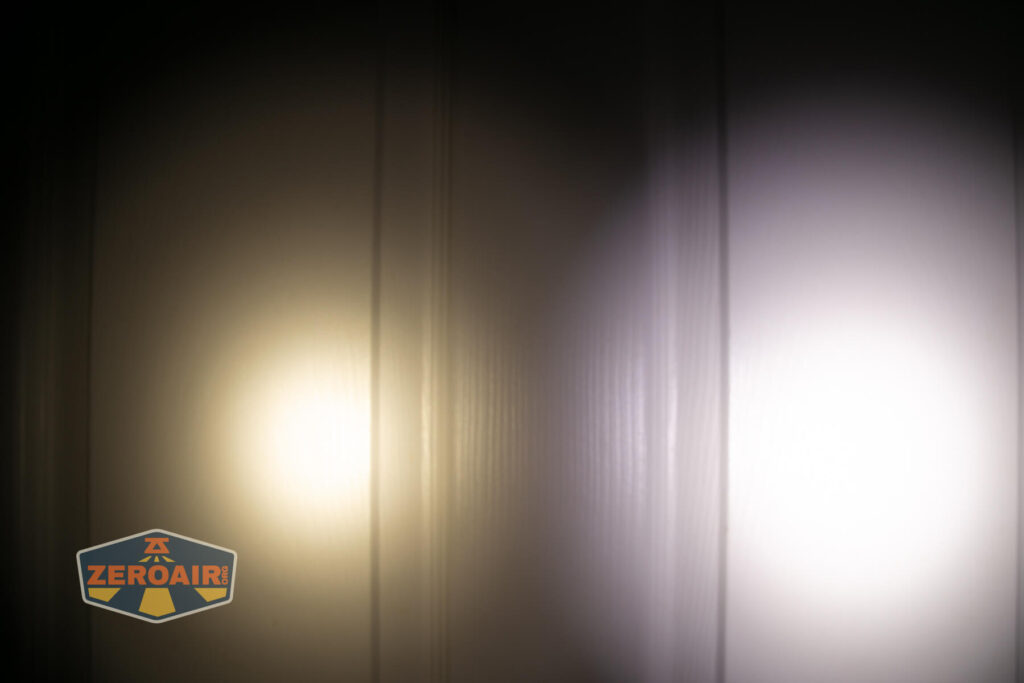
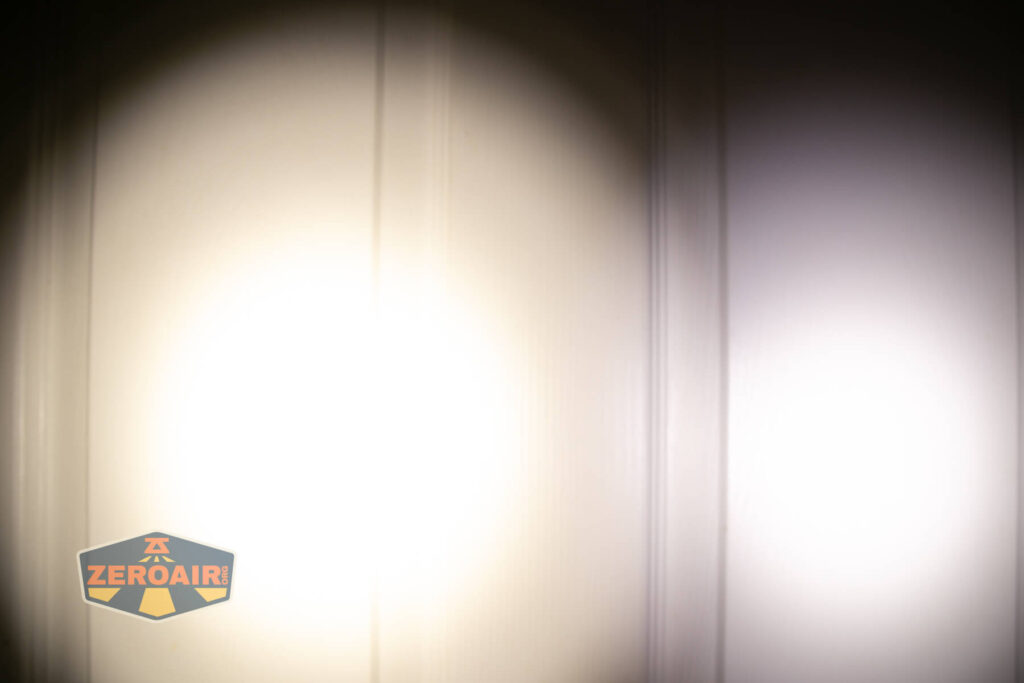

I compare everything to the KillzoneFlashlights.com 219b BLF-348 because it’s inexpensive and has the best tint!
Summary and Conclusion
The Tactile Turn Apollo flashlight is a fantastic flashlight for pen enthusiasts. Consider it a gateway flashlight – after you get this one, you’re likely to want more! And that’s no problem since you can go with a CWF Mini Arc and step into a programmable light in a familiar format. Even without programmability on the Tactile Turn Apollo flashlight, I would prefer four modes (not just three) and with the extra mode being much lower than the current Low. The build quality of the Apollo is excellent, and it will make a wonderful matching pair with your Tactile Turn pen.
The Big Table
| Tactile Turn Apollo flashlight | |
|---|---|
| Emitter: | Nichia 219c (4000K) (CRI90) |
| Price in USD at publication time: | $299.00 |
| Cell: | 1×14500 |
| Runtime Graphs | |
| LVP? | Yes |
| Switch Type: | Mechanical |
| On-Board Charging? | No |
| Claimed Lumens (lm) | 520 |
| Measured Lumens (at 30s) | 89 (17.1% of claim)^ |
| Candela per Lumen | 10.17 |
| Claimed Throw (m) | – |
| Candela (Calculated) in cd | @initial: 143lux @ 5.493m = 4315cd @30s: 39lux @ 4.97m = 963cd |
| Throw (Calculated) (m) | @initial: 131.4 @30s: 62.1 |
| Claimed CCT | 4000K |
| Measured CCT Range (K) | 4100-4300 Kelvin |
| Item provided for review by: | Me |
| All my Tactile Turn reviews! | |
^ Measurement disclaimer: Testing flashlights is my hobby. I use hobbyist-level equipment for testing, including some I made myself. Try not to get buried in the details of manufacturer specifications versus measurements recorded here; A certain amount of difference (say, 10 or 15%) is perfectly reasonable.
What I like
- Excellent build quality
- Design language same as many Tactile Turn pens
- Very simple user interface
- Good CCT
- High CRI
- Reverse clicky (good choice for this “gentleman’s carry” type light)
What I don’t like
- Massive stepdown on High
- Just three modes (I want a lower 4th mode)
- “Built with a top-of-the-line custom driver” (I disagree with this phrasing on the Tactile Turn website.)
Notes
- This content originally appeared at zeroair.org. Please visit there for the best experience!
- Please use my Amazon.com referral link to help support zeroair.org!
- Please support me on Patreon! I deeply appreciate your support!
Nice review, as always! Crippling the driver kind of makes sense, but, oof, that step down is brutal. And, yeah, it really needs a moonlight mode if there is no programming option. It’s a shame; I considered buying one!
Yes I agree about the stepdown. I’m interested if the programmable Quantum Chimera exhibits this, too.
And agree about the driver too – if it brings pen fanatics into flashlights, then… welcome!!