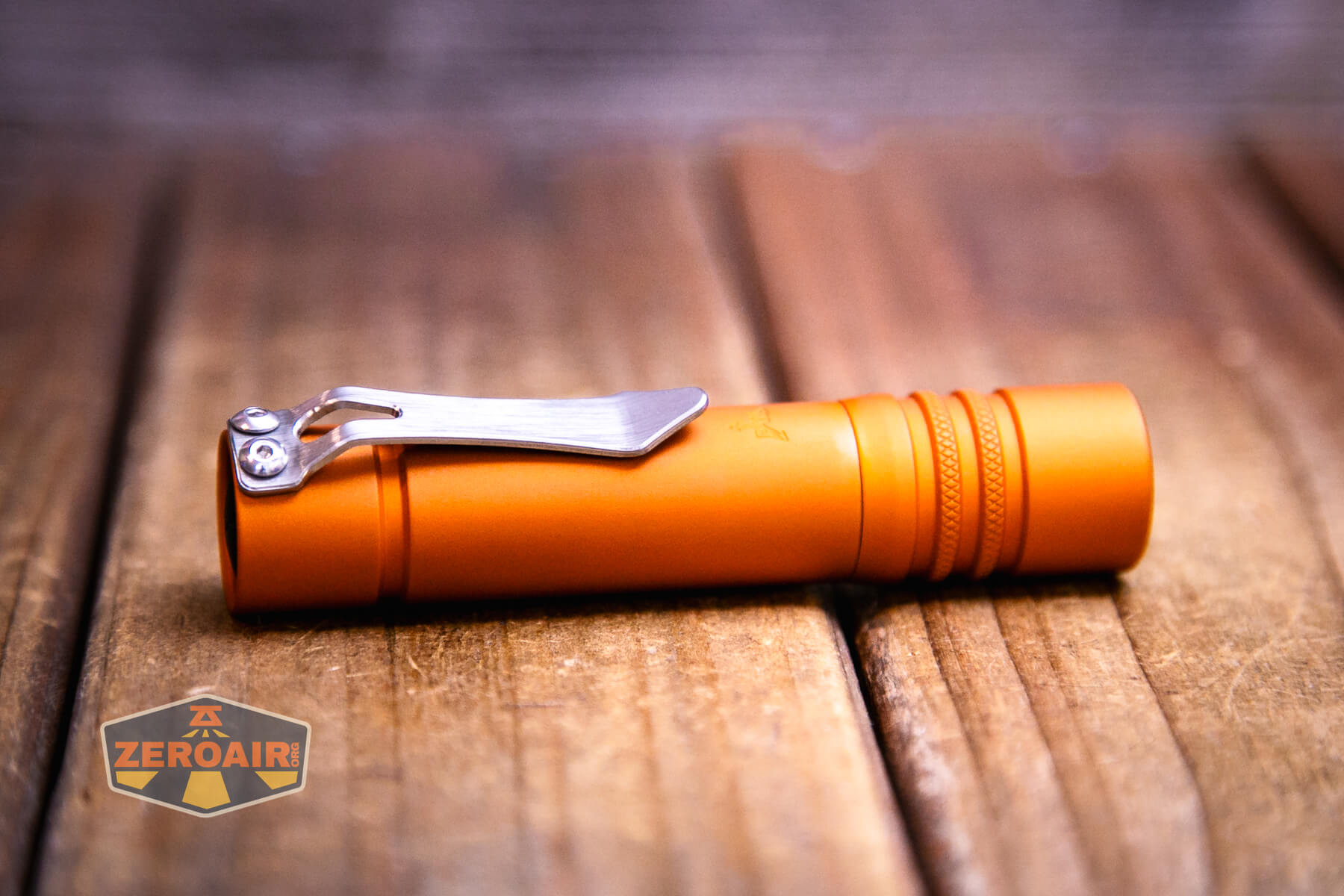

Focusworks EDC F3 Pumpkin Orange Flashlight Review
The Focusworks EDC F3 Pumpkin Orange flashlight runs a 14500-cell and is available in many colors, including this Pumpkin Orange! Read on for testing!
Official Specs and Features
Here’s a link to the Focusworks EDC F3 Pumpkin Orange flashlight product page.
Versions
A search on FocusWorksEDC turns up 14 results for the F3. Various anodization colors are available. At the very least, there have been two other metals, too: copper and titanium. Even among the anodization colors, there are options – some can be “distressed” (and look great that way!)
Two emitter options are available, too. There’s Samsung LH351d 5000K (seen here), and Nichia 219c 4000K.
Any of those options can be selected with memory or no memory. A battery is available, too.
Price
The price varies from $185 all the way up to $300 (for titanium.) It looks like the Focusworks EDC F3 Pumpkin Orange flashlight is at the lowest end; $185.
Coincidentally, Focusworks EDC is running a giveaway for a similar light to the Focusworks EDC F3 Pumpkin Orange flashlight – it’s the F4 (and some other items. You can enter here!
What’s Included
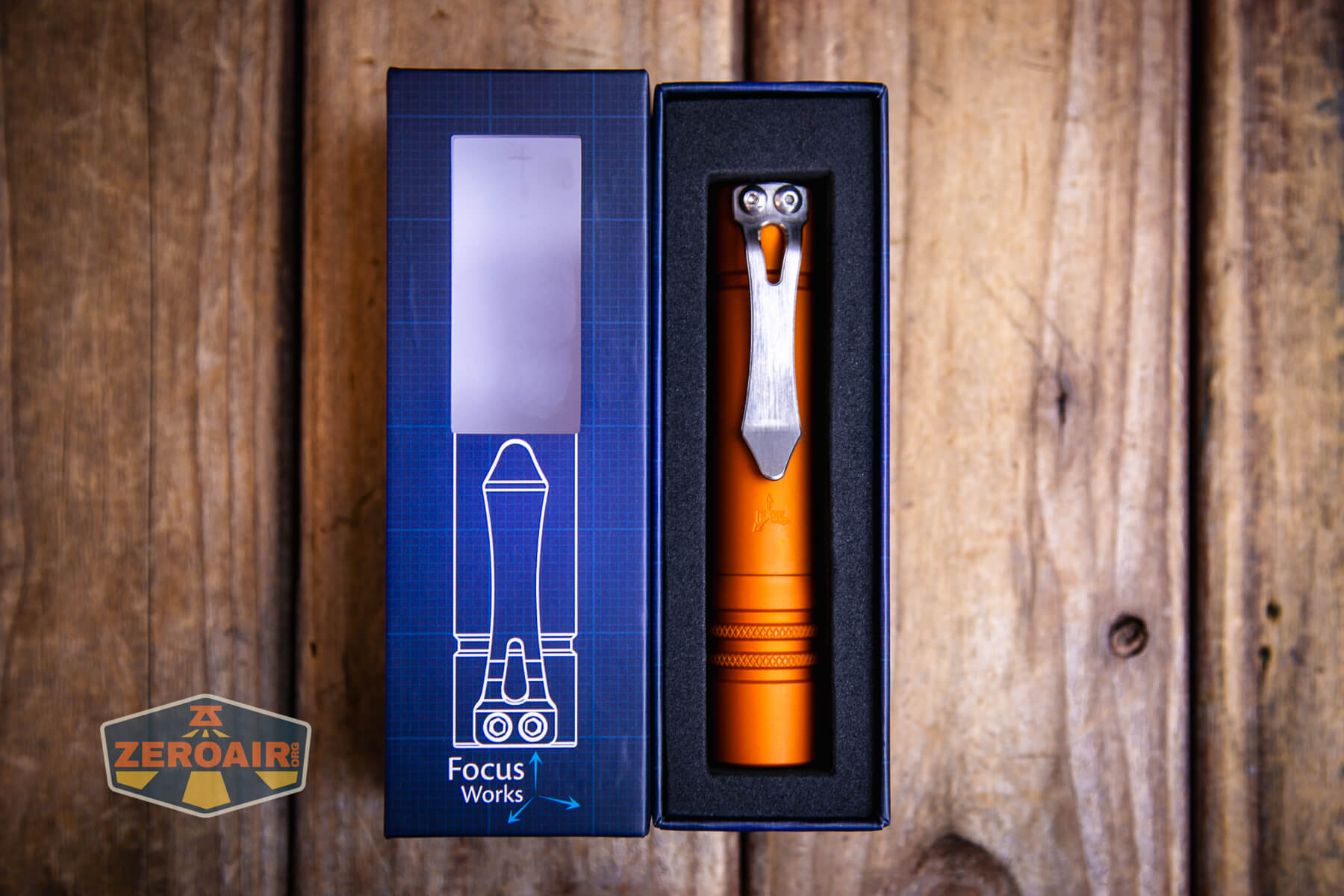
- Focusworks EDC F3 Pumpkin Orange flashlight
Package and Manual
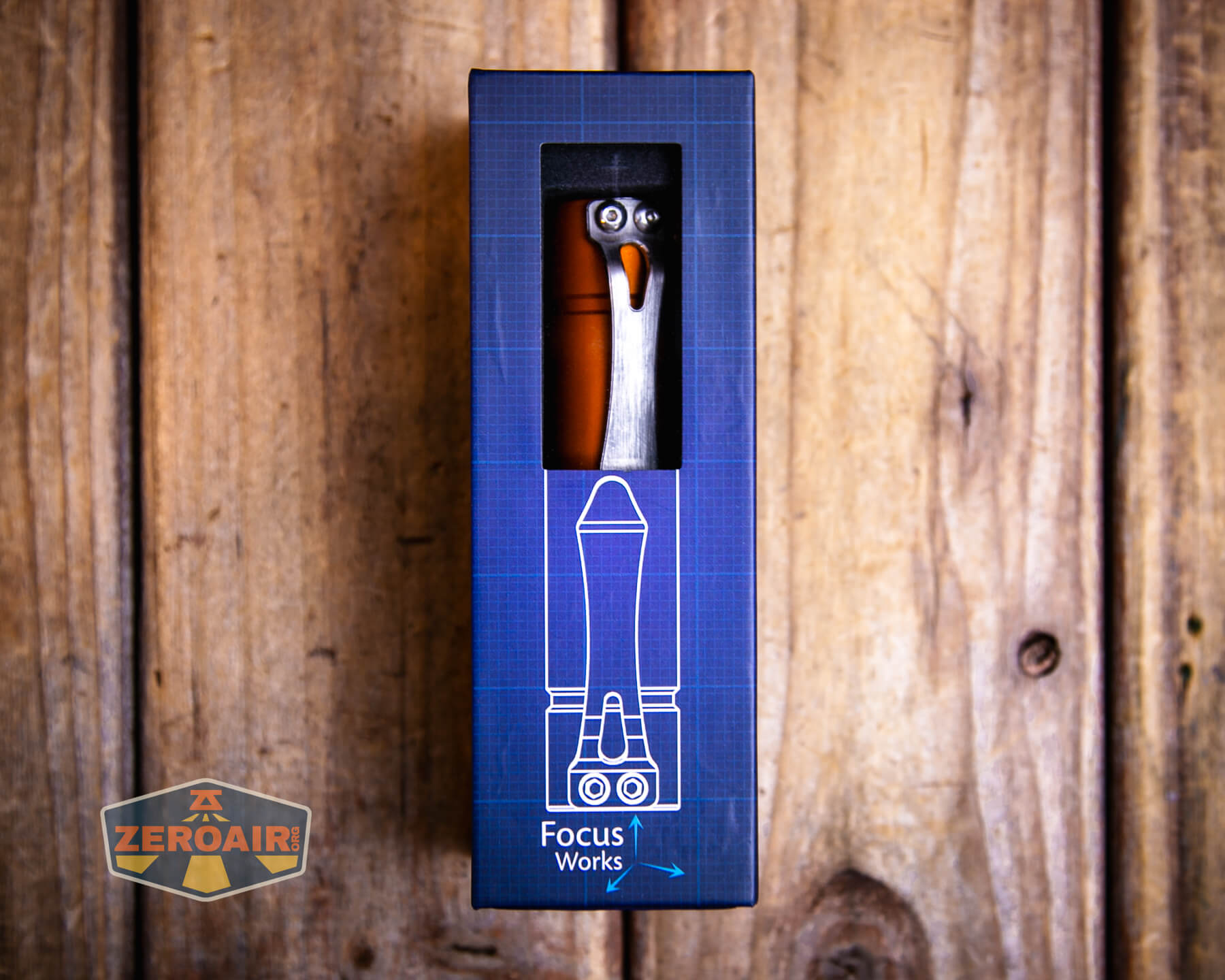
The box is a step up from previous versions in that it’s a box and not a tube. I don’t like tubes!
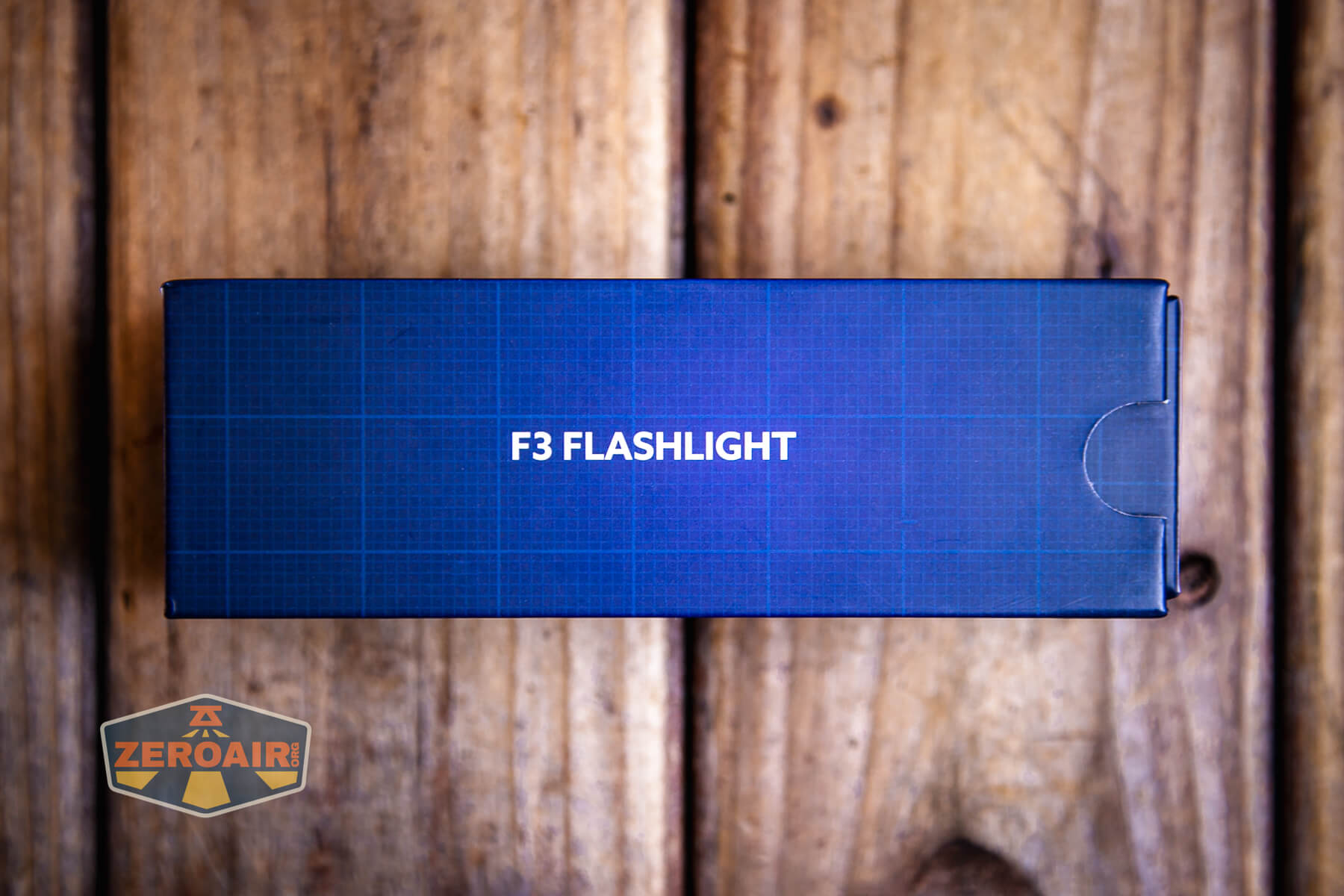
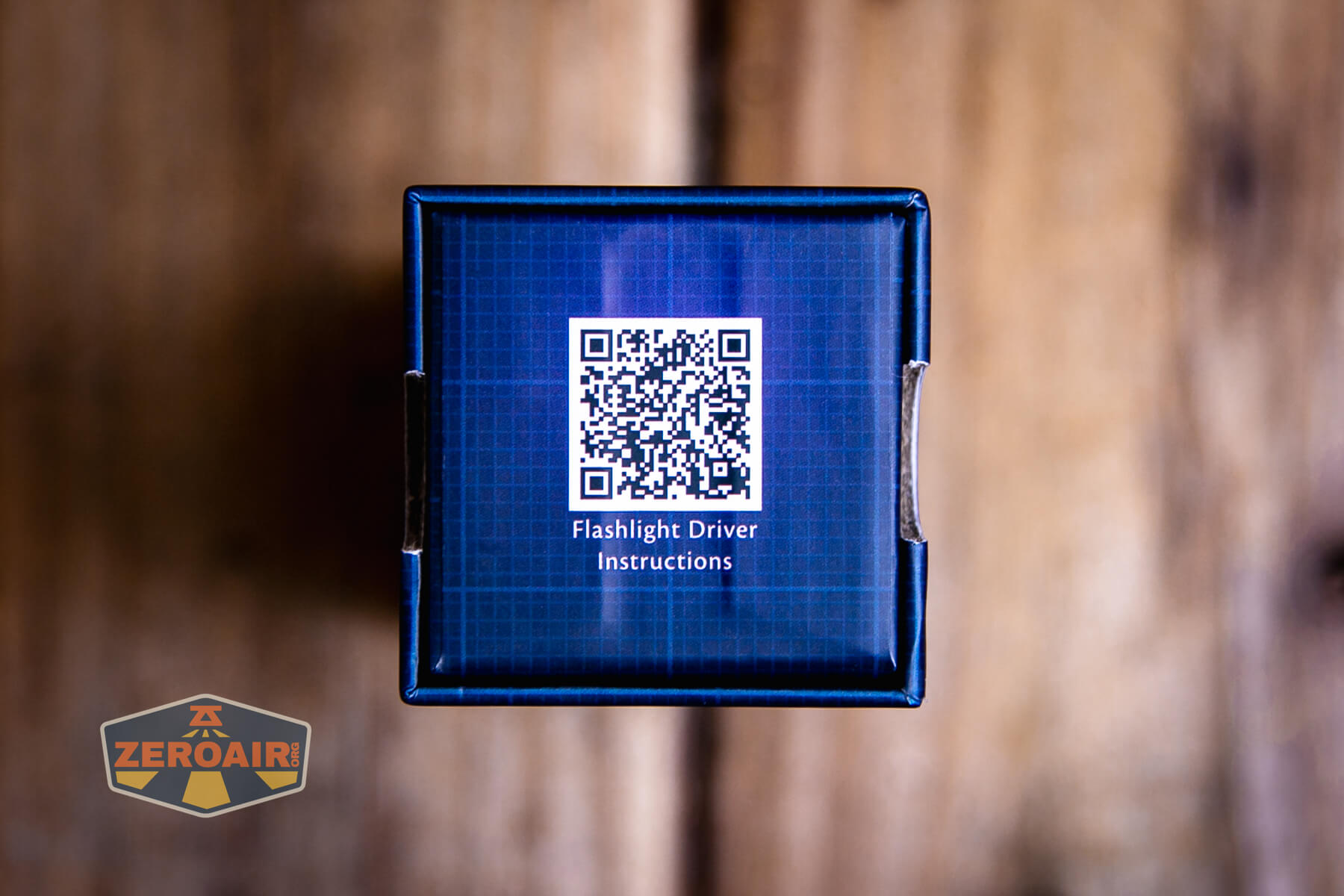
There’s no manual included, but you can see that QR code on the box above, which takes you to this webpage. For the Focusworks EDC F3 Pumpkin Orange flashlight, you’ll want this specific page for the qlite driver.
Build Quality and Disassembly
 The Focusworks EDC F3 Pumpkin Orange flashlight has an interesting design, particularly when compared to the Focusworks EDC F2 Blood Orange flashlight (which I also reviewed). The F2 has a very graceful “flashlight” design, whereas the F3 is generally more tubular (specifically a straight tube).


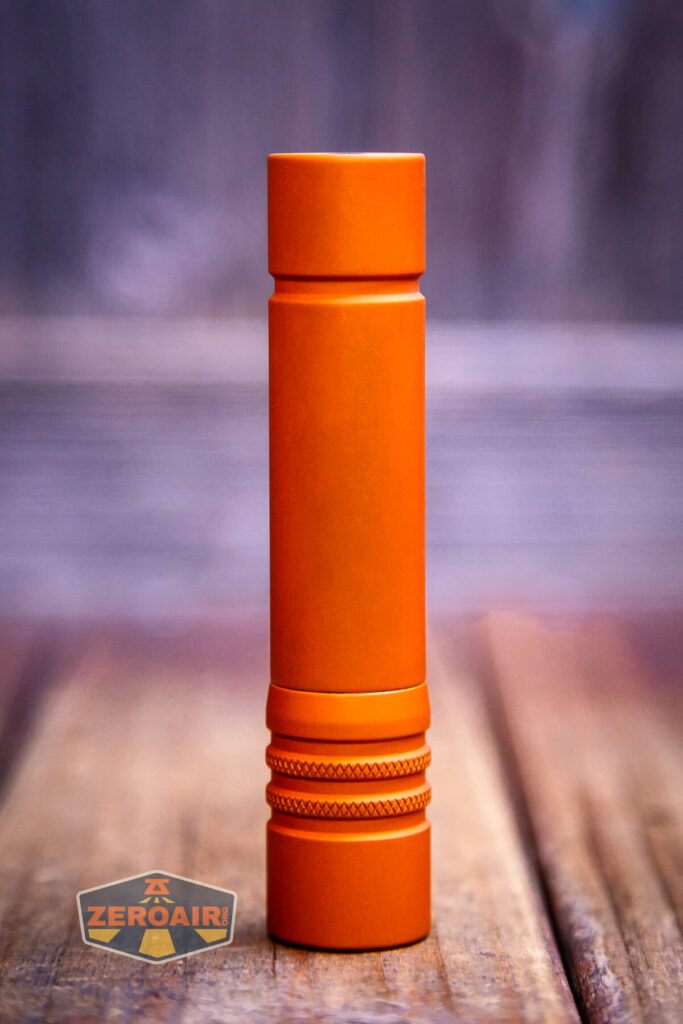
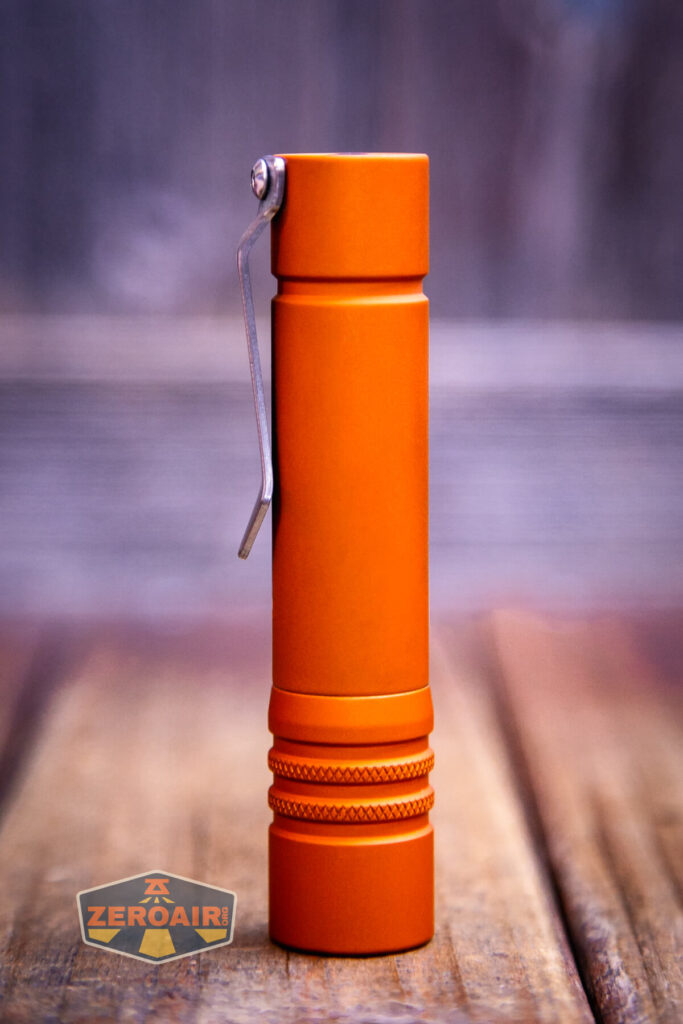
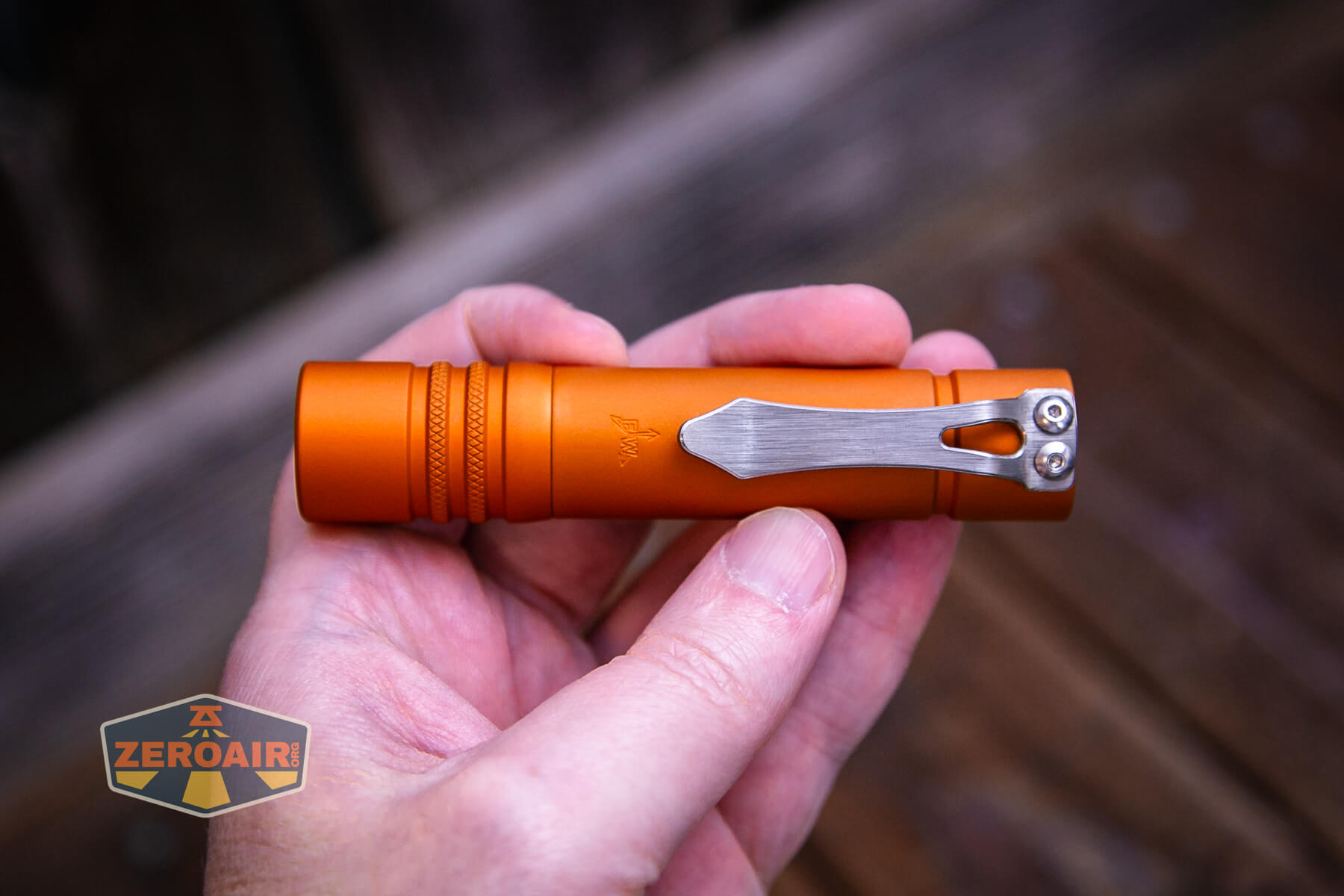
Yes, there’s a bit of flair in the head. There are also a couple of ridges on the head that are knurled – the only knurling on the light. It’s in the right place, though.
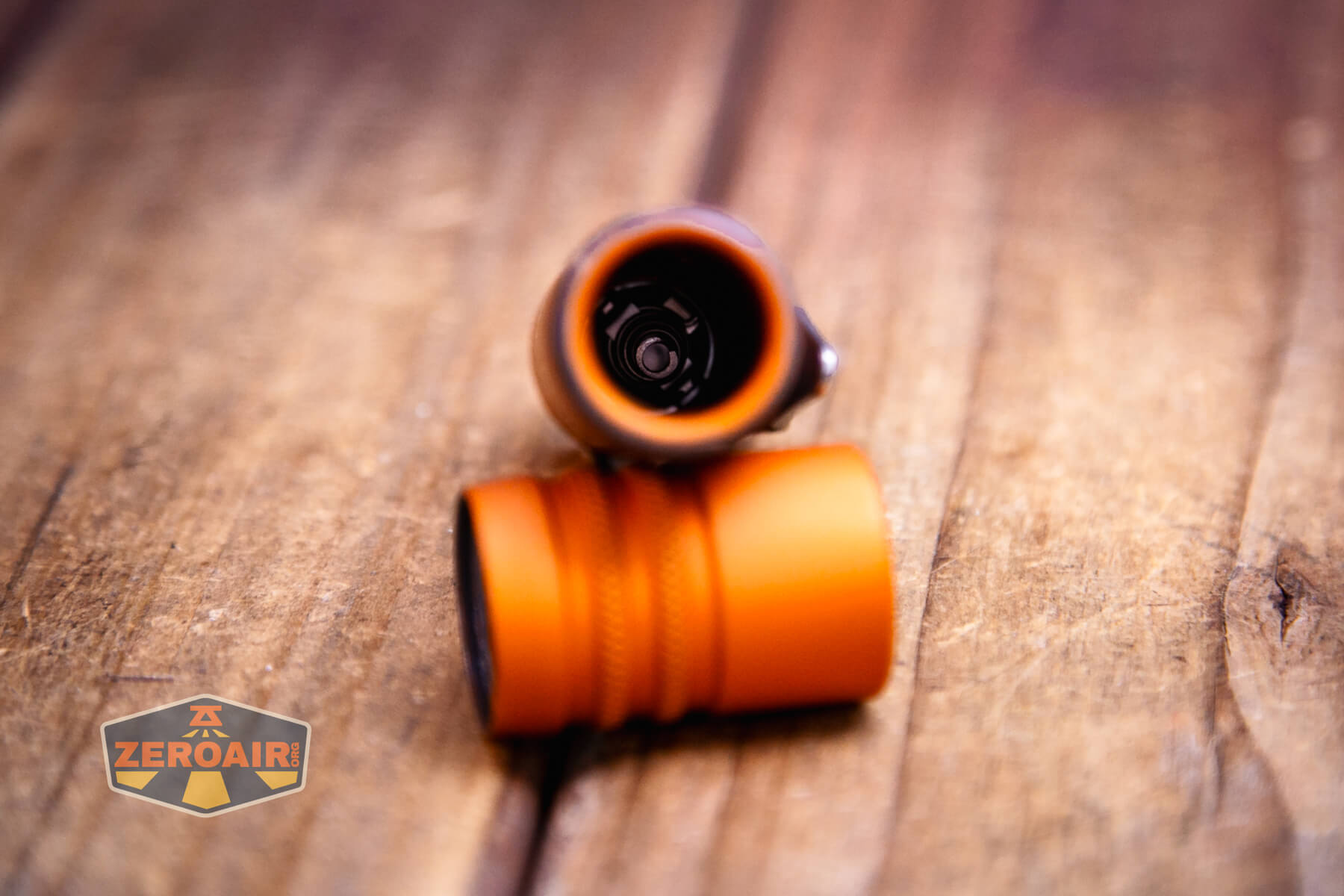
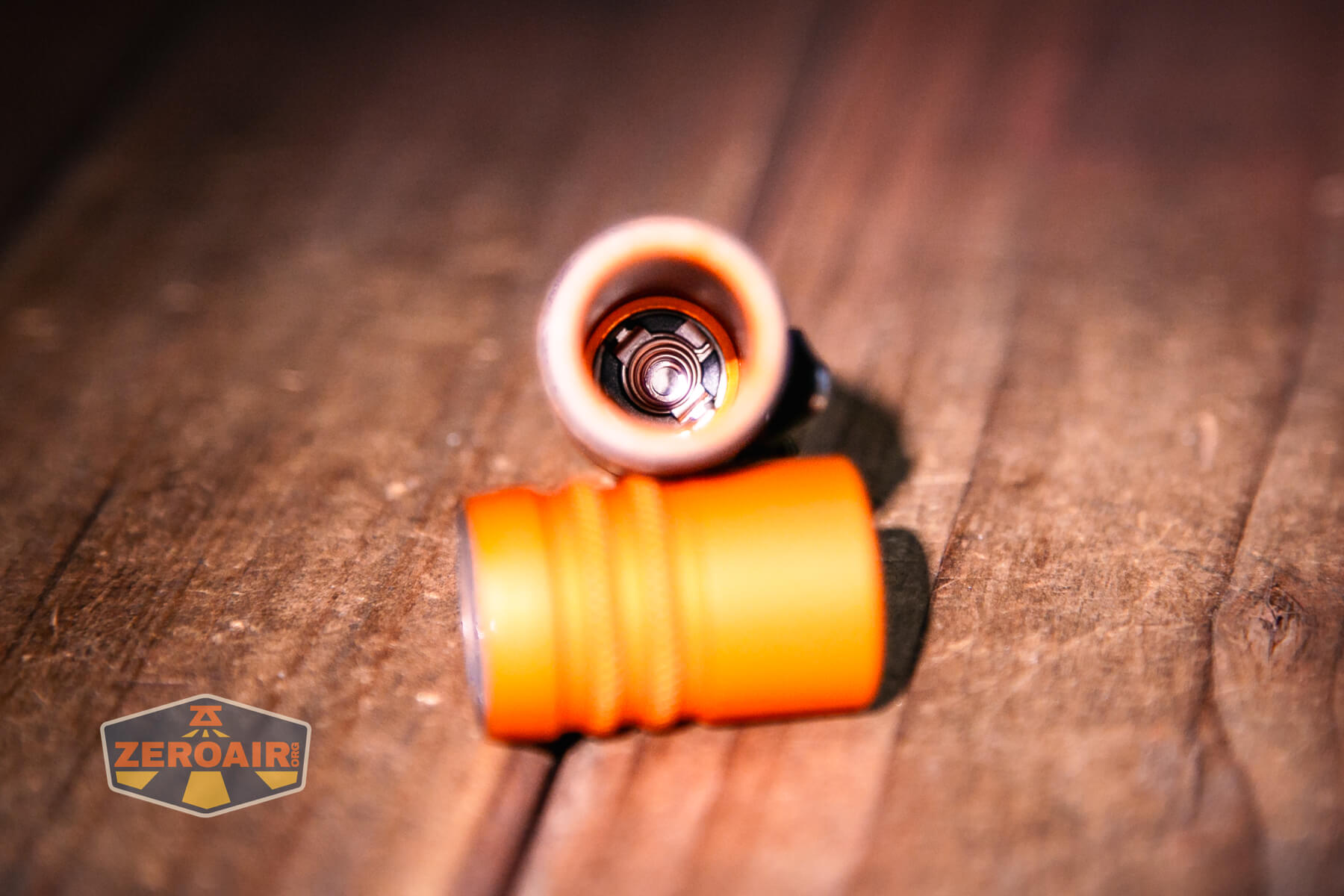
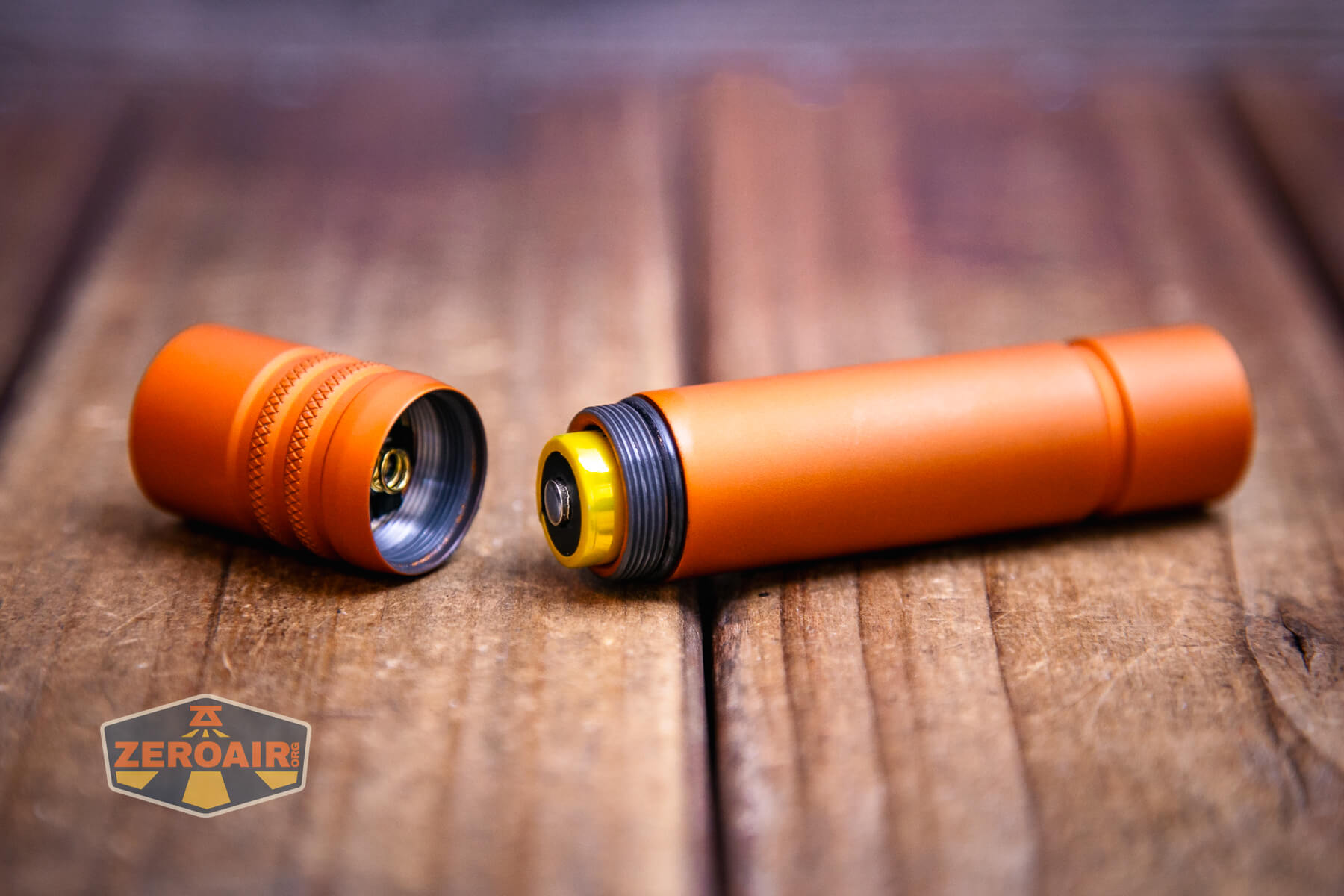
Inside the head, you can see the Qlite driver and what people usually call a “Qlite spring.”
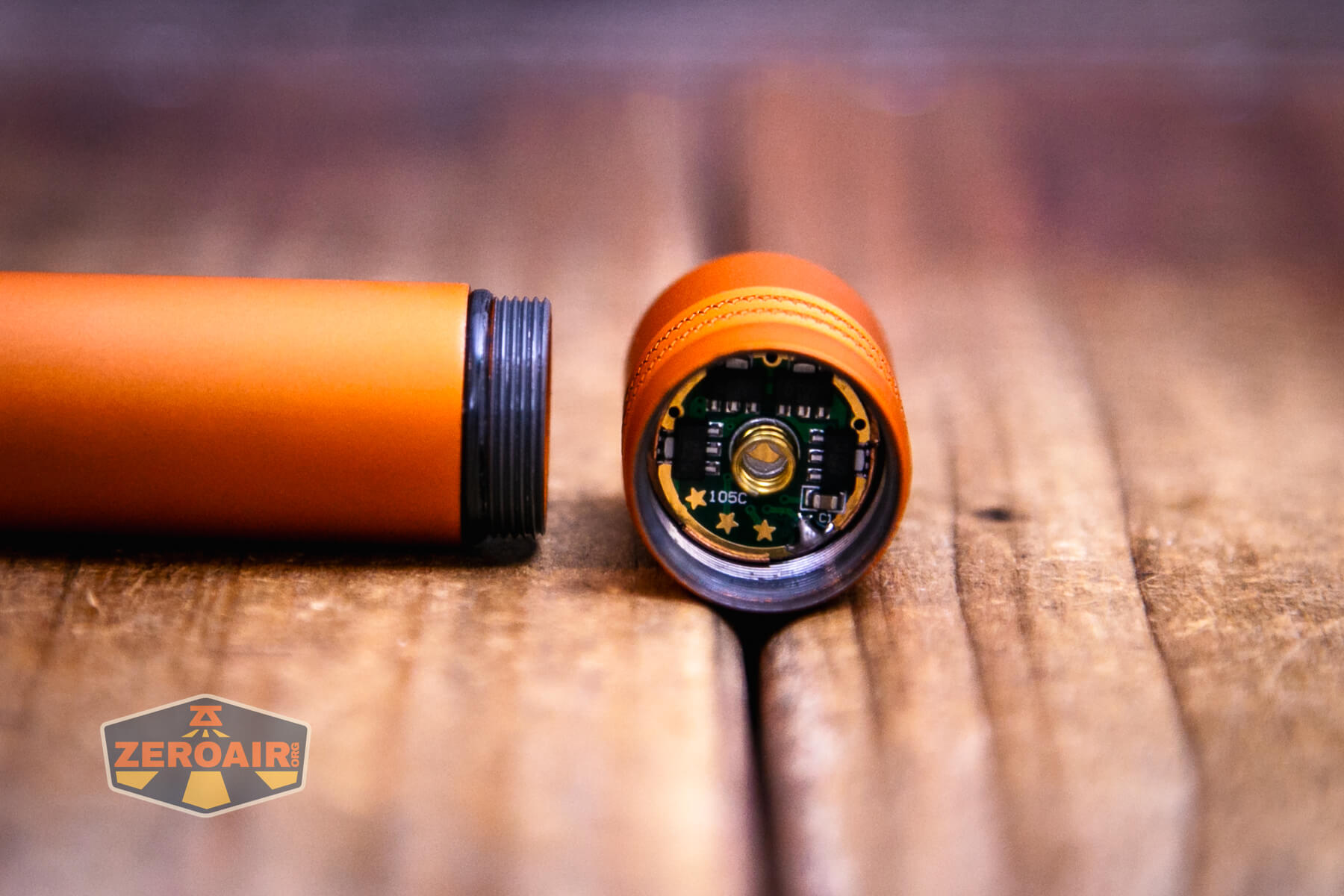
While I am no modifier of flashlights, I do believe (and it’s reported) that this driver could be swapped for some other more customizable driver (like the Dr. Jones H17f).
Inside the cell tube, you can see the McClicky spring. Since the cell tube is one piece and there’s no removable tail cap, you’d need a special tool to remove this clicky.
Size and Comps
4-1/16″ (104mm) x 7/8″ (22mm) diameter
Weight with a battery 75g

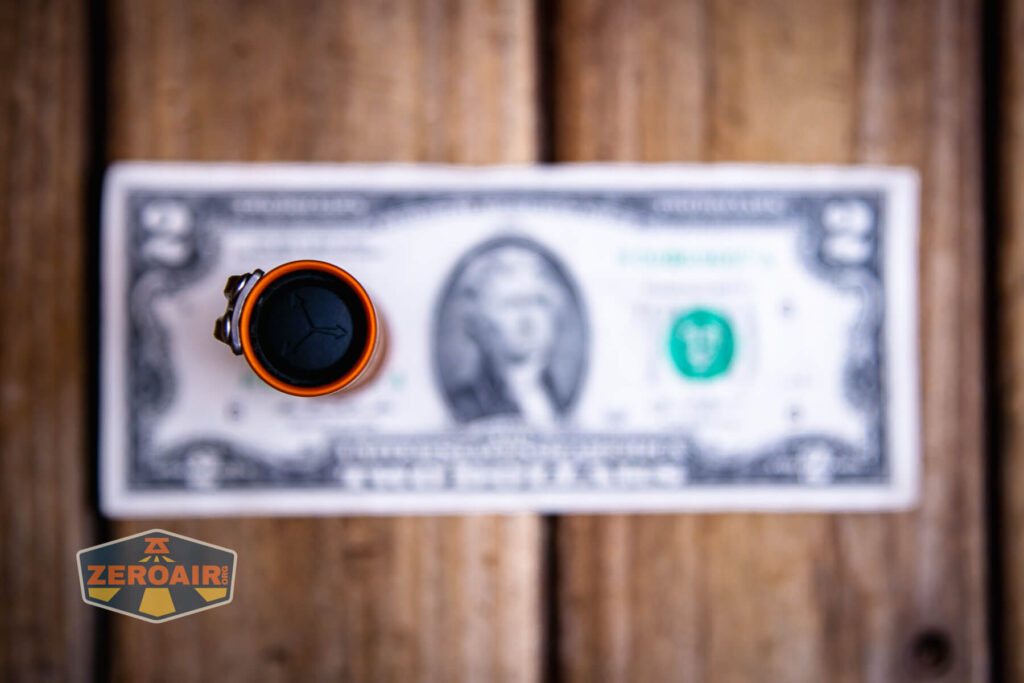
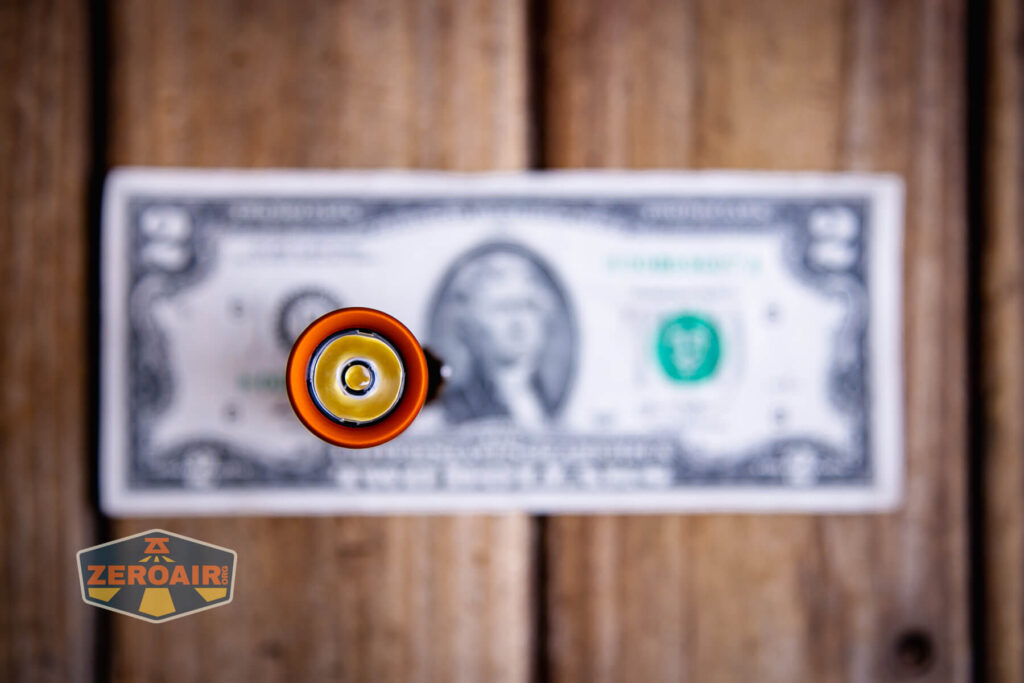
If the flashlight will headstand, I’ll show it here. If the flashlight will tailstand, I’ll also show that here too!

Here’s the test light with the venerable Convoy S2+. The version below is a custom laser-engraved Convoy S2+ host by GadgetConnections.com. I did a full post on an engraved orange host right here! Or go straight to GadgetConnections.com to buy your Convoy S2+ now!


In the photo above, you may note that the SRM (standard reference material) flashlight for comparison has changed! I used a TorchLAB BOSS 35 for ages. Now, what you can see as the 18350 SRM is the Hanko Machine Works Trident. While I have not reviewed or tested the Gunner Grip version seen here, I have tested a Hanko Machine Works Trident Total Tesseract in brass. I love the Trident, and it’s a striking contrast next to the inexpensive Convoy S2+, which also makes a great standard reference material.
Below you can see the F3 with the F2 (right side). The most important point here is the difference between Pumpkin orange (f3) and Blood orange (F3). They are both fine but the finish of the blood orange F2 is more to my taste. It’s slicker or more polished or something.


Both are fantastic, though, and both are “orange enough.”
Retention and Carry
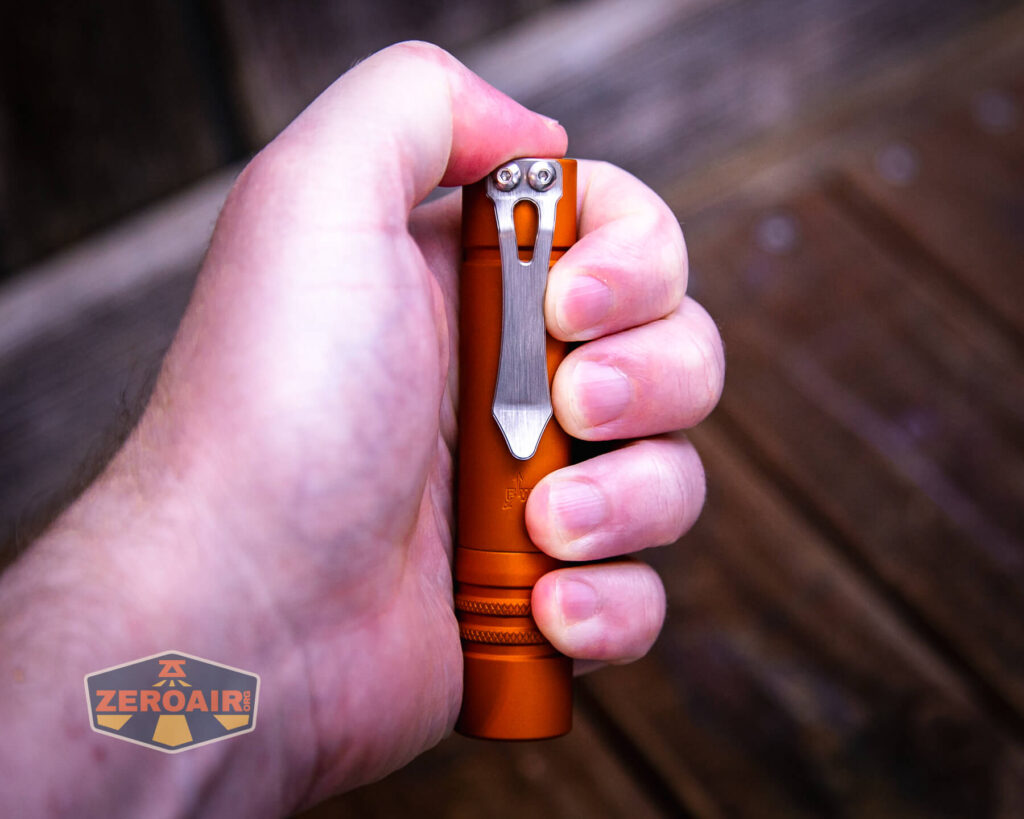
Included with the Focusworks EDC F3 Pumpkin Orange flashlight is a custom-made steel pocket clip.
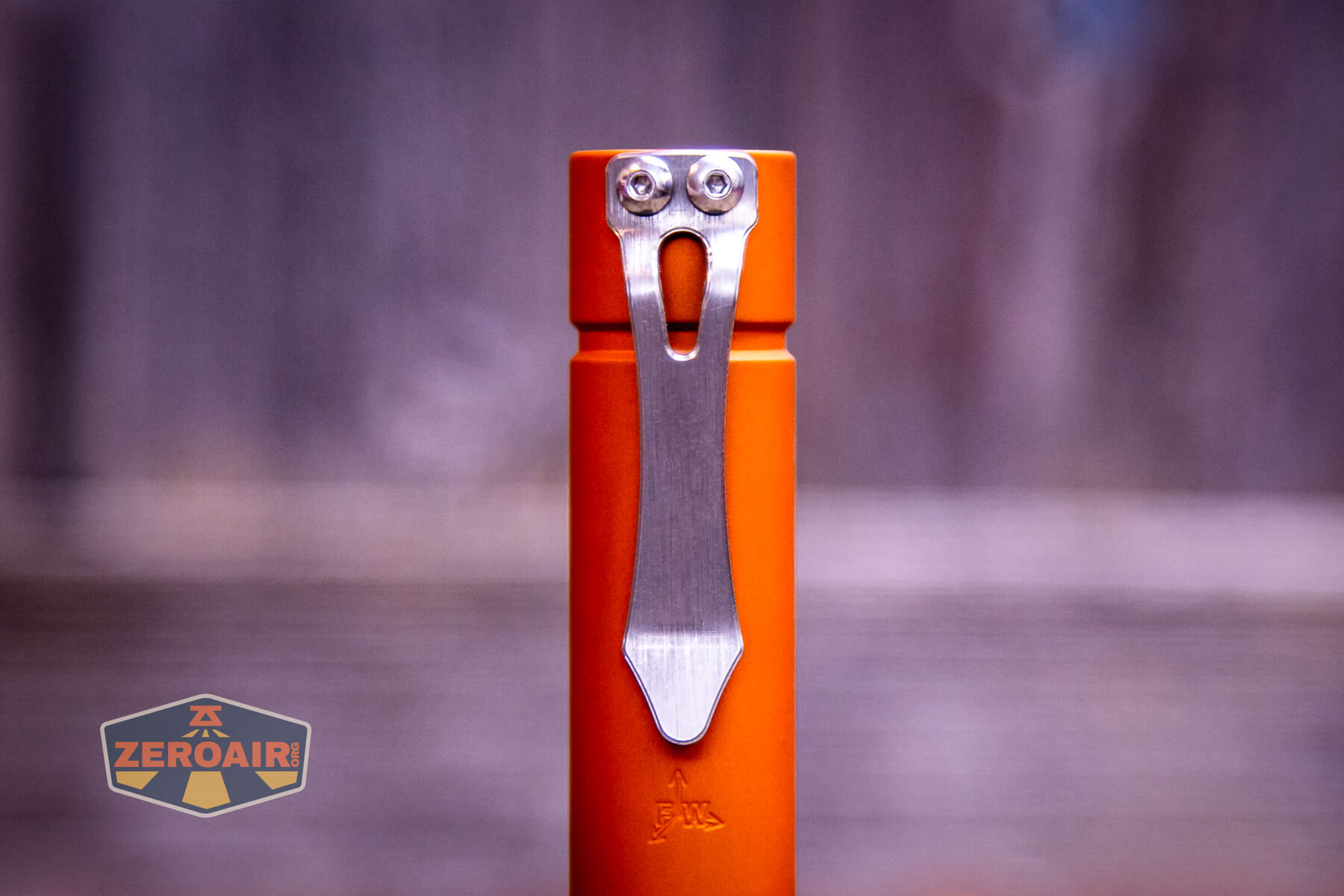
This clip attaches with two Hex screws.
Anyway, this whole setup is exceptional. It’s a custom pocket clip that has fantastic attention to detail.

For example, check out the brushed finish on this clip! Also, and very importantly, as you can see in some photos above, the edges are finished. I’m not sure what Jordy of FocusWorks does to these (maybe a tumble!), but the edges don’t feel like an afterthought and don’t feel like they’re right out of the machine that cut them. They’re very nice clips. One more point – check out where the clip lands on the body. It’s right on a nice smooth spot, so using the clip (on pants pocket or whatever) is very pleasant. I found the clip tension to be sufficient and I didn’t worry about the light unintentionally leaving my pocket.
The screw holes go all the way through the tail, as you can see below. Just by eyeballing a light or two against this pocket clip, I believe this to be standard SteelFlame pocket clip hole spacing.
That’s it – no magnet or lanyard or anything else. The pocket clip does have a hole where a lanyard can be attached, though.
Power and Runtime
The Focusworks EDC F3 Pumpkin Orange flashlight runs on a single 14500-sized lithium-ion cell. It’s possible to add one of these at the site for purchase for an additional $13. I used this 850mAh Nitecore cell I had from other tests.
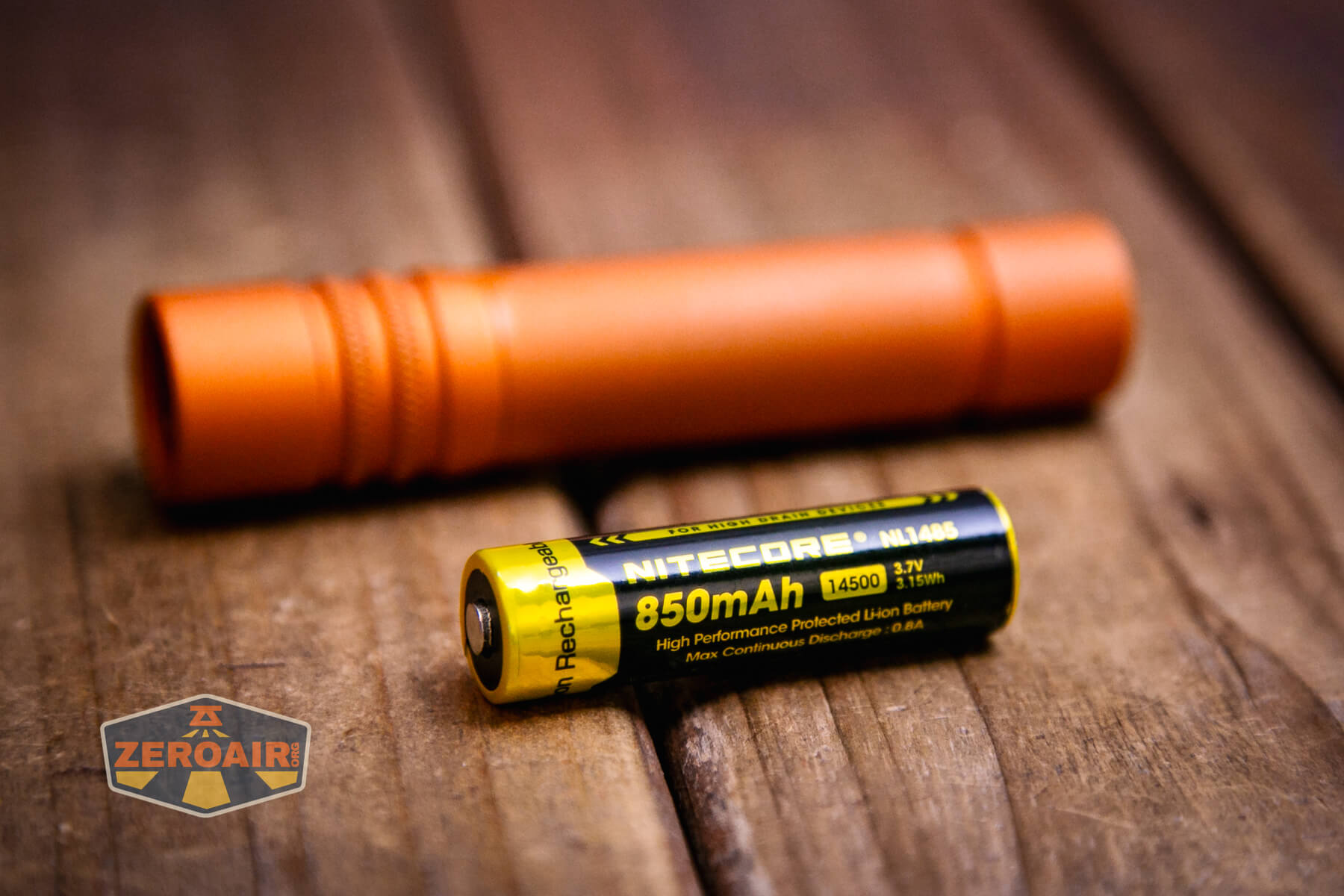
The cell fits into the light in the usual way – positive end (in this case “button end”) toward the head. NiMH cells and other 1.5V cells do not work in this light.
Here are runtime graphs for all three modes.
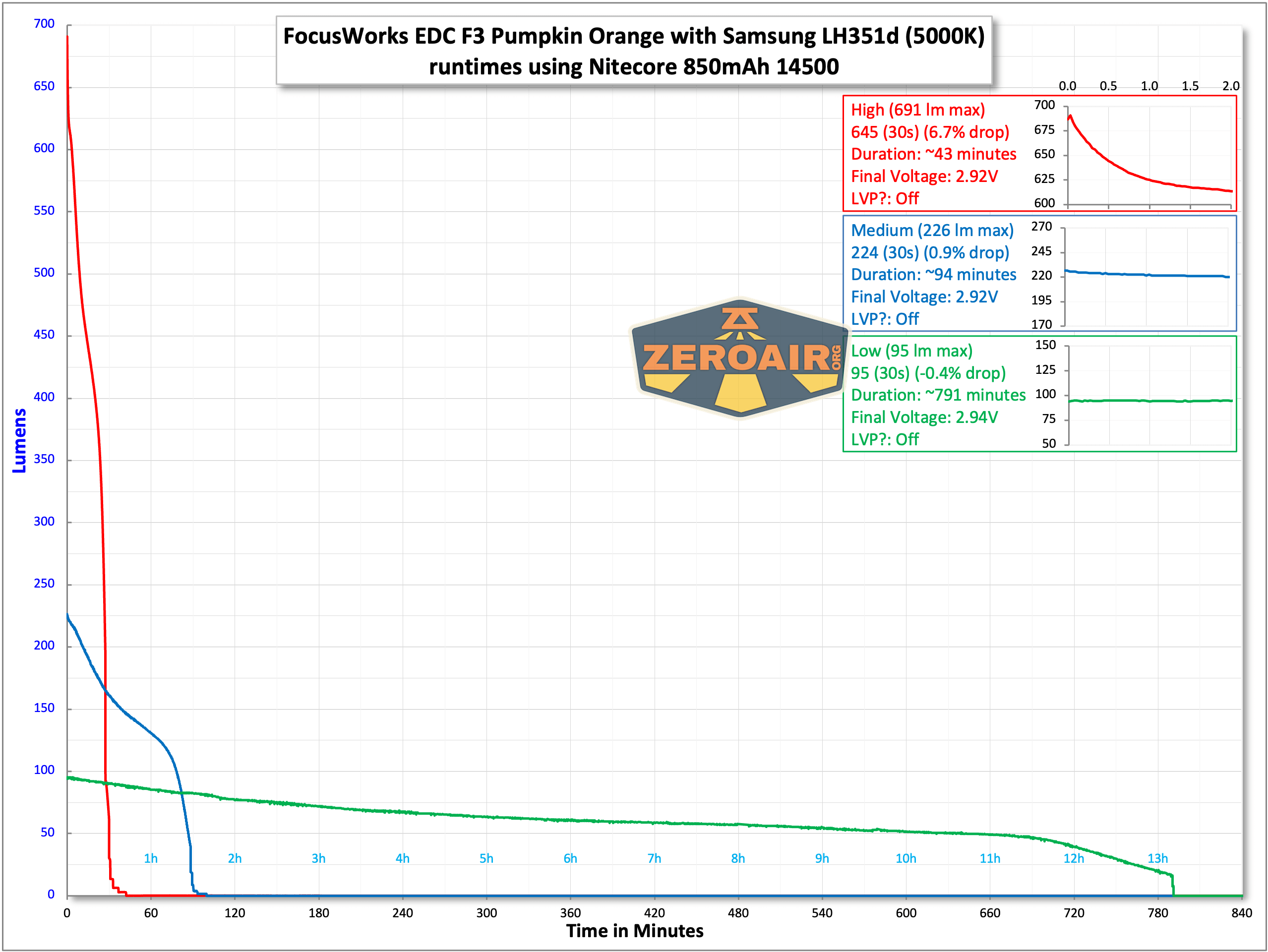
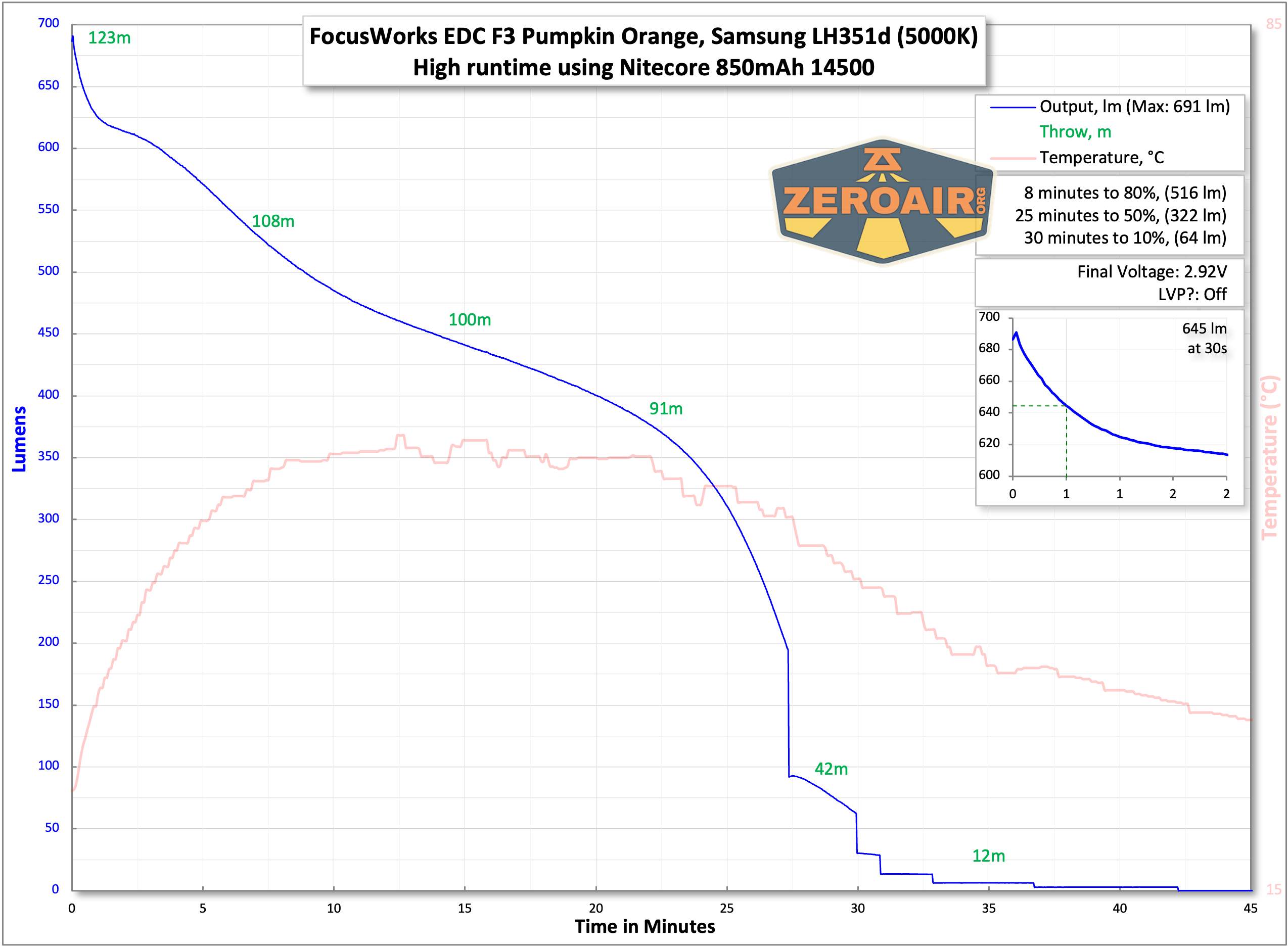
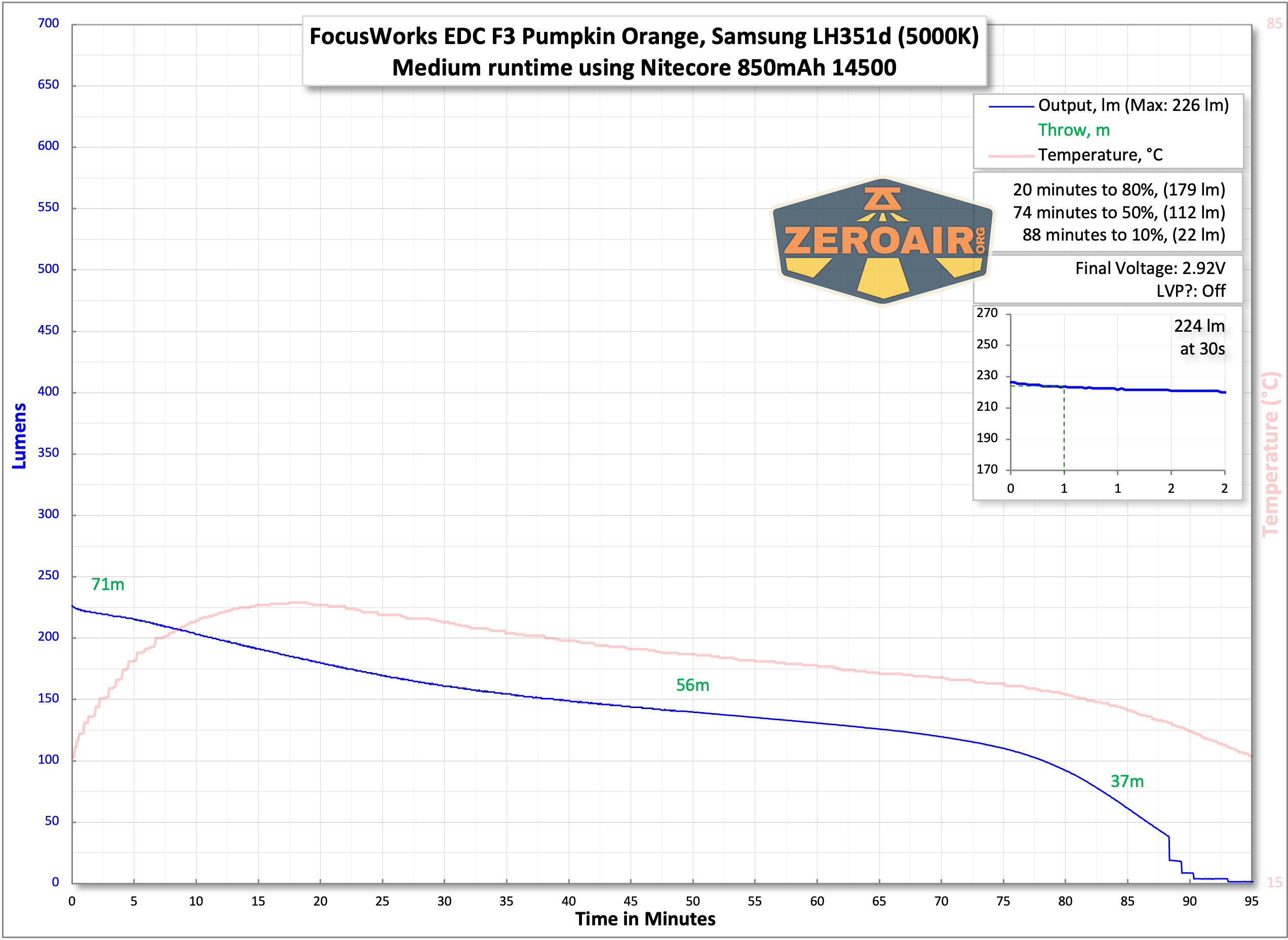
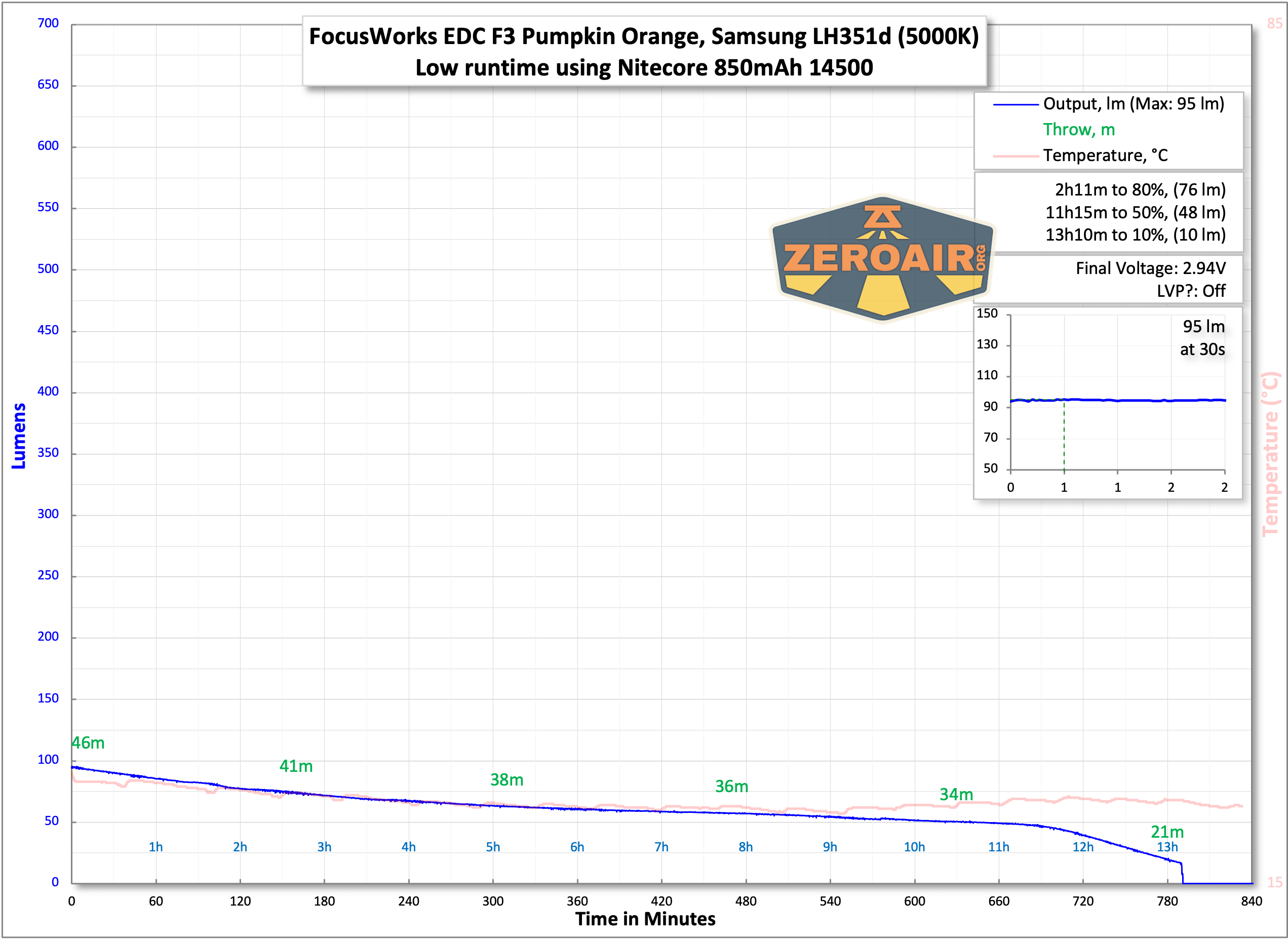
The light does shut off with low voltage protection.
Modes and Currents
| Mode | Mode Claimed Output (lm) | Claimed Runtime | Measured Lumens | Tailcap Amps |
|---|---|---|---|---|
| High | – | – | 645 | 3.00 |
| Medium | – | – | 225 | 0.87 |
| Low | – | – | 95 | 0.07 |
Pulse Width Modulation
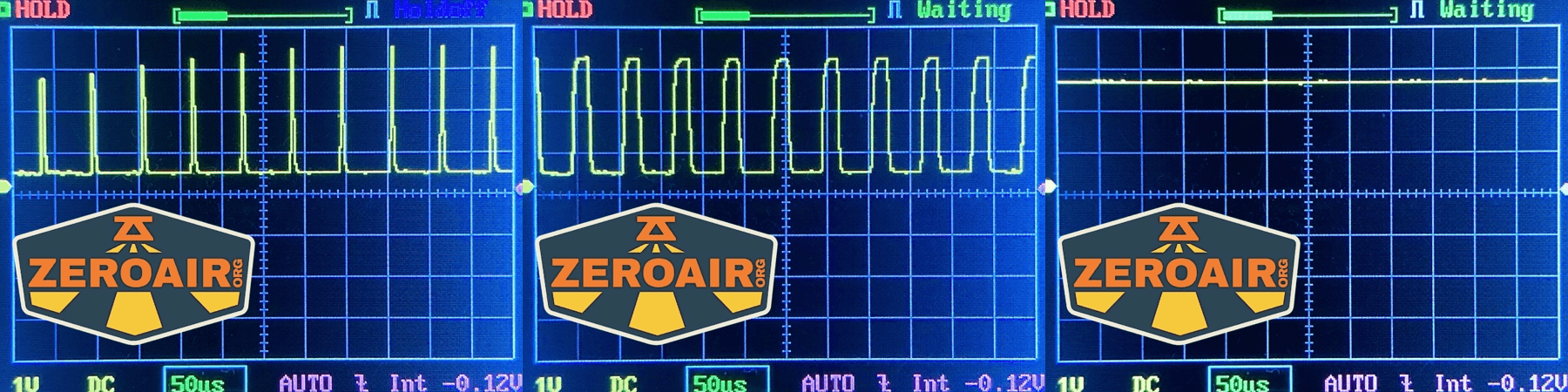
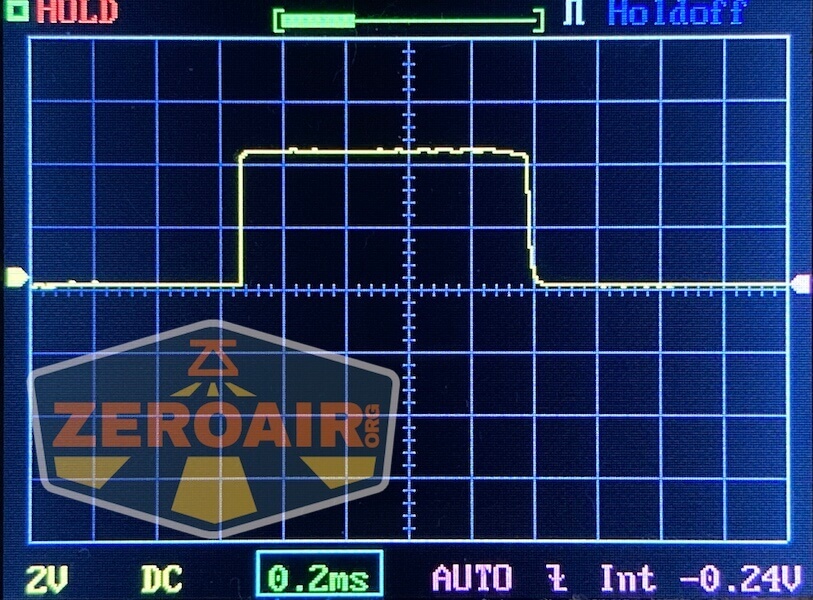
PWM is seen by the oscilloscope on the lower two modes (left) but the highest mode does not have PWM. PWM on those lower two is probably fast enough that you’ll never notice it.
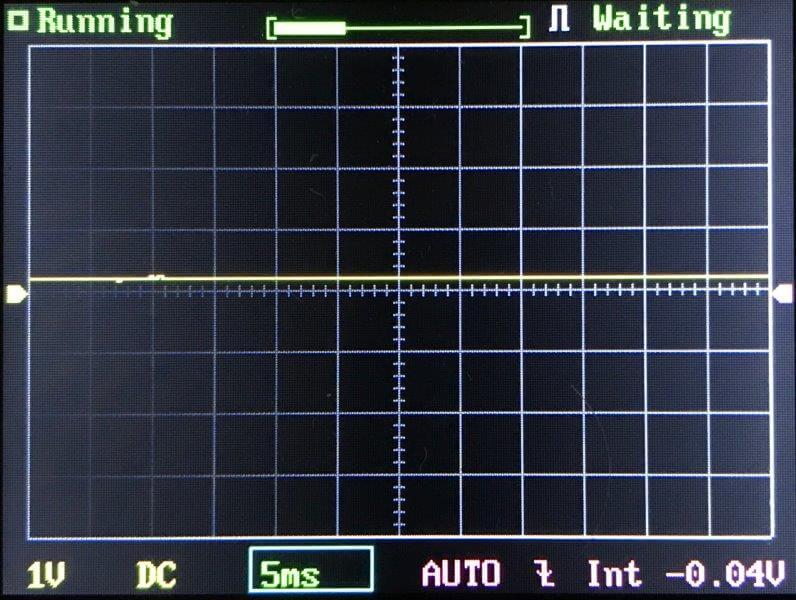
Here you can see a “baseline” – a chart with almost no light hitting the sensor.
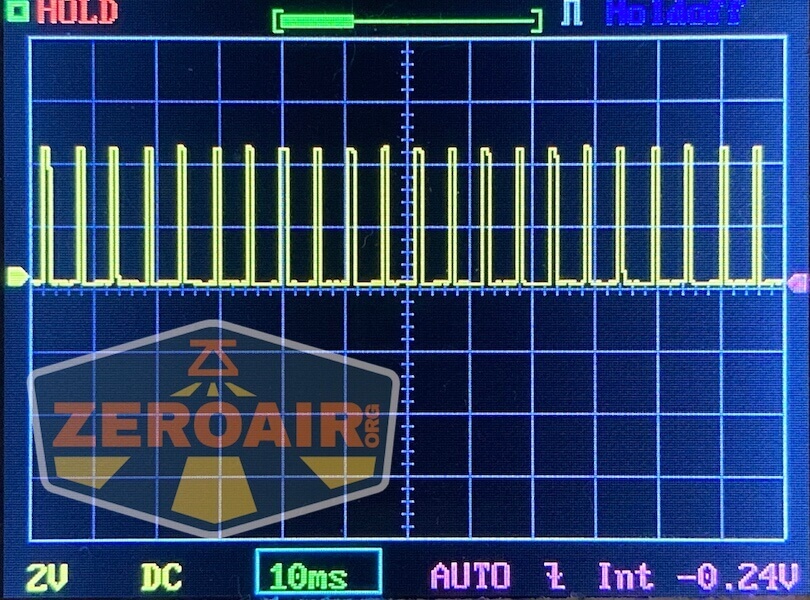
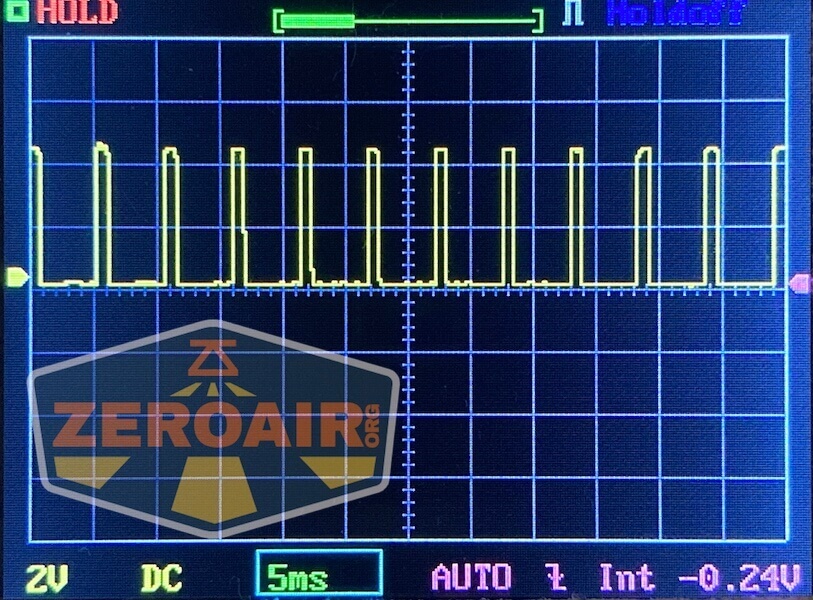
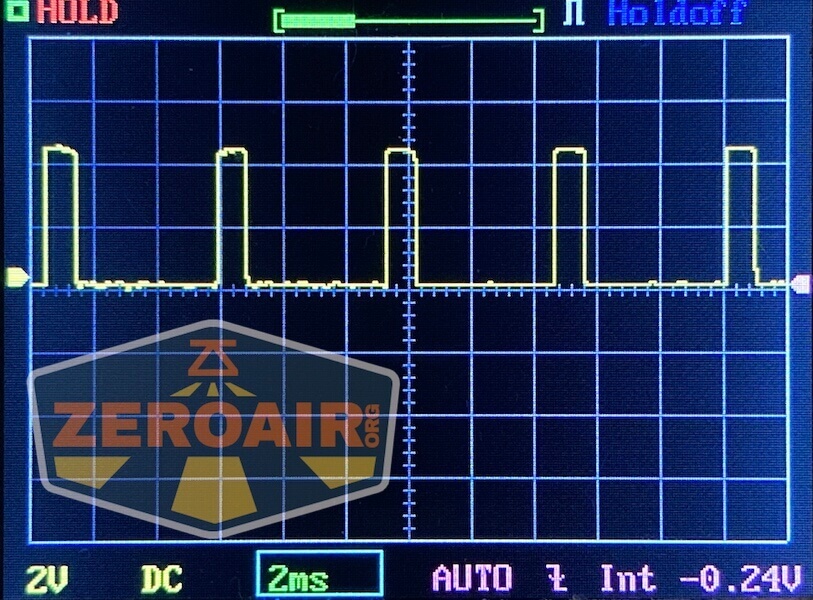
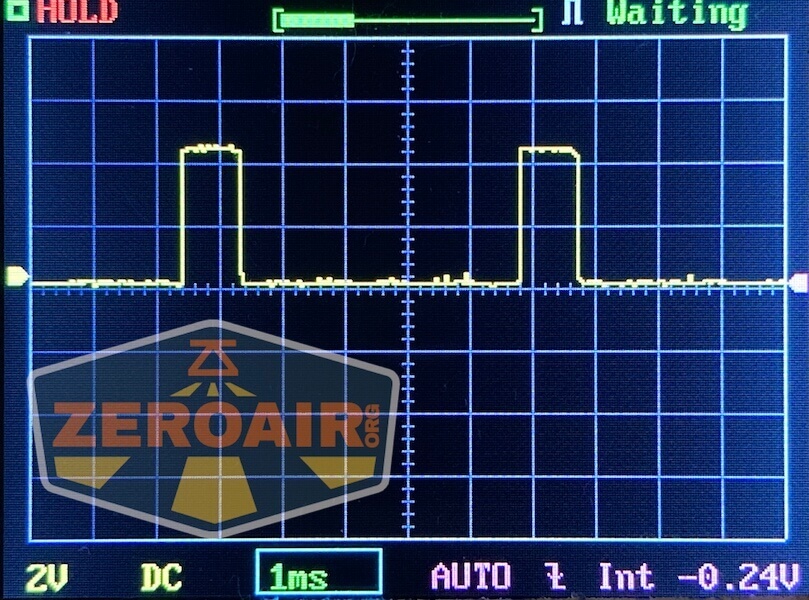
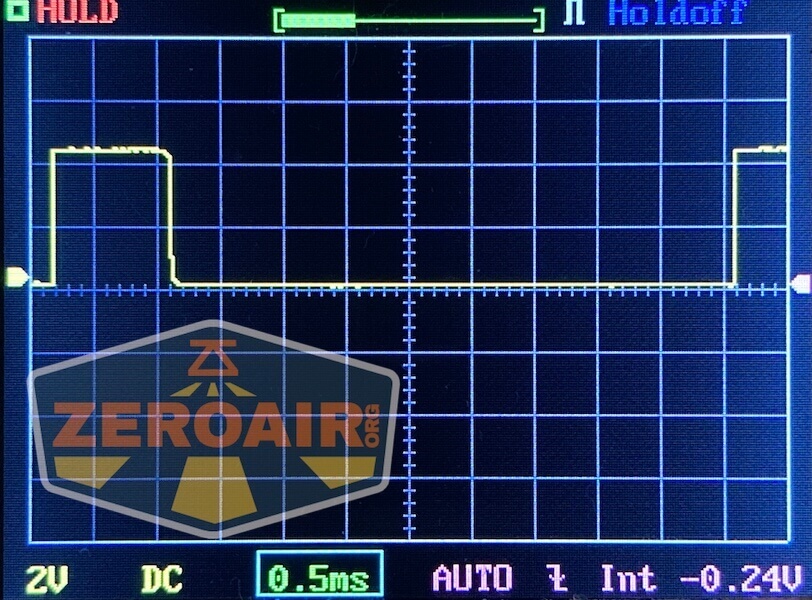
Then there’s the Ultrafire WF-602C flashlight, which has some of the worst PWM I’ve seen. It’s so bad that I used a post about it to explain PWM! Here are multiple timescales (10ms, 5ms, 2ms, 1ms, 0.5ms, 0.2ms) to make comparing this “worst” PWM light to the test light easier. That post also explains why I didn’t test the WF-602C at the usual 50us scale.
User Interface and Operation
Interaction with the Focusworks EDC F3 Pumpkin Orange flashlight comes by way of a mechanical clicky in the tail end. This is the stalwart of clicky switches – the McClicky!
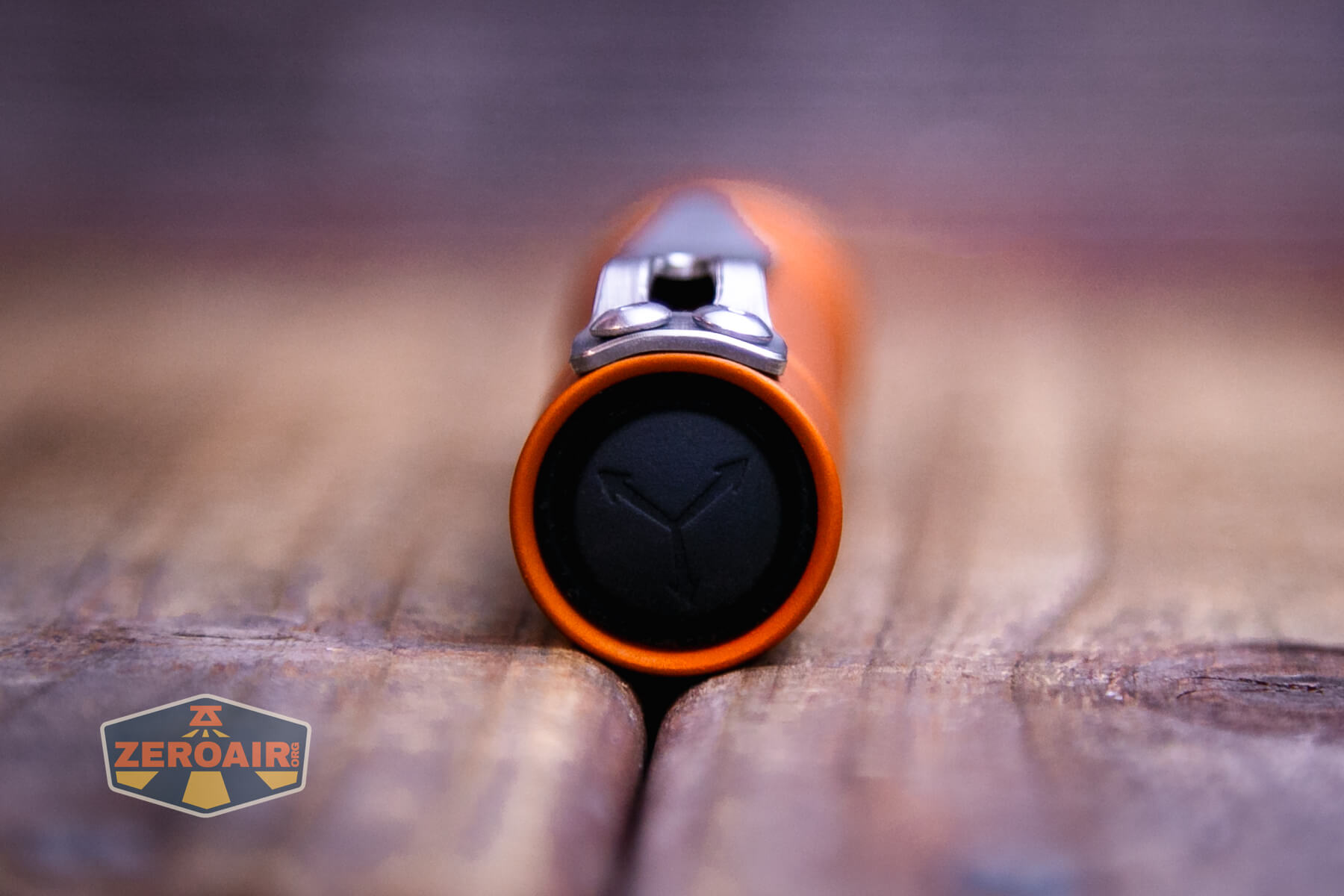
Also, check out this logo switch cover with the FocusWorks EDC arrows. This is a very nice touch.

The rubber boot cover does not protrude past the tail end of the light. That means tailstanding is easy and stable.
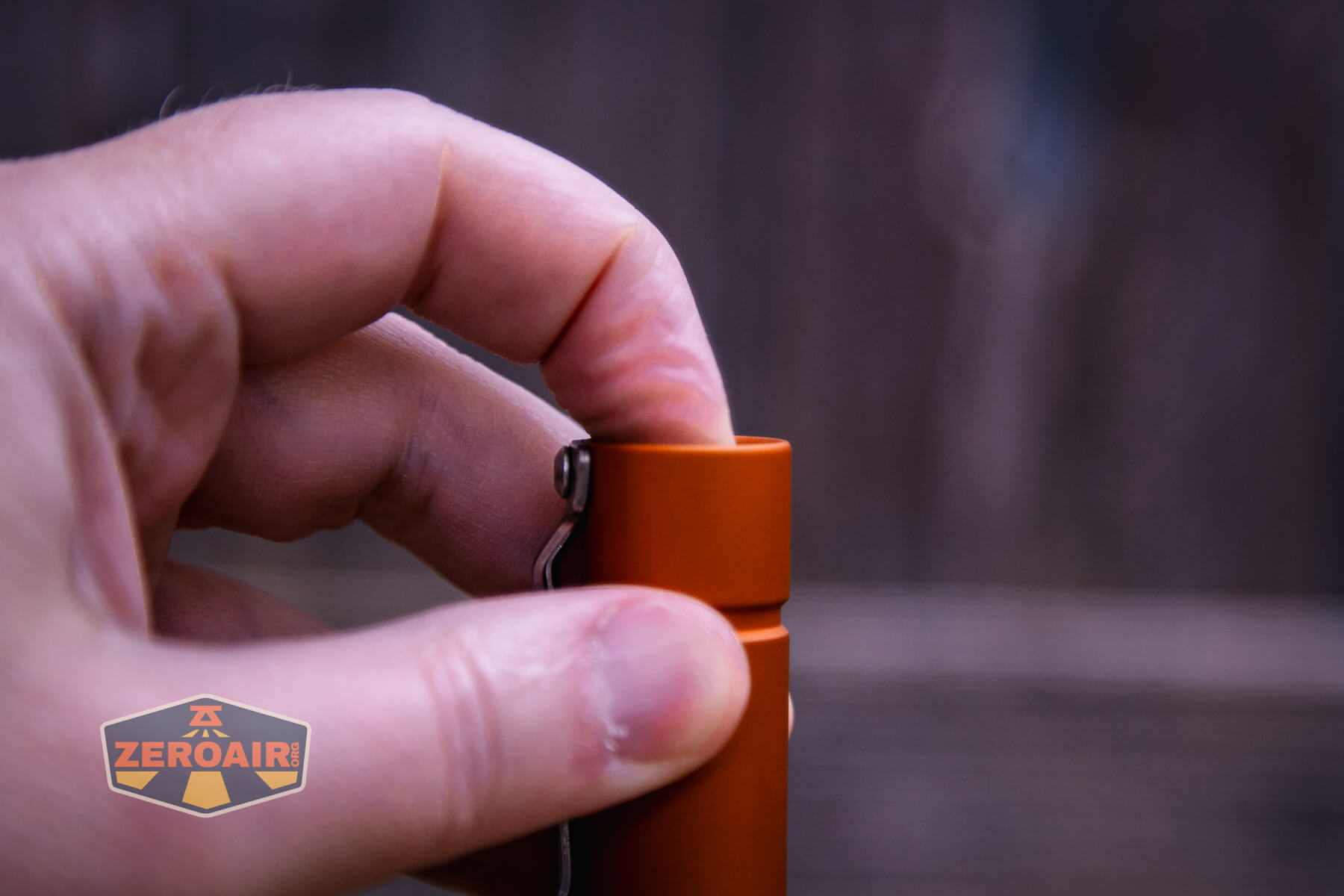
The driver on the Focusworks EDC F3 Pumpkin Orange flashlight is a qlite driver. That’s a very simple driver and does provide an interface that just about anyone can pick up and run with. But we aren’t just anyone, and I can see how you might want more. While I didn’t do it, I can say that other drivers fit into the pill with relative ease. For example, you could put into this light a Dr. Jones H17f and have programmability, many modes, and…. tons of options. At that same time, you might opt to throw in an emitter from more “current gen” like the Nichia 519a.
Even if you did those things, at $185, you can still get parts and perform the work and come out having spent less than other comparable lights. (You might even be inclined to buy a light such as the Acebeam Rider RX and driver/emitter swap into this body. You get a nice “custom-type” light but with a driver supporting 14500 and AA cells!)
Here’s a user interface table! Note that there are some options you’d need to select from when buying your F3. You can pick with or without Memory. I have the version with memory.
| State | Action | Result |
|---|---|---|
| Off | Click | On (Memory)^ |
| Off | Tap | Mode selection^^ |
| On | Click | Off |
| On | Tap | No action (because this is a forward clicky) |
^ It’s possible to purchase the light with or without memory enabled.
^^ Repeated taps cycle modes Low > Medium > High. Taps need to be “together” – if you wait for more than a second or so, tapping will put you in the same mode you’re already in. It’s very clean in practice but harder to describe in text. Anything down to a “slow double click” speed will suffice for mode changing. Anything you would describe as being slower than the speed of a “slow double click” will be too slow, and you’ll reenter the same mode.
LED and Beam
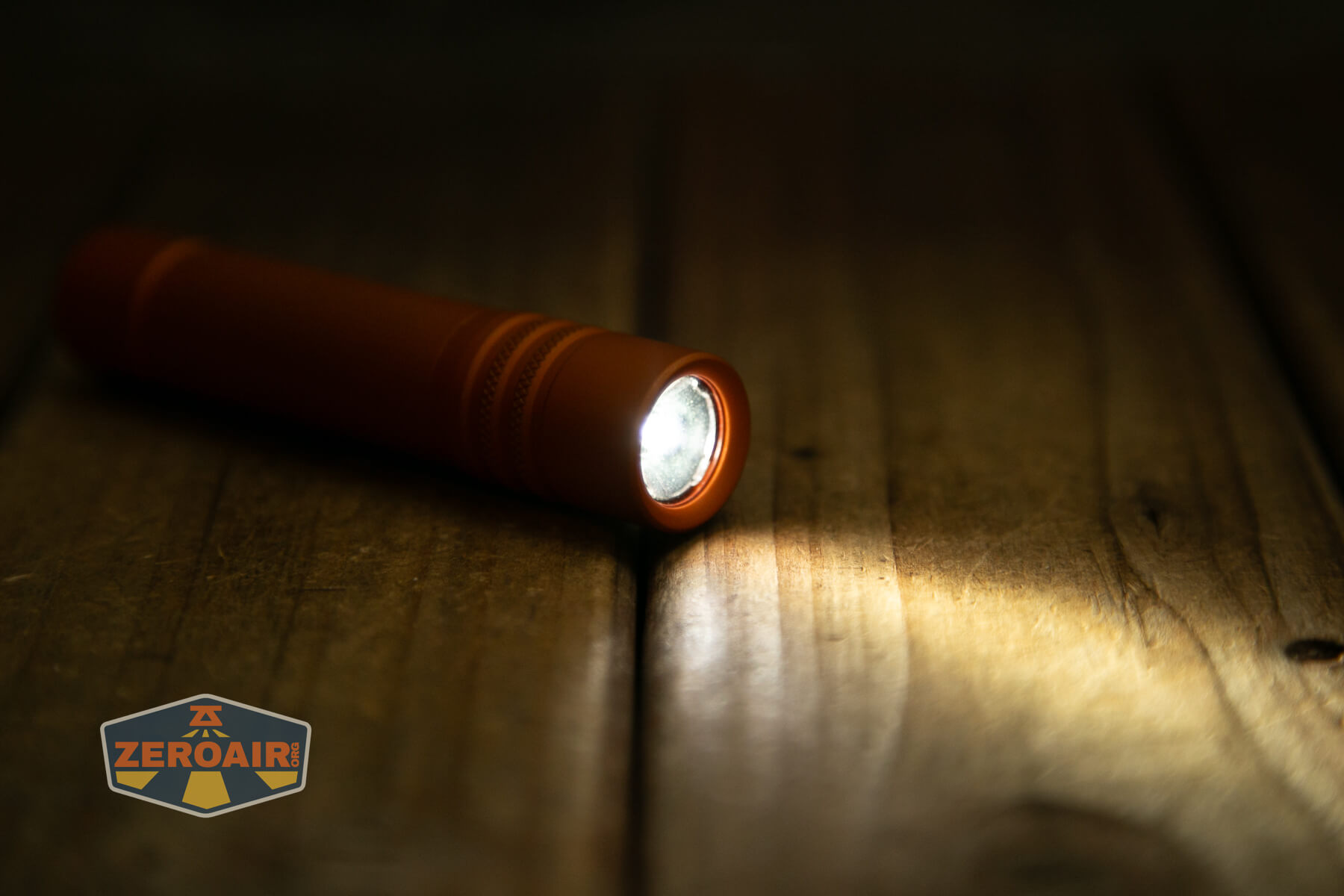
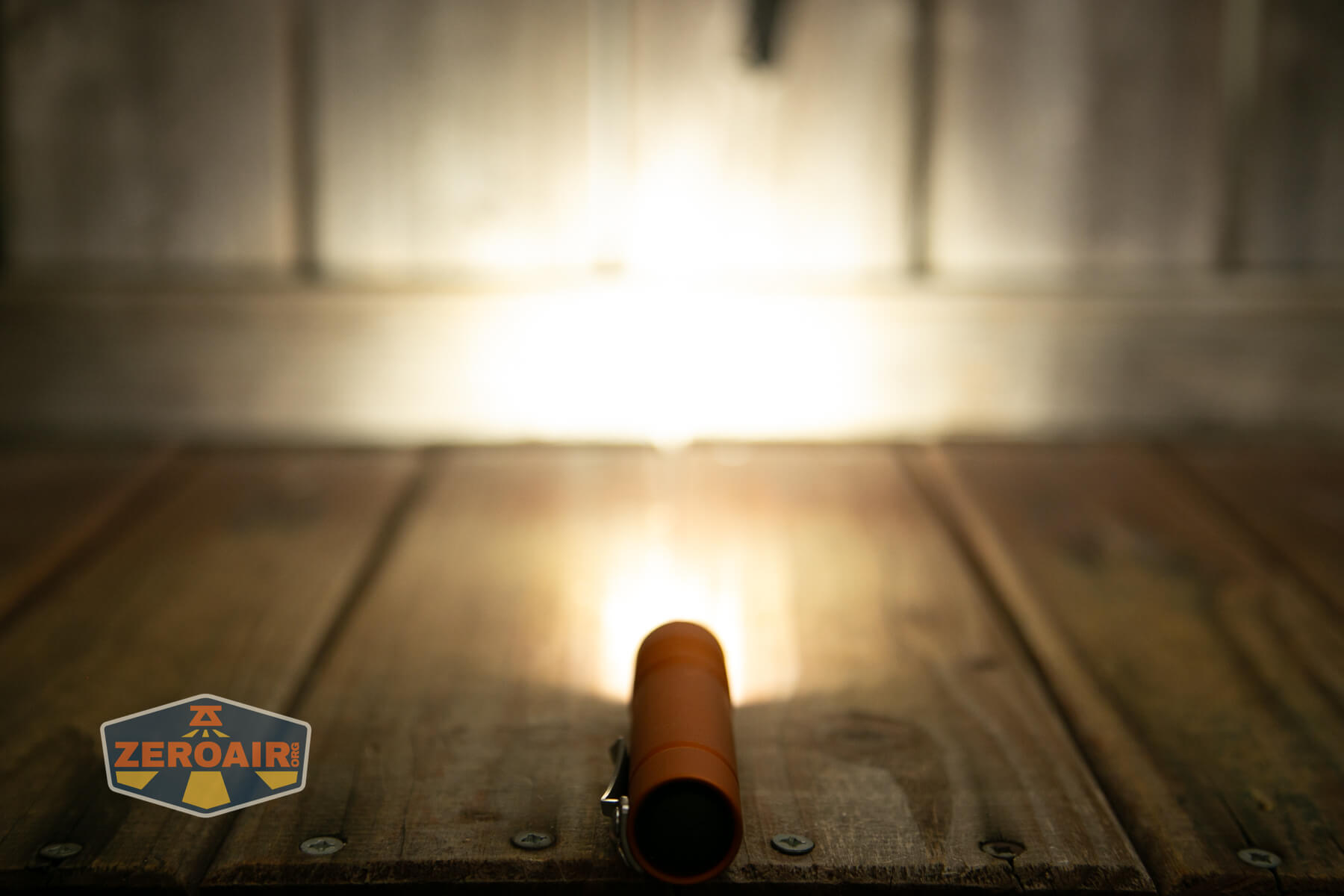
There are a couple of options, but my copy of the Focusworks EDC F3 Pumpkin Orange flashlight has a Samsung LH351d in 5000K. That’s a great emitter and coupled with the TIR, gives a great beam profile.
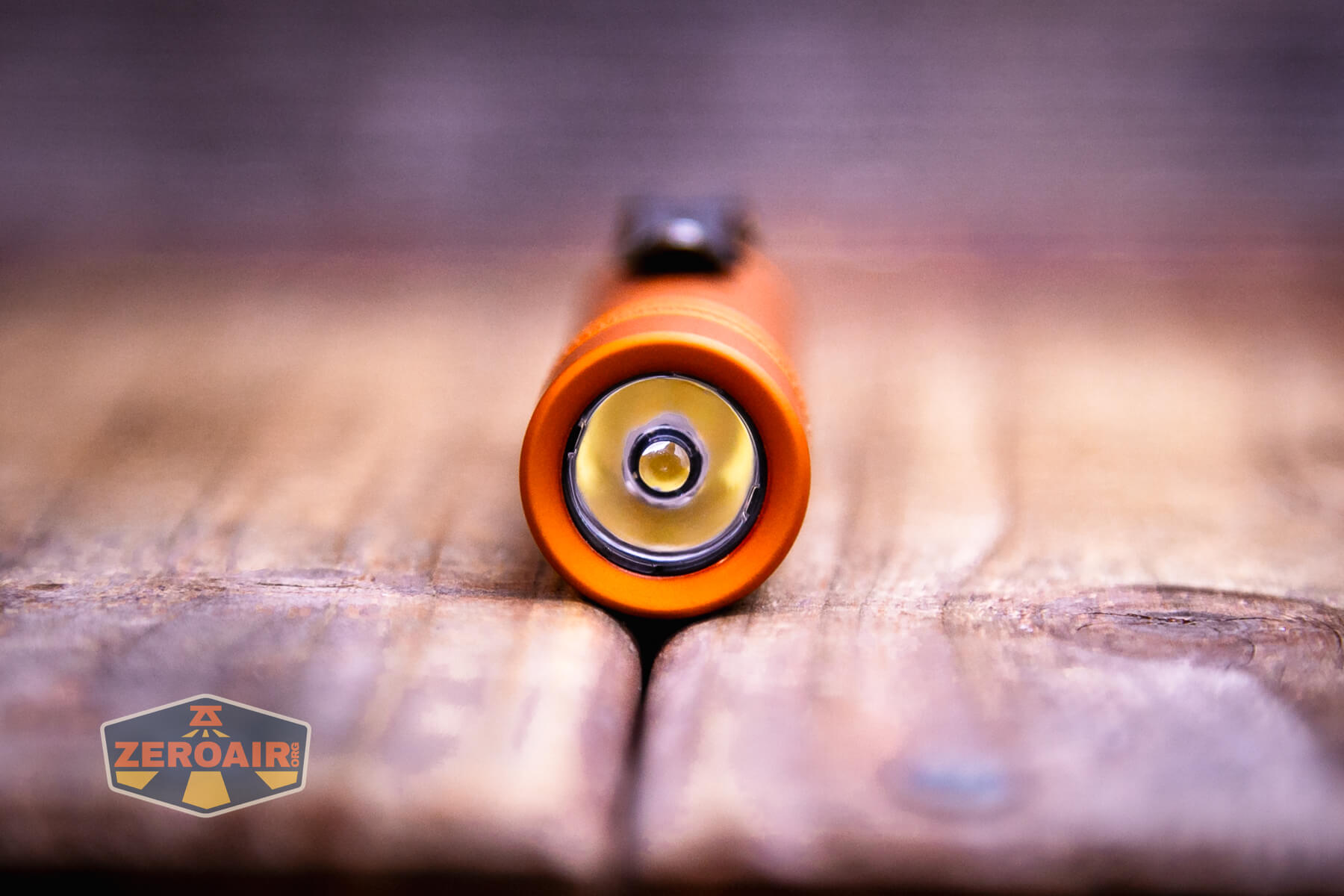
Singles are great, too, and I love them! And in this application – a 14500-cell light, it makes great sense!
LED Color Report (CRI and CCT)
CRI and CCT are both good on this emitter – from around 4700K to around 4800K and around 89CRI. Duv is positive, which supports the idea that you might see a bit of green in the beam. It’s low (technically “near zero” I guess), though.


Beamshots
These beamshots always have the following settings: f8, ISO100, 0.3s shutter, and manual 5000K exposure. These photos are taken at floor level, and the beam hits the ceiling around 9 feet away.


Tint vs BLF-348 (KillzoneFlashlights.com 219b version) (affiliate link)
I keep the test flashlight on the left and the BLF-348 reference flashlight on the right. These photos are taken around 18 inches from the door.



I compare everything to the KillzoneFlashlights.com 219b BLF-348 because it’s inexpensive and has the best tint!
Summary and Conclusion
The Focusworks EDC F3 Pumpkin Orange flashlight is a very solid contender if you need a 14500-cell light. If you’re able to modify flashlights, even better – this light will really stand out with something like a Nichia 519a and Dr. Jones H17f driver. I love that there’s minimal knurling but it’s exactly in the right place. The light carries very comfortably, too. It’s a good light!
The Big Table
| Focusworks EDC F3 Pumpkin Orange flashlight | |
|---|---|
| Emitter: | Samsung LH351d |
| Price in USD at publication time: | $185.00 |
| Cell: | 1×14500 |
| Runtime Graphs | |
| LVP? | Yes |
| Switch Type: | Mechanical |
| On-Board Charging? | No |
| Claimed Lumens (lm) | 900 |
| Measured Lumens (at 30s) | 645 (71.7% of claim)^ |
| Candela per Lumen | 5.65 |
| Claimed Throw (m) | – |
| Candela (Calculated) in cd (at 30s) | 130lux @ 5.514m = 3953cd |
| Throw (Calculated) (m) | 125.7 |
| Claimed CCT | 5000 |
| Measured CCT Range (K) | 4700-4800 Kelvin |
| Item provided for review by: | Me |
| All my Focusworks reviews! | |
^ Measurement disclaimer: Testing flashlights is my hobby. I use hobbyist-level equipment for testing, including some I made myself. Try not to get buried in the details of manufacturer specifications versus measurements recorded here; A certain amount of difference (say, 10 or 15%) is perfectly reasonable.
What I like
- Great build quality
- I love a single-emitter flashlight
- User interface is very simple
- Some very custom parts (switch cover, pocket clip)
- Carries very well
What I don’t like
- Qlite driver – h17f would be a better choice for this (and any) light
- Emitter options – Samsung LH351d seems like yesterday’s emitter
- Doesn’t support AA cells
- Three modes are not enough modes!
- Does not include 14500 cell
Notes
- This content originally appeared at zeroair.org. Please visit there for the best experience!
- Please use my Amazon.com referral link to help support zeroair.org!
- Please support me on Patreon! I deeply appreciate your support!
Discover more from ZeroAir Reviews
Subscribe to get the latest posts sent to your email.
That’s an awesome hobby! It’s great to see hands-on testing with custom equipment. I appreciate the reminder about reasonable measurement differences—real-world testing is always valuable!