

Convoy S9 Flashlight Review
Convoy has released the S9, an 18650 flashlight with a side e-switch (with indicator function), and a Cree XM-L2 emitter. Read on for testing!
Official Specs and Features
Here’s a link to the Convoy S9 Flashlight product page.
Versions
There’s but one body color for this Convoy, but three emitter tints: 4500K, 5500K, and 6500K. Being that this is a Convoy light, I’d expect some different colors in the future, if it turns out to be a popular light.
Price
Around $20.
Short Review
This is a solid light with good charging and a nice indicating switch, but it’s not driven hard enough. Add a turbo or higher mode, and this is another Convoy winner.
Long Review
The Big Table
| Convoy S9 | |
|---|---|
| Emitter: | Cree XM-L2 (5000K) |
| Price in USD at publication time: | $20 |
| Cell: | 1×18650 |
| Turbo Runtime | |
| LVP? | Warning |
| Switch Type: | E-Switch |
| On-Board Charging? | Yes |
| Chargetime | |
| Power off Charge Port with no Cell? | ? |
| Claimed Lumens (lm) | 500 |
| Claimed Throw (m) | – |
| Candela (Calculated) in cd (at 30s) | 467lux @ 3.387m = 5357cd^ |
| Throw (Calculated) (m) | 146.4 |
| All my Convoy reviews! | |
^ Measurement disclaimer: Testing flashlights is my hobby. I use hobbyist-level equipment for testing, including some I made myself. Try not to get buried in the details of manufacturer specifications versus measurements recorded here; A certain amount of difference (say, 10 or 15%) is perfectly reasonable.
What’s Included
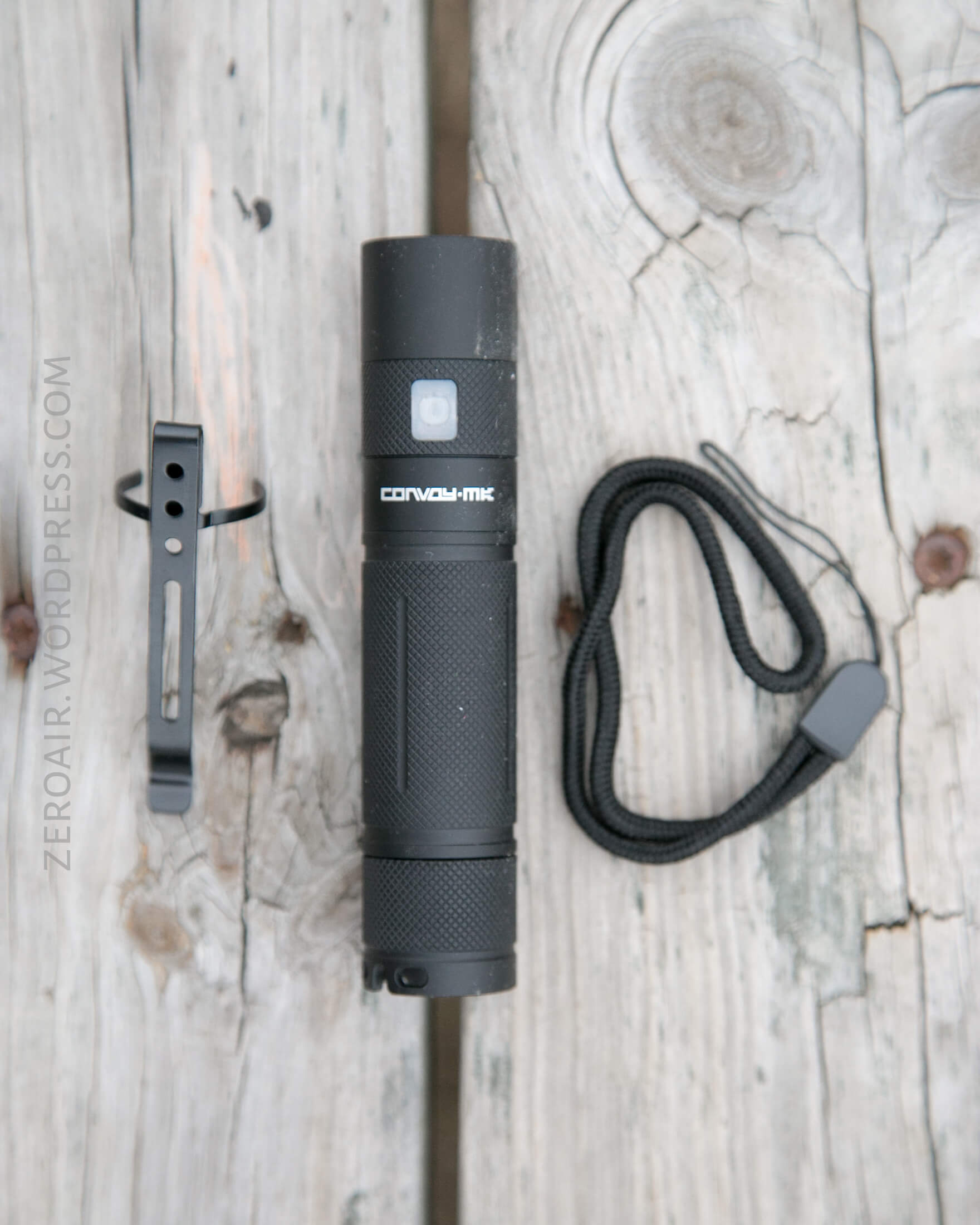
- Convoy S9
- Lanyard
- Pocket clip
Package and Manual
The Convoy S9 ships in a slip-fit cardboard box, with a letterpress Convoy logo on the front. GearBest has its inventory sticker, and there’s not much else. There is no manual.

Build Quality and Disassembly
If you’ve handled a Convoy S2+, then you’ll be familiar with the build quality of this light. They’re about the same. For a $20 light, the build quality is excellent. The anodizing is quite matte but doesn’t seem terribly thin. However, Simon does note on his page that the anodizing will scratch if the pocket clip is removed (and it does, but then, many lights do).

There’s plenty of knurling – all 3 main parts have some. It’s grippy but not aggressive.
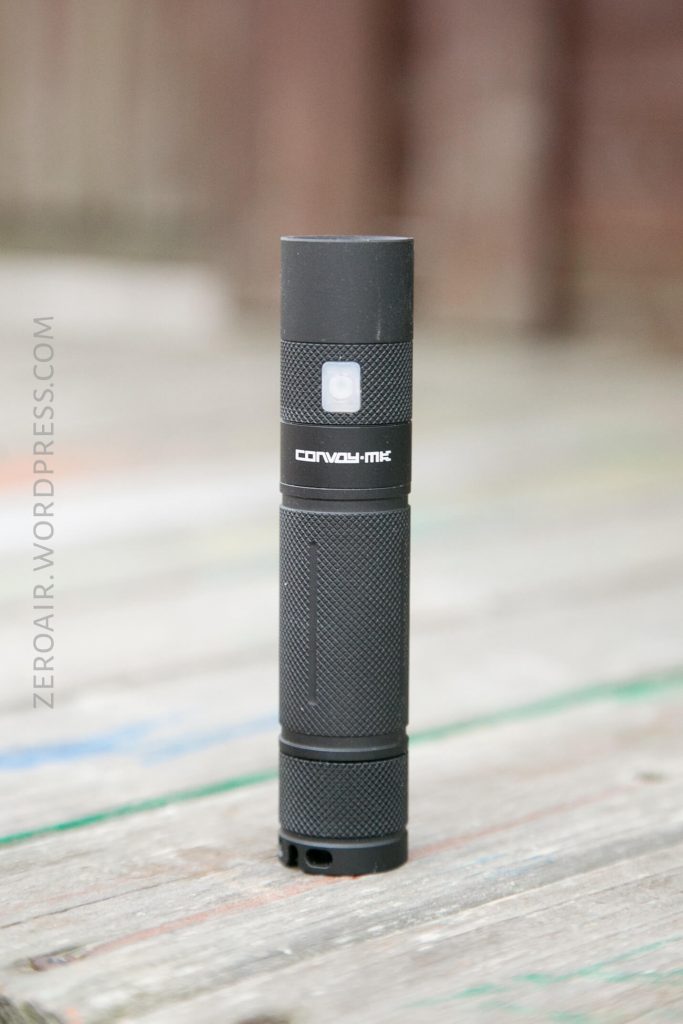


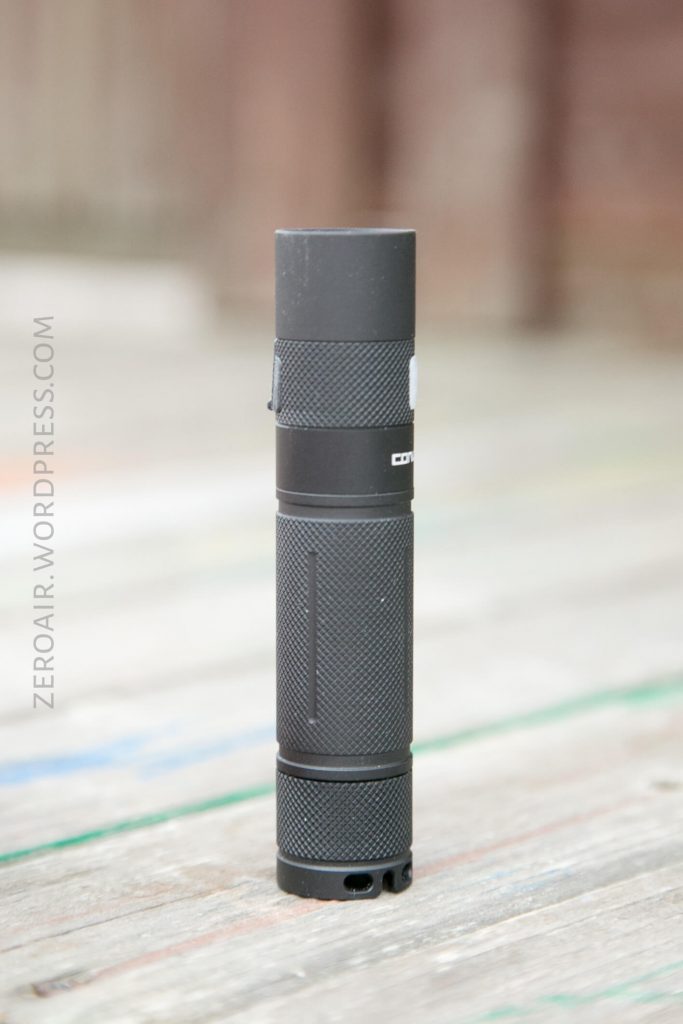
The head and tail come off easily. There’s nothing in the tail to disassemble really, since this is a side switch light. However I was not able to remove the driver from the head, with quite a bit of force. It’s secured with a brass retaining ring, which has dimples, but I could not budge it.

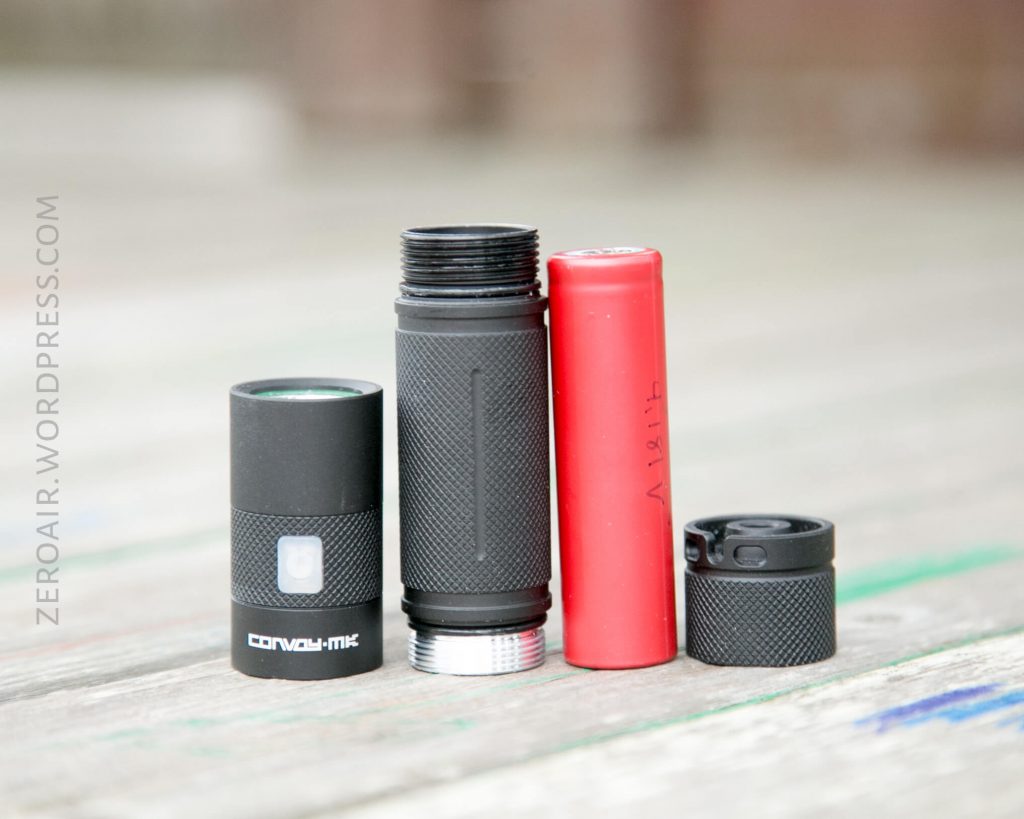
The threads on the head are unanodized, and triangle cut. The threads on the tailend are anodized, and square-cut – much beefier than on the head. As such, it seems cell changes would be better through the tailend. That said, since this light has onboard charging, cell changes might be rare for you!
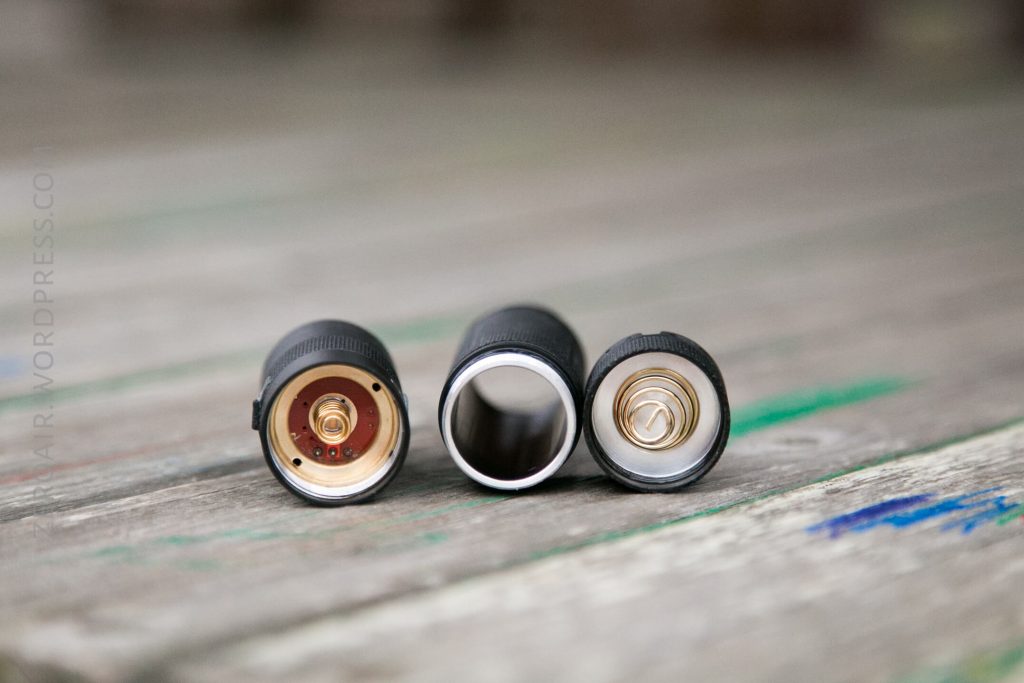

Size


This light does not add much in size to the very similar Convoy S2+ (seen below). In fact, even though it adds charging, it’s even a little shorter than it’s counterpart!


Retention
Provided is a pocket clip, which arrives installed. Simon says that removing the clip can mar the finish of the light. He’s right, it does. But this is true for many of my Convoy lights, so really comes as no surprise.


Also included is a lanyard, which may connect on the clip, or through these two holes in the tailcap:

And finally, there is a threaded bit in the tailcap for a screw connection. Note that the model I have, is not standard 1/4″ tripod threading. Simon says that will change on the next batch, and standard 1/4″ threading will be added.

Power
The S9 is powered by a single 18650, and works with all types. Flat top, button top, protected, unprotected; doesn’t matter – they all work. There’s no mention of a “working voltage” so I’d be hesitant to fire the light up with 2x18350s.
Here’s a runtime on the highest mode. It’s a fine amount of light but in all honestly, this light isn’t super bright at all. (The temperature craziness is likely due to my house heating.) Output is steady for almost an hour, as might be expected (since as I said, high isn’t akin to turbo at all.) Then there’s a steady decline until the light shut off. At this point, the cell was at 2.92V. There’s an indicating side switch as well, to alert a user that the cell voltage is becoming critical. Above 3.3V, the indicator is blue. Between 3.0 and 3.3V, the indicator is red. Then there’s a bit of a gray area, as the indicator will flash red, but the light turns off below 3V. Essentially if the switch is flashing, expect the light to turn off soon.

Charging
Also included on this light is onboard charging, provided through a micro-USB port on the head. Charging too doesn’t require any special cell: the light will charge whatever cell it also runs on. There’s a nice little rubber boot over the port, which fits snugly, and doesn’t protrude overly.

Charging progresses thusly. Current is fairly stable at just under 1A, and the terminal voltage is one of the better results I’ve had, at 4.19V. The indicating switch also indicates charging, and it’s in exactly the same way as for runtime, stated above. This is good charging. And I like that the indicating switch indicates the same way for both situations; that’s surprisingly uncommon.

Quiescent current is 0.00003A. Or 0.03 milliamps. Something like 10+ years of standby. That’s my first time to calculate that. If it’s wrong please educate me.
User Interface and Operation
There’s a single switch on this light – a side e-switch. It’s an indicating switch (as covered above) and can emit red and blue. (But there’s no police mode in the user interface – now that’d be neat, huh?) The switch is a translucent silicone switch, which clicks easily. If the light is on, then so is the indicating switch (always relaying cell voltage information.)
The user interface is quite simple. There are four modes. Click for on (mode memory, all modes). Hold for off. Click to advance modes (LMH). Double click for strobe and click to exit strobe (to previous level). Strobe is fortunately not in the main mode cycle. Unfortunately, there’s no quick access to any modes (except strobe, bleh); it’s a mode memory light. I can’t find any other hidden modes.
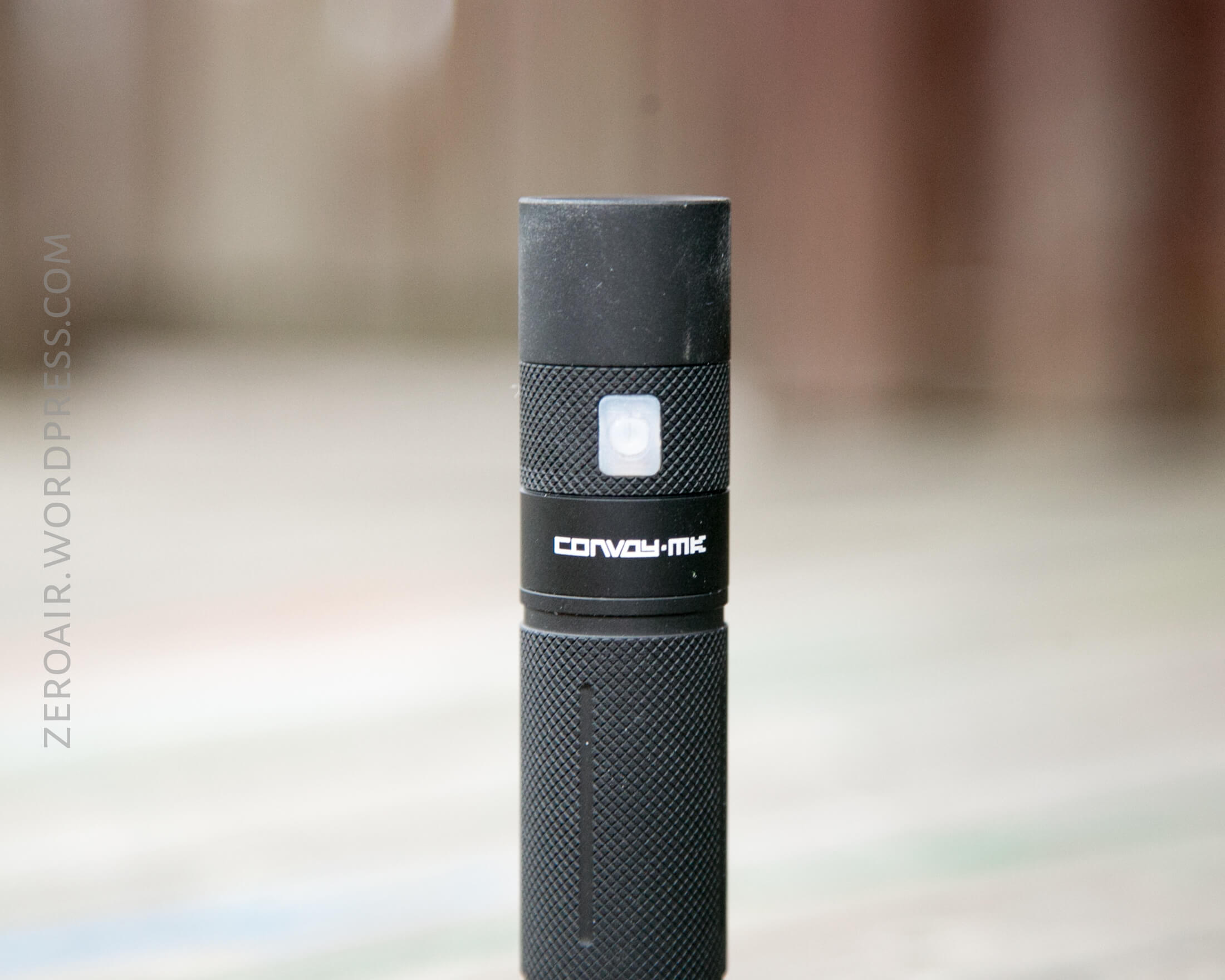
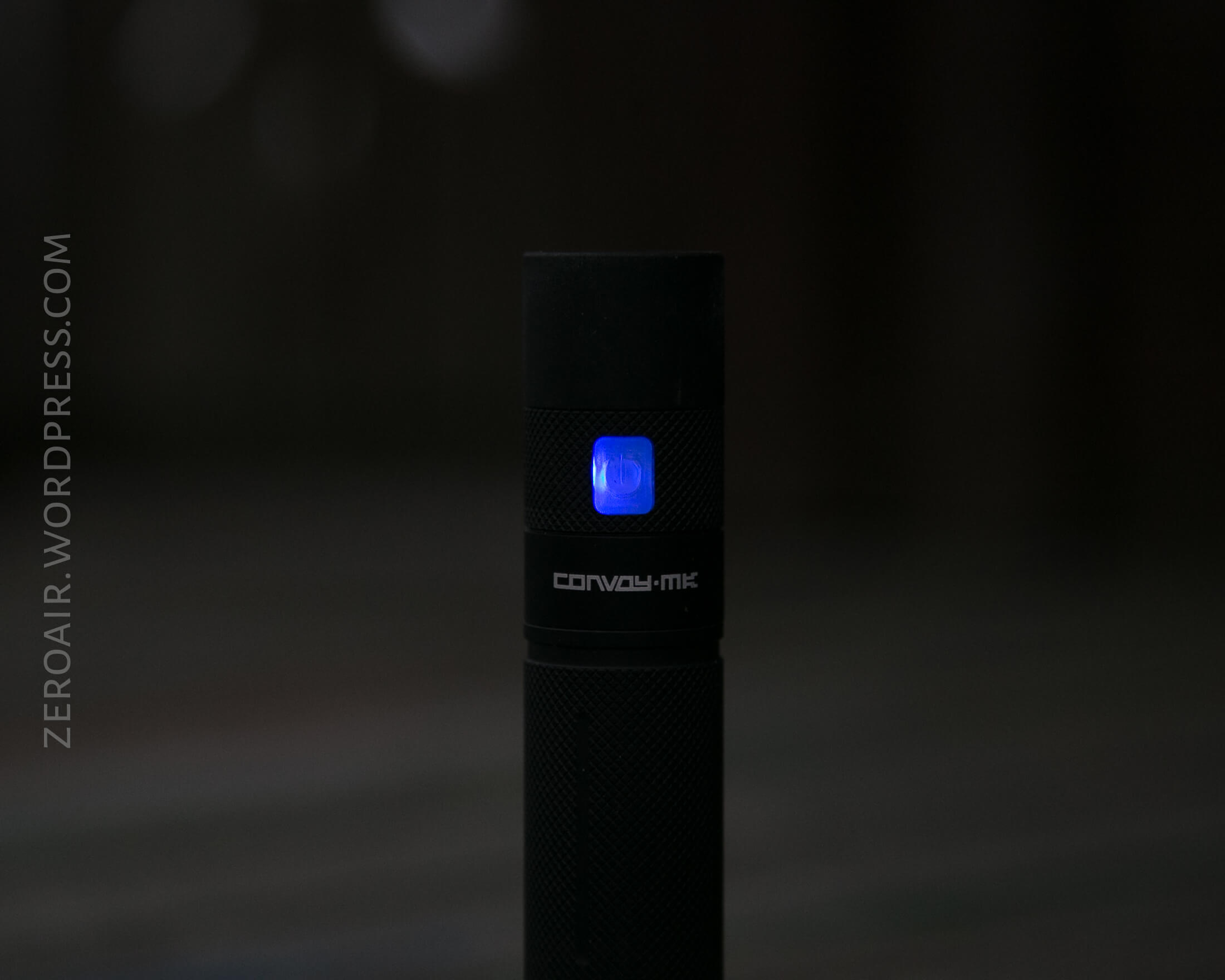
Above is a more accurate representation of the blue than below.

Modes
| Mode | Mode Claimed Output (lm) | Claimed Runtime | Mode Measured Lux | Tailcap Amps^ |
|---|---|---|---|---|
| High | “500lm or so” | – | 13480 | 1.883A |
| Medium | – | – | 5880 | 0.626A |
| Low | – | – | 1062 | 0.158A |
^ Series measured Amps
Unfortunately, the modes just aren’t doing it for me. The high isn’t high enough. The low isn’t low enough. THE MIDDLE ISN’T MIDDLE ENOUGH!! No middle is perfect, sorry. The point is that low isn’t low at all. High is passable.
LED and Beam
Convoy has gone with a Cree XM-L2 emitter and a slightly OP reflector in this light. The reflector is of average depth, and the beam has a nice amount of spot with little spill. The tint on my sample seems quite good and is stated as “Neutral White” (which I take to me 4500K).


Beamshots
These beamshots always have the following settings: f8, ISO100, 0.3s shutter, and manual 5000K exposure. These photos are taken at floor level, and the beam hits the ceiling around 9 feet away.


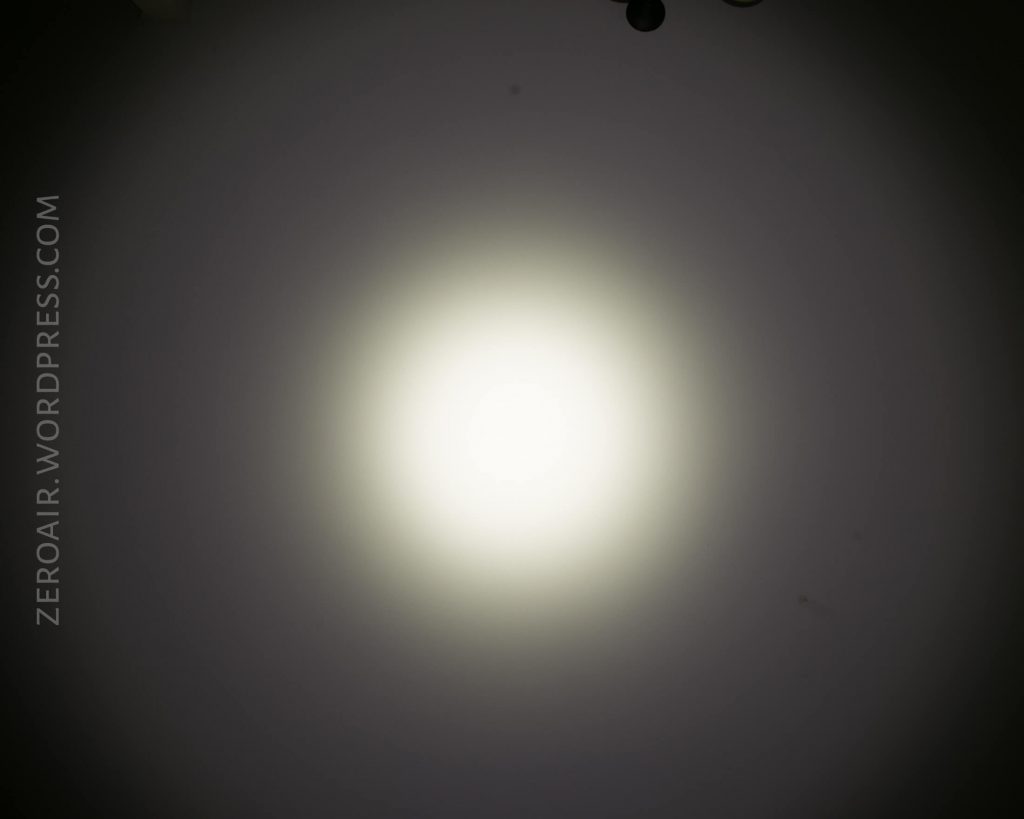
Tint vs BLF-348 (KillzoneFlashlights.com 219b version) (affiliate link)
I keep the test flashlight on the left and the BLF-348 reference flashlight on the right.

Random Comparisons and Competitive Options
Here’s a relevantly filtered page on parametrek.com. This isn’t an unfilled category of lights. The primary competitor in style for me is the Eagle Eye X2R. I really liked that light, but at the time wasn’t able to test charging. I already like Convoy brand, and know that the charging on this S9 is great. I prefer the build style and quality of the S9, as well.
Conclusion
What I like
- Inclusion of onboard charging with little increase in size
- On-Board charging is good quality
- Tint options! (And 4500K is a nice tint)
- Knurling is grippy but soft
What I don’t like
- Mode spacing is just not good at all
- Screw threads on end aren’t 1/4″ standard (but will be soon).
Notes
- This light was provided by GearBest for review. I was not paid to write this review.
- This content originally appeared at zeroair.org. Please visit there for the best experience!
- Use my amazon.com referral link if you’re willing to help support making more reviews like this one!
- Please support me on Patreon! I deeply appreciate your support!
Pingback: Mooshimeter - A Phone-Screen, Dual channel, logging digital multimeter. - ZeroAir Reviews