

Cyansky P20 18650 Flashlight Review
The Cyansky P20 is a dual-switch 18650 flashlight, utilizing a Luminus SST-40 and claiming 1600 lumens! It’s a nice package to offer so much!
Official Specs and Features
I can’t yet find this on any official channels, so no link to the official product page.
Versions
There’s just this one version. You might note, however, that the P20 and P25 are extremely similar. The main way they differ is that the P20 is an 18650 light, and the P25 is a (seemingly more current) 21700 light. As such, much of the text will be similar. You might like to see the Cyansky P25 review, which can be found here.
Price
Price is not public yet, as I can’t find it for sale.
Cyansky P20 18650 Flashlight Short Review
Depending on the price, this could be a real winner. Either way, it offers a nice package. The cell is included, dual switch interface, good output… If inexpensive, it’s a nice contender!
Long Review
The Big Table
| Cyansky P20 18650 Flashlight | |
|---|---|
| Emitter: | Luminus SST-40 |
| Price in USD at publication time: | ? |
| Cell: | 1×18650 |
| Turbo Runtime Graph | High Runtime Graph |
| LVP? | |
| Switch Type: | Both |
| Quiescent Current (mA): | – |
| On-Board Charging? | Yes |
| Charge Port Type: | micro-USB |
| Charge Graph | |
| Power off Charge Port | – |
| Claimed Lumens (lm) | 1600 |
| Measured Lumens (at 30s) | 1550 (96.9% of claim)^ |
| Candela per Lumen | 11.8 |
| Claimed Throw (m) | 240 |
| Candela (Calculated) in cd (at 30s) | 1751lux @ 3.392m = 20146cd |
| Throw (Calculated) (m) | 283.9 (118.3% of claim)^ |
| All my Cyansky reviews! | |
^ Measurement disclaimer: Testing flashlights is my hobby. I use hobbyist-level equipment for testing, including some I made myself. Try not to get buried in the details of manufacturer specifications versus measurements recorded here; A certain amount of difference (say, 10 or 15%) is perfectly reasonable.
What’s Included

- Cyansky P20 1600 Lumen Flashlight
- Cyansky 2600mAh 18650
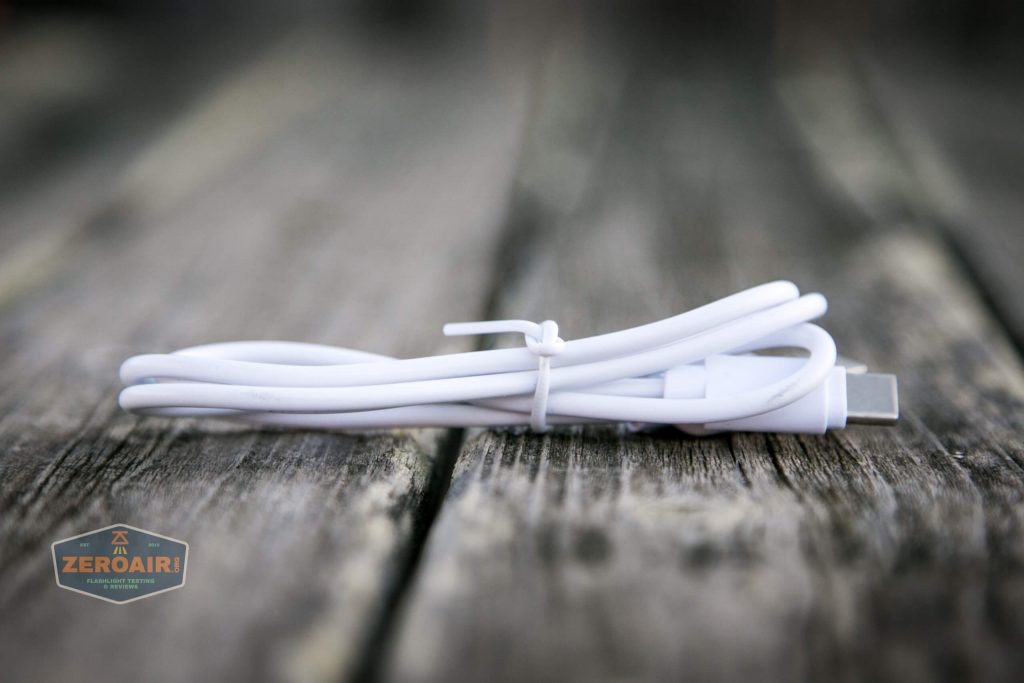
- Charge cable (USB to micro-USB)
- Nylon pouch
- Lanyard (seen below)
- Spare clicky cover (seen below)
- Spare o-ring (seen below)
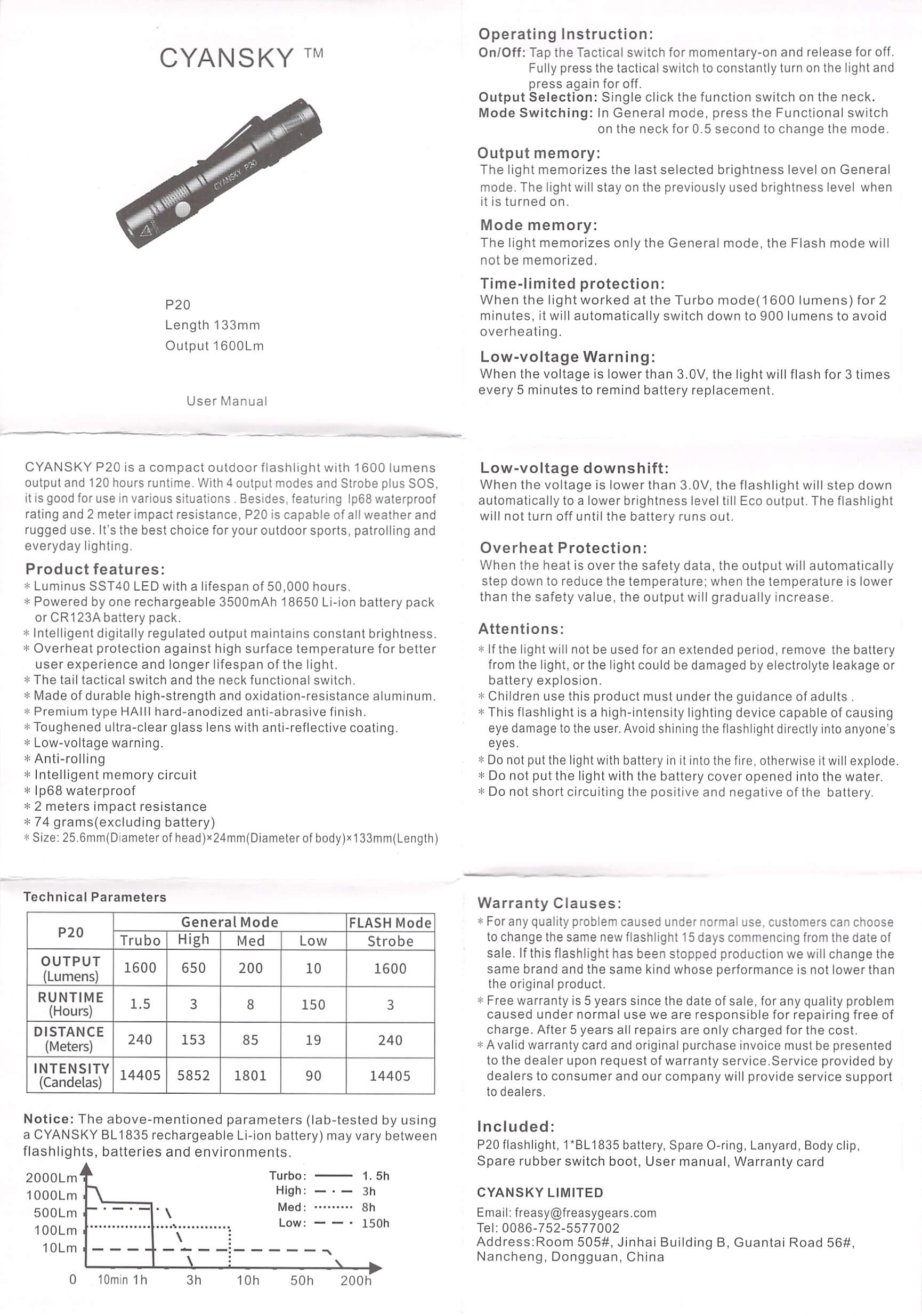
- Manual and papers
Package and Manual


Build Quality and Disassembly


The finish – the anodizing, that is – feels great in hand. Some mix of not quite matte, not quite glossy, that ends up being just right.

From the top down, you can see the light below. First is the tailcap (because we’re headstanding here!). Notice that the grip is in exactly the opposite direction from what you’d want. It doesn’t add any grip at all!

Here’s the body, which has the brand name and model number. This font is… not a font I’d pick for [basically anything]. The font looks a bit like an afterthought.


The head end has the same grip style as the tail, so at least the design language is transferred.


When headstanding, no light escapes because the front is flat with no reliefs.

The tailcap, which again doesn’t have a good grip for removal. The threads here are very nice. square-cut, very light lube, anodized, and not too long.

A beefy spring is inside the tailcap. The aluminum ring should provide good access if you need to use the spare switch boot.

Here you can see into the cell tube, to the head. There is no spring on the head, just a brass button.

Surprisingly the bezel is easy to remove. It’s threaded differently from the tailcap, so you won’t swap the two accidentally.

This provides easy access to the emitter.

Size and Comps
Officially the Cyansky P20 18650 flashlight is 25.6mm (head diameter), 24mm (body diameter), 133mm (length) and a weight of 74 grams (without cell).


If the flashlight will headstand, I’ll show it here (usually the third photo). If the flashlight will tailstand, I’ll show that here, too (usually the fourth photo).


Here’s the test light with the venerable Convoy S2+. Mine’s a custom “baked” edition Nichia 219b triple. A very nice 18650 light.


And here’s the light beside my custom-engraved TorchLAB BOSS 35, an 18350 light. I reviewed the aluminum version of that light in both 35 and 70 formats.

Retention and Carry
Included, and attached from the factory, is a friction fit belt or pocket clip affording bezel down carry only. This isn’t a deep carry clip, but due to the length of the light, it’s balanced fine.


Clip hug!

Included with the P20 is a nylon pouch. The light will go into the pouch head up or down, but can’t be used while in the pouch.
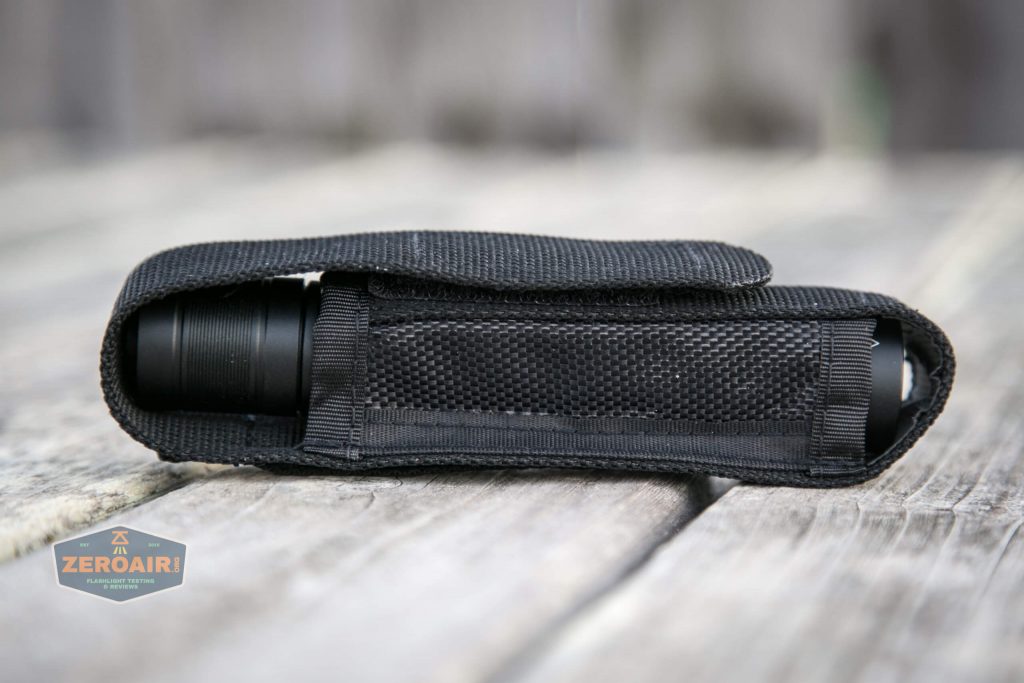

There is a lanyard that I seem to have failed to photograph. Here’s the (same) one from the P25.

There are two holes in the tailcap for receiving the lanyard. One hole here would have sufficed – the light will not tailstand anyway.

Power and Runtime
The Cyansky P20 is powered by a single lithium-ion cell. Cyansky includes an appropriate cell – a 2600mAh 18650, the BL1826U.

As far as usage goes, this is a standard button top 18650. It has some additional features, which I’ll cover below.


The cell fits into the P20 in the usual way – positive terminal toward the head.

Here are a few runtimes. Performance is not at all dissimilar to all the other Cyansky lights I’ve reviewed. I think these may share a driver.


I did not observe low voltage protection. The light does shift down to a very low output, though, at around 20 lumens.
Charging
As stated, the cell has some other features too. There’s built-in micro-USB charging, by way of a micro-USB port on the positive terminal end.

Another feature is a little indicating LED right in the positive terminal of the 18650. When charging, this indicator is red. When charging is complete, the indicator is green. Otherwise, the indicator is not on at all.
An appropriate cable is included – USB to micro-USB.

Charging proceeds at a fairly slow 1A or so, which is well under 0.5C for this 2600mAh cell. The time required is around 3.5 hours, and the terminal voltage seems to be around 4.18-4.19V.

Modes and Currents
| Mode | Mode Claimed Output (lm) | Claimed Runtime | Measured Lumens | Tailcap Amps |
|---|---|---|---|---|
| Turbo | 1600 | 1.5h | 1550 | 4.61 |
| High | 650 | 3h | 647 | 1.25 |
| Medium | 200 | 8h | 208 | 0.34 |
| Low | 10 | 150h | 0.01 |
Pulse Width Modulation
No mode utilizes pulse width modulation.


Here you can see a “baseline” – a chart with almost no light hitting the sensor.

Then there’s the Ultrafire WF-602C flashlight, which has some of the worst PWM I’ve seen. It’s so bad that I used a post about it to explain PWM! Here are multiple timescales (10ms, 5ms, 2ms, 1ms, 0.5ms, 0.2ms) to make comparing this “worst” PWM light to the test light easier. That post also explains why I didn’t test the WF-602C at the usual 50us scale.


User Interface and Operation
Two switches are used for control of the Cyansky P20. First is the mechanical tail clicky. It’s a forward clicky, which allows momentary actuation. This switch also serves as a mechanical lockout to prevent any parasitic drain on the cell.

The switch cover is big but the switch itself is normal-sized. It’s not terribly thick, so you can feel the actual switch underneath. The clicky is very clicky and the action is low.


The switch is also very proud. It completely prohibits tailstanding.
The second option for operation is the e-switch on the side near the head. This switch is metal(ish?) and very proud. Also, it doesn’t compete with anything else, so it’s very easy to find without looking.
The user interface is not complicated.
Here’s a user interface table!
| State | Action | Result |
|---|---|---|
| Off | Click Tail Switch | On (last used mode, except strobe) |
| Off | Tap Tail Switch | Momentary (last used mode, except strobe) |
| On | Click Tail Switch | Off |
| Off | Click Side Switch | No action |
| On | Click Side Switch | Mode advance L>M>H>T |
| On | Hold Side Switch | Strobe (the manual doesn’t cover this!) |
| Strobe | Click Side Switch | Return to previous mode |
LED and Beam
Cyansky has opted to put a Luminus SST-40. A color temperature is not stated but based simply on the image below, you can probably guess it’s cool white.
The emitter is accessible after removing the bezel, too.
These beamshots always have the following settings: f8, ISO100, 0.3s shutter, and manual 5000K exposure. These photos are taken at floor level, and the beam hits the ceiling around 9 feet away.


Tint vs BLF-348 (KillzoneFlashlights.com 219b version) (affiliate link)
I keep the test flashlight on the left and the BLF-348 reference flashlight on the right.


I compare everything to the KillzoneFlashlights.com 219b BLF-348 because it’s inexpensive and has the best tint!
Conclusion
What I like
- Complete package light
- Good (and simple) dual switch interface
- Included cell with micro-USB charging
- Fairly flat output of nearly 900 lumens for around an hour and a half (!!)
What I don’t like
- Cool emitter
- No tailstanding
- Charging is micro-USB instead of USB-C
Notes
- This light was provided by Cyansky for review. I was not paid to write this review.
- This content originally appeared at zeroair.org. Please visit there for the best experience!
- For flashlight-related patches, stickers, and gear, head over to PhotonPhreaks.com!
- Please use my Amazon.com referral link to help support zeroair.org!