

Lumintop GT Nano Brass Flashlight Review
The Lumintop GT Nano Brass flashlight is out…. you thought the aluminum was all the rage! I was excited about it from the start, and it’s just as fun as you think it should be. Read on for some thoughts and testing!
Official Specs and Features
Here’s a referral link to the NealsGadgets.com product page.
Versions
Of course, there’s the aluminum version – I reviewed it already. There’s brass (seen here) and copper. Lately, there is titanium, which is available in three finishes. These all have the same emitter.
Price
Brass, as seen in this review, is going for $59.95. Pretty good deal! Mine came from NealsGadgets.com.
They have copper there, too, but it’s more costly – around $67.
Short Review
I already loved the aluminum. But I love brass more, so what’s better than a brass GT Nano?? I don’t think this light could be more fun. It’s the least expensive “most impressive” light I own.
Long Review
The Big Table
| Lumintop GT Nano Brass Flashlight | |
|---|---|
| Emitter: | Osram CSLNM1.TG Flat White (1mm) |
| Price in USD at publication time: | $59.95 at NealsGadgets.com |
| Cell: | 1×10180 (included) |
| Turbo Runtime Graph | High Runtime Graph |
| LVP? | Warning, then off |
| Switch Type: | E-Switch |
| Quiescent Current (mA): | 0.24 |
| On-Board Charging? | Yes |
| Charge Port Type: | Micro-USB attachment |
| Charge Graph | |
| Power off Charge Port | – |
| Claimed Lumens (lm) | 450 |
| Measured Lumens (at 30s) | 366 (81.3% of claim)^ |
| Candela per Lumen | 62.4 |
| Claimed Throw (m) | 300 |
| Candela (Calculated) in cd (at 30s) | 635lux @ 4.729m = 14201cd |
| Throw (Calculated) (m) | 238.3 (79.4% of claim)^ |
| All my Lumintop reviews! | |
^ Measurement disclaimer: Testing flashlights is my hobby. I use hobbyist-level equipment for testing, including some I made myself. Try not to get buried in the details of manufacturer specifications versus measurements recorded here; A certain amount of difference (say, 10 or 15%) is perfectly reasonable.
What’s Included

- Lumintop GT Nano Brass Flashlight
- 10180 Cell
- Lanyard
- Keyring and hook
- Micro-USB charge attachment
- Spare o-rings (2)
- Charge cable (USB to micro-USB)
- Manual
Package and Manual


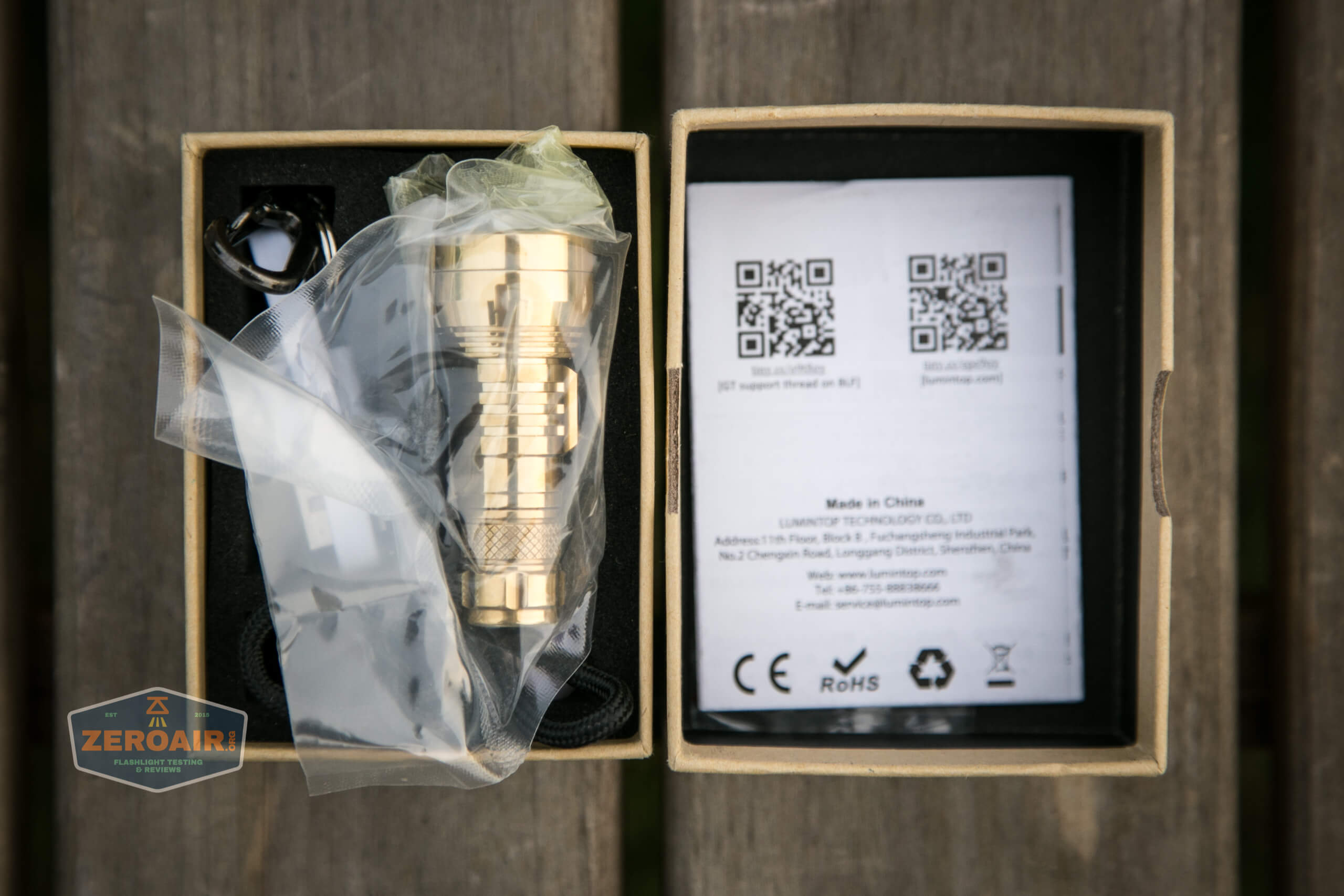
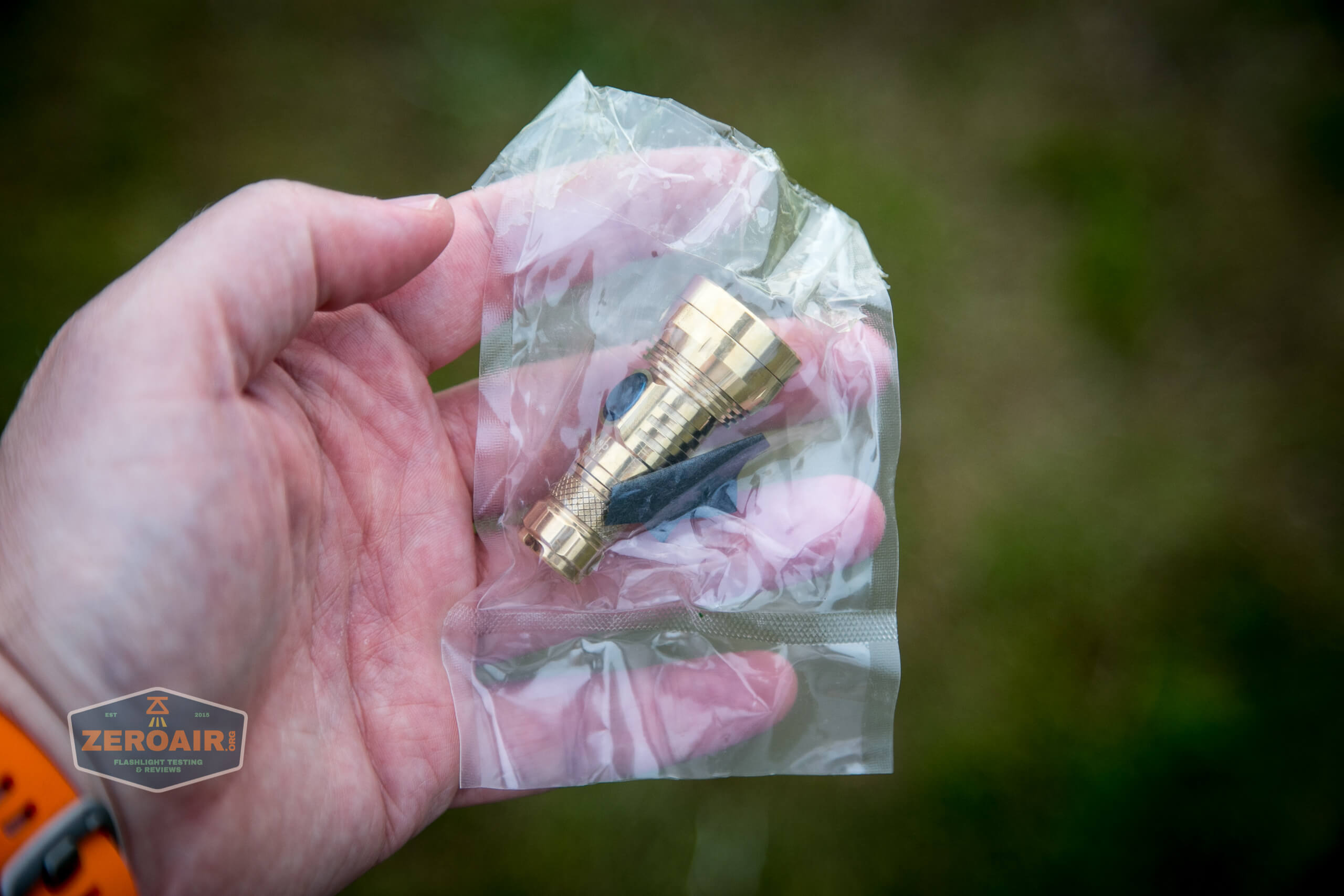

Build Quality and Disassembly

The Lumintop GT Nano Brass has the look of all the other GT series light, it’s just made of brass! So it’s perfect in this regard.
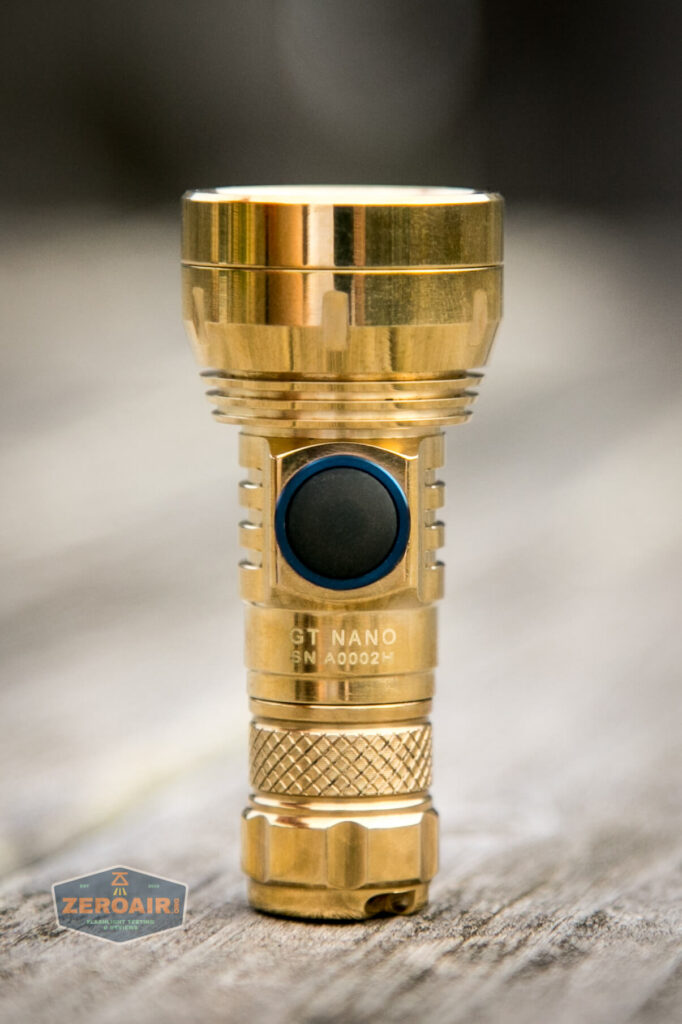


I think the labeling has been improved from the black aluminum version, but I don’t know if the serial issue has been fixed.
Here’s the top-down view!


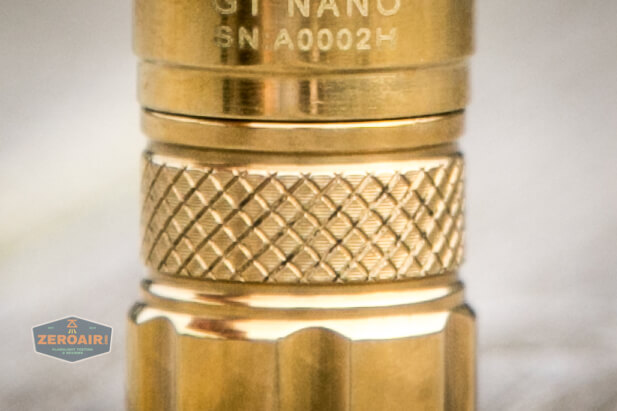
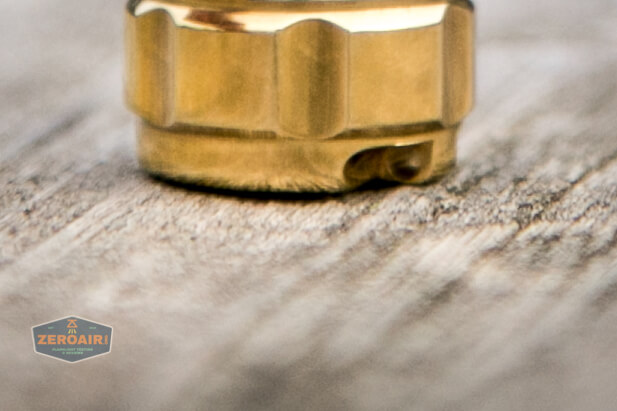
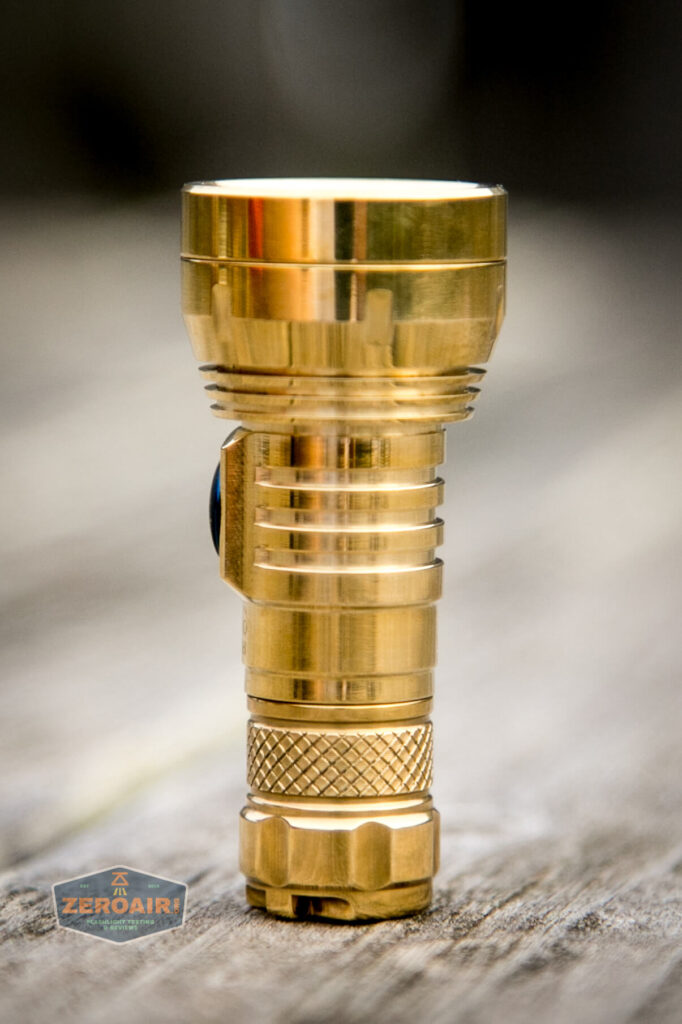
Those little fins on the head for cooling are super narrow! You can see it later but this is a very slight design change from the aluminum version.

The body has nice knurling, as usual.
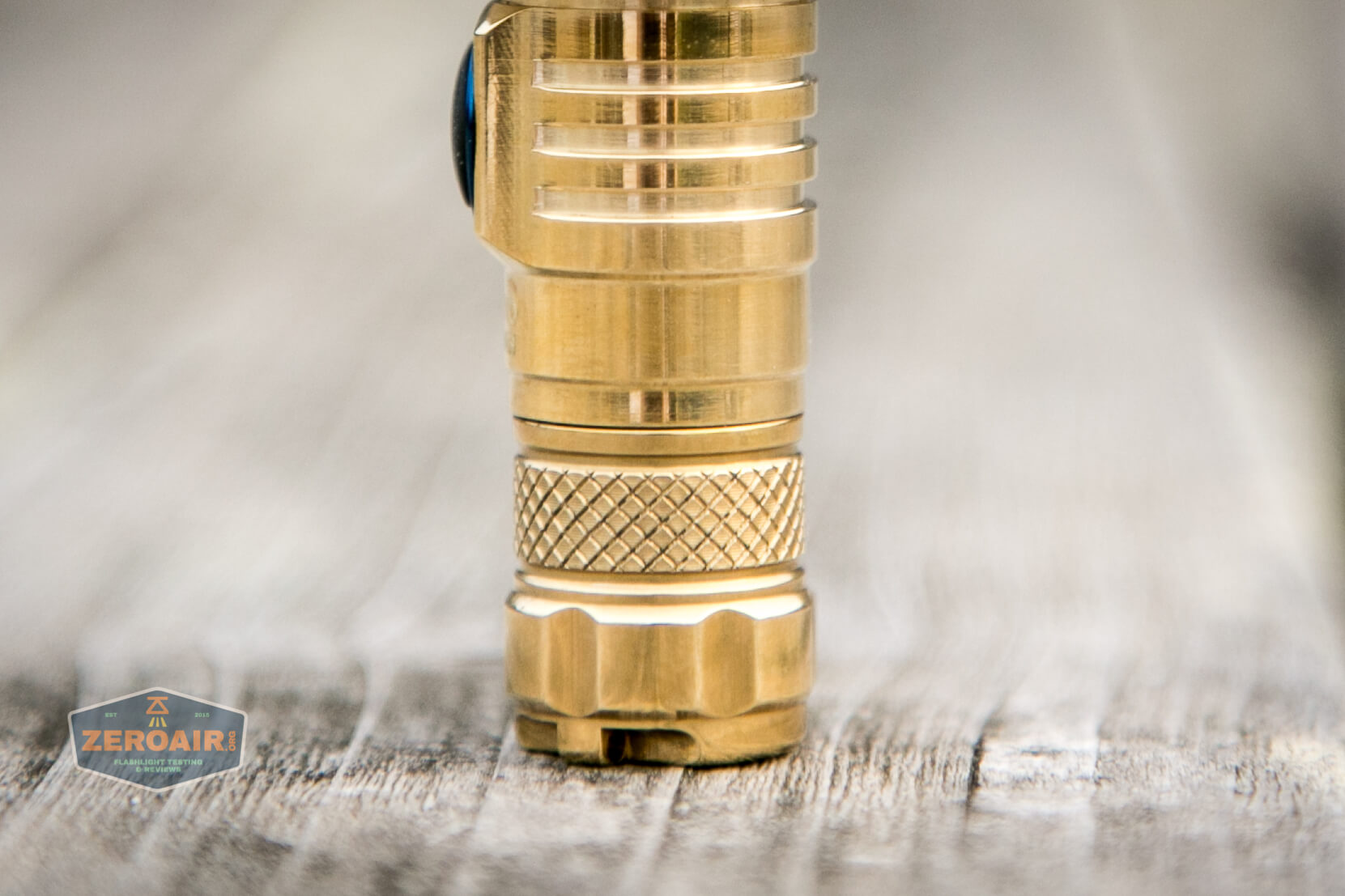
The Lumintop GT Nano Brass is fully brass – the head and body and all of it – brass. This gives it a nice heft.
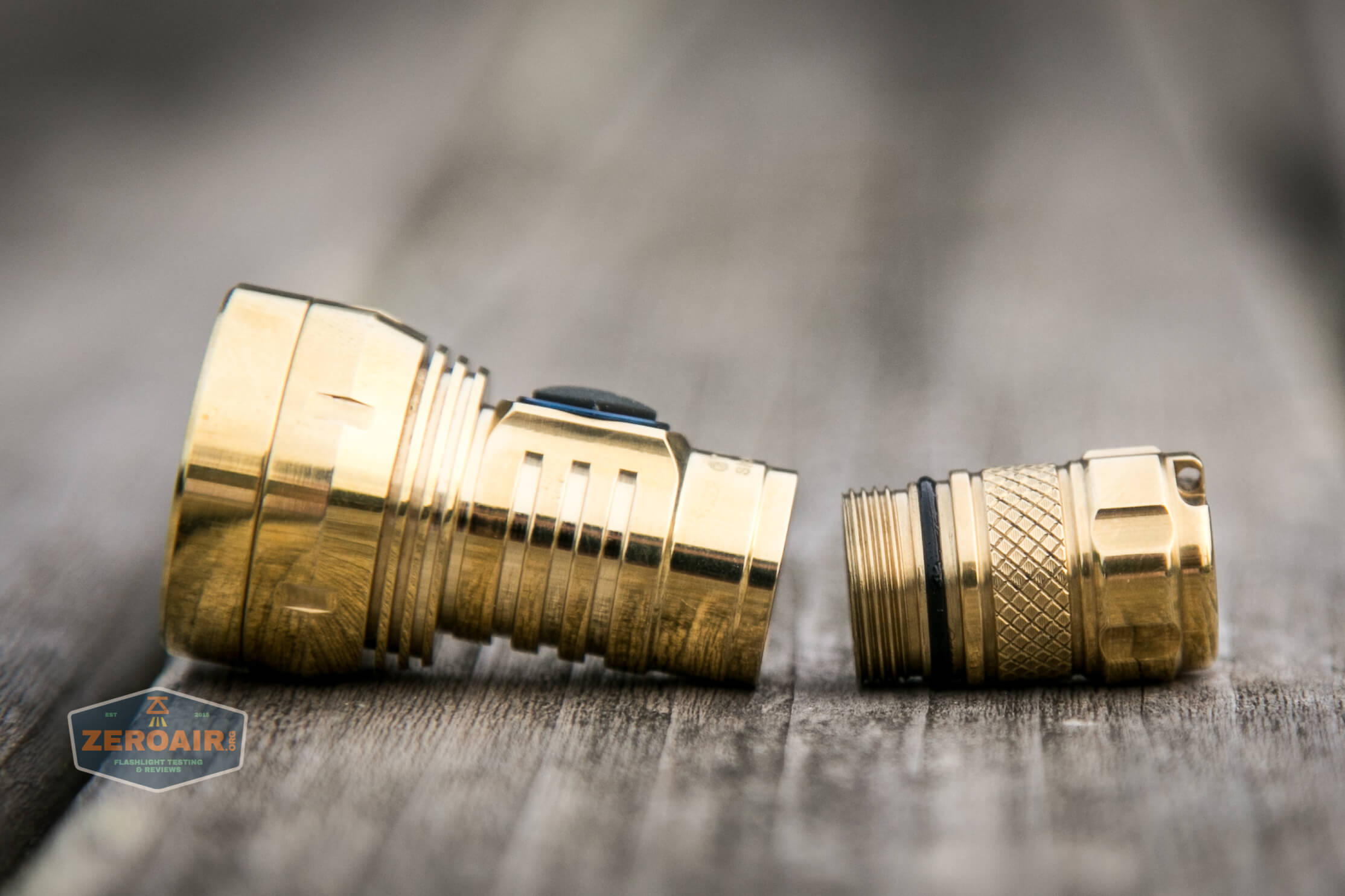
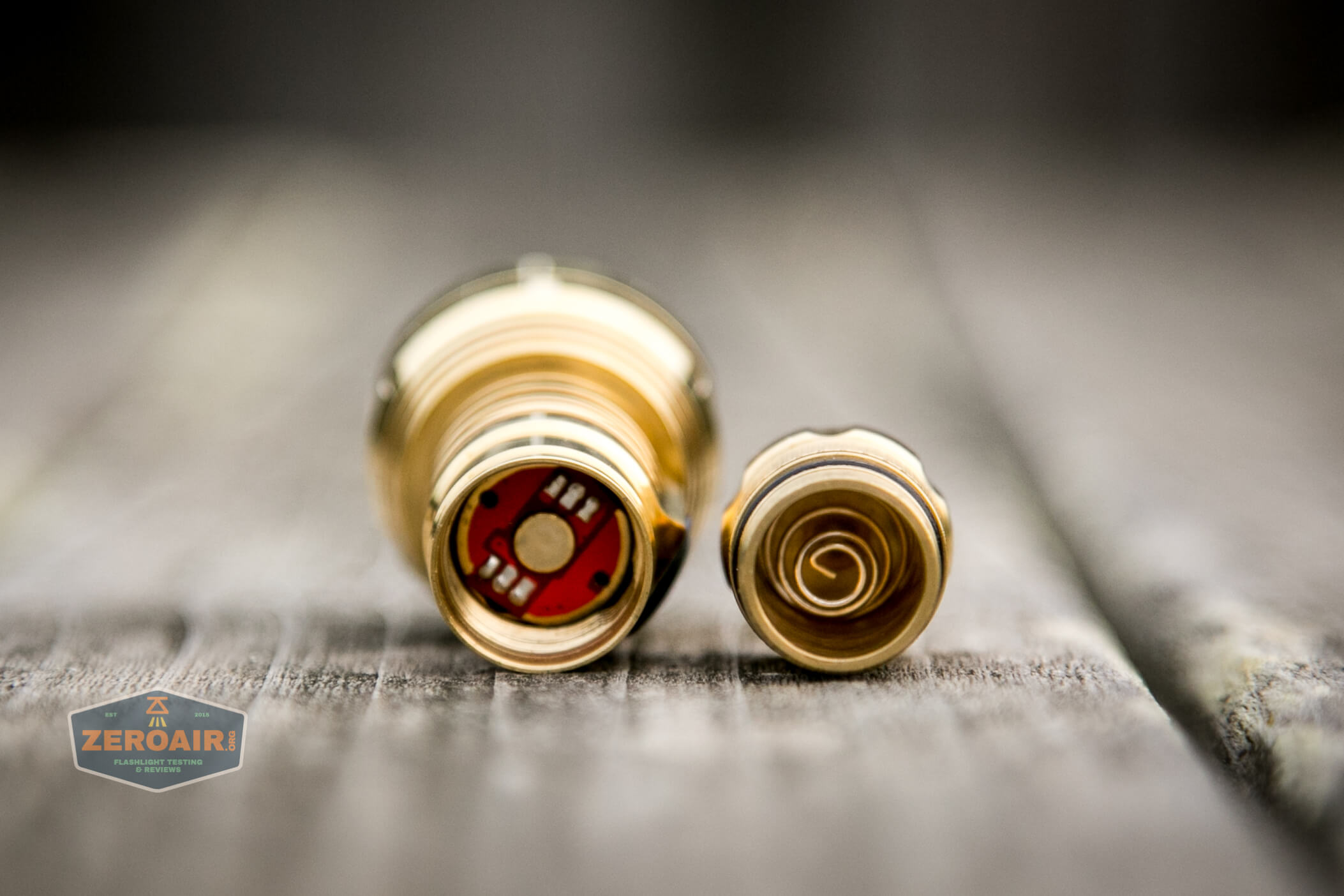
In the tail end, there’s a big tall spring, but the head has only a button for contact.
Size and Comps
Officially:
Weight: Approximately 34g without cells
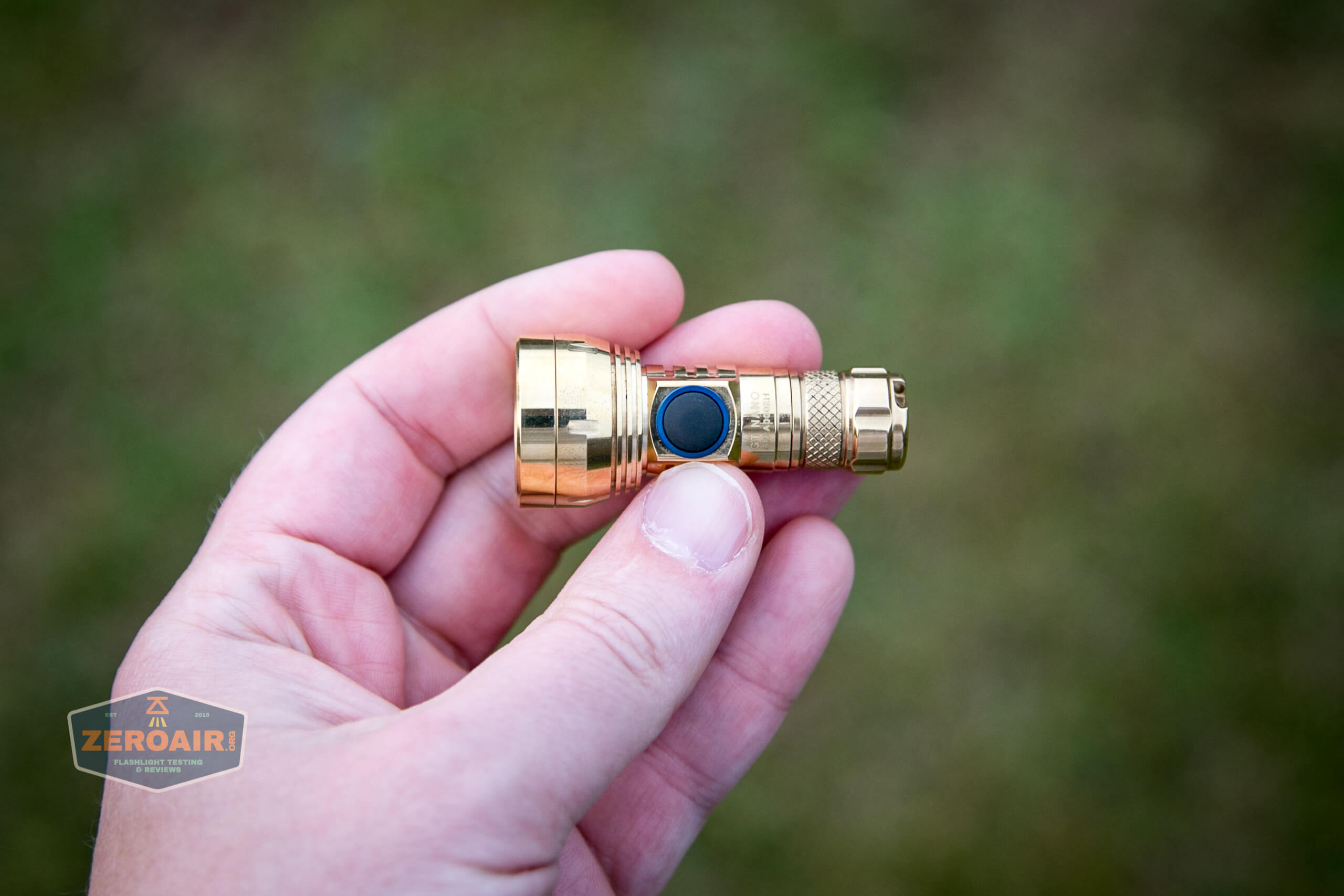
Dimensions: 24 x 52.5mm
I weight the light at 45g, and 48g with cell. Maybe the 34g is for the aluminum version.



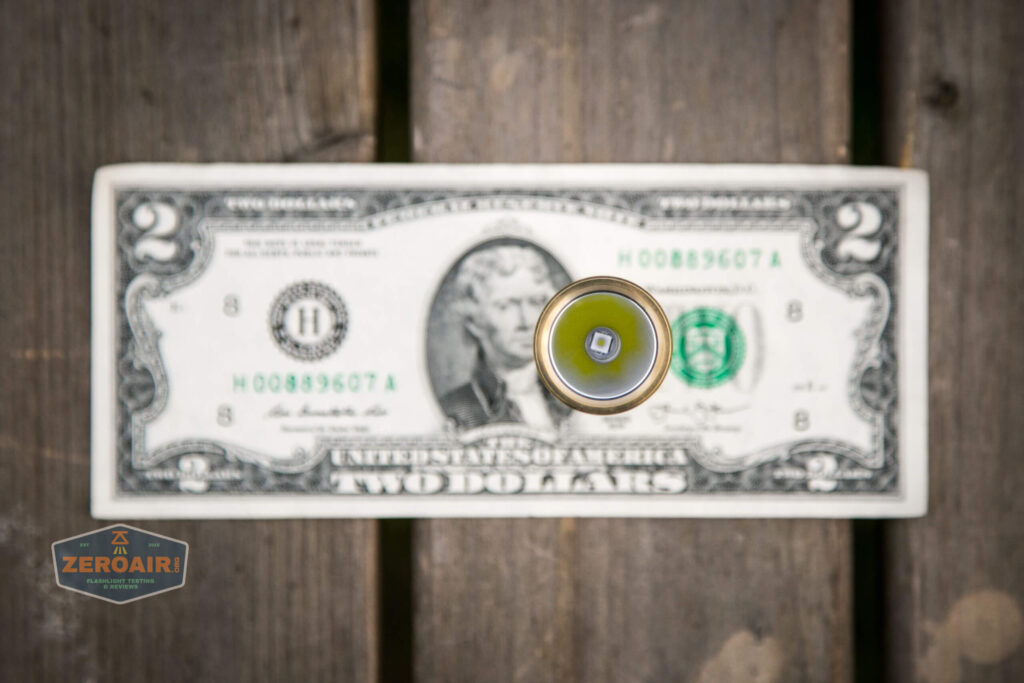
If the flashlight will headstand, I’ll show it here (usually the third photo). If the flashlight will tailstand, I’ll show that here, too (usually the fourth photo).


Here’s the test light with the venerable Convoy S2+. Mine’s a custom “baked” edition Nichia 219b triple. A very nice 18650 light.


And here’s the light beside my custom-engraved TorchLAB BOSS 35, an 18350 light. I reviewed the aluminum version of that light in both 35 and 70 formats.
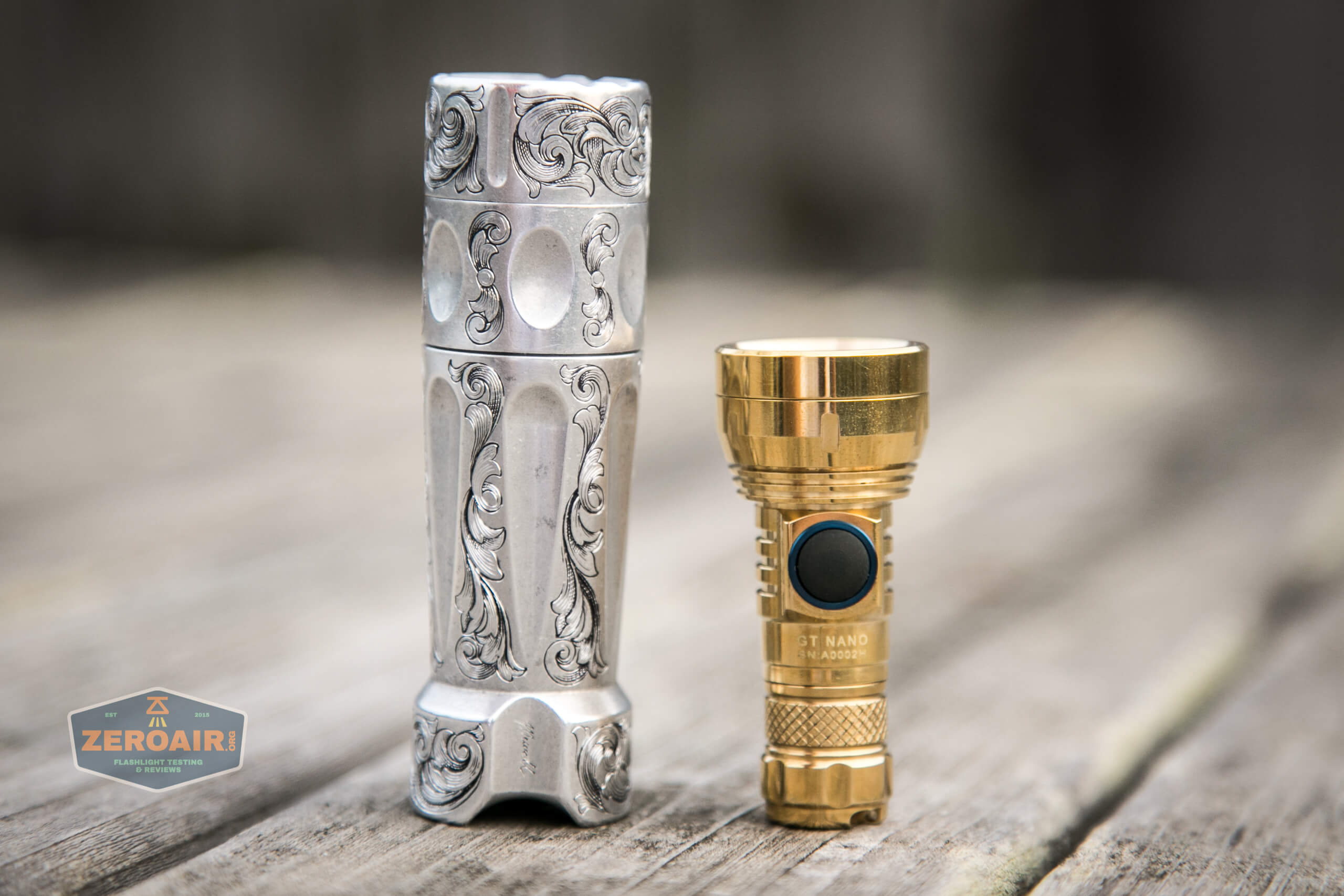
Below you can see that the brass version is ever so slightly changed from the aluminum. It’s slightly longer, and I think the difference is in the cooling fin area.


Retention and Carry
A lanyard is included for carry of the GT Nano Brass. It attaches through a loop on the tailcap.


Also included is the key hook. With that you’ll use the tiny split ring in the lanyard hole, and then hook to the split ring.
Honestly, the split ring is probably the best bet off the top – I tried and couldn’t get the lanyard to install in this tiny hole in the tailcap.
So just plan it this way – split ring attached to the light, then either lanyard or key chain hook to the split ring. That’s likely the intended way.
There’s no pocket clip or magnet or pouch.
Power and Runtime
The Lumintop GT Nano Brass is powered by a single lithium-ion cell. What ships and is intended for the light is a single 10180 cell – a tiny cell! These are rated at 80mAh capacity, which is a tiny capacity.
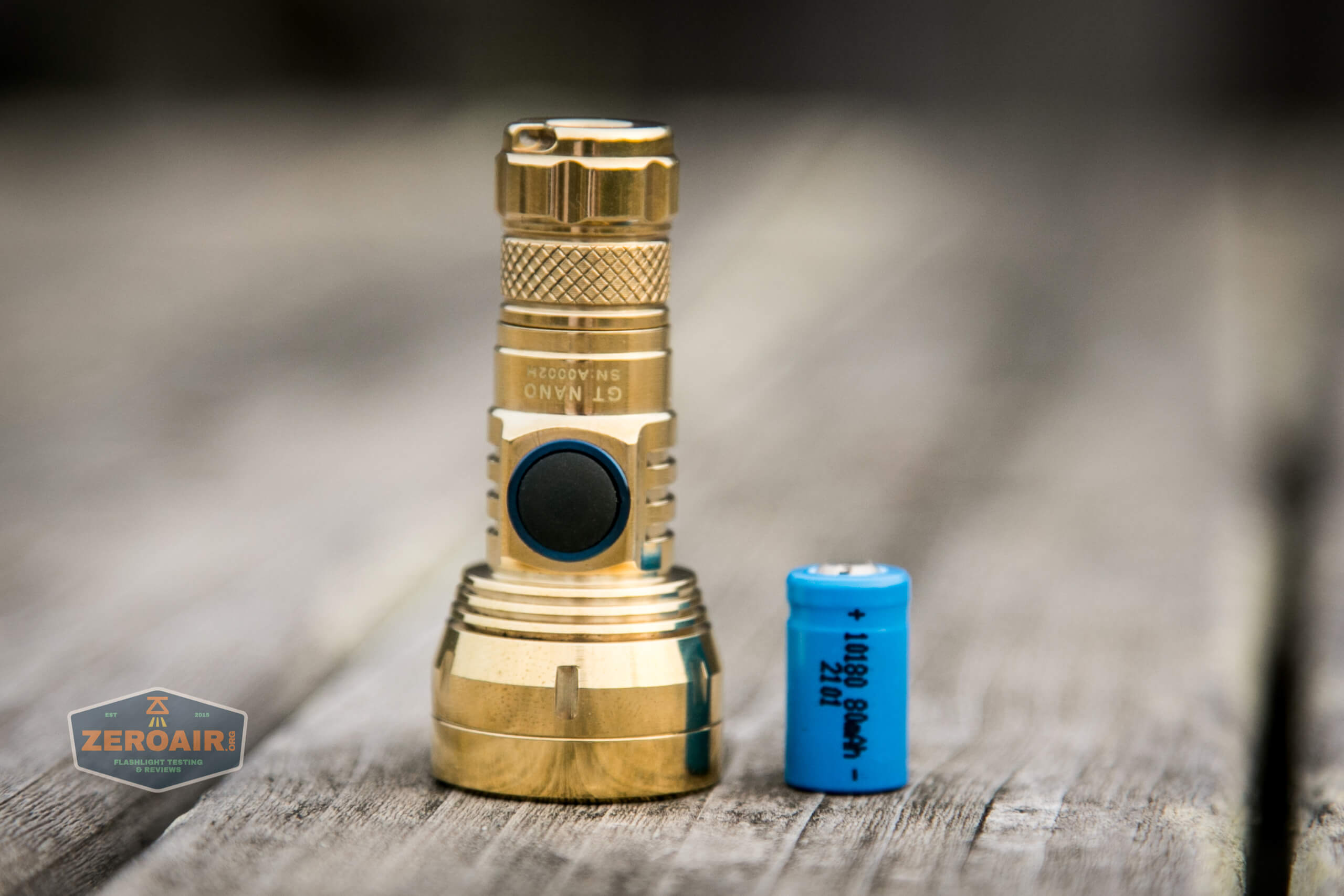
The 10180 fits into the GT Nano in the usual way – positive (button) end toward the head.
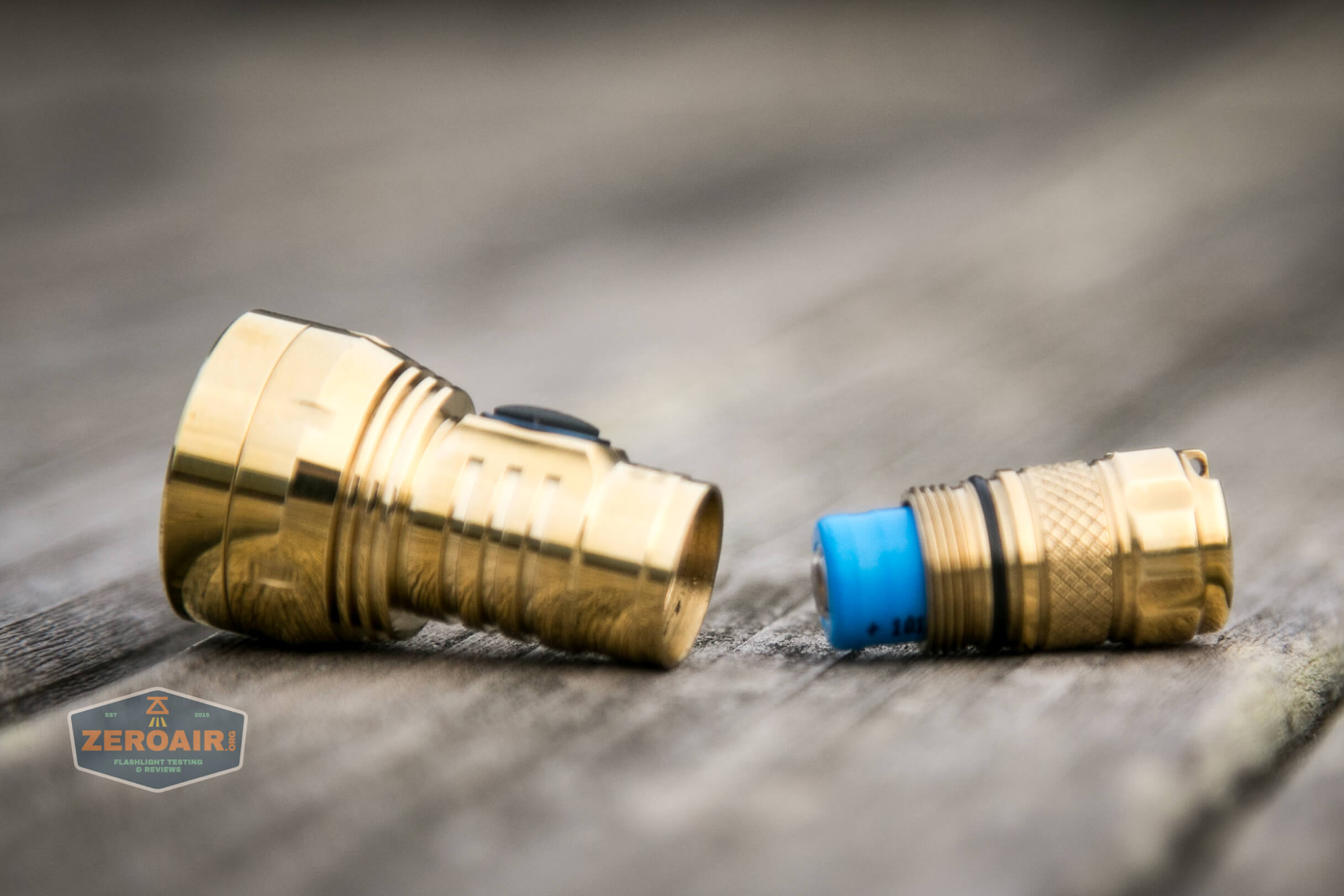

The cell is standard – slight button top.


Here are a few runtimes. The output on this light is quite fantastic (even disregarding just the actual throw of it). You’ll note a couple of stepdowns in the runtimes – the light flashes a few times at every step down.
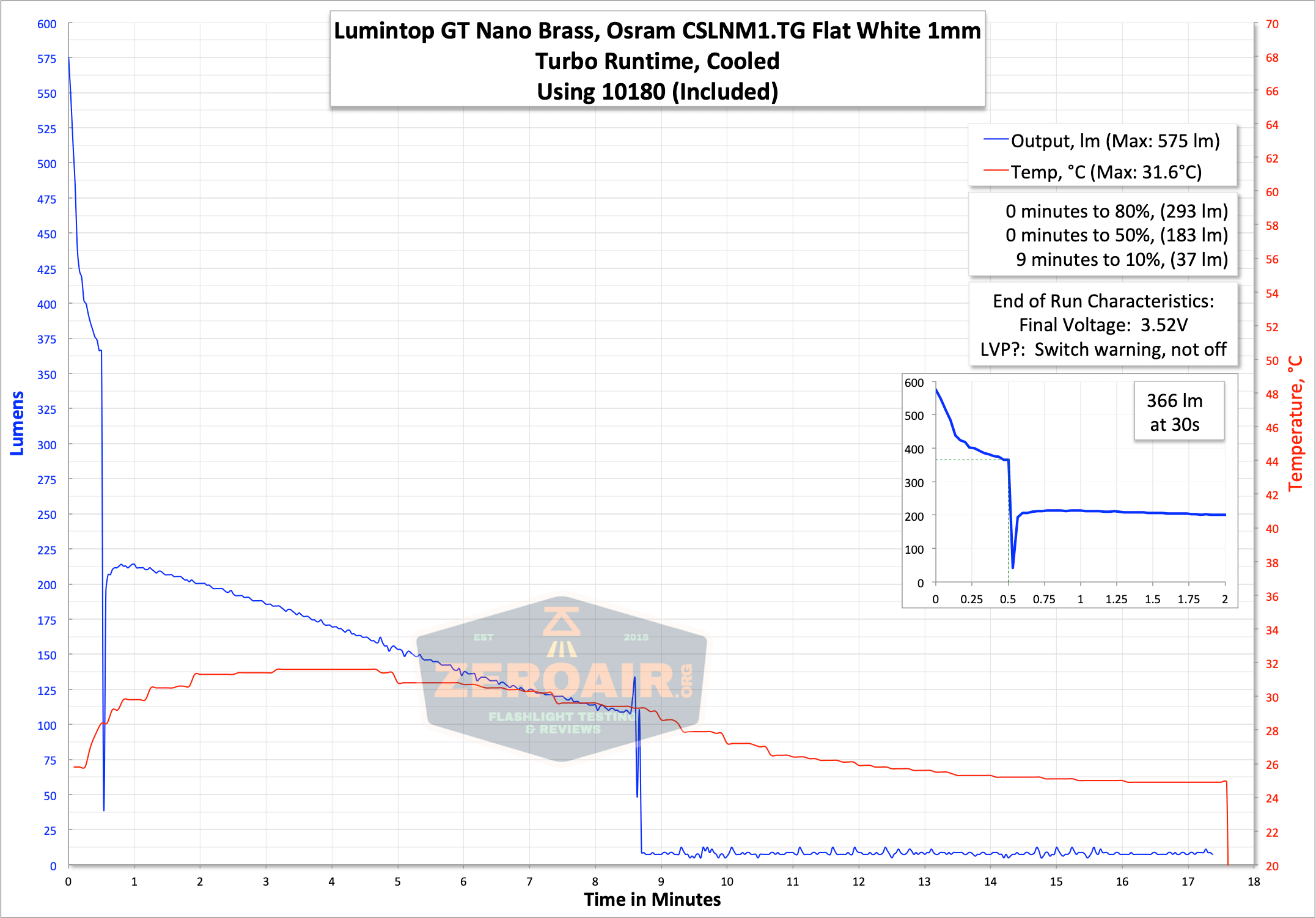
These runtimes are very short but, again, this is an 80mAh cell. You can’t reasonably expect extended runtimes.


I didn’t do any testing with a 10440 cell or AAA-sized body with this light. You can see my first GT Nano review for those runtimes. They’d be very similar to that testing.
Note that the manual says the GT Nano draws 2.5A on turbo. If that was the case (meaning if turbo was limited to 2.5A) then the 10440 wouldn’t have any effect on the emitter at all. But what this statement seems to mean is that a 10180 can only output 2.5A, which is what turbo is, thusly. However – and bear this in mind – the driver actually seems to be unregulated, meaning it’ll take whatever current you give it. So a 10440 cell has a higher max discharge, and you might experience some blue output. If you do, cease use of that cell. It’s “too good” for this light. There’s my disclaimer – use a 10440 at your own risk! (Read below for max current data.)
Charging
Included for charging is a “charge head.” It’s brass and has some plastic bits for protection. The plastic dome on the top (below) actually has charge indicators, too. Red for charging, and green for charging complete.
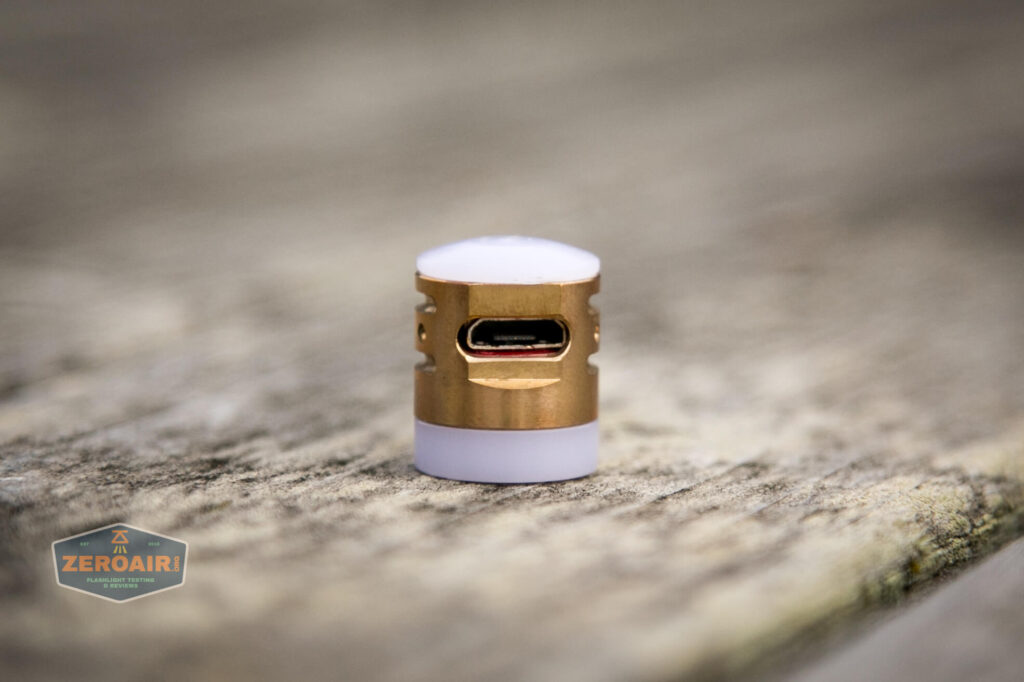

The little plastic bit seen below just unscrews – I suppose it’s just there for protection.
Here’s how the charging head fits the GT Nano. It of course can’t be used while the flashlight head is installed.

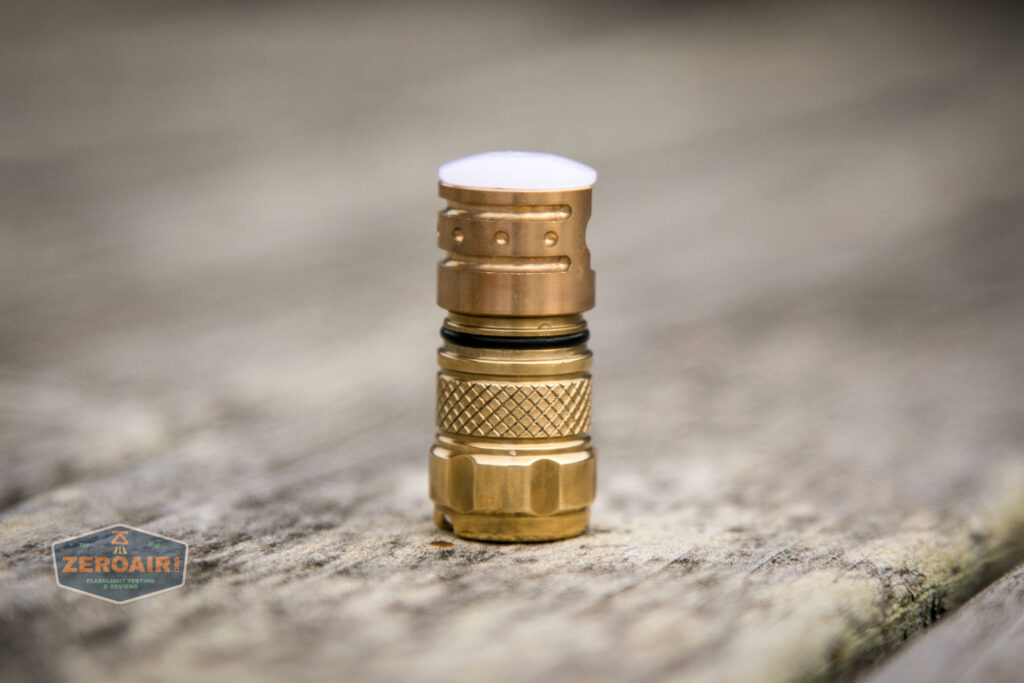

The GT Nano also has a charge adapter. Lumintop includes a cable – USB to micro-USB. It’s a very short cable.


Charging is a reasonable 0.1A or around 1C. Charge is very consistent and terminates reliably at 4.18V. Both are very good things.

Modes and Currents
| Mode | Mode Claimed Output (lm) | Claimed Runtime | Measured Lumens | Tailcap Amps |
|---|---|---|---|---|
| Turbo | 450 (100%) | 366 | >6 | |
| 4 | 40% | 240 | 1.80 | |
| 3 | 15% | 131 | 0.33 | |
| 2 | 1.5% | 11 | 0.02 | |
| Moonlight | 0.5 | ~0 |
Pulse Width Modulation
Narsil has PWM on moonlight (left) and 2 other intermediate modes. Turbo doesn’t have PWM though, and the 15% doesn’t either. I don’t notice the PWM on any mode, however.


Here you can see a “baseline” – a chart with almost no light hitting the sensor.

Then there’s the Ultrafire WF-602C flashlight, which has some of the worst PWM I’ve seen. It’s so bad that I used a post about it to explain PWM! Here are multiple timescales (10ms, 5ms, 2ms, 1ms, 0.5ms, 0.2ms) to make comparing this “worst” PWM light to the test light easier. That post also explains why I didn’t test the WF-602C at the usual 50us scale.


User Interface and Operation
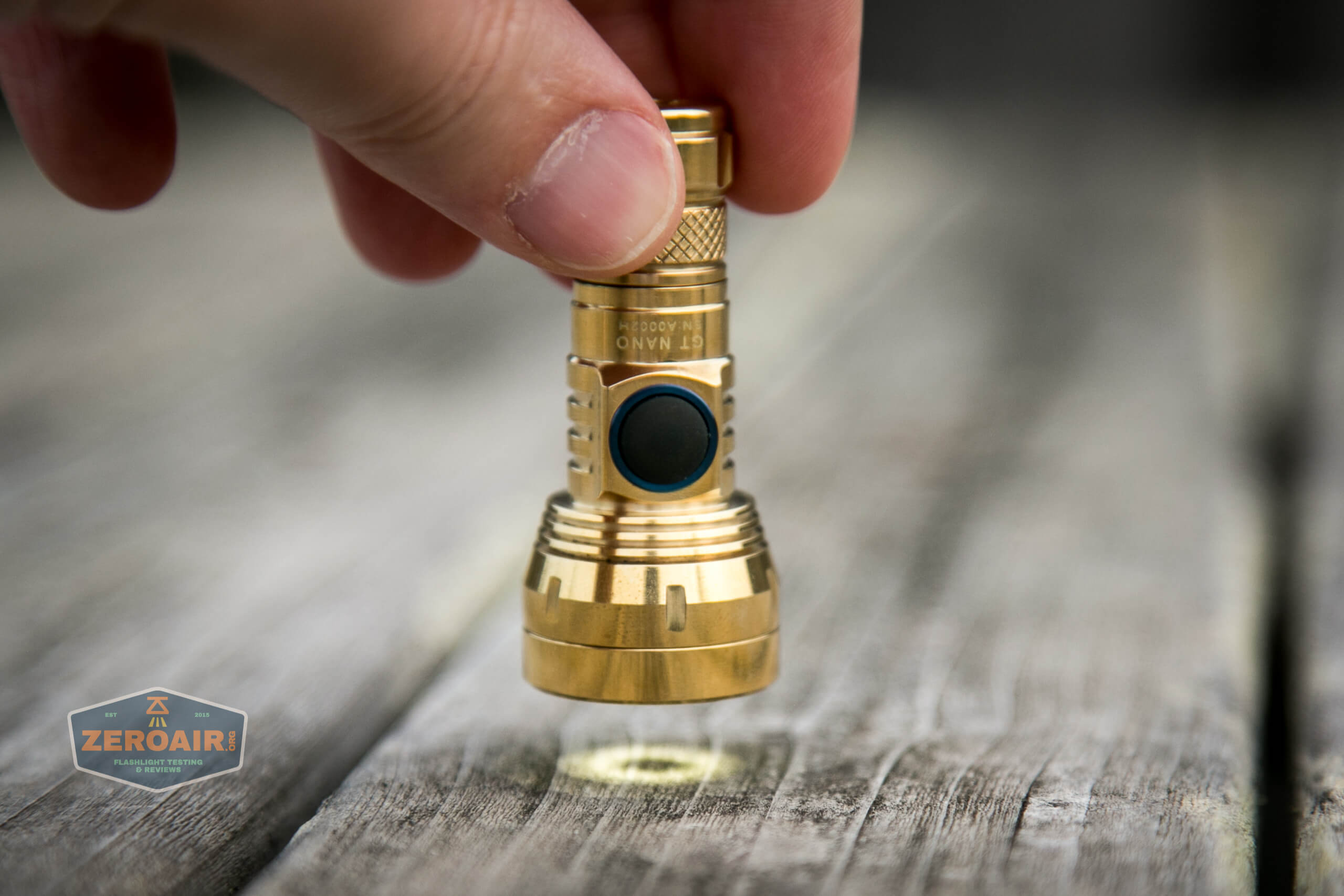
The user interface is a single side clicky. An e-switch, with a red indicator. The switch looks huge on this tiny light, but overall it’s still not a huge switch.


It’s also very domed and has a sort of “squishy clicky” action. While I could not always count on a click to do what I expected, it did seem to be better than the “appx 70% reliability” I found for the aluminum version. (This did not diminish my opinion of the light, though, even if it should have. It’s just too much fun.)


The user interface is exactly as on the other GT lights. This will be a copy-paste of that UI. I also always set these lights to stepped for testing, since it gives specific modes for testing. But ramping is all the rage, and I like it fine too, so it’s nice to be able to switch between the two.
The user interface itself is a version of Narsil, by Tom E. The version my light shows is Narsil 1.3. (Check this by clicking 3x, then 2x, then 2x, and the version will be blinked. 1 blink, pause 3 blinks.)
The user interface is much too complex for my usual table, and I’m not going to undertake that here. This Cheat Sheet is not my work! but is very useful, and thorough.

There are two groups. One group has ramping, one group has discrete modes. It’s possible to switch between ramping and discrete easily. The default is ramping, and to switch to modes, first turn on the light, then hold the switch for 3.2s. It’ll blink twice, pause, and blink once. At that point, click once. This disables ramping. Once this is done, put the light down so you don’t change other settings (which is very easy to do.) There are other things you could do to expedite termination of programming, but just skip it, and wait.
Narsil is wonderful firmware. It’s extremely versatile, and possible to change many (most? all?) of the settings about the light.
LED and Beam
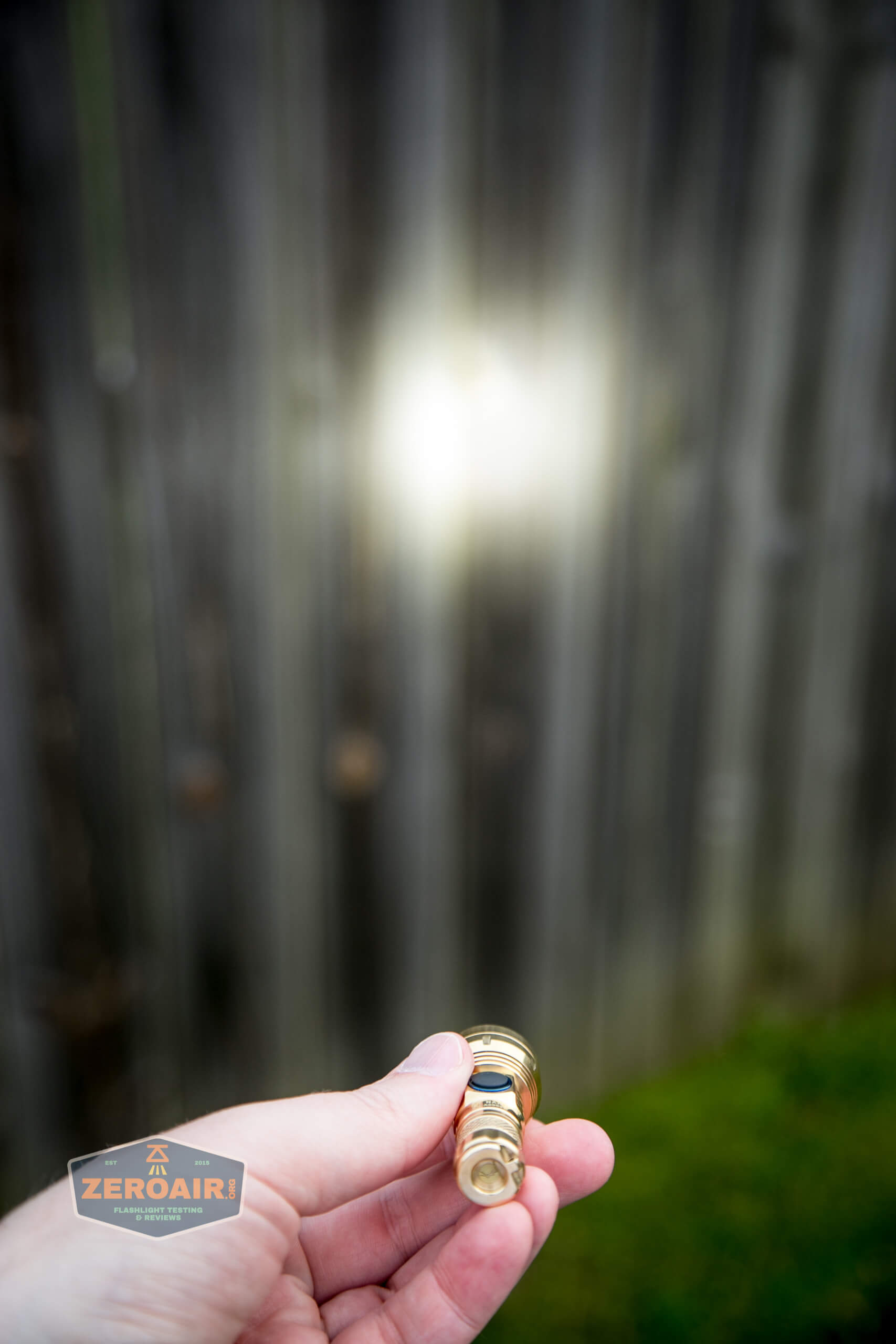
The beam selected for this Nano thrower is an Osram Flat White emitter. Really the perfect choice. It’s specifically a CSLNM1.TG, the 1mm version of Flat White. This means it’s cooler (maybe 6500K), but also the emitting surface is smaller (1mm squared) so the throw is excellent.
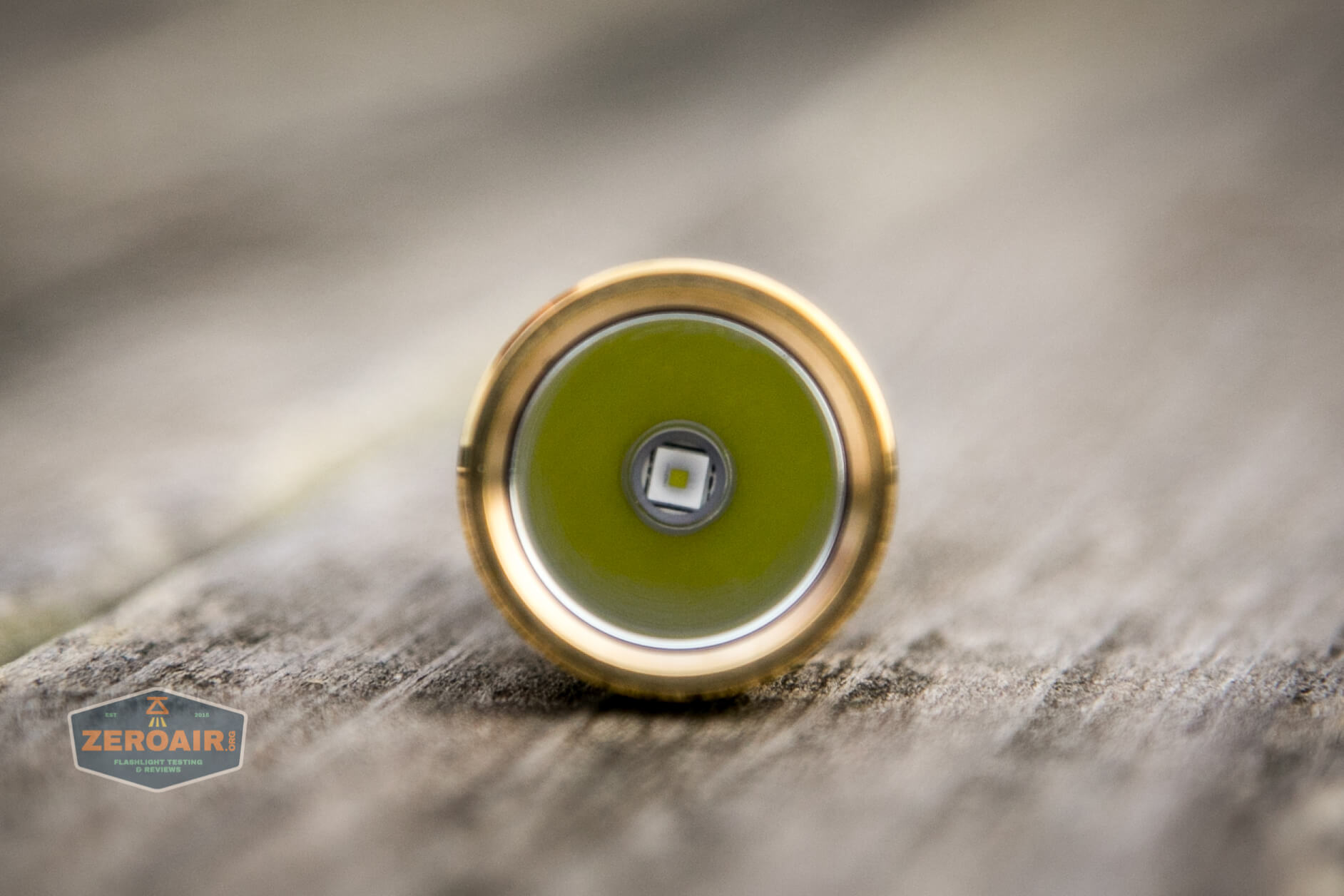
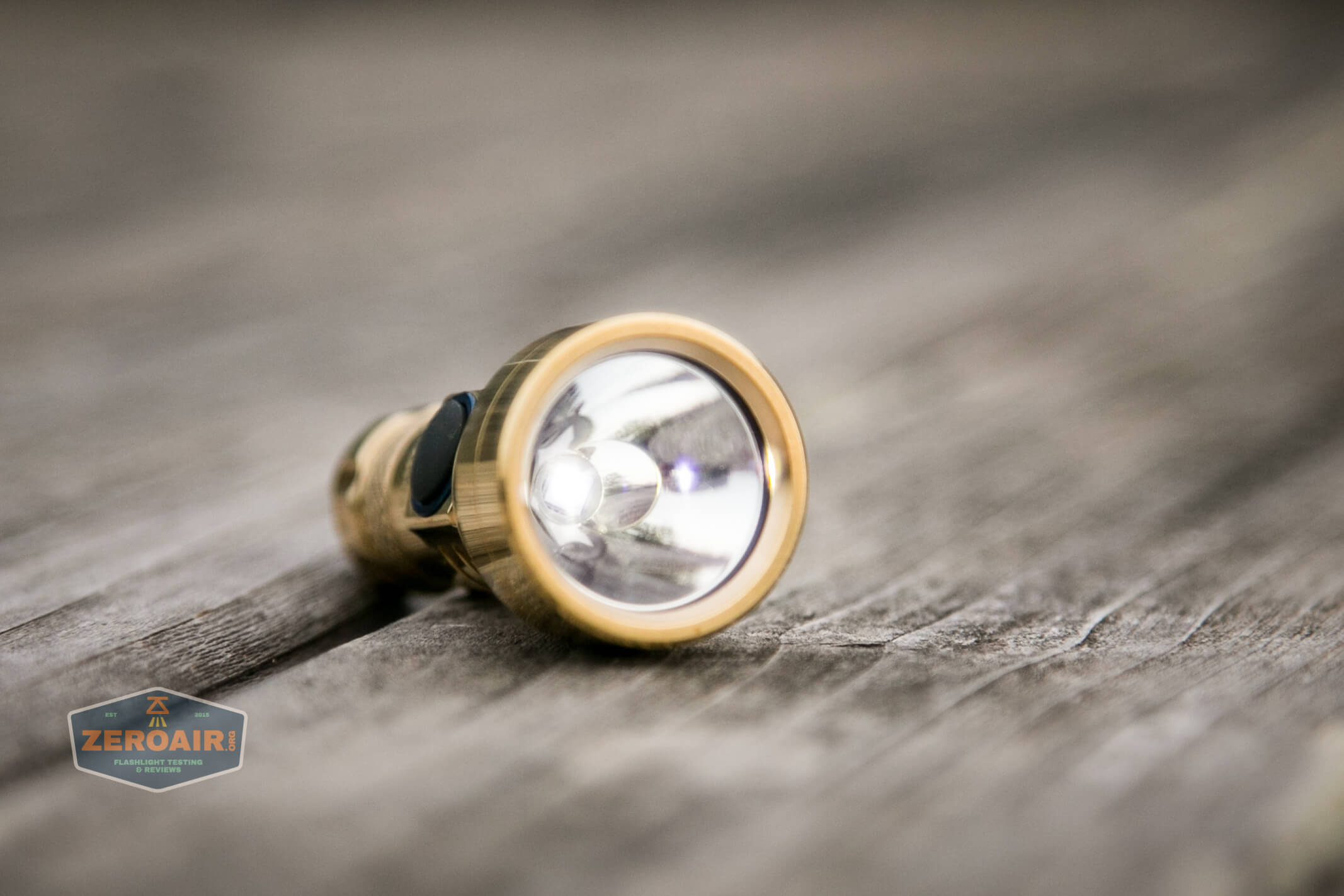
The reflector is smooth and deep.
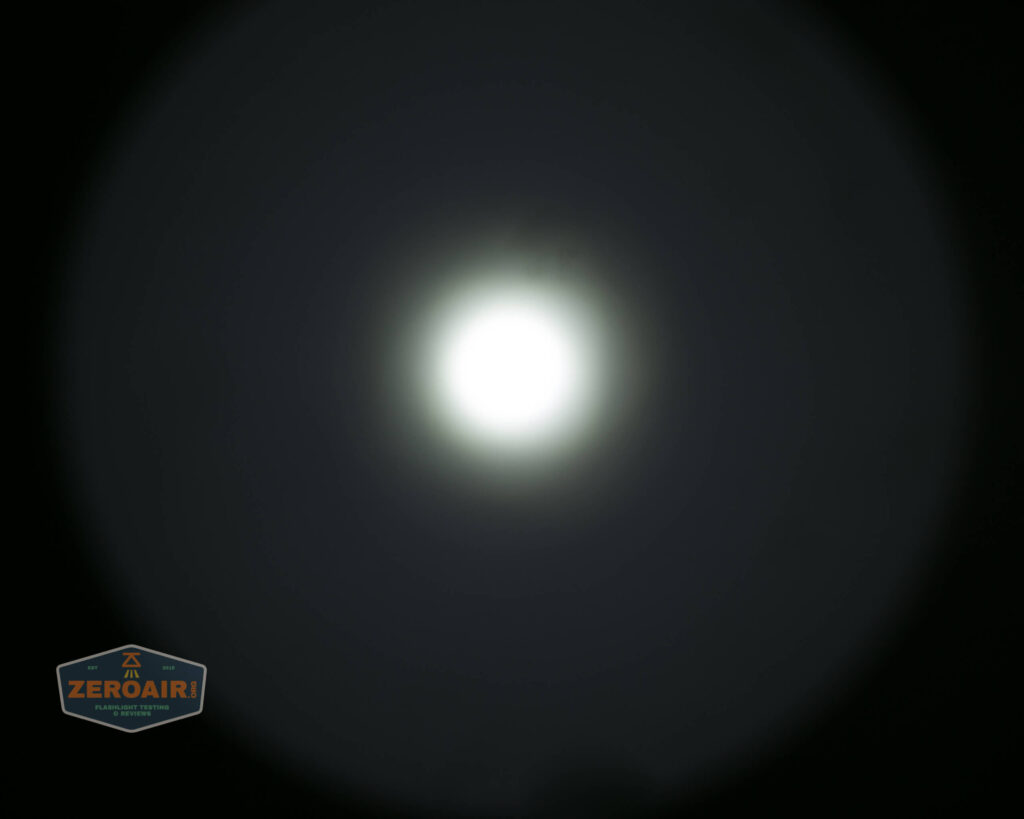
These beamshots always have the following settings: f8, ISO100, 0.3s shutter, and manual 5000K exposure. These photos are taken at floor level, and the beam hits the ceiling around 9 feet away. This is the stepped output.



Tint vs BLF-348 (KillzoneFlashlights.com 219b version) (affiliate link)
I keep the test flashlight on the left and the BLF-348 reference flashlight on the right. This is the stepped output.
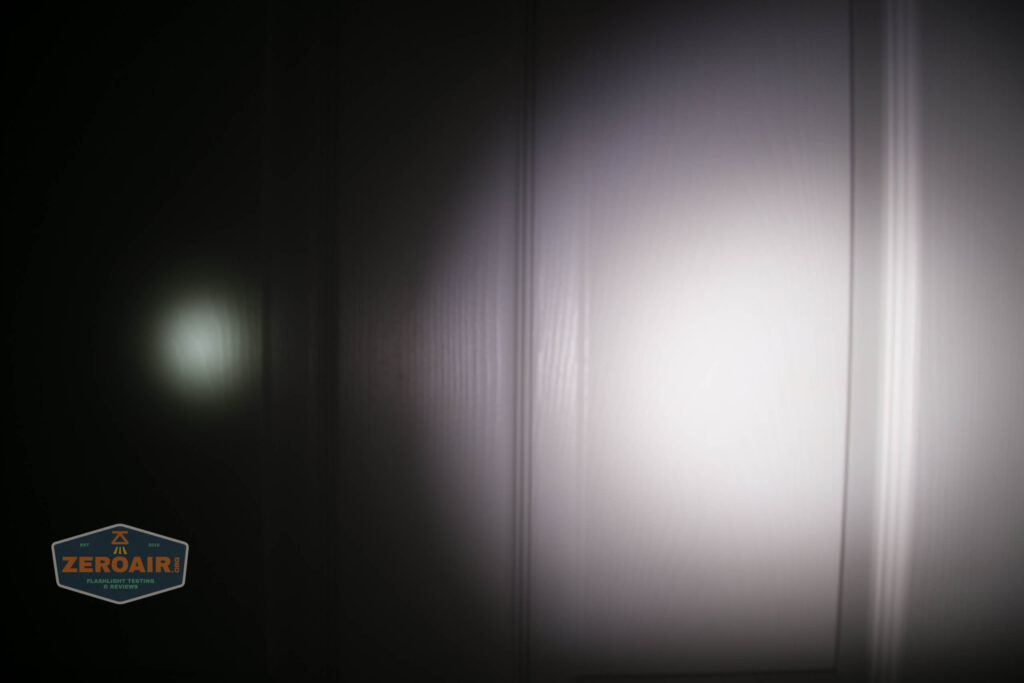



I compare everything to the KillzoneFlashlights.com 219b BLF-348 because it’s inexpensive and has the best tint!
Conclusion
What I like
- No brass light that is more fun for fewer dollars
- Performance (output) is excellent
- The “to scale” vs other GT’s is incredibly well done
- Very good charging
What I don’t like
- Switch on my copy is a little unreliable
- Output on Turbo claimed at 2.5A, but in fact, seems unregulated (so beware if trying to use a 10440 cell)
- Switch indicator is red on mine at all times (even with freshly charged cell)
- Parasitic drain is massively high
Notes
- This light was provided by NealsGadgets.com for review. I was not paid to write this review.
- This content originally appeared at zeroair.org. Please visit there for the best experience!
- Please use my Amazon.com referral link to help support zeroair.org!
Pingback: Lumintop EDC Pimi Keychain Flashlight Review - ZeroAir Reviews
Pingback: Lumintop GT Nano Brass 10440 Flashlight Review - ZeroAir Reviews
Pingback: Lumintop GT Nano Titanium Flashlight Review - ZeroAir Reviews