

Lumintop EDC Pimi Keychain Flashlight Review
The Lumintop EDC Pimi Keychain is a fetching shiny copper flashlight, with unusual twisty operation, and just one mode. Read on for testing!
Official Specs and Features
Here’s a link to the Lumintop EDC Pimi Keychain flashlight product page.
Versions
There seems to be only one body version of the Lumintop EDC Pimi Keychain flashlight. That’s the copper body version, seen here. In this body though, there are two emitter options – Cree XP-L HI (CW) (for more output) or Nichia E17A (NW) (for better color rendering). I have the Nichia version.
Price
At Lumintop’s website, the Lumintop EDC Pimi Keychain flashlight sells for $39.95 now. Only the Nichia is available.
Short Review
The Lumintop EDC Pimi Keychain is a very neat little light, which offers features rarely seen in any light, much less a tiny 10180 twisty. I like it, and I hope Lumintop does other versions as well. I do wish it had a flat base or flat side though, so it could be placed and stay steadily more easily.
Long Review
The Big Table
| Lumintop EDC Pimi Keychain Flashlight | |
|---|---|
| Emitter: | Nichia NCSLE17A-E (Neutral White) |
| Price in USD at publication time: | $39.95 |
| Cell: | 1×10180 (included) |
| Uncooled Runtime Graph | Cooled Runtime Graph |
| LVP? | Test indicate “no.” |
| Switch Type: | Twisty |
| On-Board Charging? | Yes |
| Charge Port Type: | micro-USB head |
| Charge Graph | |
| Power off Charge Port | – |
| Claimed Lumens (lm) | 60 |
| Measured Lumens (at 30s) | 66 (110% of claim)^ |
| Candela per Lumen | 1 |
| Claimed Throw (m) | |
| Candela (Calculated) in cd (at 30s) | 21lux @ 1.921m = 77cd |
| Throw (Calculated) (m) | 17.6 |
| All my Lumintop reviews! | |
^ Measurement disclaimer: Testing flashlights is my hobby. I use hobbyist-level equipment for testing, including some I made myself. Try not to get buried in the details of manufacturer specifications versus measurements recorded here; A certain amount of difference (say, 10 or 15%) is perfectly reasonable.
What’s Included
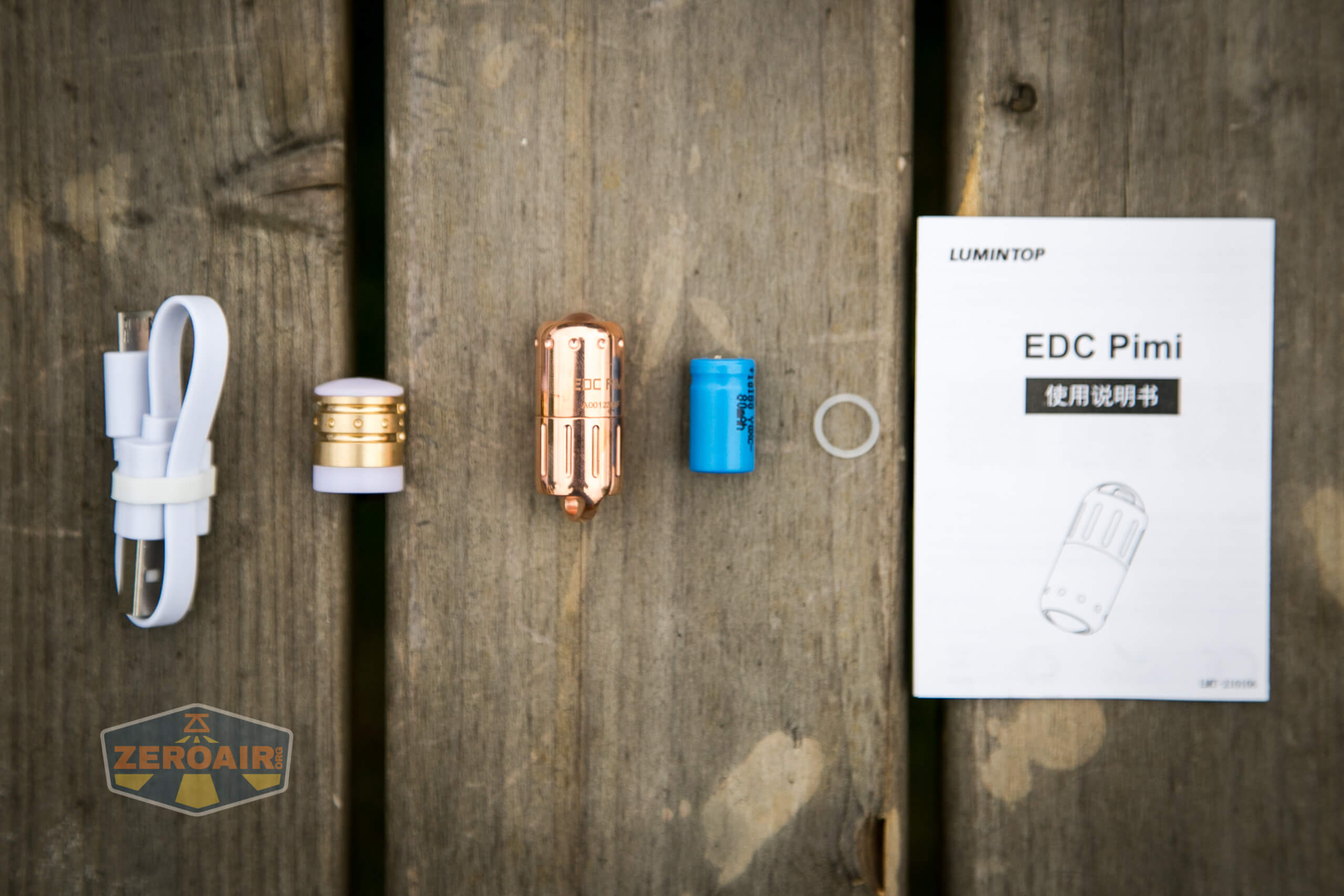
- Lumintop EDC Pimi Keychain Flashlight
- 10180 Lithium Ion cell
- Charge head
- Charge cable (USB to micro-USB)
- Spare o-ring
- Manual
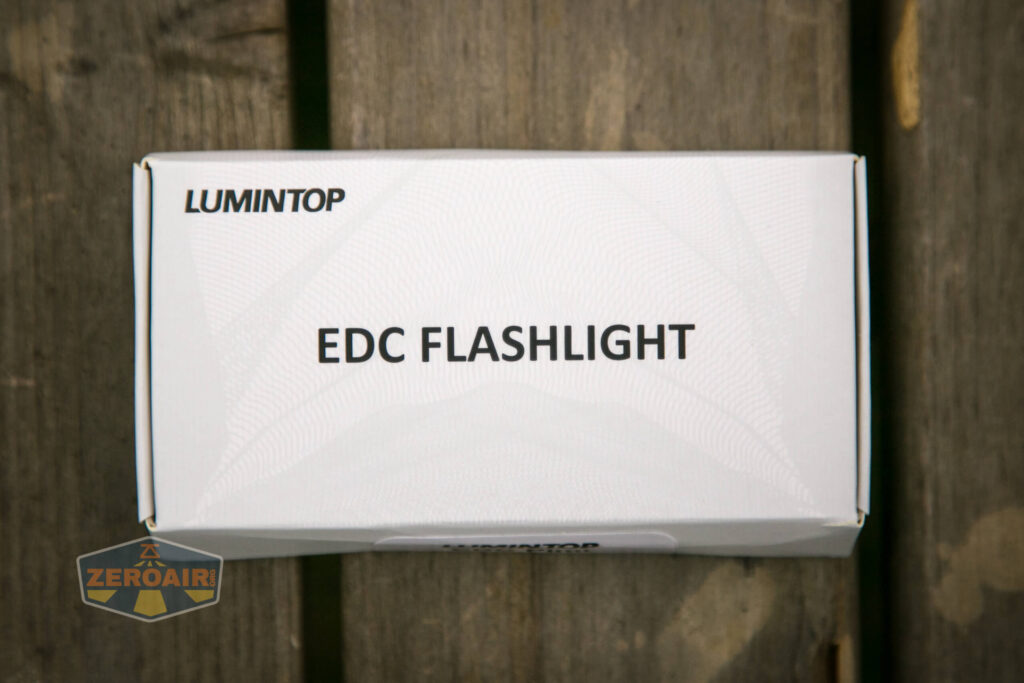
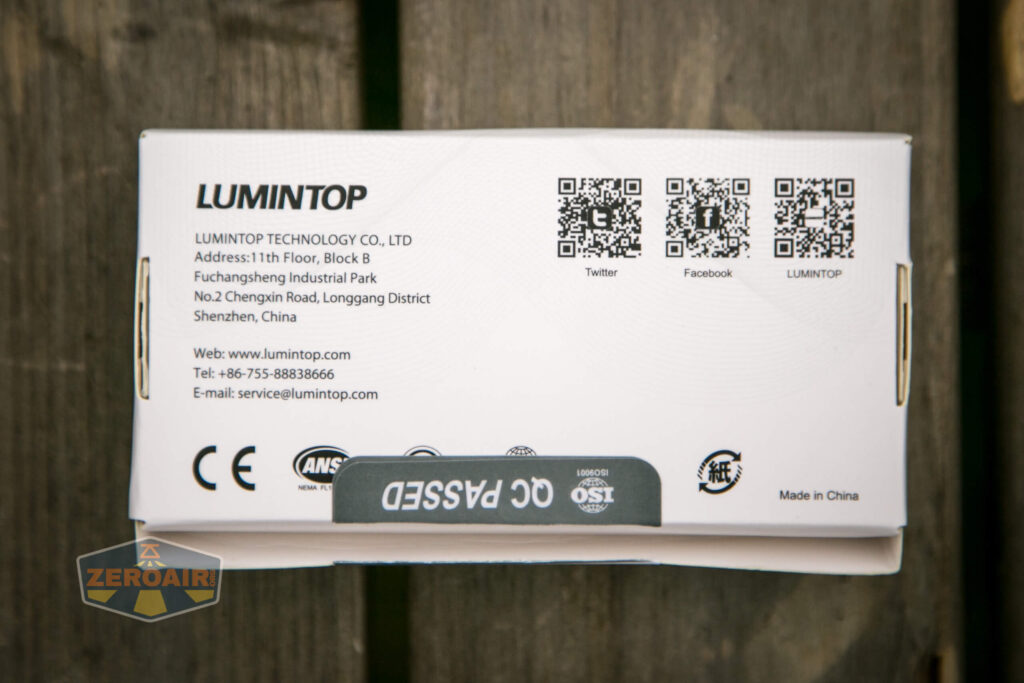
Package and Manual


Build Quality and Disassembly

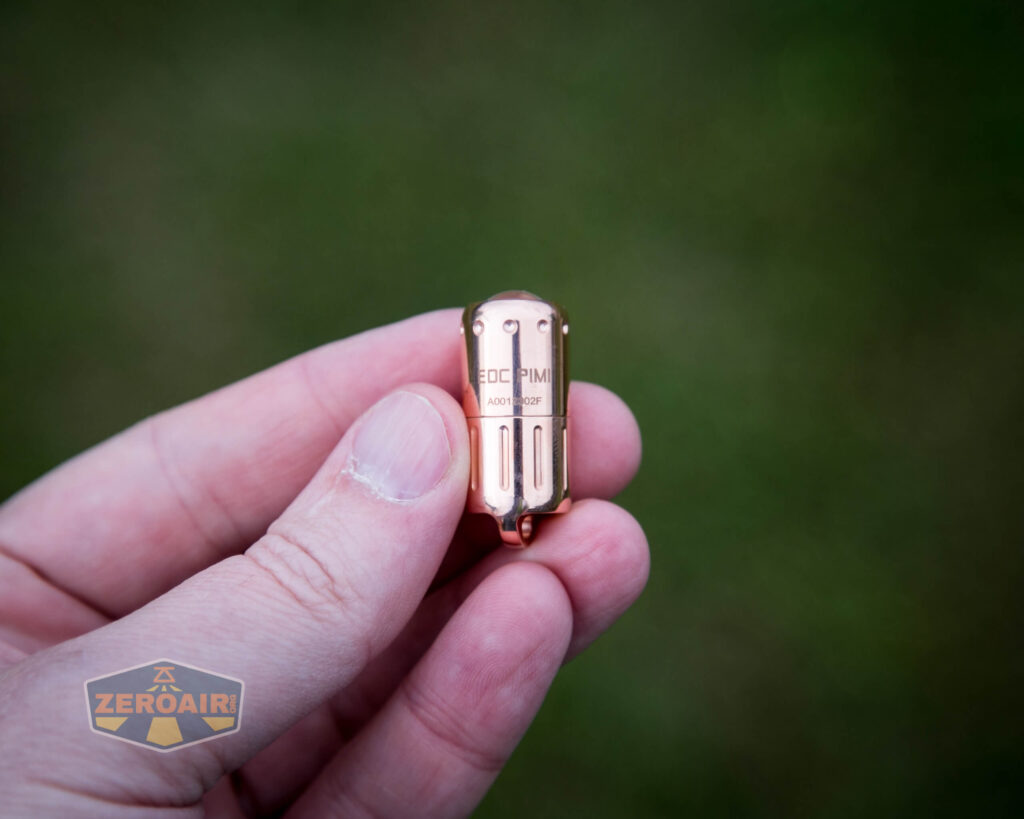
Because this little keychain flashlight is copper, I took photos immediately when I opened the sealed package. That way, you get to see what the light looks like out of the package. As you can see, it’s extremely shiny.


I’m sure with some use that sheen will wear off, particularly if carried on keys.
You can immediately see a downside for me, and how I take review photos – the light doesn’t have a “resting state.” It won’t tailstand, it rolls when laid on the side, and the aspheric lens protruding as it does prevents even headstanding. So I made it work as you can see in the photos.
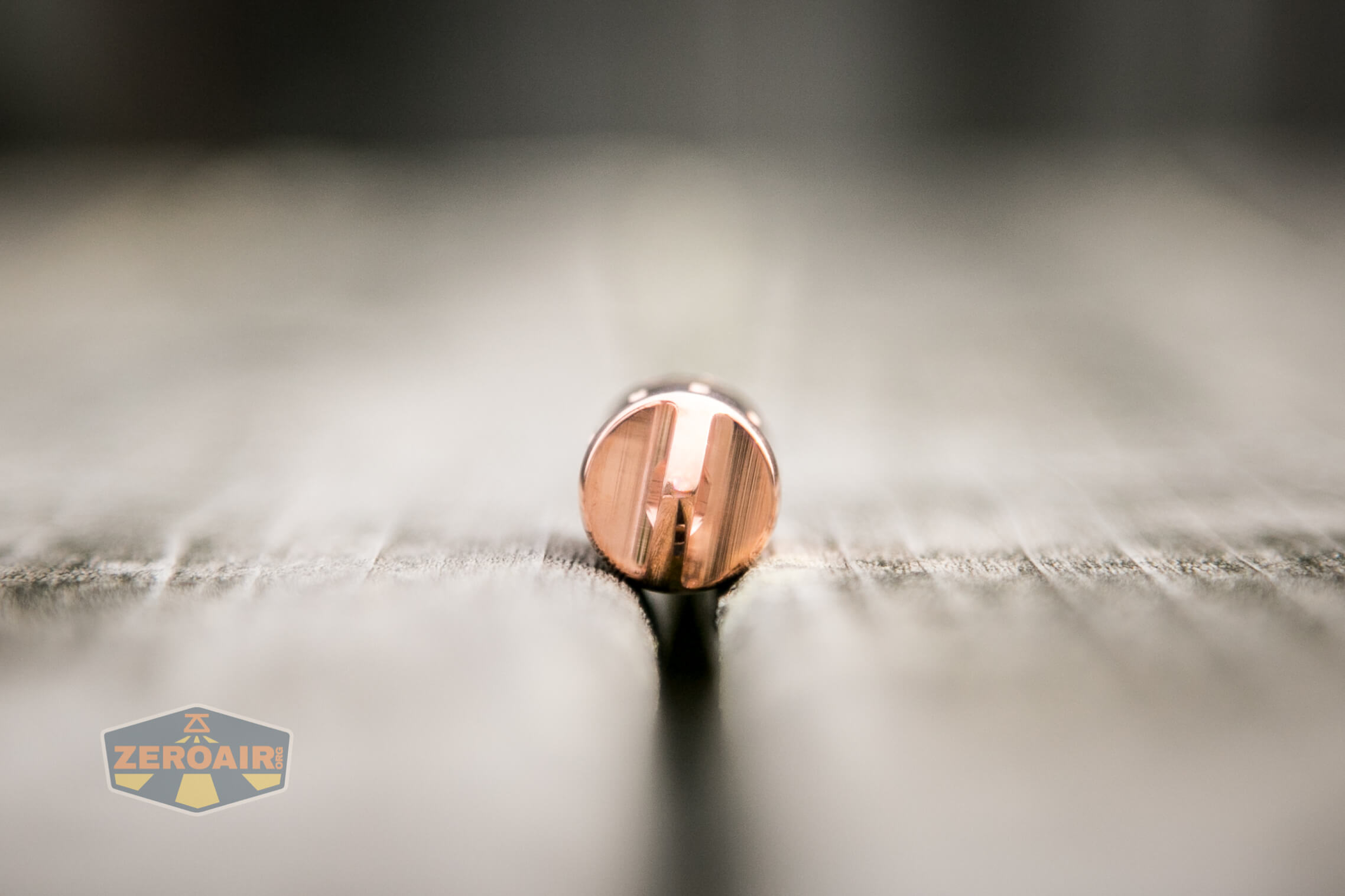
These threads are short, and very smooth. When putting these parts together you’ll immediately discover one interesting fact about this light. Only when it’s fully tightened is it off. That’s right, you loosen the head in order to turn the Lumintop EDC Pimi Keychain flashlight on!

The tail end has a nice big spring. The head has only these two brass contact rings. That center one is the positive contact. The outer ring is not the negative contact, but I’m unclear on what its role actually is. Possibly in some way it facilitates the loosen-for-on operation.

Size and Comps
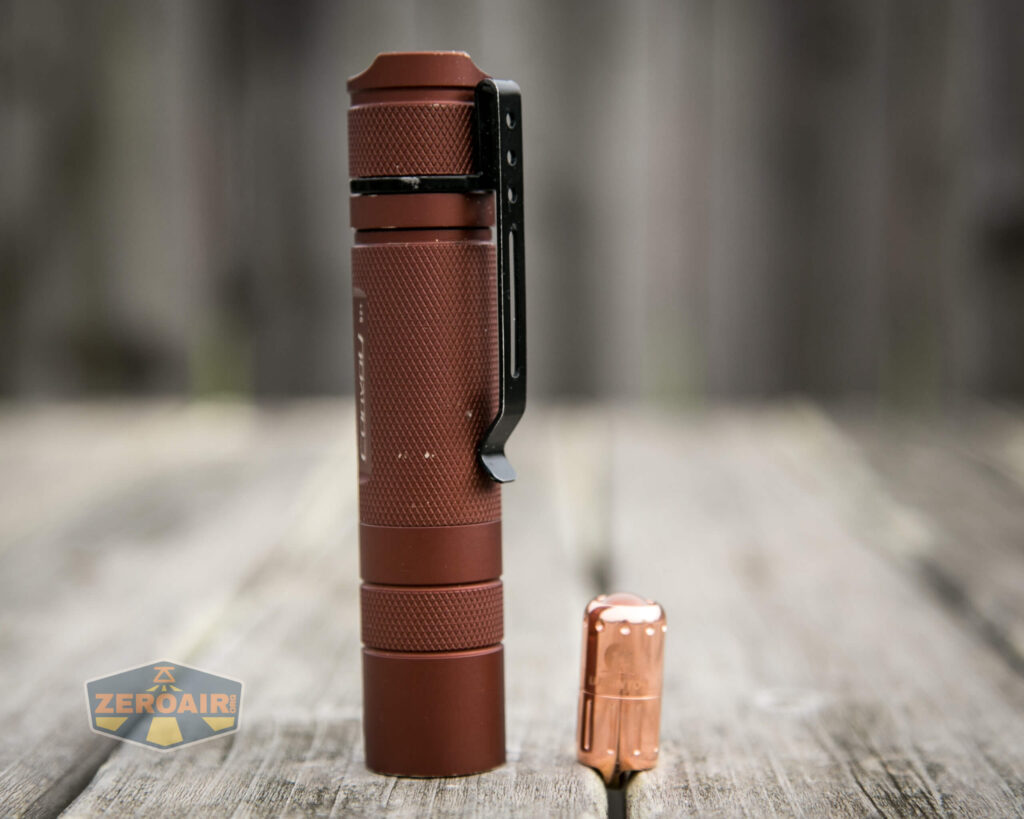
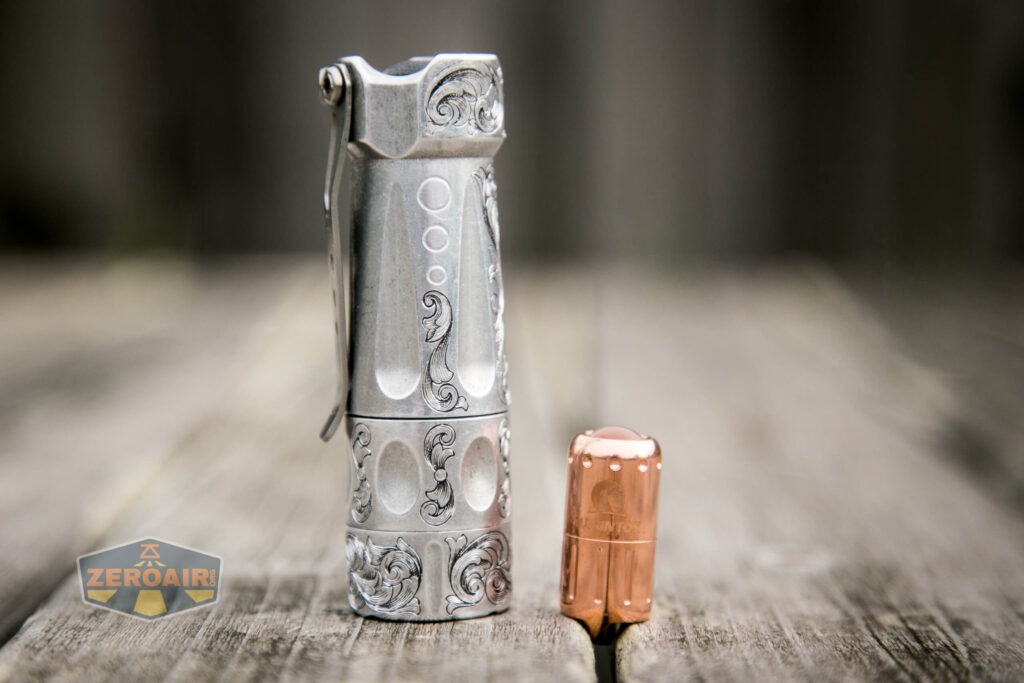
- Length 33mm
- 17.5g in net weight without battery


If the flashlight will headstand, I’ll show it here (usually the third photo). If the flashlight will tailstand, I’ll show that here, too (usually the fourth photo).



Here’s the test light with the venerable Convoy S2+. Mine’s a custom “baked” edition Nichia 219b triple. A very nice 18650 light. Again the light won’t tailstand, so the “height comparison’ is a little skewed.

And here’s the light beside my custom-engraved TorchLAB BOSS 35, an 18350 light. I reviewed the aluminum version of that light in both 35 and 70 formats.

Retention and Carry
This is really only a keychain light, and as such has a big keychain loop on the tail end. This loop is not removable and doesn’t allow tailstanding, either.
On top of all that, there is no keychain or split ring or anything else for attaching to this loop.
Power and Runtime
The Lumintop EDC Pimi keychain flashlight is powered by a single lithium-ion cell. What ships and is intended for the light is a single 10180 cell – a tiny cell! These are rated at 80mAh capacity, which is a tiny capacity.

This is the same cell exactly that is used in the GT Nano. The cell is standard – slight button top.

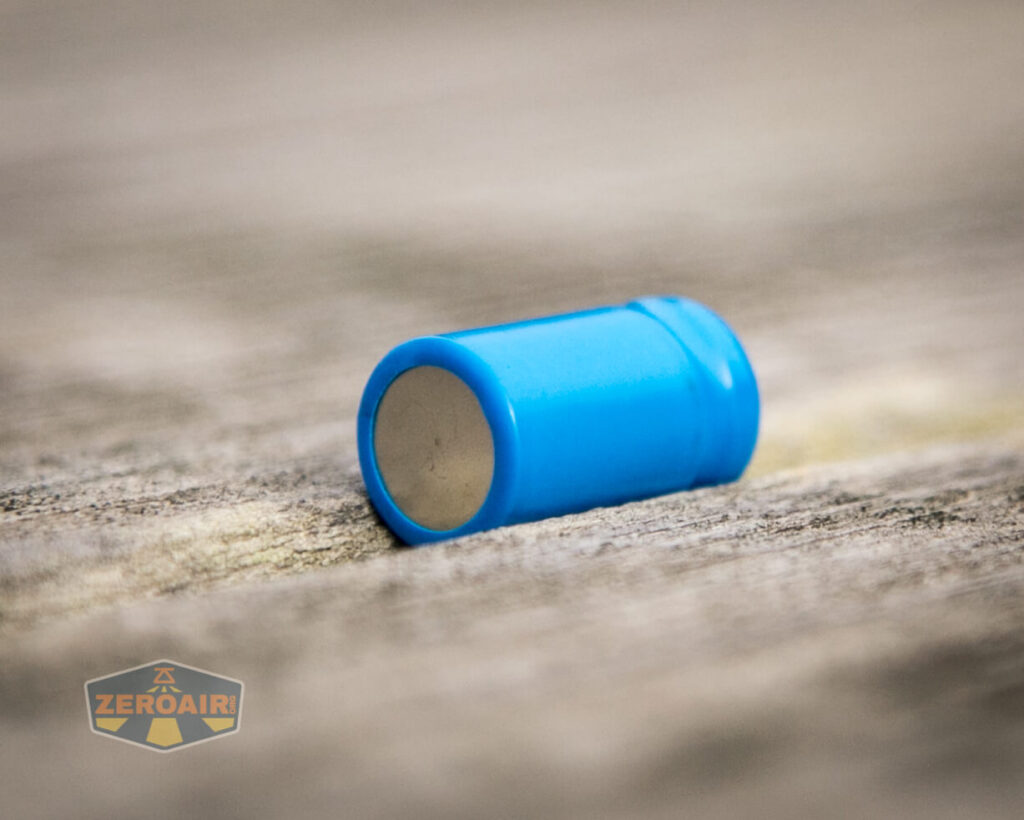
I can hear you saying it. “Zero, since that’s the GT Nano cell, does it work on the GT Nano?” Yes it sure does! The cell tube of the GT Nano fits just fine (and works just fine) on the head. The charge parts are the same. And with the GT Nano tail, the EDC Pimi will tailstand! Unfortunately the EDC Pimi body doesn’t work on the GT Nano (I don’t think it’s quite long enough to make contact.)

Here are a couple of runtimes. The output on this light is rated at 60 lumens, and that’s approximately what I measure at 30 seconds. Since there’s only one mode, and I feel like including 2 graphs in a review, I tested the light cooled and uncooled. I’d call the results fairly interesting, since output is not markedly different between the two tests. I might have expected the cooled runtime to “go harder” and “die faster” but that just really doesn’t seem to be the case.


On bench power, I was unable to understand if there is low voltage protection. The light was on all the way down to 2.4V, and never shut off electrically.
Charging
Included for charging is a “charge head.” It’s brass and has some plastic bits for protection. The plastic dome on the top (below) actually has charge indicators, too. Red for charging, and green for charging complete.

The little plastic bit seen below just unscrews – I suppose it’s just there for protection.

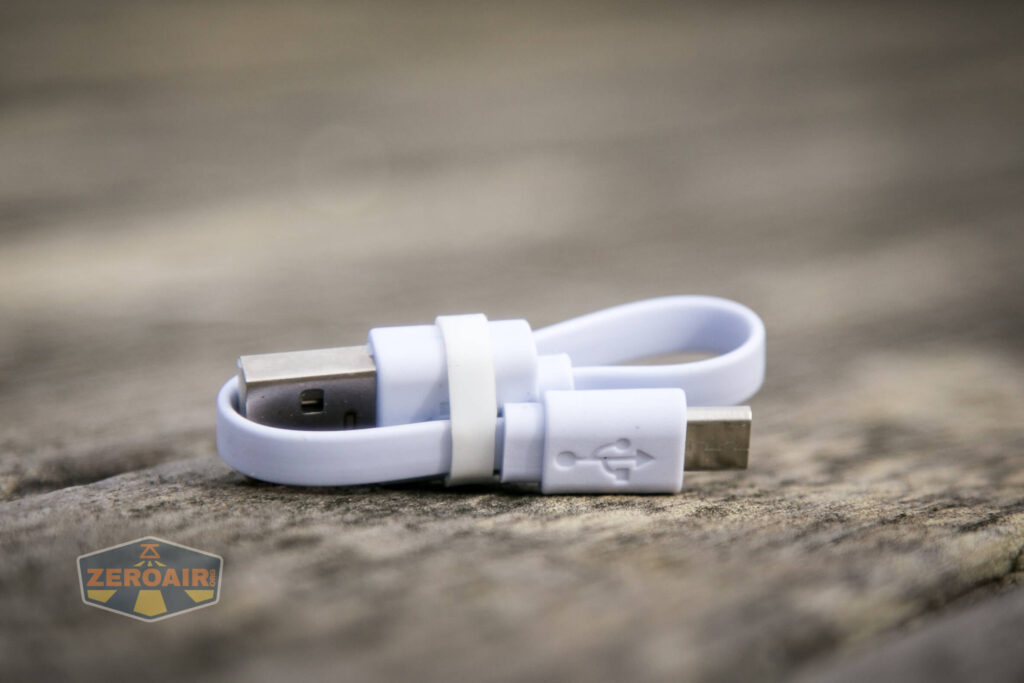
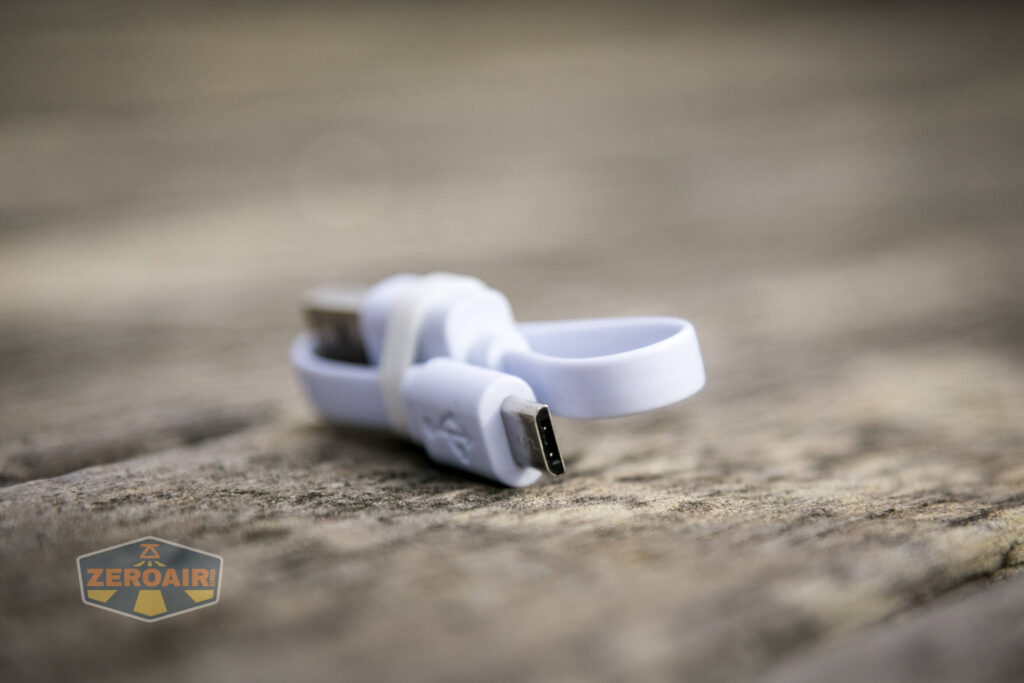
Lumintop includes a cable – USB to micro-USB. It’s a very short cable.
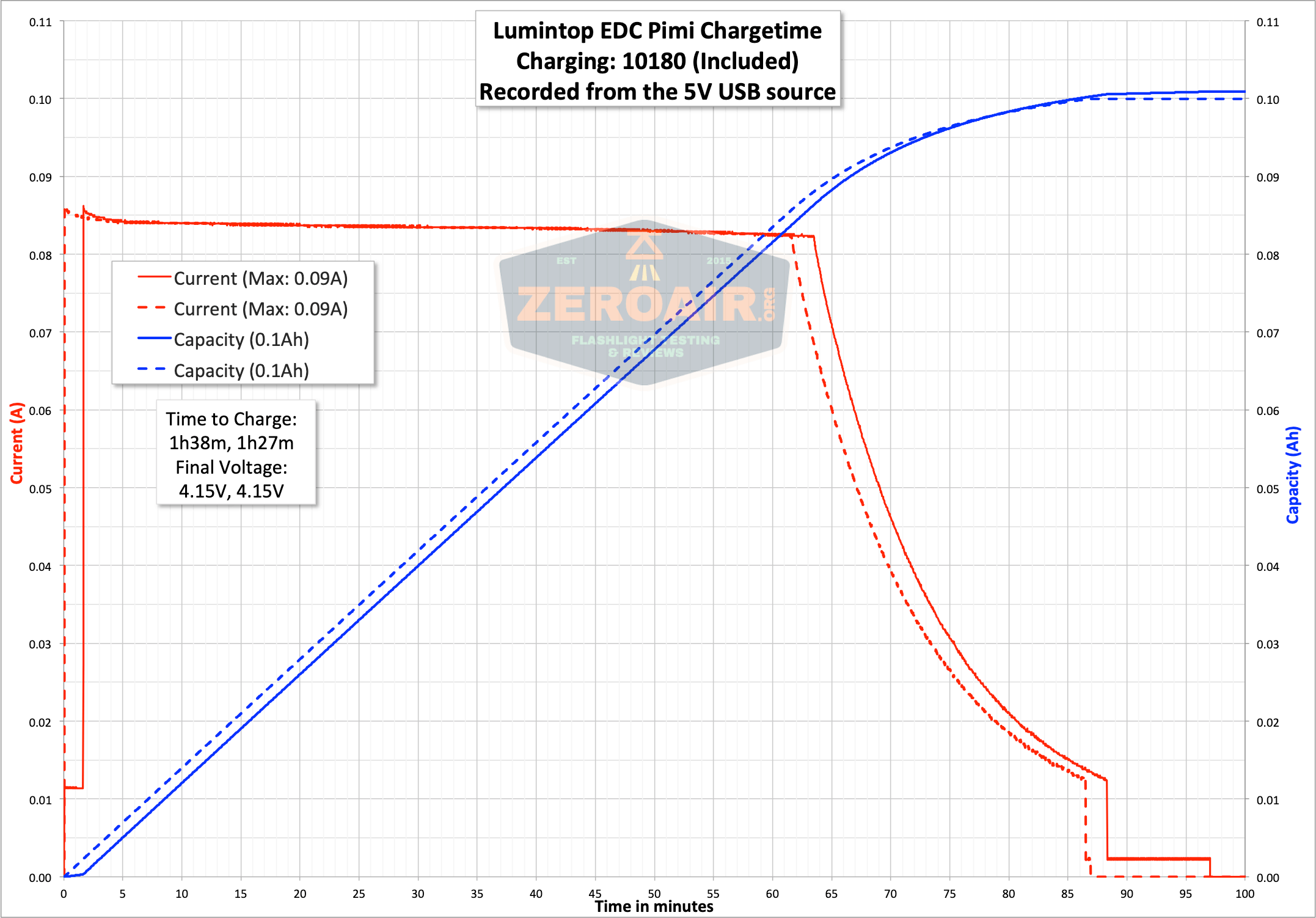
Charging is a reasonable 0.1A, or around 1C. Charge is very consistent and terminates reliably at 4.18V. Both are very good things.
Modes and Currents
| Mode | Mode Claimed Output (lm) | Claimed Runtime | Measured Lumens | Tailcap Amps |
|---|---|---|---|---|
| On | 60 | – | 66 | 0.25 |
Pulse Width Modulation
The single mode does not have PWM.

Here you can see a “baseline” – a chart with almost no light hitting the sensor.

Then there’s the Ultrafire WF-602C flashlight, which has some of the worst PWM I’ve seen. It’s so bad that I used a post about it to explain PWM! Here are multiple timescales (10ms, 5ms, 2ms, 1ms, 0.5ms, 0.2ms) to make comparing this “worst” PWM light to the test light easier. That post also explains why I didn’t test the WF-602C at the usual 50us scale.


User Interface and Operation
The Lumintop EDC Pimi keychain flashlight is a twisty. But not just any type twisty. It’s a loosen for on twisty. So in the photo below, fully tightened, you can see that the light is off!

I consider this an absolutely fantastic feature, and I wish more (all?) twisties were this way. There are so many advantages to this.
First of all, this really diminishes the possibility of the head falling off when the light is not in use. “Fully tightened” for off makes the light (for carry purposes) just like any other light (clickies, for example). It’s fully tightened, why would you expect to have any “head falling off” issues. Would you expect the head to fall off of your GT Nano, for example. No, you would not.
Secondly, when the head is loosened, the light will be on and in use. You’d immediately notice any related issues (like the head falling off).
Being fully tightened when off also prevents debris from entering the threads and cell tube – you keep a cleaner light! I’m sure there are other compelling reasons.
(By the way, the other light I can think of which uses “loosen for on” is the Tain Aurora. I believe the Maglite Solitaire may, too.)
Here’s a user interface table!
| State | Action | Result |
|---|---|---|
| Off | Loosen Head | On |
| On | Tighten Head | Off |
LED and Beam
The emitter in my copy of the Lumintop EDC Pimi keychain flashlight is a Nichia E17a (NCSLE17A-E (NW)). This is a neutral white emitter, and great for color rendering too (though Lumintop does not make this claim specifically).

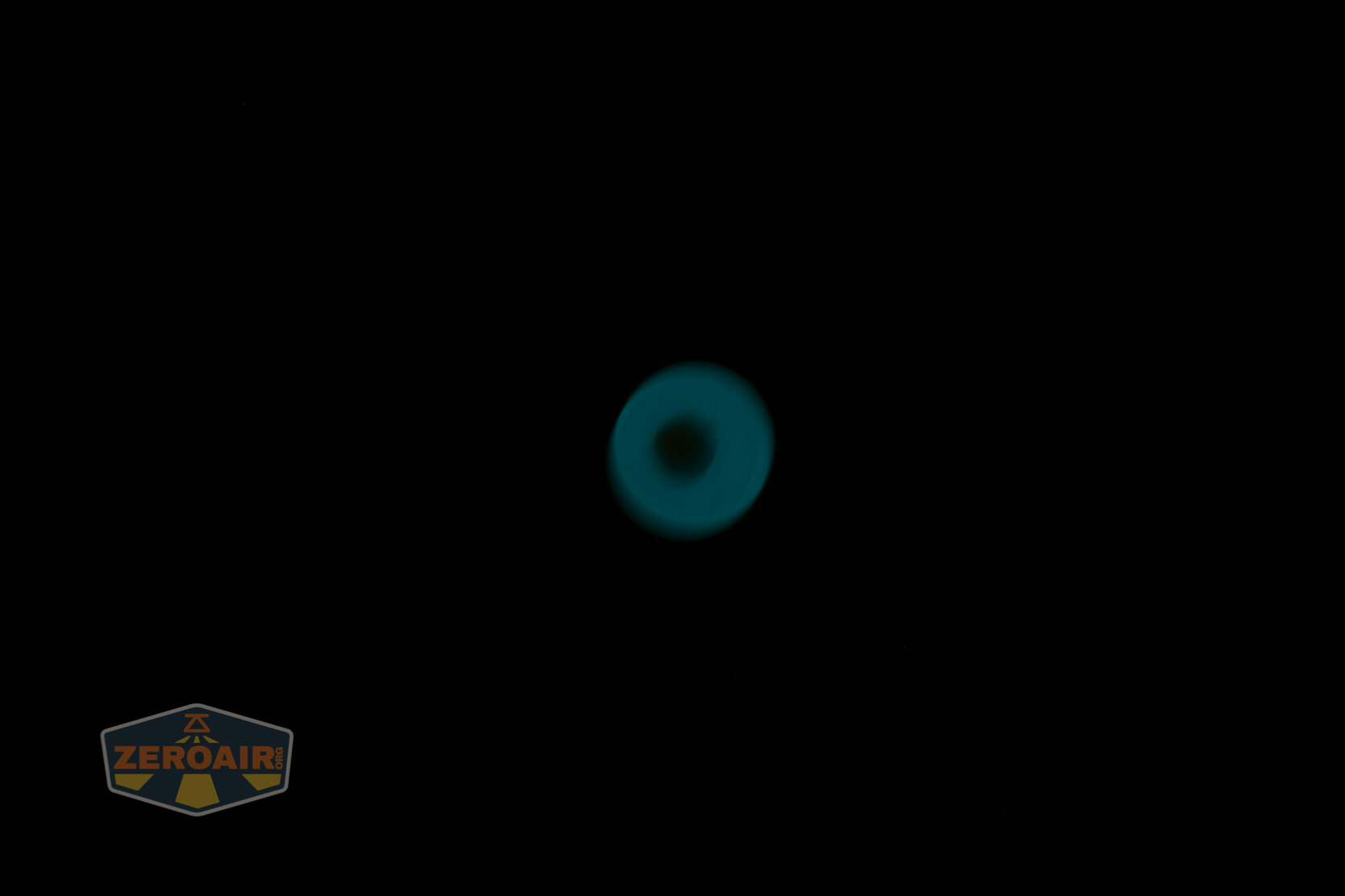
The emitter is surrounded by a glowy “reflector,” which glows a bluish color. I don’t think this is “turbo glow” just “regular glow.”

Compare the photo below to the one in hand above. There’s the edge between “off” and “on.” It’s on below, and the gap is small! So it doesn’t take much movement to turn the light on. Due to the size and slickness, however, it’s probably not a single-handed job. That said, if you have this on your keychain, you’ll be able to twist against the keys, and can probably do it one-handed.

Here’s a very bad photo of the glowy ring.
These beamshots always have the following settings: f8, ISO100, 0.3s shutter, and manual 5000K exposure. These photos are taken at floor level, and the beam hits the ceiling around 9 feet away.

I’m throwing this photo in just so you can have a better idea of the beam shape (since the one above doesn’t really show it well, but it’s “the standard”). This is a very even beam pattern all the way through.

Tint vs BLF-348 (KillzoneFlashlights.com 219b version) (affiliate link)
I keep the test flashlight on the left and the BLF-348 reference flashlight on the right.
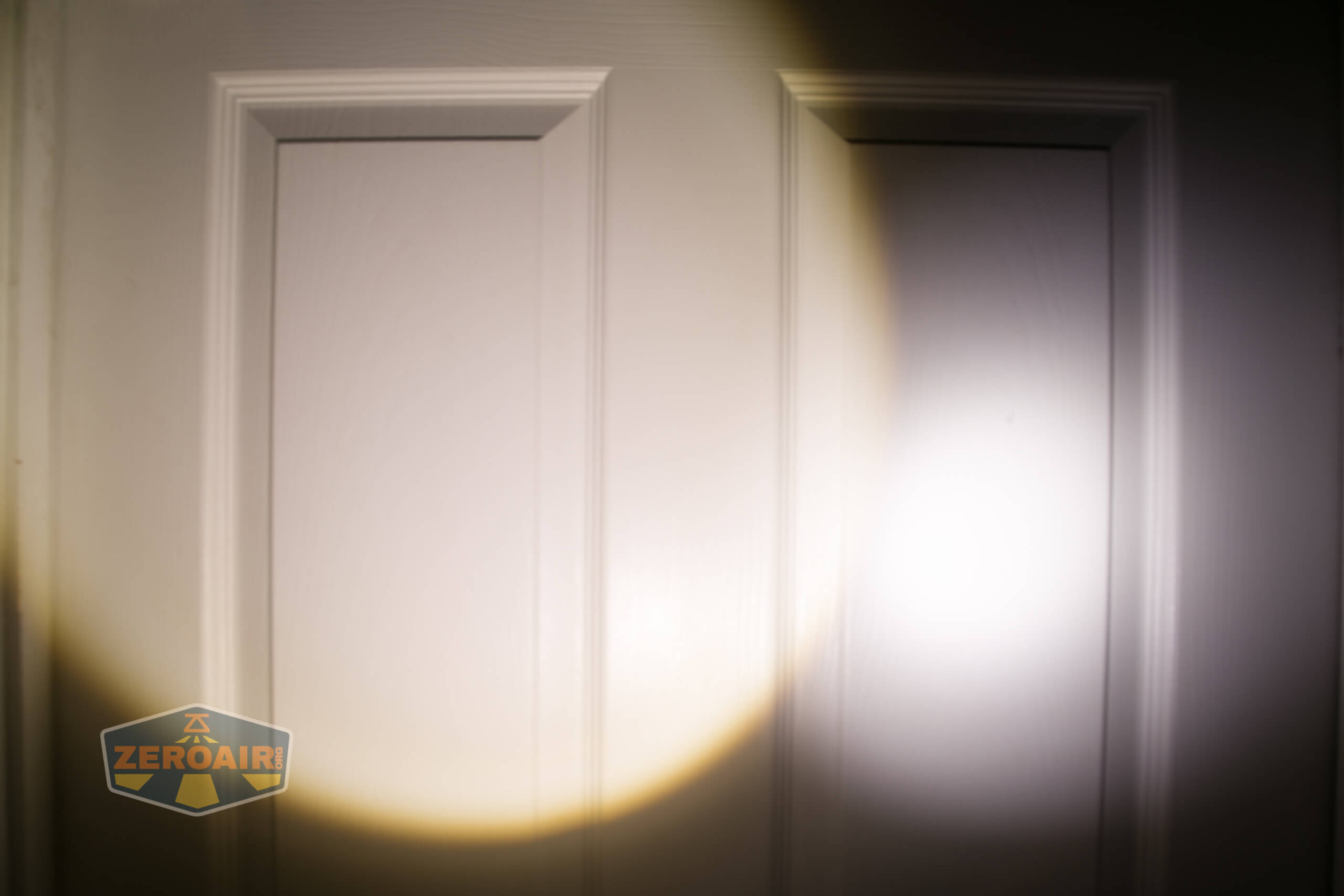
I compare everything to the KillzoneFlashlights.com 219b BLF-348 because it’s inexpensive and has the best tint!
Conclusion
What I like
- Loosen for on!
- Nichia E17a emitter
- Glow reflector
- Nice copper finish
- No PWM
What I don’t like
- No split ring or lanyard included
- Not a single flat side
Notes
- This light was provided by Lumintop for review. I was not paid to write this review.
- This content originally appeared at zeroair.org. Please visit there for the best experience!
- Please use my Amazon.com referral link to help support zeroair.org!
- Please support me on Patreon! I deeply appreciate your support!
What is the CCT of the pimi? That is a gorgeous tone.
I haven’t tested it. Maybe one of these days I’ll get time to go through all my older review lights and add that data. 🙂