

Imalent RS50 Flashlight Review
The Imalent RS50 flashlight offers massive output from eight Cree XHP50.3 HI (high intensity) emitters and has a shroud with fans and active cooling! Read on!
Official Specs and Features
Here’s a link to the Imalent RS50 flashlight product page.
Versions
There is only one version of the RS50. You might also want to consider the MS08, though, which is basically a floody version of this light (with different emitters).
Price
The Imalent RS50 flashlight is listed at $234.95, and that includes the three 21700 cells seen in this review. The RS50 is available on Amazon, too! (referral link.)
Short Review
Just like the Imalent MS08 flashlight, the RS50 is an interesting little light. The output and throw are both great. I’d like to see flatter output in the runtimes and probably better heat management, but the heat shield does keep your hand clear of most of that heat. I’m pleased to see these Cree XHP50.3 HI emitters, for sure!
Long Review
The Big Table
| Imalent RS50 | |
|---|---|
| Emitter: | Cree XHP50.3 HI (8) |
| Price in USD at publication time: | $234.95 |
| Cell: | 3×21700 |
| Turbo Runtime Graph | High Runtime Graph |
| LVP? | Yes |
| Switch Type: | E-Switch |
| Quiescent Current (mA): | 0.03mA |
| On-Board Charging? | Yes |
| Charge Port Type: | Proprietary Magnetic |
| Charge Graph | |
| Power off Charge Port | No Modes |
| Claimed Lumens (lm) | 20000 |
| Measured Lumens (at 30s) | 10296 (51.5% of claim)^ |
| Candela per Lumen | 10 |
| Claimed Throw (m) | 1160 |
| Candela (Calculated) in cd (at 30s) | 4900lux @ 5.125m = 128702cd |
| Throw (Calculated) (m) | 717.5 (61.9% of claim)^ |
| Claimed CCT | – |
| Measured CCT Range (K) | 6500-7500 Kelvin |
| Item provided for review by: | Imalent |
| All my Imalent reviews! | |
^ Measurement disclaimer: Testing flashlights is my hobby. I use hobbyist-level equipment for testing, including some I made myself. Try not to get buried in the details of manufacturer specifications versus measurements recorded here; A certain amount of difference (say, 10 or 15%) is perfectly reasonable.
What’s Included
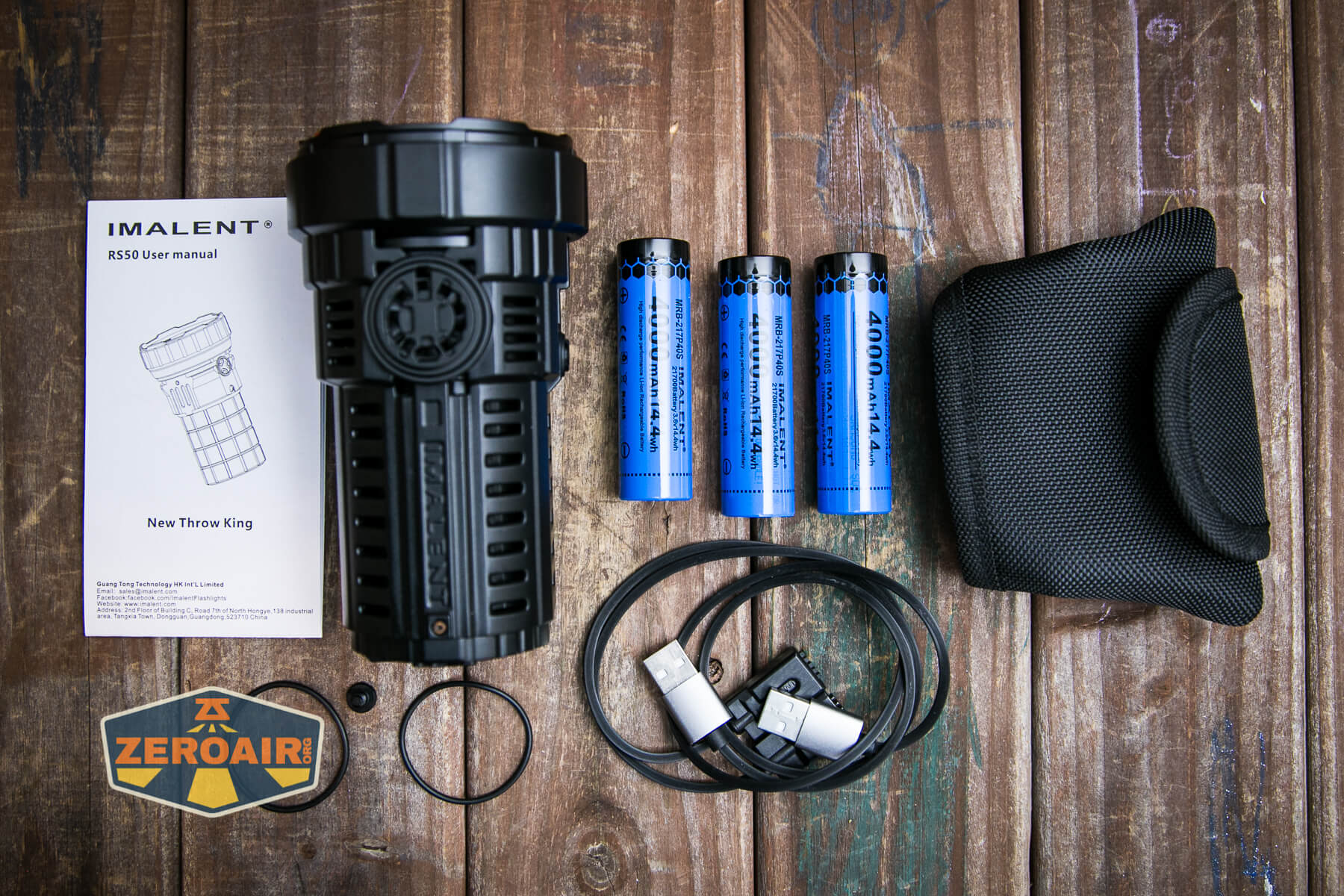
- Imalent RS50 Flashlight
- Spare o-rings (2)
- Charging cables (2) (USB to proprietary magnetic)
- Nylon pouch
- Heat shield screw (spare)
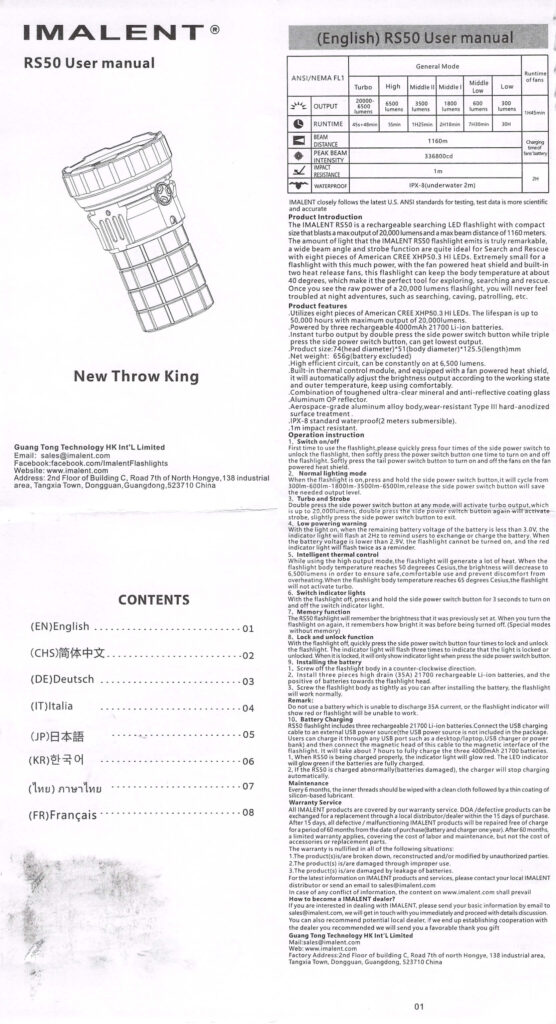
- Manual
Package and Manual
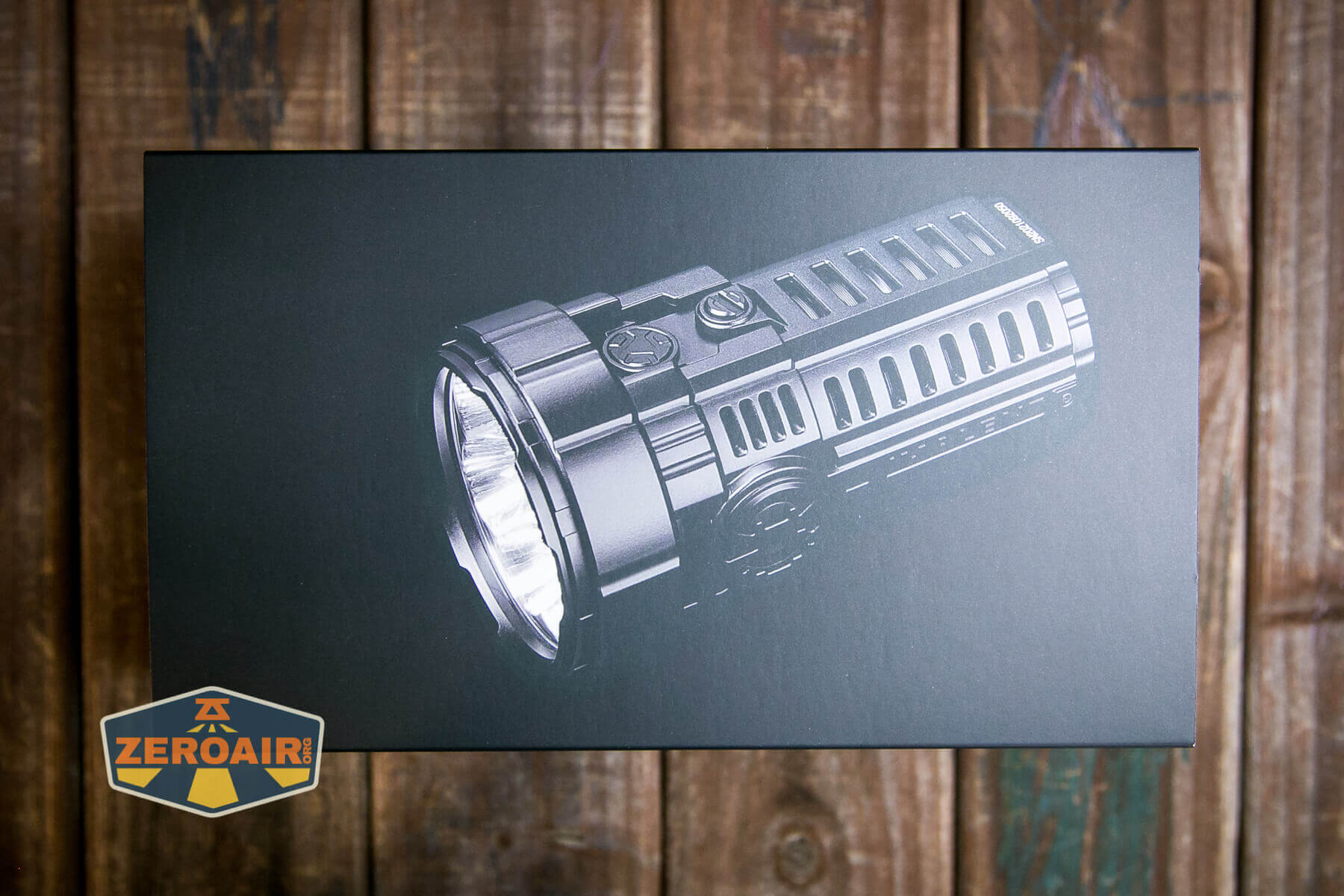
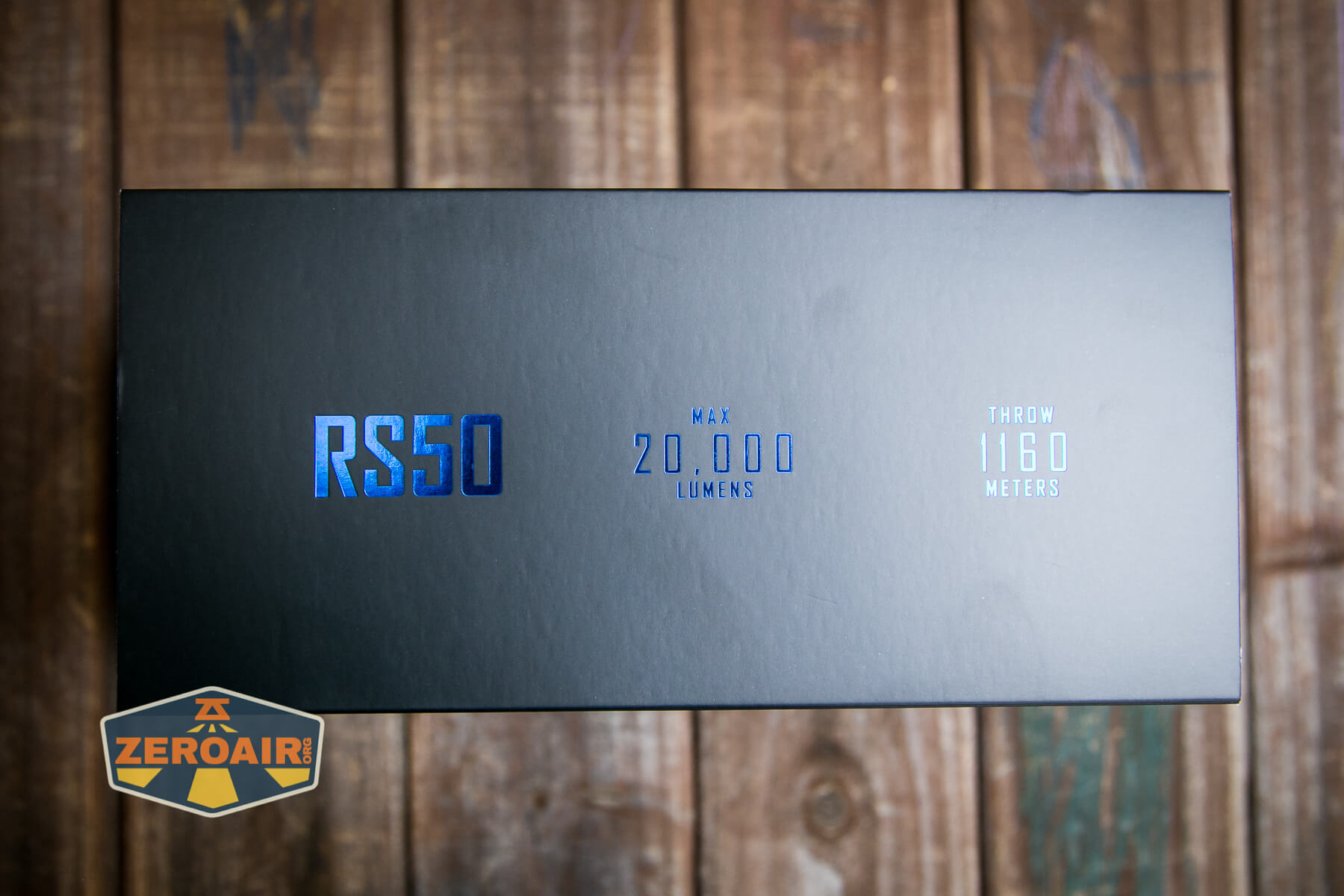

Build Quality and Disassembly

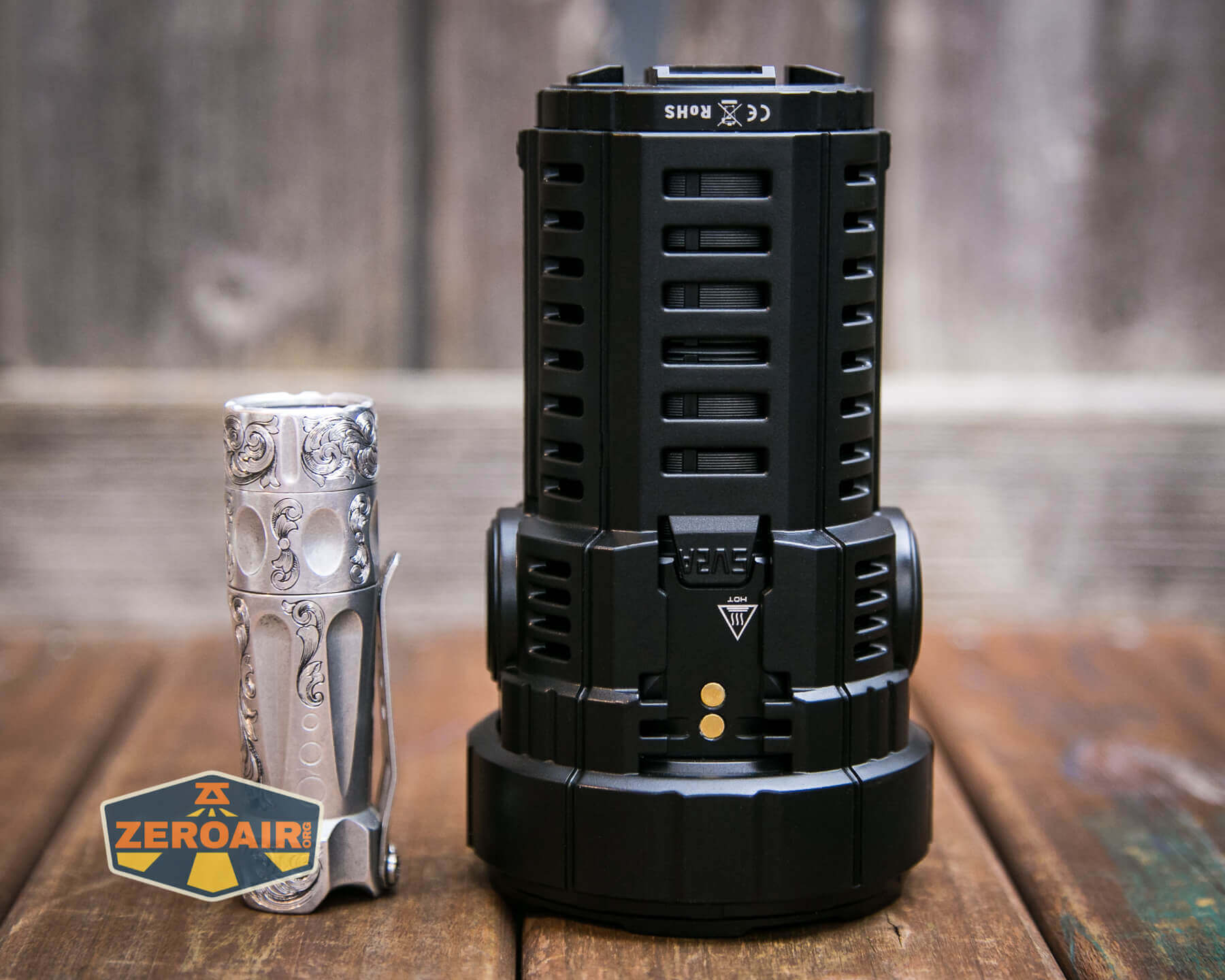
Officially that “handle” is called the “heat shield.” In fact, it’s available as a separate purchase for $20, which is not bad at all. (And I’m fairly sure it’ll fit some of Imalent’s other lights too, aside from the MS08 which ships with one of these shields.)
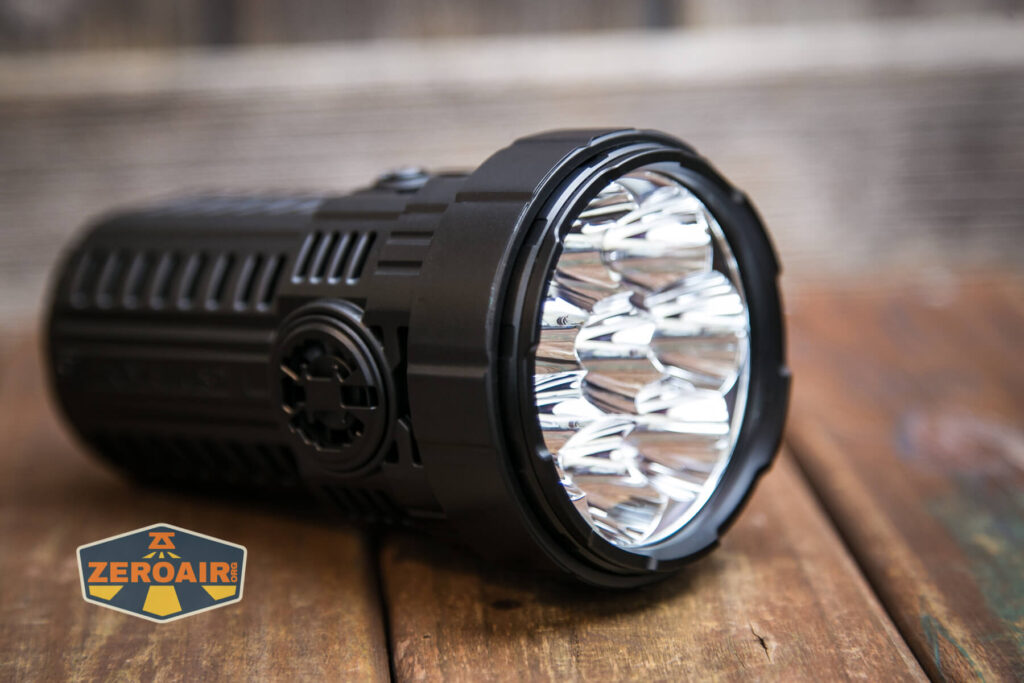
The heat shield is a hard plastic piece that fully encases the whole light except the front/output end. This case is easily removable, but you don’t have to remove it for things like charging. So removing is really not an issue.
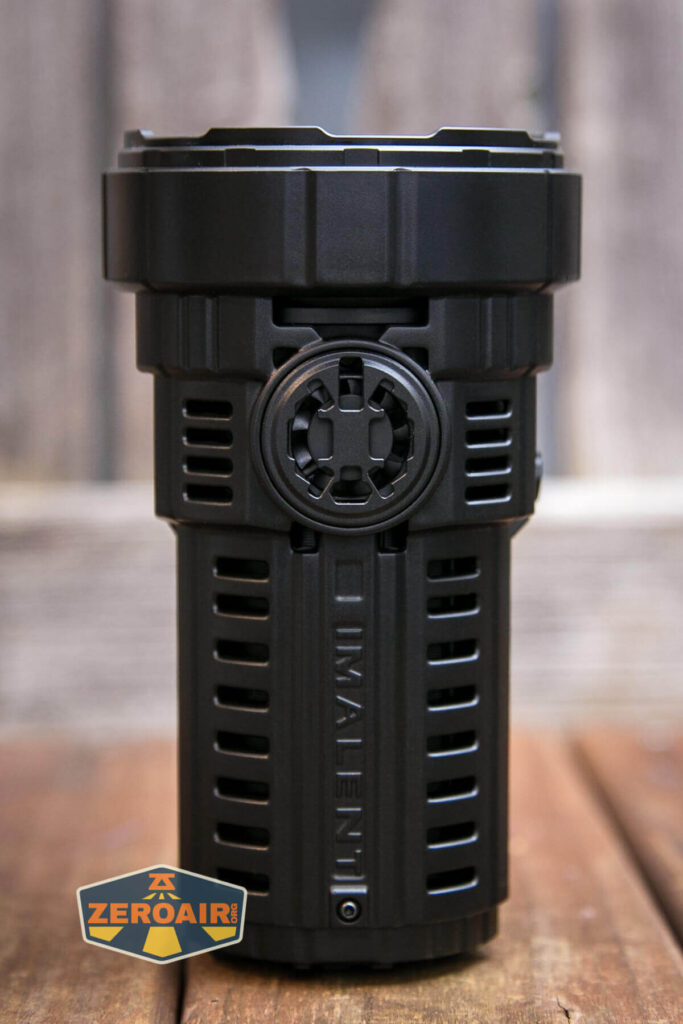
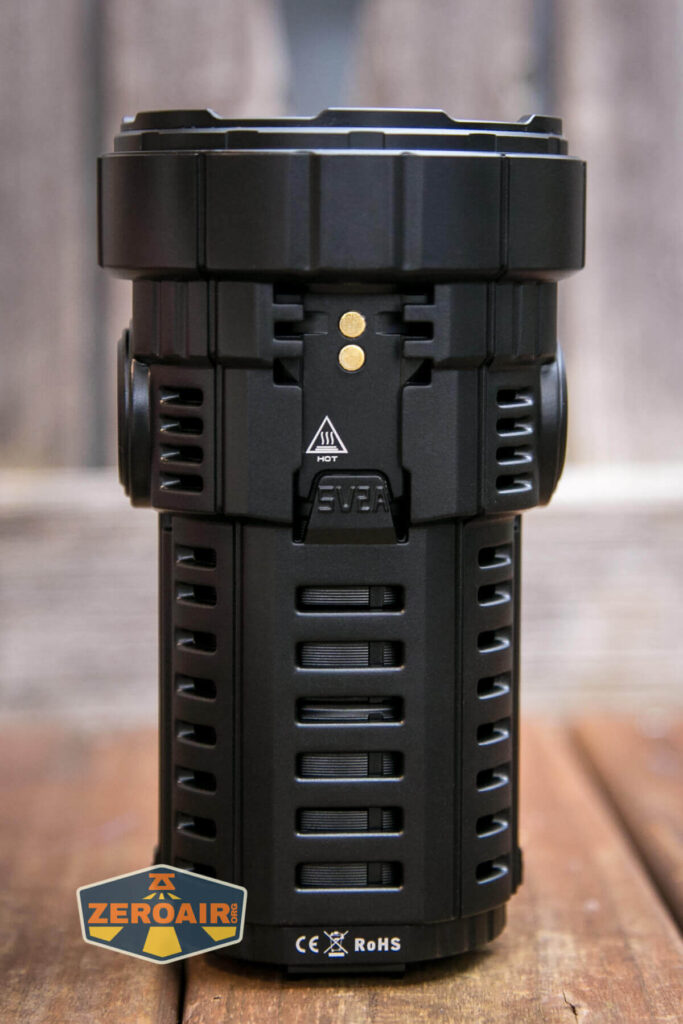
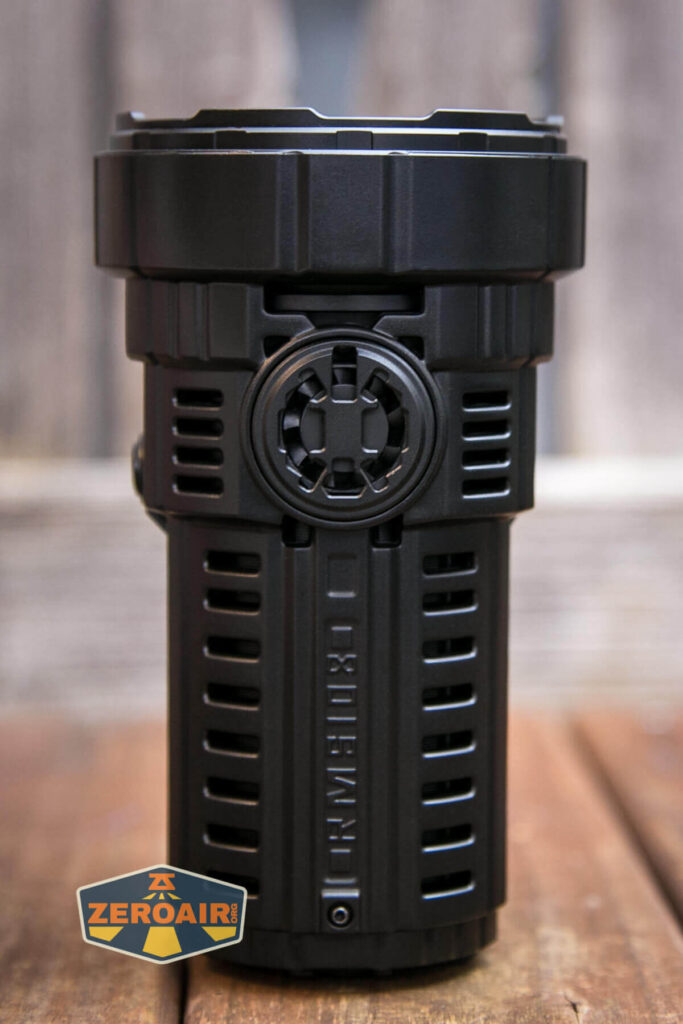
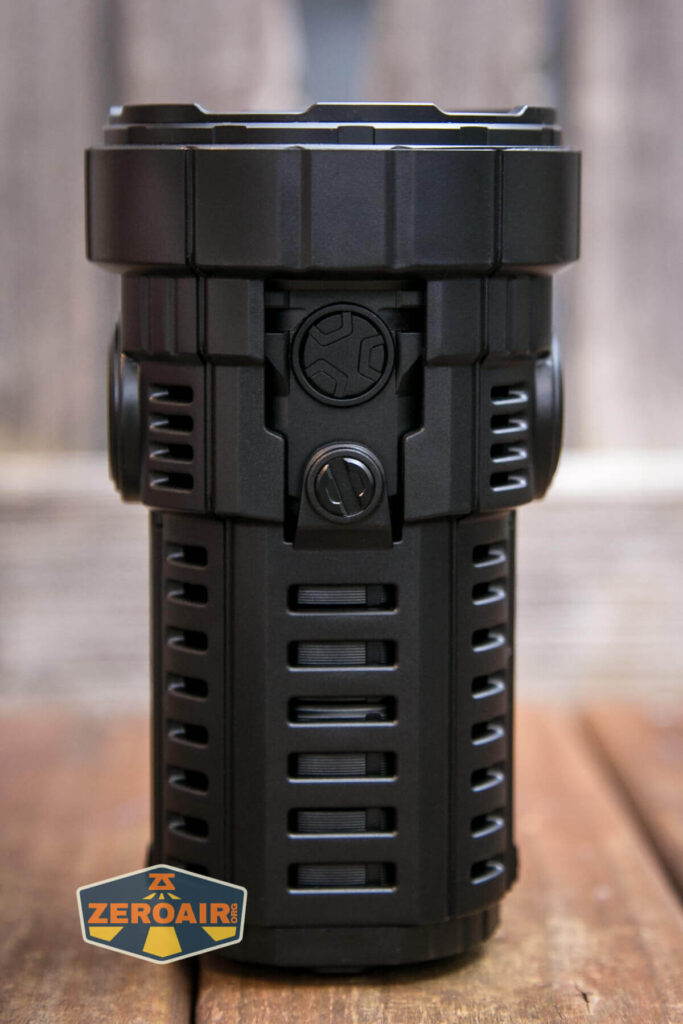
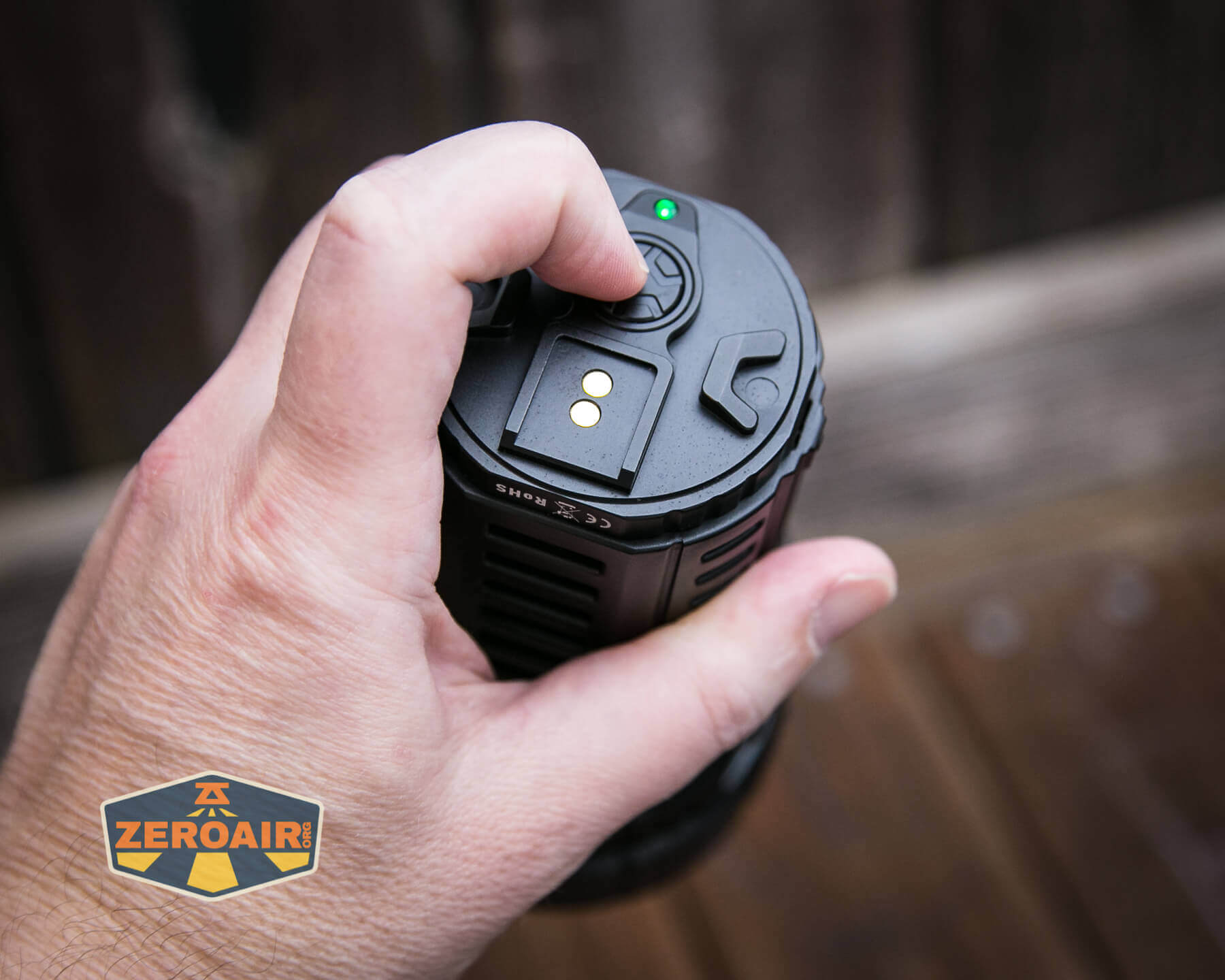
Interestingly, the heat shield has its own battery and even more interestingly requires separate charging. Here’s the charge port for the heat shield.
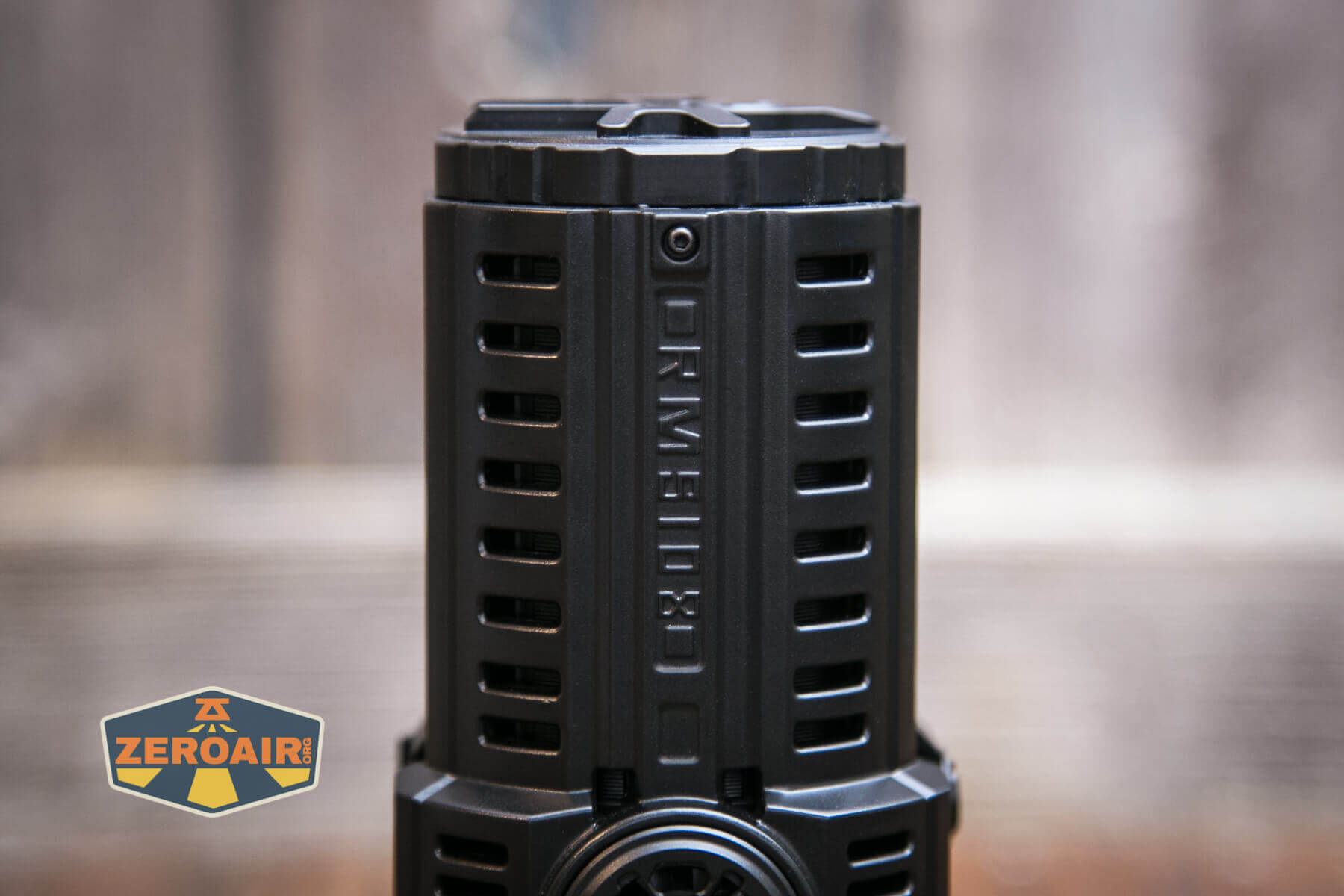
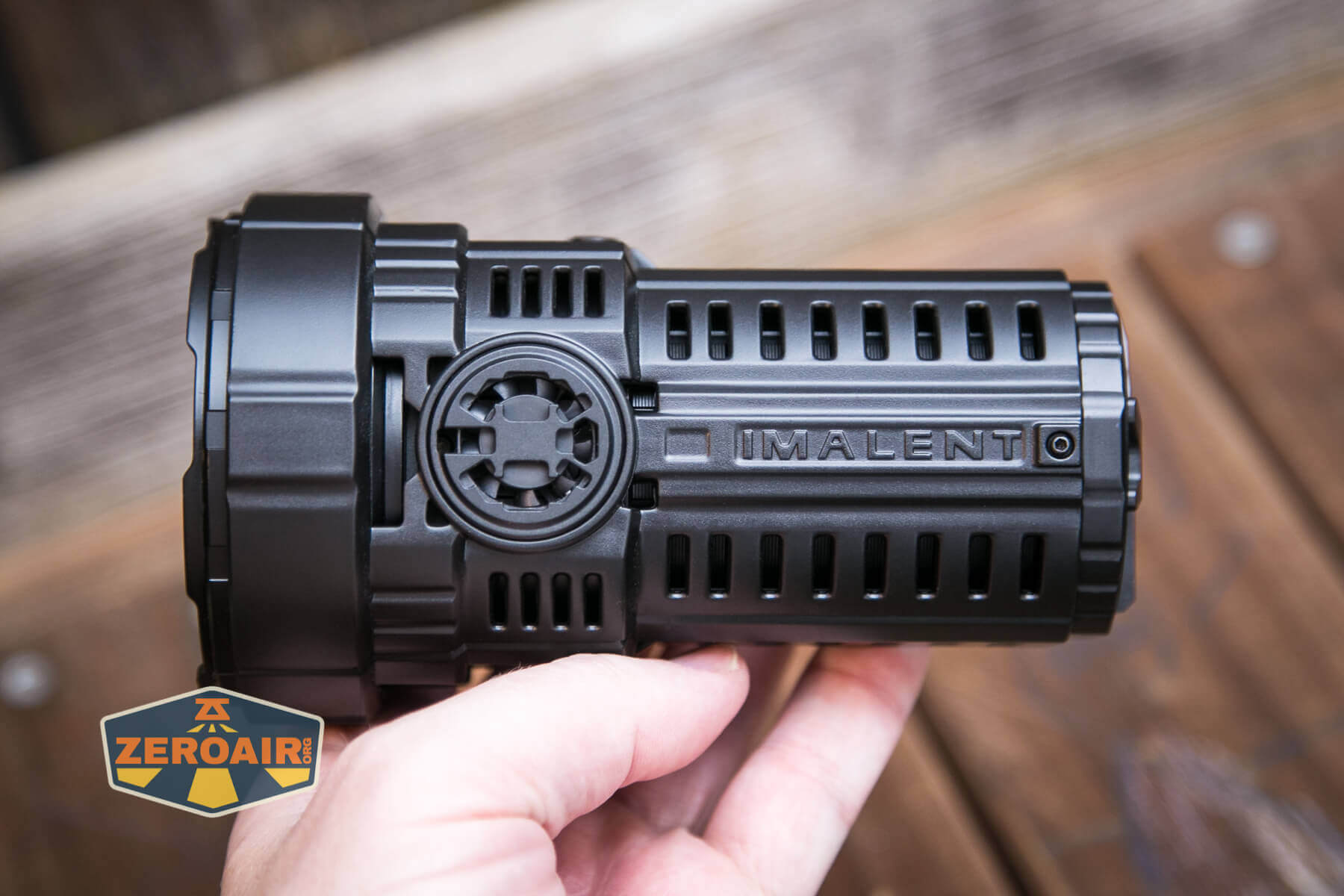
On the heat shield are a bunch of slots so that air can pass through. The Imalent MS08 flashlight still gets hot (and I mean hot) but this shield does separate the user from this heat.
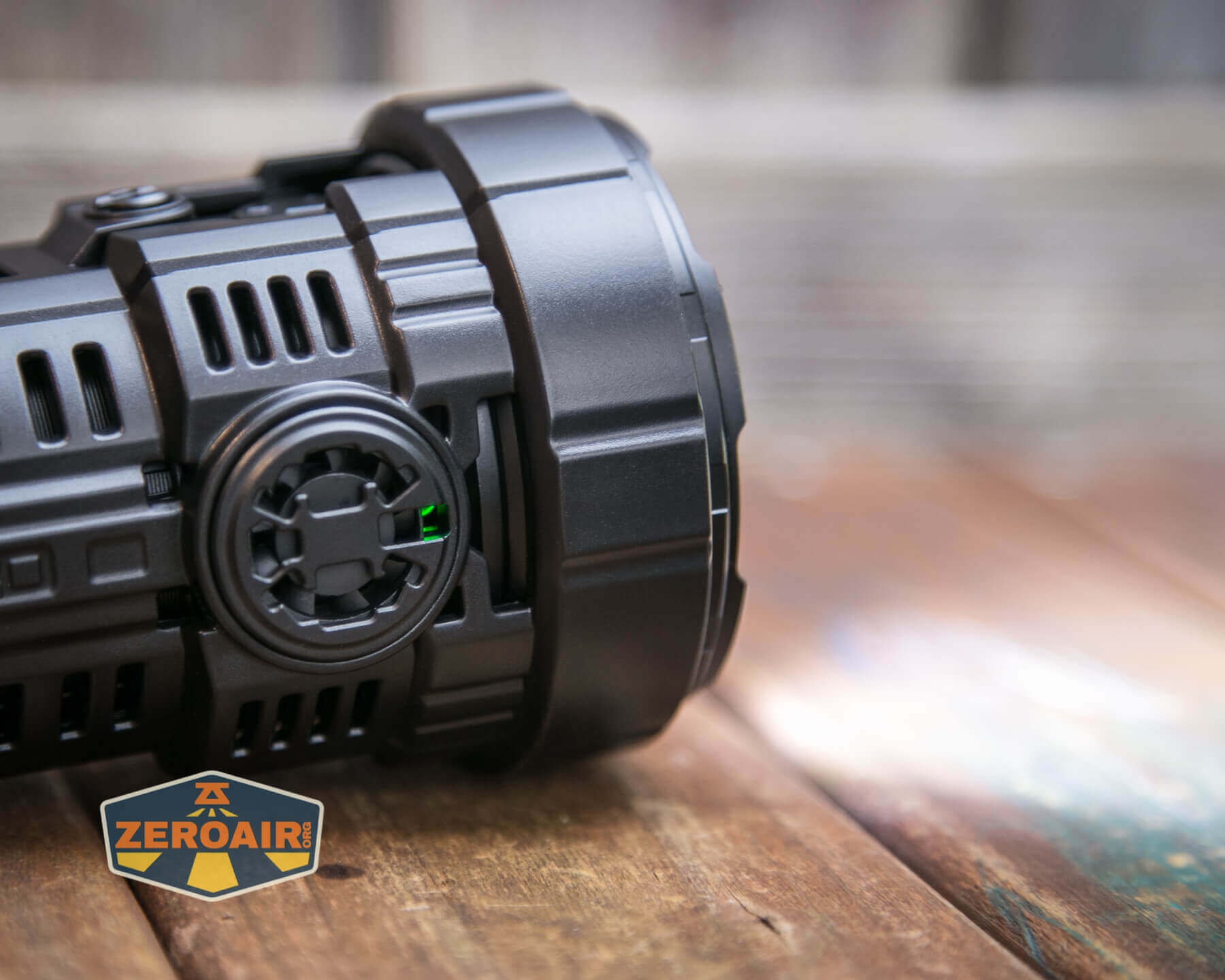
On both sides of the heat shield are small fans. These fans are very quiet, and completely separately operated from the flashlight itself.

This shield is held in place by one screw. That screw has a nice big coin slot for removal. Unfortunately, that screw is not captured. A spare is included, but still, it’d have been better to just have a captured screw in this screw hole.
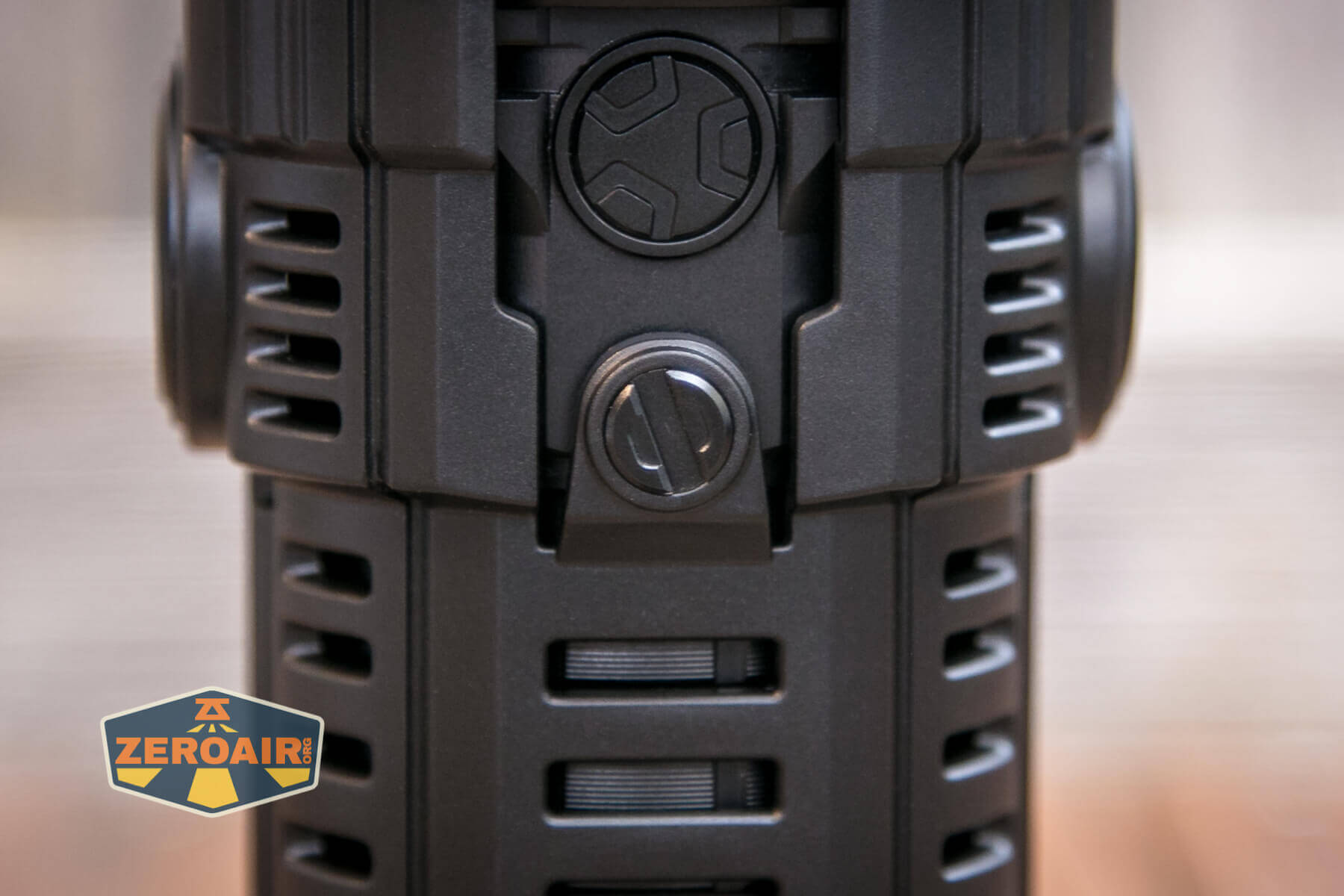
One more point about this heat shield. Again, it’s held in place by one screw. And you hold only the heat shield while holding the RS50 (and other models like it). So if your screw is loose and certainly if it falls out, your expensive RS50 is going to fall onto the hard ground. Period – its’ not captured in any other way besides this single screw. Now, the screw is fine. But you must be certain to get the screw tight enough to hold the light in place. And if you lose both screws that are included, forget holding the light in the heat shield.

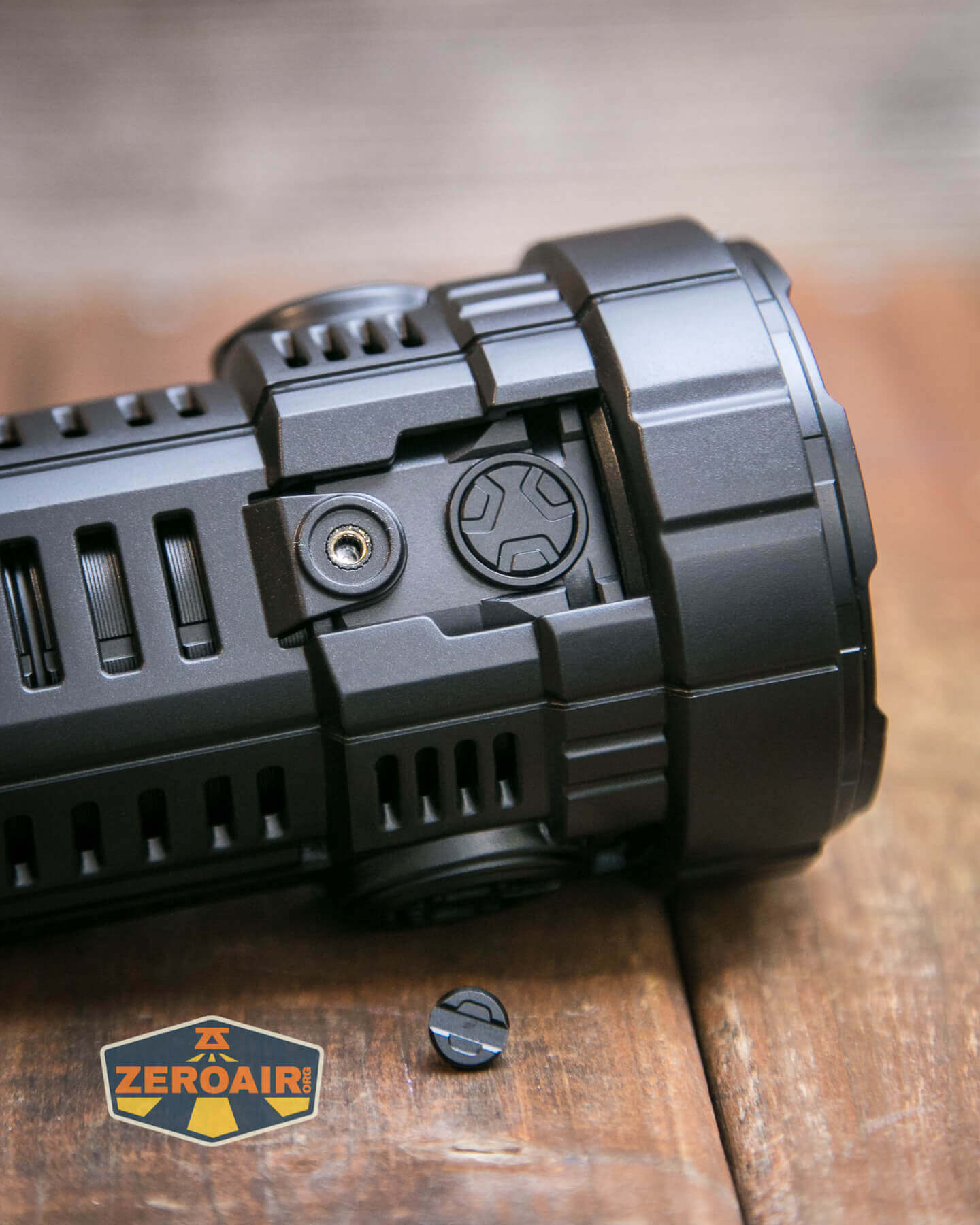
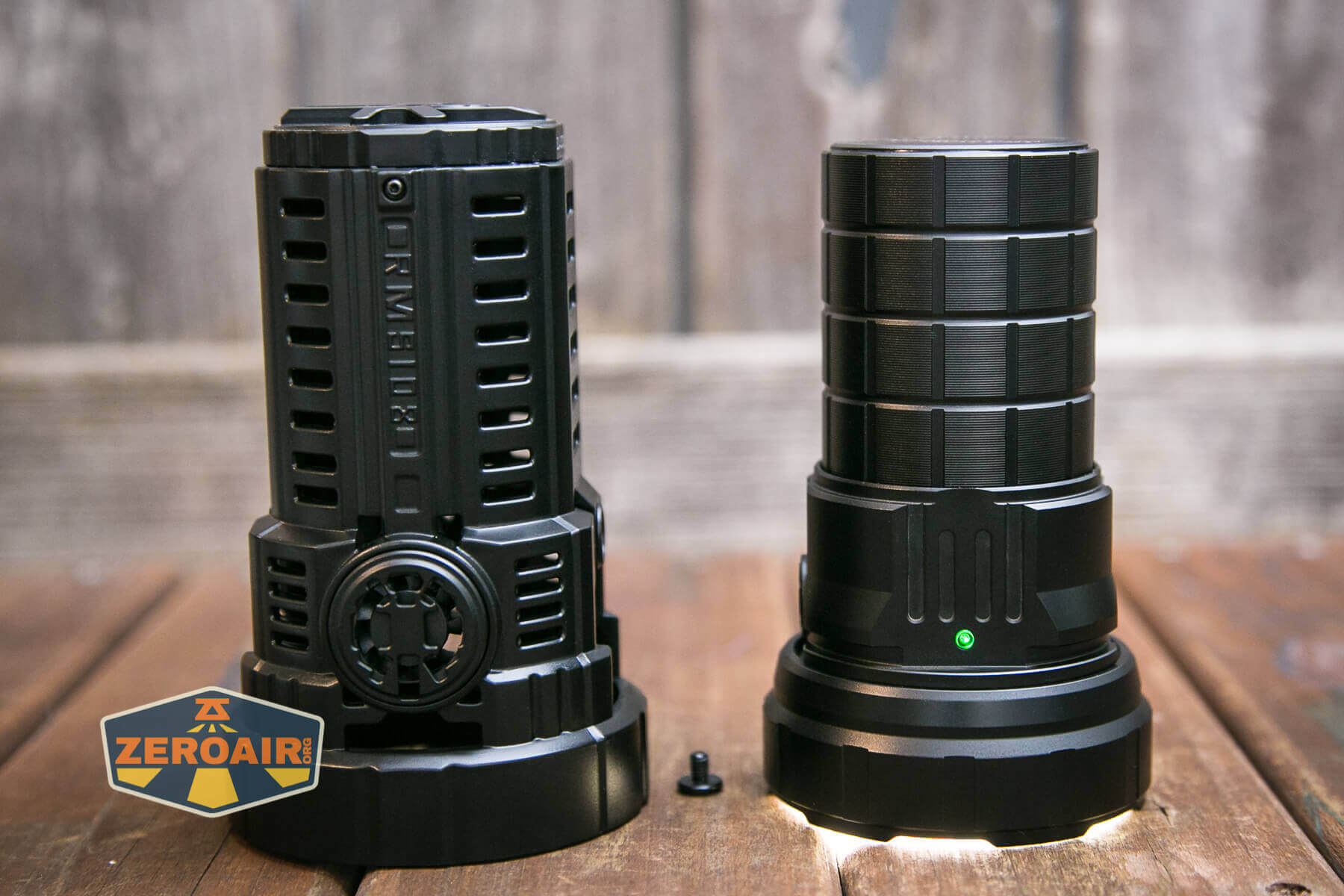
With the heat shield off, the RS50 looks a little lonely.
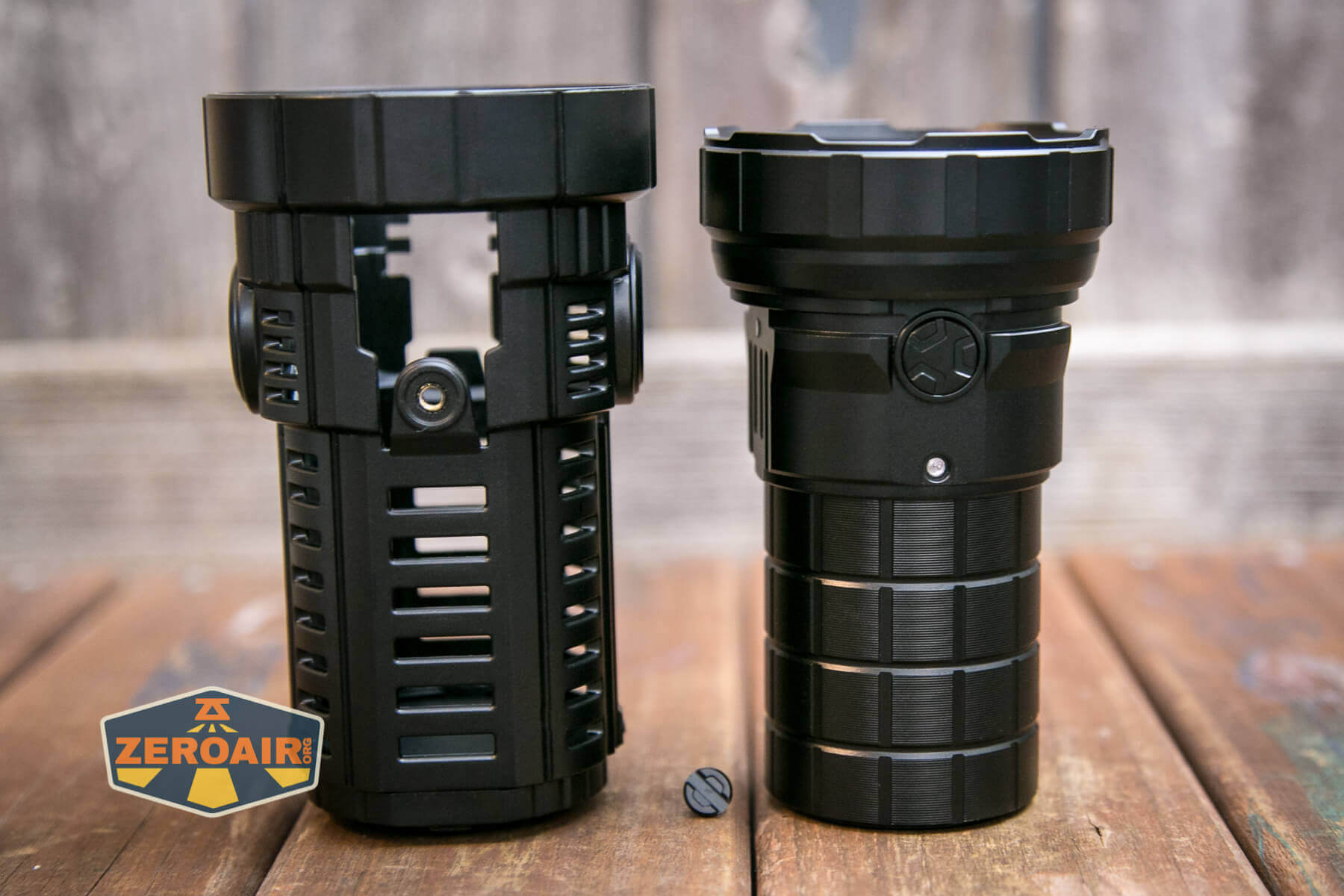
I said it above but here’s proof: the heat shield has its own power. That green indicator light near the switch indicates the fans are running.


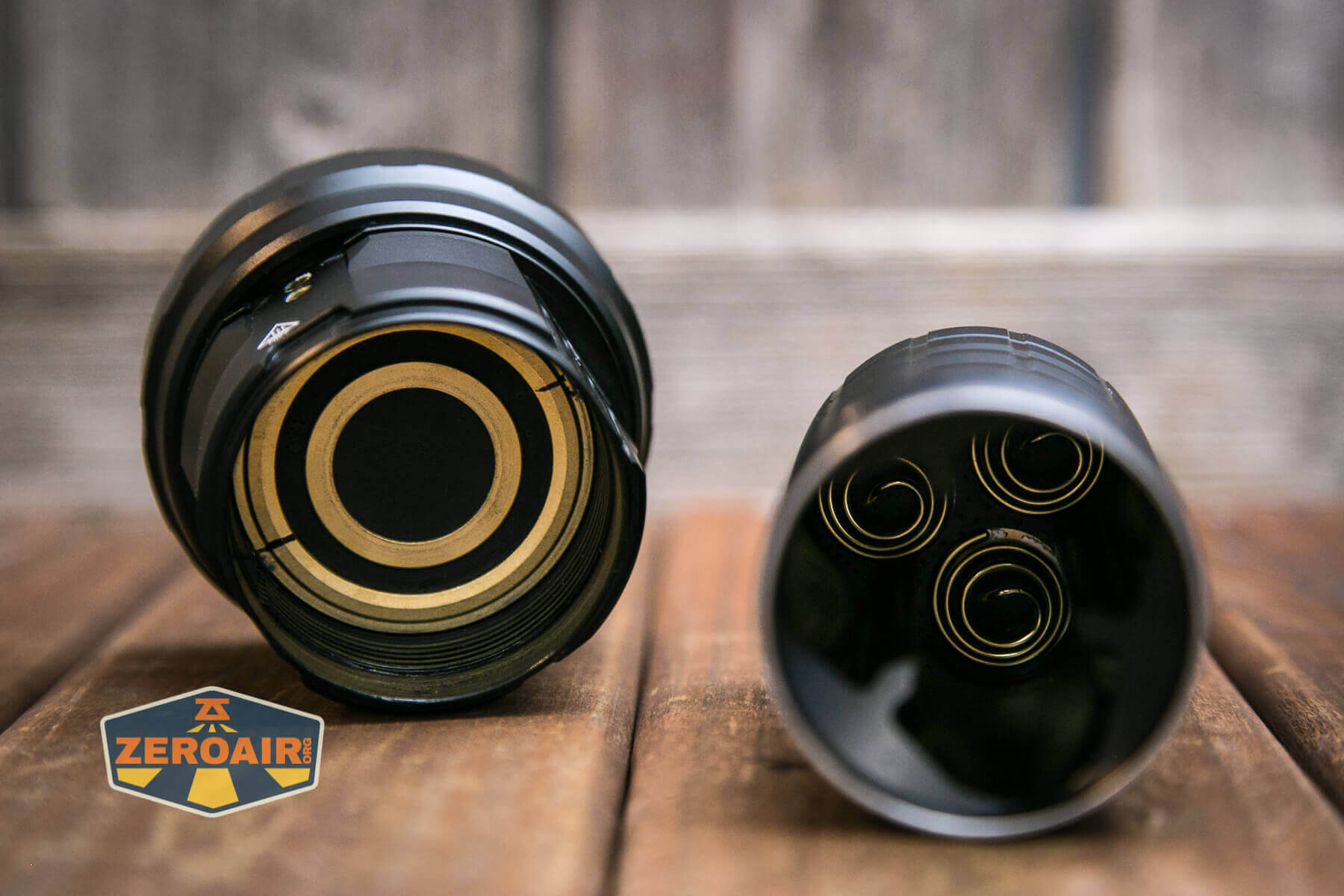
Threads on the RS50 are quite long. These are square-cut, well-lubed, and anodized. As such, it’s possible to lock the light out mechanically by loosening the head just a bit. That only works if you have the heat shield off, though! Otherwise, the head isn’t accessible in this way.

The tail end of the cell tube has springs with reasonable stiffness.
Size and Comps
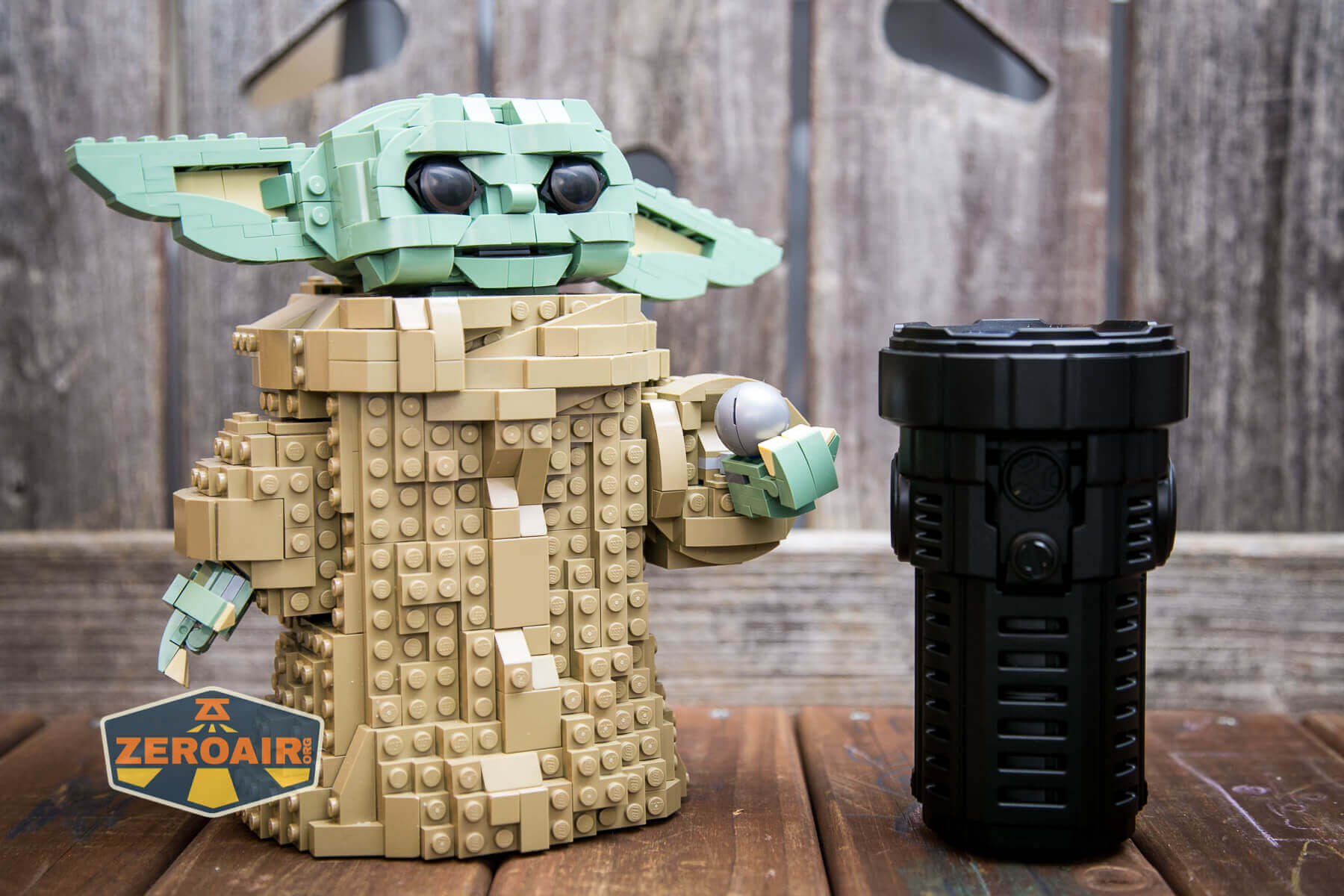
Dimensions: 74mm (length) x 51mm (head diameter) x 125.5mm (body diameter)
Weight: 656g (battery included)
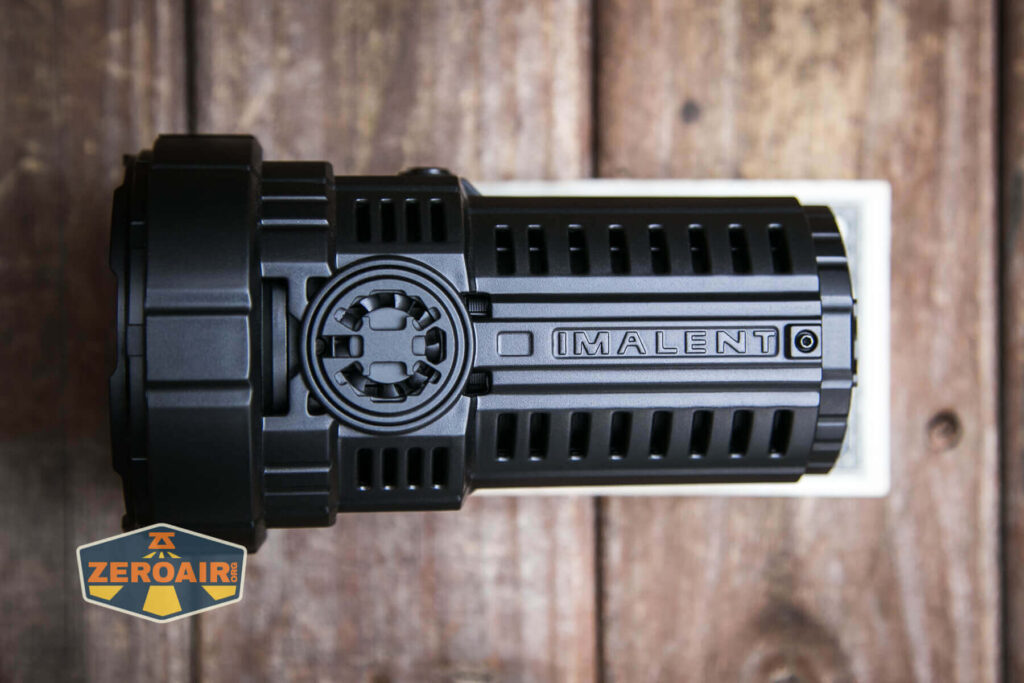
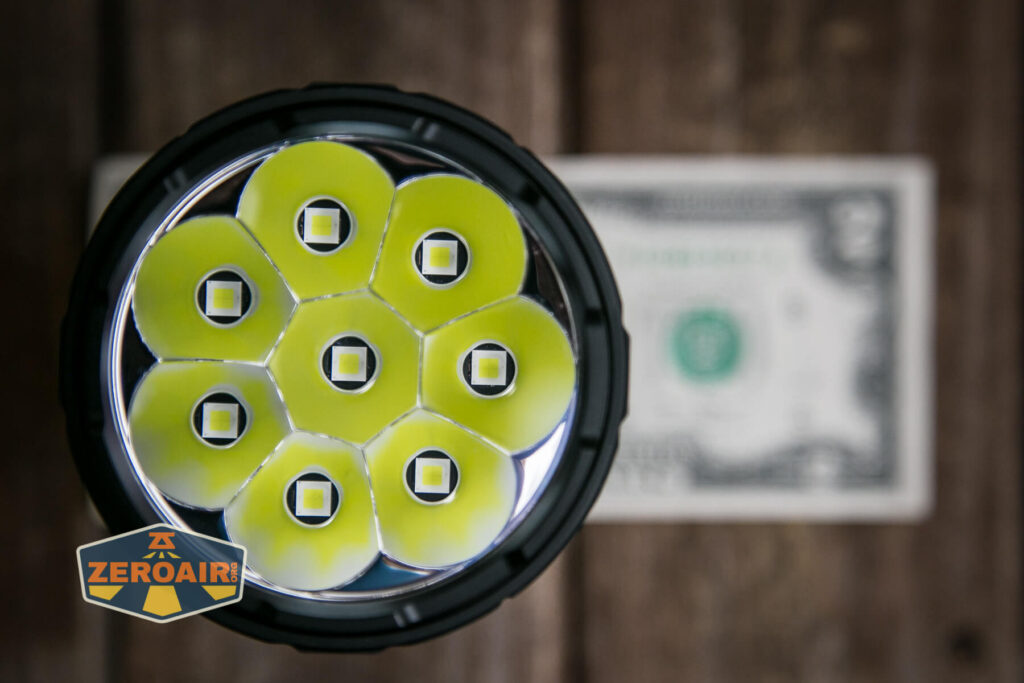

If the flashlight will headstand, I’ll show it here (usually the third photo). If the flashlight will tailstand, I’ll show that here, too (usually the fourth photo).


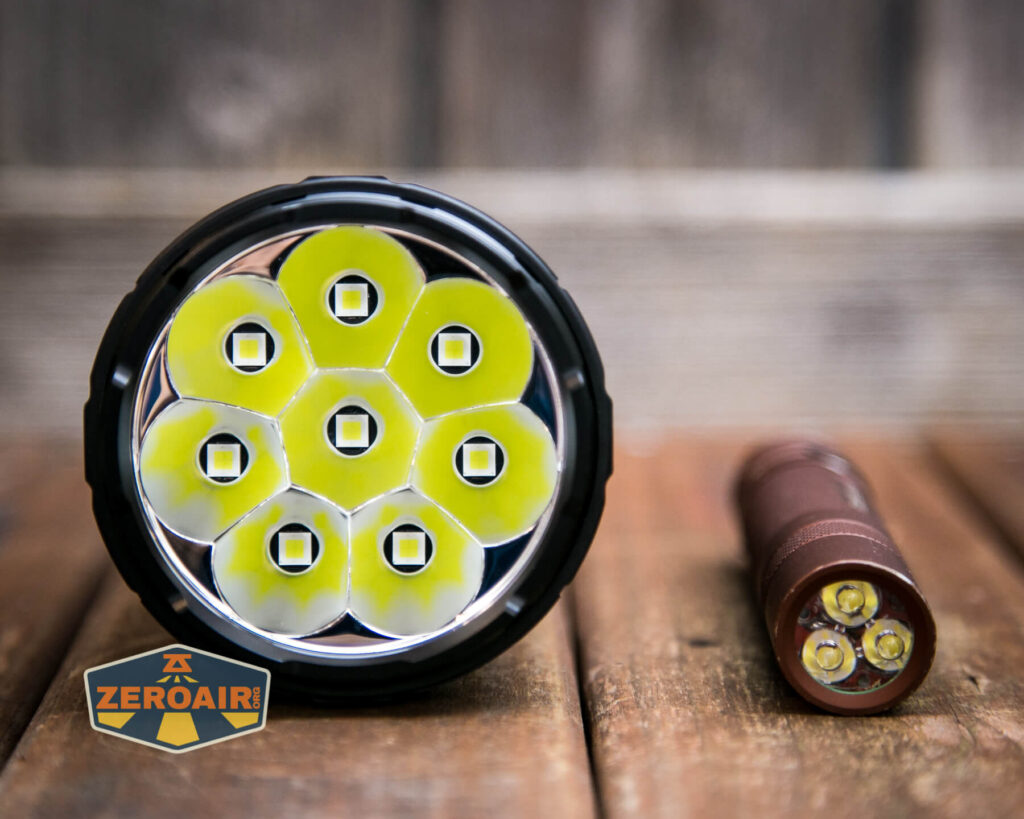
Here’s the test light with the venerable Convoy S2+. Mine is a custom “baked” edition Nichia 219b triple. A very nice 18650 light!

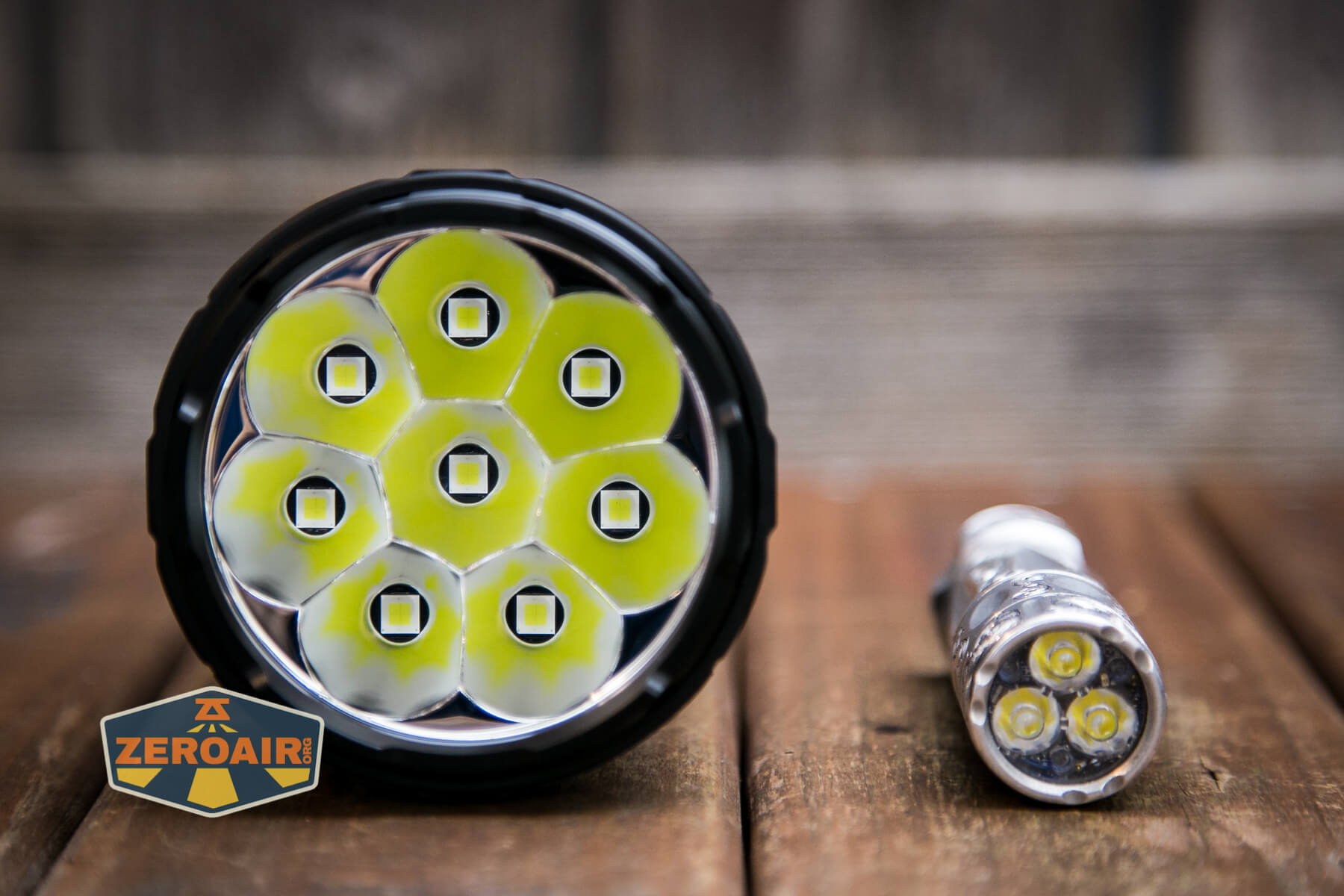
And here’s the light beside my custom-engraved TorchLAB BOSS 35, an 18350 light. I reviewed the aluminum version of that light in both 35 and 70 formats.
Retention and Carry
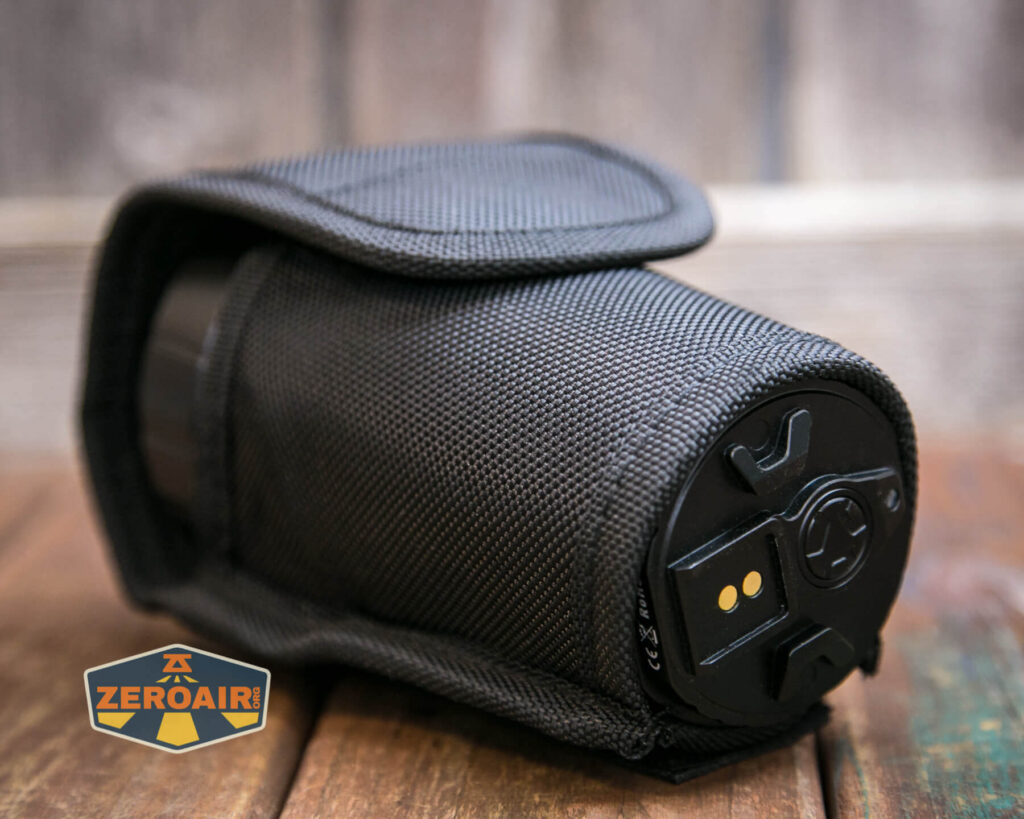
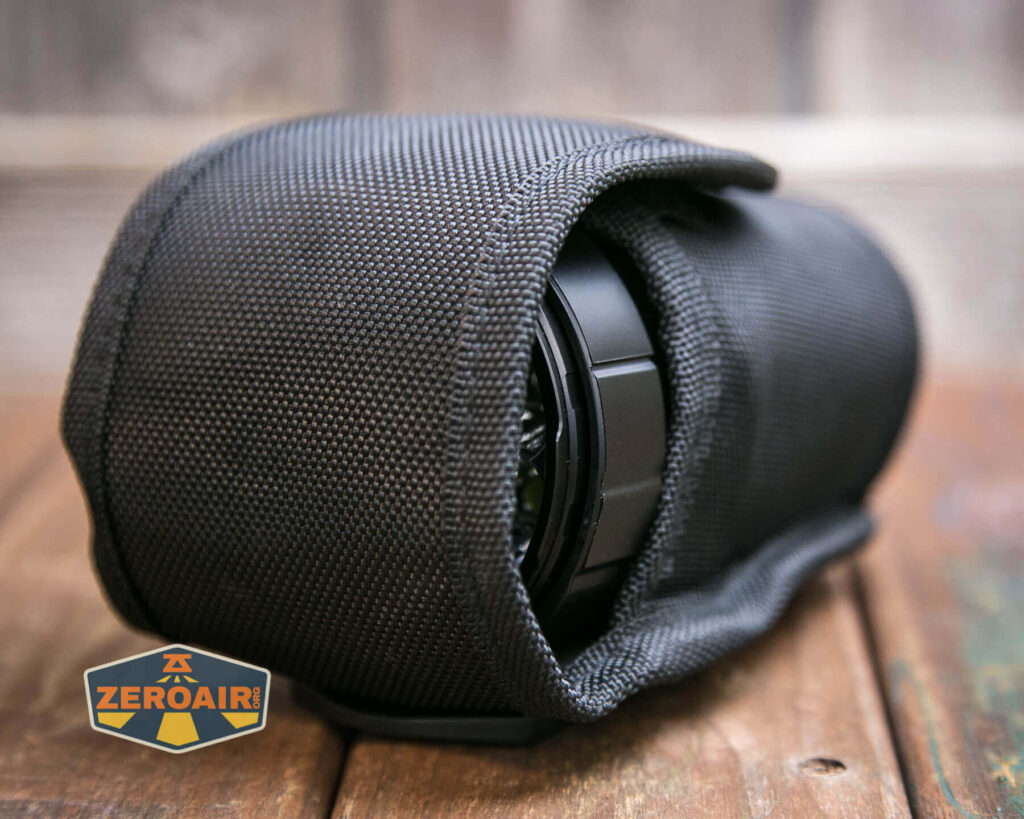
The main and only way included for carry of the MS08 is this nylon pouch. It’s a fine pouch.
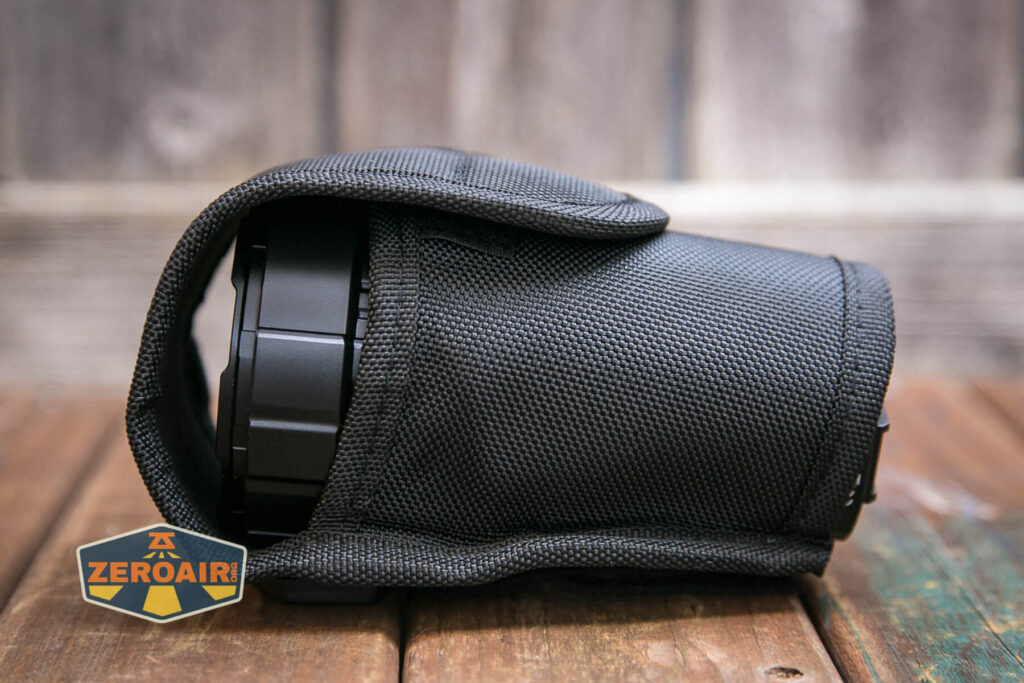
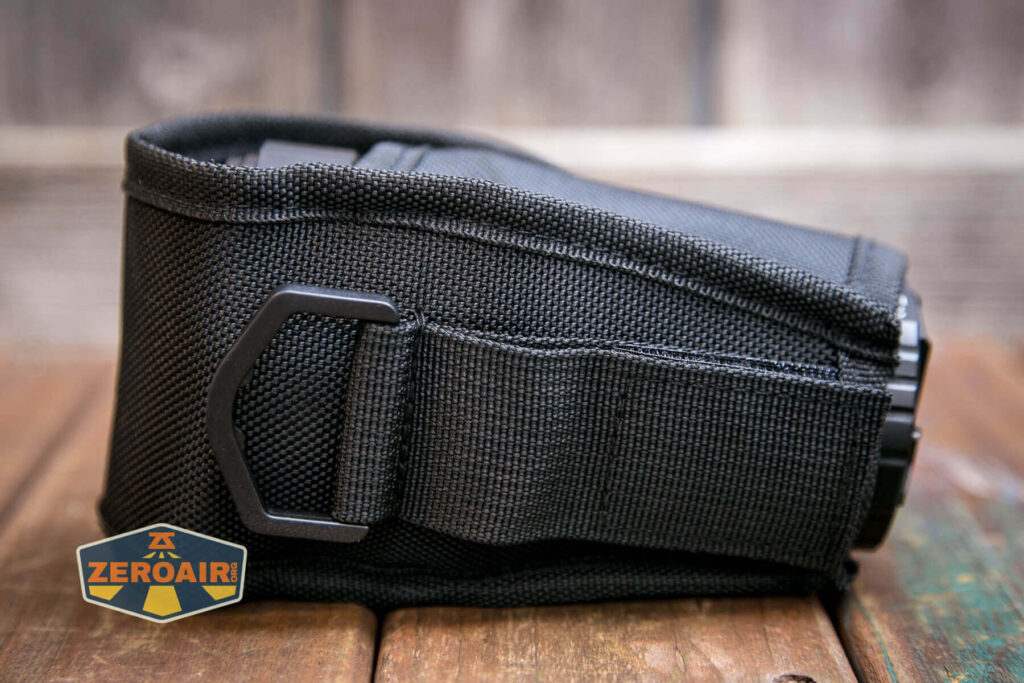
The RS50 fits only in one direction – that’s bezel up. While the tail switch is accessible, the side switch (which operates the light) is not.
Power and Runtime
The Imalent RS50 includes the cells required for operation. That’s three 21700 button top cells.
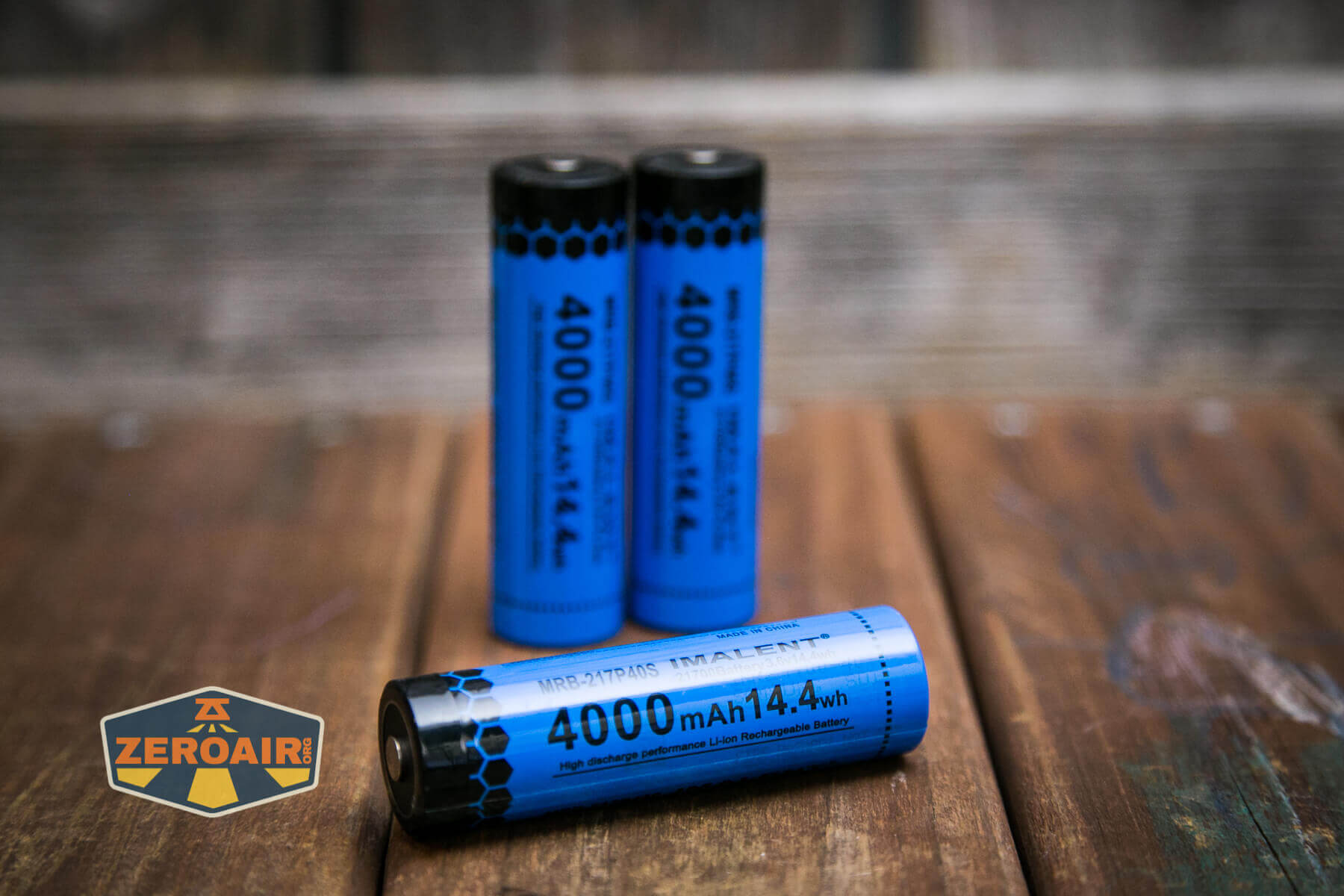
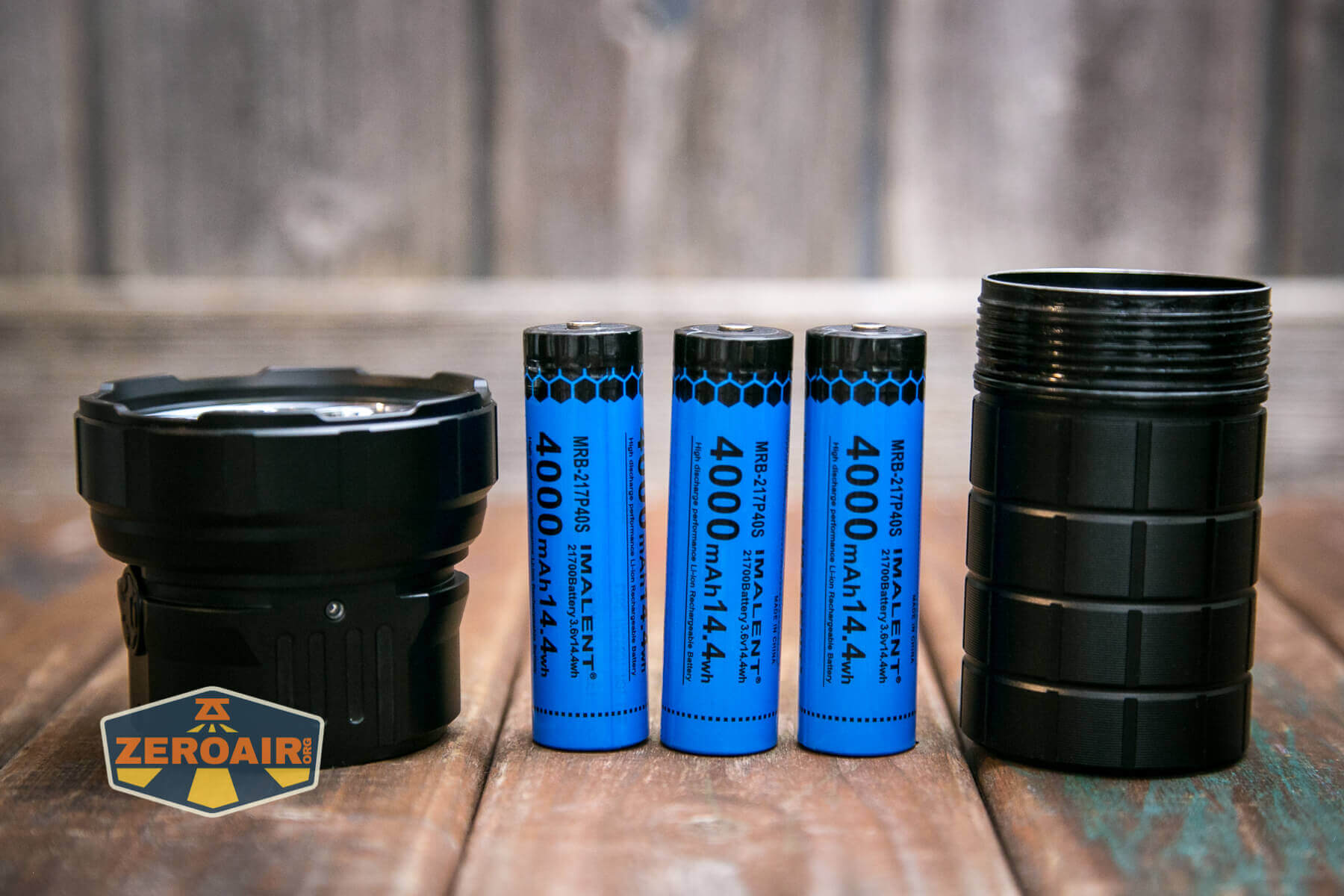
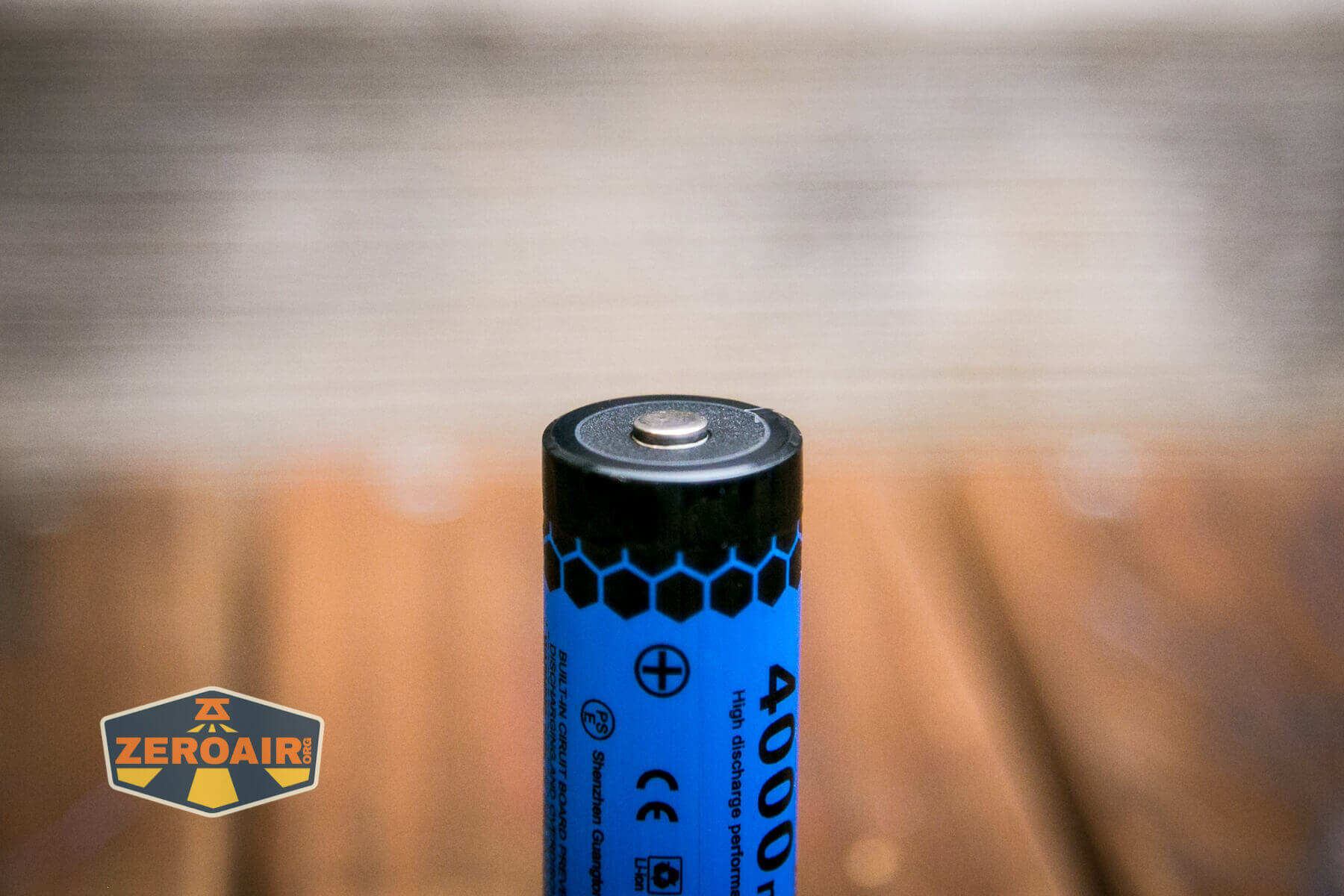

The battery setup is a parallel configuration. That means the flashlight itself runs on 4.2V (maximum), and thus the capacity is added together, for a total capacity of 12000mAh. This also adds the current capability, so these three cells should have no problem reaching the massive current needs of turbo and the higher modes.
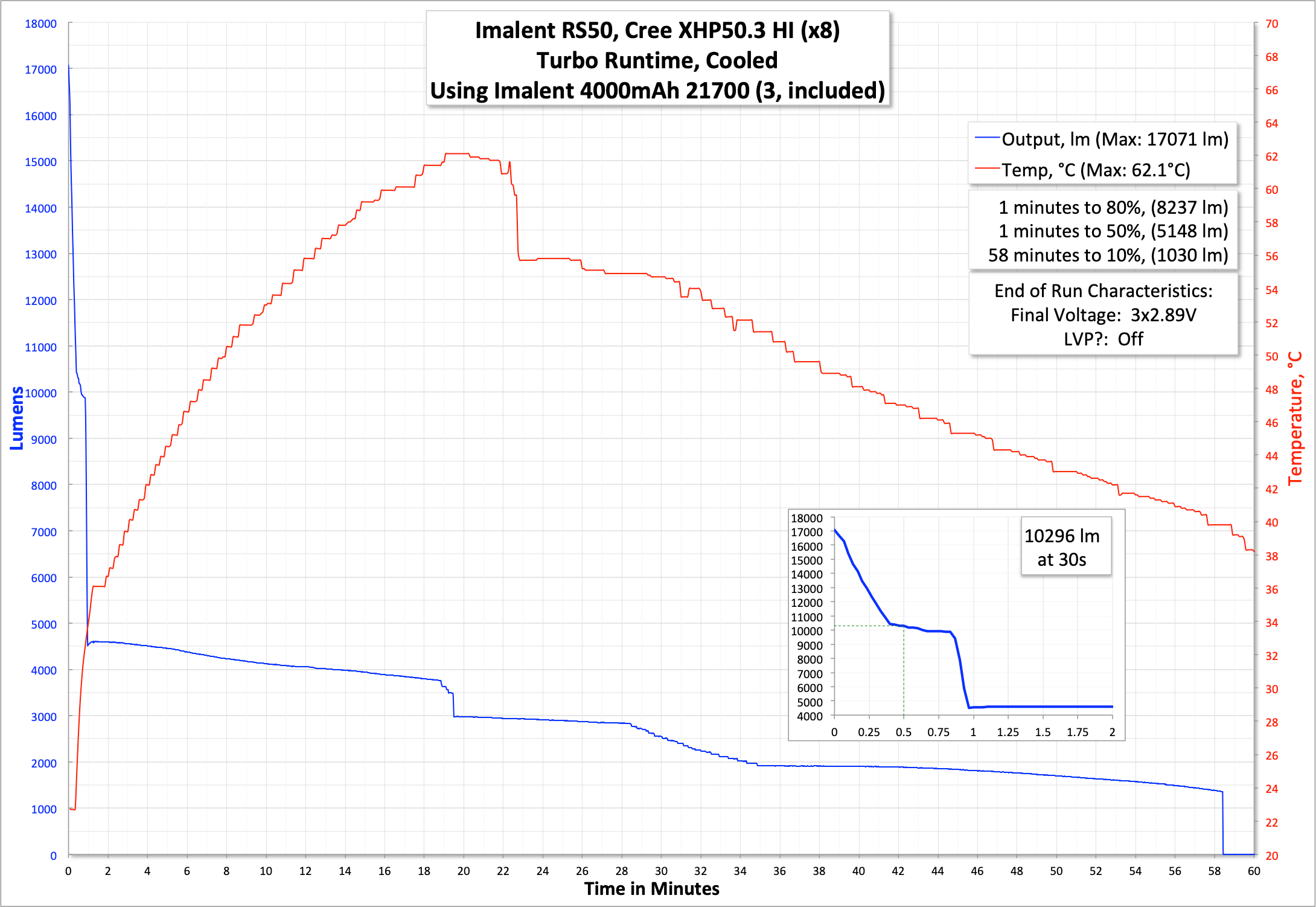
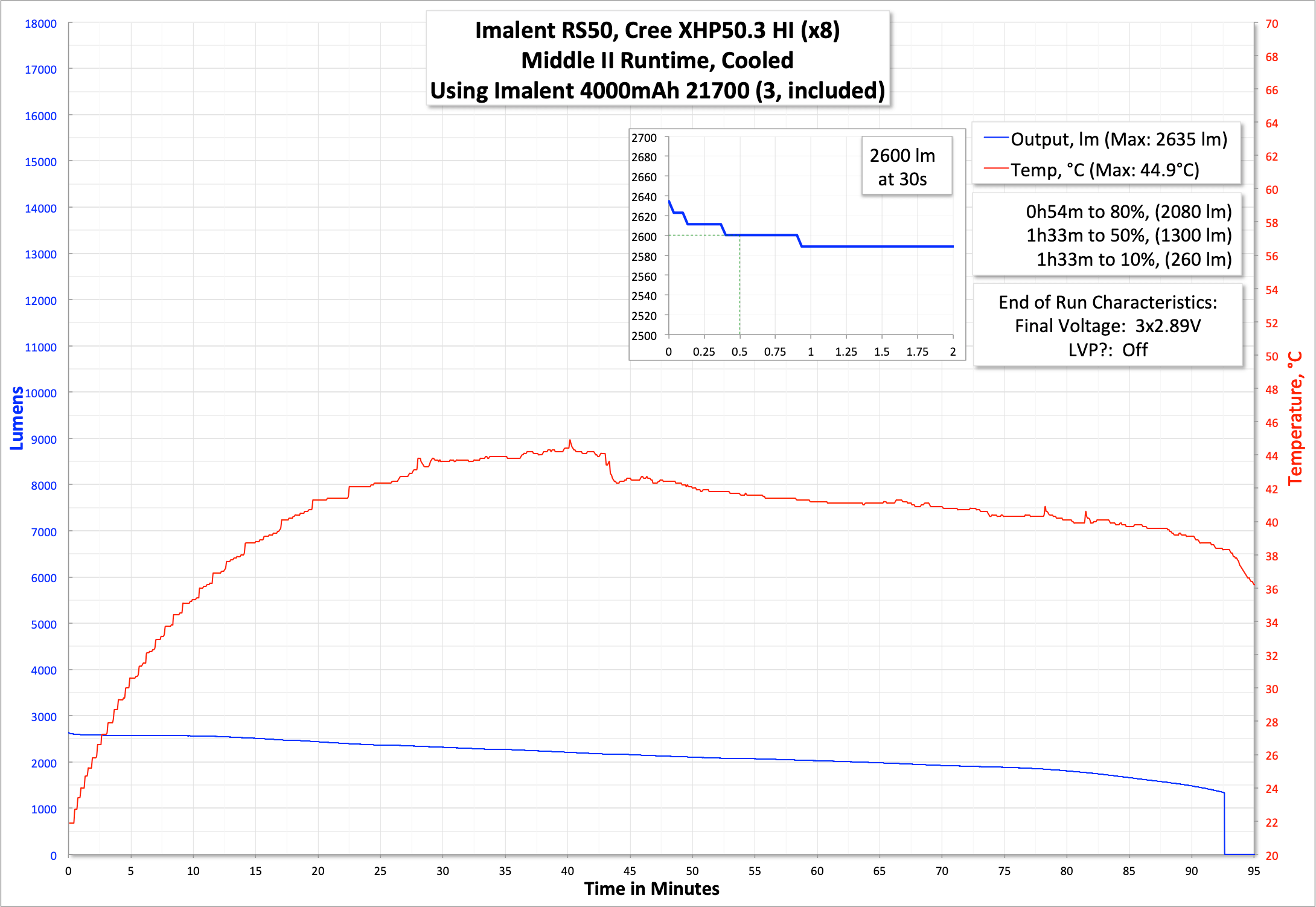
Output on turbo nearly hits the specification, at least at the initial bump of Turbo. After 30 seconds, the output has stepped down to over 10,000 lumens (which is still very bright) and remains there for around a minute after turn on.
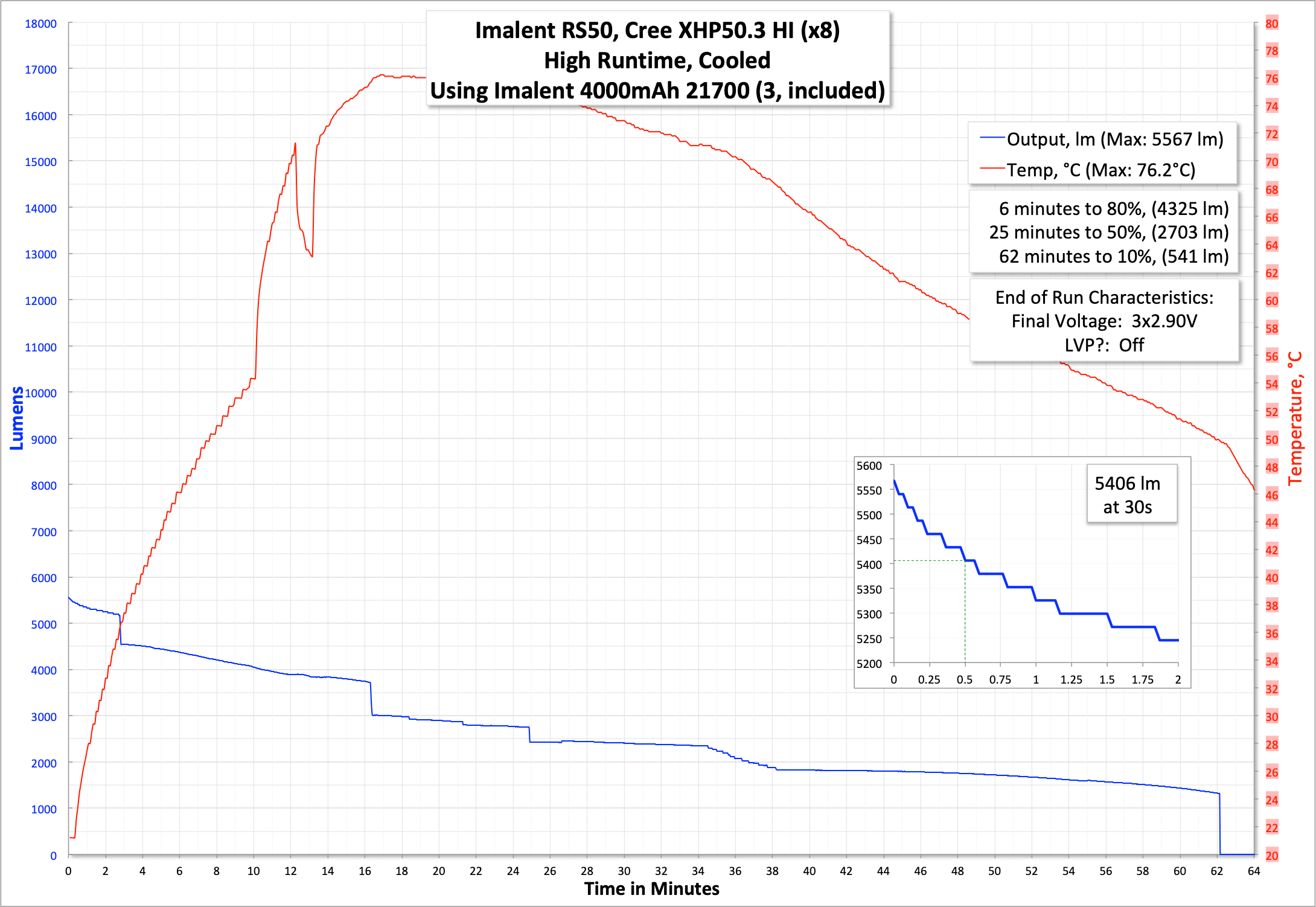
The test of High output saw a few fan difficulties – I didn’t charge the fan fully before use (oops!) and it shut off while the test was running. I figured this was good data though. I did blow my fan (the fan I usually use) over the RS50, and as you can see it made practically no difference at all.
Charging
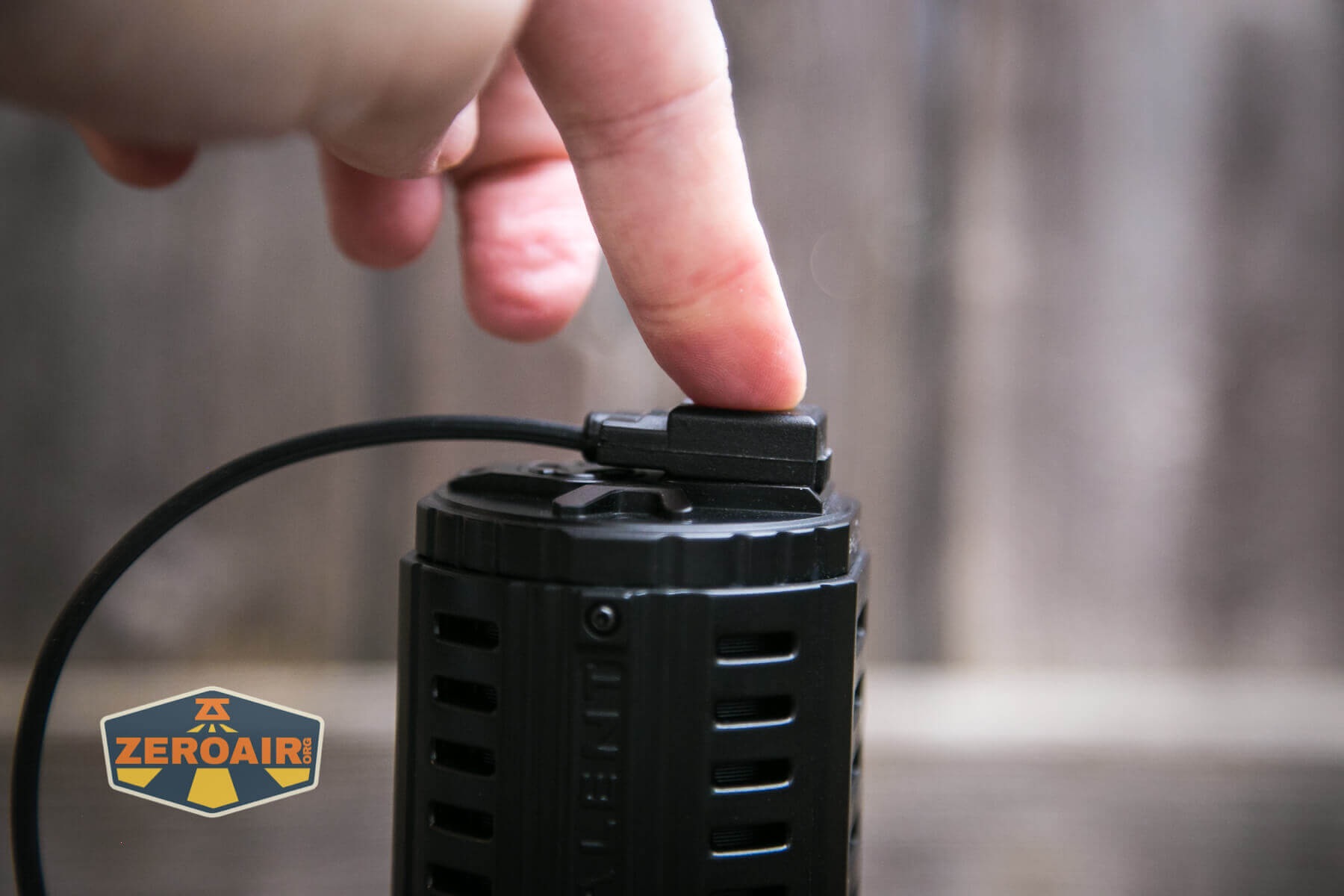
The Imalent RS50 uses a proprietary magnetic connector with physical reverse polarity connection protection built-in.
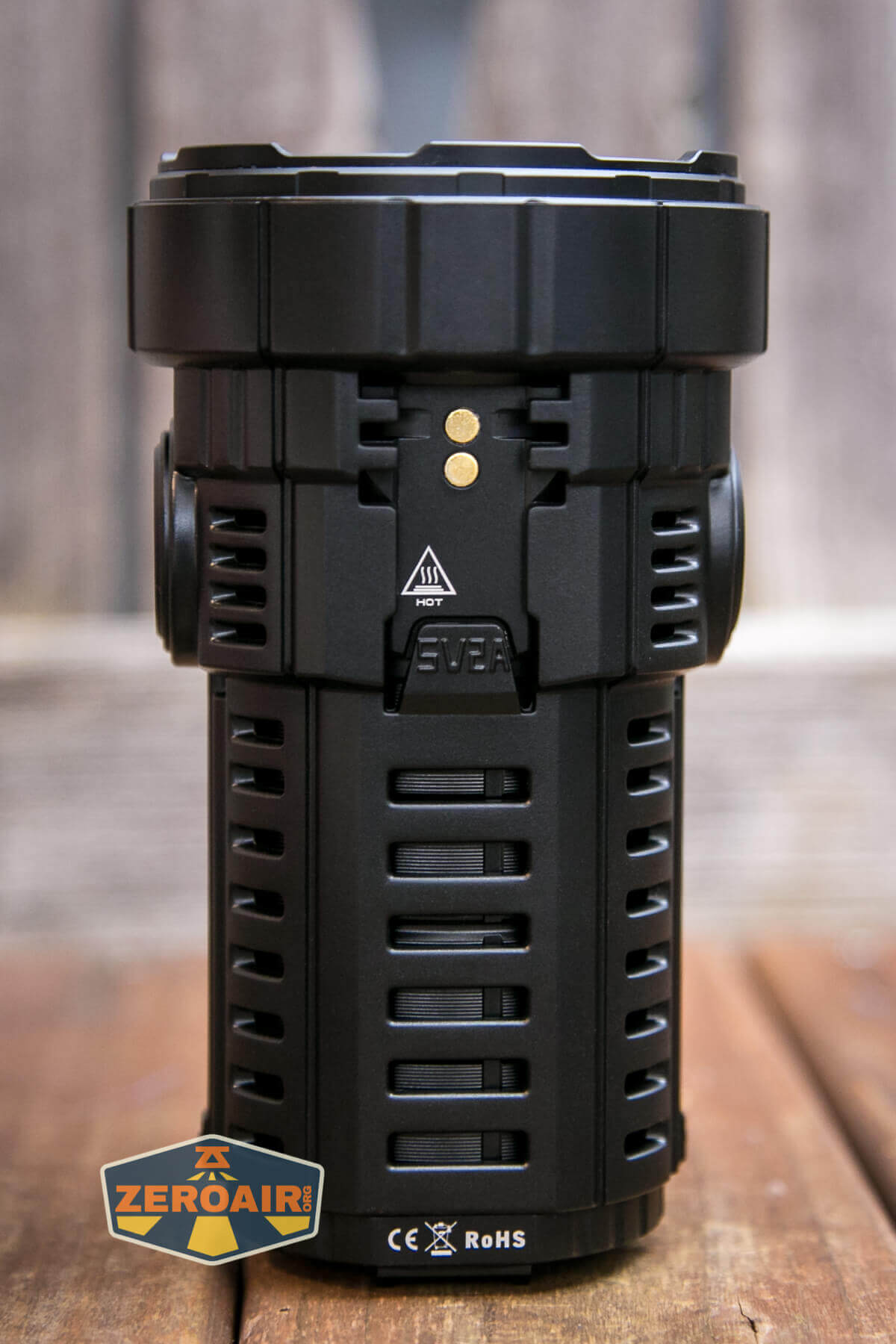

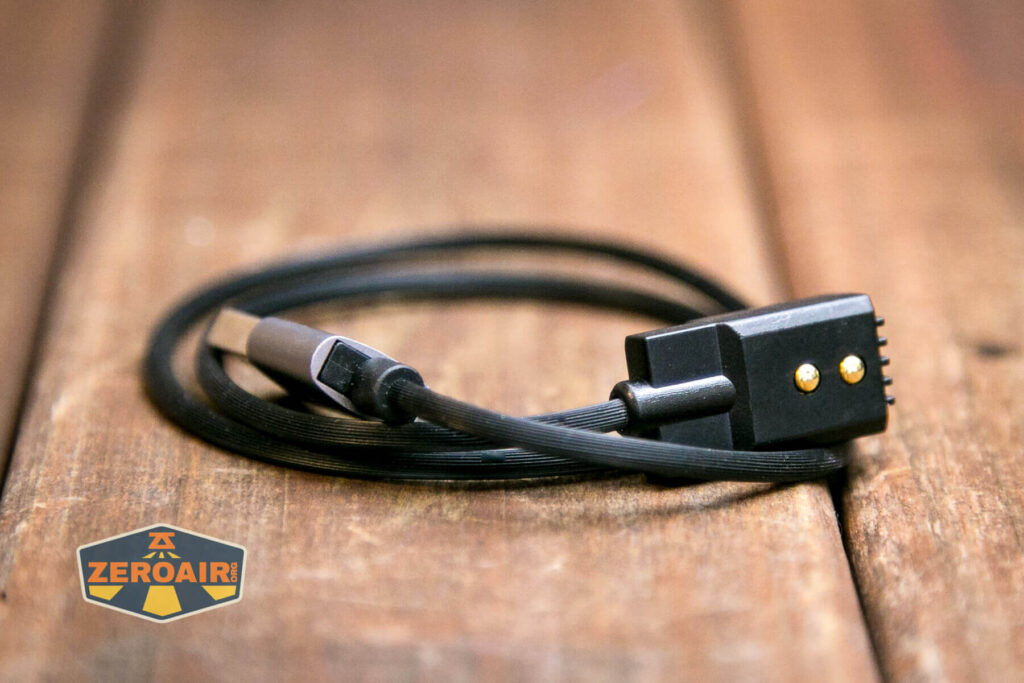

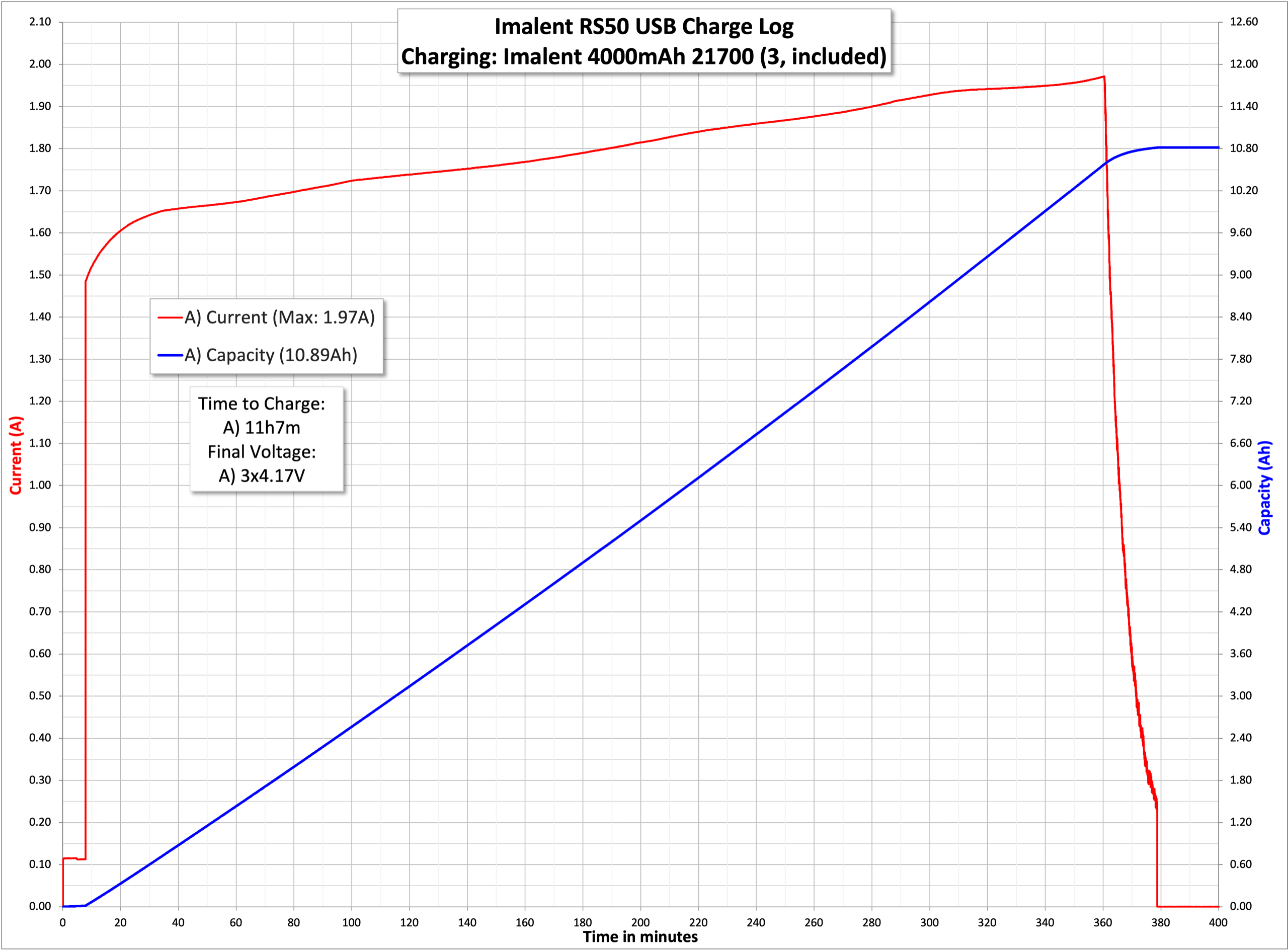
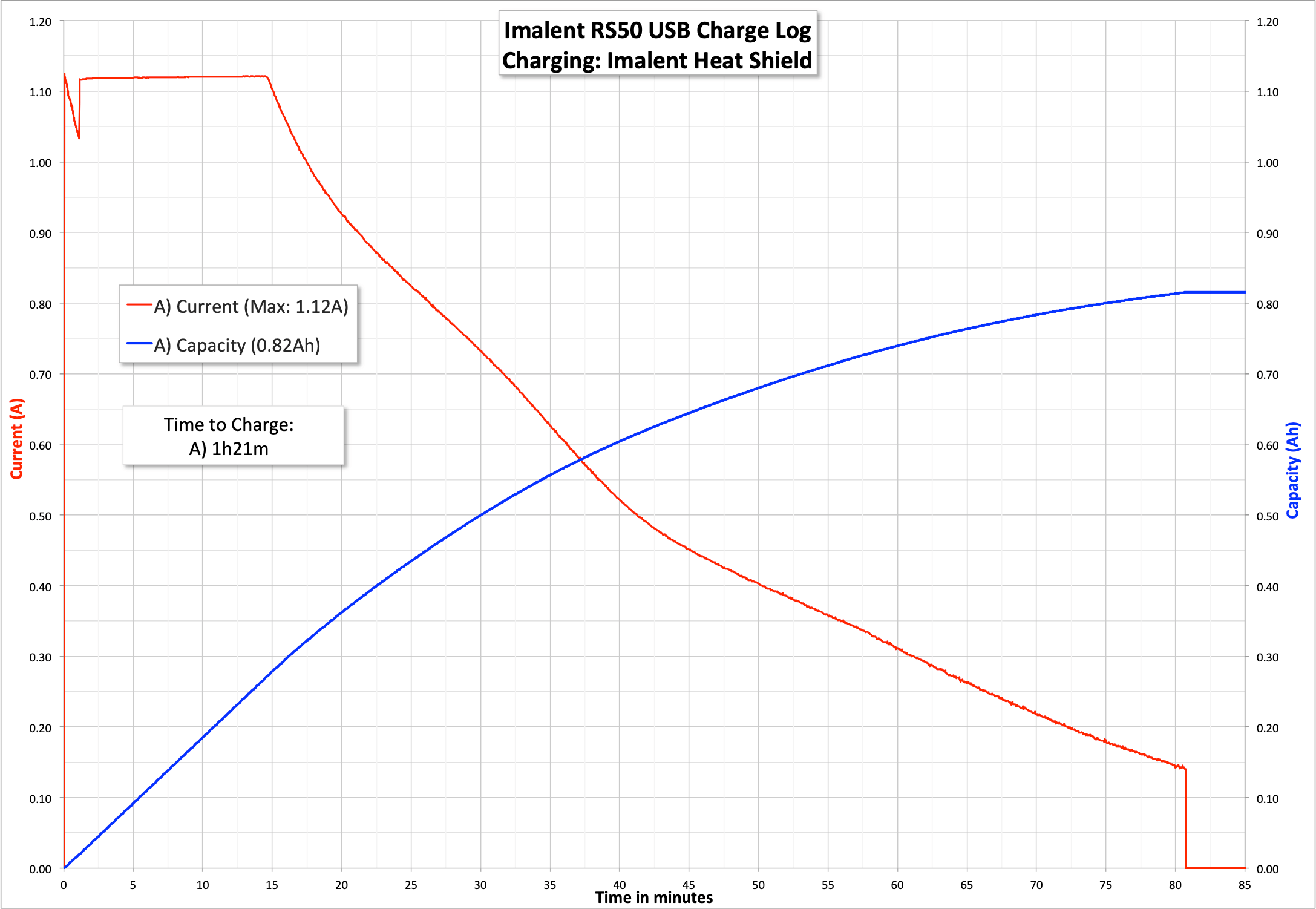
This is the same charger type you’ve seen on other recent Imalent flashlights, so that’s a good point. This RS50 actually has two chargers, because the flashlight itself (and the three internal 21700 cells) charges separately from the heat shield.

I was… a little… surprised by this. I feel like it’d be trivial to charge this (probably tiny) heat shield battery from the RS50 battery. I do not know how the connection would look, but the heat shield battery can’t be that big, to affect runtimes by that much. Anyway, charging the heat shield is quick, especially compared to charging the MS08 itself.

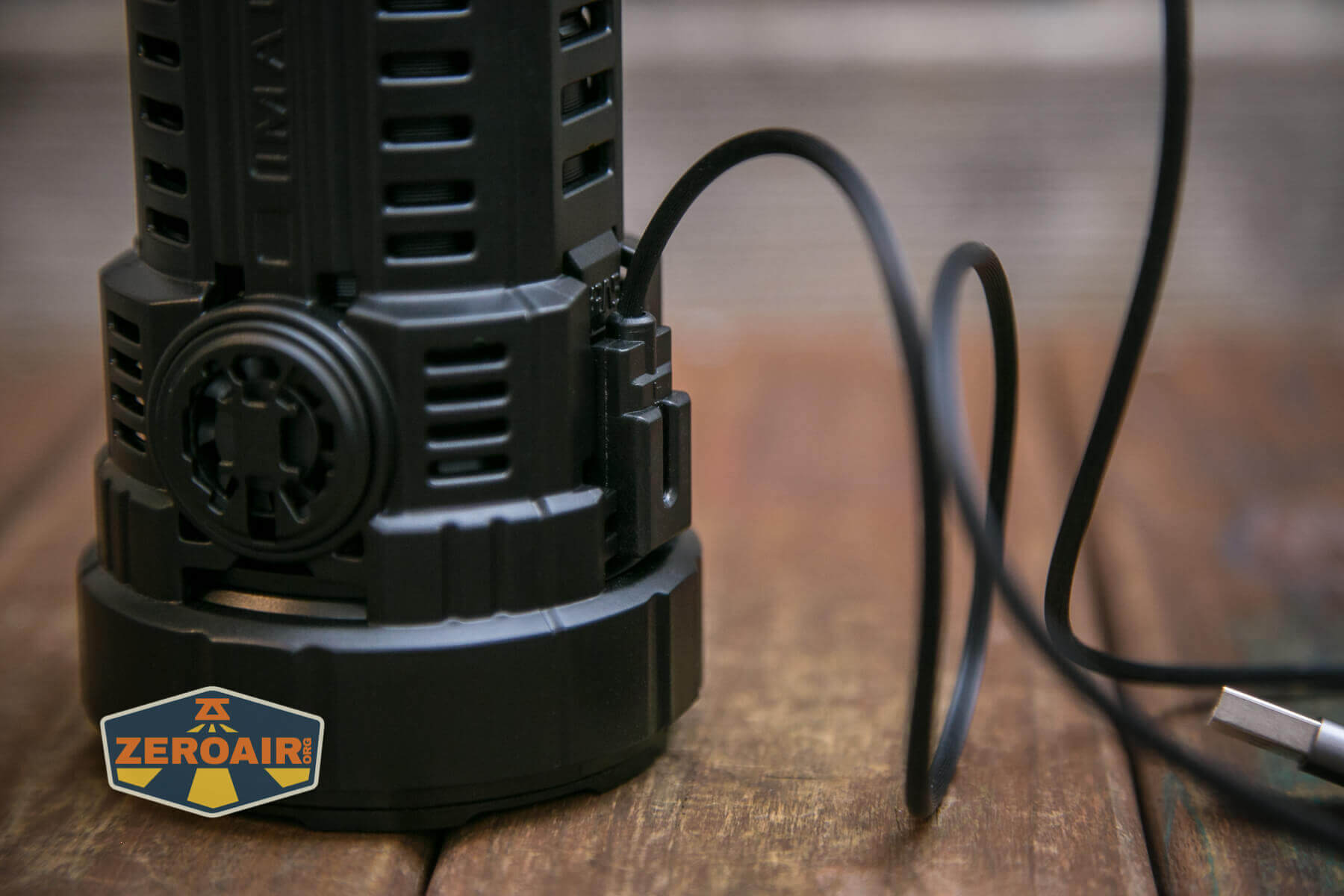
It’s not really possible to accidentally connect this charger backward. You could likely force it but it has an obvious orientation, and if it doesn’t snap into the right place, you’ll likely notice.
Modes and Currents
| Mode | Mode Claimed Output (lm) | Claimed Runtime | Measured Lumens | Tailcap Amps |
|---|---|---|---|---|
| Turbo | 20,000-6,500 | 45s-48m | 10296 | 20++ |
| High | 6,500 | 55m | 5406 | 20+ |
| Middle II | 3,500 | 1h25m | 2600 | 7.69 |
| Middle I | 1,800 | 2h18m | 1291 | 2.74 |
| Middle Low | 600 | 7h30m | 480 | 0.81 |
| Low | 300 | 30h | 277 | 0.45 |
Pulse Width Modulation
Every mode displays PWM. It’s pretty fast, so you’re unlikely to notice it.
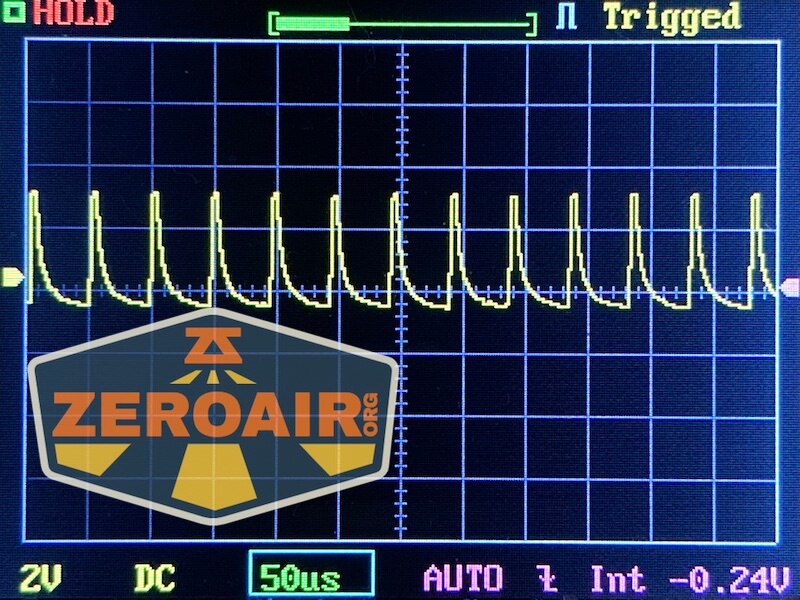
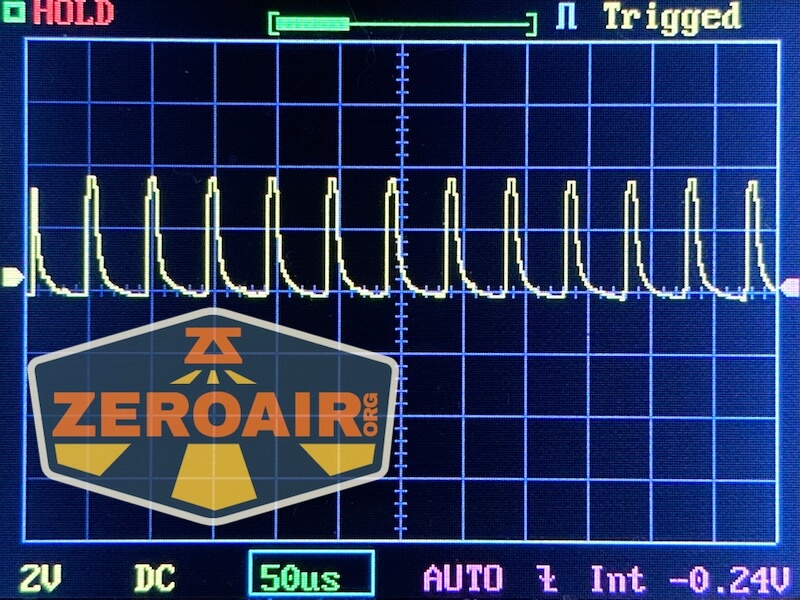
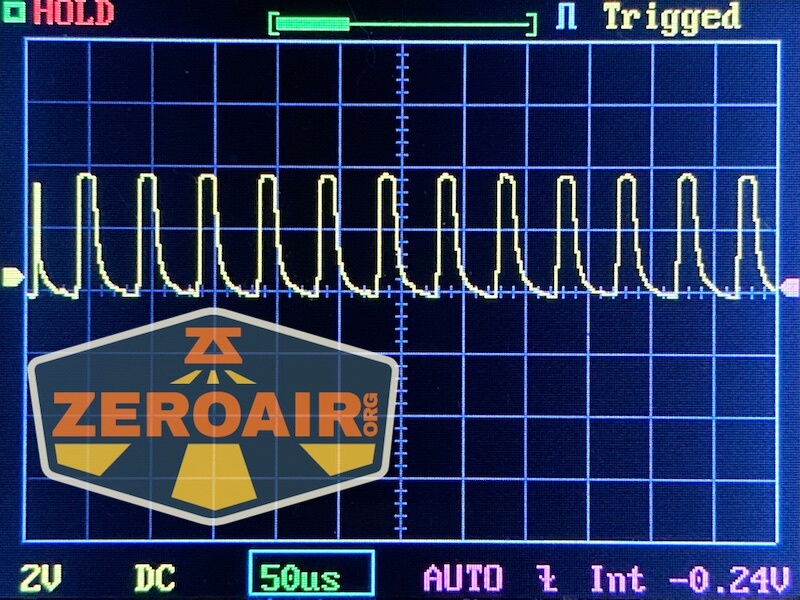
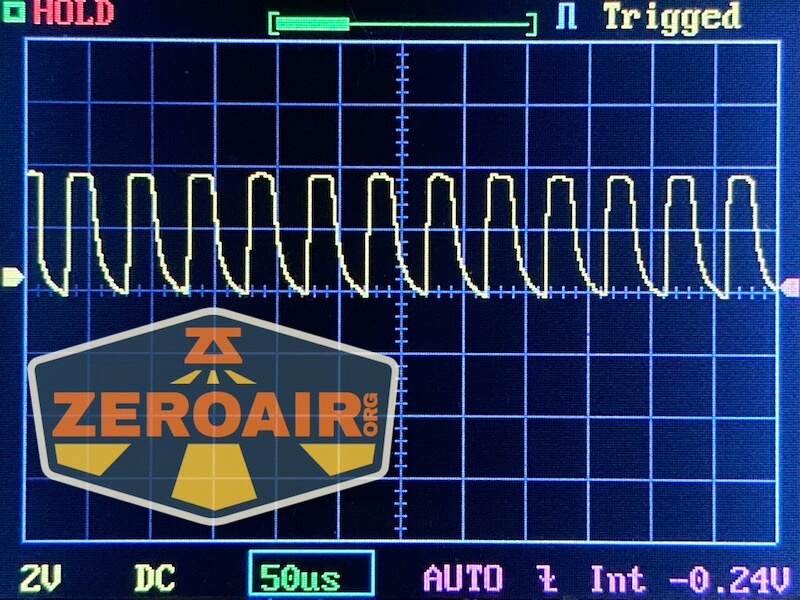
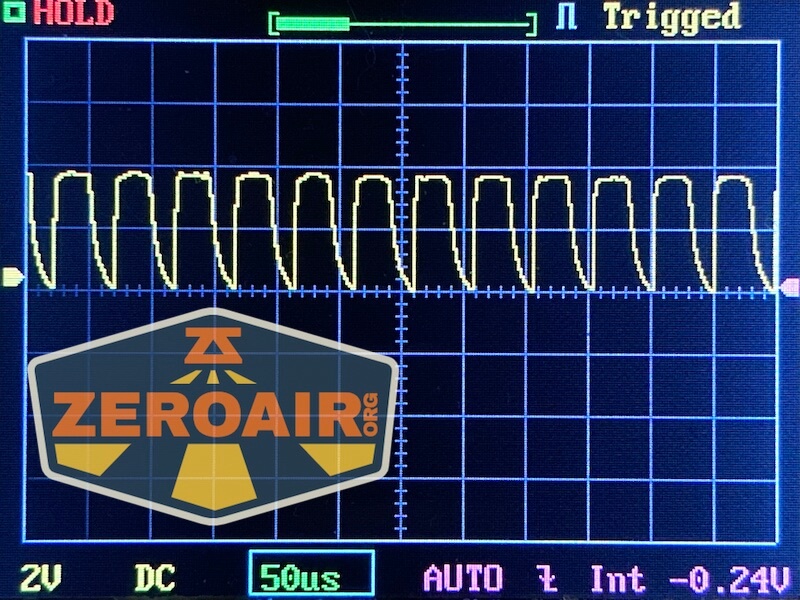
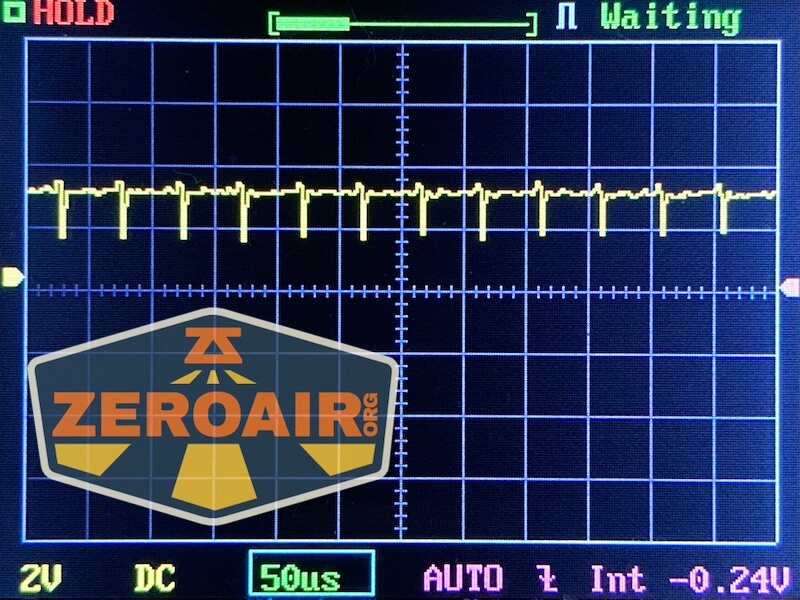
Here you can see a “baseline” – a chart with almost no light hitting the sensor.

Then there’s the Ultrafire WF-602C flashlight, which has some of the worst PWM I’ve seen. It’s so bad that I used a post about it to explain PWM! Here are multiple timescales (10ms, 5ms, 2ms, 1ms, 0.5ms, 0.2ms) to make comparing this “worst” PWM light to the test light easier. That post also explains why I didn’t test the WF-602C at the usual 50us scale.


User Interface and Operation
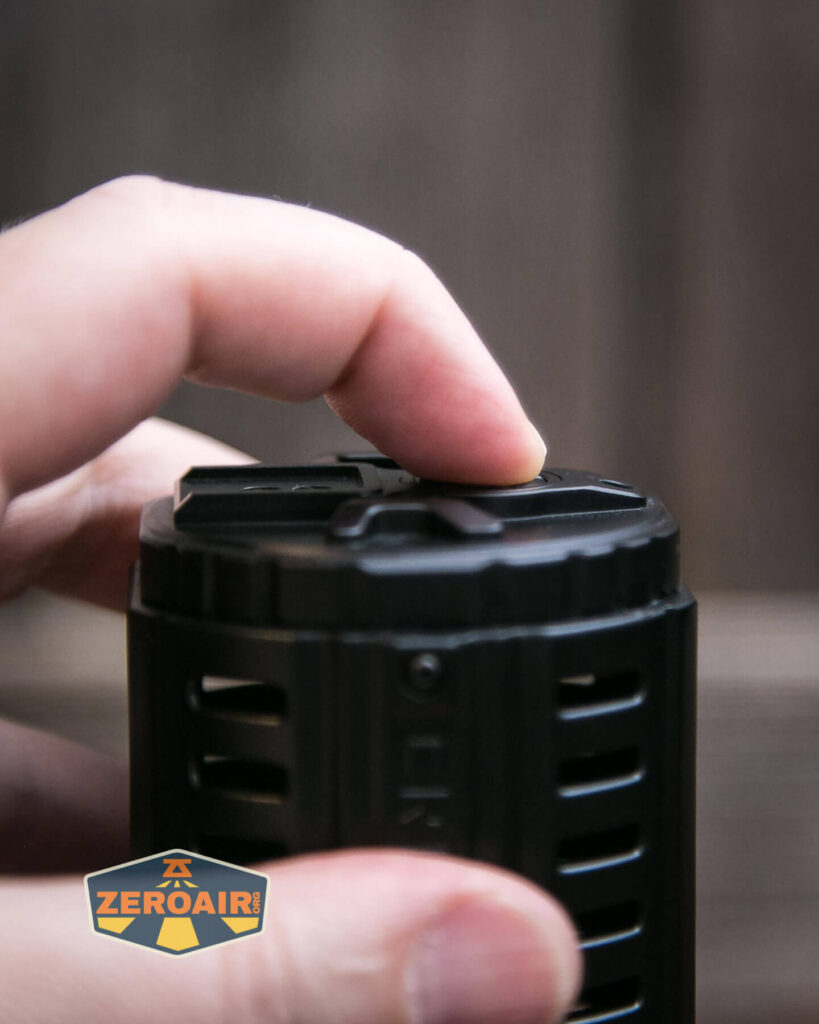
Just one switch is used for the operation of the Imalent RS50 flashlight. It’s an e-switch on the head. The switch is “textured” and has a nice positive clicky action.
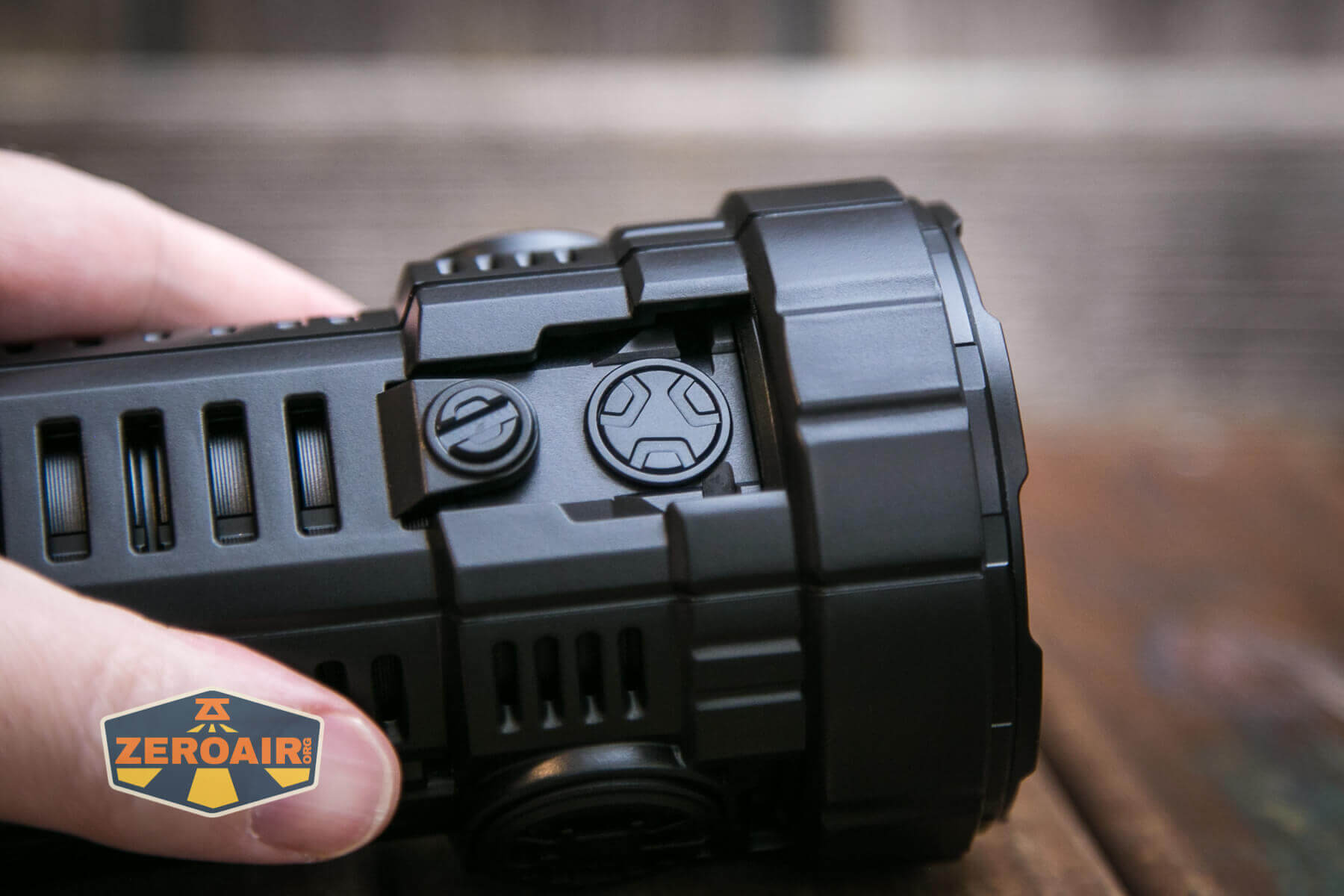
The action is very low. This switch can be rotated too. Not that you’d ever need to or that it serves any purpose to do that, but you might find it rotating under your finger, and be surprised by it. It doesn’t hurt anything, though.

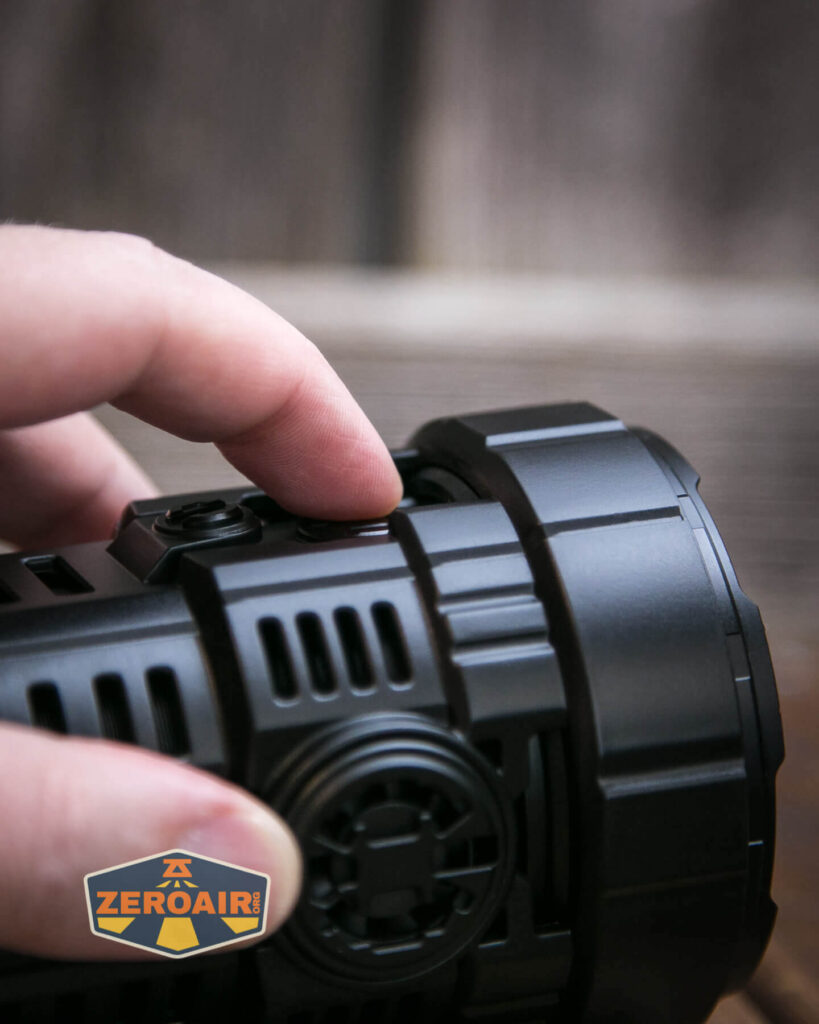

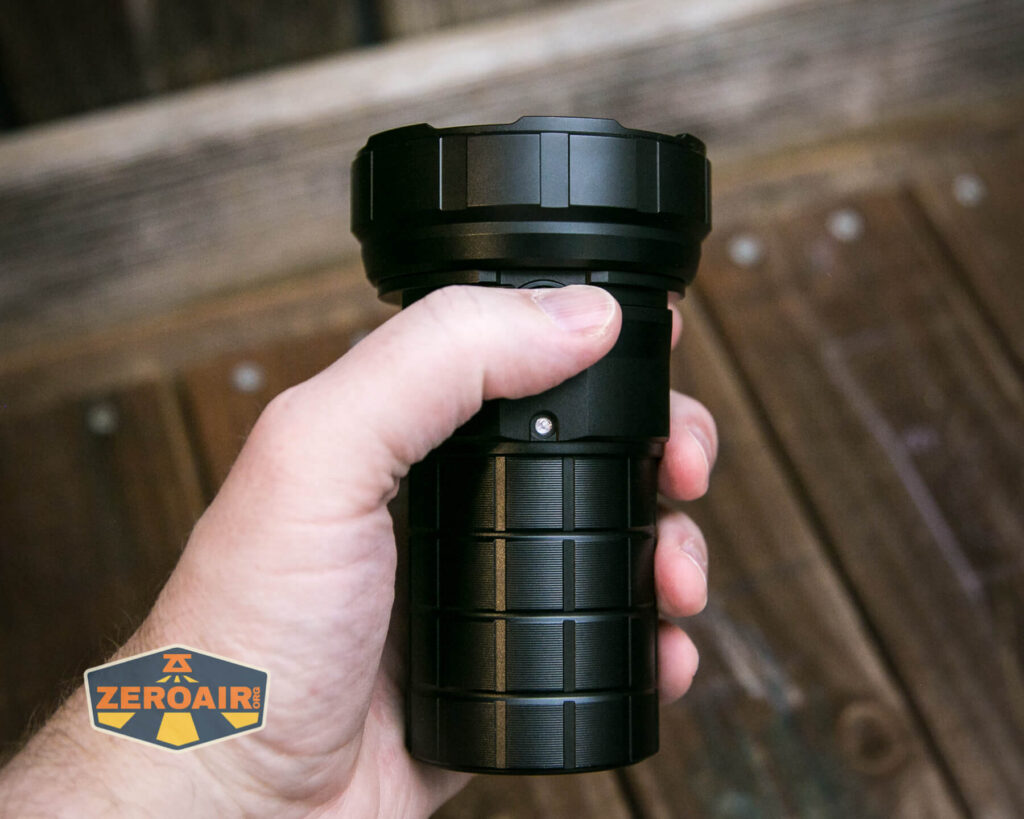
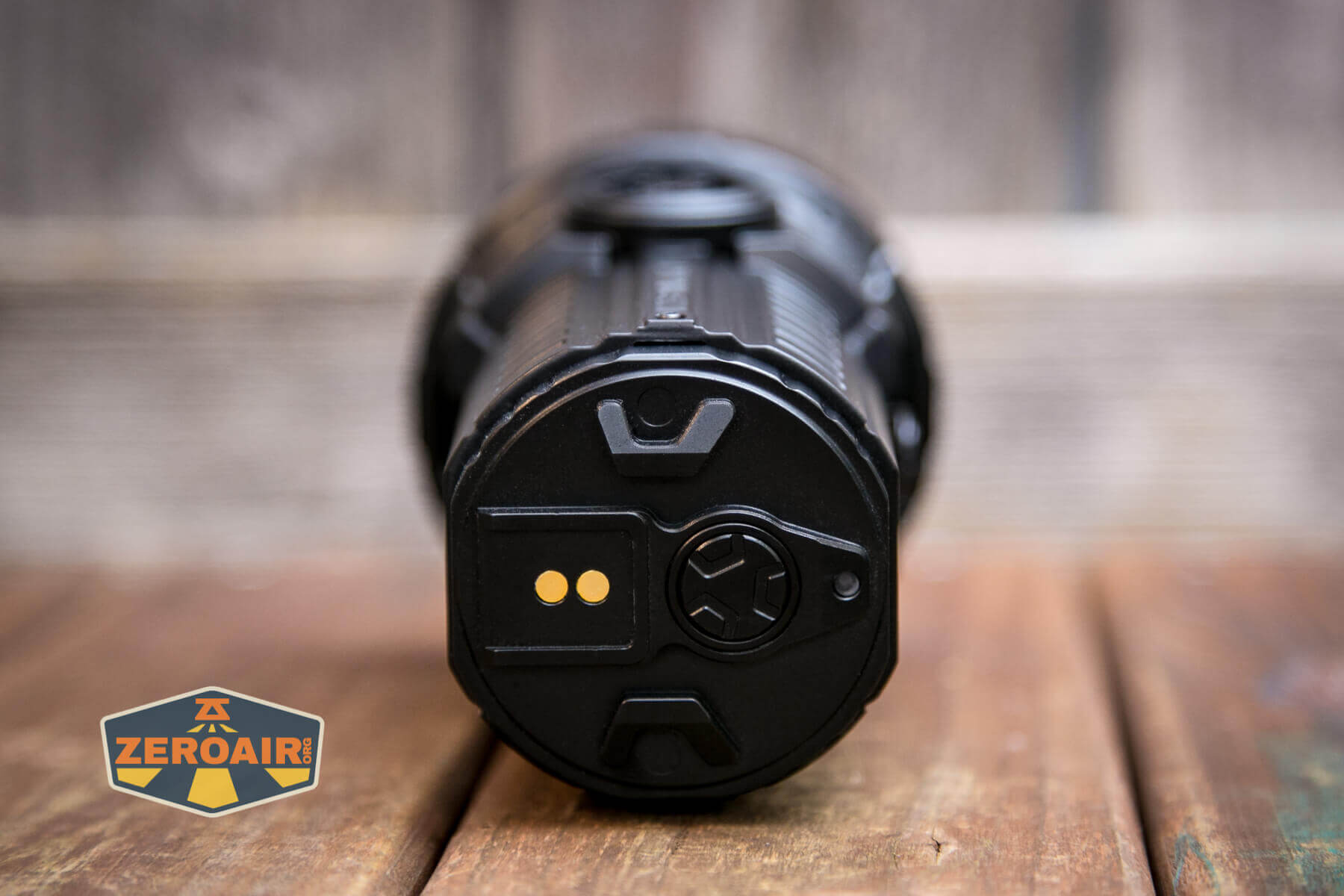
The heat shield has a switch exactly like the flashlight switch. An e-switch with a textured cover and very low action.

Here’s a user interface table!
| State | Action | Result |
|---|---|---|
| Off | Click | On (Mode Memory (excluding Turbo/Strobe) |
| On | Click | Off |
| On | Hold | Mode cycle (low to high order) |
| Off | Triple Click | On in Low |
| Any | Double Click | Turbo |
| Turbo | Double Click | Strobe |
| Off | Hold 3s | Iterate switch indicator light |
| Off | Click 4x | Iterate Lock (indicated by switch indicator light blinking a few times) |
This user interface is generally like the Imalent MS06 and MS03, which share the style of the RT90. The user interface is exactly like the MS08.
The Triple-Click to Low is an interesting choice, and while unusual, I’m pleased that off-to-Low is possible!!
I could probably put the heat shield user interface in a separate table or section but it’s very simple. Click the tail switch to iterate the fans. That’s all there is to it. As far as I can tell, nothing else can be performed via the tail switch.
LED and Beam
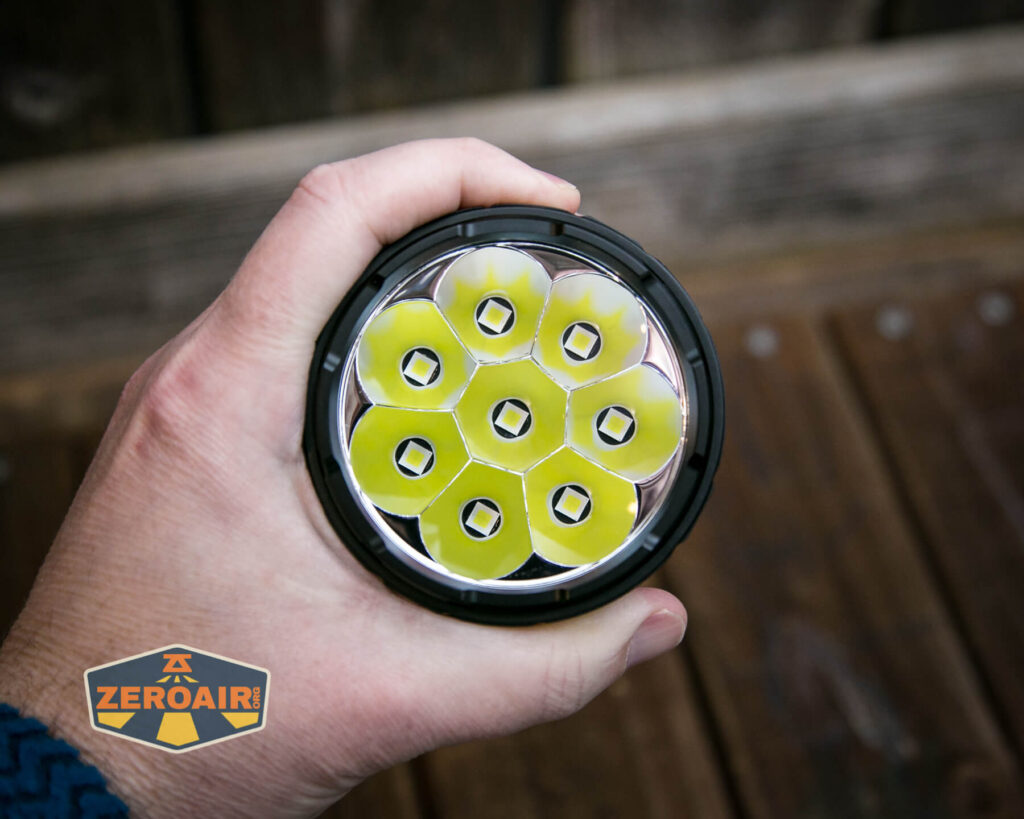
Eight of the same emitters are used in the Imalent RS50 flashlight. These 8 are Cree XHP50.3 HI emitters in an unstated CCT. Each has a little reflector.


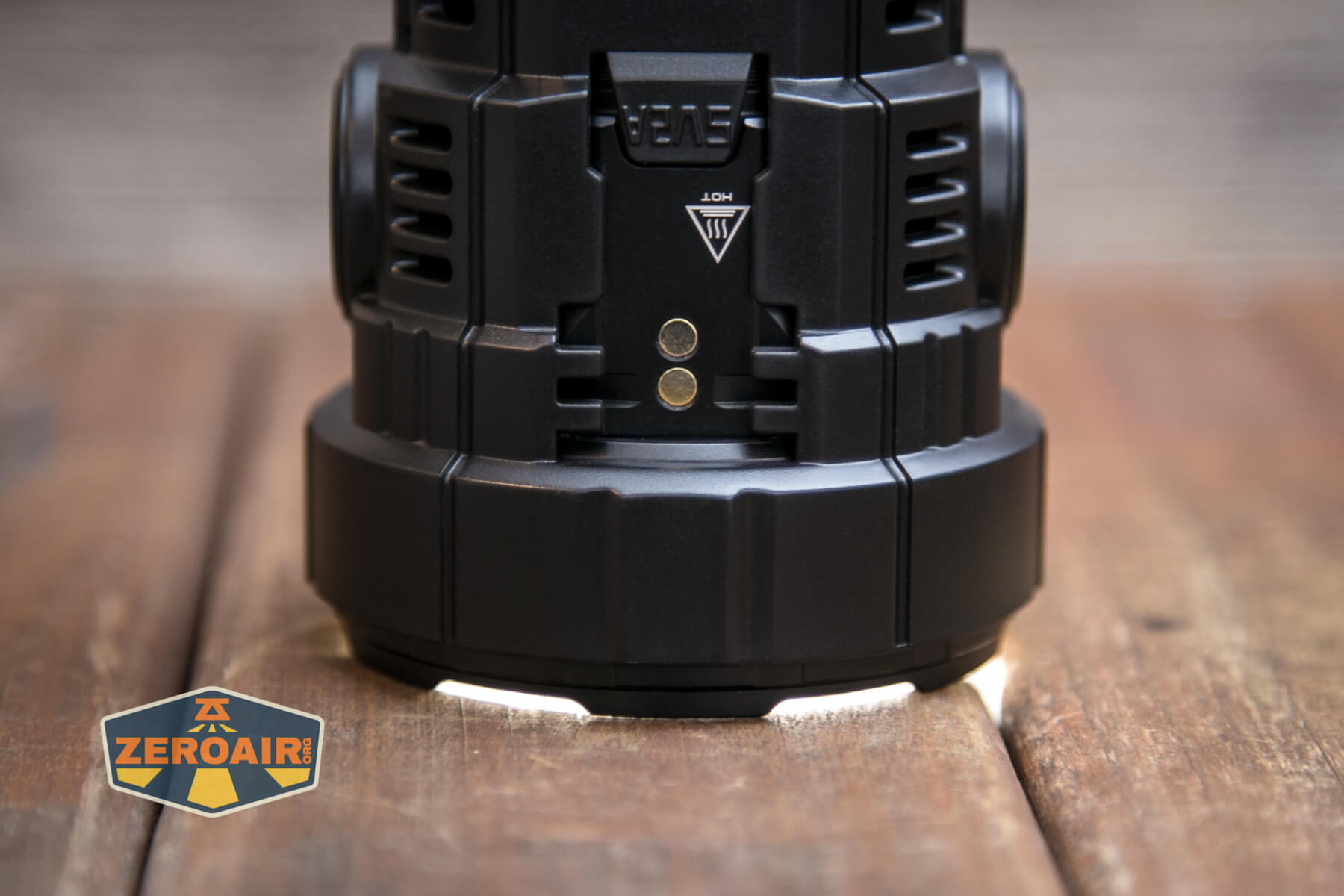
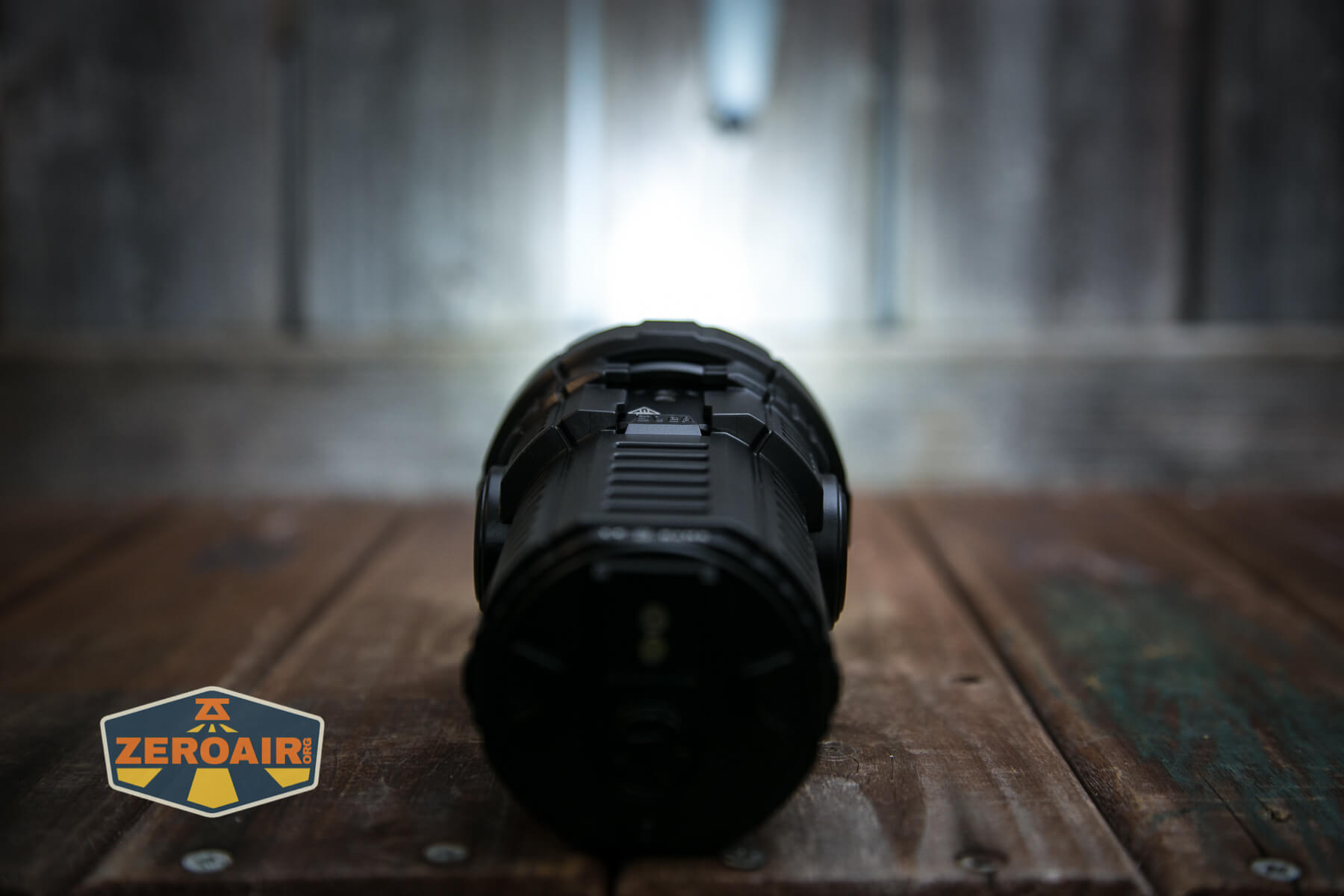
I’m happy that the bezel has a bit of shape to it so that light will escape when the RS50 headstands.
LED Color Report (CRI and CCT)
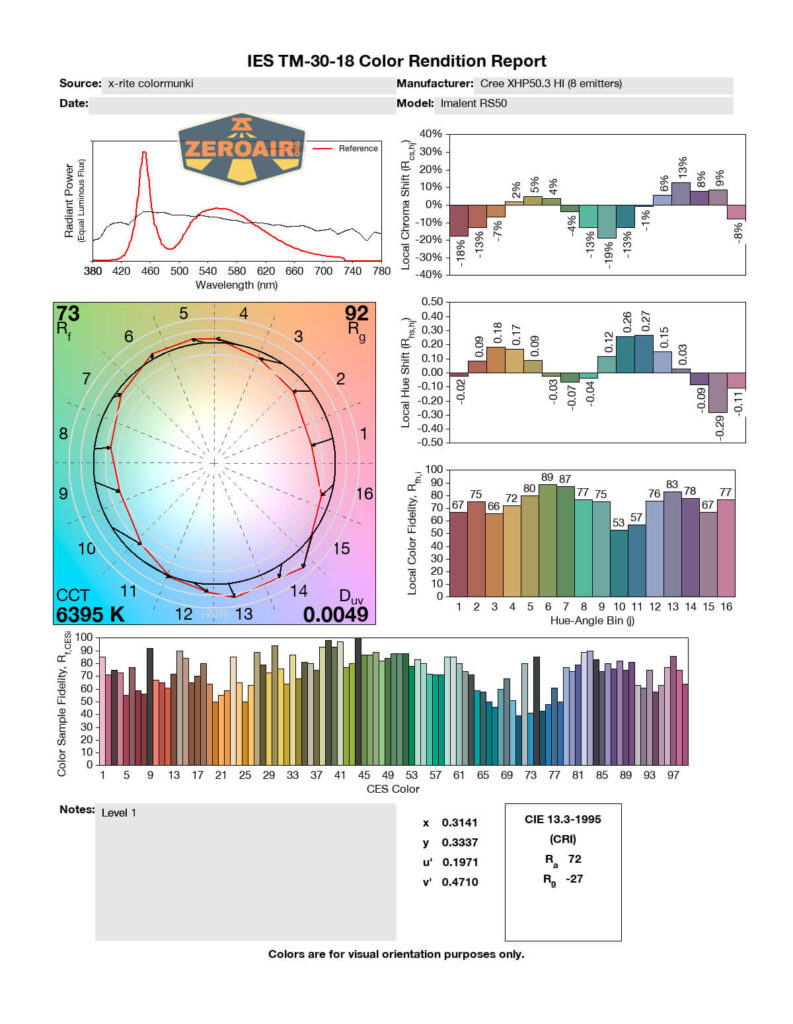
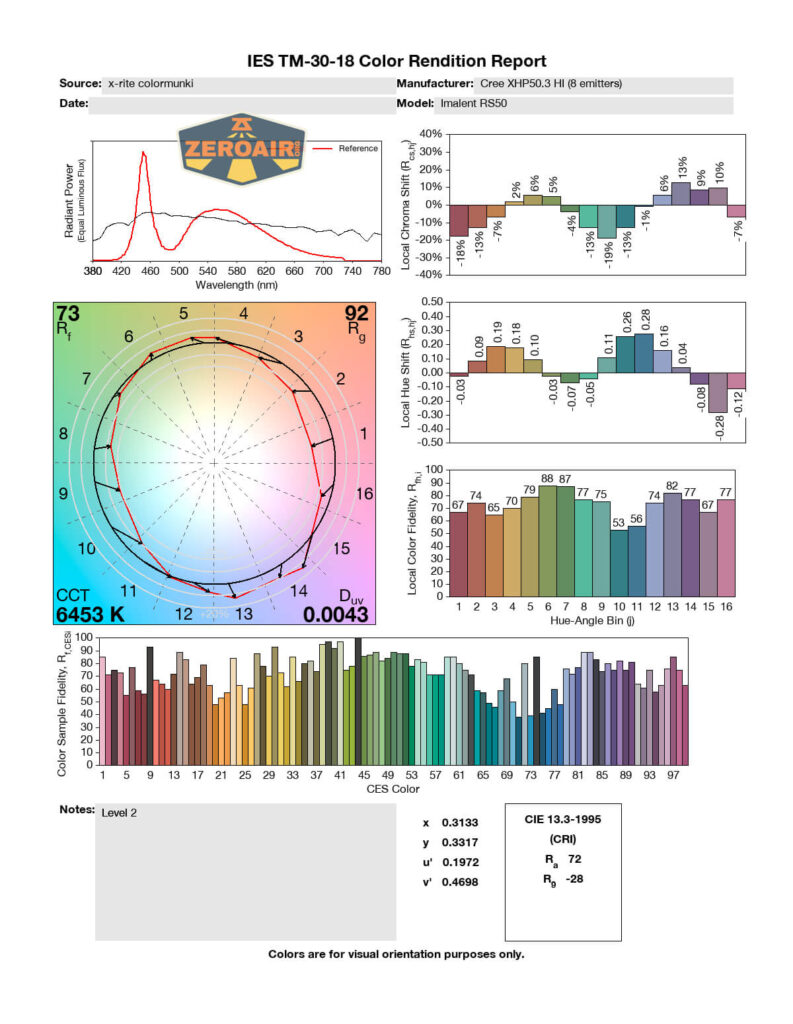
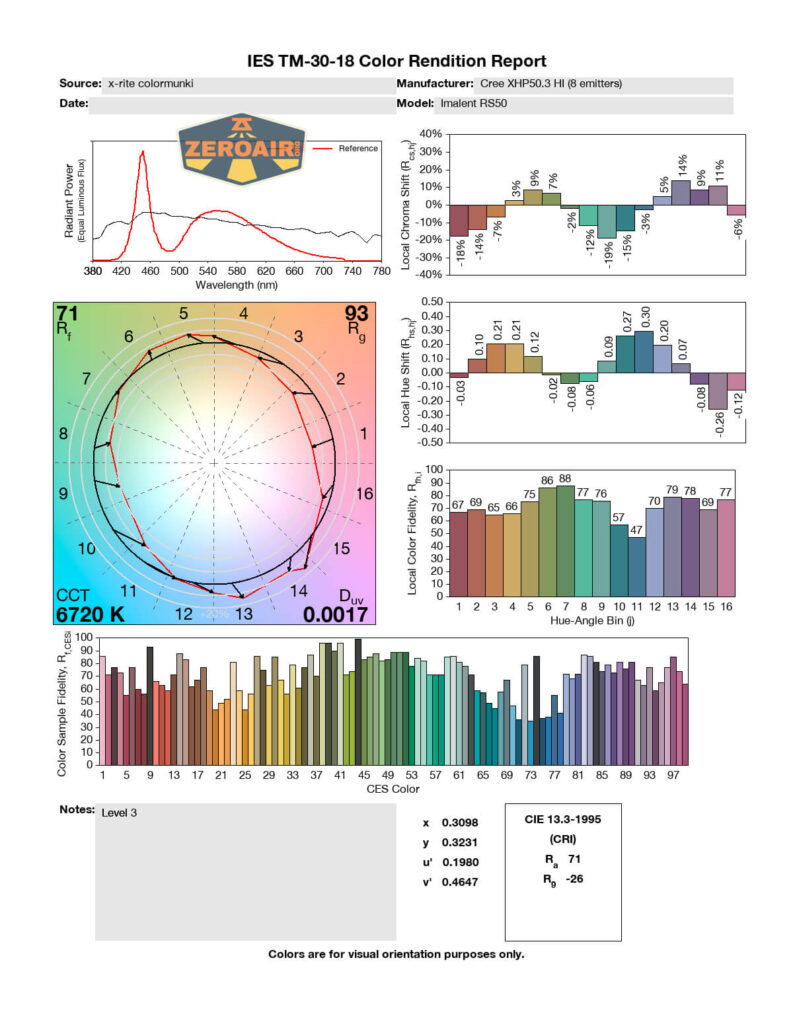
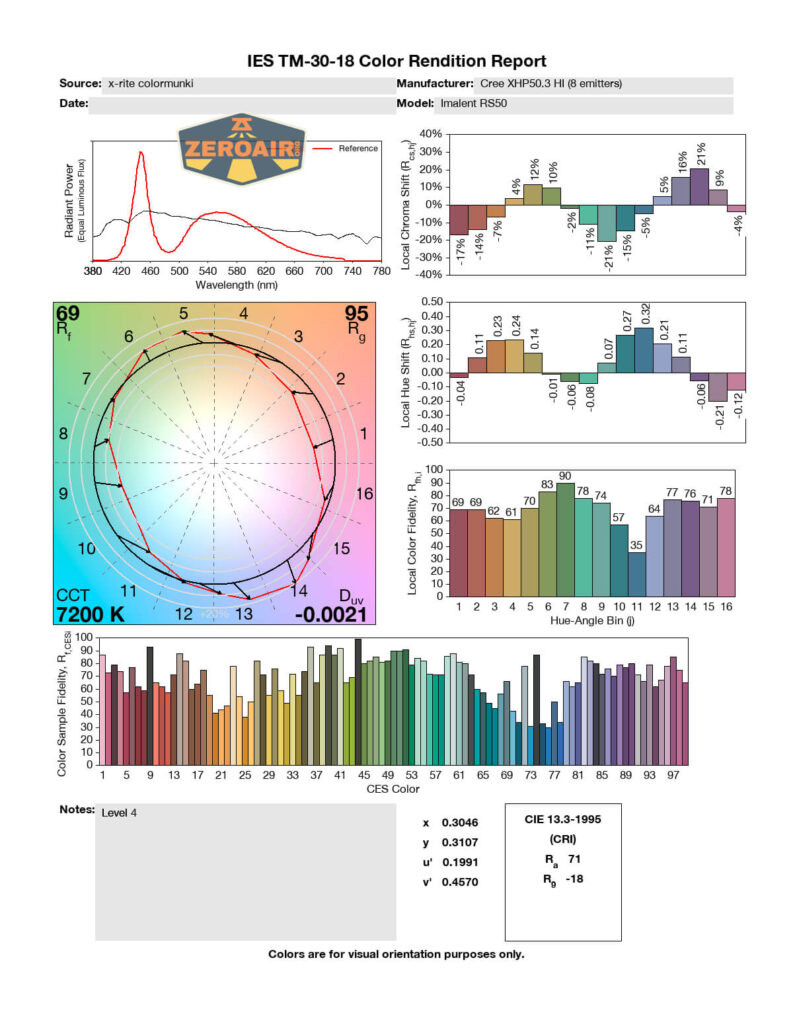
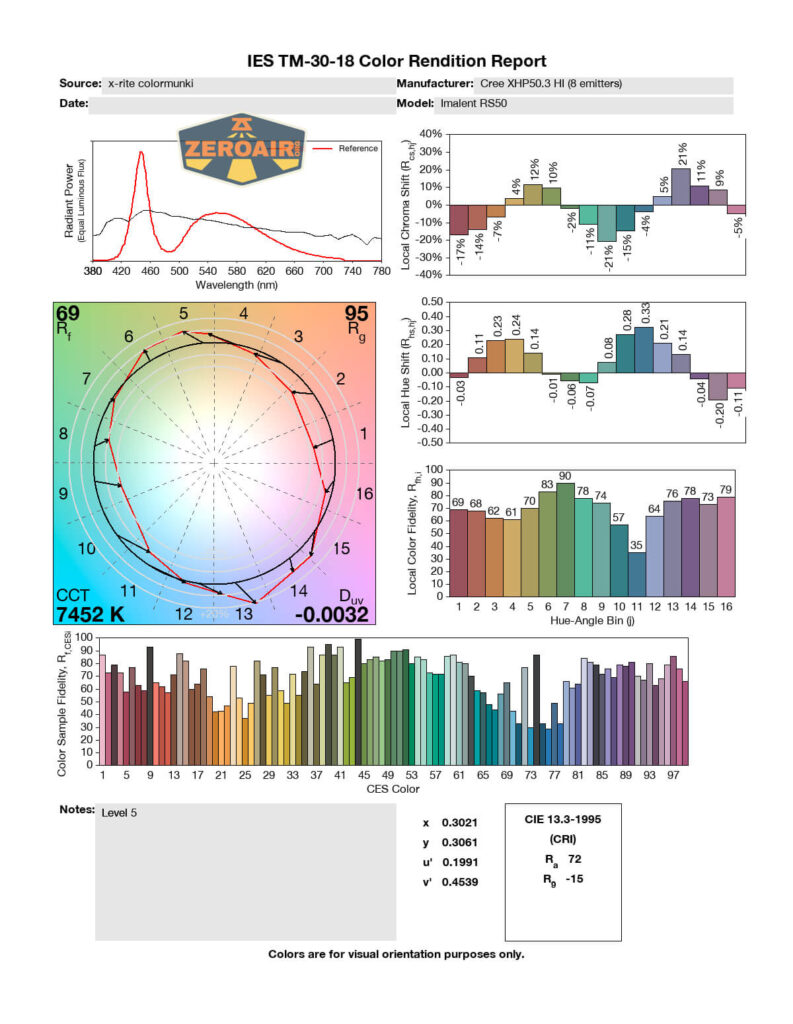
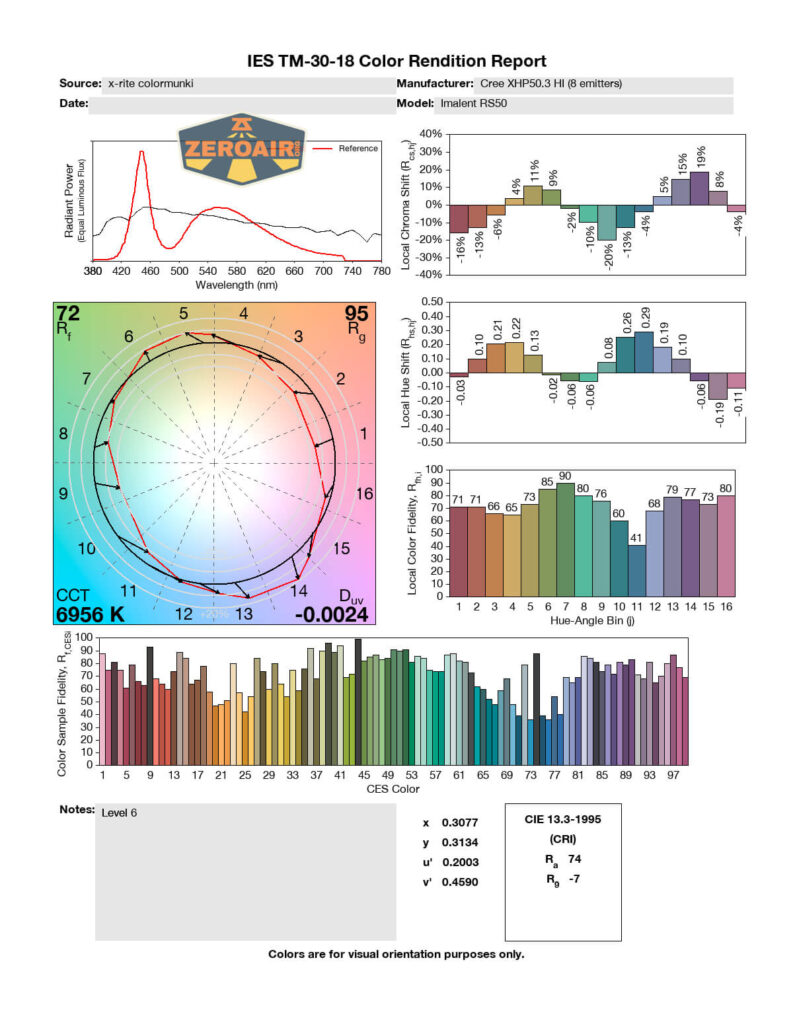
I don’t see a report anywhere of the CCT of these Cree XHP50.3 HI emitters. Based on my tests, the lower output levels are in the 6400K range, while the higher output levels get quite cool and into the 7500K range. CRI falls in around 72, which is about to be expected (and somewhat low). The highest output level saturated my sensor, so this reading is at “some distance” from the sensor. That accounts for the lower CCT.
Beamshots
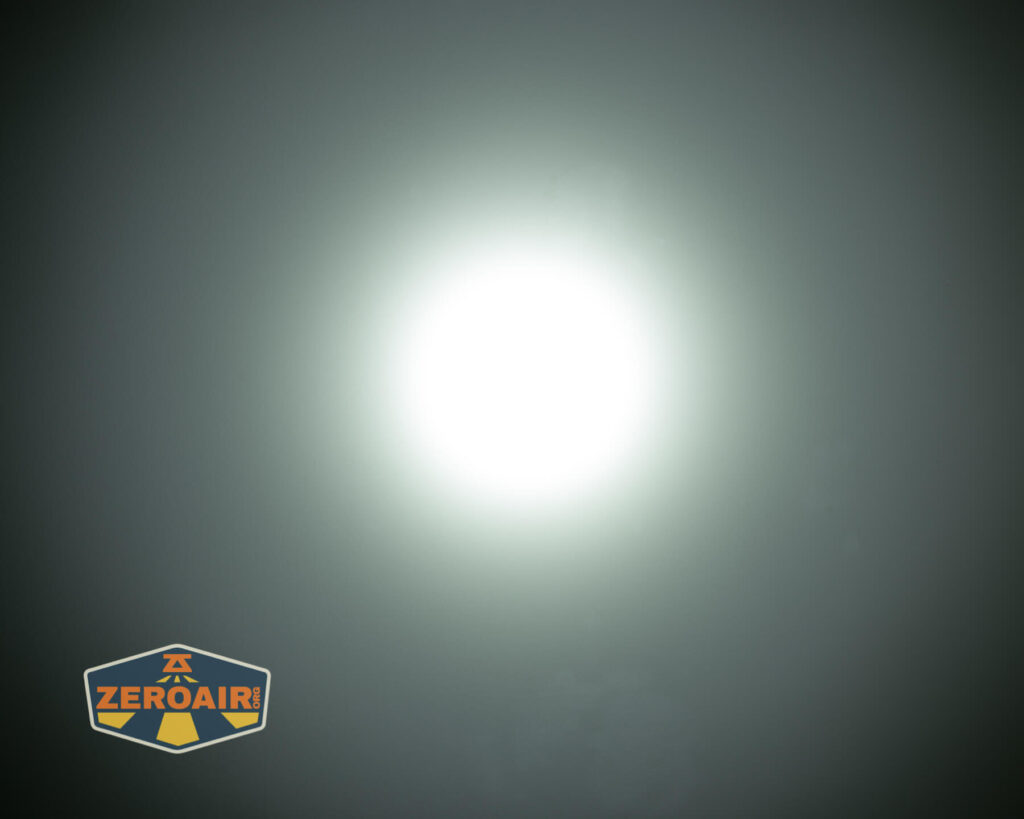
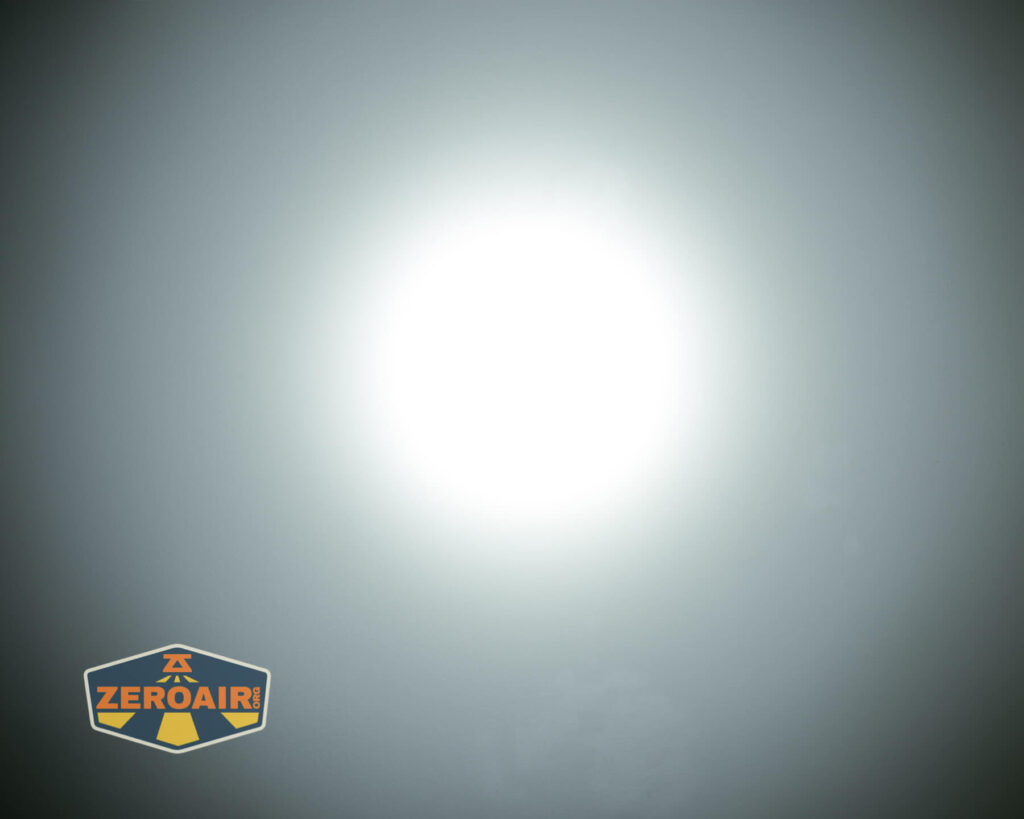
These beamshots always have the following settings: f8, ISO100, 0.3s shutter, and manual 5000K exposure. These photos are taken at floor level, and the beam hits the ceiling around 9 feet away.




Tint vs BLF-348 (KillzoneFlashlights.com 219b version) (affiliate link)
I keep the test flashlight on the left and the BLF-348 reference flashlight on the right.
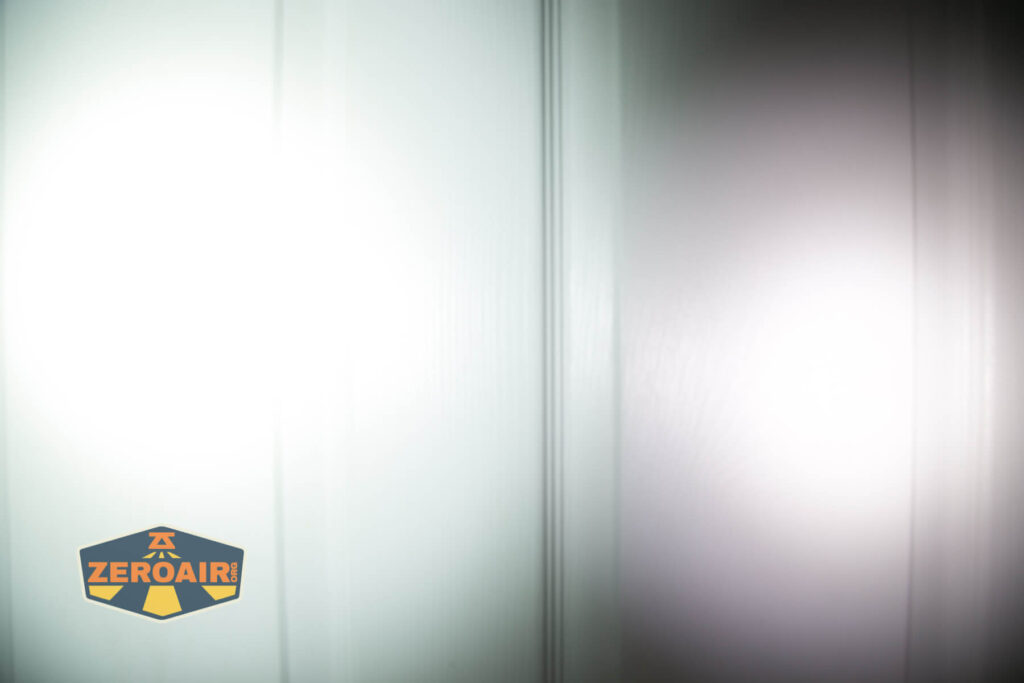



I compare everything to the KillzoneFlashlights.com 219b BLF-348 because it’s inexpensive and has the best tint!
Conclusion
What I like
- Build quality is great
- Uses standard 21700 button top cells
- Cells are user-replaceable
- Great user interface
- Fans are not loud
- It’s just very neat (seriously, there’s no quantifiable way to state this, but it’s just a neat light to have and hold and use. It’s fun.)
- Fun to see these new Cree XHP50.3 HI emitters in a production light
What I don’t like
- Doesn’t meet specifications (even initially) for output
- Also, it does not hit the throw specification
- Gets so hot (but there’s some protection with the heat shield)
- Fans never seem to turn on on their own (it would be safer if they did)
- Heat shield must be charged separately
- Output is quite cool, especially on higher outputs
Notes
- This content originally appeared at zeroair.org. Please visit there for the best experience!
- Please use my Amazon.com referral link to help support zeroair.org!
- Please support me on Patreon! I deeply appreciate your support!
Nice review.
BTW, since you are stating lumen or candela data after 30 seconds, you should not say “51.4% of claim”, because imalent never claimed it has 20.000 lumens after 30 seconds… instead it should be “51.4% of initial maximum” or similar.