

Sofirn SF26 Tactical Flashlight Review
The Sofirn SF26 tactical flashlight offers a Luminus SFT40 emitter in cool white to pump out the lumens! It offers USB-C charging and a dual switch interface.
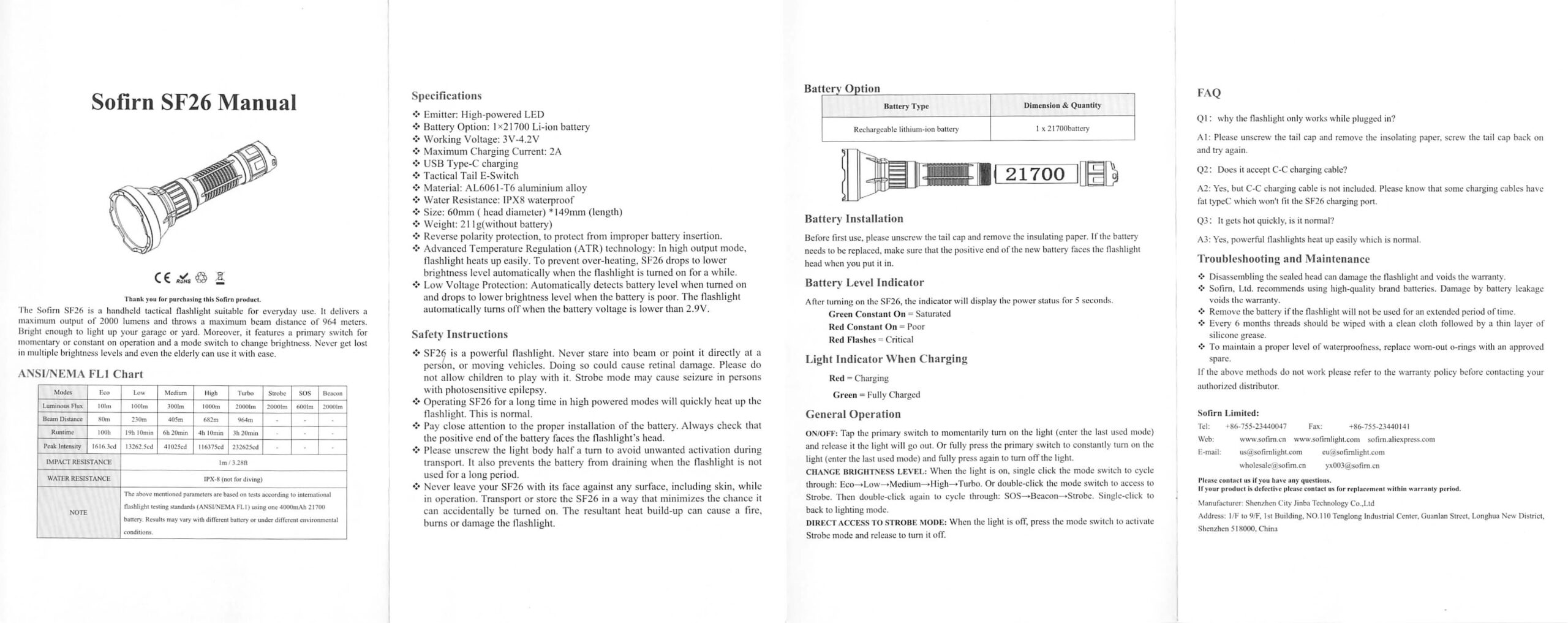
Official Specs and Features
Here’s a link to the Sofirn SF26 tactical flashlight product page.
Versions
As far as I can tell, there’s just one version. The package can be purchased with or without a 21700, though.
Price
MSRP of the Sofirn SF26 tactical flashlight is $69.99, but the current going price is 34% off, at $45.99. Including the cell (which I recommend) bumps the price up to $49.99. Reasonable!
Short Review
The Sofirn SF26 tactical flashlight is what I’d call a simple light. Sure, it has two switches but that might even play into it being simple; there’s great separation between turning the light off and on and changing modes. USB-C charging works well, and the throw is great, too. I’m not seeing the max output of 2000 lumens, so if you’re a specs person, that might be a problem. The light does hit throw numbers though, which I’d say is more important for a light like this. All for $45.99; it’s a nice deal.
Long Review
The Big Table
| Sofirn SF26 tactical flashlight | |
|---|---|
| Emitter: | Luminus SFT40 |
| Price in USD at publication time: | $45.99 |
| Cell: | 1×21700 |
| Runtime Graphs | |
| LVP? | Yes |
| Switch Type: | E-Switch |
| Quiescent Current (mA): | – |
| On-Board Charging? | Yes |
| Charge Port Type: | USB-C |
| Charge Graph | |
| Power off Charge Port | No |
| Claimed Lumens (lm) | 2000 |
| Measured Lumens (at 30s) | 1010 (50.5% of claim)^ |
| Candela per Lumen | 179.3 |
| Claimed Throw (m) | 964 |
| Candela (Calculated) in cd (at 30s) | 5590lux @ 6.334m = 224268cd |
| Throw (Calculated) (m) | 947.1 (98.2% of claim)^ |
| Claimed CCT | 6500 |
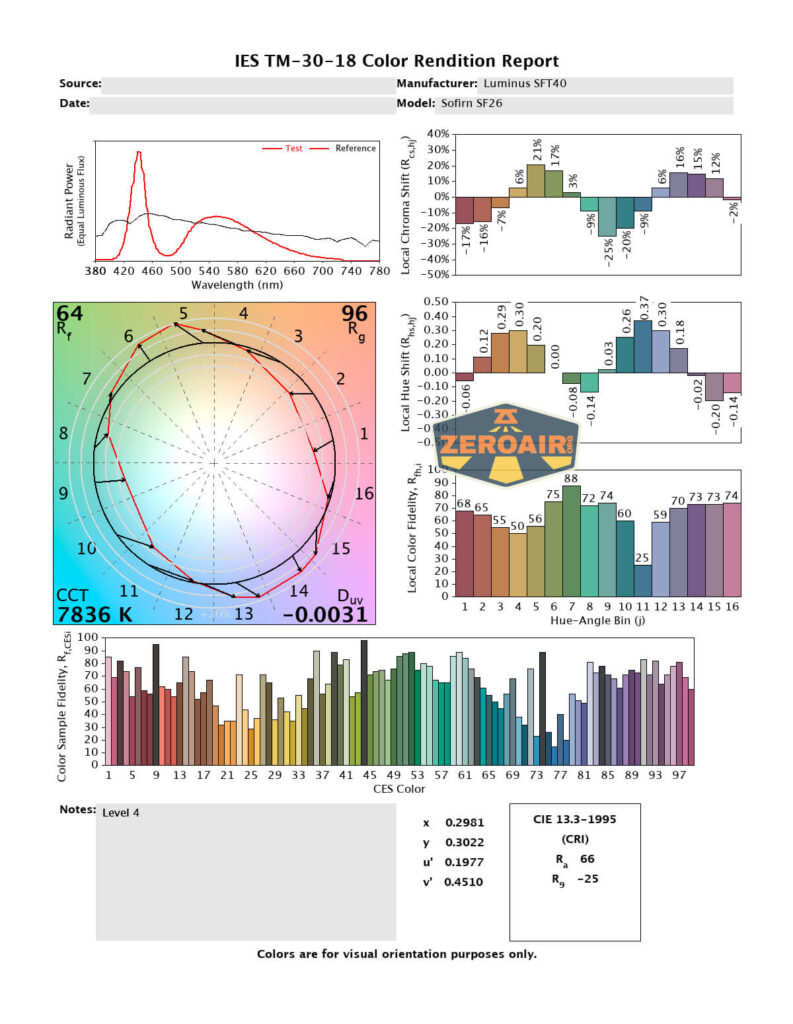
| Measured CCT Range (K) | 7000-7900 Kelvin |
| Item provided for review by: | Sofirn |
| All my Sofirn reviews! | |
^ Measurement disclaimer: Testing flashlights is my hobby. I use hobbyist-level equipment for testing, including some I made myself. Try not to get buried in the details of manufacturer specifications versus measurements recorded here; A certain amount of difference (say, 10 or 15%) is perfectly reasonable.
What’s Included

- Sofirn SF26 tactical flashlight
- Sofirn 5000mAh 21700
- Charging cable (USB to USB-C)
- Spare o-rings (2)
- Lanyard
- Manual
Package and Manual


Build Quality and Disassembly

I feel like the Sofirn SF26 tactical flashlight lines up nicely with some other Sofirn I’ve reviewed. But I can’t find it! Regardless, the Sofirn SF26 tactical flashlight build quality is great!

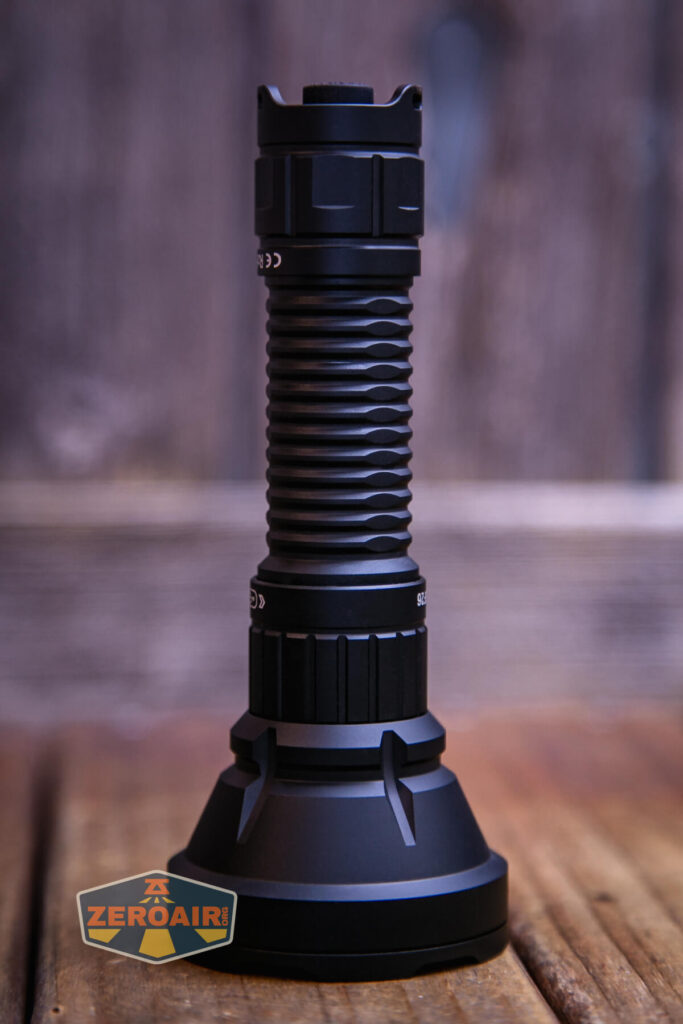

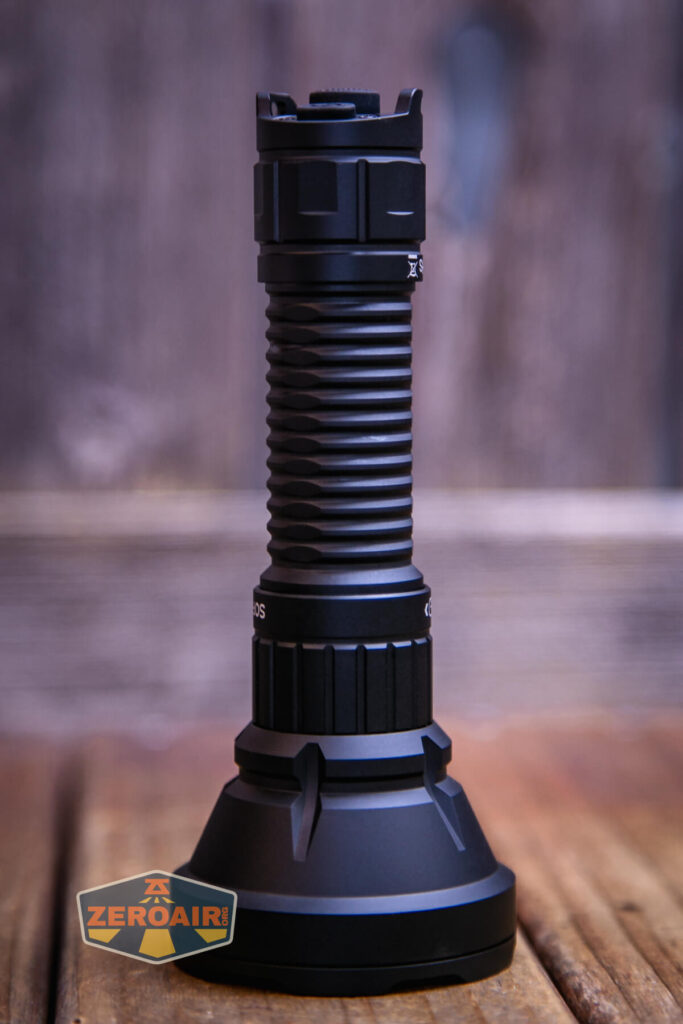
This light claims 2000 lumens, but it’s really (clearly) much more of a thrower.
Here you can see the beefy spring in the tailcap, as well as the anodized threads. They’re very smooth threads.

Inside the cell tube, the head has a spring as well. I couldn’t get the head and body separated (but more on that later.)

Size and Comps
149 mm (length) x 60mm (head diameter)
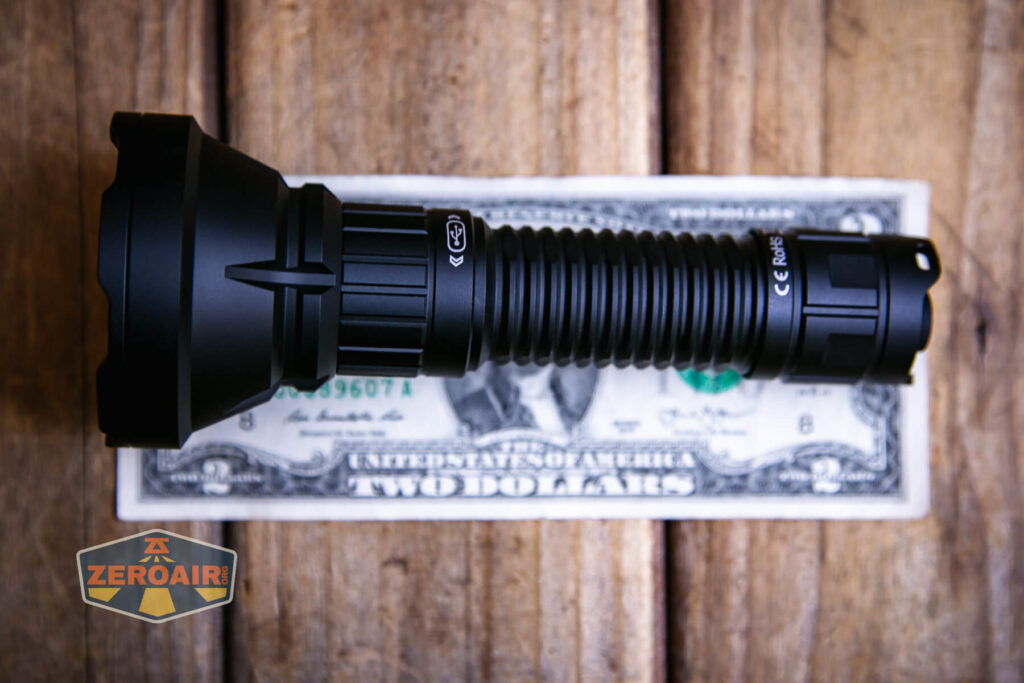


If the flashlight will headstand, I’ll show it here (usually the third photo). If the flashlight will tailstand, I’ll also show that (usually in the fourth photo).

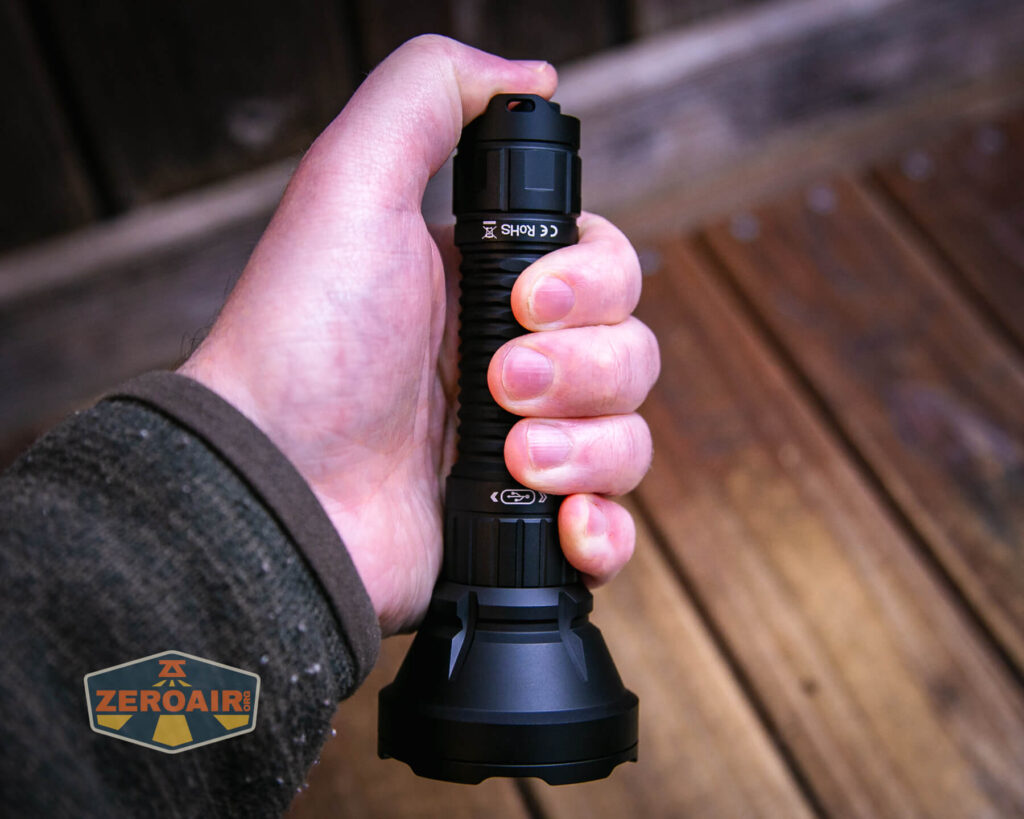

Here’s the test light with the venerable Convoy S2+. The version below is a custom laser-engraved Convoy S2+ host by GadgetConnections.com. I did a full post on an engraved orange host right here! Or go straight to GadgetConnections.com to buy your Convoy S2+ now!


Also above is the light beside a new standard 18350 light! It’s not one I’ve reviewed yet but this is the CWF Arcadian Peanut in aluminum. This one is stonewashed and has the new Quantum Dragon driver – a whole new product! Stay tuned for a full review of this tiny powerhouse!
Retention and Carry
A lanyard is included, and can attach through either of these two loops in the tailcap.

Each of those loops is just the “one loop” variety, and that prevents tailstanding. But the light won’t tailstand anyway because of the switch.

Nothing else is included. There’s no pouch or anything else.
Power and Runtime
The Sofirn SF26 tactical flashlight is powered by a single lithium-ion battery. If you go for the package deal, you’ll get the 5000mAh 21700 seen below. This is (or “appears to be”) the same cell as is used on Sofirn LT1S Pro camping lantern.

The cell goes into the SF26 with the positive end toward the top of the light.

In case you forget which way to put the cell in, you can reference this icon on the tailcap end of the SF26. Because the cell is a flat top, this icon doesn’t really represent what you’ll see. But the cell is labeled with a plus and minus, so you can observe that, anyway.

Below you can see three runtimes. Again, the output claim of 2000 lumens isn’t met. (As a bit of personal introspection, I’ve realized I don’t trust big round numbers anyway. No one is going to tune a light down to 2000 lumens exactly through some firmware output management, and the chances of a light being pushed to its limit and that happening to be exactly 2000 lumens is probably some astronomically small number. So for this claim of 2000 lumens and any other claim of 2000 lumens or 100,000 lumens or whatever – I expect it’s “whatever.” It’ll be what it is, and in this case, the light’s hitting those throw numbers, so “good enough.” I realize that’s perfectly unsatisfactory for lumen junkies, but maybe being realistic about big round numbers will provide some solace.) (I guess I should end that with “steps off soapbox…”)

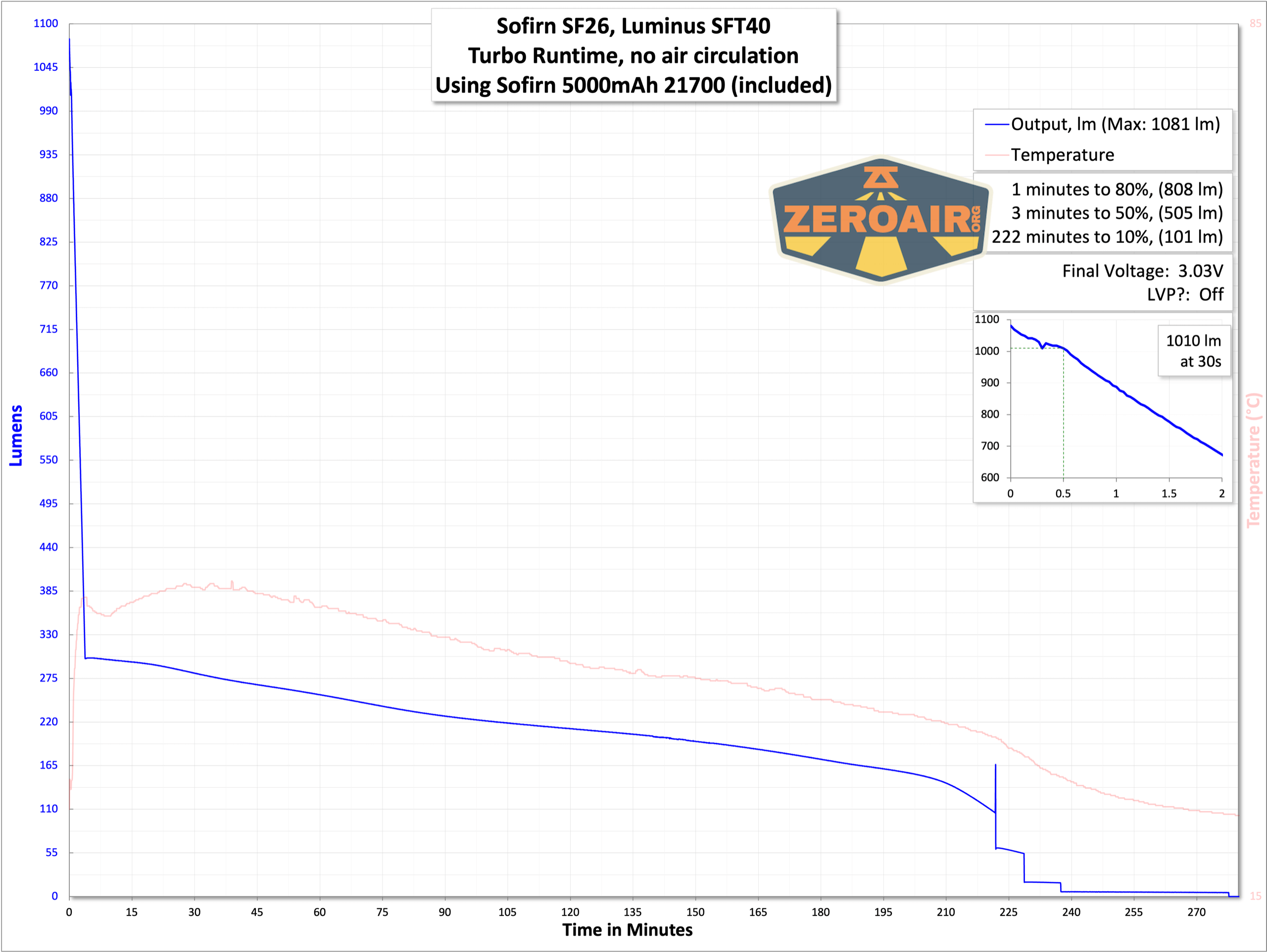
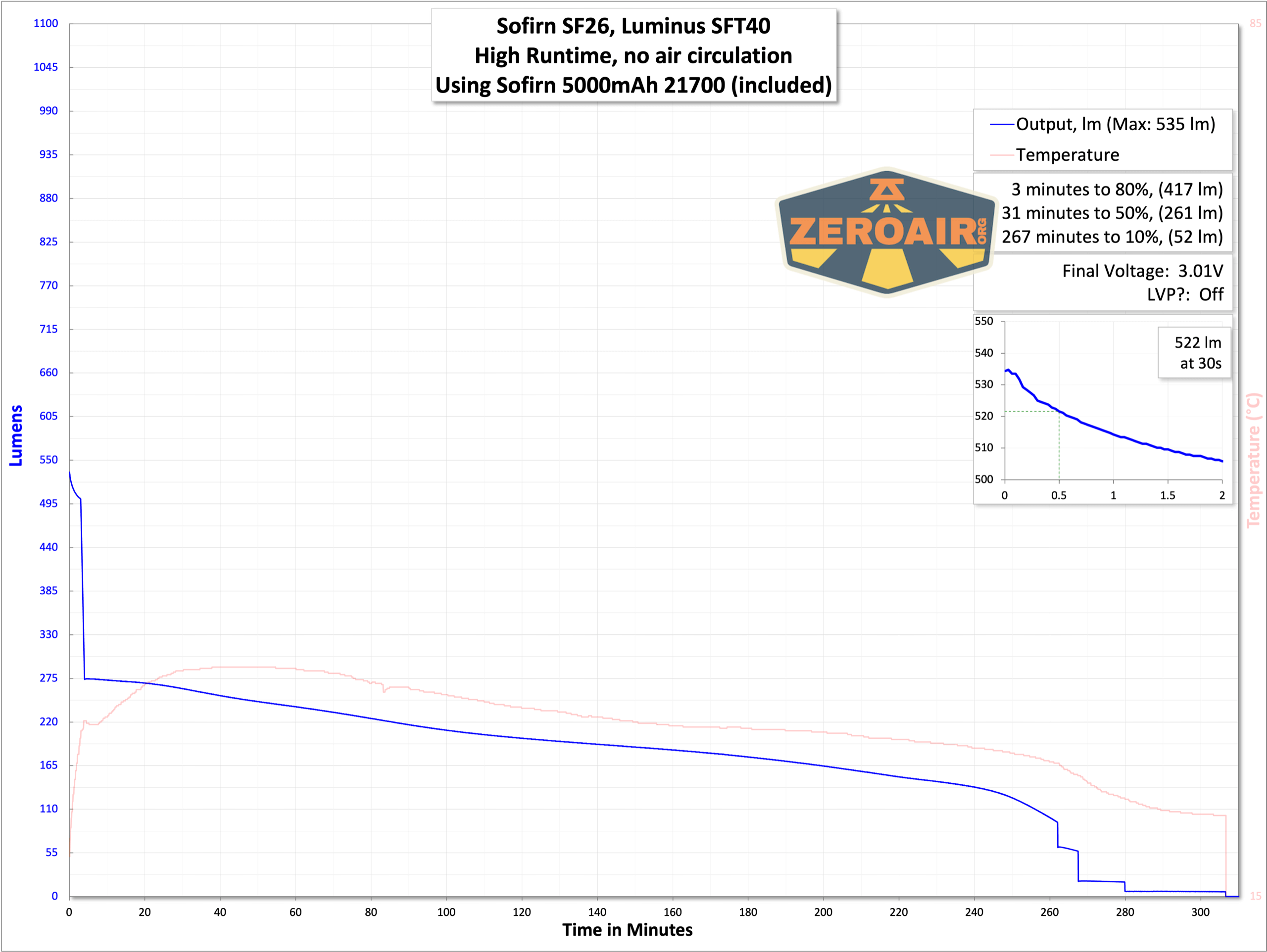
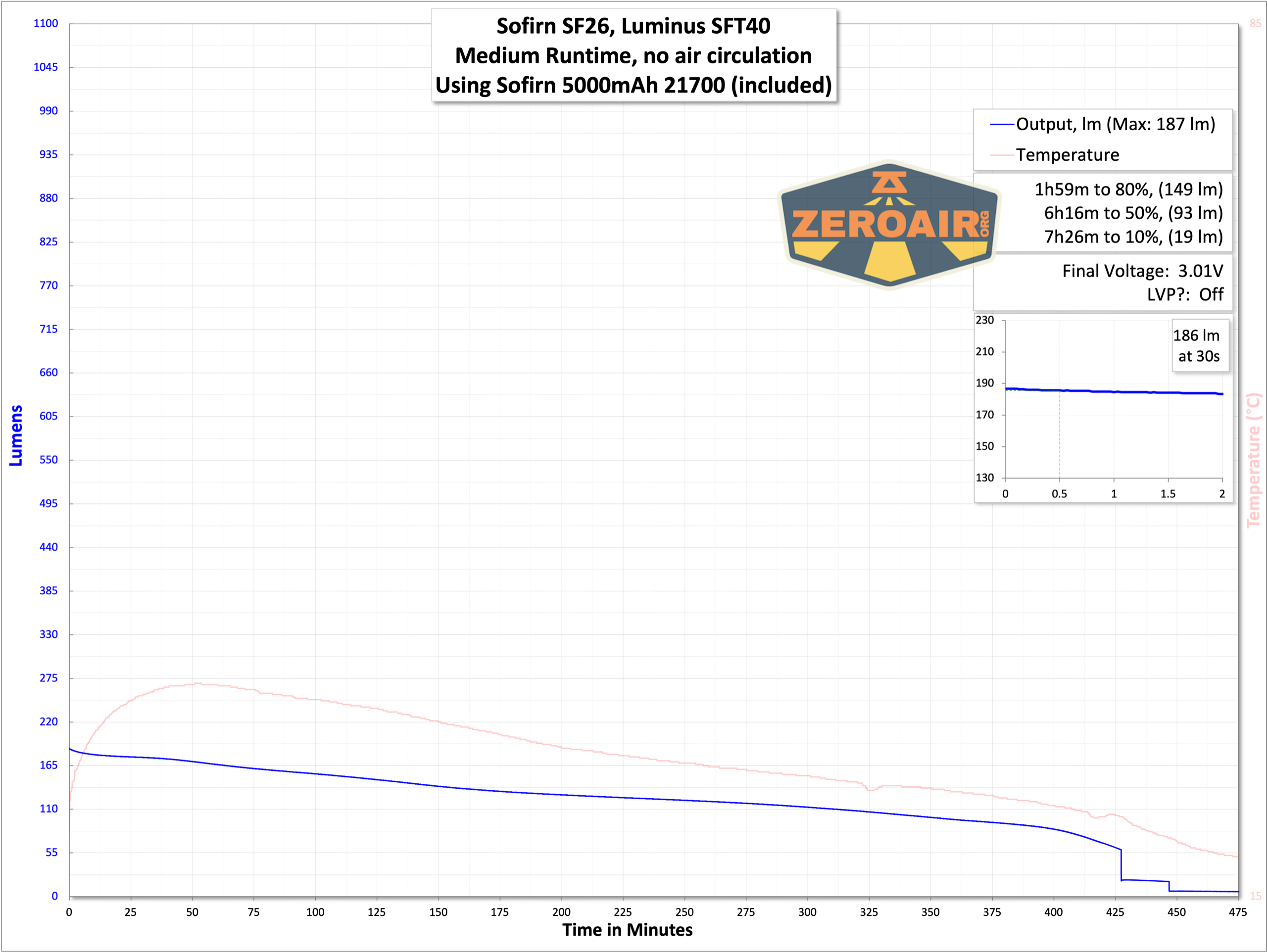
The light does have low voltage protection, which may or may not be something you want on a tactical light.
Charging
The SF26 sports USB-C charging and the charging port is on the “neck” of the light. It’s covered with a twisty cover, much like that of the Olight we recently saw (the Olight Warrior X 4).


I often feel that this type of cover feels cheap, but this one is really quite great. This is almost certainly what prevents the cell tube from being unscrewed from the head, though (ie it’s probably thread locked.)
An appropriate cable is included. It’s USB to USB-C.

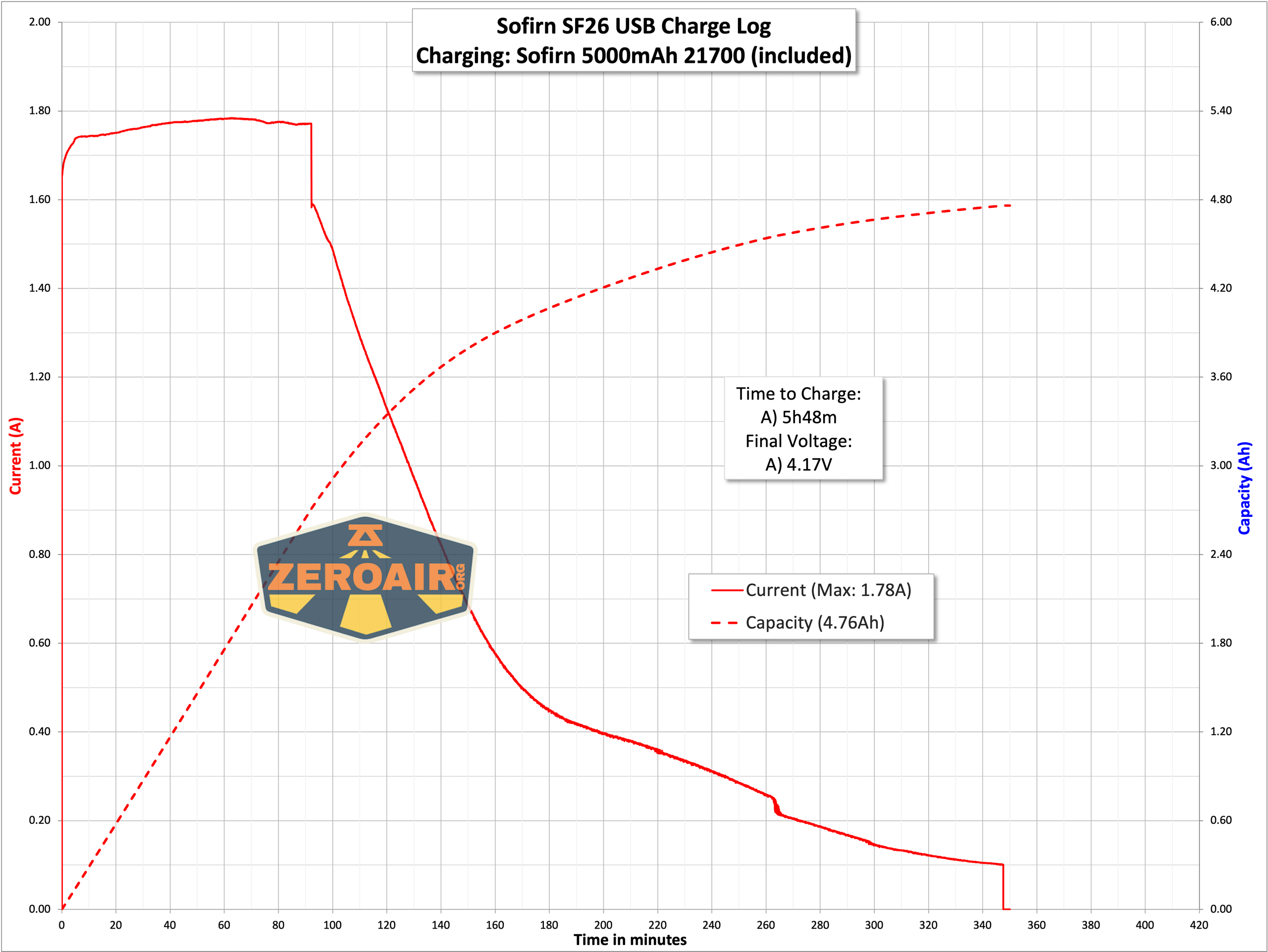
Charging looks very good at nearly 2A! For a 5000mAh cell like the one that’s included, 2A is perfectly fine. Shut off on charging seems a bit nebulous, though. The indicator switched green long before I stopped logging (probably around those squiggles around 260 minutes!)

Modes and Currents
| Mode | Mode Claimed Output (lm) | Claimed Runtime | Measured Lumens |
|---|---|---|---|
| Turbo | 2000 | 3h20m | 1081 (0s) 1010 (30s) |
| High | 1000 | 4h10m | 522 |
| Medium | 300 | 6h20m | 186 |
| Low | 100 | 19h10m | 63 |
| Eco | 10 | 100h | 7.5 |
Pulse Width Modulation
Each mode (even turbo!) uses PWM. Despite this looking “bad” it’s actually not noticeable to my eye. So I guess this is a win? Or acceptable, anyway. In any event, it’s definitely not a stroboscopic PWM.
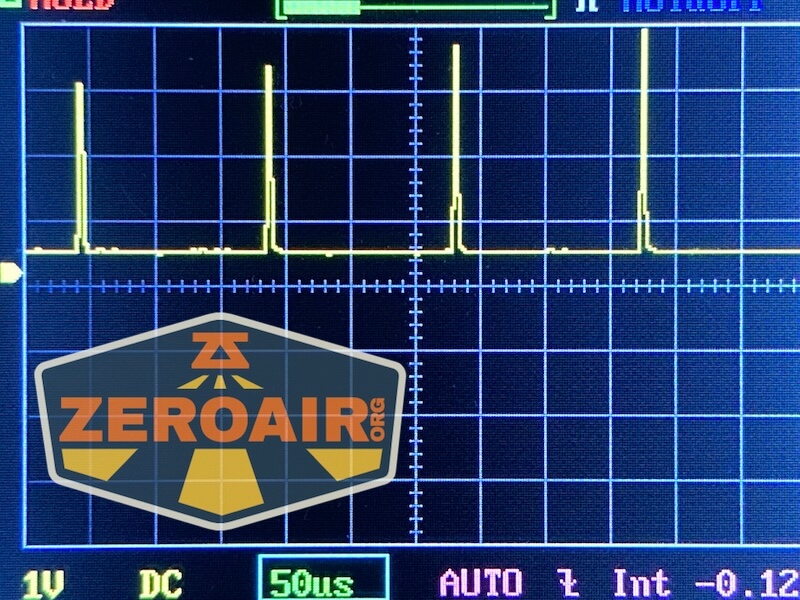
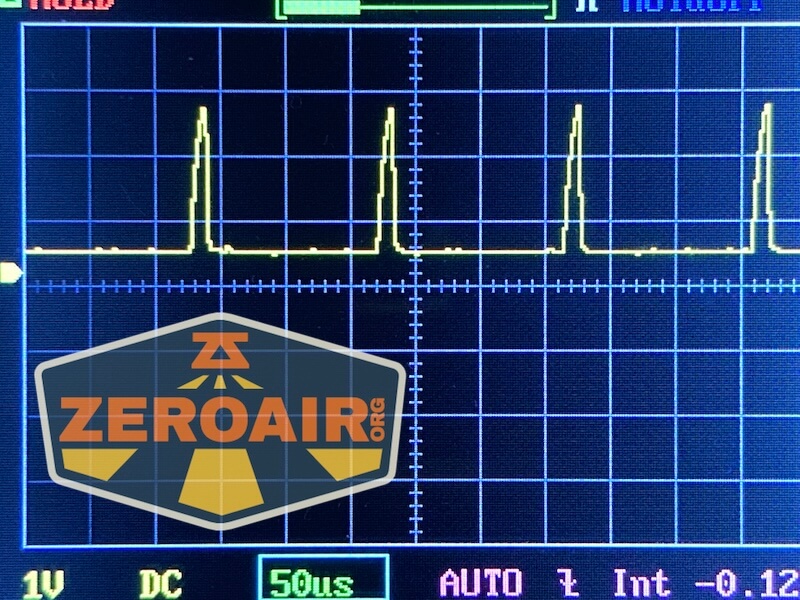
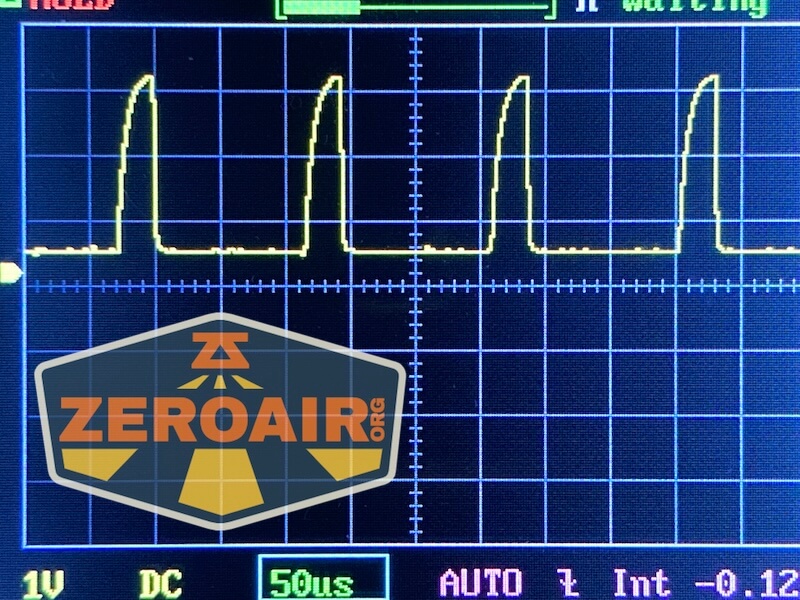
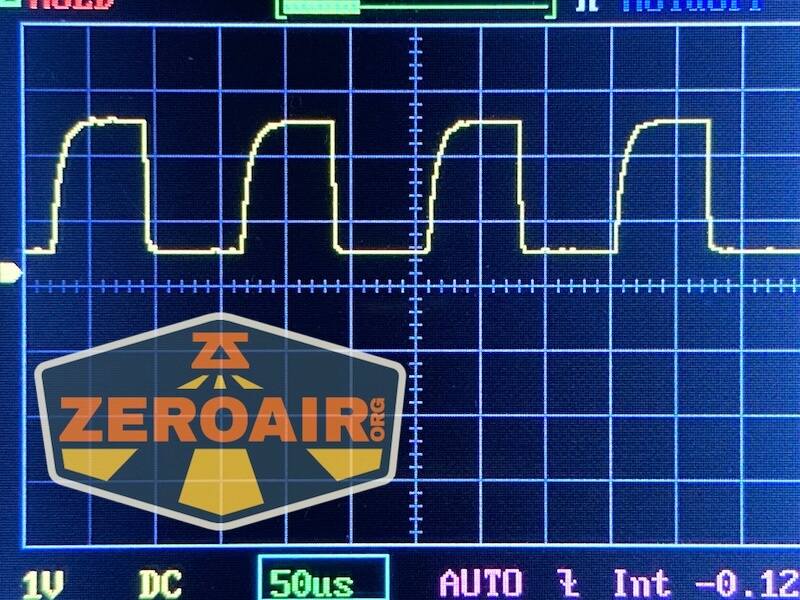
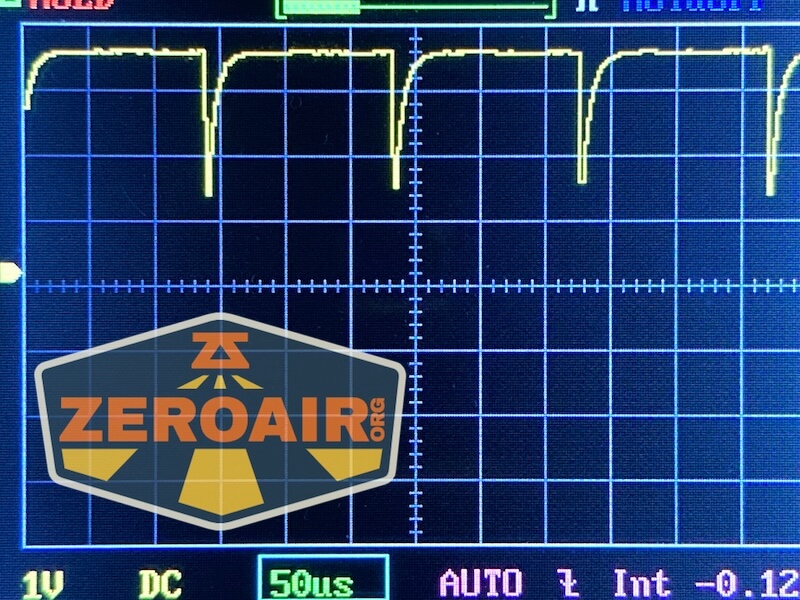
Here you can see a “baseline” – a chart with almost no light hitting the sensor. Then there’s the Ultrafire WF-602C flashlight, which has some of the worst PWM I’ve seen. It’s so bad that I used a post about it to explain PWM! Here are multiple timescales (10ms, 5ms, 2ms, 1ms, 0.5ms, 0.2ms) to make comparing this “worst” PWM light to the test light easier. That post also explains why I didn’t test the WF-602C at the usual 50us scale.


User Interface and Operation
The Sofirn SF26 tactical flashlight has two switches on the tailcap. Often on tactical lights you’ll see one mechanical switch (as here) and one paddle switch. This second switch is an e-switch and is a simple button (no paddle) but otherwise it’s very similar.

The mechanical switch is quite proud. It protrudes just enough to prevent tailstanding, but that’s compounded by the limited lanyard loop area surrounding the switch.


Here’s a user interface table!
| State | Action | Result |
|---|---|---|
| Off | Click mechanical switch | On (Mode memory) |
| On | Click mechanical switch | Off |
| Off | Click e-switch | Momentary strobe |
| Off | Hold e-switch | Momentary strobe |
| On | Click e-switch | Mode advance (lowest to highest, all 5 steady modes) |
| On | Hold e-switch | Strobe |
| Off | Double click e-switch | Turbo |
| Turbo (From “Double click e-switch”) | Click e-switch | Off^ |
| On | Double click e-switch | Turbo (the manual seems to have this wrong? Manual says “Strobe”) |
| Turbo (From “Double click e-switch”) | Click e-switch | Previous mode ^ |
LED and Beam
The Sofirn SF26 tactical flashlight uses a Luminus SFT-40 emitter. It’s cool white and there’s a nice big TIR for enhancing the throw.


LED Color Report (CRI and CCT)
I believe Sofirn states this is a 6500K emitter. It’s a good bit cooler than that in reality. CRI is also low.



Beamshots
These beamshots always have the following settings: f8, ISO100, 0.3s shutter, and manual 5000K exposure. These photos are taken at floor level, and the beam hits the ceiling around 9 feet away.


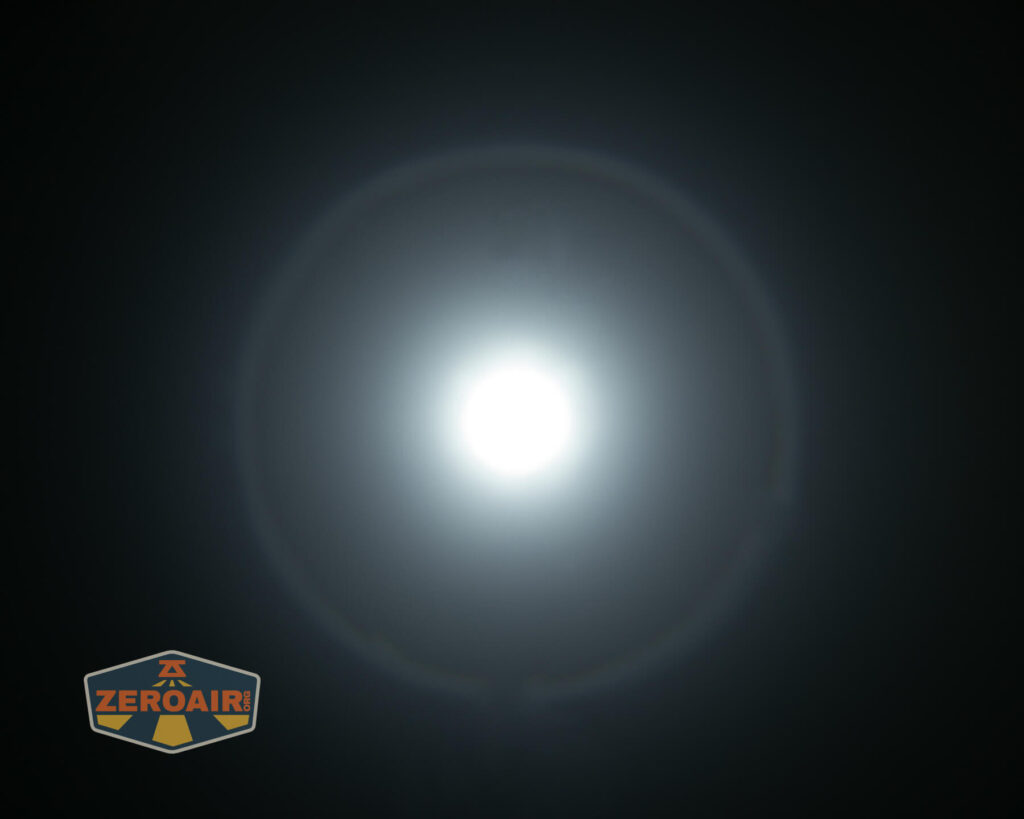
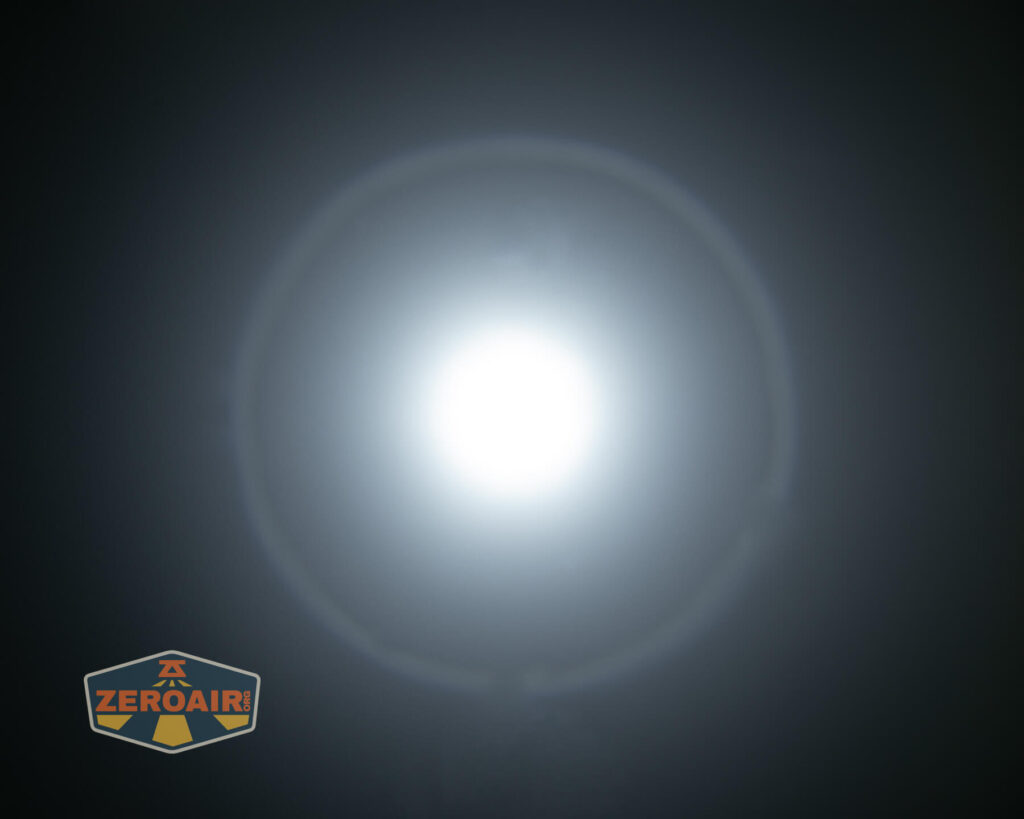
Tint vs BLF-348 (KillzoneFlashlights.com 219b version) (affiliate link)
I keep the test flashlight on the left and the BLF-348 reference flashlight on the right.


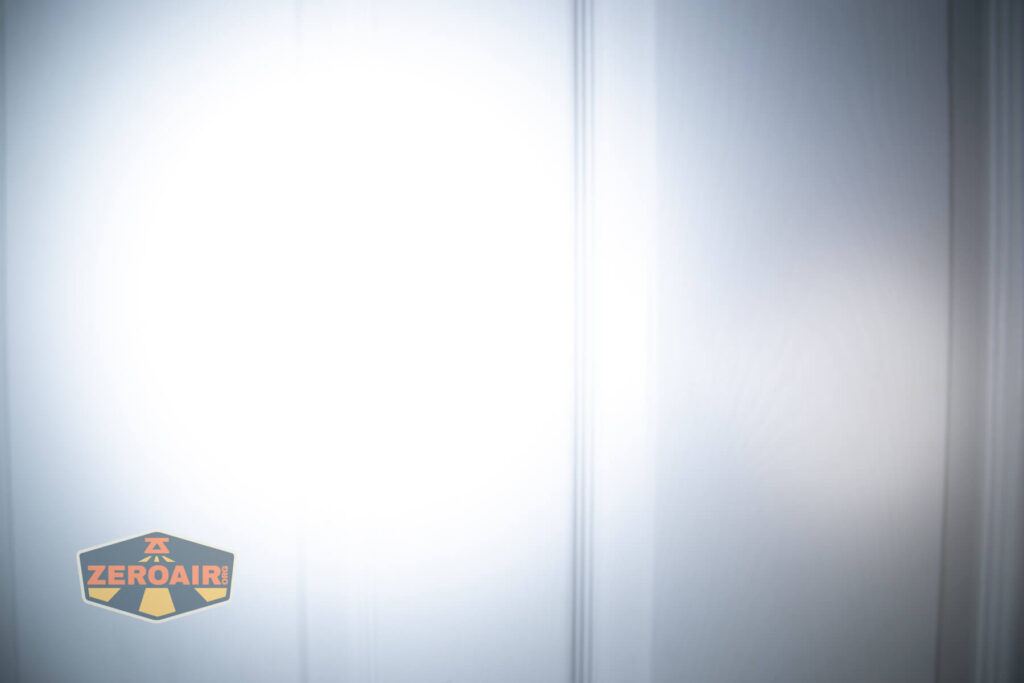

I compare everything to the KillzoneFlashlights.com 219b BLF-348 because it’s inexpensive and has the best tint!
Conclusion
What I like
- Great build quality
- Reasonable price
- Good user interface
- Nice implementation of dual switches (it’s a clean experience)
- Meets claim for throw
- USB-C charging works nicely
What I don’t like
- Does not come close to output specifications
- Very cool white
Notes
- This content originally appeared at zeroair.org. Please visit there for the best experience!
- Please use my Amazon.com referral link to help support zeroair.org!
- Please support me on Patreon! I deeply appreciate your support!
Another good review. My real problem with the lumens claim isn’t because I’m a lumen junkie. Around 150L is the most I ever really use. It’s the dishonestly. Just say it’s 1000L. I hate misleading marketing. I hate high turbo with fast step down, let alone not even making 50% of the output