

Fenix E-Lite Multipurpose Mini EDC Flashlight Review
Fenix released the E-Lite, a multipurpose EDC flashlight. This has a main white emitter, with blue and red secondary. Read on for testing!
Official Specs and Features
Here’s a link to the Fenix E-Lite Multipurpose Mini EDC flashlight product page.
Versions
There is just one version.
Price
The Fenix E-Lite Multipurpose Mini EDC flashlight is going for a reasonable $19.95.
Fenix E-Lite Multipurpose Mini EDC Flashlight Short Review
This is a fun little light. I like it much more than I guess I expected to. It’s fun to use, the secondary colors are useful, and the main emitter is much more usable like a flashlight than you probably guessed.
Long Review
The Big Table
| Fenix E-Lite Multipurpose Mini EDC Flashlight | |
|---|---|
| Emitter: | MATCH CA18 (And Red, Blue) |
| Price in USD at publication time: | $19.95 |
| Cell: | Internal |
| High Runtime Graph | Medium Runtime Graph |
| LVP? | Switches off |
| Switch Type: | E-Switch |
| Quiescent Current (mA): | ? |
| On-Board Charging? | Yes |
| Charge Port Type: | USB-C |
| Charge Graph | |
| Power off Charge Port | All modes |
| Claimed Lumens (lm) | 150 |
| Measured Lumens (at 30s) | 150 (100% of claim)^ |
| Candela per Lumen | 4.7 |
| Claimed Throw (m) | 40 |
| Candela (Calculated) in cd (at 30s) | 85lux @ 2.655m = 599cd |
| Throw (Calculated) (m) | 49.0 (122.5% of claim)^ |
| All my Fenix reviews! | |
^ Measurement disclaimer: Testing flashlights is my hobby. I use hobbyist-level equipment for testing, including some I made myself. Try not to get buried in the details of manufacturer specifications versus measurements recorded here; A certain amount of difference (say, 10 or 15%) is perfectly reasonable.
What’s Included in the Fenix E-Lite Multipurpose Mini EDC flashlight Package

- Fenix E-Lite Multipurpose Mini EDC flashlight
- Charge cable (USB to USB-C)
- Manual and paperwork
Package and Manual


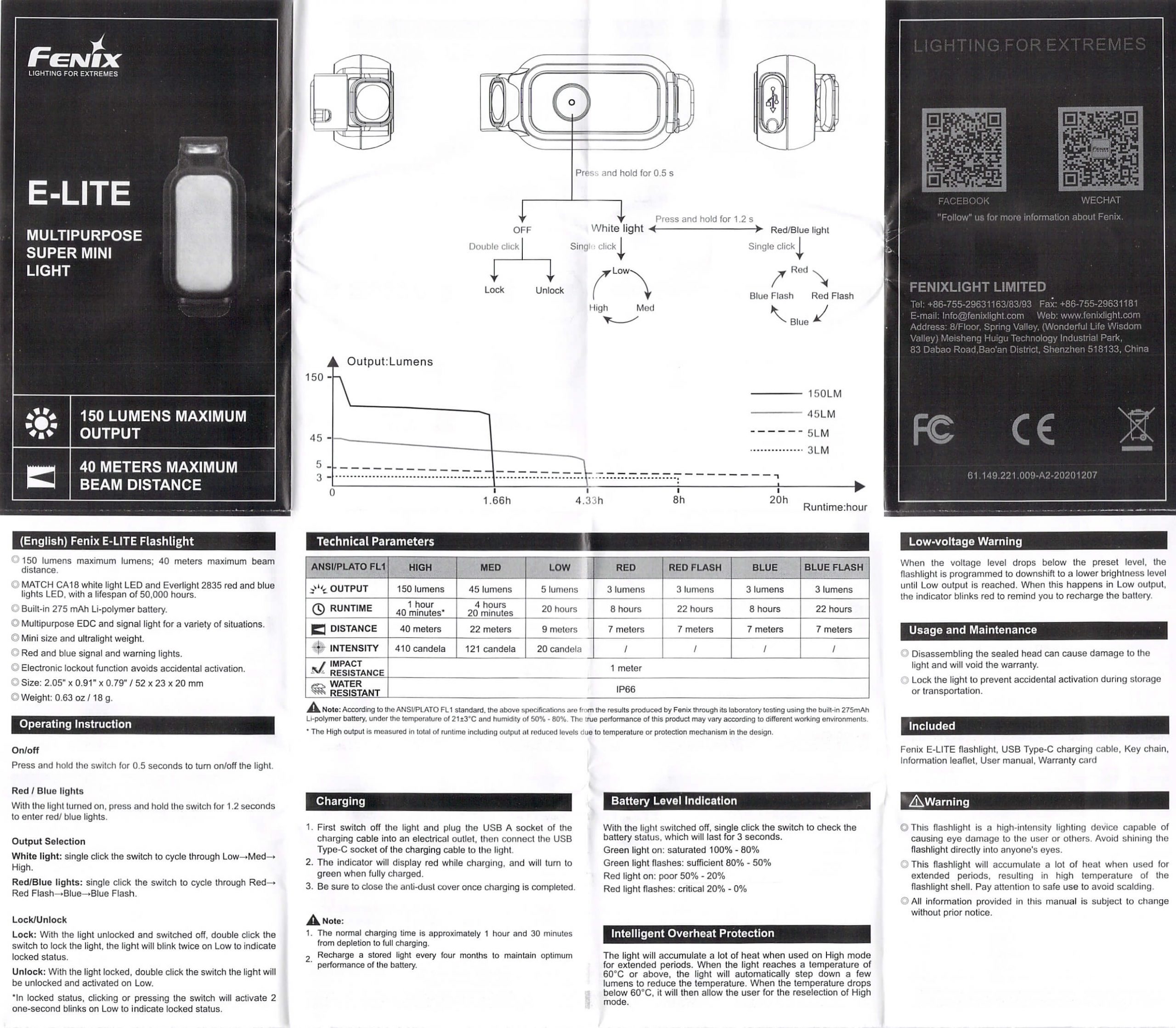
I commented on another post about the consistency of Fenix packages. Here’s support of that:


Build Quality and Disassembly
The body of the Fenix E-Lite Multipurpose Mini EDC flashlight is entirely plastic.

This white pad on the top is a soft (or “supple”) material, much like a diffusor you’ve probably seen very often.
The main emitter, though, is very much like a standard keychain flashlight style.


Overall the build quality is good. This light is IP66 rated, with I guess the weak point being the charge port. But I find it to be quite secure.
Size and Comps
- Length: 2.05″
- Width: 0.91″
- Depth: 0.79″
- Weight: 0.63 oz.


If the flashlight will headstand, I’ll show it here (usually the third photo). If the flashlight will tailstand, I’ll show that here, too (usually the fourth photo).


Here’s the test light with the venerable Convoy S2+. Mine’s a custom “baked” edition Nichia 219b triple. A very nice 18650 light.


And here’s the light beside my custom-engraved TorchLAB BOSS 35, an 18350 light. I reviewed the aluminum version of that light in both 35 and 70 formats.

Retention and Carry
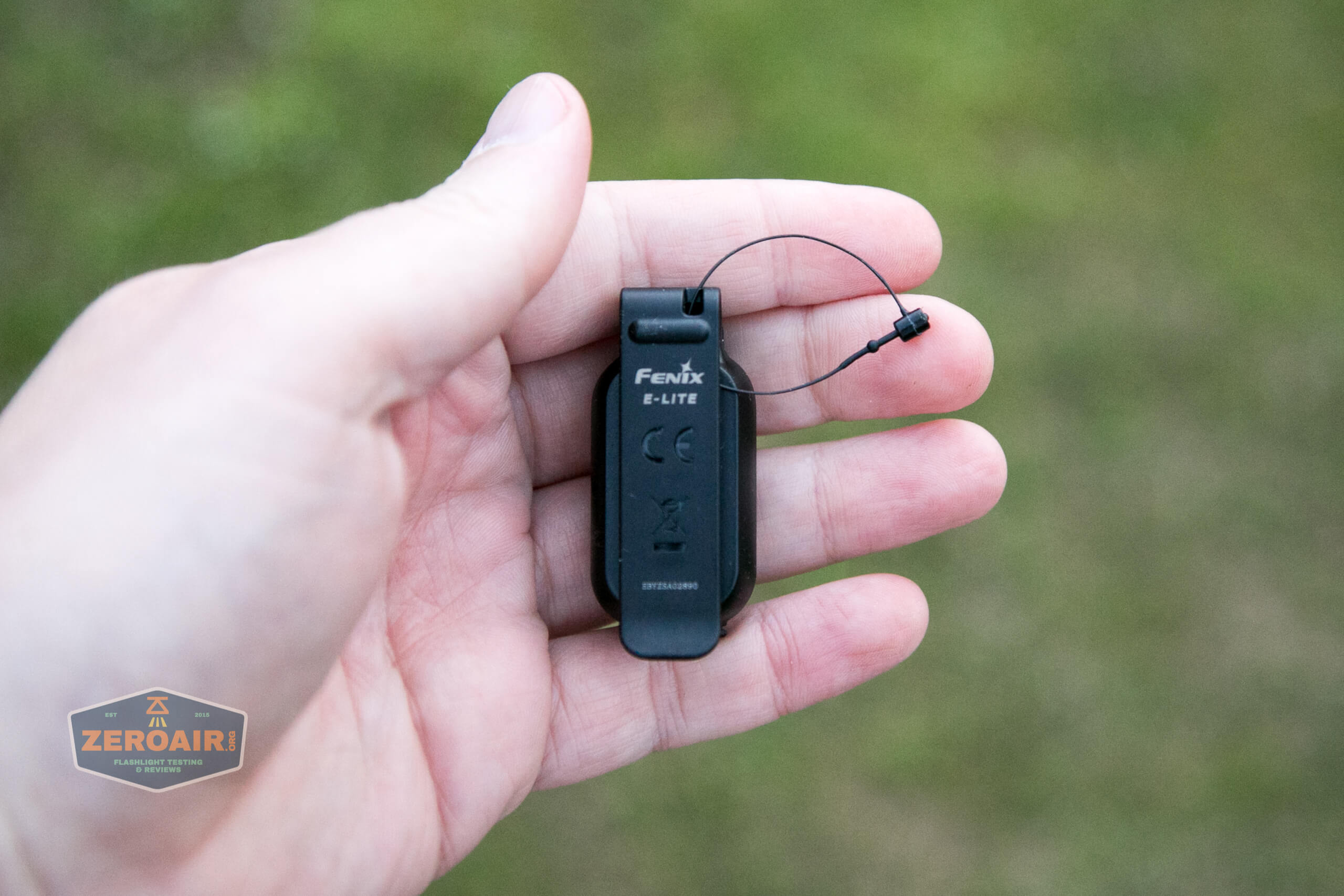
There’s a pocket clip built into the Fenix E-Lite. This is not removable
There’s a nice bit of flex with the clip.

This little loop here in the pocket clip can also be used for a lanyard or wrist strap.

Power and Runtime
Since I was unable to get the light apart, I am unsure what the battery looks like inside. In any case here are a couple of runtime tests. Unfortunately, I bumped the light around a couple of times in this test on high…. In reality, the output after stepping down would be completely flat.


Again, since the light is sealed, I was unable to test post-run voltage. The light does shut off at the end of the runtimes, though.
Charging
Charging happens via a USB-C port on the end of the body.


An appropriate cable is included – USB to USB-C.


Charging looks quite good at around 0.3A and requiring around an hour and a half.

While charging, the light indicates red, but not with the main red emitter. There’s a secondary emitter for indication. When charging is complete, a green indicating emitter stays lit.
Modes and Currents
| Mode | Mode Claimed Output (lm) | Claimed Runtime | Measured Lumens | Tailcap Amps |
|---|---|---|---|---|
| White – High | 150 | 1h40m | 150 | – |
| White – Medium | 45 | 4h20m | 45 | – |
| White – Low | 5 | 20h | – | – |
| Red | 3 | 22h | – | – |
| Blue | 3 | 22h | – | – |
Pulse Width Modulation
There is no PWM to be seen on any mode.


Here you can see a “baseline” – a chart with almost no light hitting the sensor.

Then there’s the Ultrafire WF-602C flashlight, which has some of the worst PWM I’ve seen. It’s so bad that I used a post about it to explain PWM! Here are multiple timescales (10ms, 5ms, 2ms, 1ms, 0.5ms, 0.2ms) to make comparing this “worst” PWM light to the test light easier. That post also explains why I didn’t test the WF-602C at the usual 50us scale.


User Interface and Operation
The Fenix E-Lite is controlled by an e-switch, which is under this supple pad on the top/front.

It’s very hard to see and I haven’t photographed it well, but there’s a little divot where you should press, and that divot is encircled by a raised ring. It’s very subtle though, but easy to feel.
Here’s a user interface table!
| State | Action | Result |
|---|---|---|
| Off | Click | Battery indicator |
| Off | Hold | On – White Low |
| Off | Double Click | Lock |
| Lock | Double Click | Unlock |
| On White | Click | Mode advance (LMH) |
| On | Brief Hold | Off |
| On White | Longer Hold | Red Steady (switch to secondary group) |
| Red Steady | Click | Mode advance (Red Steady > Red Flash > Blue Steady > Blue Flash) |
LED and Beam
Fenix opted for a Match CA18 for the E-Lite’s main emitter. I’ve only seen that in one other light I think, and that’s also a Fenix – the E03R.
This main emitter has a tiny TIR, and the beam is surprisingly tight and useful.
The secondary emitters – red and blue – aren’t mentioned by brand or model. In the far right photo, you can see the green indicating LED, too.


These beamshots always have the following settings: f8, ISO100, 0.3s shutter, and manual 5000K exposure. These photos are taken at floor level, and the beam hits the ceiling around 9 feet away.


Tint vs BLF-348 (KillzoneFlashlights.com 219b version) (affiliate link)
I keep the test flashlight on the left and the BLF-348 reference flashlight on the right.


I compare everything to the KillzoneFlashlights.com 219b BLF-348 because it’s inexpensive and has the best tint!
Conclusion
What I like
- Great for belt or backpack use
- Easy User Interface
- Actually useful main emitter
- USB-C Charging
- Low cost
What I don’t like
- Lack of replaceable battery
- No very low mode
- All plastic build
Notes
- This light was provided by Fenix-Store for review. I was not paid to write this review.
- This content originally appeared at zeroair.org. Please visit there for the best experience!
- For flashlight-related patches, stickers, and gear, head over to PhotonPhreaks.com!
- Please use my Amazon.com referral link to help support zeroair.org!