

Lumintop FWAA (Nichia) Flashlight Review
The Lumintop FWAA 14500 is available! It’s an FW series light and is is everything the other FW series lights are but has Anduril 2, too! Read on!
Official Specs and Features of the Lumintop FWAA 14500 Flashlight
Here’s a link to the Lumintop FWAA 14500 flashlight product page.
Lumintop FWAA 14500 Flashlight Versions
As of right now, there’s just one body of the Lumintop FWAA 14500 flashlight. We can expect others though (that’s not insider information, that’s just knowing how Lumintop did the other FW series lights.) In this one body you can have quite a few emitter options: Cree XP-G3 (6500K), Nichia 219c (3000K, 4000K, 5000K), and Luminus SST-20 (4000K).
Lumintop FWAA 14500 Flashlight Price
The going rate for the Lumintop FWAA 14500 flashlight at NealsGadgets.com is $45.95. That’s a referral link.
Short Review
Ok, I thought “eh, great another FW light.” But this little light is absolutely fantastic. You should note up front that it’s absolutely floody. If you’re ok with floody, then just stop reading and go buy one. If you’re only marginally ok with floody, then read on and see why I recommend the SST-20 version.
Long Review
The Big Table
| Lumintop FWAA 14500 Flashlight | |
|---|---|
| Emitter: | Nichia 219c (5000K) |
| Price in USD at publication time: | $45.95 |
| Cell: | 1×14500 |
| Turbo (Highest of Advanced UI) Runtime Graph | High Runtime Graph |
| LVP? | |
| Switch Type: | E-Switch |
| Quiescent Current (mA): | ? |
| On-Board Charging? | No |
| Claimed Lumens (lm) | 1200 |
| Measured Lumens (at 30s) | 866 (72.2% of claim)^ (see graph) |
| Candela per Lumen | 2.1 |
| Claimed Throw (m) | 95 |
| Candela (Calculated) in cd (at 30s) | 142lux @ 3.14m = 1400cd |
| Throw (Calculated) (m) | 74.8 (78.7% of claim)^ |
| All my Lumintop reviews! | |
^ Measurement disclaimer: Testing flashlights is my hobby. I use hobbyist-level equipment for testing, including some I made myself. Try not to get buried in the details of manufacturer specifications versus measurements recorded here; A certain amount of difference (say, 10 or 15%) is perfectly reasonable.
What’s Included

My package is not a production version, but you’ll certainly get everything seen here, and probably more (likely a manual).
- Lumintop FWAA 14500 Flashlight
- Tactical ring (installed)
- Pocket clip (two way)
- Lanyard
- Spare o-ring
Package and Manual

Again, my package is not a production version, but you’ll certainly get everything seen here, and probably more (likely a manual).
I was able to get a pdf manual, which you can see here. This is Andúril2!!

Build Quality and Disassembly

This little Lumintop FWAA 14500 flashlight feels like a very refined product. It should, there are so many other versions. But it just feels “right” – it’s a nicely finished flashlight.
Here’s the way the light ships – with the tactical ring installed. I only call it “the tactical ring” because that’s what it looks most like. I don’t think you’d really use this light tactically. But you do you?


Top-down! Yeah, we go top-down.


I’m really digging the knurling on this light. It’s extremely well done, and the anodizing on it is also perfect.

You might be inclined to think (as I very much was) that that white ring there is a glowing ring. It is not a glowing ring. It doesn’t glow no matter how much you want it to, or how much charge you give it or with what you charge it… It doesn’t glow. You’ll have to just stick with your personality for all the glow you need.

Notably, this really looks like an FW series light. In fact, in early photos (even until I actually had one in my hands) I didn’t realize the scale of this. Later in this post, you’ll see it better, I hope, and have all your questions answered.

Inside it’s a pretty typical FW light. There’s an inner sleeve, which provides signal to the tail-e-switch. The threads are square-cut and unanodized.

Both head and tail have springs. Neither are particularly robust.

Other users more knowledgeable than I am about drivers say that what Lumintop has about this is inaccurate. Lumintop says it’s a “FET+7+1 driver.” But users who have disassembled (and in fact emitter swapped) this light say it’s a FET+1.
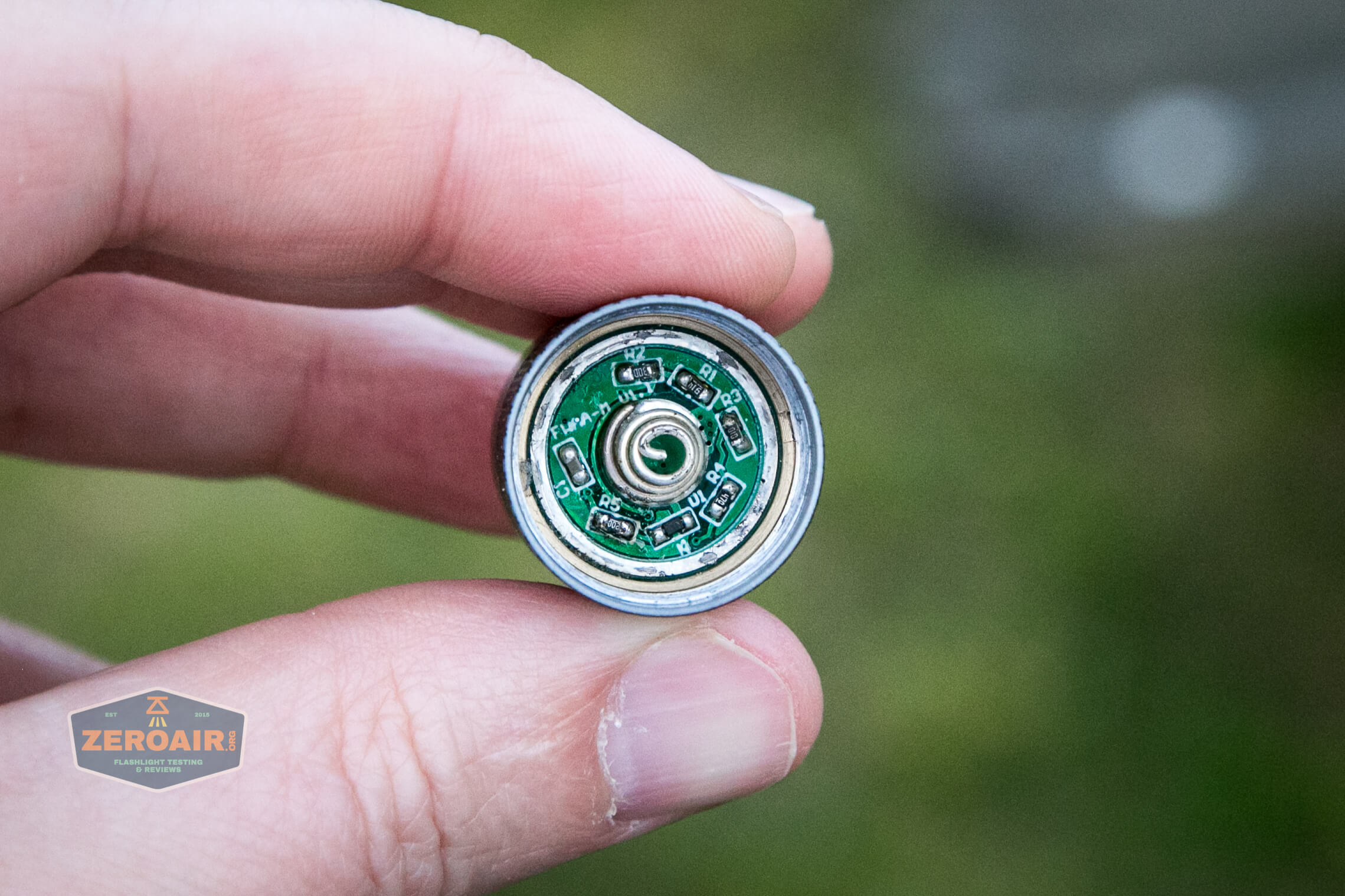
By taking off the head is likely the way you’ll want to swap the cells.

This is just a historical way; in early FW lights the tailcap parts could fall out when the tailcap was removed. But on this model (and really, most other FW’s), that’s fixed. So you could swap the cell through the tail end, but you run into other issues, possibly.

Namely, if you remove the tailcap (which you can see below) to swap the cells, you’ll still need to back the head off (loosen it), then tighten the tailcap fully (fully), then tighten the head. This is the right order.

One minor complaint about this light is just how easy the bezel unscrews. It’s not lose, but if you aren’t careful, when removing the head you’ll also loosen the bezel. You’ll be able to avoid that with some practice, and I’d much rather have the bezel removable than threadlocked, so it’s still ok.

The optic sits atop the front edge of the body.
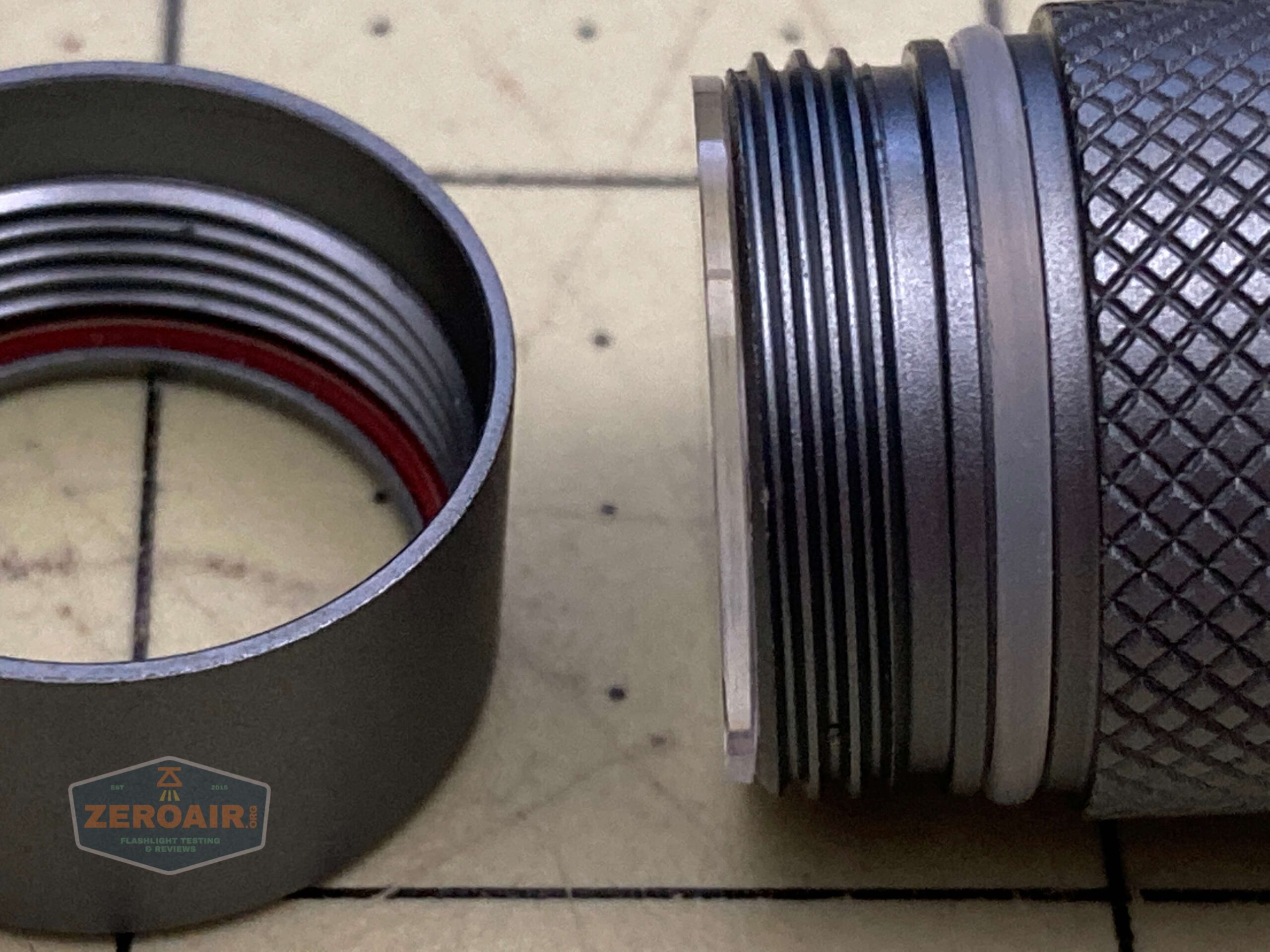

Optic edge to edge – and remember, this sits over the body.

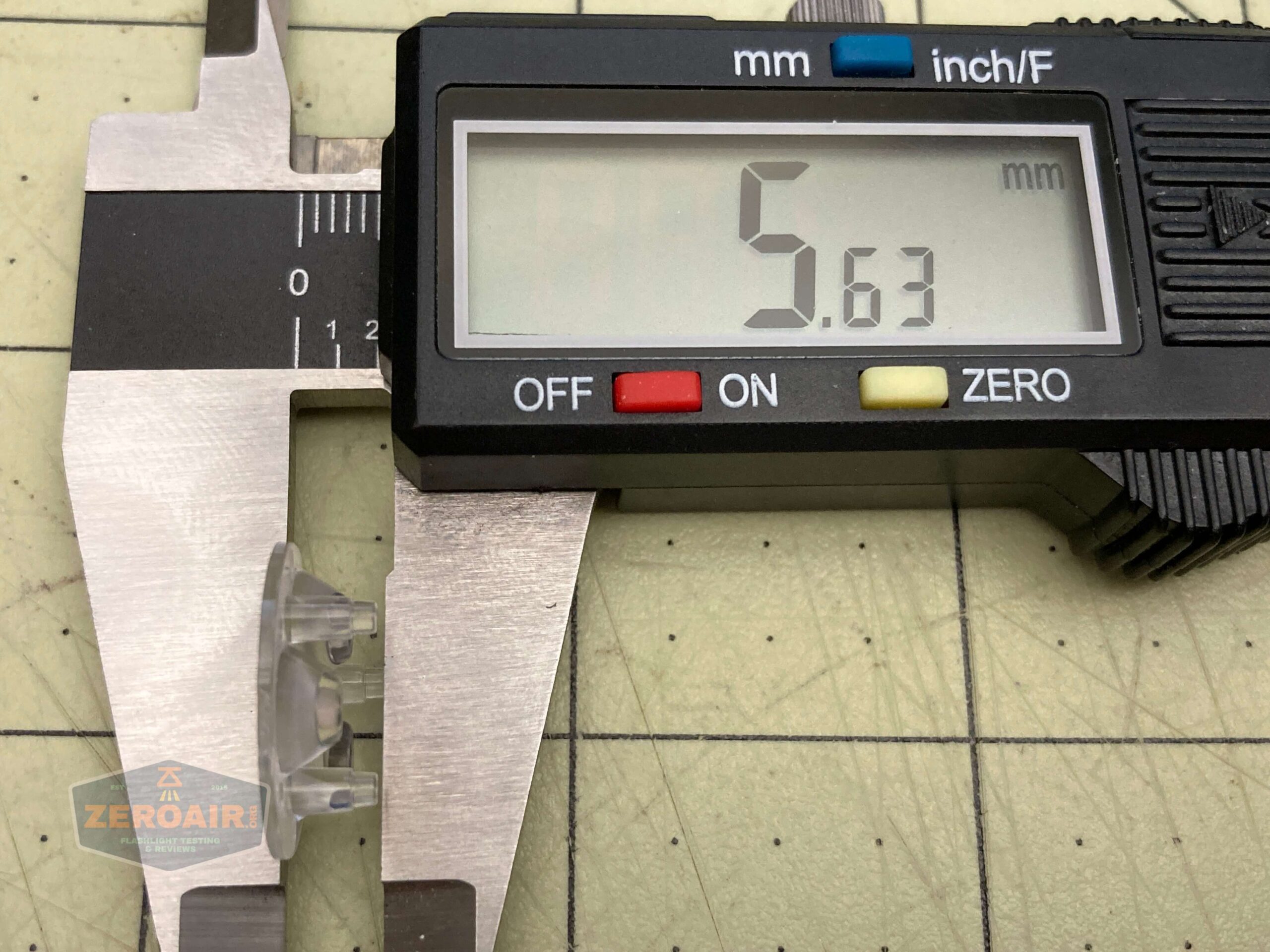
The inner diameter of the body:

Size and Comps
Weight: Approximately 30.5 g without cells
Size: 20.5 mm Ø head x 70.9 mm length.

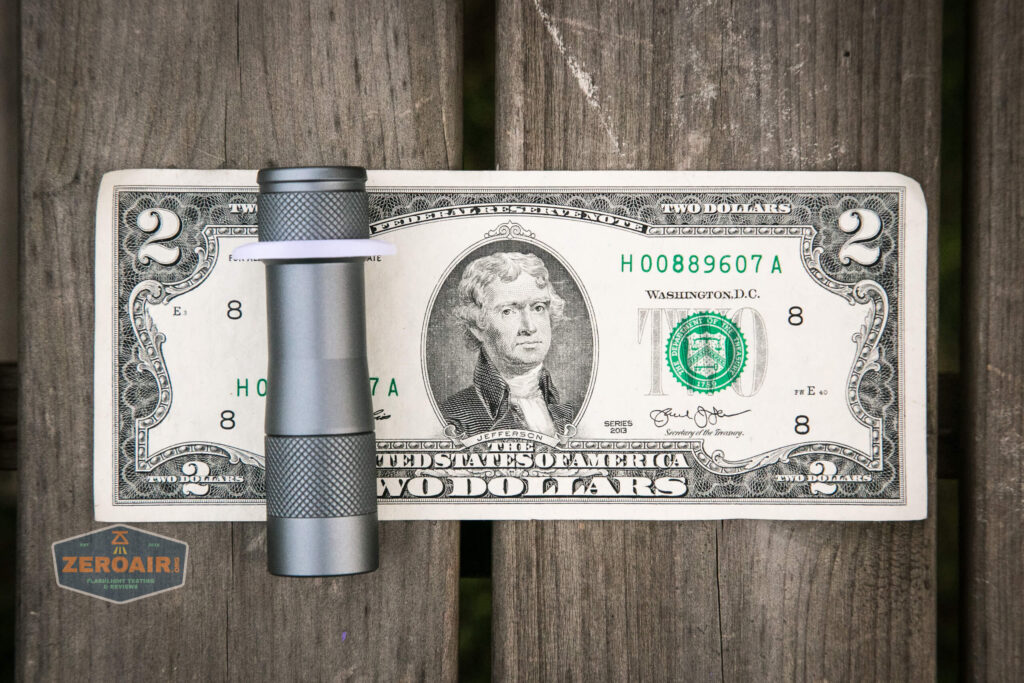


If the flashlight will headstand, I’ll show it here (usually the third photo). If the flashlight will tailstand, I’ll show that here, too (usually the fourth photo).


Here’s the test light with the venerable Convoy S2+. Mine’s a custom “baked” edition Nichia 219b triple. A very nice 18650 light.

And here’s the light beside my custom-engraved TorchLAB BOSS 35, an 18350 light. I reviewed the aluminum version of that light in both 35 and 70 formats.

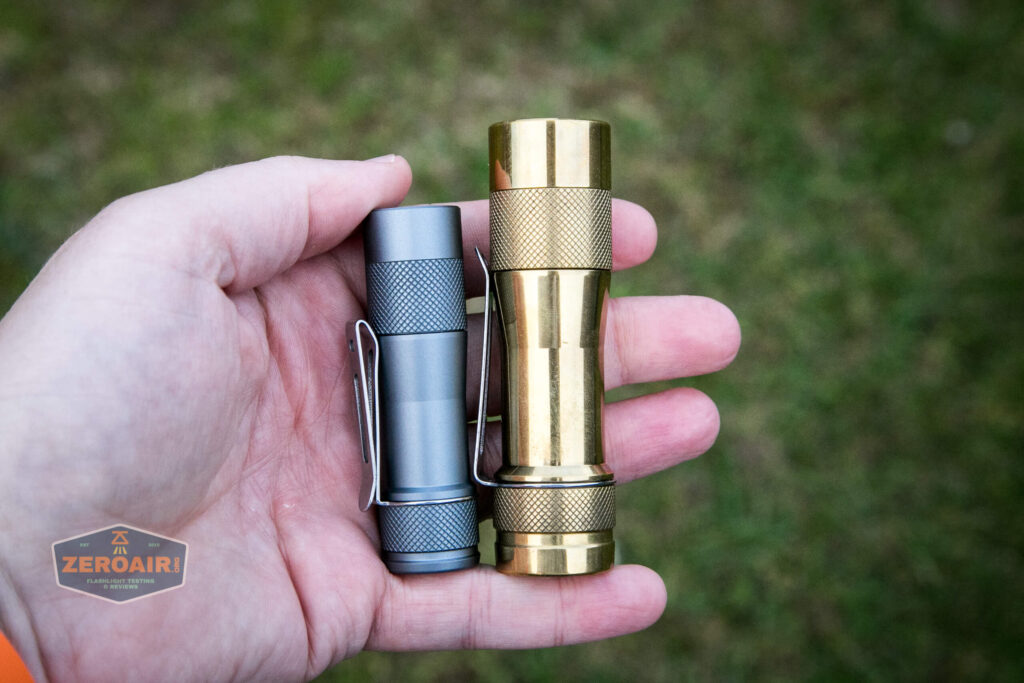
Here’s the Lumintop FWAA 14500 flashlight beside the other most comparable light. I wanted to compare the FWAA to another gray, but the only 3 I could find were all single emitters, and I thought less comparable. So I went with this beautiful brass (which I love). I reviewed that one here: Lumintop FW3C Brass.


And a couple of in-hand photos. The FWAA really is smaller, despite non-scaled photos indicating otherwise.

Retention and Carry
Shipped installed on the Lumintop FWAA 14500 flashlight is this “tactical” plastic ring. It’s on the tail end (and only on the tail end), and has two lanyard holes on both sides.

This ring spins more or less freely but is absolutely excellent for a place to grab for thumb pressing the switch. The rings are where you’d likely want to attach the included lanyard, too.
Also included is this two-way pocket clip. This replaces the tactical ring, and the two can’t be used concurrently.


At least… they can’t be used concurrently on the tail end. The pocket clip can actually fit between the knurling and the bezel, and in that case, the tactical ring can be used at the same time.

You can see that the clip is a two-way clip, and absolutely not my favorite kind. But it’s a collar clip, which I do like. All in all, it’s a wash I guess. Collar clips are so much more reliable (they’d have to break in order to come off). The clip has at least a couple of places to mount the lanyard too.

I don’t know that the “bezel side” is the best place for the pocket clip, but it really fits well there. That setup provides better “hatlight” usage, too.
Power and Runtime
The Lumintop FWAA flashlight is powered by a single lithium-ion cell. The size is 14500. I found that both my button top and flat tops worked fine but I really only had the gold Vapcell you see below in flat/button formats. So really the same cell. This light does not support 1.5V cells!
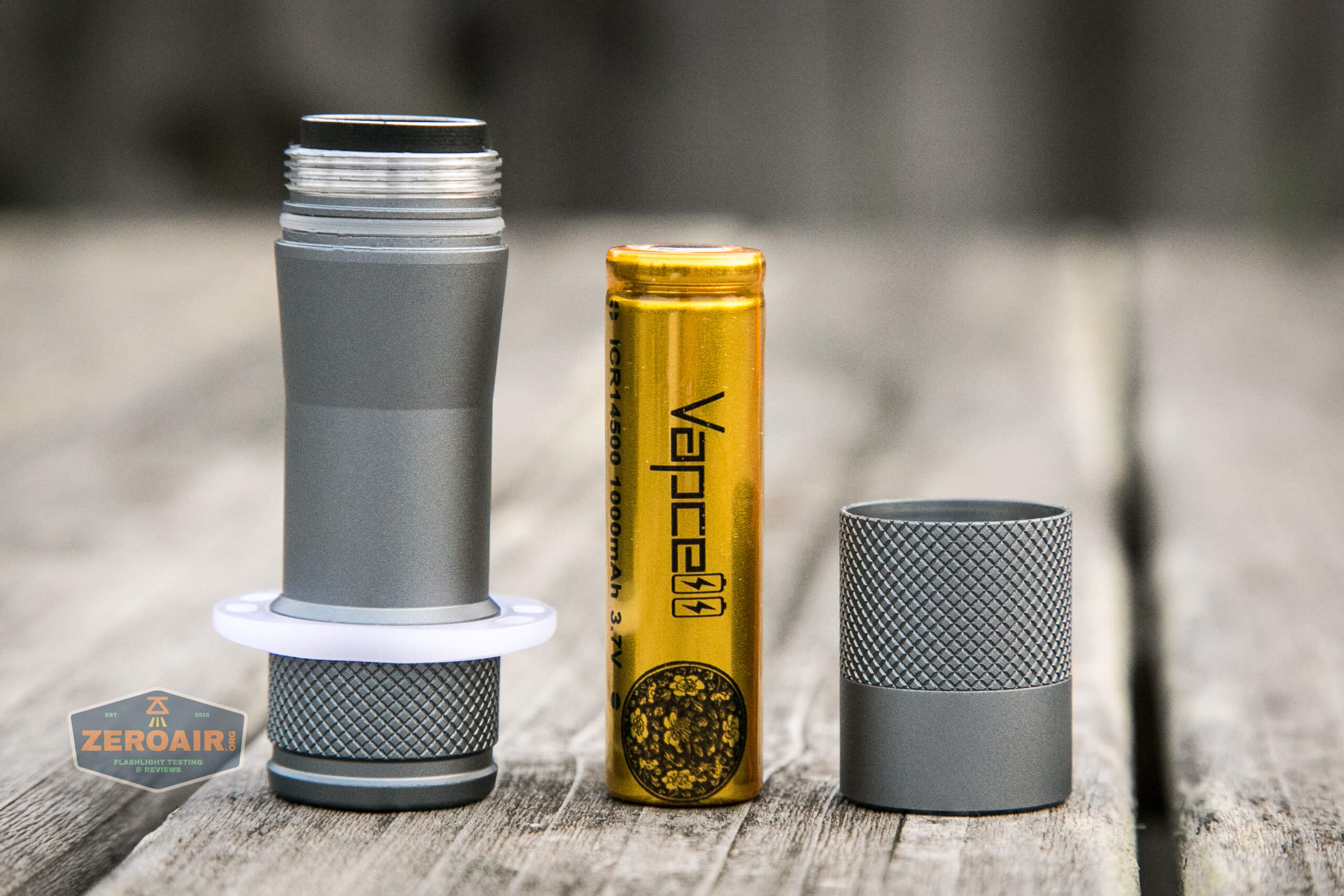
Put the cell in the normal way – positive toward head.

Flat or button, Lumintop does specify a max cell length: 50.5mm.
Here are a bunch of runtimes. There are a couple of user interfaces. More on that later but the light ships in “Simple UI” so I tested that with one runtime. Also, that’s the default UI, so that’s what I’m showing first. In the Lumintop manual, this output level is described as the “highest level” (for Simple UI). I think ToyKeeper describes this more clearly, calling it the “Ceiling Level.” I think this is the highest level that doesn’t incorporate the FET output.
I have these graphs labeled at 4000K, but I believe the light is actually 5000K. (There was no label on the package to indicate.)

There’s also an Advanced UI. If you’re reading this, then you’ll likely have already switched your FWAA 14500 flashlight to the Advanced UI. Here are some runtimes from that. I tested the stepped levels. Also yes the max level here is 1831 lumens and on the Simple user interface the max is over 1900 lumens – don’t think there’s really any difference here. This is probably the difference in using a different cell for the test (I have a number of these Vapcell button tops that were used.)


We know Andúril2 has low voltage protection, but the output switches to very low and I stopped the test at that point. Output will maintain for a while (but would really skew the graphs and so it’s not a worthwhile exercise to show.)
Pulse Width Modulation
I’ve done mostly the same thing here that I do with other Andúril lights – the lowest mode (far left) is the lowest of ramping. Because that’s much lower than the lowest stepped mode (annoying!). Then from second photo to the far right is each of the stepped modes (with the far right being the “double click to turbo” mode). All modes except the highest have PWM (again, not a surprise for Andúril, and doesn’t look to have been sped up for Andúril2.


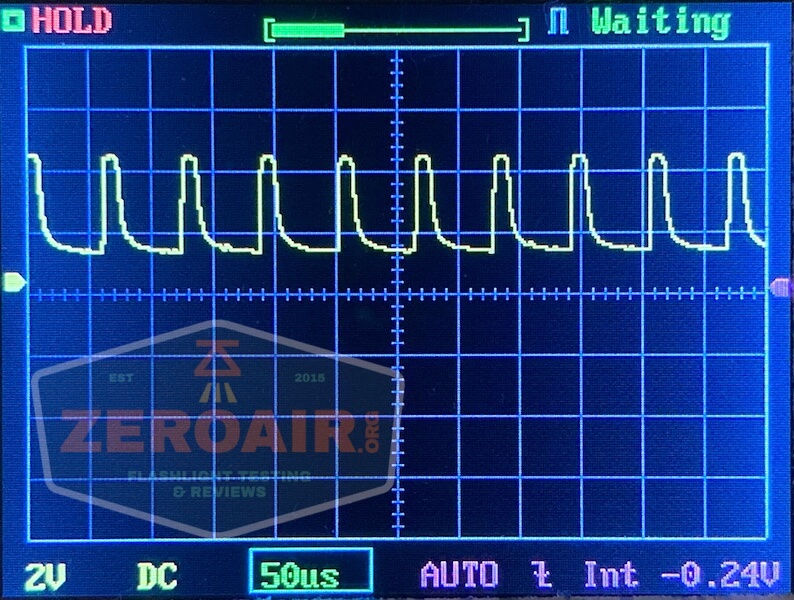
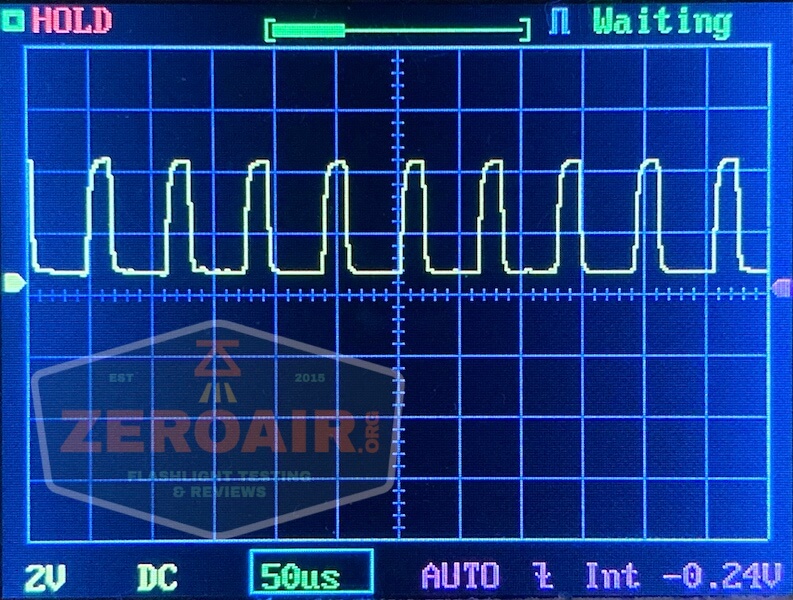


Here you can see a “baseline” – a chart with almost no light hitting the sensor.

Then there’s the Ultrafire WF-602C flashlight, which has some of the worst PWM I’ve seen. It’s so bad that I used a post about it to explain PWM! Here are multiple timescales (10ms, 5ms, 2ms, 1ms, 0.5ms, 0.2ms) to make comparing this “worst” PWM light to the test light easier. That post also explains why I didn’t test the WF-602C at the usual 50us scale.


User Interface and Operation
There’s a single switch for interacting with the Lumintop FWAA 14500 flashlight. It’s an e-switch, with a big metal button.

Reminder of this photo from above:

I didn’t get my calipers to exactly measure these, but practically speaking the button on the FWAA is the same size as the button on the FW3C (aka all the FW lights). That’s really pretty much a coup for button size – that makes the button very easy to get at, easy to use, and prominent without being proud. I love it.
Anyway, Andúril2. I love it, I think it’s an improvement over the first iteration(s). There are some things some users might not love about it, but I think overall it’s much more approachable. I will note though that the nomenclature might be a bit confusing – the light (all lights with Andúril2) ships in Simple UI. This is not Muggle Mode. You may think “well duh” and by now you’ve already seen the blistering runtime on turbo of Simple, so you get it. But just be aware, don’t hand this light to the uninitiated thinking they won’t set their hand on fire while using Simple UI. Here is where I’d tell you how to switch to muggle mode. There is no muggle mode.
The action is very low, and if you have problems with the other FW – well the action here is the same.


First let me remind you of the manual provided by Lumintop:
This may really be your jam. I find it almost useful. But….
Here’s a user interface table! This table is directly from ToyKeeper’s Andúril2 manual, which you can view here:
http://toykeeper.net/torches/fsm/anduril2/anduril-manual.txt
I am putting this in a table here with ToyKeeper’s permission. Thanks TK! This is so much better than me writing it, because it’s more reliable, and I completely trust it’s accuracy (at least, if I can paste accurately). I’m breaking it up a little differently than ToyKeeper did, though I certainly understand why it was done her way originally.
First, the table for Either User Interface. These actions work whether you’re in Simple or Advanced UI.
| State | Action | Result |
|---|---|---|
| Off | 1C | On (ramp mode, memorized level) |
| Off | 1H | On (ramp mode, floor level) |
| Off | 2C | On (ramp mode, ceiling level) |
| Off | 3C | Battcheck mode |
| Off | 4C | Lockout mode |
| Off | 13H | Factory reset (on some lights) |
| Off | 15+C | Version check (202019270312 on this light) |
| Ramp | 1C | Off |
| Ramp | 1H | Ramp (up, with reversing) |
| Ramp | 2H | Ramp (down) |
| Ramp | 3H | Tint ramping (on some lights) |
| Ramp | 3H | Momentary turbo (on lights without tint ramping) |
| Ramp | 4C | Lockout mode |
| Lockout | 1C/1H | Momentary moon (lowest floor) |
| Lockout | 2C/2H | Momentary moon (highest floor, or manual mem level) |
| Lockout | 4C | On (ramp mode, memorized level) |
| Lockout | 4H | On (ramp mode, floor level) |
| Lockout | 5C | On (ramp mode, ceiling level) |
| Batt check | 1C | Off |
A table for only Simple User Interface:
| State | Action | Result |
|---|---|---|
| Off | 2H | On (momentary ceiling level) |
| Off | 10H | Disable Simple UI |
| Ramp | 2C | Go to/from ceiling |
A table for only Advanced (aka “Full”) User Interface:
| State | Action | Result |
|---|---|---|
| Off | 2H | On (momentary turbo) |
| Off | 3H | Strobe mode (whichever was used last) |
| Off | 5C | Momentary mode |
| Off | 7C | Aux LEDs: Next pattern |
| Off | 7H | Aux LEDs: Next color |
| Off | 10C | Enable Simple UI |
| Off | 10H | Simple user interface ramp config menu (1: floor, 2: ceiling, [3: steps]) |
| Ramp | 2C | Go to/from ceiling (or turbo if at ceil already) |
| Ramp | 3C | Change ramp style (smooth / stepped) |
| Ramp | 5C | Momentary mode |
| Ramp | 5H | Sunset timer on, and add 5 minutes |
| Ramp | 7H | Ramp config menu (1: floor, 2: ceiling, [3: steps]) |
| Ramp | 10C | Turn on manual memory and save current brightness |
| Ramp | 10H | Manual memory config menu (1: off, 2: set timeout) |
| Lockout | 7C | Aux LEDs: Next pattern |
| Lockout | 7H | Aux LEDs: Next color |
| Lockout | 10H | Auto-lock config menu (1: set timeout) |
| Strobe (any) | 1C | Off |
| Strobe (any) | 2C | Next strobe mode |
| Strobe (any) | 3H | Tint ramping (on some lights) |
| Strobe (any) | 5C | Momentary mode (using current strobe) |
| Candle | 1H/2H | Brighter / dimmer |
| Candle | 5H | Sunset timer on, add 5 minutes |
| Party strobe | 1H/2H | Faster / slower |
| Tactical strobe | 1H/2H | Faster / slower |
| Biking | 1H/2H | Brighter / dimmer |
| Lightning | 1H | Interrupt current flash or start new one |
| Batt check | 2C | Next blinky mode (Temp check, Beacon, SOS) |
| Batt check | 7H | Voltage config menu |
| Temp check | 1C | Off |
| Temp check | 2C | Next blinky mode (Beacon, SOS, Batt check) |
| Temp check | 7H | Thermal config menu |
| Beacon | 1C | Off |
| Beacon | 1H | Configure beacon timing |
| Beacon | 2C | Next blinky mode (SOS, Batt check, Temp check) |
| SOS | 1C | Off |
| SOS | 2C | Next blinky mode (Batt check, Temp check, Beacon) |
| Momentary | Any | On (until button is released) |
| Momentary | Disconnect power | Exit Momentary mode |
| Config menus | Hold | Skip current item with no changes |
| Config menus | Release | Configure current item |
| Number entry | Click | Add 1 to value for current item |
To be completely honest, I’m not entirely sure yet what’s the best way to tell if you’re in Simple user interface or Advanced UI. Based on what I see here and with the light in hand, I think the fewest-clicks way will be 3 clicks from on (technically “Ramp” in the table, but I think “On” is accurate.) This action – 3C from Ramp – in Advanced user interface will iterate smooth or stepped. In Simple UI, this action will do nothing. There are other ways, though. For example double clicking from the top of the ramp will either do nothing or go to Turbo. If it does nothing, then you’re in Simple. If it goes to 11, then you’re in Advanced.
LED and Beam
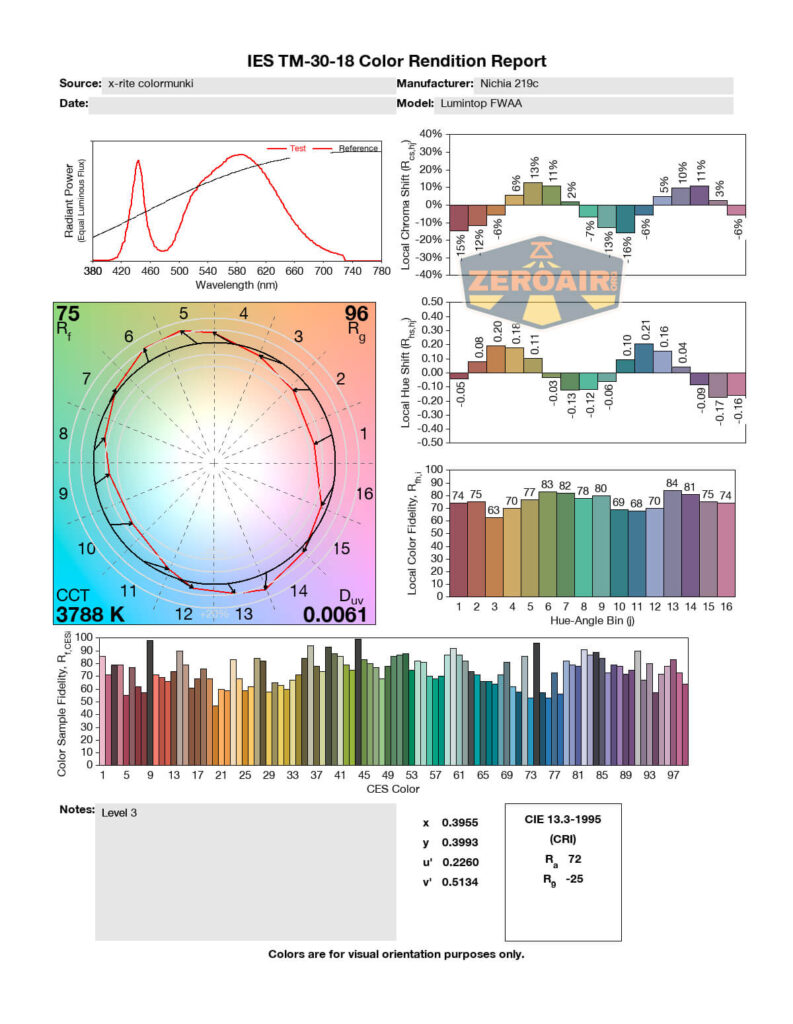
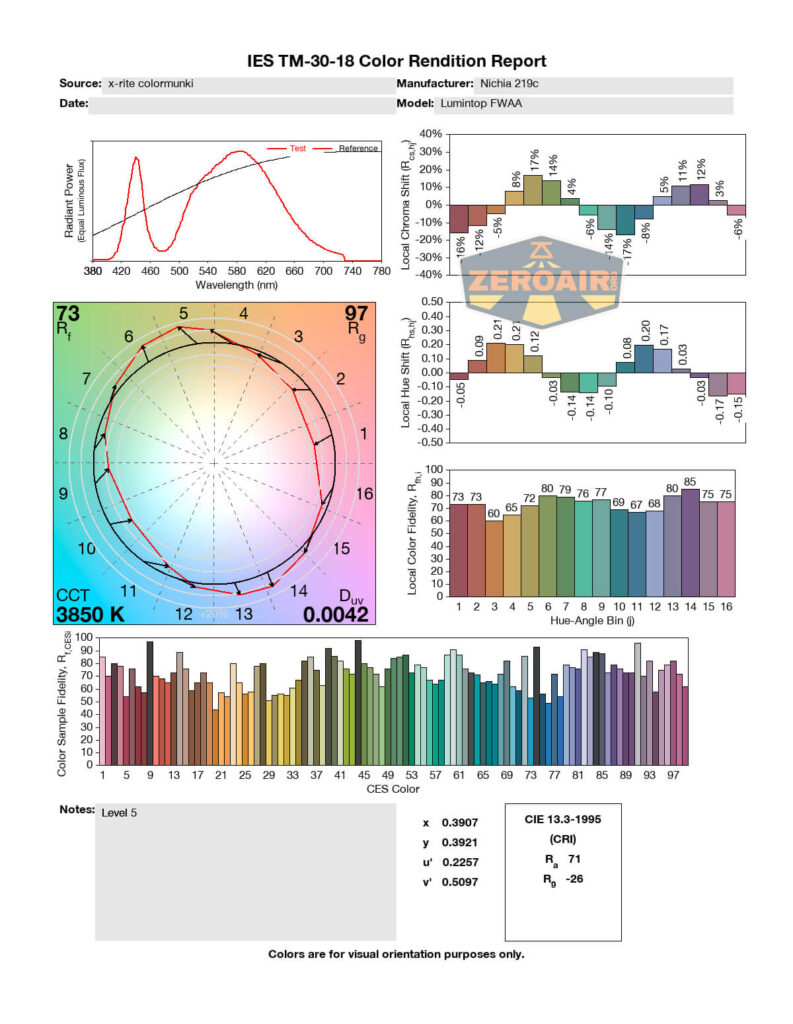
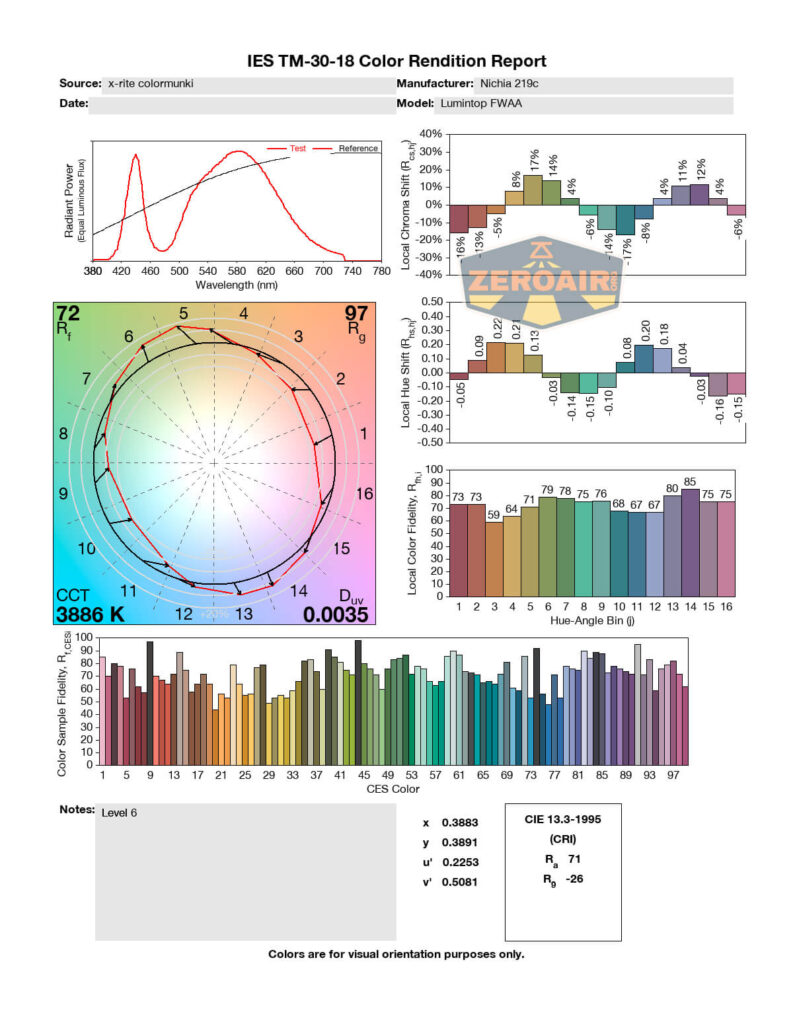
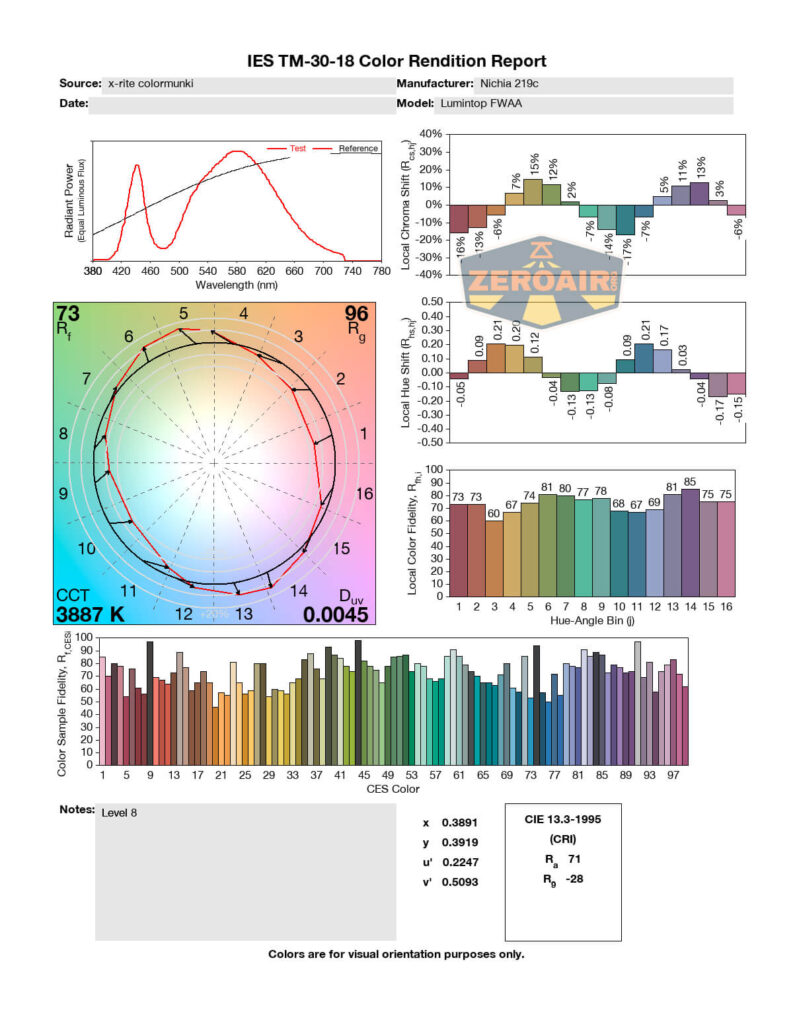
This is a triple emitter light – there are three emitters. Mine is a Nichia version, but I wasn’t told what Kelvin was shipped (and there was no package, so the package didn’t say). Based on having another FWAA that is labeled as 4000K, this is almost certainly 5000K.
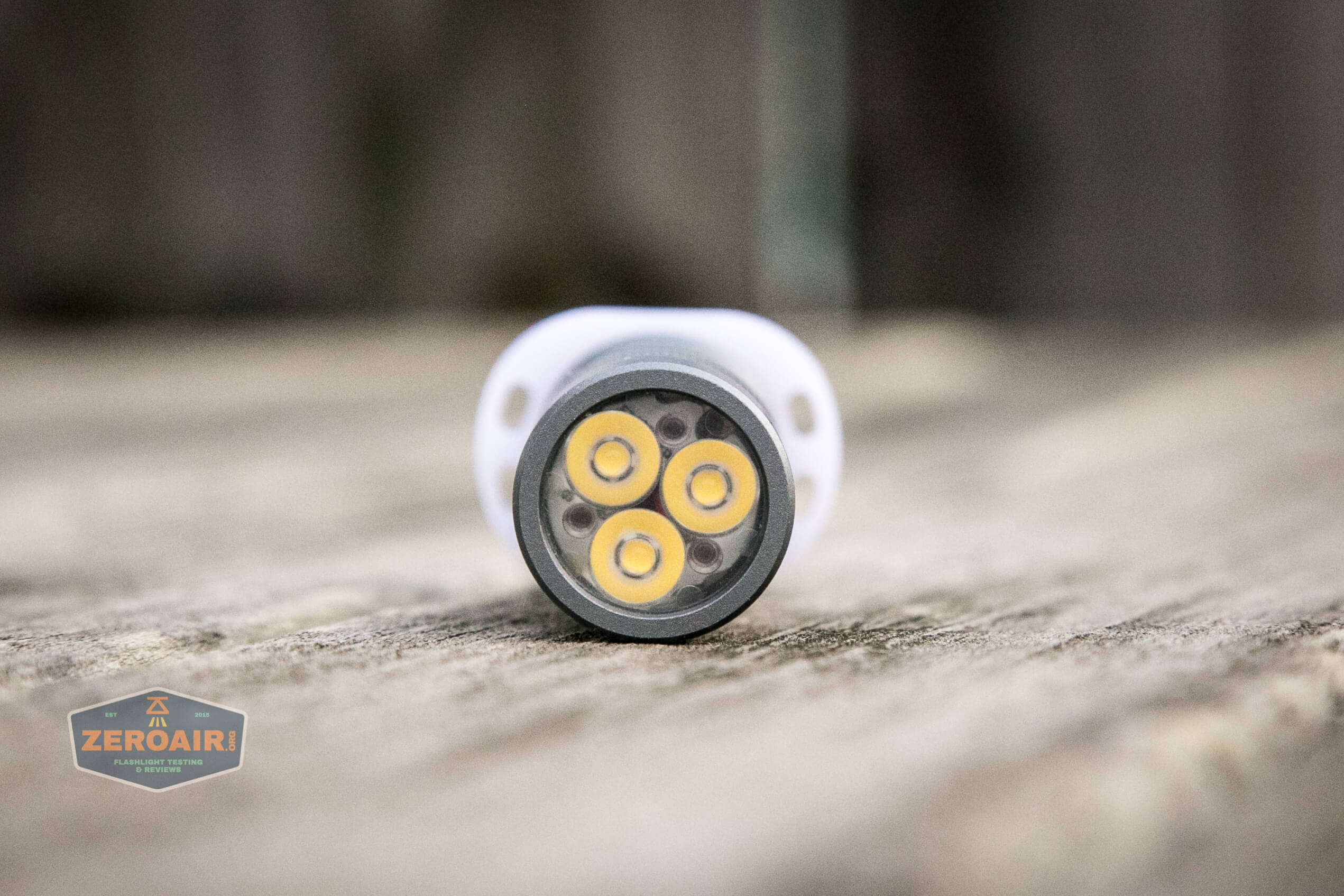
The optic is around 17mm, and I couldn’t find a single replacement anywhere for it. It’s a very floody optic (see the table up top for cd/lm). Very floody.


It’s so floody in fact, that I’d recommend the Luminus SST-20 (4000K) emitters just because they’ll throw better. Might just be “marginally better” but if you’re on the fence about your choices, this is your answer.

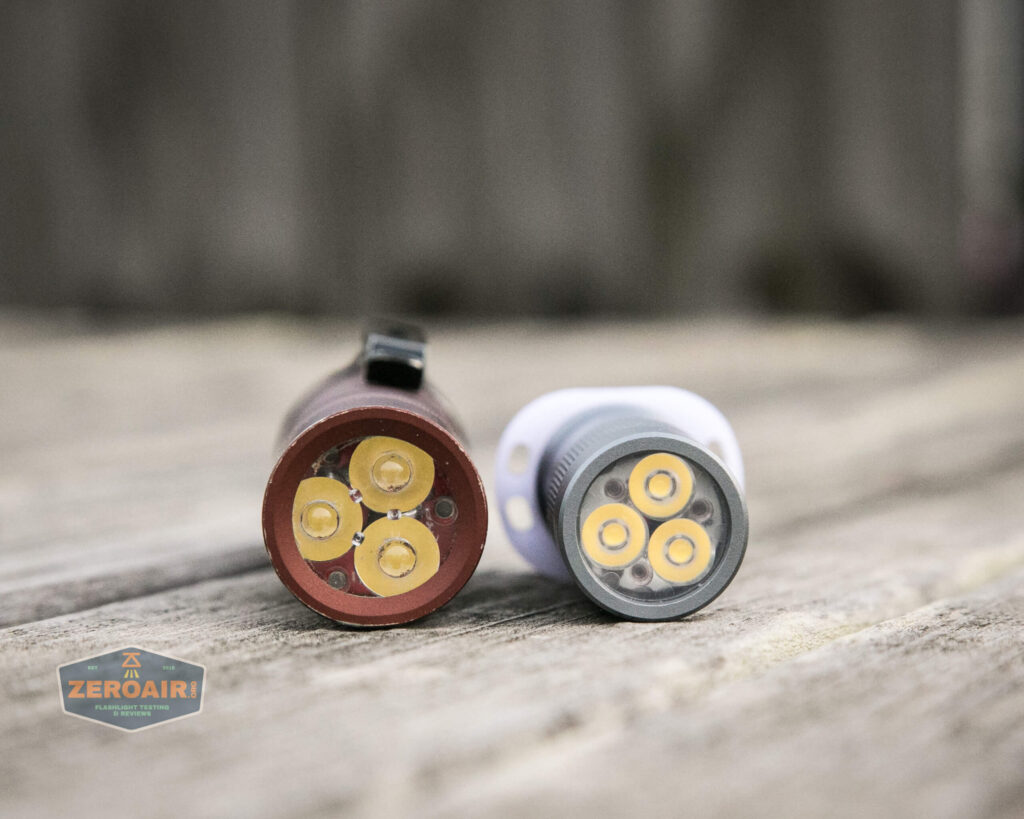
Here are these Nichia 219c emitters exposed. But that’s not what this photo is actually about…. check out just how thick that MCPCB is. I would guess that’s probably 3mm depth of copper!

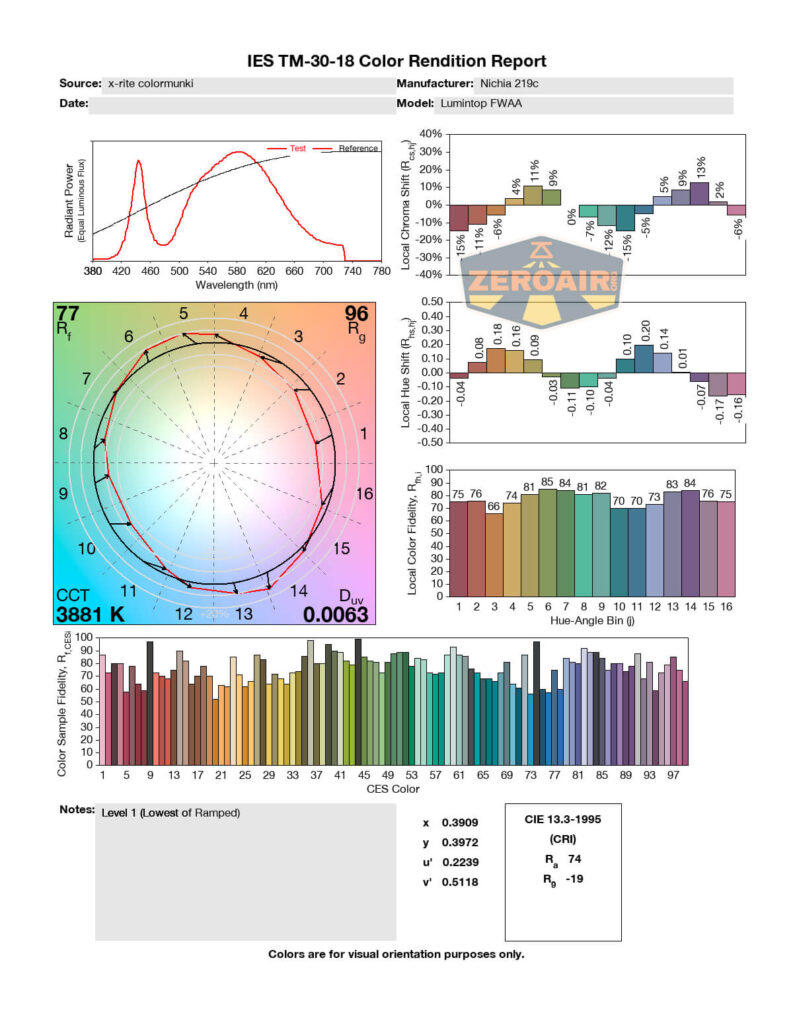
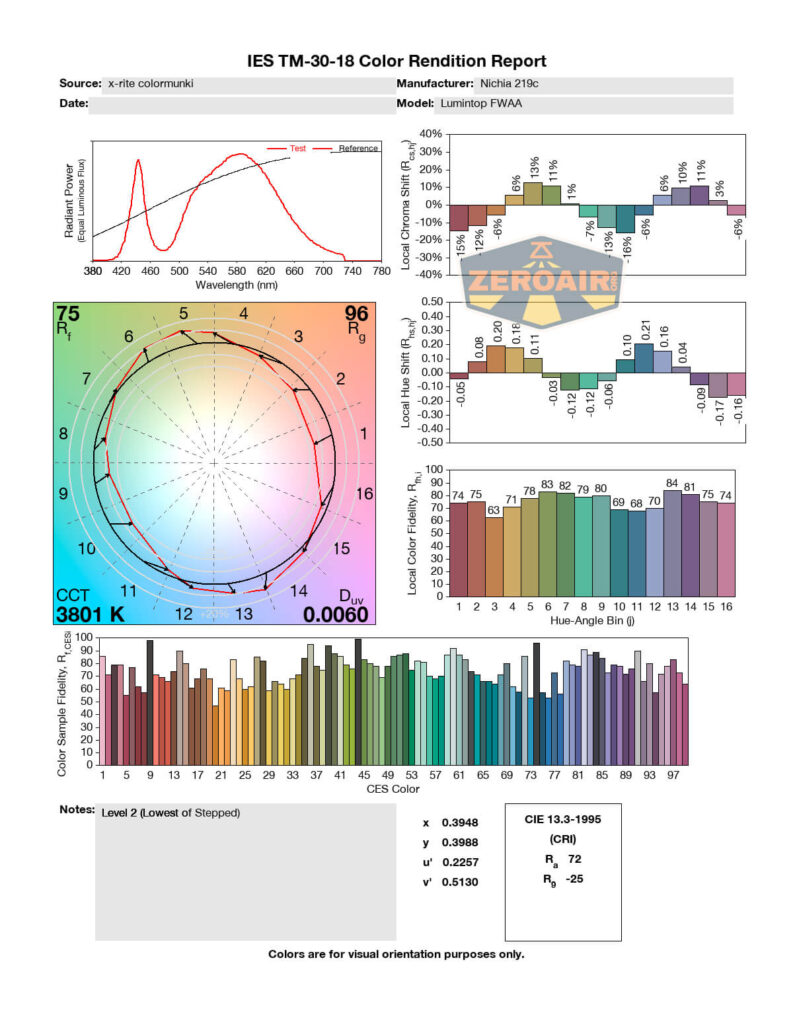
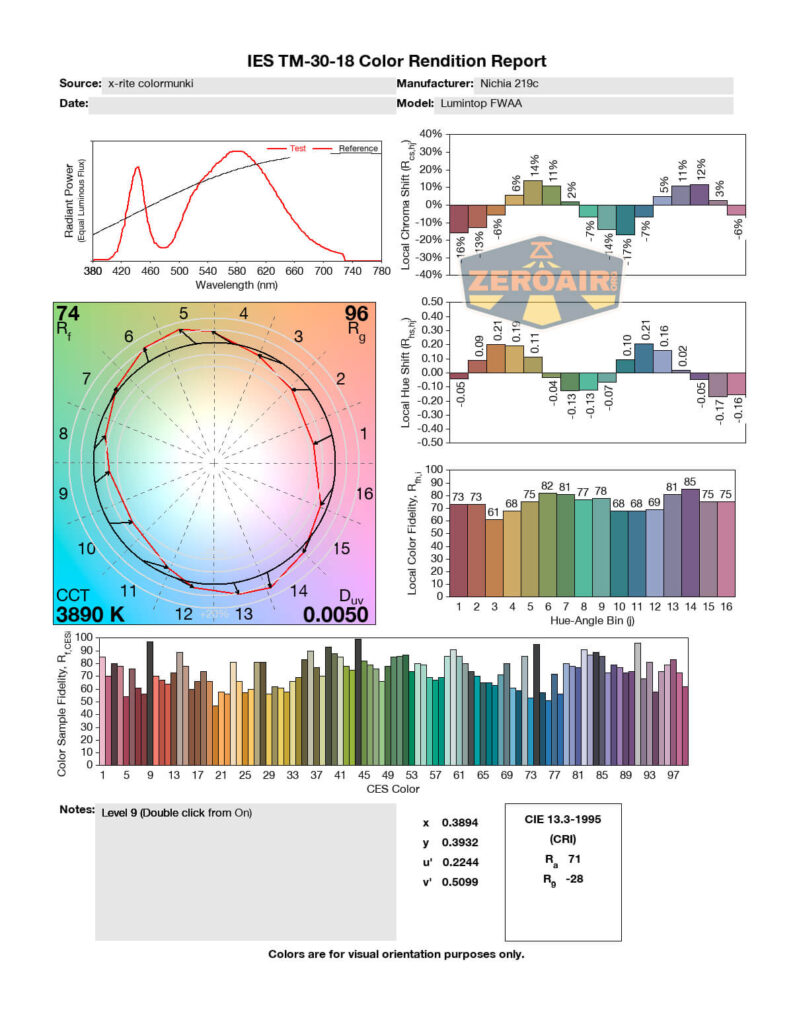
LED Color Report (CRI and CCT)


Beamshots
These beamshots always have the following settings: f8, ISO100, 0.3s shutter, and manual 5000K exposure. These photos are taken at floor level, and the beam hits the ceiling around 9 feet away.








Tint vs BLF-348 (KillzoneFlashlights.com 219b version) (affiliate link)
I keep the test flashlight on the left and the BLF-348 reference flashlight on the right.




I compare everything to the KillzoneFlashlights.com 219b BLF-348 because it’s inexpensive and has the best tint!
Conclusion
What I like
- It’s a small FW series light!
- Works with Button and Flat top 14500 cells
- Output is really massive
- Pocket clip can go on the head as well as the tail
- Collar clips are great!
- Nichia emitter options
- Warm emitter options
- Andúril2!!
What I don’t like
- Steps down before the official specs can be met (though I don’t really think that’s necessarily a bad thing – there’d be a lot of heat to manage…. (so lower the specs)).
- Two-way pocket clip
- Very floody, and no narrow 17mm optic replacements available
- PWM
- Doesn’t support AA (1.5V) cells. I can kind of allow this, but it’s worth mentioning.
Notes
- This light was provided by NealsGadgets.com for review. I was not paid to write this review.
- This content originally appeared at zeroair.org. Please visit there for the best experience!
- For flashlight-related patches, stickers, and gear, head over to PhotonPhreaks.com!
- Please use my Amazon.com referral link to help support zeroair.org!
- I invite you to support me on Patreon. Feeding all these lights is expensive! And funding Fun Fund Friday even more so. I deeply appreciate your support!
Excellent review as always. Regarding the battery, did you test with only unprotected cells or with protected cells as well? I’m interested in knowing if protected cells work.
When they make the copper one…Nice review! And you were not kidding about the floody.
Pingback: Flashlight News: Phreaky Briefing Issue 40 – PhotonPhreaks
Pingback: Flashlight News: Phreaky Briefing Issue 41 – PhotonPhreaks
Pingback: Lumintop FWAA 14500 Nichia Flashlight Review - ZeroAir Reviews
I don’t understand how this tiny light can sustain a much higher output than the FW3A…