

Thrunite TC20 V2 Flashlight Review
The Thrunite TC20 V2 is an updated version of an already-great flashlight. USB-C charging, an output bump, etc. Read on for testing!
Official Specs and Features
Here’s a link to the Thrunite TC20 V2 Flashlight product page.
Versions of the Thrunite TC20 V2 Flashlight
Only one body is available but there are cool white and neutral white (seen here) emitter options.
Price
At Thrunite’s official site, the TC20 V2 flashlight is 30% off, making the price $62.97.
The light is also available on Amazon (referral link). Once the 30% goes off at Thrunite.com, Amazon will likely be a better place to buy the Thrunite TC20 V2 flashlight.
Short Review
The Thrunite TC20 v2 is really a small beast. Output is just incredible, particularly on the lower and stable modes. It’s a great value, too!
Thrunite TC20 V2 Flashlight Long Review
The Big Table
| Thrunite TC20 V2 Flashlight | |
|---|---|
| Emitter: | Cree XHP70.2 (Neutral White ) |
| Price in USD at publication time: | $62.97 |
| Cell: | 1×26650 |
| Turbo Runtime Graph | High Runtime Graph |
| LVP? | Yes (Switch warning, then off) |
| Switch Type: | E-Switch |
| Quiescent Current (mA): | 0.09 |
| On-Board Charging? | Yes |
| Charge Port Type: | USB-C |
| Charge Graph | |
| Power off Charge Port | “With cell: Lowest 3 modes Without cell: no modes” |
| Claimed Lumens (lm) | 4068 |
| Measured Lumens (at 30s) | 3934 (96.7% of claim)^ |
| Candela per Lumen | 5.7 |
| Claimed Throw (m) | 299 |
| Candela (Calculated) in cd (at 30s) | 942lux @ 5.159m = 25072cd |
| Throw (Calculated) (m) | 316.7 (105.9% of claim)^ |
| All my Thrunite reviews! | |
^ Measurement disclaimer: Testing flashlights is my hobby. I use hobbyist-level equipment for testing, including some I made myself. Try not to get buried in the details of manufacturer specifications versus measurements recorded here; A certain amount of difference (say, 10 or 15%) is perfectly reasonable.
What’s Included

- Thrunite TC20 V2 Flashlight
- Thrunite 5000mAh 26650
- Lanyard
- Nylon pouch
- Charge cable (USB to USB-C)
- Spare o-rings (2)
- Spare rubber button
- Spare rubber cover for the charge port
- Split ring
- Manual and paperwork
Package and Manual
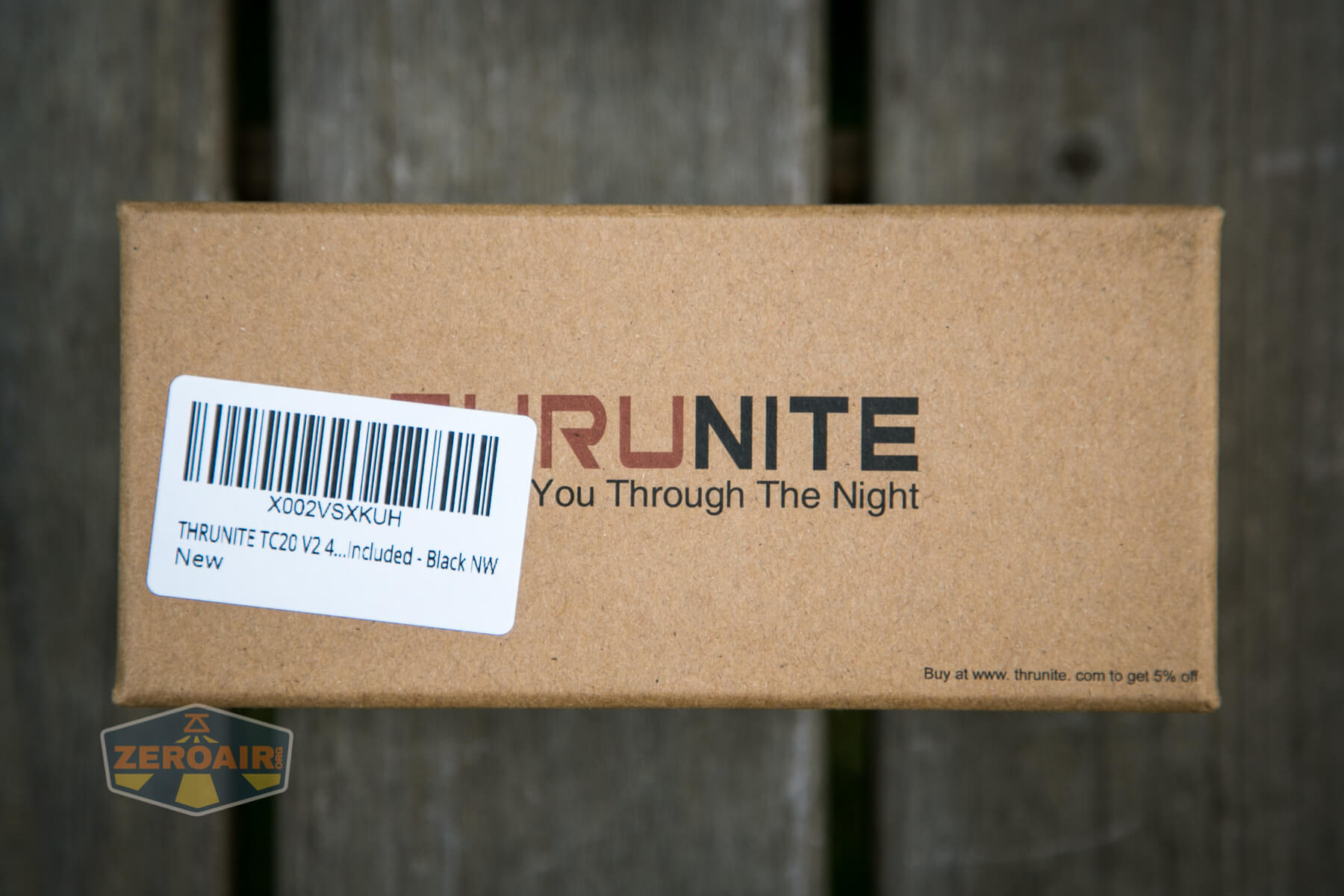
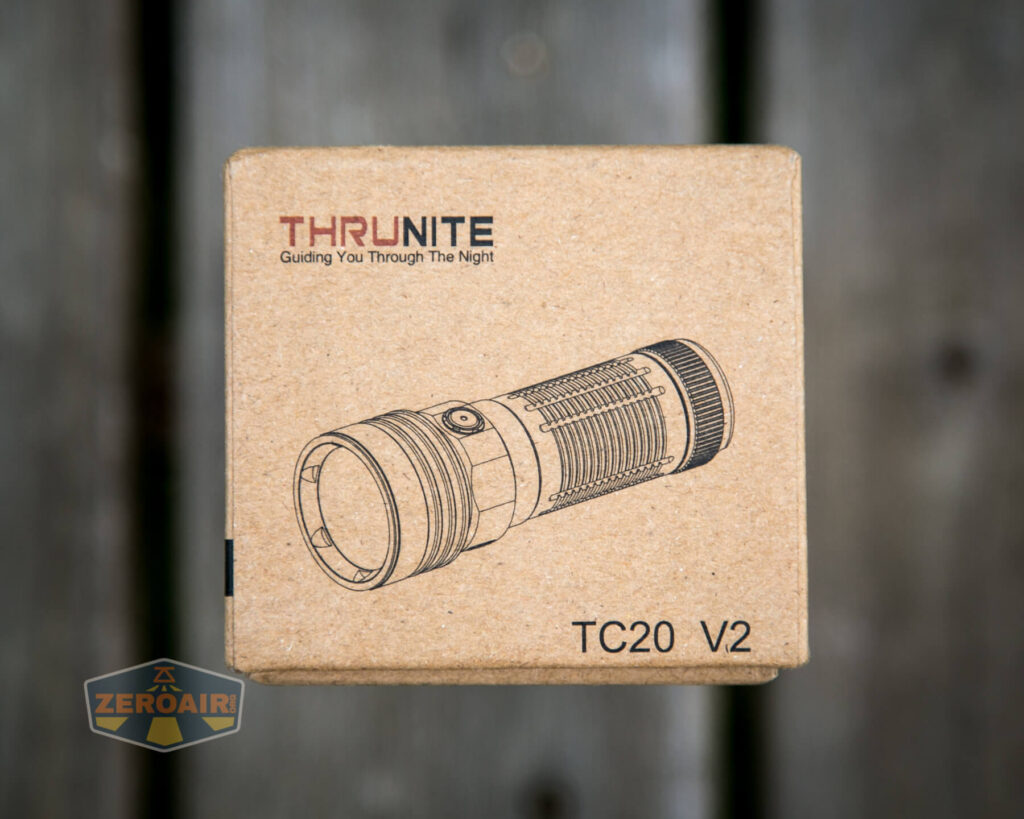
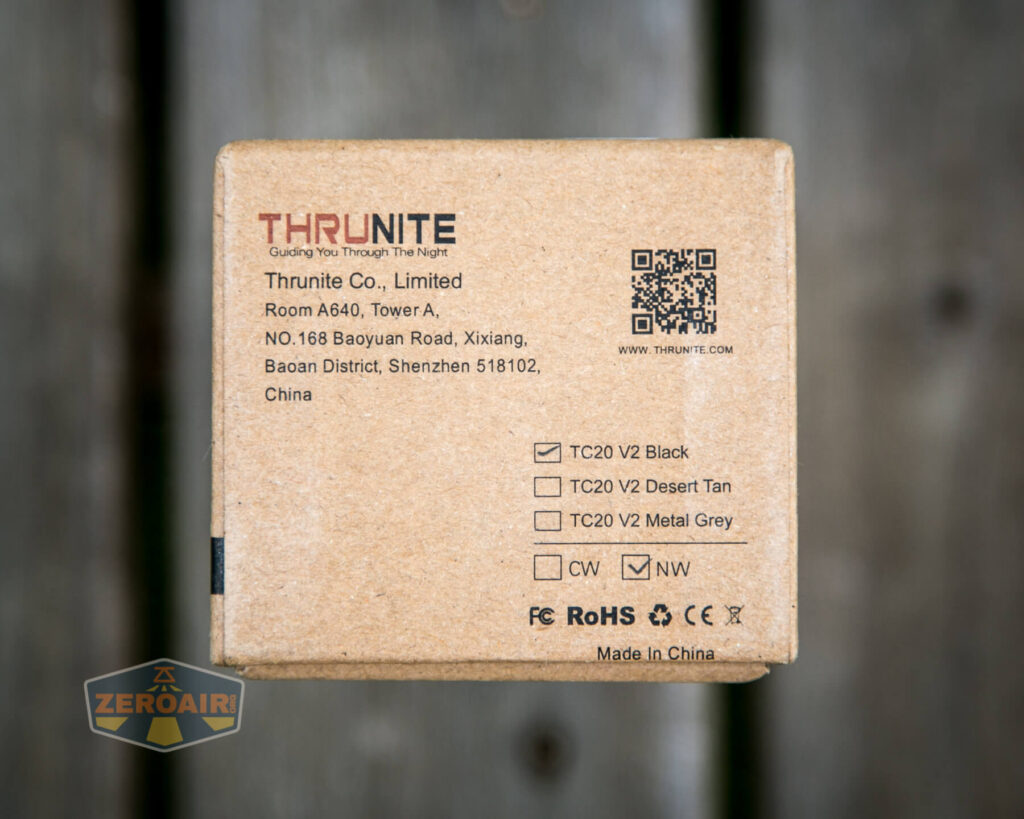
The light ships in a cardboard slip-fit box, which has cutout grip areas. It’s very easy to open. Inside, the light is protected in custom foam. Thrunite has a big bar code inventory sticker on the front of the package.

Build Quality and Disassembly
I am generally satisfied with the quality of Thrunite lights, and this one is no exception.
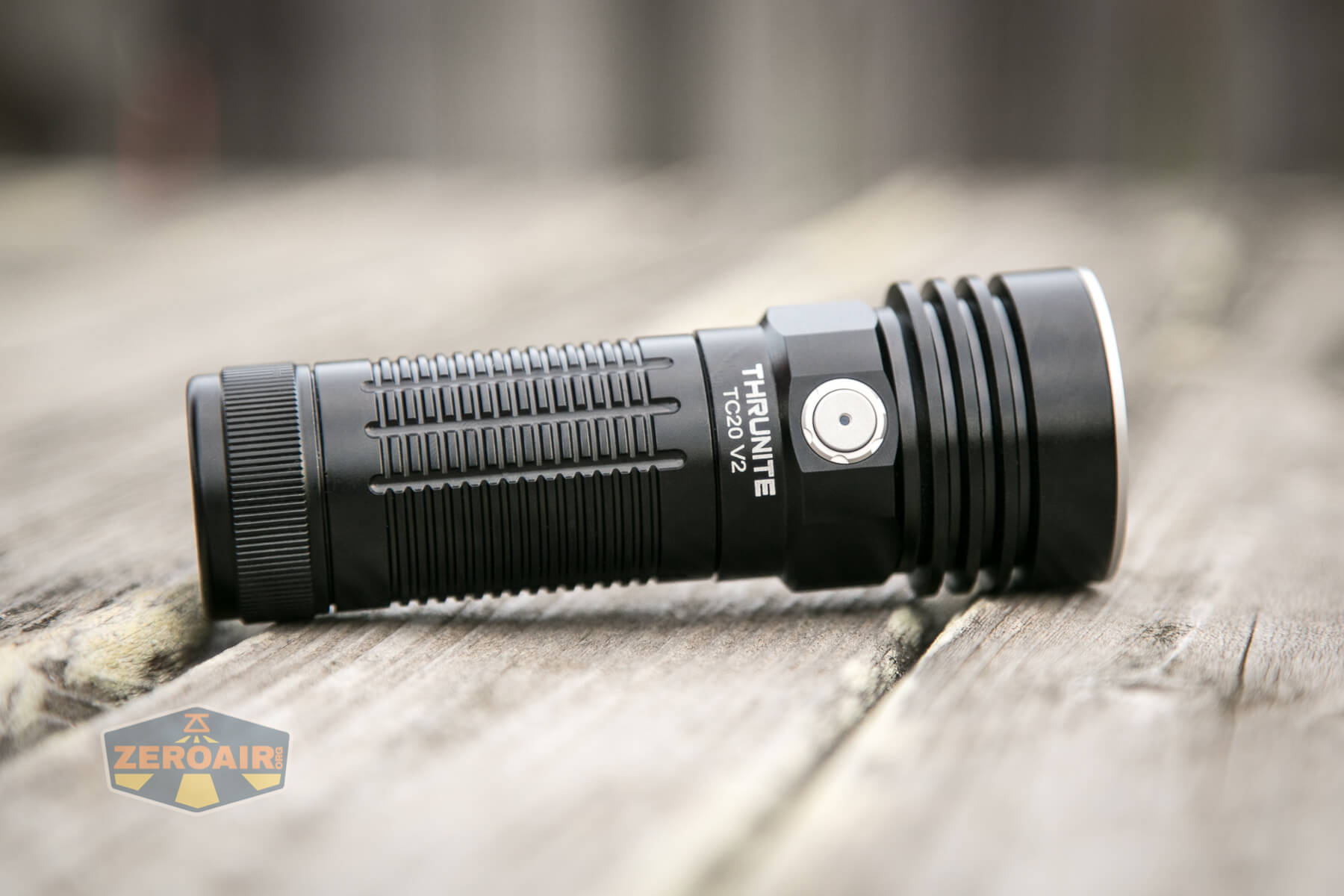
The anodizing is shiny and has a nice thick feel. The cooling fins on the head are robust. There’s no cell rattle with the provided cell.

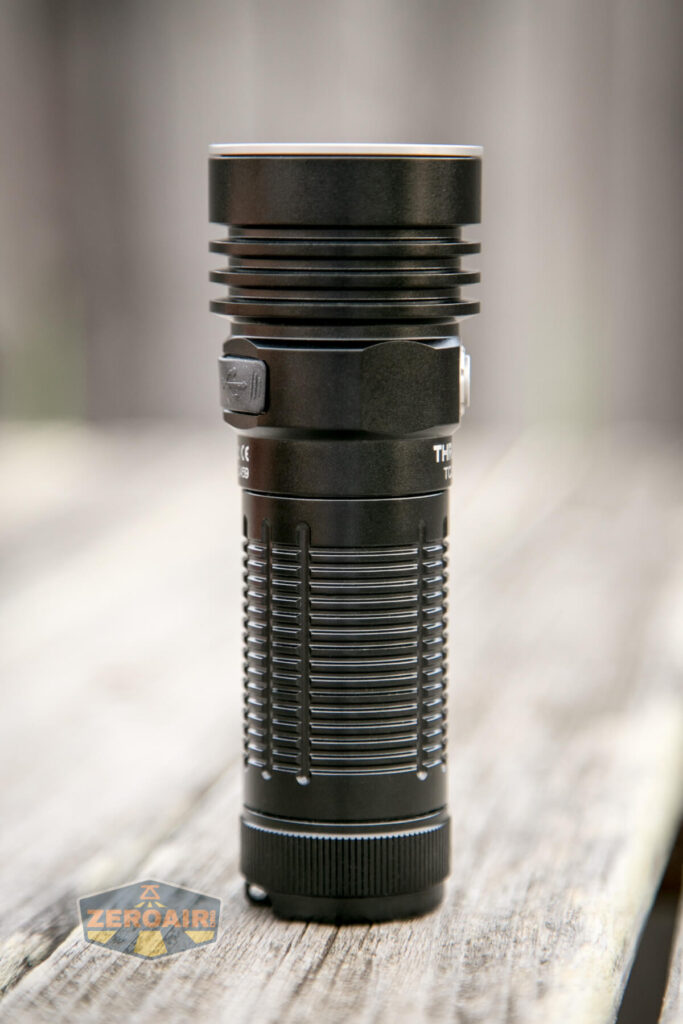
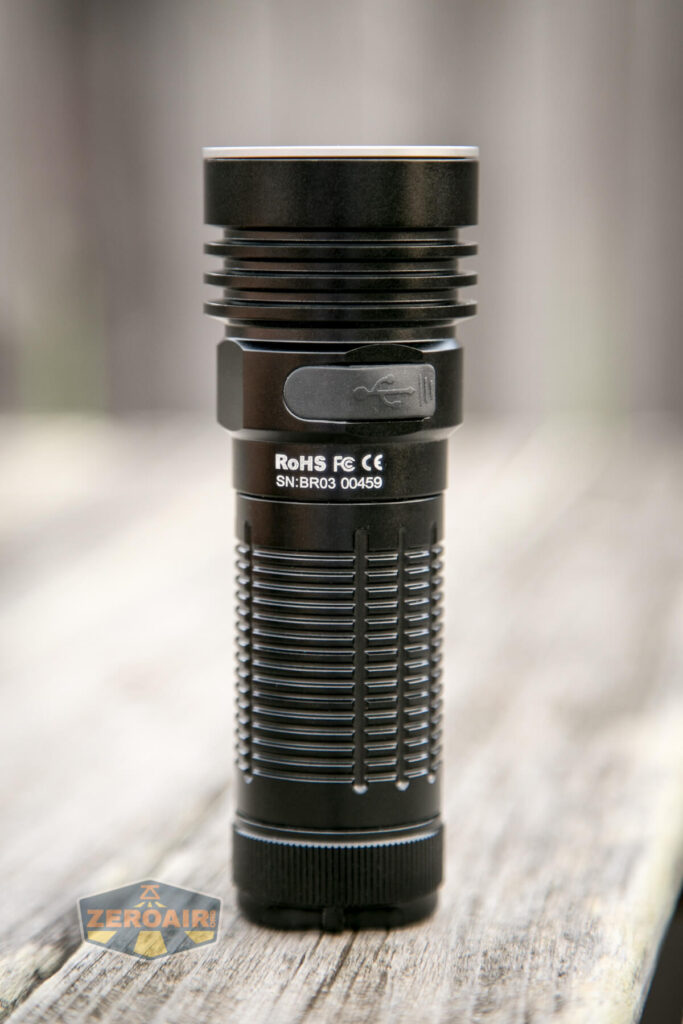

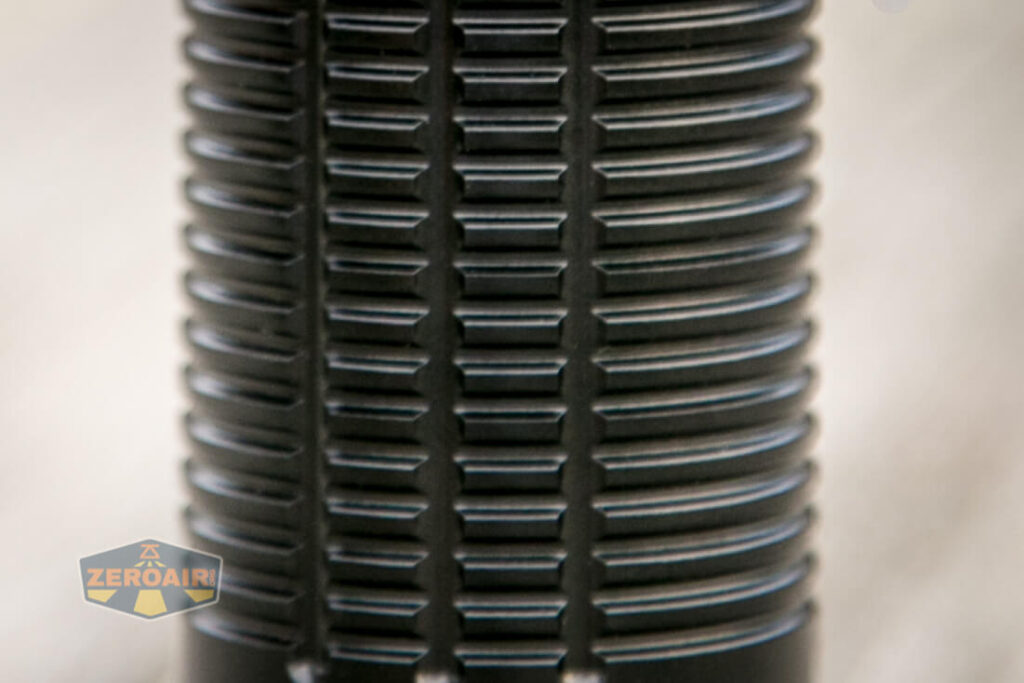
One of the things updated from the original TC20 is the knurling – now there is no knurling, and the light has just this body milled pattern. It’s very nice.
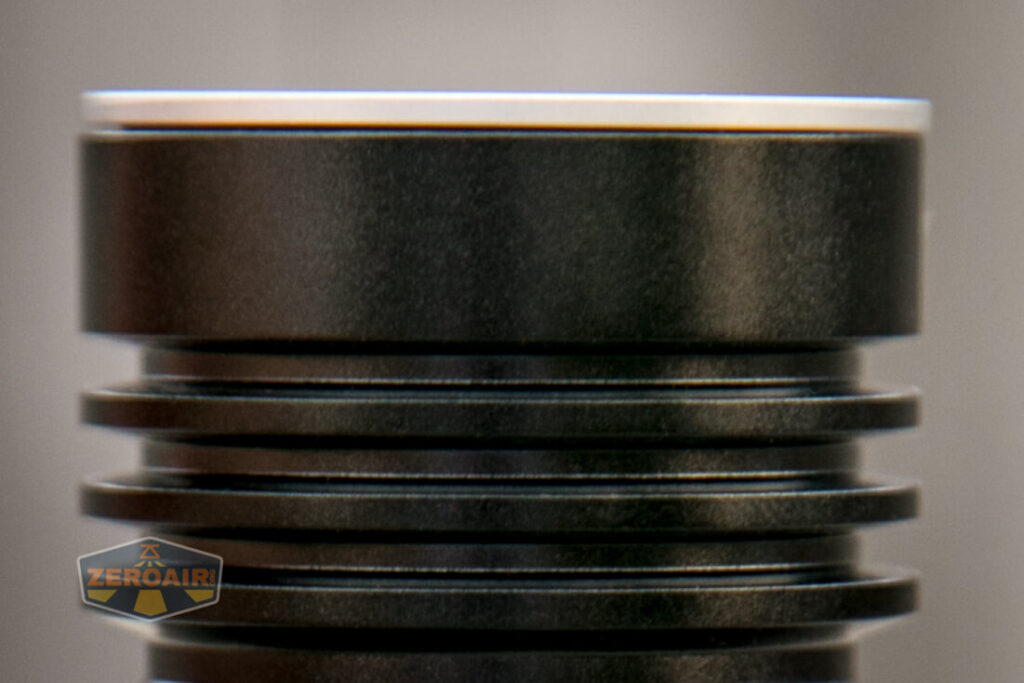
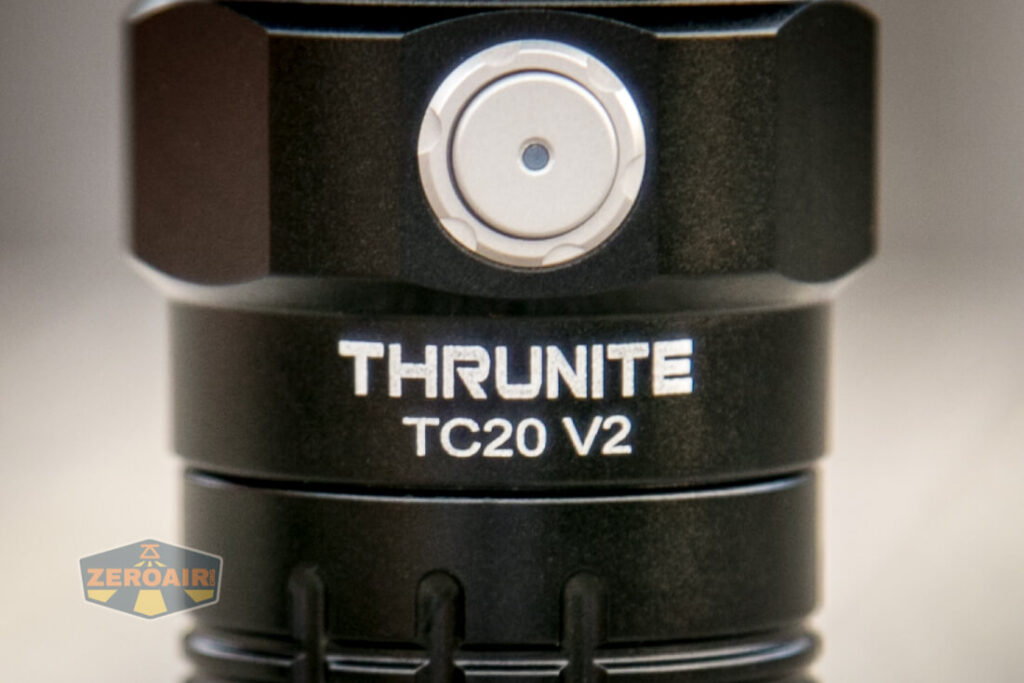
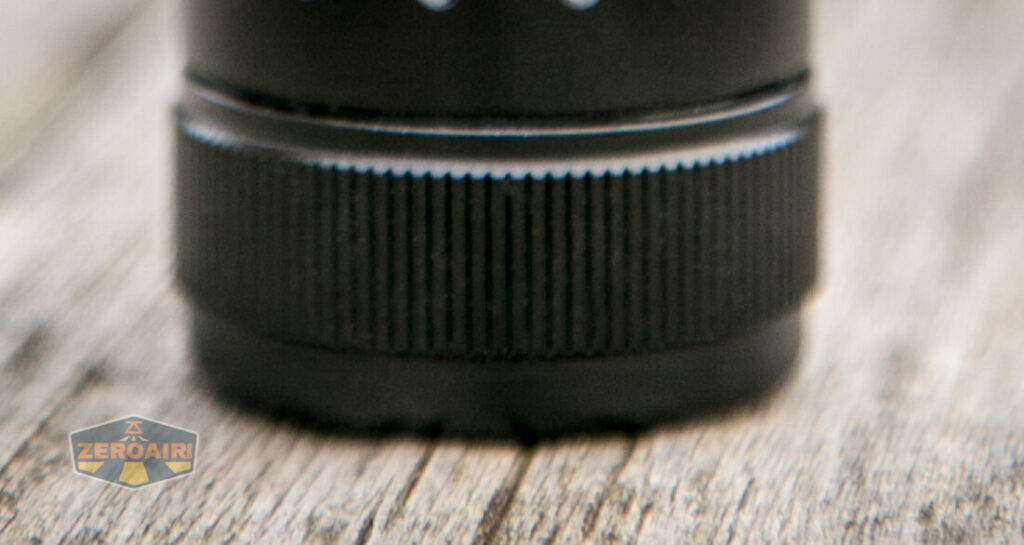
Another update to this model – the previous generation had unanodized threads (which can always feel “bitey”) but the Thrunite TC20 V2 flashlight has anodized threads with a bit of exposed “tip”. This makes the connection process very smooth.

There’s a beefy spring in the cell tube. The head has only a brass button for positive contact. This is normal for Thrunite.

Nothing to see on the tailcap.

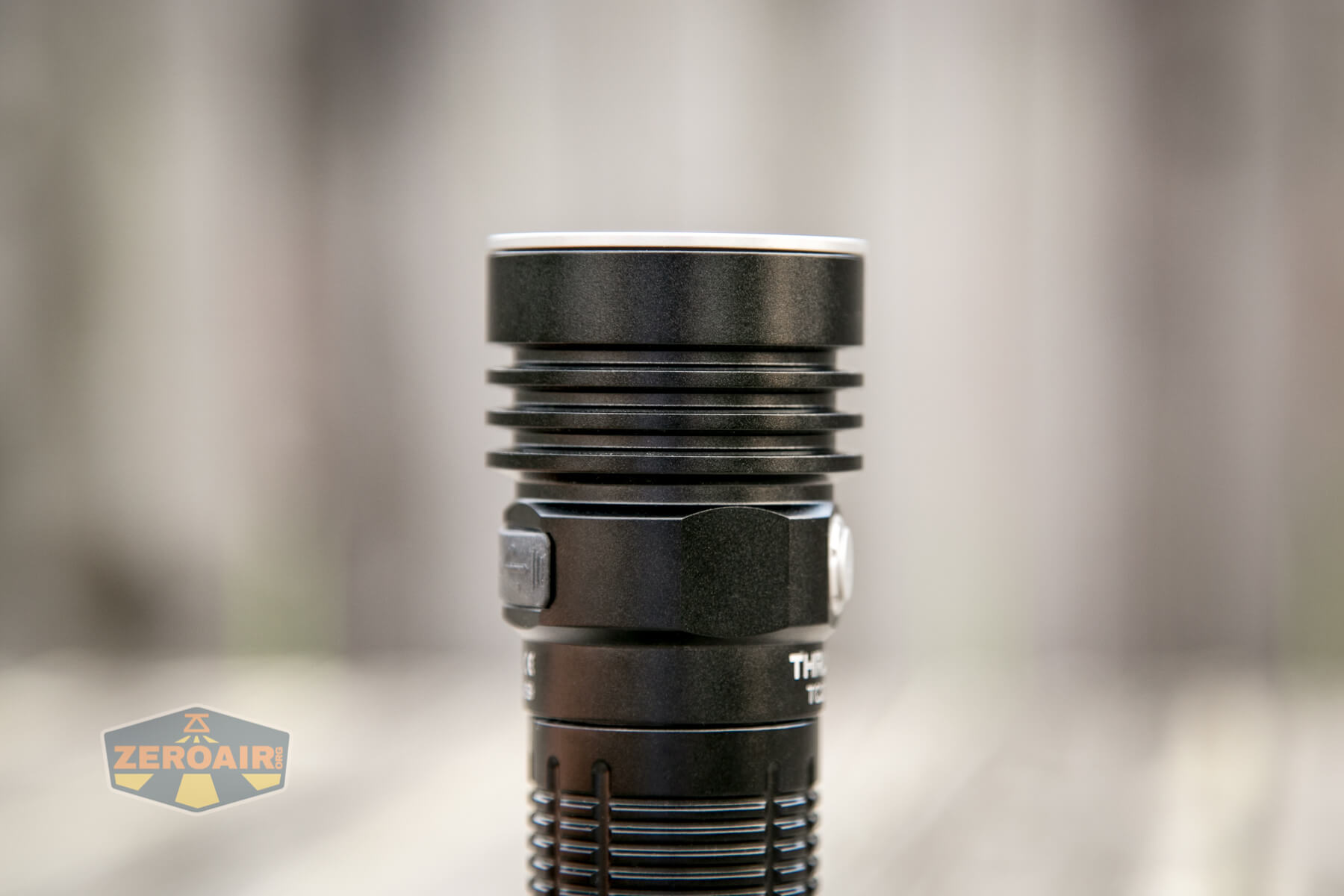
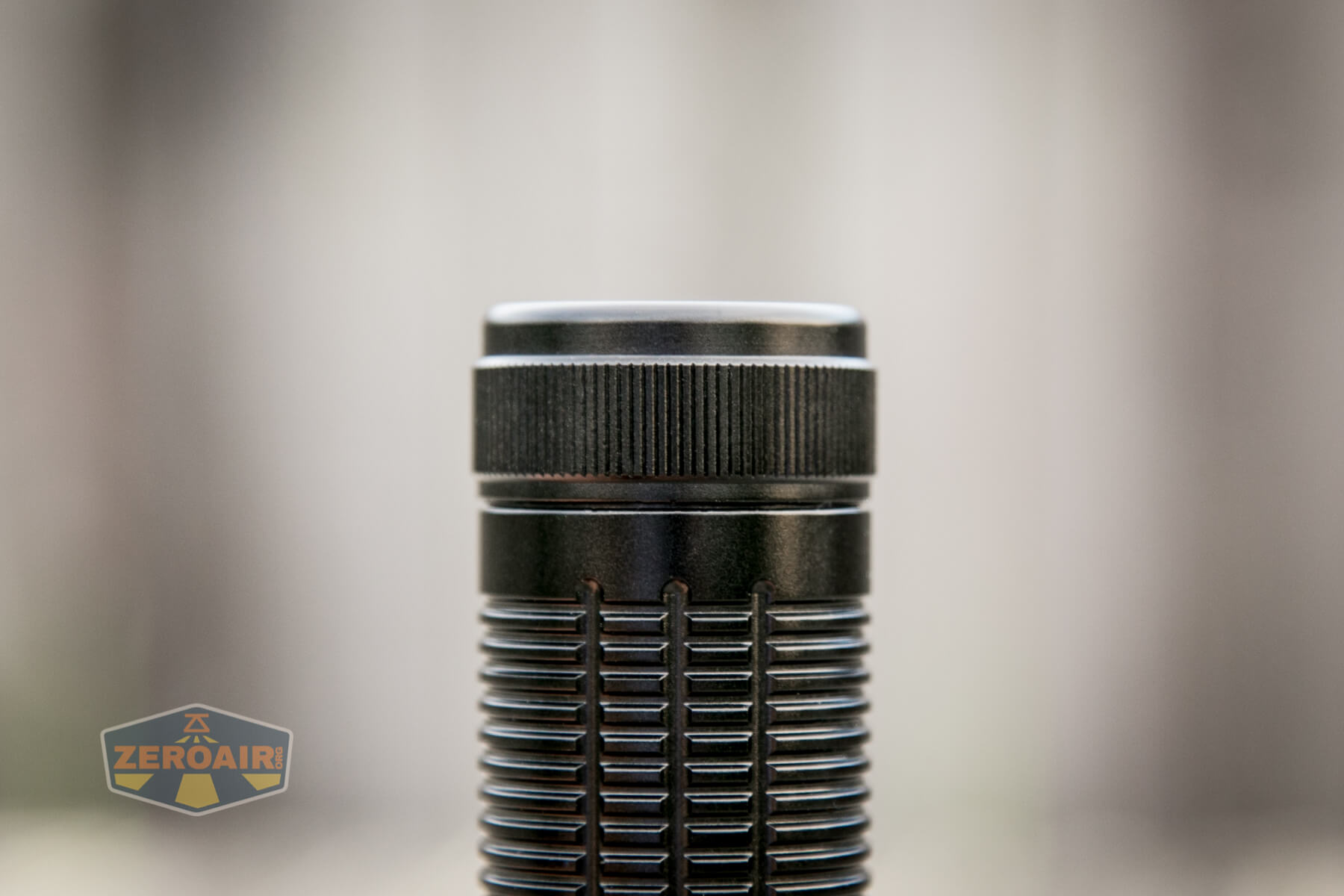
On the tailcap is the “right kind of grip.” But it’s not for removing the tailcap. It’s just to aid in the removal of the cell tube. Unlike the original, where the tailcap was removable, on the V2, the tailcap does not separate from the cell tube!
Size and Comps
Same as the original:
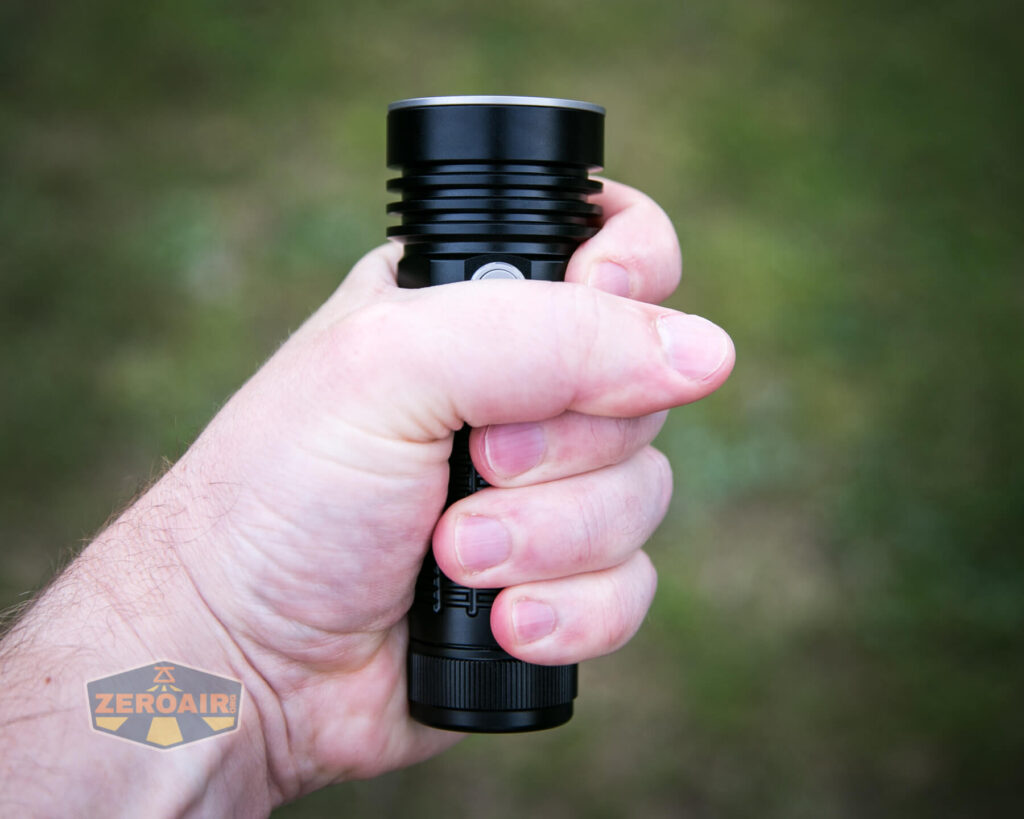
Officially 119mm in length x 42mm in head diameter x 33.5mm in tailcap diameter. The weight without cell is stated as 143g. I weight it at 142g, and 243g with cell.
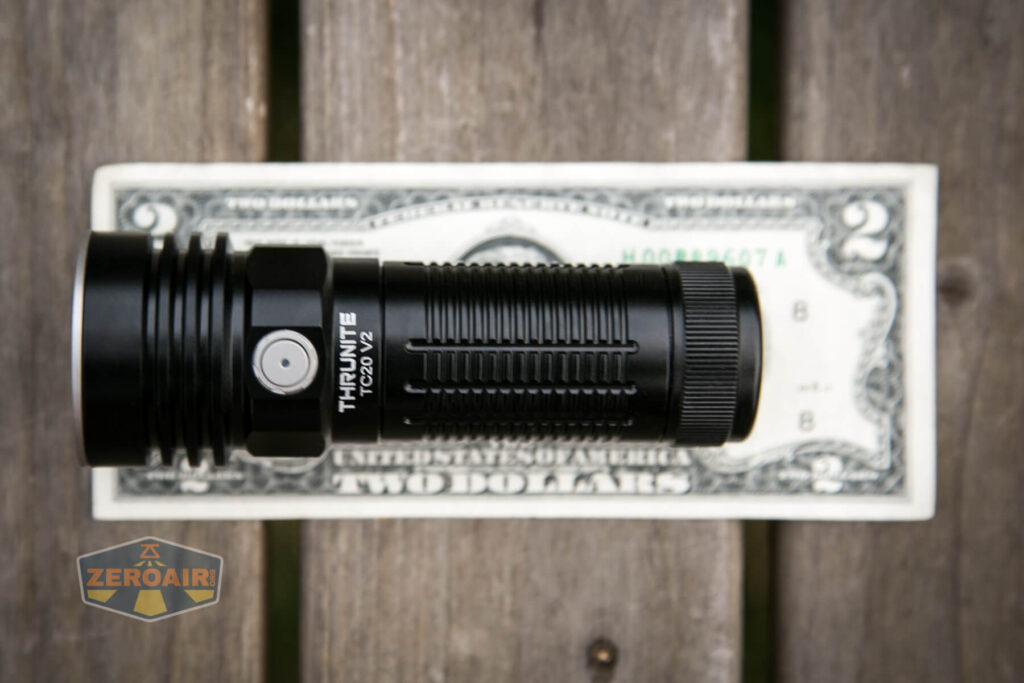


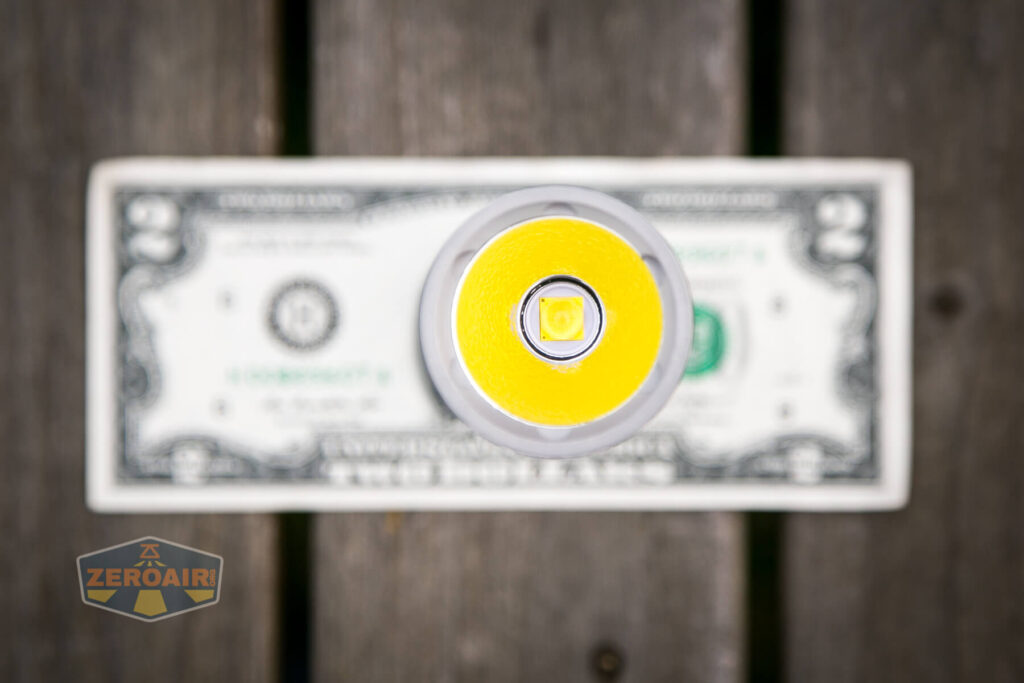
If the flashlight will headstand, I’ll show it here (usually the third photo). If the flashlight will tailstand, I’ll show that here, too (usually the fourth photo).

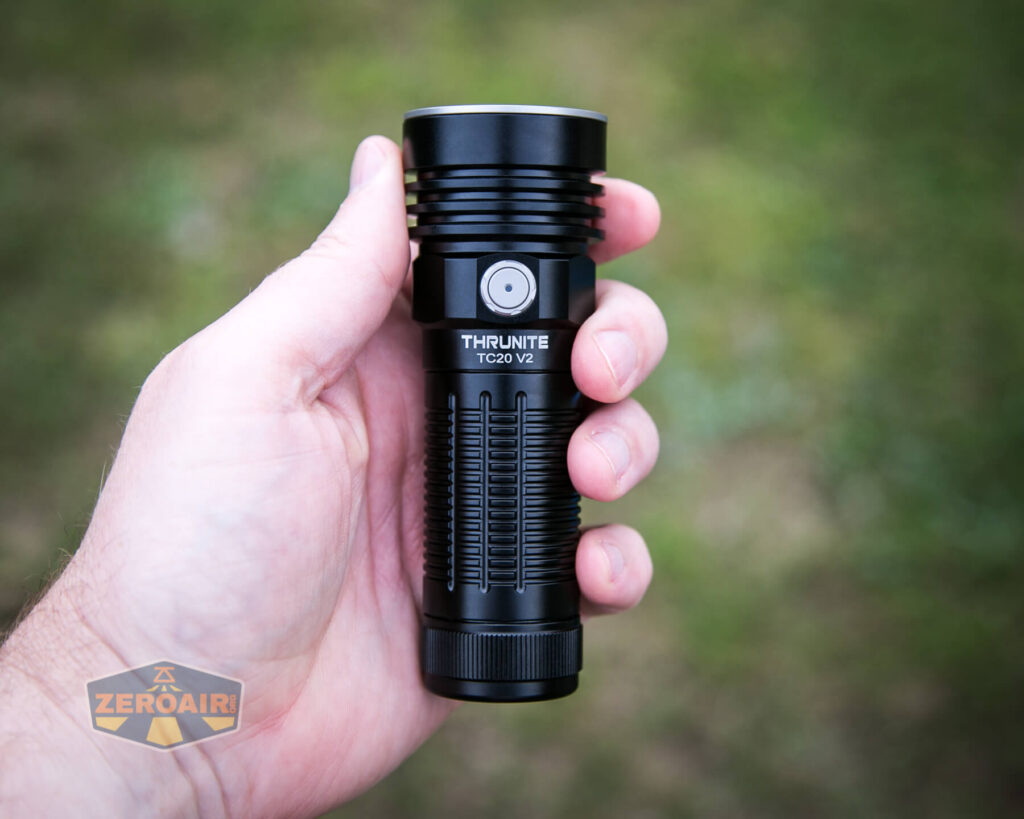
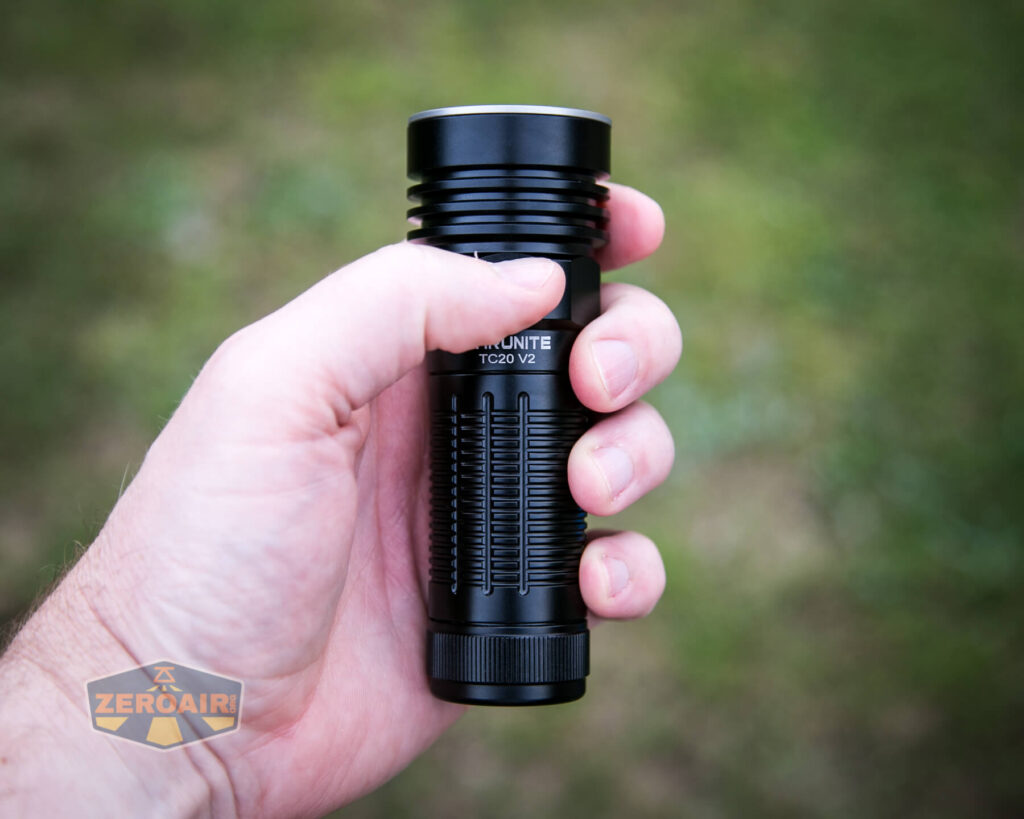
Here’s the test light with the venerable Convoy S2+. Mine is a custom “baked” edition Nichia 219b triple. A very nice 18650 light!
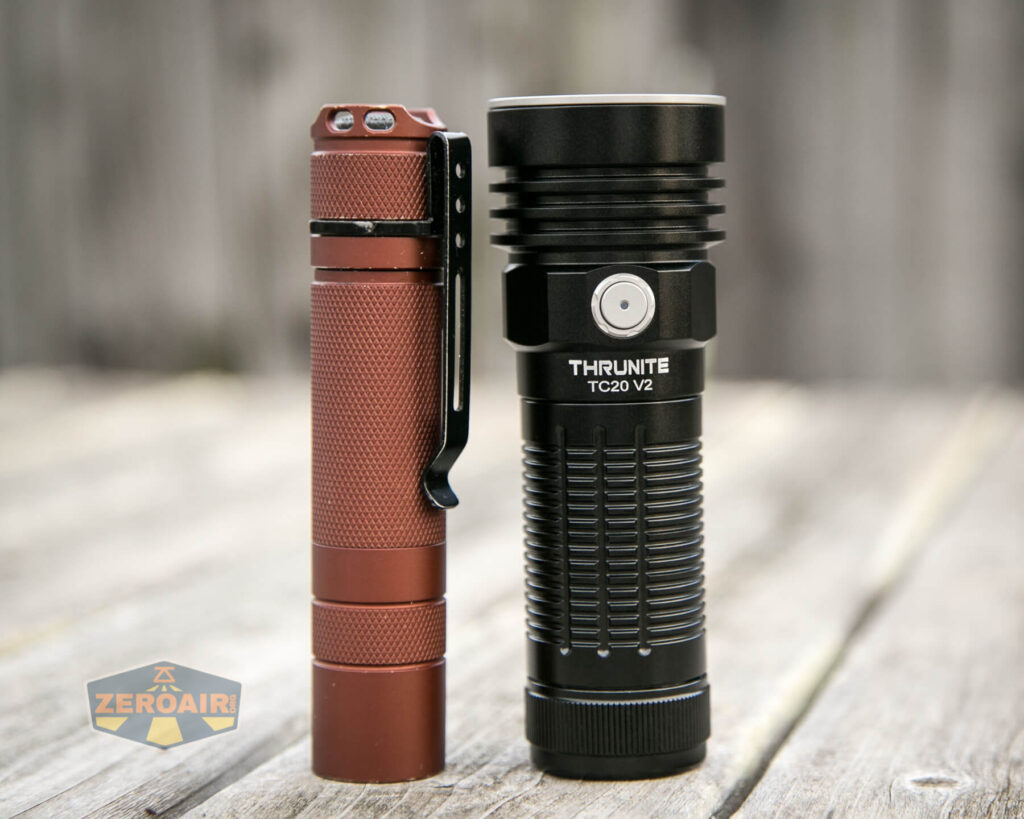

And here’s the light beside my custom-engraved TorchLAB BOSS 35, an 18350 light. I reviewed the aluminum version of that light in both 35 and 70 formats.

Here’s the Thrunite TC20 V2 with what I’d consider a major competitor: The Zebralight SC700d. The Zebralight is smaller, but of course, the Thrunite offers USB-C charging, and an indicating e-switch, too.


Retention and Carry
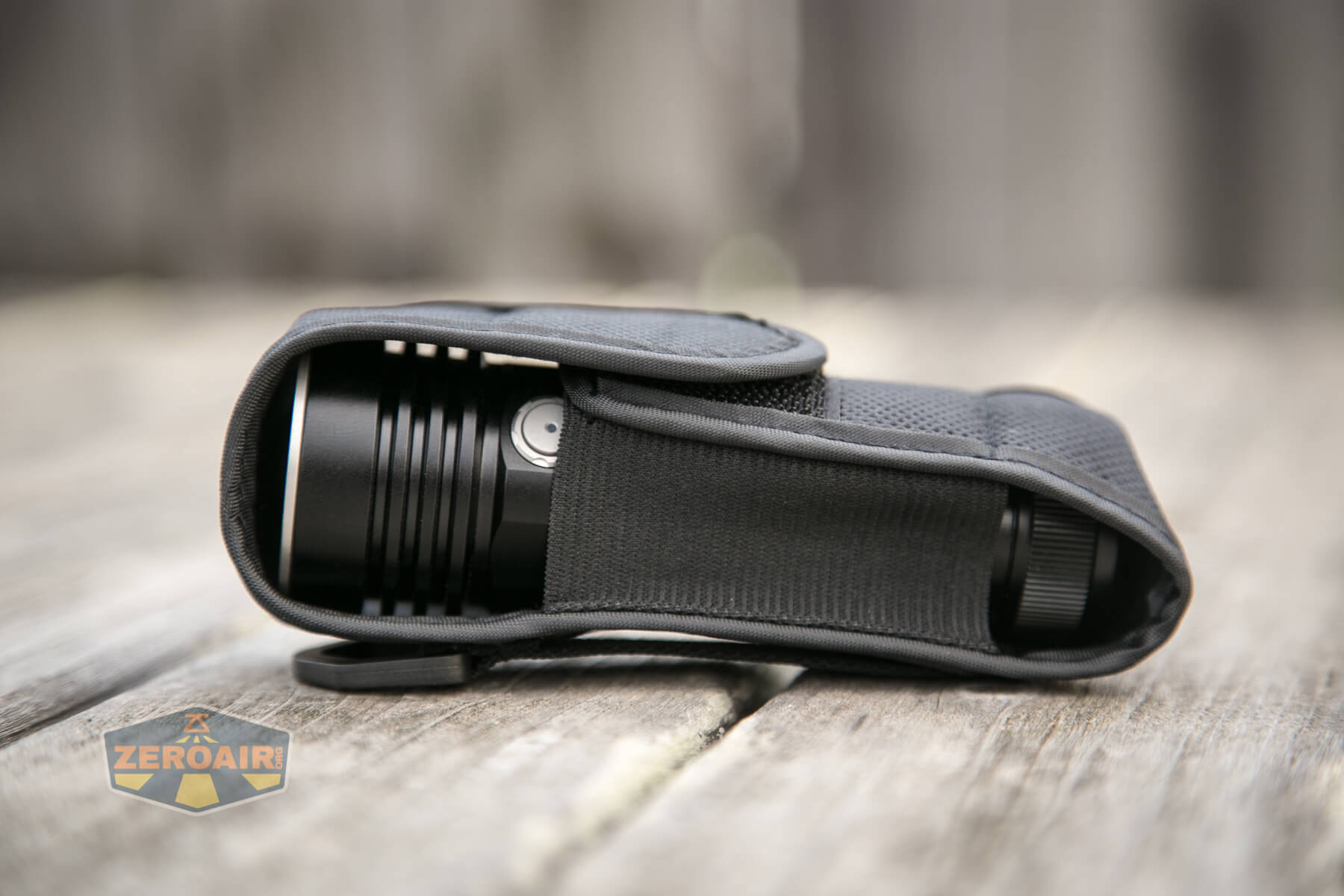
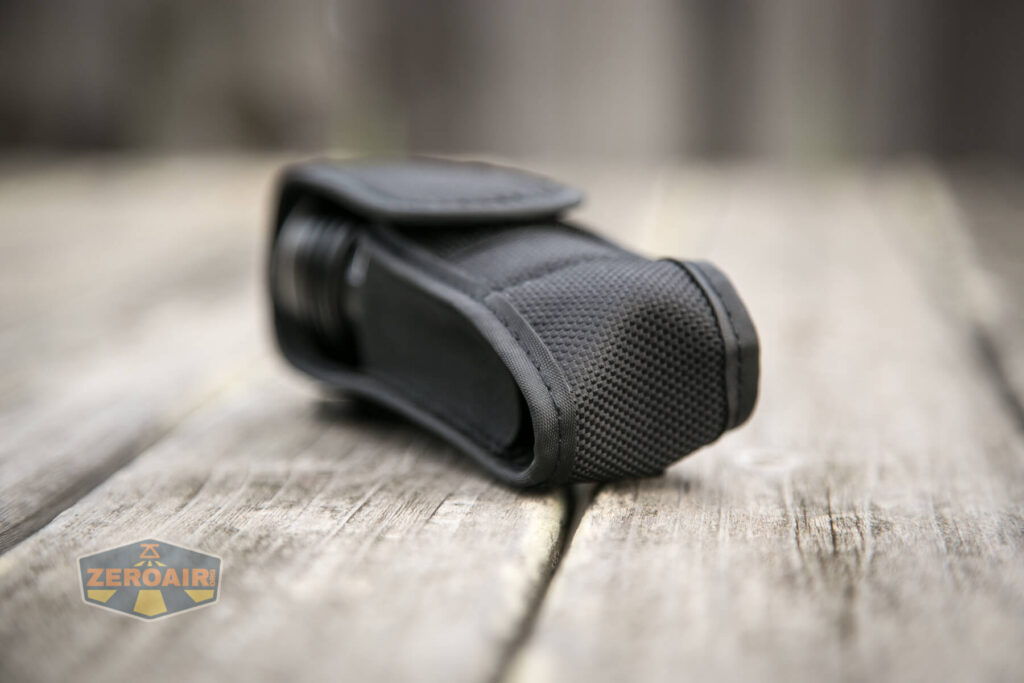
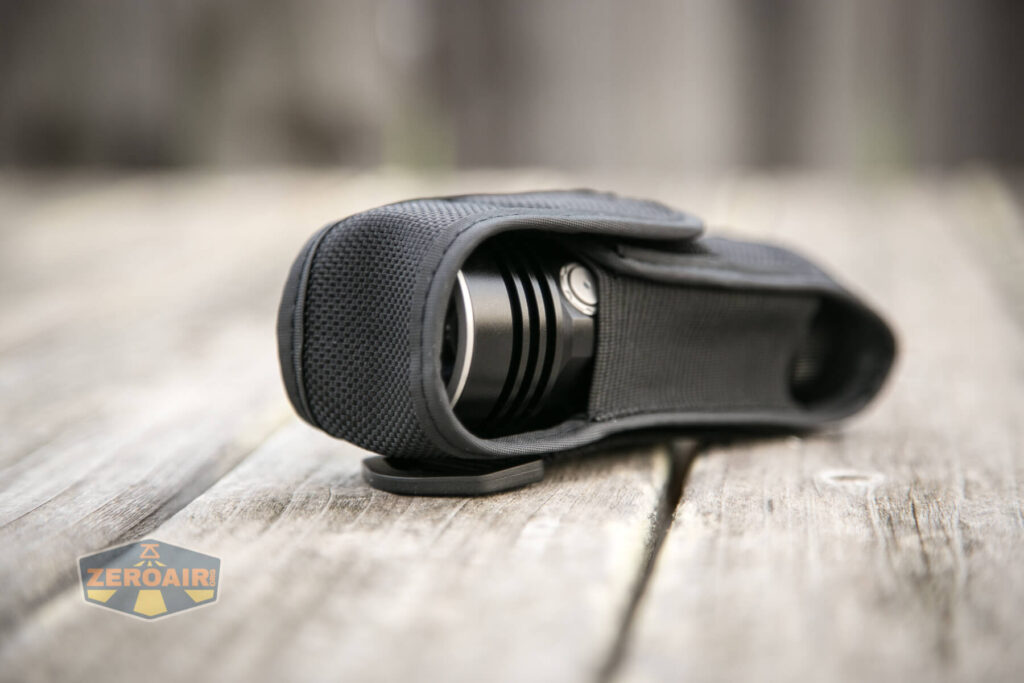
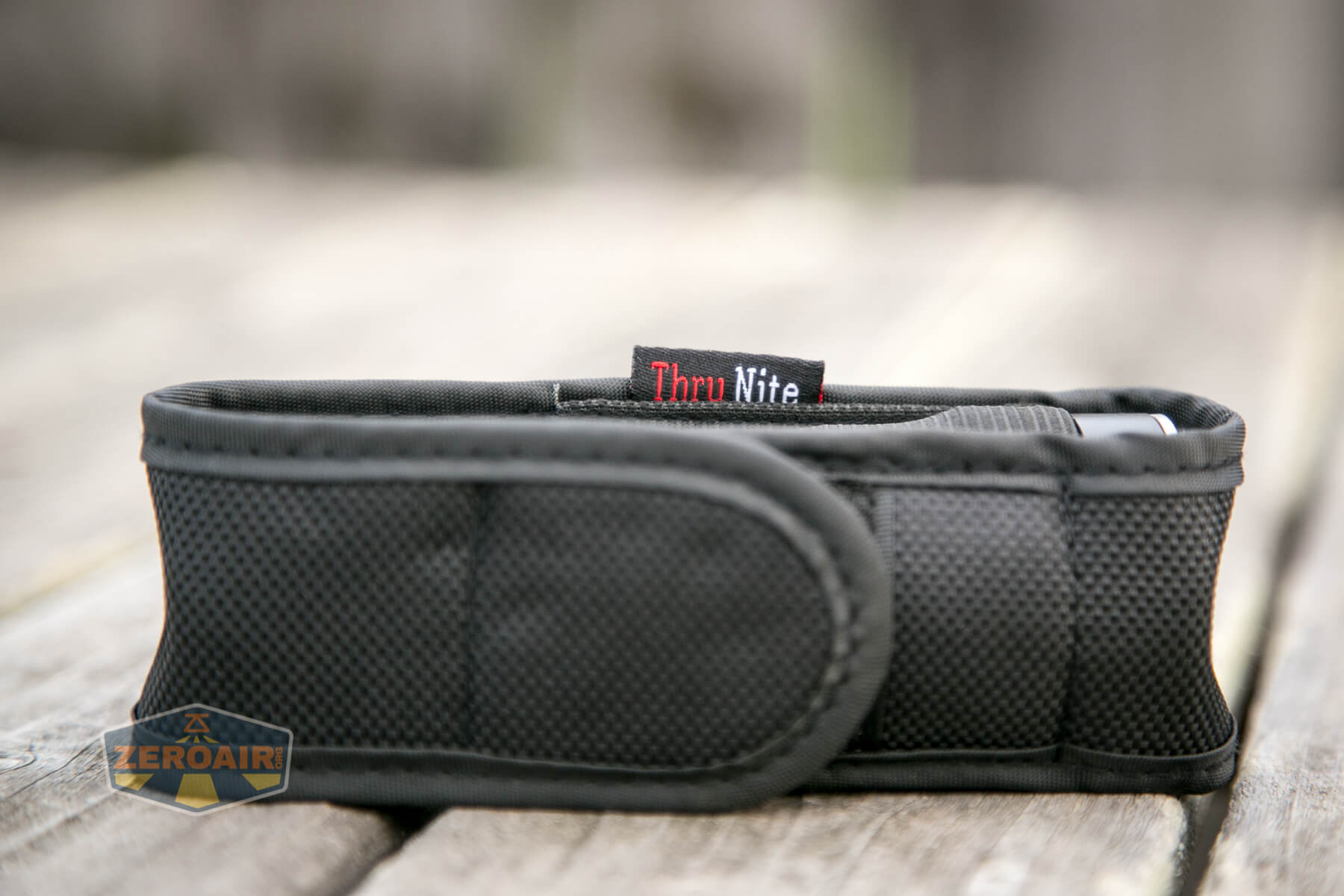
Included is a nylon belt pouch with stretchy sides. The belt loop unfortunately doesn’t have a velcro option, so must be hard-connected to the belt. The pouch holds the light in either bezel-up or down orientation.
Also included is a lanyard, which attaches through a hole in the tailcap.


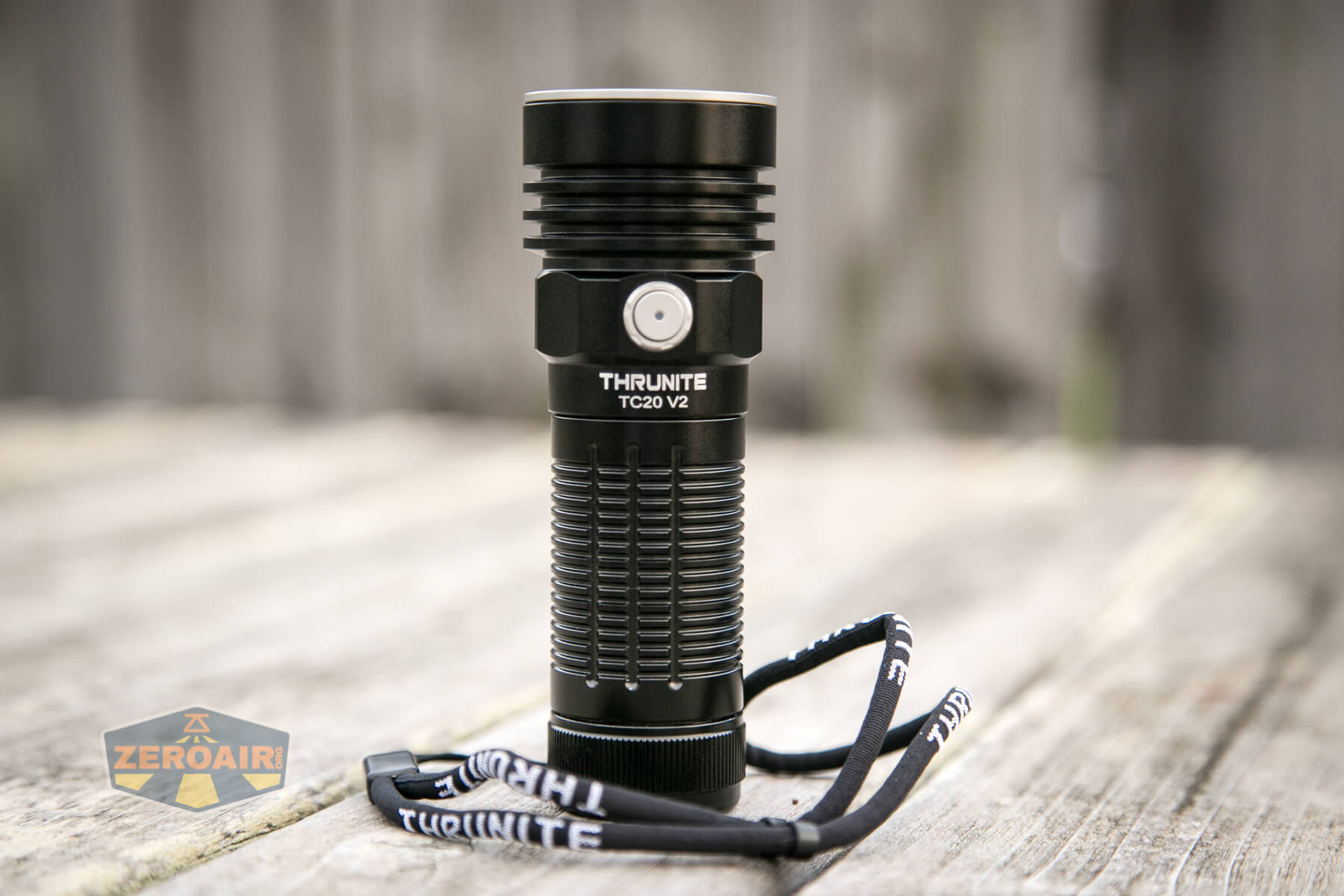
No pocket clip is provided.
Power and Runtime
The Thrunite TC20 V2 flashlight is powered by a single 26650 cell, which Thrunite provides with the package purchase.
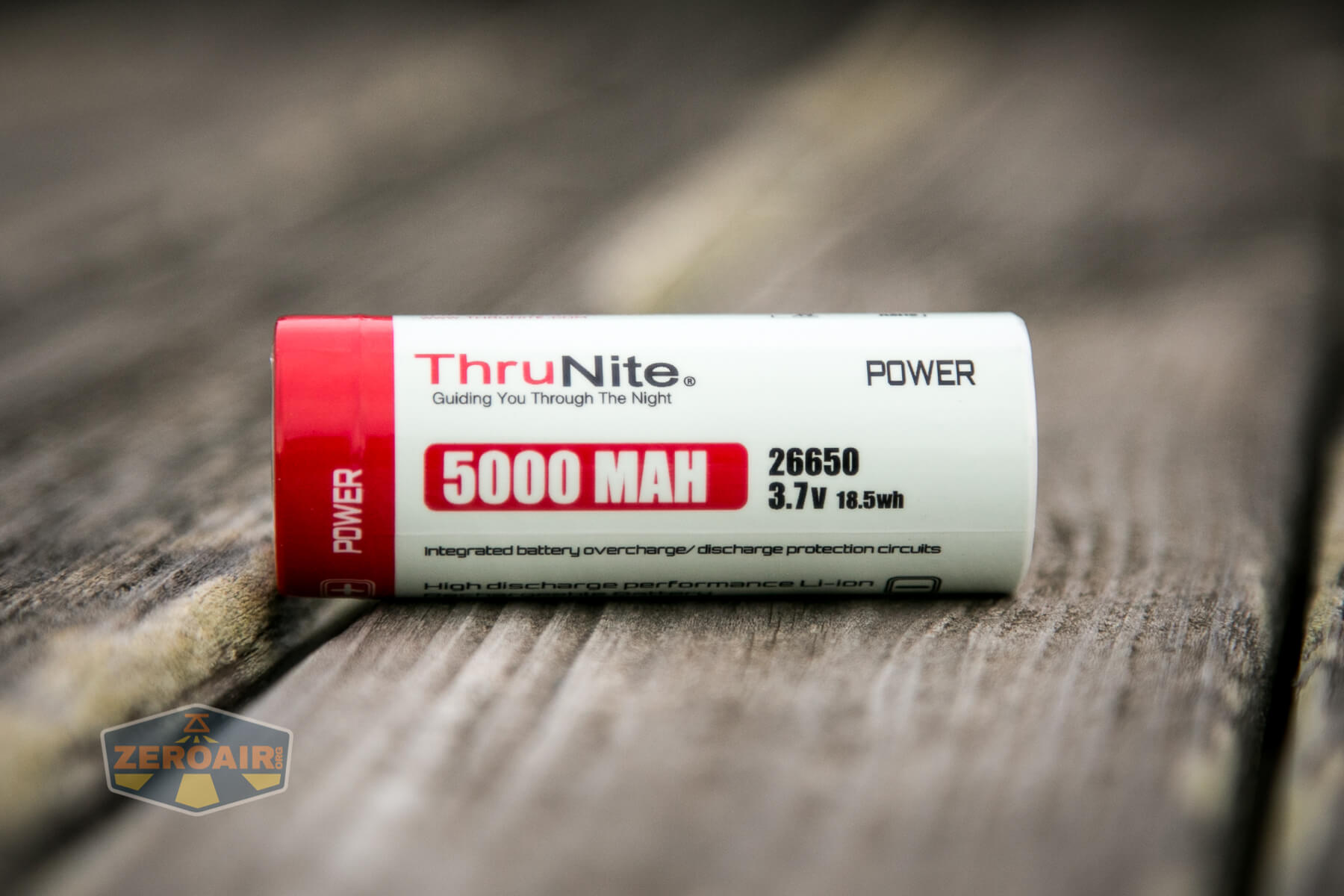
This is a Thrunite branded cell, but it’s not proprietary.
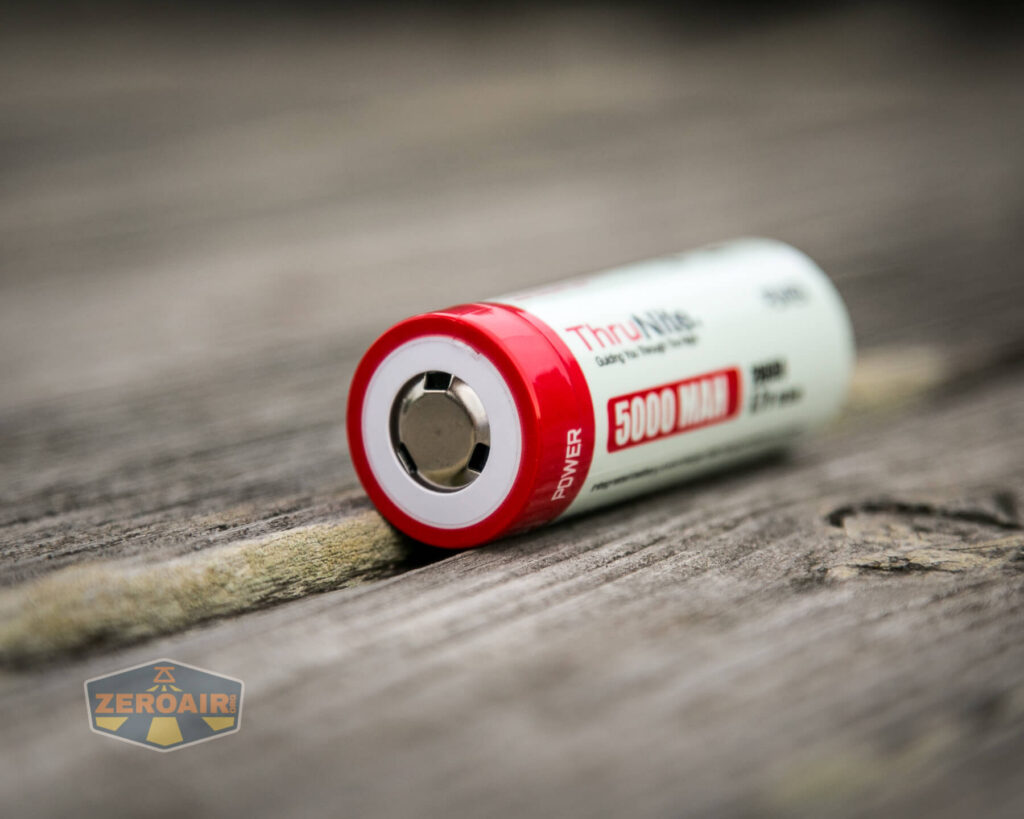
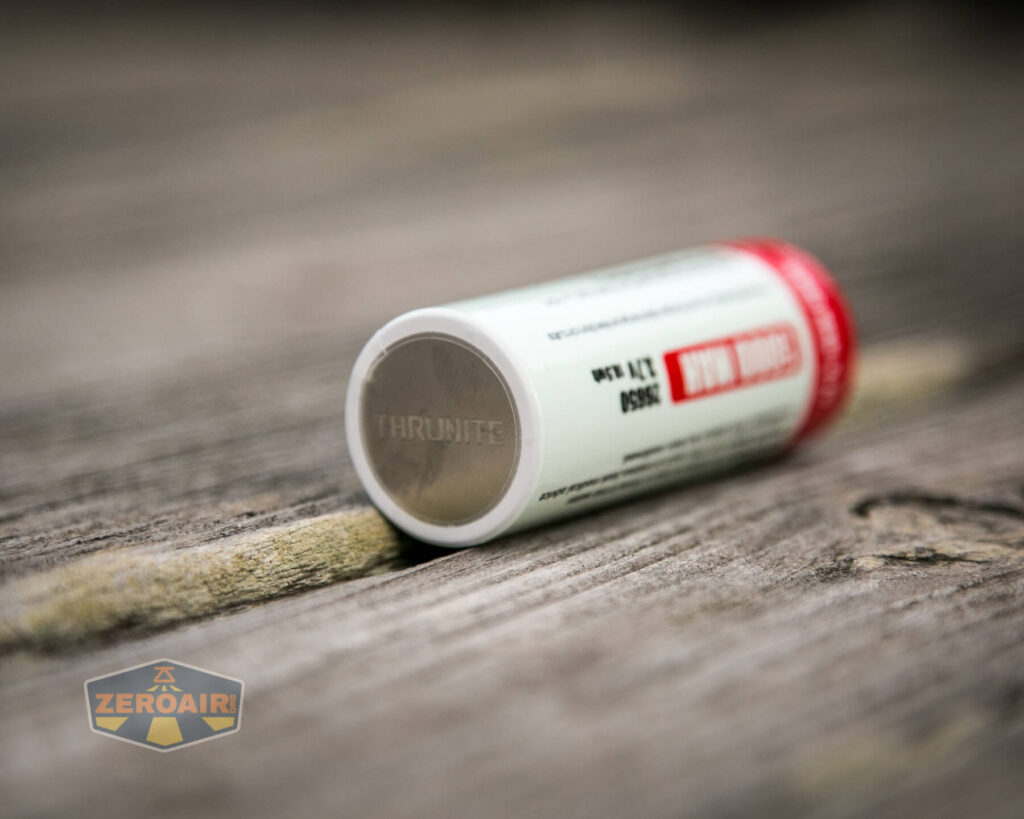

The cell is installed with the positive terminal toward the head of the light.

I performed a few runtime tests (more on that in a big). You can see that the light never gets TOO hot (you’ll notice the heat). Turbo has a couple of fairly large stepdowns, but even disregarding that, we’re seeing over 2000 lumens out of a small, single-26650 flashlight for well over an hour. This is not shabby.
Around 32 minutes the thermal sensor disconnected from the light. I reconnected it at around 75 minutes. It’s safe to assume the temperature profile for the missing segment is the same as the graph for “High.”

Unlike the original version, the output on high is exceptionally stable.

Medium also shows great stability. Those temperature bumps are almost certainly home air conditioner cycles. Interesting!

The indicating switch will give a warning about low voltage, and the Thrunite TC20 V2 flashlight will then shut off completely soon after. This shuts the light off at the (a bit low) ~2.6V (manual says 2.8V). The indicating side switch attempts to alert you that the cell voltage is getting low as follows:
At 3.3-4.2V, the switch is blue.
2-3.2V, the switch is red.
2.8-3V, flashing red.
And below that, the light shuts off.
Charging
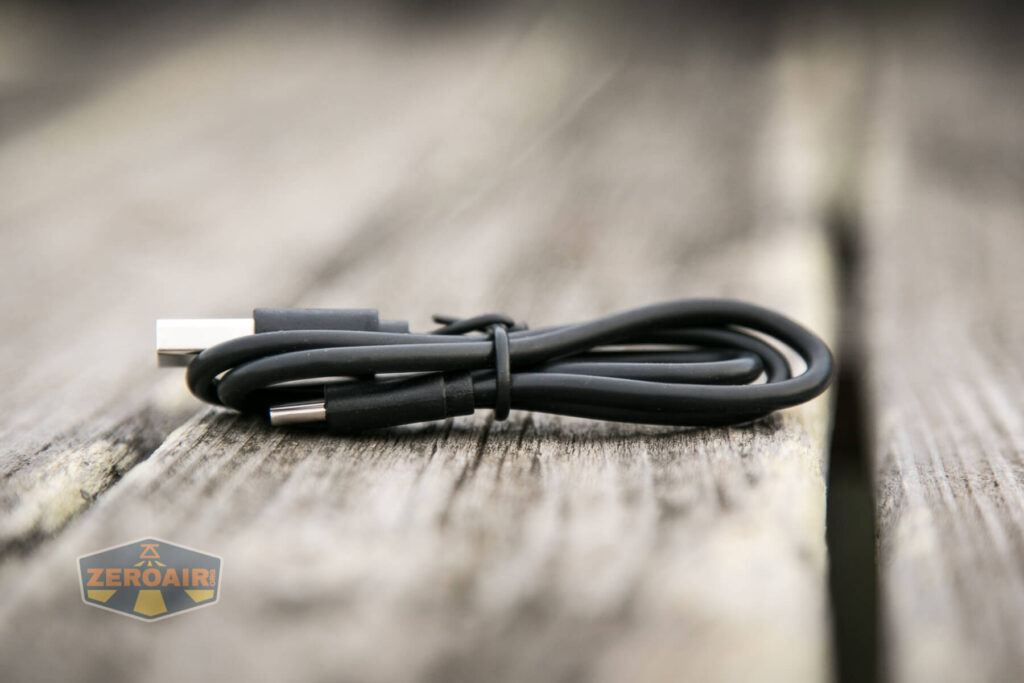
The TC20 V2 also has built-in charging, which is done by USB-C. Thrunite includes a nice cable, which I’d recommend using (over any old random cable you might have lying around).

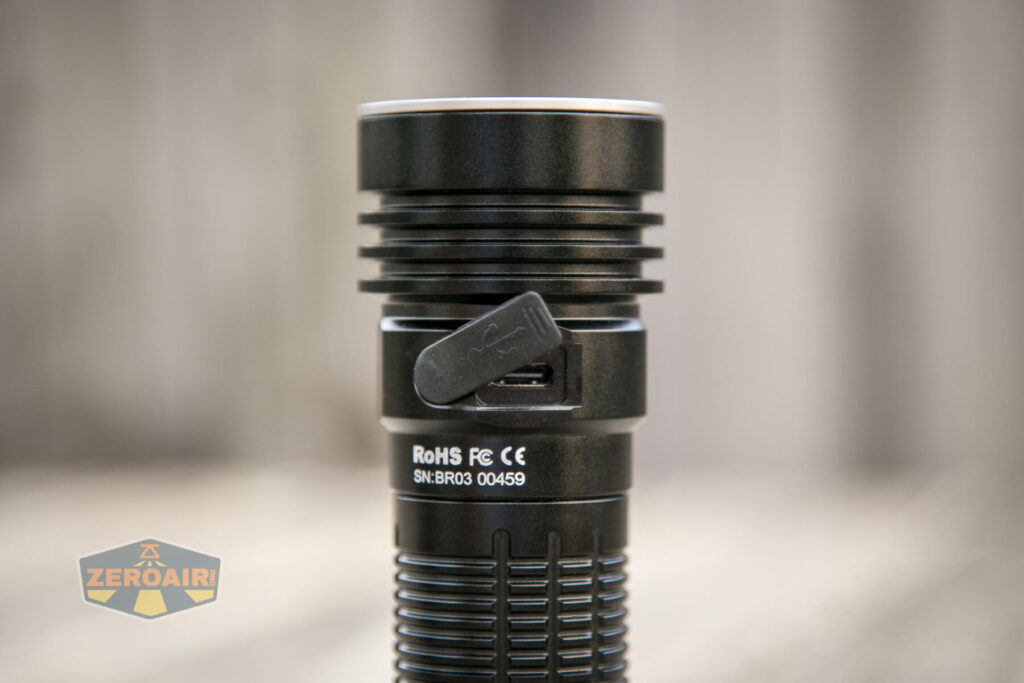
USB-C is a nice upgrade from the previous generation. The charge port cover is exactly the same. It’s fine; the cover sits in the opening securely.

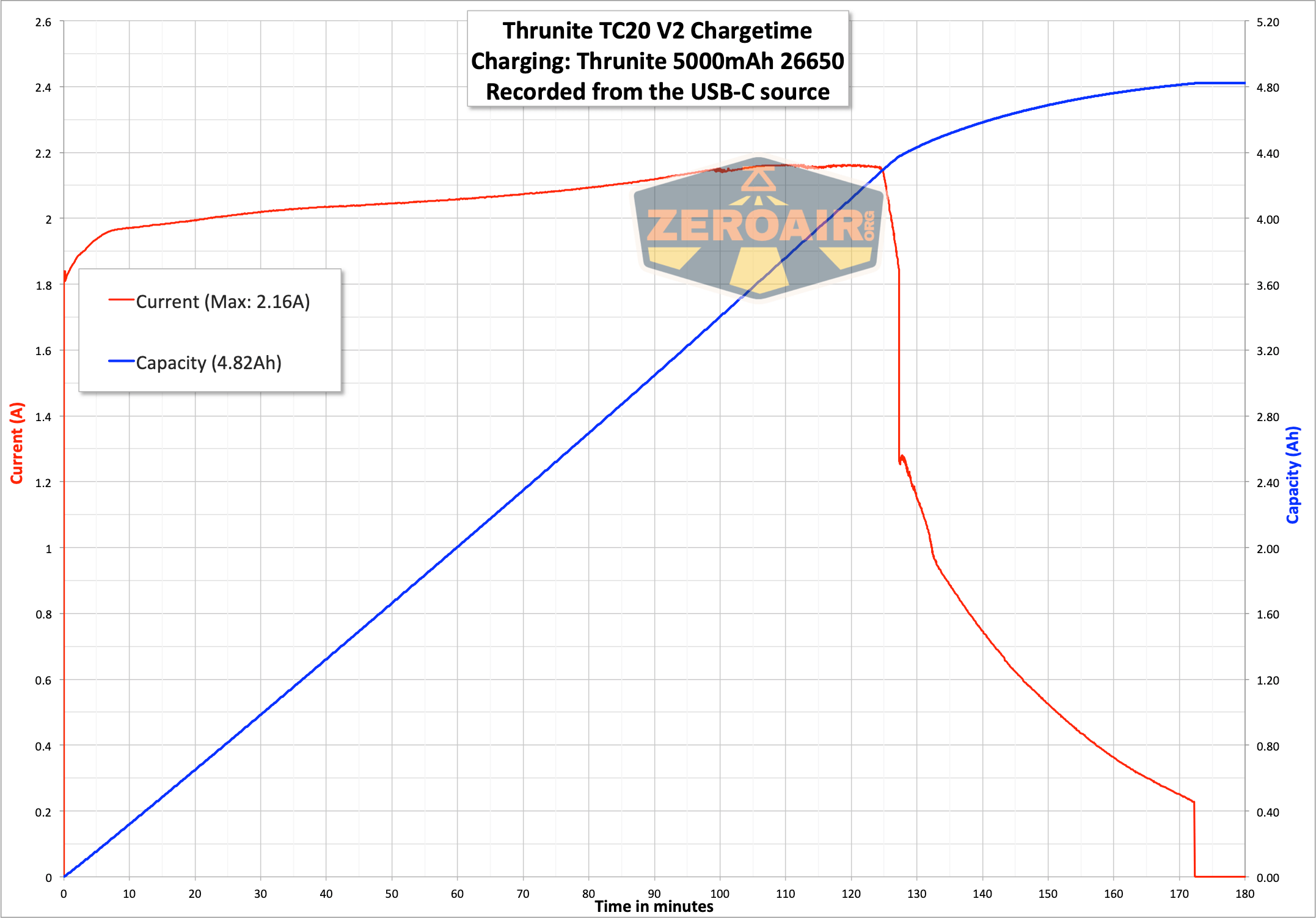
Here’s a charge graph with USB to USB-C. This is the same setup as the cable included, so I’ll guess this is the intended means of charge. Charging looks great, at well over 2A for the duration of the CC phase. This is still under 0.5C for the 5000mAh cell, so this is very acceptable.

Charging is also fairly quick for a 5000mAh cell – under 3 hours.
USB-C to USB-C also works fine, and charges at 5V.
Modes and Currents
| Mode | Mode Claimed Output (lm) | Claimed Runtime | Measured Lumens | Tailcap Amps |
|---|---|---|---|---|
| Turbo | 4068/1722 | 220s/90m | 3934 | ~9.5 |
| High | 1853 | 122m | 1971 | 3.25 |
| Medium | 320 | 9h | 351 | 0.44 |
| Low | 35 | 77h | 49.65mA | |
| Firefly | 0.3 | 71d | 2.70mA |
On the original version, I was surprised the light was pulling almost 8A on Turbo. This one briefly pulls a full 10A, then settles at around 9.5A. It’s pretty impressive.
Pulse Width Modulation
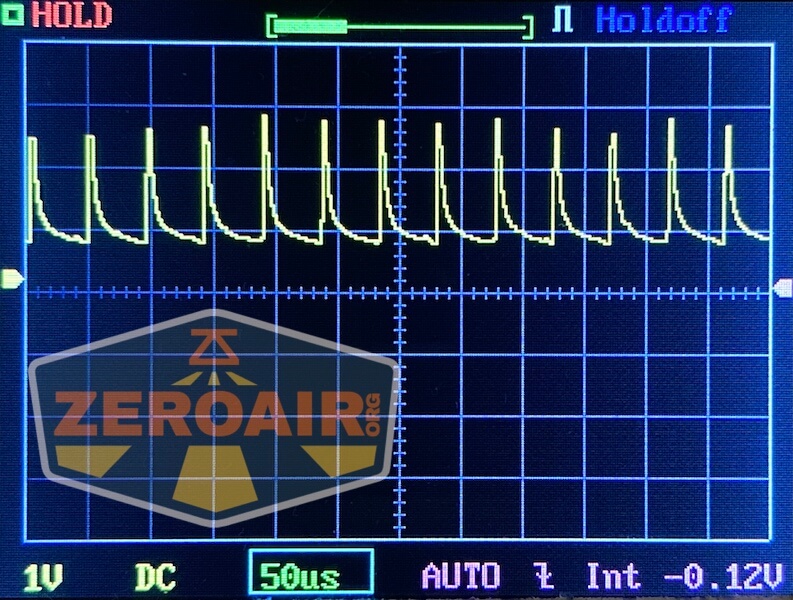
There’s no PWM, but one of the modes has a sawtooth.
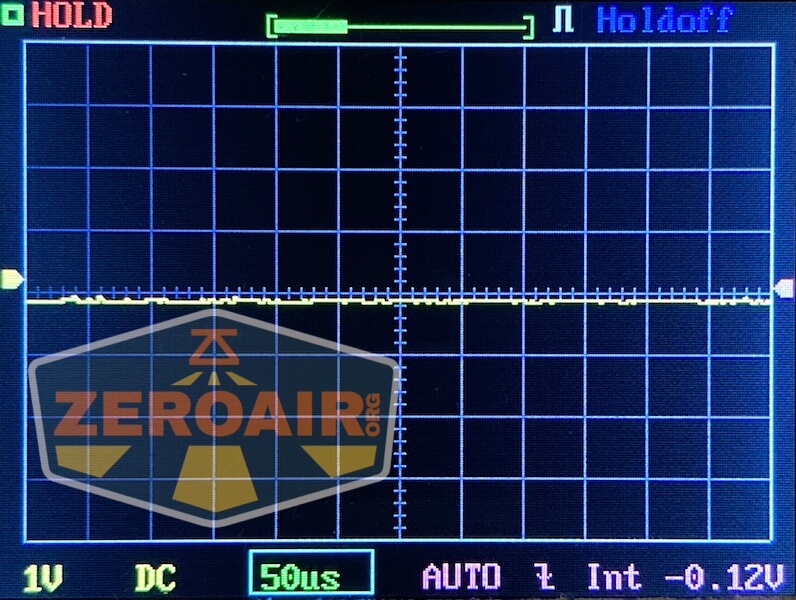
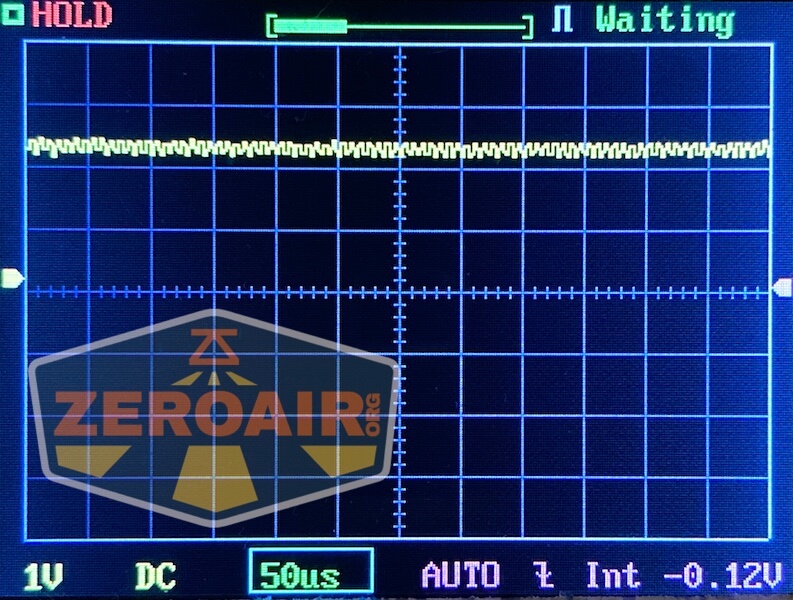
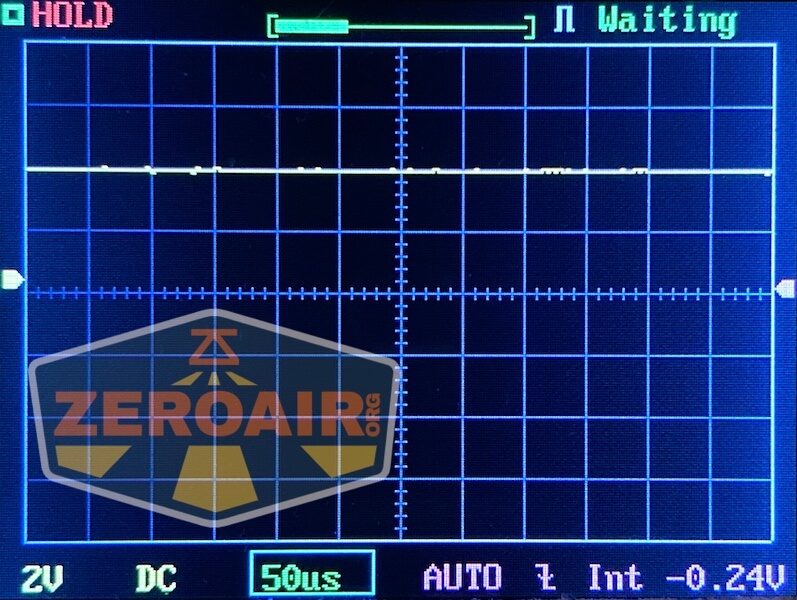
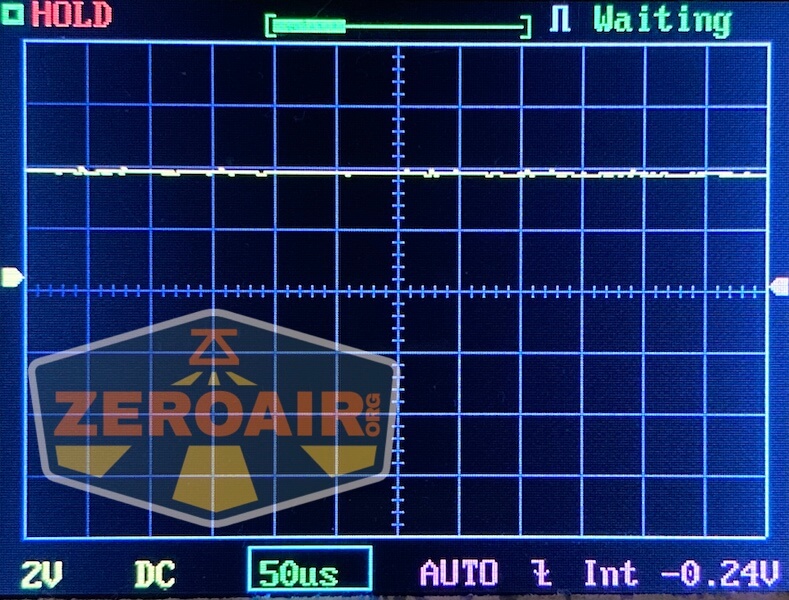
Here you can see a “baseline” – a chart with almost no light hitting the sensor.

Then there’s the Ultrafire WF-602C flashlight, which has some of the worst PWM I’ve seen. It’s so bad that I used a post about it to explain PWM! Here are multiple timescales (10ms, 5ms, 2ms, 1ms, 0.5ms, 0.2ms) to make comparing this “worst” PWM light to the test light easier. That post also explains why I didn’t test the WF-602C at the usual 50us scale.


User Interface and Operation
This Thrunite TC20 V2 flashlight has a single side switch, which is an indicating e-switch. As you can see, right in the center is a dot, which can display red and blue. The switch is a standard Thrunite switch. Low action, very positive click, and no squeak. It’s also metal (maaaayyyybe coated plastic, but it feels like real metal). I do find it to be loud on the click, but it’s a nice switch!


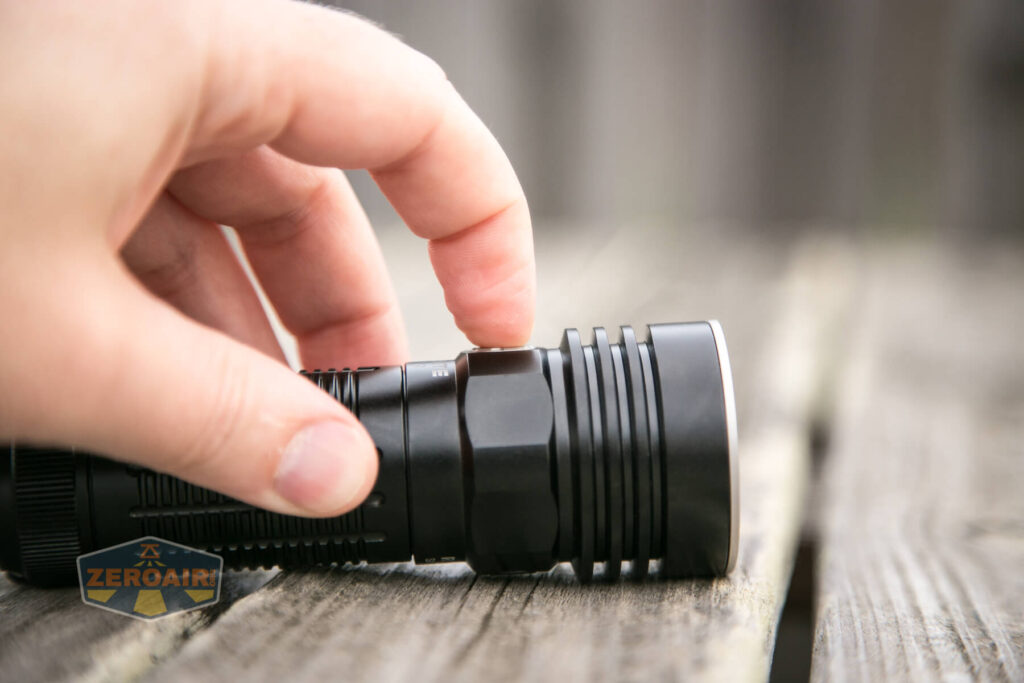
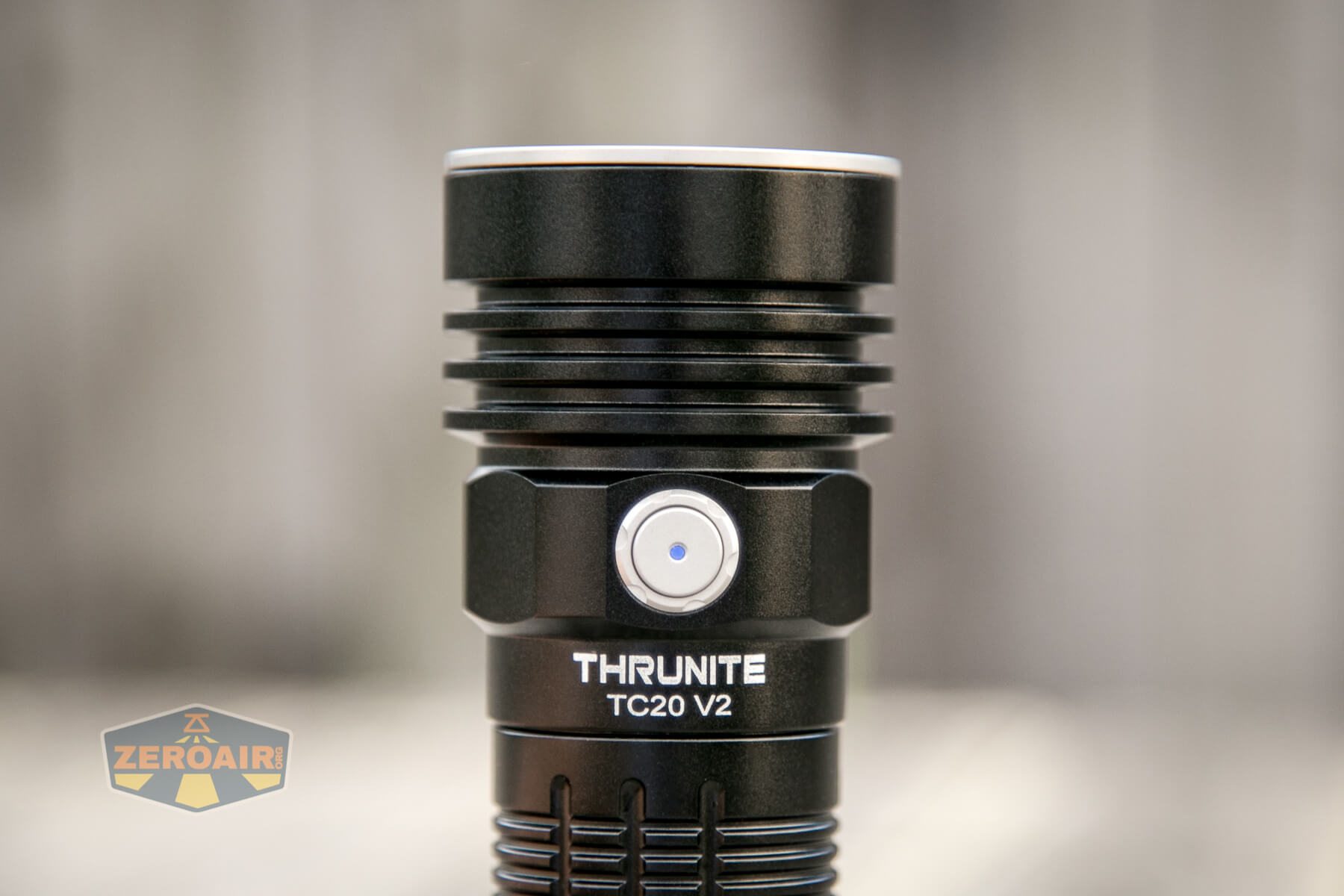
Here’s a user interface table!
| State | Action | Result |
|---|---|---|
| Off | Click | On (memory, LMH only) |
| Off | Hold | Firefly |
| Any | Double Click | Turbo |
| Turbo | Double Click | Strobe |
| On | Click | Off |
| On | Hold | Mode cycle (LMH only) |
If you’re like me, you’ll take that as a very simple UI. Note how hard it is to get to strobe…. just as things should be.
LED and Beam
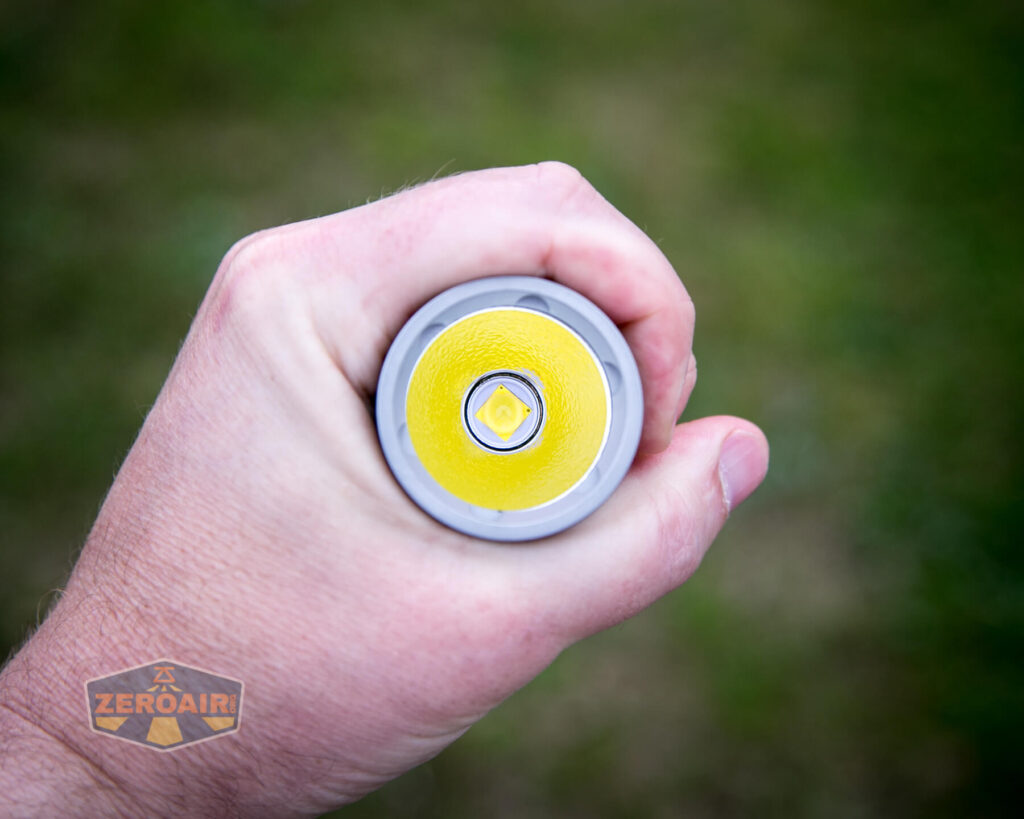
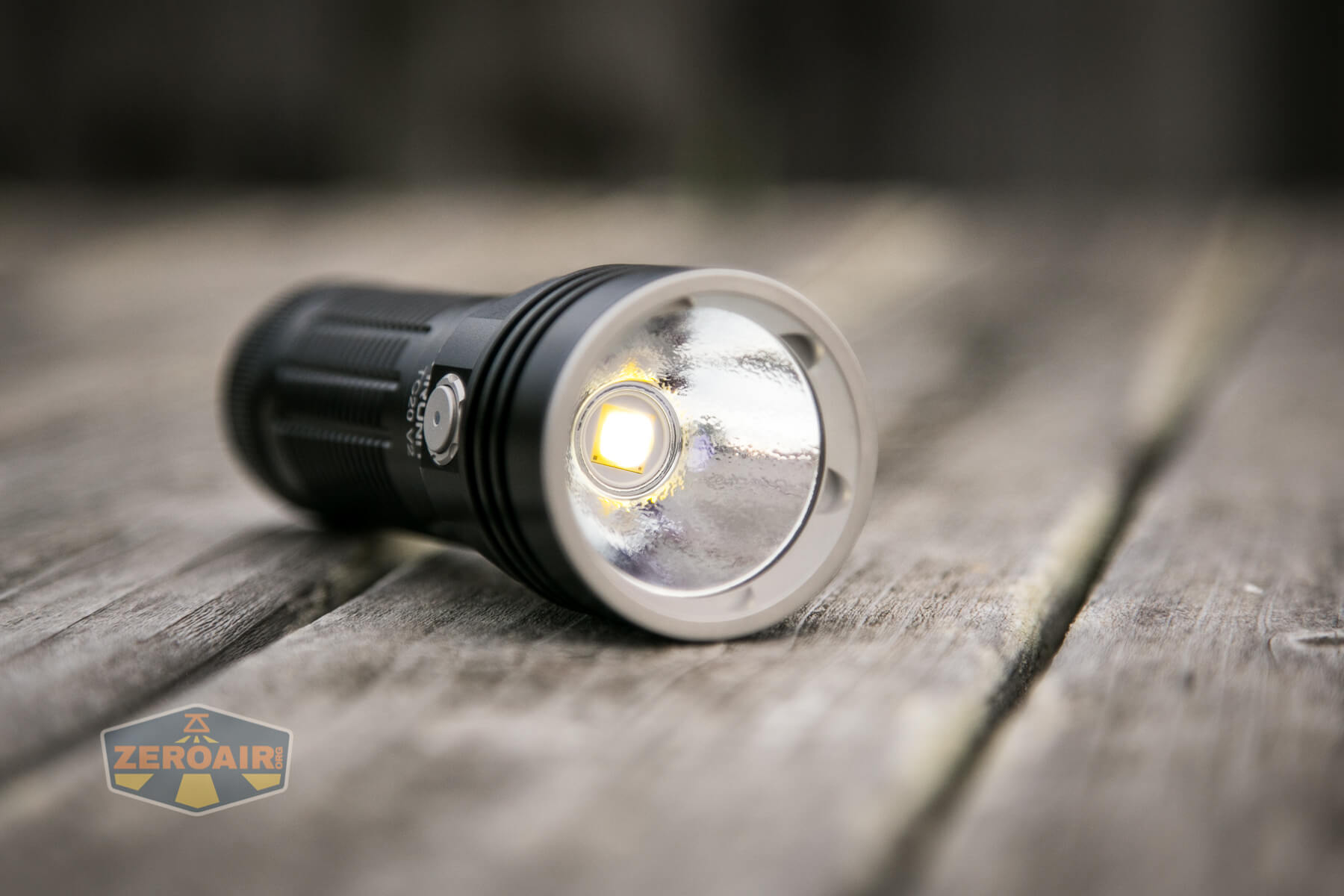
The emitter is a Cree XHP70.2. It’s at the bottom of a light orange peel, shallow reflector. This is the same emitter as the original version. I reviewed the Thrunite TC20 over 3 years ago – I guess that shows that the 70.2 emitter is either “just that good.”
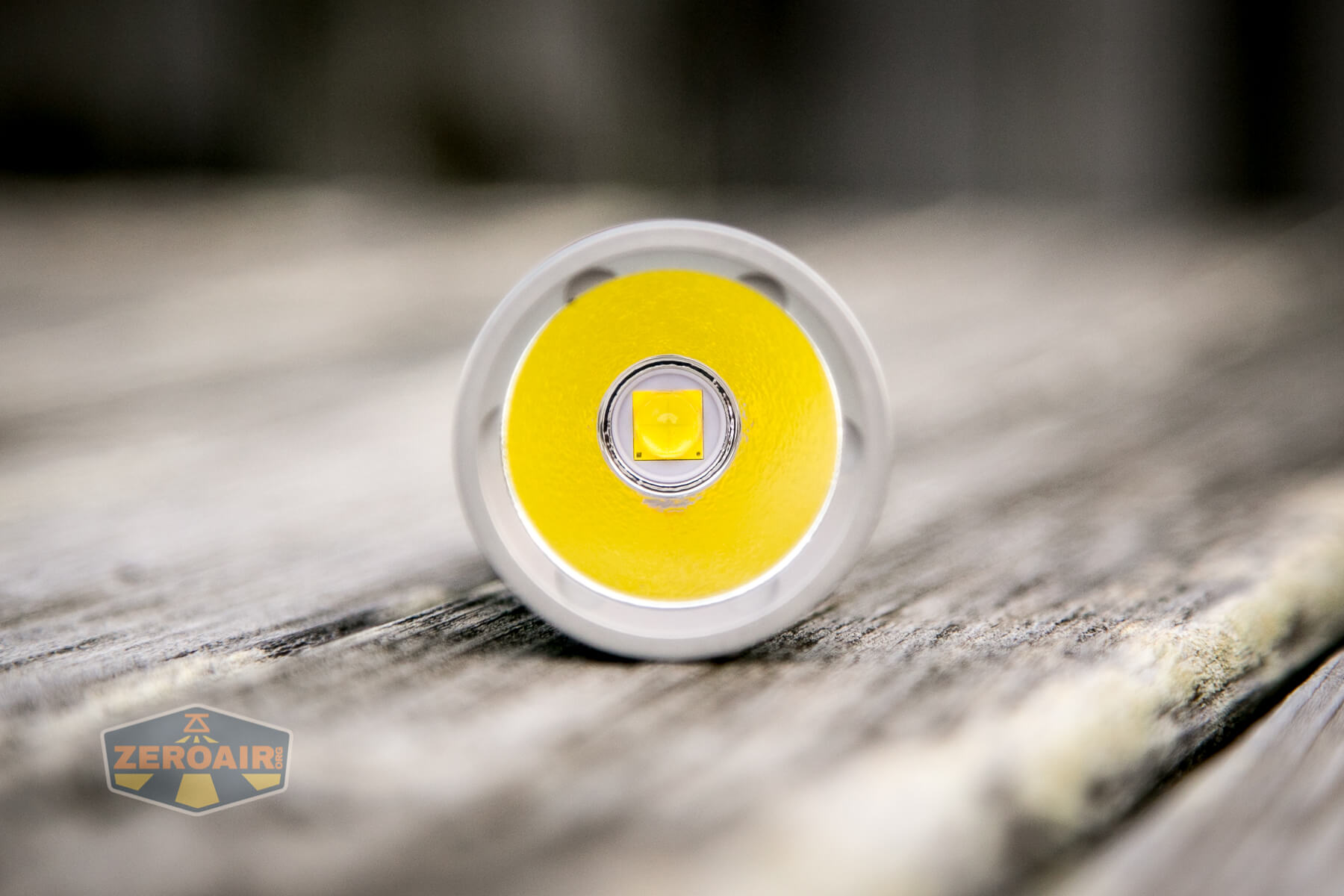

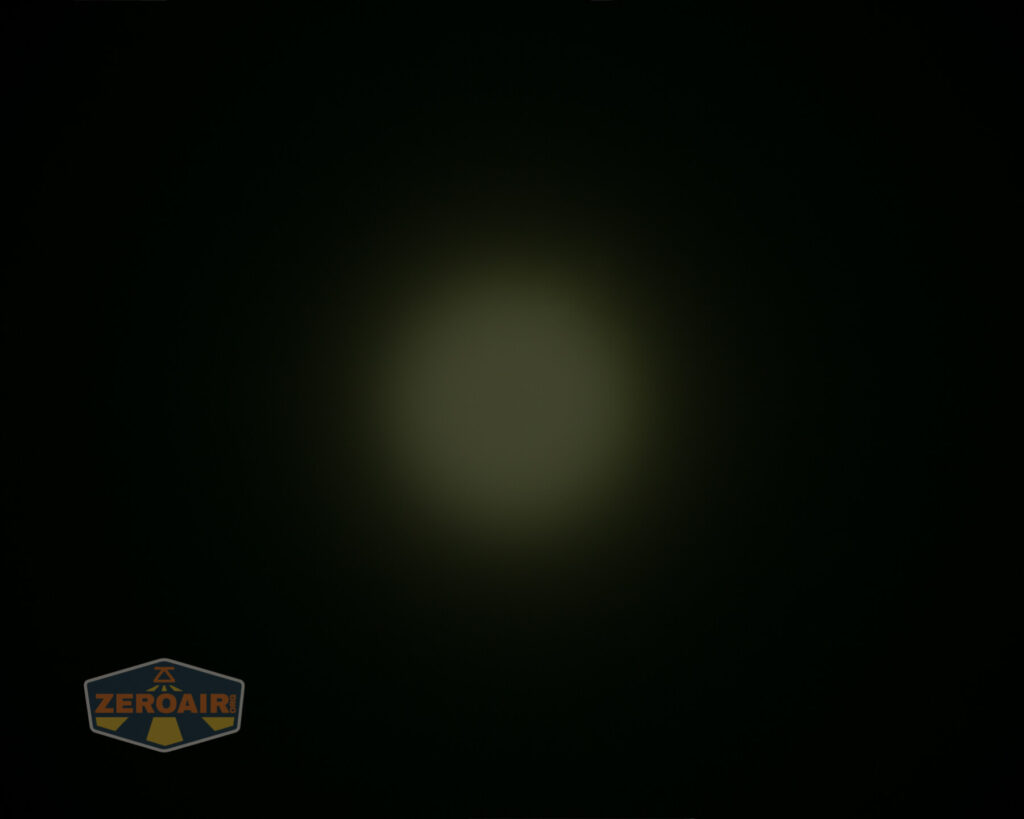
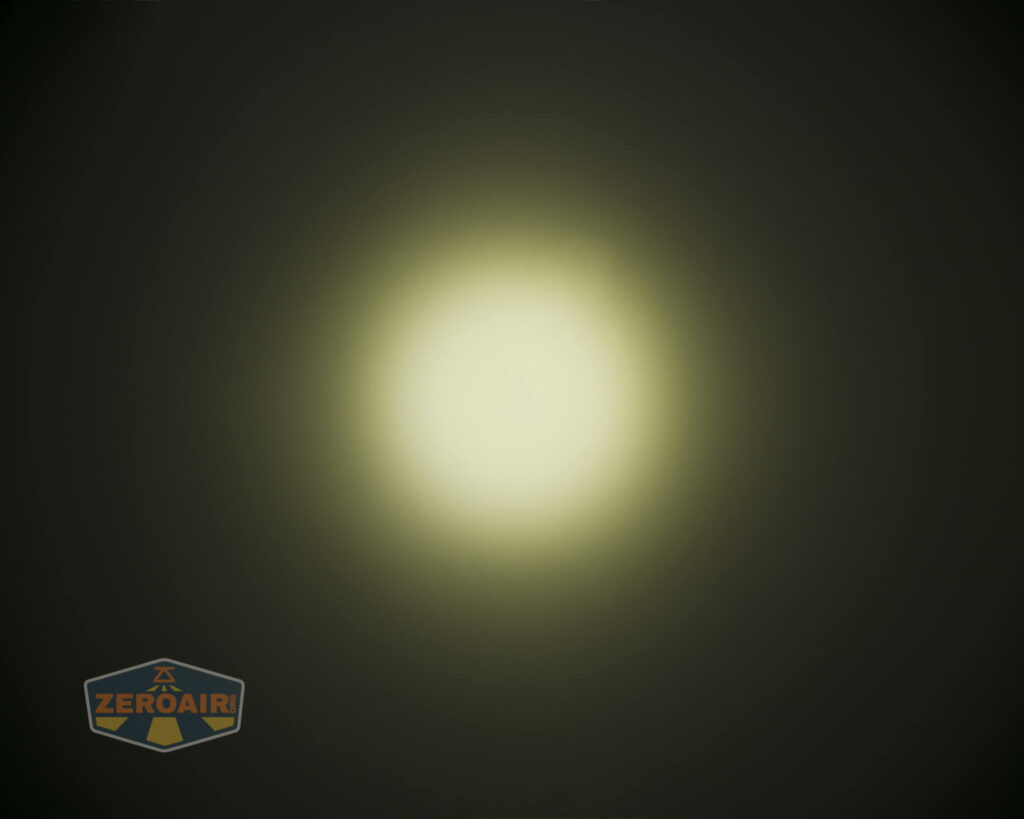
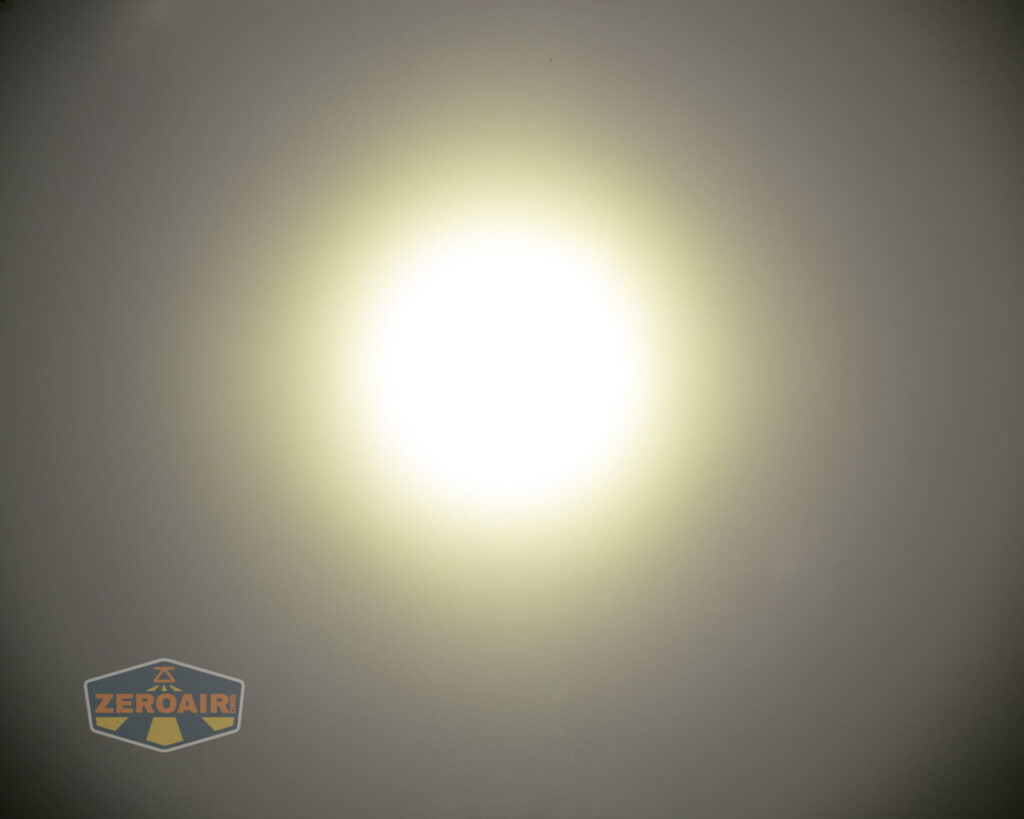
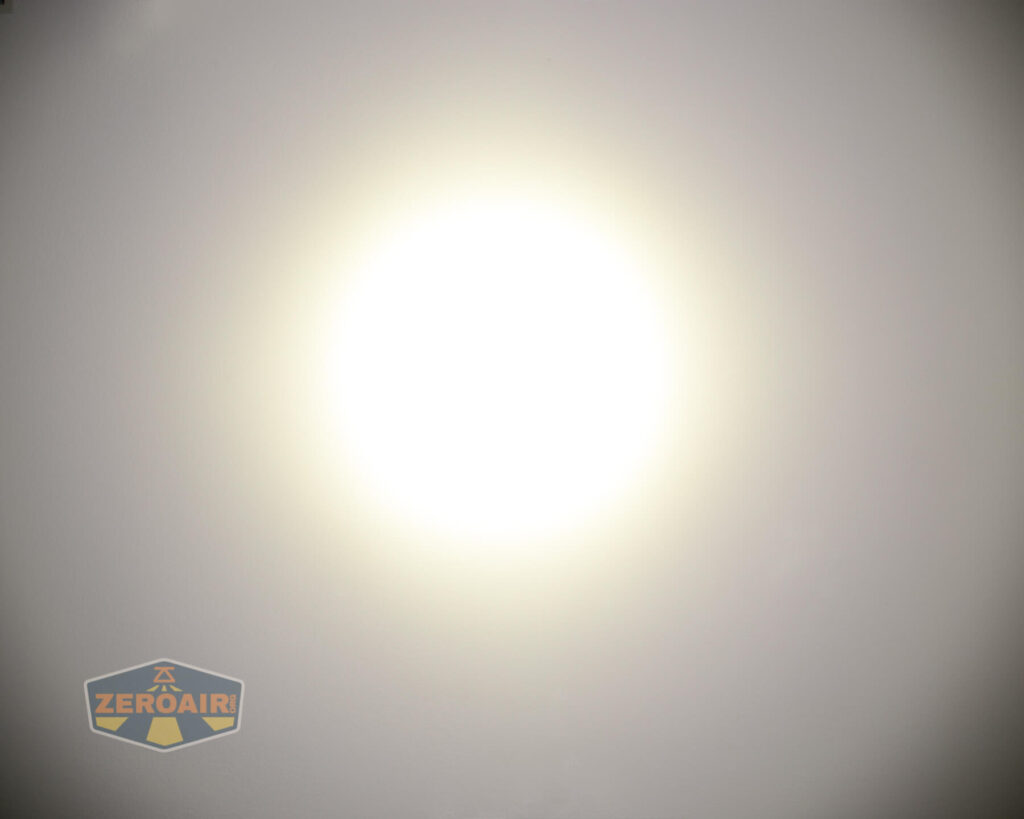
It’d seem like the beam profile would be completely floody, but it’s surprisingly not. Yes, there’s a fair bit of spill, and no, the hotspot isn’t tight, but the TC20 provides a surprisingly tight hotspot.
These beamshots always have the following settings: f8, ISO100, 0.3s shutter, and manual 5000K exposure. These photos are taken at floor level, and the beam hits the ceiling around 9 feet away.
Tint vs BLF-348 (KillzoneFlashlights.com 219b version) (affiliate link)
I keep the test flashlight on the left and the BLF-348 reference flashlight on the right.

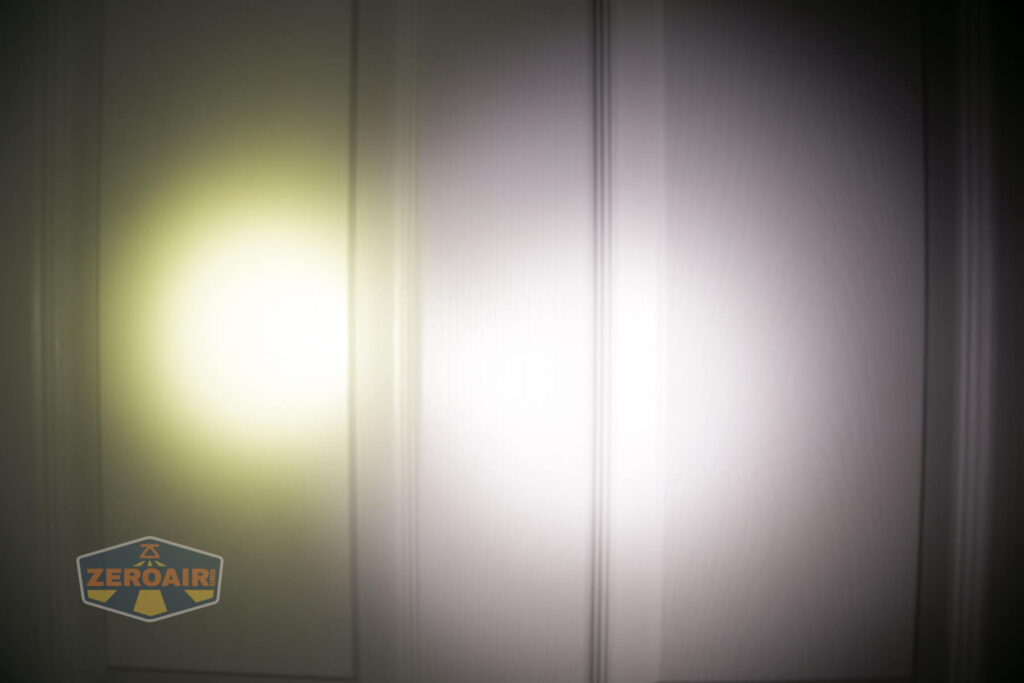
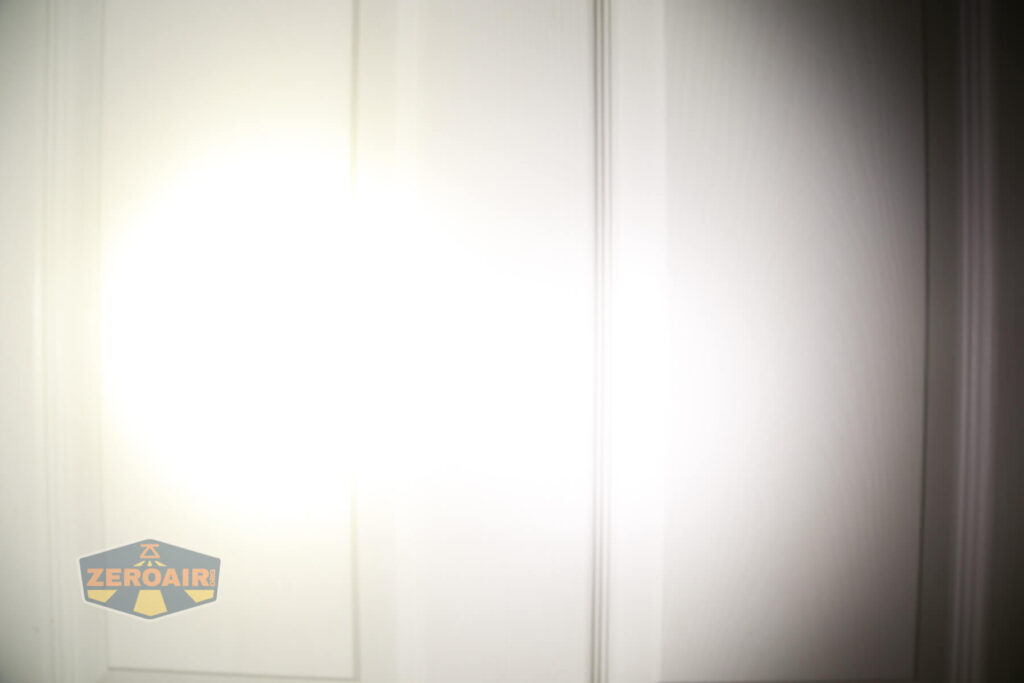


I compare everything to the KillzoneFlashlights.com 219b BLF-348 because it’s inexpensive and has the best tint!
Conclusion
What I like
- Turbo is really turbo (10A!!!)
- Onboard charging at 2A is quite good
- The included cell seems like a high-quality cell
- The package is the whole package, with everything needed
- The size is great
- Neutral white option is very much appreciated
- Improved body design (no overly aggressive knurling)
What I don’t like
- user interface is quite simple; I might love to see some fleshing out with the indicating switch, and added features there.
Notes
- This light was provided by Thrunite for review. I was not paid to write this review.
- This content originally appeared at zeroair.org. Please visit there for the best experience!
- Please use my Amazon.com referral link to help support zeroair.org!
- Please support me on Patreon! I deeply appreciate your support!
It looks like they upgraded their boost driver to pull more amps and maybe used a higher bin 70.2. That’s impressive output!
I see you have the Zebralight sc700d there for size comparison. It almost seems like the TC20 V2 would almost make the sc700d obsolete since they are both jacket-pocket sized lights and the TC20 V2 has a more stable high output. What do you think? Would you still grab the Zebralight more often for basic tasks?
Thanks!
I’d probably grab the Zebralight because it just seems to fit better in my hand. I can see why someone would pick the TC20 V2 though.
I did review the Zebralight – it should be the next post or two from this one. Thanks!
Just received mine and the tail cap does come off (requires some muscle to unscrew) however my TC20 V2 does not charge USB C to USB C. Only USB A to USB C. Bummer…