
Olight Seeker 3 Pro Flashlight Review
Here we have the Olight Seeker 3 Pro flashlight, upgraded to 4200 lumens. This one has the limited edition orange finish, too! Read on!
Official Specs and Features
Here’s a link to the official product page.
Versions
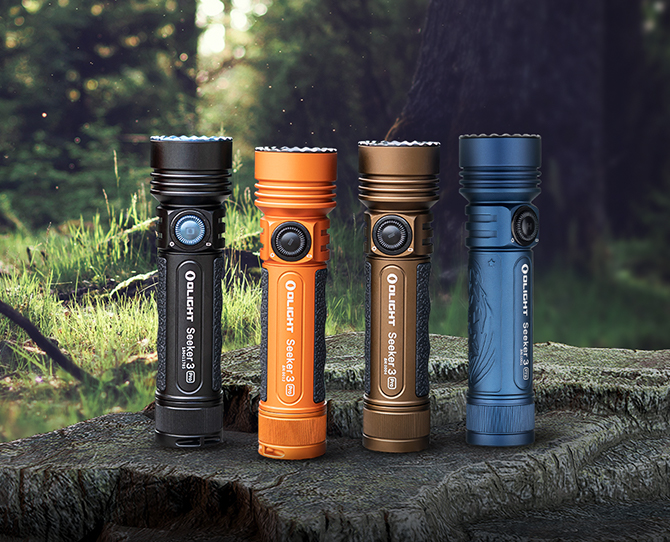
There are a bunch of versions of the Seeker in general. But of the Olight Seeker 3 Pro specifically, there are at least four. Black, orange (seen here), Brown, and Blue are all available.
Price
First off, it’s Olight “O-Fan Day!” Here’s a link to that main page. These are ShareASale links.
Short Review
Well, first off, this light is orange, so it’s clearly superior. If you need to see past that thin layer of anodizing to know more, you can know that this light has an astounding level of output. There’s also the rotary interface, allowing a much finer tuning of the output to your needs. I personally don’t use that as much as I just use the clicky, and that clicky works very well too. The nylon pouch is an outstanding part of this item, too. The battery is proprietary, as is the charging. Emitter swaps (from the cool white Osram P9) should be fairly straightforward.
Long Review
The Big Table
| Olight Seeker 3 Pro | |
|---|---|
| Emitter: | Osram P9 (4) (6000-7000K) |
| Price in USD at publication time: | $90.97 for the black, but $97.47 for the orange. |
| Cell: | 1×21700 (customized, proprietary) |
| Turbo Runtime Graph | High Runtime Graph |
| LVP? | Yes |
| Switch Type: | E-Switch |
| Quiescent Current (mA): | ? |
| On-Board Charging? | Yes |
| Charge Port Type: | Proprietary Magnetic |
| Charge Graph | |
| Power off Charge Port | with cell: all modes
without cell: no modes |
| Claimed Lumens (lm) | 4200 |
| Measured Lumens (at 30s) | 4132 (98.4% of claim)^ |
| Candela per Lumen | 3.8 |
| Claimed Throw (m) | 250 |
| Candela (Calculated) in cd (at 30s) | 908lux @ 4.564m = 18914cd |
| Throw (Calculated) (m) | 275.1 (110% of claim)^ |
| All my Olight reviews! | |
^ Measurement disclaimer: Testing flashlights is my hobby. I use hobbyist-level equipment for testing, including some I made myself. Try not to get buried in the details of manufacturer specifications versus measurements recorded here; A certain amount of difference (say, 10 or 15%) is perfectly reasonable.
What’s Included
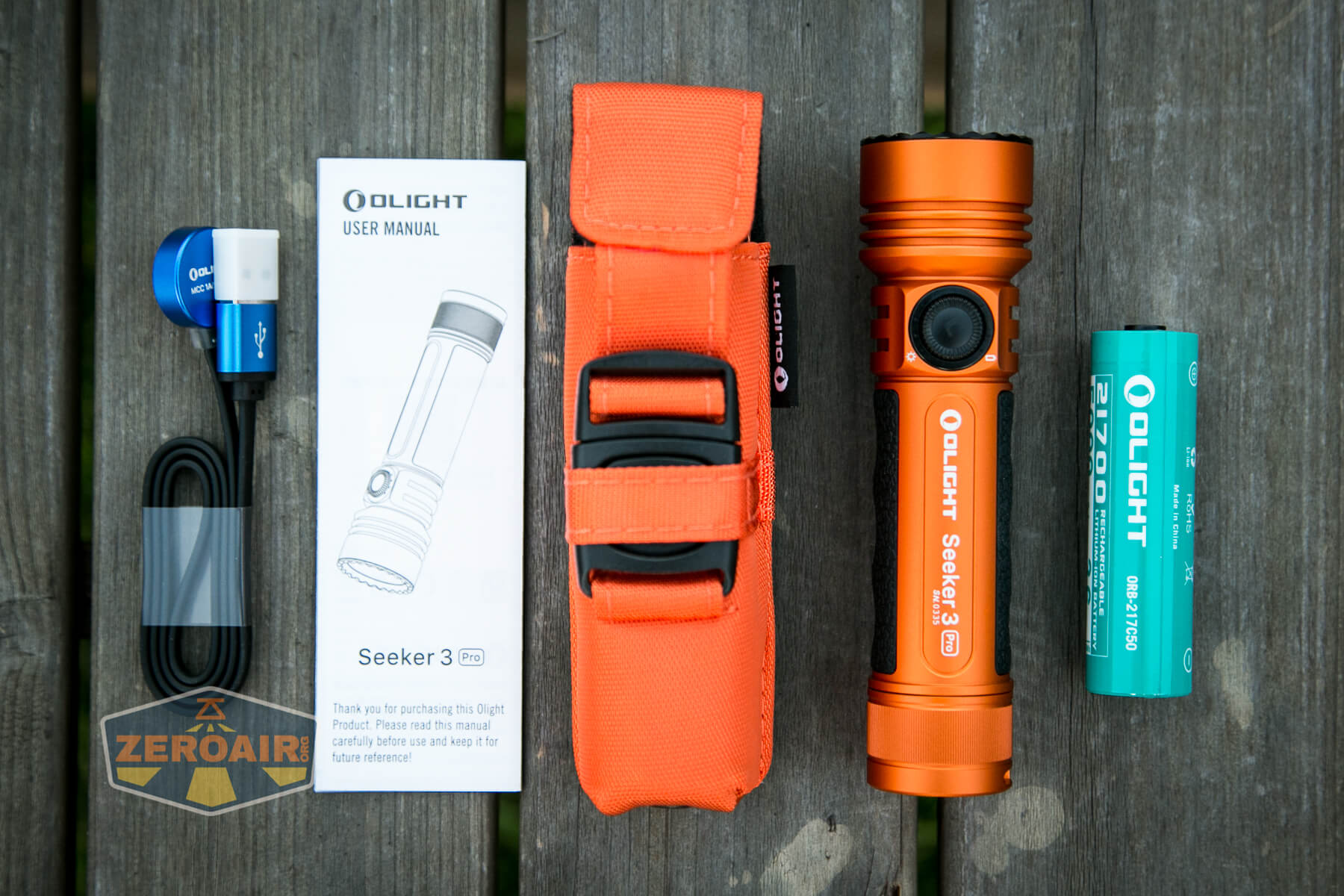
- Olight Seeker 3 Pro Flashlight
- Olight 5000mAh 21700 cell (customized, proprietary)
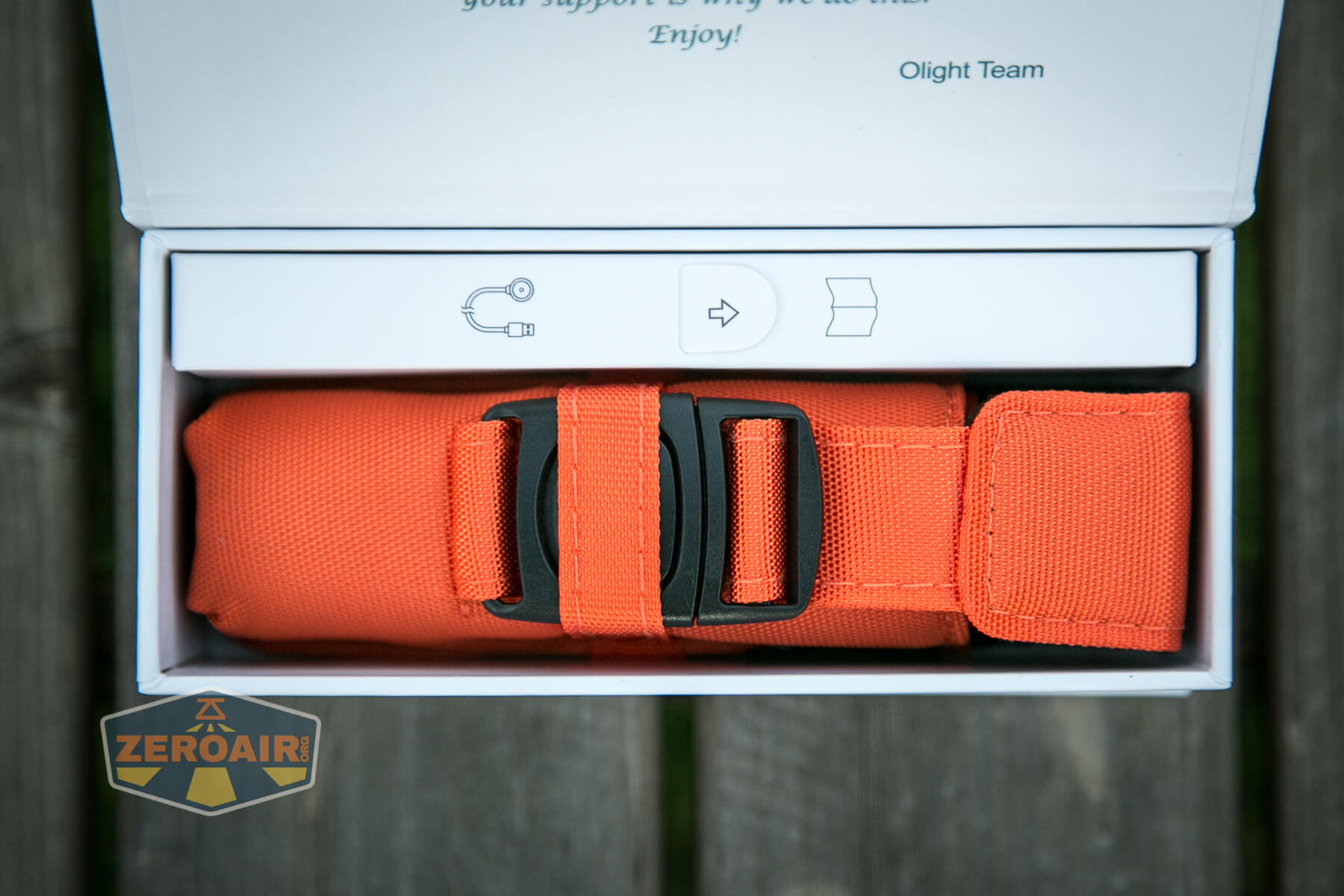
- Nylon pouch in orange
- MCC charge base (USB to proprietary magnetic)
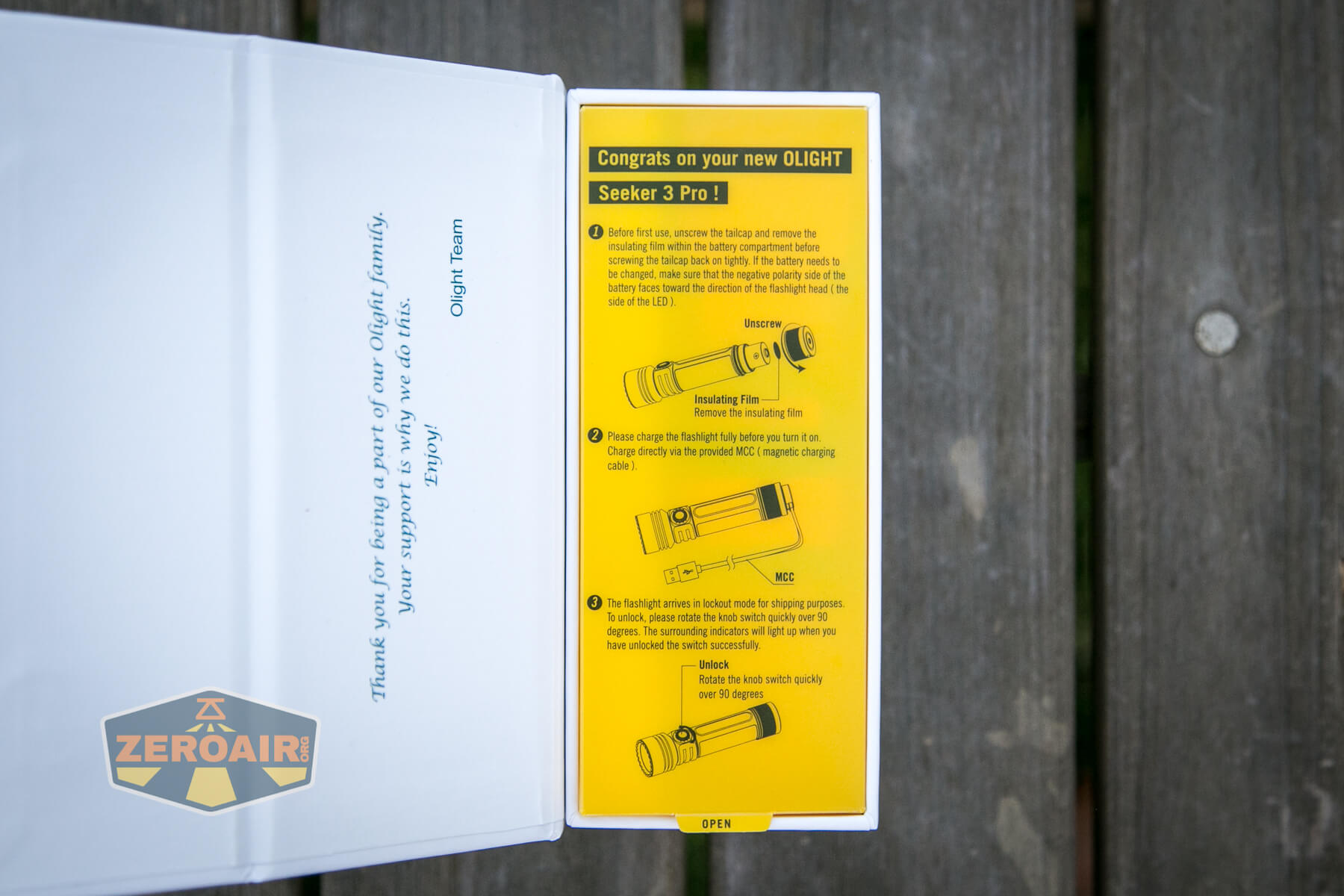
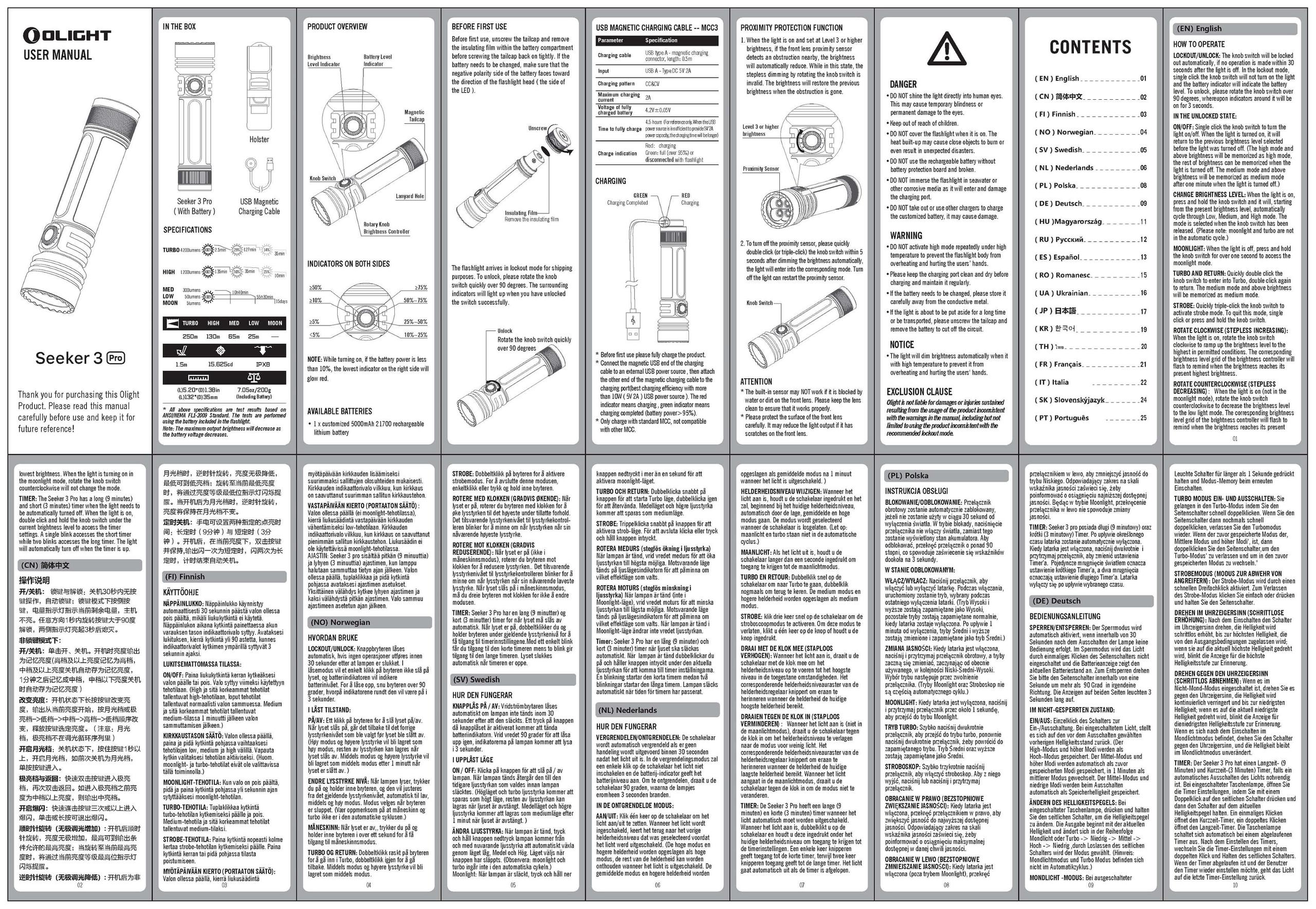
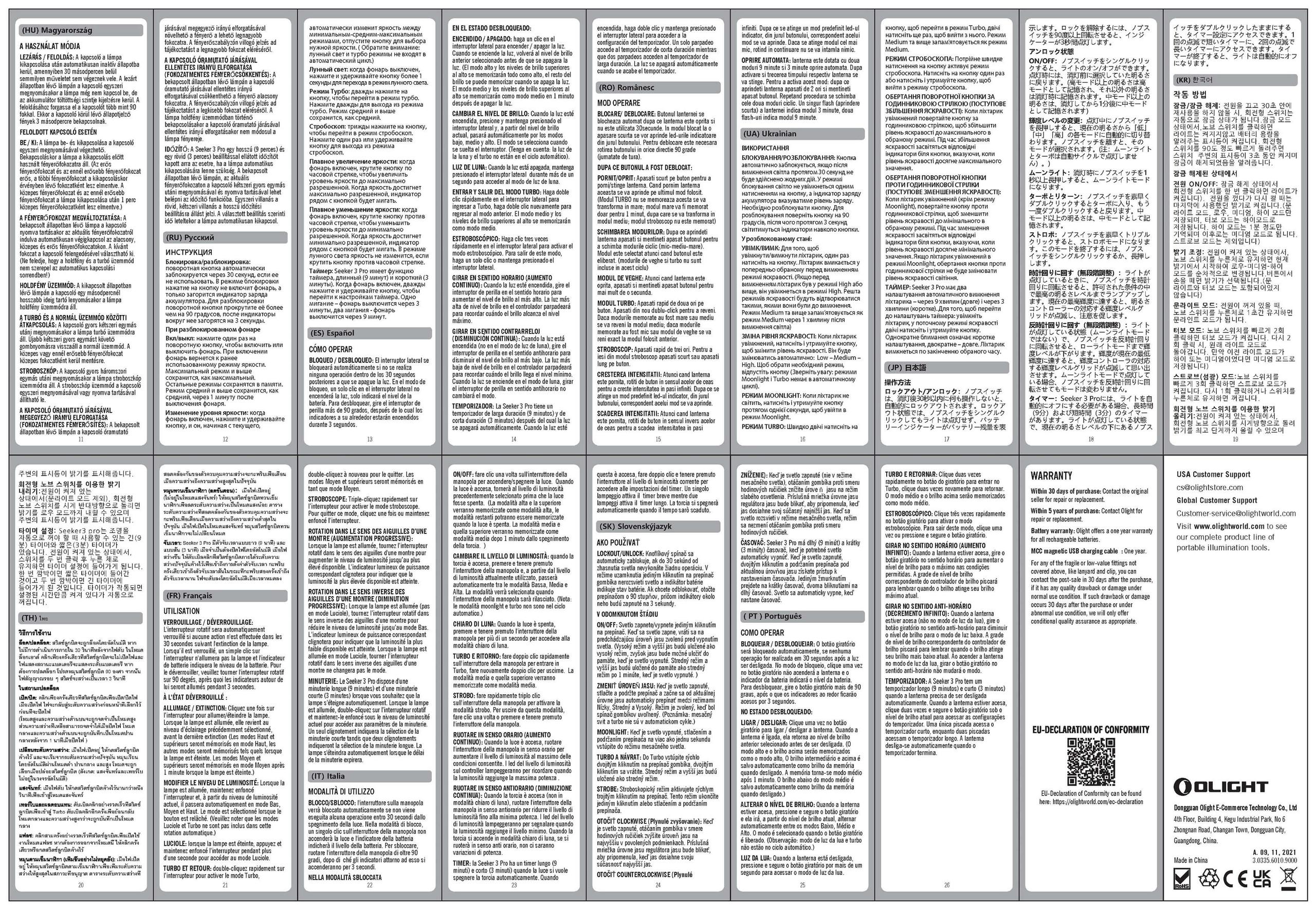
- Manual
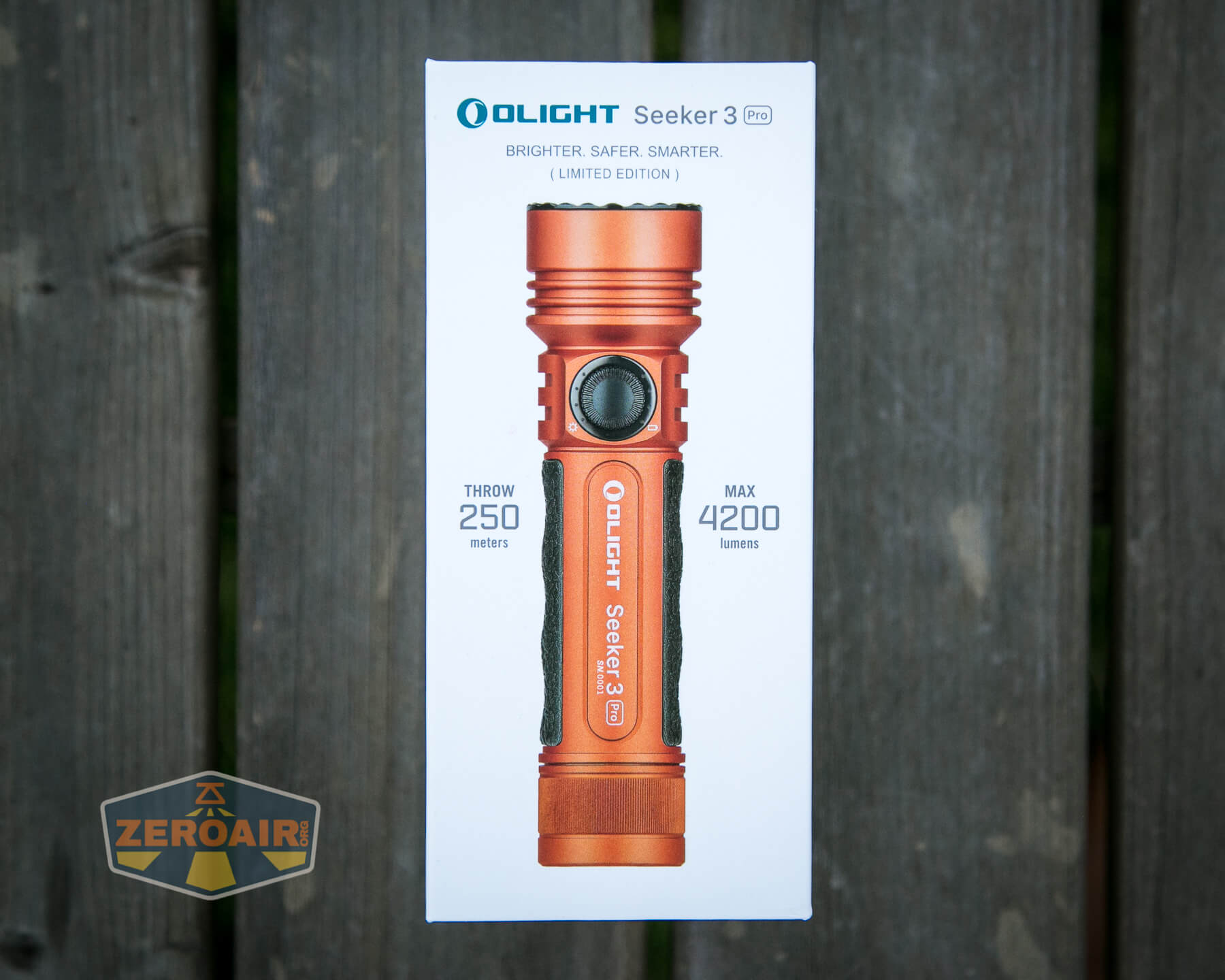
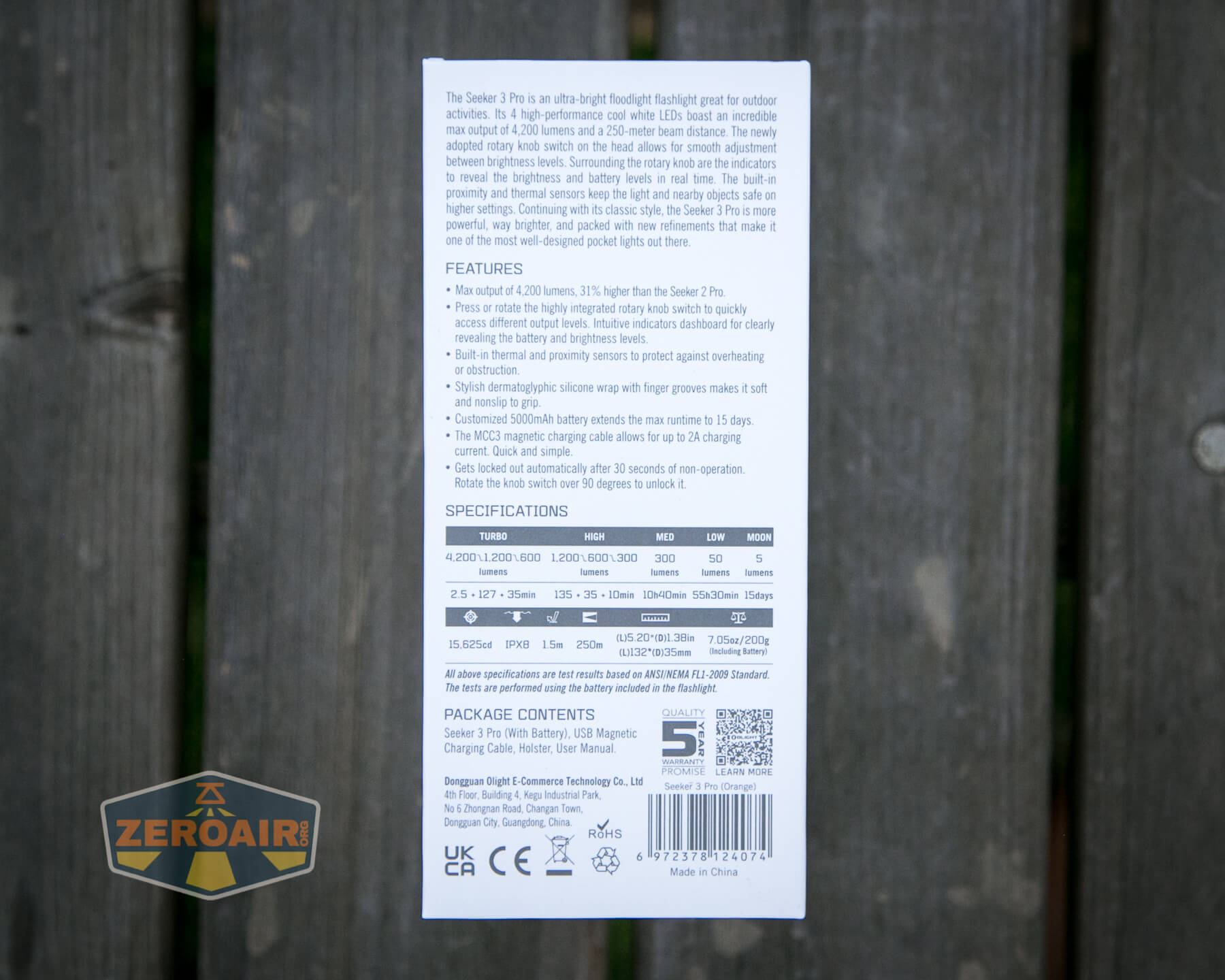
Package and Manual
Build Quality and Disassembly
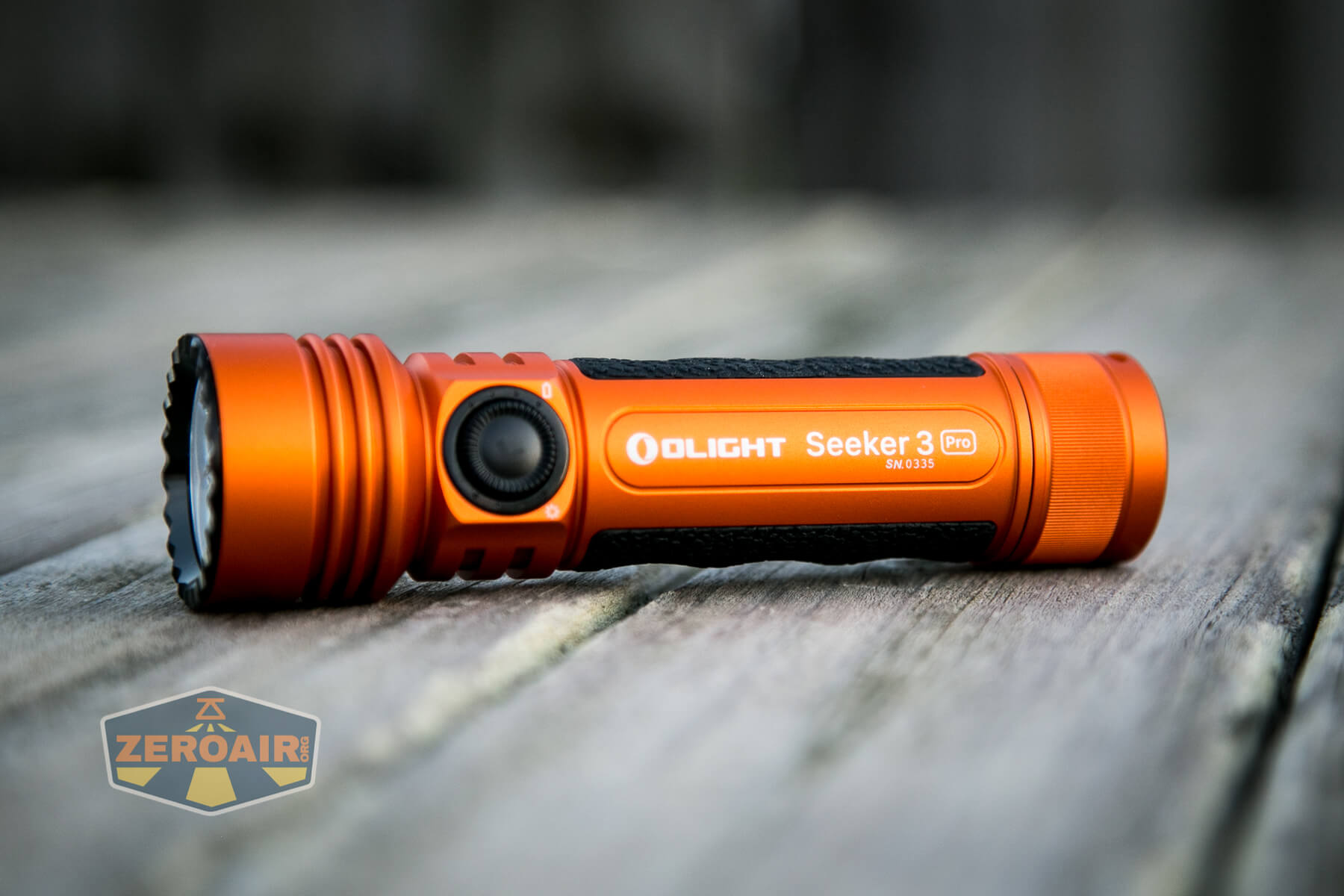
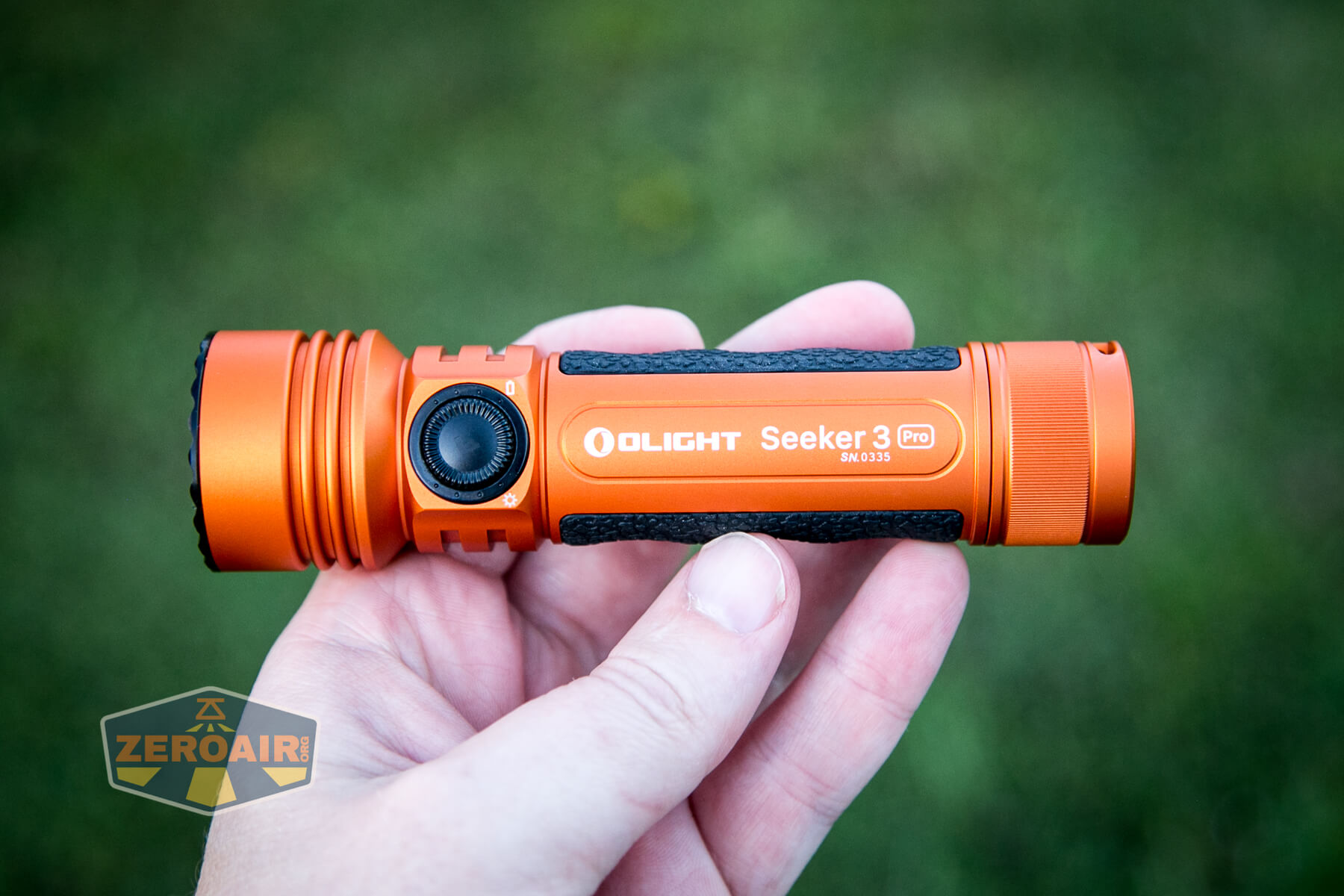
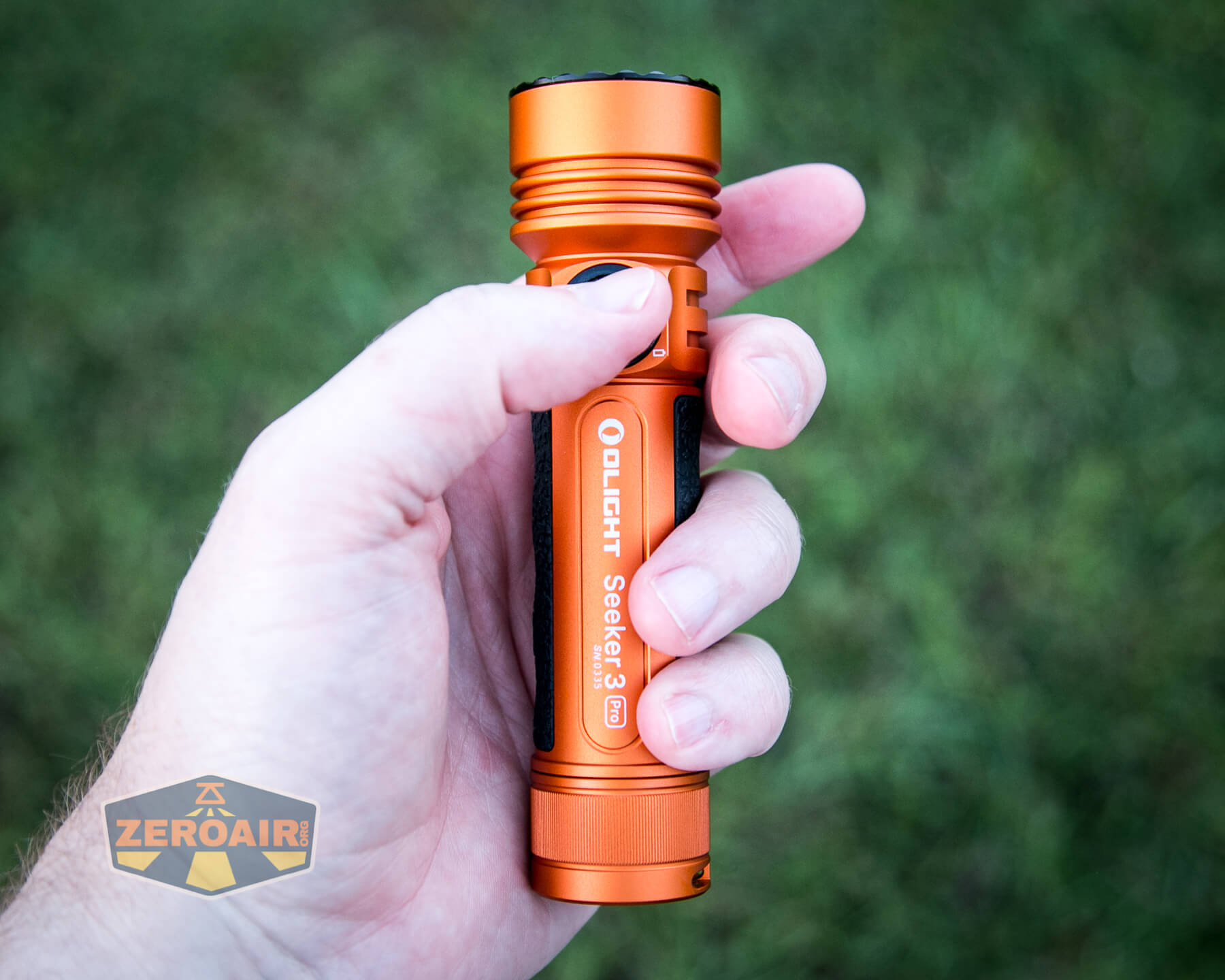
The Olight Seeker 3 Pro is a solid, well-built flashlight. This light falls in a (now) long line of orange flashlights by Olight, and I have to say, they get the orange right. While the review isn’t a “this is orange, it’s great, review done,” I can say that I’m extremely pleased by this orange.
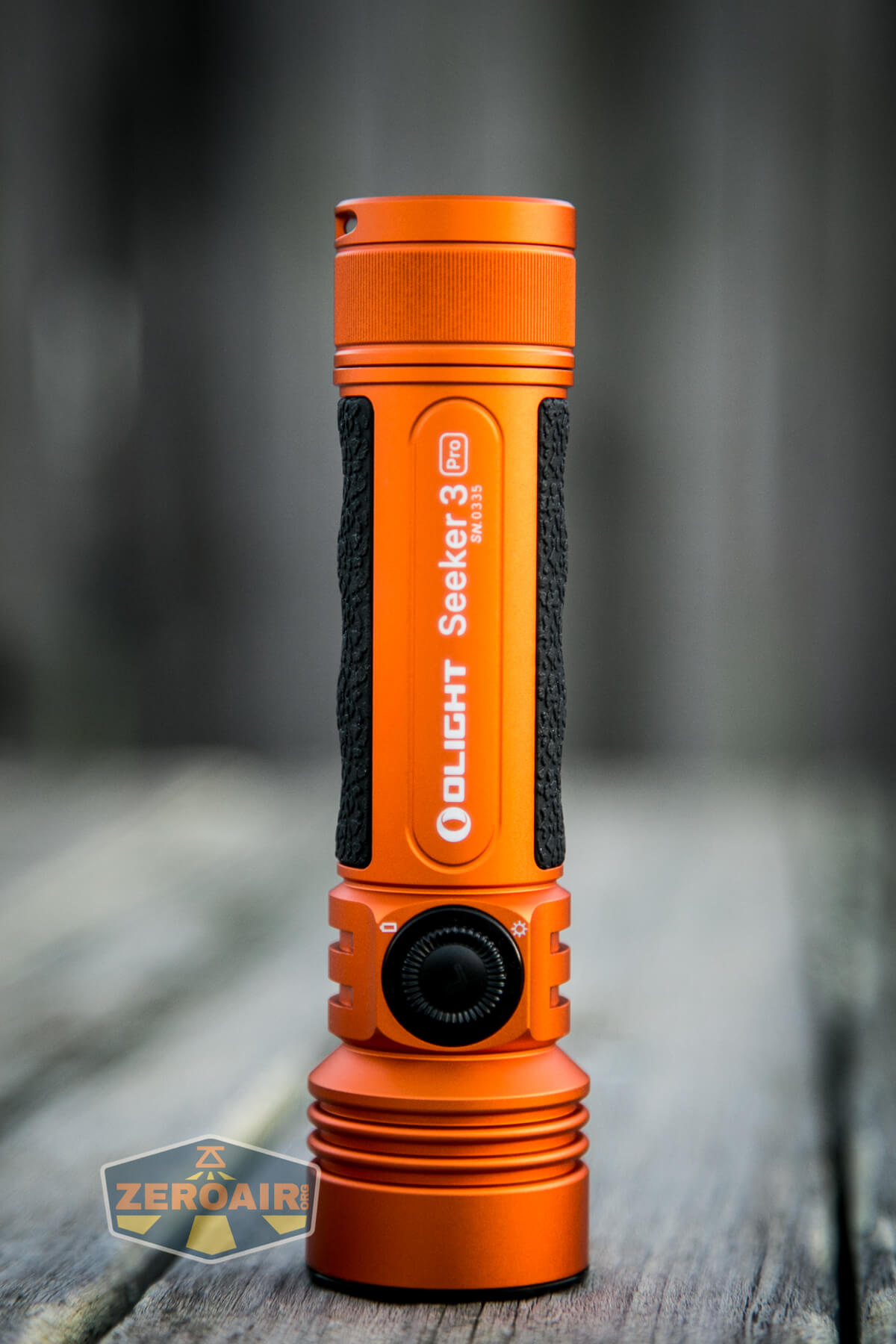
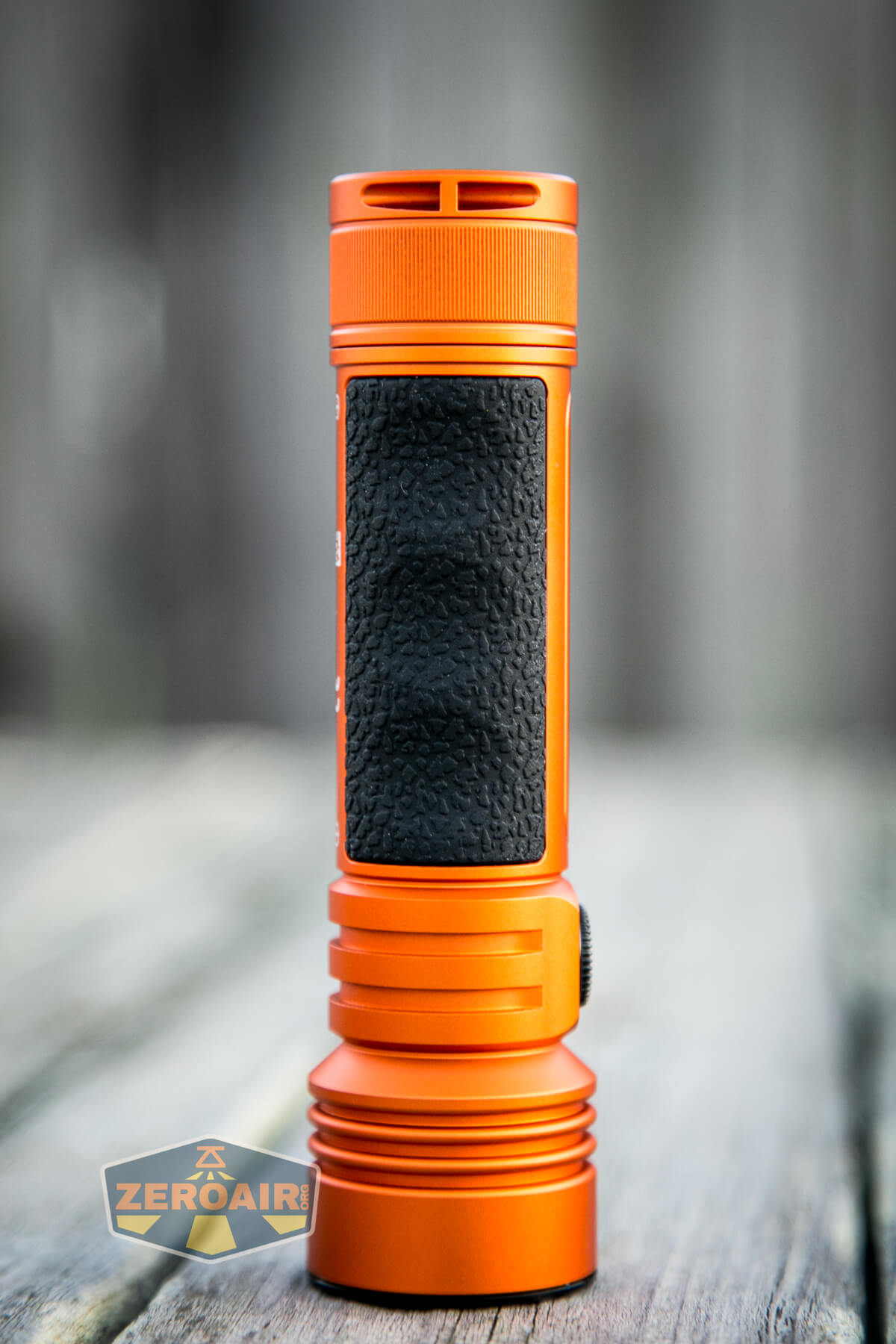
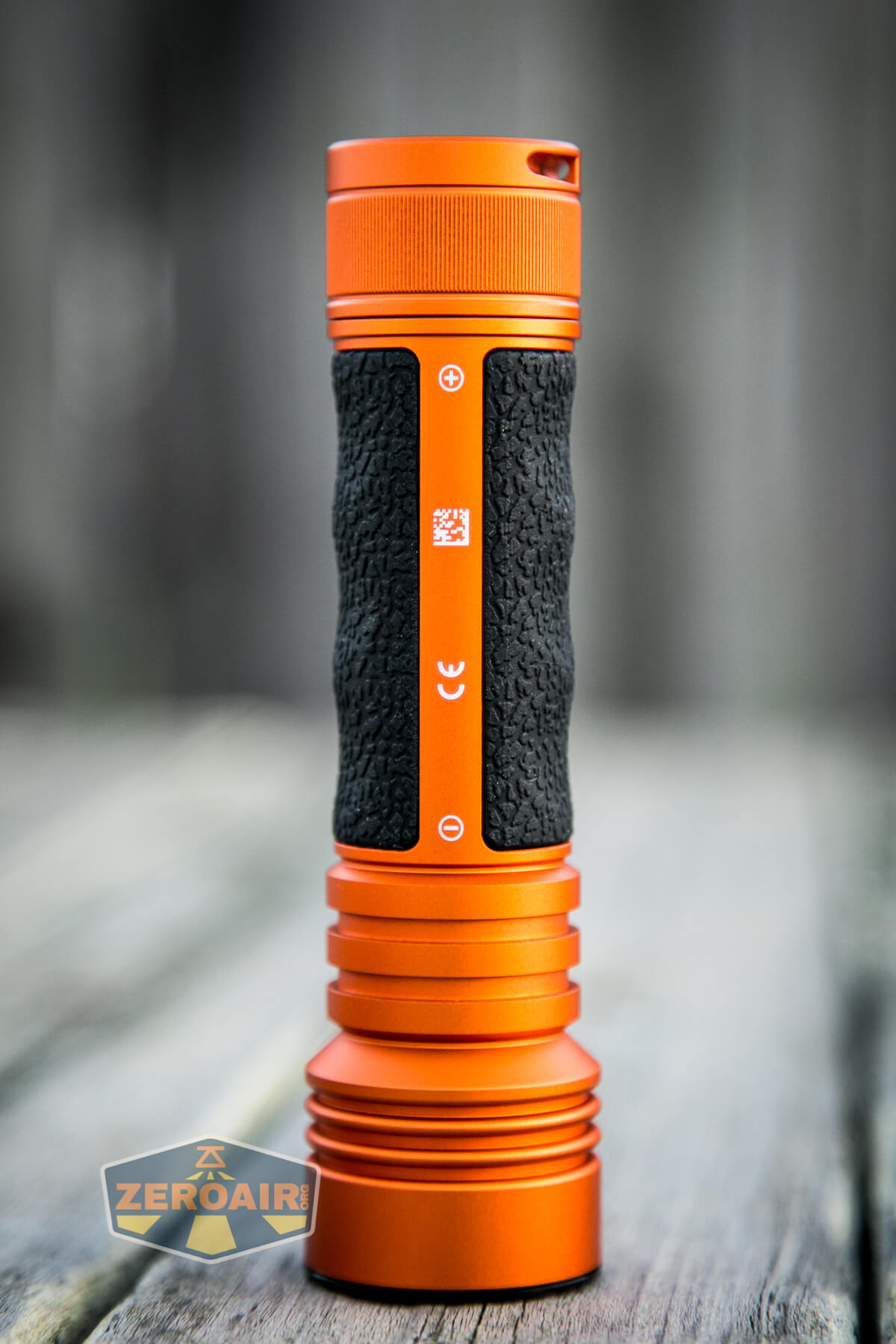
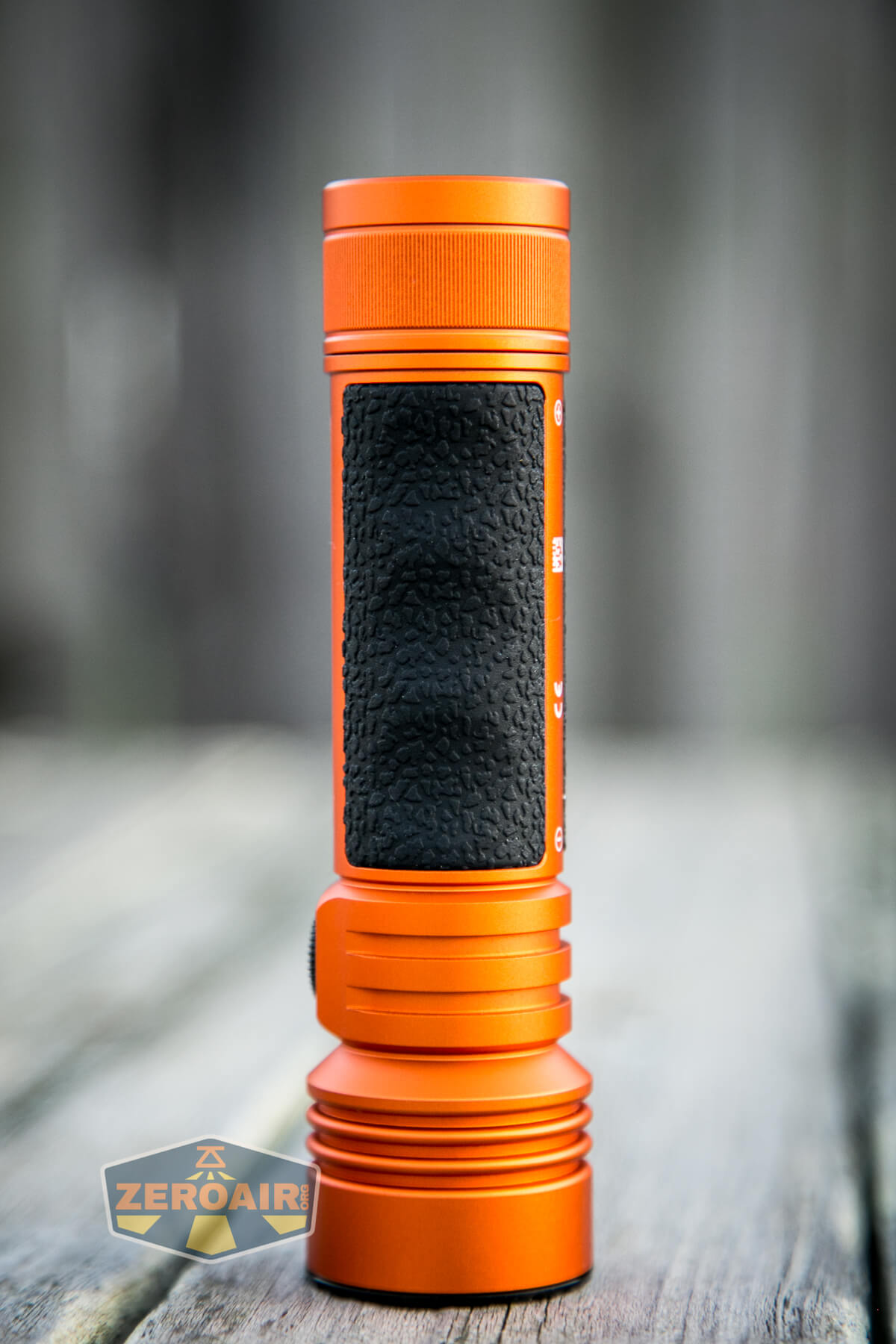
Along the sides of the Olight Seeker 3 Pro are softish grip areas. These do provide a nice bit of grip, that’s for sure. They are also dust magnets.
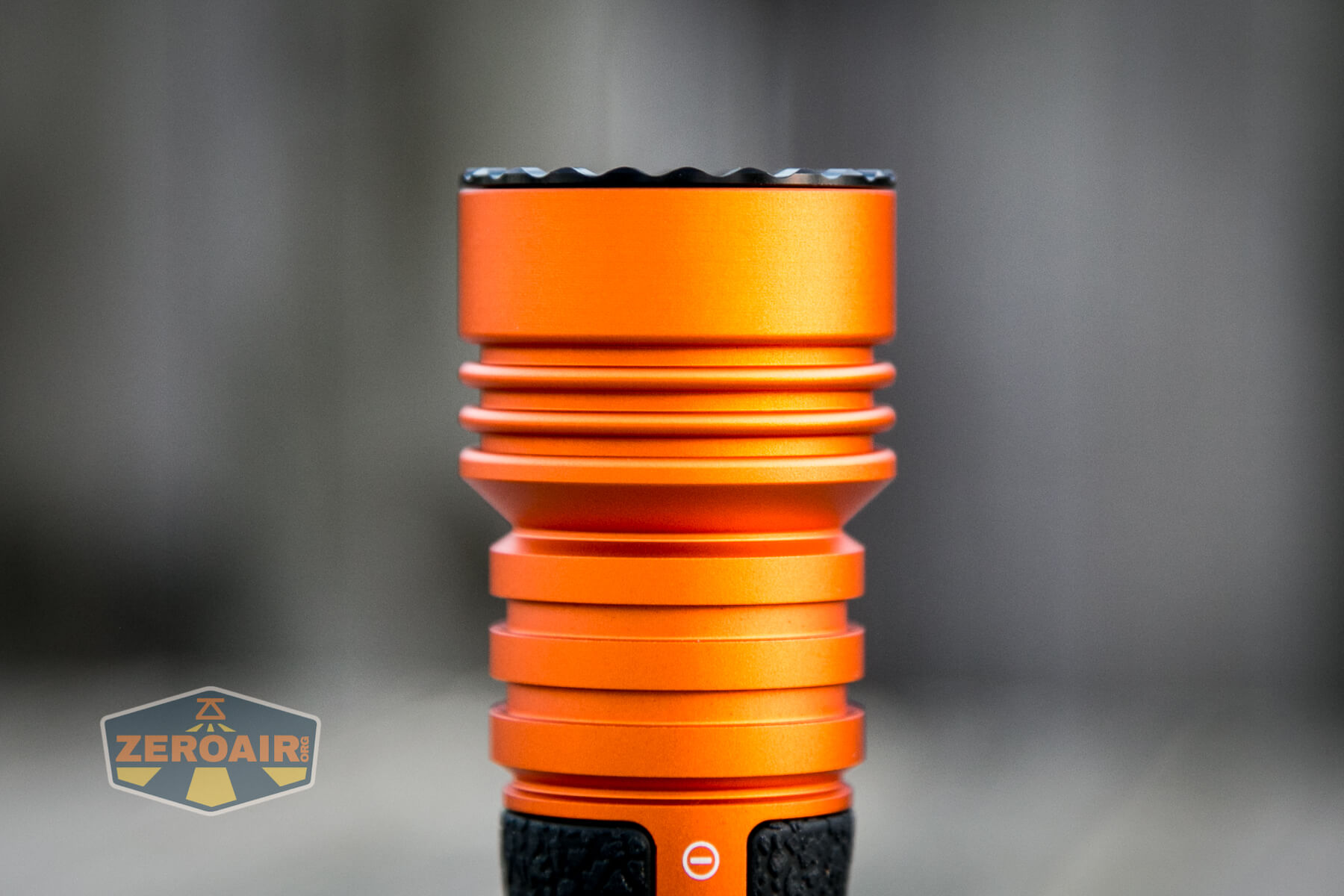
Cooling finds on the head are of minimal depth, but according to the test, they do the job just fine.
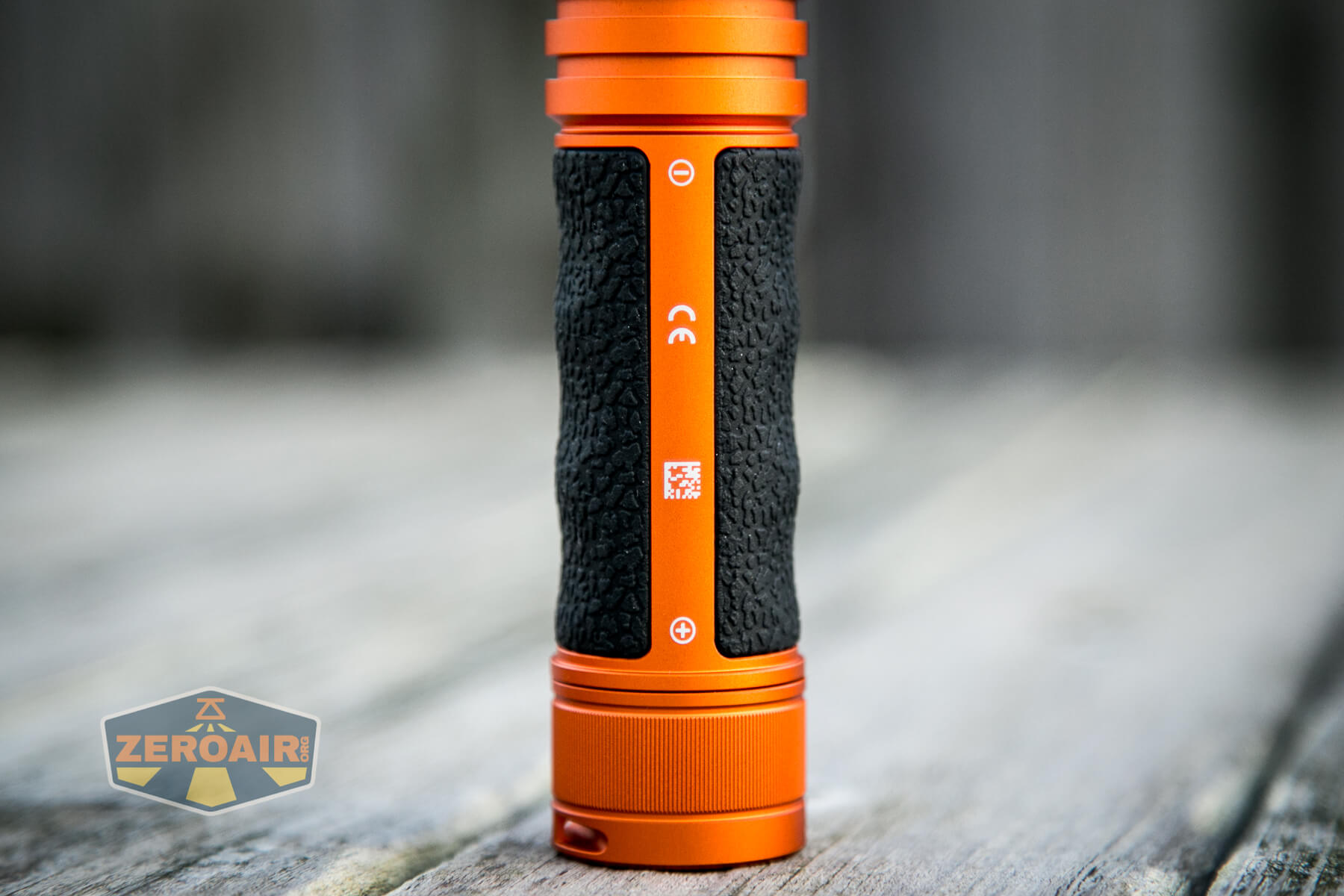
On the body are a few markings, including the cell orientation. Note that cell orientation is opposite to normal.
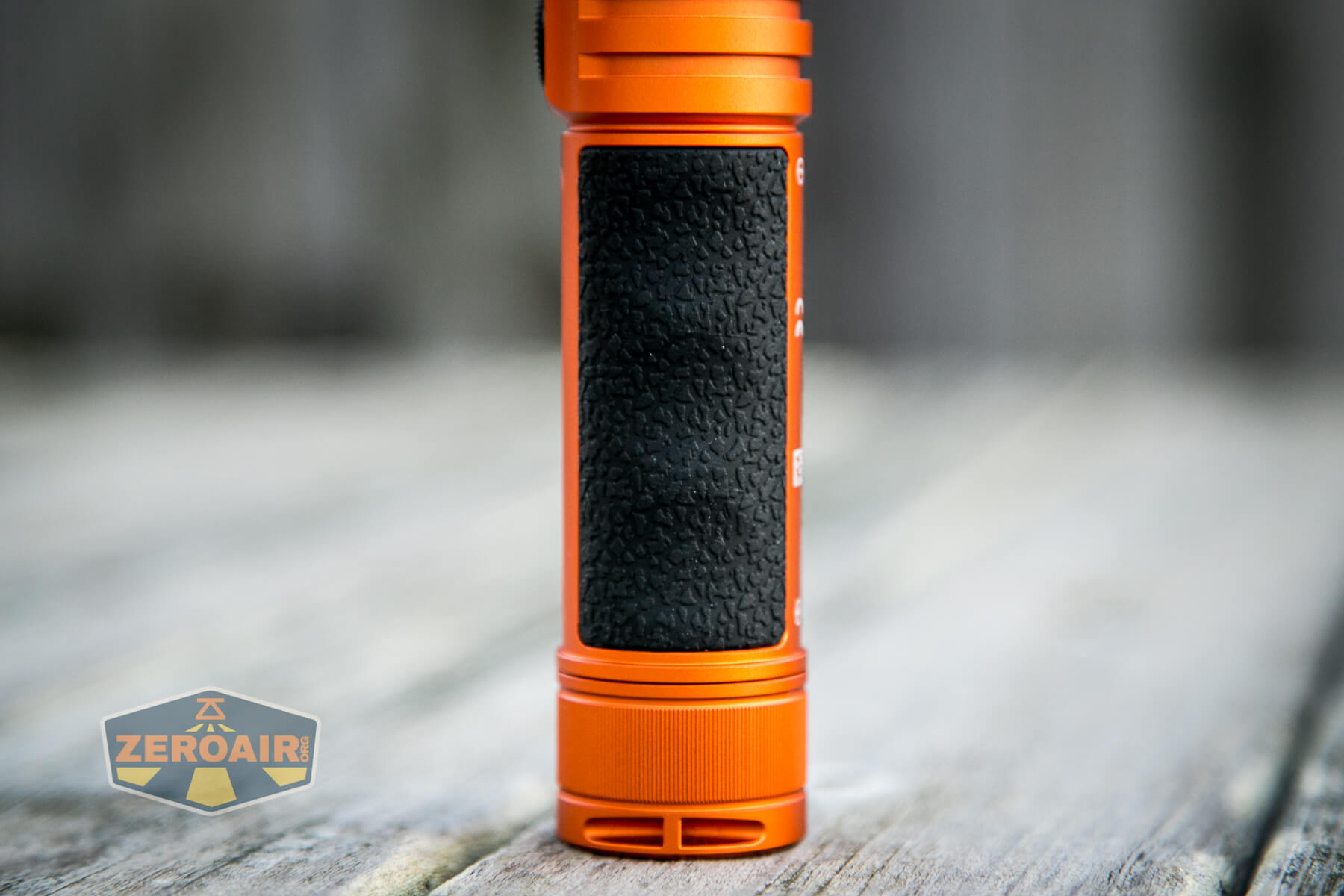
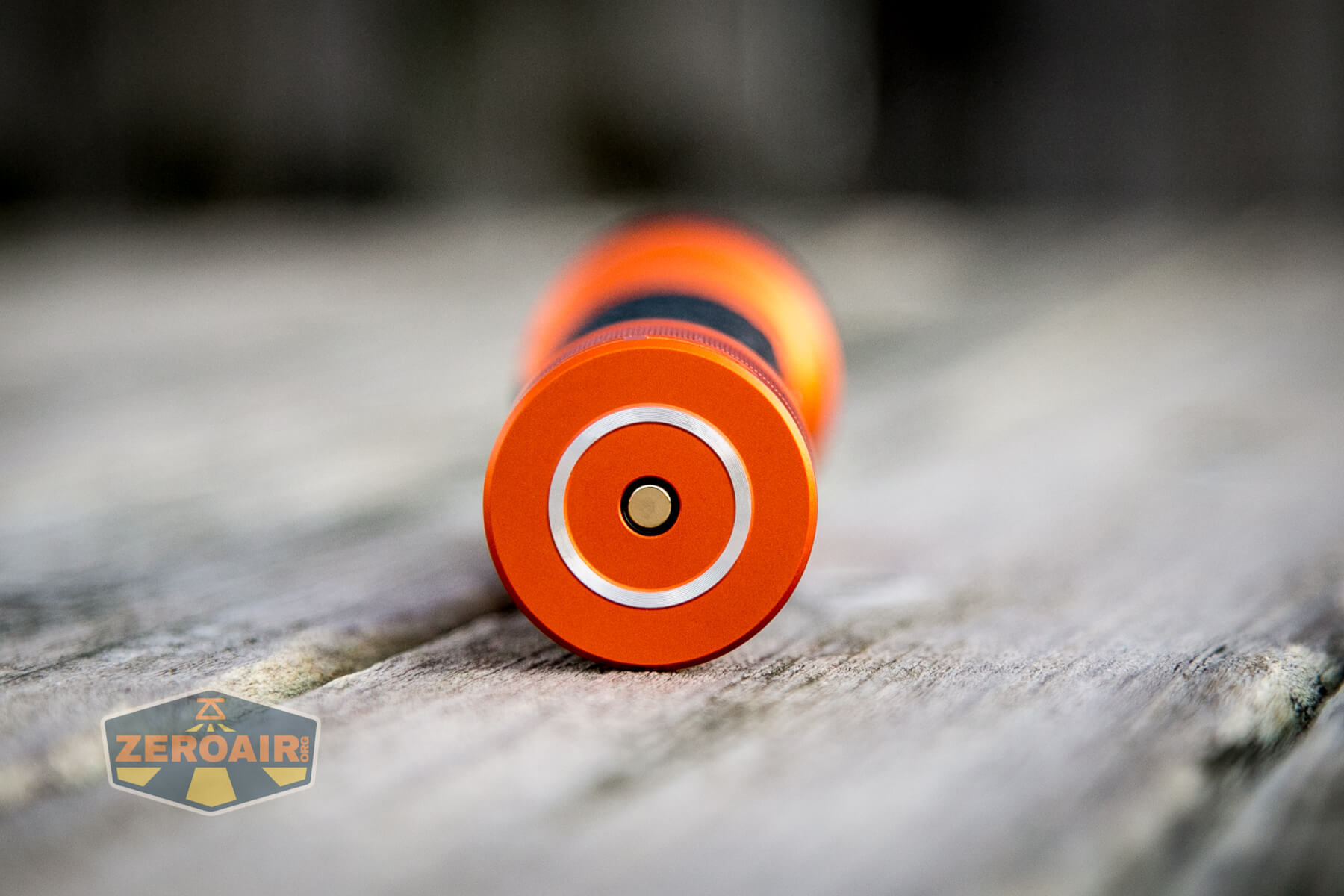
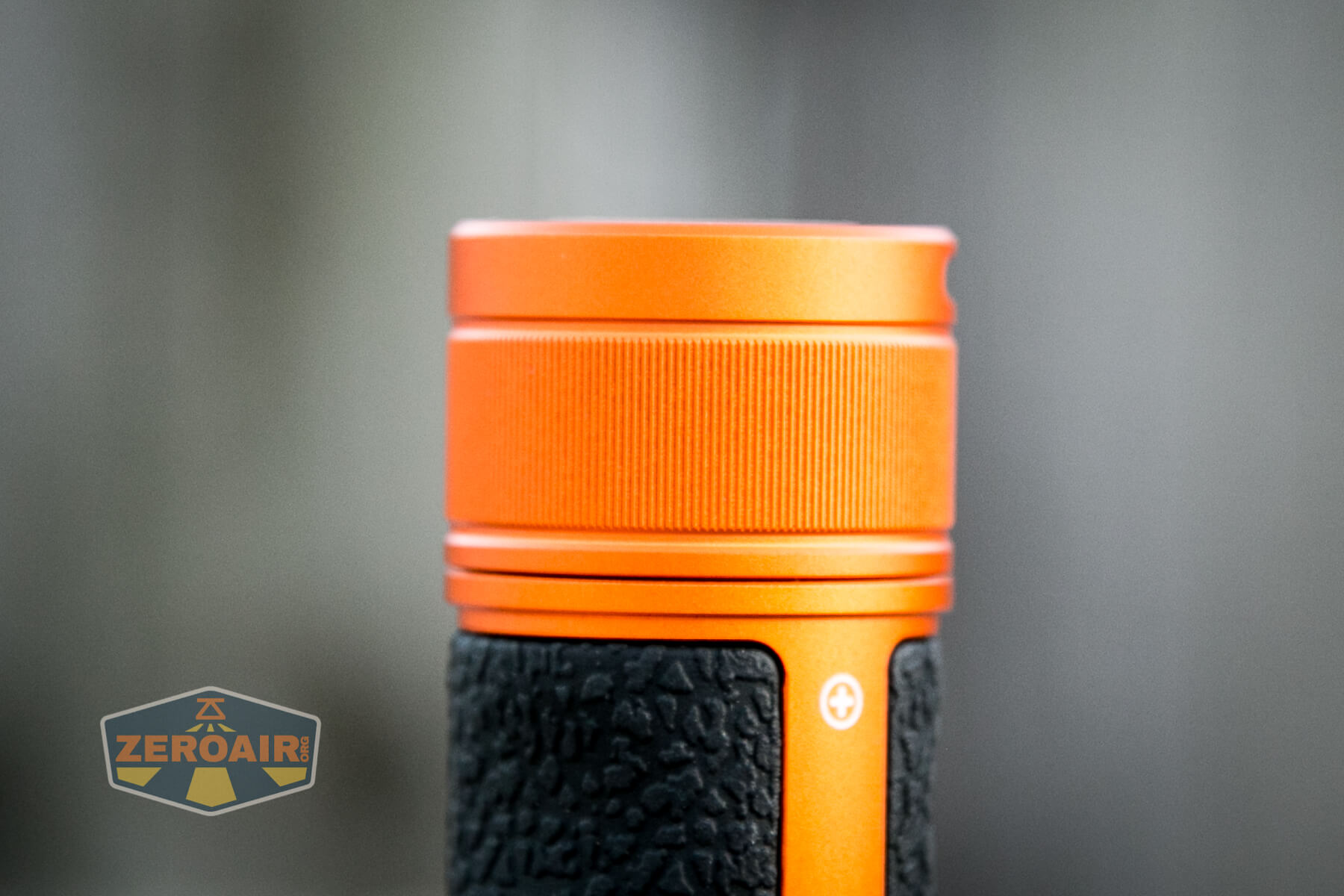
On the tailcap is reeding, which is shallow but provides enough grip.
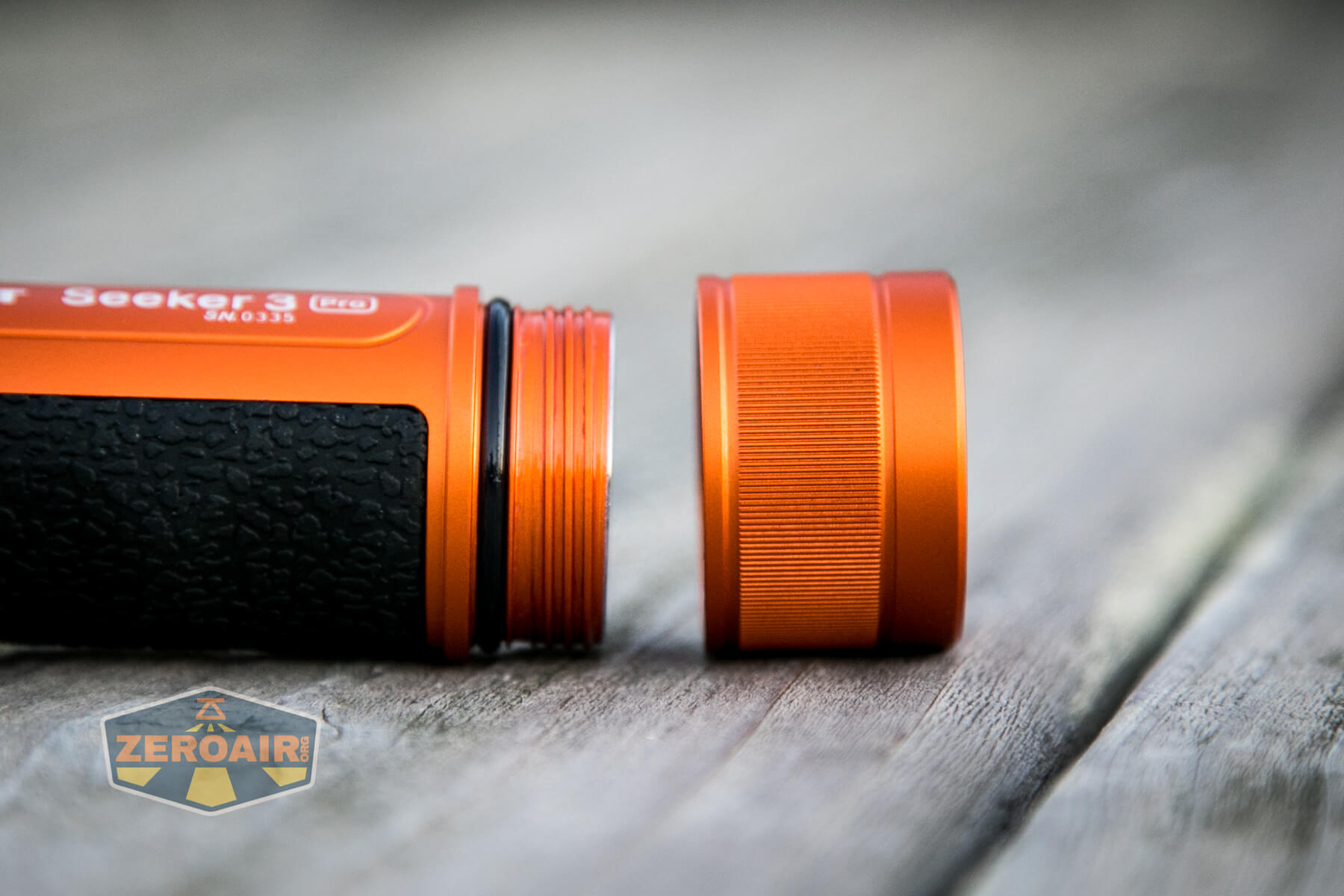
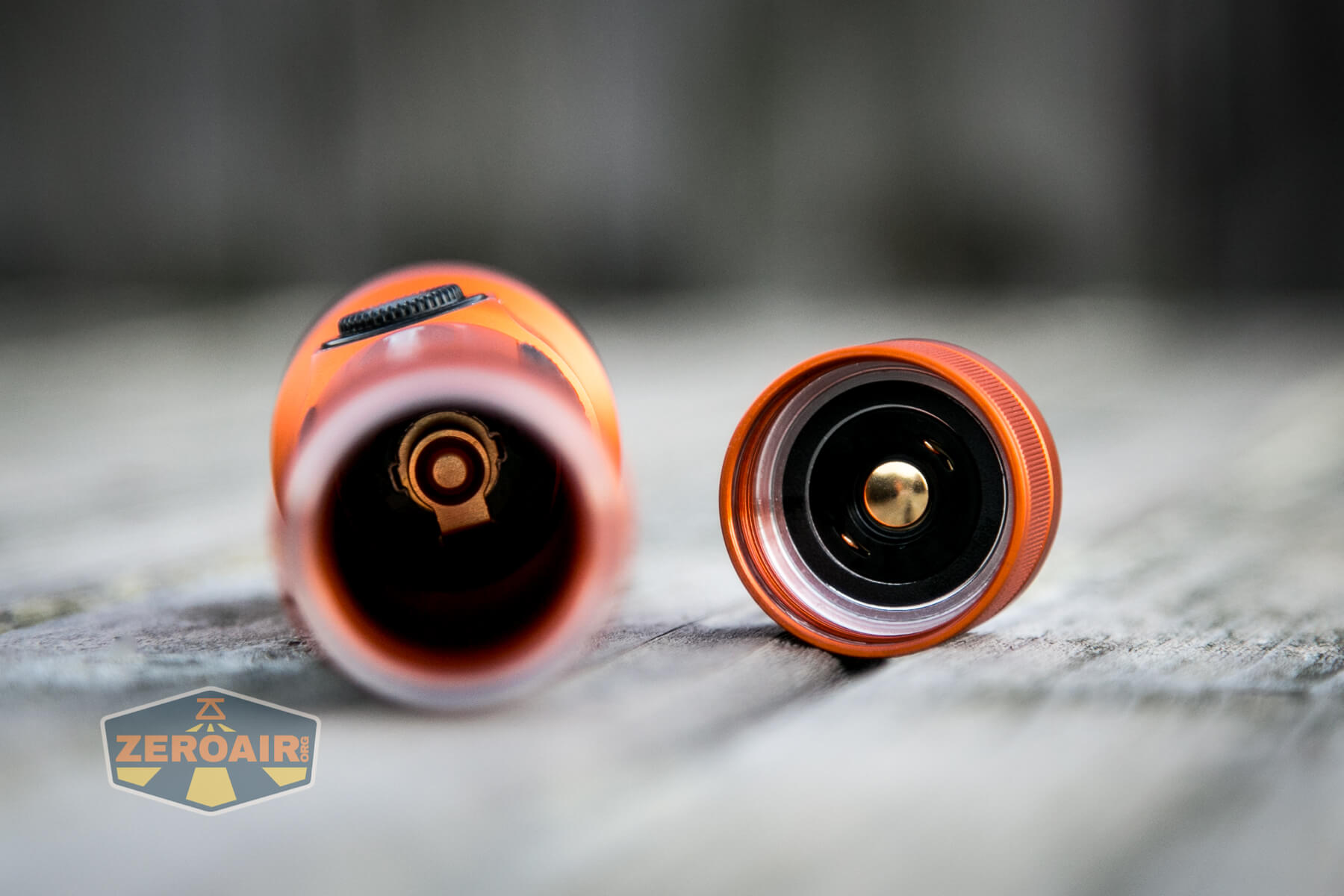
With the tailcap removed, you can see the square-cut, anodized threads. These threads are fairly short and also exceptionally smooth.
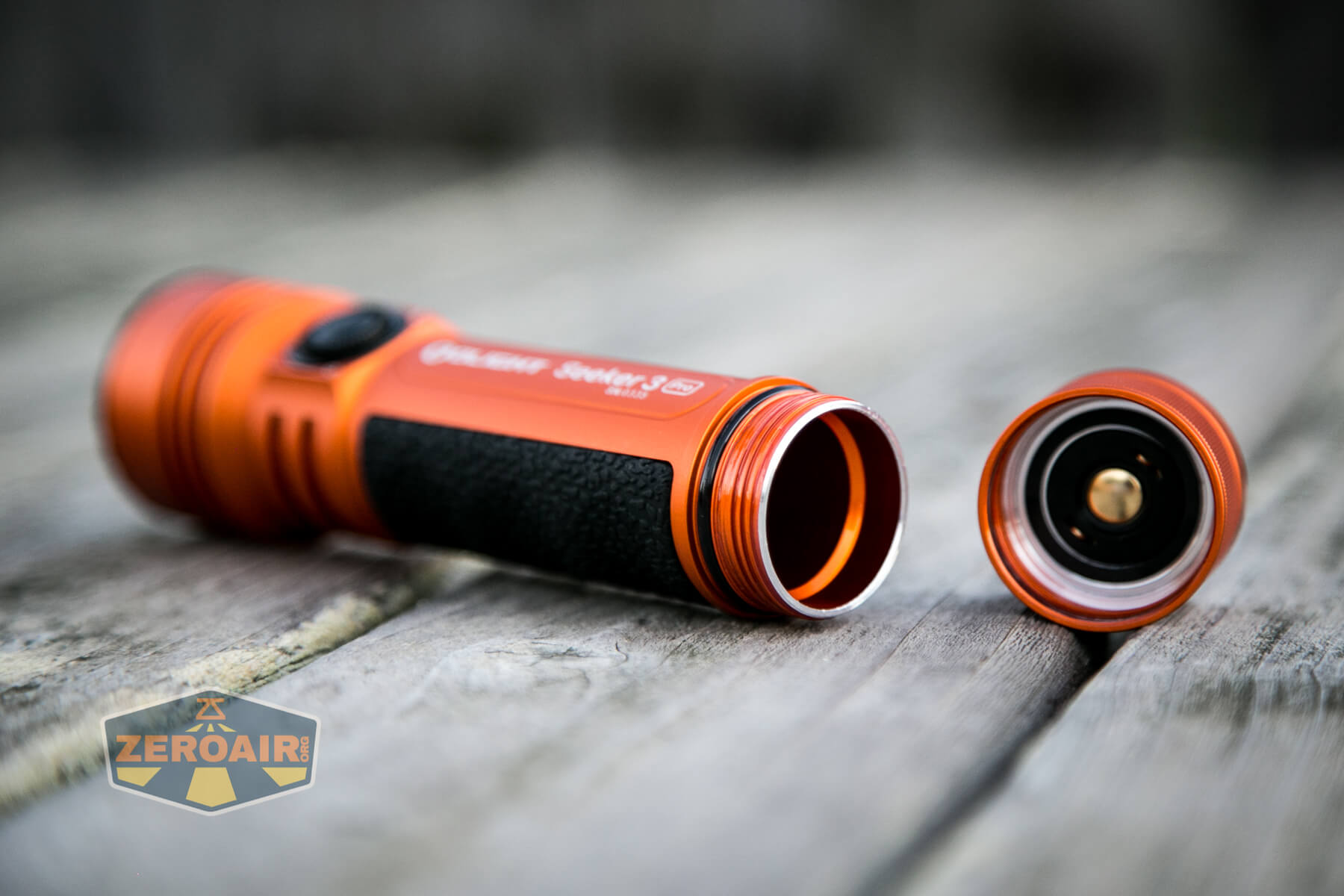
Both head and tail have springs, but those, too, are customized.
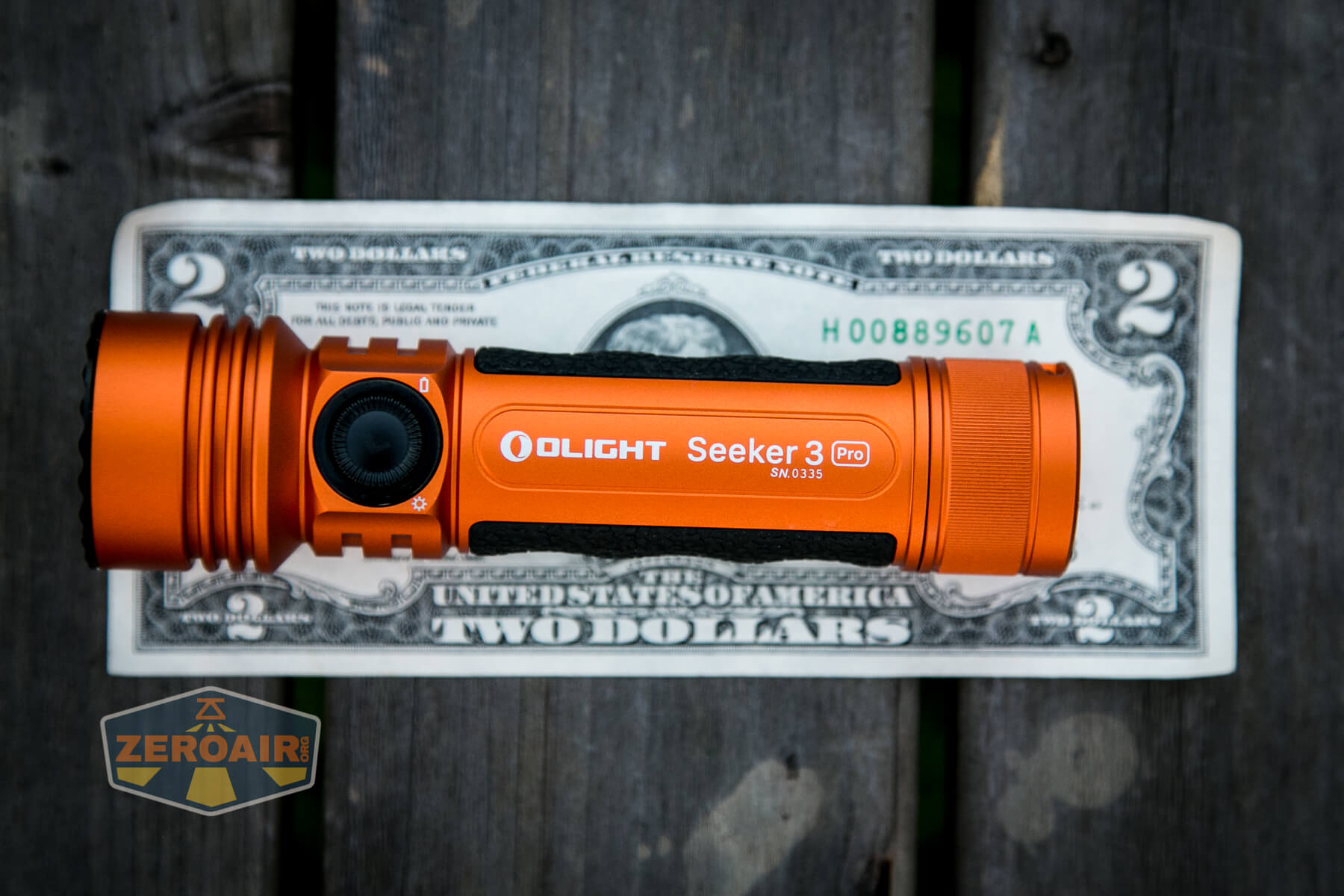
Size and Comps
Length (mm / in) 132mm/5.20in
Head Diameter (mm / in) 35mm/1.38in
Body Diameter (mm / in) 28mm/1.10in
Weight (g / oz) 200g/7.06oz (Including Battery)
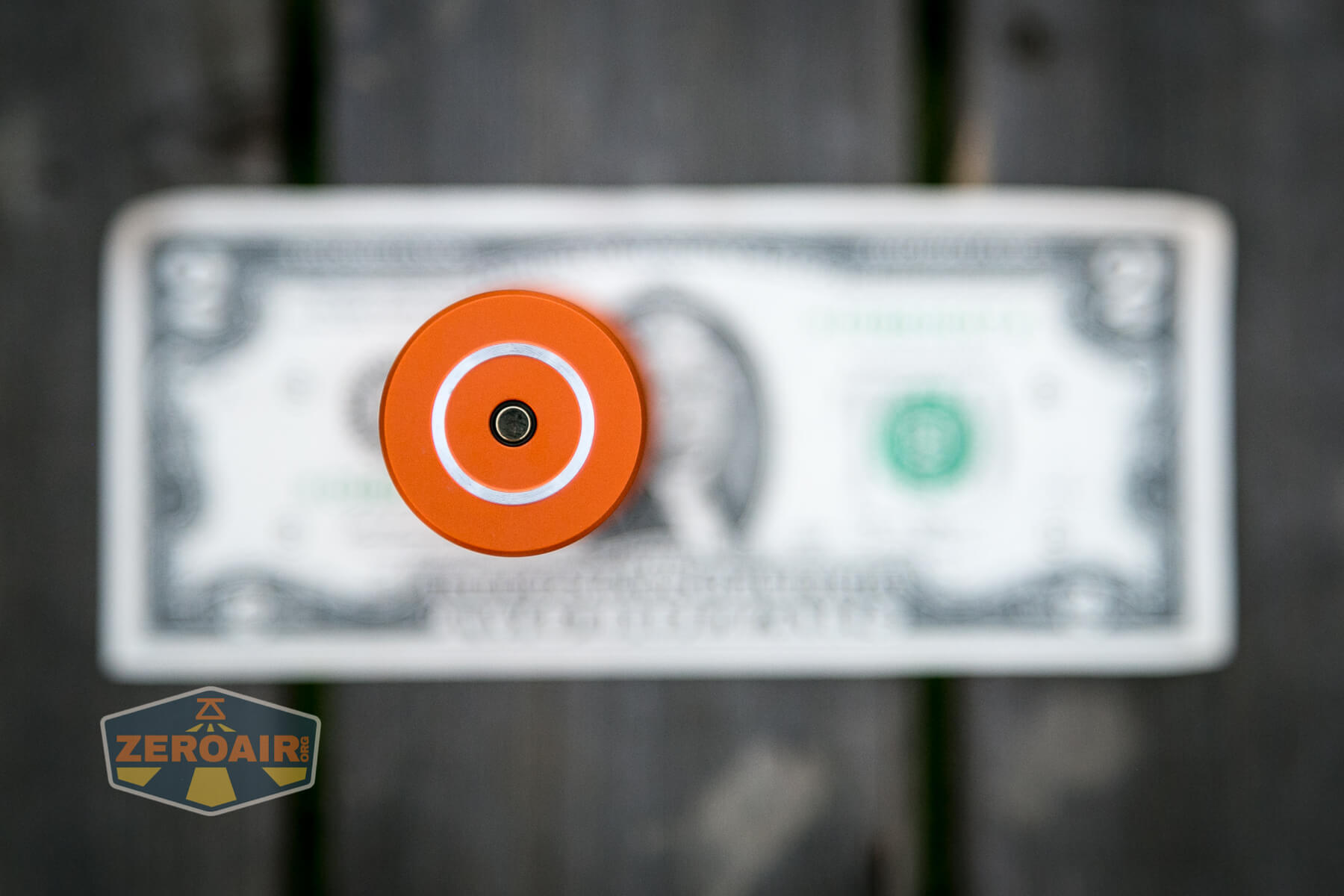
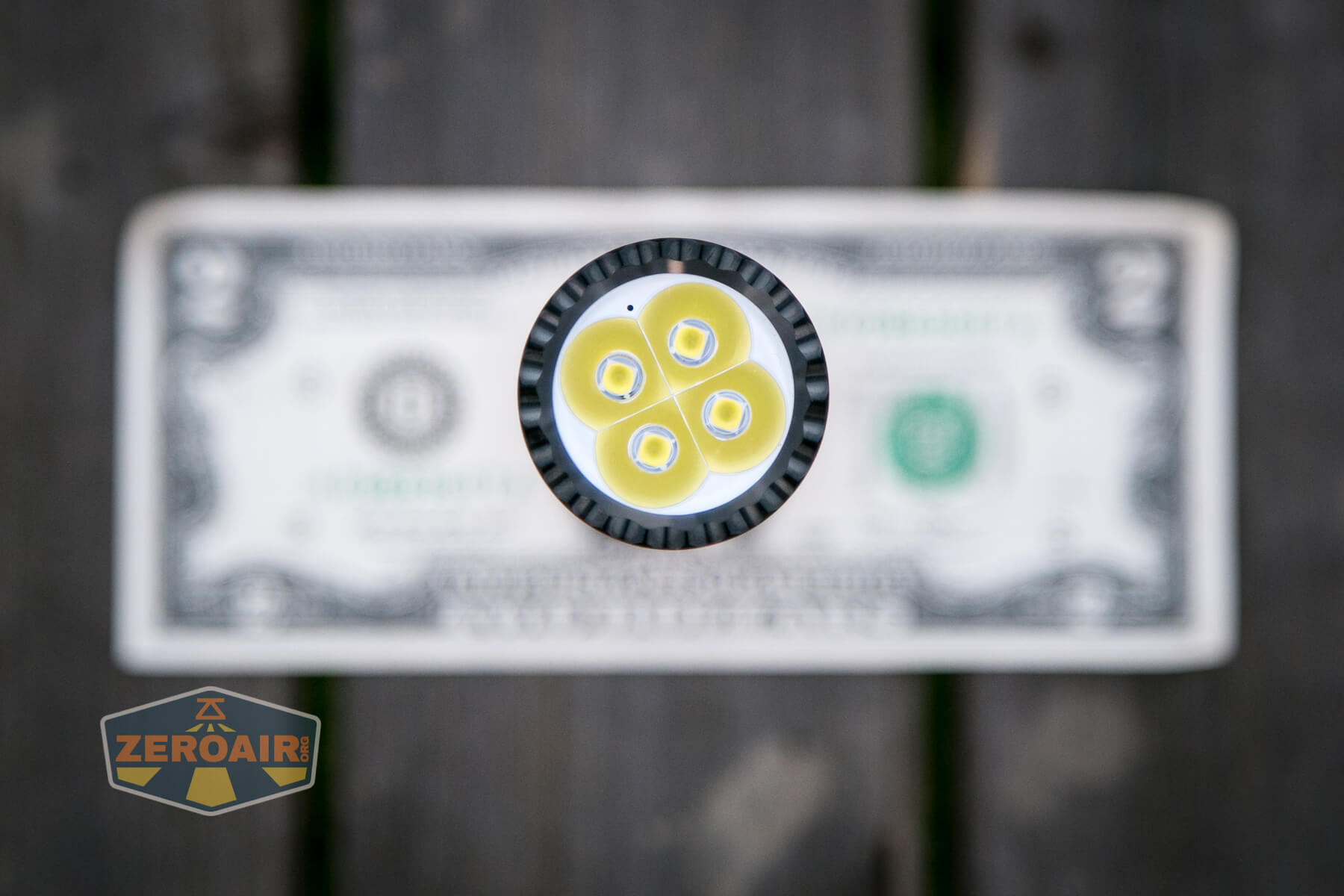
If the flashlight will headstand, I’ll show it here (usually the third photo). If the flashlight will tailstand, I’ll show that here, too (usually the fourth photo).
Here’s the test light with the venerable Convoy S2+. Mine is a custom “baked” edition Nichia 219b triple. A very nice 18650 light!
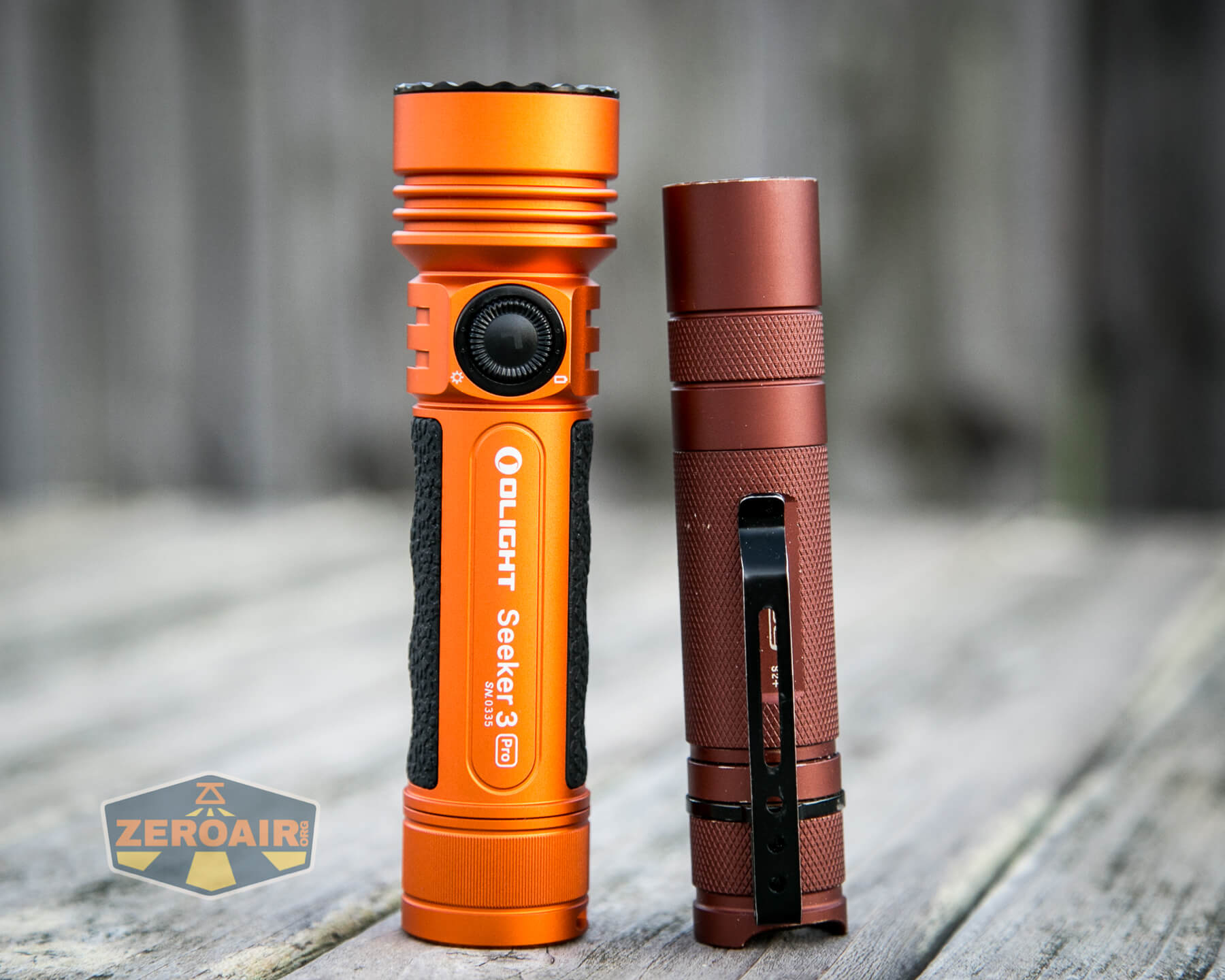
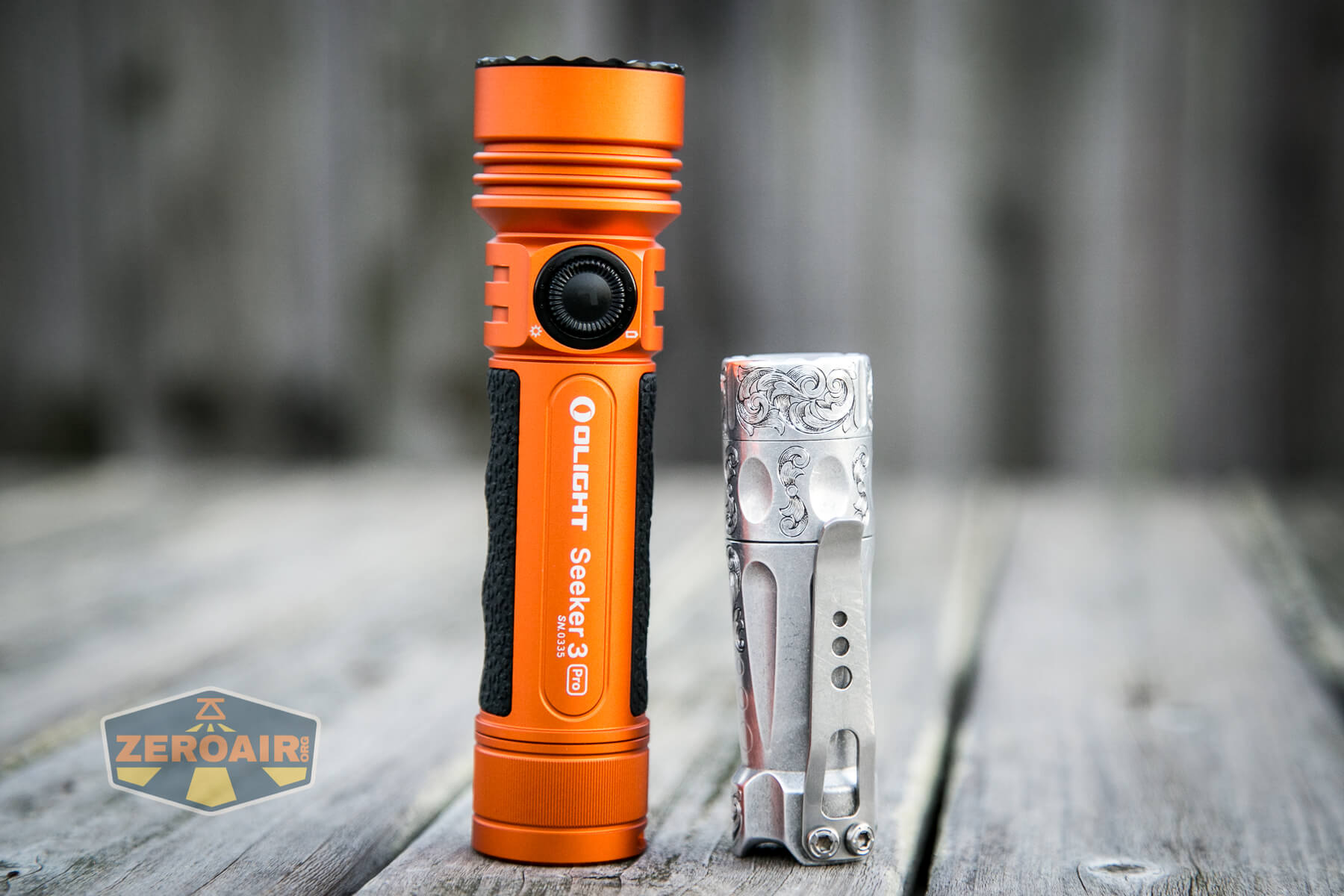
And here’s the light beside my custom-engraved TorchLAB BOSS 35, an 18350 light. I reviewed the aluminum version of that light in both 35 and 70 formats.
Retention and Carry
First, let’s talk about what this light does have for carry. There’s this very nice nylon pouch. We’ve definitely seen other pouches just like this one, but this is the first time I’ve seen an orange version. And it’s great!
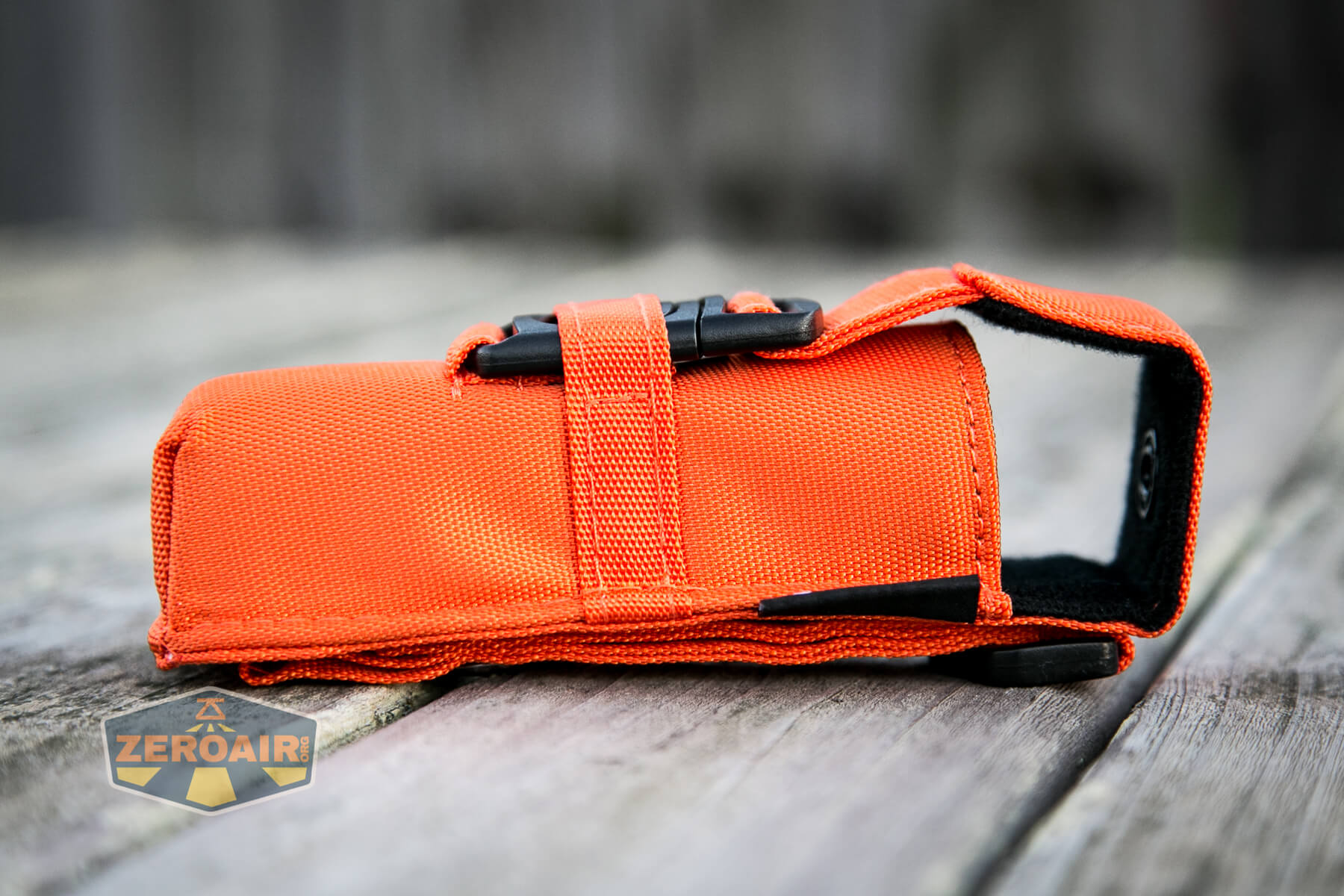
The Olight Seeker 3 Pro is intended to go bezel-up, but not intended to be used while in the pouch.
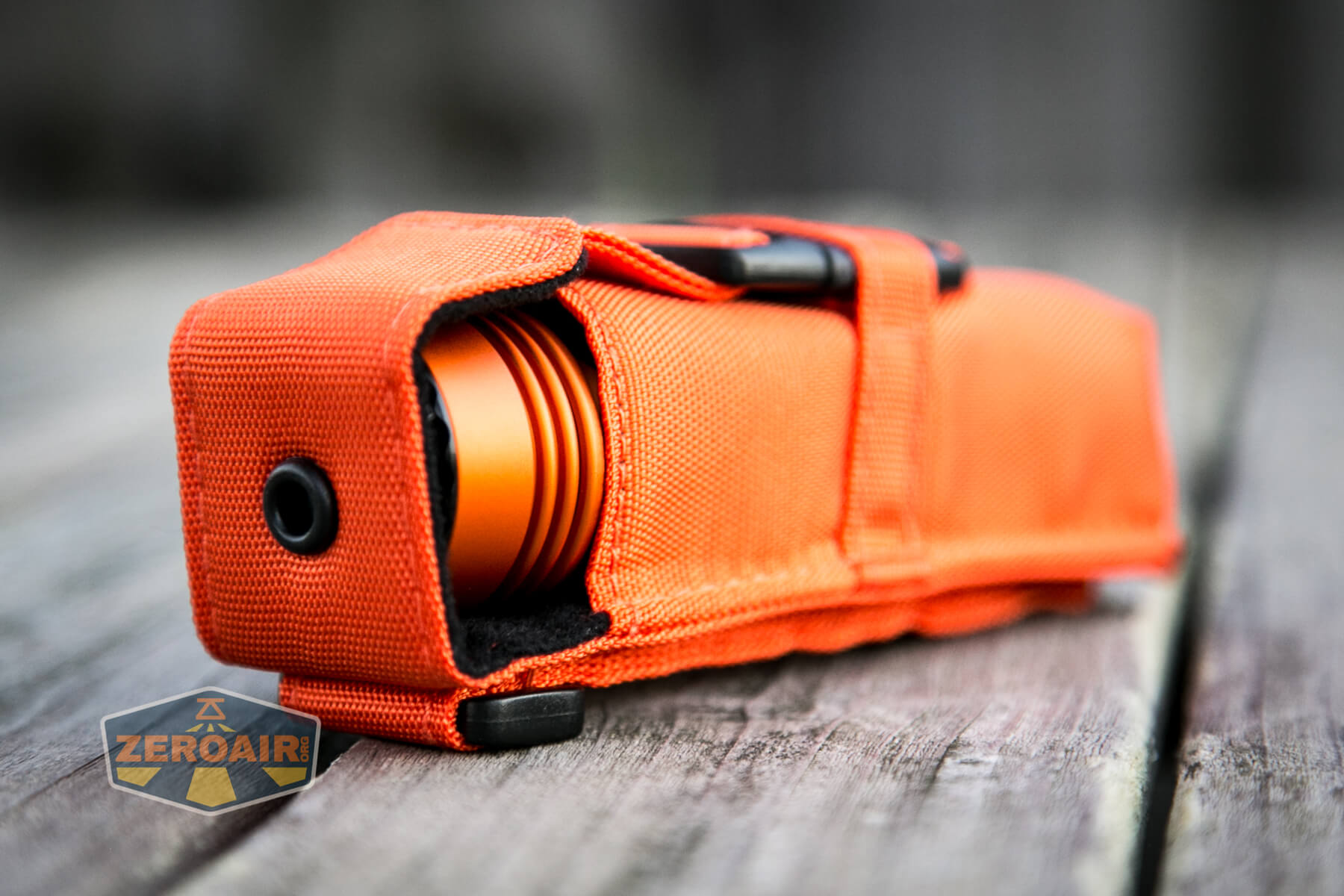
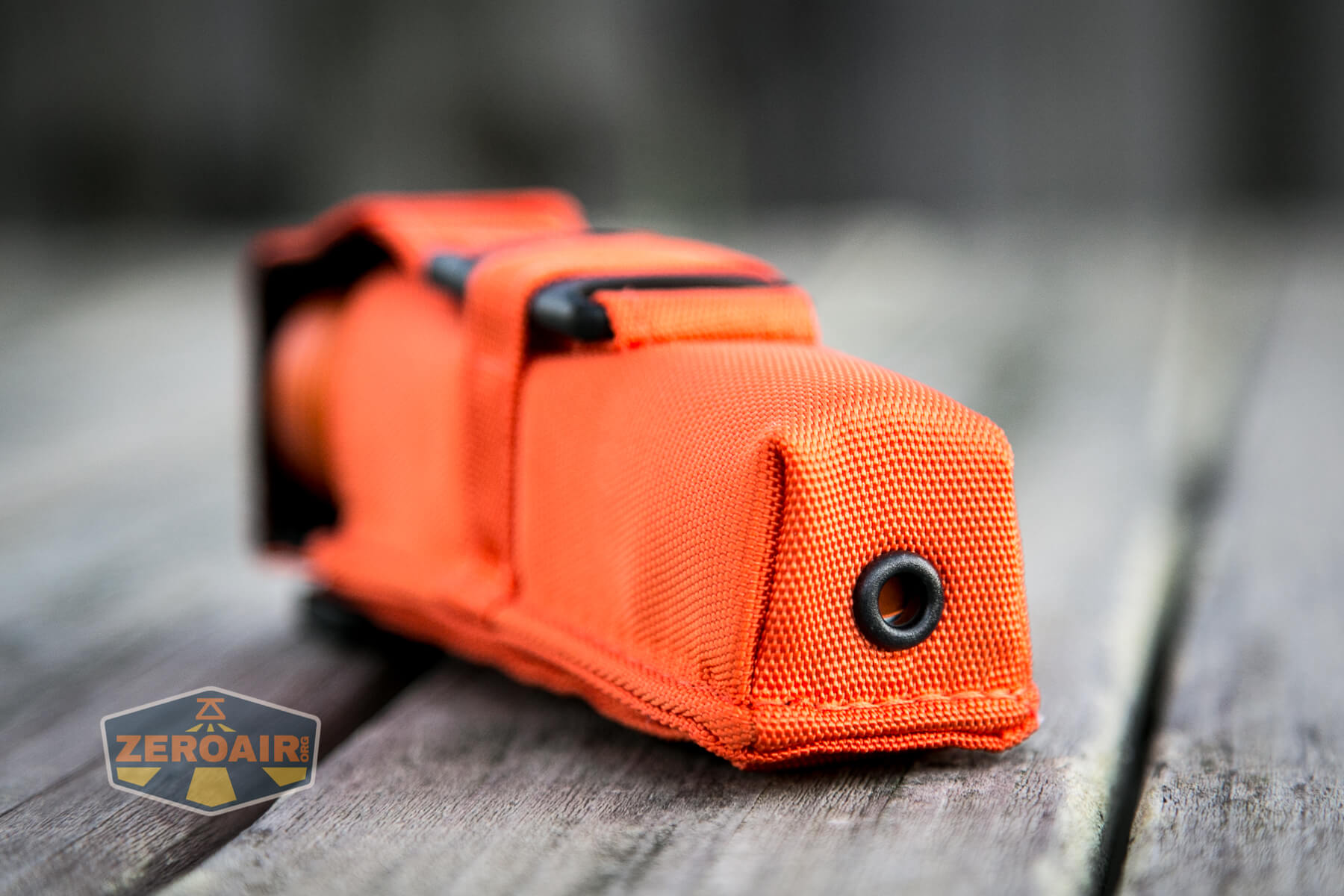
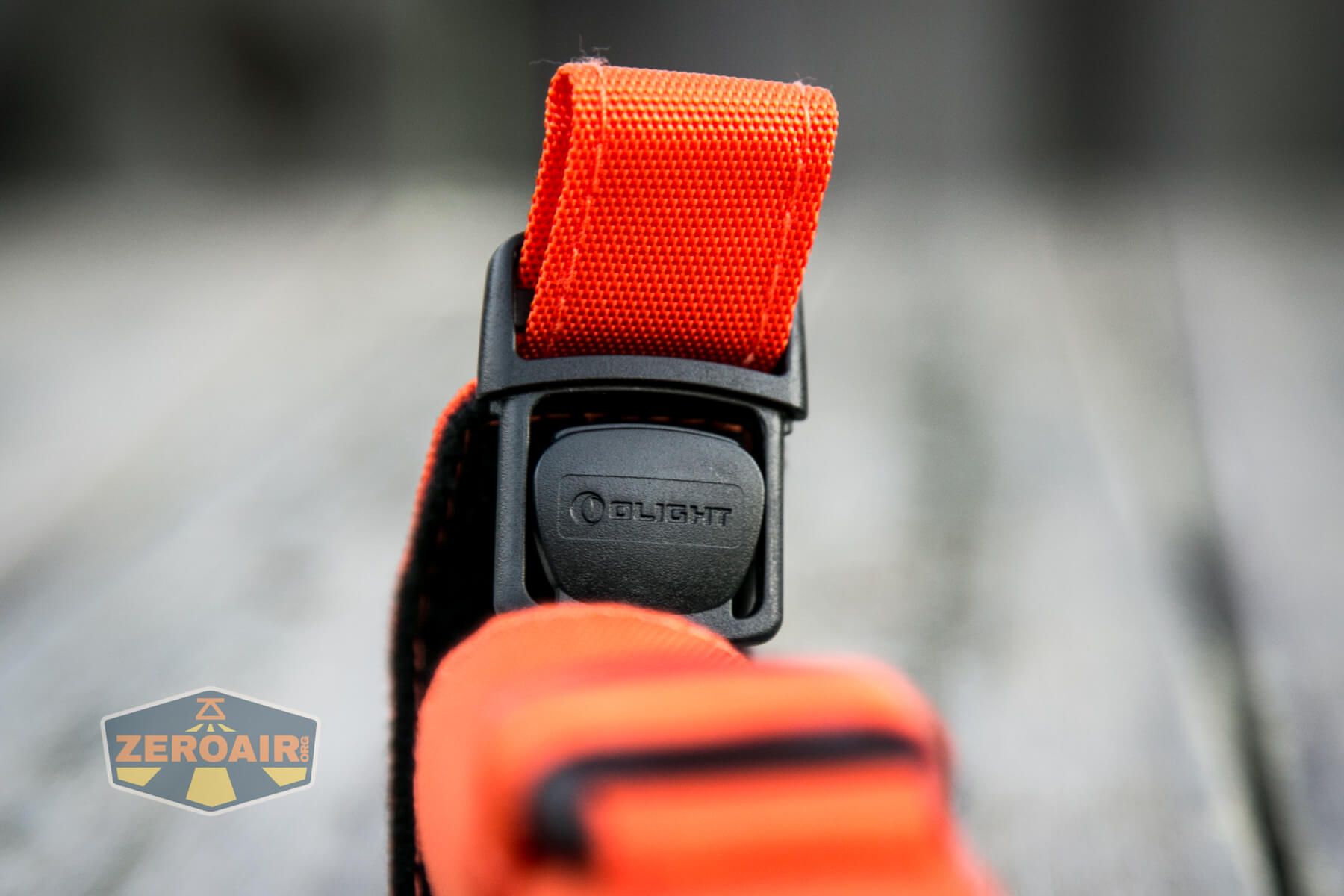
You can see below that the latch is covered by some nylon. This is an interesting design, and I can’t really explain it, but it does work very well.
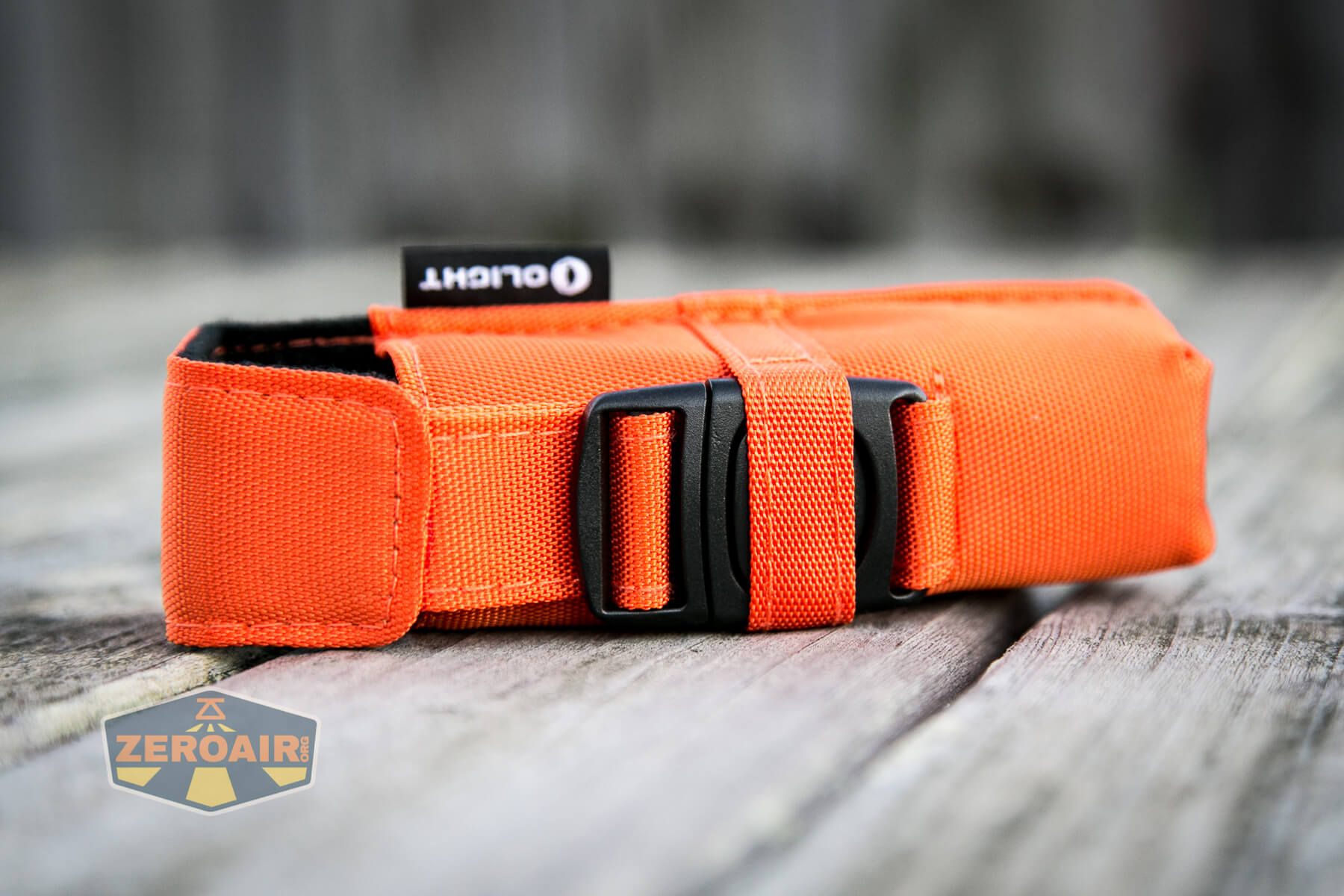
These oranges don’t match exactly, but I’ll allow it.
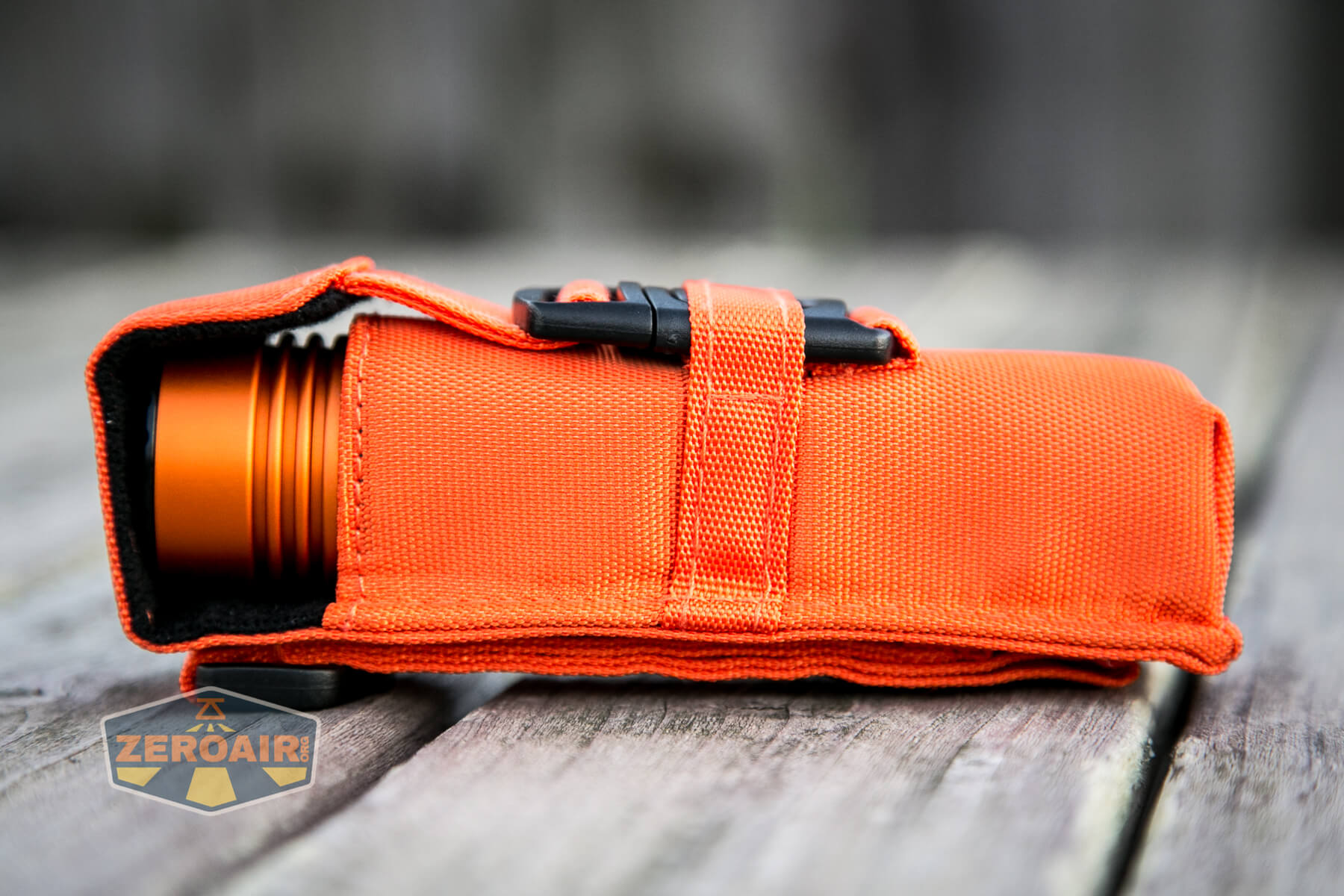
This is a nice nylon carry pouch!
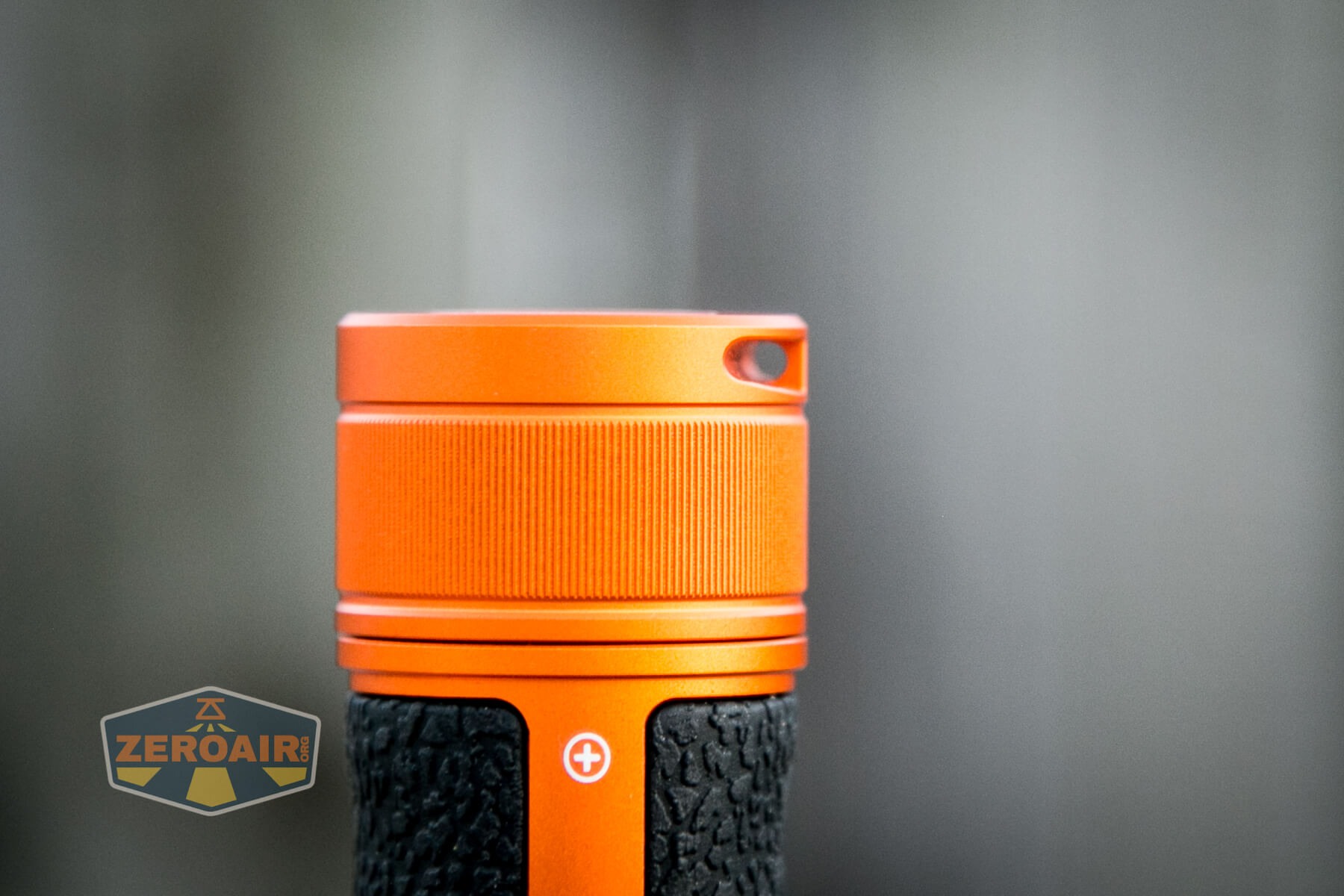
There’s a lanyard hole in the tailcap, but no lanyard is included.
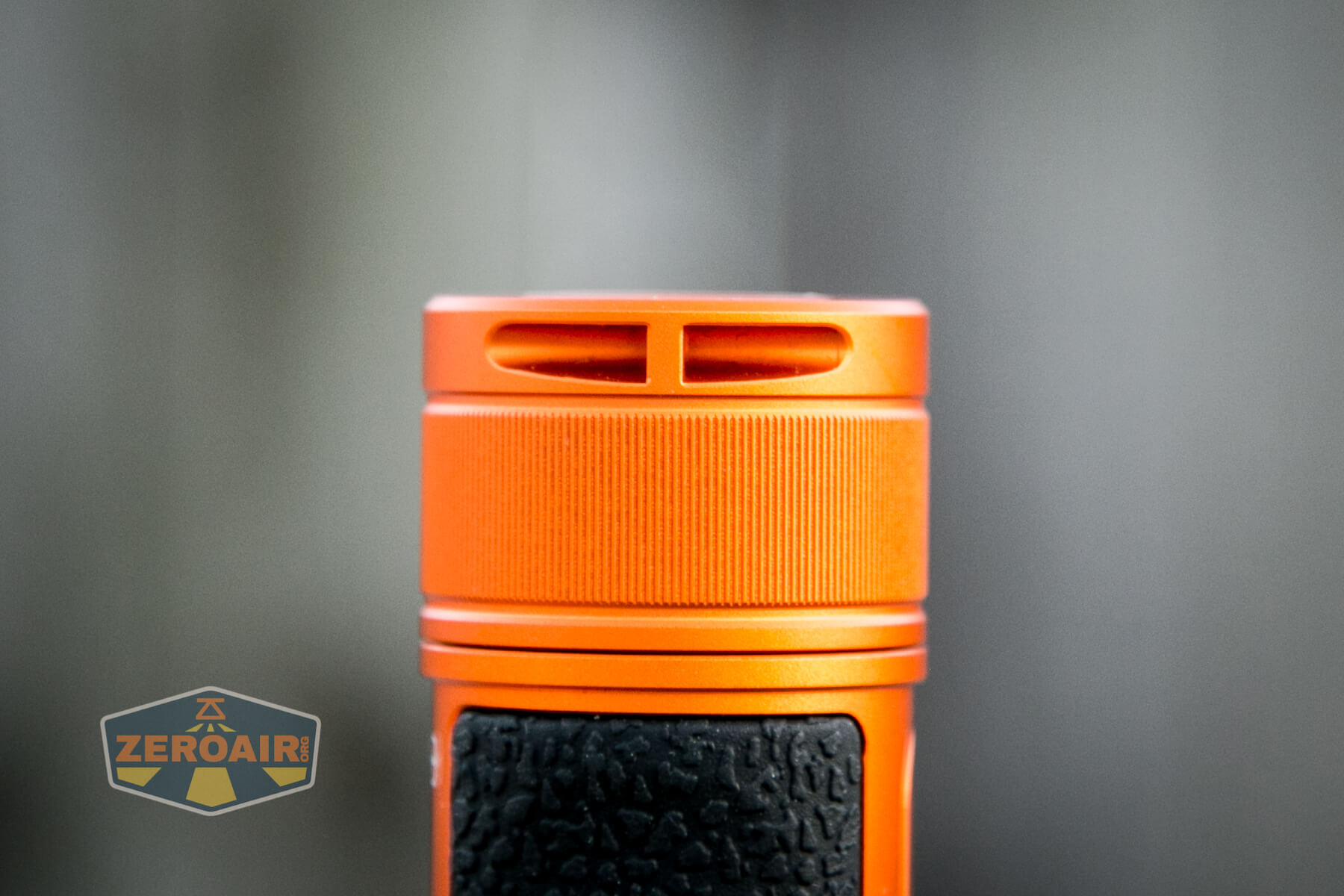
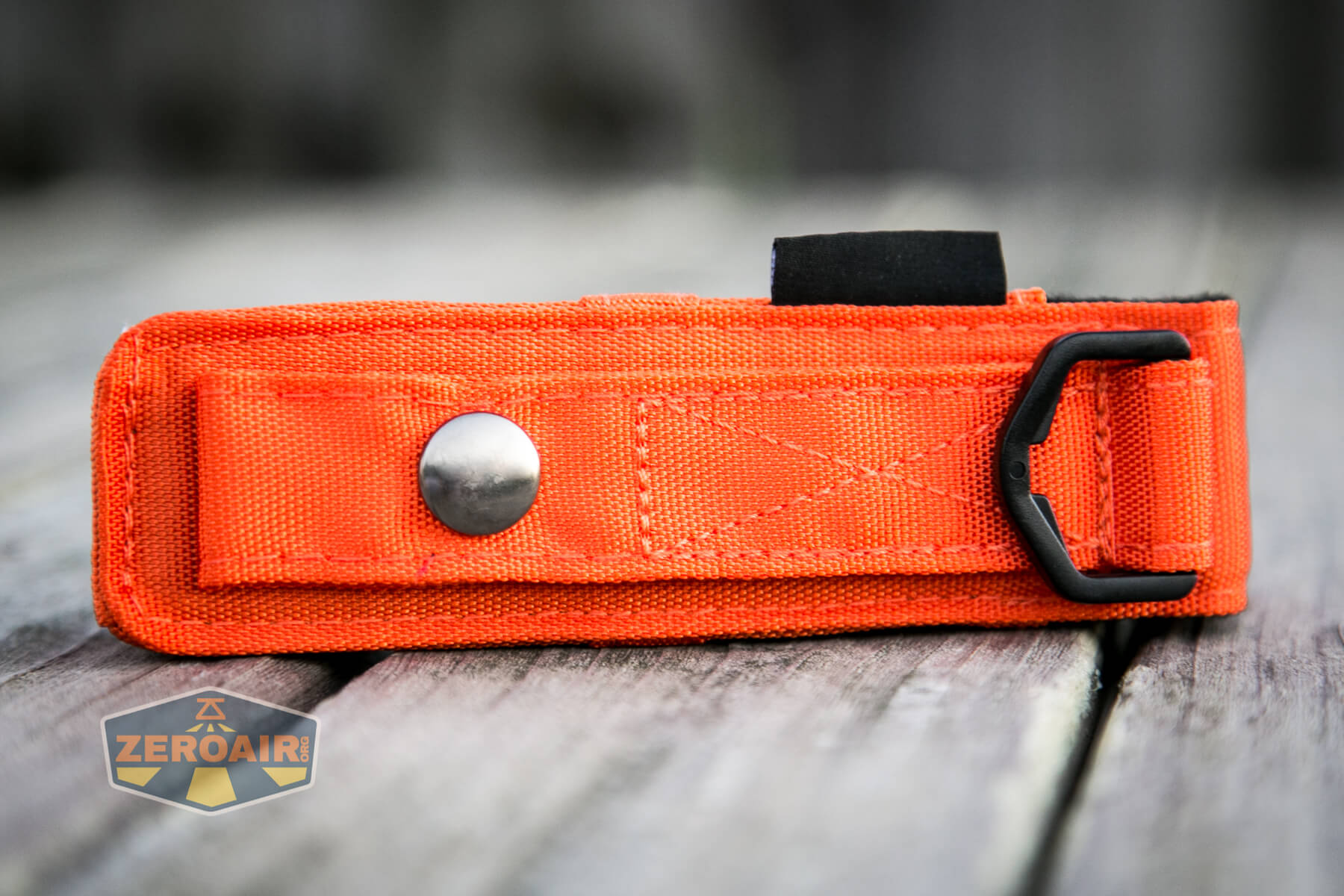
Also not included in this revision in the long lineage of Seekers is a pocket clip.
Power and Runtime
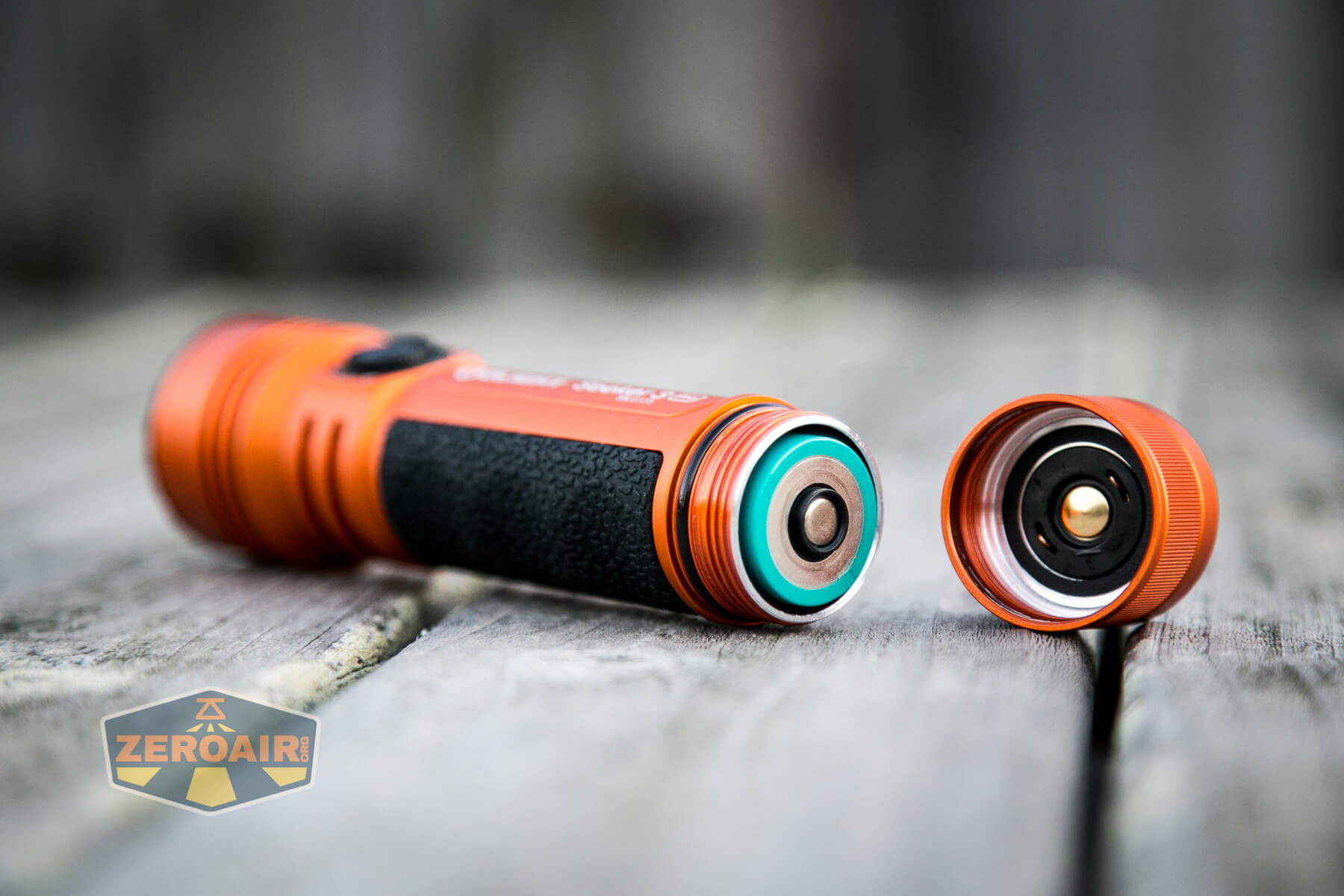
The Olight Seeker 3 Pro is powered by a proprietary 21700 cell. It’s proprietary in that both positive and negative terminals are exposed on the positive end of the cell. It will not be charged in a bay-type charger. Also, traditional 21700 cells will not work in the light, and cannot be charged by the light.
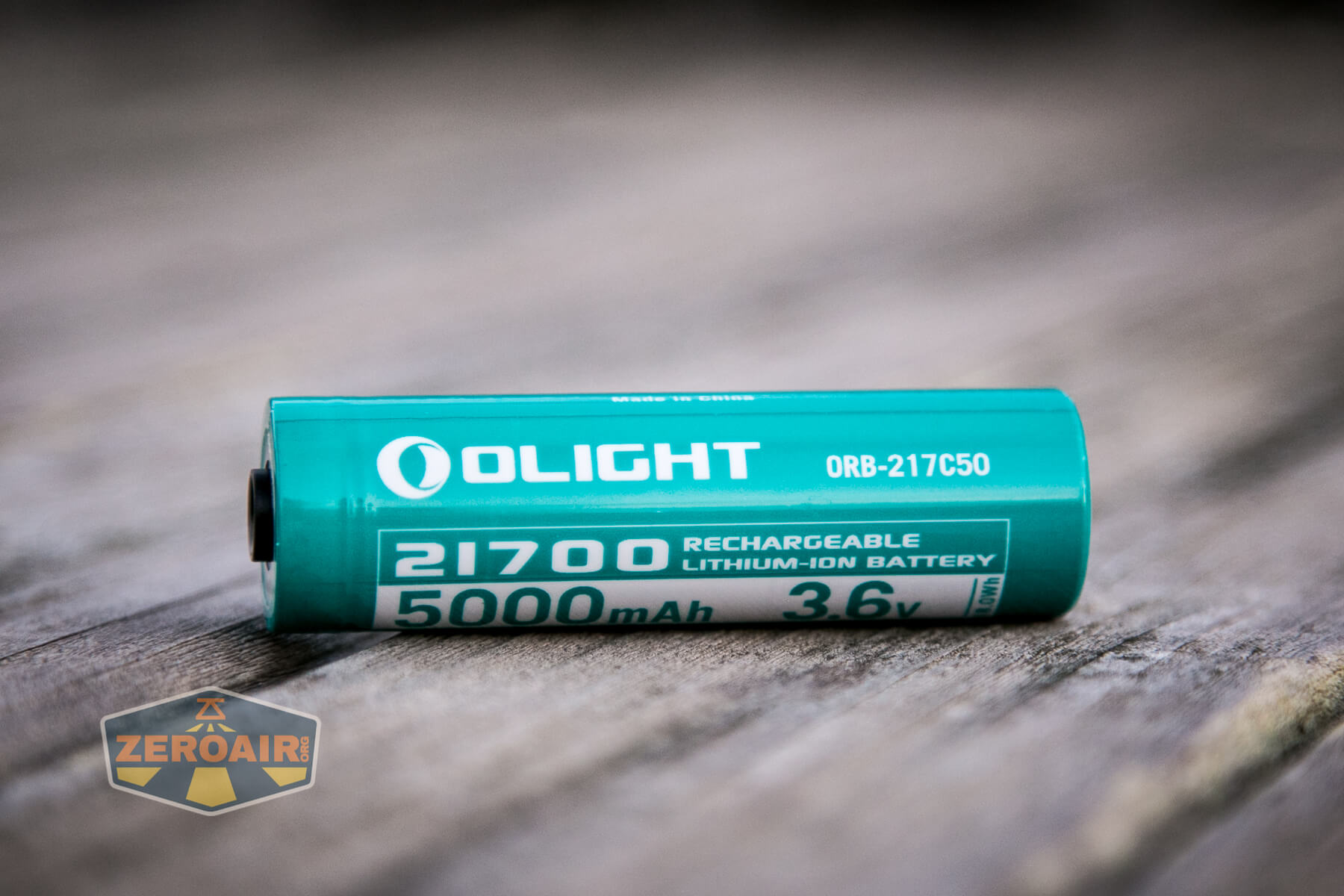
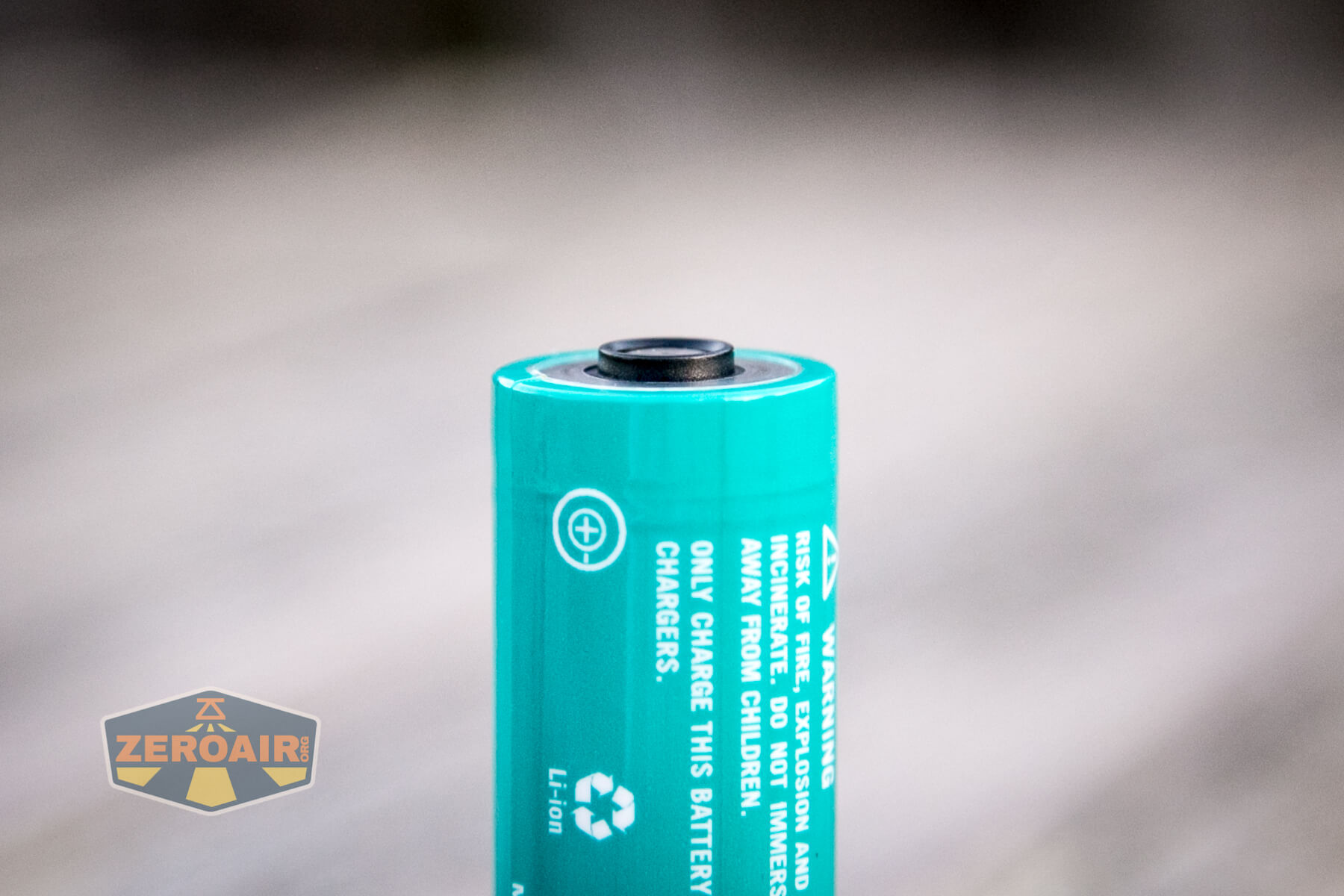
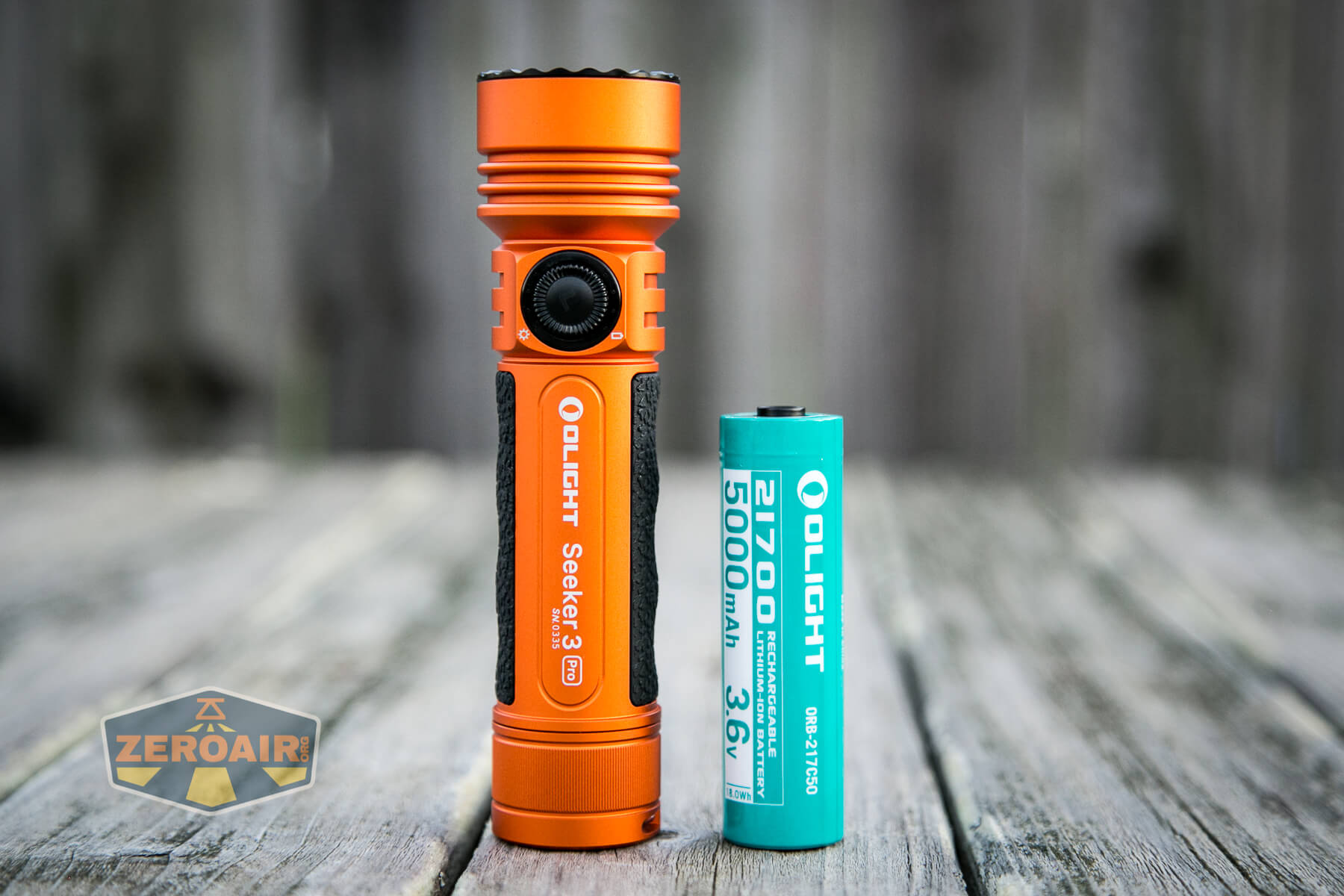
Unlike some other Olights that use the same cell, the cell for the Olight Seeker 3 Pro is inserted with the positive terminal toward the tail. This “breaks from tradition,” so pay attention here!
Below are a couple of runtimes. The light does meet the specification of 4200 lumens, which I find singularly impressive.
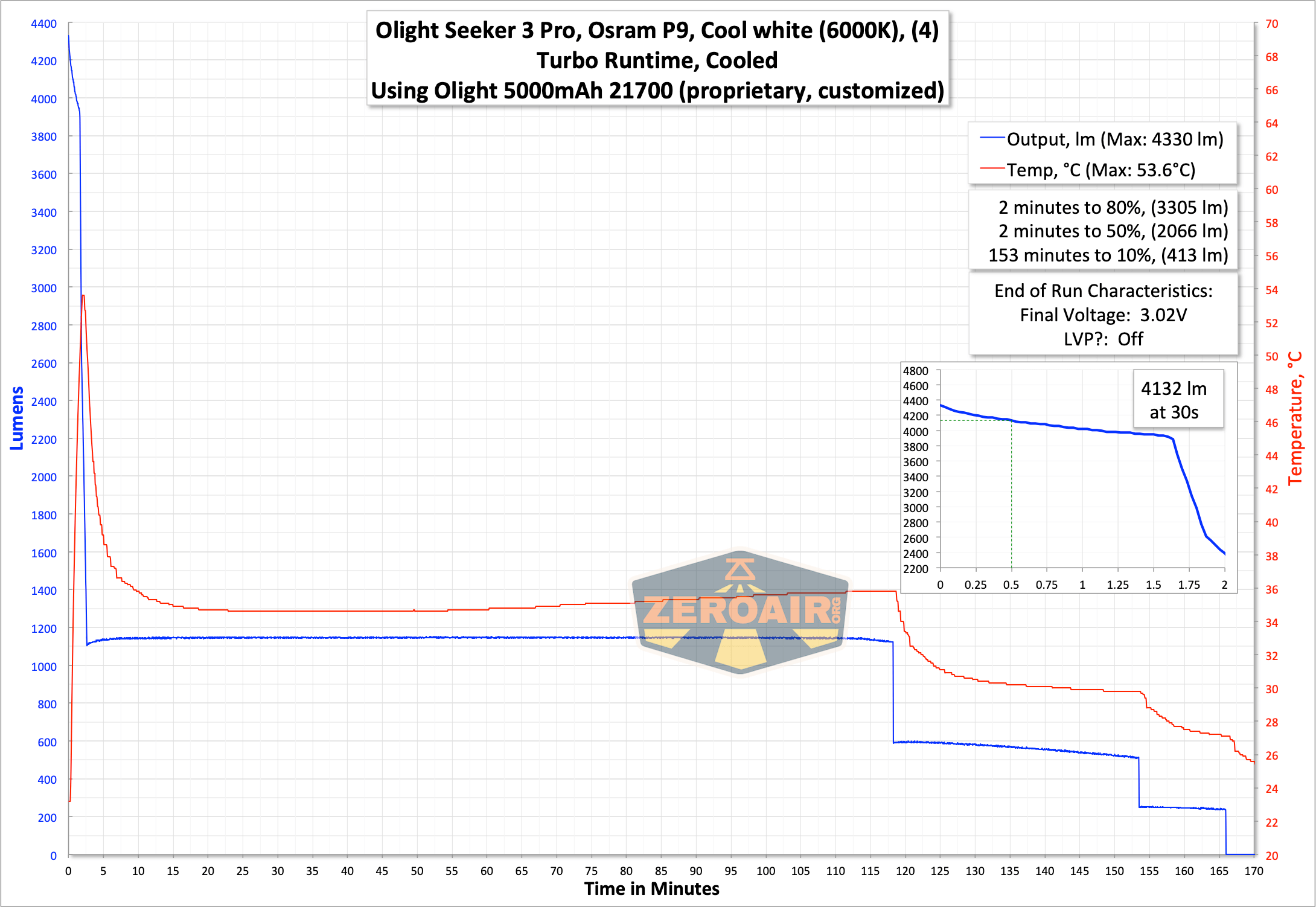
On any mode below Turbo, the output is remarkably stable.
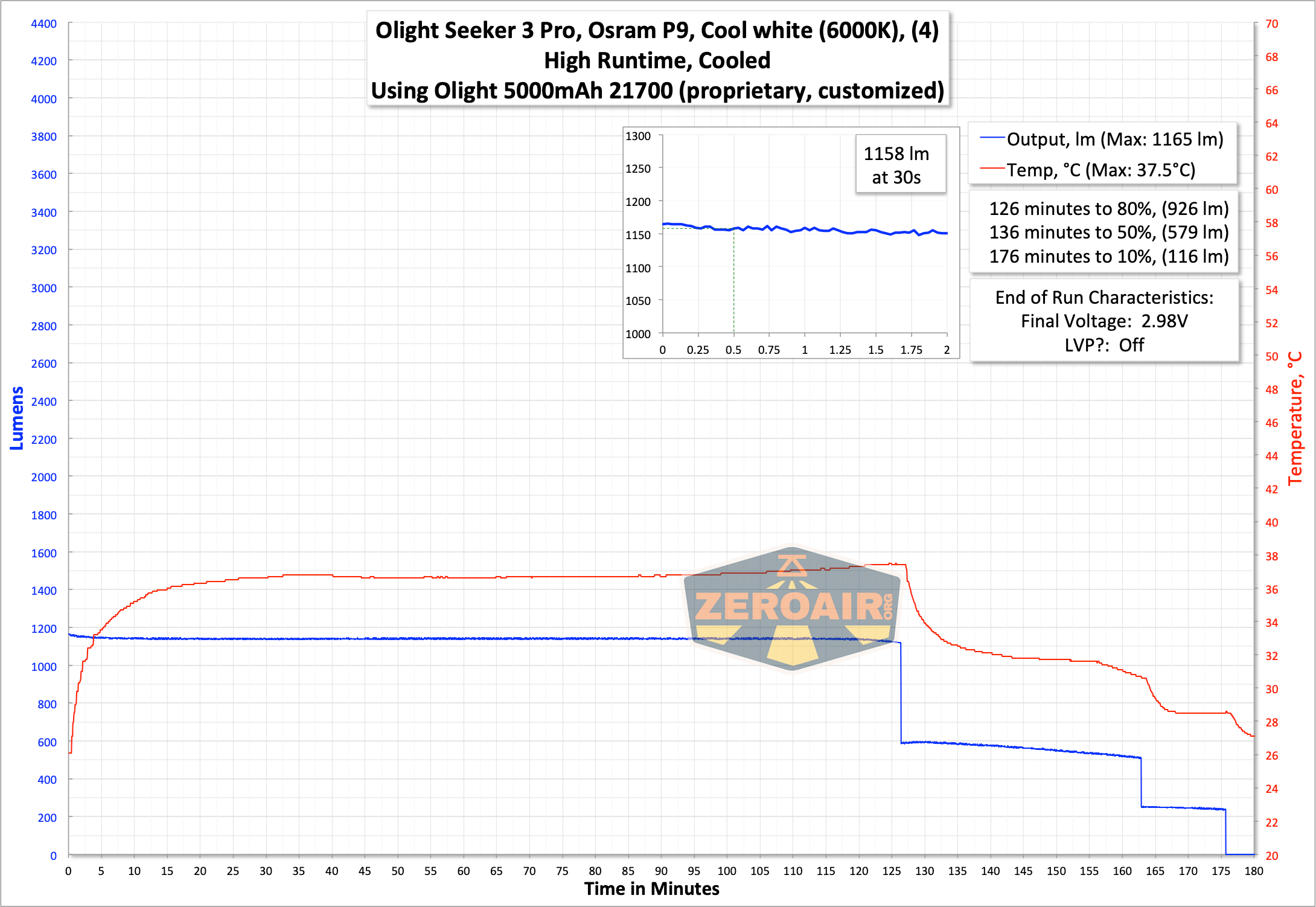
Low voltage protection is observed, too, with the output stopping when the cell is around 3V.
Charging
The Olight Seeker 3 Pro has onboard charging via a USB to magnetic connector.
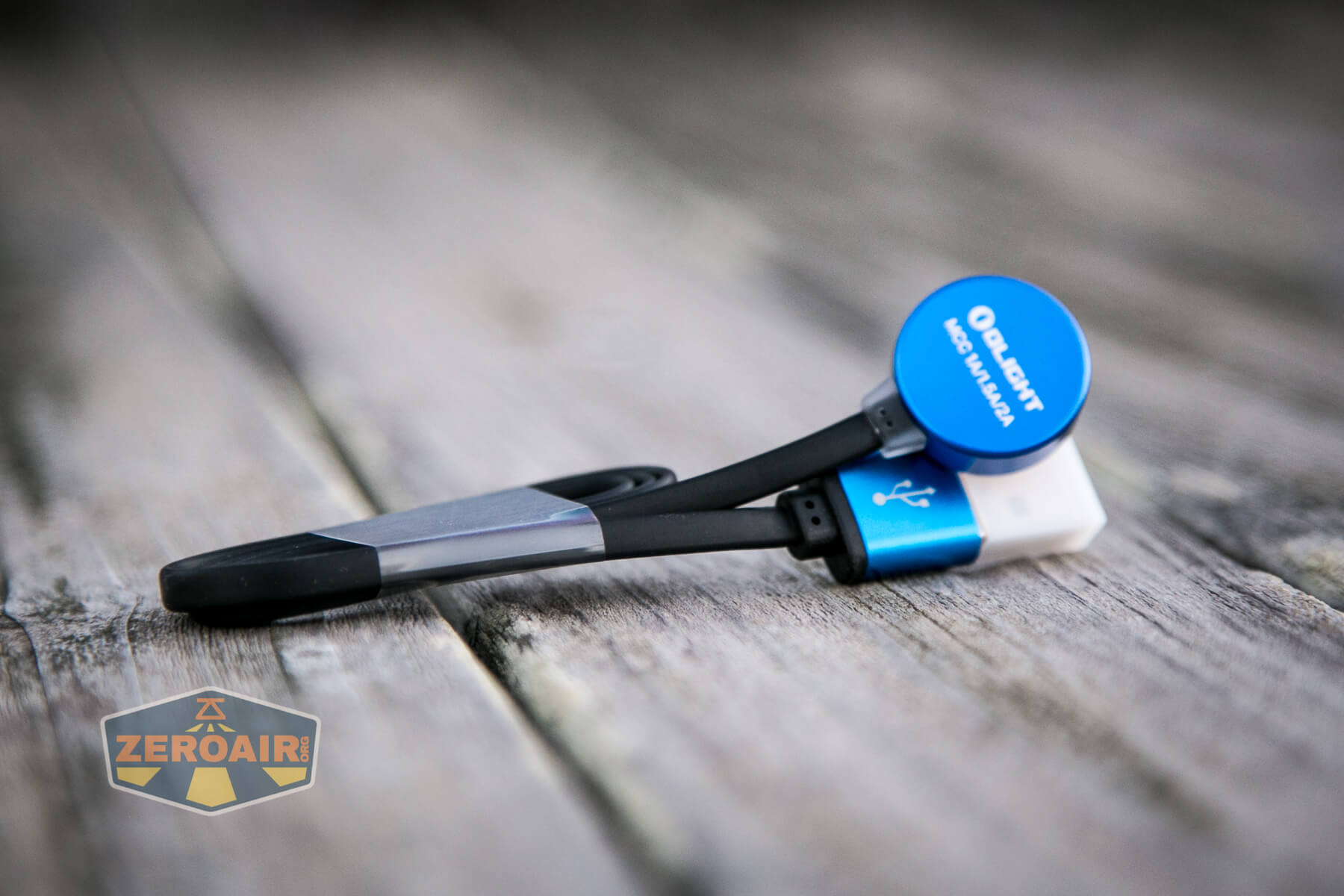
This is the standard MCC charger.
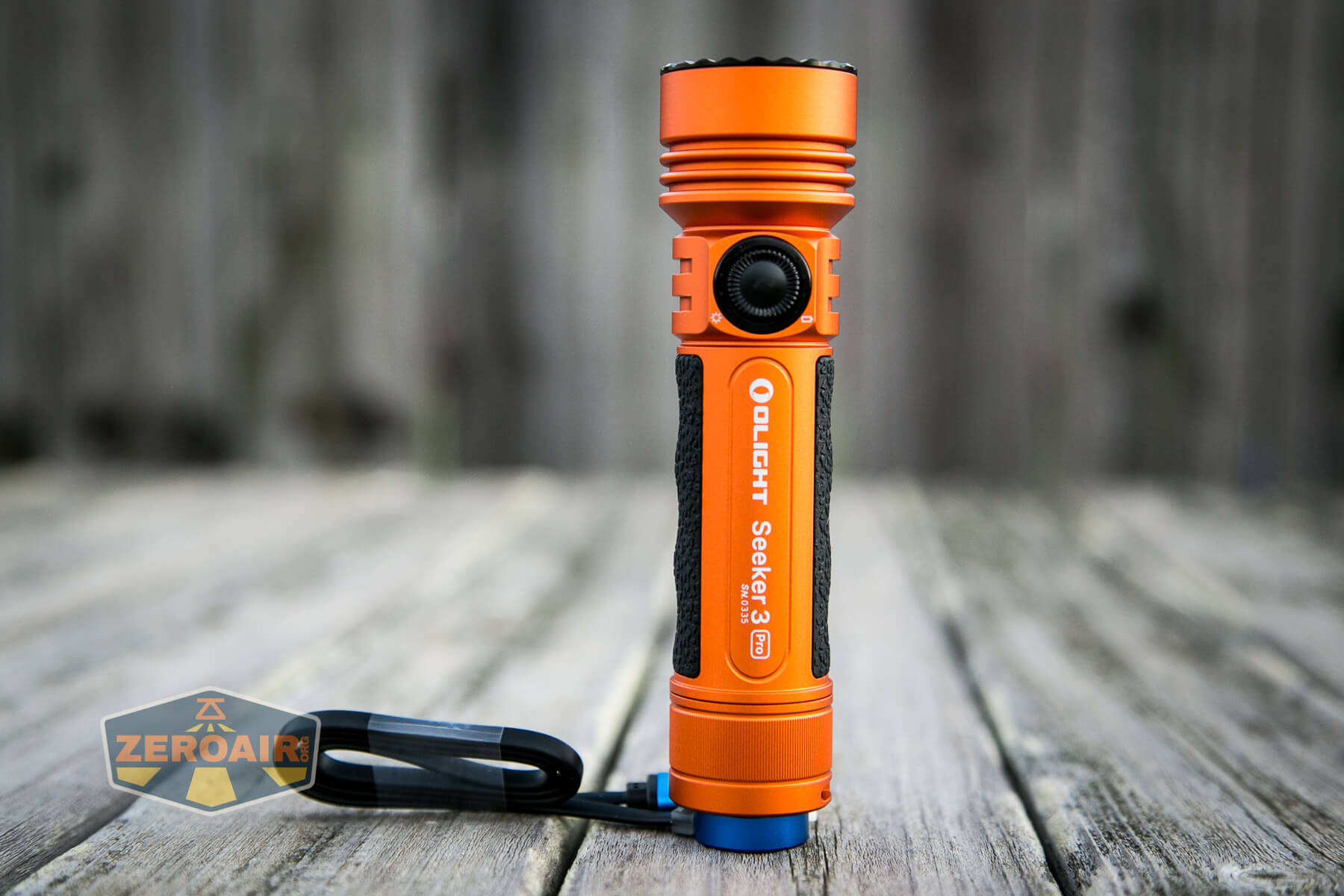
I don’t have a log, but I can say that the peak current is around 2A. I’ll get that tested later – I did so twice, but once my logger died during the test, and the second time I fat-fingered the phone and clicked “delete” instead of “transfer” the data… ugh… If you’re desperate to see it, the data should look approximately like what is seen here.
Modes and Currents
| Mode | Mode Claimed Output (lm) | Claimed Runtime | Measured Lumens | Tailcap Amps |
|---|---|---|---|---|
| Turbo | 4,200~1,200~600 | 2.5+127+35 mins | 4132 | 10.4 |
| High | 1,200~600~300 | 135+35+10 mins | 1158 | 1.80 |
| Proximity Sensor Stepdown | – | – | 398 | – |
| Med | 300 | 640m | 294 | 0.40 |
| Low | 50 | 55.5h | 41 | 0.07 |
| Moon | 5 | 15d | 3.9 | 0.01 |
Pulse Width Modulation
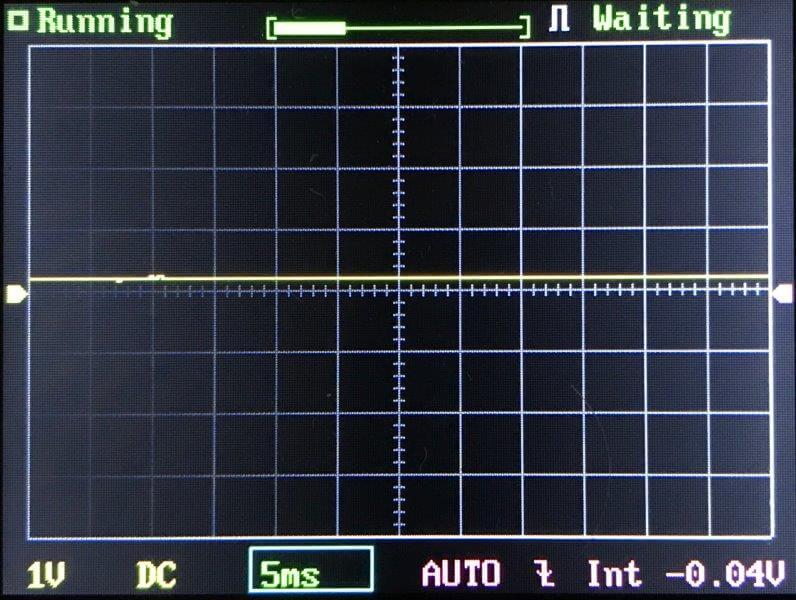
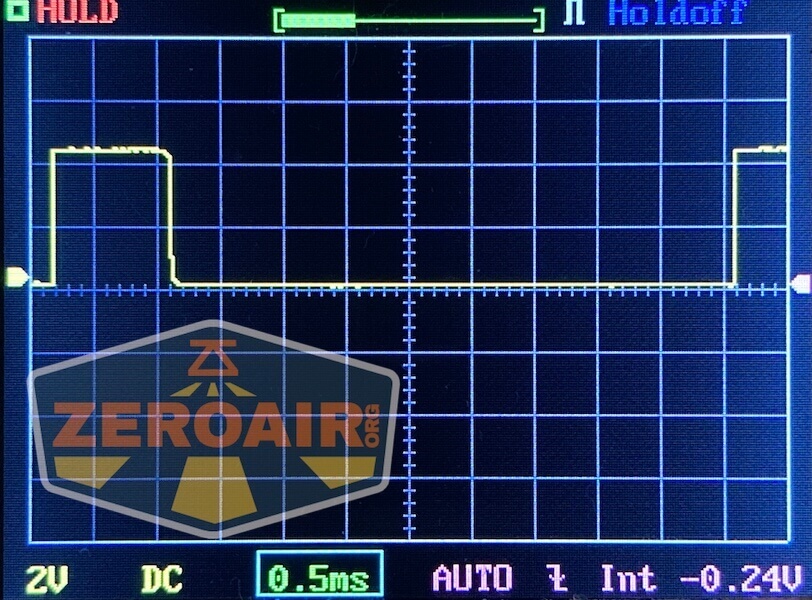
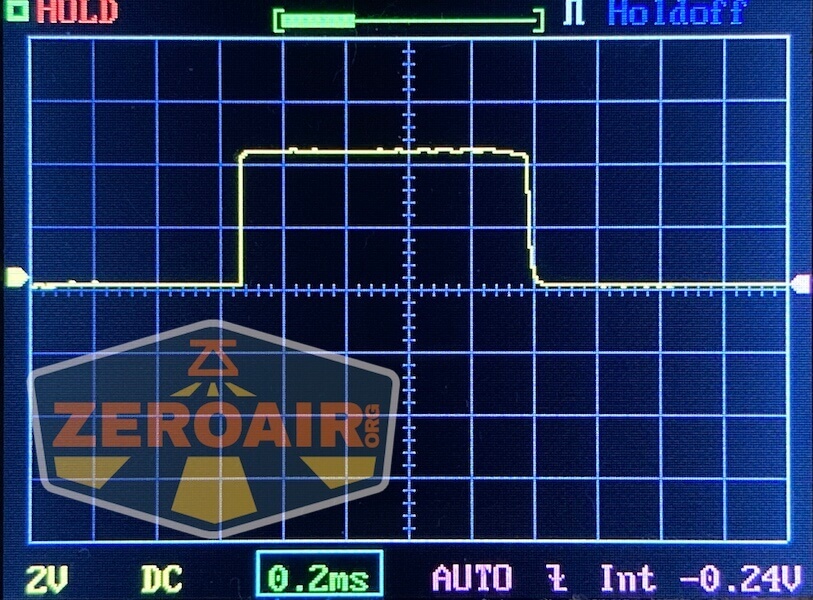
There’s no PWM on any mode.
 Here you can see a “baseline” – a chart with almost no light hitting the sensor.
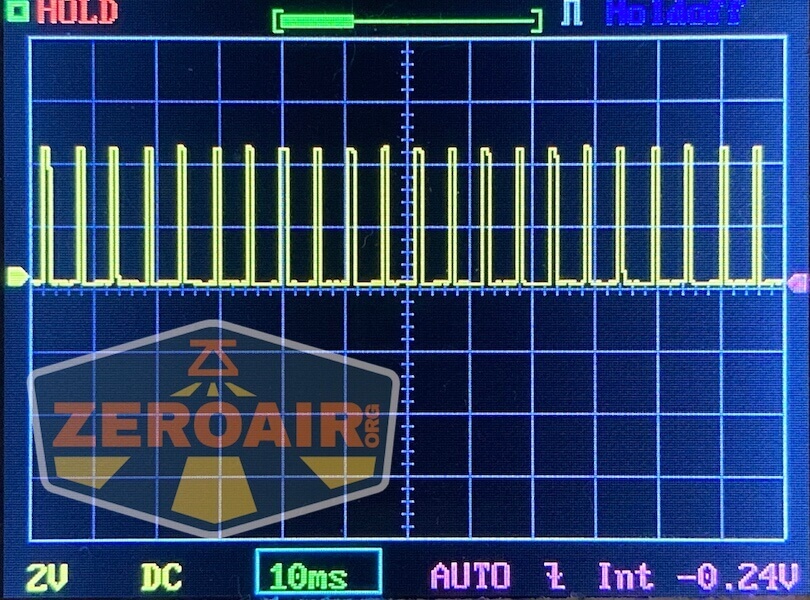
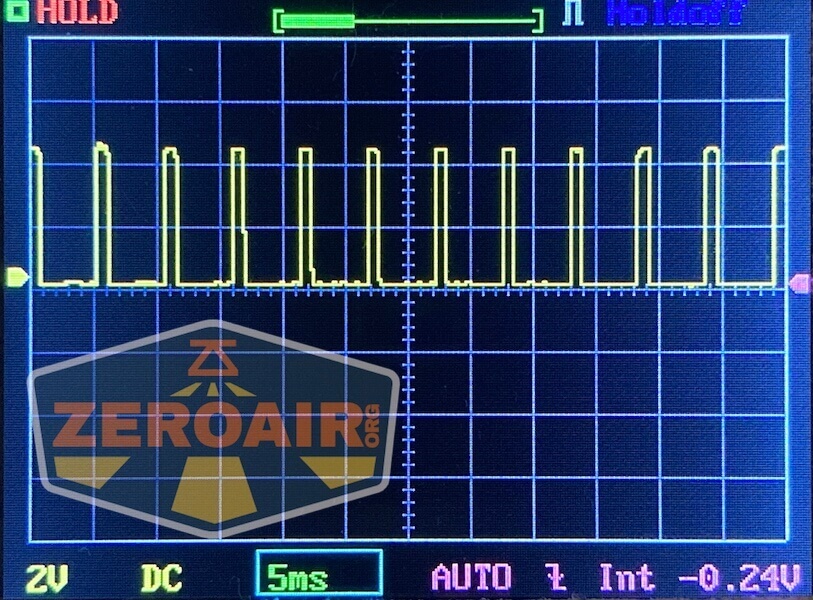
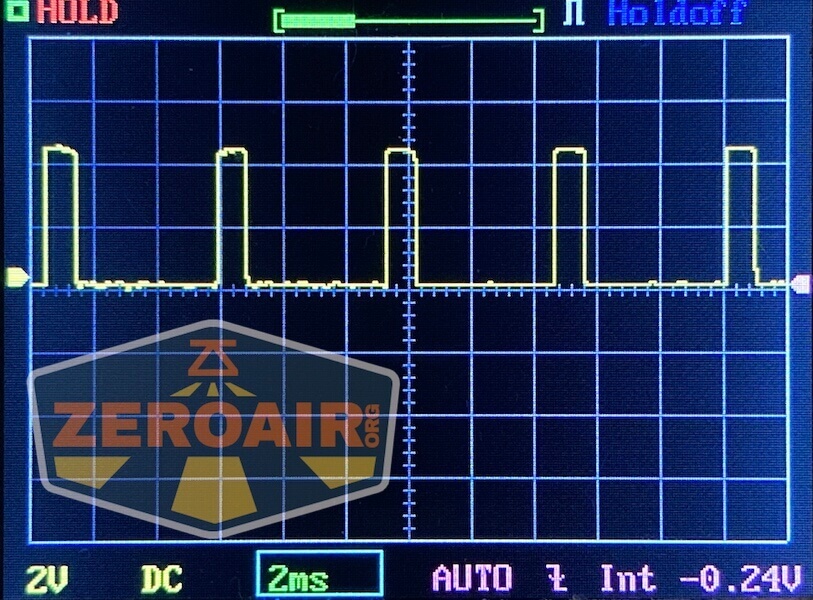
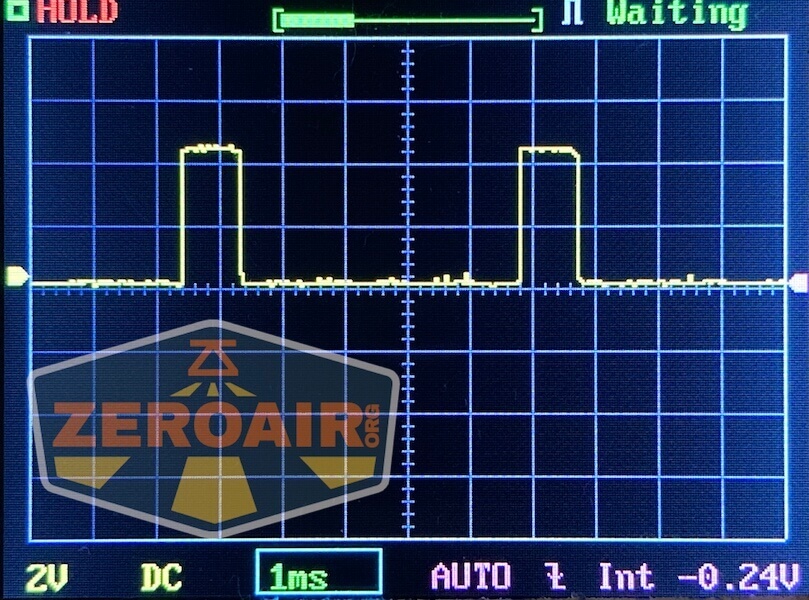
Then there’s the Ultrafire WF-602C flashlight, which has some of the worst PWM I’ve seen. It’s so bad that I used a post about it to explain PWM! Here are multiple timescales (10ms, 5ms, 2ms, 1ms, 0.5ms, 0.2ms) to make comparing this “worst” PWM light to the test light easier. That post also explains why I didn’t test the WF-602C at the usual 50us scale.
User Interface and Operation
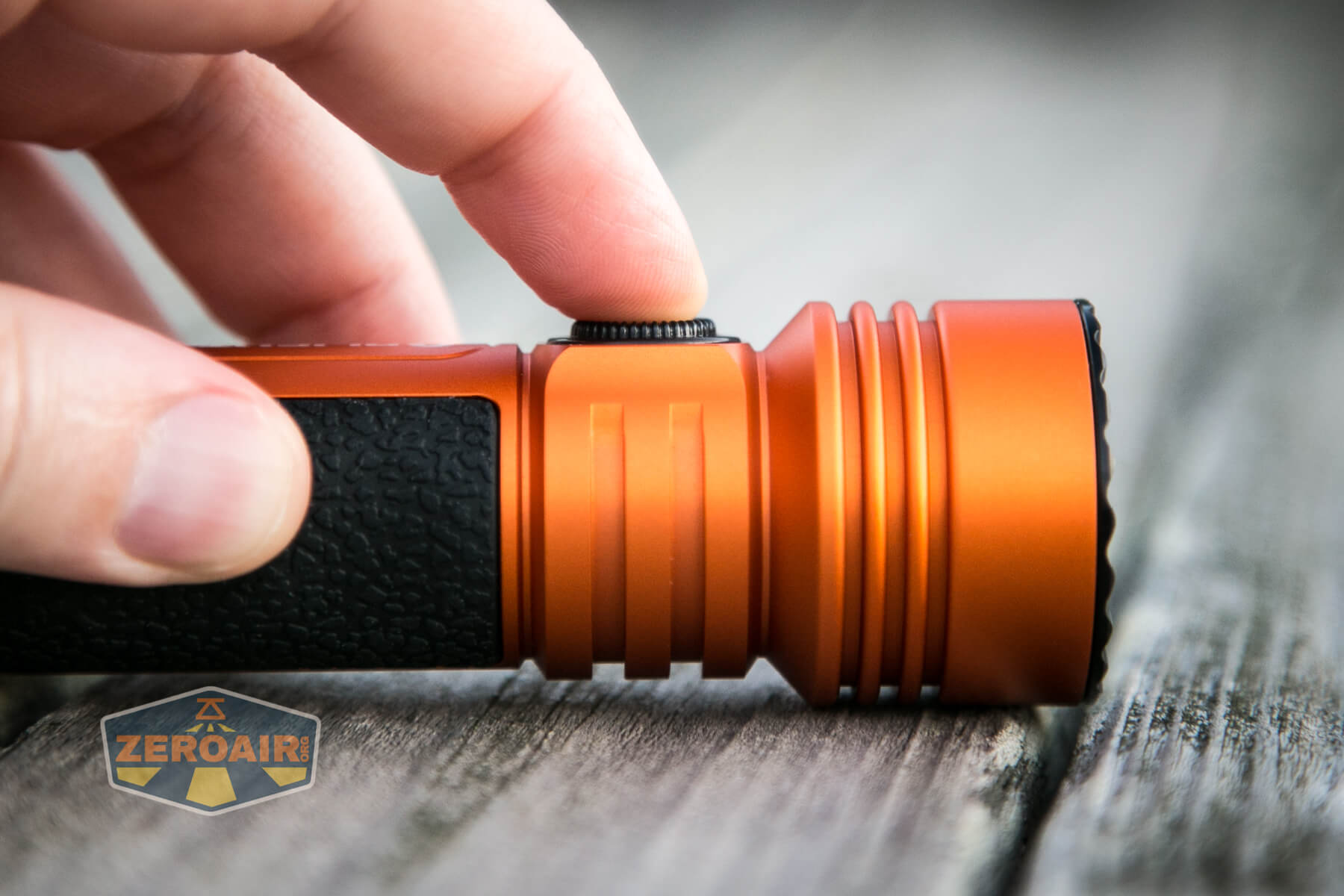
The switch used on the Olight Seeker 3 Pro is not unlike what we saw on the Marauder 2. It’s a plastic-covered e-switch that has a rotary feature.
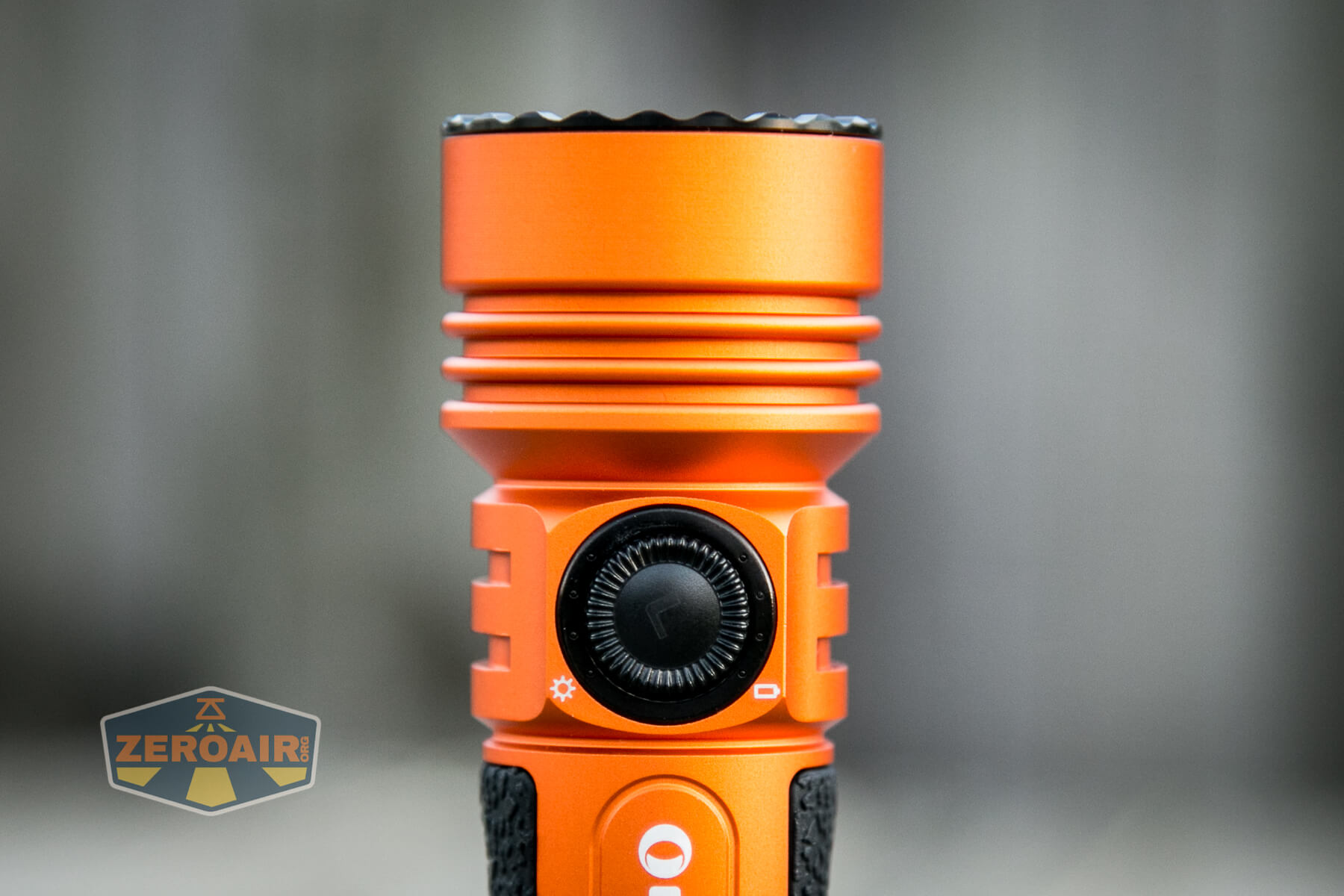
Also, Olight did something a little different here. The rotary switch has a letter! In my case, there’s an “L,” but you can collect all the models to get all the letters for spelling “OLIGHT.”
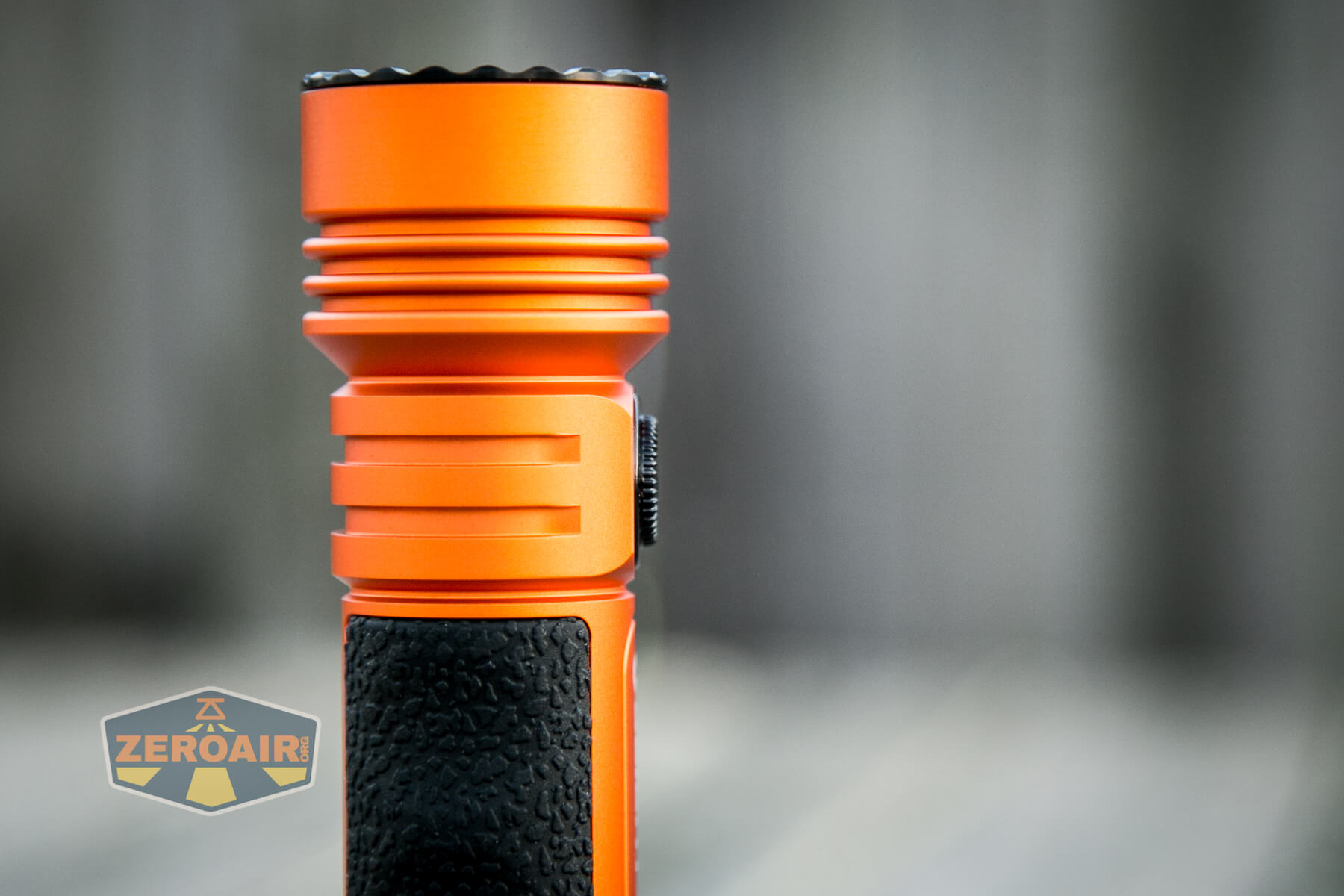
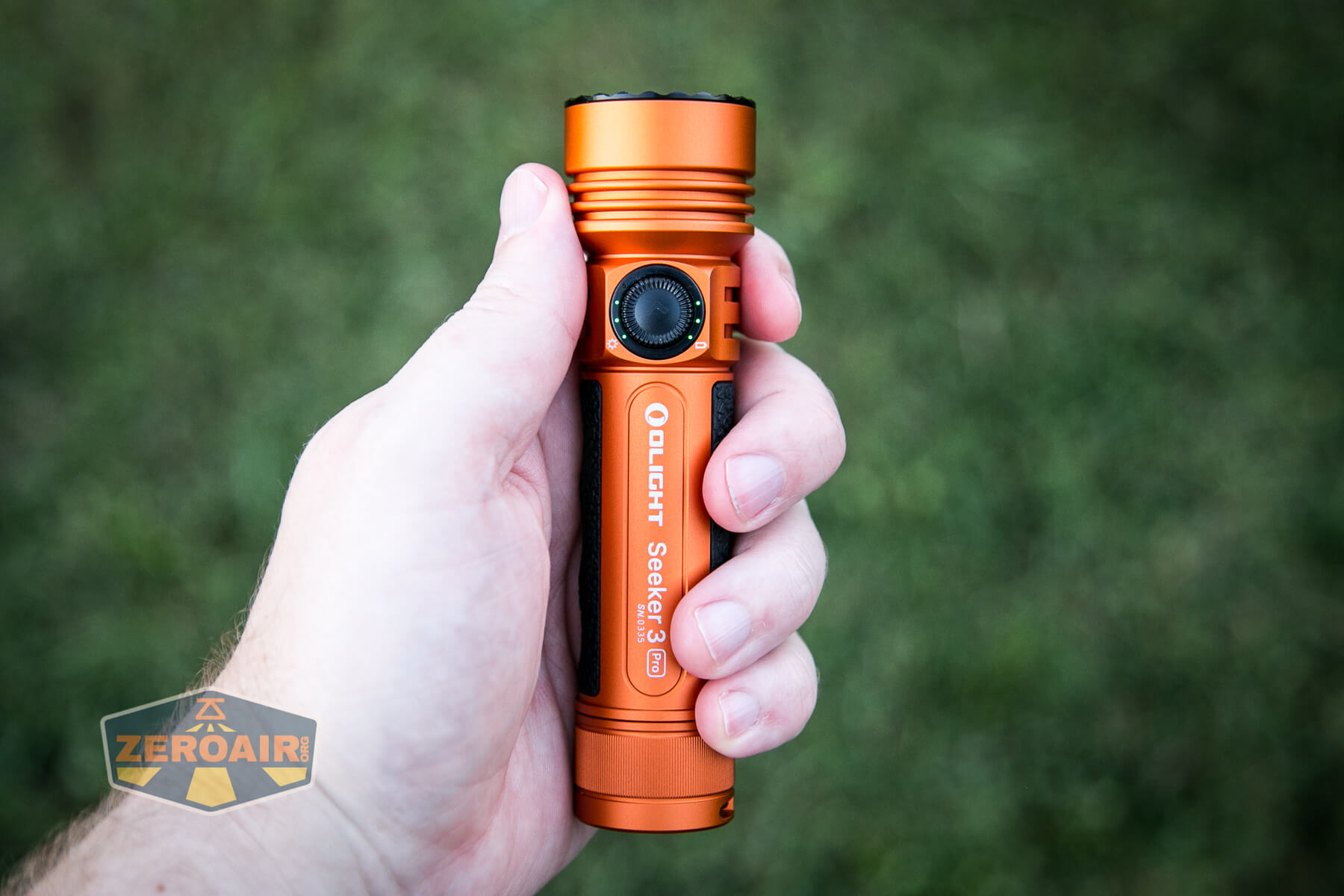
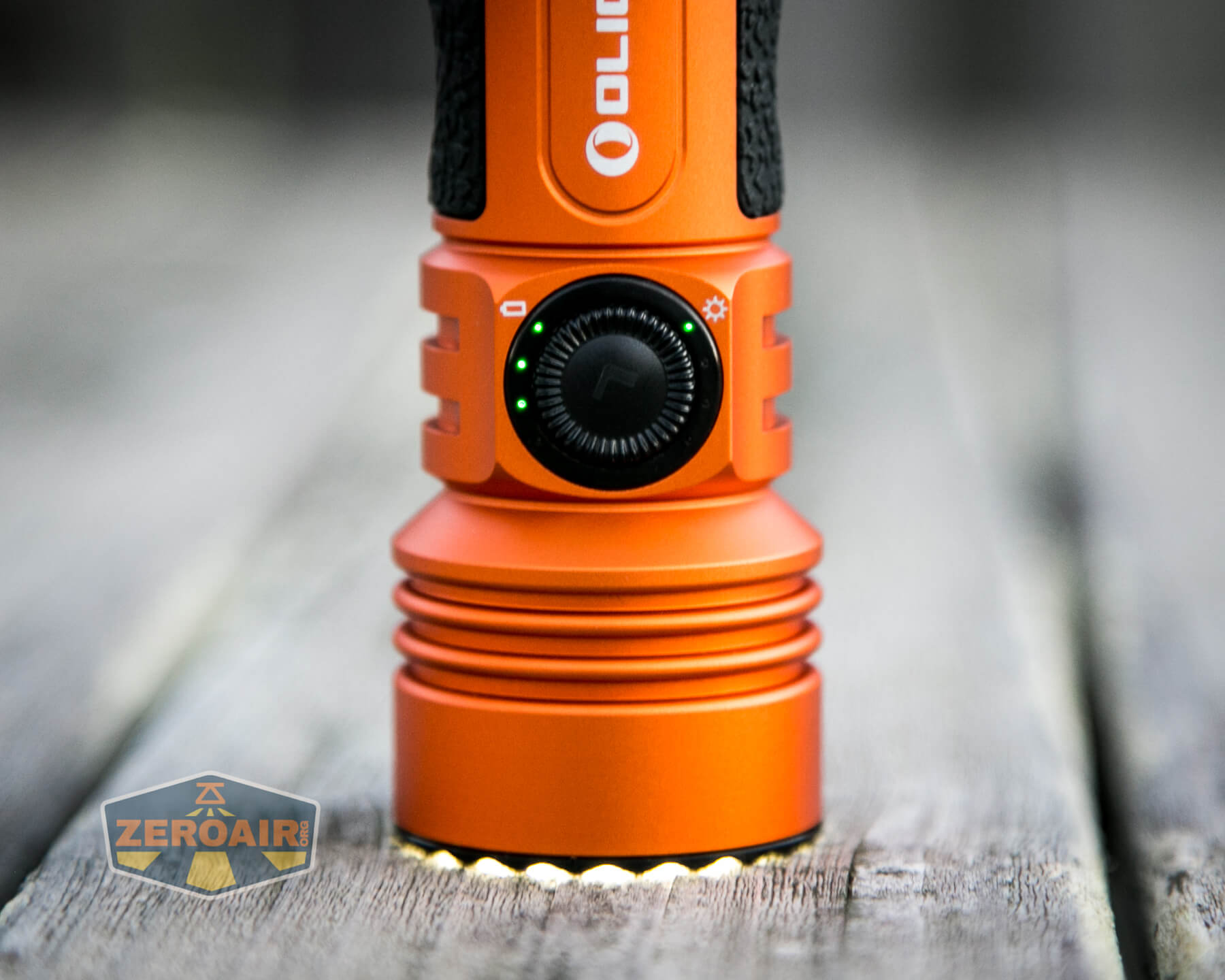
Around the switch are indicators. The right side indicates battery level, with four green marks being full. The left side indicates the output level, with one green mark indicating both moon and low, up to four marks, which indicate Turbo. These will indicate even if the light is off but unlocked (which requires the rotary dial to be turned maybe 1/2 a turn.)
People will probably go goo-goo over the rotary. I personally still prefer the stepped modes. They work together, though. If you’re in low and dial up a bit, you get an output higher than low, but lower than medium. It’s a very good system!
Here’s a user interface table!
| State | Action | Result |
|---|---|---|
| Off | Click or Hold | Battery indicator |
| Off | Rotate dial at least half turn | Unlock |
| Off (Unlocked) | Click | On (Mode memory)^ |
| Off (Unlocked) or On | Double Click | Turbo |
| On | Click | Off |
| On | Hold | Mode advance (LMH only) |
| Off (Unlocked) | Hold | Moonlight |
| Turbo | Double Click | Previous mode |
| Unlocked | Triple Click | Strobe |
| On | Rotate dial clockwise | “Stepless” increasing output |
| On | Rotate dial counterclockwise | “Stepless” decreasing output |
| On, after proximity sensor stepdown | Double Click | Temporarily disable proximity sensor |
^ The way I read the manual, High is not memorized. Only low or medium are memorized.
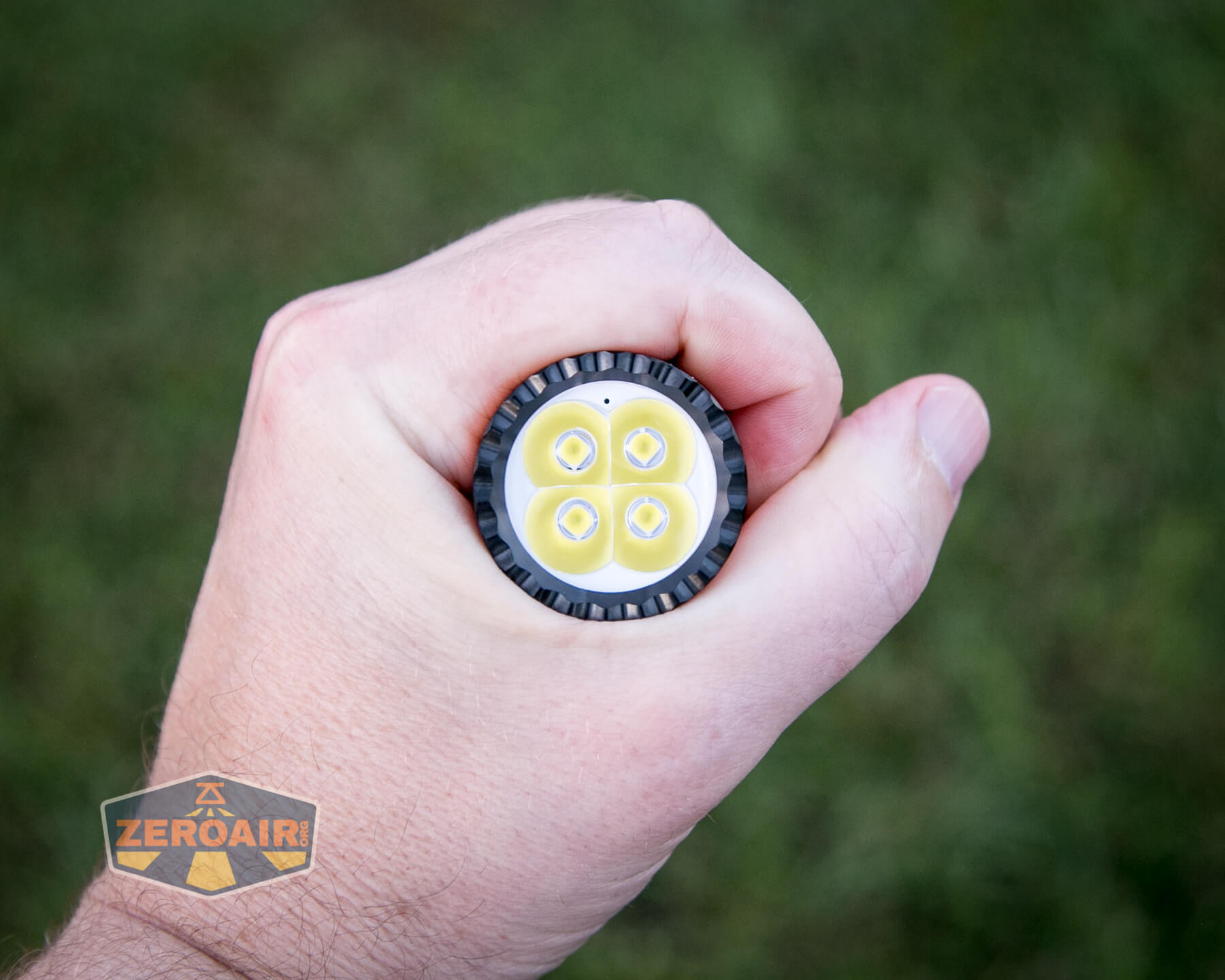
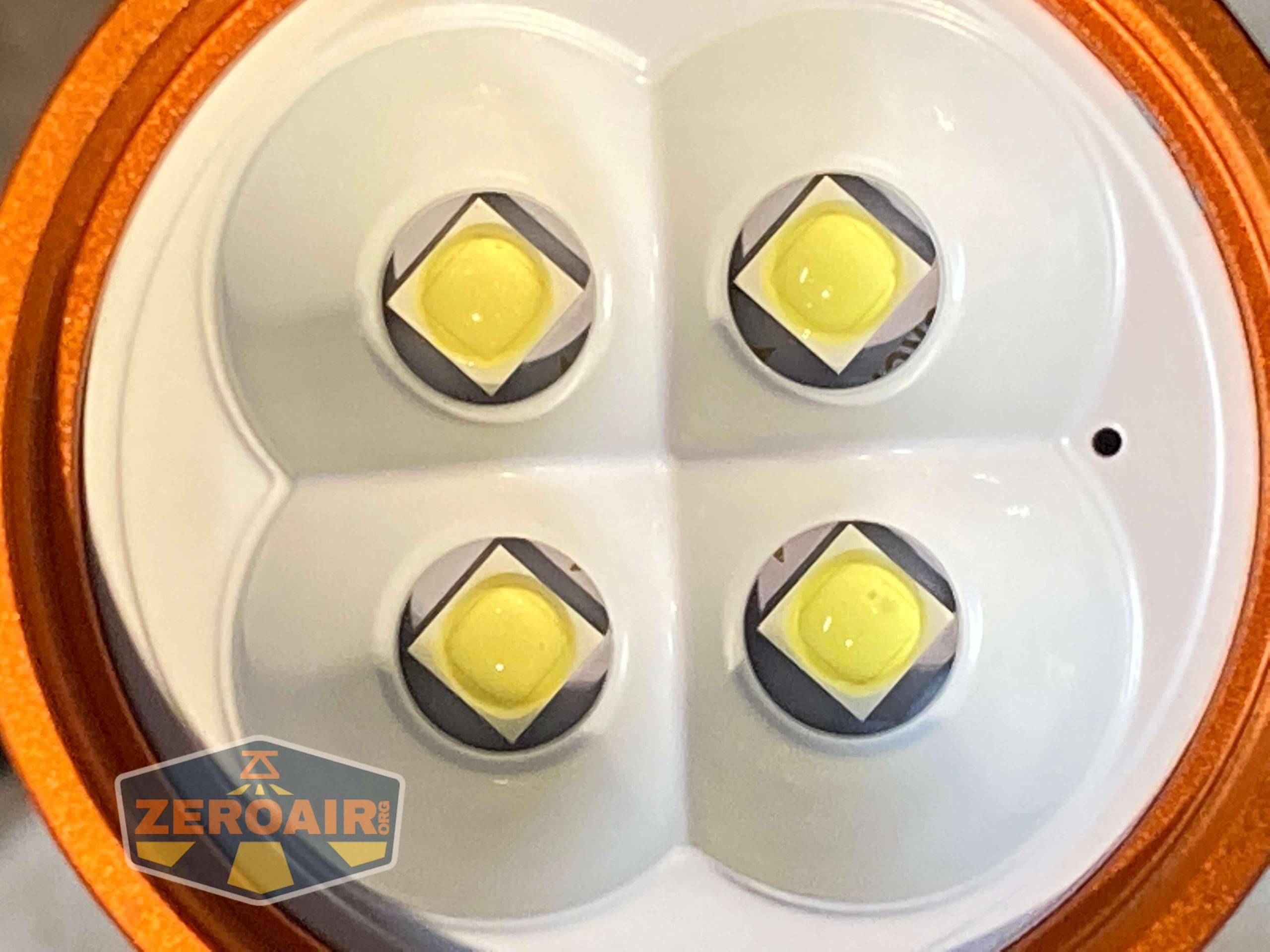
If you’ve had a good look at the front of the Olight Seeker 3 Pro, you probably noticed that little black dot near the emitters. It’s clearly evident in the photograph below, around the 4 o’clock position. That’s a proximity sensor. On the highest two modes, when the sensor gets enough bounce-back feedback, the light will downshift to a lower level. It does not shift to medium, but something higher than medium.
I’m exceptionally happy that Olight allows us to turn off the proximity sensor. I dislike those in general, but this is a very good compromise. This is better than the Marauder 2 proximity sensor disable, too, because the sensor will go back on automatically. You may end up having to cycle modes a bit to be sure the sensor is off, but overall, if burning something is a concern, this is definitely a safer solution. And it’s just two clicks, instead of 15 as on the Marauder 2.
LED and Beam
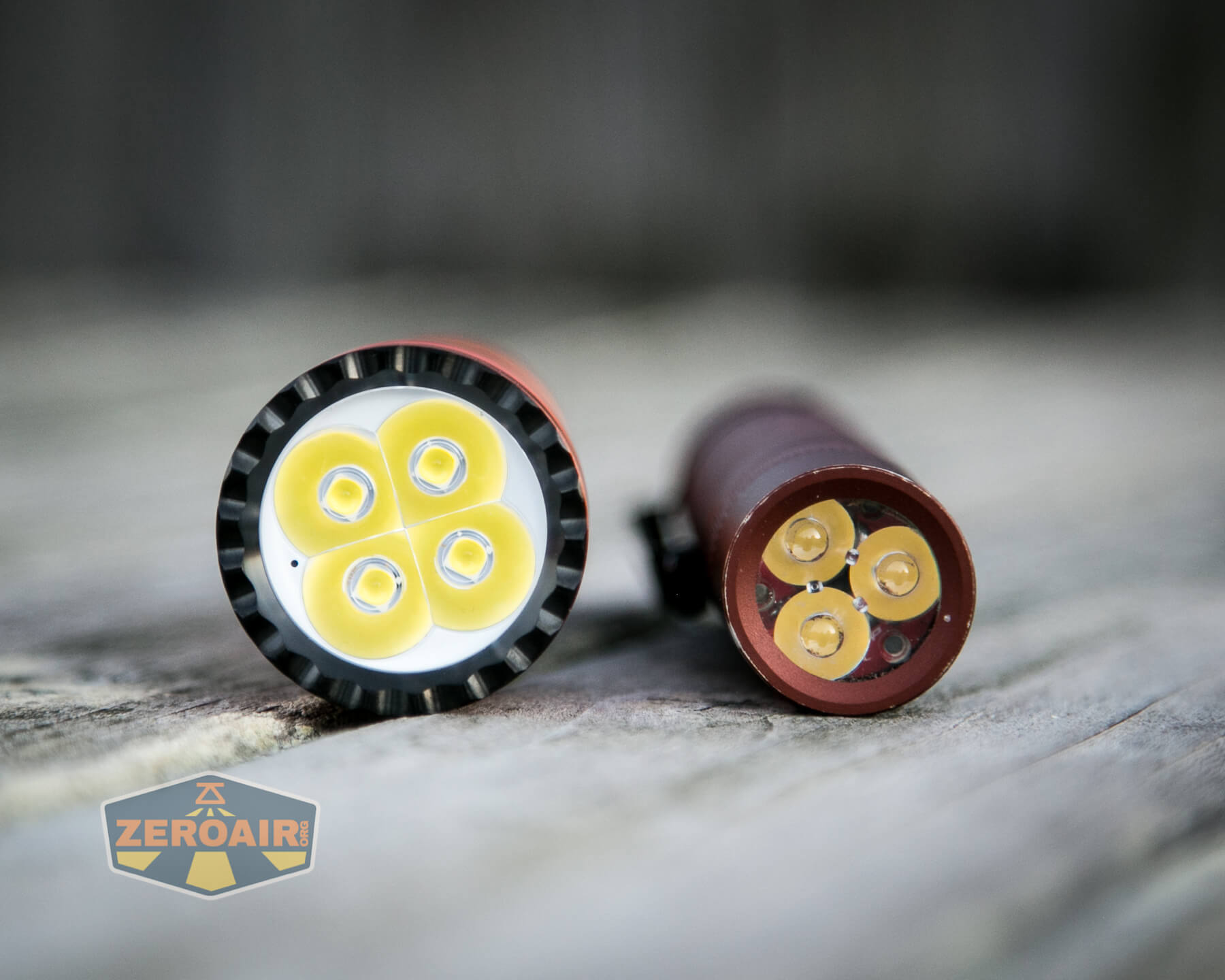
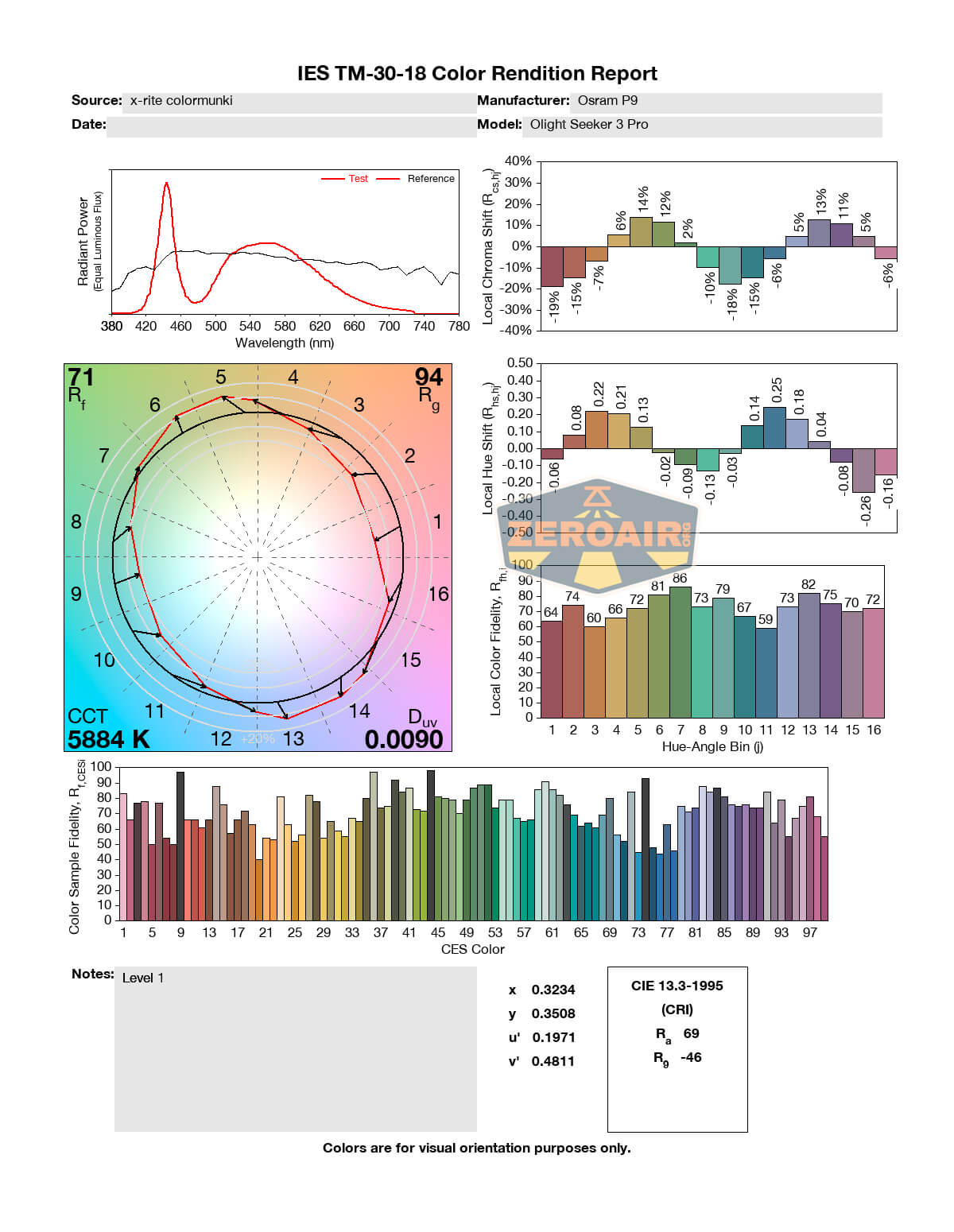
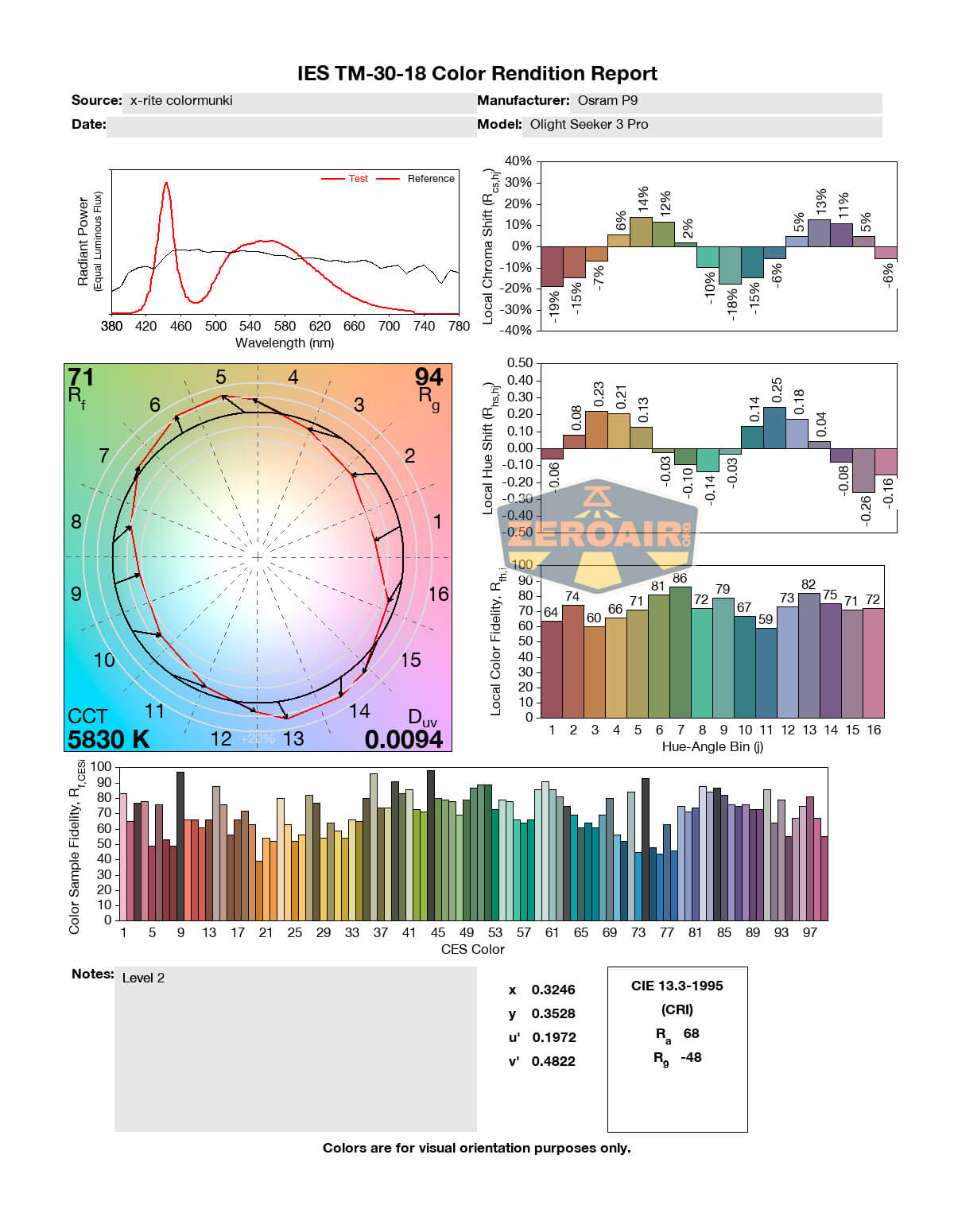
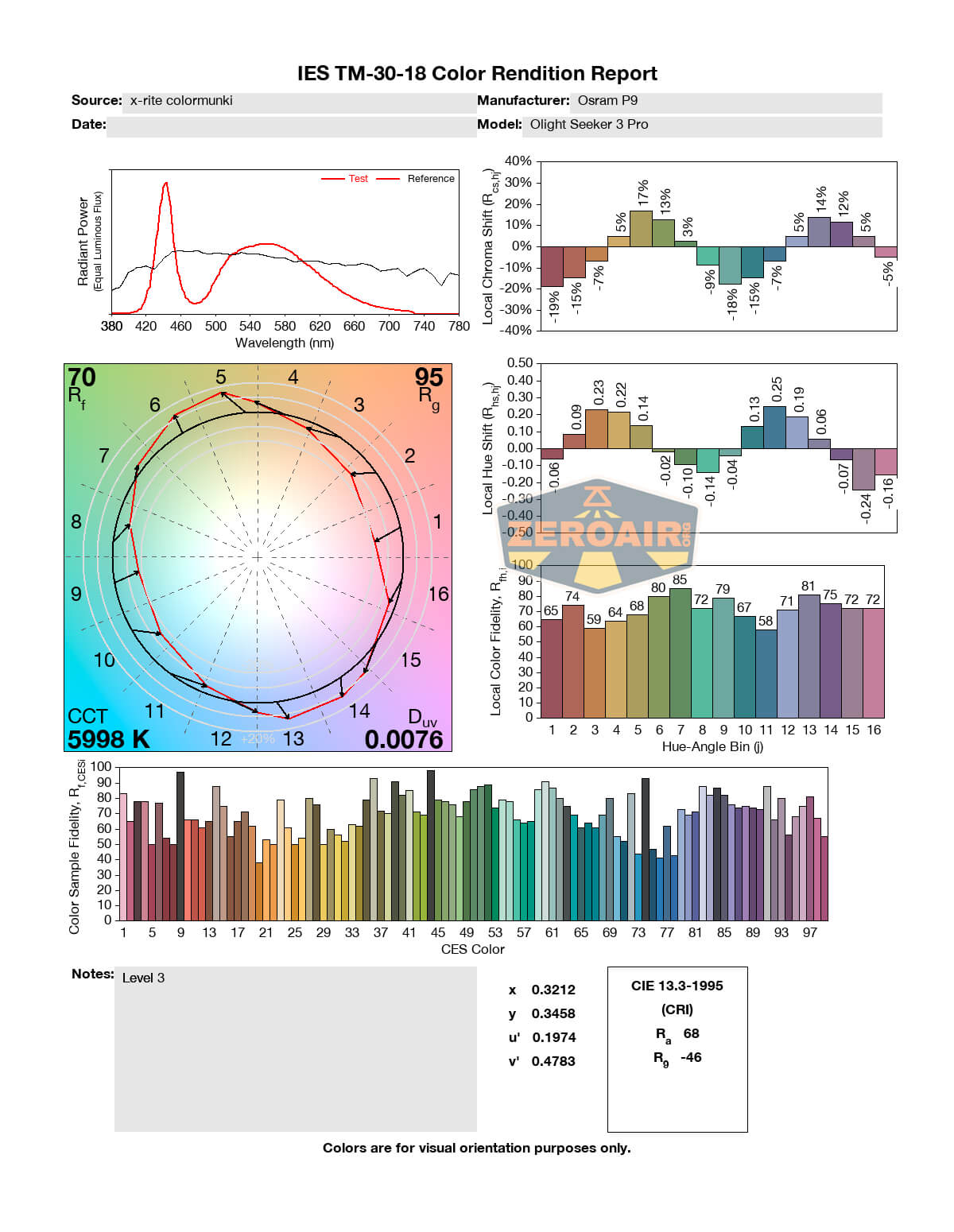
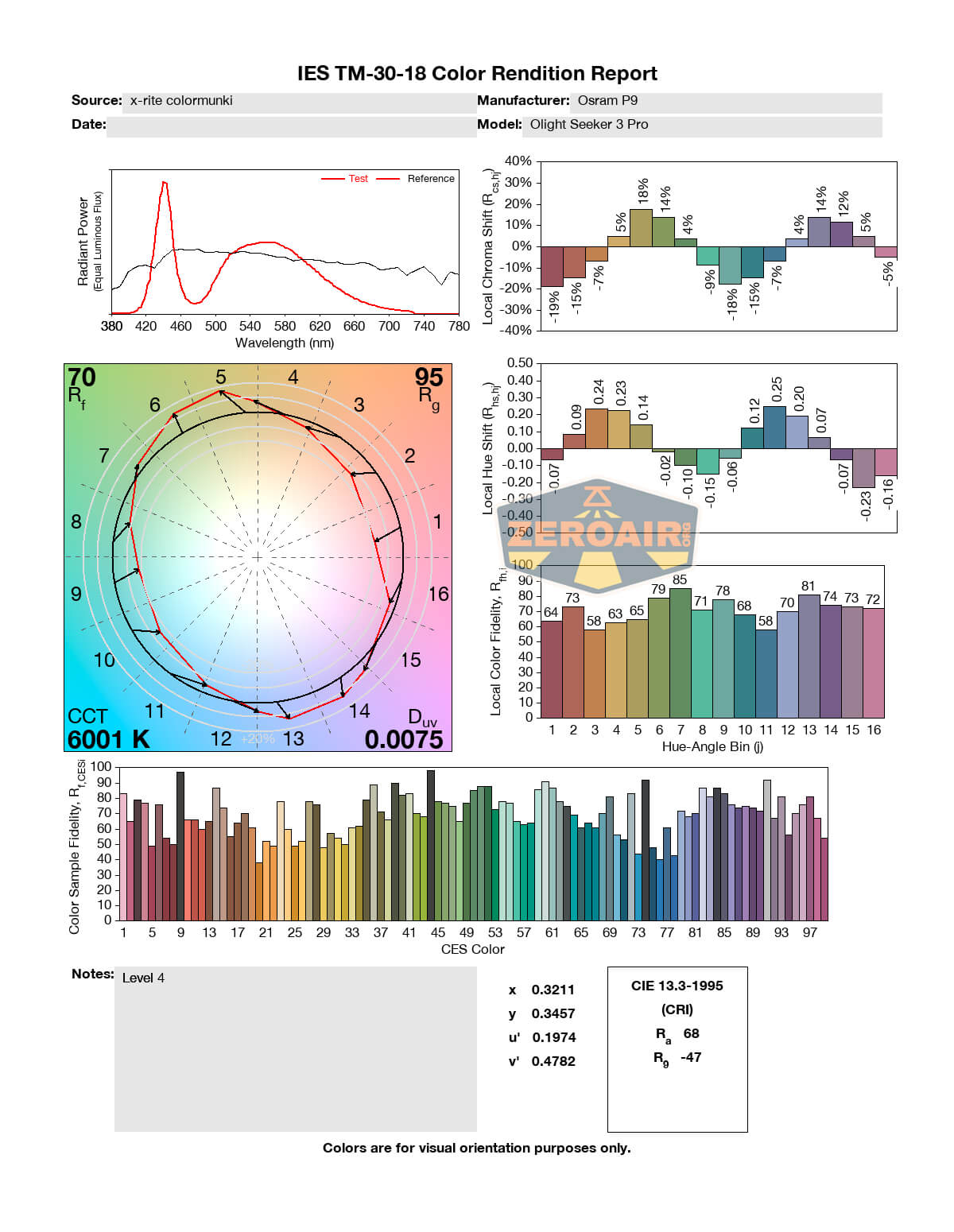
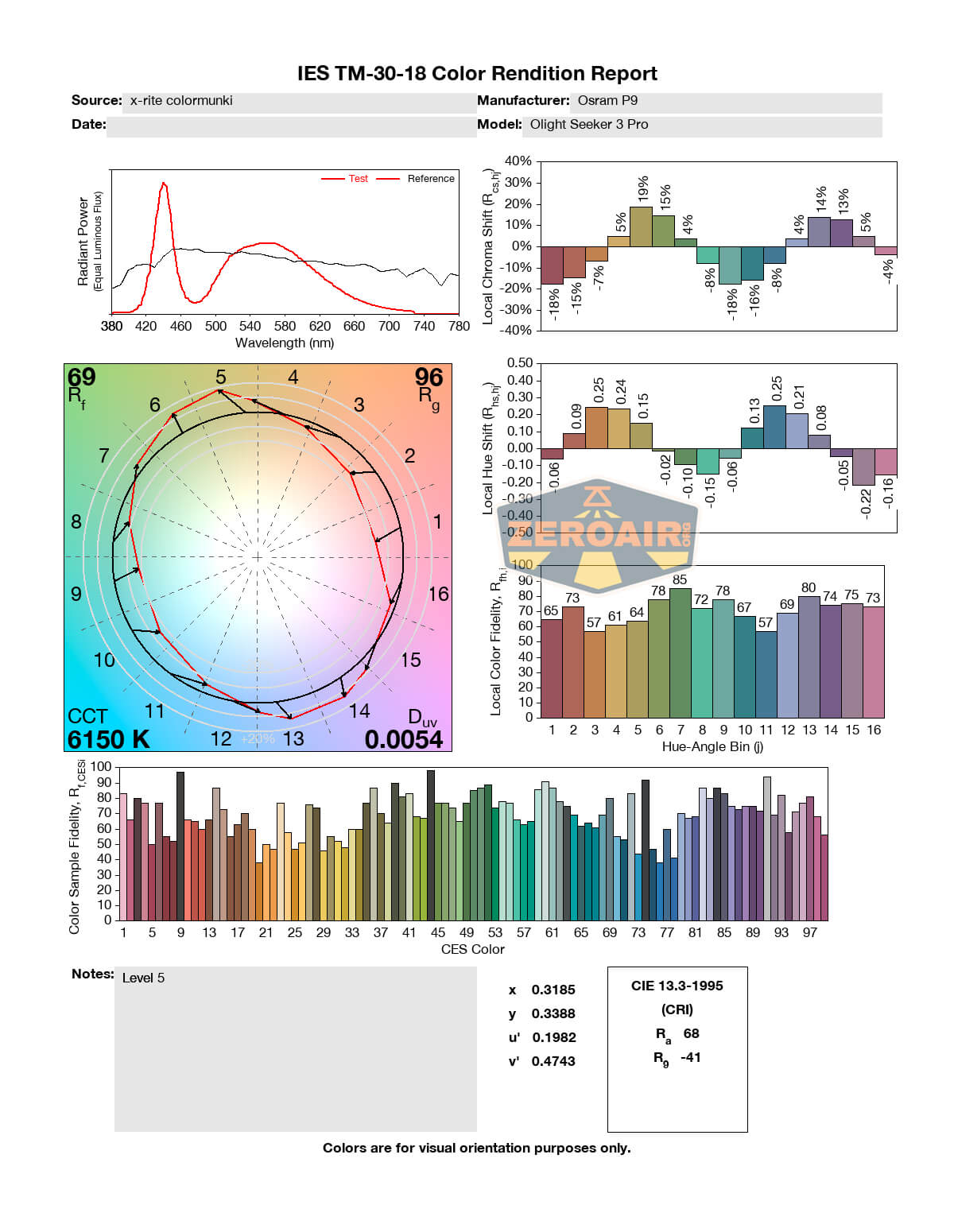
Olight doesn’t make an emitter claim here, but upon inspection, they appear to be Osram P9. That fits well with Olight, so it seems like a safe call. There are four emitters here.
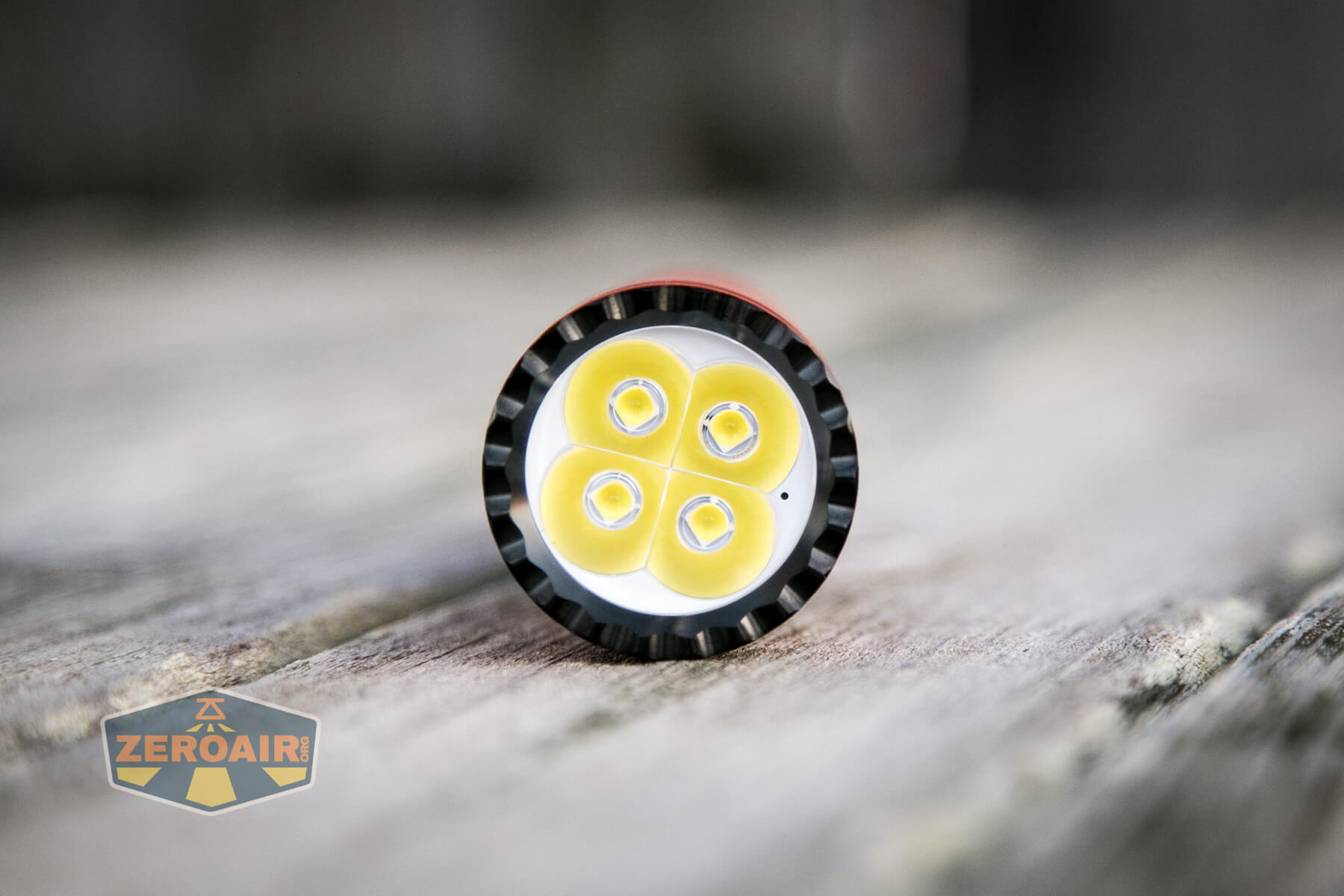
Olight uses an optic for these emitters.
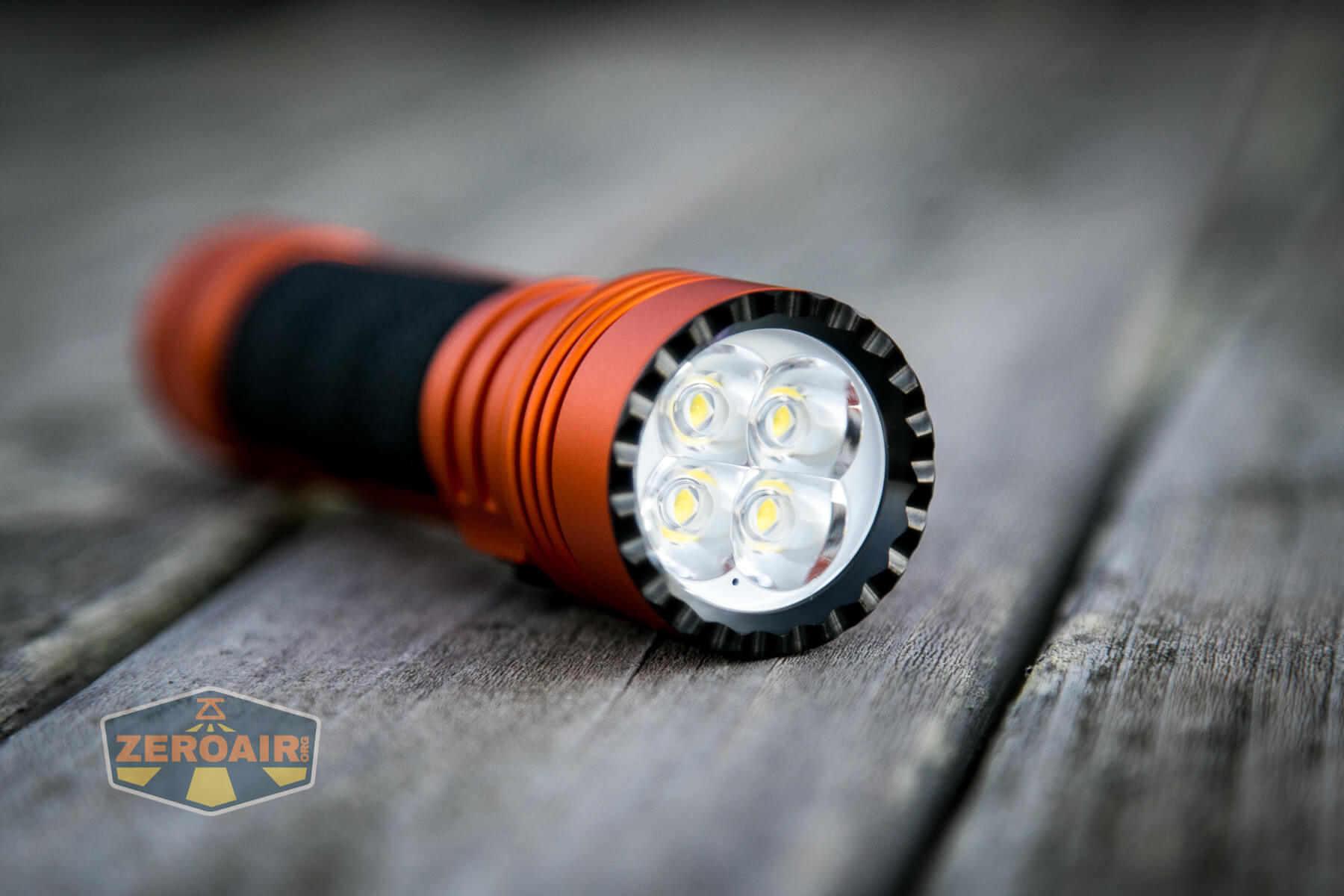
A toothed bezel is used on the front, which allows a little light to escape when headstanding. The bezel is also very easy to unscrew. When removed, the optic comes right out, revealing the white cup, which you can see below. I did not go any deeper than this.
LED Color Report (CRI and CCT)
Beamshots
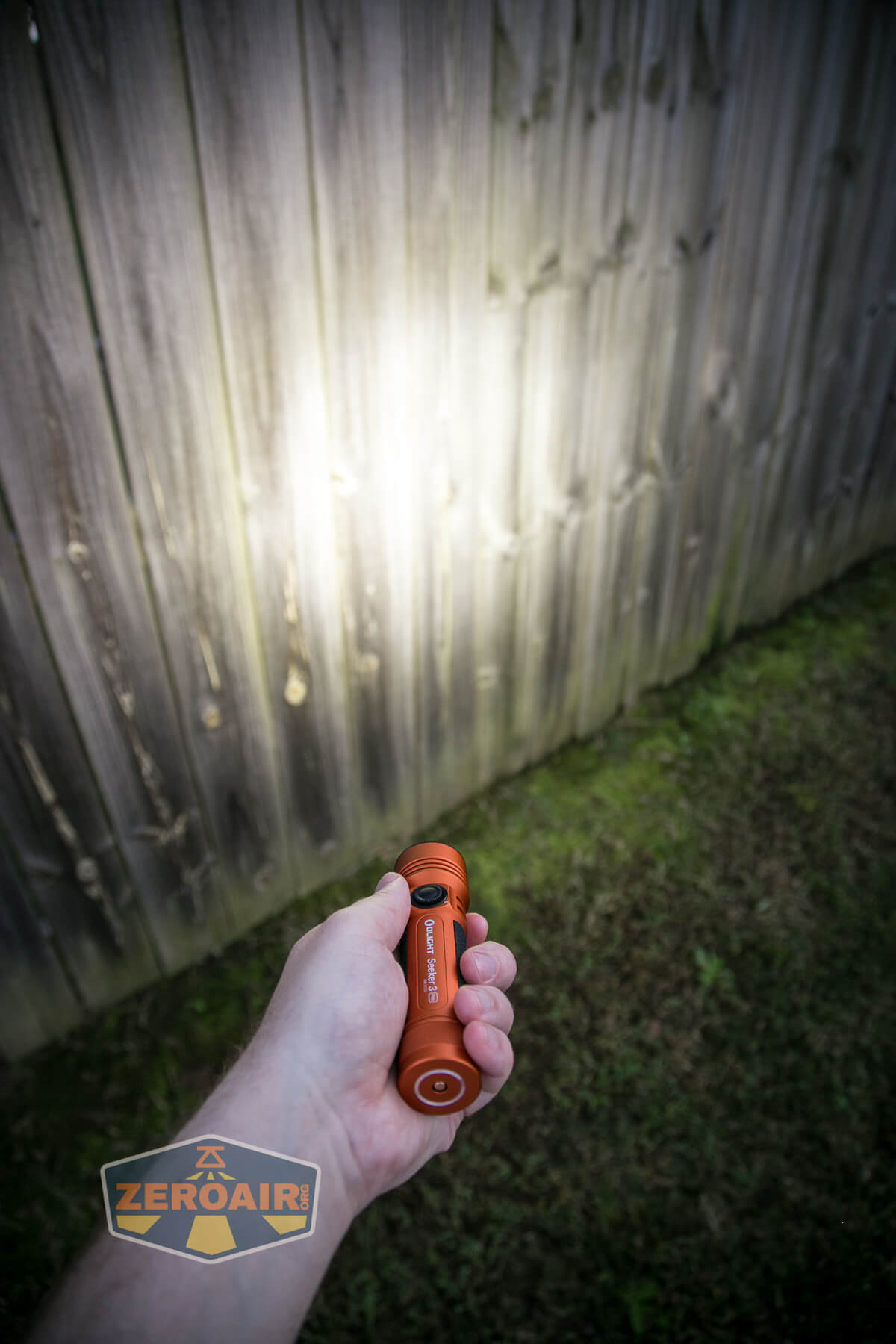
These beamshots always have the following settings: f8, ISO100, 0.3s shutter, and manual 5000K exposure. These photos are taken at floor level, and the beam hits the ceiling around 9 feet away.
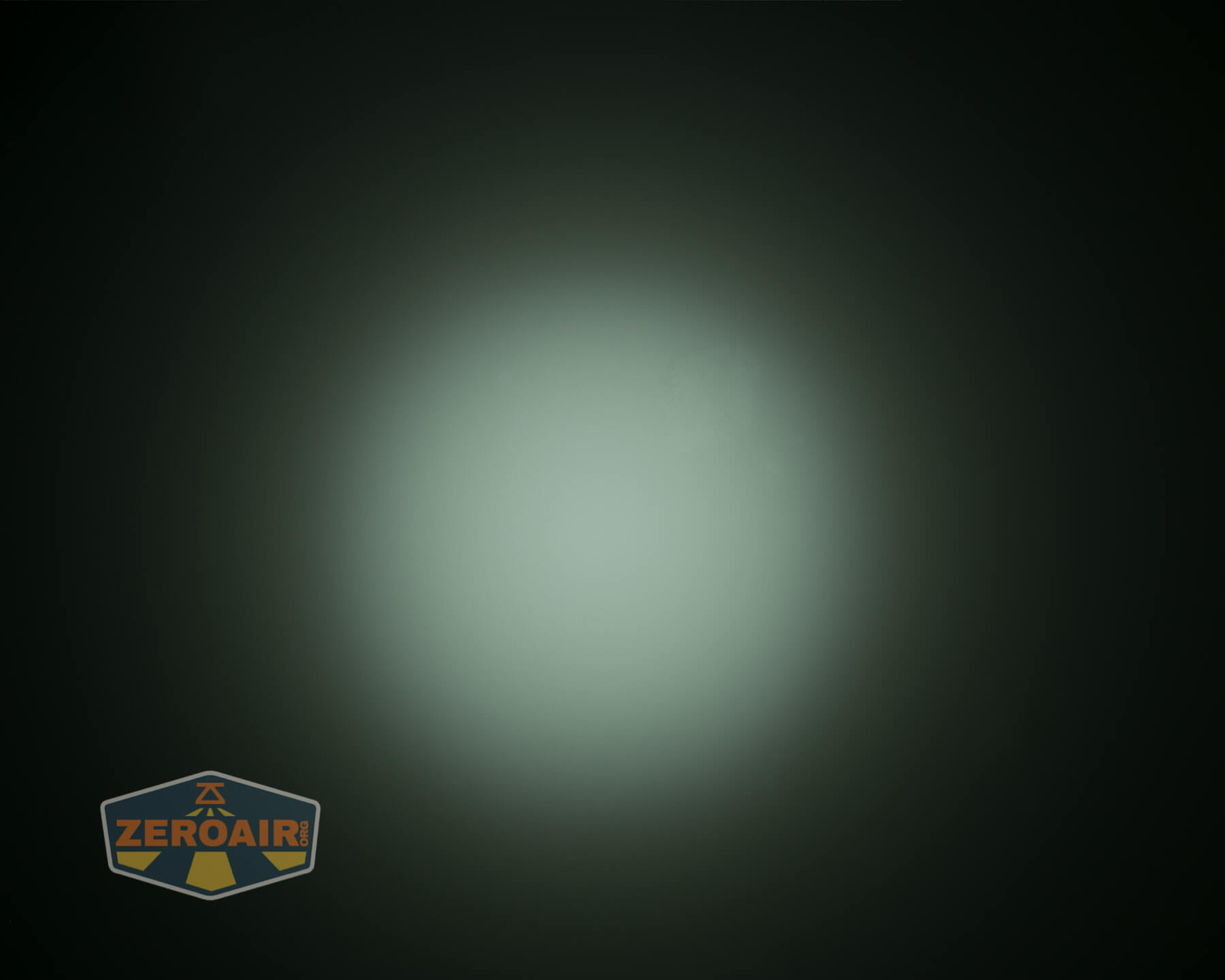
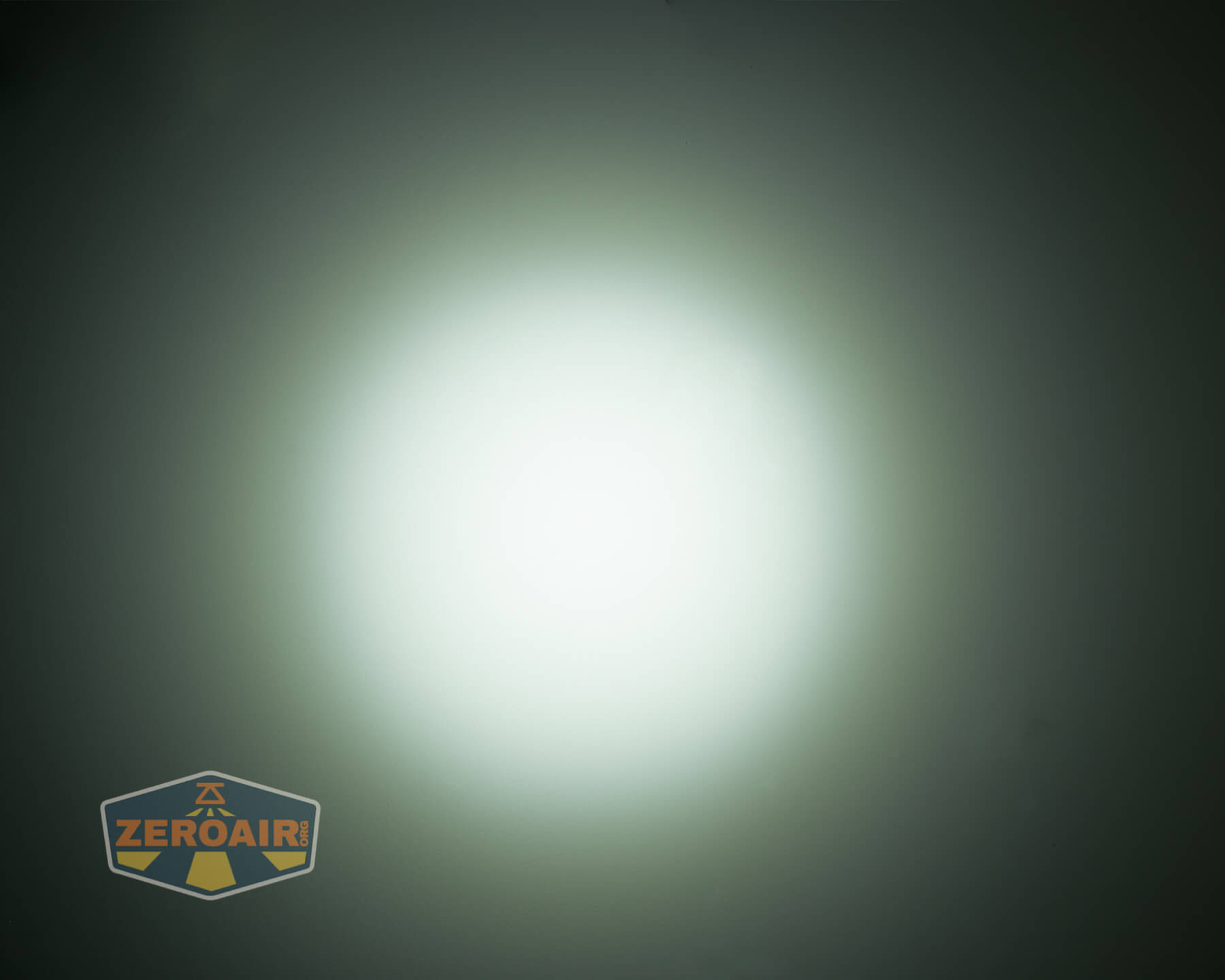
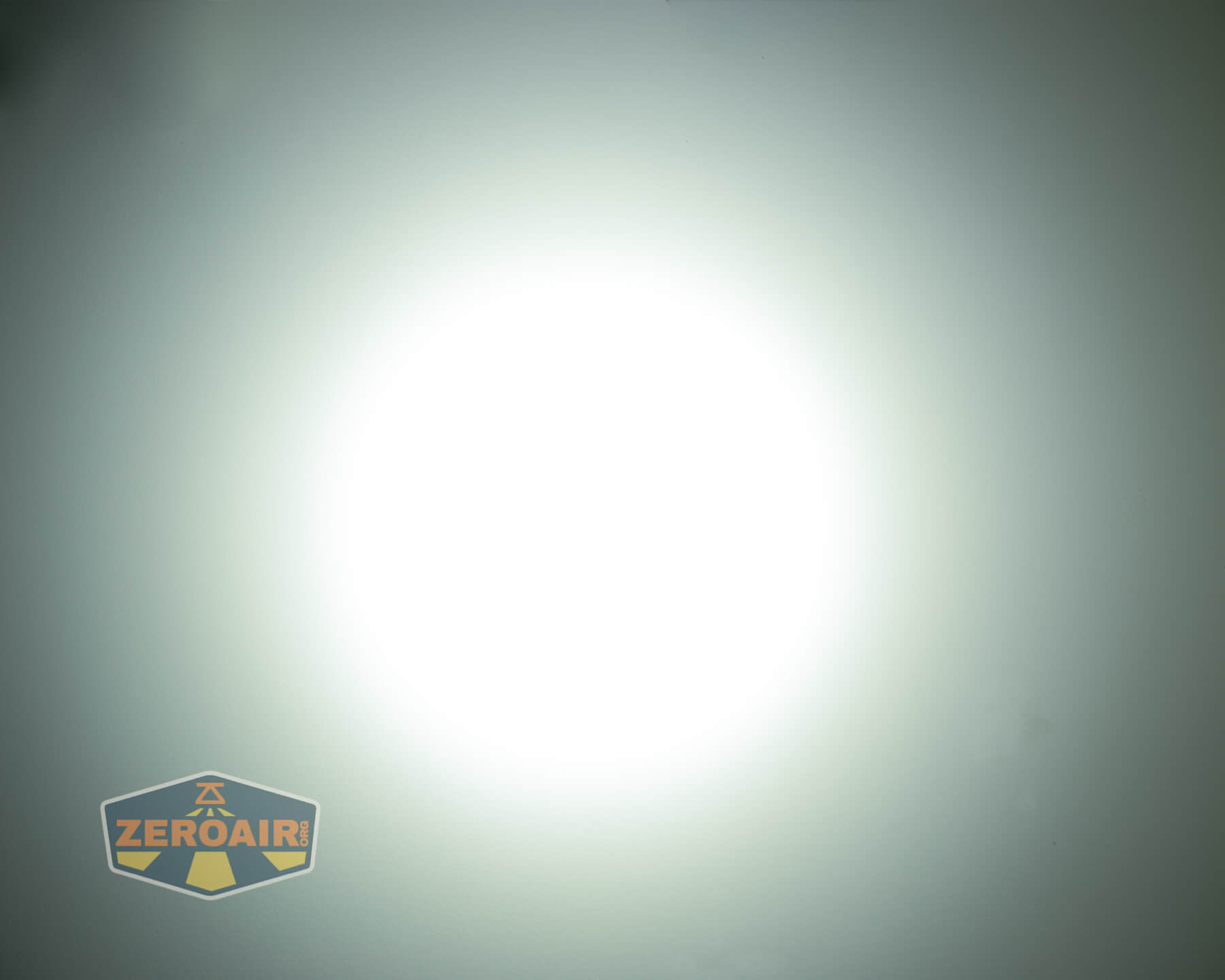
Tint vs BLF-348 (KillzoneFlashlights.com 219b version) (affiliate link)
I keep the test flashlight on the left and the BLF-348 reference flashlight on the right.
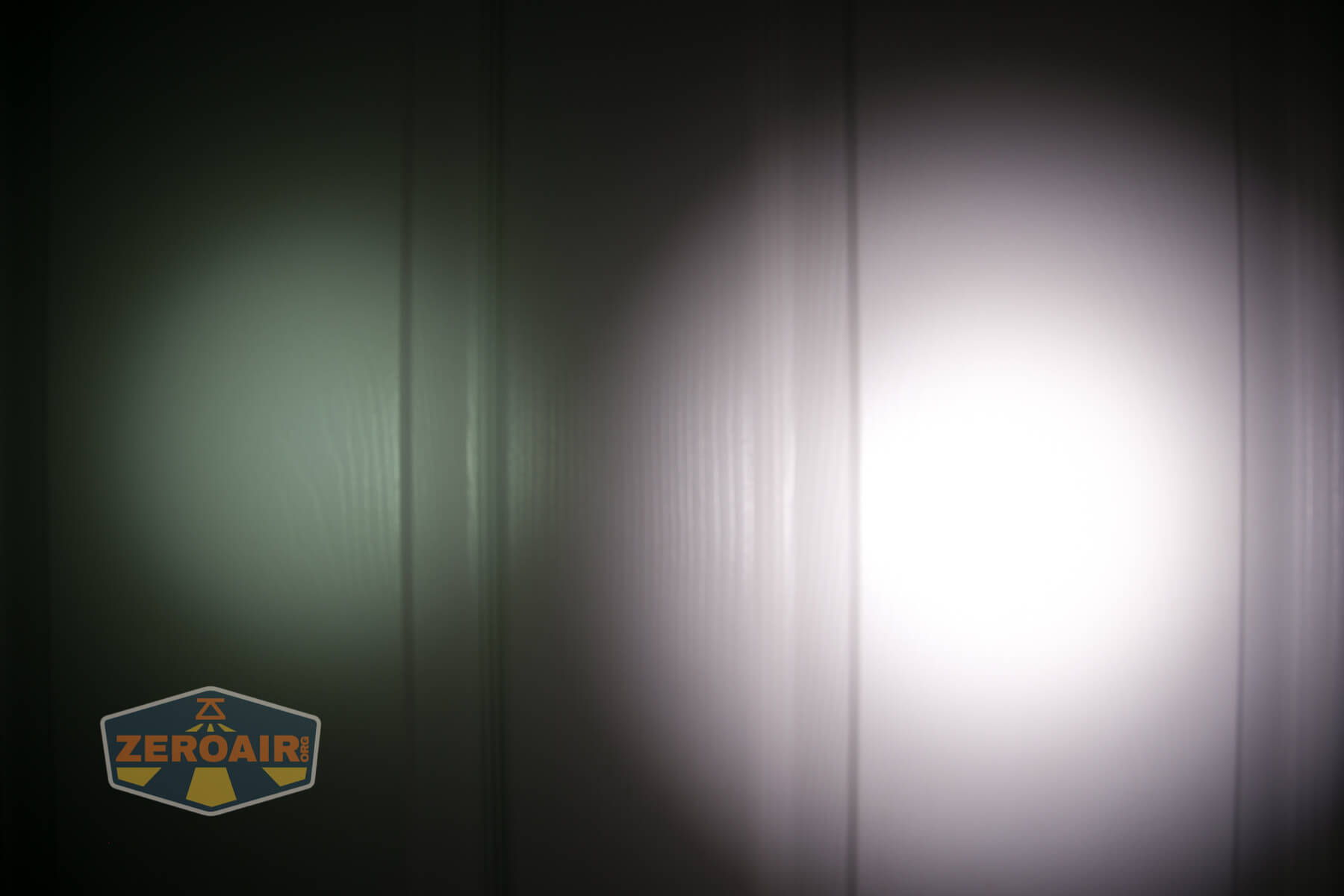
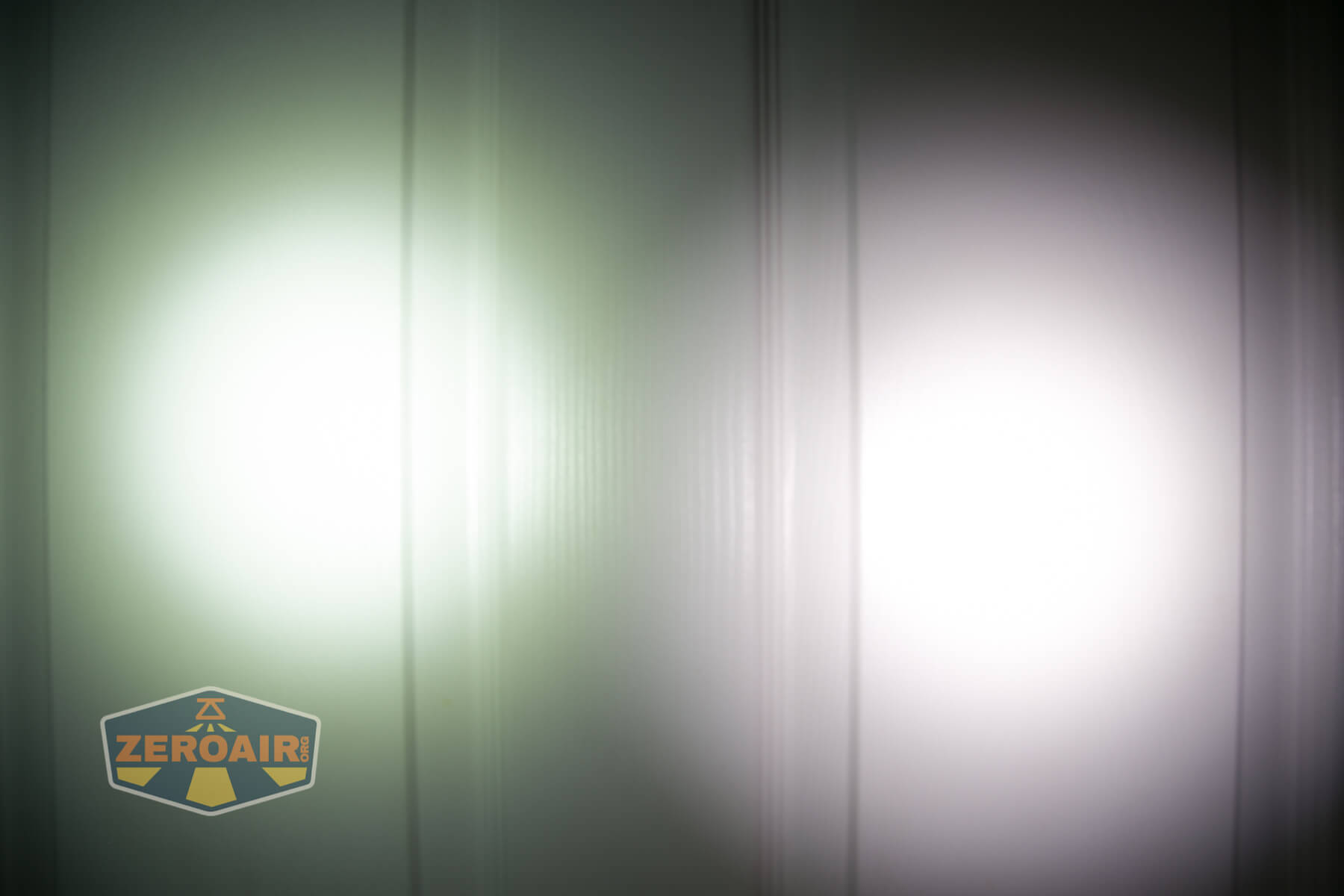



I compare everything to the KillzoneFlashlights.com 219b BLF-348 because it’s inexpensive and has the best tint!
Conclusion
What I like
- Output is just fantastic
- Levels lower than Turbo are extremely stable
- Probably possible to swap emitters on here – the bezel is not press-fit
- Charging works very well at around 2A.
- It’s orange, and it’s a good orange too.
- The rotary dial is great for mid-level mode changes (I would probably not use the rotary by itself, generally though)
- Nylon carry holster is both high quality and orange
- The proximity sensor can be turned off very easily
What I don’t like
- 6000K – but at least the Olight claim is accurate here. So you should be comfortable knowing what you’re getting.
- Proprietary magnetic charging
- Proprietary customized 21700 cell
- There’s a proximity sensor
Notes
- This light was provided by Olight for review. I was not paid to write this review.
- This content originally appeared at zeroair.org. Please visit there for the best experience!
- Please use my Amazon.com referral link to help support zeroair.org!
- Please support me on Patreon! I deeply appreciate your support!
Wish these worked with a standard 21700 even if it disabled the magnetic charging.
BTW, what lights do you edc the most lately?
Thanks!