

Olight Warrior X 4 Tactical Flashlight Review
The Olight Warrior X 4 tactical flashlight offers built-in USB-C charging with a fancy (robust) charging cover as well as a group with strobe. Read on!
Official Specs and Features
Here’s a referral link to the Olight Warrior X 4 tactical flashlight product page.
Versions
There are at least two versions of the Olight Warrior X 4 tactical flashlight. One is this black version. There’s also a green/black Camouflage edition.
Price
As is often the case, Olight is offering some introductory prices for the Olight Warrior X 4 tactical flashlight. MRSP is $139.99, but during this opening sale, the price is $90.99.
Olight also offers a number of packages that might include some other light or favor, and those are usually much better deals than just buying the light itself. So consider those!
Short Review
The Olight Warrior X 4 tactical flashlight is very neat, especially the USB-C charging port in the body. It’s sort of neat that Olight still includes the older style charging, but I think that’s just a byproduct of also still using the (fantastic) dual-stage tail switch. The output and mode selection on this light is great, and overall, this is a solid light!
Long Review
The Big Table
| Olight Warrior X 4 tactical flashlight | |
|---|---|
| Emitter: | Luminus SFT-70 |
| Price in USD at publication time: | $90.99 during the intro sale! |
| Cell: | 1×21700 |
| Runtime Graphs | |
| LVP? | Yes |
| Switch Type: | Mechanical |
| On-Board Charging? | Yes |
| Charge Port Type: | USB-C |
| Charge Graph | |
| Power off Charge Port | “With cell: all modes without cell or tailcap: no modes” |
| Claimed Lumens (lm) | 2600 |
| Measured Lumens (at 30s) | 2391 (92% of claim)^ |
| Candela per Lumen | 42.09 |
| Claimed Throw (m) | 630 |
| Candela (Calculated) in cd (at 30s) | 2900lux @ 5.691m = 93924cd |
| Throw (Calculated) (m) | 612.9 (97.3% of claim)^ |
| Claimed CCT | – |
| Measured CCT Range (K) | 6000-6700 Kelvin |
| Item provided for review by: | Olight |
| All my Olight reviews! | |
^ Measurement disclaimer: Testing flashlights is my hobby. I use hobbyist-level equipment for testing, including some I made myself. Try not to get buried in the details of manufacturer specifications versus measurements recorded here; A certain amount of difference (say, 10 or 15%) is perfectly reasonable.
What’s Included

- Olight Warrior X 4 tactical flashlight
- Olight 5000mAh Proprietary 21700
- Holster
- Charge cable (USB to proprietary Magnetic)
- Tactical ring (already installed)
- Manual
Package and Manual

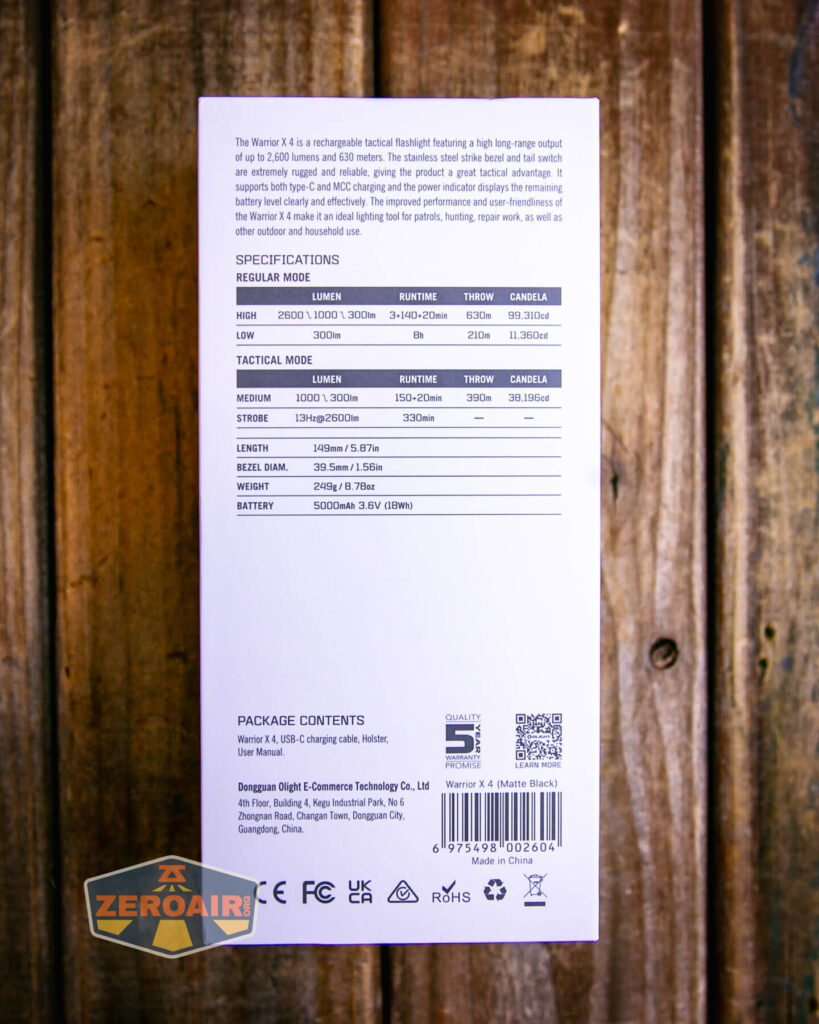

You might not think you’ll need the info covered on this little bit below, but it’s useful info. The light doesn’t just go in and out of the holster “unnecessarily.”

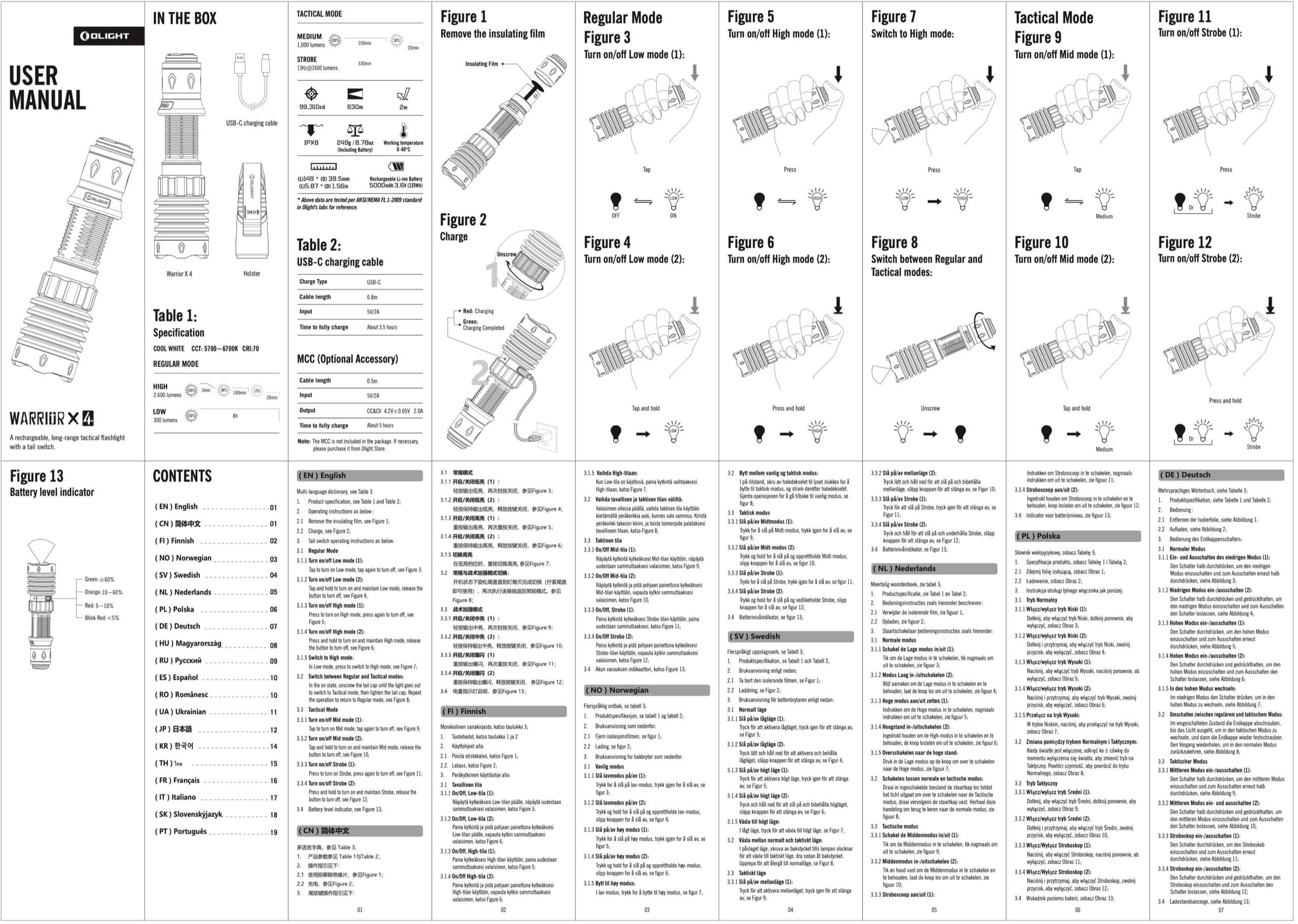
Build Quality and Disassembly

This feels like an extremely robust light. The finish is excellent.
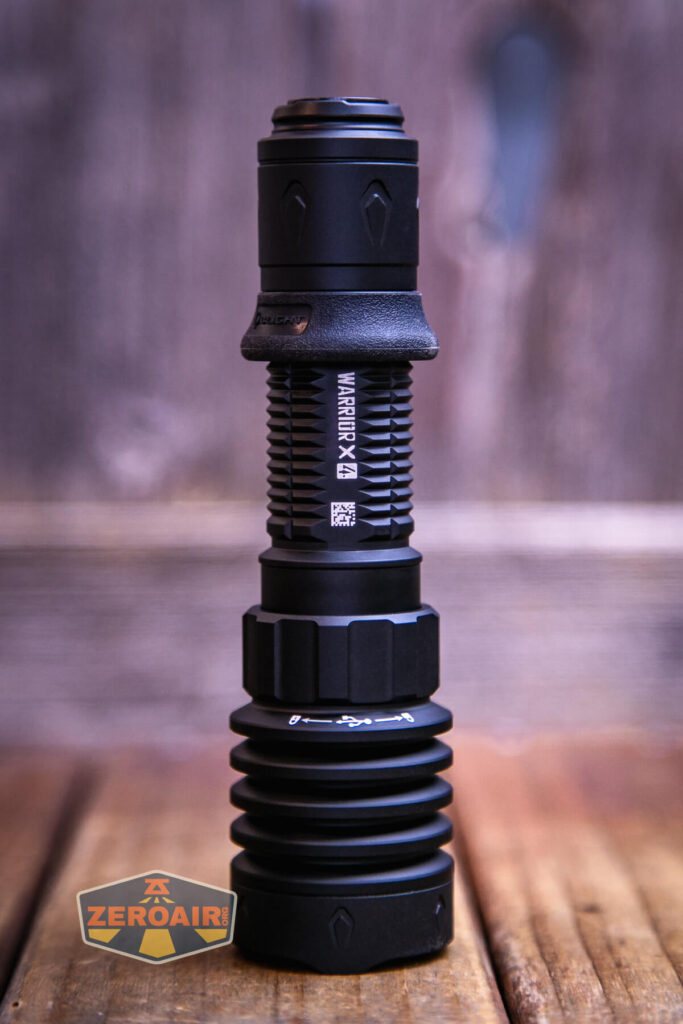


Olight uses a soft tactical ring here, as opposed to the metal they’ve used before (in lights like the Warrior X Turbo, for example). The tailcap has a bit of design for grip, allowing easy removal for cell swaps. Of course the light has onboard charging, so maybe you’d never need to swap cells.
The body has grip, but not knurling. On the head are some cooling fins of moderate depth.
The threads are big and square-cut, and very smooth.

Both head and tail have a spring, as you would expect in a weapon light.
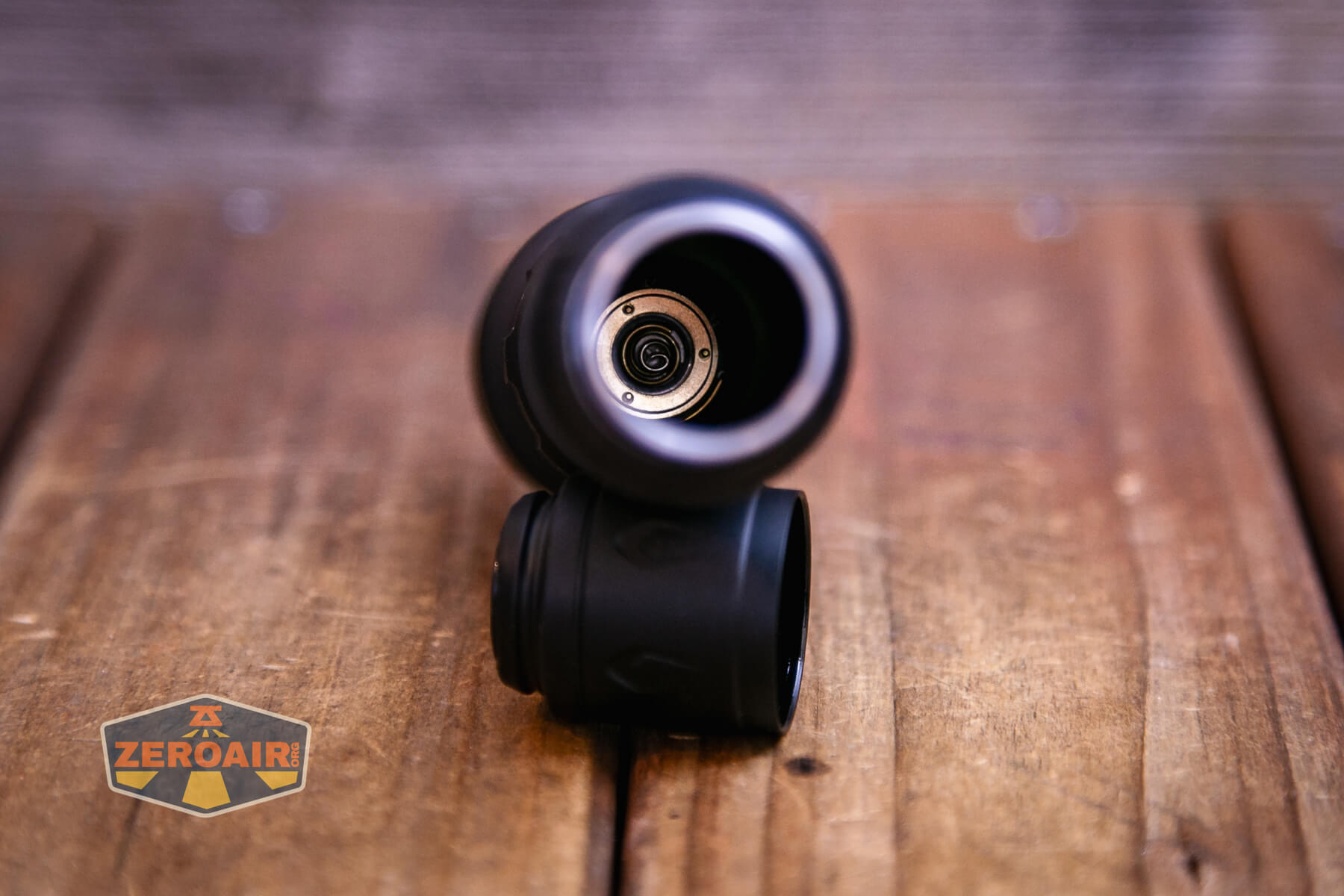
The bezel unscrews pretty easily and thus the emitter is quite accessible.

Size and Comps
Weight 8.78 oz (249 g) (Including Battery)
Length 5.87 in (149 mm)
Head Diameter 1.56 in (39.5 mm)
Body Diameter 1.02 in (26 mm)


If the flashlight will headstand, I’ll show it here (usually the third photo). If the flashlight will tailstand, I’ll also show that (usually in the fourth photo).


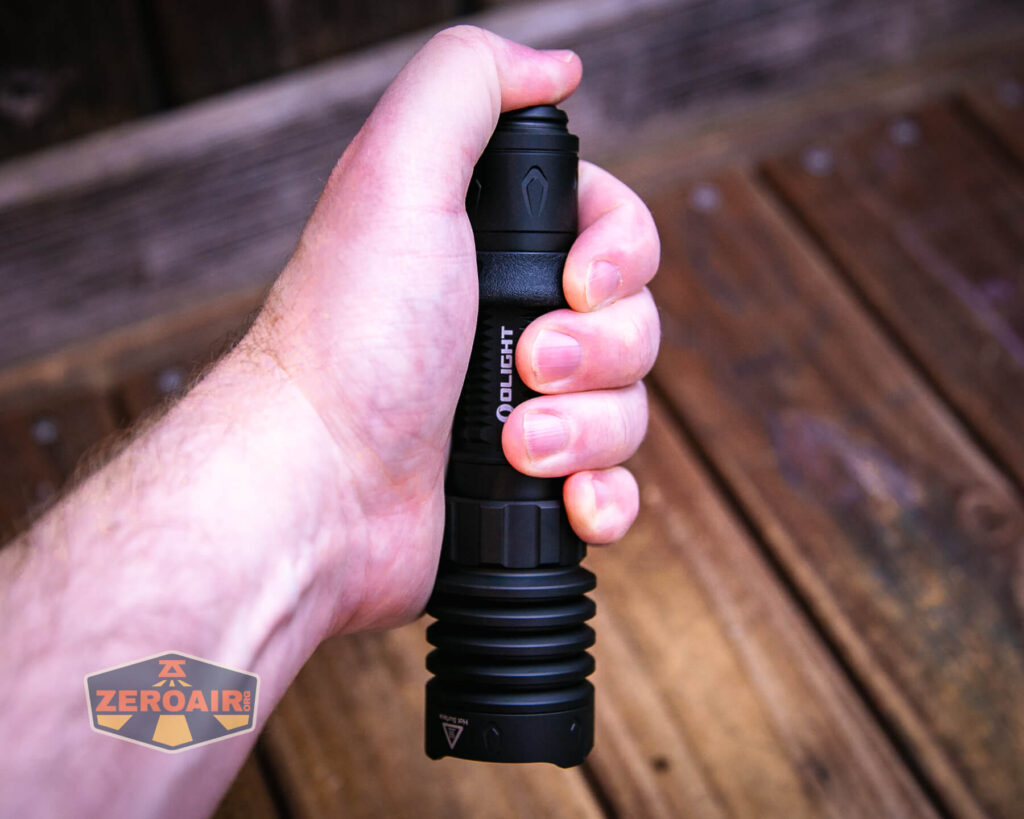

Here’s the test light with the venerable Convoy S2+. The version below is a custom laser-engraved Convoy S2+ host by GadgetConnections.com. I did a full post on an engraved orange host right here! Or go straight to GadgetConnections.com to buy your Convoy S2+ now!

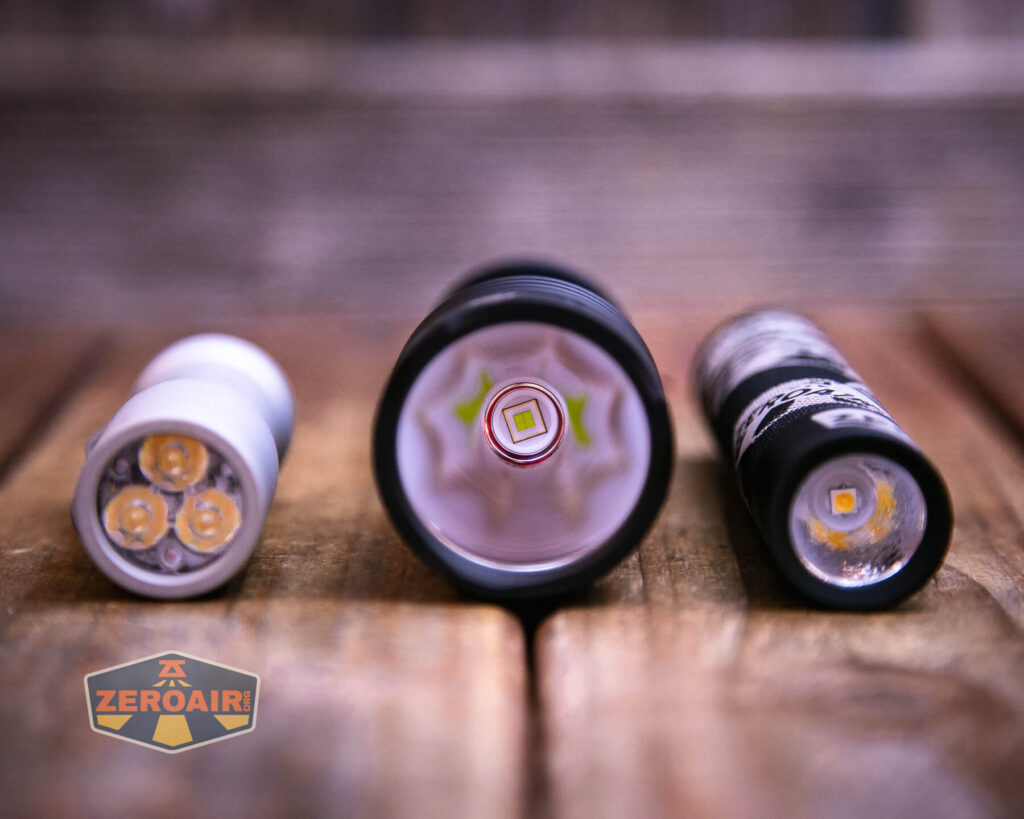
Also above is the light beside a new standard 18350 light! It’s not one I’ve reviewed yet but this is the CWF Arcadian Peanut in aluminum. This one is stonewashed and has the new Quantum Dragon driver – a whole new product! Stay tuned for a full review of this tiny powerhouse!
Retention and Carry
First, I’ll mention the tactical grip ring I already mentioned above. This is a soft sided ring but most of the ring itself is metal, I think. So it’s very firm and just covered in a grippy soft cover. It’s a very nice grip, but is removable if you need to do that.

Next (and last) up is this holster. This is not really Olight’s typical holster. It’s meant for a belt, and the light can be used while in place. There’s a sort of quick release type action intended, and I think with the right practice, that’ll be very natural. Without being mounted on something, though, removal from this holster isn’t the easiest.


There are no contacts or anything on this holster as we’ve seen on holsters like the Seeker 4 Pro has.

Power and Runtime
The Olight Warrior X 4 tactical flashlight is powered by the same cell as the M2R Pro Warrior (and many other Olights!). It’s a 5000mAh proprietary 21700 cell. This cell won’t charge in your bay charger. It’ll charge via the tailcap charging of the Warrior X 4, though.
Standard 21700 cells do not work in any capacity in this light. (No power, no charging).

The cell goes into the light in the normal orientation – positive end toward head.

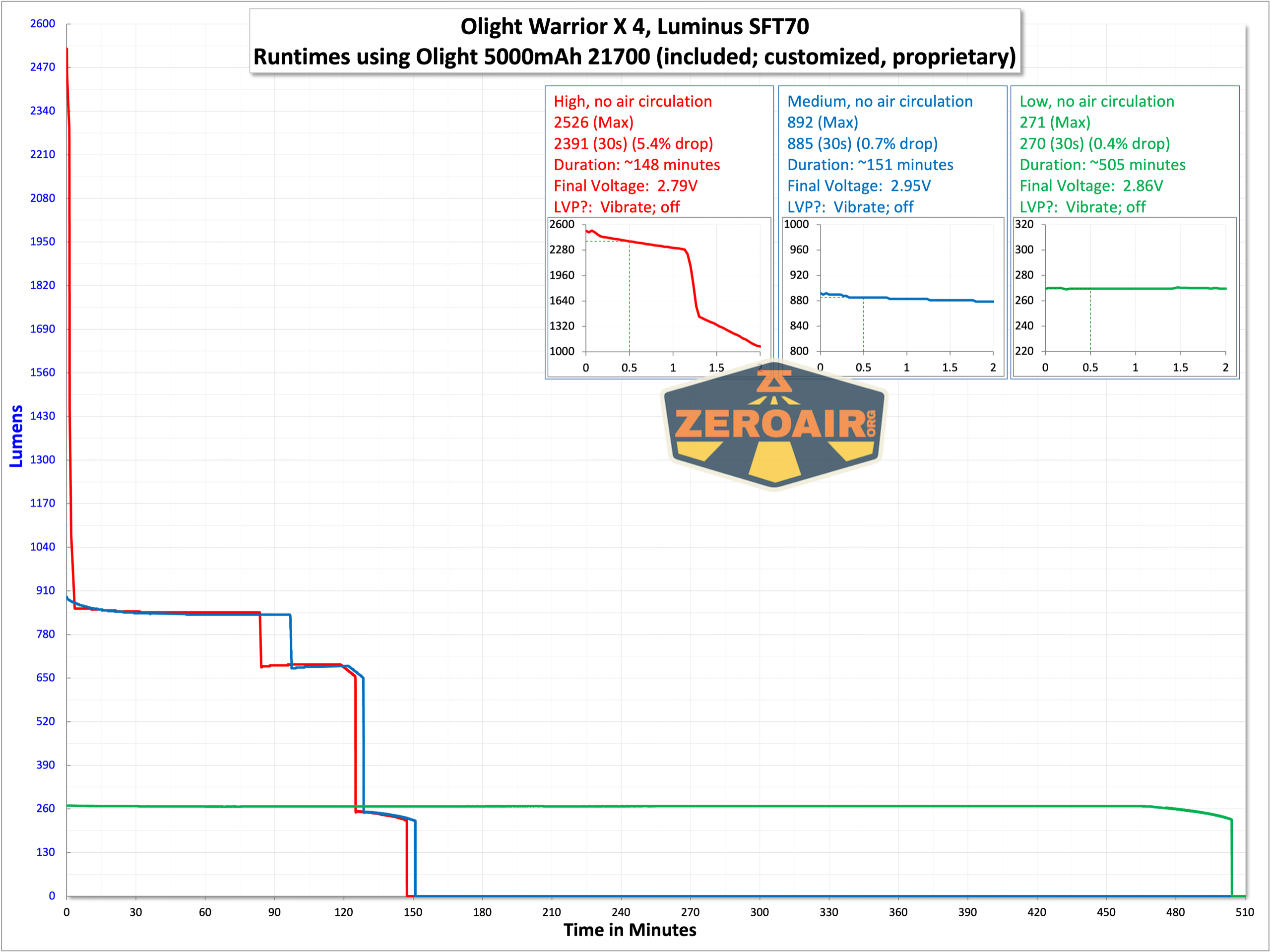
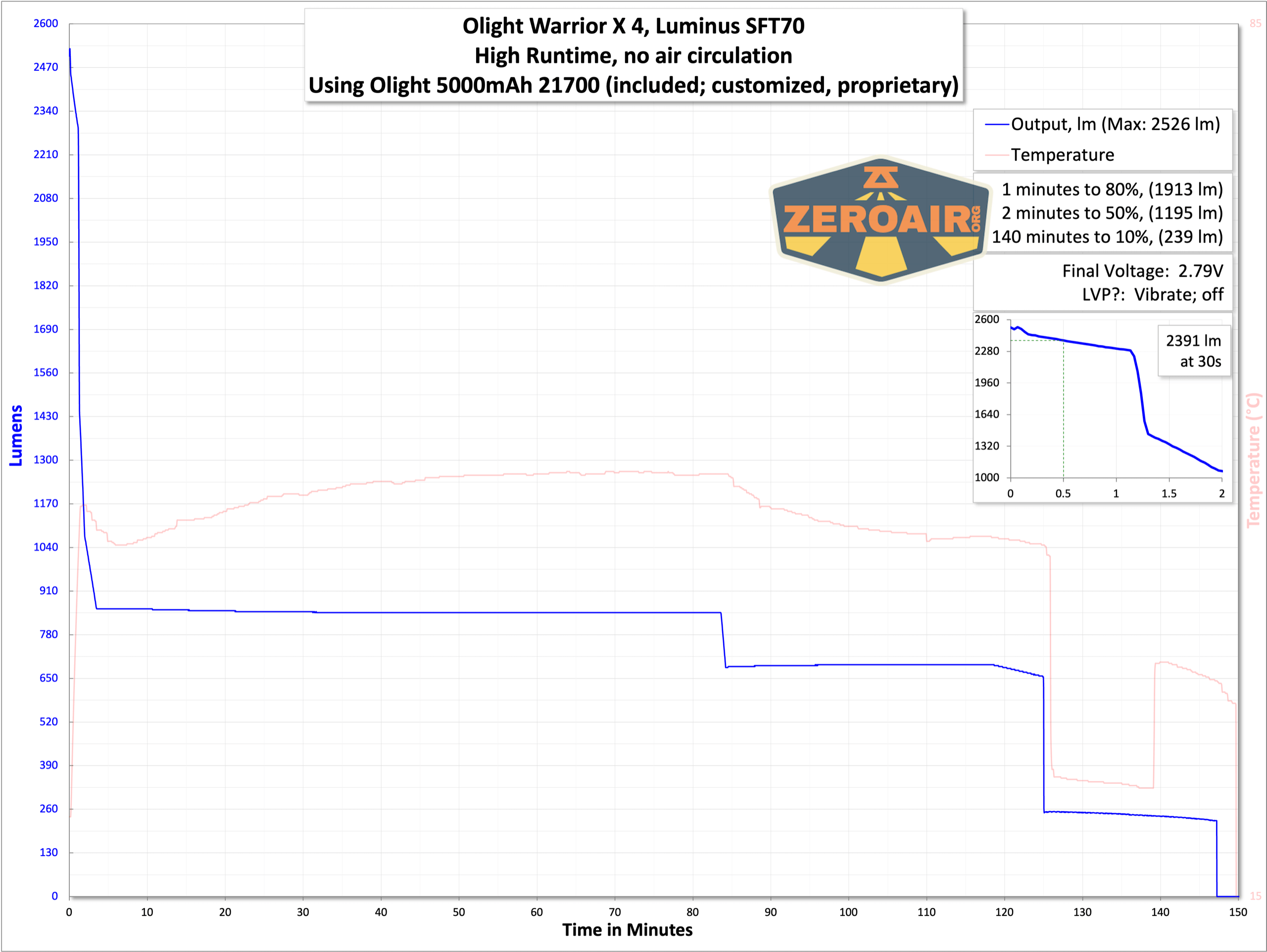
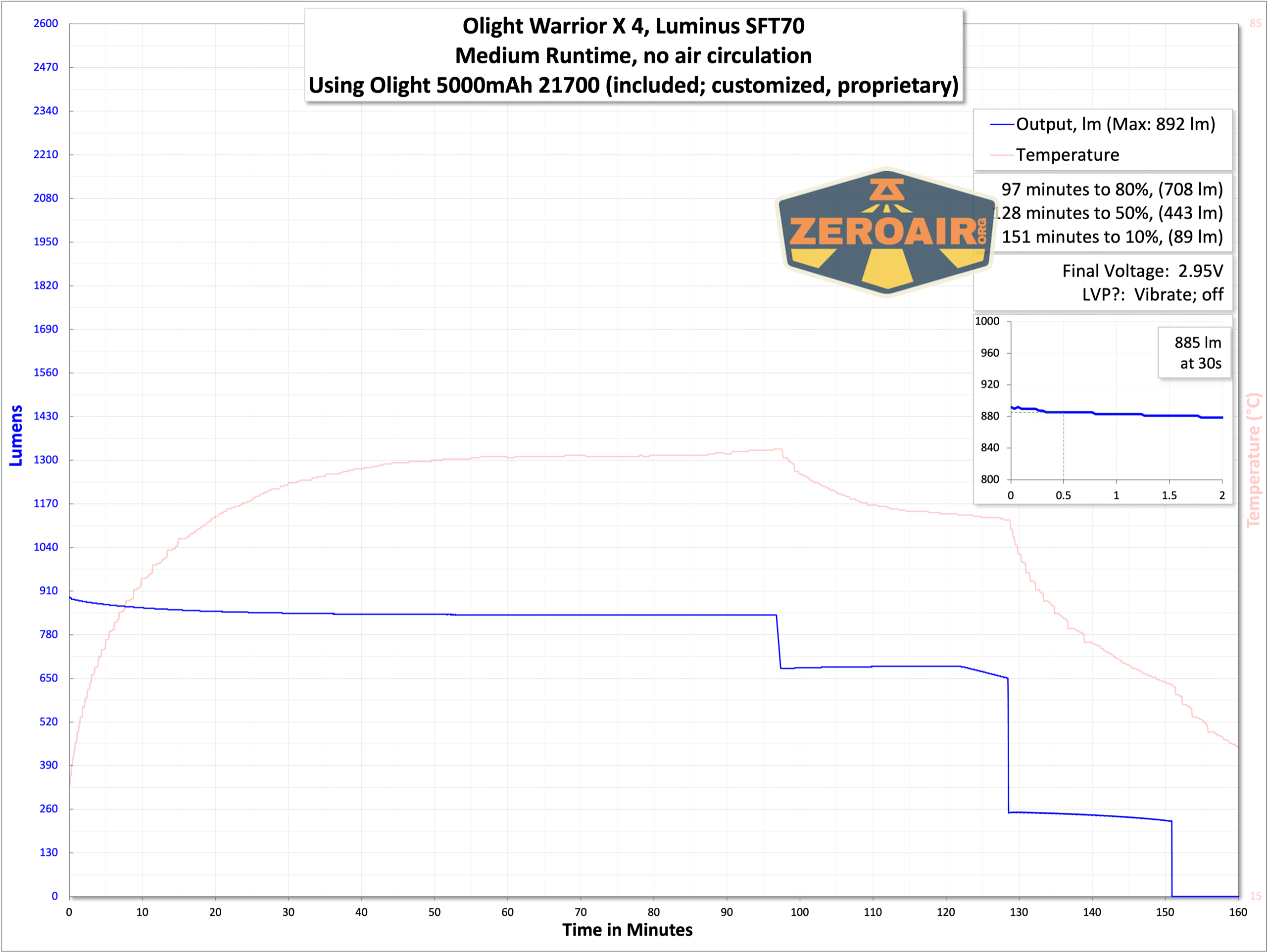
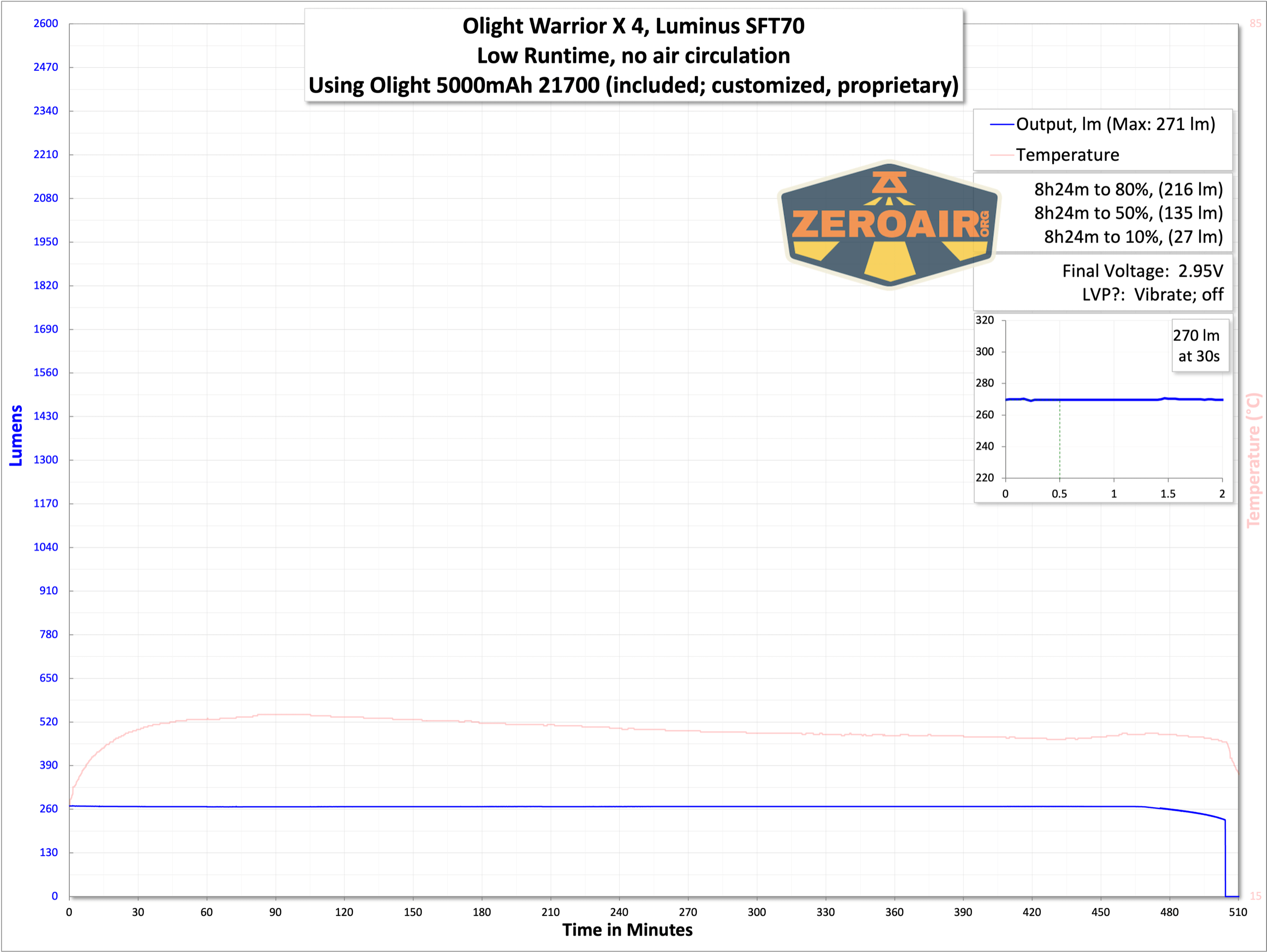
I tested runtimes for all three steady modes! They all look fairly good – High steps down dramatically, but does hold >2200 lumens for over a minute. So that’s respectable!
Charging
The first point here is that Olight is using USB-C charging on a light! But this isn’t the first light that has USB-C charging, so contain your excitement. For example, the Marauder 2 has USB-C charging.

I’ll go with you here though and say “that’s different.” That’s different, and it’s fine, but this Olight Warrior X 4 seems like an Olight with USB-C charging. This one feels “real.”
And it is. It’s great. It’s as good as you’d want it to be and more – and I want it on every Olight that has charging (mind you, I don’t think all Olights should have built-in charging, though!)

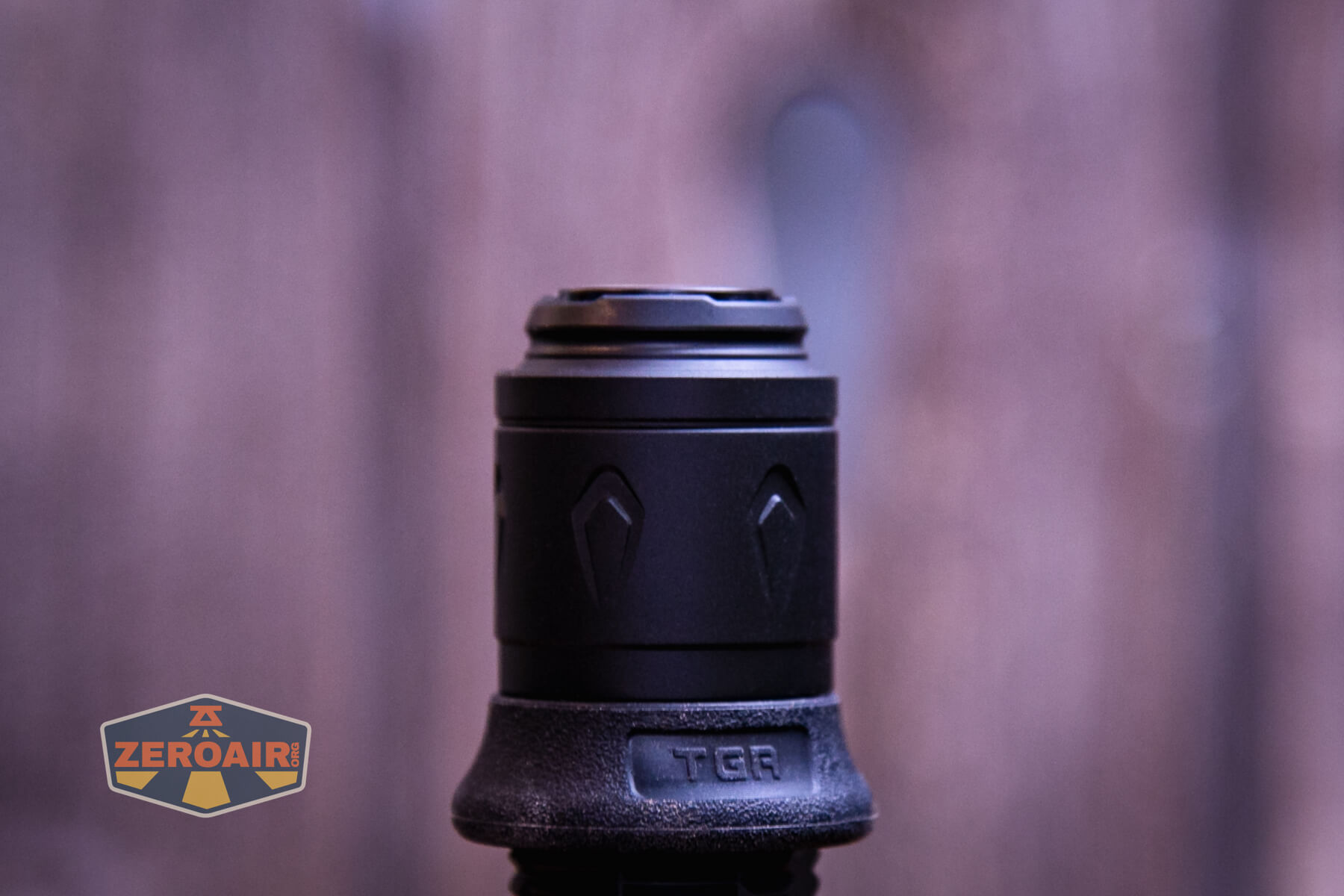
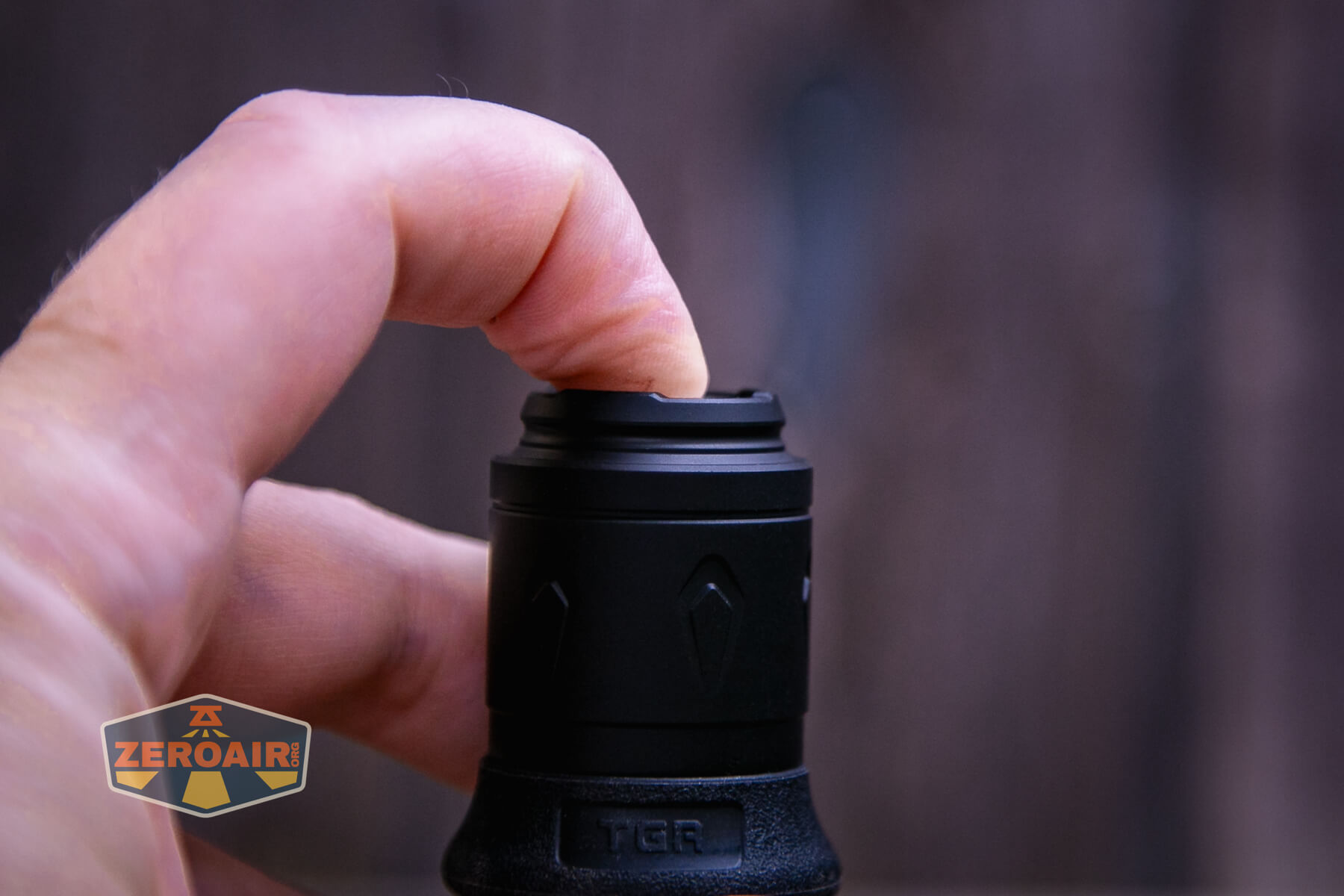
The cover is built in, and requires a twist of this collar. This isn’t “threaded” so to speak. It’s a sort of cover that twists fully open with maybe a quarter turn – it’s a quick open cover! It is not like unscrewing a sleeve cover as you’ve seen on some other lights in years past. This feels very advanced. The USB-C port itself is waterproof (according to the promotional video, at least.)
A USB to USB-C cable is included.

The light also has Olights typical built-in charging tail cap base. This uses an MCC 1A/1.5A/2A charger, which is not included. Since it’s not included, I didn’t test charging this way (didn’t test it but did observe that it works fine.)

C to C and A to C both work fine. They’re quick, too, at around 2A.
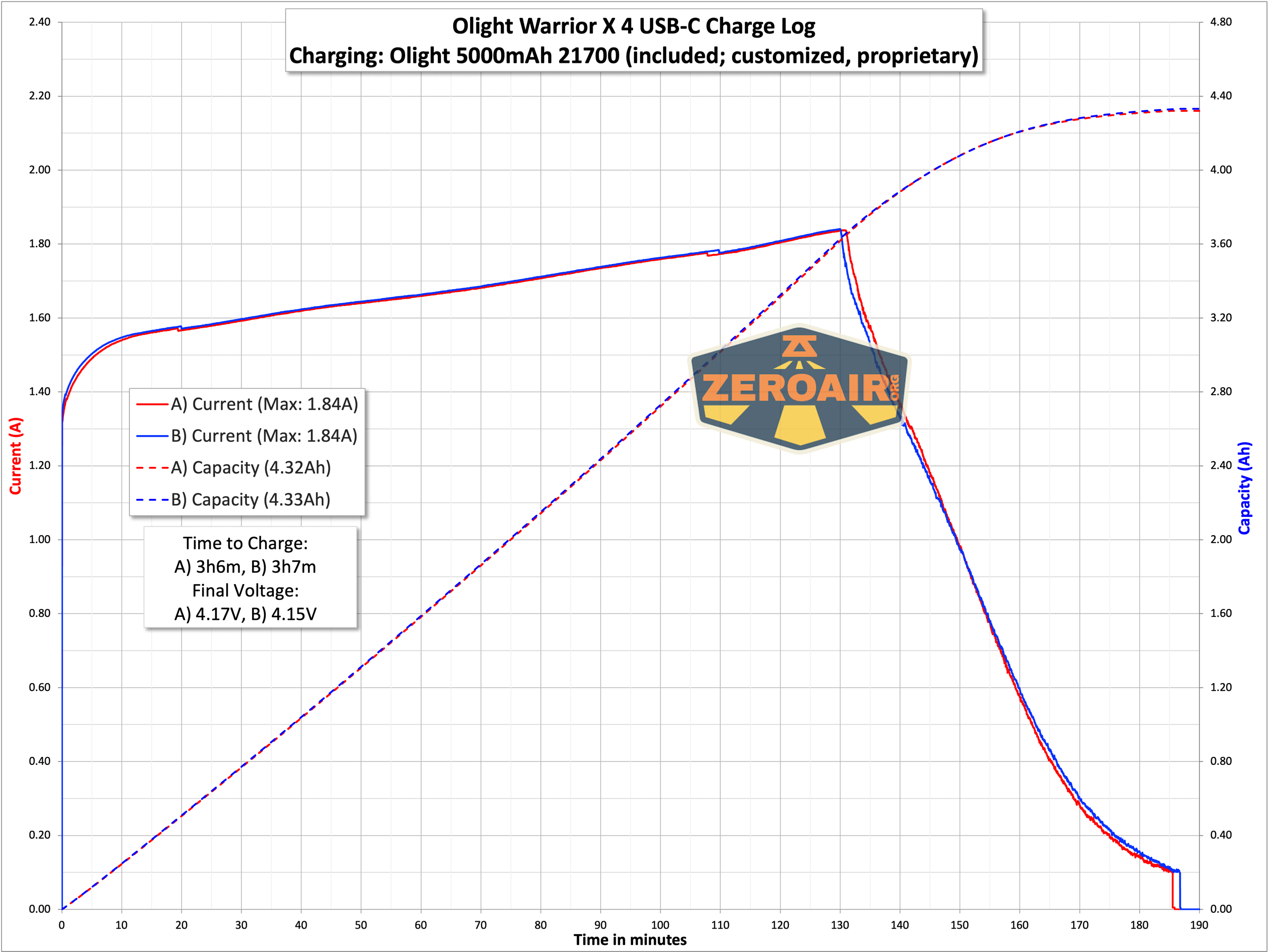
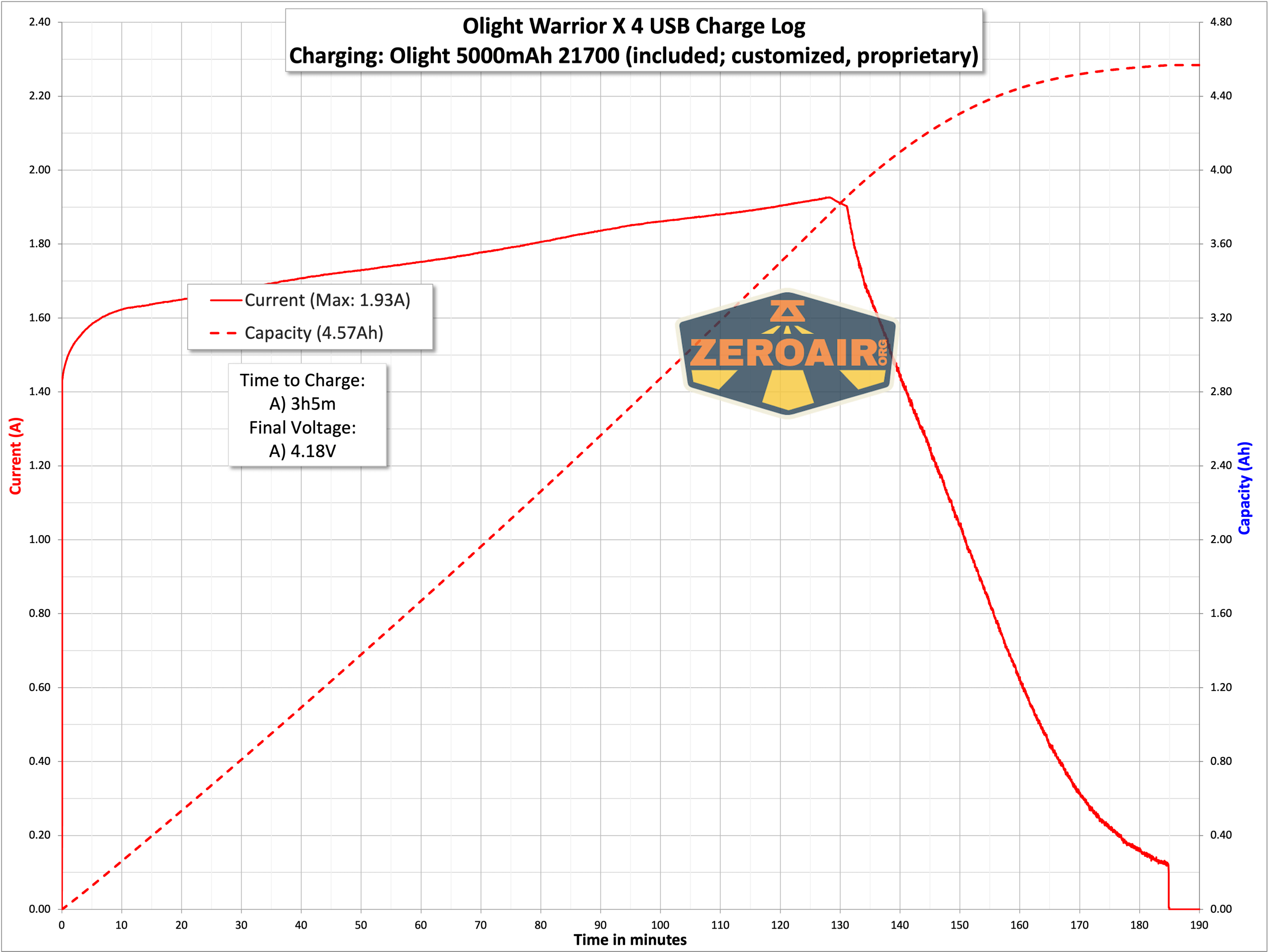
When charging, a little LED indicator near the USB-C charging port flashes red for less than 5% charged, red for 5-10% charged, orange for 10-60% charged, and green for greater than 60% charged.
Modes and Currents
| Mode | Mode Claimed Output (lm) | Claimed Runtime | Measured Lumens |
|---|---|---|---|
| High | 2600/1000/300 | 3m/140m/20m | 2526 (0s) 2391 (30s) |
| Medium | 1000/300 | 150m/20m | 885 |
| Low | 300 | 8h | 270 |
Pulse Width Modulation
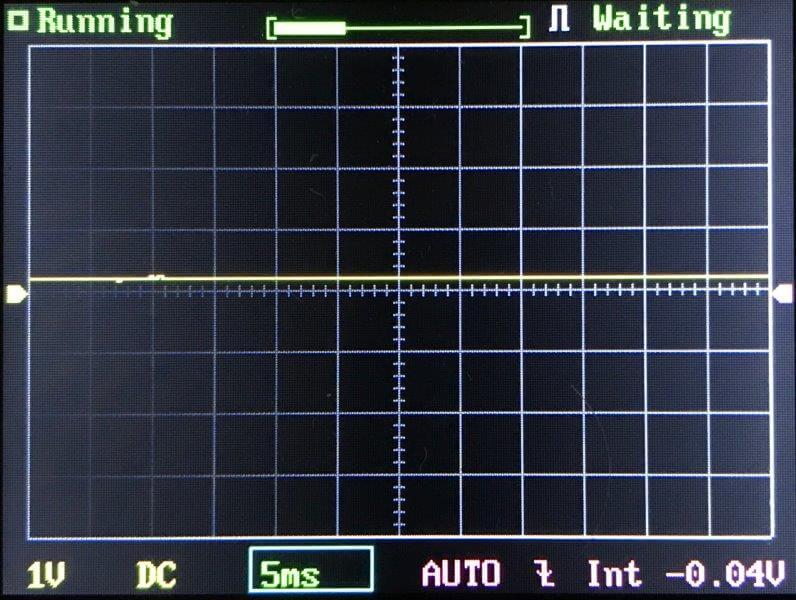
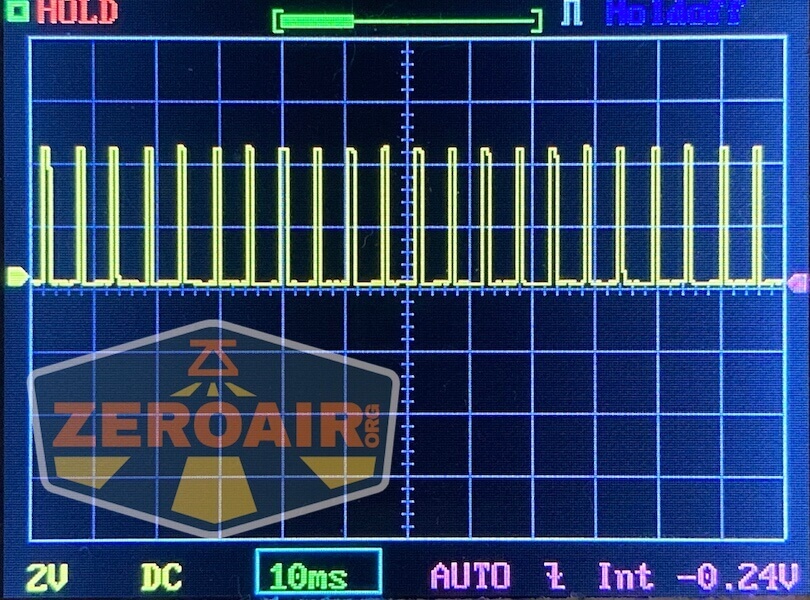
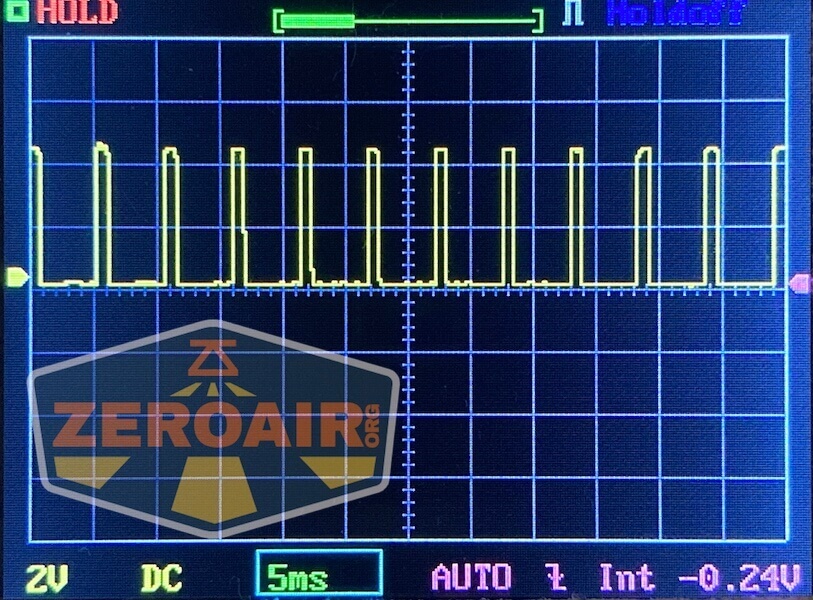
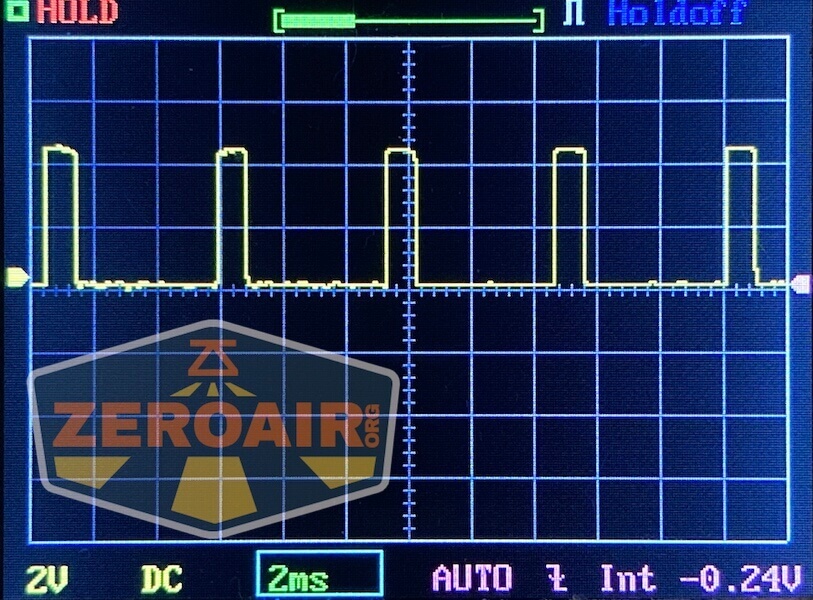
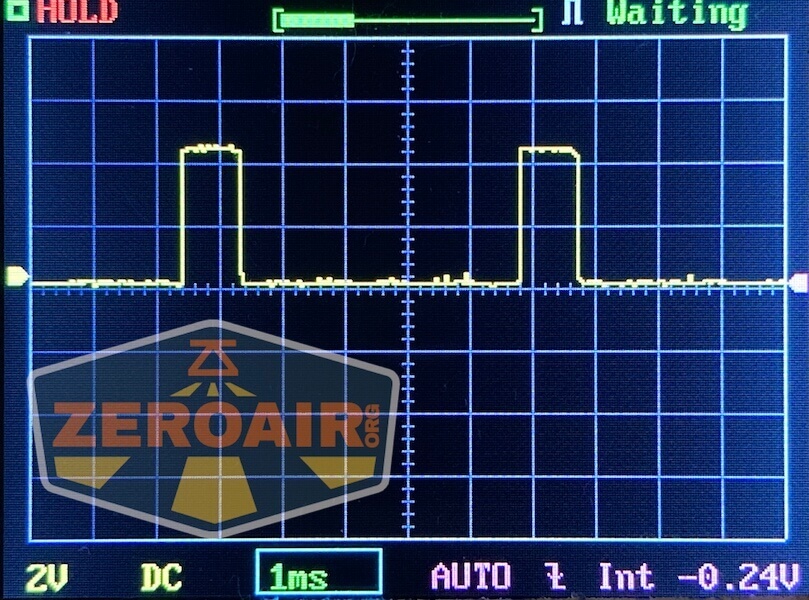
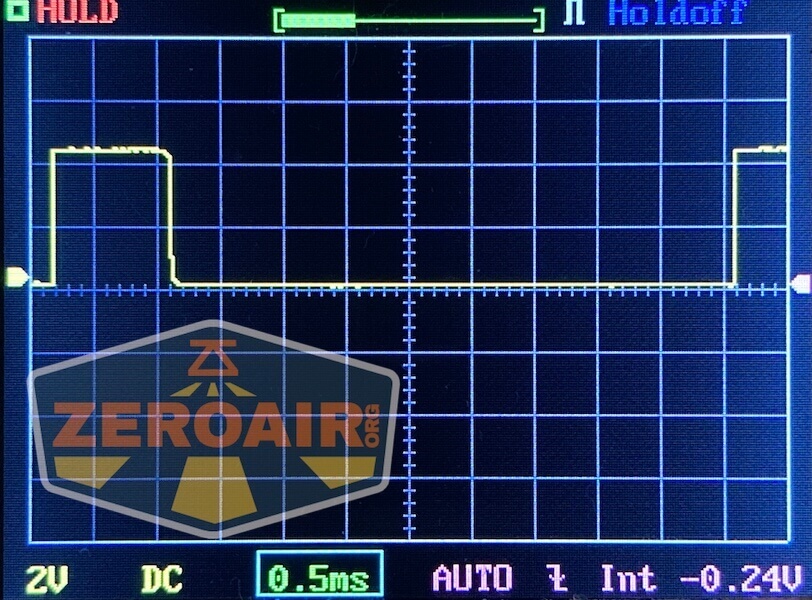
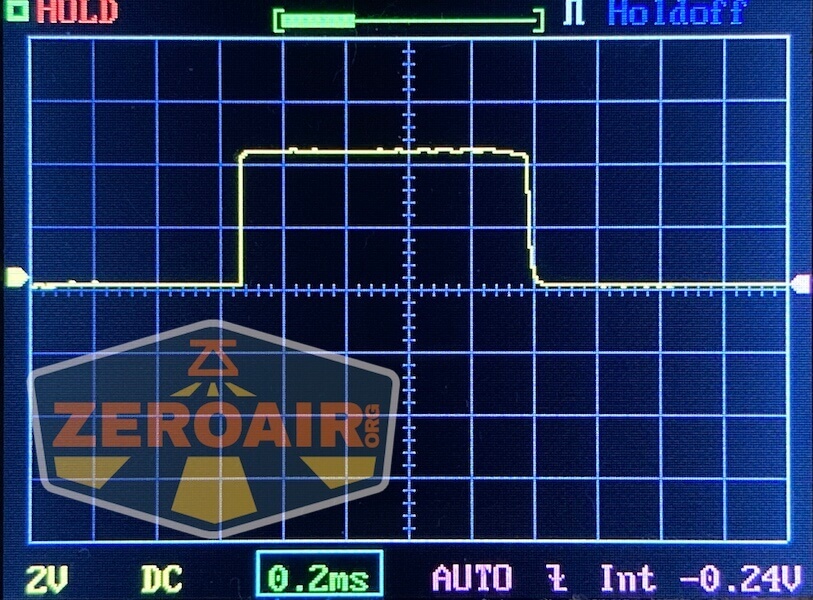
There isn’t any PWM on any of the three modes.


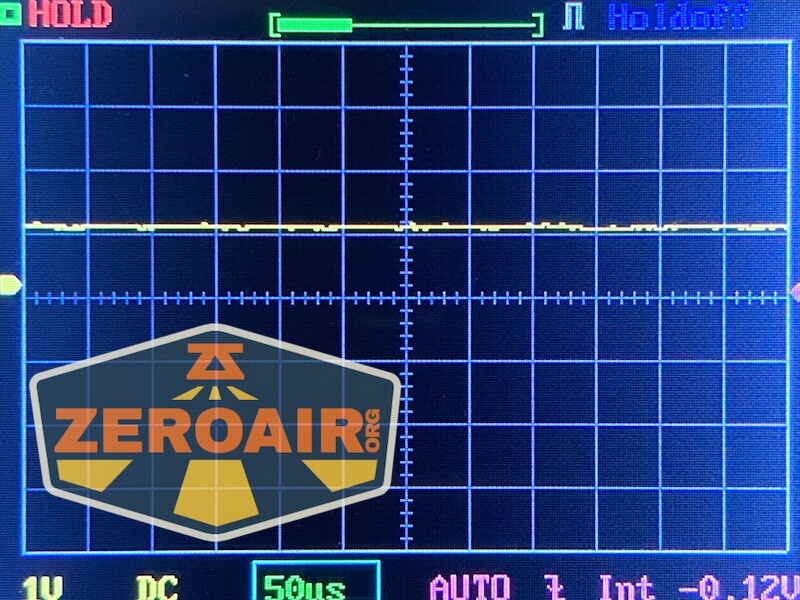
Here you can see a “baseline” – a chart with almost no light hitting the sensor. Then there’s the Ultrafire WF-602C flashlight, which has some of the worst PWM I’ve seen. It’s so bad that I used a post about it to explain PWM! Here are multiple timescales (10ms, 5ms, 2ms, 1ms, 0.5ms, 0.2ms) to make comparing this “worst” PWM light to the test light easier. That post also explains why I didn’t test the WF-602C at the usual 50us scale.
User Interface and Operation
There’s only one switch on the Warrior X 4. It’s a two-stage e-switch, and the feel is (again) just like the M2R Pro Warrior and other Olights. This is a very good switch. It works like this: Press a little (shallow) for Low. Press a little more (deeper) for Turbo. I love this switch!
Here’s a user interface table!
| State | Action | Result |
|---|---|---|
| Off | Shallow Press | Group 1: Momentary Low Group 2: Momentary Medium |
| Off | Shallow Click | Group 1: Low Group 2: Medium |
| Off | Deep Press | Group 1: Momentary High Group 2: Momentary Strobe |
| Off | Deep Click | Group 1: High Group 2: Strobe |
| Low (Group 1) Medium (Group 2) |
Deep Click | Group 1: High Group 2: Strobe |
| Low (Group 1) Medium (Group 2) |
Shallow Click | Off |
| High (Group 1) Strobe (Group 2) |
Click | Off |
It’s also possible to switch to a second group. To do this, turn the light on and loosen the tailcap until the light shuts off. When you tighten the tailcap, the light will switch to the other group. The different groups are very intuitive and I think the makeup is pretty smart (Low/Turbo and Medium/Strobe).
LED and Beam
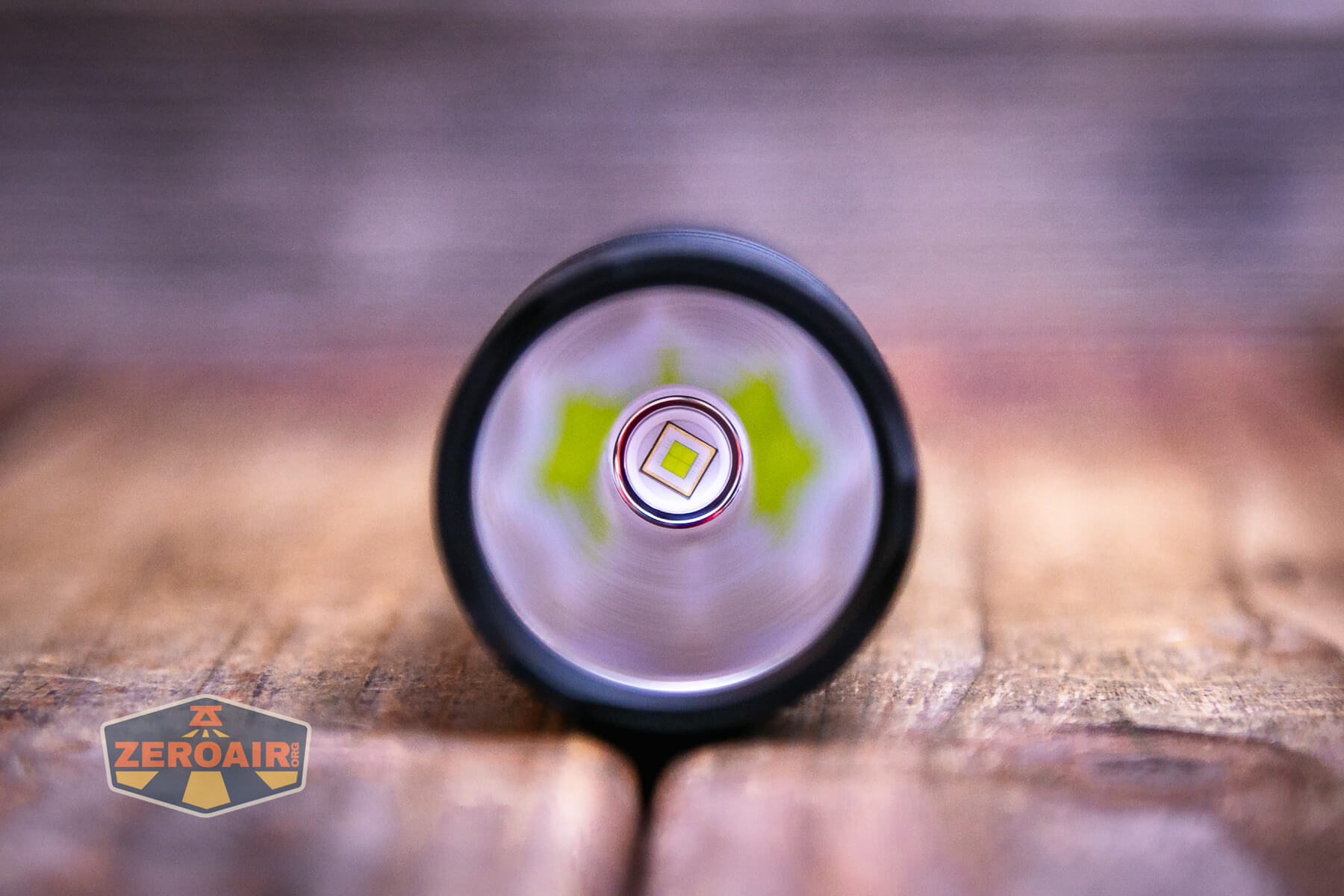
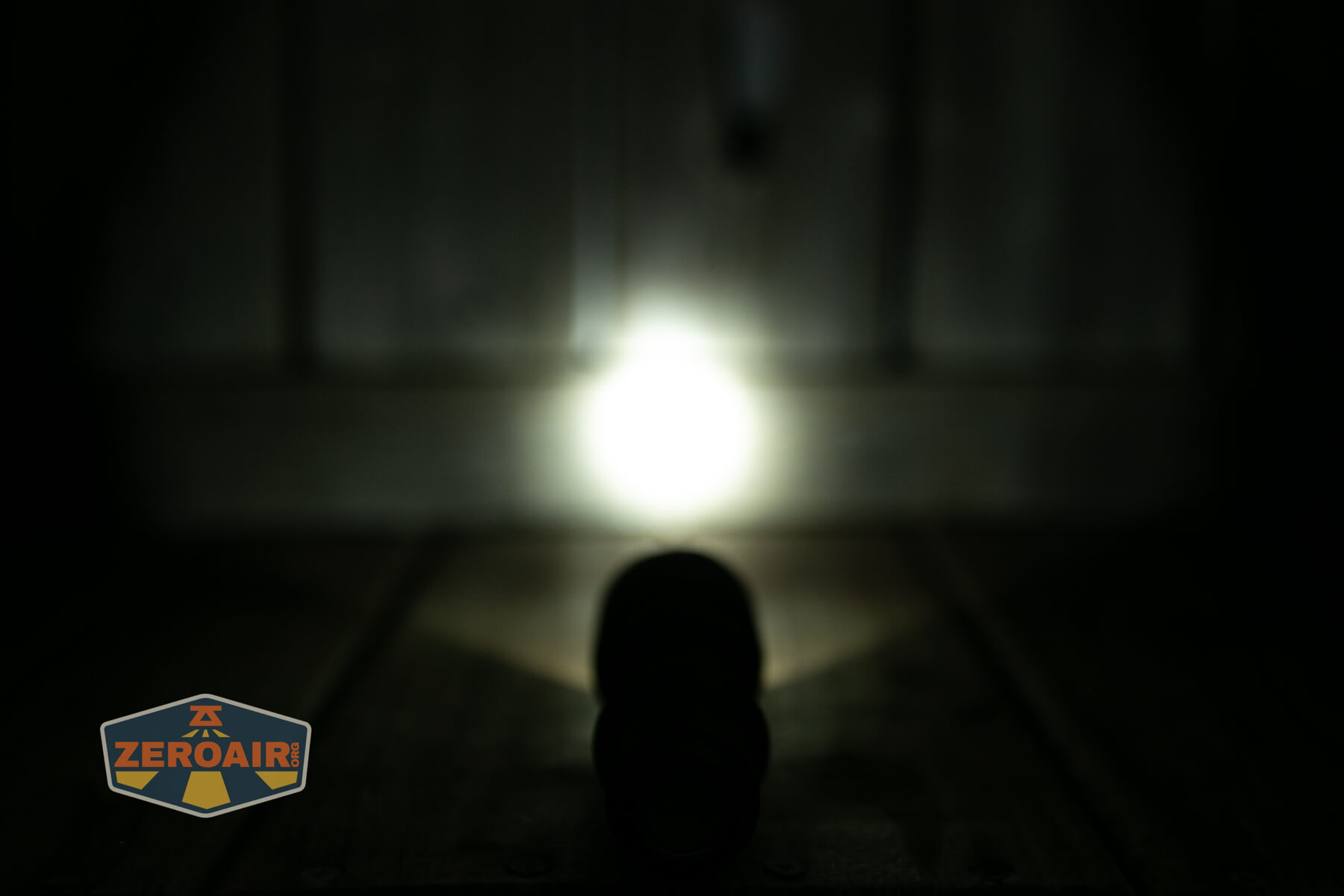
The emitter in this light is a Luminus SFT70. It’s surrounded by a very smooth, big, and deep reflector. The beam is very much throw, but on the higher mode, there is a noticeable spill. It’s specific spill though – almost uniformly lit, aside from the hotspot.
Below you can see that the light fits in the holster and can still be used.

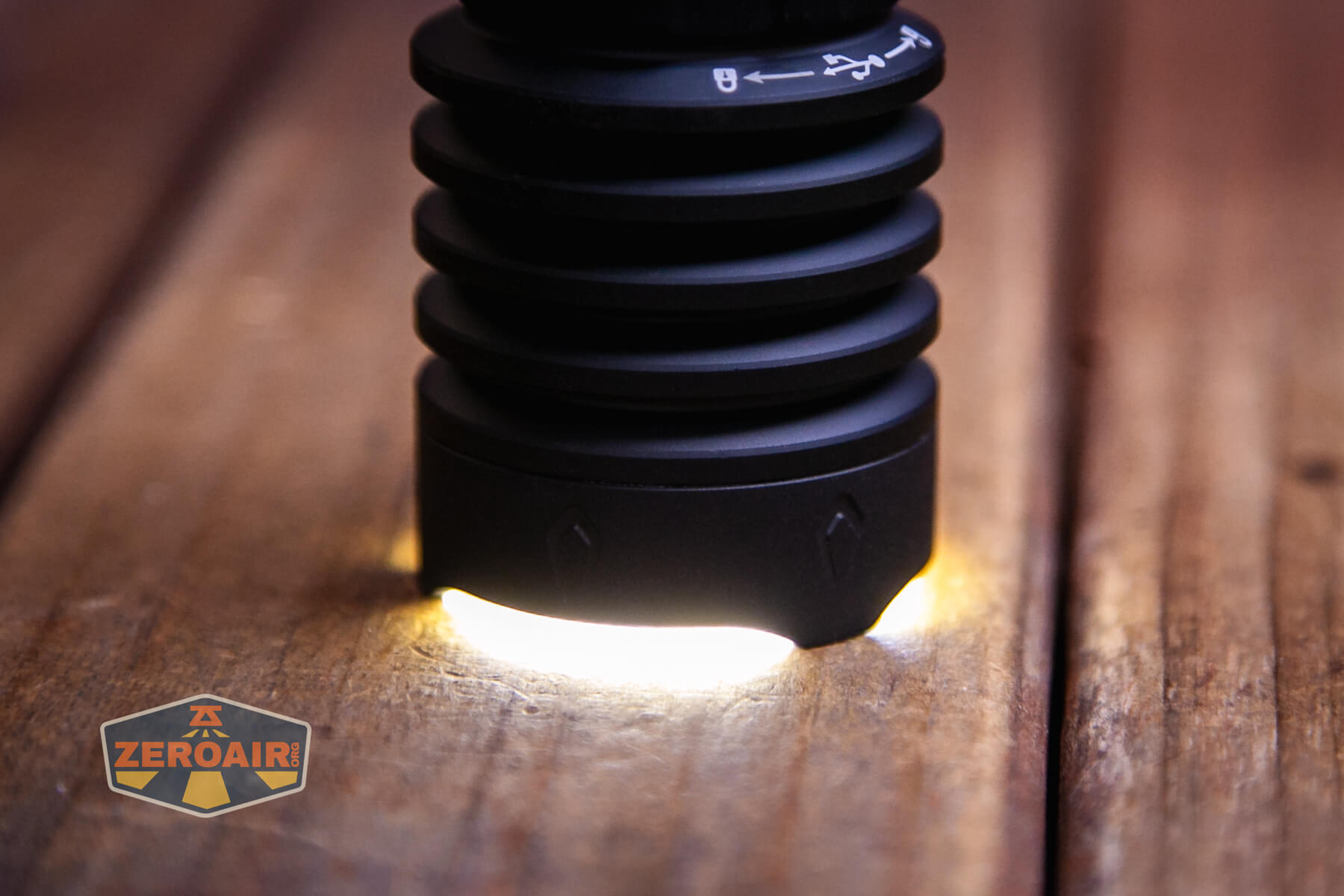
The bezel has some shape and light can escape when headstanding.
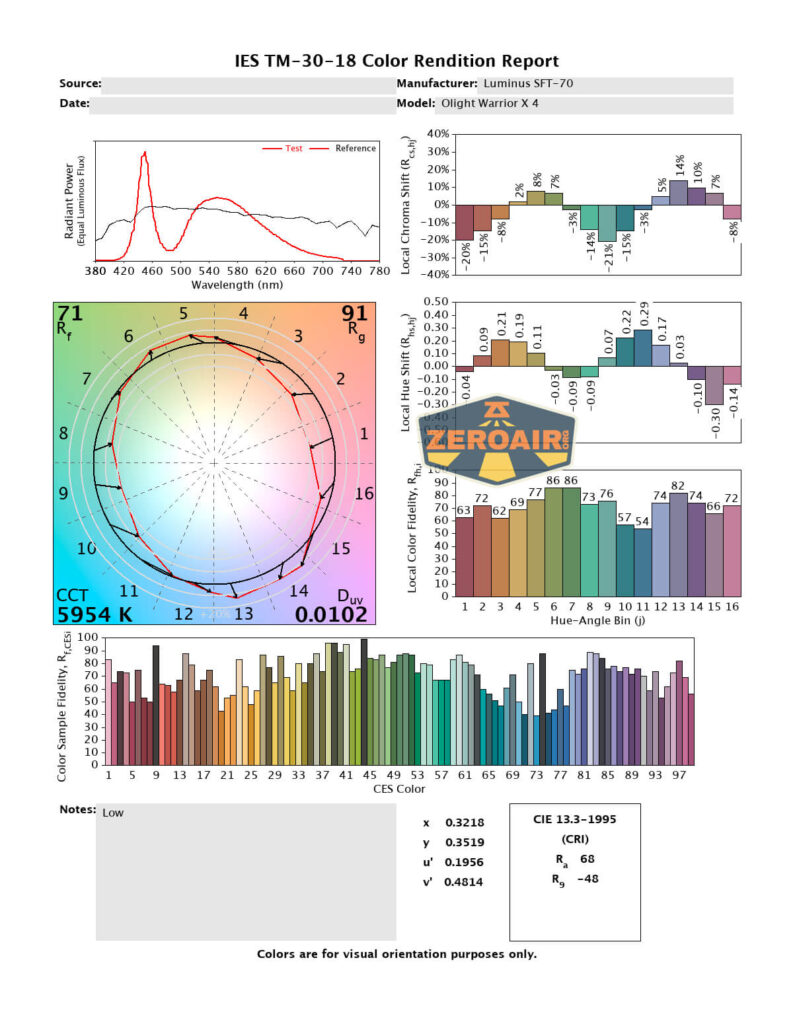
LED Color Report (CRI and CCT)
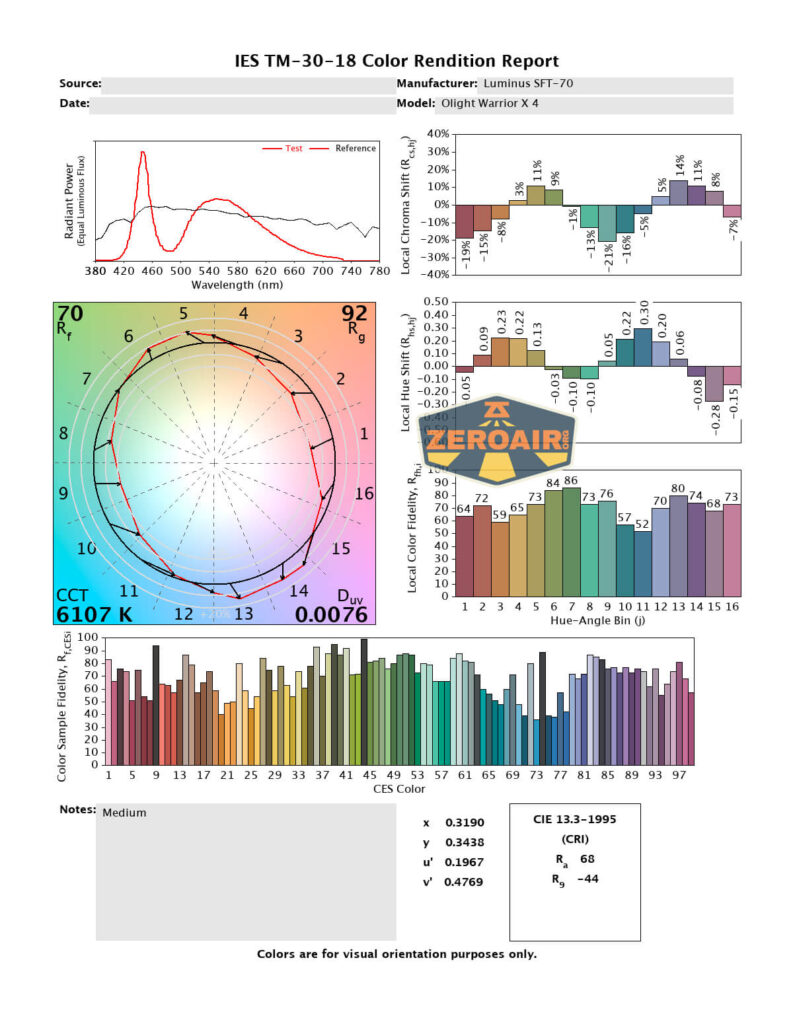
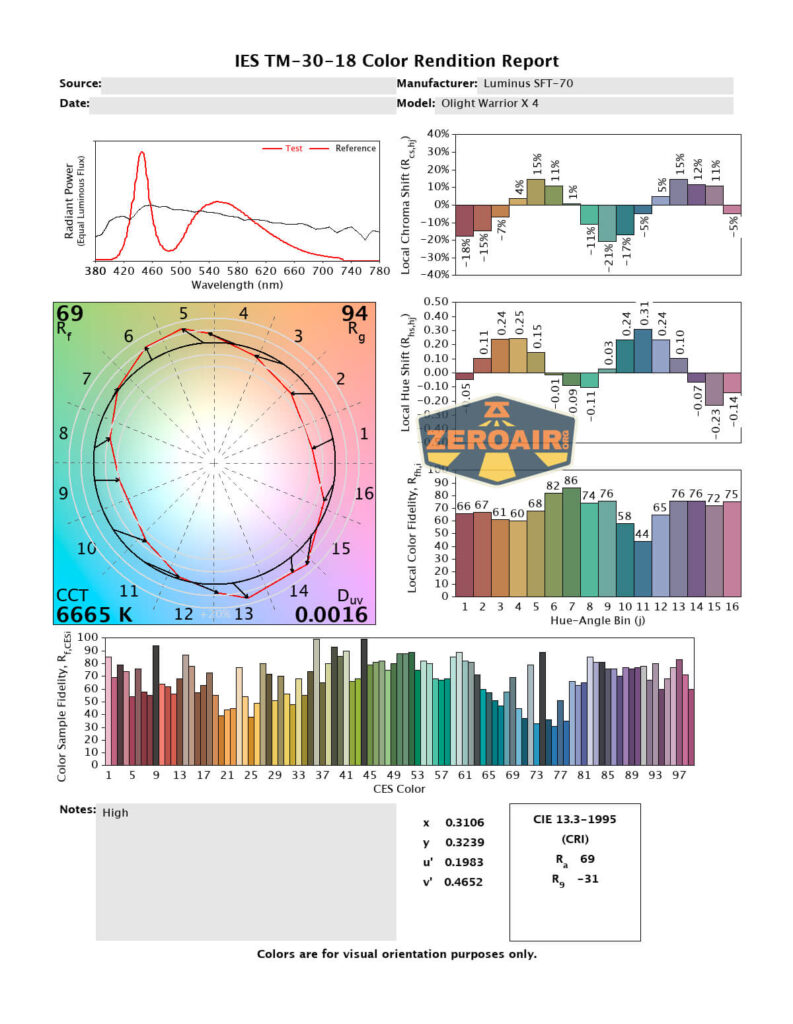
CRI comes in at around 6000K-6700K (cool white.) CRI is low, at around 69.
Beamshots
These beamshots always have the following settings: f8, ISO100, 0.3s shutter, and manual 5000K exposure. These photos are taken at floor level, and the beam hits the ceiling around 9 feet away.


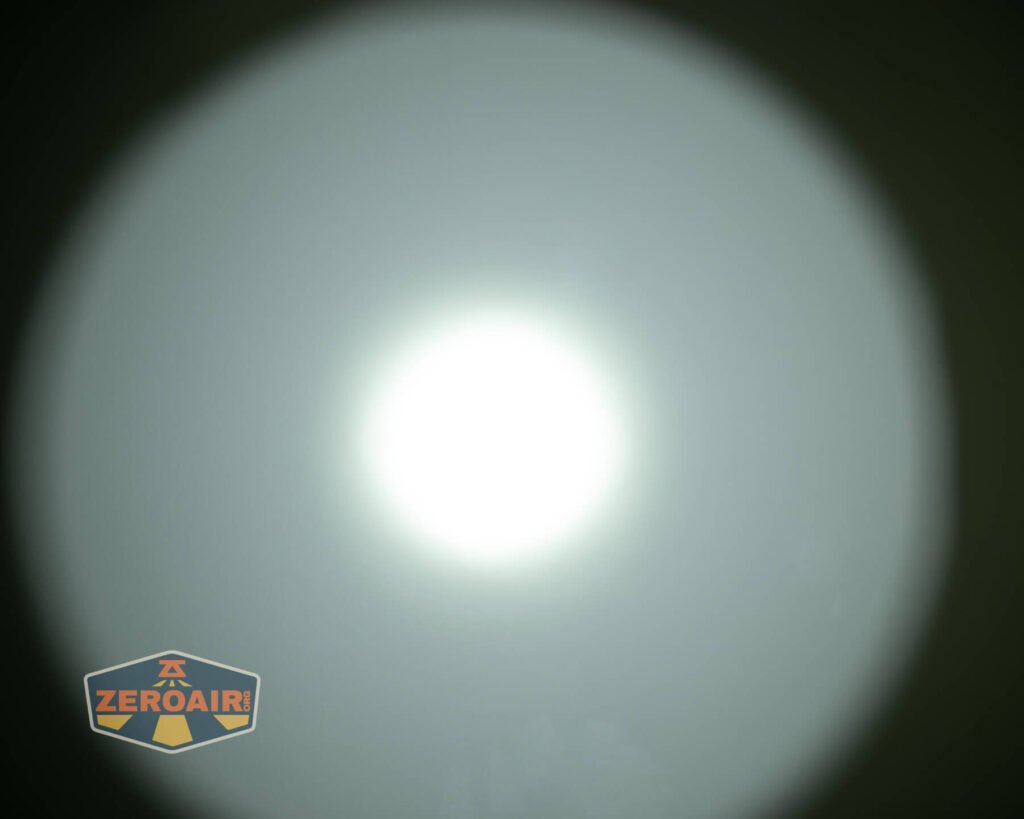
Tint vs BLF-348 (KillzoneFlashlights.com 219b version) (affiliate link)
I keep the test flashlight on the left and the BLF-348 reference flashlight on the right.



I compare everything to the KillzoneFlashlights.com 219b BLF-348 because it’s inexpensive and has the best tint!
Conclusion
What I like
- Excellent build quality
- Dead simple user interface
- User interface offers a third output over previous generations of this light, as well as strobe!
- Fantastic two-stage switch
- Great implementation of USB-C charging
- USB-C charging cover is worth mentioning separately – it’s very smooth
What I don’t like
- Proprietary 21700
- 6000K-6700K temperature (warmer would be great)
Notes
- This content originally appeared at zeroair.org. Please visit there for the best experience!
- Please use my Amazon.com referral link to help support zeroair.org!
- Please support me on Patreon! I deeply appreciate your support!
Discover more from ZeroAir Reviews
Subscribe to get the latest posts sent to your email.