

Olight Marauder Mini Flashlight Review
The Olight Marauder Mini flashlight has been released! It offers the same great rotary interface along with red, green, and blue! Read on!
Official Specs and Features
Here’s a ShareASale link to the Olight Marauder Mini Flashlight product page.
Versions
Three versions were available. Midnight Blue looks to be sold out, but black and orange are both still available.
Price
The Olight Marauder Mini flashlight sells for $139.99 at the introductory price (MSRP $199.99). That price seems to hold for either (available) color.
There’s a package deal, though, as always with Olight. You can add on a little box opener knife for just $1 more. In fact, there are a few items you can pick through to add on. Here’s a ShareASale link for the Olight Marauder Mini and the bonus, at only $140.99.
Short Review
There’s a whole lot to love about the Olight Marauder Mini flashlight. Throw is fantastic, the output is good, and offering multiple levels of red or green, or blue just makes the light extra fun! The unusual cell size (32650) does not bother me; I’m quite pleased that it’s possible to replace the cell. I do wish the Mini offered USB-C charging (and possibly a powerbank feature) as the Marauder 2 does. All in all, this one’s a big winner!
Long Review
The Big Table
| Olight Marauder Mini Flashlight | |
|---|---|
| Emitter: | Flood (Cool White) |
| Price in USD at publication time: | $139.99 |
| Cell: | 1×32650 (included) |
| Runtime Graphs | |
| LVP? | Yes |
| Switch Type: | Rotary |
| On-Board Charging? | Yes |
| Charge Port Type: | Proprietary Magnetic |
| Charge Graph | |
| Power off Charge Port | with cell: all modes without cell: no modes |
| Claimed Lumens (lm) | 7000 |
| Measured Lumens (at 30s) | 5455 (77.9% of claim)^ |
| Candela per Lumen | 4.4 |
| Claimed Throw (m) | – |
| Candela (Calculated) in cd (at 30s) | 854lux @ 6.061m = 31372cd |
| Throw (Calculated) (m) | 354.2 |
| Claimed CCT | 5500-6000 |
| Measured CCT Range (K) | |
| Item provided for review by: | Olight |
| All my Olight reviews! | |
| Olight Marauder Mini Flashlight | |
|---|---|
| Emitter: | Throw (Cool White) |
| Price in USD at publication time: | $139.99 |
| Cell: | 1×32650 (included) |
| Runtime Graphs | |
| LVP? | Yes |
| Switch Type: | Rotary |
| On-Board Charging? | Yes |
| Charge Port Type: | Proprietary Magnetic |
| Charge Graph | |
| Power off Charge Port | with cell: all modes without cell: no modes |
| Claimed Lumens (lm) | 900 |
| Measured Lumens (at 30s) | 869 (96.6% of claim)^ |
| Candela per Lumen | 95.7 |
| Claimed Throw (m) | 600 |
| Candela (Calculated) in cd (at 30s) | 2440lux @ 6.101m = 90822cd |
| Throw (Calculated) (m) | 602.7 (100.5% of claim)^ |
| Claimed CCT | 5000-6000 |
| Measured CCT Range (K) | |
| Item provided for review by: | Olight |
| All my Olight reviews! | |
^ Measurement disclaimer: Testing flashlights is my hobby. I use hobbyist-level equipment for testing, including some I made myself. Try not to get buried in the details of manufacturer specifications versus measurements recorded here; A certain amount of difference (say, 10 or 15%) is perfectly reasonable.
What’s Included

- Olight Marauder Mini flashlight
- Olight 32650 cell (proprietary and customized)
- Charge cable (USB to proprietary magnetic)
- Lanyard
- Nylon holster
- Manual etc
Package and Manual


Build Quality and Disassembly

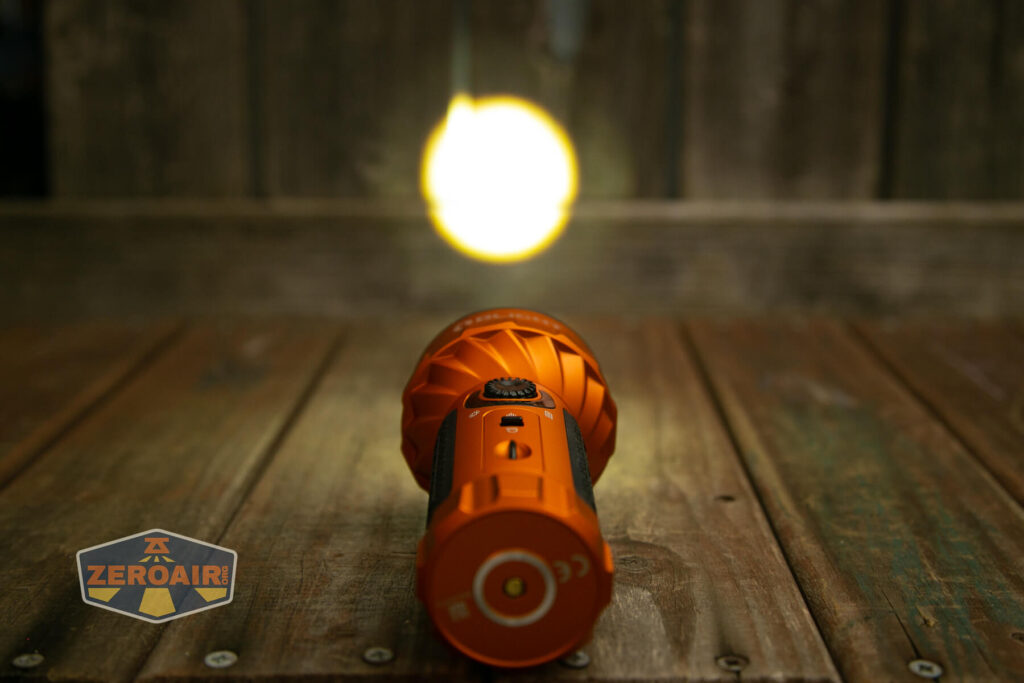
The Marauder 2 had “fantastic heft.” The Olight Marauder Mini flashlight has that too, but in a “more manageable” format. It carries a bit better because it’s not quite so big.


At the end of the Olight Marauder Mini flashlight is a bit of printing, along with the charging connection.

The Mini maintains a nice grip area (that is a magnet for dust!) around the body. It’s appropriately labeled with “Marauder Mini” text.

Unlike the Marauder 2, the Marauder Mini has a removable tailcap! I love this and wish the Marauder 2 had this as well. This means the 32650 cell is replaceable. No matter how hard it is to get or whether you have to buy them from Olight directly or whatever, it’s replaceable.
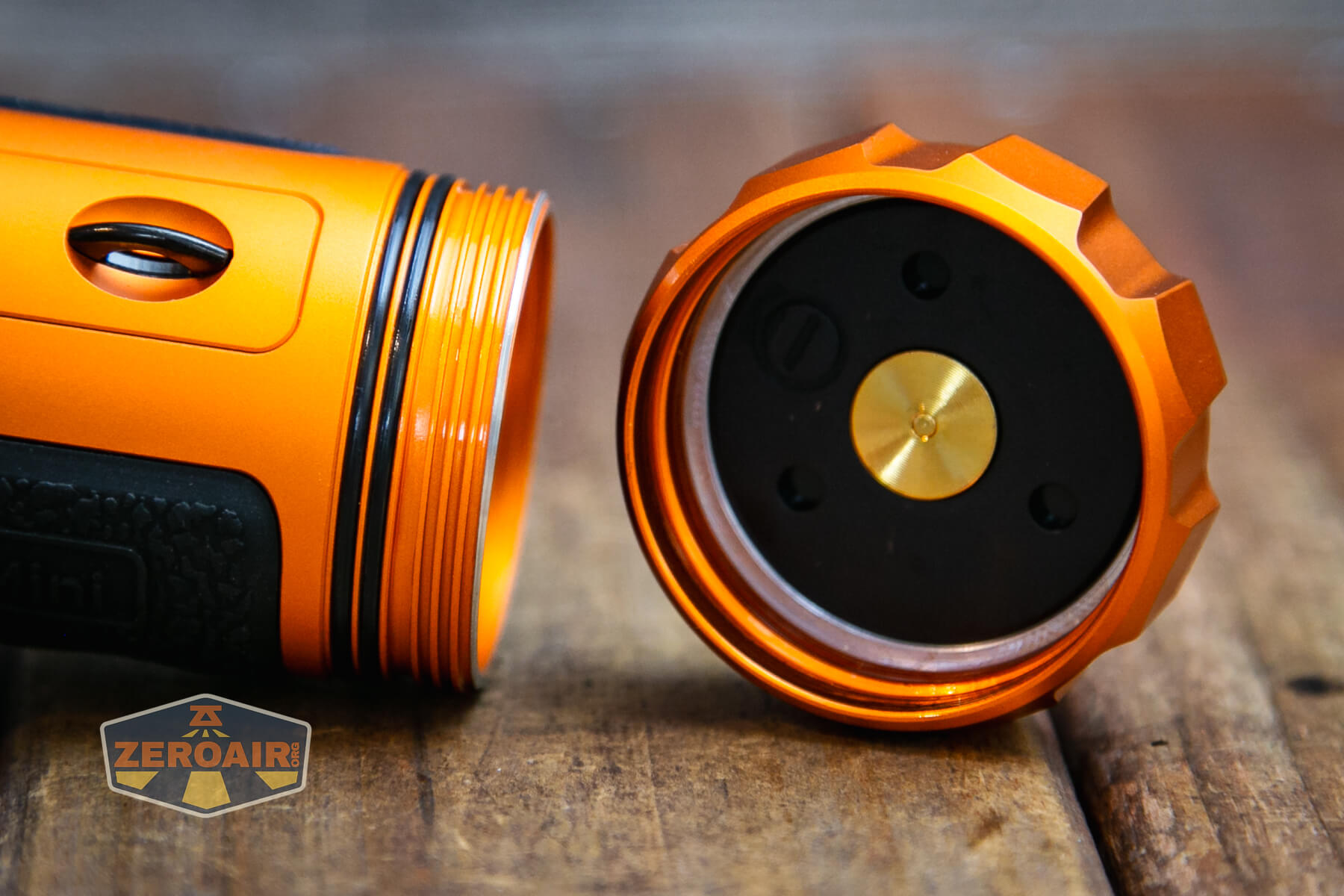
Inside, you can see the contacts. Those contacts hit the customized cell in the right place, and also explain why you can’t use a “standard” 32650 cell in this light.

Size and Comps
Weight: 16.3 oz (462 g) (Battery Included)
Length: 5.12 in (130 mm)
Head Diameter: 2.58 in (65.6 mm)
Body Diameter: 1.73 in (44 mm)

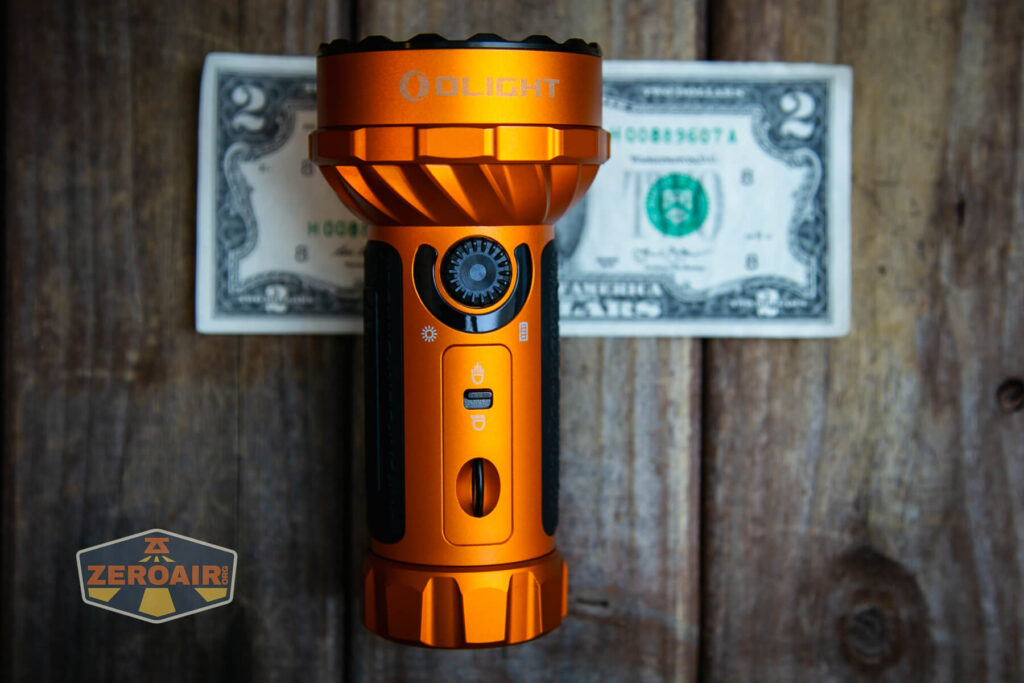


If the flashlight will headstand, I’ll show it here (usually the third photo). If the flashlight will tailstand, I’ll show that here, too (usually the fourth photo).


Here’s the test light with the venerable Convoy S2+. Mine’s a custom “baked” edition Nichia 219b triple. A very nice 18650 light.


Also above is the light beside my custom-engraved TorchLAB BOSS 35, an 18350 light. I reviewed the aluminum version of that light in both 35 and 70 formats.
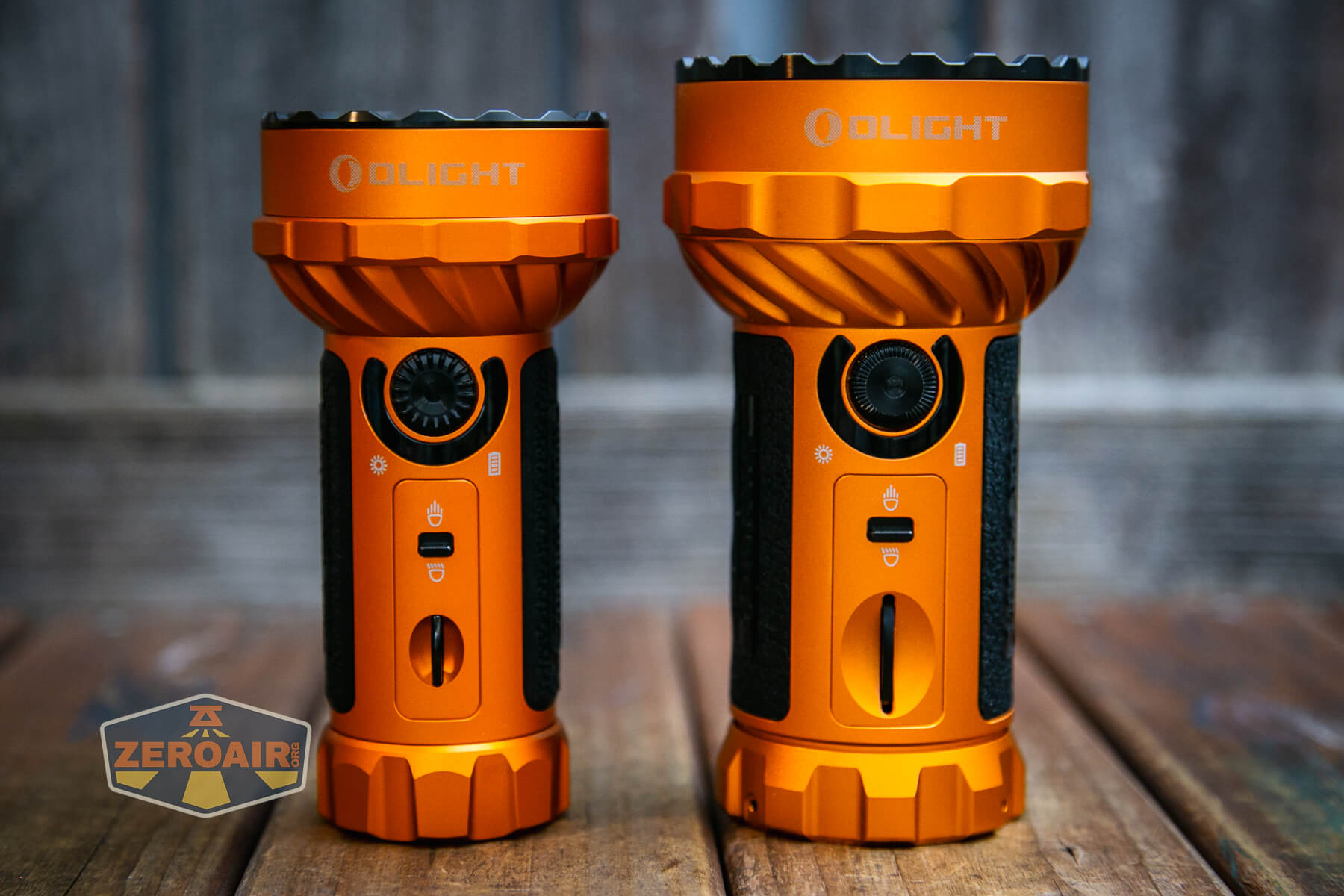
Below is the Olight Marauder Mini flashlight (left) alongside the Marauder 2 (right).
Retention and Carry
Primarily, you’ll be carrying this light by means of the lanyard, which attaches through this “coin slot loop.”

Unlike the Marauder 2 (or “M2”), this little loop does not seem to flip out, and in the photo above is as exposed as it gets.

Olight includes a nice stretchy holster for the Marauder Mini. It fits in one direction, and the light shouldn’t be used while inside.

Power and Runtime
I’ve covered the cell fairly thoroughly by this point, but it’s a single lithium-ion cell. Much like many of Olight’s other cells, this one is customized and proprietary in that it has a shroud around the positive contact and has both positive and negative contact points on the positive end.

This is not the end of the world. It’s very nice that it’s even possible to change the cell, even if we’re required to buy one directly from Olight. I am also pleased that this light runs on a single lithium-ion cell; any configuration of series or parallel just adds more complexity than I often like to fool with. (That said, cells in series or parallel are exactly why a light like the bigger Marauder 2 has the cells built in…)

The cell goes into the light in the usual direction – positive end toward the head.

Here are a number of runtime tests. I tested the highest 3 modes for flood and throw, but didn’t test any of the color modes for runtime.


The light does shut off with low voltage protection, and the stepdowns seem to approximate what Olight’s manual claims.
Charging
Olight has slipped back into its proprietary charging ecosystem for the Marauder Mini.

This charger is a “charge base” style item, which connects to USB power on one end and magnetically to the (or “a”) flashlight. Olight has a ton of lights using this same connection, so if you’re already in, this won’t be a problem.

Because I did so many runtimes, I also did a bunch of charge tests, too. The charging indicator on the charge base is red while charging and green when charging is complete. It’s noteworthy that the indicator turns green WAY before the termination I’m displaying below. The cell seems to keep charging after the indicator turns green, so I just let it. In every test, the final voltage was 4.17V, so it doesn’t seem to be overcharging.


Modes and Currents
I’ve written this chart like Olight wrote the manual. Every mode’s top level is called “100%” and the stepdowns are a percentage of that number (instead of just stating what that number is…) I don’t know why Olight did the list this way.
| Mode | Mode Claimed Output (lm) | Claimed Runtime | Measured Lumens | Tailcap Amps |
|---|---|---|---|---|
| Flood Level 7 | 7,000 (100%) – 23% – 13% | 2m – 160m – 10m | 5455 (0s) 5373 (30s) |
15.00 |
| Flood Level 6 | 3,200 (100%) – 41% – 14% | 10m – 170m – 10m | 2490 | 5.11 |
| Flood Level 5 | 1,600 (100%) – 50% – 25% | 160m – 10m – 15m | 1303 | 2.34 |
| Flood Level 4 | 800 (100%) – 50% – 25% | 320m – 5m – 15m | 653 | 1.15 |
| Flood Level 3 | 400 (100%) – 45% – 23% | 630m – 10m – 10m | 333 | 0.59 |
| Flood Level 2 | 200 | 21h | 153 | 0.30 |
| Flood Level 1 | 100 | 35h30m | 78 | 0.18 |
| Throw Level 7 | 900 (100%) – 56% – 37% | 10m – 200m – 40m | 869 | 4.01 |
| Throw Level 6 | 700 (100%) – 71% – 15% | 40m – 175m – 45m | 654 | 2.46 |
| Throw Level 5 | 500 (100%) – 60% – 20% | 220m – 30m 20m | 484 | 1.62 |
| Throw Level 4 | 300 (100%) – 33% | 7h – 20m | 309 | 0.90 |
| Throw Level 3 | 200 | 11h30m | 200 | 0.56 |
| Throw Level 2 | 100 | 21h30m | 104 | 0.29 |
| Throw Level 1 | 50 | 43h30m | 45 | 0.15 |
| Red Level 4 | 200 (100%) – 90% – 60% – 40% – 20 % | 5m – 305m – 10m – 10m – 10m | 238 | 1.21 |
| Red Level 3 | 150 (100%) – 90% – 60% – 30% | 100m -430m -10m -10m | 165 | 0.68 |
| Red Level 2 | 100 | 16h30m | 99 | 0.38 |
| Red Level 1 | 50 | 30h | 49 | 0.21 |
| Green Level 4 | 220 (100%) – 91% – 55% – 41% | 30m – 250m – 10m – 10m | 188 | 1.39 |
| Green Level 3 | 180 (100%) – 94% – 50% | 490m – 10m – 10m | 148 | 0.79 |
| Green Level 2 | 140 | 14h | 111 | 0.49 |
| Green Level 1 | 100 | 22h30m | 84 | 0.32 |
| Blue Level 4 | 120 (100%) – 33% | 260m – 40m | 35 | 1.42 |
| Blue Level 3 | 100 (100%) – 40% | 420m – 10m | 25 | 0.90 |
| Blue Level 2 | 80 | 10h30m | 19 | 0.61 |
| Blue Level 1 | 55 | 17h | 11 | 0.37 |
Pulse Width Modulation
None of the modes has PWM. The mode order in the photos below is 7 flood, 7 throw, 4 red, 4 green, and 4 blue, and all are lowest to highest. That’s the same story for all the series photos below, too.


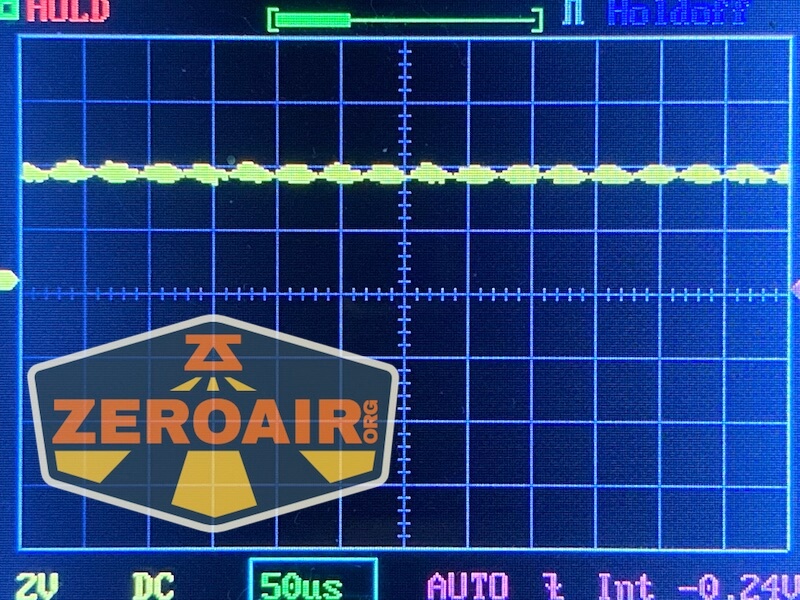


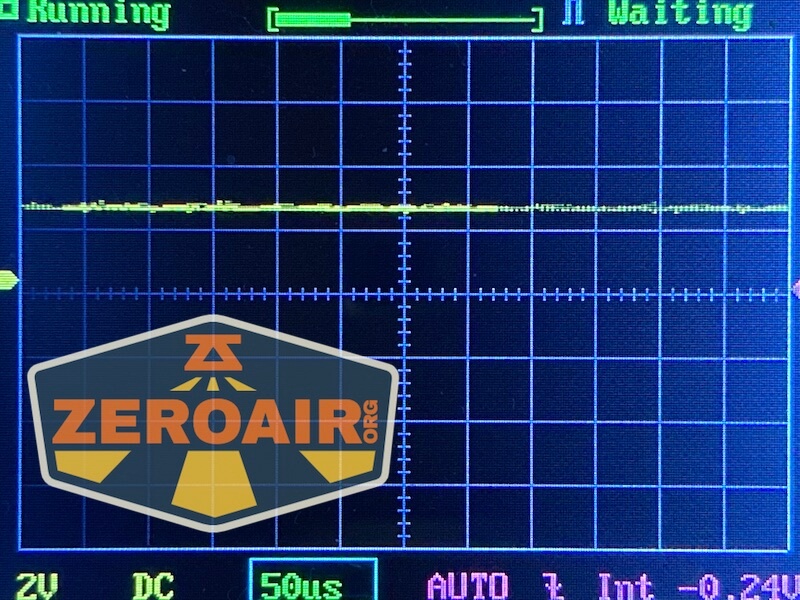

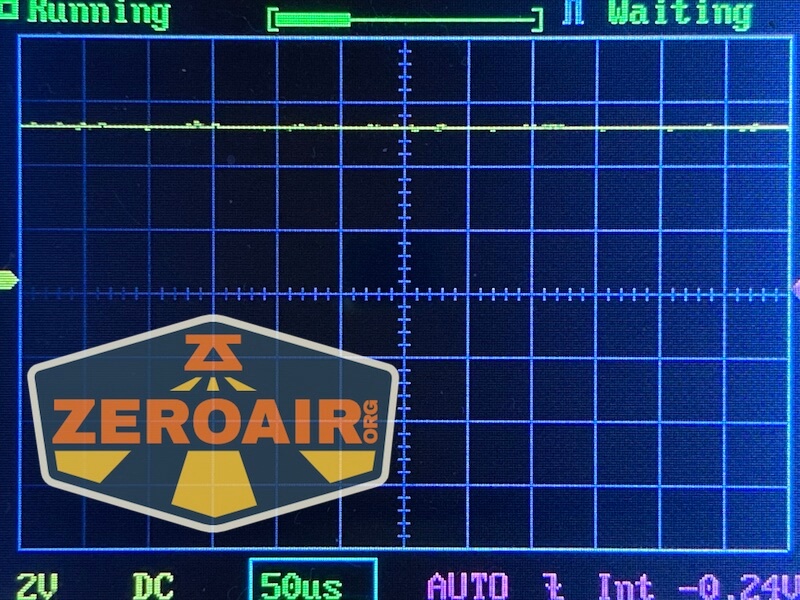
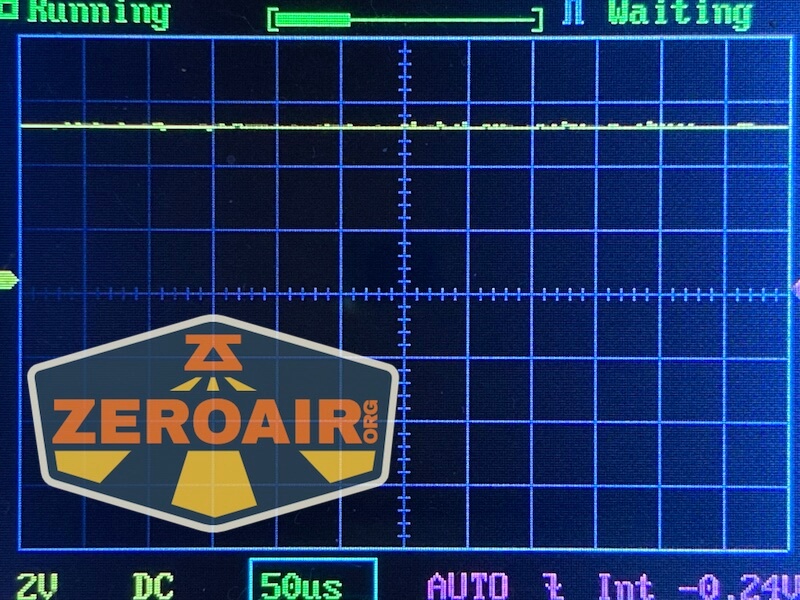
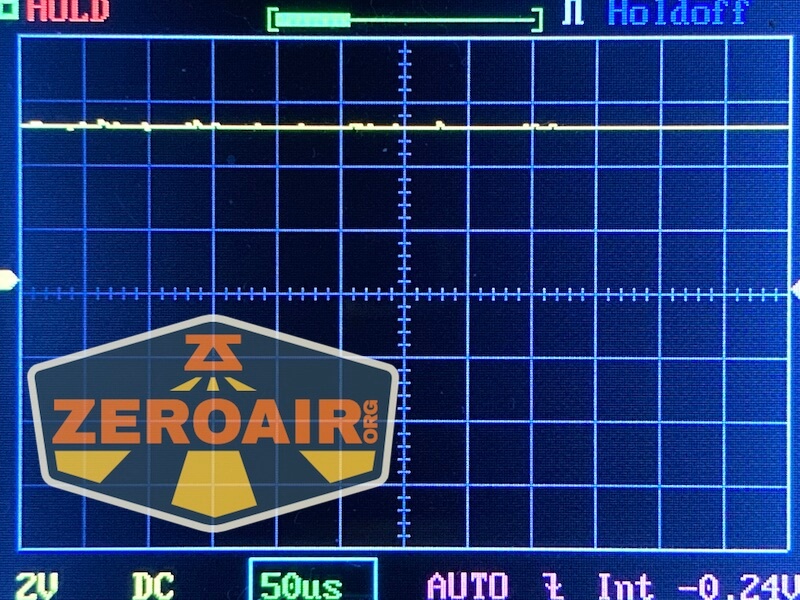
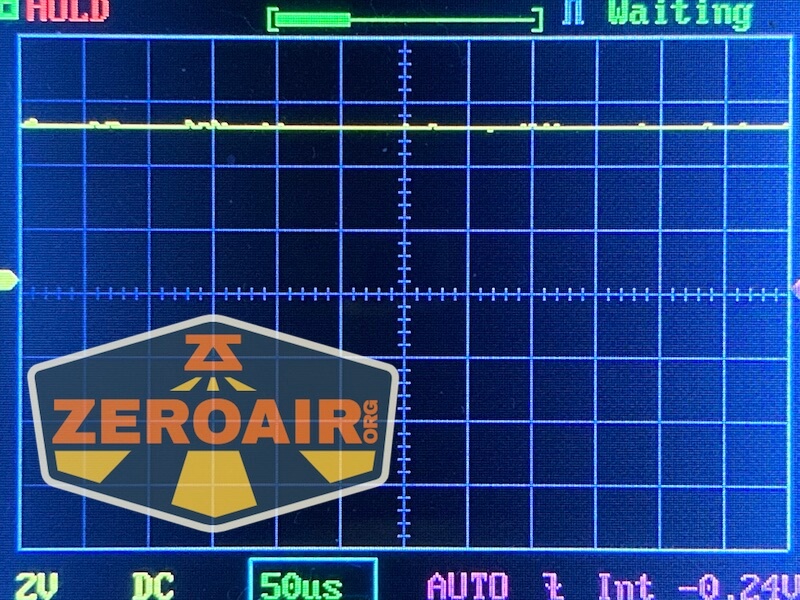
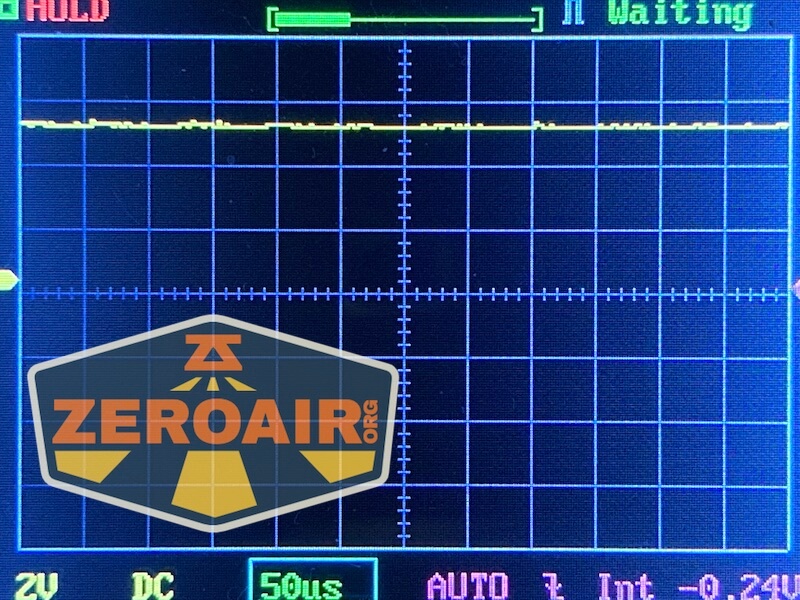

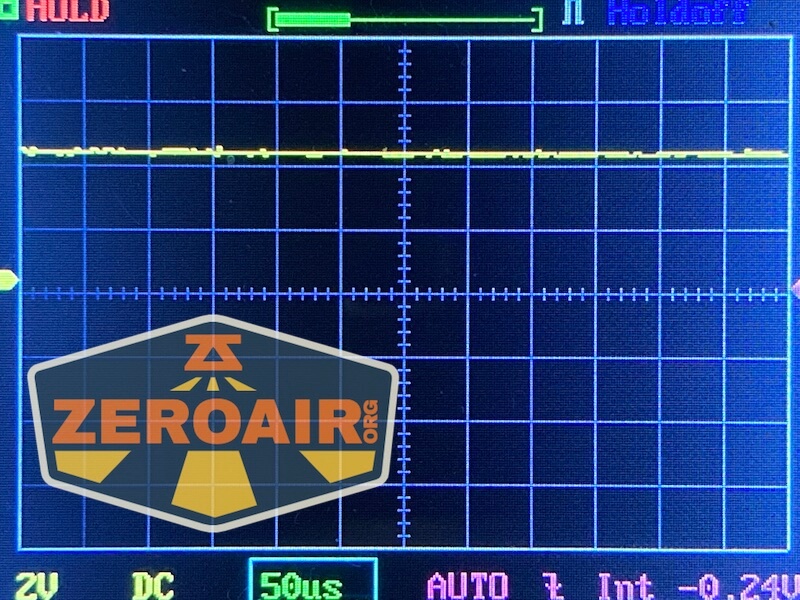


Here you can see a “baseline” – a chart with almost no light hitting the sensor. Then there’s the Ultrafire WF-602C flashlight, which has some of the worst PWM I’ve seen. It’s so bad that I used a post about it to explain PWM! Here are multiple timescales (10ms, 5ms, 2ms, 1ms, 0.5ms, 0.2ms) to make comparing this “worst” PWM light to the test light easier. That post also explains why I didn’t test the WF-602C at the usual 50us scale.


User Interface and Operation
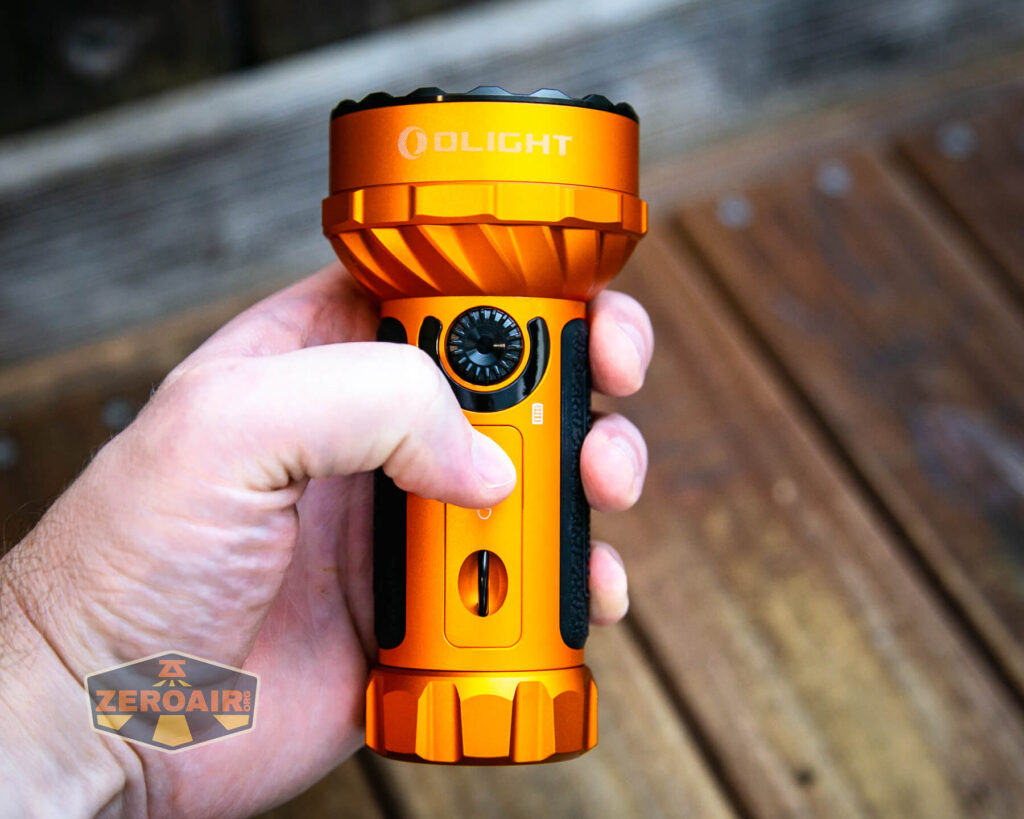
There are two switches on the Olight Marauder Mini flashlight. First is this rotary switch.

I will say that the rotary interface here doesn’t quite suit me. The switch seems to be some weird combination of rotary and “speed sensing switch” (there’s a real name for it I’m sure). If you rotate the dial very slowly, either nothing will happen, or you’ll rotate the switch nearly all the way around for one change in level. In other words, the levels are not specific places on the dial. You rotate until the level changes. The rotary rotates freely; there are no stop points here (that is, it’s not like the rotary on the Olight Olantern Classic 2 Pro, for example. In normal use, this is fine, but if you’re trying to dial in specifically to level 4 or whatever, it can be frustrating.
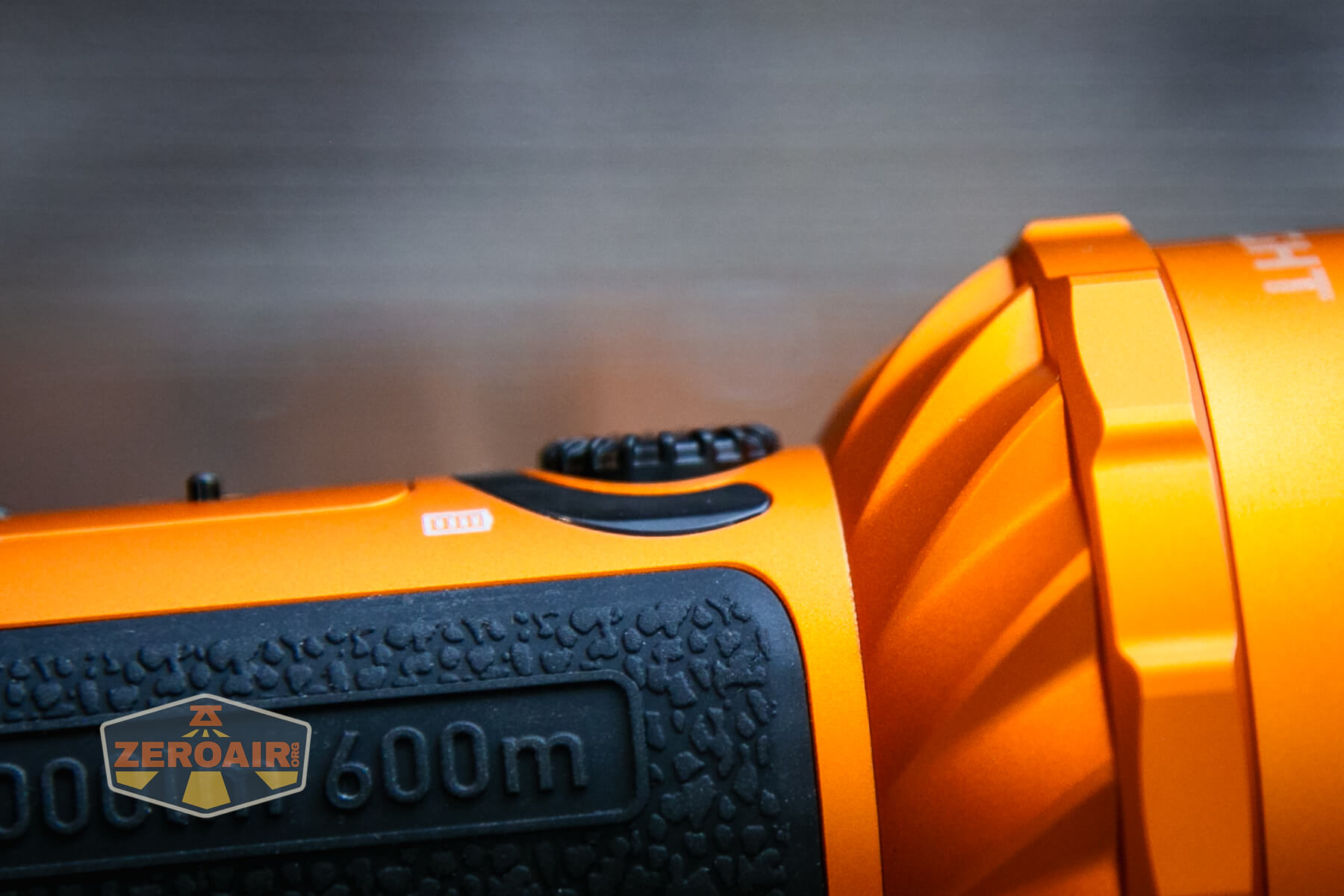
Not only does this switch serve as a dial, but it’s also clicky. There’s a fair bit of action on it, too. Travel is around 1.5-2mm.
Also, when rotating the dial, both the highest and lowest levels have a vibrating warning. This vibrate also happens when a cell is installed and makes proper contact.

I find the indicators that surround the rotary dial to be much fainter than on the Marauder 2. Maybe not quite so much as “hard to see” but… I did find myself double-checking to see if they were lit.

There’s a second switch, too. It’s this little toggle, which switches between flood and throw. The rotary doesn’t care which way the toggle is; the rotary user interface is the same. On the toggle, “up” or “forward” is the Spot emitter, and “down” or “back” is the flood.
Here’s a user interface table!
| State | Action | Result |
|---|---|---|
| Off | Click Rotary Switch | Battery indicator (if the light has been off >30s) |
| Off | Rotate Rotary Switch 90 degrees | Unlock |
| Unlocked | Click Rotary Switch | On in previously used level. (Level can not be changed while output is off.) |
| On | Rotate Switch Clockwise | Increase output level |
| On | Rotate Switch Counterclockwise | Decrease output level |
| On | Click Rotary Switch | Off |
| Any | Flip the Toggle Switch | Switch from Flood to Spot (also lights indicators around rotary switch |
| Unlocked | Double Click Rotary Switch | Level 7 (another double click accesses Level 4) |
| Unlocked | Triple Click Rotary Switch | Strobe |
| Off | Click Rotary Switch 15x | Iterate the proximity sensor |
LED and Beam
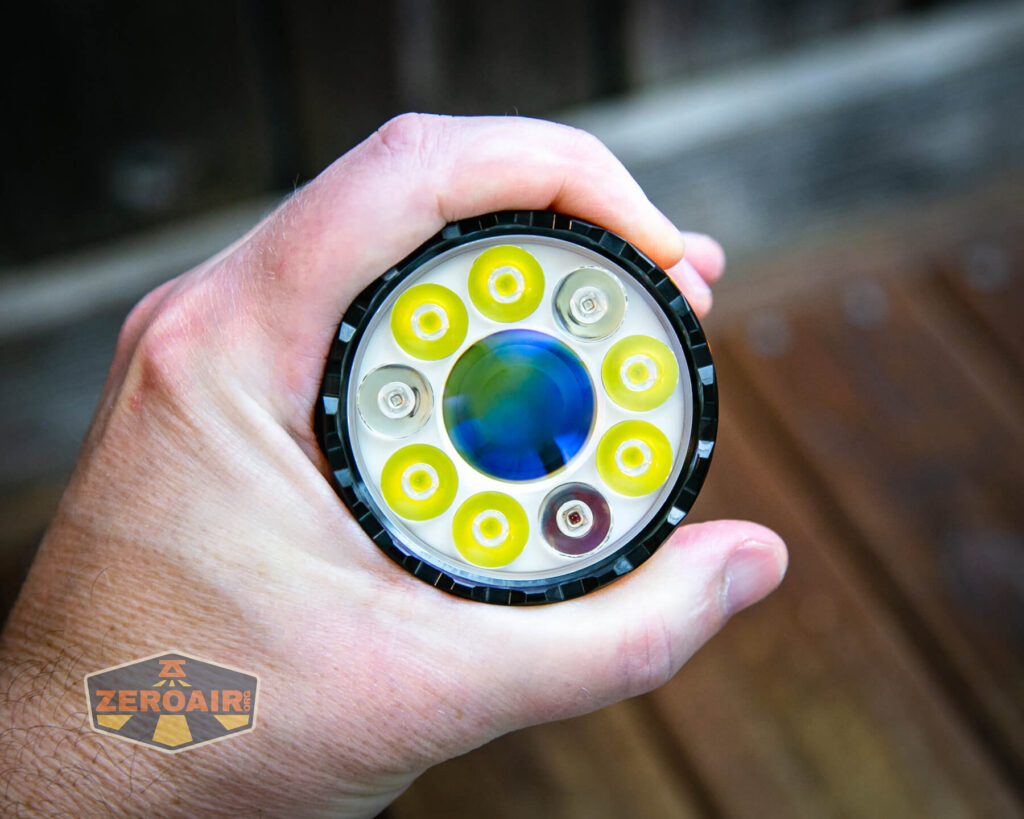
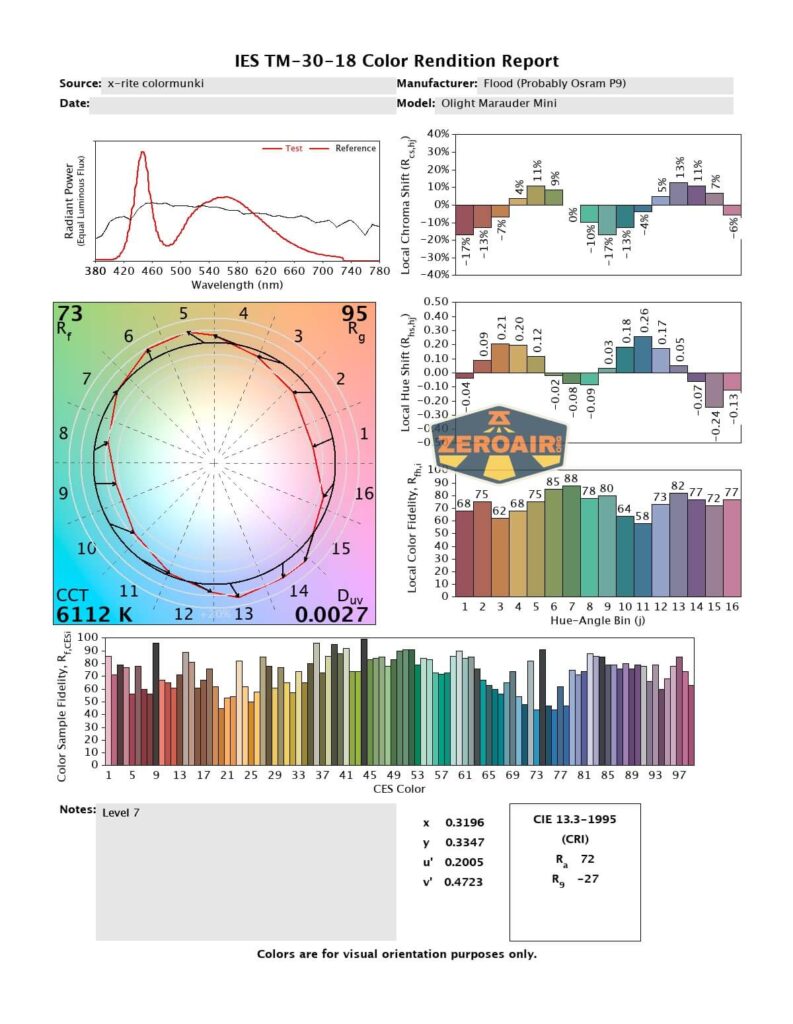
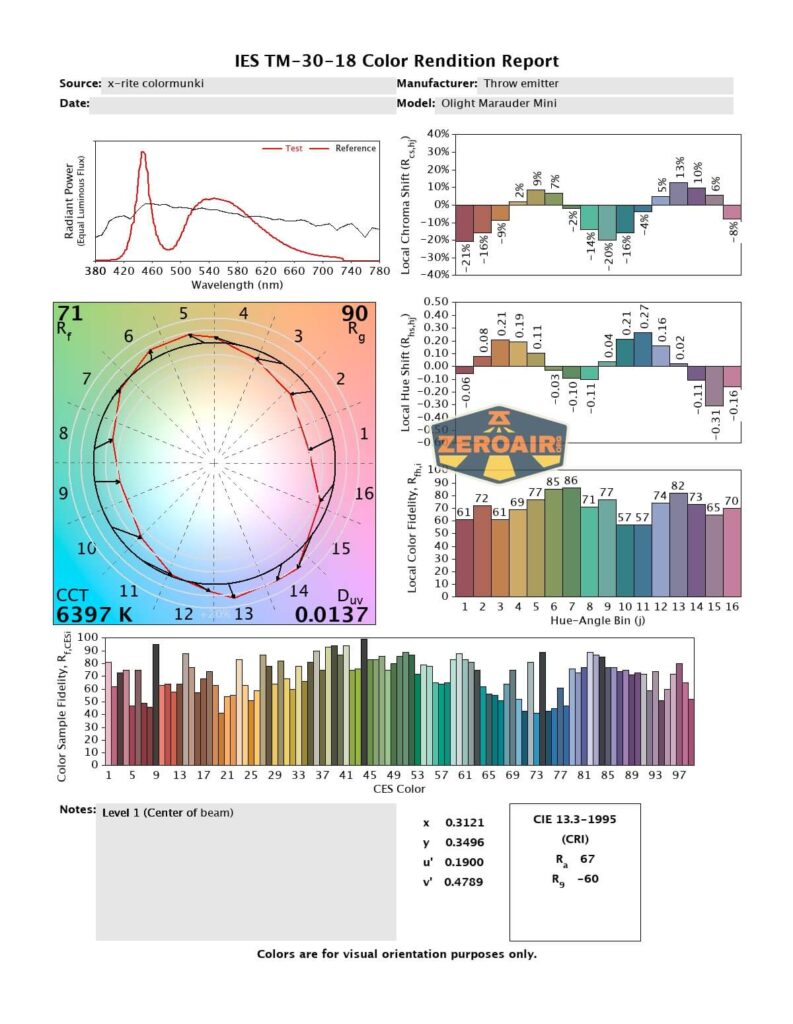
I can’t see where Olight has any specific definitions of what the emitters in the Olight Marauder Mini flashlight are. At the very least, I can guess that the flood emitters are Osram P9. Olight does state the CCT. Flood emitters are 5500 to 6000K, and the throw emitter is 5000-6000K.


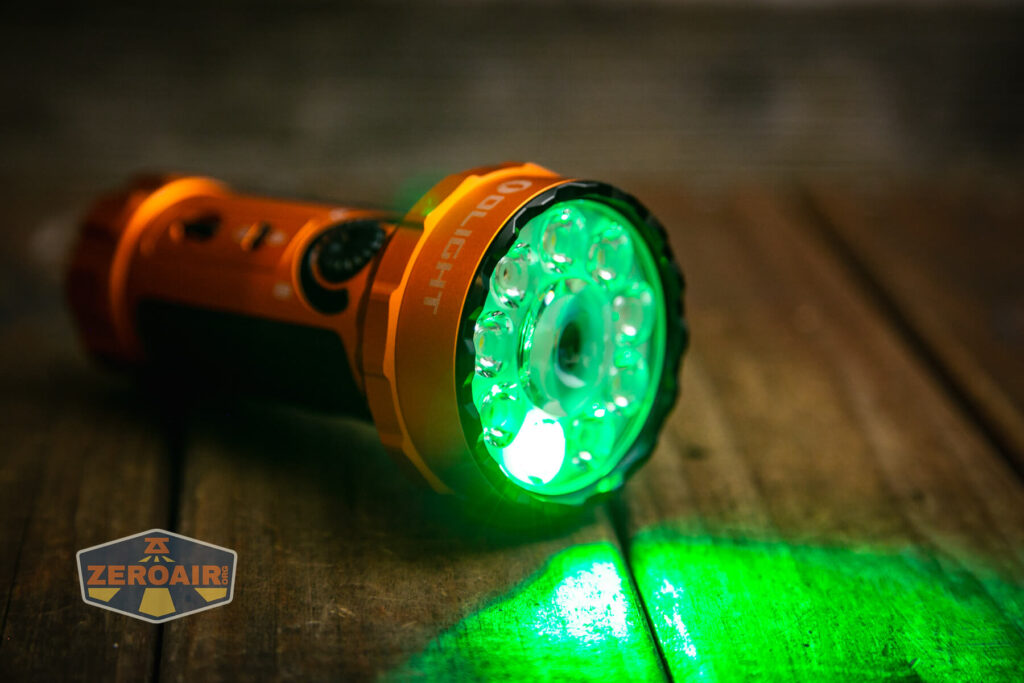

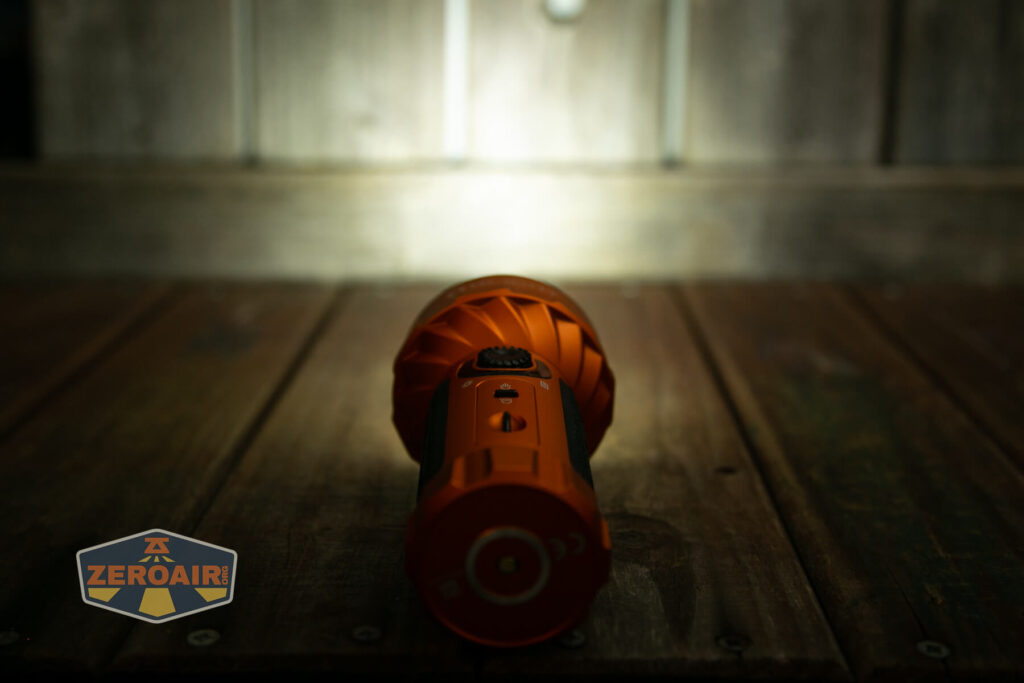
The bezel has some teeth that allow light to escape while headstanding. Also, notably (and thankfully,) there does not seem to be a proximity sensor present here!



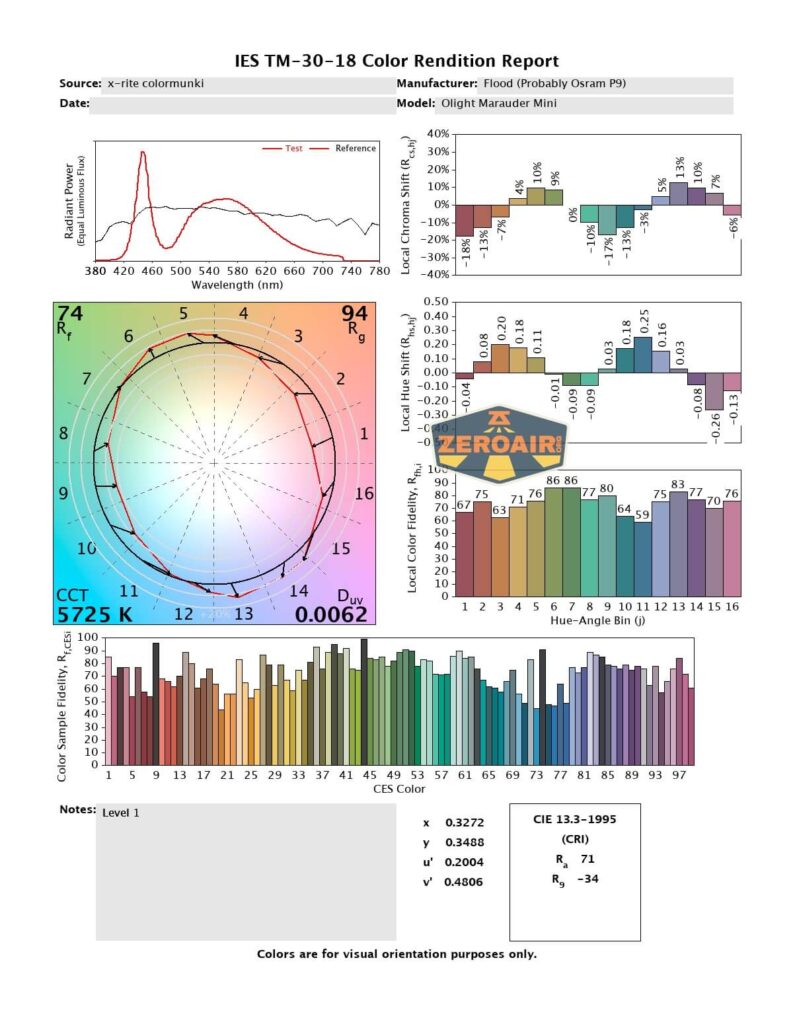
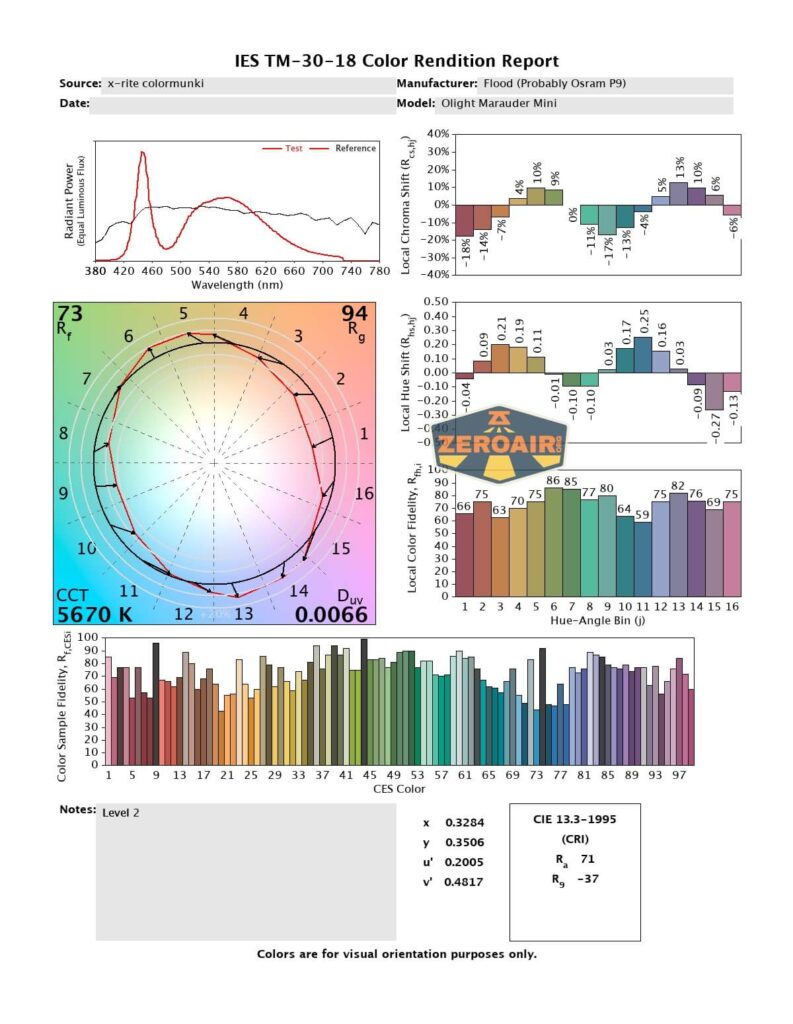
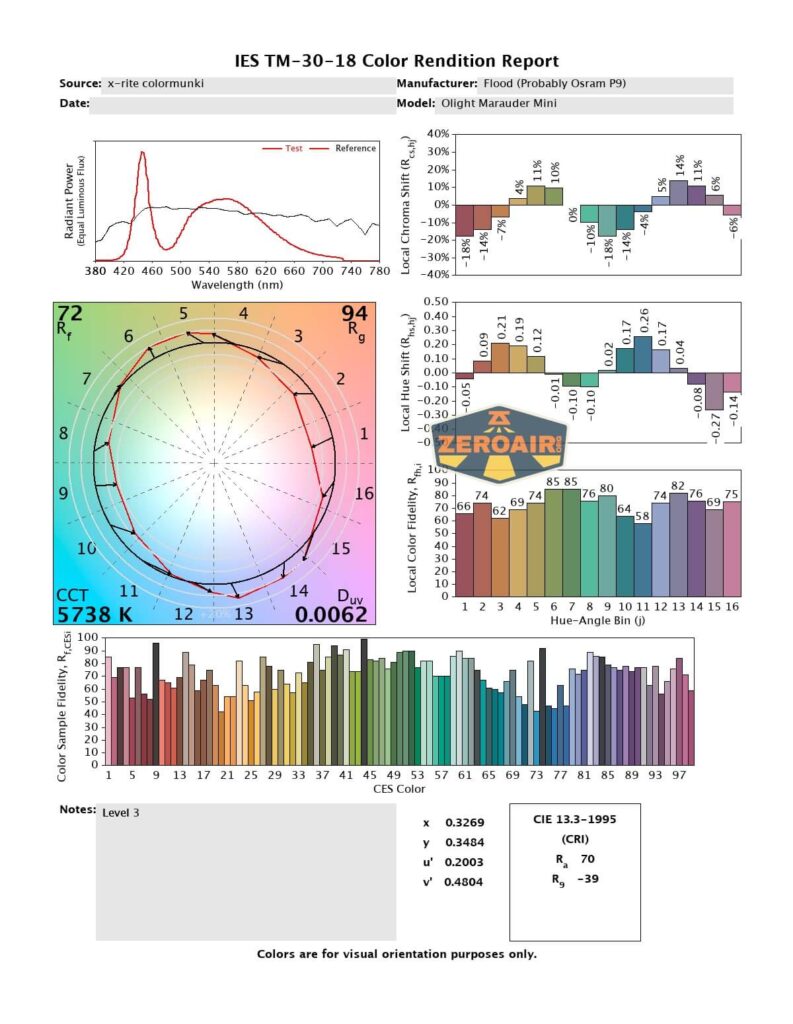
LED Color Report (CRI and CCT)
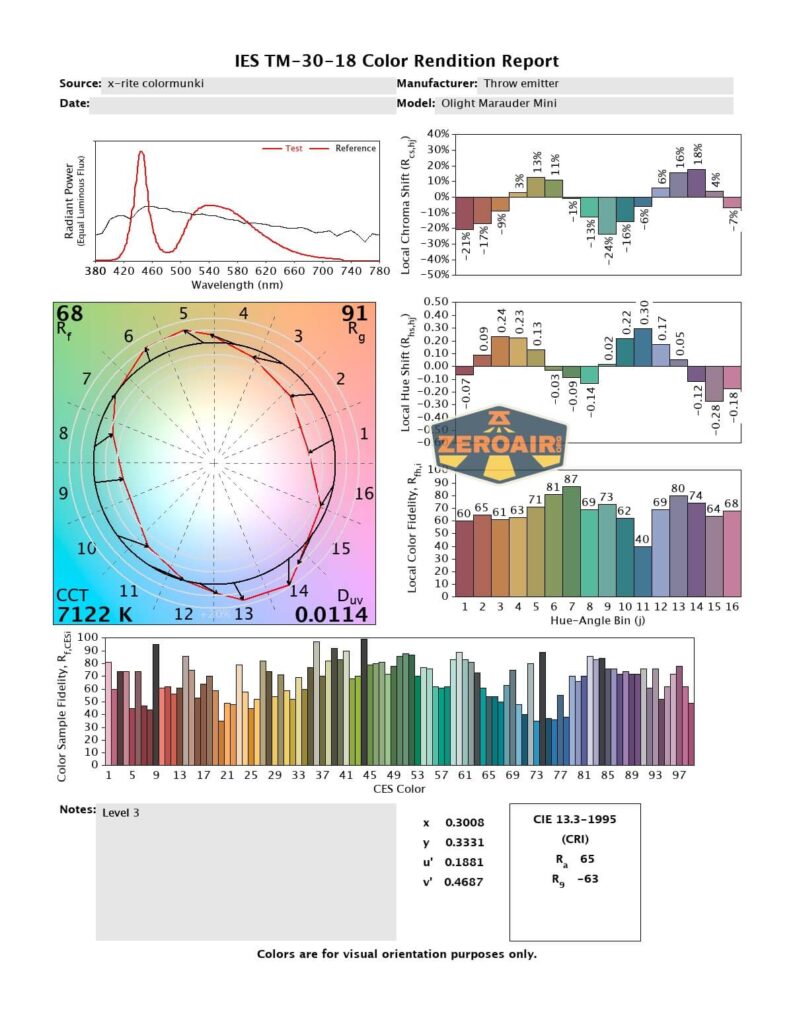
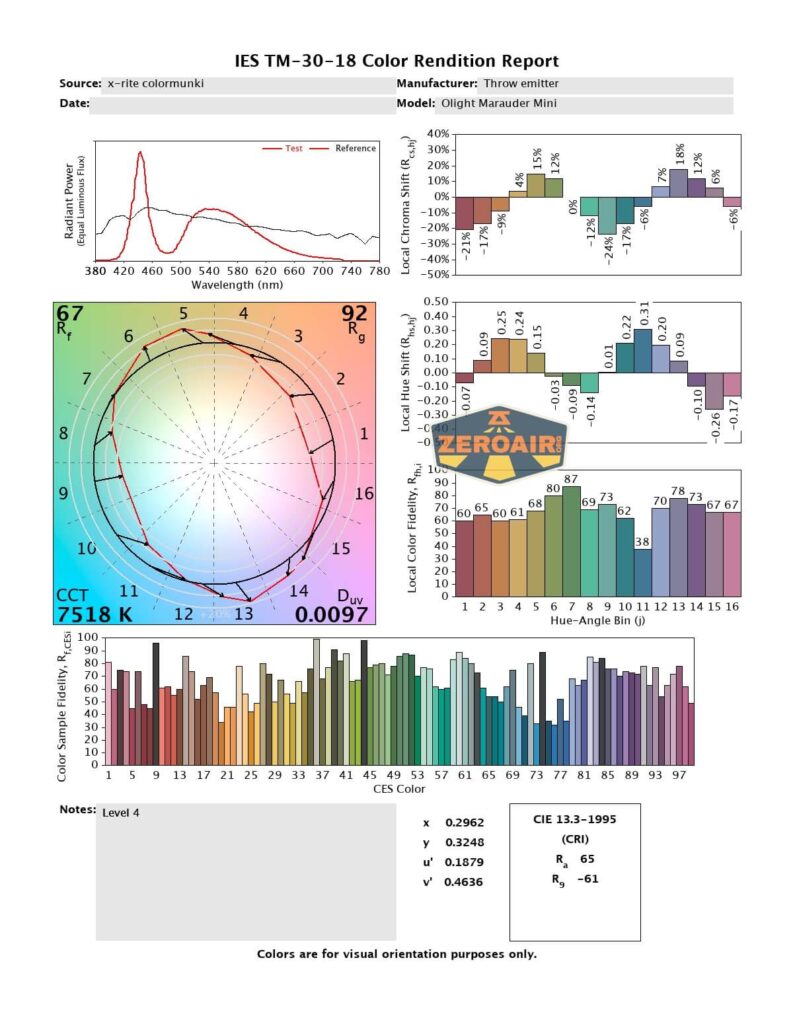
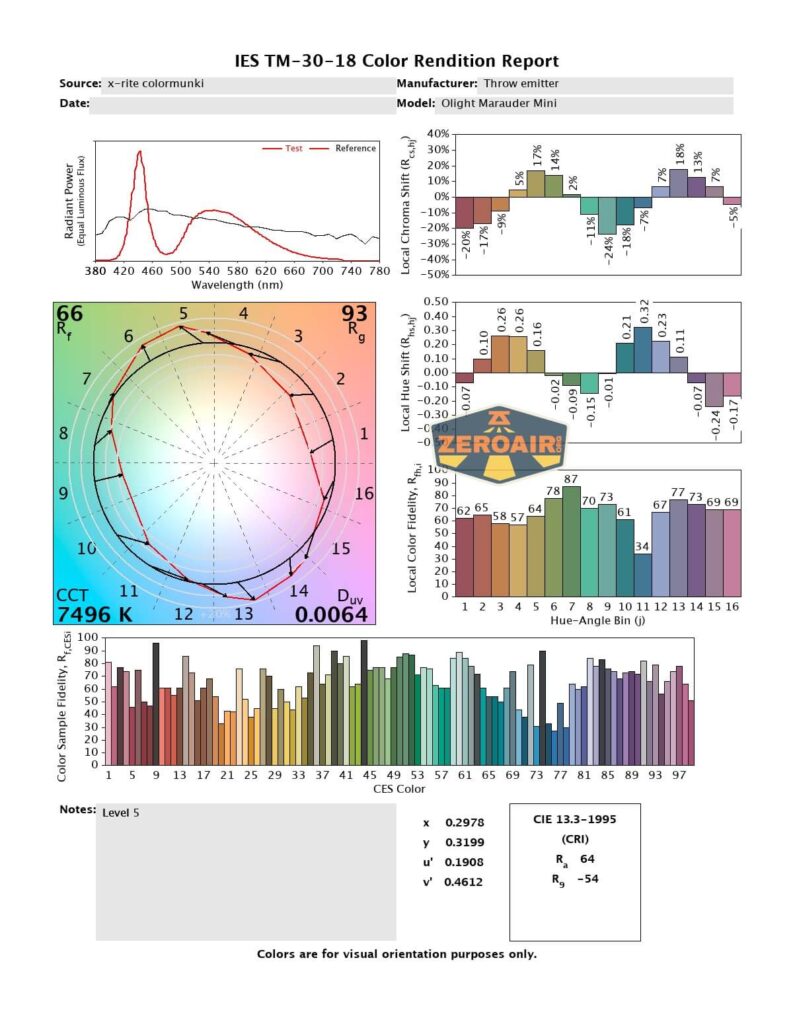
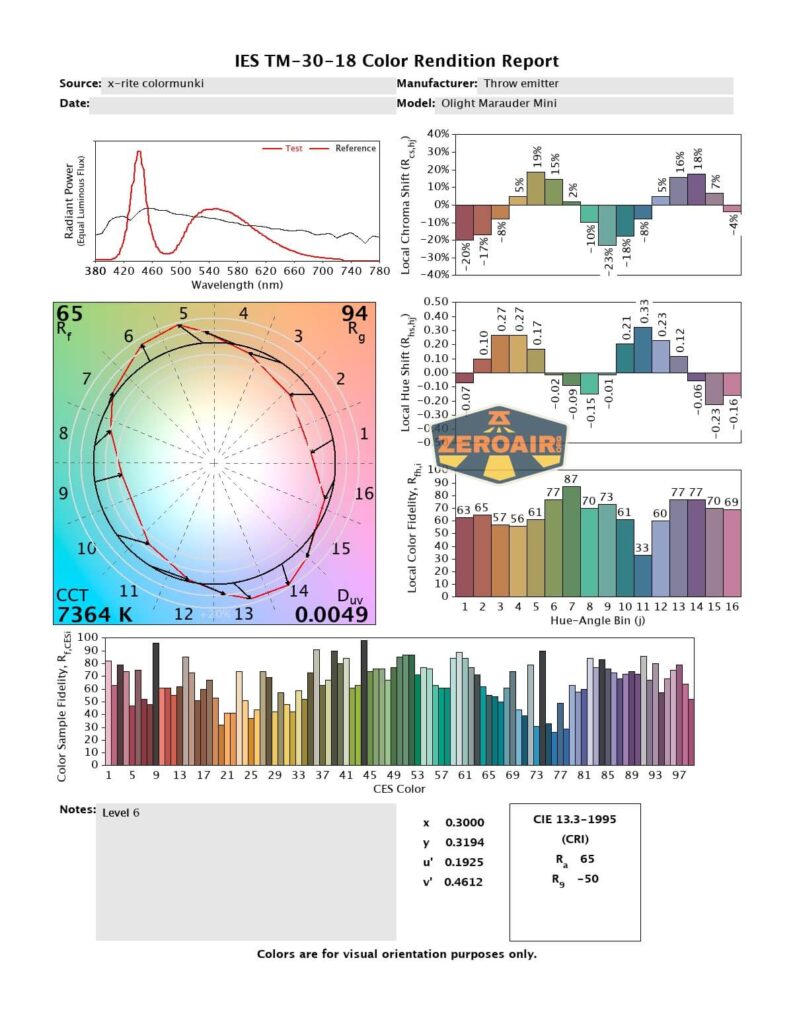
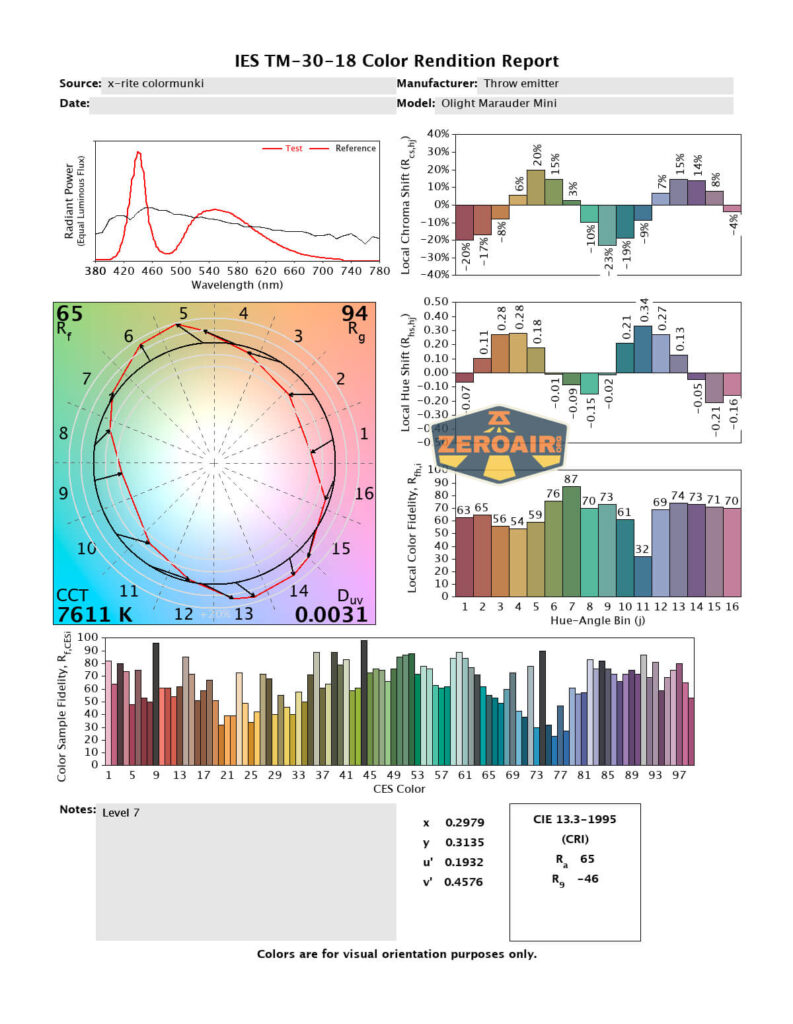
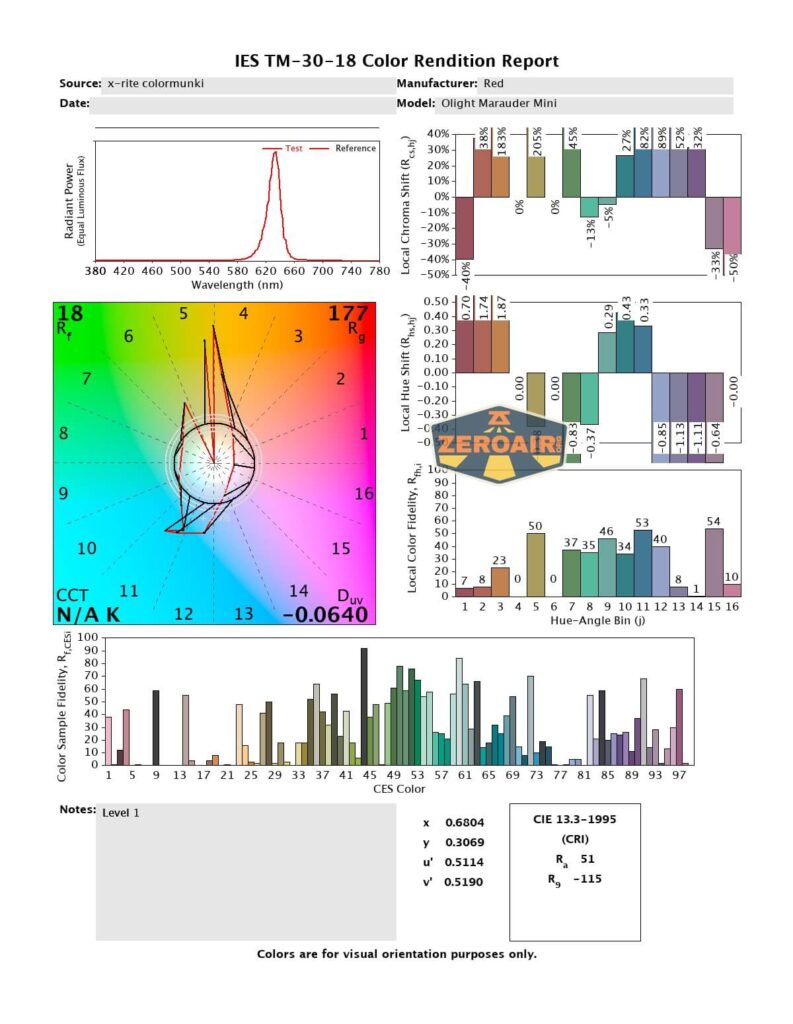
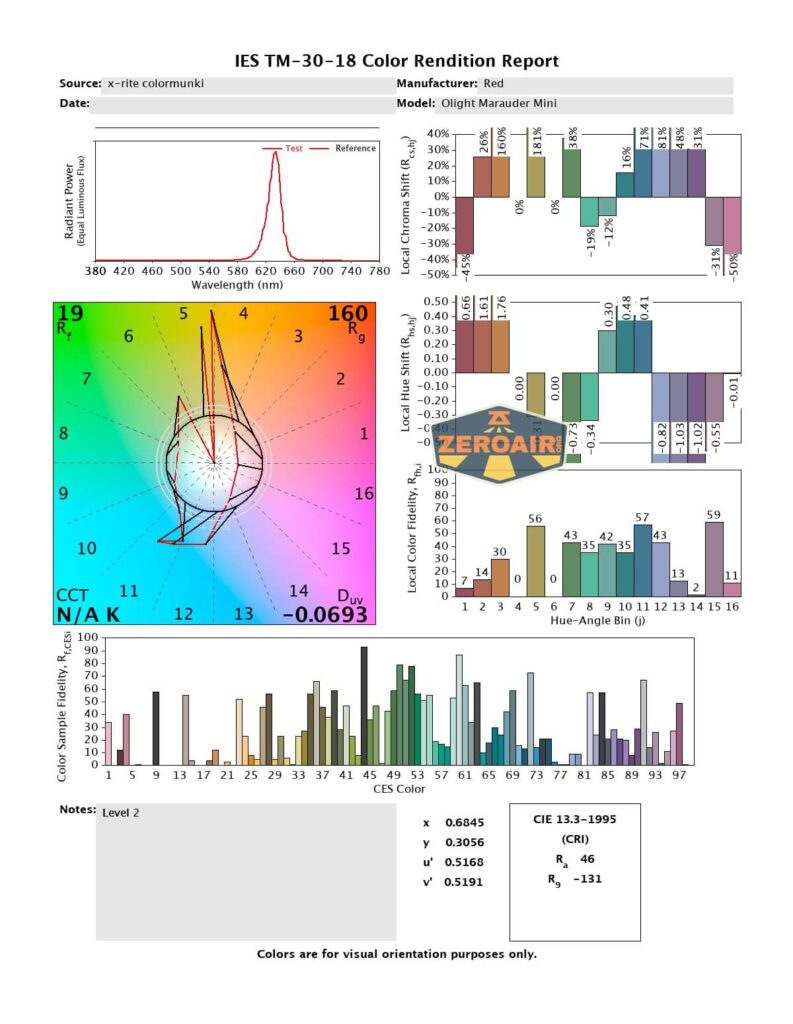
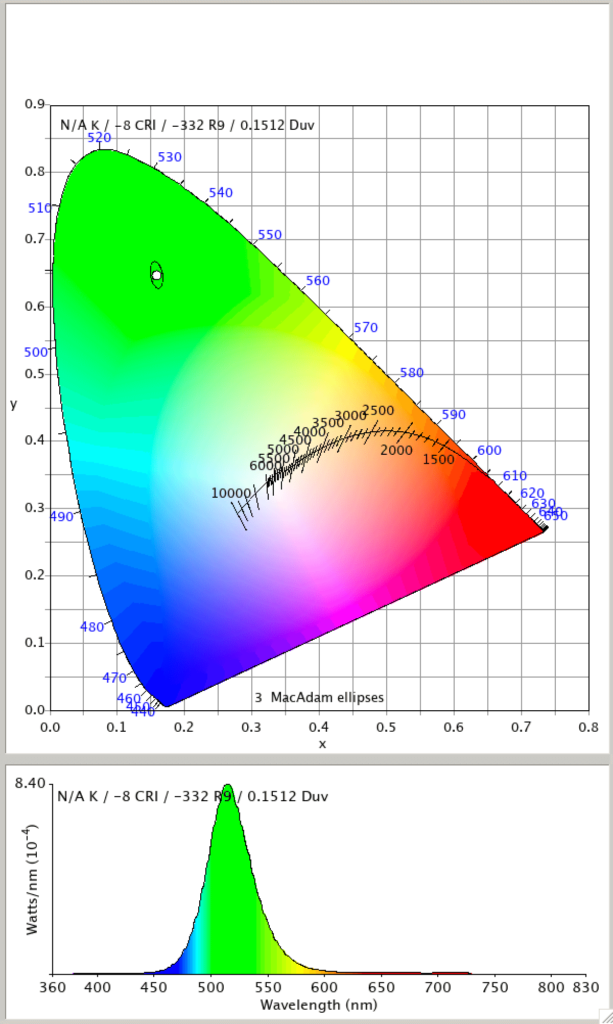
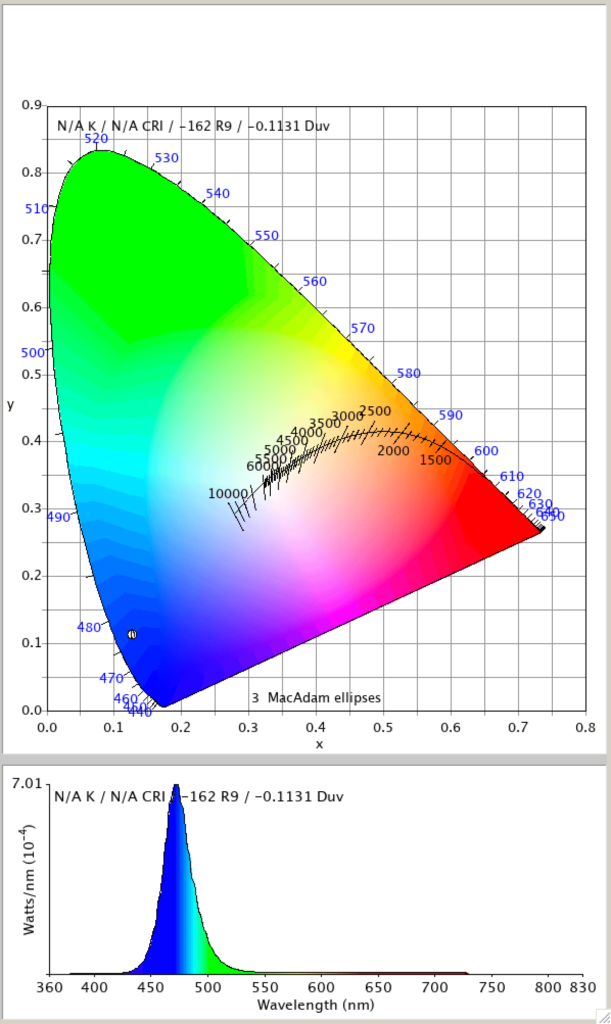
Despite the claims of 5000-6000K for these emitters, I’m reading a bit cooler on the flood emitters (5700K-6200K) and much cooler on the throw emitter (6400K-7600K). For the throw emitter, I added one extra test. The fringe of the throw beam has a bit of aberration, and that is actually quite a bit warmer, at around 4500K. It’s a small area, though, and not “warm in the good way” type of warm.









Beamshots
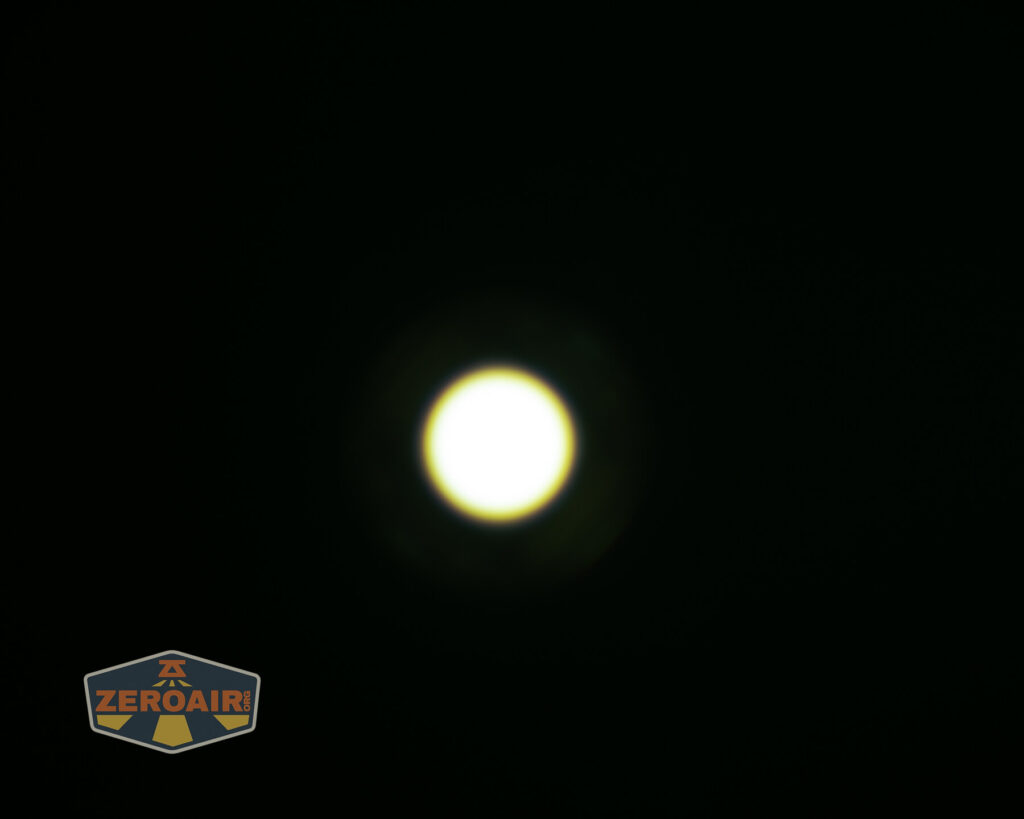
These beamshots always have the following settings: f8, ISO100, 0.3s shutter, and manual 5000K exposure. These photos are taken at floor level, and the beam hits the ceiling around 9 feet away.




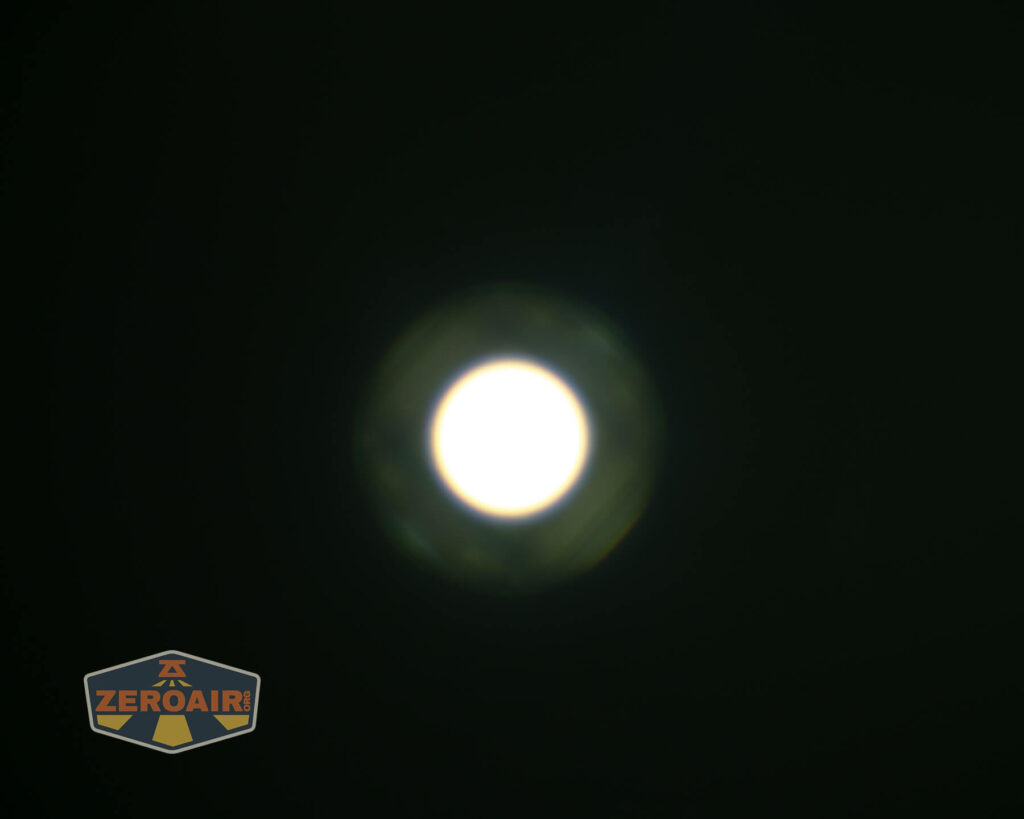
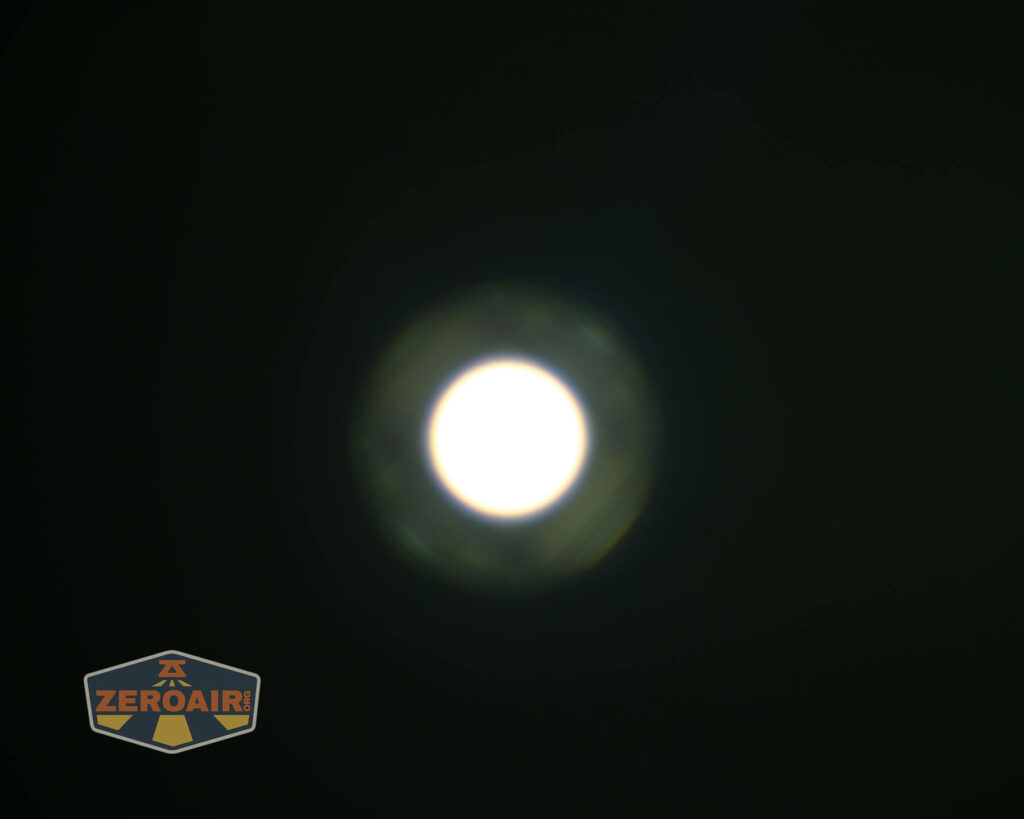


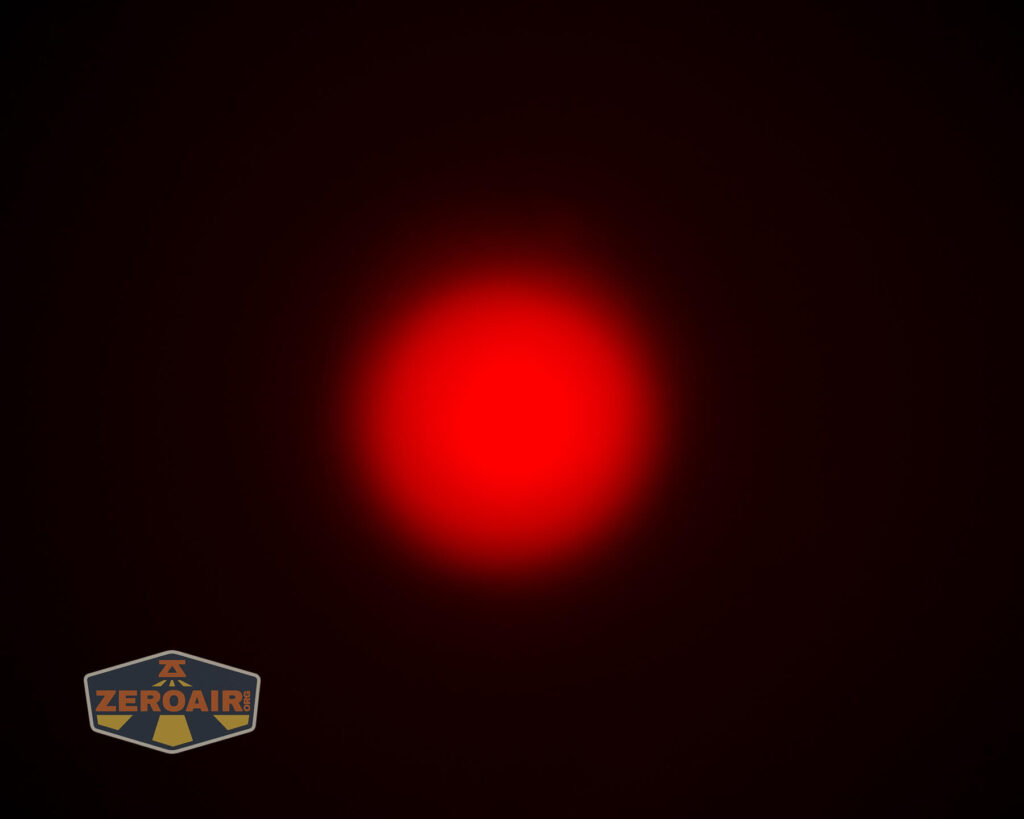


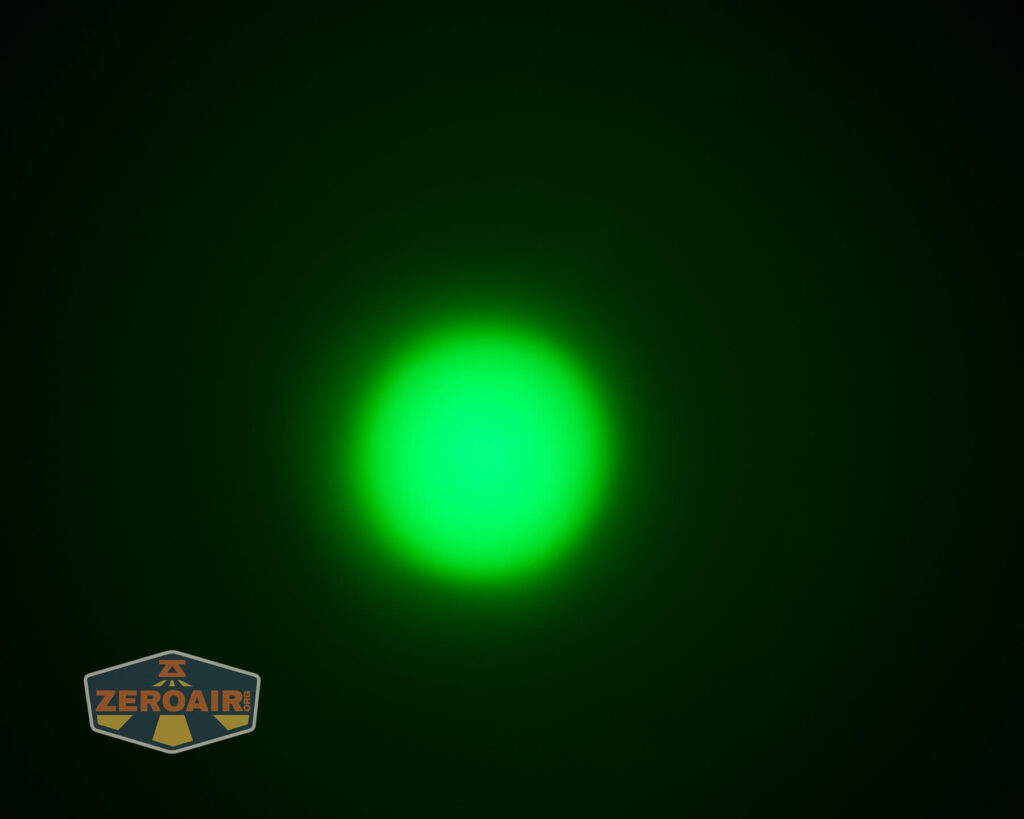


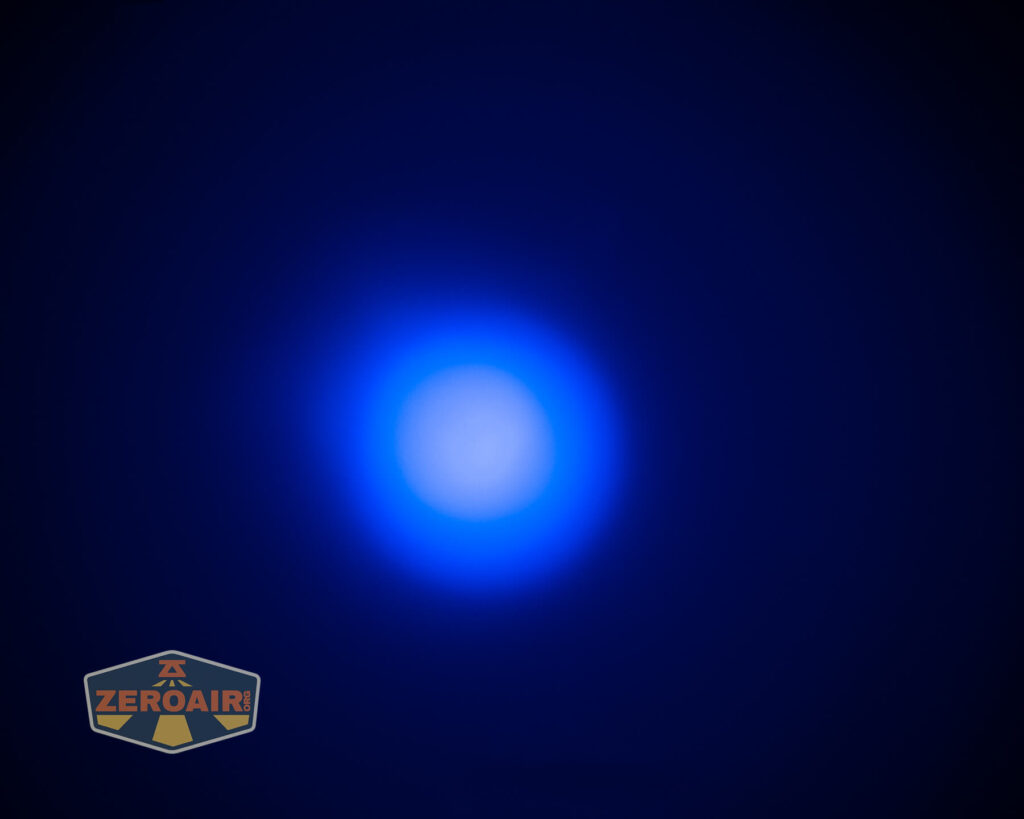


Tint vs BLF-348 (KillzoneFlashlights.com 219b version) (affiliate link)
I keep the test flashlight on the left and the BLF-348 reference flashlight on the right.


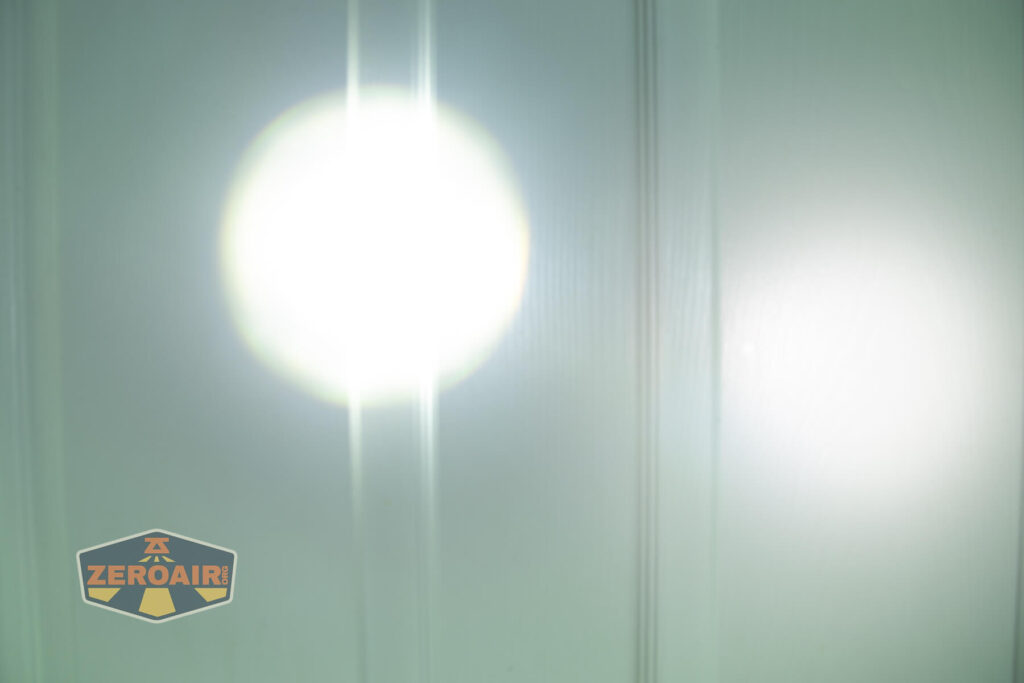






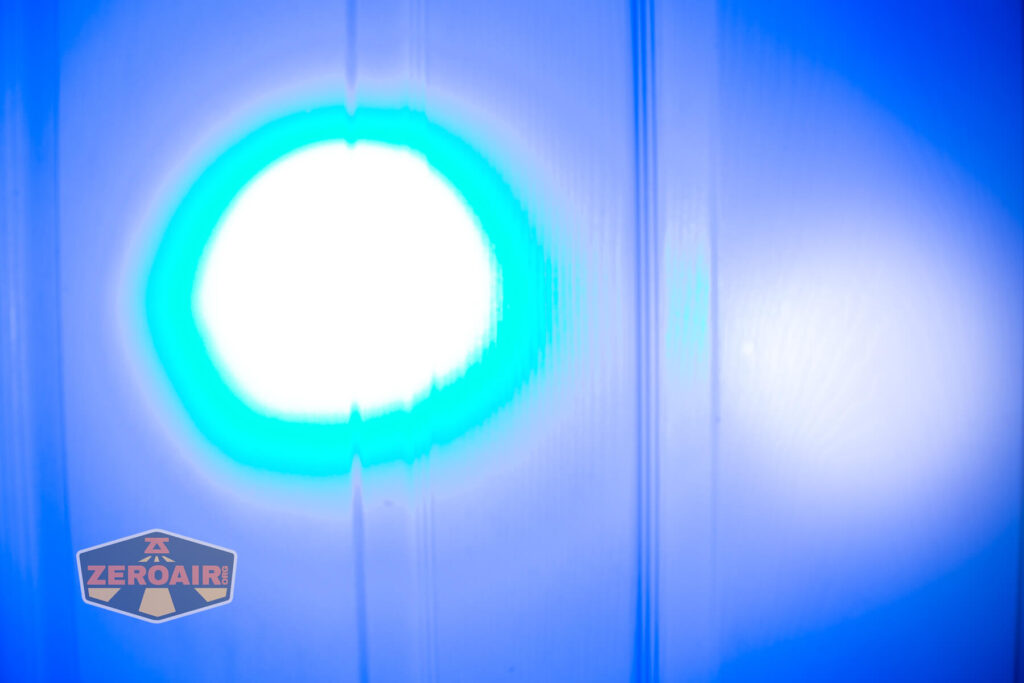

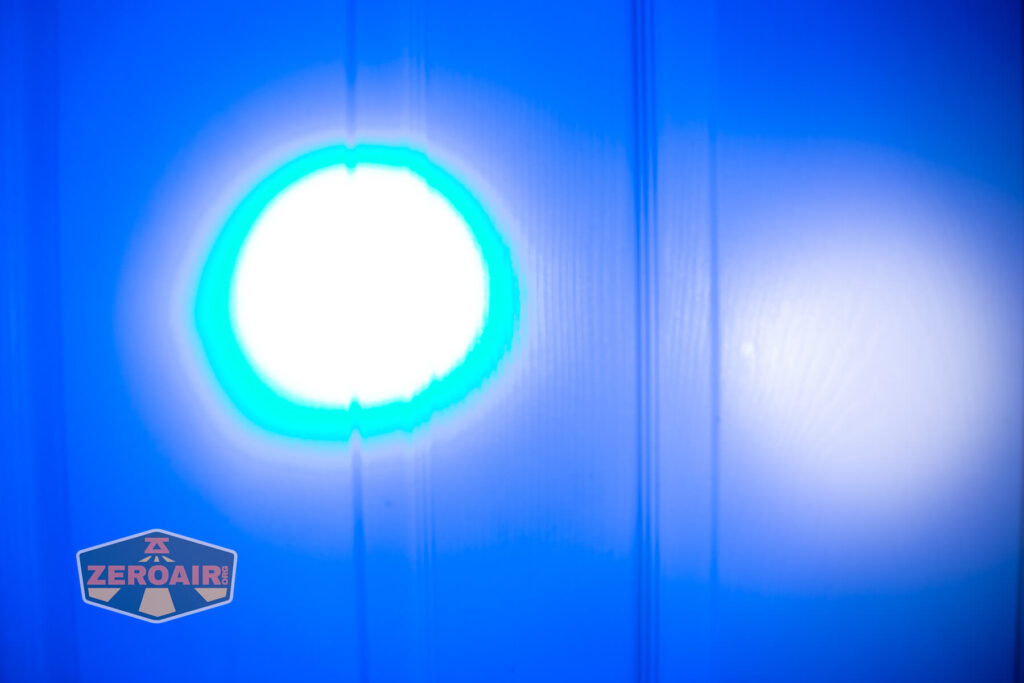


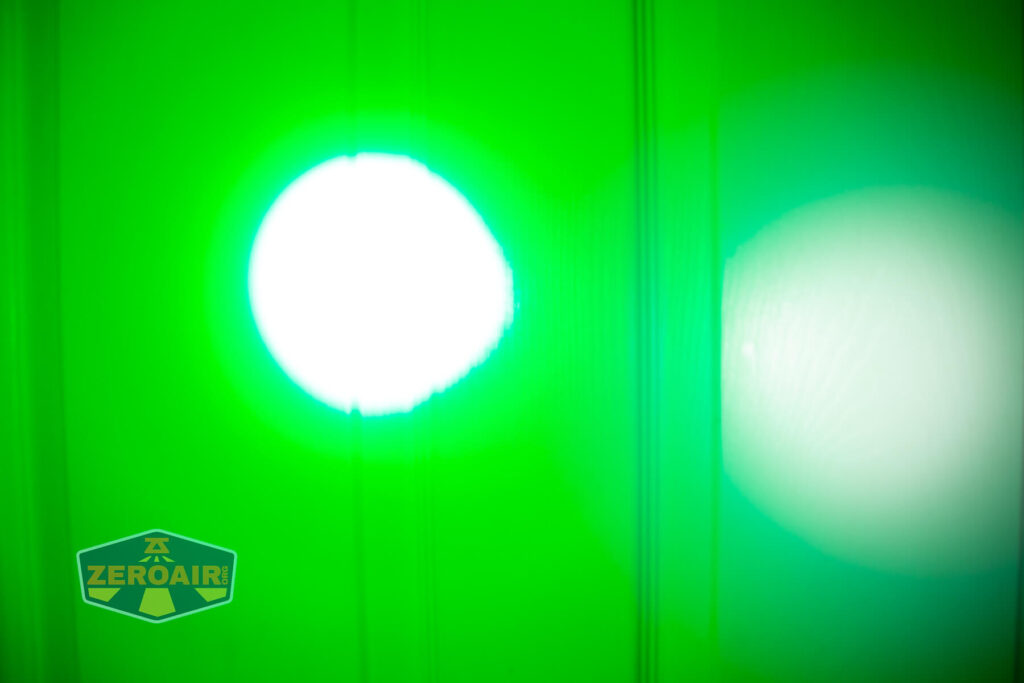
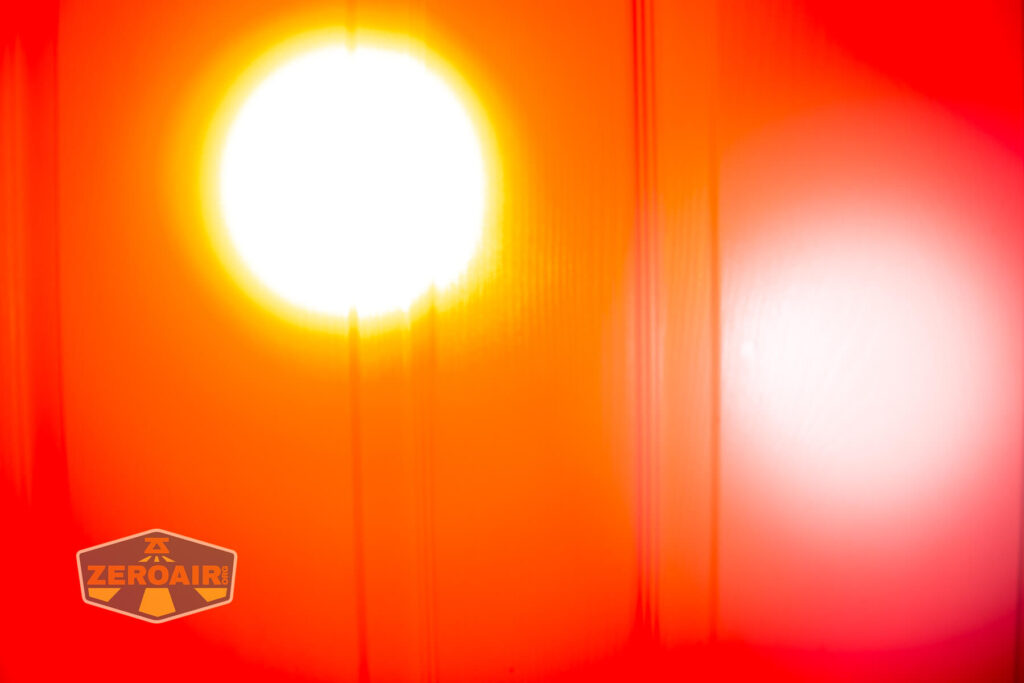
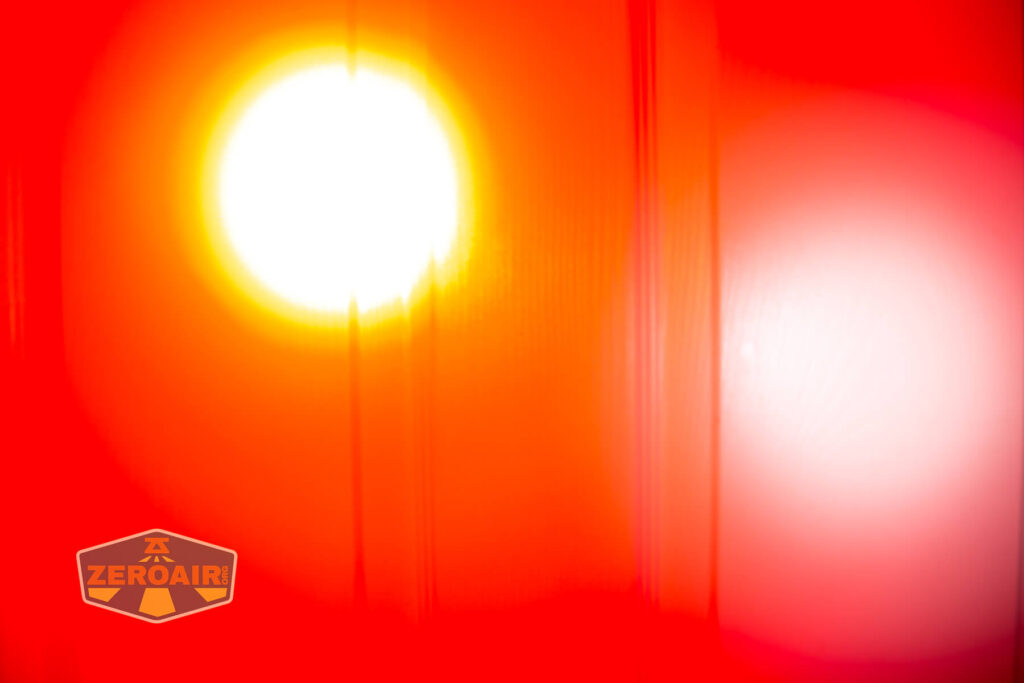
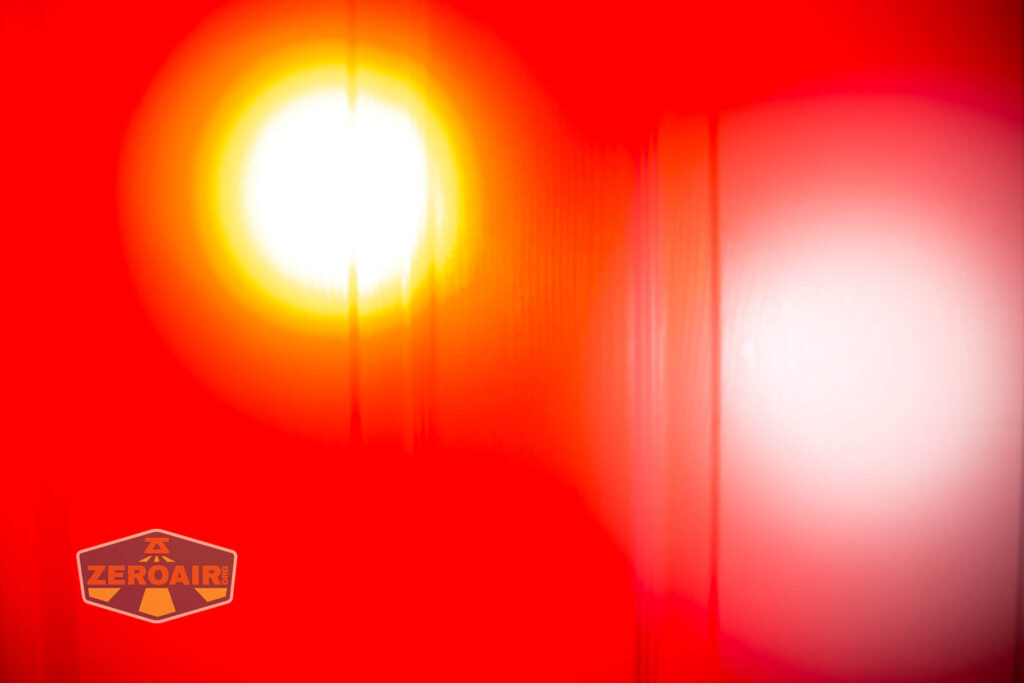

I compare everything to the KillzoneFlashlights.com 219b BLF-348 because it’s inexpensive and has the best tint!
Conclusion
What I like
- Great build quality
- Replaceable 32650 cell
- Single cell
- Good size
- Throw is great
- Flat output on most modes
- Rotary dial is a nice interface
- Seems price nicely at around $140
- I love having RGB
What I don’t like
- The 32650 cell is proprietary and customized
- Emitters are low CRI – high CRI flood would have been fantastic
- One lower (very low!) mode for each of RGB would be nice
Notes
- This content originally appeared at zeroair.org. Please visit there for the best experience!
- Please use my Amazon.com referral link to help support zeroair.org!
- Please support me on Patreon! I deeply appreciate your support!